


ISO 13506-1:2017
(Main)Protective clothing against heat and flame — Part 1: Test method for complete garments — Measurement of transferred energy using an instrumented manikin
Protective clothing against heat and flame — Part 1: Test method for complete garments — Measurement of transferred energy using an instrumented manikin
ISO 13506-1:2017 specifies the overall requirements, equipment and calculation methods to provide results that can be used for evaluating the performance of complete garments or protective clothing ensembles exposed to short duration flame engulfment. This test method establishes a rating system to characterize the thermal protection provided by single-layer and multi-layer garments made of flame resistant materials. Any material construction such as coated, quilted or sandwich can be used. The rating is based on the measurement of heat transfer to a full-size manikin exposed to convective and radiant energy in a laboratory simulation of a fire with controlled heat flux, duration and flame distribution. The heat transfer data are summed over a prescribed time to give the total transferred energy. For the purposes of this test method, the incident heat flux is limited to a nominal level of 84 kW/m2 and limited to exposure durations of 3 s to 12 s dependant on the risk assessment and expectations from the thermal insulating capability of the garment. The results obtained apply only to the particular garments or ensembles, as tested, and for the specified conditions of each test, particularly with respect to the heat flux, duration and flame distribution. This test method requires a visual evaluation, observation and inspection on the overall behaviour of the test specimen during and after the exposure as the garment or complete ensemble on the manikin is recorded before, during and after the flame exposure. Visuals of the garment or complete ensemble on the manikin are recorded (i.e. video and still images) before, during and after the flame exposure. This also applies to the evaluation of protection for the hands or the feet when they do not contain sensors. For the interfaces of ensembles tested, the test method is limited to visual inspection. The effects of body position and movement are not addressed in this test method. The heat flux measurements can also be used to calculate the predicted skin burn injury resulting from the exposure (see ISO 13506-2). This test method does not simulate high radiant exposures such as those found in arc flash exposures, some types of fire exposures where liquid or solid fuels are involved, nor exposure to nuclear explosions. NOTE 1 This test method provides information on material behaviour and a measurement of garment performance on a stationary upright manikin. The relative size of the garment and the manikin and the fit of the garment on the shape of the manikin have an important influence on the performance. NOTE 2 This test method is complex and requires a high degree of technical expertise in both the test setup and operation. NOTE 3 Even minor deviations from the instructions in this test method can lead to significantly different test results.
Vêtements de protection contre la chaleur et les flammes — Partie 1: Méthode d'essai pour vêtements complets — Mesurage de l'énergie transférée à l'aide d'un mannequin instrumenté
ISO 13506-1:2017 spécifie l'ensemble des exigences, le matériel et les méthodes de calcul donnant des résultats pouvant servir à l'évaluation de la performance de vêtements complets ou d'ensembles de vêtements de protection exposés pendant une courte durée à un embrasement. Cette méthode d'essai détermine un système de classement pour caractériser la protection thermique apportée par des vêtements monocouches et multicouches constitués de matériaux résistants à la flamme. Tout type d'assemblage de matériaux, tel que l'enduction, le matelassé ou le sandwich, peut être utilisé. Le classement s'appuie sur la mesure du transfert de chaleur à un mannequin grandeur nature exposé à une énergie par convection et par rayonnement dans une simulation de feu en laboratoire, avec un flux de chaleur, une durée et une distribution des flammes maîtrisés. Les données de transfert de chaleur sont totalisées sur une durée prescrite pour obtenir l'énergie totale transférée. Aux fins de la présente méthode d'essai, le flux de chaleur incident est limité à un niveau nominal de 84 kW/m2 et à des durées d'exposition de 3 s à 12 s en fonction de l'évaluation du risque et des attentes en matière de capacité d'isolation thermique du vêtement. Les résultats obtenus ne s'appliquent qu'aux vêtements ou ensembles de vêtements particuliers, tels que soumis à essai, et pour les conditions spécifiées de chaque essai, notamment en ce qui concerne le flux de chaleur, la durée et la distribution des flammes. Cette méthode d'essai nécessite une évaluation, une observation et une inspection visuelles du comportement global de l'éprouvette durant et après l'exposition, le vêtement ou l'ensemble de vêtements complet installé sur le mannequin étant examiné avant, pendant et après l'exposition à la flamme. Les visuels du vêtement ou de l'ensemble de vêtements complet installé sur le mannequin sont enregistrés (c'est-à-dire au moyen de vidéos et d'images fixes) avant, pendant et après l'exposition à la flamme. Cela s'applique également à l'évaluation de la protection des mains ou des pieds, lorsque ces parties ne contiennent pas de capteurs. En ce qui concerne les interfaces des ensembles soumis à essai, la méthode d'essai se limite à une inspection visuelle. Les effets associés à la position et aux mouvements du corps ne sont pas traités dans cette méthode d'essai. Les mesurages du flux de chaleur peuvent également être utilisés pour calculer les brûlures prévisibles résultant de l'exposition (voir ISO 13506‑2). Cette méthode d'essai ne simule pas d'expositions très intenses, telles que les expositions aux arcs électriques, certains types d'exposition à des feux impliquant des combustibles liquides ou solides, ni d'exposition à des explosions nucléaires. NOTE 1 La présente méthode d'essai fournit des informations sur le comportement des matériaux et un mesurage de la performance d'un vêtement placé sur un mannequin en position debout et fixe. La taille relative du vêtement et du mannequin ainsi que l'ajustement du vêtement aux formes du mannequin influent de façon importante sur la performance. NOTE 2 La présente méthode d'essai est complexe et nécessite un haut niveau d'expertise technique aussi bien pour le montage d'essai que pour la mise en ?uvre. NOTE 3 Tout écart, même mineur, par rapport aux instructions de la présente méthode d'essai peut conduire à des résultats d'essai nettement différents.
General Information
- Status
- Withdrawn
- Publication Date
- 13-Jul-2017
- Technical Committee
- ISO/TC 94/SC 13 - Protective clothing
- Drafting Committee
- ISO/TC 94/SC 13/WG 2 - Protective clothing against heat and flame
- Current Stage
- 9599 - Withdrawal of International Standard
- Start Date
- 12-Jun-2024
- Completion Date
- 12-Feb-2026
Relations
- Effective Date
- 12-Feb-2026
- Effective Date
- 19-May-2018
- Effective Date
- 11-Feb-2017



Get Certified
Connect with accredited certification bodies for this standard

NSF International
Global independent organization facilitating standards development and certification.

CIS Institut d.o.o.
Personal Protective Equipment (PPE) certification body. Notified Body NB-2890 for EU Regulation 2016/425 PPE.

Kiwa BDA Testing
Building and construction product certification.
Sponsored listings
Frequently Asked Questions
ISO 13506-1:2017 is a standard published by the International Organization for Standardization (ISO). Its full title is "Protective clothing against heat and flame — Part 1: Test method for complete garments — Measurement of transferred energy using an instrumented manikin". This standard covers: ISO 13506-1:2017 specifies the overall requirements, equipment and calculation methods to provide results that can be used for evaluating the performance of complete garments or protective clothing ensembles exposed to short duration flame engulfment. This test method establishes a rating system to characterize the thermal protection provided by single-layer and multi-layer garments made of flame resistant materials. Any material construction such as coated, quilted or sandwich can be used. The rating is based on the measurement of heat transfer to a full-size manikin exposed to convective and radiant energy in a laboratory simulation of a fire with controlled heat flux, duration and flame distribution. The heat transfer data are summed over a prescribed time to give the total transferred energy. For the purposes of this test method, the incident heat flux is limited to a nominal level of 84 kW/m2 and limited to exposure durations of 3 s to 12 s dependant on the risk assessment and expectations from the thermal insulating capability of the garment. The results obtained apply only to the particular garments or ensembles, as tested, and for the specified conditions of each test, particularly with respect to the heat flux, duration and flame distribution. This test method requires a visual evaluation, observation and inspection on the overall behaviour of the test specimen during and after the exposure as the garment or complete ensemble on the manikin is recorded before, during and after the flame exposure. Visuals of the garment or complete ensemble on the manikin are recorded (i.e. video and still images) before, during and after the flame exposure. This also applies to the evaluation of protection for the hands or the feet when they do not contain sensors. For the interfaces of ensembles tested, the test method is limited to visual inspection. The effects of body position and movement are not addressed in this test method. The heat flux measurements can also be used to calculate the predicted skin burn injury resulting from the exposure (see ISO 13506-2). This test method does not simulate high radiant exposures such as those found in arc flash exposures, some types of fire exposures where liquid or solid fuels are involved, nor exposure to nuclear explosions. NOTE 1 This test method provides information on material behaviour and a measurement of garment performance on a stationary upright manikin. The relative size of the garment and the manikin and the fit of the garment on the shape of the manikin have an important influence on the performance. NOTE 2 This test method is complex and requires a high degree of technical expertise in both the test setup and operation. NOTE 3 Even minor deviations from the instructions in this test method can lead to significantly different test results.
ISO 13506-1:2017 specifies the overall requirements, equipment and calculation methods to provide results that can be used for evaluating the performance of complete garments or protective clothing ensembles exposed to short duration flame engulfment. This test method establishes a rating system to characterize the thermal protection provided by single-layer and multi-layer garments made of flame resistant materials. Any material construction such as coated, quilted or sandwich can be used. The rating is based on the measurement of heat transfer to a full-size manikin exposed to convective and radiant energy in a laboratory simulation of a fire with controlled heat flux, duration and flame distribution. The heat transfer data are summed over a prescribed time to give the total transferred energy. For the purposes of this test method, the incident heat flux is limited to a nominal level of 84 kW/m2 and limited to exposure durations of 3 s to 12 s dependant on the risk assessment and expectations from the thermal insulating capability of the garment. The results obtained apply only to the particular garments or ensembles, as tested, and for the specified conditions of each test, particularly with respect to the heat flux, duration and flame distribution. This test method requires a visual evaluation, observation and inspection on the overall behaviour of the test specimen during and after the exposure as the garment or complete ensemble on the manikin is recorded before, during and after the flame exposure. Visuals of the garment or complete ensemble on the manikin are recorded (i.e. video and still images) before, during and after the flame exposure. This also applies to the evaluation of protection for the hands or the feet when they do not contain sensors. For the interfaces of ensembles tested, the test method is limited to visual inspection. The effects of body position and movement are not addressed in this test method. The heat flux measurements can also be used to calculate the predicted skin burn injury resulting from the exposure (see ISO 13506-2). This test method does not simulate high radiant exposures such as those found in arc flash exposures, some types of fire exposures where liquid or solid fuels are involved, nor exposure to nuclear explosions. NOTE 1 This test method provides information on material behaviour and a measurement of garment performance on a stationary upright manikin. The relative size of the garment and the manikin and the fit of the garment on the shape of the manikin have an important influence on the performance. NOTE 2 This test method is complex and requires a high degree of technical expertise in both the test setup and operation. NOTE 3 Even minor deviations from the instructions in this test method can lead to significantly different test results.
ISO 13506-1:2017 is classified under the following ICS (International Classification for Standards) categories: 13.340.10 - Protective clothing. The ICS classification helps identify the subject area and facilitates finding related standards.
ISO 13506-1:2017 has the following relationships with other standards: It is inter standard links to EN ISO 13506-1:2017, ISO 13506-1:2024, ISO 13506:2008. Understanding these relationships helps ensure you are using the most current and applicable version of the standard.
ISO 13506-1:2017 is available in PDF format for immediate download after purchase. The document can be added to your cart and obtained through the secure checkout process. Digital delivery ensures instant access to the complete standard document.
Standards Content (Sample)
INTERNATIONAL ISO
STANDARD 13506-1
First edition
2017-07
Protective clothing against heat and
flame —
Part 1:
Test method for complete garments —
Measurement of transferred energy
using an instrumented manikin
Vêtements de protection contre la chaleur et les flammes —
Partie 1: Méthode d’essai pour vêtements complets — Mesurage de
l’énergie transférée à l’aide d’un mannequin instrumenté
Reference number
©
ISO 2017
© ISO 2017, Published in Switzerland
All rights reserved. Unless otherwise specified, no part of this publication may be reproduced or utilized otherwise in any form
or by any means, electronic or mechanical, including photocopying, or posting on the internet or an intranet, without prior
written permission. Permission can be requested from either ISO at the address below or ISO’s member body in the country of
the requester.
ISO copyright office
Ch. de Blandonnet 8 • CP 401
CH-1214 Vernier, Geneva, Switzerland
Tel. +41 22 749 01 11
Fax +41 22 749 09 47
copyright@iso.org
www.iso.org
ii © ISO 2017 – All rights reserved
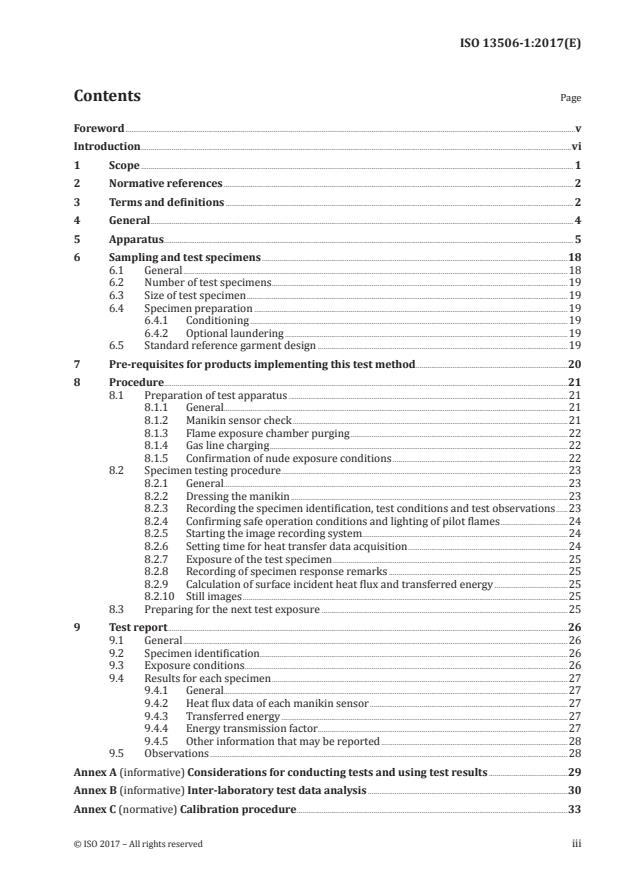
Contents Page
Foreword .v
Introduction .vi
1 Scope . 1
2 Normative references . 2
3 Terms and definitions . 2
4 General . 4
5 Apparatus . 5
6 Sampling and test specimens .18
6.1 General .18
6.2 Number of test specimens .19
6.3 Size of test specimen .19
6.4 Specimen preparation .19
6.4.1 Conditioning .19
6.4.2 Optional laundering .19
6.5 Standard reference garment design .19
7 Pre-requisites for products implementing this test method .20
8 Procedure.21
8.1 Preparation of test apparatus .21
8.1.1 General.21
8.1.2 Manikin sensor check .21
8.1.3 Flame exposure chamber purging .22
8.1.4 Gas line charging .22
8.1.5 Confirmation of nude exposure conditions .22
8.2 Specimen testing procedure .23
8.2.1 General.23
8.2.2 Dressing the manikin .23
8.2.3 Recording the specimen identification, test conditions and test observations .23
8.2.4 Confirming safe operation conditions and lighting of pilot flames .24
8.2.5 Starting the image recording system.24
8.2.6 Setting time for heat transfer data acquisition .24
8.2.7 Exposure of the test specimen .25
8.2.8 Recording of specimen response remarks .25
8.2.9 Calculation of surface incident heat flux and transferred energy .25
8.2.10 Still images .25
8.3 Preparing for the next test exposure .25
9 Test report .26
9.1 General .26
9.2 Specimen identification .26
9.3 Exposure conditions .26
9.4 Results for each specimen .27
9.4.1 General.27
9.4.2 Heat flux data of each manikin sensor .27
9.4.3 Transferred energy .27
9.4.4 Energy transmission factor .27
9.4.5 Other information that may be reported .28
9.5 Observations .28
Annex A (informative) Considerations for conducting tests and using test results .29
Annex B (informative) Inter-laboratory test data analysis .30
Annex C (normative) Calibration procedure .33
Annex D (informative) Calculation of transferred energy and energy transmission factor .42
Annex E (informative) Elements of a computer software program .45
Bibliography .47
iv © ISO 2017 – All rights reserved
Foreword
ISO (the International Organization for Standardization) is a worldwide federation of national standards
bodies (ISO member bodies). The work of preparing International Standards is normally carried out
through ISO technical committees. Each member body interested in a subject for which a technical
committee has been established has the right to be represented on that committee. International
organizations, governmental and non-governmental, in liaison with ISO, also take part in the work.
ISO collaborates closely with the International Electrotechnical Commission (IEC) on all matters of
electrotechnical standardization.
The procedures used to develop this document and those intended for its further maintenance are
described in the ISO/IEC Directives, Part 1. In particular the different approval criteria needed for the
different types of ISO documents should be noted. This document was drafted in accordance with the
editorial rules of the ISO/IEC Directives, Part 2 (see www .iso .org/ directives).
Attention is drawn to the possibility that some of the elements of this document may be the subject of
patent rights. ISO shall not be held responsible for identifying any or all such patent rights. Details of
any patent rights identified during the development of the document will be in the Introduction and/or
on the ISO list of patent declarations received (see www .iso .org/ patents).
Any trade name used in this document is information given for the convenience of users and does not
constitute an endorsement.
For an explanation on the voluntary nature of standards, the meaning of ISO specific terms and
expressions related to conformity assessment, as well as information about ISO’s adherence to the
World Trade Organization (WTO) principles in the Technical Barriers to Trade (TBT) see the following
URL: w w w . i s o .org/ iso/ foreword .html
This document was prepared by Technical Committee ISO/TC 94, Personal safety — Protective clothing
and equipment, Subcommittee SC 13, Protective clothing.
This first edition of ISO 13506-1, together with ISO 13506-2, cancels and replaces the first edition of
ISO 13506:2008, which has been technically revised. The assessment of skin burn injury has been
transferred to ISO 13506-2.
A list of all parts in the ISO 13506 series can be found on the ISO website.
Introduction
The purpose of heat and flame-resistant protective clothing is to shield the wearer from hazards that
can cause skin burn injury. The clothing can be made from one or more materials. The evaluation of
materials for potential use in this type of clothing generally involves two steps. First, the materials
are tested to gauge their ability to limit flame spread. They are then tested to determine the rate of
transferred energy through them when exposed to a particular hazard. A variety of test methods are
used in these two steps. The test method selected depends on the nature of the potential hazards and
the intended end use of the materials. Once suitable materials have been identified, they can be made
into complete garments or ensembles for testing on a manikin-fire exposure system.
Laboratory bench scale transferred energy tests are used to select suitable materials for a protective
clothing ensemble. While these tests can allow ranking of garment or ensemble materials and
components, the tests do not allow a complete assessment of a garment or ensemble made of the
materials.
Bench scale transferred energy test methods use small amounts of material, up to 150 mm × 150 mm in
area, and hold the material initially flat, either in a vertical or horizontal plane. Multiple layers are used
where appropriate (e.g. fire-fighting ensembles). In this case, the layer normally worn on the exterior
is exposed directly to the energy source, while the layer normally worn on the inside is away from the
energy source. With the planar orientation and alignment of materials, shrinkage has little effect on the
outcome of the test, unless the shrinkage is so severe as to cause holes to form in the material during
the exposure to the energy source. Sagging, however, does directly affect the results, as an air gap can
form or grow in size, adding an insulating effect. With the aforementioned test methods, it is possible to
test seams, zippers, pockets, buttons or other closures, metal and plastic clips or other features that can
be included in a complete garment such as heraldry, company logos, etc. However, it is often considered
easier to evaluate these aspects together with the overall design features of a garment or ensemble
that can affect the performance by testing complete garments or ensembles on a manikin. It is for this
purpose that this document was established.
In the test method in this document, a stationary, upright adult-sized manikin is dressed in a complete
garment and exposed to a laboratory simulation of a fire with controlled heat flux, duration and flame
distribution. The average incident heat flux to the exterior of the garment is 84 kW/m , a value similar
to those used in ISO 9151, ISO 6942 and ISO 17492. Heat flux sensors fitted to the surface of the manikin
are used to measure the heat flux variation with time and location on the manikin and to determine the
total energy absorbed over the data-gathering period. The data gathering period is selected to ensure
that the total energy transferred has been completed. The information obtained can be used to assist in
evaluating the performance of the garment or protective clothing ensembles under the test conditions.
It can also be used to estimate the extent and nature of skin damage that a person would suffer if
wearing the test garment under similar exposure conditions (see ISO 13506-2).
The manikin is used in a standing position in initially quiescent air. Controlled air motion for simulating
wind effects or body movement is not presently possible. It is possible to move the manikin through a
stationary flame but motion of this nature is not within the scope of this document. Variations in the fit
of the test garment that can occur when sitting or bending are not evaluated.
The fire simulations are dynamic. As such, the exposure is more representative of an actual industrial
accident fire than the exposures used in bench scale tests (see Annex B). The heat flux resulting from
the exposure is neither constant nor uniform over the surface of the manikin/garment. Under these
conditions, the results are expected to have more variability than carefully controlled bench scale
tests. In addition, the garment is not constrained to be a flat surface but is allowed to have a natural
drape on the manikin. The effect these variables have on a garment can be seen in several ways:
ignition and burning of the garment and heraldry, sagging or shrinkage in all directions after flaming,
hole generation, smoke generation and structural failure of seams. Many of these failures rarely appear
in the bench scale testing of the materials because they are a result of garment design variables,
interaction between material properties and design variables, construction techniques and localized
exposure conditions that are more severe.
vi © ISO 2017 – All rights reserved
Fit of the garment on the manikin is important. Thus variations in garment design and how the manikin
is dressed by the operator can influence the test results. A test garment or specimen size is selected
by the laboratory from the size range provided by the manufacturer to fit the laboratory’s manikin.
Experience suggests that testing a garment one size larger than the standard will reduce the total
energy transferred and percentage body burn by about 5 %.
This document is not designed to measure material properties directly, but to evaluate the interaction
of material behaviour and garment design. One can compare relative material behaviour by making
a series of test garments out of different materials using a common pattern. The performance of the
complete garments will not necessarily be ranked in the same order as might be obtained when the
materials are tested using ISO 9151. Correlations between small scale tests and results from single-
[15]
layer garments have been examined .
Most manikins do not have sensors on the hands and feet, but it is possible to assess some aspects of
hand protection depending upon the specific design of the hands. The head, however, does contain heat
flux sensors. The reason for this is that many outer garments include an integral hood, but not gloves or
footwear. Tests for gloves and footwear are covered by other ISO documents for specific end uses.
The protection offered by the test specimens is evaluated through quantitative measurements and
observations. Heat flux sensors fitted to the manikin are used to measure the energy transferred to
the manikin surface during the data-gathering period. This information can be reported directly (this
document) or used to calculate the nature, location and extent of the damage that would occur to human
skin from the exposure (see ISO 13506-2).
References [16] and [17] give details of manikin and sensor construction, data acquisition, computer
software requirements, flame exposure chamber and fuel and delivery system. They also suggest
numerical techniques that can be used to carry out the calculations required.
The ISO/TC 94, SC 13 and SC 14 committees and European Committee for Standardization (CEN
TC 162) specify the method described in this document as an optional part in the fire fighter standards
[11]
ISO 11999-3 and EN 469 , and as an optional part in the industrial heat and flame protective clothing
standard ISO 11612. The National Fire Protection Association (NFPA) specifies a test method similar to
[13]
the one described in this document as part of a certification process for garments (see NFPA 2112 ).
INTERNATIONAL STANDARD ISO 13506-1:2017(E)
Protective clothing against heat and flame —
Part 1:
Test method for complete garments — Measurement of
transferred energy using an instrumented manikin
1 Scope
This document specifies the overall requirements, equipment and calculation methods to provide
results that can be used for evaluating the performance of complete garments or protective clothing
ensembles exposed to short duration flame engulfment.
This test method establishes a rating system to characterize the thermal protection provided by single-
layer and multi-layer garments made of flame resistant materials. Any material construction such
as coated, quilted or sandwich can be used. The rating is based on the measurement of heat transfer
to a full-size manikin exposed to convective and radiant energy in a laboratory simulation of a fire
with controlled heat flux, duration and flame distribution. The heat transfer data are summed over a
prescribed time to give the total transferred energy.
For the purposes of this test method, the incident heat flux is limited to a nominal level of 84 kW/m
and limited to exposure durations of 3 s to 12 s dependant on the risk assessment and expectations
from the thermal insulating capability of the garment. The results obtained apply only to the particular
garments or ensembles, as tested, and for the specified conditions of each test, particularly with respect
to the heat flux, duration and flame distribution.
This test method requires a visual evaluation, observation and inspection on the overall behaviour of
the test specimen during and after the exposure as the garment or complete ensemble on the manikin
is recorded before, during and after the flame exposure. Visuals of the garment or complete ensemble
on the manikin are recorded (i.e. video and still images) before, during and after the flame exposure.
This also applies to the evaluation of protection for the hands or the feet when they do not contain
sensors. For the interfaces of ensembles tested, the test method is limited to visual inspection. The
effects of body position and movement are not addressed in this test method.
The heat flux measurements can also be used to calculate the predicted skin burn injury resulting from
the exposure (see ISO 13506-2).
This test method does not simulate high radiant exposures such as those found in arc flash exposures,
some types of fire exposures where liquid or solid fuels are involved, nor exposure to nuclear explosions.
NOTE 1 This test method provides information on material behaviour and a measurement of garment
performance on a stationary upright manikin. The relative size of the garment and the manikin and the fit of the
garment on the shape of the manikin have an important influence on the performance.
NOTE 2 This test method is complex and requires a high degree of technical expertise in both the test setup
and operation.
NOTE 3 Even minor deviations from the instructions in this test method can lead to significantly different test
results.
2 Normative references
The following documents are referred to in the text in such a way that some or all of their content
constitutes requirements of this document. For dated references, only the edition cited applies. For
undated references, the latest edition of the referenced document (including any amendments) applies.
ISO 6942, Protective clothing — Protection against heat and fire — Method of test: Evaluation of materials
and material assemblies when exposed to a source of radiant heat
ISO 9162, Petroleum products — Fuels (class F) — Liquefied petroleum gases — Specifications
ISO/TR 11610, Protective clothing — Vocabulary
ISO/IEC 17025, General requirements for the competence of testing and calibration laboratories
3 Terms and definitions
For the purposes of this document, the terms and definitions given in ISO/TR 11610 and the
following apply.
ISO and IEC maintain terminological databases for use in standardization at the following addresses:
— ISO Online browsing platform: available at http:// www .iso .org/ obp
— IEC Electropedia: available at http:// www .electropedia .org/
3.1
absorbed energy
energy (3.5) absorbed by each manikin sensors (3.14) mounted in the surface of the manikin when
exposed to the incident energy (3.12)
Note 1 to entry: This does not account for radiant or convective losses unique for each style of sensor.
3.2
associated area
area of body region divided by the number of sensors in that body region
Note 1 to entry: See Table 2.
3.3
complete garments
single garment or combination of garments designed to protect the torso, arms and legs of the wearer
Note 1 to entry: Both a single garment and a combination of garments can include protection for the head
of the wearer by means of a hood (integral or separate) or balaclava. A combination of garments can include
undergarments and outer garments.
3.4
conditioning
keeping samples under standard conditions of temperature and relative humidity for a minimum
period of time
3.5
energy
heat flux (3.10) multiplied by the time period of measurement and by associated area (3.2)
3.6
energy transmission factor
ratio of the transferred energy (3.18) to the incident energy (3.12), for the energy calculation period
2 © ISO 2017 – All rights reserved
3.7
fire
rapid oxidation process which is a chemical reaction of fuel and oxygen resulting in the evolution of
light, heat and combustion products in varying intensities
Note 1 to entry: The fuel can be a solid, dust, a gas or vapours of an ignitable liquid. The fire will last as long as
there is a combustible fuel-air mixture.
3.8
flame distribution
spatial distribution of incident flames from the test facility burners which provides a controlled heat
flux (3.10) over the manikin surface
3.9
garment ease
difference between body (manikin) dimensions and garment dimensions
3.10
heat flux
thermal intensity indicated by the amount of energy transmitted divided by time and by area to the
surface
Note 1 to entry: Heat flux is expressed in kW/m .
3.10.1
absorbed heat flux
heat flux (3.10) absorbed by the manikin sensors (3.14) mounted in the surface of the manikin when
exposed to the incident heat flux (3.10.2)
3.10.2
incident heat flux
heat flux (3.10) to which a test item or nude manikin is exposed
Note 1 to entry: The incident heat flux is determined from the characteristics of the manikin sensors (3.14) and
their measured output during a nude manikin exposure.
3.11
heat flux sensor
device capable of directly measuring the heat flux (3.10) to the manikin’s surface under test conditions,
or of providing data that can be used to calculate the heat flux
Note 1 to entry: In either case, the created data needs to be in a form that can be processed by a computer
program to assess the total energy transferred over the recording period and/or the predicted skin burn injury.
3.12
incident energy
energy (3.5) to which a test item or nude manikin is exposed
3.12.1
total incident energy
sum of the incident energy (3.12) of all the manikin sensors (3.14) during the nude exposure
3.13
instrumented manikin
model representing an adult-sized human which is fitted with manikin sensors (3.14) in the surface
3.14
manikin sensor
heat flux sensor (3.11) fulfilling the requirements of this document
Note 1 to entry: See 3.11 and 5.3.
3.15
maximum heat flux
highest value of absorbed heat flux (3.10.1) calculated from the recorded output of a manikin sensor
(3.14) during a test
3.16
protective clothing ensemble
combination of complete protective garments
Note 1 to entry: This document does not include energy transferred to the hands and feet. Gloves and footwear
can be included in the ensemble for visual inspection. This will allow a more realistic representation of interfaces
and make possible a visual inspection of gloves and footwear during and after the test.
3.17
thermal protection
overall protective performance of a garment or protective clothing ensemble (3.16) relative to how it
limits the transfer of energy to the manikin surface over the defined calculation period
Note 1 to entry: In fire testing of clothing, thermal protection of a garment or ensemble can be quantified by the
measured manikin sensor (3.14) response which indicates how well the garment or protective clothing ensemble
limits heat transfer to the manikin surface. In addition to the measured sensor response, the physical response
and degradation of the garment or ensemble are observable phenomena which are associated with the manikin
sensor calculation and are useful in understanding garment or protective clothing ensemble thermal protection.
3.18
transferred energy
energy (3.5) transferred through the test item and absorbed by a manikin sensor (3.14) over the defined
calculation period
3.18.1
total transferred energy
sum of the transferred energy (3.18) of all manikin sensors (3.14) over the transferred energy calculation
period (3.18.2)
Note 1 to entry: Each manikin sensor has an associated area (3.2). It is assumed that the measured energy
transferred for each manikin sensor is uniform over this associated area. Some manikins have a sensor layout
that has the same area associated with each manikin sensor, others do not.
3.18.2
transferred energy calculation period
measurement time when transferred energy (3.18) is gathered
Note 1 to entry: See 8.2.6.
4 General
The method evaluates the thermal protective performance of the test specimen, which is either a
garment or an ensemble. The protective performance is a function of both the materials of construction
and design. The average incident heat flux is 84 kW/m with an exposure duration of 3 s to 12 s.
The product standard shall indicate the minimum exposure time and the minimum number of samples
to be tested.
The conditioned test specimen is placed on a stationary upright adult-size manikin and exposed to
a laboratory simulation of a fire with controlled heat flux, duration and flame distribution. The test
procedure, data acquisition, result calculations and preparation of the test report are performed with
computer hardware and software programs.
4 © ISO 2017 – All rights reserved
Energy transferred through the test specimen during and after the exposure is measured by manikin
sensors. These measurements shall be used to calculate the total energy transferred to the surface of
the manikin and the energy transmission factor.
NOTE 1 The purpose of this test method is to measure the heat flux and calculate transferred energy. The
results can also be used to calculate the degree of predicted skin burn injury and total predicted skin burn injury
areas resulting from the exposure as described in ISO 13506-2.
Identification of the test garment, test conditions, comments and response of the test specimen to
the exposure are recorded and are included as part of the test report. The performance of the test
specimen is indicated by the calculated total transferred energy through the test specimen over the
data acquisition period, the total energy transmission factor and the way the test specimen responds to
the test exposure.
NOTE 2 This test method can be used for other purposes such as for research on fabrics and garment designs,
comparison of garment ensembles, or evaluation of any garment or ensemble to particular applications or end
use standards or specifications.
5 Apparatus
5.1 Instrumented manikin
An upright manikin, which is the shape and size of an adult human, shall be used [see Figure 2 a) and
b)]. The manikin shall be constructed to simulate the body of a human and shall consist of a head, a
chest/back, an abdomen/buttocks, arms, hands, legs and feet. The arms should be able to rotate
through a sufficient arc at the shoulder to ease the garment donning and doffing on the manikin.
NOTE 1 Figure 2 illustrates a male shape and the dimensions of Table 1 are for a male manikin. A standard
female form has not yet been determined.
The manikin shall be constructed of flame-resistant, thermally stable, non-metallic materials such as
ceramics or glass-reinforced vinyl ester resin that will not contribute to the combustion process. The
shell thickness shall be in the range of 3 mm to 6 mm other than in localized areas (e.g. joints).
NOTE 2 The manikin thickness is dependent on structural requirements needed to maintain a stable physical
form related to the thermal properties of the manikin material and it has been historically observed to affect
the operability of the manikin rather than the reproducibility of results. For example, the variance of thickness
of a manikin has been found to affect its durability due to differential thermal stresses that increase the risks of
cracking. In addition, the greater the thickness of the manikin, the longer it takes to cool. The manikin utilizes a
hollow structure to allow for the electrical wiring of the sensors.
The manikin shall not be made of a material, which may be affected by humidity or any cleaning liquid
(e.g. water, acetone, etc.), which may be used for the cleaning of the manikin sensors.
5.2 Posture of the manikin
A reproducible positioning system is required for the manikin. It may consist of pin locators in the floor,
a portable rigid positioning frame and/or light or laser beams for setting vertical orientation and arm
position.
The elbow angle between the upper and lower arm (see Figure 1) shall be set in the range of 150° to
165°. The angle of the shoulder (see Figure 1) shall be set in the range of 25° to 35° from the centreline
of the manikin. These angles apply to all manikin exposures (nude and with test items). Reference lines
and angles are identified in Figure 1.
NOTE 1 Tape can be used to increase the friction of the joints of the arm to ensure that the position is
1)
maintained during the exposure .
1) Gore® Joint Sealant is an example of a suitable product available commercially. This information is given for the
convenience of users of this document and does not constitute an endorsement by ISO of this product. Equivalent
products may be used if they can be shown to lead to the same results.
NOTE 2 Most manikins have legs that cannot move. Some manikins have a slight twist of the torso as compared
to the legs. The legs are less than 10° apart from the centre line and at the ankles, they are about 120 mm to
250 mm apart.
Key
1 angle between upper arm and lower arm
2 angle between line shoulder and hip to shoulder and elbow
Figure 1 — Definition of arm position
6 © ISO 2017 – All rights reserved
a) Instrumented manikin and torch stands (burner system)
Figure 2 (continued)
b) Measurements for adult manikin
Key
a
Knee level.
b
Elbow level.
NOTE 1 Only six burners of the total are shown in Figure 2 a) (see 5.7.2)
NOTE 2 The instrumented manikin matches the dimensions given in Table 1 and the key to the numbers
referenced in Figure 2 b) correspond to the measurements in Table 1.
Figure 2 — Representation of an instrumented manikin
8 © ISO 2017 – All rights reserved
Table 1 — Measurements for an adult manikin
Measurement Tolerance
No Description
mm mm
1 Stature/total height 1 810 ±60
2 Crotch height, from heel 880 ±75
3 Trunk (from back of neck to crotch back to front neck) 1 560 ±60
4 Head height, including neck 255 ±45
5 Waist height, from heel 1 125 ±50
6 Collarbone to back waist 480 ±70
7 Crotch to knee 330 ±45
8 Knee height, standing 530 ±70
9 Top of shoulder to wrist along arm 585 ±75
10 Arm inseam 470 ±40
11 Sleeve length, 3-point measurement from collarbone to wrist 785 ±65
12 Shoulder length (from base of back of neck to arm hole-union) 170 ±75
13 Neck circumference 420 ±60
14 Across shoulder (from one shoulder across back to other shoulder) 500 ±90
15 Across chest, (100 mm down) 475 ±95
16 Chest circumference, at the armpits 995 ±105
17 Waist circumference 870 ±25
18 Hip circumference, maximum 1 015 ±15
19 Thigh circumference just below buttock 590 ±40
20 Knee circumference 390 ±50
21 Calf circumference 400 ±30
22 Ankle circumference 280 ±30
23 Wrist circumference 205 ±30
24 Elbow circumference 290 ±25
25 Upper arm circumference, at the midpoint 320 ±35
26 Shoulder circumference 410 ±50
NOTE Manikins meeting these requirements is available from either of:
— Composites USA, 1 Peninsula Drive, Northeast, Maryland, USA. Ph. +1 302 834 7712,
— Precision Products LLC, 7400 Whitepine Road, Richmond, Virginia, USA, Ph. +1 804 561 0777,
— Measurement Technology Northwest,/Thermetrics, LLC, 4220 - 24th Avenue West, Seattle, WA 98199, USA,
— MYAC Consulting Inc., 23046 Township Road 514, Sherwood Park, AB, T8B 1K9, Canada.
This information is given for the convenience of users of this document and does not constitute an endorse-
ment by ISO. Equivalent products may be used if they can be shown to lead to the same results.
5.3 Manikin sensors
5.3.1 Principle
The measurement system shall use manikin sensors which produce an output, which can be used to
calculate the incident heat flux, or absorbed heat flux, at its surface under the test conditions. The
incident heat flux measurement is used to set the exposure conditions for testing (nude exposure); the
absorbed heat flux is used in the calculation of the energy transferred through the test specimen.
Each manikin sensor has an associated area. Some manikins have a sensor layout that has the same
area associated with each manikin sensor; others do not. If a manikin system has unequal sensor areas,
the results calculated from the manikin sensor data shall be permitted to be area weighted.
The area associated with any manikin sensor shall be determined by locating points to the surrounding
sensors. These points are joined by straight lines on the curved surface of the manikin. The area so
formed around a particular manikin sensor is its associated surface area (see Figure 3). The design
layout of the manikin sensors can be such that each associated surface area has approximately the
same value. The test results report both the individual sensor results and the calculated average of the
body parts of the manikin. The number of sensors per area needs to be sufficient to be able to describe
the garment performance.
Figure 3 — Example of manikin sensor location and their associated area
The incident heat flux is not equivalent to the absorbed heat flux during a nude exposure. The incident
heat flux is calculated from the calculated absorbed heat flux at each manikin sensor taking into
account the ability of the manikin sensor surface to absorb thermal energy from the flames and how
much is exchanged with to the walls of the room (see also 5.5.1).
NOTE All the convective energy present at the surface of the sensor is absorbed by the sensor. Only radiant
energy is lost from the sensor surface during the nude exposure. The calculation from the incident energy to the
absorbed is not currently defined and is often assumed that they are equivalent.
5.3.2 Number of manikin sensors
The system shall use a minimum of 110 manikin sensors distributed as uniformly as practical over the
surface of the manikin (which excludes hands and feet). Table 2 describes an acceptable manikin sensor
distribution.
The manikin used in this test method is composed of a complex, three-dimensional surface topography.
Minor trade-offs are required in order to locate sensors over its surface that approaches a distribution
that is as uniform as practical given the geometry of the manikin form.
10 © ISO 2017 – All rights reserved
Table 2 — Sensor distribution
Percentage area of body
Percentage of total
Minimum 2
(area in m based on an
sensored area without
number of
assumed body surface
Body region Body area
sensors in hands or feet
manikin sen- 2
area of 2 m ); see Note 2
sors
%
%
Head Head 8 7 7,8 (0,156)
Chest 10
Chest and abdomen
Abdomen 11 40 35,5 (0,71)
Upper back 11 (Trunk) (Trunk)
Back
Lower back 11
Right arm
Arms 18 16 13,9 (0,278)
Left arm
Right leg
Thighs and lower
41 37 30,5 (0,6)
legs (Shanks)
Left leg
If sensor used
Hands 0 — 5,4 (0,108)
include in arms
If sensor used
Feet 0 — 6,9 (0,138)
include in legs
Total 110 100 100 (2)
NOTE 1 The number of manikin sensors presently used in manikins range from 110 to 126. Depending on the
number of manikin sensors and their location, column 3 (110 sensors used) or column 4 (more than 110 sensors
used) is used. Extra sensors can be added to the hands and feet if desired. Adding manikin sensors to the hands
and feet will require the percentages in Table 2, column 5.
NOTE 2 Several sources [e.g. US. EPA. Exposure Factors Handbook (1997 Final Report). US. Environmental
Protection Agency, Washington, DC, EPA/600/P-95/002F a-c, 1997 (partially being updated)] assume a total
surface area of approximately 2 m for a male of approximately 1,85 m in height and with average weight.
Subtracting the area not covered by sensors (hands and feet) results in a surface area of approximately 1,8 m .
5.3.3 Manikin sensor-measuring capability
Each manikin sensor shall have the capability to determine an incident heat flux over the range from
2 2 2
0 kW/m to 130 kW/m . The manikin sensor shall tolerate heat fluxes up to 200 kW/m and withstand
rapid heat flux changes (e.g. 4 s nude exposure) without being destroyed. This range permits the use of
the manikin sensors to set the testing exposure level by exposing the nude manikin directly to flame
and also to measure the heat transferred to the exposed manikin surface with a test specimen.
2 2
NOTE Sensor functioning in the range of 0 kW/m to 130 kW/m and resisting destruction at heat fluxes
up to 200 kW/m depends on manufacturer’s specification and stated calibration curves and other response
correction factors. Calibration with a traceable reference sensor and a radiant heat source are only good to about
40 kW/m as accepted traceable references are not available above this level.
5.3.4 Manikin sensor construction
The manikin sensors shall be constructed of a material with known thermal characteristics that can
directly indicate the heat flux or be calculated from sensor temperature responses to indicate heat
flux and its variation with time as received by the sensor. The outer surface of the sensor shall have
an absorptivity greater than or equal to 0,9 or shall be covered with a thin layer of flat black high-
2)
temperature paint with an absorptivity greater than or equal to 0,9 . The manikin sensor, data
acquisition system combination, when calibrated with a NIST (National Institute of Standards and
Technology) or equivalently certified reference sensor, shall respond within 0,2 s of the start of the
2 2
exposure and reac
...
NORME ISO
INTERNATIONALE 13506-1
Première édition
2017-07
Vêtements de protection contre la
chaleur et les flammes —
Partie 1:
Méthode d’essai pour vêtements
complets — Mesurage de l’énergie
transférée à l’aide d’un mannequin
instrumenté
Protective clothing against heat and flame —
Part 1: Test method for complete garments — Measurement of
transferred energy using an instrumented manikin
Numéro de référence
©
ISO 2017
DOCUMENT PROTÉGÉ PAR COPYRIGHT
© ISO 2017, Publié en Suisse
Droits de reproduction réservés. Sauf indication contraire, aucune partie de cette publication ne peut être reproduite ni utilisée
sous quelque forme que ce soit et par aucun procédé, électronique ou mécanique, y compris la photocopie, l’affichage sur
l’internet ou sur un Intranet, sans autorisation écrite préalable. Les demandes d’autorisation peuvent être adressées à l’ISO à
l’adresse ci-après ou au comité membre de l’ISO dans le pays du demandeur.
ISO copyright office
Ch. de Blandonnet 8 • CP 401
CH-1214 Vernier, Geneva, Switzerland
Tel. +41 22 749 01 11
Fax +41 22 749 09 47
copyright@iso.org
www.iso.org
ii © ISO 2017 – Tous droits réservés
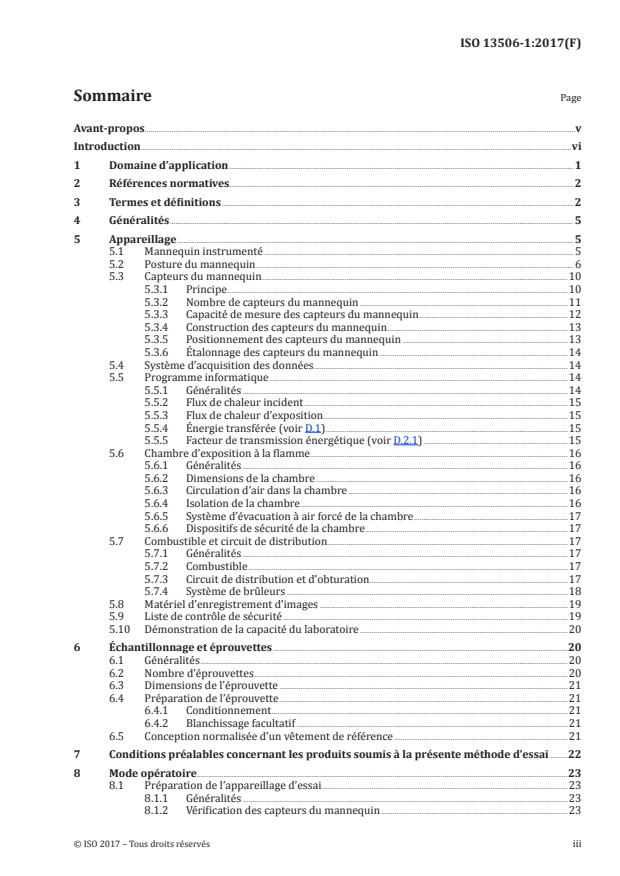
Sommaire Page
Avant-propos .v
Introduction .vi
1 Domaine d’application . 1
2 Références normatives . 2
3 Termes et définitions . 2
4 Généralités . 5
5 Appareillage . 5
5.1 Mannequin instrumenté . 5
5.2 Posture du mannequin . 6
5.3 Capteurs du mannequin .10
5.3.1 Principe .10
5.3.2 Nombre de capteurs du mannequin .11
5.3.3 Capacité de mesure des capteurs du mannequin .12
5.3.4 Construction des capteurs du mannequin .13
5.3.5 Positionnement des capteurs du mannequin .13
5.3.6 Étalonnage des capteurs du mannequin .14
5.4 Système d’acquisition des données .14
5.5 Programme informatique .14
5.5.1 Généralités .14
5.5.2 Flux de chaleur incident .15
5.5.3 Flux de chaleur d’exposition .15
5.5.4 Énergie transférée (voir D.1) .15
5.5.5 Facteur de transmission énergétique (voir D.2.1) .15
5.6 Chambre d’exposition à la flamme .16
5.6.1 Généralités .16
5.6.2 Dimensions de la chambre .16
5.6.3 Circulation d’air dans la chambre .16
5.6.4 Isolation de la chambre .16
5.6.5 Système d’évacuation à air forcé de la chambre .17
5.6.6 Dispositifs de sécurité de la chambre .17
5.7 Combustible et circuit de distribution .17
5.7.1 Généralités .17
5.7.2 Combustible .17
5.7.3 Circuit de distribution et d’obturation .17
5.7.4 Système de brûleurs .18
5.8 Matériel d’enregistrement d’images .19
5.9 Liste de contrôle de sécurité .19
5.10 Démonstration de la capacité du laboratoire .20
6 Échantillonnage et éprouvettes .20
6.1 Généralités .20
6.2 Nombre d’éprouvettes .20
6.3 Dimensions de l’éprouvette .21
6.4 Préparation de l’éprouvette .21
6.4.1 Conditionnement .21
6.4.2 Blanchissage facultatif .21
6.5 Conception normalisée d’un vêtement de référence .21
7 Conditions préalables concernant les produits soumis à la présente méthode d’essai .22
8 Mode opératoire.23
8.1 Préparation de l’appareillage d’essai .23
8.1.1 Généralités .23
8.1.2 Vérification des capteurs du mannequin .23
8.1.3 Purge de la chambre d’exposition à la flamme .24
8.1.4 Charge des canalisations de gaz .24
8.1.5 Confirmation des conditions d’exposition nu .24
8.2 Mode opératoire des essais sur éprouvette .25
8.2.1 Généralités .25
8.2.2 Habillage du mannequin .25
8.2.3 Consignation de l’identification de l’éprouvette, des conditions d’essai et
des observations au cours de l’essai .26
8.2.4 Confirmation de la sécurité des conditions de fonctionnement et de
l’allumage des veilleuses .27
8.2.5 Démarrage du système d’enregistrement d’images .27
8.2.6 Détermination de la durée d’acquisition des données relatives au
transfert de chaleur .27
8.2.7 Exposition de l’éprouvette .27
8.2.8 Consignation des remarques relatives à la réaction de l’éprouvette .28
8.2.9 Calcul du flux de chaleur de surface incidente et de l’énergie transférée .28
8.2.10 Images fixes .28
8.3 Préparation en vue de l’exposition d’essai suivante .28
9 Rapport d’essai .29
9.1 Généralités .29
9.2 Identification de l’éprouvette .29
9.3 Conditions d’exposition .29
9.4 Résultat de chaque éprouvette .30
9.4.1 Généralités .30
9.4.2 Données relatives au flux de chaleur de chacun des capteurs du mannequin .30
9.4.3 Énergie transférée .30
9.4.4 Facteur de transmission énergétique .30
9.4.5 Autres informations pouvant être enregistrées .30
9.5 Observations .31
Annexe A (informative) Considérations relatives à la conduite des essais et à l’utilisation
des résultats d’essai .32
Annexe B (informative) Analyse des données de l’essai interlaboratoires .34
Annexe C (normative) Mode opératoire d’étalonnage .36
Annexe D (informative) Calcul de l’énergie transférée et du facteur de
transmission énergétique .46
Bibliographie .49
iv © ISO 2017 – Tous droits réservés
Avant-propos
L’ISO (Organisation internationale de normalisation) est une fédération mondiale d’organismes
nationaux de normalisation (comités membres de l’ISO). L’élaboration des Normes internationales est
en général confiée aux comités techniques de l’ISO. Chaque comité membre intéressé par une étude
a le droit de faire partie du comité technique créé à cet effet. Les organisations internationales,
gouvernementales et non gouvernementales, en liaison avec l’ISO participent également aux travaux.
L’ISO collabore étroitement avec la Commission électrotechnique internationale (IEC) en ce qui
concerne la normalisation électrotechnique.
Les procédures utilisées pour élaborer le présent document et celles destinées à sa mise à jour sont
décrites dans les Directives ISO/IEC, Partie 1. Il convient, en particulier de prendre note des différents
critères d’approbation requis pour les différents types de documents ISO. Le présent document a été
rédigé conformément aux règles de rédaction données dans les Directives ISO/IEC, Partie 2 (voir www
.iso .org/ directives).
L’attention est appelée sur le fait que certains des éléments du présent document peuvent faire l’objet de
droits de propriété intellectuelle ou de droits analogues. L’ISO ne saurait être tenue pour responsable
de ne pas avoir identifié de tels droits de propriété et averti de leur existence. Les détails concernant
les références aux droits de propriété intellectuelle ou autres droits analogues identifiés lors de
l’élaboration du document sont indiqués dans l’Introduction et/ou dans la liste des déclarations de
brevets reçues par l’ISO (voir www .iso .org/ brevets).
Les appellations commerciales éventuellement mentionnées dans le présent document sont données
pour information, par souci de commodité, à l’intention des utilisateurs et ne sauraient constituer un
engagement.
Pour une explication de la nature volontaire des normes, la signification des termes et expressions
spécifiques de l’ISO liés à l’évaluation de la conformité, ou pour toute information au sujet de l’adhésion
de l’ISO aux principes de l’Organisation mondiale du commerce (OMC) concernant les obstacles
techniques au commerce (OTC), voir le lien suivant: w w w . i s o .org/ iso/ fr/ avant -propos .html
Le présent document a été élaboré par le comité technique ISO/TC 94, Sécurité individuelle — Vêtements
et équipements de protection, sous-comité SC 13, Vêtements de protection.
Cette première édition de l’ISO 13506-1, conjointement avec l’ISO 13506-2, annule et remplace la
première édition de l’ISO 13506:2008, qui a fait l’objet d’une révision technique. L’évaluation des
brûlures corporelles a été déplacée dans l’ISO 13506-2.
Une liste de toutes les parties de l’ISO 13506 figure sur le site web de l’ISO.
Introduction
La fonction de l’habillement de protection résistant à la chaleur et à la flamme est de protéger
l’utilisateur contre des dangers susceptibles de provoquer des brûlures corporelles. Les vêtements
peuvent être constitués d’un ou de plusieurs matériaux. L’évaluation des matériaux en vue de leur
utilisation éventuelle dans ce type de vêtements comprend généralement deux étapes. Les matériaux
sont tout d’abord soumis à essai afin d’évaluer leur aptitude à limiter la propagation de la flamme.
Ils sont ensuite soumis à essai afin de déterminer leur vitesse de transfert de l’énergie lorsqu’ils sont
exposés à un phénomène dangereux particulier. Diverses méthodes d’essai sont employées au cours
de ces deux étapes. La méthode d’essai est choisie en fonction de la nature des phénomènes dangereux
potentiels et de l’utilisation finale prévue des matériaux. Une fois que les matériaux adéquats ont été
identifiés, ils peuvent être assemblés en un seul vêtement ou en un ensemble de vêtements destinés à
revêtir un mannequin soumis à un système d’exposition au feu.
Les essais de transfert d’énergie réalisés en laboratoire sont utilisés pour choisir les matériaux
appropriés à un ensemble de vêtements de protection. Bien que ces essais puissent permettre un
classement des matériaux et des composants du vêtement ou de l’ensemble de vêtements, ils ne
permettent pas une évaluation complète d’un vêtement ou d’un ensemble de vêtements fabriqués à
l’aide desdits matériaux.
Les méthodes d’essais de transfert d’énergie réalisés en laboratoire utilisent de faibles quantités de
matériau, ne dépassant pas une surface de 150 mm x 150 mm, et maintiennent le matériau initialement
à plat, dans un plan vertical ou horizontal. Plusieurs couches sont utilisées, le cas échéant (par exemple
pour les tenues de lutte contre l’incendie). Dans ce cas, la couche normalement portée à l’extérieur est
exposée directement à la source d’énergie et la couche normalement portée à l’intérieur est éloignée de
la source d’énergie. Avec l’orientation plane et l’alignement des matériaux, la rétraction a peu d’effet sur
les résultats de l’essai, à moins qu’elle ne soit tellement importante qu’elle provoque la formation de trous
dans le matériau pendant l’exposition à la source d’énergie. Toutefois, l’affaissement influe directement
sur les résultats, car une couche d’air intermédiaire peut se former ou croître, en augmentant l’effet
isolant. Les méthodes d’essai mentionnées ci-dessus permettent de soumettre à essai les coutures,
les fermetures à glissière, les poches, les boutons ou autres fermetures, les attaches métalliques et
en matière plastique ou les autres éléments pouvant être inclus dans un vêtement complet, tels qu’un
blason, des logos de société, etc. Cependant, il est souvent considéré plus facile d’évaluer ces aspects
en même temps que les caractéristiques globales de conception d’un vêtement ou d’un ensemble de
vêtements susceptibles d’avoir une incidence sur la performance, en soumettant à essai les vêtements ou
les ensembles de vêtements complets sur un mannequin. Le présent document a été élaboré à cet effet.
Dans la méthode d’essai du présent document, un mannequin de taille adulte en position stationnaire et
debout est revêtu d’un vêtement complet et exposé à une simulation de feu en laboratoire, avec un flux
de chaleur, une durée et une distribution des flammes contrôlés. Le flux de chaleur incident moyen sur
l’extérieur du vêtement est de 84 kW/m , valeur similaire à celles utilisées dans l’ISO 9151, l’ISO 6942 et
l’ISO 17492. Des capteurs de flux thermique fixés à la surface du mannequin sont utilisés pour mesurer la
variation du flux de chaleur en fonction du temps et de la position sur le mannequin, et pour déterminer
l’énergie totale absorbée au cours de la période de collecte des données. La période de collecte des
données est choisie de manière à garantir que le transfert de l’énergie a été effectué dans sa totalité. Les
informations obtenues peuvent être utilisées pour aider à l’évaluation de la performance du vêtement
ou de l’ensemble de vêtements de protection dans les conditions d’essai. Elles peuvent également être
utilisées pour estimer l’étendue et la nature des lésions cutanées susceptibles d’affecter une personne
portant le vêtement d’essai dans des conditions similaires d’exposition (voir l’ISO 13506-2).
Le mannequin est utilisé en position debout dans un air initialement calme. Il n’est pas actuellement
possible de réaliser un flux d’air contrôlé permettant de simuler les effets du vent ou des mouvements
du corps. Il est possible de déplacer le mannequin à travers une flamme fixe, mais les déplacements
de cette nature n’entrent pas dans le domaine d’application du présent document. Les variations de
l’ajustement du vêtement d’essai lors du passage en position assise ou en flexion ne sont pas évaluées.
Les simulations de feu sont dynamiques. Ainsi, l’exposition est plus représentative d’un accident
industriel que les expositions utilisées dans les essais de laboratoire (voir Annexe B). Le flux de chaleur
vi © ISO 2017 – Tous droits réservés
résultant de l’exposition n’est ni constant ni uniforme sur la surface du mannequin/vêtement. Dans ces
conditions, on s’attend à ce que les résultats présentent une plus grande variabilité que des essais en
laboratoire soigneusement contrôlés. De plus, le vêtement n’est pas fixé à plat, mais drapé naturellement
sur le mannequin. L’effet de ces variables sur un vêtement peut se manifester de plusieurs manières:
inflammation et combustion du vêtement et du blason, affaissement ou rétraction dans toutes les
directions après inflammation, génération de trous, dégagement de fumée et défaillance structurale
des coutures. Un grand nombre de ces défaillances ne se produisent pas lors des essais en laboratoire
des matériaux parce qu’elles sont le résultat des variables de conception du vêtement, de l’interaction
entre les propriétés des matériaux et les variables de conception, des techniques de construction et des
conditions d’exposition localisée qui sont plus intenses.
L’ajustement du vêtement sur le mannequin est important. C’est ainsi que des modifications de la
conception du vêtement et la façon dont l’opérateur habille le mannequin peuvent influer sur les
résultats de l’essai. Un vêtement d’essai ou une taille d’éprouvette est choisi(e) par le laboratoire parmi
la gamme de tailles fournie par le fabricant en vue de son ajustement sur le mannequin. L’expérience
laisse penser que la réalisation des essais sur un vêtement plus grand d’une taille par rapport à la norme
réduira l’énergie totale transférée et le pourcentage de brûlure corporelle d’environ 5 %.
Le présent document n’est pas destiné à mesurer directement les propriétés des matériaux, mais à
évaluer l’interaction entre le comportement du matériau et la conception du vêtement. Il est possible
de comparer le comportement relatif des matériaux par une série d’essais sur des articles d’habillement
dans différents matériaux en utilisant un patron commun. La performance des vêtements complets
ne sera pas nécessairement classée dans le même ordre que celle qui peut être obtenue lorsque les
matériaux sont soumis à essai conformément à l’ISO 9151. Les corrélations entre des essais à échelle
[15]
réduite et les résultats obtenus avec des vêtements monocouches ont été examinées .
La plupart des mannequins ne contiennent pas de capteurs sur les mains et les pieds, mais il est possible
d’évaluer certains aspects de la protection des mains selon la conception spécifique des mains. La tête,
en revanche, contient des capteurs de flux thermique parce qu’un grand nombre de vêtements de dessus
comprennent une cagoule intégrée, mais pas de gants ni de chaussures. Les essais relatifs aux gants et
aux chaussures sont couverts par d’autres documents ISO relatifs à des usages finaux spécifiques.
La protection offerte par les éprouvettes est évaluée par des mesurages quantitatifs et des observations.
Les capteurs de flux thermique fixés sur le mannequin sont utilisés pour mesurer l’énergie transférée
à la surface du mannequin pendant la période de collecte des données. Ces informations peuvent être
consignées directement (comme présentées dans le présent document) ou être utilisées pour calculer la
nature, l’emplacement et l’étendue des lésions cutanées pouvant être provoquées par l’exposition (voir
ISO 13506-2).
Les Références [16] et [17] donnent des informations détaillées sur la construction du mannequin
et des capteurs, l’acquisition des données, les exigences relatives au logiciel, la chambre d’exposition
à la flamme, le combustible et le circuit de distribution. Elles proposent également des techniques
numériques pouvant être utilisées pour effectuer les calculs requis.
Les sous-comités SC 13 et SC 14 de l’ISO/TC 94 et le Comité européen de normalisation (CEN TC 162)
spécifient la méthode décrite dans le présent document, en tant que partie facultative, dans les normes
[11]
ISO 11999-3 et EN 469 concernant les sapeurs-pompiers, et, en tant que partie facultative, dans
la norme ISO 11612 sur l’habillement de protection dans l’industrie contre la chaleur et les flammes.
La National Fire Protection Association (NFPA) spécifie une méthode d’essai similaire à celle décrite
dans le présent document en tant que partie d’un processus de certification relatif aux vêtements (voir
[13]
NFPA 2112 ).
NORME INTERNATIONALE ISO 13506-1:2017(F)
Vêtements de protection contre la chaleur et les
flammes —
Partie 1:
Méthode d’essai pour vêtements complets — Mesurage de
l’énergie transférée à l’aide d’un mannequin instrumenté
1 Domaine d’application
Le présent document spécifie l’ensemble des exigences, le matériel et les méthodes de calcul donnant
des résultats pouvant servir à l’évaluation de la performance de vêtements complets ou d’ensembles de
vêtements de protection exposés pendant une courte durée à un embrasement.
Cette méthode d’essai détermine un système de classement pour caractériser la protection thermique
apportée par des vêtements monocouches et multicouches constitués de matériaux résistants à la
flamme. Tout type d’assemblage de matériaux, tel que l’enduction, le matelassé ou le sandwich, peut être
utilisé. Le classement s’appuie sur la mesure du transfert de chaleur à un mannequin grandeur nature
exposé à une énergie par convection et par rayonnement dans une simulation de feu en laboratoire,
avec un flux de chaleur, une durée et une distribution des flammes maîtrisés. Les données de transfert
de chaleur sont totalisées sur une durée prescrite pour obtenir l’énergie totale transférée.
Aux fins de la présente méthode d’essai, le flux de chaleur incident est limité à un niveau nominal de
84 kW/m et à des durées d’exposition de 3 s à 12 s en fonction de l’évaluation du risque et des attentes
en matière de capacité d’isolation thermique du vêtement. Les résultats obtenus ne s’appliquent qu’aux
vêtements ou ensembles de vêtements particuliers, tels que soumis à essai, et pour les conditions
spécifiées de chaque essai, notamment en ce qui concerne le flux de chaleur, la durée et la distribution
des flammes.
Cette méthode d’essai nécessite une évaluation, une observation et une inspection visuelles du
comportement global de l’éprouvette durant et après l’exposition, le vêtement ou l’ensemble de
vêtements complet installé sur le mannequin étant examiné avant, pendant et après l’exposition à la
flamme. Les visuels du vêtement ou de l’ensemble de vêtements complet installé sur le mannequin sont
enregistrés (c’est-à-dire au moyen de vidéos et d’images fixes) avant, pendant et après l’exposition à
la flamme. Cela s’applique également à l’évaluation de la protection des mains ou des pieds, lorsque
ces parties ne contiennent pas de capteurs. En ce qui concerne les interfaces des ensembles soumis
à essai, la méthode d’essai se limite à une inspection visuelle. Les effets associés à la position et aux
mouvements du corps ne sont pas traités dans cette méthode d’essai.
Les mesurages du flux de chaleur peuvent également être utilisés pour calculer les brûlures prévisibles
résultant de l’exposition (voir ISO 13506-2).
Cette méthode d’essai ne simule pas d’expositions très intenses, telles que les expositions aux arcs
électriques, certains types d’exposition à des feux impliquant des combustibles liquides ou solides, ni
d’exposition à des explosions nucléaires.
NOTE 1 La présente méthode d’essai fournit des informations sur le comportement des matériaux et un
mesurage de la performance d’un vêtement placé sur un mannequin en position debout et fixe. La taille relative
du vêtement et du mannequin ainsi que l’ajustement du vêtement aux formes du mannequin influent de façon
importante sur la performance.
NOTE 2 La présente méthode d’essai est complexe et nécessite un haut niveau d’expertise technique aussi bien
pour le montage d’essai que pour la mise en œuvre.
NOTE 3 Tout écart, même mineur, par rapport aux instructions de la présente méthode d’essai peut conduire à
des résultats d’essai nettement différents.
2 Références normatives
Les documents suivants cités dans le texte constituent, pour tout ou partie de leur contenu, des
exigences du présent document. Pour les références datées, seule l’édition citée s’applique. Pour les
références non datées, la dernière édition du document de référence s’applique (y compris les éventuels
amendements).
ISO 6942, Vêtements de protection — Protection contre la chaleur et le feu — Méthode d’essai: Évaluation
des matériaux et assemblages des matériaux exposés à une source de chaleur radiante
ISO 9162, Produits pétroliers — Combustibles (classe F) — Gaz de pétrole liquéfiés — Spécifications
ISO/TR 11610, Vêtements de protection — Vocabulaire
ISO/IEC 17025, Exigences générales concernant la compétence des laboratoires d’étalonnages et d’essais
3 Termes et définitions
Pour les besoins du présent document, les termes et définitions de l’ISO/TR 11610 ainsi que les suivants
s’appliquent.
L’ISO et l’IEC tiennent à jour des bases de données terminologiques destinées à être utilisées en
normalisation, consultables aux adresses suivantes:
— ISO Online browsing platform: disponible à l’adresse http:// www .iso .org/ obp
— IEC Electropedia: disponible à l’adresse http:// www .electropedia .org/
3.1
énergie absorbée
énergie (3.5) absorbée par chaque capteur du mannequin (3.14) fixé à la surface du mannequin lorsque
celui-ci est exposé à l’énergie incidente (3.12)
Note 1 à l’article: L’énergie absorbée ne rend pas compte des pertes par rayonnement ou par convection propres
à chaque type de capteur.
3.2
surface associée
surface d’une partie du corps divisée par le nombre de capteurs situées dans ladite partie du corps
Note 1 à l’article: Voir Tableau 2.
3.3
vêtements complets
tout vêtement individuel ou combinaison de vêtements conçu(e) pour protéger le torse, les bras et les
jambes de l’utilisateur
Note 1 à l’article: Le vêtement individuel ou la combinaison de vêtements peut inclure une protection de la tête
de l’utilisateur par une cagoule (intégrée ou séparée) ou un passe-montagne. Une combinaison de vêtements peut
comprendre des sous-vêtements et des survêtements.
3.4
conditionnement
conservation d’échantillons pendant une période de temps minimale, dans des conditions de
température et d’humidité relative normalisées
2 © ISO 2017 – Tous droits réservés
3.5
énergie
flux de chaleur (3.10) multiplié par la durée de mesurage et par la superficie de la surface associée (3.2)
3.6
facteur de transmission énergétique
rapport de l’énergie transférée (3.18) à l’énergie incidente (3.12) pour la période de calcul de l’énergie
3.7
feu
incendie
processus d’oxydation rapide, correspondant à une réaction chimique d’un combustible au contact de
l’oxygène entraînant une production de lumière, de chaleur et de produits de combustion d’intensités
variables
Note 1 à l’article: Le combustible peut être un solide, de la poussière, un gaz ou des vapeurs d’un liquide
inflammable. Le feu dure tant qu’il subsiste un mélange combustible-air.
3.8
distribution de flammes
distribution spatiale des flammes incidentes émises par les brûleurs de l’installation d’essai qui produit
un flux de chaleur (3.10) contrôlé à la surface du mannequin
3.9
aisance d’un vêtement
différence entre les mensurations du corps (du mannequin) et les dimensions du vêtement
3.10
flux de chaleur
intensité thermique indiquée par la quantité d’énergie transmise à la surface divisée par la durée et par
la superficie
Note 1 à l’article: Le flux de chaleur est exprimé en kW/m .
3.10.1
flux de chaleur absorbé
flux de chaleur (3.10) absorbé par les capteurs du mannequin (3.14) fixés à la surface du mannequin
lorsque celui-ci est exposé au flux de chaleur incident (3.10.2)
3.10.2
flux de chaleur incident
flux de chaleur (3.10) auquel est exposé un élément soumis à essai ou un mannequin nu
Note 1 à l’article: Le flux de chaleur incident est déterminé à partir des caractéristiques des capteurs du mannequin
(3.14) et de la mesure des réponses qui sont collectées pendant l’exposition du mannequin nu.
3.11
capteur de flux thermique
dispositif capable de mesurer directement le flux de chaleur (3.10) à la surface du mannequin dans les
conditions d’essai ou capable de fournir des données permettant de le calculer
Note 1 à l’article: Dans les deux cas, les données générées doivent se présenter sous une forme qui peut être traitée
par un programme informatique, afin d’évaluer l’énergie totale transférée pendant la période d’enregistrement
et/ou les brûlures cutanées prévisibles.
3.12
énergie incidente
énergie (3.5) à laquelle est exposé un élément soumis à essai ou un mannequin nu
3.12.1
énergie incidente totale
somme des mesures de l’énergie incidente (3.12) de tous les capteurs du mannequin (3.14) lors de
l’exposition d’un mannequin nu
3.13
mannequin instrumenté
mannequin représentant un humain de taille adulte, dont la surface est équipée de capteurs du
mannequin (3.14)
3.14
capteur du mannequin
capteur de flux thermique (3.11) remplissant les exigences du présent document
Note 1 à l’article: Voir 3.11 et 5.3.
3.15
flux de chaleur maximal
valeur la plus élevée du flux de chaleur absorbé (3.10.1), calculée à partir des réponses enregistrées d’un
capteur du mannequin (3.14) lors d’un essai
3.16
ensemble de vêtements de protection
combinaison de vêtements de protection complets
Note 1 à l’article: Le présent document n’inclut pas l’énergie transférée aux mains et aux pieds. Les gants et les
chaussures peuvent être intégrés à l’ensemble en vue d’une inspection visuelle. Cela permettra d’obtenir une
représentation plus réaliste des interfaces et de procéder à l’inspection visuelle des gants et des chaussures
pendant et après l’essai.
3.17
protection thermique
performance globale de protection d’un vêtement ou d’un ensemble de vêtements de protection (3.16)
par rapport à la façon dont ils limitent le transfert d’énergie à la surface du mannequin sur la période de
calcul définie
Note 1 à l’article: Dans les essais de réaction des vêtements au feu, la protection thermique d’un vêtement ou
d’un ensemble de vêtements peut être quantifiée par la mesure de la réponse des capteurs du mannequin (3.14)
qui indique l’efficacité avec laquelle le vêtement ou l’ensemble de vêtements de protection limite le transfert de
chaleur à la surface du mannequin. Outre la mesure de la réponse des capteurs, la réaction et la dégradation
physiques du vêtement ou de l’ensemble de vêtements sont des phénomènes observables qui sont associés
aux calculs des capteurs du mannequin et qui constituent des éléments utiles à l’estimation de la protection
thermique du vêtement ou de l’ensemble de vêtements de protection.
3.18
énergie transférée
énergie (3.5) transférée à travers l’élément soumis à essai et absorbée par un capteur du mannequin
(3.14) sur une période de calcul définie
3.18.1
énergie totale transférée
somme des mesures d’énergie transférée (3.18) de tous les capteurs du mannequin (3.14) sur la période de
calcul de l’énergie transférée (3.18.2)
Note 1 à l’article: Chaque capteur du mannequin possède une surface associée (3.2). On part du principe que la
mesure de l’énergie transférée de chacun des capteurs du mannequin est uniforme pour la surface qui lui est
associée. Certains mannequins présentent une implantation de capteurs couvrant chacun la même superficie,
d’autres non.
4 © ISO 2017 – Tous droits réservés
3.18.2
période de calcul de l’énergie transférée
durée de mesurage au cours de laquelle l’énergie transférée (3.18) est recueillie
Note 1 à l’article: Voir 8.2.6.
4 Généralités
Cette méthode évalue la performance de protection thermique de l’éprouvette qui est soit un vêtement,
soit un ensemble de vêtements. La performance de protection dépend à la fois des matériaux de
construction et de la conception. Le flux de chaleur incident moyen est de 84 kW/m pour des durées
d’exposition de 3 s à 12 s.
La norme de produit doit indiquer la durée minimale d’exposition et le nombre minimal d’échantillons
à soumettre à essai.
L’éprouvette conditionnée est placée sur un mannequin de taille adulte en position debout et fixe et
exposée à une simulation de feu en laboratoire en contrôlant le flux de chaleur, la durée et la distribution
des flammes. Le mode opératoire d’essai, l’acquisition des données, les calculs des résultats et la
préparation du rapport d’essai sont réalisés à l’aide d’un matériel et de programmes informatiques.
L’énergie transférée à travers l’éprouvette pendant et après l’exposition est mesurée par les capteurs du
mannequin. Ces mesures doivent être utilisées pour le calcul de l’énergie totale transférée à la surface
du mannequin et du facteur de transmission énergétique.
NOTE 1 L’objectif de cette méthode d’essai consiste à mesurer le flux de chaleur et à calculer l’énergie
transférée. Les résultats peuvent également être utilisés pour calculer le degré de brûlures cutanées et les
surfaces totales de brûlure prévisibles provoqués par l’exposition, comme décrit dans l’ISO 13506-2.
L’identification du vêtement d’essai, les conditions d’essai, les observations et la réaction de l’éprouvette
à l’exposition sont consignées et incluses dans le rapport d’essai. La performance de l’éprouvette est
indiquée par le calcul de l’énergie totale transférée à travers l’éprouvette sur la période d’acquisition
des données, le facteur de transfert énergétique total et la façon dont les éprouvettes réagissent à
l’exposition d’essai.
NOTE 2 Cette méthode d’essai peut être utilisée à d’autres fins, comme la recherche sur les étoffes et les
conceptions de vêtements, la comparaison d’ensembles de vêtements ou l’évaluation d’un vêtement ou d’un
ensemble de vêtements pour des applications spécifiques ou vis-à-vis de normes ou spécifications relatives à des
usages finaux.
5 Appareillage
5.1 Mannequin instrumenté
On doit utiliser un mannequin debout ayant la forme et les dimensions d’une silhouette humaine adulte
[voir Figure 2 a) et b)]. Le mannequin doit être construit de manière à simuler le corps d’un être humain
et doit comprendre une tête, une poitrine/un dos, un abdomen/des fesses, des bras, des mains, des
jambes et des pieds. Il convient que les bras puissent tourner au niveau des épaules selon une courbe
appropriée facilitant l’enfilage du vêtement sur le mannequin et son retrait.
NOTE 1 La Figure 2 illustre une forme masculine et les dimensions du Tableau 1 s’appliquent à un mannequin
masculin. Une forme féminine normalisée n’a toujours pas été définie.
Le mannequin doit être construit dans des matériaux non métalliques, résistants à la flamme et
stables thermiquement, tels que la céramique ou la résine vinylester renforcée à la fibre de verre qui ne
favoriseront pas le processus de combustion. L’épaisseur de l’enveloppe doit être comprise entre 3 mm
et 6 mm aux emplacements autres que les surfaces localisées (par exemple, les articulations).
NOTE 2 L’épaisseur du mannequin dépend des exigences structurales nécessaires au maintien d’une forme
physique stable en ce qui concerne les propriétés thermiques du matériau et, d’après les constats effectués, elle
affecte plus l’opérabilité du mannequin que la reproductibilité des résultats. Par exemple, il a été constaté que la
variation de l’épaisseur d’un mannequin altère sa durabilité en raison des contraintes thermiques différentielles
qui augmentent le risque de fissuration. En outre, plus le mannequin est épais, plus le temps de refroidissement
est long. Le mannequin dispose d’une structure creuse permettant le branchement électrique des capteurs.
Le mannequin ne doit pas être fabriqué dans un matériau qui pourrait souffrir de l’humidité ou de
l’application d’un nettoyant liquide (par exemple, eau, acétone, etc.) susceptible d’être utilisé pour le
nettoyage des capteurs du mannequin.
5.2 Posture du mannequin
Un système de positionnement reproductible est exigé pour le mannequin. Il peut être constitué de
tiges de repérage au sol, d’un cadre de po
...
Questions, Comments and Discussion
Ask us and Technical Secretary will try to provide an answer. You can facilitate discussion about the standard in here.
Loading comments...