

ISO 11237:2025
(Main)Rubber hoses and hose assemblies — Compact wire-braid-reinforced hydraulic types for oil-based or water-based fluids — Specification
General Information
- Abstract
This document specifies requirements for five types of compact, wire-braid-reinforced hoses and hose assemblies of nominal size from 5 to 76. They are suitable for use with: — oil-based hydraulic fluids HH, HL, HM, HR and HV as defined in ISO 6743-4 at temperatures ranging from −40 °C to +100 °C; — water-based fluids HFC, HFAE, HFAS and HFB as defined in ISO 6743-4 at temperatures ranging from 0 °C to +70 °C; — water at temperatures ranging from 0 °C to +70 °C. This document does not include requirements for end fittings. It is limited to requirements for hoses and hose assemblies. The hose assembly maximum working pressure is governed by the lowest maximum working pressure of the components. NOTE It is the responsibility of the user, in consultation with the hose manufacturer, to establish the compatibility of the hose with the fluid to be used.
- Status
- Published
- Publication Date
- 01-May-2025
- Technical Committee
- ISO/TC 45/SC 1 - Rubber and plastics hoses and hose assemblies
- Drafting Committee
- ISO/TC 45/SC 1 - Rubber and plastics hoses and hose assemblies
- Current Stage
- 6060 - International Standard published
- Start Date
- 02-May-2025
- Due Date
- 17-Jan-2026
- Completion Date
- 02-May-2025

Overview
ISO 11237:2025 - Rubber hoses and hose assemblies - Compact wire-braid-reinforced hydraulic types for oil‑based or water‑based fluids - Specification defines construction, dimensional limits and performance requirements for compact, wire‑braid‑reinforced hydraulic hoses and hose assemblies. The standard covers five hose types in nominal sizes 5 to 76 and is applicable for:
- Oil‑based hydraulic fluids (HH, HL, HM, HR, HV per ISO 6743‑4) at −40 °C to +100 °C
- Water‑based fluids (HFC, HFAE, HFAS, HFB per ISO 6743‑4) and water at 0 °C to +70 °C
ISO 11237:2025 addresses hoses and hose assemblies only - end fittings are not specified - and notes that assembly maximum working pressure is governed by the lowest rated component. Users must verify fluid compatibility with the hose in consultation with manufacturers.
Key technical topics and requirements
- Hose classification: five types (Type 1SC, 2SC, R16S, R17, R19) distinguished by braid layers, working pressure and minimum bend radius. Types R17 and R19 are constant‑pressure designs (21 MPa and 28 MPa respectively).
- Materials and construction: rubber lining resistant to hydraulic fluids, one or two layers of high‑tensile steel wire braid, and a weather/oil‑resistant rubber cover.
- Dimensions and tolerances: inside/outside diameters, concentricity limits and cover thickness (0.8 mm to 1.5 mm) are specified and measured per ISO 4671.
- Performance tests (type and routine): change in length at maximum working pressure (limit +2% to −4%), hydrostatic testing, impulse resistance, minimum bend radius, low temperature flexibility, vacuum resistance (not required for R16S/R17/R19), adhesion between components, ozone resistance, fluid immersion/resistance tests and visual examination.
- Marking, supplied lengths and test frequency: requirements and tolerances are covered, with annexes detailing test frequencies and length tolerances.
Practical applications and who uses this standard
ISO 11237:2025 is intended for:
- Hydraulic hose manufacturers and assembly fabricators for product design, type testing and quality control
- OEMs and system designers specifying hoses for mobile and industrial hydraulic systems
- Maintenance, procurement and quality assurance teams verifying conformance, selection and safe replacement of hoses
- Test laboratories performing hydrostatic, impulse and fluid‑resistance testing
Typical applications include hydraulic lines in mobile machinery, industrial equipment and other systems using oil‑ or water‑based hydraulic fluids where compact wire‑braid hoses are required.
Related standards
Normative and related references include ISO 1402, ISO 1817, ISO 4671, ISO 6605, ISO 6803, ISO 7233, ISO 7326, ISO 8033, ISO 8330 and ISO 10619 (flexibility/stiffness). These are useful when implementing testing, dimensional measurement and fluid compatibility assessments.
Keywords: ISO 11237:2025, rubber hoses, hydraulic hoses, wire‑braid‑reinforced, hose assemblies, oil‑based fluids, water‑based fluids, hose testing, maximum working pressure.
Relations
- Effective Date
- 01-Jul-2026
- Effective Date
- 28-Jan-2023
Get Certified
Connect with accredited certification bodies for this standard

DIN CERTCO
DIN Group product certification.
Institut za varilstvo d.o.o. (Welding Institute)
Slovenia's leading welding institute since 1952. ISO 3834, EN 1090, pressure equipment certification, NDT personnel, welder qualification. Only IIW Au

Smithers Quality Assessments
US management systems and product certification.
Sponsored listings
Frequently Asked Questions
ISO 11237:2025 is a standard published by the International Organization for Standardization (ISO). Its full title is "Rubber hoses and hose assemblies — Compact wire-braid-reinforced hydraulic types for oil-based or water-based fluids — Specification". This standard covers: This document specifies requirements for five types of compact, wire-braid-reinforced hoses and hose assemblies of nominal size from 5 to 76. They are suitable for use with: — oil-based hydraulic fluids HH, HL, HM, HR and HV as defined in ISO 6743-4 at temperatures ranging from −40 °C to +100 °C; — water-based fluids HFC, HFAE, HFAS and HFB as defined in ISO 6743-4 at temperatures ranging from 0 °C to +70 °C; — water at temperatures ranging from 0 °C to +70 °C. This document does not include requirements for end fittings. It is limited to requirements for hoses and hose assemblies. The hose assembly maximum working pressure is governed by the lowest maximum working pressure of the components. NOTE It is the responsibility of the user, in consultation with the hose manufacturer, to establish the compatibility of the hose with the fluid to be used.
This document specifies requirements for five types of compact, wire-braid-reinforced hoses and hose assemblies of nominal size from 5 to 76. They are suitable for use with: — oil-based hydraulic fluids HH, HL, HM, HR and HV as defined in ISO 6743-4 at temperatures ranging from −40 °C to +100 °C; — water-based fluids HFC, HFAE, HFAS and HFB as defined in ISO 6743-4 at temperatures ranging from 0 °C to +70 °C; — water at temperatures ranging from 0 °C to +70 °C. This document does not include requirements for end fittings. It is limited to requirements for hoses and hose assemblies. The hose assembly maximum working pressure is governed by the lowest maximum working pressure of the components. NOTE It is the responsibility of the user, in consultation with the hose manufacturer, to establish the compatibility of the hose with the fluid to be used.
ISO 11237:2025 is classified under the following ICS (International Classification for Standards) categories: 23.100.40 - Piping and couplings; 83.140.40 - Hoses. The ICS classification helps identify the subject area and facilitates finding related standards.
ISO 11237:2025 has the following relationships with other standards: It is inter standard links to EN ISO 6909:2026, ISO 11237:2017. Understanding these relationships helps ensure you are using the most current and applicable version of the standard.
ISO 11237:2025 is available in PDF format for immediate download after purchase. The document can be added to your cart and obtained through the secure checkout process. Digital delivery ensures instant access to the complete standard document.
Standards Content (Sample)
International
Standard
ISO 11237
Third edition
Rubber hoses and hose
2025-05
assemblies — Compact wire-braid-
reinforced hydraulic types for
oil-based or water-based fluids —
Specification
Tuyaux et flexibles en caoutchouc — Types hydrauliques
compacts avec armature de fils métalliques tressés pour fluides à
base d'huile ou à base d'eau — Spécifications
Reference number
© ISO 2025
All rights reserved. Unless otherwise specified, or required in the context of its implementation, no part of this publication may
be reproduced or utilized otherwise in any form or by any means, electronic or mechanical, including photocopying, or posting on
the internet or an intranet, without prior written permission. Permission can be requested from either ISO at the address below
or ISO’s member body in the country of the requester.
ISO copyright office
CP 401 • Ch. de Blandonnet 8
CH-1214 Vernier, Geneva
Phone: +41 22 749 01 11
Email: copyright@iso.org
Website: www.iso.org
Published in Switzerland
ii
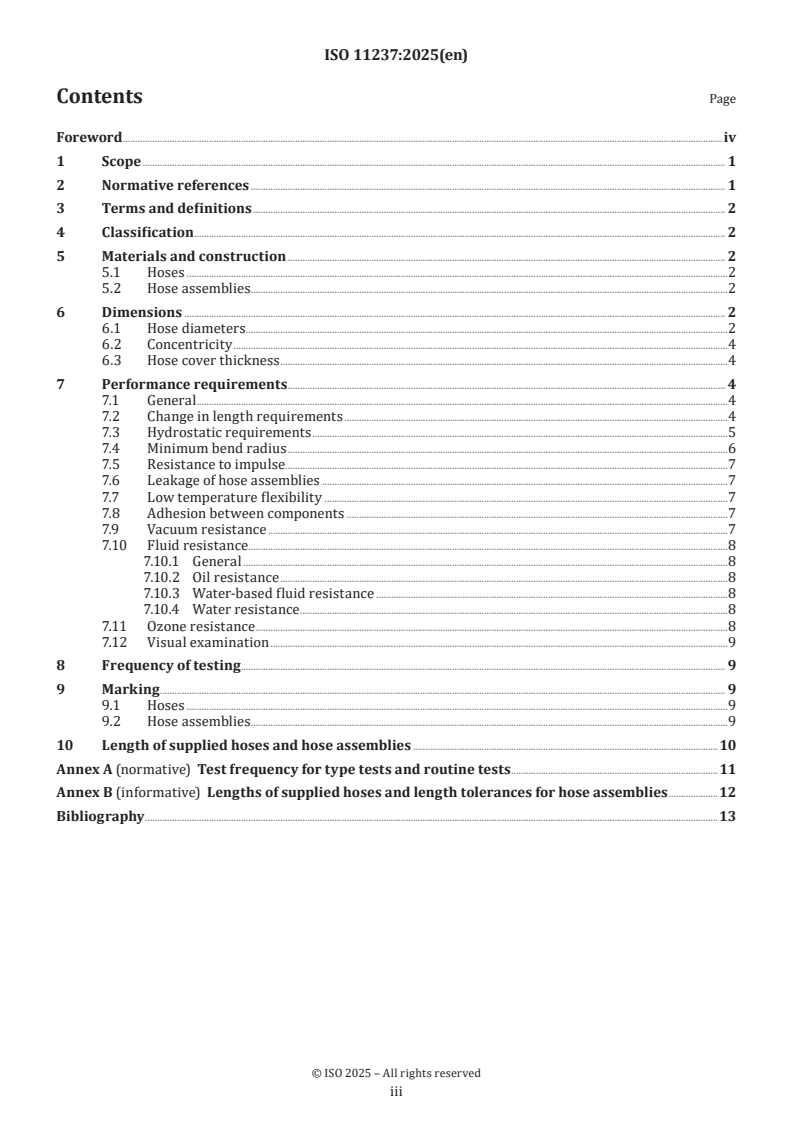
Contents Page
Foreword .iv
1 Scope . 1
2 Normative references . 1
3 Terms and definitions . 2
4 Classification . 2
5 Materials and construction . 2
5.1 Hoses .2
5.2 Hose assemblies .2
6 Dimensions . 2
6.1 Hose diameters .2
6.2 Concentricity .4
6.3 Hose cover thickness .4
7 Performance requirements . . 4
7.1 General .4
7.2 Change in length requirements .4
7.3 Hydrostatic requirements .5
7.4 Minimum bend radius .6
7.5 Resistance to impulse.7
7.6 Leakage of hose assemblies .7
7.7 Low temperature flexibility .7
7.8 Adhesion between components .7
7.9 Vacuum resistance .7
7.10 Fluid resistance . . .8
7.10.1 General .8
7.10.2 Oil resistance .8
7.10.3 Water-based fluid resistance .8
7.10.4 Water resistance .8
7.11 Ozone resistance .8
7.12 Visual examination .9
8 Frequency of testing . . 9
9 Marking . . 9
9.1 Hoses .9
9.2 Hose assemblies .9
10 Length of supplied hoses and hose assemblies . 10
Annex A (normative) Test frequency for type tests and routine tests .11
Annex B (informative) Lengths of supplied hoses and length tolerances for hose assemblies .12
Bibliography .13
iii
Foreword
ISO (the International Organization for Standardization) is a worldwide federation of national standards
bodies (ISO member bodies). The work of preparing International Standards is normally carried out through
ISO technical committees. Each member body interested in a subject for which a technical committee
has been established has the right to be represented on that committee. International organizations,
governmental and non-governmental, in liaison with ISO, also take part in the work. ISO collaborates closely
with the International Electrotechnical Commission (IEC) on all matters of electrotechnical standardization.
The procedures used to develop this document and those intended for its further maintenance are described
in the ISO/IEC Directives, Part 1. In particular, the different approval criteria needed for the different types
of ISO document should be noted. This document was drafted in accordance with the editorial rules of the
ISO/IEC Directives, Part 2 (see www.iso.org/directives).
ISO draws attention to the possibility that the implementation of this document may involve the use of (a)
patent(s). ISO takes no position concerning the evidence, validity or applicability of any claimed patent
rights in respect thereof. As of the date of publication of this document, ISO had not received notice of (a)
patent(s) which may be required to implement this document. However, implementers are cautioned that
this may not represent the latest information, which may be obtained from the patent database available at
www.iso.org/patents. ISO shall not be held responsible for identifying any or all such patent rights.
Any trade name used in this document is information given for the convenience of users and does not
constitute an endorsement.
For an explanation of the voluntary nature of standards, the meaning of ISO specific terms and expressions
related to conformity assessment, as well as information about ISO's adherence to the World Trade
Organization (WTO) principles in the Technical Barriers to Trade (TBT), see www.iso.org/iso/foreword.html.
This document was prepared by Technical Committee ISO/TC 45, Rubber and rubber products, Subcommittee
SC 1, Rubber and plastics hoses and hose assemblies.
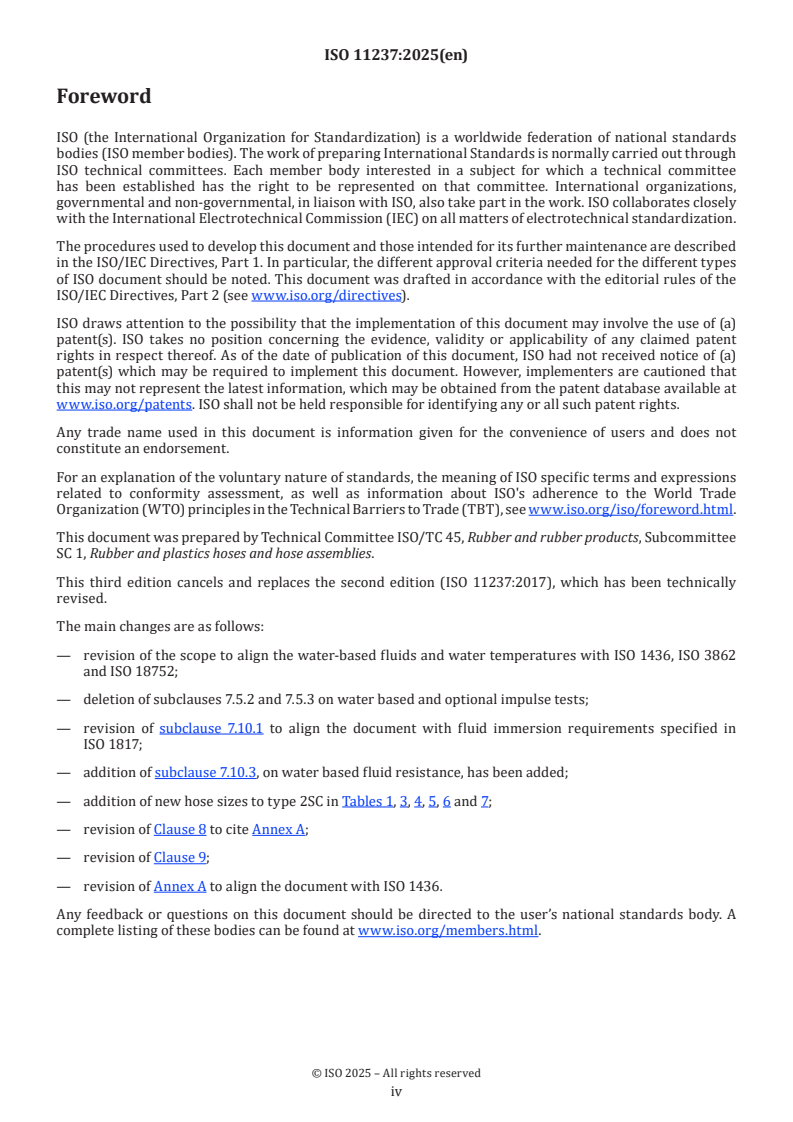
This third edition cancels and replaces the second edition (ISO 11237:2017), which has been technically
revised.
The main changes are as follows:
— revision of the scope to align the water-based fluids and water temperatures with ISO 1436, ISO 3862
and ISO 18752;
— deletion of subclauses 7.5.2 and 7.5.3 on water based and optional impulse tests;
— revision of subclause 7.10.1 to align the document with fluid immersion requirements specified in
ISO 1817;
— addition of subclause 7.10.3, on water based fluid resistance, has been added;
— addition of new hose sizes to type 2SC in Tables 1, 3, 4, 5, 6 and 7;
— revision of Clause 8 to cite Annex A;
— revision of Clause 9;
— revision of Annex A to align the document with ISO 1436.
Any feedback or questions on this document should be directed to the user’s national standards body. A
complete listing of these bodies can be found at www.iso.org/members.html.
iv
International Standard ISO 11237:2025(en)
Rubber hoses and hose assemblies — Compact wire-braid-
reinforced hydraulic types for oil-based or water-based fluids
— Specification
1 Scope
This document specifies requirements for five types of compact, wire-braid-reinforced hoses and hose
assemblies of nominal size from 5 to 76.
They are suitable for use with:
— oil-based hydraulic fluids HH, HL, HM, HR and HV as defined in ISO 6743-4 at temperatures ranging from
−40 °C to +100 °C;
— water-based fluids HFC, HFAE, HFAS and HFB as defined in ISO 6743-4 at temperatures ranging from
0 °C to +70 °C;
— water at temperatures ranging from 0 °C to +70 °C.
This document does not include requirements for end fittings. It is limited to requirements for hoses and
hose assemblies. The hose assembly maximum working pressure is governed by the lowest maximum
working pressure of the components.
NOTE It is the responsibility of the user, in consultation with the hose manufacturer, to establish the compatibility
of the hose with the fluid to be used.
2 Normative references
The following documents are referred to in the text in such a way that some or all of their content constitutes
requirements of this document. For dated references, only the edition cited applies. For undated references,
the latest edition of the referenced document (including any amendments) applies.
ISO 1402, Rubber and plastics hoses and hose assemblies — Hydrostatic testing
ISO 1817, Rubber, vulcanized or thermoplastic — Determination of the effect of liquids
ISO 4671, Rubber and plastics hoses and hose assemblies — Methods of measurement of the dimensions of hoses
and the lengths of hose assemblies
ISO 6605, Hydraulic fluid power — Test methods for hoses and hose assemblies
ISO 6803, Rubber or plastics hoses and hose assemblies — Hydraulic-pressure impulse test without flexing
ISO 7233, Rubber and plastics hoses and hose assemblies — Determination of resistance to vacuum
ISO 7326, Rubber and plastics hoses — Assessment of ozone resistance under static conditions
ISO 8033:2016, Rubber and plastics hoses — Determination of adhesion between components
ISO 8330, Rubber and plastics hoses and hose assemblies — Vocabulary
ISO 10619-1:2017, Rubber and plastics hoses and tubing — Measurement of flexibility and stiffness — Part 1:
Bending tests at ambient temperature
ISO 10619-2, Rubber and plastics hoses and tubing — Measurement of flexibility and stiffness — Part 2: Bending
tests at sub-ambient temperatures
3 Terms and definitions
For the purposes of this document, the terms and definitions given in ISO 8330 apply.
ISO and IEC maintain terminology databases for use in standardization at the following addresses:
— ISO Online browsing platform: available at https:// www .iso .org/ obp
— IEC Electropedia: available at https:// www .electropedia .org/
4 Classification
Five types of hose are specified, distinguished by their construction, working pressure and minimum bend
radius. These hoses have thin covers designed to permit fitting assembly without the removal of the cover or
a portion of the cover.
a) Type 1SC: Hoses with a single braid of wire reinforcement.
b) Type 2SC: Hoses with two braids of wire reinforcement.
c) Type R16S: Hoses with one or two braids of wire reinforcement.
d) Type R17: 21 MPa (210 bar) constant pressure hoses with one or two braids of wire reinforcement.
e) Type R19: 28 MPa (280 bar) constant pressure hoses with one or two braids of wire reinforcement.
NOTE Types R16S, R17 and R19 are not subjected to the vacuum resistance tests.
5 Materials and construction
5.1 Hoses
Hoses shall consist of a rubber lining resistant to oil- or water-based hydraulic fluids, one or two layers of
high-tensile steel wire and a weather- and oil-resistant rubber cover.
5.2 Hose assemblies
Hose assemblies shall be manufactured using hoses conforming to the requirements of this document.
Hose assemblies shall be manufactured only with those hose fittings whose correct functioning has been
verified in accordance with 7.2, 7.3, 7.5, 7.6 and 7.7. The manufacturer’s instructions shall be followed for the
preparation and fabrication of hose assemblies.
6 Dimensions
6.1 Hose diameters
The test shall be carried out in accordance with ISO 4671. The hose diameters shall conform to the values
given in Table 1.
̶̶̶̶
̶̶̶̶
̶̶̶̶
̶̶̶̶
̶̶̶̶
̶̶̶̶
̶̶̶̶
̶̶̶̶
̶̶̶̶
Table 1 — Dimensions of hoses
All types Type 1SC Type 2SC Type R16S Type R17 Type R19
Outside Outside Outside Outside
Diameter over Diameter over Diameter over Diameter over Diameter over Outside diame-
Inside diameter diameter of diameter of diameter of diameter of
Nominal
wire wire wire wire wire ter of hose
a hose hose hose hose
size
mm mm mm mm mm mm mm mm mm mm mm
min. max. min. max. max. min. max. max. max. max. max. max. max. max.
5 4,6 5,4 N/A N/A N/A N/A N/A N/A N/A N/A 10,1 11,6 10,8 12,7
6,3 6,1 6,9 9,6 10,8 13,5 10,6 11,7 14,2 12,3 14,5 11,0 13,2 12,4 14,4
8 7,7 8,5 10,9 12,1 14,5 12,1 13,3 16,0 13,3 15,8
...