

ISO/TS 26762:2025
(Main)Design and operation of allocation systems used in gas productions facilities
General Information
- Abstract
This document specifies how to design and operate allocation systems for gas production facilities. It describes the most common types, principles and methods used for the allocation of gas and associated liquids. The objective is to provide an approach to current best practice in the oil and gas industry. It applies to gas and liquid allocations to be performed in production, processing, transportation, storage and terminal installations dealing with natural gas and associated liquids as well as end products like sales gas, liquefied petroleum gas (LPG), liquefied natural gas (LNG), condensate and to some extend non-hydrocarbon gases like CO2, H2. This document provides the minimum information needed to develop and implement allocation procedures and systems both for internal purposes (well allocation) and fiscal or commercial applications with different owners and stakeholders. This document can be used to develop gas and liquid processing and transportation agreements and regulatory documents as well as to conduct audit of measurement and allocation systems. It also introduces the areas of competence needed and the terminology used in the industry.
- Status
- Published
- Publication Date
- 20-Apr-2025
- Technical Committee
- ISO/TC 193/SC 3 - Upstream area
- Drafting Committee
- ISO/TC 193/SC 3 - Upstream area
- Current Stage
- 6060 - International Standard published
- Start Date
- 21-Apr-2025
- Due Date
- 07-May-2025
- Completion Date
- 21-Apr-2025

Overview
ISO/TS 26762:2025 - Design and operation of allocation systems used in gas production facilities provides a best-practice technical specification for designing, implementing and operating allocation systems for natural gas and associated liquids. It covers allocation of inputs and products across production, processing, transportation, storage and terminal installations - including sales gas, LPG, LNG, condensate and, to some extent, non‑hydrocarbon gases (CO2, H2). The document supplies minimum information required for internal well allocation, fiscal/commercial allocation, contractual agreements, regulatory documents and measurement/allocation audits.
Key topics and requirements
- Allocation fundamentals: definitions, objectives, types (technical vs contractual/fiscal), boundaries and stepwise allocation processes.
- Physical streams & products: classification of input streams and end products, fluid characteristics and composition considerations.
- Fluid properties & phase behavior: requirements for stabilized/equilibrium fluids, flash calculations, blending effects and use of process simulation models to support allocation (e.g., shrinkage factors).
- Measurement, sampling and analysis: flow measurement methods (single‑phase, multiphase, wet gas, indirect and virtual metering), sampling best practices, laboratory analysis and measurement uncertainty.
- Balance, reconciliation & reporting: mass/volume balance approaches, reconciliation procedures, units and timing, data flow and reporting, and auditing/fallback arrangements.
- Operational & commercial considerations: pipeline capacity, system response time, forecasting, contractual clauses, regulatory interfaces and stakeholder reporting.
- Competence & terminology: recommended areas of competence and standardized terminology for consistent implementation.
Practical applications
ISO/TS 26762:2025 is applied to:
- Develop and document allocation procedures and systems for oil & gas production and processing facilities.
- Create commercial and fiscal agreements, transportation/processing contracts and regulatory filings involving allocation rules.
- Design measurement and allocation solutions for onshore/offshore platforms, processing plants, terminals (LNG, LPG) and pipeline networks.
- Support audits of measurement systems and allocation outcomes, ensuring traceability, reconciliation and accepted uncertainty.
- Guide engineering teams in integrating process simulation and metering data to compute allocations and shrinkage.
Who should use this standard
- Upstream/downstream operators and production engineers
- Measurement and metering engineers, sampling & laboratory teams
- Commercial, regulatory and contract managers
- Consultants, auditors and technical negotiators
- Process simulation and reservoir engineers
Related guidance
Use ISO/TS 26762 alongside relevant measurement, metering and sampling standards and industry best practice documents for a complete allocation and metering governance framework.
Keywords: ISO/TS 26762:2025, allocation systems, gas production facilities, gas allocation, liquid allocation, metering, sampling, process simulation, fiscal allocation, measurement uncertainty.
Relations
- Effective Date
- 08-Jul-2023
Get Certified
Connect with accredited certification bodies for this standard

Element Materials Technology
Materials testing and product certification.

ABS Group Brazil
ABS Group certification services in Brazil.

ABS Quality Evaluations Inc.
American Bureau of Shipping quality certification.
Sponsored listings
Frequently Asked Questions
ISO/TS 26762:2025 is a technical specification published by the International Organization for Standardization (ISO). Its full title is "Design and operation of allocation systems used in gas productions facilities". This standard covers: This document specifies how to design and operate allocation systems for gas production facilities. It describes the most common types, principles and methods used for the allocation of gas and associated liquids. The objective is to provide an approach to current best practice in the oil and gas industry. It applies to gas and liquid allocations to be performed in production, processing, transportation, storage and terminal installations dealing with natural gas and associated liquids as well as end products like sales gas, liquefied petroleum gas (LPG), liquefied natural gas (LNG), condensate and to some extend non-hydrocarbon gases like CO2, H2. This document provides the minimum information needed to develop and implement allocation procedures and systems both for internal purposes (well allocation) and fiscal or commercial applications with different owners and stakeholders. This document can be used to develop gas and liquid processing and transportation agreements and regulatory documents as well as to conduct audit of measurement and allocation systems. It also introduces the areas of competence needed and the terminology used in the industry.
This document specifies how to design and operate allocation systems for gas production facilities. It describes the most common types, principles and methods used for the allocation of gas and associated liquids. The objective is to provide an approach to current best practice in the oil and gas industry. It applies to gas and liquid allocations to be performed in production, processing, transportation, storage and terminal installations dealing with natural gas and associated liquids as well as end products like sales gas, liquefied petroleum gas (LPG), liquefied natural gas (LNG), condensate and to some extend non-hydrocarbon gases like CO2, H2. This document provides the minimum information needed to develop and implement allocation procedures and systems both for internal purposes (well allocation) and fiscal or commercial applications with different owners and stakeholders. This document can be used to develop gas and liquid processing and transportation agreements and regulatory documents as well as to conduct audit of measurement and allocation systems. It also introduces the areas of competence needed and the terminology used in the industry.
ISO/TS 26762:2025 is classified under the following ICS (International Classification for Standards) categories: 75.160.30 - Gaseous fuels. The ICS classification helps identify the subject area and facilitates finding related standards.
ISO/TS 26762:2025 has the following relationships with other standards: It is inter standard links to ISO/TR 26762:2008. Understanding these relationships helps ensure you are using the most current and applicable version of the standard.
ISO/TS 26762:2025 is available in PDF format for immediate download after purchase. The document can be added to your cart and obtained through the secure checkout process. Digital delivery ensures instant access to the complete standard document.
Standards Content (Sample)
Technical
Specification
ISO/TS 26762
First edition
Design and operation of allocation
2025-04
systems used in gas productions
facilities
Conception et opération des systèmes d'allocation dans les
installations de production de gaz
Reference number
© ISO 2025
All rights reserved. Unless otherwise specified, or required in the context of its implementation, no part of this publication may
be reproduced or utilized otherwise in any form or by any means, electronic or mechanical, including photocopying, or posting on
the internet or an intranet, without prior written permission. Permission can be requested from either ISO at the address below
or ISO’s member body in the country of the requester.
ISO copyright office
CP 401 • Ch. de Blandonnet 8
CH-1214 Vernier, Geneva
Phone: +41 22 749 01 11
Email: copyright@iso.org
Website: www.iso.org
Published in Switzerland
ii
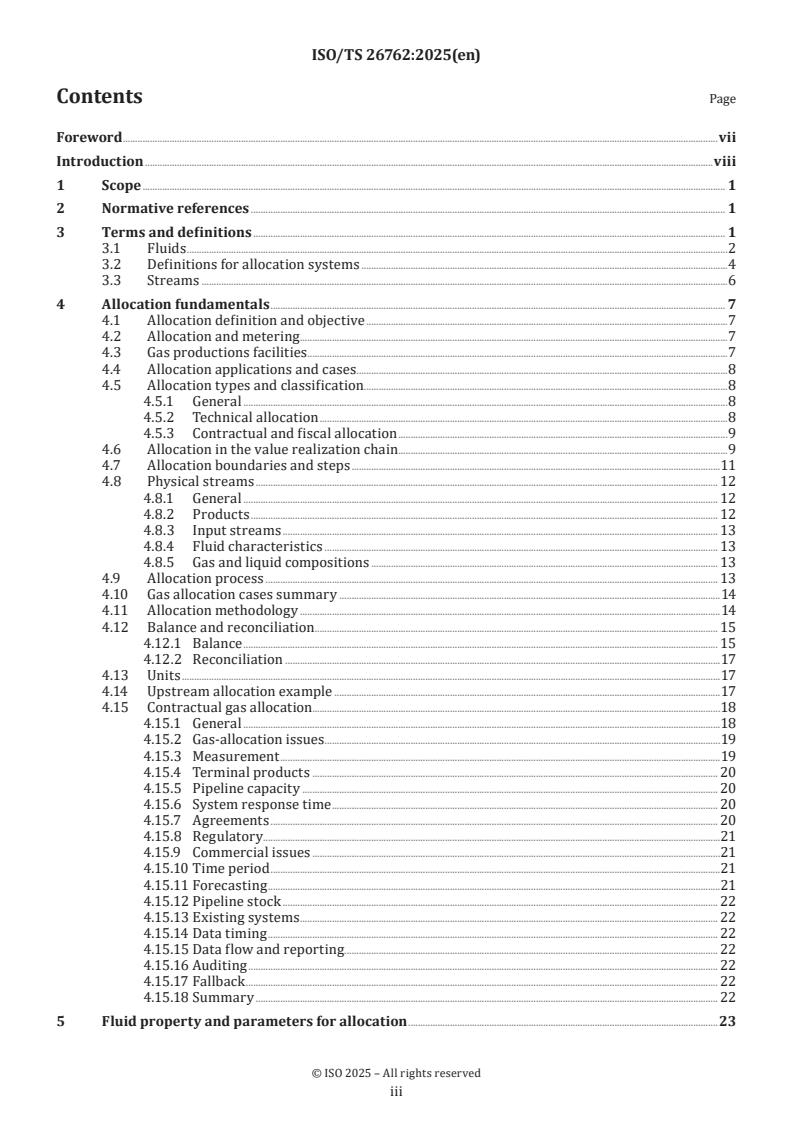
Contents Page
Foreword .vii
Introduction .viii
1 Scope . 1
2 Normative references . 1
3 Terms and definitions . 1
3.1 Fluids .2
3.2 Definitions for allocation systems .4
3.3 Streams .6
4 Allocation fundamentals . 7
4.1 Allocation definition and objective .7
4.2 Allocation and metering .7
4.3 Gas productions facilities .7
4.4 Allocation applications and cases .8
4.5 Allocation types and classification .8
4.5.1 General .8
4.5.2 Technical allocation .8
4.5.3 Contractual and fiscal allocation .9
4.6 Allocation in the value realization chain.9
4.7 Allocation boundaries and steps .11
4.8 Physical streams . 12
4.8.1 General . 12
4.8.2 Products . 12
4.8.3 Input streams . 13
4.8.4 Fluid characteristics . 13
4.8.5 Gas and liquid compositions . 13
4.9 Allocation process . 13
4.10 Gas allocation cases summary .14
4.11 Allocation methodology .14
4.12 Balance and reconciliation . . 15
4.12.1 Balance . 15
4.12.2 Reconciliation .17
4.13 Units .17
4.14 Upstream allocation example .17
4.15 Contractual gas allocation.18
4.15.1 General .18
4.15.2 Gas-allocation issues . .19
4.15.3 Measurement .19
4.15.4 Terminal products . 20
4.15.5 Pipeline capacity . 20
4.15.6 System response time . 20
4.15.7 Agreements . 20
4.15.8 Regulatory . . .21
4.15.9 Commercial issues .21
4.15.10 Time period .21
4.15.11 Forecasting .21
4.15.12 Pipeline stock . 22
4.15.13 Existing systems . 22
4.15.14 Data timing . 22
4.15.15 Data flow and reporting. 22
4.15.16 Auditing . 22
4.15.17 Fallback . 22
4.15.18 Summary . 22
5 Fluid property and parameters for allocation .23
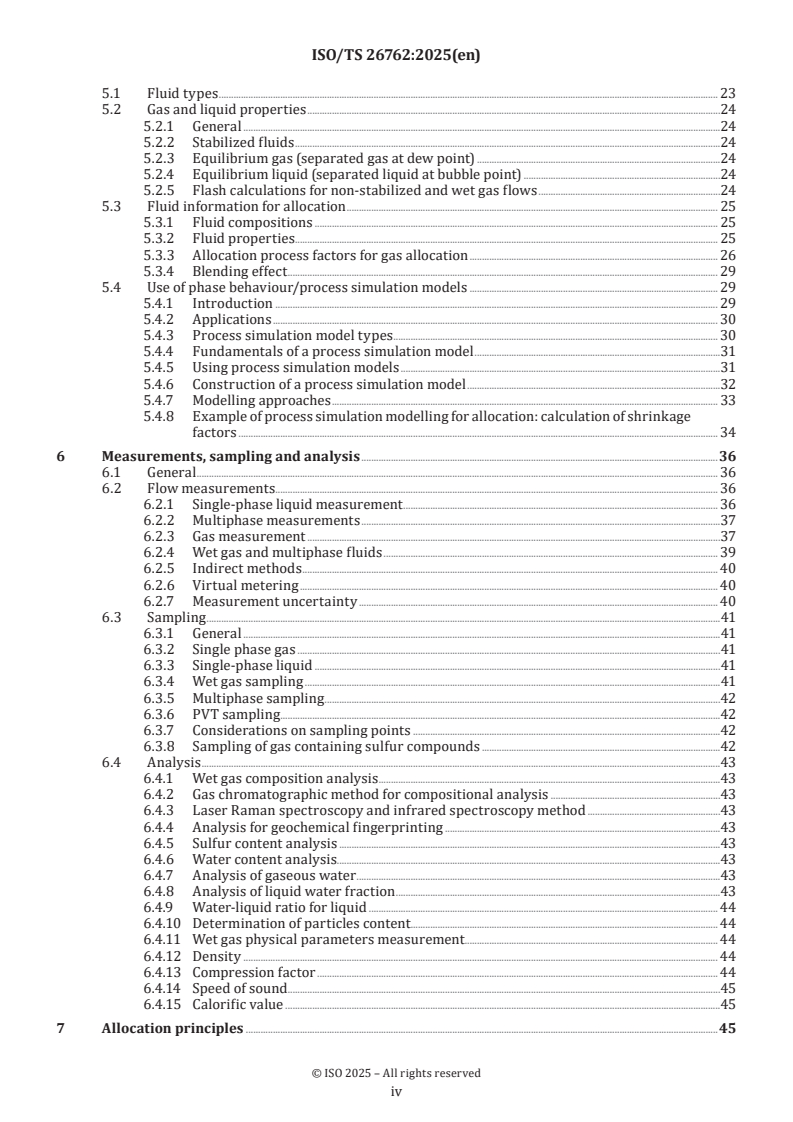
iii
5.1 Fluid types . 23
5.2 Gas and liquid properties .24
5.2.1 General .24
5.2.2 Stabilized fluids .24
5.2.3 Equilibrium gas (separated gas at dew point) .24
5.2.4 Equilibrium liquid (separated liquid at bubble point) .24
5.2.5 Flash calculations for non-stabilized and wet gas flows .24
5.3 Fluid information for allocation . 25
5.3.1 Fluid compositions . 25
5.3.2 Fluid properties . . . 25
5.3.3 Allocation process factors for gas allocation . 26
5.3.4 Blending effect . 29
5.4 Use of phase behaviour/process simulation models . 29
5.4.1 Introduction . 29
5.4.2 Applications . 30
5.4.3 Process simulation model types . 30
5.4.4 Fundamentals of a process simulation model .31
5.4.5 Using process simulation models .31
5.4.6 Construction of a process simulation model .32
5.4.7 Modelling approaches . 33
5.4.8 Example of process simulation modelling for allocation: calculation of shrinkage
factors . 34
6 Measurements, sampling and analysis .36
6.1 General . 36
6.2 Flow measurements. 36
6.2.1 Single-phase liquid measurement . 36
6.2.2 Multiphase measurements .37
6.2.3 Gas measurement .37
6.2.4 Wet gas and multiphase fluids . 39
6.2.5 Indirect methods . 40
6.2.6 Virtual metering . 40
6.2.7 Measurement uncertainty . 40
6.3 Sampling .41
6.3.1 General .41
6.3.2 Single phase gas .41
6.3.3 Single-phase liquid .41
6.3.4 Wet gas sampling .41
6.3.5 Multiphase sampling .42
6.3.6 PVT sampling .42
6.3.7 Considerations on sampling points .42
6.3.8 Sampling of gas containing sulfur compounds .42
6.4 Analysis .43
6.4.1 Wet gas composition analysis .43
6.4.2 Gas chromatographic method for compositional analysis .43
6.4.3 Laser Raman spectroscopy and infrared spectroscopy method .43
6.4.4 Analysis for geochemical fingerprinting .43
6.4.5 Sulfur content analysis .43
6.4.6 Water content analysis.43
6.4.7 Analysis of gaseous water .43
6.4.8 Analysis of liquid water fraction .43
6.4.9 Water-liquid ratio for liquid . 44
6.4.10 Determination of particles content . . 44
6.4.11 Wet gas physical parameters measurement . 44
6.4.12 Density . 44
6.4.13 Compression factor . 44
6.4.14 Speed of sound . . .45
6.4.15 Calorific value .45
7 Allocation principles .45
iv
7.1 General .45
7.2 Allocation methods .45
7.3 Allocation units for gas allocation . 46
7.4 Proportional allocation . 46
7.4.1 General . 46
7.4.2 Pro rata based on estimations . 48
7.4.3 Component mass pro rata . 49
7.5 Allocation by by-difference . 50
7.6 Allocation by process simulation . 50
7.7 Uncertainty based allocation . .51
7.8 Geochemical fingerprinting . 53
7.9 Conversion calculation . 53
7.9.1 Mass allocation conversion into volume . 53
7.9.2 Mass allocation conversion to energy . 55
7.10 Quantity allocation . 56
7.10.1 General . 56
7.10.2 Mass-quantity allocation .57
7.10.3 Volume quantity allocation .57
7.10.4 Energy-quantity allocation .57
7.11 Allocation calculations .57
7.11.1 General .57
7.11.2 Calculations at the measurement points .57
7.11.3 Allocated field’s share . 60
7.12 Allocation methodology selection . 63
7.13 Balancing and reconciliation calculations . 64
7.13.1 General . 64
7.13.2 Reconciliation . 64
7.13.3 Balancing and reconciliation accounts . 65
8 Utility and disposed gas allocation .65
8.1 General . 65
8.2 Utility gas allocation by volume .67
8.3 Injection and sales (purchase) gas allocation . 69
8.4 Export gas and oil mass and volume .70
9 Inventory .70
10 Allocation cases and typical lay out .71
10.1 Allocation cases .71
10.1.1 General .71
10.1.2 Well allocation and well production . 72
10.1.3 Asset, field and subgroup, upstream allocation . 73
10.1.4 Pipeline, midstream allocation . 73
10.1.5 Terminal, downstream allocation . 73
10.1.6 Liquid natural gas .74
10.1.7 Carbon dioxide CO .74
10.1.8 New development tied into an existing one .74
10.1.9 New development tied into an existing transportation system. . 75
10.2 Typical allocation lay out . 75
10.2.1 Gas only. 75
10.2.2 Dry gas in, dry gas and liquid out .76
10.2.3 Wet gas combined in, dry gas and liquid out .76
10.2.4 Dry gas and liquid in; dry gas and liquid out . 77
11 Allocation uncertainty (from HM 96) .78
11.1 General . 78
11.2 Relative and absolute uncertainty . 78
11.3 Uncertainty of a calculated value -analytical solution . 78
11.4 Allocation per difference . 79
11.5 Proportional/pro rata allocation . 80
11.6 Uncertainty based allocation . . 81
v
11.7 Uncertainty of a calculated value – other methods . 82
11.8 Uncertainty contributors . 82
12 Allocation systems design and integration .82
12.1 General . 82
12.2 Metering and allocation philosophy . 85
12.3 Allocation agreements . 85
12.4 Regulations . 85
12.5 Development procedure . 85
12.5.1 General . 85
12.5.2 Step 1 . 86
12.5.3 Step 2 . 87
12.5.4 Step 3 . 87
12.5.5 Step 4 . 88
13 Operation of allocation systems .88
13.1 General . 88
13.2 Input QA/QC . 90
13.3 Imbalance follow up . 90
13.4 Trending .91
13.5 Surveillance .91
13.6 Validation .91
13.6.1 General .91
13.6.2 Meter validation . 92
13.6.3 Allocation procedures and process validation . 92
13.6.4 Data validation . 93
13.6.5 Data reconciliation . 93
13.6.6 Process-model validation . 93
13.6.7 Allocation-process results validation . 93
13.6.8 Software validation . 94
13.7 Mismeasurement handling . 94
14 Audits .95
14.1 General . 95
14.2 Metering and allocation audit objectives . 95
14.3 MandA audit boundary and activity . 95
14.3.1 Installations . 95
14.3.2 Systems . 95
14.3.3 Metering and allocation activity . 96
14.4 Audit scope . 96
14.5 Audit findings . 97
14.5.1 General . 97
14.5.2 Audit exceptions . 97
14.5.3 Audit recommendations . 97
14.5.4 Audit observation . 97
14.5.5 Allocation audit checklist . 97
Annex A (informative) Exposure to loss/risk assessment .99
Bibliography .103
vi
Foreword
ISO (the International Organization for Standardization) is a worldwide federation of national standards
bodies (ISO member bodies). The work of preparing International Standards is normally carried out through
ISO technical committees. Each member body interested in a subject for which a technical committee
has been established has the right to be represented on that committee. International organizations,
governmental and non-governmental, in liaison with ISO, also take part in the work. ISO collaborates closely
with the International Electrotechnical Commission (IEC) on all matters of electrotechnical standardization.
The procedures used to develop this document and those intended for its further maintenance are described
in the ISO/IEC Directives, Part 1. In particular, the different approval criteria needed for the different types
of ISO document should be noted. This document was drafted in accordance with the editorial rules of the
ISO/IEC Directives, Part 2 (see www.iso.org/directives).
ISO draws attention to the possibility that the implementation of this document may involve the use of (a)
patent(s). ISO takes no position concerning the evidence, validity or applicability of any claimed patent
rights in respect thereof. As of the date of publication of this document, ISO had not received notice of (a)
patent(s) which may be required to implement this document. However, implementers are cautioned that
this may not represent the latest information, which may be obtained from the patent database available at
www.iso.org/patents. ISO shall not be held responsible for identifying any or all such patent rights.
Any trade name used in this document is information given for the convenience of users and does not
constitute an endorsement.
For an explanation of the voluntary nature of standards, the meaning of ISO specific terms
...