

ISO 16089:2015
(Main)Machine tools — Safety — Stationary grinding machines
General Information
- Abstract
ISO 16089:2015 specifies the requirements and/or measures to eliminate the hazards or reduce the risks in the following groups of stationary grinding machines which are designed primarily to shape metal by grinding: Group 1: Manually controlled grinding machines without power operated axes and without numerical control. Group 2: Manually controlled grinding machines with power operated axes and limited numerically controlled capability, if applicable. Group 3: Numerically controlled grinding machines. NOTE 1 For detailed information on the groups of grinding machines, see the definitions in 3.1 and 3.4. NOTE 2 Requirements in this International Standard are, in general, applicable to all groups of grinding machines. If requirements are applicable to some special group(s) of grinding machines only, then the special group(s) of grinding machine(s) is/are specified. This International Standard covers the significant hazards listed in Clause 4 and applies to ancillary devices (e.g. for workpieces, tools, and workpiece holding devices, handling devices), which are integral to the machine. This International Standard also applies to machines which are integrated into an automatic production line or grinding cell inasmuch as the hazards and risks arising are comparable to those of machines working separately. This International Standard also includes in Clause 7 a minimum list of safety-relevant information which the manufacturer has to provide to the user. See also ISO 12100:2010, Figure 2, which illustrates the interaction of manufacturer's and user's responsibility for the operational safety. The user's responsibility to identify specific hazards (e.g. fire and explosion) and reduce the associated risks can be critical (e.g. whether the central extraction system is working correctly). Where additional metalworking processes (e.g. milling, turning, laser processing) are involved, this International Standard can be taken as a basis for safety requirements. For specific information on hazards arising from other metalworking processes, which are covered by other International Standards, see the Bibliography. This International Standard applies to machines that are manufactured after the date of issue of this International Standard. This International Standard does not apply to stationary honing, polishing, and belt grinding machines and not to transportable motor-operated electric tools in accordance with IEC 61029‑2‑4 and IEC 61029‑2‑10.
- Status
- Withdrawn
- Publication Date
- 15-Nov-2015
- Technical Committee
- ISO/TC 39/SC 10 - Safety
- Drafting Committee
- ISO/TC 39/SC 10 - Safety
- Current Stage
- 9599 - Withdrawal of International Standard
- Start Date
- 21-Feb-2025
- Completion Date
- 29-Aug-2026
Buy Documents
ISO 16089:2015 - Machine tools — Safety — Stationary grinding machines Released:11/16/2015

ISO 16089:2015 - Machines-outils — Sécurité — Machines a meuler fixes Released:11/16/2015
Overview
ISO 16089:2015 - Machine tools: Safety - Stationary grinding machines specifies safety requirements and measures to eliminate hazards or reduce risks for stationary grinding machines used primarily to shape metal by grinding. The standard applies to three machine groups based on automation level:
- Group 1: manually controlled, no powered axes or NC
- Group 2: manually controlled with powered axes and limited NC capability (if applicable)
- Group 3: numerically controlled (CNC) grinding machines
ISO 16089:2015 covers significant hazards (see Clause 4), guards and interlocking, ancillary devices integral to the machine, machines integrated into production lines or cells, and the manufacturer’s minimum safety information (Clause 7). It applies to machines manufactured after the publication date and excludes stationary honing, polishing, belt grinding machines and portable motor-operated tools covered by IEC standards.
Key topics and technical requirements
- Hazard identification and risk reduction: Lists significant hazards and main hazard zones; requires design measures, guarding and protective devices.
- Guards and interlocks: Requirements for abrasive product guards, work zone enclosures, guard-locking and anti-tamper measures to prevent manipulation and unintended exposure.
- Modes of safe operation (MSO): Defines operating modes, including the optional MSO 3 (restricted manual intervention) to reduce incentive to bypass guards.
- Safety-related control measures: Performance level requirements for safety functions referenced to ISO 13849‑1 (functional safety for control systems).
- Special hazards: Electrical safety, noise and vibration limits, radiation, ejected objects, over‑speed and unexpected start-up, loss of stability, slips/trips/falls.
- Materials and fluids: Measures for metalworking fluids, fire and explosion hazards; includes guidance for flammable fluids, extraction, and fire‑extinguishing integration (Annexes G–I).
- Verification and documentation: Verification procedures for safety measures (Clause 6) and minimum manufacturer information for safe use, installation and maintenance (Clause 7).
Practical applications and who uses the standard
ISO 16089:2015 is used by:
- Machine manufacturers and designers to design compliant stationary grinding machines and integrated grinding cells.
- Safety engineers and risk assessors to perform machine risk assessments and specify guarding/interlocks and control-system performance levels.
- Plant engineers and integrators when installing grinding machines into automated production lines, including extraction and fire‑suppression systems for flammable fluids.
- Operators and maintenance teams to understand required markings, instructions for use, safe modes, and residual risks.
This standard is essential for achieving regulatory compliance, improving workplace safety around stationary grinding machines, and reducing incidents from abrasive product failure, ejection, fire, and ergonomic or control failures.
Related standards
- ISO 12100 (general machine risk assessment and design)
- ISO 13849‑1 (safety-related control system performance levels)
- IEC standards for portable tools (IEC 61029‑2‑4 / 61029‑2‑10) - excluded from ISO 16089 scope
Keywords: ISO 16089:2015, stationary grinding machines, machine tools safety, guards, abrasive product, MSO 3, ISO 13849-1, metalworking fluids, fire and explosion, grinding machine safety.
Relations
- Consolidates
EN ISO 16089:2015 - Machine tools - Safety - Stationary grinding machines (ISO 16089:2015) - Effective Date
- 12-Feb-2026
- Consolidates
ISO/TS 16111:2006 - Transportable gas storage devices — Hydrogen absorbed in reversible metal hydride - Effective Date
- 06-Jun-2022
- Effective Date
- 06-Jun-2022
Buy Documents
ISO 16089:2015 - Machine tools — Safety — Stationary grinding machines Released:11/16/2015
ISO 16089:2015 - Machines-outils — Sécurité — Machines a meuler fixes Released:11/16/2015
Get Certified
Connect with accredited certification bodies for this standard

DVS-ZERT GmbH
German welding certification society.
CARES (UK Certification Authority for Reinforcing Steels)
UK certification for reinforcing steels and construction.
EWF/IIW (European/International Welding Federation)
International welding personnel certification.
Sponsored listings
Frequently Asked Questions
ISO 16089:2015 is a standard published by the International Organization for Standardization (ISO). Its full title is "Machine tools — Safety — Stationary grinding machines". This standard covers: ISO 16089:2015 specifies the requirements and/or measures to eliminate the hazards or reduce the risks in the following groups of stationary grinding machines which are designed primarily to shape metal by grinding: Group 1: Manually controlled grinding machines without power operated axes and without numerical control. Group 2: Manually controlled grinding machines with power operated axes and limited numerically controlled capability, if applicable. Group 3: Numerically controlled grinding machines. NOTE 1 For detailed information on the groups of grinding machines, see the definitions in 3.1 and 3.4. NOTE 2 Requirements in this International Standard are, in general, applicable to all groups of grinding machines. If requirements are applicable to some special group(s) of grinding machines only, then the special group(s) of grinding machine(s) is/are specified. This International Standard covers the significant hazards listed in Clause 4 and applies to ancillary devices (e.g. for workpieces, tools, and workpiece holding devices, handling devices), which are integral to the machine. This International Standard also applies to machines which are integrated into an automatic production line or grinding cell inasmuch as the hazards and risks arising are comparable to those of machines working separately. This International Standard also includes in Clause 7 a minimum list of safety-relevant information which the manufacturer has to provide to the user. See also ISO 12100:2010, Figure 2, which illustrates the interaction of manufacturer's and user's responsibility for the operational safety. The user's responsibility to identify specific hazards (e.g. fire and explosion) and reduce the associated risks can be critical (e.g. whether the central extraction system is working correctly). Where additional metalworking processes (e.g. milling, turning, laser processing) are involved, this International Standard can be taken as a basis for safety requirements. For specific information on hazards arising from other metalworking processes, which are covered by other International Standards, see the Bibliography. This International Standard applies to machines that are manufactured after the date of issue of this International Standard. This International Standard does not apply to stationary honing, polishing, and belt grinding machines and not to transportable motor-operated electric tools in accordance with IEC 61029‑2‑4 and IEC 61029‑2‑10.
ISO 16089:2015 specifies the requirements and/or measures to eliminate the hazards or reduce the risks in the following groups of stationary grinding machines which are designed primarily to shape metal by grinding: Group 1: Manually controlled grinding machines without power operated axes and without numerical control. Group 2: Manually controlled grinding machines with power operated axes and limited numerically controlled capability, if applicable. Group 3: Numerically controlled grinding machines. NOTE 1 For detailed information on the groups of grinding machines, see the definitions in 3.1 and 3.4. NOTE 2 Requirements in this International Standard are, in general, applicable to all groups of grinding machines. If requirements are applicable to some special group(s) of grinding machines only, then the special group(s) of grinding machine(s) is/are specified. This International Standard covers the significant hazards listed in Clause 4 and applies to ancillary devices (e.g. for workpieces, tools, and workpiece holding devices, handling devices), which are integral to the machine. This International Standard also applies to machines which are integrated into an automatic production line or grinding cell inasmuch as the hazards and risks arising are comparable to those of machines working separately. This International Standard also includes in Clause 7 a minimum list of safety-relevant information which the manufacturer has to provide to the user. See also ISO 12100:2010, Figure 2, which illustrates the interaction of manufacturer's and user's responsibility for the operational safety. The user's responsibility to identify specific hazards (e.g. fire and explosion) and reduce the associated risks can be critical (e.g. whether the central extraction system is working correctly). Where additional metalworking processes (e.g. milling, turning, laser processing) are involved, this International Standard can be taken as a basis for safety requirements. For specific information on hazards arising from other metalworking processes, which are covered by other International Standards, see the Bibliography. This International Standard applies to machines that are manufactured after the date of issue of this International Standard. This International Standard does not apply to stationary honing, polishing, and belt grinding machines and not to transportable motor-operated electric tools in accordance with IEC 61029‑2‑4 and IEC 61029‑2‑10.
ISO 16089:2015 is classified under the following ICS (International Classification for Standards) categories: 25.080.01 - Machine tools in general. The ICS classification helps identify the subject area and facilitates finding related standards.
ISO 16089:2015 has the following relationships with other standards: It is inter standard links to EN ISO 16089:2015, ISO/TS 16111:2006, ISO 16089:2025. Understanding these relationships helps ensure you are using the most current and applicable version of the standard.
ISO 16089:2015 is available in PDF format for immediate download after purchase. The document can be added to your cart and obtained through the secure checkout process. Digital delivery ensures instant access to the complete standard document.
Standards Content (Sample)
INTERNATIONAL ISO
STANDARD 16089
First edition
2015-11-15
Machine tools — Safety — Stationary
grinding machines
Machines-outils — Sécurité — Machines à meuler fixes
Reference number
©
ISO 2015
© ISO 2015, Published in Switzerland
All rights reserved. Unless otherwise specified, no part of this publication may be reproduced or utilized otherwise in any form
or by any means, electronic or mechanical, including photocopying, or posting on the internet or an intranet, without prior
written permission. Permission can be requested from either ISO at the address below or ISO’s member body in the country of
the requester.
ISO copyright office
Ch. de Blandonnet 8 • CP 401
CH-1214 Vernier, Geneva, Switzerland
Tel. +41 22 749 01 11
Fax +41 22 749 09 47
copyright@iso.org
www.iso.org
ii © ISO 2015 – All rights reserved
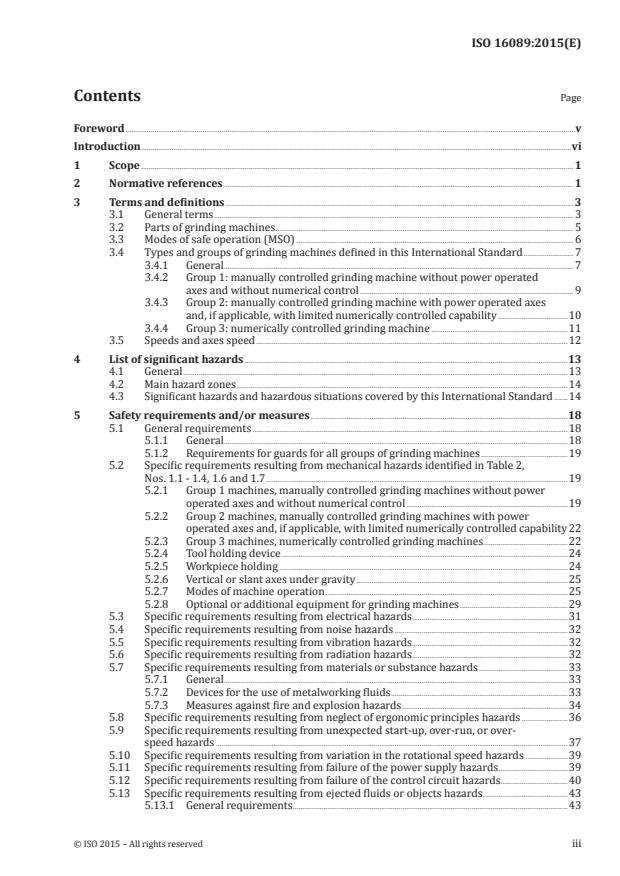
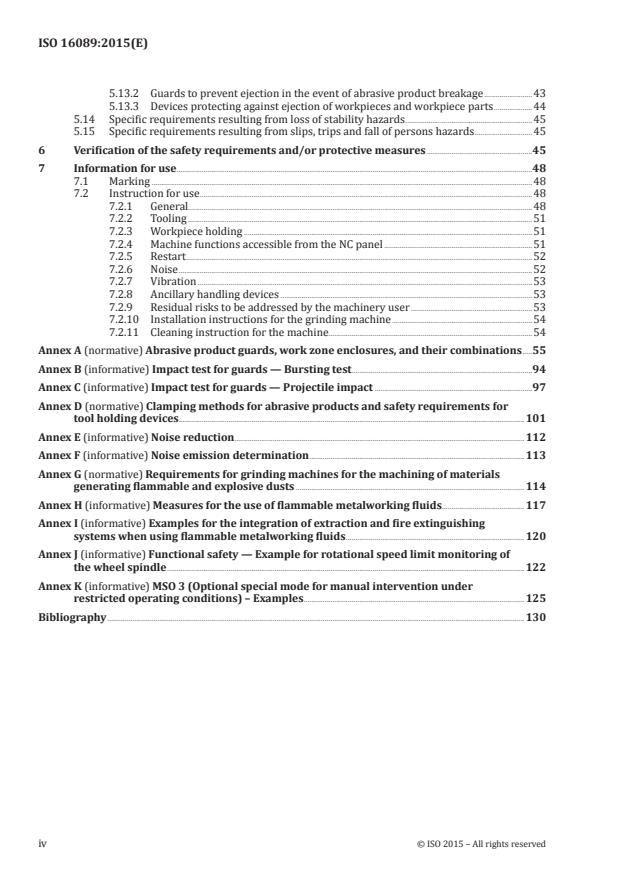
Contents Page
Foreword .v
Introduction .vi
1 Scope . 1
2 Normative references . 1
3 Terms and definitions . 3
3.1 General terms . 3
3.2 Parts of grinding machines . 5
3.3 Modes of safe operation (MSO) . 6
3.4 Types and groups of grinding machines defined in this International Standard . 7
3.4.1 General. 7
3.4.2 Group 1: manually controlled grinding machine without power operated
axes and without numerical control . 9
3.4.3 Group 2: manually controlled grinding machine with power operated axes
and, if applicable, with limited numerically controlled capability .10
3.4.4 Group 3: numerically controlled grinding machine .11
3.5 Speeds and axes speed .12
4 List of significant hazards .13
4.1 General .13
4.2 Main hazard zones .14
4.3 Significant hazards and hazardous situations covered by this International Standard .14
5 Safety requirements and/or measures .18
5.1 General requirements .18
5.1.1 General.18
5.1.2 Requirements for guards for all groups of grinding machines .19
5.2 Specific requirements resulting from mechanical hazards identified in Table 2,
Nos. 1.1 - 1.4, 1.6 and 1.7 .19
5.2.1 Group 1 machines, manually controlled grinding machines without power
operated axes and without numerical control .19
5.2.2 Group 2 machines, manually controlled grinding machines with power
operated axes and, if applicable, with limited numerically controlled capability 22
5.2.3 Group 3 machines, numerically controlled grinding machines.22
5.2.4 Tool holding device .24
5.2.5 Workpiece holding .24
5.2.6 Vertical or slant axes under gravity .25
5.2.7 Modes of machine operation .25
5.2.8 Optional or additional equipment for grinding machines .29
5.3 Specific requirements resulting from electrical hazards .31
5.4 Specific requirements resulting from noise hazards .32
5.5 Specific requirements resulting from vibration hazards .32
5.6 Specific requirements resulting from radiation hazards .32
5.7 Specific requirements resulting from materials or substance hazards .33
5.7.1 General.33
5.7.2 Devices for the use of metalworking fluids .33
5.7.3 Measures against fire and explosion hazards .34
5.8 Specific requirements resulting from neglect of ergonomic principles hazards .36
5.9 Specific requirements resulting from unexpected start-up, over-run, or over-
speed hazards .37
5.10 Specific requirements resulting from variation in the rotational speed hazards .39
5.11 Specific requirements resulting from failure of the power supply hazards .39
5.12 Specific requirements resulting from failure of the control circuit hazards.40
5.13 Specific requirements resulting from ejected fluids or objects hazards .43
5.13.1 General requirements .43
5.13.2 Guards to prevent ejection in the event of abrasive product breakage .43
5.13.3 Devices protecting against ejection of workpieces and workpiece parts .44
5.14 Specific requirements resulting from loss of stability hazards .45
5.15 Specific requirements resulting from slips, trips and fall of persons hazards .45
6 Verification of the safety requirements and/or protective measures .45
7 Information for use .48
7.1 Marking .48
7.2 Instruction for use .48
7.2.1 General.48
7.2.2 Tooling .51
7.2.3 Workpiece holding .51
7.2.4 Machine functions accessible from the NC panel .51
7.2.5 Restart .52
7.2.6 Noise .52
7.2.7 Vibration .53
7.2.8 Ancillary handling devices .53
7.2.9 Residual risks to be addressed by the machinery user .53
7.2.10 Installation instructions for the grinding machine .54
7.2.11 Cleaning instruction for the machine.54
Annex A (normative) Abrasive product guards, work zone enclosures, and their combinations .55
Annex B (informative) Impact test for guards — Bursting test.94
Annex C (informative) Impact test for guards — Projectile impact .97
Annex D (normative) Clamping methods for abrasive products and safety requirements for
tool holding devices . .101
Annex E (informative) Noise reduction.112
Annex F (informative) Noise emission determination .113
Annex G (normative) Requirements for grinding machines for the machining of materials
generating flammable and explosive dusts .114
Annex H (informative) Measures for the use of flammable metalworking fluids .117
Annex I (informative) Examples for the integration of extraction and fire extinguishing
systems when using flammable metalworking fluids .120
Annex J (informative) Functional safety — Example for rotational speed limit monitoring of
the wheel spindle .122
Annex K (informative) MSO 3 (Optional special mode for manual intervention under
restricted operating conditions) – Examples.125
Bibliography .130
iv © ISO 2015 – All rights reserved
Foreword
ISO (the International Organization for Standardization) is a worldwide federation of national standards
bodies (ISO member bodies). The work of preparing International Standards is normally carried out
through ISO technical committees. Each member body interested in a subject for which a technical
committee has been established has the right to be represented on that committee. International
organizations, governmental and non-governmental, in liaison with ISO, also take part in the work.
ISO collaborates closely with the International Electrotechnical Commission (IEC) on all matters of
electrotechnical standardization.
The procedures used to develop this document and those intended for its further maintenance are
described in the ISO/IEC Directives, Part 1. In particular the different approval criteria needed for the
different types of ISO documents should be noted. This document was drafted in accordance with the
editorial rules of the ISO/IEC Directives, Part 2 (see www.iso.org/directives).
Attention is drawn to the possibility that some of the elements of this document may be the subject of
patent rights. ISO shall not be held responsible for identifying any or all such patent rights. Details of
any patent rights identified during the development of the document will be in the Introduction and/or
on the ISO list of patent declarations received (see www.iso.org/patents).
Any trade name used in this document is information given for the convenience of users and does not
constitute an endorsement.
For an explanation on the meaning of ISO specific terms and expressions related to conformity
assessment, as well as information about ISO’s adherence to the WTO principles in the Technical
Barriers to Trade (TBT) see the following URL: Foreword - Supplementary information
The committee responsible for this document is Technical Committee ISO/TC 39, Machine tools,
Subcommittee SC 10, Safety.
This first edition of ISO 16089 is an adaptation of European Standard EN 13218:2002+A1/AC:2010-04.
Significant differences between the European Standard and ISO 16089 are as follows.
a) Introduction of a subdivision of grinding machines into three groups, based on the degree of
automation. Specific safety measures for safe design for each group of grinding machines.
b) Introduction of the Mode of safe operation 3 (optional special mode for manual intervention under
restricted operating conditions) with a separate selection device and specific safety measures, and a
new informative Annex providing examples.
c) Instead of the categories of EN 954-1, the required performance level according to ISO 13849-1 is
defined for relevant safety functions.
d) The decrease in the impact resistance of unprotected polycarbonate depending on the duration of
use is shown in the form of an aging curve in Annex A.
e) Measures for the use of flammable metalworking fluids are given in the new Annex H.
f) Examples for the integration of extraction and fire extinguishing systems when using flammable
metalworking fluids are given in the new Annex I.
g) Example for rotational speed limit monitoring of the wheel spindle given in the new Annex K.
Introduction
In order to take technological progress into account, it was decided to revise EN 13218 for this purpose.
Due to the worldwide use of these machines, an agreement was made by CEN/TC 143 and ISO/TC 39/SC
10. According to the Vienna Agreement, this revision was carried out as ISO 16089.
A decisive aspect for the preparation of this standard was the consideration of foreseeable misuse, e.g.
by means of manipulation of protective devices.
Safety measures for grinding machines are, in particular, characterized by guards with interlocking
and guard locking, to effectively counteract risks of fracture of ceramic tools. In some special cases
of grinding operations, guards can be regarded as disturbing by the operator because they obstruct
process monitoring. Then, by means of manipulation of the interlocking devices, automatic mode
without guard can occur with dramatically increased hazards for the operator. To reduce the incentive
for manipulation, the possibility of using a special mode (MSO 3) was provided in the operating mode
concept for grinding machines such as in the preceding standard EN 13218. This implies the same strong
safety measures as for the operating mode setting. These restrictions offer a significant motivation
for switching back into automatic mode where higher speeds and feed rates are available for a more
profitable production. Comparisons of risks show that the provision of a special mode presents a much
lower risk than a manipulated automatic mode.
At the time this International Standard was developed, it was already foreseen that the information
given in A.3.2 on the wall thickness of abrasive product guards and in A.3.5 on the work zone enclosure
will probably be modified by an Amendment to this International Standard, depending on the result of
further scientific research.
vi © ISO 2015 – All rights reserved
INTERNATIONAL STANDARD ISO 16089:2015(E)
Machine tools — Safety — Stationary grinding machines
1 Scope
This International Standard specifies the requirements and/or measures to eliminate the hazards or
reduce the risks in the following groups of stationary grinding machines which are designed primarily
to shape metal by grinding:
Group 1: Manually controlled grinding machines without power operated axes and without
numerical control.
Group 2: Manually controlled grinding machines with power operated axes and limited numerically
controlled capability, if applicable.
Group 3: Numerically controlled grinding machines.
NOTE 1 For detailed information on the groups of grinding machines, see the definitions in 3.1 and 3.4.
NOTE 2 Requirements in this International Standard are, in general, applicable to all groups of grinding
machines. If requirements are applicable to some special group(s) of grinding machines only, then the special
group(s) of grinding machine(s) is/are specified.
This International Standard covers the significant hazards listed in Clause 4 and applies to ancillary
devices (e.g. for workpieces, tools, and workpiece holding devices, handling devices), which are integral
to the machine.
This International Standard also applies to machines which are integrated into an automatic production
line or grinding cell inasmuch as the hazards and risks arising are comparable to those of machines
working separately.
This International Standard also includes in Clause 7 a minimum list of safety-relevant information
which the manufacturer has to provide to the user. See also ISO 12100:2010, Figure 2, which illustrates
the interaction of manufacturer’s and user’s responsibility for the operational safety.
The user’s responsibility to identify specific hazards (e.g. fire and explosion) and reduce the associated
risks can be critical (e.g. whether the central extraction system is working correctly).
Where additional metalworking processes (e.g. milling, turning, laser processing) are involved, this
International Standard can be taken as a basis for safety requirements. For specific information
on hazards arising from other metalworking processes, which are covered by other International
Standards, see the Bibliography.
This International Standard applies to machines that are manufactured after the date of issue of this
International Standard.
This International Standard does not apply to stationary honing, polishing, and belt grinding machines
and not to transportable motor-operated electric tools in accordance with IEC 61029-2-4 and
IEC 61029-2-10.
2 Normative references
The following documents, in whole or in part, are normatively referenced in this document and are
indispensable for its application. For dated references, only the edition cited applies. For undated
references, the latest edition of the referenced document (including any amendments) applies.
ISO 447, Machine tools — Direction of operation of controls
ISO 2553, Welding and allied processes — Symbolic representation on drawings — Welded joints
ISO 3834-1, Quality requirements for fusion welding of metallic materials — Part 1: Criteria for the selection
of the appropriate level of quality requirements
ISO 4413:2010, Hydraulic fluid power — General rules and safety requirements for systems and their
components
ISO 4414:2010, Pneumatic fluid power — General rules and safety requirements for systems and their
components
ISO 4871, Acoustics — Declaration and verification of noise emission values of machinery and equipment
ISO 5817, Welding — Fusion-welded joints in steel, nickel, titanium and their alloys (beam welding
excluded) — Quality levels for imperfections
ISO 9355-1, Ergonomic requirements for the design of displays and control actuators — Part 1: Human
interactions with displays and control actuators
ISO 9355-2, Ergonomic requirements for the design of displays and control actuators — Part 2: Displays
ISO 9355-3, Ergonomic requirements for the design of displays and control actuators — Part 3: Control
actuators
ISO 9606-1, Qualification testing of welders — Fusion welding — Part 1: Steels
ISO 9606-2, Qualification test of welders — Fusion welding — Part 2: Aluminium and aluminium alloys
ISO 10218-1:2006, Robots for industrial environments — Safety requirements — Part 1: Robots
ISO 11161, Safety of machinery — Integrated manufacturing systems — Basic requirements
ISO 12100:2010, Safety of machinery — General principles for design — Risk assessment and risk reduction
ISO 13849-1:2006, Safety of machinery — Safety-related parts of control systems — Part 1: General
principles for design
ISO 13850, Safety of machinery — Emergency stop — Principles for design
ISO 13856-2, Safety of machinery — Pressure-sensitive protective devices — Part 2: General principles for
design and testing of pressure-sensitive edges and pressure-sensitive bars
ISO 13857:2008, Safety of machinery — Safety distances to prevent hazard zones being reached by upper
and lower limbs
ISO 14118:2000, Safety of machinery — Prevention of unexpected start-up
ISO 14119:1998, Safety of machinery — Interlocking devices associated with guards — Principles for design
and selection
ISO 14120:2002, Safety of machinery — Guards — General requirements for the design and construction of
fixed and movable guards
ISO 14122-1, Safety of machinery ─ Permanent means of access to machinery ─ Part 1: Choice of fixed
means of access between two levels
ISO 14122-2, Safety of machinery ─ Permanent means of access to machinery ─ Part 2: Working
platforms and walkways
ISO 14122-3, Safety of machinery — Permanent means of access to machinery — Part 3: Stairs, stepladders
and guard-rails
ISO 14122-4, Safety of machinery — Permanent means of access to machinery — Part 4: Fixed ladders
2 © ISO 2015 – All rights reserved
ISO 15607, Specification and qualification of welding procedures for metallic materials — General rules
ISO 19719, Machine tools — Work holding chucks — Vocabulary
IEC 60204-1:2009, Safety of machinery — Electrical equipment of machines — Part 1: General requirements
IEC 60825-1, Safety of laser products — Part 1: Equipment classification and requirements
IEC 61000-6-2, Electromagnetic compatibility (EMC) — Part 6-2: Generic standards — Immunity for
industrial environments
IEC 61000-6-4, Electromagnetic compatibility (EMC) — Part 6-4: Generic standards — Emission standard
for industrial environments
IEC 61800-5-2, Adjustable speed electrical power drive systems — Part 5-2: Safety requirements - Functional
IEC 62061, Safety of machinery — Functional safety of safety-related electrical, electronic and
programmable electronic control systems
EN 1127-1, Explosive atmospheres — Explosion prevention and protection — Part 1: Basic concepts
and methodology
3 Terms and definitions
For the purposes of this document, the terms and definitions given in ISO 12100, ISO 13849-1, and the
following apply.
3.1 General terms
3.1.1
grinding machine
machine tool intended to machine workpieces by means of rotating grinding tools
Note 1 to entry: The machine can combine different types of grinding methods, e.g. external cylindrical grinding
and internal cylindrical grinding.
3.1.1.1
stationary grinding machine
grinding machine (3.1.1) fixed in position during operation
Note 1 to entry: For types and groups of stationary grinding machines, see 3.4.
Note 2 to entry: In the following text of this International Standard, the term “grinding machines” will stand for
“stationary grinding machines”.
3.1.2
manual control
control where each movement of the machine is individually initiated and controlled by the operator
3.1.3
manually controlled grinding machine
grinding machine (3.1.1) for which all process steps for the machining are controlled or started by an
operator without support by an NC-machining program
3.1.4
numerical control
NC
automatic control of a process performed by a device that makes use of numeric data introduced while
operation is in progress
[SOURCE: ISO 2806:1994, 2.1.1]
3.1.5
computerized numerical control
CNC
realization of NC (3.1.4) using a computer to control the machine functions
[SOURCE: ISO 2806:1994, 2.1.2]
3.1.6
numerically controlled grinding machine
NC grinding machine
grinding machine that operates under numerical control (3.1.4) or computerized numerical control (3.1.5)
3.1.7
power operated axis
axis which is operated by a force other than muscular or gravity force
3.1.8
abrasive product
grinding tool
rotary cutting tool of varied shapes with geometrically unspecified cutting edges made from abrasive
grains and bond
Note 1 to entry: There is a distinction between bonded abrasive products and superabrasive products (see
EN 12413 and EN 13236).
3.1.9
dressing tool
fixed or rotary tool for the generation or reproduction of the grinding capacity (sharpening) and/or the
geometry (truing) of abrasive products
3.1.10
work zone
space where cutting is to take place
3.1.11
access to the hazard zone
entering or reaching the hazard zone either with individual parts of the body or with the whole body
(whole body access)
3.1.12
operational stop
stop of the machine movements in the production process
Note 1 to entry: Control functions between control system and machine drives are maintained (torque, speed of
rotation, position).
3.1.13
safe operational stop
operational stop with additional control system measures preventing dangerous machine movements
due to control system faults
3.1.14
safe stop
stop by removal of the power to the machine actuators, preventing dangerous machine movements due
to control system faults
4 © ISO 2015 – All rights reserved
3.1.15
performance level
PL
discrete level used to specify the ability of safety-related parts of control systems to perform a safety
function under foreseeable conditions
[SOURCE: ISO 13849-1:2006, 3.1.23, modified]
3.1.16
required performance level
PL
r
performance level (PL) applied in order to reach the required risk reduction for each safety function
[SOURCE: ISO 13489-1:2006, 3.1.24, modified]
3.2 Parts of grinding machines
3.2.1
vision panel
window provided in a guard through which the operator can view the work zone (3.1.10) or other areas
of the machine
3.2.2
transparent screen
screen used on the machines for the protection of the face and the eyes of the operator from small
pieces of debris and grinding sparks
3.2.3
chuck
clamping device in which workpieces are clamped either by manual force or with the aid of pneumatic,
hydraulic, electric energy, or mechanically stored energy (e.g. preloaded springs)
Note 1 to entry: See Figure 1.
Figure 1 — Chuck
Note 2 to entry: The chuck with 3 jaws is only an example; a chuck can have 2, 3, 4, 6, etc. jaws.
[SOURCE: ISO 16156:2004, 3.1, 3.2, and 3.3, modified]
3.2.4
collet
chuck with multiple clamping
elements for the internal or external clamping of workpieces
[SOURCE: ISO 19719:2010, 1.5]
3.2.5
electronic handwheel
manually operated control device which initiates and maintains an axis movement by pulse generation
input to the numerical control (3.1.4) during its rotation
3.2.6
abrasive product guard
guard which encloses the abrasive product exposing only the part necessary for grinding and which is
designed and constructed in such a way that it retains fragments in the guarded area in the event of
breakage of the abrasive product
3.2.7
work zone enclosure
guard for grinding machines, which is so designed that any ejected object (e.g. fragments abrasive
product, part of machine, material, working fluid) are retained in the work zone (enclosed) and that
access to the dangerous movement is prevented
3.2.8
tool holding device
device intended to secure and position the abrasive product on the wheel spindle
3.3 Modes of safe operation (MSO)
3.3.1
MSO 0
manual mode
mode with no automatic machine operation, where the operator has control over the machining process
without the use of pre-programmed operations
Note 1 to entry: This can be controlled by the use of push buttons, mechanical or electronic hand wheels, or joysticks.
3.3.2
MSO 1
automatic mode
operation mode for the automatic, programmed, sequential operation of the machine, with the facility for
manual or automatic loading/unloading of workpiece and tools, until stopped by program or operator
3.3.3
MSO 2
setting mode
operation mode in which adjustments for the subsequent machining process are performed by the
operator
Note 1 to entry: Checking of grinding tool or workpiece position (e.g. by touching the workpiece with a probe or
the grinding tool) are procedures of the setting mode. Adjustment includes machine setup operations.
3.3.4
MSO 3
optional special mode for manual intervention under restricted operating conditions mode
operation mode in which the possibility for manual intervention into the machining process, as well as
for a limited automatic mode started by the operator, is given
EXAMPLE Programmed movements can be continued automatically, e.g by a program or the operator with
movable guards open to access the work area.
6 © ISO 2015 – All rights reserved
3.3.5
MSO service
mode for service and maintenance tasks
Note 1 to entry: In MSO service, the machining of a workpiece is not allowed.
EXAMPLE Axis calibration by e.g. laser, ballbar testing, and/or spindle error analysis.
3.4 Types and groups of grinding machines defined in this International Standard
3.4.1 General
Grinding machines are subdivided into different groups with regard to the relevant hazards and
into different types with regard to the grinding process. For examples for different types of grinding
machines, see Table 1.
Table 1 — Types of grinding machines
Type of machine
No. Designation Grinding method
(scheme)
en: Bench or pedestal grind- Peripheral grinding
ing machine
Grinding at the periphery of the
fr: Touret pour établi ou sur abrasive products. The workpiece is
1.1
socle guided by hand.
de: Tisch- oder Ständer-
schleifmaschine
en: Pedestal grinding ma- Side grinding
chine
Grinding at the side of the abrasive
1.2
fr: Lapidaire products. The workpiece is guided
by hand.
de: Ständerschleifmaschine
en: Cutting-off machine Cutting-off
fr: Tronçonneuse Grinding for the generation of cuts. The
workpiece is fixed, the cutting-off wheel
de: Trennschleifmaschine
is mechanically guided (manual feed).
1.3
en: Swing frame grinding Peripheral grinding, cutting-off
machine
High pressure grinding at the periphery
fr: Meulage et tronçonnage of the abrasive products. The workpiece
1.4
avec machine suspendue is firmly attached or stabilized by its
own weight. The grinding machine is
de: Pendelschleifmaschine
suspended and guided by hand.
en: Cutting-off machine Cutting-off
fr: Tronçonneuse Grinding for the generation of slots or
cuts. The workpiece is guided by hand.
de: Trennschleifmaschine
The cutting-off wheel is mechanically
1.5
guided.
Table 1 (continued)
Type of machine
No. Designation Grinding method
(scheme)
en: Tool grinding machine Peripheral and side grinding
fr: Affûteuse Grinding for the generation or repro-
1.6
duction of cutting faces. Workpiece
de: Werkzeugschleif-
and abrasive product are mechanically
maschine
guided.
en: External cylindrical External cylindrical grinding
grinding machine
Grinding for the generation of exter-
fr: Rectifieuse cylindrique nal surfaces at a rotating workpiece.
1.7
extérieure Workpiece and abrasive product are
mechanically guided
de: Außenrundschleif-
maschine
en: Centreless external cylin- Centreless external cylindrical
drical grinding machine grinding
fr: Rectifieuse cylindrique Grinding for the generation of
sans centre external faces at a rotating work-
1.8
piece. The workpiece is mechanically
de: Spitzenlose Außenrund-
guided in its position to the abrasive
schleifmaschine
product by a control wheel and rests
on a guiderail between the two
wheels
en: Internal cylindrical Internal cylindrical grinding
grinding machine
Grinding for the generation of internal
fr: Rectifieuse cylindrique faces at a rotating workpiece. Workpiece
1.9
intérieure and abrasive product are mechanically
guided.
de: Innenrundschleif-
maschine
en: Surface grinding ma- Surface grinding — Peripheral
chine, reciprocating or rotary grinding
table, horizontal spindle
Grinding for the generation of plane
fr: Rectifieuse plane à surfaces, where the workpiece is
table a déplacement rectiligne attached to a table. Workpiece and
1.10
ou rotative– broche horizon- abrasive product are mechanically
tale guided.
de: Planschleifmaschine,
Rechteck- oder Rundtisch,
waagerechte Spindel
en: Surface grinding ma- Surface grinding — Side grinding
chine, reciprocating or rotary
Grinding for the generation of plane
table, vertical spindle
surfaces where the workpiece is
fr: Rectifieuse plane à attached to a table. Workpiece and
1.11 table a déplacement rectiligne abrasive product are mechanically
ou rotative – broche verticale guided.
de: Planschleifmaschine,
Rechteck- oder Rundtisch,
senkrechte Spindel
8 © ISO 2015 – All rights reserved
Table 1 (continued)
Type of machine
No. Designation Grinding method
(scheme)
en: Surface grinding ma- Surface grinding — side grinding
chine, double spindle, hori-
Grinding of plane parallel opposite
zontal or vertical
faces. Workpiece and abrasive prod-
fr: Rectifieuse plane à deux uct are mechanically guided.
broches horizontales ou
1.12
verticals
de: Doppelspindel-
Planschleifmaschine, waa-
gerechte oder senkrechte
Spindel
en: Cutting-off machine Cutting-off
fr: Tronçonneuse Grinding for the generation of slots or
cuts. Workpiece and abrasive product
1.13
de: Trennschleifmaschine
are mechanically guided.
en: High pressure grinding Surface grinding
machine
High pressure grinding for the
fr: Machine pour meulage à generation of plane surfaces where
haute pression the workpiece is attached to a table.
1.14
Workpiece and abrasive product are
de: Hochdruckschleif-
mechanically guided.
maschine
3.4.2 Group 1: manually controlled grinding machine without power operated axes and
without numerical control
Grinding machine without power operated axes with the exception of the wheel spindle and individual
axes for rough positioning. All movements are initiated and controlled by the operator, one at a time.
This group of grinding machines can be equipped with the following features:
— mechanical facilities for mechanical feed;
— manual workpiece or tool guiding for processing;
— electronic facilities for constant surface speed (CSS);
— copying attachments (e.g. radius grinder, template);
— measuring equipment for workpiece outline (e.g. microscope);
— indexing equipment (partial device);
— power controlled rough positioning of individual axes.
Grinding machines of this group have no limited nor fully numeric control system (NC).
Figure 2 — Example of a group 1 grinding machine
3.4.3 Group 2: manually controlled grinding machine with power operated axes and, if
applicable, with limited numerically controlled capability
Grinding machine with power operated axes that can be operated by the use of electronic handwheels
or as a machine with limited NC control by operating controls on NC panel.
The feed movement between grinding tool and workpiece is carried out manually by physical force or
power operated.
This group of grinding machines can be equipped with the following features:
a) all of the features of group 1;
b) a limited numeric control system (NC) providing:
1) MSO 0 exclusively;
2) axis interpolation (i.e. copying/predefined profiling).
However, the following features are not provided:
— automatic program start;
— automatically initiated tool change system;
— automatic workpiece change system.
10 © ISO 2015 – All rights reserved
Figure 3 — Example of a group 2 grinding machine
3.4.4 Group 3: numerically controlled grinding machine
Grinding machine with numerical control (NC) providing automatic function.
This group of grinding machines can be equipped with the following features:
a) a numeric control system with different modes of safe operation;
b) automatic workpiece change systems;
c) automatic tool magazine, tool transfer, and tool changing systems;
d) automatic tailstock quill advance or retreat;
e) automatic truing devices;
f) secondary machining operations (e.g. milling, turning, drilling);
g) additional ancillary handling devices.
Figure 4 — Example 1 of a group 3 grinding machine
Figure 5 — Example 2 of a group 3 grinding machine
3.5 Speeds and axes speed
3.5.1
maximum operating speed
maximum permissible speed specified by the manufacturer of the abrasive product
12 © ISO 2015 – All rights reserved
3.5.2
maximum permissible speed
maximum permissible speed set as a machine parameter by the machine manufacturer
3.5.3
maximum possible speed
highest possible speed which occurs in case of failure
3.5.4
reduced speed
speed which is limited for safety related purposes by the machine manufacturer to a maximum
permissible value
3.5.5
rotational speed
speed of an abrasive product calculated by the formula
v××1000 60
n=
D×π
where
n is the rotational speed in rotations per minute;
v is the peripheral speed in metres per second;
D is the outside diameter of the abrasive product in millimetres.
3.5.6
peripheral speed
speed of an abrasive product calculated by the formula
Dn××π
v=
60×1000
where
n is the rotational speed in rotations per minute;
v is the peripheral speed in metres per second;
D is the outside diameter of the abrasive product in millimetres.
4 List of significant hazards
4.1 General
The manufacturer of the grinding machine shall conduct a risk assessment in accordance with ISO 12100.
The list of hazards and hazardous situations in Table 2 is the result of task and hazard identification
determined by risk assessment carried out in accordance with ISO 12100:2010, Clauses 4 and 5.4, for
grinding machines covered by the Scope of this International Standard. The safety requirements and/or
protective measures in Clauses 5 and 6 are based on the risk assessment and deal with the identified
hazards by either eliminating them or reducing the risks they generate.
The risk assessment assumes foreseeable access from all directions, as well as unexpected start-up.
Risks to both the operator(s) and other person(s) who can have access to the hazard zones are identified,
taking into account hazards which can occur under various conditions (e.g. commissioning, set-up,
production, maintenance, repair, and decommissioning) during the life of the machine. The assessment
includes an analysis of the effect of failure in the control system.
In addition, the user of this International Standard (i.e. the designer, manufacturer and supplier)
shall confirm through a risk assessment that the risk assessment is complete for the machine under
consideration with particular attention to
a) the intended use of the machine including maintenance, setting and cleaning and its reasonably
foreseeable misuse (see ISO 12100:2010, 3.23 and 3.24), and
b) the identification of the significant hazards associated with the machine.
4.2 Main hazard zones
The main hazard zones are the following:
a) work zones with moving axis(es) and wheel spindle(s) including truing spindle(s), workpiece
holding device, work holding spindle(s), rest(s), tailstock, workpiece(s);
b) handling devices for workpiece loading/unloading;
c) internal and external tool magazines and tool changers;
d) gear box;
e) cam mechanisms.
4.3 Significant hazards and hazardous situations covered by this International Standard
The significant hazards covered by this International Standard are listed in Tabl
...
NORME ISO
INTERNATIONALE 16089
Première édition
2015-11-15
Machines-outils — Sécurité —
Machines à meuler fixes
Machine tools — Safety — Stationary grinding machines
Numéro de référence
©
ISO 2015
DOCUMENT PROTÉGÉ PAR COPYRIGHT
© ISO 2015, Publié en Suisse
Droits de reproduction réservés. Sauf indication contraire, aucune partie de cette publication ne peut être reproduite ni utilisée
sous quelque forme que ce soit et par aucun procédé, électronique ou mécanique, y compris la photocopie, l’affichage sur
l’internet ou sur un Intranet, sans autorisation écrite préalable. Les demandes d’autorisation peuvent être adressées à l’ISO à
l’adresse ci-après ou au comité membre de l’ISO dans le pays du demandeur.
ISO copyright office
Ch. de Blandonnet 8 • CP 401
CH-1214 Vernier, Geneva, Switzerland
Tel. +41 22 749 01 11
Fax +41 22 749 09 47
copyright@iso.org
www.iso.org
ii © ISO 2015 – Tous droits réservés
Sommaire Page
Avant-propos .v
Introduction .vii
1 Domaine d’application . 1
2 Références normatives . 1
3 Termes et définitions . 3
3.1 Termes généraux . 3
3.2 Parties des machines à meuler . 5
3.3 Modes de fonctionnement sûr (MSO) . 6
3.4 Types et groupes de machines à meuler définis dans la présente Norme internationale . 7
3.4.1 Généralités . 7
3.4.2 Groupe 1: machine à meuler à commande manuelle sans axes mécanisés
et sans commande numérique .10
3.4.3 Groupe 2: machine à meuler à commande manuelle avec axes mécanisés
et, le cas échéant, à commande numérique limitée .10
3.4.4 Groupe 3: machine à meuler à commande numérique .11
3.5 Vitesses et vitesse d’avance des axes .13
4 Liste des phénomènes dangereux significatifs .13
4.1 Généralités .13
4.2 Principales zones dangereuses .14
4.3 Situations et phénomènes dangereux significatifs couverts par la présente
Norme internationale .14
5 Exigences et/ou mesures de sécurité .19
5.1 Règles générales .19
5.1.1 Généralités .19
5.1.2 Exigences relatives aux protecteurs pour tous les groupes de machines
à meuler .19
5.2 Exigences spécifiques résultant des phénomènes dangereux mécaniques identifiés
dans le Tableau 2, n° 1.1 à 1.4, 1.6 et 1.7.20
5.2.1 Machines du groupe 1, machines à meuler à commande manuelle sans
axes mécanisés et sans commande numérique .20
5.2.2 Machines du groupe 2, machines à meuler à commande manuelle avec
axes mécanisés et, le cas échéant, à commande numérique limitée .23
5.2.3 Machines du groupe 3, machines à meuler à commande numérique .23
5.2.4 Dispositif porte-outil .25
5.2.5 Porte-pièce .25
5.2.6 Axes verticaux ou inclinés sous l’effet de la pesanteur .26
5.2.7 Modes de fonctionnement de la machine .26
5.2.8 Équipements optionnels ou supplémentaires pour machines à meuler .31
5.3 Exigences spécifiques résultant des phénomènes dangereux électriques.33
5.4 Exigences spécifiques résultant des phénomènes dangereux engendrés par le bruit .34
5.5 Exigences spécifiques résultant des phénomènes dangereux engendrés par
les vibrations .34
5.6 Exigences spécifiques résultant des phénomènes dangereux engendrés par
les rayonnements .35
5.7 Exigences spécifiques résultant des phénomènes dangereux engendrés par les
matériaux ou les produits .35
5.7.1 Généralités .35
5.7.2 Dispositifs pour l’utilisation de fluides de coupe . .35
5.7.3 Mesures de protection contre les phénomènes dangereux d’incendie
et d’explosion .37
5.8 Exigences spécifiques résultant des phénomènes dangereux engendrés par le
non‑respect des principes ergonomiques .38
5.9 Exigences spécifiques résultant des phénomènes dangereux engendrés par une
mise en marche intempestive, un emballement ou une survitesse .40
5.10 Exigences spécifiques résultant des phénomènes dangereux engendrés par une
variation des vitesses de rotation .42
5.11 Exigences spécifiques résultant des phénomènes dangereux engendrés par une
défaillance de l’alimentation en énergie .43
5.12 Exigences spécifiques résultant des phénomènes dangereux engendrés par une
défaillance du circuit de commande .43
5.13 Exigences spécifiques résultant des phénomènes dangereux engendrés par
l’éjection d’objets ou de fluides .46
5.13.1 Règles générales .46
5.13.2 Protecteurs empêchant l’éjection en cas de rupture d’un produit abrasif .46
5.13.3 Dispositifs de protection contre l’éjection de pièces et d’éléments de pièces .47
5.14 Exigences spécifiques résultant des phénomènes dangereux engendrés par une
perte de stabilité .48
5.15 Exigences spécifiques résultant des phénomènes dangereux engendrés par les
glissades, pertes d’équilibre et chutes de personnes .48
6 Vérification des exigences de sécurité et/ou mesures de prévention .48
7 Informations pour l’utilisation .51
7.1 Marquage .51
7.2 Instructions d’utilisation .52
7.2.1 Généralités .52
7.2.2 Outillage .54
7.2.3 Maintien des pièces .55
7.2.4 Fonctions de la machine accessibles depuis le pupitre de
commande numérique .55
7.2.5 Remise en marche .55
7.2.6 Bruit .55
7.2.7 Vibrations .56
7.2.8 Accessoires de manutention .57
7.2.9 Risques résiduels devant être pris en compte par l’utilisateur de la machine .57
7.2.10 Instructions d’installation de la machine à meuler.58
7.2.11 Conditions de nettoyage de la machine.58
Annexe A (normative) Protecteurs de produits abrasifs, enceintes de protection de la zone
de travail et leurs combinaisons .59
Annexe B (informative) Essai de choc pour les protecteurs — Essai d’éclatement .99
Annexe C (informative) Essai de choc pour les protecteurs — Choc par projectile .103
Annexe D (normative) Méthodes de serrage des produits abrasifs et exigences de sécurité
pour les dispositifs porte-outils .107
Annexe E (informative) Réduction du bruit .118
Annexe F (informative) Détermination de l’émission sonore .119
Annexe G (normative) Exigences relatives aux machines à meuler conçues pour le meulage
des matériaux générant des poussières inflammables et explosives .120
Annexe H (informative) Mesures pour l’utilisation de fluides de coupe inflammables .123
Annexe I (informative) Exemples concernant l’intégration de systèmes d’extraction et de
systèmes d’extinction d’incendie lors de l’utilisation de fluides de coupe inflammables 127
Annexe J (informative) Sécurité fonctionnelle — Exemple de surveillance de la vitesse
limite de rotation de la broche porte-meule .130
Annexe K (informative) MSO 3 (Mode spécial optionnel pour une intervention manuelle
dans des conditions de fonctionnement restreintes) – Exemples .134
Bibliographie .139
iv © ISO 2015 – Tous droits réservés
Avant-propos
L’ISO (Organisation internationale de normalisation) est une fédération mondiale d’organismes
nationaux de normalisation (comités membres de l’ISO). L’élaboration des Normes internationales est
en général confiée aux comités techniques de l’ISO. Chaque comité membre intéressé par une étude
a le droit de faire partie du comité technique créé à cet effet. Les organisations internationales,
gouvernementales et non gouvernementales, en liaison avec l’ISO, participent également aux travaux.
L’ISO collabore étroitement avec la Commission électrotechnique internationale (IEC) en ce qui
concerne la normalisation électrotechnique.
Les procédures utilisées pour élaborer le présent document et celles destinées à sa mise à jour sont
décrites dans les Directives ISO/IEC, Partie 1. Il convient, en particulier, de prendre note des différents
critères d’approbation requis pour les différents types de documents ISO. Le présent document a été
rédigé conformément aux règles de rédaction données dans les Directives ISO/IEC, Partie 2 (voir www.
iso.org/directives).
L’attention est appelée sur le fait que certains des éléments du présent document peuvent faire l’objet de
droits de propriété intellectuelle ou de droits analogues. L’ISO ne saurait être tenue pour responsable
de ne pas avoir identifié de tels droits de propriété et averti de leur existence. Les détails concernant
les références aux droits de propriété intellectuelle ou autres droits analogues identifiés lors de
l’élaboration du document sont indiqués dans l’Introduction et/ou dans la liste des déclarations de
brevets reçues par l’ISO (voir www.iso.org/brevets).
Les appellations commerciales éventuellement mentionnées dans le présent document sont données
pour information, par souci de commodité, à l’intention des utilisateurs et ne sauraient constituer
un engagement.
Pour une explication de la signification des termes et expressions spécifiques de l’ISO liés à
l’évaluation de la conformité, ou pour toute information au sujet de l’adhésion de l’ISO aux principes
de l’OMC concernant les obstacles techniques au commerce (OTC), voir le lien suivant: Avant-
propos — Informations supplémentaires.
Le comité chargé de l’élaboration du présent document est l’ISO/TC 39, Machines-outils, sous-comité
SC 10, Sécurité.
Cette première édition de l’ISO 16089 est une adaptation de la Norme européenne,
l’EN 13218+A1/AC:2010-04. Les différences importantes entre la Norme européenne et l’ISO 16089
sont indiquées ci-après:
a) Introduction d’une subdivision des machines à meuler en trois groupes, basée sur le degré
d’automatisation. Des mesures de sécurité spécifiques concernant la prévention intrinsèque pour
chaque groupe de machines à meuler.
b) Introduction du Mode de fonctionnement sûr 3 (mode spécial optionnel pour une intervention manuelle
dans des conditions de fonctionnement restreintes) avec un dispositif de sélection distinct et des
mesures de sécurité spécifiques, ainsi qu’une nouvelle annexe informative fournissant des exemples.
c) Au lieu des catégories de l’EN 954‑1, le niveau de performance requis conformément à l’ISO 13849‑1
est défini pour les fonctions de sécurité appropriées.
d) La diminution de la résistance aux chocs du polycarbonate non protégé en fonction de la durée
d’utilisation est indiquée sous la forme d’une courbe de vieillissement dans l’Annexe A.
e) Des dispositions concernant l’utilisation de fluides de coupe inflammables sont données dans la
nouvelle Annexe H.
f) Des exemples concernant l’intégration de systèmes d’extraction et de systèmes d’extinction d’incendie
lors de l’utilisation de fluides de coupe inflammables sont donnés dans la nouvelle Annexe I.
g) Un exemple de surveillance de vitesse limite de rotation de la broche porte‑meule est donné dans la
nouvelle Annexe K.
vi © ISO 2015 – Tous droits réservés
Introduction
Afin de tenir compte des avancées technologiques, il a été décidé de réviser l’EN 13218 à cet effet. En
raison de l’utilisation à l’échelle mondiale de ces machines un accord a été passé entre le CEN/TC 143
et l’ISO/TC 39/SC 10. Conformément aux Accords de Vienne, la présente révision a été effectuée en tant
qu’ISO 16089.
Un aspect déterminant de l’élaboration de présente norme a été la prise en compte du mauvais usage
prévisible, par exemple, par la manipulation des dispositifs de protection.
Les mesures de sécurité pour les machines à meuler sont notamment caractérisées par les protecteurs
avec verrouillage et interverrouillage, pour éliminer efficacement les risques de rupture des outils
en céramique. Dans certains cas particuliers d’opérations de meulage, les protecteurs peuvent être
considérés comme gênants par l’opérateur car ils empêchent la surveillance du processus. Ainsi, par
la manipulation des dispositifs de verrouillage, le mode automatique sans protecteur peut se produire
avec des phénomènes dangereux considérablement accrus pour l’opérateur. Pour réduire la tentation de
manipulation, la possibilité d’utiliser un mode spécial (MSO 3) a été prévue dans le concept du mode de
fonctionnement pour les machines à meuler comme dans la norme antérieure EN 13218. Ceci implique
les mêmes mesures de sécurité rigoureuses que celles pour le réglage du mode de fonctionnement.
Ces restrictions donnent une motivation significative pour repasser en mode automatique lorsque des
vitesses de rotation et des vitesses d’avance plus élevées sont disponibles pour une production plus
rentable. Les comparaisons des risques montrent que la mise à disposition d’un mode spécial présente
un risque bien plus réduit qu’un mode automatique manipulé.
Lors de l’élaboration de la présente Norme internationale, il était déjà prévu que les informations
données en A.3.2 sur l’épaisseur de paroi des protecteurs de produits abrasifs et en A.3.5 sur l’enceinte
de la zone de travail seront probablement modifiées par un amendement à la présente Norme
internationale, en fonction du résultat de recherches scientifiques ultérieures.
NORME INTERNATIONALE ISO 16089:2015(F)
Machines-outils — Sécurité — Machines à meuler fixes
1 Domaine d’application
La présente Norme internationale spécifie les exigences et/ou mesures permettant d’éliminer les
phénomènes dangereux ou de réduire les risques sur les groupes suivants de machines à meuler fixes
qui sont principalement destinés à la mise en forme des métaux par meulage:
Groupe 1: Machines à meuler à commande manuelle sans axes mécanisés et sans commande numérique.
Groupe 2: Machines à meuler à commande manuelle avec axes mécanisés et commande numérique
limitée, le cas échéant.
Groupe 3: Machines à meuler à commande numérique.
NOTE 1 Pour des informations détaillées sur les groupes de machines à meuler, voir les définitions en 3.1 et 3.4.
NOTE 2 Les exigences de la présente Norme internationale sont en général applicables à tous les groupes de
machines à meuler. Lorsque des exigences ne sont applicables qu’à quelques groupes particuliers de machines à
meuler, ceux‑ci sont alors spécifiés.
La présente Norme internationale couvre les phénomènes dangereux significatifs énumérés dans
l’Article 4 et s’applique aux dispositifs auxiliaires (par exemple, pour les pièces, les outils et les
dispositifs porte‑pièce, dispositifs de manutention) faisant partie intégrante de la machine.
La présente Norme internationale s’applique également aux machines intégrées dans une chaîne de
production ou une unité de meulage automatisée, dans la mesure où les phénomènes dangereux et
risques qui y sont liés sont comparables à ceux de machines isolées.
La présente Norme internationale inclut également, dans l’Article 7, une liste minimale d’informations
relatives à la sécurité que le fabricant doit fournir à l’utilisateur. Voir également l’ISO 12100:2010,
Figure 2, qui illustre l’interaction entre la responsabilité du concepteur et celle de l’utilisateur
concernant la sécurité de fonctionnement.
En ce qui concerne l’identification de certains phénomènes dangereux spécifiques (par exemple, feu et
explosion) et la réduction des risques associés, la responsabilité de l’utilisateur peut être critique (par
exemple, en s’assurant que le système d’extraction central fonctionne correctement).
Lorsque des procédés supplémentaires de travail des métaux (par exemple, fraisage, tournage,
traitement au laser) sont concernés, la présente Norme internationale peut servir de base pour les
exigences de sécurité. Pour obtenir des informations spécifiques concernant des phénomènes dangereux
liés à d’autres procédés de travail des métaux, qui sont couverts par d’autres normes internationales,
voir la Bibliographie.
La présente Norme internationale s’applique aux machines construites après sa date de publication.
La présente Norme internationale ne s’applique pas aux machines fixes à rôder, à polir et à meuler à
bande; elle ne s’applique pas non plus aux machines‑outils électriques semi‑fixes conformes aux
IEC 61029-2-4 et IEC 61029-2-10.
2 Références normatives
Les documents suivants, en tout ou en partie, sont référencés de manière normative dans le présent
document, et sont indispensables pour son application. Pour les références datées, seule l’édition citée
s’applique. Pour les références non datées, la dernière édition du document de référence (y compris les
éventuels amendements) s’applique.
ISO 447, Machines-outils — Sens de manoeuvre des organes de commande
ISO 2553, Soudage et techniques connexes — Représentations symboliques sur les dessins — Joints soudés
ISO 3834-1, Exigences de qualité en soudage par fusion des matériaux métalliques — Partie 1: Critères
pour la sélection du niveau approprié d’exigences de qualité
ISO 4413:2010, Transmissions hydrauliques — Règles générales et exigences de sécurité relatives aux
systèmes et leurs composants
ISO 4414:2010, Transmissions pneumatiques — Règles générales et exigences de sécurité pour les systèmes
et leurs composants
ISO 4871, Acoustique — Déclaration et vérification des valeurs d’émission sonore des machines et équipements
ISO 5817, Soudage — Assemblages en acier, nickel, titane et leurs alliages soudés par fusion (soudage par
faisceau exclu) — Niveaux de qualité par rapport aux défauts
ISO 9355-1, Spécifications ergonomiques pour la conception des dispositifs de signalisation et des organes
de service — Partie 1: Interactions entre l’homme et les dispositifs de signalisation et organes de service
ISO 9355-2, Spécifications ergonomiques pour la conception des dispositifs de signalisation et des organes
de service — Partie 2: Dispositifs de signalisation
ISO 9355-3, Spécifications ergonomiques pour la conception des dispositifs de signalisation et des organes
de service — Partie 3: Organes de service
ISO 9606-1, Épreuve de qualification des soudeurs — Soudage par fusion — Partie 1: Aciers
ISO 9606-2, Épreuve de qualification des soudeurs — Soudage par fusion — Partie 2: Aluminium et
alliages d’aluminium
ISO 10218-1:2006, Robots et dispositifs robotiques — Exigences de sécurité pour les robots industriels —
Partie 1: Robots
ISO 11161, Sécurité des machines — Systèmes de fabrication intégrés — Prescriptions fondamentales
ISO 12100:2010, Sécurité des machines — Principes généraux de conception — Appréciation du risque et
réduction du risque
ISO 13849-1:2006, Sécurité des machines — Parties des systèmes de commande relatives à la sécurité —
Partie 1: Principes généraux de conception
ISO 13850, Sécurité des machines — Fonction d’arrêt d’urgence — Principes de conception
ISO 13856-2, Sécurité des machines — Dispositifs de protection sensibles à la pression — Partie 2: Principes
généraux de conception et d’essai des bords et barres sensibles à la pression
ISO 13857:2008, Sécurité des machines — Distances de sécurité empêchant les membres supérieurs et
inférieurs d’atteindre les zones dangereuses
ISO 14118:2000, Sécurité des machines — Prévention de la mise en marche intempestive
ISO 14119:1998, Sécurité des machines — Dispositifs de verrouillage associés à des protecteurs — Principes
de conception et de choix
ISO 14120:2002, Sécurité des machines — Protecteurs — Prescriptions générales pour la conception et la
construction des protecteurs fixes et mobiles
ISO 14122-1, Sécurité des machines ─ Moyens d’accès permanents aux machines ─ Partie 1: Choix d’un
moyen d’accès fixe entre deux niveaux
2 © ISO 2015 – Tous droits réservés
ISO 14122-2, Sécurité des machines ─ Moyens d’accès permanents aux machines ─ Partie 2: Plates-formes
de travail et passerelles
ISO 14122-3, Sécurité des machines ─ Moyens d’accès permanents aux machines ─ Partie 3: Escaliers,
échelles à marches et garde-corps
ISO 14122-4, Sécurité des machines ─ Moyens d’accès permanents aux machines ─ Partie 4: Échelles fixes
ISO 15607, Descriptif et qualification d’un mode opératoire de soudage pour les matériaux métalliques —
Règles générales
ISO 19719, Machines-outils — Mandrins porte-pièces — Vocabulaire
IEC 60204-1:2009, Sécurité des machines — Équipement électrique des machines — Partie 1: Règles générales
IEC 60825-1, Sécurité des appareils à laser — Partie 1: Classification des matériels et exigences
IEC 61000-6-2, Compatibilité électromagnétique (CEM) — Partie 6-2: Normes génériques — Immunité
pour les environnements industriels
IEC 61000-6-4, Compatibilité électromagnétique (CEM) — Partie 6-4: Normes génériques — Norme sur
l’émission pour les environnements industriels
IEC 61800-5-2, Entraînements électriques de puissance à vitesse variable — Partie 5-2: Exigences de
sécurité — Fonctionnalité
IEC 62061, Sécurité des machines — Sécurité fonctionnelle des systèmes de commande électriques,
électroniques et électroniques programmables relatifs à la sécurité
EN 1127-1, Atmosphères explosives — Prévention de l’explosion et protection contre l’explosion — Partie 1:
Notions fondamentales et méthodologie
3 Termes et définitions
Pour les besoins du présent document, les termes et définitions donnés dans l’ISO 12100, l’ISO 13849‑1,
ainsi que les suivants s’appliquent.
3.1 Termes généraux
3.1.1
machine à meuler
machine‑outil destinée à usiner des pièces au moyen d’outils de meulage rotatifs
Note 1 à l’article: La machine peut combiner différents types de méthodes de meulage, par exemple, meulage
cylindrique extérieur et meulage cylindrique intérieur.
3.1.1.1
machine à meuler fixe
machine à meuler (3.1.1) fixée en position pendant son fonctionnement
Note 1 à l’article: Pour les types et groupes de machines à meuler fixes, voir 3.4.
Note 2 à l’article: Dans le texte qui suit de la présente Norme internationale, le terme « machines à meuler »
signifie «machines à meuler fixes».
3.1.2
commande manuelle
commande selon laquelle chaque mouvement de la machine est déclenché et commandé individuellement
par l’opérateur
3.1.3
machines à meuler à commande manuelle
machine à meuler (3.1.1) pour laquelle toutes les étapes du procédé d’usinage sont commandées ou
déclenchées par l’opérateur sans l’aide d’un programme d’usinage par commande numérique
3.1.4
commande numérique
CN
commande automatique d’un processus réalisé par un équipement qui utilise des données numériques
introduites pendant que l’opération est en cours
[SOURCE: ISO 2806:1994, 2.1.1]
3.1.5
commande numérique par ordinateur
CNC
réalisation de CN (3.1.4) utilisant un ordinateur pour commander les fonctions machine
[SOURCE: ISO 2806:1994, 2.1.2]
3.1.6
machine à meuler à commande numérique
machine à meuler CN
machine à meuler actionnée par une commande numérique (3.1.4) ou une commande numérique par
ordinateur (3.1.5)
3.1.7
axe mécanisé
axe actionné par une force autre qu’une force musculaire ou la force de gravité
3.1.8
produit abrasif
outil de meulage
outil de coupe tournant de formes variées à arêtes de coupe non spécifiées géométriquement et
constituées de grains abrasifs et d’un agglomérant
Note 1 à l’article: Il y a une distinction entre les produits abrasifs agglomérés et les produits superabrasifs (voir
l’EN 12413 et l’EN 13236).
3.1.9
outil de dressage
outil fixe ou tournant pour la réalisation ou la reproduction de la capacité de meulage (affûtage) et/ou
de la géométrie (dressage) de produits abrasifs
3.1.10
zone de travail
espace où la coupe doit avoir lieu
3.1.11
accès à la zone dangereuse
entrer dans la zone dangereuse ou atteindre celle‑ci avec des parties du corps ou avec le corps entier
(accès du corps entier)
3.1.12
arrêt opérationnel
arrêt des mouvements de la machine pendant le processus de production
Note 1 à l’article: Les fonctions de commande entre le système de commande et les mécanismes d’entraînement
sont maintenues (couple, vitesse de rotation, position).
4 © ISO 2015 – Tous droits réservés
3.1.13
arrêt opérationnel de sécurité
arrêt opérationnel comprenant des mesures supplémentaires du système de commande pour éviter
tout mouvement dangereux de la machine dû à des défaillances du système de commande
3.1.14
arrêt de sécurité
arrêt par coupure de l’alimentation en énergie des actionneurs de la machine afin d’empêcher tout
mouvement dangereux de la machine dû à des défaillances du système de commande
3.1.15
niveau de performance
PL
niveau discret utilisé pour spécifier l’aptitude de parties de systèmes de commande relatives à la
sécurité à réaliser une fonction de sécurité dans des conditions prévisibles
[SOURCE: ISO 13849‑1:2006, 3.1.23, modifiée]
3.1.16
niveau de performance requis
PL
r
niveau de performance (PL) permettant d’atteindre la réduction du risque requise pour chaque
fonction de sécurité
[SOURCE: ISO 13489‑1:2006, 3.1.24, modifiée]
3.2 Parties des machines à meuler
3.2.1
regard vitré
fenêtre équipant un protecteur au travers de laquelle l’opérateur peut observer la zone de travail (3.1.10)
ou d’autres zones de la machine
3.2.2
écran transparent
écran utilisé sur les machines pour protéger le visage et les yeux de l’opérateur des petits débris et des
étincelles de meulage
3.2.3
mandrin
dispositif porte‑pièce dans lequel les pièces sont fixées par une force manuelle, par un apport d’énergie
pneumatique, hydraulique ou électrique ou par un apport d’énergie accumulée mécaniquement (par
exemple, ressorts tarés)
Note 1 à l’article: Voir Figure 1.
Figure 1 — Mandrin
Note 2 à l’article: Le mandrin à 3 mors n’est qu’un exemple; un mandrin peut avoir 2, 3, 4, 6 mors ou plus.
[SOURCE: ISO 16156:2004, 3.1, 3.2, et 3.3, modifiée]
3.2.4
pince de serrage
mandrin à éléments de serrage multiples
éléments pour le serrage interne et externe des pièces
[SOURCE: ISO 19719:2010, 1.5]
3.2.5
volant électronique
dispositif de commande manuelle qui déclenche et maintient un mouvement de l’axe par l’application
d’impulsions à la commande numérique (3.1.4) pendant sa rotation
3.2.6
protecteur du produit abrasif
protecteur qui entoure le produit abrasif ne laissant accessible que la partie nécessaire au meulage
et conçu et construit pour qu’en cas de rupture du produit abrasif, les fragments soient effectivement
interceptés dans la zone protégée
3.2.7
enceinte de protection de la zone de travail
protecteur pour machines à meuler, qui est conçu de manière à retenir dans la zone de travail tout objet
éjecté (par exemple, fragments de produit abrasif, pièce de machine, matériau, fluide de coupe) et à
empêcher l’accès au mouvement dangereux
3.2.8
dispositif porte-outil
dispositif destiné à fixer et positionner le produit abrasif sur la broche porte‑meule
3.3 Modes de fonctionnement sûr (MSO)
3.3.1
MSO 0
mode manuel
mode sans aucun fonctionnement automatique de la machine, dans lequel l’opérateur commande le
processus d’usinage sans utilisation d’opérations préprogrammées
Note 1 à l’article: La commande peut être effectuée à l’aide de boutons-poussoirs, de volants mécaniques ou
électroniques ou de manettes.
6 © ISO 2015 – Tous droits réservés
3.3.2
MSO 1
mode automatique
mode de fonctionnement pour le fonctionnement automatique, programmé et séquentiel de la machine
avec la possibilité de chargement/déchargement manuel ou automatique des pièces et des outils jusqu’à
son arrêt par le programme ou l’opérateur
3.3.3
MSO 2
mode réglage
mode de fonctionnement dans lequel des réglages sont réalisés par l’opérateur pour le procédé
d’usinage suivant
Note 1 à l’article: La vérification de la position de l’outil de meulage ou de la pièce (par exemple, en touchant la
pièce avec une sonde ou l’outil de meulage) est une procédure du mode réglage. L’ajustement inclut les opérations
de réglage de la machine.
3.3.4
MSO 3
mode spécial optionnel pour une intervention manuelle dans des conditions de
fonctionnement restreintes
mode de fonctionnement dans lequel il existe une possibilité d’intervention manuelle pendant le
procédé d’usinage ainsi que d’un mode automatique limité déclenchées par l’opérateur
EXEMPLE Les mouvements programmés peuvent se poursuivre automatiquement, par exemple, par un
programme ou par l’opérateur avec les protecteurs mobiles ouverts pour l’accès à la zone de travail.
3.3.5
MSO entretien
mode pour les tâches d’entretien et de maintenance
Note 1 à l’article: En MSO entretien, l’usinage d’une pièce n’est pas autorisé.
EXEMPLE Étalonnage des axes par laser, essai avec la barre à billes, analyse des erreurs de la broche
porte-meule.
3.4 Types et groupes de machines à meuler définis dans la présente
Norme internationale
3.4.1 Généralités
Les machines à meuler sont subdivisées en différents groupes en fonction des phénomènes dangereux
spécifiques et en différents types en fonction du procédé de meulage. Pour des exemples de différents
types de machines à meuler, voir le Tableau 1.
Tableau 1 — Types de machines à meuler
Type de machine
N° Désignation Méthode de meulage
(schéma)
en: Bench or pedestal grinding Meulage périphérique
machine
Meulage à la périphérie des pro-
fr: Touret pour établi ou sur duits abrasifs. La pièce est guidée
1.1
socle manuellement.
de: Tisch- oder Ständerschleif-
maschine
Tableau 1 (suite)
Type de machine
N° Désignation Méthode de meulage
(schéma)
en: Pedestal grinding machine Meulage latéral
fr: Lapidaire Meulage sur le côté des produits
1.2
abrasifs. La pièce est guidée
de: Ständerschleifmaschine
manuellement.
en: Cutting‑off machine Tronçonnage
fr: Tronçonneuse Meulage pour produire des pièces
tronçonnées. La pièce est fixée et
de: Trennschleifmaschine
la meule à tronçonner est guidée
1.3
mécaniquement (avance manuelle).
en: Swing frame grinding Meulage périphérique, tronçon-
machine nage
fr: Meulage et tronçonnage Meulage à haute pression à la péri-
avec machine suspendue phérie des produits abrasifs. La pièce
1.4
est fermement fixée ou stabilisée
de: Pendelschleifmaschine
par son propre poids. La machine
à meuler est suspendue et guidée
manuellement.
en: Cutting‑off machine Tronçonnage
fr: Tronçonneuse Meulage de pièces pour mortaisage
ou tronçonnage. La pièce est guidée
de: Trennschleifmaschine
manuellement. La meule à tronçon-
1.5
ner est guidée mécaniquement.
en: Tool grinding machine Meulage périphérique et latéral
fr: Affûteuse Meulage pour la production ou la re-
1.6
production de surfaces tranchantes.
de: Werkzeugschleifmaschine
La pièce et le produit abrasif sont
guidés mécaniquement.
en: External cylindrical grin- Meulage cylindrique extérieur
ding machine
Meulage pour la production de sur-
1.7 fr: Rectifieuse cylindrique faces externes au niveau d’une pièce
extérieure en rotation. La pièce et le produit
abrasif sont guidés mécaniquement.
de: Außenrundschleifmaschine
en: Centreless external cylin- Meulage cylindrique extérieur
drical grinding machine sans centre
fr: Rectifieuse cylindrique sans Meulage pour la production de
centre surfaces externes au niveau d’une
pièce en rotation. La pièce est
1.8
de: Spitzenlose Außenrund-
guidée mécaniquement dans sa
schleifmaschine
position par rapport au produit
abrasif par une meule de com-
mande et repose sur un rail de
guidage entre les deux meules.
8 © ISO 2015 – Tous droits réservés
Tableau 1 (suite)
Type de machine
N° Désignation Méthode de meulage
(schéma)
en: Internal cylindrical grin- Meulage cylindrique intérieur
ding machine
Meulage pour la production de sur-
1.9 fr: Rectifieuse cylindrique faces internes au niveau d’une pièce
intérieure en rotation. La pièce et le produit
abrasif sont guidés mécaniquement.
de: Innenrundschleifmaschine
en: Surface grinding machine, Meulage de surfaces planes —
reciprocating or rotary table, Meulage périphérique
horizontal spindle
Meulage pour la production de
fr: Rectifieuse plane à surfaces planes, la pièce étant
table a déplacement rectiligne fixée à une table. La pièce et le
1.10
ou rotative– broche horizon- produit abrasif sont guidés méca-
tale niquement.
de: Planschleifmaschine, Rech-
teck‑ oder Rundtisch, waage-
rechte Spindel
en: Surface grinding machine, Meulage de surfaces planes —
reciprocating or rotary table, Meulage latéral
vertical spindle
Meulage pour la production de
fr: Rectifieuse plane à surfaces planes, la pièce étant
1.11 table a déplacement rectiligne fixée à une table. La pièce et le
ou rotative – broche verticale produit abrasif sont guidés méca-
niquement.
de: Planschleifmaschine,
Rechteck- oder Rundtisch,
senkrechte Spindel
en: Surface grinding machine, Meulage de surfaces planes —
double spindle, horizontal or Meulage latéral
vertical
Meulage de faces parallèles oppo-
fr: Rectifieuse plane à deux sées planes. La pièce et le produit
1.12 broches horizontales ou verti- abrasif sont guidés mécanique-
cales ment.
de: Doppelspindel-
Planschleifmaschine, waage-
rechte oder senkrechte Spindel
en: Cutting‑off machine Tronçonnage
fr: Tronçonneuse Meulage de pièces pour mortaisage
ou tronçonnage. La pièce et le produit
1.13 de: Trennschleifmaschine
abrasif sont guidés mécaniquement.
en: High pressure grinding Meulage de surfaces planes
machine
Meulage à haute pression pour la
fr: Machine à meuler à haute production de surfaces planes, la
pression pièce étant fixée à une table. La
1.14
pièce et le produit abrasif sont
de: Hochdruckschleifmaschine
guidés mécaniquement.
3.4.2 Groupe 1: machine à meuler à commande manuelle sans axes mécanisés et sans
commande numérique
Machine à meuler sans axes mécanisés à l’exception de la broche porte-meule et des axes individuels pour
le pré‑positionnement. Tous les mouvements sont déclenchés et contrôlés, un à la fois, par l’opérateur.
Ce groupe de machines à meuler peut être équipé des fonctions suivantes:
— dispositifs mécaniques pour l’avance mécanique;
— guidage manuel de la pièce ou de l’outil pour le traitement;
— dispositifs électroniques permettant une vitesse périphérique constante (CSS);
— accessoires de copiage (par exemple, rectifieuse de rayon, gabarit);
— matériel de mesurage pour les contours de la pièce (par exemple, microscope);
— matériel d’indexage (dispositif partiel);
— pré-positionnement mécanisé des axes individuels;
Les machines à meuler de ce groupe ne sont équipées d’aucun système de commande numérique limitée
ou totale (CN).
Figure 2 — Exemple de machine à meuler du groupe 1
3.4.3 Groupe 2: machine à meuler à commande manuelle avec axes mécanisés et, le cas
échéant, à commande numérique limitée
Machine à meuler avec axes mécanisés pouvant être actionnés par des volants électroniques ou machine
à commande numérique limitée par des organes de commande sur le tableau de commande numérique.
Le mouvement d’avance entre l’outil de meulage et la pièce est effectué manuellement par application
de force musculaire ou mécanique.
10 © ISO 2015 – Tous droits réservés
Ce groupe de machines à meuler peut être équipé des fonctions suivantes:
a) toutes les fonctions du groupe 1;
b) un système de com
...