

ISO 603-1:1999
(Main)Bonded abrasive products — Dimensions — Part 1: Grinding wheels for external cylindrical grinding between centres
General Information
- Abstract
- Status
- Published
- Publication Date
- 14-Jul-1999
- Technical Committee
- ISO/TC 29/SC 5 - Grinding wheels and abrasives
- Drafting Committee
- ISO/TC 29/SC 5/WG 5 - Bonded abrasives
- Current Stage
- 9093 - International Standard confirmed
- Start Date
- 05-Nov-2025
- Completion Date
- 29-Aug-2026
Buy Documents

ISO 603-1:1999 - Bonded abrasive products — Dimensions — Part 1: Grinding wheels for external cylindrical grinding between centres Released:7/15/1999

ISO 603-1:1999 - Produits abrasifs agglomérés — Dimensions — Partie 1: Meules pour rectification cylindrique extérieure entre centres Released:7/15/1999
Overview
ISO 603-1:1999 establishes the standard dimensions for bonded abrasive grinding wheels used specifically for external cylindrical grinding between centres. Published by the International Organization for Standardization (ISO), this standard helps ensure that grinding wheels are manufactured consistently for their intended industrial applications worldwide. The document covers a wide range of wheel types-straight, recessed, relieved, and hubbed-ensuring compatibility and interchangeability across machine tools.
Standardizing the nominal dimensions enhances operational safety, precision, and efficiency in metalworking and manufacturing processes. The scope of ISO 603-1:1999 focuses on grinding wheels that are mechanically guided, providing essential parameters for selecting and specifying the appropriate abrasive wheel.
Key Topics
Wheel Types and Shapes:
The standard details multiple grinding wheel geometries:- Type 1: Straight wheel
- Type 5 & 7: Wheels recessed on one or both sides
- Types 20–26: Wheels with various combinations of reliefs and recesses
- Type 38 & 39: Hubbed and double-hubbed wheels
Dimensions:
Nominal dimensions (diameter, bore, thickness, recess depth) are specified in millimeters, ensuring consistent sizing across manufacturers.Designation System:
A clear method is set out for the complete designation of a grinding wheel, including type, dimensions, specification details (abrasive type, grain size, grade, structure, bond type), and maximum operating speed.Specifications and Tolerances:
Manufacturing tolerances, balancing requirements, and marking guidelines reference ISO 13942, ISO 6103, and ISO 525, ensuring quality and safety compliance.
Applications
ISO 603-1:1999 applies broadly across industries using external cylindrical grinding for precision machining. Key sectors include:
Automotive:
Grinding camshafts, crankshafts, and other rotating components to tight tolerances.Aerospace and Defense:
Achieving precise surface finishes on high-strength alloys for critical engine and structural parts.General Manufacturing:
Surface finishing and dimensional correction of shafts, rollers, and other cylindrical parts.Toolmaking and Maintenance:
Reconditioning and shaping of cutting tools and precision components.
By adhering to standard dimensions, users benefit from the reliable performance and safe interchangeability of abrasive products across different machines and geographic locations.
Related Standards
ISO 603-1:1999 is part of the broader ISO 603 series, which covers dimensions for bonded abrasive products in diverse grinding and finishing operations. Related and referenced standards include:
- ISO 603-2: Grinding wheels for centreless external cylindrical grinding
- ISO 603-3: Grinding wheels for internal cylindrical grinding
- ISO 603-4 to ISO 603-16: Various specific applications including surface, tool room, manually guided, deburring, cutting-off, and superfinishing wheels
- ISO 525: General requirements for bonded abrasive products
- ISO 6103: Testing static balancing of grinding wheels
- ISO 13942: Limit deviations and run-out tolerances
- ISO 8486-1 and ISO 8486-2: Determination and designation of grain size for abrasives
For organizations involved in grinding processes, adopting ISO 603-1:1999 supports compliance, boosts productivity, and ensures that finished products meet global quality expectations. Integrating this standard into procurement, quality control, and machining operations is a vital part of best practice in manufacturing and engineering.
Relations
- Effective Date
- 25-Aug-2026
- Effective Date
- 06-Jun-2022
- Effective Date
- 15-Apr-2008
- Effective Date
- 15-Apr-2008
- Effective Date
- 15-Apr-2008
- Effective Date
- 15-Apr-2008
- Effective Date
- 15-Apr-2008
- Effective Date
- 15-Apr-2008
- Effective Date
- 15-Apr-2008
- Effective Date
- 15-Apr-2008
Buy Documents
ISO 603-1:1999 - Bonded abrasive products — Dimensions — Part 1: Grinding wheels for external cylindrical grinding between centres Released:7/15/1999
ISO 603-1:1999 - Produits abrasifs agglomérés — Dimensions — Partie 1: Meules pour rectification cylindrique extérieure entre centres Released:7/15/1999
Get Certified
Connect with accredited certification bodies for this standard

DVS-ZERT GmbH
German welding certification society.
CARES (UK Certification Authority for Reinforcing Steels)
UK certification for reinforcing steels and construction.
EWF/IIW (European/International Welding Federation)
International welding personnel certification.
Sponsored listings
Frequently Asked Questions
ISO 603-1:1999 is a standard published by the International Organization for Standardization (ISO). Its full title is "Bonded abrasive products — Dimensions — Part 1: Grinding wheels for external cylindrical grinding between centres". This standard covers: La présente partie de l'ISO 603 spécifie les dimensions nominales, en millimètres, des meules de:- Type 1: Meule plate- Type 5: Meule à un embrèvement- Type 7: Meule à deux embrèvements- Type 20: Meule à dépouille sur un côté- Type 21: Meule à dépouille sur deux côtés- Type 22: Meule à dépouille sur un côté et à embrèvement sur l'autre- Type 23: Meule à dépouille et à embrèvement sur le même côté- Type 24: Meule à dépouille et à embrèvement sur un côté, embrèvement sur l'autre- Type 25: Meule à dépouille et à embrèvement sur un côté, dépouille sur l'autre- Type 26: Meule à dépouille et à embrèvement sur deux côtés- Type 38: Meule à moyeu- Type 39: Meule à deux moyeuxCes produits abrasifs agglomérés sont utilisés pour la rectification cylindrique extérieure entre centres. La pièce travaillée et la meule sont guidées mécaniquement.
La présente partie de l'ISO 603 spécifie les dimensions nominales, en millimètres, des meules de:- Type 1: Meule plate- Type 5: Meule à un embrèvement- Type 7: Meule à deux embrèvements- Type 20: Meule à dépouille sur un côté- Type 21: Meule à dépouille sur deux côtés- Type 22: Meule à dépouille sur un côté et à embrèvement sur l'autre- Type 23: Meule à dépouille et à embrèvement sur le même côté- Type 24: Meule à dépouille et à embrèvement sur un côté, embrèvement sur l'autre- Type 25: Meule à dépouille et à embrèvement sur un côté, dépouille sur l'autre- Type 26: Meule à dépouille et à embrèvement sur deux côtés- Type 38: Meule à moyeu- Type 39: Meule à deux moyeuxCes produits abrasifs agglomérés sont utilisés pour la rectification cylindrique extérieure entre centres. La pièce travaillée et la meule sont guidées mécaniquement.
ISO 603-1:1999 is classified under the following ICS (International Classification for Standards) categories: 25.100.70 - Abrasives. The ICS classification helps identify the subject area and facilitates finding related standards.
ISO 603-1:1999 has the following relationships with other standards: It is inter standard links to EN ISO 6103:2005, ISO 603-1:1999/Cor 1:1999, ISO 3921:1976, ISO 2933:1974, ISO 3920:1976, ISO 2220:1972, ISO 1117:1975, ISO 603-2:1981, ISO/R 603:1967; is excused to ISO 603-1:1999/Cor 1:1999. Understanding these relationships helps ensure you are using the most current and applicable version of the standard.
ISO 603-1:1999 is available in PDF format for immediate download after purchase. The document can be added to your cart and obtained through the secure checkout process. Digital delivery ensures instant access to the complete standard document.
Standards Content (Sample)
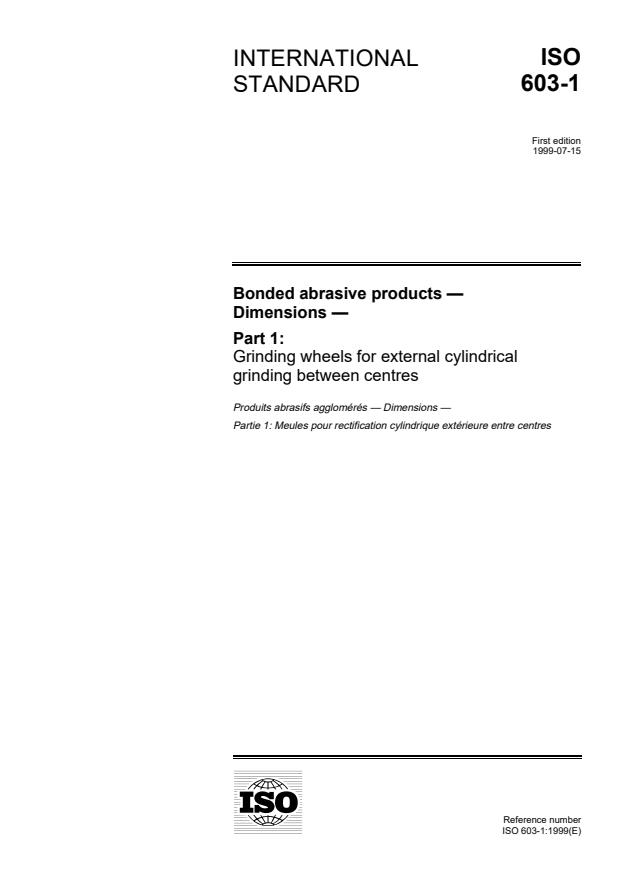
INTERNATIONAL ISO
STANDARD 603-1
First edition
1999-07-15
Bonded abrasive products —
Dimensions —
Part 1:
Grinding wheels for external cylindrical
grinding between centres
Produits abrasifs agglomérés — Dimensions —
Partie 1: Meules pour rectification cylindrique extérieure entre centres
A
Reference number
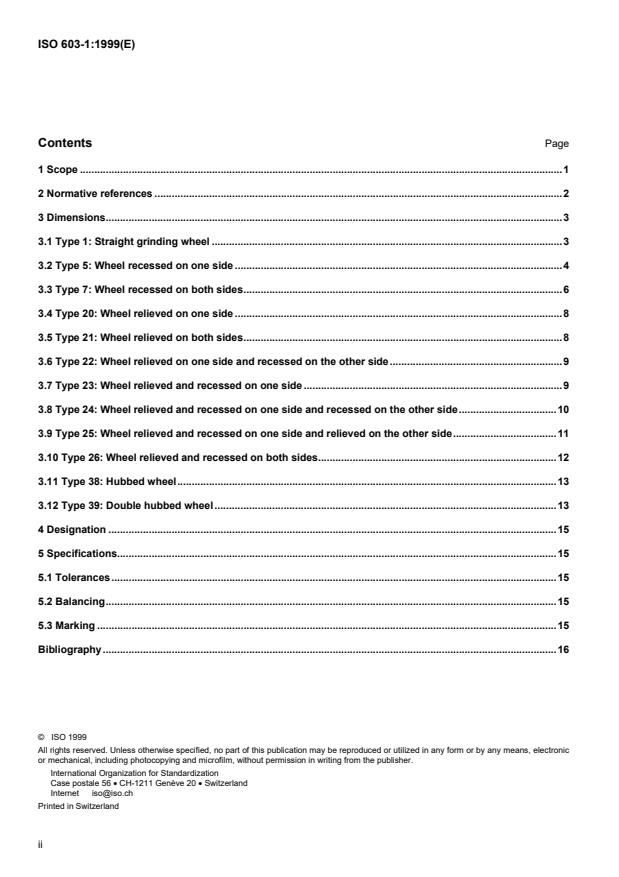
Contents Page
1 Scope .1
2 Normative references .2
3 Dimensions.3
3.1 Type 1: Straight grinding wheel .3
3.2 Type 5: Wheel recessed on one side .4
3.3 Type 7: Wheel recessed on both sides.6
3.4 Type 20: Wheel relieved on one side .8
3.5 Type 21: Wheel relieved on both sides.8
3.6 Type 22: Wheel relieved on one side and recessed on the other side.9
3.7 Type 23: Wheel relieved and recessed on one side .9
3.8 Type 24: Wheel relieved and recessed on one side and recessed on the other side.10
3.9 Type 25: Wheel relieved and recessed on one side and relieved on the other side.11
3.10 Type 26: Wheel relieved and recessed on both sides.12
3.11 Type 38: Hubbed wheel.13
3.12 Type 39: Double hubbed wheel.13
4 Designation .15
5 Specifications.15
5.1 Tolerances.15
5.2 Balancing.15
5.3 Marking .15
Bibliography.16
© ISO 1999
All rights reserved. Unless otherwise specified, no part of this publication may be reproduced or utilized in any form or by any means, electronic
or mechanical, including photocopying and microfilm, without permission in writing from the publisher.
International Organization for Standardization
Case postale 56 • CH-1211 Genève 20 • Switzerland
Internet iso@iso.ch
Printed in Switzerland
ii
© ISO
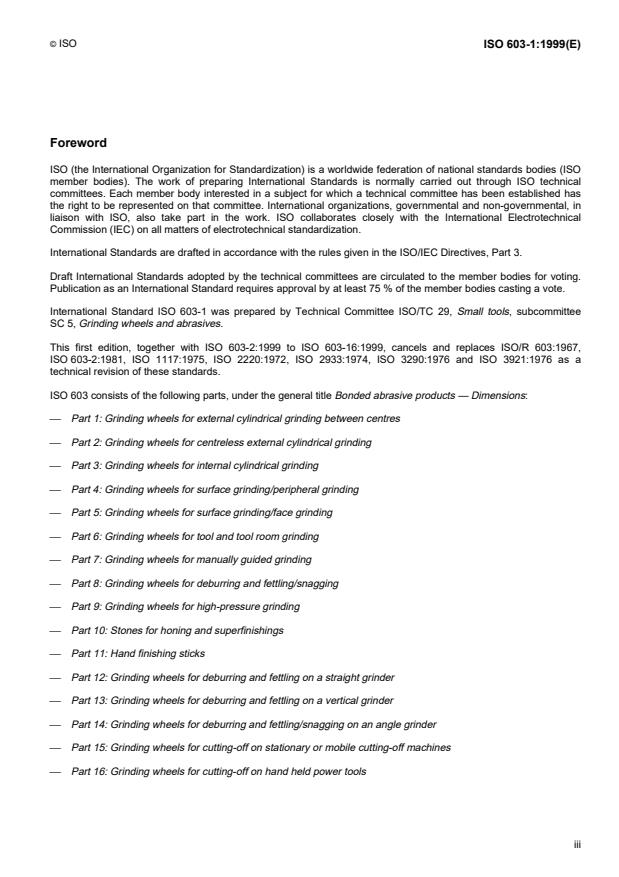
Foreword
ISO (the International Organization for Standardization) is a worldwide federation of national standards bodies (ISO
member bodies). The work of preparing International Standards is normally carried out through ISO technical
committees. Each member body interested in a subject for which a technical committee has been established has
the right to be represented on that committee. International organizations, governmental and non-governmental, in
liaison with ISO, also take part in the work. ISO collaborates closely with the International Electrotechnical
Commission (IEC) on all matters of electrotechnical standardization.
International Standards are drafted in accordance with the rules given in the ISO/IEC Directives, Part 3.
Draft International Standards adopted by the technical committees are circulated to the member bodies for voting.
Publication as an International Standard requires approval by at least 75 % of the member bodies casting a vote.
International Standard ISO 603-1 was prepared by Technical Committee ISO/TC 29, Small tools, subcommittee
SC 5, Grinding wheels and abrasives.
This first edition, together with ISO 603-2:1999 to ISO 603-16:1999, cancels and replaces ISO/R 603:1967,
ISO 603-2:1981, ISO 1117:1975, ISO 2220:1972, ISO 2933:1974, ISO 3290:1976 and ISO 3921:1976 as a
technical revision of these standards.
ISO 603 consists of the following parts, under the general title Bonded abrasive products — Dimensions:
Part 1: Grinding wheels for external cylindrical grinding between centres
Part 2: Grinding wheels for centreless external cylindrical grinding
Part 3: Grinding wheels for internal cylindrical grinding
Part 4: Grinding wheels for surface grinding/peripheral grinding
Part 5: Grinding wheels for surface grinding/face grinding
Part 6: Grinding wheels for tool and tool room grinding
Part 7: Grinding wheels for manually guided grinding
Part 8: Grinding wheels for deburring and fettling/snagging
Part 9: Grinding wheels for high-pressure grinding
Part 10: Stones for honing and superfinishings
Part 11: Hand finishing sticks
Part 12: Grinding wheels for deburring and fettling on a straight grinder
Part 13: Grinding wheels for deburring and fettling on a vertical grinder
Part 14: Grinding wheels for deburring and fettling/snagging on an angle grinder
Part 15: Grinding wheels for cutting-off on stationary or mobile cutting-off machines
Part 16: Grinding wheels for cutting-off on hand held power tools
iii
INTERNATIONAL STANDARD © ISO ISO 603-1:1999(E)
Bonded abrasive products — Dimensions —
Part 1:
Grinding wheels for external cylindrical grinding between centres
1 Scope
This part of ISO 603 specifies the nominal dimensions, in millimeters, of:
Type 1: Straight grinding wheel
Type 5: Wheel recessed on one side
Type 7: Wheel recessed on both sides
Type 20: Wheel relieved on one side
Type 21: Wheel relieved on both sides
Type 22: Wheel relieved on one side and recessed on the other side
Type 23: Wheel relieved and recessed on one side
Type 24: Wheel relieved and recessed on one side and recessed on the other side
Type 25: Wheel relieved and recessed on one side and relieved on the other side
Type 26: Wheel relieved and recessed on both sides.
Type 38: Hubbed wheel
Type 39: Double hubbed wheel
These bonded abrasive products are intended to be used for external cylindrical grinding between centres. The
workpiece and the grinding wheel are mechanically guided.
© ISO
2 Normative references
The following normative documents contain provisions which, through reference in this text, constitute provisions of
this part of ISO 603. For dated references, subsequent amendments to, or revisions of, any of these publications do
not apply. However, parties to agreements based on this part of ISO 603 are encouraged to investigate the
possibility of applying the most recent editions of the normative documents indicated below. For undated
references, the lates edition of the normative document referred to applies. Members of ISO and IEC maintain
registers of currently valid International Standards.
ISO 525:1999, Bonded abrasive products — General requirements.
ISO 6103:1999, Bonded abrasive products — Static balancing of grinding wheels — Testing.
1)
ISO 13942:— , Bonded abrasive products — Limit deviations and run-out tolerances.
1)
To be published.
© ISO
3 Dimensions
3.1 Type 1: Straight grinding wheel
See Figure 1 and Table 1.
Figure 1 — Type 1
Table 1 — Dimensions of Type 1
DT H
20 25 32 40 50 63 80 100 125 150
076,2
250 X X X X —— ——— —
076,2
300 X X X X X — — — — —
350/356 — X X X X X — — — —
400/406 — — X X X X X — — —
450/457 — — X X X X X —
...
NORME ISO
INTERNATIONALE 603-1
Première édition
1999-07-15
Produits abrasifs agglomérés —
Dimensions —
Partie 1:
Meules pour rectification cylindrique extérieure
entre centres
Bonded abrasive products — Dimensions —
Part 1: Grinding wheels for external cylindrical grinding between centres
A
Numéro de référence
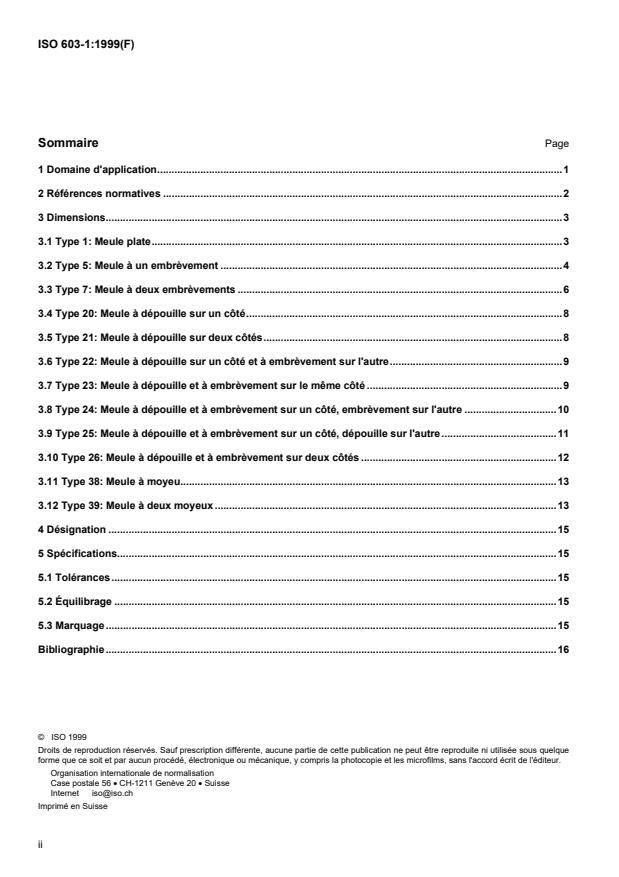
Sommaire Page
1 Domaine d'application.1
2 Références normatives .2
3 Dimensions.3
3.1 Type 1: Meule plate.3
3.2 Type 5: Meule à un embrèvement .4
3.3 Type 7: Meule à deux embrèvements .6
3.4 Type 20: Meule à dépouille sur un côté.8
3.5 Type 21: Meule à dépouille sur deux côtés.8
3.6 Type 22: Meule à dépouille sur un côté et à embrèvement sur l'autre.9
3.7 Type 23: Meule à dépouille et à embrèvement sur le même côté .9
3.8 Type 24: Meule à dépouille et à embrèvement sur un côté, embrèvement sur l'autre .10
3.9 Type 25: Meule à dépouille et à embrèvement sur un côté, dépouille sur l'autre.11
3.10 Type 26: Meule à dépouille et à embrèvement sur deux côtés .12
3.11 Type 38: Meule à moyeu.13
3.12 Type 39: Meule à deux moyeux .13
4 Désignation .15
5 Spécifications.15
5.1 Tolérances.15
5.2 Équilibrage .15
5.3 Marquage.15
Bibliographie.16
© ISO 1999
Droits de reproduction réservés. Sauf prescription différente, aucune partie de cette publication ne peut être reproduite ni utilisée sous quelque
forme que ce soit et par aucun procédé, électronique ou mécanique, y compris la photocopie et les microfilms, sans l'accord écrit de l'éditeur.
Organisation internationale de normalisation
Case postale 56 • CH-1211 Genève 20 • Suisse
Internet iso@iso.ch
Imprimé en Suisse
ii
© ISO
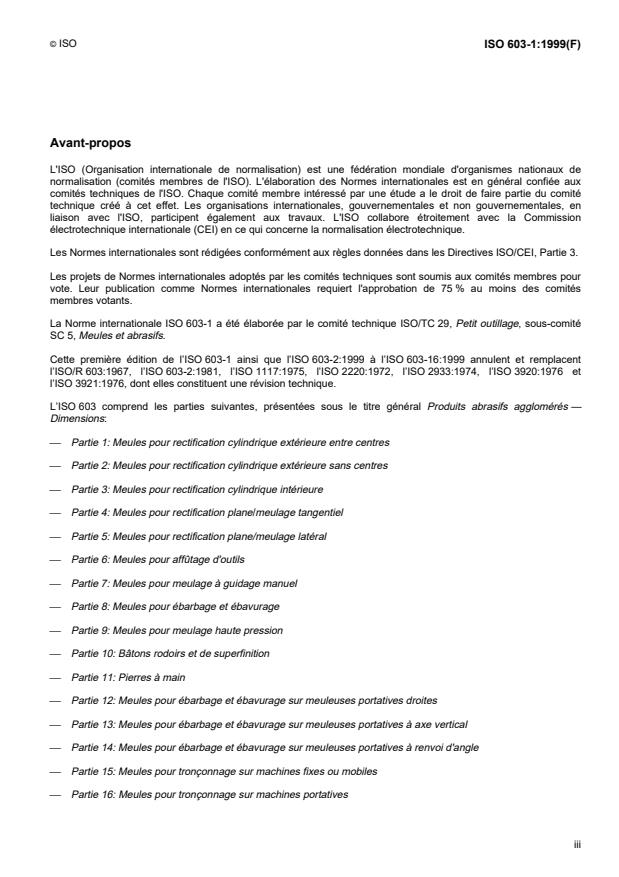
Avant-propos
L'ISO (Organisation internationale de normalisation) est une fédération mondiale d'organismes nationaux de
normalisation (comités membres de l'ISO). L'élaboration des Normes internationales est en général confiée aux
comités techniques de l'ISO. Chaque comité membre intéressé par une étude a le droit de faire partie du comité
technique créé à cet effet. Les organisations internationales, gouvernementales et non gouvernementales, en
liaison avec l'ISO, participent également aux travaux. L'ISO collabore étroitement avec la Commission
électrotechnique internationale (CEI) en ce qui concerne la normalisation électrotechnique.
Les Normes internationales sont rédigées conformément aux règles données dans les Directives ISO/CEI, Partie 3.
Les projets de Normes internationales adoptés par les comités techniques sont soumis aux comités membres pour
vote. Leur publication comme Normes internationales requiert l'approbation de 75 % au moins des comités
membres votants.
La Norme internationale ISO 603-1 a été élaborée par le comité technique ISO/TC 29, Petit outillage, sous-comité
SC 5, Meules et abrasifs.
Cette première édition de l’ISO 603-1 ainsi que l’ISO 603-2:1999 à l’ISO 603-16:1999 annulent et remplacent
l’ISO/R 603:1967, l’ISO 603-2:1981, l’ISO 1117:1975, l’ISO 2220:1972, l’ISO 2933:1974, l’ISO 3920:1976 et
l’ISO 3921:1976, dont elles constituent une révision technique.
L’ISO 603 comprend les parties suivantes, présentées sous le titre général Produits abrasifs agglomérés —
Dimensions:
Partie 1: Meules pour rectification cylindrique extérieure entre centres
Partie 2: Meules pour rectification cylindrique extérieure sans centres
Partie 3: Meules pour rectification cylindrique intérieure
Partie 4: Meules pour rectification plane/meulage tangentiel
Partie 5: Meules pour rectification plane/meulage latéral
Partie 6: Meules pour affûtage d'outils
Partie 7: Meules pour meulage à guidage manuel
Partie 8: Meules pour ébarbage et ébavurage
Partie 9: Meules pour meulage haute pression
Partie 10: Bâtons rodoirs et de superfinition
Partie 11: Pierres à main
Partie 12: Meules pour ébarbage et ébavurage sur meuleuses portatives droites
Partie 13: Meules pour ébarbage et ébavurage sur meuleuses portatives à axe vertical
Partie 14: Meules pour ébarbage et ébavurage sur meuleuses portatives à renvoi d'angle
Partie 15: Meules pour tronçonnage sur machines fixes ou mobiles
Partie 16: Meules pour tronçonnage sur machines portatives
iii
NORME INTERNATIONALE © ISO ISO 603-1:1999(F)
Produits abrasifs agglomérés — Dimensions —
Partie 1:
Meules pour rectification cylindrique extérieure entre centres
1 Domaine d'application
La présente partie de l’ISO 603 spécifie les dimensions nominales, en millimètres, des meules de
Type 1: Meule plate
Type 5: Meule à un embrèvement
Type 7: Meule à deux embrèvements
Type 20: Meule à dépouille sur un côté
Type 21: Meule à dépouille sur deux côtés
Type 22: Meule à dépouille sur un côté et à embrèvement sur l'autre
Type 23: Meule à dépouille et à embrèvement sur le même côté
Type 24: Meule à dépouille et à embrèvement sur un côté, embrèvement sur l'autre
Type 25: Meule à dépouille et à embrèvement sur un côté, dépouille sur l'autre
Type 26: Meule à dépouille et à embrèvement sur deux côtés
Type 38: Meule à moyeu
Type 39: Meule à deux moyeux
Ces produits abrasifs agglomérés sont utilisés pour la rectification cylindrique extérieure entre centres. La pièce
travaillée et la meule sont guidées mécaniquement.
© ISO
2 Références normatives
Les documents normatifs suivants contiennent des dispositions qui, par suite de la référence qui y est faite,
constituent des dispositions valables pour la présente partie de l’ISO 603. Pour les références datées, les
amendements ultérieurs ou les révisions de ces publications ne s’appliquent pas. Toutefois, les parties prenantes
aux accords fondés sur la présente partie de l’ISO 603 sont invitées à rechercher la possibilité d'appliquer les
éditions les plus récentes des documents normatifs indiqués ci-après. Pour les références non datées, la dernière
édition du document normatif en référence s’applique. Les membres de l'ISO et de la CEI possèdent le registre des
Normes internationales en vigueur.
ISO 525:1999, Produits abrasifs agglomérés — Exigences générales.
ISO 6103:1999, Produits abrasifs agglomérés — Équilibrage statique des meules — Contrôle.
1)
ISO 13942:— , Produits abrasifs agglomérés — Écarts limites et tolérances de battement.
1)
À publier.
© ISO
3 Dimensions
3.1 Type 1: Meule plate
Voir Figure 1 et Tableau 1.
Figure 1 — Type 1
Table 1 — Dimensions du type 1
DT H
20 25 32 40 50 63 80 100 125 150
76,2
250 X X X X —— —— ——
76,2
300 XX XX X — — — — —
350/356 — X X X X X — — — —
400/406 — — X X X X X — — —
450/457 — — X X X X X — — —
203,2
203,2
500/508 — — X X X X
...