

ISO 21400:2018
(Main)Pulp — Determination of cellulose nanocrystal sulfur and sulfate half-ester content
General Information
- Abstract
This document specifies procedures for the laboratory determination of the total elemental sulfur and the sulfate half-ester content of cellulose nanocrystals (CNCs) by inductively coupled plasma-optical emission spectroscopy and conductometric titration, respectively, including sample preparation, measurement methods and data analysis. This document is applicable to the characterization of CNCs: a) with all monovalent counterions (particularly hydronium and sodium cations); b) which are either in the never-dried state in aqueous suspension, or have been redispersed from a dried form; and c) which have been extracted from any naturally occurring cellulose source using a range of sulfuric acid hydrolysis conditions, or have been sulfated post-hydrolysis using sulfuric acid.
- Status
- Published
- Publication Date
- 17-Dec-2018
- Technical Committee
- ISO/TC 6 - Paper, board and pulps
- Drafting Committee
- ISO/TC 6/WG 4 - Chemical analysis
- Current Stage
- 9093 - International Standard confirmed
- Start Date
- 29-Nov-2024
- Completion Date
- 29-Aug-2026
Buy Documents


ISO 21400:2018 - Pulp -- Determination of cellulose nanocrystal sulfur and sulfate half-ester content


ISO 21400:2018 - Pulp — Determination of cellulose nanocrystal sulfur and sulfate half-ester content/18/2018
Overview
ISO 21400:2018 specifies laboratory procedures for determining the total elemental sulfur and the sulfate half‑ester content of cellulose nanocrystals (CNCs). The standard defines sample preparation, measurement methods and data analysis for two complementary techniques: inductively coupled plasma–optical emission spectroscopy (ICP‑OES) for total sulfur, and conductometric titration for sulfate half‑ester (R–OSO−) content. ISO 21400:2018 is applicable to CNCs with monovalent counterions (e.g., H+ or Na+), whether never‑dried or redispersed after drying, and to CNCs produced by sulfuric acid hydrolysis or post‑hydrolysis sulfation.
Key topics and technical requirements
- Scope and applicability: Methods cover CNCs from natural cellulose sources and a range of sulfuric acid hydrolysis/sulfation conditions.
- ICP‑OES method: Procedure for sample purification (dialysis), microwave‑assisted digestion (or Annex A wet‑ashing alternative), calibration, analysis and calculation of total elemental sulfur and derived surface charge.
- Conductometric titration method: Protocol for dialysis purification, protonation (including ion‑exchange resin batch treatment described in Annex B), titration steps, and conversion of titration results to sulfate half‑ester content and CNC surface charge.
- Sample preparation: Emphasis on controlled dialysis, resin treatment or protonation, and accurate dry mass determination to report results on an oven‑dry basis.
- Data analysis and reporting: Calculation formulas, test report requirements, and cross‑method comparison (ICP‑OES vs. conductometric titration) with typical agreement expected within about 5–10%.
- Quality controls: Use of calibration solutions, blanks, internal standards and precision assessment (Annex C).
Practical applications and users
ISO 21400:2018 is designed for laboratory use by:
- CNC manufacturers for product specification and batch quality control (sulfur/surface charge listed on material data sheets).
- Analytical testing laboratories validating CNC surface chemistry.
- R&D teams and academics studying CNC colloidal stability, self‑assembly, rheology or functionalization that depend on surface charge.
- Formulators in composites, coatings, paper, packaging and biomedical applications where CNC charge affects dispersion, interactions and performance.
Practical benefits include standardized, reproducible measurement of CNC sulfur content and surface charge-critical parameters that influence suspension stability, processing, and end‑use properties. Users should ensure laboratory safety training for hazardous reagents and follow the standard’s purification and calibration procedures for reliable results.
Related standards
ISO 21400 references several normative documents relevant to laboratory practice and nanomaterials vocabulary, including:
- ISO 3696 (water for analytical laboratory use)
- ISO 14644‑1 (cleanroom classification)
- ISO/TS 80004 series (nanotechnologies vocabulary)
- Relevant ISO/TS documents on CNC terminology and characterization.
Buy Documents
ISO 21400:2018 - Pulp -- Determination of cellulose nanocrystal sulfur and sulfate half-ester content
ISO 21400:2018 - Pulp — Determination of cellulose nanocrystal sulfur and sulfate half-ester content/18/2018
Get Certified
Connect with accredited certification bodies for this standard

Control Union Certifications
Global certification for agriculture and sustainability.

Gozdarski inštitut Slovenije
Slovenian Forestry Institute. Forest management certification support, timber testing.
Sponsored listings
Frequently Asked Questions
ISO 21400:2018 is a standard published by the International Organization for Standardization (ISO). Its full title is "Pulp — Determination of cellulose nanocrystal sulfur and sulfate half-ester content". This standard covers: This document specifies procedures for the laboratory determination of the total elemental sulfur and the sulfate half-ester content of cellulose nanocrystals (CNCs) by inductively coupled plasma-optical emission spectroscopy and conductometric titration, respectively, including sample preparation, measurement methods and data analysis. This document is applicable to the characterization of CNCs: a) with all monovalent counterions (particularly hydronium and sodium cations); b) which are either in the never-dried state in aqueous suspension, or have been redispersed from a dried form; and c) which have been extracted from any naturally occurring cellulose source using a range of sulfuric acid hydrolysis conditions, or have been sulfated post-hydrolysis using sulfuric acid.
This document specifies procedures for the laboratory determination of the total elemental sulfur and the sulfate half-ester content of cellulose nanocrystals (CNCs) by inductively coupled plasma-optical emission spectroscopy and conductometric titration, respectively, including sample preparation, measurement methods and data analysis. This document is applicable to the characterization of CNCs: a) with all monovalent counterions (particularly hydronium and sodium cations); b) which are either in the never-dried state in aqueous suspension, or have been redispersed from a dried form; and c) which have been extracted from any naturally occurring cellulose source using a range of sulfuric acid hydrolysis conditions, or have been sulfated post-hydrolysis using sulfuric acid.
ISO 21400:2018 is classified under the following ICS (International Classification for Standards) categories: 85.040 - Pulps. The ICS classification helps identify the subject area and facilitates finding related standards.
ISO 21400:2018 is available in PDF format for immediate download after purchase. The document can be added to your cart and obtained through the secure checkout process. Digital delivery ensures instant access to the complete standard document.
Standards Content (Sample)
INTERNATIONAL ISO
STANDARD 21400
First edition
2018-12
Pulp — Determination of cellulose
nanocrystal sulfur and sulfate half-
ester content
Pâte — Détermination de la teneur en soufre et en demi-ester de
sulfate des nanocristaux de cellulose
Reference number
©
ISO 2018
© ISO 2018
All rights reserved. Unless otherwise specified, or required in the context of its implementation, no part of this publication may
be reproduced or utilized otherwise in any form or by any means, electronic or mechanical, including photocopying, or posting
on the internet or an intranet, without prior written permission. Permission can be requested from either ISO at the address
below or ISO’s member body in the country of the requester.
ISO copyright office
CP 401 • Ch. de Blandonnet 8
CH-1214 Vernier, Geneva
Phone: +41 22 749 01 11
Fax: +41 22 749 09 47
Email: copyright@iso.org
Website: www.iso.org
Published in Switzerland
ii © ISO 2018 – All rights reserved
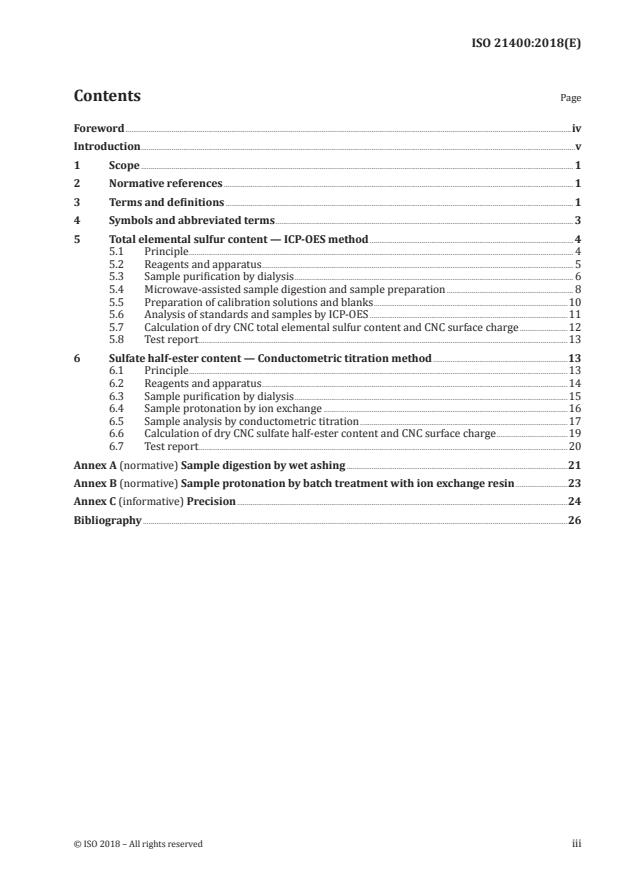
Contents Page
Foreword .iv
Introduction .v
1 Scope . 1
2 Normative references . 1
3 Terms and definitions . 1
4 Symbols and abbreviated terms . 3
5 Total elemental sulfur content — ICP-OES method . 4
5.1 Principle . 4
5.2 Reagents and apparatus . 5
5.3 Sample purification by dialysis . 6
5.4 Microwave-assisted sample digestion and sample preparation . 8
5.5 Preparation of calibration solutions and blanks .10
5.6 Analysis of standards and samples by ICP-OES .11
5.7 Calculation of dry CNC total elemental sulfur content and CNC surface charge .12
5.8 Test report .13
6 Sulfate half-ester content — Conductometric titration method .13
6.1 Principle .13
6.2 Reagents and apparatus .14
6.3 Sample purification by dialysis .15
6.4 Sample protonation by ion exchange .16
6.5 Sample analysis by conductometric titration .17
6.6 Calculation of dry CNC sulfate half-ester content and CNC surface charge .19
6.7 Test report .20
Annex A (normative) Sample digestion by wet ashing .21
Annex B (normative) Sample protonation by batch treatment with ion exchange resin .23
Annex C (informative) Precision .24
Bibliography .26
Foreword
ISO (the International Organization for Standardization) is a worldwide federation of national standards
bodies (ISO member bodies). The work of preparing International Standards is normally carried out
through ISO technical committees. Each member body interested in a subject for which a technical
committee has been established has the right to be represented on that committee. International
organizations, governmental and non-governmental, in liaison with ISO, also take part in the work.
ISO collaborates closely with the International Electrotechnical Commission (IEC) on all matters of
electrotechnical standardization.
The procedures used to develop this document and those intended for its further maintenance are
described in the ISO/IEC Directives, Part 1. In particular, the different approval criteria needed for the
different types of ISO documents should be noted. This document was drafted in accordance with the
editorial rules of the ISO/IEC Directives, Part 2 (see www .iso .org/directives).
Attention is drawn to the possibility that some of the elements of this document may be the subject of
patent rights. ISO shall not be held responsible for identifying any or all such patent rights. Details of
any patent rights identified during the development of the document will be in the Introduction and/or
on the ISO list of patent declarations received (see www .iso .org/patents).
Any trade name used in this document is information given for the convenience of users and does not
constitute an endorsement.
For an explanation of the voluntary nature of standards, the meaning of ISO specific terms and
expressions related to conformity assessment, as well as information about ISO's adherence to the
World Trade Organization (WTO) principles in the Technical Barriers to Trade (TBT) see www .iso
.org/iso/foreword .html.
This document was prepared by Technical Committee ISO/TC 6, Paper, board and pulps.
Any feedback or questions on this document should be directed to the user’s national standards body. A
complete listing of these bodies can be found at www .iso .org/members .html.
iv © ISO 2018 – All rights reserved
Introduction
This document, which establishes testing methodologies for measuring the total elemental sulfur and
sulfate half-ester group contents of cellulose nanocrystals (CNCs), was developed in response to a need
for a simple and rapid method for indirect quantification of CNC surface charge.
The main purpose of the two methods covered (inductively coupled plasma-optical emission
spectroscopy (ICP-OES) and conductometric titration) in this document is to measure the surface
charge of sulfated CNCs. Sulfate half-ester groups (R–OSO H) covalently bound at the nanocrystal
surface are introduced during concentrated sulfuric acid hydrolysis by partial esterification of the
[1]
cellulose hydroxy groups . The anionic sulfate half-ester groups are strong acids, such that at neutral
-
and basic pH values, the protons dissociate and the CNC surface is negatively charged (R–OSO ). The
pKa of the sulfate half-ester groups on CNCs is approximately 2,5 (as determined by potentiometric
titration), implying that at very low pH the surface groups are protonated and CNCs have a net neutral
[2]
charge . This surface charge controls many important properties of CNC suspensions, including the
colloidal stability, self-assembly and rheological behaviour, both in the pure state and in the presence of
salts and other additives. As such, the CNC surface charge is a very important factor in the processing
and development of commercial products containing CNCs. The sulfate half-ester (sulfur) content will
also be a key entry on material specifications sheets which will accompany the commercial product,
enabling different product grades to be distinguished from each other and from other companies’
products.
ICP-OES and conductometric titration are both included in this document as they provide different but
complementary ways of measuring the surface charge. ICP-OES measures elemental sulfur which is
present in a 1:1 ratio with the charged sulfate half-ester groups, and does not depend on the nature of
the counterion. Conductometric titration, on the other hand, measures only protons associated with
-
the anionic R–OSO , but is much less complicated to carry out. The two analysis methods should yield
equivalent results (see 5.1 and 6.1), or within 5 % to 10 % owing to sources of uncertainty/error such
as transfer losses and slight differences in the purification and protonation steps. CNCs derived from
different cellulose sources have shown different levels of agreement between the results from the two
[3]
methods . The objective of this document is to use this information in quantifying the CNC surface
charge arising from the easily ionized sulfate half-ester moieties introduced during hydrolysis or post-
sulfation.
The tests contained herein are based on literature methods and were developed over several years by a
group of industry experts, and were identified as being those which can yield reproducible and accurate
results. The tests are anticipated to be performed in a laboratory setting.
As with any laboratory procedure requiring the use of potentially hazardous chemicals, the user is
expected to have received proper knowledge and training in the use and disposal of these chemicals.
This document contains footnotes giving examples of apparatus, reagents and sometimes the supplier(s)
of those materials that are available commercially. This information is given for the convenience of users
of this document and does not constitute an endorsement by ISO of the products named. Equivalent
products may be used if they can be shown to lead to the same results.
Annex A provides an alternative method of sample digestion for ICP-OES by wet ashing. Annex B
provides an alternative method of sample protonation for conductometric titration by treatment with
batches of ion exchange resin.
INTERNATIONAL STANDARD ISO 21400:2018(E)
Pulp — Determination of cellulose nanocrystal sulfur and
sulfate half-ester content
1 Scope
This document specifies procedures for the laboratory determination of the total elemental sulfur and
the sulfate half-ester content of cellulose nanocrystals (CNCs) by inductively coupled plasma-optical
emission spectroscopy and conductometric titration, respectively, including sample preparation,
measurement methods and data analysis.
This document is applicable to the characterization of CNCs:
a) with all monovalent counterions (particularly hydronium and sodium cations);
b) which are either in the never-dried state in aqueous suspension, or have been redispersed from a
dried form; and
c) which have been extracted from any naturally occurring cellulose source using a range of sulfuric
acid hydrolysis conditions, or have been sulfated post-hydrolysis using sulfuric acid.
2 Normative references
The following documents are referred to in the text in such a way that some or all of their content
constitutes requirements of this document. For dated references, only the edition cited applies. For
undated references, the latest edition of the referenced document (including any amendments) applies.
ISO 3696, Water for analytical laboratory use — Specification and test methods
ISO 14644-1, Cleanrooms and associated controlled environments — Part 1: Classification of air cleanliness
by particle concentration
ISO/TS 80004-1, Nanotechnologies — Vocabulary — Part 1: Core terms
ISO/TS 80004-2, Nanotechnologies — Vocabulary — Part 2: Nano-objects
ISO/TS 80004-6, Nanotechnologies — Vocabulary — Part 6: Nano-object characterization
3 Terms and definitions
For the purposes of this document, the terms and definitions given in ISO/TS 80004-1, ISO/TS 80004-2,
ISO/TS 80004-6 and the following apply.
ISO and IEC maintain terminological databases for use in standardization at the following addresses:
— ISO Online browsing platform: available at https: //www .iso .org/obp
— IEC Electropedia: available at http: //www .electropedia .org/
3.1
nanoscale
length range approximately from 1 nm to 100 nm
Note 1 to entry: Properties that are not extrapolations from larger sizes are predominantly exhibited in this
length range.
[SOURCE: ISO/TS 80004-1:2015, 2.1]
3.2
nano-object
discrete piece of material with one, two or three external dimensions in the nanoscale (3.1)
Note 1 to entry: The second and third external dimensions are orthogonal to the first dimension and to each other.
[SOURCE: ISO/TS 80004-1:2015, 2.5]
3.3
nanocrystal
nano-object (3.2) with a crystalline structure
[SOURCE: ISO/TS 80004-2:2015, 4.15]
3.4
elementary fibril
structure, originating from a single terminal enzyme complex, having a configuration of cellulose
chains specific to each cellulose-producing plant, animal, algal and bacterial species
[SOURCE: ISO/TS 20477:2017, 3.2.5]
3.5
cellulose nanocrystal
CNC
nanocrystal (3.3) predominantly composed of cellulose with at least one elementary fibril (3.4),
containing predominantly crystalline and paracrystalline regions, with aspect ratio of usually less
than 50 but usually greater than 5, not exhibiting longitudinal splits, inter-particle entanglement, or
network-like structures
Note 1 to entry: The dimensions are typically 3 nm to 50 nm in cross-section and 100 nm to several μm in length,
depending on the source of the cellulose nanocrystal.
Note 2 to entry: The aspect ratio refers to the ratio of the longest to the shortest dimension.
Note 3 to entry: Historically, cellulose nanocrystals have been called nanocrystalline cellulose (NCC), cellulose
whiskers or cellulose nanowhiskers (CNW), and cellulose microfibrils; they have also been called spheres,
needles or nanowires based on their shape, dimensions and morphology. Other names have included cellulose
micelles, cellulose crystallites and cellulose microcrystals.
[SOURCE: ISO/TS 20477:2017, 3.3.5, modified — Note 3 to entry has been revised.]
3.6
agglomerate
collection of weakly or medium-strongly bound particles where the resulting external surface area is
similar to the sum of the surface areas of the individual components
Note 1 to entry: The forces holding an agglomerate together are weak forces, for example van der Waals forces or
simple physical entanglement.
Note 2 to entry: Agglomerates are also termed secondary particles and the original source particles are termed
primary particles.
[SOURCE: ISO/TS 80004-2:2015, 3.4]
3.7
analyte
element to be determined
3.8
calibration blank solution
solution prepared in the same way as the calibration solution (3.9) but leaving out the analyte (3.7)
2 © ISO 2018 – All rights reserved
3.9
calibration solution
solution used to calibrate the instrument, prepared from a stock solution (3.11) or a certified standard
by adding acids, buffer, reference element and salts as needed
3.10
matrix blank solution
solution prepared in the same way as the test sample solution (3.14) but omitting the test sample (3.13)
3.11
stock solution
solution with accurately known analyte (3.7) concentration(s), prepared from pure chemicals such as a
primary standard
3.12
quality control sample solution
solution of known composition within the range of the calibration solutions (3.8), but prepared
independently
3.13
test sample
portion taken from the laboratory sample after, for example, homogenizing or dividing
3.14
test sample solution
solution prepared after extraction, dispersion, purification or other preparation of the test sample
(3.13), such that it can be used for the envisaged measurement
4 Symbols and abbreviated terms
a slope of the standard addition plot, in mg/kg
b intercept of the standard addition plot, in mg/kg
c concentration (titre) of sodium hydroxide, in mol/l
CAS Chemical Abstracts Service, a division of American Chemical Society
CNC cellulose nanocrystal
cps counts per second
ICP-OES inductively coupled plasma-optical emission spectroscopy
κ conductivity corrected for dilution, in S/cm
m mass of dry sample, expressed in g
d
m mass of the internal standard added to sample aliquot number i, in g
int, i
m mass of potassium hydrogen phthalate standard, in g
KHP
m mass of original sample, in g
o
m mass of the CNC sample present in sample aliquot number i, in g
S, i
m mass of the sulfur standard added to sample aliquot number i, in g
std, i
m oven-dry mass of resin-treated CNCs in the suspension being titrated, in kg
t
meq milliequivalent
MWCO molecular weight cut-off
NIST National Institute of Standards and Technology
o.d. oven-dry
ppm parts per million
R ratio of ICP-OES signals corresponding to the analyte and the internal standard
i
σ CNC surface charge content, in meq/kg
S concentration of sulfur in the undiluted matrix blank solution, in mg/kg or mg/l
blk
S mass fraction of analyte (sulfur) in the sulfur standard added to each sample aliquot,
std
in mg/kg
SAC strong acid cation
v added volume of titrant, in l
V volume of sodium hydroxide solution required to reach the equivalence point, in l
e
V initial volume of test sample solution being titrated, in l
t
w mass fraction solids content, in percent
[R–OSO H] quantity of protonated sulfate half-ester groups [R–OSO H] present on the CNC sur-
3 3
face, in moles per kg of dry CNCs
[S] blank corrected concentration of sulfur in the CNC test sample, in mg/kg
5 Total elemental sulfur content — ICP-OES method
5.1 Principle
5.1.1 This method covers the determination of total elemental sulfur (S) content of cellulose
nanocrystals (CNCs). Inductively coupled plasma-optical emission spectroscopy (ICP-OES) is used for
analysis, following sample purification by dialysis to remove any sulfur-containing contaminants found
in the water matrix of the aqueous CNC suspension, and sample digestion to ensure that most (all) of the
S in the CNC sample is dissolved in the aqueous medium used for analysis.
5.1.2 Dialysis is typically used to purify CNC suspensions by removing dissolved ions, including residual
[4]
sulfur-containing contaminants such as sulfuric acid or sodium sulfate, from the aqueous phase . The
final dialysed samples are freeze-dried prior to analysis by ICP-OES. Samples can also be digested and
analysed beginning directly from aqueous CNC suspensions, but this method is less precise owing to the
variations in solids content.
5.1.3 The aqueous sample containing the dissolved sulfur-containing ions is delivered by a peristaltic
pump into an analytical nebulizer where it is atomized and introduced into a plasma flame. The sample
is broken down into ions, which break up into their respective atoms, which then lose electrons and
recombine repeatedly in the plasma, giving off radiation at the characteristic wavelengths of the elements
involved. During analysis, light of wavelength around 180 nm to 182 nm (atom and ion lines) is emitted
from the sulfur and onto a detector that measures the amount of light emitted. The emission intensity is a
measure of the concentration of sulfur in the sample. The spectra are dispersed by a grating spectrometer
and the intensities of the lines are monitored by a detector. The signals from the detector(s) are then
4 © ISO 2018 – All rights reserved
processed and controlled by a computer system. A suitable background correction technique is used to
compensate for variable background contributions.
5.1.4 ICP-OES is used to measure the total elemental sulfur content in a CNC sample. Sulfur is not
typically present in cellulose derived from native sources; the sulfur in the CNCs can therefore be
assumed to originate only from the surface sulfate half-ester groups imparted during CNC production
[5]
by sulfuric acid hydrolysis. However, if sulfur is known to be present in the original cellulose sample
[6]
, comparing the total S content of the CNCs with that of the original material and with CNCs produced
from the same source by HCl hydrolysis (which do not contain sulfate half-ester groups) should give the
concentration of sulfur derived from sulfate half-ester groups.
5.2 Reagents and apparatus
1)
5.2.1 Water, ultrapure (deionized or distilled), conforming to Grade 2 of ISO 3696 or better .
5.2.2 Nitric acid (HNO ) solution, concentrated, trace metal grade (60 % – 70 % assay) (CAS number
7697-37-2).
5.2.3 Hydrochloric acid (HCl) solution, concentrated, reagent grade (36 %) (CAS number 7647-01-0).
5.2.4 Calibration blank, solution of acid used to digest samples (see 5.5.3).
2)
5.2.5 Standard sulfur reference material, for quality control sample solution .
5.2.6 Primary sulfur standard stock calibration solution, containing 1 000 ppm to 10 000 ppm S,
3)
and other elements .
5.2.7 Solution of yttrium (Y) for internal standard, or other appropriate internal standard such as
4)
europium (Eu) which will not interfere with measurement of the sulfur wavelengths .
5.2.8 Probe-type sonicator, with variable power output control, fitted with a probe of
5)
appropriate processing capability for the volume of sample to be treated .
5.2.9 Plastic centrifuge tubes, 50 ml capacity.
1) Millipore Milli-Q® water purification systems are examples of suitable systems available commercially. This
information is given for the convenience of users of this document and does not constitute an endorsement by ISO of
these products.
2) CNCD-1 certified CNC reference material (National Research Council Canada) containing 8 720 mg/kg ± 140 mg/
kg S in a matrix similar to the samples intended for analysis, and NIST bovine liver standard reference material
1577c containing 7 490 ± 340 mg S/kg are examples of suitable products available commercially. This information is
given for the convenience of users of this document and does not constitute an endorsement by ISO of this product.
3) Pre-mixed calibration stock solution composed of 27 elements including 1 000 ppm S (Delta Scientific) or NIST
stock sulfur solution (10 300 mg/kg ± 30 mg/kg) are examples of suitable products available commercially. This
information is given for the convenience of users of this document and does not constitute an endorsement by ISO of
these products.
4) A 10 000 ppm Y solution from SCP Science is an example of a suitable product available commercially. This
information is given for the convenience of users of this document and does not constitute an endorsement by ISO of
this product.
5) A Sonics vibra-cell™ 130 watt ultrasonic processor with a 6 mm diameter probe is an example of a suitable
product available commercially. This information is given for the convenience of users of this document and does
not constitute an endorsement by ISO of this product.
5.2.10 Dialysis membrane tubes, with molecular weight cut-off (MWCO) small enough to prevent
6)
CNCs escaping but large enough to allow rapid dialysis .
5.2.11 Dialysis clips.
5.2.12 Dialysis column or equivalent.
5.2.13 Freezer.
5.2.14 Freeze-dryer and freeze-dryer flasks.
5.2.15 Desiccator.
5.2.16 Oven, capable of maintaining a temperature of 105 °C ± 3 °C.
5.2.17 Balance, accuracy ± 0,000 1 g.
5.2.18 Aluminium weighing dishes.
5.2.19 Fume hood.
5.2.20 Volumetric flasks, 50 ml, 100 ml and 1 000 ml capacity.
5.2.21 Microwave digestion vessels, quartz or polytetrafluoroethylene (PTFE), with PTFE caps.
5.2.22 Stir bars, egg-shaped, sized to fit in microwave digestion vessels with enough clearance to move
easily. Stir bars are not required with every microwave digestion system.
5.2.23 Microwave digestion system. Any pressurized closed vessel microwave digestion system
7)
equipped with temperature monitoring capabilities is suitable . Alternatively, a conventional hotplate
may be used (see Annex A).
5.2.24 ICP-OES system. Any inductively coupled plasma-optical emission spectroscopy system which
8)
can detect concentrations of sulfur ≥ 1 ppm is suitable .
5.2.25 Argon gas, high purity (CAS number 7440-37-1), for ICP-OES system.
5.3 Sample purification by dialysis
5.3.1 Carry out the entire procedure in duplicate on separate test specimens.
5.3.2 Around 0,25 g (o.d.) of CNCs are typically required to run the ICP-OES analysis, in order to obtain
a sulfur content in the sample solutions that lies in the mid-range of the standard curve; this mass may
6) Spectra/Por® 4 Regenerated Cellulose membranes with MWCO of 12 kDa–14 kDa are an example of a suitable
product available commercially. This information is given for the convenience of users of this document and does
not constitute an endorsement by ISO of this product.
7) The CEM Discover SP-D is an example of a suitable instrument available commercially. This information is
given for the convenience of users of this document and does not constitute an endorsement by ISO of this product.
8) The Thermo Scientific iCAP 6000 series is an example of a suitable instrument available commercially. This
information is given for the convenience of users of this document and does not constitute an endorsement by ISO of
this product.
6 © ISO 2018 – All rights reserved
be adjusted as required. The mass of CNC suspension required can be calculated by dividing the desired
mass of CNCs for analysis by the mass fraction solids content of the CNC suspension.
5.3.3 Dilute never-dried CNC suspension containing at least 0,5 g (o.d.) of CNCs to around 0,55 %
(mass fraction) with water (5.2.1).
It is not recommended that concentrated CNC suspensions [>1 % (mass fraction)] be dialysed, as
diffusion rates will decrease due to the increased suspension viscosity, significantly reducing the
dialysis efficiency.
5.3.4 Alternatively, redisperse at least 0,5 g (o.d.) spray-dried or freeze-dried CNCs to around 0,55 %
(mass fraction) in water (5.2.1) by gradually adding to water in a container while stirring vigorously
(e.g. with a magnetic stir bar). Cover and stir until all visible particles have disappeared. Continue
stirring for 1 h.
5.3.5 Sonicate the redispersed dried CNC suspension to ensure full dispersion. A suitable procedure is
described in Reference [3].
EXAMPLE A 30 g aliquot of 0,55 % (mass fraction) CNC suspension in a 50 ml plastic centrifuge tube is
sonicated using a 6 mm diameter probe on a 130 W sonicator set at 60 % amplitude (7 W – 8 W power output),
to a total energy input of 1 650 J (= 10 kJ per g CNCs in the sample). This operation is performed a total of three
times to obtain a sonicated sample containing 0,5 g of CNC.
Ultrasonic baths are not powerful enough to achieve full dispersion of CNC agglomerates; sonicator
probes directly immersed in the suspension shall be used.
Sonication may be omitted if unsonicated and sonicated samples show no difference in final results
(e.g. for never-dried CNC suspensions). Each different type of sample should be tested before omitting
sonication.
Sonicated suspensions may be filtered using GF/F glass microfibre filter paper to remove metal particles
(normally titanium, aluminium or aluminium-containing alloys) released from the probe.
5.3.6 Soak dialysis membrane tubes in water (5.2.1) for 30 min, then rinse thoroughly inside and out
with fresh water (5.2.1).
5.3.7 Place suspension in dialysis membrane tubes after clipping one end, ensuring the tubes are no
more than two-thirds full, then clip the other end. Dialyse the samples against running deionized or
better-quality water for at least 3 days. If using dialysis columns (tanks containing static water stirred
with magnetic stir bar or equivalent), change the water (5.2.1) at least three or four times per day for
at least 3 days, until constant pH and conductivity of the column water are reached for two consecutive
water changes. Both pH and conductivity should be within ± 0,2 units and ± 5 μS/cm of the values for the
water used for dialysis.
5.3.8 Freeze and lyophilize the dialysed CNC suspensions and store the freeze-dried CNC samples in a
desiccator.
Dried cellulose nanocrystals are hygroscopic and adsorb atmospheric moisture rapidly; they should
always be stored in a desiccator when not in use.
5.3.9 Accurately weigh (to ± 0,000 1 g) a minimum of approximately 0,20 g of the freeze-dried CNCs
obtained in 5.3.8. Dry to constant mass at a temperature of 105 °C ± 3 °C. Cool the sample in a desiccator
and weigh. Calculate w, the mass fraction solids content, expressed as a percentage, using Formula (1):
mm− m
od d
w =−100 1 =100 (1)
m m
o o
where
w is the mass fraction solids content, expressed as a percentage, of the dialysed CNC suspension;
m is the mass, in grams, of the original sample;
o
m is the mass, in grams, of the dry sample.
d
The CNC sample may also be dried to constant mass by storing the sample in a desiccator over
magnesium perchlorate for 8 days.
5.4 Microwave-assisted sample digestion and sample preparation
5.4.1 The sample is completely solubilized by microwave-assisted digestion using high purity nitric
acid in high pressure closed vessels. Wet ashing digestion using a hotplate can provide similar results
(see Annex A). The open glassware used in conventional wet ashing, however, poses a risk of cross-
contamination if several samples are being heated at one time and “bumping” occurs in one or more
samples. Additionally, losses due to volatilization are minimized in the closed vessels used for microwave-
assisted digestion.
5.4.2 Pre-clean the microwave vessels by washing with soap, followed by 50:50 vol:v ol hydrochloric
acid/water solution, then rinse with ultrapure water (5.2.1). Dry in the oven at 105 °C ± 3 °C for ≥ 4 h. If
necessary, add 5 ml of concentrated nitric acid and run the same microwave program as for the samples
(5.4.10), then rinse with ultrapure water (5.2.1) and dry.
Alternatively, if the sample is digested for ICP-OES by wet ashing, the method given in Annex A shall be
followed.
5.4.3 Measure the moisture content of each freeze-dried CNC sample immediately prior to analysis by
weighing a portion before and after drying to constant mass as described in 5.3.9.
5.4.4 Accurately weigh (to ± 0,000 1 g) about 0,25 g (o.d.) of the freeze-dried CNCs obtained in 5.3.8
into a pre-cleaned microwave vessel, minimizing the amount of CNCs on the inner walls of the vessel.
5.4.5 Insert clean stir bar into the vessel if needed.
5.4.6 Slowly add 5 ml of concentrated nitric acid to the vessel, ensuring that the CNCs are rinsed down
the inner walls. The amount of acid may be adjusted provided that the matrix composition of the test
sample solutions and the calibration solutions is the same (see 5.4.12).
5.4.7 Set the sample aside for about 15 min to pre-digest in the acid. Do not stir the sample.
NOTE Freeze-dried CNC flakes are very light and tend to hold static charge. Therefore, they might fly onto
the inner walls of the vessel during vigorous mixing and adhere there such that they are not exposed to the liquid
acid during the subsequent steps, which could prevent them being fully digested.
5.4.8 Add 2 ml water (5.2.1) down the inner walls of the vessel to further rinse the CNCs into the acid.
5.4.9 Place the PTFE cap on the vessel and load the sample into the microwave system.
5.4.10 Digest the sample in the microwave according to the manufacturer’s instructions or established
protocol (see example).
EXAMPLE CNC microwave digestion protocol (operating parameters) for a CEM Discover SP-D.
8 © ISO 2018 – All rights reserved
Step Temperature Ramp time Hold time Pressure Power Stirring
°C min min MPa W speed
1 100 4,0 1,0 2,76 300 Medium
2 90 2,0 1,0 2,76 300 Medium
3 180 6,0 3,0 2,76 300 Medium
5.4.11 After digestion, if there are undigested CNCs on the inner walls of the vessel or as visible solid
particles in a transparent solution, repeat the digestion steps using the same method.
The acid used might need to be adapted to obtain complete dissolution (a clear solution with no solid
residue), depending on the microwave system. A 3:1 vol: vol nitric acid/hydrochloric acid mixture has
also been used to digest CNCs.
The microwave digestion program might need to be adapted depending on the microwave system. If
the instrument manufacturer provides a suggested program for cellulose matrices, it can be used as a
starting point if the above method does not work.
5.4.12 Cool the digested sample and transfer into a 100 ml volumetric flask by rinsing the vessel,
including the cap, with ultrapure water (5.2.1). Reconstitute the sample with water (5.2.1) to give a test
sample solution with a final volume of 100 ml (a 1:19 vol: vol ratio). The exact nitric acid concentration of
the matrix (~5 %) will vary depending on the exact concentration (assay) of the concentrated nitric acid
(5.2.2). As long as the same ratio of the volume of concentrated acid to the final volume of matrix is used for
all test sample solutions, calibration solutions, etc., the matrix composition will be identical. The amount
of acid used to digest the sample in 5.4.6, as well as the final volume, may be adjusted provided that the
matrix compositions of the test sample solutions and those of the calibration solutions are the same.
The following optional drying and reconstitution steps may be taken:
— after cooling, transfer the contents of the vessels to a pre-cleaned polypropylene or PTFE vial;
— place on a hotplate in the fume hood and evaporate to near dryness to remove the acid;
— dissolve the residues in concentrated nitric acid;
— cool and dilute each sample with water (5.2.1) such that the matrix composition of the test sample
solutions and the calibration solutions is the same.
5.4.13 Prepare a matrix blank solution by performing 5.4.2 to 5.4.12 without sample (same final
volume).
5.4.14 Prepare quality control sample solution by performing 5.4.2 to 5.4.12 with standard sulfur
reference material (5.2.5).
5.4.15 To evaluate the performance of the analytical procedure and compensate for any residual matrix
interferences, samples should be spiked with at least three incremental levels of appropriate amounts
of known primary sulfur standard stock calibration solution (5.2.6), which contains between 1 000 ppm
and 10 000 ppm S.
5.4.15.1 Prepare a spiked sample solution series by dividing the (digested and diluted) test sample
solution into four equal portions and placing them in four vials (A, B, C, D). Spike vial B with x g or ml of
the primary sulfur standard stock calibration solution (5.2.6), vial C with 2x g or ml of the primary sulfur
standard stock calibration solution (5.2.6) and vial D with 3x g or ml of the primary sulfur standard stock
calibration solution (5.2.6) as shown in Table 1. To ensure each sample has the same volume, make up
the balance by adding 5 % nitric acid. The internal standard (5.2.7) may be added to the unknown test
sample solution prior to dividing it into four portions, or to each of the four portions separately.
NOTE It is assumed that each flask or vial contains more than enough sample volume for analysis.
Table 1 — Samples for standard addition analysis and plot
Vial Sample, i m m m
S, i std, i int, i
A 1 1 0 1
B 2 1 1 1
C 3 1 2 1
D 4 1 3 1
Symbols:
S = CNC sample
std = sulfur standard (5.2.6)
int = internal standard (5.2.7)
m = mass, in grams, of the CNC sample present in each sample aliquot
S, i
m = mass, in grams, of the sulfur standard added to each sample aliquot
std, i
m = mass, in grams, of the internal standard added to each sample aliquot
int, i
5.4.15.2 Prepare a spiked sample series for both the undiluted matrix blank and the quality control
samples.
The concentration of analyte in the spiking solution (primary sulfur standard stock calibration solution,
5.2.6) should be 50 to 100 times higher than the concentration of the analyte in the unspiked sample
(sulfur from CNCs). This allows the minimum volume of standard to be added such that the sample is
not diluted significantly (by more than ~5 %) if the balance is not made up by adding 5 % nitric acid.
The spiked concentration should be of the same magnitude as that of the sample itself. Spiking
levels should be chosen such that the spike results in a onefold to twofold increase in the total sulfur
concentration in the sample and the analytical response is linear. For example, a sample containing
10 ppm sulfur may be spiked with 10 ppm and 20 ppm of a sulfur standard, but not 0,001 ppm or
100 ppm. However, if the sample sulfur concentration is very low, it should be spiked at a level that is in
the middle of the calibration range.
The concentration of the spiked sample should be within the calibration range. If necessary, dilute the
spiked sample (after spiking).
5.5 Preparation of calibration solutions and blanks
5.5.1 Ensure that the matrix of all the calibration solutions and blanks matches that of the samples and
contains the same final concentration of appropriate acid used to digest the samples.
5.5.2 Prepare sulfur calibration solutions of incremental concentration (e.g. 1 ppm, 10 ppm, 20 ppm,
50 ppm and 100 ppm or mg/l) from 1 000 ppm primary sulfur standard stock calibration solution by
transferring aliquots (e.g. 0,1 ml, 1 ml, 2 ml, 5 ml and 10 ml) to 100 ml volumetric flasks. Fill about
halfway with ultrapure water (5.2.1), add 5 ml of concentrated nitric acid (5.2.2) and dilute with ultrapure
water (5.2.1) to 100 ml. Store in plastic bottles previously washed with a 50:50 hydrochloric acid/water
solution.
Primary sulfur standard stock calibration solutions and test sample solutions may be diluted either
gravimetrically or volumetrically; care shall be taken to ensure that the dilution method is applied
consistently. Calibration solutions shall not be prepared by serial dilution, but rather from an
appropriate aliquot of the primary standard stock solution.
5.5.3 Prepare calibration blank solution (acid blank) by diluting the acid used to digest the samples to
the same concentration as the matrix of the samples to be analysed.
10 © ISO 2018 – All rights reserved
5.5.4 Prepare internal standard by diluting stock solution (5.2.7) to an appropriate concentration, e.g.
10 mg/l yttrium, following the procedure in 5.5.2.
5.6 Analysis of standards and samples by ICP-OES
5.6.1 Switch on the inductively coupled plasma-optical emission spectrometer and configure it for
detection of sulfur according to the manufacturer’s instructions.
The wavelength(s) used for sulfur detection (around 180 nm to 182 nm) may be varied slightly
depending on the ICP-OES manufacturer and interference from sample matrix components.
5.6.2 Reference the analyte lines to the internal standard line (e.g. yttrium, wavelength 224,306 nm).
5.6.3 Rinse the instrument with calibration blank solution.
Ideally, the acid concentration of the rinse solution should match that of the samples, but a small
variation is acceptable.
5.6.4 Run at least five incremental sulfur standard solutions and a calibration blank solution, rinsing
the instrument with calibration blank solution between each sample. Plot the signal intensity against
concentration and verify that the instrument response is linear in the range of sample measurements.
To determine if there is any memory effect, compare the signal with the first measurement of calibration
blank (rinse) solution. If the signal is higher, keep running rinse solution until the signal is at the same
level as the first measurement.
A calibration range from 1 ppm to 100 ppm or mg/l sulfur will help to ensure the samples are in the
linear range of the calibration curve.
Always make sure that the sample signal intensity lies within the calibration range. If not, samples
should be diluted or an additional standard with higher concentration prepared (making sure it is still
in the linear range).
A minimum linear regression coefficient of 0,99 has to be achieved to ensure that a linear calibration
function has been obtained.
5.6.5 Run a calibration blank or rinse solution to check for carryover. If there is carryover, increase
rinse time until signal is at the same level as the first measurement of calibration blank or rinse solution.
5.6.6 Run sulfur standards as unknowns to check the calibration, each followed by a calibration blank
or rinse solution. The calibration check standard concentrations shall cover both the low- and mid-
range of the calibration curve, e.g. 1 ppm and 50 ppm or mg/l. The calibration check standards shall be
purchased or prepared from a different primary stock solution, preferably from a different source than
the primary sulfur stock solution (5.2.6).
5.6.7 Run matrix blank solution followed by a calibration blank or rinse solution.
5.6.8 Run spiked sample series for each unknown sample, the blank and the quality control samples,
each series followed by a calibration blank or rinse solution. Check the calibration for drift when needed.
If necessary to ensure that the signal strength is not out of range, dilute the samples while ensuring that
the final acid concentration is the same.
5.6.9 After all samples have been analysed, run calibration blank solution or rinse solution to rinse the
instrument.
5.7 Calculation of dry CNC total elemental sulfur content and CNC surface charge
Construct a standard addition plot for each CNC sample and for the quality control sample, using the
following approach.
Since the slope of the standard addition calibration function for the sample and blank might not be
equivalent, separate plots for the sampl
...
INTERNATIONAL ISO
STANDARD 21400
First edition
2018-12
Pulp — Determination of cellulose
nanocrystal sulfur and sulfate half-
ester content
Pâte — Détermination de la teneur en soufre et en demi-ester de
sulfate des nanocristaux de cellulose
Reference number
©
ISO 2018
© ISO 2018
All rights reserved. Unless otherwise specified, or required in the context of its implementation, no part of this publication may
be reproduced or utilized otherwise in any form or by any means, electronic or mechanical, including photocopying, or posting
on the internet or an intranet, without prior written permission. Permission can be requested from either ISO at the address
below or ISO’s member body in the country of the requester.
ISO copyright office
CP 401 • Ch. de Blandonnet 8
CH-1214 Vernier, Geneva
Phone: +41 22 749 01 11
Fax: +41 22 749 09 47
Email: copyright@iso.org
Website: www.iso.org
Published in Switzerland
ii © ISO 2018 – All rights reserved
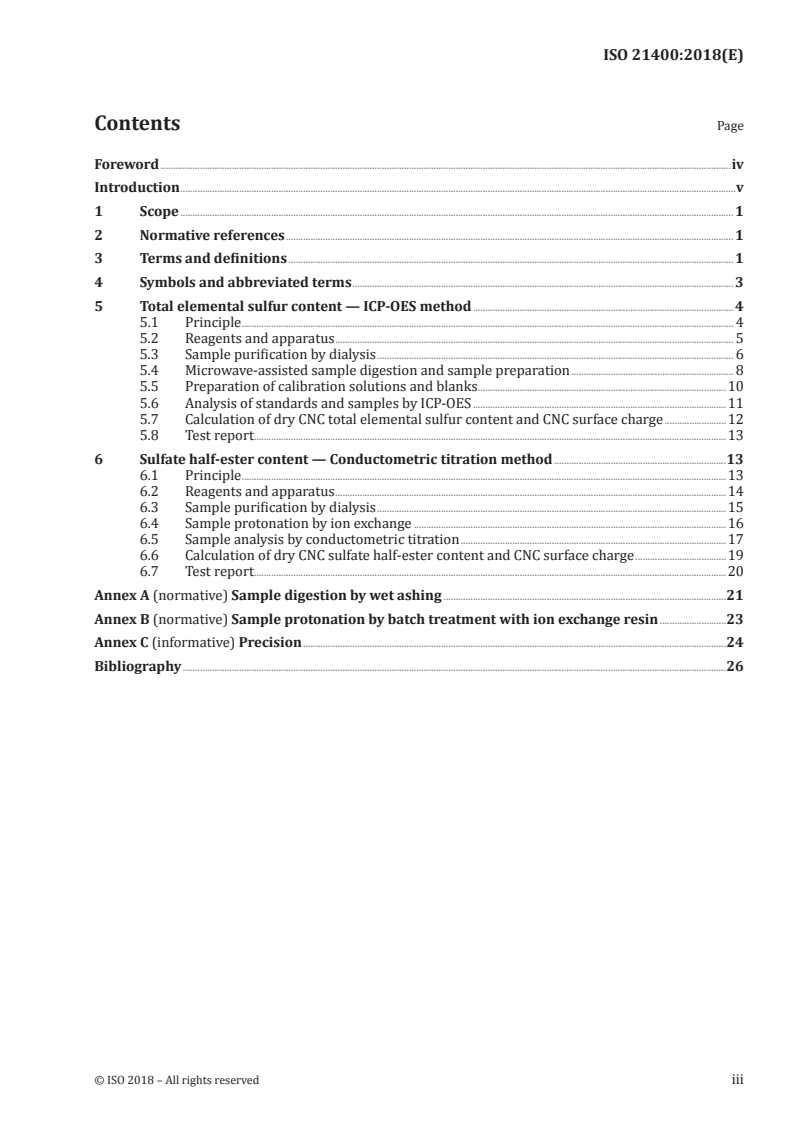
Contents Page
Foreword .iv
Introduction .v
1 Scope . 1
2 Normative references . 1
3 Terms and definitions . 1
4 Symbols and abbreviated terms . 3
5 Total elemental sulfur content — ICP-OES method . 4
5.1 Principle . 4
5.2 Reagents and apparatus . 5
5.3 Sample purification by dialysis . 6
5.4 Microwave-assisted sample digestion and sample preparation . 8
5.5 Preparation of calibration solutions and blanks .10
5.6 Analysis of standards and samples by ICP-OES .11
5.7 Calculation of dry CNC total elemental sulfur content and CNC surface charge .12
5.8 Test report .13
6 Sulfate half-ester content — Conductometric titration method .13
6.1 Principle .13
6.2 Reagents and apparatus .14
6.3 Sample purification by dialysis .15
6.4 Sample protonation by ion exchange .16
6.5 Sample analysis by conductometric titration .17
6.6 Calculation of dry CNC sulfate half-ester content and CNC surface charge .19
6.7 Test report .20
Annex A (normative) Sample digestion by wet ashing .21
Annex B (normative) Sample protonation by batch treatment with ion exchange resin .23
Annex C (informative) Precision .24
Bibliography .26
Foreword
ISO (the International Organization for Standardization) is a worldwide federation of national standards
bodies (ISO member bodies). The work of preparing International Standards is normally carried out
through ISO technical committees. Each member body interested in a subject for which a technical
committee has been established has the right to be represented on that committee. International
organizations, governmental and non-governmental, in liaison with ISO, also take part in the work.
ISO collaborates closely with the International Electrotechnical Commission (IEC) on all matters of
electrotechnical standardization.
The procedures used to develop this document and those intended for its further maintenance are
described in the ISO/IEC Directives, Part 1. In particular, the different approval criteria needed for the
different types of ISO documents should be noted. This document was drafted in accordance with the
editorial rules of the ISO/IEC Directives, Part 2 (see www .iso .org/directives).
Attention is drawn to the possibility that some of the elements of this document may be the subject of
patent rights. ISO shall not be held responsible for identifying any or all such patent rights. Details of
any patent rights identified during the development of the document will be in the Introduction and/or
on the ISO list of patent declarations received (see www .iso .org/patents).
Any trade name used in this document is information given for the convenience of users and does not
constitute an endorsement.
For an explanation of the voluntary nature of standards, the meaning of ISO specific terms and
expressions related to conformity assessment, as well as information about ISO's adherence to the
World Trade Organization (WTO) principles in the Technical Barriers to Trade (TBT) see www .iso
.org/iso/foreword .html.
This document was prepared by Technical Committee ISO/TC 6, Paper, board and pulps.
Any feedback or questions on this document should be directed to the user’s national standards body. A
complete listing of these bodies can be found at www .iso .org/members .html.
iv © ISO 2018 – All rights reserved
Introduction
This document, which establishes testing methodologies for measuring the total elemental sulfur and
sulfate half-ester group contents of cellulose nanocrystals (CNCs), was developed in response to a need
for a simple and rapid method for indirect quantification of CNC surface charge.
The main purpose of the two methods covered (inductively coupled plasma-optical emission
spectroscopy (ICP-OES) and conductometric titration) in this document is to measure the surface
charge of sulfated CNCs. Sulfate half-ester groups (R–OSO H) covalently bound at the nanocrystal
surface are introduced during concentrated sulfuric acid hydrolysis by partial esterification of the
[1]
cellulose hydroxy groups . The anionic sulfate half-ester groups are strong acids, such that at neutral
-
and basic pH values, the protons dissociate and the CNC surface is negatively charged (R–OSO ). The
pKa of the sulfate half-ester groups on CNCs is approximately 2,5 (as determined by potentiometric
titration), implying that at very low pH the surface groups are protonated and CNCs have a net neutral
[2]
charge . This surface charge controls many important properties of CNC suspensions, including the
colloidal stability, self-assembly and rheological behaviour, both in the pure state and in the presence of
salts and other additives. As such, the CNC surface charge is a very important factor in the processing
and development of commercial products containing CNCs. The sulfate half-ester (sulfur) content will
also be a key entry on material specifications sheets which will accompany the commercial product,
enabling different product grades to be distinguished from each other and from other companies’
products.
ICP-OES and conductometric titration are both included in this document as they provide different but
complementary ways of measuring the surface charge. ICP-OES measures elemental sulfur which is
present in a 1:1 ratio with the charged sulfate half-ester groups, and does not depend on the nature of
the counterion. Conductometric titration, on the other hand, measures only protons associated with
-
the anionic R–OSO , but is much less complicated to carry out. The two analysis methods should yield
equivalent results (see 5.1 and 6.1), or within 5 % to 10 % owing to sources of uncertainty/error such
as transfer losses and slight differences in the purification and protonation steps. CNCs derived from
different cellulose sources have shown different levels of agreement between the results from the two
[3]
methods . The objective of this document is to use this information in quantifying the CNC surface
charge arising from the easily ionized sulfate half-ester moieties introduced during hydrolysis or post-
sulfation.
The tests contained herein are based on literature methods and were developed over several years by a
group of industry experts, and were identified as being those which can yield reproducible and accurate
results. The tests are anticipated to be performed in a laboratory setting.
As with any laboratory procedure requiring the use of potentially hazardous chemicals, the user is
expected to have received proper knowledge and training in the use and disposal of these chemicals.
This document contains footnotes giving examples of apparatus, reagents and sometimes the supplier(s)
of those materials that are available commercially. This information is given for the convenience of users
of this document and does not constitute an endorsement by ISO of the products named. Equivalent
products may be used if they can be shown to lead to the same results.
Annex A provides an alternative method of sample digestion for ICP-OES by wet ashing. Annex B
provides an alternative method of sample protonation for conductometric titration by treatment with
batches of ion exchange resin.
INTERNATIONAL STANDARD ISO 21400:2018(E)
Pulp — Determination of cellulose nanocrystal sulfur and
sulfate half-ester content
1 Scope
This document specifies procedures for the laboratory determination of the total elemental sulfur and
the sulfate half-ester content of cellulose nanocrystals (CNCs) by inductively coupled plasma-optical
emission spectroscopy and conductometric titration, respectively, including sample preparation,
measurement methods and data analysis.
This document is applicable to the characterization of CNCs:
a) with all monovalent counterions (particularly hydronium and sodium cations);
b) which are either in the never-dried state in aqueous suspension, or have been redispersed from a
dried form; and
c) which have been extracted from any naturally occurring cellulose source using a range of sulfuric
acid hydrolysis conditions, or have been sulfated post-hydrolysis using sulfuric acid.
2 Normative references
The following documents are referred to in the text in such a way that some or all of their content
constitutes requirements of this document. For dated references, only the edition cited applies. For
undated references, the latest edition of the referenced document (including any amendments) applies.
ISO 3696, Water for analytical laboratory use — Specification and test methods
ISO 14644-1, Cleanrooms and associated controlled environments — Part 1: Classification of air cleanliness
by particle concentration
ISO/TS 80004-1, Nanotechnologies — Vocabulary — Part 1: Core terms
ISO/TS 80004-2, Nanotechnologies — Vocabulary — Part 2: Nano-objects
ISO/TS 80004-6, Nanotechnologies — Vocabulary — Part 6: Nano-object characterization
3 Terms and definitions
For the purposes of this document, the terms and definitions given in ISO/TS 80004-1, ISO/TS 80004-2,
ISO/TS 80004-6 and the following apply.
ISO and IEC maintain terminological databases for use in standardization at the following addresses:
— ISO Online browsing platform: available at https: //www .iso .org/obp
— IEC Electropedia: available at http: //www .electropedia .org/
3.1
nanoscale
length range approximately from 1 nm to 100 nm
Note 1 to entry: Properties that are not extrapolations from larger sizes are predominantly exhibited in this
length range.
[SOURCE: ISO/TS 80004-1:2015, 2.1]
3.2
nano-object
discrete piece of material with one, two or three external dimensions in the nanoscale (3.1)
Note 1 to entry: The second and third external dimensions are orthogonal to the first dimension and to each other.
[SOURCE: ISO/TS 80004-1:2015, 2.5]
3.3
nanocrystal
nano-object (3.2) with a crystalline structure
[SOURCE: ISO/TS 80004-2:2015, 4.15]
3.4
elementary fibril
structure, originating from a single terminal enzyme complex, having a configuration of cellulose
chains specific to each cellulose-producing plant, animal, algal and bacterial species
[SOURCE: ISO/TS 20477:2017, 3.2.5]
3.5
cellulose nanocrystal
CNC
nanocrystal (3.3) predominantly composed of cellulose with at least one elementary fibril (3.4),
containing predominantly crystalline and paracrystalline regions, with aspect ratio of usually less
than 50 but usually greater than 5, not exhibiting longitudinal splits, inter-particle entanglement, or
network-like structures
Note 1 to entry: The dimensions are typically 3 nm to 50 nm in cross-section and 100 nm to several μm in length,
depending on the source of the cellulose nanocrystal.
Note 2 to entry: The aspect ratio refers to the ratio of the longest to the shortest dimension.
Note 3 to entry: Historically, cellulose nanocrystals have been called nanocrystalline cellulose (NCC), cellulose
whiskers or cellulose nanowhiskers (CNW), and cellulose microfibrils; they have also been called spheres,
needles or nanowires based on their shape, dimensions and morphology. Other names have included cellulose
micelles, cellulose crystallites and cellulose microcrystals.
[SOURCE: ISO/TS 20477:2017, 3.3.5, modified — Note 3 to entry has been revised.]
3.6
agglomerate
collection of weakly or medium-strongly bound particles where the resulting external surface area is
similar to the sum of the surface areas of the individual components
Note 1 to entry: The forces holding an agglomerate together are weak forces, for example van der Waals forces or
simple physical entanglement.
Note 2 to entry: Agglomerates are also termed secondary particles and the original source particles are termed
primary particles.
[SOURCE: ISO/TS 80004-2:2015, 3.4]
3.7
analyte
element to be determined
3.8
calibration blank solution
solution prepared in the same way as the calibration solution (3.9) but leaving out the analyte (3.7)
2 © ISO 2018 – All rights reserved
3.9
calibration solution
solution used to calibrate the instrument, prepared from a stock solution (3.11) or a certified standard
by adding acids, buffer, reference element and salts as needed
3.10
matrix blank solution
solution prepared in the same way as the test sample solution (3.14) but omitting the test sample (3.13)
3.11
stock solution
solution with accurately known analyte (3.7) concentration(s), prepared from pure chemicals such as a
primary standard
3.12
quality control sample solution
solution of known composition within the range of the calibration solutions (3.8), but prepared
independently
3.13
test sample
portion taken from the laboratory sample after, for example, homogenizing or dividing
3.14
test sample solution
solution prepared after extraction, dispersion, purification or other preparation of the test sample
(3.13), such that it can be used for the envisaged measurement
4 Symbols and abbreviated terms
a slope of the standard addition plot, in mg/kg
b intercept of the standard addition plot, in mg/kg
c concentration (titre) of sodium hydroxide, in mol/l
CAS Chemical Abstracts Service, a division of American Chemical Society
CNC cellulose nanocrystal
cps counts per second
ICP-OES inductively coupled plasma-optical emission spectroscopy
κ conductivity corrected for dilution, in S/cm
m mass of dry sample, expressed in g
d
m mass of the internal standard added to sample aliquot number i, in g
int, i
m mass of potassium hydrogen phthalate standard, in g
KHP
m mass of original sample, in g
o
m mass of the CNC sample present in sample aliquot number i, in g
S, i
m mass of the sulfur standard added to sample aliquot number i, in g
std, i
m oven-dry mass of resin-treated CNCs in the suspension being titrated, in kg
t
meq milliequivalent
MWCO molecular weight cut-off
NIST National Institute of Standards and Technology
o.d. oven-dry
ppm parts per million
R ratio of ICP-OES signals corresponding to the analyte and the internal standard
i
σ CNC surface charge content, in meq/kg
S concentration of sulfur in the undiluted matrix blank solution, in mg/kg or mg/l
blk
S mass fraction of analyte (sulfur) in the sulfur standard added to each sample aliquot,
std
in mg/kg
SAC strong acid cation
v added volume of titrant, in l
V volume of sodium hydroxide solution required to reach the equivalence point, in l
e
V initial volume of test sample solution being titrated, in l
t
w mass fraction solids content, in percent
[R–OSO H] quantity of protonated sulfate half-ester groups [R–OSO H] present on the CNC sur-
3 3
face, in moles per kg of dry CNCs
[S] blank corrected concentration of sulfur in the CNC test sample, in mg/kg
5 Total elemental sulfur content — ICP-OES method
5.1 Principle
5.1.1 This method covers the determination of total elemental sulfur (S) content of cellulose
nanocrystals (CNCs). Inductively coupled plasma-optical emission spectroscopy (ICP-OES) is used for
analysis, following sample purification by dialysis to remove any sulfur-containing contaminants found
in the water matrix of the aqueous CNC suspension, and sample digestion to ensure that most (all) of the
S in the CNC sample is dissolved in the aqueous medium used for analysis.
5.1.2 Dialysis is typically used to purify CNC suspensions by removing dissolved ions, including residual
[4]
sulfur-containing contaminants such as sulfuric acid or sodium sulfate, from the aqueous phase . The
final dialysed samples are freeze-dried prior to analysis by ICP-OES. Samples can also be digested and
analysed beginning directly from aqueous CNC suspensions, but this method is less precise owing to the
variations in solids content.
5.1.3 The aqueous sample containing the dissolved sulfur-containing ions is delivered by a peristaltic
pump into an analytical nebulizer where it is atomized and introduced into a plasma flame. The sample
is broken down into ions, which break up into their respective atoms, which then lose electrons and
recombine repeatedly in the plasma, giving off radiation at the characteristic wavelengths of the elements
involved. During analysis, light of wavelength around 180 nm to 182 nm (atom and ion lines) is emitted
from the sulfur and onto a detector that measures the amount of light emitted. The emission intensity is a
measure of the concentration of sulfur in the sample. The spectra are dispersed by a grating spectrometer
and the intensities of the lines are monitored by a detector. The signals from the detector(s) are then
4 © ISO 2018 – All rights reserved
processed and controlled by a computer system. A suitable background correction technique is used to
compensate for variable background contributions.
5.1.4 ICP-OES is used to measure the total elemental sulfur content in a CNC sample. Sulfur is not
typically present in cellulose derived from native sources; the sulfur in the CNCs can therefore be
assumed to originate only from the surface sulfate half-ester groups imparted during CNC production
[5]
by sulfuric acid hydrolysis. However, if sulfur is known to be present in the original cellulose sample
[6]
, comparing the total S content of the CNCs with that of the original material and with CNCs produced
from the same source by HCl hydrolysis (which do not contain sulfate half-ester groups) should give the
concentration of sulfur derived from sulfate half-ester groups.
5.2 Reagents and apparatus
1)
5.2.1 Water, ultrapure (deionized or distilled), conforming to Grade 2 of ISO 3696 or better .
5.2.2 Nitric acid (HNO ) solution, concentrated, trace metal grade (60 % – 70 % assay) (CAS number
7697-37-2).
5.2.3 Hydrochloric acid (HCl) solution, concentrated, reagent grade (36 %) (CAS number 7647-01-0).
5.2.4 Calibration blank, solution of acid used to digest samples (see 5.5.3).
2)
5.2.5 Standard sulfur reference material, for quality control sample solution .
5.2.6 Primary sulfur standard stock calibration solution, containing 1 000 ppm to 10 000 ppm S,
3)
and other elements .
5.2.7 Solution of yttrium (Y) for internal standard, or other appropriate internal standard such as
4)
europium (Eu) which will not interfere with measurement of the sulfur wavelengths .
5.2.8 Probe-type sonicator, with variable power output control, fitted with a probe of
5)
appropriate processing capability for the volume of sample to be treated .
5.2.9 Plastic centrifuge tubes, 50 ml capacity.
1) Millipore Milli-Q® water purification systems are examples of suitable systems available commercially. This
information is given for the convenience of users of this document and does not constitute an endorsement by ISO of
these products.
2) CNCD-1 certified CNC reference material (National Research Council Canada) containing 8 720 mg/kg ± 140 mg/
kg S in a matrix similar to the samples intended for analysis, and NIST bovine liver standard reference material
1577c containing 7 490 ± 340 mg S/kg are examples of suitable products available commercially. This information is
given for the convenience of users of this document and does not constitute an endorsement by ISO of this product.
3) Pre-mixed calibration stock solution composed of 27 elements including 1 000 ppm S (Delta Scientific) or NIST
stock sulfur solution (10 300 mg/kg ± 30 mg/kg) are examples of suitable products available commercially. This
information is given for the convenience of users of this document and does not constitute an endorsement by ISO of
these products.
4) A 10 000 ppm Y solution from SCP Science is an example of a suitable product available commercially. This
information is given for the convenience of users of this document and does not constitute an endorsement by ISO of
this product.
5) A Sonics vibra-cell™ 130 watt ultrasonic processor with a 6 mm diameter probe is an example of a suitable
product available commercially. This information is given for the convenience of users of this document and does
not constitute an endorsement by ISO of this product.
5.2.10 Dialysis membrane tubes, with molecular weight cut-off (MWCO) small enough to prevent
6)
CNCs escaping but large enough to allow rapid dialysis .
5.2.11 Dialysis clips.
5.2.12 Dialysis column or equivalent.
5.2.13 Freezer.
5.2.14 Freeze-dryer and freeze-dryer flasks.
5.2.15 Desiccator.
5.2.16 Oven, capable of maintaining a temperature of 105 °C ± 3 °C.
5.2.17 Balance, accuracy ± 0,000 1 g.
5.2.18 Aluminium weighing dishes.
5.2.19 Fume hood.
5.2.20 Volumetric flasks, 50 ml, 100 ml and 1 000 ml capacity.
5.2.21 Microwave digestion vessels, quartz or polytetrafluoroethylene (PTFE), with PTFE caps.
5.2.22 Stir bars, egg-shaped, sized to fit in microwave digestion vessels with enough clearance to move
easily. Stir bars are not required with every microwave digestion system.
5.2.23 Microwave digestion system. Any pressurized closed vessel microwave digestion system
7)
equipped with temperature monitoring capabilities is suitable . Alternatively, a conventional hotplate
may be used (see Annex A).
5.2.24 ICP-OES system. Any inductively coupled plasma-optical emission spectroscopy system which
8)
can detect concentrations of sulfur ≥ 1 ppm is suitable .
5.2.25 Argon gas, high purity (CAS number 7440-37-1), for ICP-OES system.
5.3 Sample purification by dialysis
5.3.1 Carry out the entire procedure in duplicate on separate test specimens.
5.3.2 Around 0,25 g (o.d.) of CNCs are typically required to run the ICP-OES analysis, in order to obtain
a sulfur content in the sample solutions that lies in the mid-range of the standard curve; this mass may
6) Spectra/Por® 4 Regenerated Cellulose membranes with MWCO of 12 kDa–14 kDa are an example of a suitable
product available commercially. This information is given for the convenience of users of this document and does
not constitute an endorsement by ISO of this product.
7) The CEM Discover SP-D is an example of a suitable instrument available commercially. This information is
given for the convenience of users of this document and does not constitute an endorsement by ISO of this product.
8) The Thermo Scientific iCAP 6000 series is an example of a suitable instrument available commercially. This
information is given for the convenience of users of this document and does not constitute an endorsement by ISO of
this product.
6 © ISO 2018 – All rights reserved
be adjusted as required. The mass of CNC suspension required can be calculated by dividing the desired
mass of CNCs for analysis by the mass fraction solids content of the CNC suspension.
5.3.3 Dilute never-dried CNC suspension containing at least 0,5 g (o.d.) of CNCs to around 0,55 %
(mass fraction) with water (5.2.1).
It is not recommended that concentrated CNC suspensions [>1 % (mass fraction)] be dialysed, as
diffusion rates will decrease due to the increased suspension viscosity, significantly reducing the
dialysis efficiency.
5.3.4 Alternatively, redisperse at least 0,5 g (o.d.) spray-dried or freeze-dried CNCs to around 0,55 %
(mass fraction) in water (5.2.1) by gradually adding to water in a container while stirring vigorously
(e.g. with a magnetic stir bar). Cover and stir until all visible particles have disappeared. Continue
stirring for 1 h.
5.3.5 Sonicate the redispersed dried CNC suspension to ensure full dispersion. A suitable procedure is
described in Reference [3].
EXAMPLE A 30 g aliquot of 0,55 % (mass fraction) CNC suspension in a 50 ml plastic centrifuge tube is
sonicated using a 6 mm diameter probe on a 130 W sonicator set at 60 % amplitude (7 W – 8 W power output),
to a total energy input of 1 650 J (= 10 kJ per g CNCs in the sample). This operation is performed a total of three
times to obtain a sonicated sample containing 0,5 g of CNC.
Ultrasonic baths are not powerful enough to achieve full dispersion of CNC agglomerates; sonicator
probes directly immersed in the suspension shall be used.
Sonication may be omitted if unsonicated and sonicated samples show no difference in final results
(e.g. for never-dried CNC suspensions). Each different type of sample should be tested before omitting
sonication.
Sonicated suspensions may be filtered using GF/F glass microfibre filter paper to remove metal particles
(normally titanium, aluminium or aluminium-containing alloys) released from the probe.
5.3.6 Soak dialysis membrane tubes in water (5.2.1) for 30 min, then rinse thoroughly inside and out
with fresh water (5.2.1).
5.3.7 Place suspension in dialysis membrane tubes after clipping one end, ensuring the tubes are no
more than two-thirds full, then clip the other end. Dialyse the samples against running deionized or
better-quality water for at least 3 days. If using dialysis columns (tanks containing static water stirred
with magnetic stir bar or equivalent), change the water (5.2.1) at least three or four times per day for
at least 3 days, until constant pH and conductivity of the column water are reached for two consecutive
water changes. Both pH and conductivity should be within ± 0,2 units and ± 5 μS/cm of the values for the
water used for dialysis.
5.3.8 Freeze and lyophilize the dialysed CNC suspensions and store the freeze-dried CNC samples in a
desiccator.
Dried cellulose nanocrystals are hygroscopic and adsorb atmospheric moisture rapidly; they should
always be stored in a desiccator when not in use.
5.3.9 Accurately weigh (to ± 0,000 1 g) a minimum of approximately 0,20 g of the freeze-dried CNCs
obtained in 5.3.8. Dry to constant mass at a temperature of 105 °C ± 3 °C. Cool the sample in a desiccator
and weigh. Calculate w, the mass fraction solids content, expressed as a percentage, using Formula (1):
mm− m
od d
w =−100 1 =100 (1)
m m
o o
where
w is the mass fraction solids content, expressed as a percentage, of the dialysed CNC suspension;
m is the mass, in grams, of the original sample;
o
m is the mass, in grams, of the dry sample.
d
The CNC sample may also be dried to constant mass by storing the sample in a desiccator over
magnesium perchlorate for 8 days.
5.4 Microwave-assisted sample digestion and sample preparation
5.4.1 The sample is completely solubilized by microwave-assisted digestion using high purity nitric
acid in high pressure closed vessels. Wet ashing digestion using a hotplate can provide similar results
(see Annex A). The open glassware used in conventional wet ashing, however, poses a risk of cross-
contamination if several samples are being heated at one time and “bumping” occurs in one or more
samples. Additionally, losses due to volatilization are minimized in the closed vessels used for microwave-
assisted digestion.
5.4.2 Pre-clean the microwave vessels by washing with soap, followed by 50:50 vol:v ol hydrochloric
acid/water solution, then rinse with ultrapure water (5.2.1). Dry in the oven at 105 °C ± 3 °C for ≥ 4 h. If
necessary, add 5 ml of concentrated nitric acid and run the same microwave program as for the samples
(5.4.10), then rinse with ultrapure water (5.2.1) and dry.
Alternatively, if the sample is digested for ICP-OES by wet ashing, the method given in Annex A shall be
followed.
5.4.3 Measure the moisture content of each freeze-dried CNC sample immediately prior to analysis by
weighing a portion before and after drying to constant mass as described in 5.3.9.
5.4.4 Accurately weigh (to ± 0,000 1 g) about 0,25 g (o.d.) of the freeze-dried CNCs obtained in 5.3.8
into a pre-cleaned microwave vessel, minimizing the amount of CNCs on the inner walls of the vessel.
5.4.5 Insert clean stir bar into the vessel if needed.
5.4.6 Slowly add 5 ml of concentrated nitric acid to the vessel, ensuring that the CNCs are rinsed down
the inner walls. The amount of acid may be adjusted provided that the matrix composition of the test
sample solutions and the calibration solutions is the same (see 5.4.12).
5.4.7 Set the sample aside for about 15 min to pre-digest in the acid. Do not stir the sample.
NOTE Freeze-dried CNC flakes are very light and tend to hold static charge. Therefore, they might fly onto
the inner walls of the vessel during vigorous mixing and adhere there such that they are not exposed to the liquid
acid during the subsequent steps, which could prevent them being fully digested.
5.4.8 Add 2 ml water (5.2.1) down the inner walls of the vessel to further rinse the CNCs into the acid.
5.4.9 Place the PTFE cap on the vessel and load the sample into the microwave system.
5.4.10 Digest the sample in the microwave according to the manufacturer’s instructions or established
protocol (see example).
EXAMPLE CNC microwave digestion protocol (operating parameters) for a CEM Discover SP-D.
8 © ISO 2018 – All rights reserved
Step Temperature Ramp time Hold time Pressure Power Stirring
°C min min MPa W speed
1 100 4,0 1,0 2,76 300 Medium
2 90 2,0 1,0 2,76 300 Medium
3 180 6,0 3,0 2,76 300 Medium
5.4.11 After digestion, if there are undigested CNCs on the inner walls of the vessel or as visible solid
particles in a transparent solution, repeat the digestion steps using the same method.
The acid used might need to be adapted to obtain complete dissolution (a clear solution with no solid
residue), depending on the microwave system. A 3:1 vol: vol nitric acid/hydrochloric acid mixture has
also been used to digest CNCs.
The microwave digestion program might need to be adapted depending on the microwave system. If
the instrument manufacturer provides a suggested program for cellulose matrices, it can be used as a
starting point if the above method does not work.
5.4.12 Cool the digested sample and transfer into a 100 ml volumetric flask by rinsing the vessel,
including the cap, with ultrapure water (5.2.1). Reconstitute the sample with water (5.2.1) to give a test
sample solution with a final volume of 100 ml (a 1:19 vol: vol ratio). The exact nitric acid concentration of
the matrix (~5 %) will vary depending on the exact concentration (assay) of the concentrated nitric acid
(5.2.2). As long as the same ratio of the volume of concentrated acid to the final volume of matrix is used for
all test sample solutions, calibration solutions, etc., the matrix composition will be identical. The amount
of acid used to digest the sample in 5.4.6, as well as the final volume, may be adjusted provided that the
matrix compositions of the test sample solutions and those of the calibration solutions are the same.
The following optional drying and reconstitution steps may be taken:
— after cooling, transfer the contents of the vessels to a pre-cleaned polypropylene or PTFE vial;
— place on a hotplate in the fume hood and evaporate to near dryness to remove the acid;
— dissolve the residues in concentrated nitric acid;
— cool and dilute each sample with water (5.2.1) such that the matrix composition of the test sample
solutions and the calibration solutions is the same.
5.4.13 Prepare a matrix blank solution by performing 5.4.2 to 5.4.12 without sample (same final
volume).
5.4.14 Prepare quality control sample solution by performing 5.4.2 to 5.4.12 with standard sulfur
reference material (5.2.5).
5.4.15 To evaluate the performance of the analytical procedure and compensate for any residual matrix
interferences, samples should be spiked with at least three incremental levels of appropriate amounts
of known primary sulfur standard stock calibration solution (5.2.6), which contains between 1 000 ppm
and 10 000 ppm S.
5.4.15.1 Prepare a spiked sample solution series by dividing the (digested and diluted) test sample
solution into four equal portions and placing them in four vials (A, B, C, D). Spike vial B with x g or ml of
the primary sulfur standard stock calibration solution (5.2.6), vial C with 2x g or ml of the primary sulfur
standard stock calibration solution (5.2.6) and vial D with 3x g or ml of the primary sulfur standard stock
calibration solution (5.2.6) as shown in Table 1. To ensure each sample has the same volume, make up
the balance by adding 5 % nitric acid. The internal standard (5.2.7) may be added to the unknown test
sample solution prior to dividing it into four portions, or to each of the four portions separately.
NOTE It is assumed that each flask or vial contains more than enough sample volume for analysis.
Table 1 — Samples for standard addition analysis and plot
Vial Sample, i m m m
S, i std, i int, i
A 1 1 0 1
B 2 1 1 1
C 3 1 2 1
D 4 1 3 1
Symbols:
S = CNC sample
std = sulfur standard (5.2.6)
int = internal standard (5.2.7)
m = mass, in grams, of the CNC sample present in each sample aliquot
S, i
m = mass, in grams, of the sulfur standard added to each sample aliquot
std, i
m = mass, in grams, of the internal standard added to each sample aliquot
int, i
5.4.15.2 Prepare a spiked sample series for both the undiluted matrix blank and the quality control
samples.
The concentration of analyte in the spiking solution (primary sulfur standard stock calibration solution,
5.2.6) should be 50 to 100 times higher than the concentration of the analyte in the unspiked sample
(sulfur from CNCs). This allows the minimum volume of standard to be added such that the sample is
not diluted significantly (by more than ~5 %) if the balance is not made up by adding 5 % nitric acid.
The spiked concentration should be of the same magnitude as that of the sample itself. Spiking
levels should be chosen such that the spike results in a onefold to twofold increase in the total sulfur
concentration in the sample and the analytical response is linear. For example, a sample containing
10 ppm sulfur may be spiked with 10 ppm and 20 ppm of a sulfur standard, but not 0,001 ppm or
100 ppm. However, if the sample sulfur concentration is very low, it should be spiked at a level that is in
the middle of the calibration range.
The concentration of the spiked sample should be within the calibration range. If necessary, dilute the
spiked sample (after spiking).
5.5 Preparation of calibration solutions and blanks
5.5.1 Ensure that the matrix of all the calibration solutions and blanks matches that of the samples and
contains the same final concentration of appropriate acid used to digest the samples.
5.5.2 Prepare sulfur calibration solutions of incremental concentration (e.g. 1 ppm, 10 ppm, 20 ppm,
50 ppm and 100 ppm or mg/l) from 1 000 ppm primary sulfur standard stock calibration solution by
transferring aliquots (e.g. 0,1 ml, 1 ml, 2 ml, 5 ml and 10 ml) to 100 ml volumetric flasks. Fill about
halfway with ultrapure water (5.2.1), add 5 ml of concentrated nitric acid (5.2.2) and dilute with ultrapure
water (5.2.1) to 100 ml. Store in plastic bottles previously washed with a 50:50 hydrochloric acid/water
solution.
Primary sulfur standard stock calibration solutions and test sample solutions may be diluted either
gravimetrically or volumetrically; care shall be taken to ensure that the dilution method is applied
consistently. Calibration solutions shall not be prepared by serial dilution, but rather from an
appropriate aliquot of the primary standard stock solution.
5.5.3 Prepare calibration blank solution (acid blank) by diluting the acid used to digest the samples to
the same concentration as the matrix of the samples to be analysed.
10 © ISO 2018 – All rights reserved
5.5.4 Prepare internal standard by diluting stock solution (5.2.7) to an appropriate concentration, e.g.
10 mg/l yttrium, following the procedure in 5.5.2.
5.6 Analysis of standards and samples by ICP-OES
5.6.1 Switch on the inductively coupled plasma-optical emission spectrometer and configure it for
detection of sulfur according to the manufacturer’s instructions.
The wavelength(s) used for sulfur detection (around 180 nm to 182 nm) may be varied slightly
depending on the ICP-OES manufacturer and interference from sample matrix components.
5.6.2 Reference the analyte lines to the internal standard line (e.g. yttrium, wavelength 224,306 nm).
5.6.3 Rinse the instrument with calibration blank solution.
Ideally, the acid concentration of the rinse solution should match that of the samples, but a small
variation is acceptable.
5.6.4 Run at least five incremental sulfur standard solutions and a calibration blank solution, rinsing
the instrument with calibration blank solution between each sample. Plot the signal intensity against
concentration and verify that the instrument response is linear in the range of sample measurements.
To determine if there is any memory effect, compare the signal with the first measurement of calibration
blank (rinse) solution. If the signal is higher, keep running rinse solution until the signal is at the same
level as the first measurement.
A calibration range from 1 ppm to 100 ppm or mg/l sulfur will help to ensure the samples are in the
linear range of the calibration curve.
Always make sure that the sample signal intensity lies within the calibration range. If not, samples
should be diluted or an additional standard with higher concentration prepared (making sure it is still
in the linear range).
A minimum linear regression coefficient of 0,99 has to be achieved to ensure that a linear calibration
function has been obtained.
5.6.5 Run a calibration blank or rinse solution to check for carryover. If there is carryover, increase
rinse time until signal is at the same level as the first measurement of calibration blank or rinse solution.
5.6.6 Run sulfur standards as unknowns to check the calibration, each followed by a calibration blank
or rinse solution. The calibration check standard concentrations shall cover both the low- and mid-
range of the calibration curve, e.g. 1 ppm and 50 ppm or mg/l. The calibration check standards shall be
purchased or prepared from a different primary stock solution, preferably from a different source than
the primary sulfur stock solution (5.2.6).
5.6.7 Run matrix blank solution followed by a calibration blank or rinse solution.
5.6.8 Run spiked sample series for each unknown sample, the blank and the quality control samples,
each series followed by a calibration blank or rinse solution. Check the calibration for drift when needed.
If necessary to ensure that the signal strength is not out of range, dilute the samples while ensuring that
the final acid concentration is the same.
5.6.9 After all samples have been analysed, run calibration blank solution or rinse solution to rinse the
instrument.
5.7 Calculation of dry CNC total elemental sulfur content and CNC surface charge
Construct a standard addition plot for each CNC sample and for the quality control sample, using the
following approach.
Since the slope of the standard addition calibration function for the sample and blank might not be
equivalent, separate plots for the sampl
...