


ISO 7240-2:2003
(Main)Fire detection and alarm systems — Part 2: Control and indicating equipment
Fire detection and alarm systems — Part 2: Control and indicating equipment
ISO 7240-2:3003 specifies requirements, test methods and performance criteria for control and indicating equipment (c.i.e.) for use in fire detection and fire alarm systems installed in buildings.
Systèmes de détection et d'alarme d'incendie — Partie 2: Équipement de contrôle et de signalisation
General Information
- Status
- Withdrawn
- Publication Date
- 09-Sep-2003
- Withdrawal Date
- 09-Sep-2003
- Technical Committee
- ISO/TC 21/SC 3 - Fire detection and alarm systems
- Drafting Committee
- ISO/TC 21/SC 3 - Fire detection and alarm systems
- Current Stage
- 9599 - Withdrawal of International Standard
- Start Date
- 23-Nov-2017
- Completion Date
- 12-Feb-2026
Relations
- Effective Date
- 04-Nov-2015
Get Certified
Connect with accredited certification bodies for this standard

NSF International
Global independent organization facilitating standards development and certification.

CIS Institut d.o.o.
Personal Protective Equipment (PPE) certification body. Notified Body NB-2890 for EU Regulation 2016/425 PPE.

Kiwa BDA Testing
Building and construction product certification.
Sponsored listings
Frequently Asked Questions
ISO 7240-2:2003 is a standard published by the International Organization for Standardization (ISO). Its full title is "Fire detection and alarm systems — Part 2: Control and indicating equipment". This standard covers: ISO 7240-2:3003 specifies requirements, test methods and performance criteria for control and indicating equipment (c.i.e.) for use in fire detection and fire alarm systems installed in buildings.
ISO 7240-2:3003 specifies requirements, test methods and performance criteria for control and indicating equipment (c.i.e.) for use in fire detection and fire alarm systems installed in buildings.
ISO 7240-2:2003 is classified under the following ICS (International Classification for Standards) categories: 13.220.20 - Fire protection. The ICS classification helps identify the subject area and facilitates finding related standards.
ISO 7240-2:2003 has the following relationships with other standards: It is inter standard links to ISO 7240-2:2017. Understanding these relationships helps ensure you are using the most current and applicable version of the standard.
ISO 7240-2:2003 is available in PDF format for immediate download after purchase. The document can be added to your cart and obtained through the secure checkout process. Digital delivery ensures instant access to the complete standard document.
Standards Content (Sample)
INTERNATIONAL ISO
STANDARD 7240-2
First edition
2003-09-15
Fire detection and alarm systems —
Part 2:
Control and indicating equipment
Systèmes de détection et d'alarme d'incendie —
Partie 2: Équipement de contrôle et de signalisation
Reference number
©
ISO 2003
PDF disclaimer
This PDF file may contain embedded typefaces. In accordance with Adobe's licensing policy, this file may be printed or viewed but
shall not be edited unless the typefaces which are embedded are licensed to and installed on the computer performing the editing. In
downloading this file, parties accept therein the responsibility of not infringing Adobe's licensing policy. The ISO Central Secretariat
accepts no liability in this area.
Adobe is a trademark of Adobe Systems Incorporated.
Details of the software products used to create this PDF file can be found in the General Info relative to the file; the PDF-creation
parameters were optimized for printing. Every care has been taken to ensure that the file is suitable for use by ISO member bodies. In
the unlikely event that a problem relating to it is found, please inform the Central Secretariat at the address given below.
© ISO 2003
All rights reserved. Unless otherwise specified, no part of this publication may be reproduced or utilized in any form or by any means,
electronic or mechanical, including photocopying and microfilm, without permission in writing from either ISO at the address below or
ISO's member body in the country of the requester.
ISO copyright office
Case postale 56 • CH-1211 Geneva 20
Tel. + 41 22 749 01 11
Fax + 41 22 749 09 47
E-mail copyright@iso.org
Web www.iso.org
Published in Switzerland
ii © ISO 2003 — All rights reserved
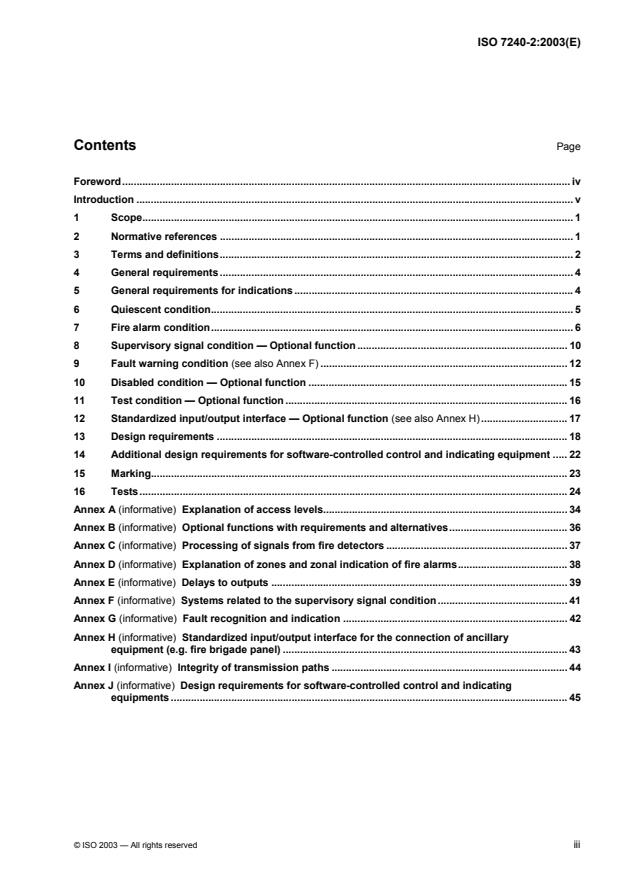
Contents Page
Foreword. iv
Introduction . v
1 Scope. 1
2 Normative references . 1
3 Terms and definitions. 2
4 General requirements . 4
5 General requirements for indications . 4
6 Quiescent condition. 5
7 Fire alarm condition. 6
8 Supervisory signal condition — Optional function . 10
9 Fault warning condition (see also Annex F) . 12
10 Disabled condition — Optional function .15
11 Test condition — Optional function . 16
12 Standardized input/output interface — Optional function (see also Annex H). 17
13 Design requirements . 18
14 Additional design requirements for software-controlled control and indicating equipment . 22
15 Marking. 23
16 Tests. 24
Annex A (informative) Explanation of access levels. 34
Annex B (informative) Optional functions with requirements and alternatives. 36
Annex C (informative) Processing of signals from fire detectors . 37
Annex D (informative) Explanation of zones and zonal indication of fire alarms. 38
Annex E (informative) Delays to outputs . 39
Annex F (informative) Systems related to the supervisory signal condition . 41
Annex G (informative) Fault recognition and indication . 42
Annex H (informative) Standardized input/output interface for the connection of ancillary
equipment (e.g. fire brigade panel) . 43
Annex I (informative) Integrity of transmission paths . 44
Annex J (informative) Design requirements for software-controlled control and indicating
equipments . 45
Foreword
ISO (the International Organization for Standardization) is a worldwide federation of national standards bodies
(ISO member bodies). The work of preparing International Standards is normally carried out through ISO
technical committees. Each member body interested in a subject for which a technical committee has been
established has the right to be represented on that committee. International organizations, governmental and
non-governmental, in liaison with ISO, also take part in the work. ISO collaborates closely with the
International Electrotechnical Commission (IEC) on all matters of electrotechnical standardization.
International Standards are drafted in accordance with the rules given in the ISO/IEC Directives, Part 2.
The main task of technical committees is to prepare International Standards. Draft International Standards
adopted by the technical committees are circulated to the member bodies for voting. Publication as an
International Standard requires approval by at least 75 % of the member bodies casting a vote.
Attention is drawn to the possibility that some of the elements of this document may be the subject of patent
rights. ISO shall not be held responsible for identifying any or all such patent rights.
ISO 7240-2 was prepared by Technical Committee ISO/TC 21, Equipment for fire protection and fire fighting,
Subcommittee SC 3, Fire detection and alarm systems.
ISO 7240 consists of the following parts, under the general title Fire detection and alarm systems:
Part 1: General and definitions
Part 2: Control and indicating equipment
Part 4: Power supply equipment
Part 5: Point-type heat detectors
Part 6: Point-type fire detectors for carbon monoxide
Part 7: Point-type smoke detectors using scattered light, transmitted light or ionization
Part 11: Manual call points
Part 14: Guidelines for drafting codes of practice for design, installation and use of fire detection and fire
alarm systems in and around buildings [Technical Report]
Part 15: Point-type multisensor (light and heat) fire detectors
Compatibility assessment of system components and carbon monoxide point-type fire detectors using
electrochemical cells are to form the subjects of future Parts 13 and 16.
iv © ISO 2003 — All rights reserved
Introduction
This part of ISO 7240 is drafted on the basis of mandatory functions, which are to be provided on all control
and indicating equipment, and optional functions (with requirements) which may be provided. It is intended
that the options be used for specific applications, as recommended in application guidelines.
Each optional function is included as a separate entity, with its own set of associated requirements, in order to
permit control and indicating equipment with many different combinations of functions to comply with this part
of ISO 7240.
Other functions associated with fire detection and alarm may also be provided, even if not specified in this part
of ISO 7240.
INTERNATIONAL STANDARD ISO 7240-2:2003(E)
Fire detection and alarm systems —
Part 2:
Control and indicating equipment
1 Scope
This part of ISO 7240 specifies requirements, test methods and performance criteria for control and indicating
equipment (c.i.e.) for use in fire detection and fire alarm systems installed in buildings.
2 Normative references
The following referenced documents are indispensable for the application of this document. For dated
references, only the edition cited applies. For undated references, the latest edition of the referenced
document (including any amendments) applies.
ISO 7240-1:1988, Fire detection and alarm systems — Part 1: General and definitions
ISO 7240-4, Fire detection and alarm systems — Part 4: Power supply equipment
ISO 7240-7, Smoke detectors — Part 7: Point detectors using scattered light, transmitted light or ionization
ISO 8201, Acoustics — Audible emergency evacuation signal
IEC 60068-1, Environmental testing — Part 1: General and guidance
IEC 60068-2-1, Environmental testing — Part 2: Tests. Tests A: cold
IEC 60068-2-2, Environmental testing — Part 2: Tests. Tests B: dry heat
IEC 60068-2-3, Environmental testing — Part 2: Tests. Test Ca: damp heat, steady state
IEC 60068-2-6, Environmental testing — Part 2: Tests. Test Fc: vibration (sinusoidal)
IEC 60068-2-47, Environmental testing — Part 2: Test methods — Mounting of components, equipment and
other articles for vibration, impact and similar dynamic tests
IEC 60068-2-75, Environmental testing — Part 2: Tests — Test Eh: Hammer tests
IEC 60529, Degrees of protection provided by enclosures (IP Code)
IEC 60721-3-3, Classification of environmental conditions — Part 3: Classification of groups of environmental
parameters and their severities — Section 3: Stationary use and weather protected locations
EN 50130-4, Alarm systems — Part 4: Electromagnetic compatibility — Product family standard: Immunity
requirements for components of fire, intruder and social alarm systems
3 Terms and definitions
For the purposes of this document, the terms and definitions given in ISO 7240-1 and the following apply. See
also Figure 1 of ISO 7240-1:1988.
3.1
access level
one of several states of a c.i.e. in which selected
controls can be operated,
manual operations can be carried out,
indications are visible, and/or
information can be obtained
See annex A.
3.2
addressable point
point which can be individually identified at the c.i.e.
cf. point (3.15)
3.3
alphanumeric display
indicator capable of giving information by the display of messages consisting of text and/or numeric characters
3.4
confirmation signal
signal from a fire detector or manual call point which terminates a first alarm state
3.5
detection circuit
transmission path which connects points to the c.i.e.
cf. point (3.15) and transmission path (3.22)
3.6
earth fault
unwanted connection between earth potential and any part of the c.i.e., transmission paths to the c.i.e. or
transmission paths between parts of the c.i.e.
3.7
field
sub-division of a window
3.8
first alarm signal
signal from a fire detector or manual call point which is interpreted as a fire alarm, but following which the c.i.e.
enters a first alarm state
3.9
first alarm state
state of the c.i.e. following the receipt of a first alarm signal during which mandatory functions of the c.i.e. may
be inhibited
2 © ISO 2003 — All rights reserved
3.10
functional condition
condition of the c.i.e. characterized by its indication at the c.i.e.
NOTE The functional conditions recognized in this part of ISO 7240 are the following:
fire alarm condition, when a fire alarm is indicated;
supervisory signal condition, when a supervisory signal is indicated;
fault warning condition, when a fault is indicated;
disabled condition, when the disablement of functions is indicated;
test condition, when the testing of functions is indicated;
quiescent condition, when the c.i.e. is powered by a power supply in accordance with ISO 7240-4 and no other
functional condition is indicated.
3.11
indicator
a device which can change its state to give information
3.12
indication
information given by an indicator
3.13
mandatory adj.
qualification applied to those functions required to be provided on all c.i.e. and the functions' requirements and
to the requirements of any optional functions that have requirements, if such optional functions are provided
3.14
non-volatile memory
memory elements which do not require the presence of an energy source for the retention of their contents
3.15
point
component connected to a detection circuit able to transmit or receive information in relation to fire detection
NOTE Includes Items A and D in Figure 1 of ISO 7240-1:1988.
3.16
program
software necessary for c.i.e. to comply with at least the requirements of this part of ISO 7240, including
initializing data, reset and interrupt vectors, operating code and declarations
3.17
reset
operation capable of terminating the fire alarm condition and/or the fault warning condition
3.18
running data
alterable data subject to temporary modification during operation, either automatically or by manual controls
3.19
separate adj.
physically separate and exclusively provided for the purpose or purposes stated in this part of ISO 7240
3.20
silencing n.
manual operation for switching off the audible signal of a sounding device which is capable of being
automatically re-sounded by a new event
3.21
site-specific data
alterable data required for the c.i.e. to operate in a defined system configuration
3.22
transmission path
connection, external to the cabinet of the c.i.e., for the transmission of information and/or power
between the c.i.e. and other components of a fire detection and fire alarm system as defined in
ISO 7240-1, and/or
between parts of c.i.e. contained in different cabinets
3.23
volatile memory
memory elements which require the presence of an energy source for the retention of their contents
3.24
window
part or all of an alphanumeric display used for information relating to one functional condition at a given time.
NOTE A sub-division of the display may be realized either by mechanical separation, or under software control
3.25
zone
geographical sub-division of the protected premises in which one or more points are installed and for which a
common zonal indication is provided
4 General requirements
If an optional function with requirements is included in the c.i.e., then all the corresponding requirements shall
be met (see also Annex B).
If functions other than those specified in this part of ISO 7240 are provided, they shall not jeopardize
compliance with any requirement of this part of ISO 7240.
5 General requirements for indications
5.1 Display of functional conditions
5.1.1 The c.i.e. shall be capable of unambiguously indicating the following functional conditions, in
accordance with Clauses 6 to 11:
quiescent condition;
fire alarm condition;
supervisory signal condition;
fault warning condition;
4 © ISO 2003 — All rights reserved
disablement condition;
test condition.
5.1.2 The c.i.e. shall be capable of being simultaneously in any combination of the following functional
conditions:
fire alarm condition;
supervisory signal condition;
fault warning condition;
disablement condition;
test condition.
5.2 Display of indications
All mandatory indications shall be clearly identifiable, except where otherwise specified in this part of
ISO 7240.
5.3 Indications on alphanumeric displays
Where an alphanumeric display is used to display indications relating to different functional conditions, these
may be displayed at the same time. However, for each functional condition there shall be only one window, in
which all of the fields relating to that functional condition shall be grouped.
5.4 Indication of supply of power
A visible indication shall be given by means of a separate light-emitting indicator while the c.i.e. is supplied
with power.
5.5 Audible indications
The audible indication for the fire alarm condition may be the same as that for the fault warning condition. If
they are different, the fire alarm indication shall have priority.
5.6 Additional indications
Where indications are used in addition to mandatory indications, these shall not result in contradiction or
confusion.
6 Quiescent condition
Any kind of system information may be displayed during the quiescent condition. However, no indications shall
be given which could be confused with indications used in the
fire alarm condition,
supervisory signal condition,
fault warning condition,
disabled condition, or
test condition.
7 Fire alarm condition
7.1 Reception and processing of fire signals (see also Annex C)
7.1.1 The c.i.e. shall enter the fire alarm condition when signals are received which, after any necessary
processing, are interpreted as a fire alarm.
7.1.2 The c.i.e. shall be capable of receiving, processing and indicating signals from zones. A signal from
one zone shall not falsify the processing storing and/or indication of signals from other zones.
7.1.3 Except where 7.11 or 7.12 applies, the time taken by scanning, interrogation, or other processing of
signals from fire detectors, in addition to that required to take the fire alarm decision, shall not delay the
indication of the fire alarm condition, or of a new zone in alarm by more than 10 s.
7.1.4 The c.i.e. shall enter the fire alarm condition within 10 s of the activation of any manual call point.
7.1.5 The mandatory indications and/or outputs shall not be falsified by multiple fire signals received from
the same or different detection circuits as a result of the simultaneous operation of two points, the operation of
further points or both.
7.2 Indication of fire alarm condition
The fire alarm condition shall be indicated without prior manual intervention. The indication is established
when all of the following are present:
a) a visible indication, by means of a separate light-emitting indicator (the general fire alarm indicator);
b) a visible indication, as specified in 7.3, of the zones in alarm, which may be omitted for c.i.e. capable of
receiving signals from only one zone;
c) an audible indication, as specified in 7.4.
7.3 Indication of zones in alarm (see also Annex D)
7.3.1 The zones in alarm shall be visibly indicated by means of a separate light-emitting indicator for each
zone or an alphanumeric display or both.
7.3.2 If the zonal indications are on an alphanumeric display which because of its limited capacity cannot
simultaneously indicate all the zones in alarm, at least the following shall apply:
a) the first zone in alarm shall be displayed in a field at the top of the display;
b) additional zones in alarm shall be displayed in another field until the c.i.e. has been reset;
c) the total number of zones in alarm shall be permanently displayed;
d) zones in alarm not currently indicated shall be capable of being displayed at Access Level 1 or 2. A single
manual action shall be required for each display of zonal information.
7.4 Audible indication
7.4.1 The audible indication shall be capable of being silenced by means of a separate manual control at
Access Level 1 or 2. This control shall only be used for silencing the audible indication, and may be the same
as that used for silencing in the fault warning condition.
7.4.2 The audible indication shall not be silenced automatically.
7.4.3 The audible indication shall re-sound for each new zone in alarm.
6 © ISO 2003 — All rights reserved
7.5 Other indications during the fire alarm condition
7.5.1 If faults, disablements or tests are indicated by means of separate light-emitting indicators, and such
indications are suppressed in the fire alarm condition, it shall be possible to reveal these by means of a
manual operation at Access Level 1 or 2.
7.5.2 If the fire alarm indications are on an alphanumeric display, the following shall apply to the display of
other information:
a) information not related to the fire alarm condition shall be suppressed unless the display has more than
one window, one of which is exclusively reserved for fire alarm indications;
b) suppressed indications of faults and disablements shall each be capable of being displayed at any time
by manual operations at Access Level 1 or 2. These operations shall be different from, or additional to,
that specified in 7.3.2 d) for displaying zones in alarm.
7.6 Reset from fire alarm condition
7.6.1 The c.i.e. shall be capable of being reset from the fire alarm condition. This shall only be possible by
means of a separate manual control, at Access Level 2. This control shall be used only for reset and may be
the same as that used for reset from the fault warning condition.
7.6.2 Following a reset operation, the indication of the correct functional conditions, corresponding to any
received signals, shall either remain, or be re-established, within 20 s.
7.7 Output of fire alarm condition
7.7.1 At least one output that signals the fire alarm condition shall be provided, which may be an output in
accordance with 7.8, 7.9 or 7.10.
7.7.2 Except where 7.11 or 7.12 or both apply, the c.i.e. shall activate all mandatory outputs within 3 s of
the indication of a fire alarm condition.
7.7.3 Except where 7.11 applies, the c.i.e. shall activate all mandatory outputs within 10 s of the activation
of any manual call point.
7.8 Output to fire alarm devices — Optional function (see also 9.2.5 and 10.4.2)
The c.i.e. may have provision for the automatic transmission of fire alarm signals to fire alarm signalling
devices (see item C of Figure 1 of ISO 7240-1:1988). In this case the following shall apply.
a) It shall be possible to silence the fire alarm devices at Access Level 2.
b) Following silencing, it shall be possible to re-sound the fire alarm devices at Access Level 2.
c) Fire alarm devices shall not be silenced automatically.
d) Following silencing, it shall be possible to automatically re-sound the fire alarm devices by an alarm in
another zone.
7.9 Control of fire alarm routing equipment — Optional function (see also 9.2.5)
7.9.1 Output to fire alarm routing equipment
The c.i.e. may have provision for the automatic transmission of fire alarm signals to fire alarm routing
equipment (Item E in Figure 1 of ISO 7240-1:1988). The transmission of the signal may be indicated by
means of a separate light-emitting indicator or a field on the alphanumeric display or both. In this case, the
indication shall remain until the fire alarm condition is reset.
7.9.2 Input from fire alarm routing equipment
Where the output specified in 7.9.1 is provided, the c.i.e. may have an input which is capable of receiving
signals from fire alarm routing equipment (Item E in Figure 1 of ISO 7240-1:1988). In this case the reception of
the signals shall be indicated by means of a separate light-emitting indicator or a field on the alphanumeric
display or both. The light-emitting indicator may be used instead of the indicator specified in 7.9.1. The
indication shall remain until the fire alarm condition is reset.
7.10 Output to fire protection equipment — Optional function [see also 9.2.4 f) and 10.4.1 b)]
7.10.1 Output type A
The c.i.e. may have provision for the transmission of fire alarm signals to controls for automatic fire protection
equipment (Item G in Figure 1 of ISO 7240-1:1988).
7.10.2 Output type B
The c.i.e. may have provision for the transmission of fire alarm signals to controls for automatic fire protection
equipment (Item G in Figure 1 of ISO 7240-1:1988). In this case the transmission of the signal shall be
indicated by means of a separate light-emitting indicator or a field on the alphanumeric display or both. The
indication shall be at least common to all such equipment, and shall not be suppressed during the fire alarm
condition.
7.10.3 Output type C
The c.i.e. may have provision for the transmission of fire alarm signals to controls for automatic fire protection
equipment (Item G in Figure 1 of ISO 7240-1:1988). In this case the reception of a confirmatory signal from
such equipment shall be indicated by means of a separate light-emitting indicator or a field on the
alphanumeric display or both. The indication shall be at least common to all such equipment, and shall not be
suppressed during the fire alarm condition.
7.10.4 Fault monitoring of fire protection equipment
The c.i.e. may have provision to receive fault warning signals from controls for automatic fire protection
equipment (Item G in Figure 1 of ISO 7240-1:1988). These faults shall be indicated by means of a separate
light-emitting indicator or a field on the alphanumeric display or both. The indication shall be at least common
to all such equipment, and shall not be suppressed during the fire alarm condition. The indicator may be the
same as that of 9.2.4 f).
7.11 Delays to outputs — Optional function (see also Annex E)
7.11.1 Configuration of delays
The c.i.e. may have provision to delay the activation of outputs to fire alarm devices (Item C in Figure 1 of
ISO 7240-1:1988) or to fire alarm routing equipment (Item E in Figure 1 of ISO 7240-1:1988) or to controls for
automatic fire protection equipment (Item G in Figure 1 of ISO 7240-1:1988), or all these. In these cases at
least the following shall apply.
a) The operation of delays to outputs to fire alarm signalling devices or outputs to automatic fire protection
equipment shall be selectable at Access Level 3 to apply to
fire detectors, and/or
manual call points, and/or
signals from specific zones.
8 © ISO 2003 — All rights reserved
b) The operation of delays to outputs to fire alarm routing equipment shall be selectable at Access Level 3,
to apply to
fire detectors, and/or
signals from specific zones.
c) The delay times shall be configurable at Access Level 3, in increments not exceeding 1 min, up to a
maximum of 10 min.
d) It shall be possible to override the delays and immediately activate delayed outputs by means of a
manual operation at Access Level 1 or by means of a signal from a manual call point or by both means.
e) The delay to one output signal shall not affect the activation of other outputs.
7.11.2 Control of delay
If the configuration is according to 7.11.1, the c.i.e. may have provision to switch on and switch off the delayed
operation of outputs. In this case the following is applicable.
a) Provision may be made to switch on and switch off delays, by means of a manual operation at Access
Level 2.
b) Provision may be made to automatically switch on and/or switch off delays by means of a programmable
timer, which shall be configurable at Access Level 3.
c) A separate light-emitting indicator or a field on the alphanumeric display or both shall be visible when the
delayed operation of outputs is switched on. The indication shall not be suppressed during the fire alarm
condition.
7.12 Dependency on more than one alarm signal — Optional function
7.12.1 Type A dependency
Following the receipt of a first alarm signal, the entry to the fire alarm condition could be inhibited until the
receipt of a confirmation alarm signal from the same fire detector, or from a fire detector in the same zone. In
this case the following shall apply.
a) The mode of operation shall be configurable at Access Level 3.
b) The first alarm state need not be indicated.
c) It shall be possible to receive a confirmation alarm signal at least from the same fire detector within 60 s
of the receipt of the first alarm signal.
d) The first alarm state shall be automatically cancelled within 30 min of the receipt of the first alarm signal.
7.12.2 Type B dependency
Following the receipt of a first alarm signal, the entry to the fire alarm condition may be inhibited until the
receipt of a confirmation alarm signal from another fire detector, which may be in the same or a different zone.
In this case the following shall apply.
a) The mode of operation shall be configurable at Access Level 3.
b) The first alarm state shall be indicated by means of
an audible indication, which may be the same as that in the fire alarm condition or fault warning
condition, or
a visible indication of the affected zone, which may be the same as that for indication of the zone in
alarm according to 7.3; the fire alarm indicator shall not be illuminated.
c) It shall be possible to manually cancel the first alarm state. This may be done with the same control used
for reset from the fire alarm condition or fault warning condition.
d) The c.i.e. may have provision to automatically cancel the first alarm state after a time interval, which shall
not be less than 5 min.
7.12.3 Type C dependency
Following the receipt of a first alarm signal from a fire detector or a manual call point, and until a confirmatory
signal is received from another fire detector or manual call point in the same or another zone, the c.i.e. shall
enter the fire alarm condition but may have provision to inhibit the operation of outputs. In this case it shall be
possible to configure the mode of operation at Access Level 3 to apply individually to each of the following
(where provided):
output to fire alarm devices (Item C in Figure 1 of ISO 7240-1:1988), according to 7.8;
output to fire alarm routing equipment (Item E in Figure 1 of ISO 7240-1:1988), according to 7.9;
output to fire protection equipment (Item G in Figure 1 of ISO 7240-1:1988), according to 7.10.
The inhibition of one output signal shall not affect the activation of other outputs.
7.13 Alarm counter — Optional function
The c.i.e. may have provision to record the number of instances that the c.i.e. enters the fire alarm condition.
In this case at least the following shall apply.
a) Re-initialization of the counter shall only be possible at Access Level 4.
b) The information shall be available at Access Level 1 or 2.
c) The counter shall be capable of recording at least 999 instances.
d) In the event of a loss of the main and the stand-by power sources, the data shall be retained for at least
14 days.
7.14 Output of standard emergency evacuation signal — Optional function
The c.i.e. shall have provision for the output of a standard emergency evacuation signal in accordance with
ISO 8201.
The following shall apply:
a) it shall be possible to silence the signals at Access Level 2;
b) following silencing, it shall be possible to re-sound the emergency evacuation signal at Access Level 2.
8 Supervisory signal condition — Optional function
8.1 Reception and processing of supervisory signals
8.1.1 The c.i.e. shall enter the supervisory signal condition when signals are received which, after any
necessary processing, are interpreted as an abnormal status (other than a fault) of equipment monitored by
the c.i.e. that could adversely affect the performance of other life, safety or property protection systems being
monitored by the c.i.e.
10 © ISO 2003 — All rights reserved
8.1.2 The c.i.e. shall be capable of receiving, processing and indicating supervisory signals for which the
manufacturer declares the equipment to be suitable, unless this is prevented by
a fault in the same zone, and/or
a disablement in the same zone, and/or
a disablement of the transmission path from which signals originate, and/or
a test of the same zone or function.
8.1.3 The c.i.e. shall enter the supervisory signal condition within 100 s of the occurrence of the supervisory
signal.
8.2 Indication of the supervisory signal condition
The supervisory signal condition shall be indicated without prior manual intervention. The indication shall be
established when the following are present:
a visible indication by means of a separate light-emitting indicator (the general supervisory signal
indicator);
a visible indication for each recognized signal, in accordance with 8.3;
an audible indication in accordance with 8.4.
8.3 Indication of the supervisory signals from zones
8.3.1 The zones from which supervisory signals originate shall be visibly indicated by means of a separate
light-emitting indicator for each zone or an alphanumeric display or both.
8.3.2 If the indication is on an alphanumeric display which cannot simultaneously indicate all of the
supervisory signals, the following shall apply.
a) If supervisory signal indications have been suppressed, this fact shall be indicated.
b) Suppressed supervisory signal indications shall be capable of being displayed by means of a manual
operation at Access Level 1 or 2.
8.4 Audible indication
8.4.1 The audible indication shall be capable of being silenced by means of a separate manual control at
Access Level 1 or 2. This control shall be used for silencing the audible indication and may be the same as
that for silencing the fault warning condition.
8.4.2 The audible indication shall not be silenced automatically.
8.4.3 If previously silenced, the audible indication shall re-sound for supervisory signals from each new
zone.
8.5 Reset of supervisory signal
8.5.1 The c.i.e. shall be capable of being reset from the supervisory signal condition. This shall only be
possible by means of a separate manual control at Access Level 2. This control shall be used only for reset,
but may be the same as that used for reset from the fire alarm condition or from the fault warning condition.
8.5.2 Following a reset operation, the indications of the correct conditions, corresponding to the received
signals, shall either be maintained or shall be re-established within 20 s.
8.6 Supervisory signal condition output
The c.i.e. shall have an output capable of signalling a common signal for all supervisory signal to supervisory
routing equipment (J in Figure 1 of ISO 7240-1:1988).
9 Fault warning condition (see also Annex F)
9.1 Reception and processing of fault signals
9.1.1 The c.i.e. shall enter the fault warning condition when signals are received which, after any necessary
processing, are interpreted as a fault.
9.1.2 The c.i.e. shall be capable of simultaneously recognizing all of the faults specified in 9.2 and if
provided, in 9.3, unless this is prevented by
the presence of fire alarm signals from the same zone, and/or
the disablement of the corresponding zone or function, and/or
the testing of a corresponding zone or function,
the activation of the output to a transmission path which is exclusively used to transmit signals to
1) fire alarm devices (Item C in Figure 1 of ISO 7240-1:1988), or
2) fire alarm routing equipment (Item E in Figure 1 of ISO 7240-1:1988), or
3) controls for automatic fire protection equipment (Item G in Figure 1 of ISO 7240-1:1988), or
4) fault warning routing equipment (Item J in Figure 1 of ISO 7240-1:1988).
9.1.3 The c.i.e. shall enter the fault warning condition within 100 s of the occurrence of the fault or the
reception of a fault signal, or as specified in 14.6.
9.2 Indication of faults in specified functions
9.2.1 The presence of faults specified in 9.2.4, 9.2.5, 9.2.6 and 9.3 (if provided) shall be indicated without
prior manual intervention. The fault warning condition is established when the following are present:
a) a visible indication by means of a separate light-emitting indicator (the general fault warning indicator);
b) a visible indication for each recognized fault;
c) an audible indication, as specified in 9.6.
9.2.2 If the indication is by means of separate light-emitting indicators, these may be the same as those
used to indicate disablement and/or testing of the corresponding zones or functions.
9.2.3 If the indication is on an alphanumeric display, which cannot simultaneously indicate all of the faults,
the following shall apply:
a) the presence of fault indications which have been suppressed shall be indicated;
b) suppressed fault indications shall be capable of being displayed by means of a manual operation at
Access Level 1 or 2.
12 © ISO 2003 — All rights reserved
9.2.4 The following faults shall be indicated by means of separate light-emitting indicators or an
alphanumeric display or both. The indications may be suppressed during the fire alarm condition:
a) an indication for each zone in which the transmission of signals from a point to the c.i.e. is affected by
a short circuit in a detection circuit, unless the short circuit is reported as a fire alarm,
an interruption in a detection circuit,
the removal of a point;
b) an indication at least common to any power supply fault resulting from
a short circuit or an interruption in a transmission path to a power supply (Item L in Figure 1 of
ISO 7240-1:1988), where the power supply is contained in a different cabinet from that of the c.i.e.,
power supply faults as specified in ISO 7240-4;
c) an indication at least common to any single earth fault which affects a mandatory function, and which is
not otherwise indicated as a fault of a supervised function;
d) an indication as a fault of the supervised function of the rupture of any fuse, or the operation of any
protective device which is capable of affecting a mandatory function in the fire alarm condition;
e) an indication of any short circuit or interruption, at least common to all transmission paths between parts
of the c.i.e. contained in more than one mechanical cabinet, which is capable of affecting a mandatory
function, and which is not otherwise indicated as a fault of a supervised function;
f) an indication of any short circuit or interruption, at least common to all transmission paths, which affects
the transmission of a signal to, or reception of signals from, controls for automatic fire protection
equipment (Item G in Figure 1 of ISO 7240-1:1988);
g) an indication of any short circuit or interruption, at least common to all transmission paths, which affects
the transmission of signals to fault warning routing equipment (Item J in Figure 1 of ISO 7240-1:1988).
9.2.5 The following faults shall be indicated by means of separate light-emitting indicators or an
alphanumeric display or both. The indications shall not be suppressed during the fire alarm condition:
a) an indication of any short circuit or interruption, at least common to all transmission paths, which affects
the transmission of signals to fire alarm devices (Item C in Figure 1 of ISO 7240-1:1988);
b) an indication of any short circuit or interruption, at least common to all transmission paths, which affects
the transmission of signals to fire alarm routing equipment (Item E of Figure 1 of ISO 7240-1:1988).
9.2.6 The following faults shall be indicated at least by means of the general fault warning indicator:
a) any short circuit or interruption in a transmission path between parts of the c.i.e. contained in more than
one mechanical cabinet, where the fault does not affect a mandatory function;
b) any short circuit or interruption in a detection circuit, where the fault does not prevent the transmission of
signals to the c.i.e.
9.3 Fault signals from points — Optional function
The c.i.e. may have provision for the reception, processing and indication of fault signals from points. In this
case, faults shall be indicated at least as zone faults, as specified in 9.2.4.a).
9.4 Total loss of the power supply — Optional function
In the event of the loss of the main power source (in accordance with ISO 7240-4), the c.i.e. may have
provision to recognize and indicate the failure of the standby power source to a point where it may no longer
be possible to fulfill mandatory functions of this part of ISO 7240. In this case, at least an audible indication
shall be given for a period of at least one hour.
9.5 System fault
A system fault is a fault as specified in 14.4 or 14.6 in the case of a software-controlled c.i.e. A system fault
may prevent requirements of this part of ISO 7240, other than those specified in this subclause and in 14.6,
from being fulfilled. In the event of a system fault, at least the following shall apply.
a) A system fault shall be visibly indicated by means of the general fault warning indicator and a separate
light-emitting indicator. These indications shall not be suppressed by any other functional condition of the
c.i.e. and shall remain until a manual reset and/or another manual operation at Access Level 2 or 3.
b) A system fault shall be audibly indicated. This indication may be capable of being silenced.
9.6 Audible indication
9.6.1 The audible indication of faults under 9.2 and 9.3 (if provided) shall be capable of being silenced
manually at Access Level 1 or 2. The same manual operation may be used as that for silencing in the fire
alarm condition.
9.6.2 The audible indication shall be silenced automatically if the c.i.e. is automatically reset from the fault
warning condition.
9.6.3 If previously silenced, the audible indication shall re-sound for each newly recognized fault.
9.7 Reset of fault indications
9.7.1 Indications of faults as under 9.2 and 9.3 (if provided) shall be capable of being reset
automatically when faults are no longer recognized, and/or
by a manual operation at Access Level 2, which may be the same as that used for resetting from the fire
alarm condition.
9.7.2 Following reset, the indication of the correct functional conditions, corresponding to any received
signals, shall either remain or be re-established within 100 s.
9.8 Fault output
The c.i.e. shall have an output which signals the fault warning condition. This may be the output specified in
9.9. The output signal shall be given if the c.i.e. is de-energized.
9.9 Output to fault warning routing equipment — Optional function [see also 10.4.1 c)]
The c.i.e. may have provision for the transmission of fault signals to fault warning routing equipment (Item J in
Figure 1 of ISO 7240-1:1988). This output shall signal all faults specified in Clause 9. The output signal shall
be given if the c.i.e. is de-energ
...
Questions, Comments and Discussion
Ask us and Technical Secretary will try to provide an answer. You can facilitate discussion about the standard in here.
Loading comments...