

ISO 23373:2024
(Main)Heavy commercial vehicles and buses — Vehicle dynamics simulation and validation — Tyre model for lateral estimation of heavy vehicle combinations operated at dry paved road surface
General Information
- Abstract
This document specifies a generic tyre model and model parameters for calculating lateral tyre forces, for use in lateral stability simulations of heavy commercial vehicle combinations with test cases according to ISO 14791. This tyre model is parameterized by easily understandable characteristics which can be estimated from tyre measurement data. If tyre data is not available, the parameters proposed in this document can be used. One typical application area of this document is the comparing and ranking of various vehicle combination configurations with respect to on-road lateral and roll stability. Such an assessment is usually performed at close to constant speed levels typical for public roads, usually higher than 40 km/h. The tyre model, however, can be useful for both high- and low-speed manoeuvring. This tyre model is relevant for representing the lateral performance of tyres on a vehicle combination when the longitudinal forces are insignificant, typically less than 10 % of the peak longitudinal friction utilization. The tyre model can be used for normal forces ranging from zero to twice the nominal normal force of the tyre. This tyre model has been developed for moderate lateral slip conditions; it is important that the model is used with care for scenarios where tyre slip angle exceeds 15°. This tyre model is suitable for vehicle models operating in the yaw and roll plane which naturally include vertical load transfer between the wheels during manoeuvring. The tyre model can also be used in models with less complexity such as pure yaw plane models. This document applies to heavy vehicles, including commercial vehicles, commercial vehicle combinations, buses and articulated buses as defined in ISO 3833 (trucks and trailers with a maximum weight above 3,5 tonnes and buses and articulated buses with a maximum weight above 5 tonnes, according to ECE and EC vehicle classification, categories M3, N2, N3, O3 and O4).
- Status
- Published
- Publication Date
- 30-Apr-2024
- Technical Committee
- ISO/TC 22/SC 33 - Vehicle dynamics and chassis components
- Drafting Committee
- ISO/TC 22/SC 33 - Vehicle dynamics and chassis components
- Current Stage
- 6060 - International Standard published
- Start Date
- 01-May-2024
- Due Date
- 29-Jan-2024
- Completion Date
- 01-May-2024
Buy Documents
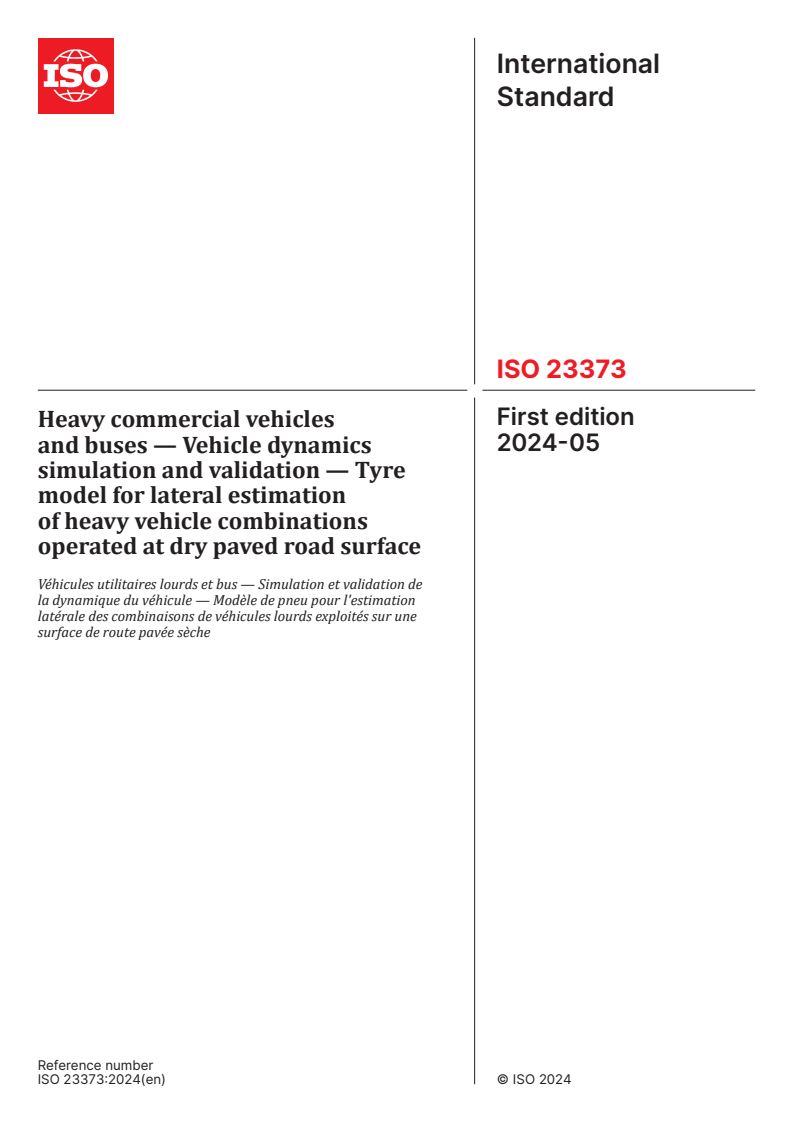
ISO 23373:2024 - Heavy commercial vehicles and buses — Vehicle dynamics simulation and validation — Tyre model for lateral estimation of heavy vehicle combinations operated at dry paved road surface Released:1. 05. 2024
Overview
ISO 23373:2024 specifies a generic tyre model for lateral estimation of heavy commercial vehicle combinations and buses operating on dry paved road surfaces. The standard provides a compact, parameterized tyre model for calculating lateral tyre forces used in vehicle dynamics simulations and validation (particularly for lateral stability assessment and roll behaviour). The model is suitable for simulation frameworks used with ISO 14791 test cases and covers steady-state and transient behaviour for normal forces from zero up to twice the tyre nominal load.
Key topics and technical requirements
- Model scope and limits
- Intended for heavy vehicles per ISO 3833 (categories M3, N2, N3, O3, O4).
- Best used when longitudinal forces are insignificant (typically < 10% of peak longitudinal friction).
- Developed for moderate lateral slip - exercise caution for slip angles > 15°.
- Model structure
- Inspired by the Magic Formula family but simplified (no camber, asymmetry, or combined slip effects).
- Five steady‑state parameters: nominal cornering coefficient, cornering coefficient gradient, nominal peak lateral friction, peak lateral friction gradient, shape factor (plus nominal peak position relation).
- Two transient parameters: nominal lateral relaxation length and its gradient (first-order filter behaviour).
- Formulations provided
- Steady-state lateral force as a non-linear function of slip angle and vertical load.
- Load-dependent scaling of peak friction and cornering coefficient.
- Transient modelling via lateral relaxation length (or alternatively by low‑pass filtering the slip angle).
- Standard parameter set
- If no tyre data are available, ISO 23373:2024 provides recommended parameter values for several tyre sizes and an all-purpose tyre (values derived from tyre measurements).
Applications
- Comparing and ranking vehicle combination configurations for on-road lateral and roll stability.
- Vehicle dynamics simulation at near-constant public-road speeds (typically > 40 km/h), and for both higher- and lower-speed manoeuvres within model limitations.
- Use in yaw-and-roll plane vehicle models (including vertical load transfer) or simpler yaw-plane models.
- Useful for vehicle manufacturers, simulation engineers, safety analysts, tire developers, and test laboratories conducting lateral stability studies.
Who should use this standard
- Simulation engineers and vehicle dynamics teams in OEMs and suppliers
- Tyre testing laboratories and tyre model developers
- Regulatory and conformity assessment bodies performing stability assessments
- Research groups studying heavy vehicle rollover and stability
Related standards
- ISO 14791 (vehicle combination lateral stability test cases)
- ISO 3833 (vehicle category definitions)
- ISO 8855 (vehicle dynamics vocabulary)
- ISO 15037‑2 (test conditions for heavy vehicles)
Keywords: ISO 23373:2024, tyre model, lateral tyre forces, heavy commercial vehicles, vehicle dynamics simulation, lateral stability, lateral relaxation length, cornering stiffness, peak lateral friction.
Buy Documents
ISO 23373:2024 - Heavy commercial vehicles and buses — Vehicle dynamics simulation and validation — Tyre model for lateral estimation of heavy vehicle combinations operated at dry paved road surface Released:1. 05. 2024
Get Certified
Connect with accredited certification bodies for this standard

TÜV Rheinland
TÜV Rheinland is a leading international provider of technical services.

TÜV SÜD
TÜV SÜD is a trusted partner of choice for safety, security and sustainability solutions.

DEKRA Certification Inc.
DEKRA US certification services.
Sponsored listings
Frequently Asked Questions
ISO 23373:2024 is a standard published by the International Organization for Standardization (ISO). Its full title is "Heavy commercial vehicles and buses — Vehicle dynamics simulation and validation — Tyre model for lateral estimation of heavy vehicle combinations operated at dry paved road surface". This standard covers: This document specifies a generic tyre model and model parameters for calculating lateral tyre forces, for use in lateral stability simulations of heavy commercial vehicle combinations with test cases according to ISO 14791. This tyre model is parameterized by easily understandable characteristics which can be estimated from tyre measurement data. If tyre data is not available, the parameters proposed in this document can be used. One typical application area of this document is the comparing and ranking of various vehicle combination configurations with respect to on-road lateral and roll stability. Such an assessment is usually performed at close to constant speed levels typical for public roads, usually higher than 40 km/h. The tyre model, however, can be useful for both high- and low-speed manoeuvring. This tyre model is relevant for representing the lateral performance of tyres on a vehicle combination when the longitudinal forces are insignificant, typically less than 10 % of the peak longitudinal friction utilization. The tyre model can be used for normal forces ranging from zero to twice the nominal normal force of the tyre. This tyre model has been developed for moderate lateral slip conditions; it is important that the model is used with care for scenarios where tyre slip angle exceeds 15°. This tyre model is suitable for vehicle models operating in the yaw and roll plane which naturally include vertical load transfer between the wheels during manoeuvring. The tyre model can also be used in models with less complexity such as pure yaw plane models. This document applies to heavy vehicles, including commercial vehicles, commercial vehicle combinations, buses and articulated buses as defined in ISO 3833 (trucks and trailers with a maximum weight above 3,5 tonnes and buses and articulated buses with a maximum weight above 5 tonnes, according to ECE and EC vehicle classification, categories M3, N2, N3, O3 and O4).
This document specifies a generic tyre model and model parameters for calculating lateral tyre forces, for use in lateral stability simulations of heavy commercial vehicle combinations with test cases according to ISO 14791. This tyre model is parameterized by easily understandable characteristics which can be estimated from tyre measurement data. If tyre data is not available, the parameters proposed in this document can be used. One typical application area of this document is the comparing and ranking of various vehicle combination configurations with respect to on-road lateral and roll stability. Such an assessment is usually performed at close to constant speed levels typical for public roads, usually higher than 40 km/h. The tyre model, however, can be useful for both high- and low-speed manoeuvring. This tyre model is relevant for representing the lateral performance of tyres on a vehicle combination when the longitudinal forces are insignificant, typically less than 10 % of the peak longitudinal friction utilization. The tyre model can be used for normal forces ranging from zero to twice the nominal normal force of the tyre. This tyre model has been developed for moderate lateral slip conditions; it is important that the model is used with care for scenarios where tyre slip angle exceeds 15°. This tyre model is suitable for vehicle models operating in the yaw and roll plane which naturally include vertical load transfer between the wheels during manoeuvring. The tyre model can also be used in models with less complexity such as pure yaw plane models. This document applies to heavy vehicles, including commercial vehicles, commercial vehicle combinations, buses and articulated buses as defined in ISO 3833 (trucks and trailers with a maximum weight above 3,5 tonnes and buses and articulated buses with a maximum weight above 5 tonnes, according to ECE and EC vehicle classification, categories M3, N2, N3, O3 and O4).
ISO 23373:2024 is classified under the following ICS (International Classification for Standards) categories: 43.080.01 - Commercial vehicles in general. The ICS classification helps identify the subject area and facilitates finding related standards.
ISO 23373:2024 is available in PDF format for immediate download after purchase. The document can be added to your cart and obtained through the secure checkout process. Digital delivery ensures instant access to the complete standard document.
Standards Content (Sample)
International
Standard
ISO 23373
First edition
Heavy commercial vehicles
2024-05
and buses — Vehicle dynamics
simulation and validation — Tyre
model for lateral estimation
of heavy vehicle combinations
operated at dry paved road surface
Véhicules utilitaires lourds et bus — Simulation et validation de
la dynamique du véhicule — Modèle de pneu pour l'estimation
latérale des combinaisons de véhicules lourds exploités sur une
surface de route pavée sèche
Reference number
© ISO 2024
All rights reserved. Unless otherwise specified, or required in the context of its implementation, no part of this publication may
be reproduced or utilized otherwise in any form or by any means, electronic or mechanical, including photocopying, or posting on
the internet or an intranet, without prior written permission. Permission can be requested from either ISO at the address below
or ISO’s member body in the country of the requester.
ISO copyright office
CP 401 • Ch. de Blandonnet 8
CH-1214 Vernier, Geneva
Phone: +41 22 749 01 11
Email: copyright@iso.org
Website: www.iso.org
Published in Switzerland
ii
Contents Page
Foreword .iv
Introduction .v
1 Scope . 1
2 Normative references . 1
3 Terms and definitions . 1
4 Tyre model formulae . 4
4.1 Steady-state calculation .4
4.2 Transient properties . .5
4.3 Standard values of the model parameters .5
Bibliography . 7
iii
Foreword
ISO (the International Organization for Standardization) is a worldwide federation of national standards
bodies (ISO member bodies). The work of preparing International Standards is normally carried out through
ISO technical committees. Each member body interested in a subject for which a technical committee
has been established has the right to be represented on that committee. International organizations,
governmental and non-governmental, in liaison with ISO, also take part in the work. ISO collaborates closely
with the International Electrotechnical Commission (IEC) on all matters of electrotechnical standardization.
The procedures used to develop this document and those intended for its further maintenance are described
in the ISO/IEC Directives, Part 1. In particular, the different approval criteria needed for the different types
of ISO document should be noted. This document was drafted in accordance with the editorial rules of the
ISO/IEC Directives, Part 2 (see www.iso.org/directives).
ISO draws attention to the possibility that the implementation of this document may involve the use of (a)
patent(s). ISO takes no position concerning the evidence, validity or applicability of any claimed patent
rights in respect thereof. As of the date of publication of this document, ISO had not received notice of (a)
patent(s) which may be required to implement this document. However, implementers are cautioned that
this may not represent the latest information, which may be obtained from the patent database available at
www.iso.org/patents. ISO shall not be held responsible for identifying any or all such patent rights.
Any trade name used in this document is information given for the convenience of users and does not
constitute an endorsement.
For an explanation of the voluntary nature of standards, the meaning of ISO specific terms and expressions
related to conformity assessment, as well as information about ISO's adherence to the World Trade
Organization (WTO) principles in the Technical Barriers to Trade (TBT), see www.iso.org/iso/foreword.html.
This document was prepared by Technical Committee ISO/TC 22, Road vehicles, Subcommittee SC 33, Vehicle
dynamics, chassis components and driving automation systems testing.
Any feedback or questions on this document should be directed to the user’s national standards body. A
complete listing of these bodies can be found at www.iso.org/members.html.
iv
Introduction
This document describes a generic tyre model intended for lateral stability performance estimations of
commercial vehicle combinations operated at dry paved road surface.
Even though the recommended use is limited to moderate excitation levels, non-linear components of truck
tyres are included to not underestimate risk levels, especially when it comes to loads with high centres of
gravity. Hence the standard model calculates the lateral force from vertical force and slip angle input with a
non-linear formula.
The tyre model in this document is inspired by a trigonometric formula for calculating steady-state lateral
or longitudinal force under pure slip conditions, often referred to as the Magic Formula. This formula was
introduced by HB Pacejka and colleagues in the 1980s.
The standard tyre model is however less complex compared to many tyre models based on the Magic
Formula, for example, by neglecting the influence of camber inclination, asymmetry and combined
longitudinal slip and sideslip. There are five characterizing parameters in the tyre model that describe the
steady state properties of the tyre, and two parameters that describe its transient properties.
v
International Standard ISO 23373:2024(en)
Heavy commercial vehicles and buses — Vehicle dynamics
simulation and validation — Tyre model for lateral
estimation of heavy vehicle combinations operated at dry
paved road surface
1 Scope
This document specifies a generic tyre model and model parameters for calculating lateral tyre forces, for
use in lateral stability simulations of heavy commercial vehicle combinations with test cases according
to ISO 14791. This tyre model is parameterized by easily understandable characteristics which can be
estimated from tyre measurement data. If tyre data is not available, the parameters proposed in this
document can be used.
One typical application area of this document is the comparing and ranking of various vehicle combination
configurations with respect to on-road lateral and roll stability. Such an assessment is usually performed
at close to constant speed levels typical for public roads, usually higher than 40 km/h. The tyre model,
however, can be useful for both high- and low-speed manoeuvring.
This tyre model is relevant for representing the lateral performance of tyres on a vehicle combination when
the longitudinal forces are insignificant, typically less than 10 % of the peak longitudinal friction utilization.
The tyre model can be used for normal forces ranging from zero to twice the nominal normal force of the
tyre. This tyre model has been developed for moderate lateral slip conditions; it is important that the model
is used with care for scenarios where tyre slip angle exceeds 15°.
This tyre model is suitable for vehicle models operating in the yaw and roll plane which naturally include
vertical load transfer between the wheels during manoeuvring. The tyre model can also be used in models
with less complexity such as pure yaw plane models.
This document applies to heavy vehicles, including commercial vehicles, commercial vehicle combinations,
buses and articulated buses as defined in ISO 3833 (trucks and trailers with a maximum weight above 3,5
tonnes and buses and articulated buses with a maximum weight above 5 tonnes, according to ECE and EC
vehicle classification, categories M3, N2, N3, O3 and O4).
2 Normative references
The following documents are referred to in the text in such a way that some or all of their content constitutes
requirements of this document. For dated references, only the edition cited applies. For undated references,
the latest edition of the referenced document (including any amendments) applies.
ISO 3833, Road vehicles — Types — Terms and definitions
ISO 8855, Road vehicles — Vehicle dynamics and road-holding ability — Vocabulary
ISO 15037-2, Road vehicles — Vehicle dynamics test methods — Part 2: General conditions for heavy vehicles
and buses
3 Terms and definitions
For the purposes of this document, the terms and definitions given in ISO 3833, ISO 8855, ISO 15037-2 and
the following apply.
...