


ISO 23552-1
(Main)Control and protective devices for gaseous and liquid fuels - Particular requirements - Part 1: Electronic fuel/air ratio control systems, including associated sensors and mechanical actuators
Control and protective devices for gaseous and liquid fuels - Particular requirements - Part 1: Electronic fuel/air ratio control systems, including associated sensors and mechanical actuators
ISO 23552-1:2007 specifies safety, construction and performance requirements for electronic fuel/air ratio control systems intended for use with gas or oil burners and gas or oil burning appliances. ISO 23552-1:2007 also describes the test procedures for evaluating these requirements and specifies information necessary for installation and use. ISO 23552-1:2007 is applicable only to closed-loop fuel/air ratio controls and does not differentiate into classes by heat input. ISO 23552-1:2007 applies to electronic fuel/air ratio control systems that can be tested independently or as part of an appliance or as part of a burner.
Dispositifs de commande et de protection pour combustibles gazeux et liquides — Exigences particulières — Partie 1: Systèmes électroniques de commande des dispositifs de régulation du rapport air y compris les capteurs associés et les actionneurs mécaniques
General Information
- Status
- Not Published
- Technical Committee
- ISO/TC 161 - Controls and protective devices for gas and/or oil
- Drafting Committee
- ISO/TC 161 - Controls and protective devices for gas and/or oil
- Current Stage
- 6000 - International Standard under publication
- Start Date
- 06-Dec-2025
- Completion Date
- 10-Jan-2026
Relations
- Effective Date
- 05-Nov-2022
- Effective Date
- 05-Nov-2022
Overview
ISO 23552-1 specifies safety, construction and performance requirements for electronic fuel/air ratio control systems used with gas or oil burners and gas- or oil-burning appliances. The standard covers closed‑loop electronic fuel/air ratio controls, associated sensors, mechanical actuators, and the test procedures needed to evaluate compliance. It applies to controls tested independently, as part of a burner, or integrated into an appliance, and includes guidance and mandatory requirements for installation and use.
Keywords: ISO 23552-1, electronic fuel/air ratio control systems, fuel/air ratio, burners, sensors, actuators, safety requirements.
Key Topics
- Scope and classification: Definitions of system types, classes of controls and control functions relevant to closed‑loop fuel/air ratio systems.
- Construction requirements: Mechanical and material requirements, connections, and special provisions for gas controls that include electrical components in the gas path.
- Performance and functional requirements: Accuracy, repeatability, rated flow, range of operation, start‑up and restart behavior, and protection against internal faults for functional safety.
- Durability and endurance testing: Long‑term performance, thermal stress and vibration tests to ensure reliability in service.
- Leak‑tightness and flow testing: Volumetric and pressure‑loss test methods for leakage assessment (informative and normative annexes).
- Electrical equipment and EMC: Requirements and tests for electrical components, electromagnetic compatibility (immunity and emission), surge and transient protection.
- Marking and documentation: Required markings, installation and operating instructions, and warning notices for safe use.
- Data exchange and interfaces: Requirements for communication and interface to automatic burner control systems.
- Regional requirements and annexes: Specific regional provisions (Europe, Canada/USA, Japan), gas quick connector, elastomer compatibility, and manufacturer declarations for sensors and actuators.
Keywords: leak‑tightness test, durability, EMC, electrical equipment, functional safety.
Applications and Users
Who uses ISO 23552-1:
- Manufacturers of electronic fuel/air ratio controllers, sensors and actuators
- Burner and appliance designers integrating closed‑loop controls
- Test laboratories and certification bodies performing compliance testing
- Systems integrators and OEMs building gas/oil-fired equipment
- Safety engineers and installers referencing installation and marking requirements
Practical uses:
- Designing compliant fuel/air ratio control products
- Establishing test protocols for product verification and certification
- Ensuring safe integration of electronic controls in burners and appliances
- Harmonizing product documentation and installation instructions for regulatory compliance
Keywords: burner control design, product testing, certification, installation instructions.
Related Standards
- Other parts of the ISO 23552 series and related standards developed by ISO/TC 161 (Control and protective devices for gaseous and liquid fuels).
- Regional and national standards referenced in the annexes for Europe, North America and Japan.
Keywords: ISO/TC 161, fuel control standards, regional requirements.

ISO/FDIS 23552-1 - Control and protective devices for gaseous and liquid fuels — Particular requirements — Part 1: Electronic fuel/air ratio control systems, including associated sensors and mechanical actuators Released:9/26/2025
REDLINE ISO/FDIS 23552-1 - Control and protective devices for gaseous and liquid fuels — Particular requirements — Part 1: Electronic fuel/air ratio control systems, including associated sensors and mechanical actuators Released:9/26/2025
Frequently Asked Questions
ISO 23552-1 is a draft published by the International Organization for Standardization (ISO). Its full title is "Control and protective devices for gaseous and liquid fuels - Particular requirements - Part 1: Electronic fuel/air ratio control systems, including associated sensors and mechanical actuators". This standard covers: ISO 23552-1:2007 specifies safety, construction and performance requirements for electronic fuel/air ratio control systems intended for use with gas or oil burners and gas or oil burning appliances. ISO 23552-1:2007 also describes the test procedures for evaluating these requirements and specifies information necessary for installation and use. ISO 23552-1:2007 is applicable only to closed-loop fuel/air ratio controls and does not differentiate into classes by heat input. ISO 23552-1:2007 applies to electronic fuel/air ratio control systems that can be tested independently or as part of an appliance or as part of a burner.
ISO 23552-1:2007 specifies safety, construction and performance requirements for electronic fuel/air ratio control systems intended for use with gas or oil burners and gas or oil burning appliances. ISO 23552-1:2007 also describes the test procedures for evaluating these requirements and specifies information necessary for installation and use. ISO 23552-1:2007 is applicable only to closed-loop fuel/air ratio controls and does not differentiate into classes by heat input. ISO 23552-1:2007 applies to electronic fuel/air ratio control systems that can be tested independently or as part of an appliance or as part of a burner.
ISO 23552-1 is classified under the following ICS (International Classification for Standards) categories: 27.060.20 - Gas fuel burners. The ICS classification helps identify the subject area and facilitates finding related standards.
ISO 23552-1 has the following relationships with other standards: It is inter standard links to ISO 23552-1:2007, ISO 23552-1:2007/Amd 1:2010. Understanding these relationships helps ensure you are using the most current and applicable version of the standard.
ISO 23552-1 is available in PDF format for immediate download after purchase. The document can be added to your cart and obtained through the secure checkout process. Digital delivery ensures instant access to the complete standard document.
Standards Content (Sample)
FINAL DRAFT
International
Standard
ISO/FDIS 23552-1
ISO/TC 161
Control and protective devices
Secretariat: DIN
for gaseous and liquid fuels —
Voting begins on:
Particular requirements —
2025-10-10
Part 1:
Voting terminates on:
2025-12-05
Electronic fuel/air ratio control
systems, including associated
sensors and mechanical actuators
Dispositifs de commande et de protection pour combustibles
gazeux et liquides — Exigences particulières —
Partie 1: Systèmes électroniques de commande des dispositifs de
régulation du rapport air y compris les capteurs associés et les
actionneurs mécaniques
RECIPIENTS OF THIS DRAFT ARE INVITED TO SUBMIT,
WITH THEIR COMMENTS, NOTIFICATION OF ANY
RELEVANT PATENT RIGHTS OF WHICH THEY ARE AWARE
AND TO PROVIDE SUPPOR TING DOCUMENTATION.
IN ADDITION TO THEIR EVALUATION AS
BEING ACCEPTABLE FOR INDUSTRIAL, TECHNO-
LOGICAL, COMMERCIAL AND USER PURPOSES, DRAFT
INTERNATIONAL STANDARDS MAY ON OCCASION HAVE
TO BE CONSIDERED IN THE LIGHT OF THEIR POTENTIAL
TO BECOME STAN DARDS TO WHICH REFERENCE MAY BE
MADE IN NATIONAL REGULATIONS.
Reference number
ISO/FDIS 23552-1:2025(en) © ISO 2025
FINAL DRAFT
ISO/FDIS 23552-1:2025(en)
International
Standard
ISO/FDIS 23552-1
ISO/TC 161
Control and protective devices
Secretariat: DIN
for gaseous and liquid fuels —
Voting begins on:
Particular requirements —
Part 1:
Voting terminates on:
Electronic fuel/air ratio control
systems, including associated
sensors and mechanical actuators
Dispositifs de commande et de protection pour combustibles
gazeux et liquides — Exigences particulières —
Partie 1: Systèmes électroniques de commande des dispositifs de
régulation du rapport air y compris les capteurs associés et les
actionneurs mécaniques
RECIPIENTS OF THIS DRAFT ARE INVITED TO SUBMIT,
WITH THEIR COMMENTS, NOTIFICATION OF ANY
RELEVANT PATENT RIGHTS OF WHICH THEY ARE AWARE
AND TO PROVIDE SUPPOR TING DOCUMENTATION.
© ISO 2025
IN ADDITION TO THEIR EVALUATION AS
All rights reserved. Unless otherwise specified, or required in the context of its implementation, no part of this publication may
BEING ACCEPTABLE FOR INDUSTRIAL, TECHNO-
LOGICAL, COMMERCIAL AND USER PURPOSES, DRAFT
be reproduced or utilized otherwise in any form or by any means, electronic or mechanical, including photocopying, or posting on
INTERNATIONAL STANDARDS MAY ON OCCASION HAVE
the internet or an intranet, without prior written permission. Permission can be requested from either ISO at the address below
TO BE CONSIDERED IN THE LIGHT OF THEIR POTENTIAL
or ISO’s member body in the country of the requester.
TO BECOME STAN DARDS TO WHICH REFERENCE MAY BE
MADE IN NATIONAL REGULATIONS.
ISO copyright office
CP 401 • Ch. de Blandonnet 8
CH-1214 Vernier, Geneva
Phone: +41 22 749 01 11
Email: copyright@iso.org
Website: www.iso.org
Published in Switzerland Reference number
ISO/FDIS 23552-1:2025(en) © ISO 2025
ii
ISO/FDIS 23552-1:2025(en)
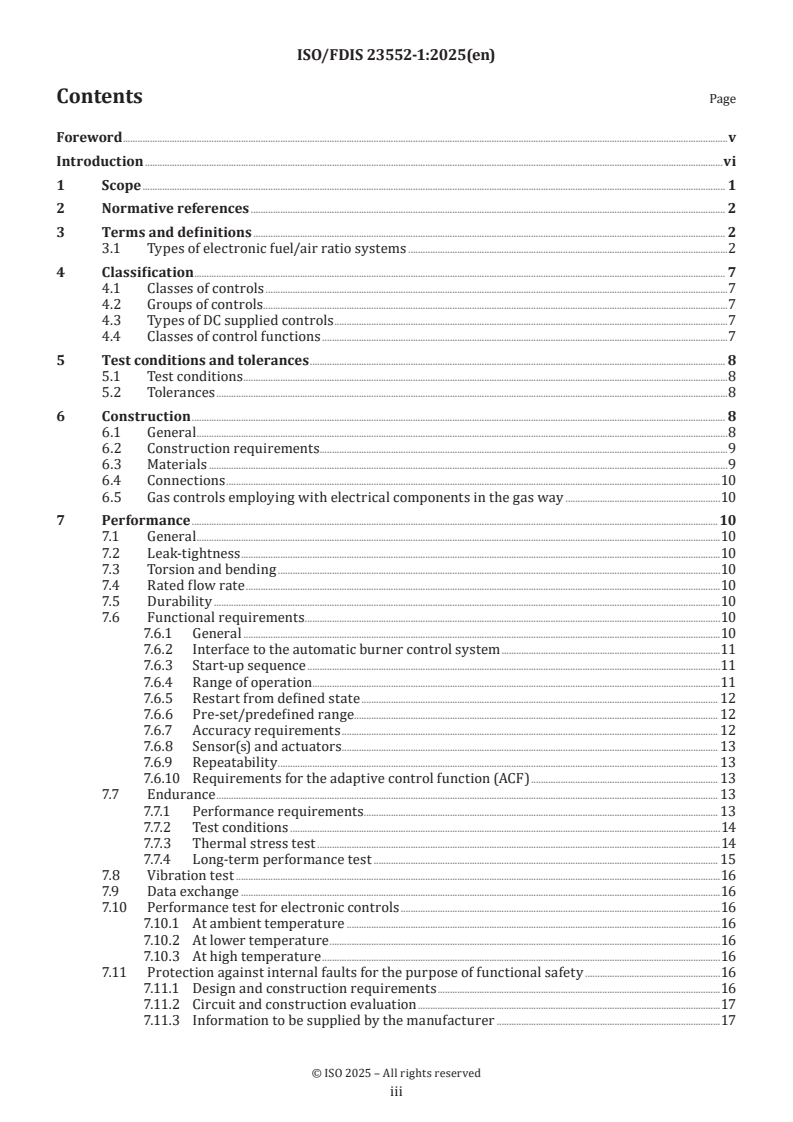
Contents Page
Foreword .v
Introduction .vi
1 Scope . 1
2 Normative references . 2
3 Terms and definitions . 2
3.1 Types of electronic fuel/air ratio systems .2
4 Classification . 7
4.1 Classes of controls .7
4.2 Groups of controls .7
4.3 Types of DC supplied controls .7
4.4 Classes of control functions .7
5 Test conditions and tolerances . 8
5.1 Test conditions .8
5.2 Tolerances .8
6 Construction . 8
6.1 General .8
6.2 Construction requirements.9
6.3 Materials .9
6.4 Connections .10
6.5 Gas controls employing with electrical components in the gas way .10
7 Performance . 10
7.1 General .10
7.2 Leak-tightness .10
7.3 Torsion and bending .10
7.4 Rated flow rate .10
7.5 Durability .10
7.6 Functional requirements . .10
7.6.1 General .10
7.6.2 Interface to the automatic burner control system .11
7.6.3 Start-up sequence .11
7.6.4 Range of operation . .11
7.6.5 Restart from defined state . 12
7.6.6 Pre-set/predefined range. 12
7.6.7 Accuracy requirements . 12
7.6.8 Sensor(s) and actuators . . 13
7.6.9 Repeatability . 13
7.6.10 Requirements for the adaptive control function (ACF) . 13
7.7 Endurance . 13
7.7.1 Performance requirements . . 13
7.7.2 Test conditions .14
7.7.3 Thermal stress test .14
7.7.4 Long-term performance test . 15
7.8 Vibration test .16
7.9 Data exchange .16
7.10 Performance test for electronic controls .16
7.10.1 At ambient temperature .16
7.10.2 At lower temperature .16
7.10.3 At high temperature .16
7.11 Protection against internal faults for the purpose of functional safety .16
7.11.1 Design and construction requirements .16
7.11.2 Circuit and construction evaluation .17
7.11.3 Information to be supplied by the manufacturer .17
iii
ISO/FDIS 23552-1:2025(en)
7.11.4 Information .17
7.11.5 Compliance .18
8 Electrical equipment .18
8.1 General .18
8.2 Requirements .18
8.3 Test .18
8.4 Protection by enclosure .18
9 Electromagnetic compatibility (EMC) . .18
9.1 Protection against environmental influences .18
9.1.1 General .18
9.1.2 Requirements .19
9.2 Harmonics and interharmonics including mains signalling at AC power port, low
frequency immunity . 20
9.3 Voltage dips, voltage interruptions and voltage variations in the power supply network . 20
9.4 Test of influence of voltage unbalance . 20
9.5 Surge immunity test . 20
9.6 Electrical fast transient/burst . 20
9.7 Ring wave immunity .21
9.8 Electrostatic discharge .21
9.9 Radio-frequency electromagnetic field immunity .21
9.9.1 Immunity to conducted disturbances .21
9.9.2 Immunity to radiated disturbances .21
9.10 Influence of supply frequency variations .21
9.11 Power frequency magnetic field immunity .21
9.12 Evaluation of compliance . 22
10 Marking, installation and operating instructions .22
10.1 Marking . 22
10.2 Installation and operating instructions . 22
10.2.1 General . 22
10.2.2 Technical information for the safety after integration in the appliance . 23
10.3 Warning notice .24
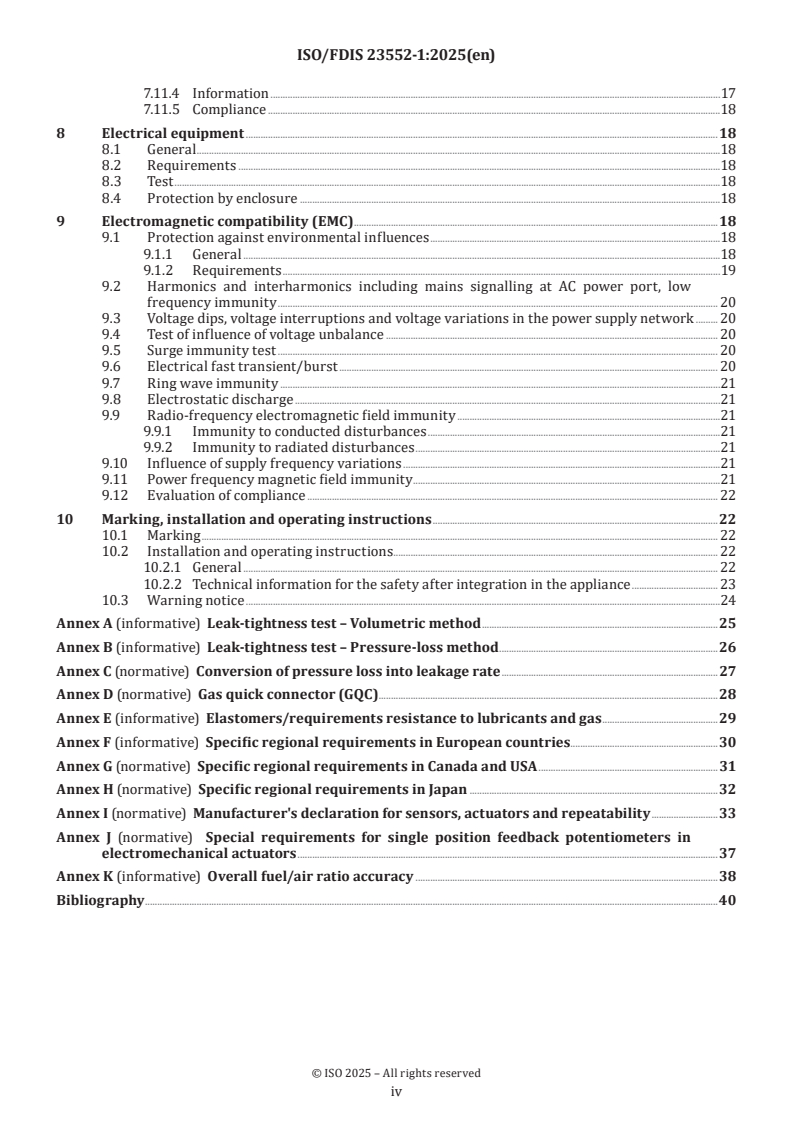
Annex A (informative) Leak-tightness test – Volumetric method .25
Annex B (informative) Leak-tightness test – Pressure-loss method .26
Annex C (normative) Conversion of pressure loss into leakage rate .27
Annex D (normative) Gas quick connector (GQC).28
Annex E (informative) Elastomers/requirements resistance to lubricants and gas .29
Annex F (informative) Specific regional requirements in European countries.30
Annex G (normative) Specific regional requirements in Canada and USA .31
Annex H (normative) Specific regional requirements in Japan .32
Annex I (normative) Manufacturer's declaration for sensors, actuators and repeatability .33
Annex J (normative) Special requirements for single position feedback potentiometers in
electromechanical actuators .37
Annex K (informative) Overall fuel/air ratio accuracy .38
Bibliography .40
iv
ISO/FDIS 23552-1:2025(en)
Foreword
ISO (the International Organization for Standardization) is a worldwide federation of national standards
bodies (ISO member bodies). The work of preparing International Standards is normally carried out through
ISO technical committees. Each member body interested in a subject for which a technical committee
has been established has the right to be represented on that committee. International organizations,
governmental and non-governmental, in liaison with ISO, also take part in the work. ISO collaborates closely
with the International Electrotechnical Commission (IEC) on all matters of electrotechnical standardization.
The procedures used to develop this document and those intended for its further maintenance are described
in the ISO/IEC Directives, Part 1. In particular, the different approval criteria needed for the different types
of ISO document should be noted. This document was drafted in accordance with the editorial rules of the
ISO/IEC Directives, Part 2 (see www.iso.org/directives).
ISO draws attention to the possibility that the implementation of this document may involve the use of (a)
patent(s). ISO takes no position concerning the evidence, validity or applicability of any claimed patent
rights in respect thereof. As of the date of publication of this document, ISO had not received notice of (a)
patent(s) which may be required to implement this document. However, implementers are cautioned that
this may not represent the latest information, which may be obtained from the patent database available at
www.iso.org/patents. ISO shall not be held responsible for identifying any or all such patent rights.
Any trade name used in this document is information given for the convenience of users and does not
constitute an endorsement.
For an explanation of the voluntary nature of standards, the meaning of ISO specific terms and expressions
related to conformity assessment, as well as information about ISO's adherence to the World Trade
Organization (WTO) principles in the Technical Barriers to Trade (TBT), see www.iso.org/iso/foreword.html.
This document was prepared by Technical Committee ISO/TC 161, Controls and protective devices for gaseous
and liquid fuels.
This second edition cancels and replaces the first edition (ISO 23552-1:2007), which has been technically
revised. It also incorporates the Amendment ISO 23552-1:2007/Amd 1:2010.
The main changes are as follows:
— the title and scope have been modified;
— the document has been aligned with ISO 23550 and IEC 60730-1;
— the requirements for fuel/air ratio using oil as the fuel have been integrated;
— the control types ERS and ERT have been added;
— the terms and definitions clause has been expanded and updated;
— the accuracy requirements have been updated;
— Clause 7 “Endurance” has been updated;
— subclause 7.9 “Data exchange” has been added;
— update 7.11 “Protection against internal faults for the purpose of functional safety”;
— update Clause 9 “Electromagnetic compatibility”.
A list of all parts in the ISO 23552 series can be found on the ISO website.
Any feedback or questions on this document should be directed to the user’s national standards body. A
complete listing of these bodies can be found at www.iso.org/members.html.
v
ISO/FDIS 23552-1:2025(en)
Introduction
This document is designed to be used in combination with ISO 23550. Together with ISO 23550, this
document establishes the full requirements as they apply to the product covered by this document.
Where needed, this document adapts ISO 23550 by stating in the corresponding clause:
— “with the following modification”;
— “with the following addition”;
— “is replaced by the following”;
— “is not applicable”.
In order to identify specific requirements that are particular to this document and that are not already
covered by ISO 23550, this document contains clauses or subclauses that are additional to the structure of
ISO 23550. These subclauses are indicated by the introductory sentence: “Subclause (or Annex) specific to
this document.”
To ensure the global relevance of this document, the differing requirements resulting from practical
experience and installation practices in various regions of the world have been taken into account.
The variations in basic design associated with gas controls and appliances have also been recognized,
some of which are addressed in Annexes F, G and H. This document intends to provide a basic framework of
requirements that recognize these differences.
For electronic fuel/air ratio control/supervision systems, there are numerous solutions for specific
applications in the market. For this reason, ISO/TC 161, Controls and protective devices for gaseous and liquid
fuels, decided to draft an International Standard for type testing for electronic fuel/air ratio control systems
(ERC), electronic fuel/air ratio supervision systems (ERS) and electronic fuel/air ratio trim systems (ERT)
intended for use with burners and appliances burning gaseous or liquid fuels.
NOTE Trim function is a special design of electronic fuel/air ratio control function.
This document does not override requirements of relevant appliance standards. It is the intention of this
document that the safety of the appliance will not be reduced by any normal or abnormal operation of the
ERC, ERS or ERT.
In this document, there is no classification, either by heat input or by applications.
The accuracy of actual fuel/air ratio is not specified as a fixed value.
This document specifies which parameters are declared in the instruction and under what conditions this
declaration is considered fulfilled. These parameters relate to the fuel/air ratio control/supervision systems
rather than the combustion process.
This document does not include a standard test rig. However, the purpose of the tests is to verify the
manufacturer's declaration under the conditions required in this document.
vi
FINAL DRAFT International Standard ISO/FDIS 23552-1:2025(en)
Control and protective devices for gaseous and liquid fuels —
Particular requirements —
Part 1:
Electronic fuel/air ratio control systems, including associated
sensors and mechanical actuators
1 Scope
This document specifies safety, design, construction and performance requirements and testing for
electronic fuel/air ratio control (FARC) systems. Systems can include sensors, mechanical actuators and
motors/blowers that make up the complete system. Systems can be described as:
— closed loop fuel/air ratio control systems (ERC), see 3.1.1;
— closed loop fuel/air ratio trim systems (ERT), see 3.1.2;
— fuel/air ratio supervision systems (ERS), see 3.2.
NOTE 1 Throughout this document, the word “system” means “FARC control and system components”.
These systems are intended for use with burners and appliances that burn gaseous or liquid fuels. This
document describes the procedures for evaluating these requirements and specifies information necessary
for installation and use.
This document applies to the inherent safety of the system, to the declared operating values, operating times
and operating sequences if they are associated with FARC safety and to the testing of FARC systems used in,
on or in association with appliances.
NOTE 2 The documents for burners, appliances or processes which use ERC, ERS or ERT can override the
requirements of this document.
This document prescribes testing requirements in addition to the relevant standards for integrated devices
or components (e.g. actuators) to ensure safe operation of the FARC system.
If no part 2 standards in ISO/TC 161, Controls and protective devices for gaseous and liquid fuels, or IEC/TC 72,
Textile machinery and accessories, exist, then IEC 60730-1 is considered.
NOTE 3 Supplemental or modified requirements and tests and evaluations can be needed for ERC, ERS or ERT
systems for conformance with relevant burner, appliance or process standards. Conformance of an ERC, ERS or ERT
with this document does not imply that such systems or components thereof are acceptable for use on an appliance
without supplemental tests of the control system applied to the particular appliance to meet the requirements of the
relevant burner, appliance or process standard(s).
This document applies to electronic fuel/air ratio control systems that can be tested independently or as a
system or as part of an appliance or as part of a burner.
This document does not cover burner control function like e.g. burner ignition, flame supervision and fuel
shutoff.
ISO/FDIS 23552-1:2025(en)
2 Normative references
The following documents are referred to in the text in such a way that some or all of their content constitutes
requirements of this document. For dated references, only the edition cited applies. For undated references,
the latest edition of the referenced document (including any amendments) applies.
ISO 23550:2018, Safety and control devices for gas and/or oil burners and appliances — General requirements
IEC 60730-1:2022, Automatic electrical controls — Part 1: General requirements
IEC 60730-2-5:2021, Automatic electrical controls — Part 2-5: Particular requirements for automatic electrical
burner control systems
3 Terms and definitions
For the purposes of this document, the terms and definitions given in ISO 23550 and the following apply.
ISO and IEC maintain terminology databases for use in standardization at the following addresses:
— ISO Online browsing platform: available at https:// www .iso .org/ obp
— IEC Electropedia: available at https:// www .electropedia .org/
3.1 Types of electronic fuel/air ratio systems
3.1.1
electronic fuel/air ratio control system
ERC
closed-loop system consisting of the electronic control unit, actuating elements for the fuel flow and the air
flow as a minimum, and allocated feedback signal(s) that are used to control fuel/air ratio of a burner
Note 1 to entry: Figure 1 shows an example of different feedback alternatives. For details, see also Table 1.
Key
1 electronic control unit (ECU) 8 sensor flame (for FARC function)
2 combustion process 9 sensor flue gas
3 actuator air 10 actuator air feedback
4 actuator fuel 11 actuator fuel feedback
5 sensor air 12 automatic burner control system
ISO/FDIS 23552-1:2025(en)
6 sensor fuel
7 sensor fuel/air mixture scope of ERC
a
From the ERC point of view, 12 acts in case a defined state is requested by 1 to de-energize the safety shut-off valves.
Figure 1 — Scope of the electronic fuel/air ratio control system (ERC)
3.1.2
electronic fuel/air ratio trim system
ERT
closed loop system consisting of the electronic control unit, actuating element(s) or control output(s) to
influence the fuel/air ratio controlled by other means (see Figure 2, item 13), and the allocated feedback
signal(s) to the electronic control unit
Note 1 to entry: Figure 2 shows an example of different feedback alternatives. For details, see also Table 1.
Key
1 electronic control unit (ECU) 9 sensor flue gas
2 combustion process 10 actuator air feedback
3 actuator air 11 actuator fuel feedback
4 actuator fuel 12 automatic burner control system
5 sensor air 13 arbitrary control
6 sensor fuel 14 trim signal air
7 sensor fuel/air mixture 15 trim signal fuel
8 sensor flame 16 state signal to 13, e.g. release signal
scope of ERT
a
From the ERT point of view, 12 acts in case a defined state is requested by 1 to de-energize the safety shut-off valves.
Figure 2 — Scope of the electronic fuel/air ratio trim system (ERT)
3.2
electronic fuel/air ratio supervision system
ERS
supervision system consisting of electronic control unit and sensor(s), providing at least one output signal
to indicate if the fuel/air ratio is outside of the safe area of the application
Note 1 to entry: Figure 3 shows an example of different feedback alternatives. For details, see also Table 1.
ISO/FDIS 23552-1:2025(en)
Note 2 to entry: Electronic control unit is not intended to control actuators.
Key
1 electronic control unit (ECU) 8 sensor flame
2 combustion process 9 sensor flue gas
3 actuator air 10 actuator air feedback
4 actuator fuel 11 actuator fuel feedback
5 sensor air 12 automatic burner control system
6 sensor fuel 13 arbitrary control
7 sensor fuel/air mixture scope of ERC
a
From the ERS point of view, 12 acts in case a defined state is requested by 1 to de-energize the safety shut-off valves.
Figure 3 — Scope of the electronic fuel/air ratio supervision system (ERS)
3.3
electronic control unit
ECU
electronic main control module incorporating all inputs and outputs of the ERC, ERS or ERT function
3.4
actuator
device for controlling the amount of fuel and/or air
Note 1 to entry: A variable speed fan is an example of an air actuator.
3.5
sensor
device which responds to a physical activating quantity on the sensing element that then generates a signal
related to the value of that activating quantity
3.6
combustion process
chemical reaction between fuel and air to produce heat
ISO/FDIS 23552-1:2025(en)
3.7
defined state
state assumed by system to ensure a safe situation under all circumstances
Note 1 to entry: For example, the system can execute a protective action to the burner control system causing it to
safety shut-down and lock out or the system remains in operation, continuing to satisfy all safety related functional
requirements.
3.8
fault tolerating time
FTT
time between the occurrence of a fault and reaching a defined state, which is tolerated by the application
without resulting in a hazardous situation
Note 1 to entry: For illustration of the fault tolerating time, see Figure 4 or Figure 5.
[SOURCE: IEC 60730-1:2022, H.3.22.2, modified — The part of the sentence “the shut-down of the controlled
equipment” has been replaced by “reaching a defined state”. Note 1 to entry has been replaced.]
3.9
fault reaction time control
FRTc
time that the ERC, ERS or ERT needs from the moment the fault condition reaches the sensor to the moment
of an initialization to reach a defined state
Note 1 to entry: For illustration of the fault reaction time of control for ERC and ERS, see Figure 4.
Note 2 to entry: For illustration of the fault reaction time of control for ERT, see Figure 5.
Key
1 fuel/air ratio moves outside of the safe area of the application
2 effect of fault condition reaches the sensor
3 sensor e.g. position sensors, flue gas sensors outputs effect of fault
4 sensor output is amplified
5 amplified signal passes filter
6 effect of fault condition is flagged by limit switch
7 flag is processed by automatic burner control
8 defined state is reached
Figure 4 — Relationship between fault tolerating time and fault reaction time of control for ERC and ERS
ISO/FDIS 23552-1:2025(en)
Key
1 fuel/air ratio moves outside of the safe area of the application
2 effect of fault condition reaches the sensor
3 sensor e.g. position sensors, flue gas sensors outputs effect of fault
4 sensor output is amplified
5 amplified signal passes filter
6 effect of fault condition is flagged by limit switch
a
7 flag may be processed by optional control system to initiate a defined state
8 shut-off element or actuating element influences the fuel/air ratio to reach a defined state
a
Examples for optional control are key 12 or key 13 in Figure 2. An optional control can only be used to reach
a defined state if the control has the required safety class for this function.
Figure 5 — Relationship between fault tolerating time and fault reaction time of control for ERT
3.10
safety shut-down
de-energization of the main fuel flow means as the result of the action of a limiter, a cut-out or the detection
of an internal fault of the system
Note 1 to entry: Safety shut-down may include additional actions by the system.
[SOURCE: IEC 60730-2-5:2021, 2.3.32]
3.11
lock-out
process in which the system goes into either volatile lock-out (3.11.2) or non-volatile lock-out (3.11.1)
following safety shut-down
[SOURCE: IEC 60730-2-5:2021, 2.3.112]
3.11.1
non-volatile lock-out
condition such that a restart can only be accomplished by a manual reset of the system and by no other cause
[SOURCE: IEC 60730-2-5:2021, 2.3.112.1]
3.11.2
volatile lock-out
condition such that a restart can be accomplished by either a manual reset of the system or by an interruption
of the power supply and its subsequent restoration
[SOURCE: IEC 60730-2-5:2021, 2.3.112.2]
ISO/FDIS 23552-1:2025(en)
3.12
normal operation
operation of the ERC, ERS or ERT control system within its specification including the effect of influences
which can occur during intended operation
Note 1 to entry: Examples of influences on sensors are given in Table I.1.
3.13
abnormal operation
operation of the appliance under the effect of internal failures of the ERC, ERS or ERT control system
3.14
form closure construction
mechanical construction ensuring non-slippage of a connection between at least two components
3.15
accuracy
ability to provide an indicated value close to the true value
[SOURCE: IEC 60050-311:2001+A1:2015+A2:2016+A3:2017+A4:2020, 311-06-08, modified — The term
“measuring instrument” and expression “of the measurand” have been deleted. Note 1 to entry and Note 2 to
entry have been deleted.]
3.16
adaptive control function
ACF
control function, intended to maintain λ constant in a range Δλ by adapting the flow of fuel, and/or the flow of air
and/or other physical quantity to compensate changes in input parameters relevant for the combustion process
Note 1 to entry: Changes in input parameters can be the composition of the fuel or the combustion air temperature.
4 Classification
4.1 Classes of controls
Shall be according to ISO 23550:2018, 4.1.
4.2 Groups of controls
ISO 23550:2018, 4.2 is not applicable.
4.3 Types of DC supplied controls
Shall be according to ISO 23550:2018, 4.3.
4.4 Classes of control functions
Shall be according to ISO 23550:2018, 4.4 with the following addition:
The class of control function shall be determined based on a risk assessment that has been agreed upon with
a certification body. If no risk assessment is available the ERC, ERT, ERS shall be a class C function.
If the control functions are combined with each other or with other fuel/air ratio control system technologies
(e.g. pneumatic, mechanical), then they may have a lower class of control function if the entire ERC, ERS or
ERT complies with determined class control function.
ISO/FDIS 23552-1:2025(en)
5 Test conditions and tolerances
5.1 Test conditions
For the purposes of this document, ISO 23550:2018, 5.1 is replaced by the following:
Unless otherwise stated, the ERC, ERS or ERT shall be tested in the relevant situations such as standby,
start-up, normal operation and lock-out (volatile or non-volatile).
NOTE A lock-out situation can also be a lock-out demand signal to the automatic burner control system.
Unless otherwise stated, the practical assessment shall be carried out under the following conditions:
— ambient temperature: 20 °C ± 5 °C;
— relative humidity: between 40 % and 80 %;
— at rated supply voltage and frequency.
Testing shall always be performed according to a test plan, which shall be included in the test report. The
relevant assessment criteria should be part of this test plan.
Where possible, the tests already covered by other standards (e.g. the relevant parts of IEC 60730-1) can be
combined with tests presented in this document.
5.2 Tolerances
Shall be according to ISO 23550:2018, 5.2.
6 Construction
6.1 General
Shall be according to ISO 23550:2018, 6.1 with the following addition.
The electrical components shall be designed for their intended use.
The quality of the materials and the design and structure of the components used shall be such that the
control will operate safely and in accordance with the requirements of this document for its designed
lifetime as stated in the instruction. That shall continue under the mechanical, chemical, thermal and
environmental conditions normally expected, even in the event of careless behaviour as can occur in normal
use. Compliance is checked by carrying out the tests specified in this document.
The ERC, ERS or ERT shall be designed such that changes in critical component values (e.g. those affecting
timing, sequence and accuracy) within the worst-case specifications of the components, including the long-
term stability, shall result in the control continuing to function in accordance with this document.
The ERC shall consist of at least two actuators and at least one sensor; see Figure 1 and Table 1, which shall
be considered together.
The ERS shall consist of at least one sensor and one output to initiate reaching a defined state; see Figure 3
and Table 1, which shall be considered together.
The ERT shall consist of at least one output to trim the fuel/air ratio and at least one sensor; see Figure 2 and
Table 1, which shall be considered together.
The ERC, ERS or ERT shall have a self-checking function. When the ERC, ERS or ERT is not active (e.g. in
stand-by), any fault in its control function shall move to or remain in a defined state.
An ERC, ERS or ERT shall use a feedback system which ensures the fuel/air ratio meets the requirements of 7.6.6.
ISO/FDIS 23552-1:2025(en)
When analysing the system safety, the complete system shall be taken into account. This shall include the
peripheral elements, e.g. servo motors, actuators, positional devices, sensors, variable-speed controls for
combustion air fans and combustion analysis feedback systems.
Table 1 — Acceptable feedback types
Actuator output
Actuator feedback Process feedback
feedback
Fuel/ air
b
Position Speed Flow/Δp p Flame Flue gas
ratio
Valve /
X X X
Actuator
damper
Air
a, d
Fan X X X
Valve / X X X
X X X
damper
d, e
Actuator
Pump X X X
Fuel
Pressure / X X
flow regu-
c c
At least 2 feedbacks (1 fuel, 1 air) required At least 1 feedback required
lator
a
If a fan speed signal is used to control the air flow, proof of air flow cannot rely on fan rotation only. A possible additional
signal can be derived from an independent air proving device at least checked during start up.
b
A feedback signal which is directly related to the mechanical part of the actuator.
c
The two actuator feedbacks and the process feedback are alternatives.
d
A feedback signal from a va
...
Formatted: Left
Formatted: English (United Kingdom)
ISO/DISFDIS 23552-1:2024(en)
ISO/TC 161
Secretariat: DIN
Date: 2025-03-27
Control and protective devices for gaseous and liquid fuels —
Particular requirements — —
Part 1:
Electronic fuel/air ratio control systems, including associated
sensors and mechanical actuators
Dispositifs de commande et de protection pour combustibles gazeux et liquides — Exigences particulières —
Partie 1: Systèmes électroniques de commande des dispositifs de régulation du rapport air y compris les
capteurs associés et les actionneurs mécaniques
FDIS stage
Formatted: Justified
ISO/FDIS 23552-1:2025(en)
Formatted: Font: Bold
Formatted: HeaderCentered
All rights reserved. Unless otherwise specified, or required in the context of its implementation, no part of this publication
may be reproduced or utilized otherwise in any form or by any means, electronic or mechanical, including photocopying,
or posting on the internet or an intranet, without prior written permission. Permission can be requested from either
ISO at the address below or ISO’s member body in the country of the requester.
ISO copyright office
CP 401 • Ch. de Blandonnet 8
CH-1214 Vernier, Geneva
Phone: + 41 22 749 01 11
EmailE-mail: copyright@iso.org
Formatted: French (Switzerland)
Website: www.iso.orgwww.iso.org
Published in Switzerland
Formatted: Font: 10 pt
Formatted: Font: 10 pt
Formatted: Font: 11 pt
Formatted: FooterPageRomanNumber, Space After: 0
pt, Line spacing: single
ii © ISO #### 2025 – All rights reserved
ii
ISO/DISFDIS 23552-1:20242025(en)
Formatted: Font: Bold
Formatted: Font: Bold
Formatted: Font: Bold
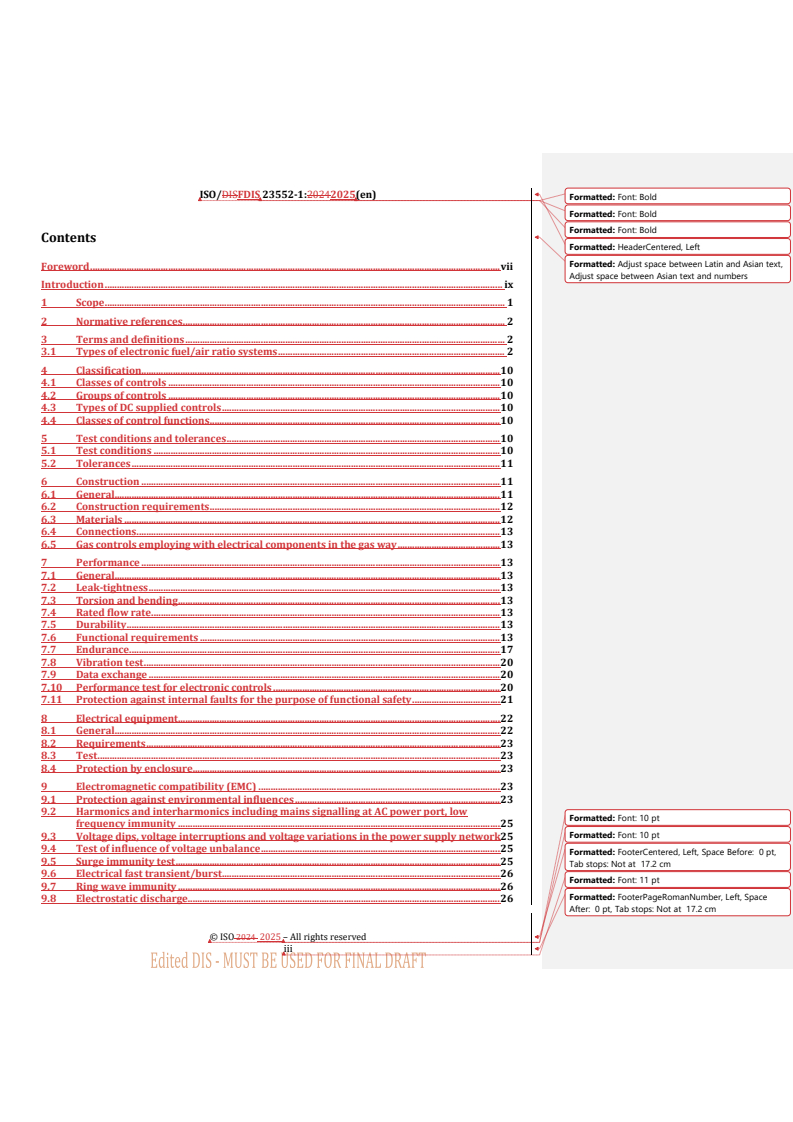
Contents
Formatted: HeaderCentered, Left
Formatted: Adjust space between Latin and Asian text,
Foreword . vii
Adjust space between Asian text and numbers
Introduction . ix
1 Scope . 1
2 Normative references . 2
3 Terms and definitions . 2
3.1 Types of electronic fuel/air ratio systems . 2
4 Classification. 10
4.1 Classes of controls . 10
4.2 Groups of controls . 10
4.3 Types of DC supplied controls . 10
4.4 Classes of control functions . 10
5 Test conditions and tolerances . 10
5.1 Test conditions . 10
5.2 Tolerances . 11
6 Construction . 11
6.1 General. 11
6.2 Construction requirements . 12
6.3 Materials . 12
6.4 Connections . 13
6.5 Gas controls employing with electrical components in the gas way . 13
7 Performance . 13
7.1 General. 13
7.2 Leak-tightness . 13
7.3 Torsion and bending . 13
7.4 Rated flow rate . 13
7.5 Durability . 13
7.6 Functional requirements . 13
7.7 Endurance . 17
7.8 Vibration test . 20
7.9 Data exchange . 20
7.10 Performance test for electronic controls . 20
7.11 Protection against internal faults for the purpose of functional safety . 21
8 Electrical equipment. 22
8.1 General. 22
8.2 Requirements . 23
8.3 Test . 23
8.4 Protection by enclosure. 23
9 Electromagnetic compatibility (EMC) . 23
9.1 Protection against environmental influences . 23
9.2 Harmonics and interharmonics including mains signalling at AC power port, low
Formatted: Font: 10 pt
frequency immunity . 25
Formatted: Font: 10 pt
9.3 Voltage dips, voltage interruptions and voltage variations in the power supply network 25
9.4 Test of influence of voltage unbalance . 25
Formatted: FooterCentered, Left, Space Before: 0 pt,
9.5 Surge immunity test . 25
Tab stops: Not at 17.2 cm
9.6 Electrical fast transient/burst . 26
Formatted: Font: 11 pt
9.7 Ring wave immunity . 26
Formatted: FooterPageRomanNumber, Left, Space
9.8 Electrostatic discharge. 26
After: 0 pt, Tab stops: Not at 17.2 cm
iii
ISO/FDIS 23552-1:2025(en)
Formatted: Font: Bold
Formatted: HeaderCentered
9.9 Radio-frequency electromagnetic field immunity . 26
9.10 Influence of supply frequency variations. 27
9.11 Power frequency magnetic field immunity . 27
9.12 Evaluation of compliance . 27
10 Marking, installation and operating instructions . 27
10.1 Marking . 27
10.2 Installation and operating instructions . 27
10.3 Warning notice . 29
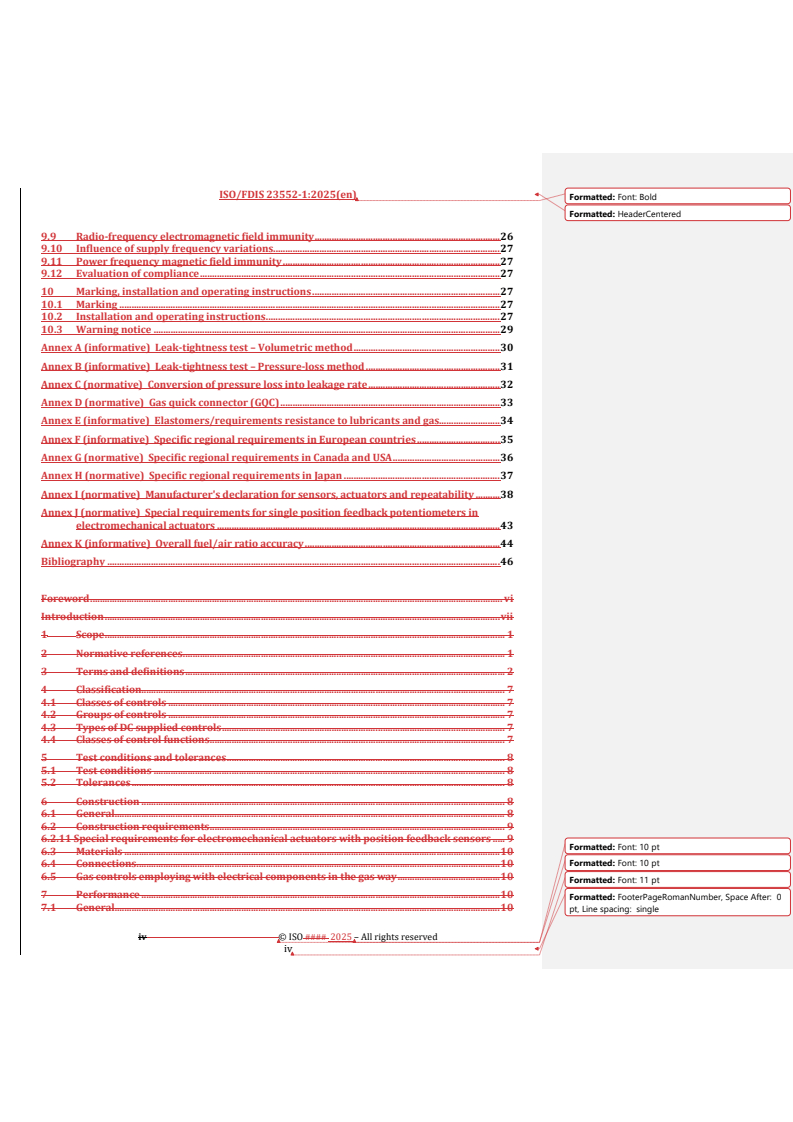
Annex A (informative) Leak-tightness test – Volumetric method . 30
Annex B (informative) Leak-tightness test – Pressure-loss method . 31
Annex C (normative) Conversion of pressure loss into leakage rate . 32
Annex D (normative) Gas quick connector (GQC) . 33
Annex E (informative) Elastomers/requirements resistance to lubricants and gas . 34
Annex F (informative) Specific regional requirements in European countries . 35
Annex G (normative) Specific regional requirements in Canada and USA . 36
Annex H (normative) Specific regional requirements in Japan . 37
Annex I (normative) Manufacturer's declaration for sensors, actuators and repeatability . 38
Annex J (normative) Special requirements for single position feedback potentiometers in
electromechanical actuators . 43
Annex K (informative) Overall fuel/air ratio accuracy . 44
Bibliography . 46
Foreword . vi
Introduction . vii
1 Scope . 1
2 Normative references . 1
3 Terms and definitions . 2
4 Classification. 7
4.1 Classes of controls . 7
4.2 Groups of controls . 7
4.3 Types of DC supplied controls . 7
4.4 Classes of control functions . 7
5 Test conditions and tolerances . 8
5.1 Test conditions . 8
5.2 Tolerances . 8
6 Construction . 8
6.1 General. 8
6.2 Construction requirements . 9
6.2.11 Special requirements for electromechanical actuators with position feedback sensors . 9
Formatted: Font: 10 pt
6.3 Materials . 10
6.4 Connections . 10 Formatted: Font: 10 pt
6.5 Gas controls employing with electrical components in the gas way . 10
Formatted: Font: 11 pt
7 Performance . 10
Formatted: FooterPageRomanNumber, Space After: 0
7.1 General. 10
pt, Line spacing: single
iv © ISO #### 2025 – All rights reserved
iv
ISO/DISFDIS 23552-1:20242025(en)
Formatted: Font: Bold
Formatted: Font: Bold
Formatted: Font: Bold
7.2 Leak-tightness . 10
Formatted: HeaderCentered, Left
7.3 Torsion and bending . 10
7.4 Rated flow rate . 10
7.5 Durability . 10
7.6 Functional requirements . 10
7.6.1 General. 10
7.6.2 Interface to the automatic burner control system . 11
7.6.3 Start-up sequence . 11
7.6.4 Range of operation . 11
7.6.5 Restart from defined state . 12
7.6.6 Pre-set/predefined range . 12
7.6.7 Accuracy requirements . 12
7.6.8 Sensor(s) and actuators . 13
7.6.9 Repeatability . 13
7.6.10 Requirements for ACF . 13
7.7 Endurance . 13
7.7.1 Performance requirements . 13
7.7.2 Test conditions . 14
7.7.3 Thermal stress test . 14
7.7.4 Long-term performance test . 15
7.8 Vibration test . 16
7.9 Data exchange . 16
7.10 Performance test for electronic controls . 16
7.10.1 At ambient temperature . 16
7.10.2 At lower temperature . 16
7.10.3 At high temperature. 16
7.11 Protection against internal faults for the purpose of functional safety . 17
7.11.1 Design and construction requirements . 17
7.11.2 Circuit and construction evaluation. 17
7.11.3 Information to be supplied by the manufacturer . 17
7.11.4 Information . 18
7.11.5 Compliance . 18
8 Electrical equipment. 18
8.1 General. 18
8.2 Requirements . 18
8.3 Test . 19
8.4 Protection by enclosure. 19
9 Electromagnetic compatibility (EMC) . 19
9.1 Protection against environmental influences . 19
9.1.1 General. 19
9.1.2 Requirements . 19
9.2 Harmonics and interharmonics including mains signalling at a.c. power port, low
frequency immunity . 20
9.3 Voltage dips, voltage interruptions and voltage variations in the power supply network 20
9.4 Test of influence of voltage unbalance . 21
9.5 Surge immunity test . 21
Formatted: Font: 10 pt
9.6 Electrical fast transient/burst . 21
Formatted: Font: 10 pt
9.7 Ring wave immunity . 21
9.8 Electrostatic discharge. 21
Formatted: FooterCentered, Left, Space Before: 0 pt,
9.9 Radio-frequency electromagnetic field immunity . 21
Tab stops: Not at 17.2 cm
9.9.1 Immunity to conducted disturbances. 21
Formatted: Font: 11 pt
9.9.2 Immunity to radiated disturbances . 22
Formatted: FooterPageRomanNumber, Left, Space
9.10 Influence of supply frequency variations. 22
After: 0 pt, Tab stops: Not at 17.2 cm
v
ISO/FDIS 23552-1:2025(en)
Formatted: Font: Bold
Formatted: HeaderCentered
9.11 Power frequency magnetic field immunity . 22
9.12 Evaluation of compliance . 22
9.13 Shall be according to ISO 23550:2018, 9.12. . 22
10 Marking, installation and operating instructions . 22
10.1 Marking . 22
10.2 Instructions . 23
10.2.101 Technical information for the safety after integration in the appliance . 24
10.3 Warning notice . 24
Annex A (informative) Leak-tightness test – Volumetric method . 25
Annex B (informative) Leak-tightness test – Pressure-loss method . 26
Annex C (normative) Conversion of pressure loss into leakage rate . 27
Annex D (normative) Gas quick connector (GQC) . 28
Annex E (informative) Elastomers/requirements resistance to lubricants and gas . 29
Annex F (normative) Specific regional requirements in European countries . 30
Annex G (normative) Specific regional requirements in Canada and USA . 31
Annex H (normative) Specific regional requirements in Japan . 32
Annex I (normative) Manufacturer's declaration for sensors, actuators and repeatability . 33
Annex J (normative) Special requirements for single position feedback potentiometers in
electromechanical actuators . 2
Annex K (informative) Overall fuel/air ratio accuracy . 3
K.1 General. 3
K.2 Method A . 3
K.3 Method B . 3
Bibliography . 5
Formatted: Font: 10 pt
Formatted: Font: 10 pt
Formatted: Font: 11 pt
Formatted: FooterPageRomanNumber, Space After: 0
pt, Line spacing: single
vi © ISO #### 2025 – All rights reserved
vi
ISO/DISFDIS 23552-1:20242025(en)
Formatted: Font: Bold
Formatted: Font: Bold
Formatted: Font: Bold
Foreword
Formatted: HeaderCentered, Left
ISO (the International Organization for Standardization) is a worldwide federation of national standards
Formatted: Adjust space between Latin and Asian text,
bodies (ISO member bodies). The work of preparing International Standards is normally carried out through Adjust space between Asian text and numbers
ISO technical committees. Each member body interested in a subject for which a technical committee has been
established has the right to be represented on that committee. International organizations, governmental and
non-governmental, in liaison with ISO, also take part in the work. ISO collaborates closely with the
International Electrotechnical Commission (IEC) on all matters of electrotechnical standardization.
The procedures used to develop this document and those intended for its further maintenance are described
in the ISO/IEC Directives, Part 1. In particular, the different approval criteria needed for the different types of
ISO document should be noted. This document was drafted in accordance with the editorial rules of the
ISO/IEC Directives, Part 2 (see www.iso.org/directives).
Formatted: English (United Kingdom)
ISO draws attention to the possibility that the implementation of this document may involve the use of (a)
patent(s). ISO takes no position concerning the evidence, validity or applicability of any claimed patent rights
in respect thereof. As of the date of publication of this document, ISO had not received notice of (a) patent(s)
which may be required to implement this document. However, implementers are cautioned that this may not
represent the latest information, which may be obtained from the patent database available at
www.iso.org/patents.www.iso.org/patents. ISO shall not be held responsible for identifying any or all such
patent rights.
Any trade name used in this document is information given for the convenience of users and does not
constitute an endorsement.
For an explanation of the voluntary nature of standards, the meaning of ISO specific terms and expressions
Formatted: English (United Kingdom)
related to conformity assessment, as well as information about ISO's adherence to the World Trade
Organization (WTO) principles in the Technical Barriers to Trade (TBT), see
Formatted: Adjust space between Latin and Asian text,
www.iso.org/iso/foreword.htmlwww.iso.org/iso/foreword.html.
Adjust space between Asian text and numbers
Formatted: Default Paragraph Font
This document was prepared by Technical Committee ISO/TC 161, Controls and protective devices for gaseous
and liquid fuels. Formatted: Default Paragraph Font
Formatted: Default Paragraph Font
This second edition cancels and replaces the first edition (ISO 23552-1:2007,), which has been technically
Formatted: Default Paragraph Font
revised. It also incorporates the Amendment ISO 23552-1:2007/Amd 1:2010.
Formatted: List Continue 1, Adjust space between Latin
The main changes are as follows:
and Asian text, Adjust space between Asian text and
numbers, Tab stops: Not at 0.7 cm + 1.4 cm + 2.1 cm
— — the title and scope have been modified; + 2.8 cm + 3.5 cm + 4.2 cm + 4.9 cm + 5.6 cm + 6.3
cm + 7 cm
— — the document has been aligned with ISO 23550 and IEC 60730--1;
Formatted: Default Paragraph Font
Formatted: Default Paragraph Font
— — the requirements for fuel/air ratio using oil as the fuel have been integrated;
Formatted: Default Paragraph Font
— — the control types ERS and ERT have been added;
Formatted: Default Paragraph Font
Formatted: Default Paragraph Font
— — the terms and definitions clause has been expanded and updated;
Formatted: Font: 10 pt
— — the accuracy requirements have been updated;
Formatted: Font: 10 pt
— — Clause 77 “Endurance” has been updated;
Formatted: FooterCentered, Left, Space Before: 0 pt,
Tab stops: Not at 17.2 cm
— — subclause 7.97.9 “Data exchange” has been added;
Formatted: Font: 11 pt
Formatted: FooterPageRomanNumber, Left, Space
— — update clause 7.117.11 “Protection against internal faults for the purpose of functional safety”;
After: 0 pt, Tab stops: Not at 17.2 cm
vii
ISO/FDIS 23552-1:2025(en)
Formatted: Font: Bold
Formatted: HeaderCentered
— — update clause 99 “Electromagnetic compatibility”.
A list of all parts in the ISO 23552 series can be found on the ISO website.
Any feedback or questions on this document should be directed to the user’s national standards body. A
Formatted: Adjust space between Latin and Asian text,
complete listing of these bodies can be found at www.iso.org/members.htmlwww.iso.org/members.html.
Adjust space between Asian text and numbers
Formatted: Font: 10 pt
Formatted: Font: 10 pt
Formatted: Font: 11 pt
Formatted: FooterPageRomanNumber, Space After: 0
pt, Line spacing: single
viii © ISO #### 2025 – All rights reserved
viii
ISO/DISFDIS 23552-1:20242025(en)
Formatted: Font: Bold
Formatted: Font: Bold
Formatted: Font: Bold
Introduction
Formatted: HeaderCentered, Left
This document is designed to be used in combination with ISO 23550. Together with ISO 23550, this document
Formatted: Default Paragraph Font
establishes the full requirements as they apply to the product covered by this document.
Formatted: Default Paragraph Font
Formatted: Default Paragraph Font
Where needed, this document adapts ISO 23550 by stating in the corresponding clause:
Formatted: Default Paragraph Font
— — “with the following modification”;
Formatted: Default Paragraph Font
— — “with the following addition”;
Formatted: Default Paragraph Font
Formatted: Adjust space between Latin and Asian text,
— — “is replaced by the following”;
Adjust space between Asian text and numbers, Tab
stops: Not at 0.7 cm + 1.4 cm + 2.1 cm + 2.8 cm +
— — “is not applicable”.
3.5 cm + 4.2 cm + 4.9 cm + 5.6 cm + 6.3 cm + 7 cm
In order to identify specific requirements that are particular to this document and that are not already covered
Formatted: Adjust space between Latin and Asian text,
by ISO 23550, this document contains clauses or subclauses that are additional to the structure of ISO 23550.
Adjust space between Asian text and numbers
These subclauses are indicated by the introductory sentence: “Subclause (or Annex) specific to this
Formatted: Default Paragraph Font
document.”
Formatted: Default Paragraph Font
To ensure the global relevance of this document, the differing requirements resulting from practical
Formatted: Default Paragraph Font
experience and installation practices in various regions of the world have been taken into account.
Formatted: Default Paragraph Font
The variations in basic design associated with gas controls and appliances have also been recognized, some of
which are addressed in Annexes F, G and H.Annexes F, G and H. This document intends to provide a basic
framework of requirements that recognize these differences.
For electronic fuel/air ratio control/supervision systems, there are numerous solutions for specific
applications in the market. For this reason, ISO/TC 161, Controls and protective devices for gaseous and liquid
fuels, decided to draft an International Standard for type testing for electronic fuel/air ratio control systems
(ERC), electronic fuel/air ratio supervision systems (ERS) and electronic fuel/air ratio trim systems (ERT)
intended for use with burners and appliances burning gaseous or liquid fuels.
NOTE Trim function is a special design of electronic fuel/air ratio control function.
Formatted: Adjust space between Latin and Asian text,
Adjust space between Asian text and numbers, Tab
This document does not override requirements of relevant appliance standards. It is the intention of this
stops: Not at 0.7 cm + 1.4 cm + 2.1 cm + 2.8 cm +
document that the safety of the appliance will not be reduced by any normal or abnormal operation of the
3.5 cm + 4.2 cm + 4.9 cm + 5.6 cm + 6.3 cm + 7 cm
ERC, ERS or ERT.
Formatted: Adjust space between Latin and Asian text,
Adjust space between Asian text and numbers
In this document, there is no classification, either by heat input or by applications.
The accuracy of actual fuel/air ratio is not specified as a fixed value.
This document specifies which parameters shall beare declared in the instruction and under what conditions
this declaration is considered fulfilled. These parameters relate to the fuel/air ratio control/supervision
systems rather than the combustion process.
This document does not include a standard test rig. However, the purpose of the tests is to verify the
Formatted: Font: 10 pt
manufacturer's declaration under the conditions required in this document.
Formatted: Font: 10 pt
Formatted: FooterCentered, Left, Space Before: 0 pt,
Tab stops: Not at 17.2 cm
Formatted: Font: 11 pt
Formatted: FooterPageRomanNumber, Left, Space
After: 0 pt, Tab stops: Not at 17.2 cm
ix
DRAFT International Standard ISO/DIS 23552-1:2024(en)
Formatted: Left
Control and protective devices for gaseous and liquid fuels —
Particular requirements — —
Formatted: Main Title 2, Adjust space between Latin
Part 1:
and Asian text, Adjust space between Asian text and
Electronic fuel/air ratio control systems, including associated sensors
numbers
and mechanical actuators
1 Scope
This document specifies safety, design, construction and performance requirements and testing for electronic
fuel/air ratio control (FARC) systems. Systems can include sensors, mechanical actuators and motors/blowers
that make up the complete system. Systems can be described as:
— — closed loop fuel/air ratio control systems (ERC), see 3.1.1;3.1.1;
Formatted: Adjust space between Latin and Asian text,
Adjust space between Asian text and numbers, Tab
— — closed loop fuel/air ratio trim systems (ERT), see 3.1.2;3.1.2;
stops: Not at 0.7 cm + 1.4 cm + 2.1 cm + 2.8 cm +
3.5 cm + 4.2 cm + 4.9 cm + 5.6 cm + 6.3 cm + 7 cm
— — fuel/air ratio supervision systems (ERS), see 3.2.3.2.
NOTE 1 Throughout this document, the word “system” means “FARC control and system components”.
These systems are intended for use with burners and appliances that burn gaseous or liquid fuels. This
Formatted: Adjust space between Latin and Asian text,
document describes the procedures for evaluating these requirements and specifies information necessary
Adjust space between Asian text and numbers
for installation and use.
This document applies to the inherent safety of the system, to the declared operating values, operating times
and operating sequences if they are associated with FARC safety and to the testing of FARC systems used in,
on or in association with appliances.
NOTE 2 The documents for burners, appliances or processes which use ERC, ERS or ERT can override the
Formatted: Adjust space between Latin and Asian text,
requirements of this document.
Adjust space between Asian text and numbers, Tab
stops: Not at 0.7 cm + 1.4 cm + 2.1 cm + 2.8 cm +
This document prescribes testing requirements in addition to the relevant standards for integrated devices or
3.5 cm + 4.2 cm + 4.9 cm + 5.6 cm + 6.3 cm + 7 cm
components (e.g. actuators) to ensure safe operation of the FARC system.
Formatted: Adjust space between Latin and Asian text,
Adjust space between Asian text and numbers
If no part 2 standards in ISO/TC 161, Controls and protective devices for gaseous and liquid fuels, or IEC/TC 72,
Textile machinery and accessories, exist, then IEC 60730-1 has to beis considered.
Formatted: Default Paragraph Font
Formatted: Default Paragraph Font
NOTE 3 Supplemental or modified requirements and tests and evaluations can be needed for ERC, ERS or ERT systems
for conformance with relevant burner, appliance or process standards. Conformance of an ERC, ERS or ERT with this Formatted: Default Paragraph Font
document does not imply that such systems or components thereof are acceptable for use on an appliance without
Formatted: Adjust space between Latin and Asian text,
supplemental tests of the control system applied to the particular appliance to meet the requirements of the relevant
Adjust space between Asian text and numbers, Tab
burner, appliance or process standard(s).
stops: Not at 0.7 cm + 1.4 cm + 2.1 cm + 2.8 cm +
3.5 cm + 4.2 cm + 4.9 cm + 5.6 cm + 6.3 cm + 7 cm
This document applies to electronic fuel/air ratio control systems that can be tested independently or as a
Formatted: Adjust space between Latin and Asian text,
system or as part of an appliance or as part of a burner.
Adjust space between Asian text and numbers
This document does not cover burner control function like e.g. burner ignition, flame supervision and fuel
Formatted: Footer, Left, Space After: 0 pt, Tab stops:
shutoff.
Not at 17.2 cm
ISO/FDIS 23552-1:2025(en)
Formatted: Font: Bold
Formatted: HeaderCentered
2 Normative references
The following documents are referred to in the text in such a way that some or all of their content constitutes
requirements of this document. For dated references, only the edition cited applies. For undated references,
Formatted: Default Paragraph Font
the latest edition of the referenced document (including any amendments) applies.
Formatted: Default Paragraph Font
Formatted: Default Paragraph Font
ISO 23550:2018, Safety and control devices for gas and/or oil burners and appliances — General requirements
Formatted: Default Paragraph Font, Font: Italic
IEC 60730--1:2022, Automatic electrical controls — Part 1: General requirements
Formatted: Adjust space between Latin and Asian text,
Adjust space between Asian text and numbers, Tab
IEC 60730--2--5:2021, Automatic electrical controls — Part 2-5: Particular requirements for automatic
stops: Not at 0.7 cm + 1.4 cm + 2.1 cm + 2.8 cm +
electrical burner control systems
3.5 cm + 4.2 cm + 4.9 cm + 5.6 cm + 6.3 cm + 7 cm
Formatted: Default Paragraph Font
3 Terms and definitions
Formatted: Default Paragraph Font
For the purposes of this document, the terms and definitions given in ISO 23550 and the following apply.
Formatted: Default Paragraph Font
ISO and IEC maintain terminology databases for use in standardization at the following addresses: Formatted: Default Paragraph Font
Formatted: Default Paragraph Font, Font: Italic
— — ISO Online browsing platform: available at https://www.iso.org/obphttps://www.iso.org/obp
Formatted: Default Paragraph Font
— — IEC Electropedia: available at https://www.electropedia.org/https://www.electropedia.org/
Formatted: Default Paragraph Font
Formatted: Default Paragraph Font
3.1 Types of electronic fuel/air ratio systems
Formatted: Default Paragraph Font
3.1.1 3.1.1
Formatted: Default Paragraph Font
electronic fuel/air ratio control system
Formatted: Default Paragraph Font, Font: Italic
ERC
closed-loop system consisting of the electronic control unit, actuating elements for the fuel flow and the air
Formatted: Adjust space between Latin and Asian text,
flow as a minimum, and allocated feedback signal(s) that are used to control fuel/air ratio of a burner
Adjust space between Asian text and numbers
Formatted: Default Paragraph Font
Note 1 to entry: Figure 1 Figure 1 shows an example of different feedback alternatives. For details, see also
Table 1.Table 1. Formatted: Default Paragraph Font
Formatted: Adjust space between Latin and Asian text,
Adjust space between Asian text and numbers, Tab
stops: Not at 0.7 cm + 1.4 cm + 2.1 cm + 2.8 cm +
3.5 cm + 4.2 cm + 4.9 cm + 5.6 cm + 6.3 cm + 7 cm
Formatted: English (United States)
Formatted: Adjust space between Latin and Asian text,
Adjust space between Asian text and numbers, Tab
stops: Not
...
Questions, Comments and Discussion
Ask us and Technical Secretary will try to provide an answer. You can facilitate discussion about the standard in here.
Loading comments...