

ISO 6350:2024
(Main)Lignins — Determination of dry matter content — Oven-drying and freeze-drying methods
General Information
- Abstract
This document describes methods for the determination of the dry matter content of lignins by oven-drying and freeze-drying. The methods are applicable to all types of lignins isolated from kraft, organosolv, soda, and sulfite pulping processes, and to lignin obtained by enzymatic or acid hydrolysis of biomass. However, the oven-drying method is not applicable to kraft lignins in the base form, also referred to as sodium form. Both methods are applicable only to lignins in the solid form.
- Status
- Published
- Publication Date
- 13-Feb-2024
- Technical Committee
- ISO/TC 6 - Paper, board and pulps
- Drafting Committee
- ISO/TC 6 - Paper, board and pulps
- Current Stage
- 6060 - International Standard published
- Start Date
- 14-Feb-2024
- Due Date
- 09-Jul-2024
- Completion Date
- 14-Feb-2024
Buy Documents
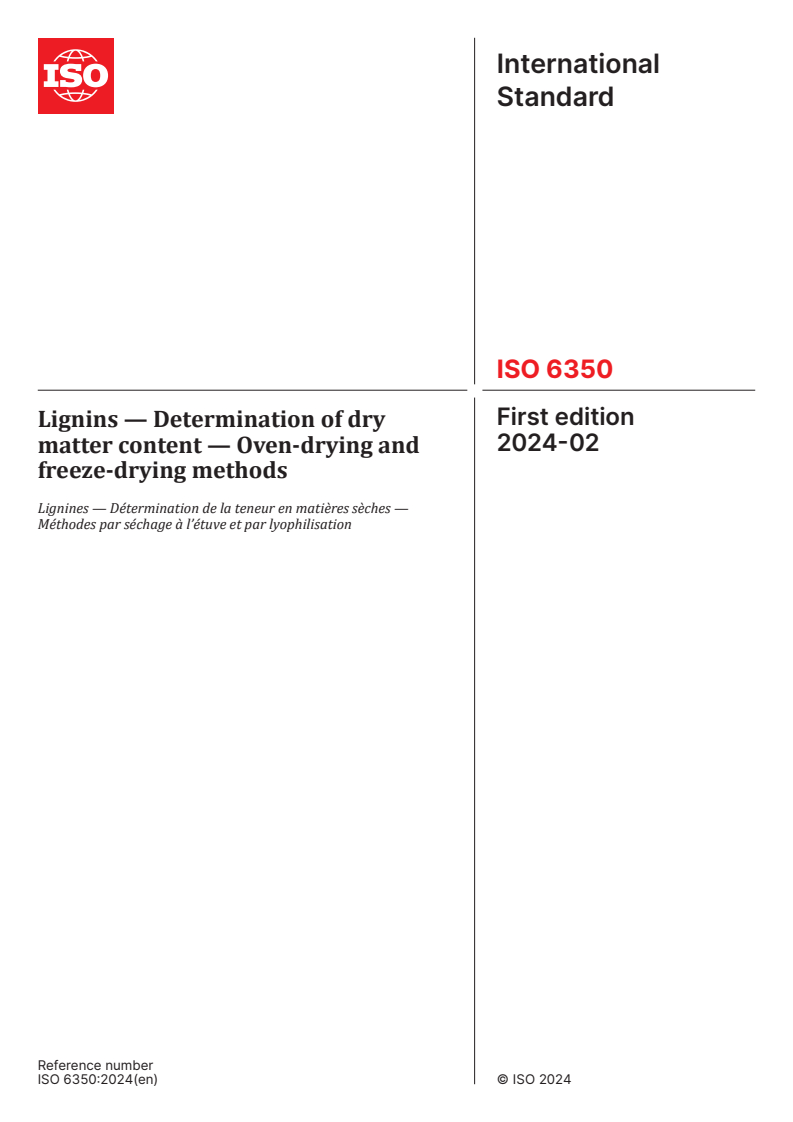
ISO 6350:2024 - Lignins — Determination of dry matter content — Oven-drying and freeze-drying methods Released:14. 02. 2024
ISO 6350:2024 - Lignines — Détermination de la teneur en matieres seches — Méthodes par séchage a l’étuve et par lyophilisation Released:14. 02. 2024
Overview - ISO 6350:2024 (Lignins, dry matter content)
ISO 6350:2024 specifies laboratory methods for determining the dry matter content of lignins using two validated drying techniques: oven‑drying and freeze‑drying (lyophilization). The standard applies to solid lignins from kraft, organosolv, soda and sulfite pulping processes, and to lignins recovered after enzymatic or acid hydrolysis of biomass. Important: oven‑drying is not applicable to kraft lignins in the base (sodium) form. Freeze‑drying is recommended when preserving lignin integrity or when preparing samples for additional analyses.
Key topics and technical requirements
- Scope and applicability
- Applies only to lignins in solid form (not slurries unless frozen and then lyophilized).
- Methods cover kraft, organosolv, soda, sulfite and hydrolysis lignins.
- Sampling and sample handling
- Representative sample: about 2 g to 3 g (air‑dry basis) for sampling; test specimen typically 1 g to 2 g.
- Store airtight; if stored >2–3 days, refrigerate at 5 °C ± 1 °C; bring to room temperature before opening.
- Precondition samples: air‑dry to >75% solids to minimize degradation during final drying.
- Oven‑drying method
- Use water‑vapour‑proof containers, previously dried to constant mass.
- Dry at 105 °C ± 2 °C: initial 4 h, then repeat 1 h increments until constant mass (difference ≤ 0.1% of pre‑drying test piece mass). Total drying not to exceed 7 h.
- Not suitable for kraft lignins in sodium/base form.
- Freeze‑drying (lyophilization)
- Freeze specimen (overnight or ≥4 h) then lyophilize (typical conditions –80 °C, ~25 mTorr) for 24 h increments until constant mass (≤ 0.1% change).
- Preferred method to prevent thermal degradation and loss of VOCs; required when drying prior to other lignin analyses.
- Apparatus and accuracy
- Analytical balance accuracy: 0.1 mg.
- Desiccator, freeze‑dryer, ventilated oven and suitable containers specified.
- Calculation and precision
- Dry matter (%) = (mass after drying / mass before drying) × 100.
- Precision data (repeatability and reproducibility) are reported from a round‑robin study (see Annex A).
Applications and users
- Laboratories in pulp & paper, biorefineries and biomass characterization.
- Quality control (QC) for lignin production and product specification.
- Research groups studying lignin composition, thermal stability, or downstream conversion (chemistry, materials, adhesives).
- Regulatory and procurement testing where standardized solids content reporting is required.
Related standards and references
- ISO 6350 complements existing biomass compositional and solids/extractives procedures (for example, documented NREL methods referenced in the introduction).
- Prepared by ISO/TC 6 (Paper, board and pulps); users should consult Annex A for precision data and the ISO Online Browsing Platform for related terminology.
Keywords: ISO 6350:2024, lignins dry matter content, oven‑drying, freeze‑drying, lyophilization, kraft lignin, organosolv, biomass analysis.
Buy Documents
ISO 6350:2024 - Lignins — Determination of dry matter content — Oven-drying and freeze-drying methods Released:14. 02. 2024
ISO 6350:2024 - Lignines — Détermination de la teneur en matieres seches — Méthodes par séchage a l’étuve et par lyophilisation Released:14. 02. 2024
Get Certified
Connect with accredited certification bodies for this standard

Control Union Certifications
Global certification for agriculture and sustainability.

Gozdarski inštitut Slovenije
Slovenian Forestry Institute. Forest management certification support, timber testing.
Sponsored listings
Frequently Asked Questions
ISO 6350:2024 is a standard published by the International Organization for Standardization (ISO). Its full title is "Lignins — Determination of dry matter content — Oven-drying and freeze-drying methods". This standard covers: This document describes methods for the determination of the dry matter content of lignins by oven-drying and freeze-drying. The methods are applicable to all types of lignins isolated from kraft, organosolv, soda, and sulfite pulping processes, and to lignin obtained by enzymatic or acid hydrolysis of biomass. However, the oven-drying method is not applicable to kraft lignins in the base form, also referred to as sodium form. Both methods are applicable only to lignins in the solid form.
This document describes methods for the determination of the dry matter content of lignins by oven-drying and freeze-drying. The methods are applicable to all types of lignins isolated from kraft, organosolv, soda, and sulfite pulping processes, and to lignin obtained by enzymatic or acid hydrolysis of biomass. However, the oven-drying method is not applicable to kraft lignins in the base form, also referred to as sodium form. Both methods are applicable only to lignins in the solid form.
ISO 6350:2024 is classified under the following ICS (International Classification for Standards) categories: 85.040 - Pulps. The ICS classification helps identify the subject area and facilitates finding related standards.
ISO 6350:2024 is available in PDF format for immediate download after purchase. The document can be added to your cart and obtained through the secure checkout process. Digital delivery ensures instant access to the complete standard document.
Standards Content (Sample)
International
Standard
ISO 6350
First edition
Lignins — Determination of dry
2024-02
matter content — Oven-drying and
freeze-drying methods
Lignines — Détermination de la teneur en matières sèches —
Méthodes par séchage à l’étuve et par lyophilisation
Reference number
© ISO 2024
All rights reserved. Unless otherwise specified, or required in the context of its implementation, no part of this publication may
be reproduced or utilized otherwise in any form or by any means, electronic or mechanical, including photocopying, or posting on
the internet or an intranet, without prior written permission. Permission can be requested from either ISO at the address below
or ISO’s member body in the country of the requester.
ISO copyright office
CP 401 • Ch. de Blandonnet 8
CH-1214 Vernier, Geneva
Phone: +41 22 749 01 11
Email: copyright@iso.org
Website: www.iso.org
Published in Switzerland
ii
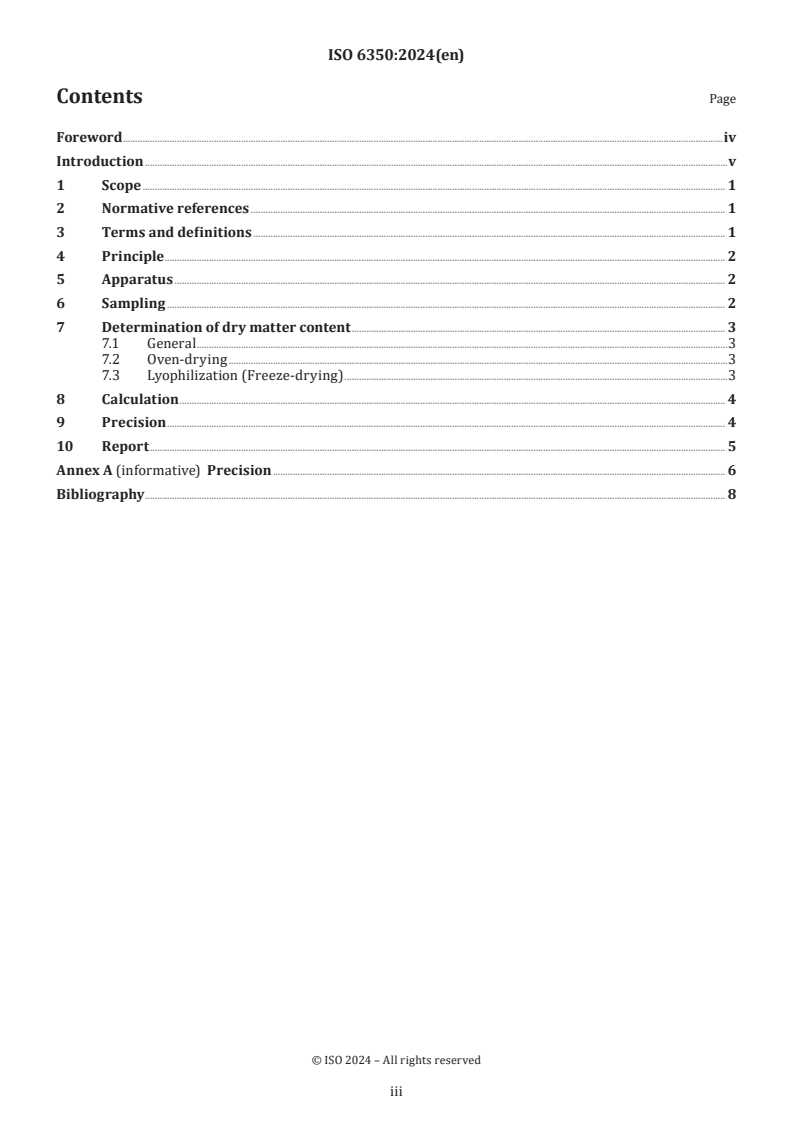
Contents Page
Foreword .iv
Introduction .v
1 Scope . 1
2 Normative references . 1
3 Terms and definitions . 1
4 Principle . 2
5 Apparatus . 2
6 Sampling . 2
7 Determination of dry matter content . 3
7.1 General .3
7.2 Oven-drying .3
7.3 Lyophilization (Freeze-drying) .3
8 Calculation . 4
9 Precision . 4
10 Report . 5
Annex A (informative) Precision . 6
Bibliography . 8
iii
Foreword
ISO (the International Organization for Standardization) is a worldwide federation of national standards
bodies (ISO member bodies). The work of preparing International Standards is normally carried out through
ISO technical committees. Each member body interested in a subject for which a technical committee
has been established has the right to be represented on that committee. International organizations,
governmental and non-governmental, in liaison with ISO, also take part in the work. ISO collaborates closely
with the International Electrotechnical Commission (IEC) on all matters of electrotechnical standardization.
The procedures used to develop this document and those intended for its further maintenance are described
in the ISO/IEC Directives, Part 1. In particular, the different approval criteria needed for the different types
of ISO document should be noted. This document was drafted in accordance with the editorial rules of the
ISO/IEC Directives, Part 2 (see www.iso.org/directives).
ISO draws attention to the possibility that the implementation of this document may involve the use of (a)
patent(s). ISO takes no position concerning the evidence, validity or applicability of any claimed patent
rights in respect thereof. As of the date of publication of this document, ISO had not received notice of (a)
patent(s) which may be required to implement this document. However, implementers are cautioned that
this may not represent the latest information, which may be obtained from the patent database available at
www.iso.org/patents. ISO shall not be held responsible for identifying any or all such patent rights.
Any trade name used in this document is information given for the convenience of users and does not
constitute an endorsement.
For an explanation of the voluntary nature of standards, the meaning of ISO specific terms and expressions
related to conformity assessment, as well as information about ISO's adherence to the World Trade
Organization (WTO) principles in the Technical Barriers to Trade (TBT), see www.iso.org/iso/foreword.html.
This document was prepared by Technical Committee ISO/TC 6, Paper, board and pulps.
Any feedback or questions on this document should be directed to the user’s national standards body. A
complete listing of these bodies can be found at www.iso.org/members.html.
iv
Introduction
This document describes methods for the determination of dry matter content in lignins by oven-drying or
freeze drying.
In general, freeze-drying is preferred over oven-drying at 105 °C, especially for kraft lignins in the sodium
[1]
form, in order to preserve the integrity of the sample. In a study on the effect of drying on lignin solids ,
kraft lignins - particularly hardwood lignins - in the base form (also referred to as sodium form) were most
affected by oven-drying. In some cases, the solids contents of oven-dried samples were over four percentage
points lower than those of the corresponding freeze-dried samples.
When drying samples prior to the determination of other lignin properties, only the freeze-drying method
[2,3]
is acceptable. Water interferes with certain lignin analyses , and oven-drying might lead to changes in
lignin structure as a result of, for example, decomposition or condensation reactions. Thus, any residual
water is removed from the test specimen through lyophilization (freeze-drying). In addition, freeze-drying
prevents the loss of volatile organic compounds (VOC’s) which can be determined separately if required.
Several related procedures for the preparation of biomass for compositional analysis and for the
determination of solids and extractives in biomass have been published by the National Renewable Energy
[4-7]
Laboratory (NREL) . However, the procedures described in this document are specifically applicable to
lignins.
v
International Standard ISO 6350:2024(en)
Lignins — Determination of dry matter content — Oven-
drying and freeze-drying methods
1 Scope
This document describes methods for the determination of the dry matter content of lignins by oven-drying
and freeze-drying. The methods are applicable to all types of lignins isolated from kraft, organosolv, soda,
and sulfite pulping processes, and to lignin obtained by enzymatic or acid hydrolysis of biomass. However,
the oven-drying method is not applicable to kraft lignins in the base form, also referred to as sodium form.
Both methods are applicable only to lignins in the solid form.
2 Normative references
There are no normative references in this document.
3 Terms and definitions
For the purposes of this document, the following terms and definitions apply.
ISO and IEC maintain terminology databases for use in standardization at the following addresses:
— ISO Online browsing platform: available at https:// www .iso .org/ obp
— IEC Electropedia: available at https:// www .electropedia .org/
3.1
lignins
class of complex organic macromolecules, containing aromatic sub-units, that plays a key role in the
formation of cell walls in wood and bark, conferring mechanical strength and rigidity to the cell walls and to
plants as a whole
Note 1 to entry: Lignin is the main non-carbohydrate constituent of wood.
3.2
kraft lignin
depolymerized and chemically modified lignin isolated from a kraft pulping process, such as that originating
from kraft black liquor
3.3
soda lignin
depolymerized and chemically modified lignin isolated from a soda pulping process, such as that originating
from soda liquor
3.4
organosolv lignin
depolymerized and chemically modified lignin isolated from an organosolv pulping process, such as that
originating from organosolv liquor
3.5
hydrolysis lignin
lignin produced by conversion of biomass, through enzymatic or acid hydrolysis, into sugars and lignin
streams, followed by separation of the lignin fraction
3.6
biomass
biological material derived from living, or previously living organisms, such as wood, agricultural crops and
other plant-based biodegradable material
3.7
constant mass
mass of the test specimen determined at the equilibrium condition after drying until the difference between
two successive drying and weighings, separated in time by at least half the initial drying period, does not
exceed 0,1 % mass fraction of the test specimen before drying
4 Principle
The dry matter content is calculated from the difference in the mass of the specimen before and after drying.
5 Apparatus
5.1 Containers, appropriate for freeze-drying or oven-drying, as recommended by the manufacturer.
Containers shall be water-vapour-proof with tightly fitting lids, and made from a material not affected by
the conditions of the test, previously dried to constant mass and weighed.
5.2 Drying oven, capable of maintaining the air temperature at 105 °C ± 2 °C, and suitably ventilated.
5.3 Freeze-dryer, typically available with condenser refrigeration of -80 °C, and capable of maintaining a
pressure (vacuum) of about 25 mTorr.
5.4 Analytical balance, accurate to 0,1 mg.
TM1)
5.5 Desiccator, using Drierite or equivalent desiccant.
6 Sampling
Obtain a representative sample of lignin equivalent to about 2 g to 3 g on an air-dry basis. Report the origin of
the sample and the sampling procedure. For example, in the case of kraft lignin samples, it shall be reported
whether they were collected in their base form, or after acid-washing; or as they come out of the press,
partly dried, flash dried, or otherwise.
If the sample is not analysed immediately after collection, it shall be stored in an airtight container or
sealable polyethylene bag. If it is necessary to store the samples for longer than 2 days to 3 days, they shall
be kept in a refrigerator or cold room at 5 °C ± 1 °C prior to use. Samples shall be brought back to room
temperature before opening the container or bag.
All samples shall be air-dried to over 75 % solids prior to the determination of dry matter content or analysis
of other properties. This is necessary to minimize the extent of lignin degradation reactions during the
subsequent drying period.
TM
1) Drierite is an example of a suitable product(s) available commercially. This information is given for the convenience
of users of this docum
...
Norme
internationale
ISO 6350
Première édition
Lignines — Détermination de
2024-02
la teneur en matières sèches —
Méthodes par séchage à l’étuve et
par lyophilisation
Lignins — Determination of dry matter content — Oven-drying
and freeze-drying methods
Numéro de référence
DOCUMENT PROTÉGÉ PAR COPYRIGHT
© ISO 2024
Tous droits réservés. Sauf prescription différente ou nécessité dans le contexte de sa mise en œuvre, aucune partie de cette
publication ne peut être reproduite ni utilisée sous quelque forme que ce soit et par aucun procédé, électronique ou mécanique,
y compris la photocopie, ou la diffusion sur l’internet ou sur un intranet, sans autorisation écrite préalable. Une autorisation peut
être demandée à l’ISO à l’adresse ci-après ou au comité membre de l’ISO dans le pays du demandeur.
ISO copyright office
Case postale 401 • Ch. de Blandonnet 8
CH-1214 Vernier, Genève
Tél.: +41 22 749 01 11
E-mail: copyright@iso.org
Web: www.iso.org
Publié en Suisse
ii
Sommaire Page
Avant-propos .iv
Introduction .v
1 Domaine d’application . 1
2 Références normatives . 1
3 Termes et définitions . 1
4 Principe. 2
5 Appareillage . 2
6 Échantillonnage . 2
7 Détermination de la teneur en matières sèches . 3
7.1 Généralités .3
7.2 Séchage à l’étuve .3
7.3 Lyophilisation (freeze-drying).4
8 Calcul . 5
9 Fidélité . 5
10 Rapport . 5
Annexe A (informative) Fidélité . 6
Bibliographie . 8
iii
Avant-propos
L’ISO (Organisation internationale de normalisation) est une fédération mondiale d’organismes nationaux
de normalisation (comités membres de l’ISO). L’élaboration des Normes internationales est en général
confiée aux comités techniques de l’ISO. Chaque comité membre intéressé par une étude a le droit de faire
partie du comité technique créé à cet effet. Les organisations internationales, gouvernementales et non
gouvernementales, en liaison avec l’ISO participent également aux travaux. L’ISO collabore étroitement avec
la Commission électrotechnique internationale (IEC) en ce qui concerne la normalisation électrotechnique.
Les procédures utilisées pour élaborer le présent document et celles destinées à sa mise à jour sont
décrites dans les Directives ISO/IEC, Partie 1. Il convient, en particulier, de prendre note des différents
critères d’approbation requis pour les différents types de documents ISO. Le présent document
a été rédigé conformément aux règles de rédaction données dans les Directives ISO/IEC, Partie 2
(voir www.iso.org/directives).
L’ISO attire l’attention sur le fait que la mise en application du présent document peut entraîner l’utilisation
d’un ou de plusieurs brevets. L’ISO ne prend pas position quant à la preuve, à la validité et à l’applicabilité de
tout droit de brevet revendiqué à cet égard. À la date de publication du présent document, l’ISO n’avait pas
reçu notification qu’un ou plusieurs brevets pouvaient être nécessaires à sa mise en application. Toutefois,
il y a lieu d’avertir les responsables de la mise en application du présent document que des informations
plus récentes sont susceptibles de figurer dans la base de données de brevets, disponible à l’adresse
www.iso.org/brevets. L’ISO ne saurait être tenue pour responsable de ne pas avoir identifié tout ou partie de
tels droits de brevet.
Les appellations commerciales éventuellement mentionnées dans le présent document sont données pour
information, par souci de commodité, à l’intention des utilisateurs et ne sauraient constituer un engagement.
Pour une explication de la nature volontaire des normes, la signification des termes et expressions
spécifiques de l’ISO liés à l’évaluation de la conformité, ou pour toute information au sujet de l’adhésion de
l’ISO aux principes de l’Organisation mondiale du commerce (OMC) concernant les obstacles techniques au
commerce (OTC), voir www.iso.org/iso/fr/avant-propos.html.
Le présent document a été élaboré par le comité technique ISO/TC 6, Papiers, cartons et pâtes.
Il convient que l’utilisateur adresse tout retour d’information ou toute question concernant le présent
document à l’organisme national de normalisation de son pays. Une liste exhaustive desdits organismes se
trouve à l’adresse www.iso.org/fr/members.html.
iv
Introduction
Le présent document décrit des méthodes pour la détermination de la teneur en matières sèches dans les
lignines par séchage à l’étuve ou lyophilisation.
En général, la lyophilisation est préférée par rapport au séchage à l’étuve à 105 °C, en particulier pour les
lignines kraft sous forme de sodium, afin de préserver l’intégrité de l’échantillon. Dans une étude sur l’effet
[1]
du séchage des lignines solides, les lignines kraft – en particulier les lignines de feuillus – sous forme de
base (également appelée forme de sodium) étaient les plus affectées par le séchage à l’étuve. Dans certains
cas, les teneurs en matières solides des échantillons séchés à l’étuve étaient inférieures de plus de quatre
pour cent à celles des échantillons correspondants lyophilisés.
Lorsque les échantillons sont séchés avant la détermination des autres propriétés de la lignine, seule la
[2,3]
méthode par lyophilisation est acceptable. L’eau interfère avec certaines analyses de la lignine et le
séchage à l’étuve peut conduire à des modifications au niveau de la structure de la lignine résultant, par
exemple, de réactions de décomposition ou de condensation. Par conséquent, toute eau résiduelle est
éliminée de l’éprouvette par lyophilisation (freeze-drying). En outre, la lyophilisation empêche la perte de
composés organiques volatils (COV), qui peut être déterminée séparément si nécessaire.
Plusieurs modes opératoires associés à la préparation de la biomasse pour l’analyse de la composition et
pour la détermination de la teneur en matières solides et extractives dans la biomasse ont été publiés par le
National Renewable Energy Laboratory (NREL, Laboratoire national sur les énergies
[4-7]
renouvelables). Toutefois, les modes opératoires décrits dans le présent document sont spécifiquement
applicables aux lignines.
v
Norme internationale ISO 6350:2024(fr)
Lignines — Détermination de la teneur en matières sèches —
Méthodes par séchage à l’étuve et par lyophilisation
1 Domaine d’application
Le présent document décrit des méthodes pour la détermination de la teneur en matières sèches des
lignines par séchage à l’étuve et par lyophilisation. Les méthodes sont applicables à tous les types de lignines
isolées par des procédés de mise en pâte kraft, organosolve, soude et lignosulfates, et à la lignine obtenue
par hydrolyse enzymatique ou acide de la biomasse. Toutefois, la méthode par séchage à l’étuve n’est pas
applicable aux lignines kraft sous forme de base, également appelée forme de sodium. Les deux méthodes
s’appliquent uniquement aux lignines sous forme solide.
2 Références normatives
Le présent document ne contient aucune référence normative.
3 Termes et définitions
Pour les besoins du présent document, les termes et définitions suivants s’appliquent.
L’ISO et l’IEC tiennent à jour des bases de données terminologiques destinées à être utilisées en normalisation,
consultables aux adresses suivantes :
— ISO Online browsing platform : disponible à l’adresse https:// www .iso .org/ obp
— IEC Electropedia : disponible à l’adresse https:// www .electropedia .org/
3.1
lignines
classe de macromolécules organiques complexes, contenant des sous-unités aromatiques, jouant un rôle clé
dans la formation des parois cellulaires du bois et de l’écorce, conférant une résistance mécanique et une
rigidité aux parois cellulaires et aux végétaux dans leur ensemble
Note 1 à l'article: La lignine est le principal constituant non glucidique du bois.
3.2
lignine kraft
lignine dépolymérisée et modifiée chimiquement isolée par un procédé de mise en pâte kraft, telle que celle
provenant de la liqueur noire kraft
3.3
lignine soude
lignine dépolymérisée et modifiée chimiquement isolée par un procédé de mise en pâte à la soude, telle que
celle provenant de la liqueur de soude
3.4
lignine organosolve
lignine dépolymérisée et modifiée chimiquement isolée par un procédé de mise en pâte organosolve, telle
que celle provenant de la liqueur organosolve
3.5
lignine hydrolytique
lignine produite par conversion de la biomasse, via une hydrolyse enzymatique ou acide, en sucres et en flux
de lignine, suivie d’une séparation de la fraction de lignine
3.6
biomasse
matière biologique issue d’organismes vivants, ou auparavant vivants, tels que le bois, les cultures agricoles
et autres matières biodégradables d’origine végétale
3.7
masse constante
masse atteinte par une éprouvette en conditions d’équilibre après séchage jusqu’à ce que la différence entre
deux séchages et pesées successifs, séparés dans le temps d’au moins la moitié de la durée de séchage initiale,
ne dépasse pas 0,1 % de la fraction massique de l’éprouvette avant séchage
4 Principe
La teneur en matières sèches est calculée d’après la différence de masse de l’éprouvette avant et après
séchage.
5 Appareillage
5.1 Récipients, appropriés pour la lyophilisation ou le séchage à l’étuve, suivant les recommandations
du fabricant. Les récipients doivent être étanches à la vapeur d’eau, munis de couvercles s’adaptant
hermétiquement, et fabriqués dans un matériau non affecté par les conditions d’essai, préalablement séchés
à masse constante et pesés.
5.2 Étuve, permettant de maintenir la température de l’air à 105 °C ± 2 °C, et convenablement ventilée.
5.3 Lyophilisateur, généralement disponible avec une réfrigération par condenseur à –80 °C, et pouvant
maintenir une pression (vide) d’environ 25 mTorr.
5.4 Balance analytique, d’une exactitude de 0,1 mg.
TM1)
5.5 Dessiccateur, utilizant du Drierite ou un produit desséchant équivalent.
6 Échantillonnage
Obtenir un échantillon représentatif de lignine équivalant à environ 2 g à 3 g sur une base séchée à l’air.
Consigner dans le rapport l’origine de l’échantillon et le mode opératoire d’échantillonnage. Par exemple,
dans le cas d’échantillons de lignine kraft, il faut consigner dans le rapport s’ils ont été recueillis sous leur
forme de base ou après un lavage à l’acide, ou à leur sortie de la presse, s’ils ont été partiellement séchés, s’ils
ont subi un séchage flash ou autre.
Si l’échantillon n’est pas analysé immédiatement après son prélèvement, il doit être conservé dans un
récipient étanche ou dans un sac en polyéthylène pouvant être fermé. S’il est nécessaire de conserver les
échantillons pendant plus de 2 jours ou 3 jours, ils doivent être conservés dans un réfrigérateur ou une
chambre froide à 5 °C ± 1 °C avant utilisation. Les échantillons doivent être ramenés à la température
ambiante avant d’ouvrir le récipient ou le sac.
TM
1) Le Drierite est un exemple de produit approprié disponible sur le marché. Cette information est donnée par souci
de commodité à l’intention des utilisateurs du présent document et ne saurait constituer un engagement de l’ISO à l’égard
de ce produit.
Tous les échantillons doivent être séchés à l’air jusqu’à obtention de 75 % de matières solides avant la
détermination de la teneur en matières sèches ou l’analyse d’autres propriétés. Cela est nécessaire pour
réduire au maximum l’étendue des réactions de dégradation de la lignine pendant la période ultérieure de
séchage.
7 Détermina
...