


ISO/FDIS 4074
(Main)Natural rubber latex male condoms - Requirements and test methods
Natural rubber latex male condoms - Requirements and test methods
Préservatifs externes en latex de caoutchouc naturel — Exigences et méthodes d'essai
General Information
- Status
- Not Published
- Technical Committee
- ISO/TC 157 - Non-systemic contraceptives and STI barrier prophylactics
- Drafting Committee
- ISO/TC 157/WG 23 - Natural rubber latex male condoms
- Current Stage
- 5020 - FDIS ballot initiated: 2 months. Proof sent to secretariat
- Start Date
- 26-Nov-2025
- Completion Date
- 26-Nov-2025
Relations
- Effective Date
- 23-Apr-2020
Overview
ISO/FDIS 4074:2025 - Natural rubber latex male condoms - Requirements and test methods is an international standard that defines the requirements, quality verification and laboratory test methods for natural rubber latex male condoms. Developed under ISO/TC 157, the FDIS-stage document provides comprehensive procedural annexes covering sampling, dimensional and mechanical tests, microbiological evaluation, packaging integrity, stability and shelf-life assessment, and reporting. This standard is central to condom standards, regulatory compliance and manufacturing quality control.
Key topics and technical requirements
The standard addresses a broad set of technical topics and test methods, including:
- Quality verification and sampling plans (continuing series and isolated lots) to assess lot conformance.
- Design and dimensional requirements (length, width, thickness) and rules for products outside normal size ranges.
- Mechanical performance: bursting volume and pressure, force and elongation at break, and related calibration procedures.
- Freedom from holes and visible defects testing with verification procedures to ensure product safety and barrier integrity.
- Biocompatibility and microbial contamination assessments to verify safety for users.
- Lubricant quantification and methods for determining total lubricant in individual containers.
- Stability, real-time shelf-life studies and accelerated ageing guidance to determine product expiry and storage conditions.
- Package integrity of individual containers, packaging and labelling requirements and test methods.
- Test reporting requirements specifying the information to be recorded and presented.
Many technical procedures are provided as normative annexes (e.g., bursting tests, hole testing, package integrity, oven treatment, calibration of air inflation equipment), ensuring reproducible laboratory practice.
Practical applications and users
This standard is used by:
- Condom manufacturers for product development, in-process control and final lot release testing.
- Independent testing laboratories that perform standardized physical, microbiological and packaging tests.
- Regulatory authorities and notified bodies assessing conformity for market access and safety.
- Procurement teams, NGOs and public health organizations that require assurance of condom quality for programs.
- R&D and quality assurance professionals improving product performance, shelf life and labeling accuracy.
Related standards and regulatory alignment
- The document includes an informative relationship to EU Regulation (EU) 2017/745 (medical devices) indicating regulatory alignment.
- It is part of the body of condom standards used worldwide for harmonized test methods and specifications.
Keywords: ISO 4074, ISO/FDIS 4074, natural rubber latex male condoms, condom standards, test methods, quality verification, freedom from holes, bursting pressure, shelf life, package integrity.

ISO/FDIS 4074 - Natural rubber latex male condoms — Requirements and test methods Released:12. 11. 2025
REDLINE ISO/FDIS 4074 - Natural rubber latex male condoms — Requirements and test methods Released:12. 11. 2025
ISO/FDIS 4074 - Préservatifs externes en latex de caoutchouc naturel — Exigences et méthodes d'essai Released:10. 12. 2025
Frequently Asked Questions
ISO/FDIS 4074 is a draft published by the International Organization for Standardization (ISO). Its full title is "Natural rubber latex male condoms - Requirements and test methods". This standard covers: Natural rubber latex male condoms - Requirements and test methods
Natural rubber latex male condoms - Requirements and test methods
ISO/FDIS 4074 is classified under the following ICS (International Classification for Standards) categories: 11.200 - Birth control. Mechanical contraceptives. The ICS classification helps identify the subject area and facilitates finding related standards.
ISO/FDIS 4074 has the following relationships with other standards: It is inter standard links to ISO 4074:2015. Understanding these relationships helps ensure you are using the most current and applicable version of the standard.
ISO/FDIS 4074 is available in PDF format for immediate download after purchase. The document can be added to your cart and obtained through the secure checkout process. Digital delivery ensures instant access to the complete standard document.
Standards Content (Sample)
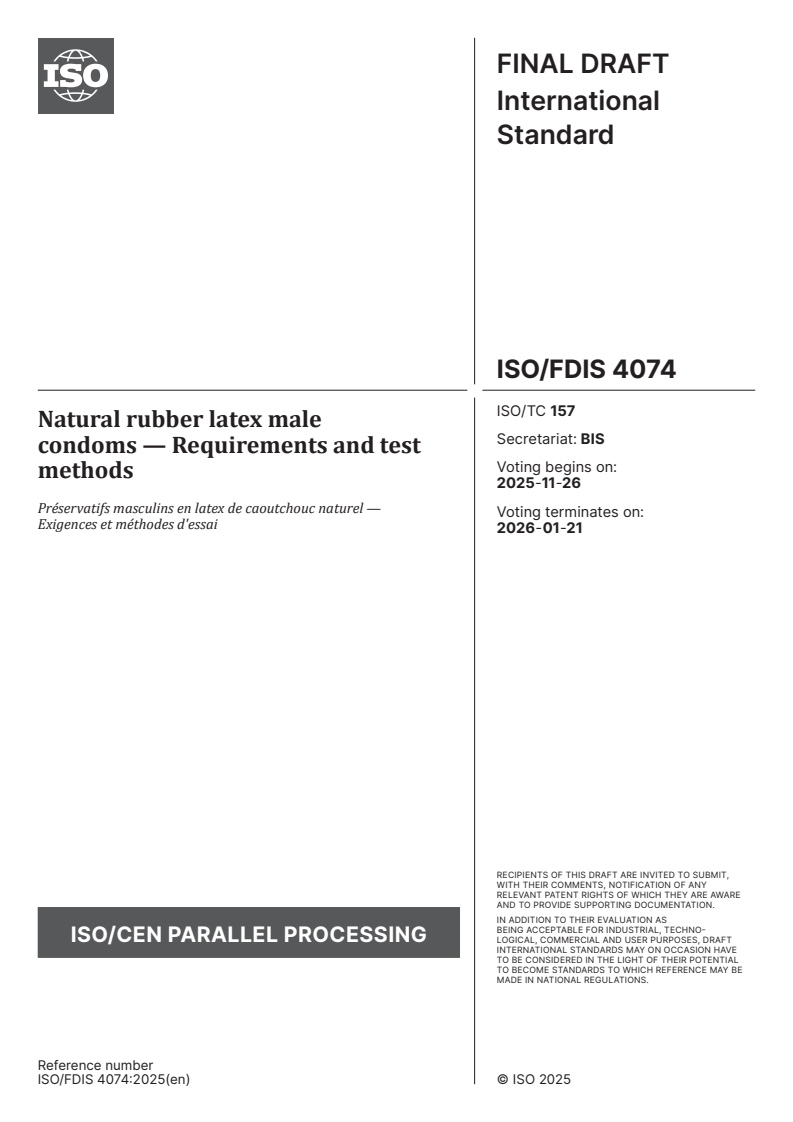
FINAL DRAFT
International
Standard
ISO/TC 157
Natural rubber latex male
Secretariat: BIS
condoms — Requirements and test
Voting begins on:
methods
2025-11-26
Préservatifs masculins en latex de caoutchouc naturel —
Voting terminates on:
Exigences et méthodes d'essai
2026-01-21
RECIPIENTS OF THIS DRAFT ARE INVITED TO SUBMIT,
WITH THEIR COMMENTS, NOTIFICATION OF ANY
RELEVANT PATENT RIGHTS OF WHICH THEY ARE AWARE
AND TO PROVIDE SUPPOR TING DOCUMENTATION.
IN ADDITION TO THEIR EVALUATION AS
BEING ACCEPTABLE FOR INDUSTRIAL, TECHNO
ISO/CEN PARALLEL PROCESSING LOGICAL, COMMERCIAL AND USER PURPOSES, DRAFT
INTERNATIONAL STANDARDS MAY ON OCCASION HAVE
TO BE CONSIDERED IN THE LIGHT OF THEIR POTENTIAL
TO BECOME STAN DARDS TO WHICH REFERENCE MAY BE
MADE IN NATIONAL REGULATIONS.
Reference number
FINAL DRAFT
International
Standard
ISO/TC 157
Natural rubber latex male condoms —
Secretariat: BIS
Requirements and test methods
Voting begins on:
Préservatifs masculins en latex de caoutchouc naturel —
Exigences et méthodes d'essai
Voting terminates on:
RECIPIENTS OF THIS DRAFT ARE INVITED TO SUBMIT,
WITH THEIR COMMENTS, NOTIFICATION OF ANY
RELEVANT PATENT RIGHTS OF WHICH THEY ARE AWARE
AND TO PROVIDE SUPPOR TING DOCUMENTATION.
© ISO 2025
IN ADDITION TO THEIR EVALUATION AS
All rights reserved. Unless otherwise specified, or required in the context of its implementation, no part of this publication may
BEING ACCEPTABLE FOR INDUSTRIAL, TECHNO
ISO/CEN PARALLEL PROCESSING
LOGICAL, COMMERCIAL AND USER PURPOSES, DRAFT
be reproduced or utilized otherwise in any form or by any means, electronic or mechanical, including photocopying, or posting on
INTERNATIONAL STANDARDS MAY ON OCCASION HAVE
the internet or an intranet, without prior written permission. Permission can be requested from either ISO at the address below
TO BE CONSIDERED IN THE LIGHT OF THEIR POTENTIAL
or ISO’s member body in the country of the requester.
TO BECOME STAN DARDS TO WHICH REFERENCE MAY BE
MADE IN NATIONAL REGULATIONS.
ISO copyright office
CP 401 • Ch. de Blandonnet 8
CH-1214 Vernier, Geneva
Phone: +41 22 749 01 11
Email: copyright@iso.org
Website: www.iso.org
Published in Switzerland Reference number
ii
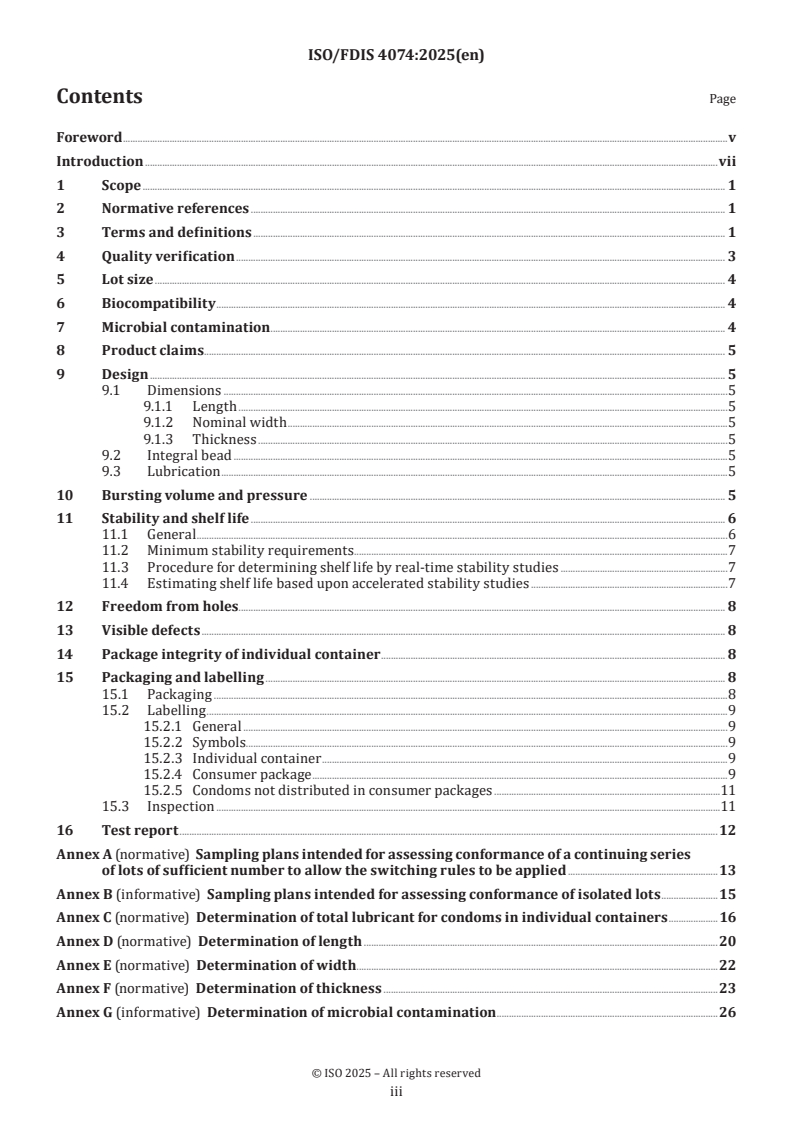
Contents Page
Foreword .v
Introduction .vii
1 Scope . 1
2 Normative references . 1
3 Terms and definitions . 1
4 Quality verification . 3
5 Lot size . 4
6 Biocompatibility . 4
7 Microbial contamination . 4
8 Product claims . 5
9 Design . 5
9.1 Dimensions .5
9.1.1 Length .5
9.1.2 Nominal width .5
9.1.3 Thickness .5
9.2 Integral bead .5
9.3 Lubrication .5
10 Bursting volume and pressure . 5
11 Stability and shelf life . 6
11.1 General .6
11.2 Minimum stability requirements . .7
11.3 Procedure for determining shelf life by real-time stability studies .7
11.4 Estimating shelf life based upon accelerated stability studies .7
12 Freedom from holes. 8
13 Visible defects . 8
14 Package integrity of individual container . 8
15 Packaging and labelling . 8
15.1 Packaging .8
15.2 Labelling .9
15.2.1 General .9
15.2.2 Symbols.9
15.2.3 Individual container .9
15.2.4 Consumer package .9
15.2.5 Condoms not distributed in consumer packages .11
15.3 Inspection .11
16 Test report .12
Annex A (normative) Sampling plans intended for assessing conformance of a continuing series
of lots of sufficient number to allow the switching rules to be applied .13
Annex B (informative) Sampling plans intended for assessing conformance of isolated lots .15
Annex C (normative) Determination of total lubricant for condoms in individual containers .16
Annex D (normative) Determination of length .20
Annex E (normative) Determination of width . .22
Annex F (normative) Determination of thickness .23
Annex G (informative) Determination of microbial contamination .26
iii
Annex H (normative) Determination of bursting volume and pressure .31
Annex I (normative) Oven treatment for condoms .38
Annex J (informative) Determination of force and elongation at break of test pieces of condoms .39
Annex K (normative) Determination of shelf life by real-time stability studies .42
Annex L (informative) Guidance on conducting and analysing accelerated ageing studies .45
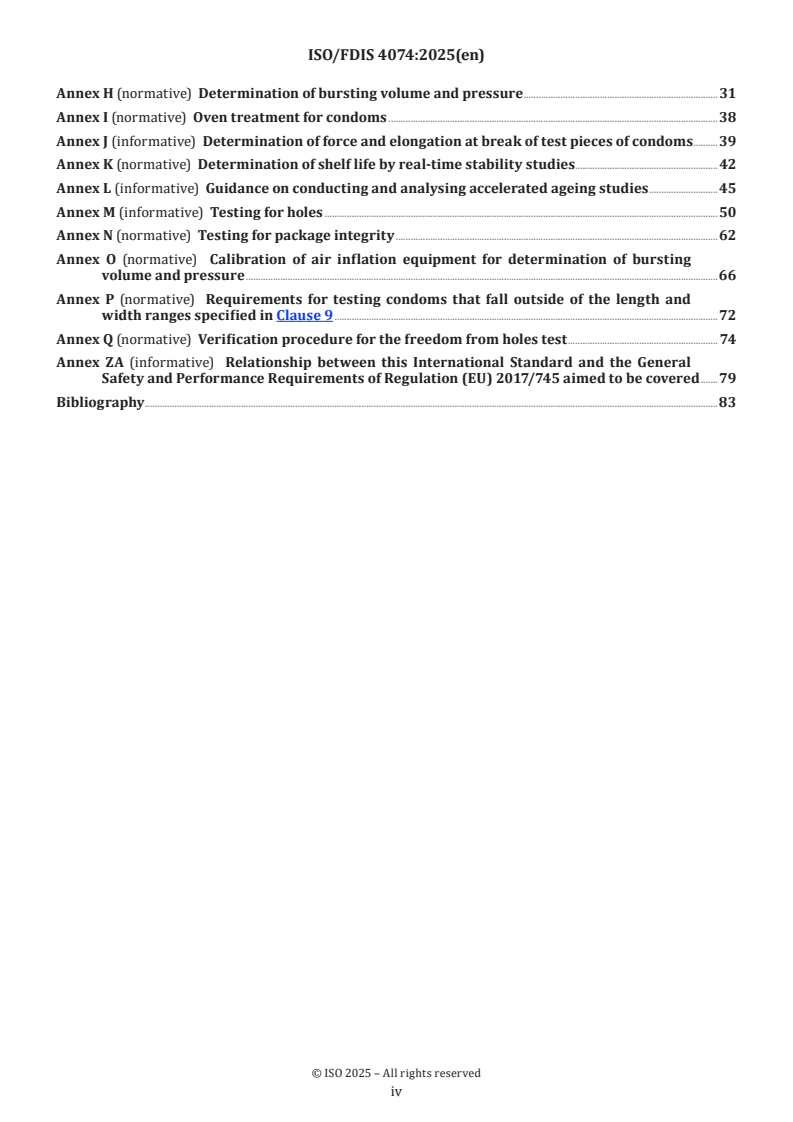
Annex M (informative) Testing for holes .50
Annex N (normative) Testing for package integrity .62
Annex O (normative) Calibration of air inflation equipment for determination of bursting
volume and pressure .66
Annex P (normative) Requirements for testing condoms that fall outside of the length and
width ranges specified in Clause 9 .72
Annex Q (normative) Verification procedure for the freedom from holes test . 74
Annex ZA (informative) Relationship between this International Standard and the General
Safety and Performance Requirements of Regulation (EU) 2017/745 aimed to be covered .79
Bibliography .83
iv
Foreword
ISO (the International Organization for Standardization) is a worldwide federation of national standards
bodies (ISO member bodies). The work of preparing International Standards is normally carried out through
ISO technical committees. Each member body interested in a subject for which a technical committee
has been established has the right to be represented on that committee. International organizations,
governmental and non-governmental, in liaison with ISO, also take part in the work. ISO collaborates closely
with the International Electrotechnical Commission (IEC) on all matters of electrotechnical standardization.
The procedures used to develop this document and those intended for its further maintenance are described
in the ISO/IEC Directives, Part 1. In particular, the different approval criteria needed for the different types
of ISO document should be noted. This document was drafted in accordance with the editorial rules of the
ISO/IEC Directives, Part 2 (see www.iso.org/directives).
ISO draws attention to the possibility that the implementation of this document may involve the use of (a)
patent(s). ISO takes no position concerning the evidence, validity or applicability of any claimed patent
rights in respect thereof. As of the date of publication of this document, ISO had not received notice of (a)
patent(s) which may be required to implement this document. However, implementers are cautioned that
this may not represent the latest information, which may be obtained from the patent database available at
www.iso.org/patents. ISO shall not be held responsible for identifying any or all such patent rights.
Any trade name used in this document is information given for the convenience of users and does not
constitute an endorsement.
For an explanation of the voluntary nature of standards, the meaning of ISO specific terms and expressions
related to conformity assessment, as well as information about ISO's adherence to the World Trade
Organization (WTO) principles in the Technical Barriers to Trade (TBT), see www.iso.org/iso/foreword.html.
This document was prepared by Technical Committee ISO/TC 157, Non-systemic contraceptives and STI
barrier prophylactics, in collaboration with the European Committee for Standardization (CEN) Technical
Committee CEN/TC 205, Non-active medical devices, in accordance with the Agreement on technical
cooperation between ISO and CEN (Vienna Agreement).
This fourth edition cancels and replaces the third edition (ISO 4074:2015), which has been technically
revised.
The main changes are as follows.
— This document now covers all condom sizes including those with dimensions specified in Annex P, which
has been made normative.
— The electrical test for freedom from holes in Annex M has been amended to improve the probability of
finding small holes in the teat (reservoir tip) and closed end of the condom.
— A new Annex Q has been added to specify requirements and procedures for validating new or modified test
procedures and verifying that the test methods for freedom from holes meet the specified performance
requirements. As a consequence, Annex M has been made informative.
— Improvements have been made to inflation test procedure specified in Annex H.
— The condom handling procedures described in ISO/TR 19969:2018 have been integrated into Annex H,
testing for burst properties, and Annex M, testing for freedom from holes.
— A statement has been added to Annex A regarding the sample sizes used for reduced inspection.
— The use of technical grade propan-2-ol is permitted for removing lubricant from condoms when
determining the lubricant quantity according to Annex C.
— In Annex G, it has been made clear that a Stomacher® is a specific type of mixer that can be used along
with other types of mixers when preparing samples for microbiological testing of condoms. Some
amendments to the test procedures have been made based on current best practices.
v
— An alternative dry vacuum method for testing the integrity of individual condom containers has been
included in Annex N.
— Annex K has been updated to provide clearer and more detailed information about conducting real time
stability tests.
— Annex L has been updated to include a more rapid accelerated stability test to assess the effect of process
and formulation changes on the stability of a product and provide a stress test for condoms that might be
stored in high temperature environments.
— Annex O has been made normative and amended to include a new section to verify that technicians can
unroll the condoms correctly when conducting the burst test.
Any feedback or questions on this document should be directed to the user’s national standards body. A
complete listing of these bodies can be found at www.iso.org/members.html.
vi
Introduction
Condoms made from intact latex film have been shown to be a barrier to human immunodeficiency virus
(HIV), other infectious agents responsible for the transmission of sexually transmitted infections (STIs), and
to spermatozoa. Numerous clinical studies have confirmed that male latex condoms are effective in helping
to prevent pregnancy and reduce the risk of transmission of most STIs including HIV.
To help ensure that condoms are effective for contraceptive purposes and in assisting in the prevention of
transmission of STIs, it is essential that condoms fit the penis properly, are free from holes, have adequate
physical strength so as not to break during use, are correctly packaged to protect them during storage, and
are correctly labelled to facilitate their use. All these issues are addressed in this document.
Condoms are medical devices. To ensure high quality product, it is essential that condoms are produced
[7]
under a good quality management system. See ISO 13485 for quality management requirements and
ISO 14971 for risk management requirements.
Condoms are non-sterile medical devices, but manufacturers are advised to take appropriate precautions
to minimize microbiological contamination of the product throughout the manufacturing and packaging
processes. Recommendations for manufacturers to periodically monitor microbial contamination during
production are included in this document. Methods that can be used to determine bioburden levels are
included in Annex G.
This document requires manufacturers to conduct stability tests to estimate the shelf life of any new condom
design before the product is placed on the market and to initiate real-time stability studies. Manufacturers
are also required to consider the stability of any modified condom design. These requirements are described
in Clause 11. The real-time stability test can be considered as part of the manufacturers’ requirement to
conduct post-marketing surveillance on their products. These requirements are intended to ensure that
manufacturers have adequate data to support shelf life claims before products are placed on the market
and that these data are available for review by regulatory authorities, third party test laboratories, and
purchasers. They are also intended to limit the need for third parties to conduct long-term stability studies.
Condoms can be subject to specific local requirements as required by national regulatory bodies in addition
to those specified in this document.
[8]
ISO 16038 provides guidance for the application of this document. It includes additional information on
the test methods and requirements specified in this document.
Pictures and diagrams in this document are to enhance clarity and do not indicate a preference for any
specific equipment type or design.
There are no requirements for determining the tensile properties of condoms in this document. Nevertheless,
tensile testing is sometimes used for quality control and development purposes. Annex J includes guidance
on how to determine force and elongation at break of condoms.
The need for a transition period when implementing the requirements of this document should be considered
to allow manufacturers to make the changes required to maintain conformance.
vii
FINAL DRAFT International Standard ISO/FDIS 4074:2025(en)
Natural rubber latex male condoms — Requirements and
test methods
1 Scope
This document specifies requirements and test methods for male condoms made from natural rubber latex.
This document does not specify requirements related to any medicinal substances applied to or delivered by
the condom.
NOTE The safety and effectiveness of any medicinal substance are assessed according to national and regional
regulations.
2 Normative references
The following documents are referred to in the text in such a way that some or all of their content constitutes
requirements of this document. For dated references, only the edition cited applies. For undated references,
the latest edition of the referenced document (including any amendments) applies.
ISO 2859-1, Sampling procedures for inspection by attributes — Part 1: Sampling schemes indexed by acceptance
quality limit (AQL) for lot-by-lot inspection
ISO 10993-1, Biological evaluation of medical devices — Part 1: Evaluation and testing within a risk
management process
ISO 14971, Medical devices — Application of risk management to medical devices
ISO 15223-1, Medical devices — Symbols to be used with information to be supplied by the manufacturer—
Part 1: General requirements
ISO/IEC 17025, General requirements for the competence of testing and calibration laboratories
3 Terms and definitions
For the purposes of this document, the terms and definitions given in ISO 2859-1 and the following apply.
ISO and IEC maintain terminology databases for use in standardization at the following addresses:
— ISO Online browsing platform: available at https:// www .iso .org/ obp
— IEC Electropedia: available at https:// www .electropedia .org/
3.1
acceptance quality limit
AQL
quality level that is the worst tolerable process average when a continuing series of lots (3.11) is submitted
for acceptance sampling
[SOURCE: ISO 2859-1:1999, 3.1.26]
3.2
male condom
medical device used by consumers, which is intended to cover and be retained on the penis during sexual
activity, for purposes of contraception and prevention of sexually transmitted infections
3.3
modified condom design
established condom design that has been subjected to changes in formulation, manufacturing process,
manufacturing site, lubrication, or individual sealed container
3.4
consumer package
box, bag or container intended for distribution to a consumer, containing one or more individual containers
of condoms
3.5
expiry date
date after which the condom should not be used
3.6
identification number
number, or combination of numerals, symbols, or letters, used by a manufacturer on consumer packages (3.4)
to identify uniquely the lot numbers (3.12) of individual condoms contained in that package, and from which
it is possible to trace those lots (3.11) through all stages of manufacturing, packaging and distribution
Note 1 to entry: When the consumer package contains only one type of condom, then the identification number may
be the same as the lot number; but if the consumer package contains several different types of condoms, for instance
condoms of different shapes or colours, then the identification number will be different from the lot numbers.
3.7
individual container
primary package containing a single condom
3.8
inspection level
index of the relative amount of inspection of an acceptance sampling scheme, chosen in advance, and relating
the sample size to the lot size
[SOURCE: ISO 3534-2:2006, 4.3.5]
3.9
inflation length
length of the condom to be inflated during the burst test
3.10
integral bead
ring formed at the open end of the condom, usually by rolling down a portion of the partially dried and cured
latex film, to assist rolling and handling the condom
3.11
lot
collection of condoms of the same design, colour, shape, size, and formulation, manufactured at essentially
the same time, using the same process, raw materials of the same specifications, common equipment, and
packed with the same lubricant and any other additive or dressing in the same type of individual container
3.12
lot number
number, or combination of numerals, symbols, or letters, used by the manufacturer to identify a lot (3.11)
of individually packaged condoms, and from which it is possible to trace that lot through all stages of
manufacture up to packaging
3.13
non-visible hole
puncture or tear in a condom that is not visible under normal or corrected vision but is detected by the
water leak test or electrical test
3.14
sampling plan
specific plan which indicates the number of units of product from each lot (3.11) which are to be inspected
(sample size or series of sample sizes) and the associated criteria for determining the acceptability of the lot
(acceptance and rejection numbers)
3.15
shelf life
period from date of manufacture during which condoms are required to conform to the requirements for
bursting pressure, bursting volume, freedom from holes and pack integrity
3.16
visible hole
puncture or tear in the condom that is visible under normal or corrected vision before the condom is filled
with water or electrolyte during testing for freedom from holes
3.17
date of manufacture
date specified by the manufacturer when the product was made
Note 1 to entry: See 11.1.
3.18
visible defect
broken, missing, or severely distorted bead and permanent creases with adhesion of the film
Note 1 to entry: This refers to visible defects other than holes.
4 Quality verification
Condoms are regulated medical devices in most countries and should be manufactured and tested using an
appropriate quality management system (QMS). A suitable QMS for the manufacture of medical devices is
[7]
described in ISO 13485.
Condoms are mass produced articles. Inevitably, there will be some variation between individual condoms,
and a small proportion of condoms in each production run might not meet the requirements in this
document. Further, most of the test methods described in this document are destructive. For these reasons,
the only practicable method of assessing conformity with this document is by testing a representative
sample from a lot or series of lots. Basic sampling plans are given in ISO 2859-1. Reference should be made
[2]
to the ISO/TR 8550 series for guidance on the use of acceptance sampling system, scheme, or plan for the
inspection of discrete items in lots. For testing purposes, sampling shall be conducted by lot number, not by
identification number.
Sampling plans shall be selected to provide an acceptable level of consumer protection. Suitable sampling
plans are given in Annexes A and B.
a) Annex A describes sampling plans based on ISO 2859-1 and is most applicable to manufacturers or
purchasers assessing the conformity of a continuing series of lots. The full level of consumer protection
available depends upon the switch to tightened inspection if deterioration in quality is detected. The
switching rules, described in ISO 2859-1:1999, Clause 9, cannot offer their full protection for the first
two lots tested but become progressively more effective as the number of lots in a series increases. The
sampling plans in Annex A shall be used when a continuing series of five or more lots are being tested.
b) When testing isolated lots or fewer than 5 lots, the level of consumer protection is reduced because the
switching rules cannot be applied. If in such cases it is necessary to maintain high levels of consumer
protection the sampling plans in Annex B are recommended. The sampling plans in Annex B provide
approximately the same level of consumer protection as those given in Annex A when used with the
switching rules. Examples of when the sampling plans in Annex B should be used include cases of dispute,
for referee purposes, for type testing, for qualification purposes, and for short runs of continuing lots.
It is necessary to know the lot size to derive from ISO 2859-1 the number of condoms to be tested. The lot
size will vary between manufacturers and is regarded as part of the process and quality controls used by
the manufacturer.
If the lot size is not known or cannot be confirmed by the manufacturer, then a lot size of 500 000 condoms
shall be assumed for determining the sample sizes for testing.
5 Lot size
The maximum individual lot size for production shall be 500 000 condoms.
This document does not specify the size of a lot, but it is possible for a purchaser to do so as part of the
purchasing contract. Purchasers are encouraged to specify a lot size compatible with the manufacturer’s
quality management system.
6 Biocompatibility
For any new product biocompatibility assessments shall be conducted in accordance with ISO 10993-1.
When testing is required, in-vitro tests are preferred if possible. In-vivo (animal) testing should be kept to a
minimum. For a modified condom design, manufacturers shall conduct a risk assessment in accordance with
ISO 14971 to determine whether the biocompatibility assessment needs to be repeated.
NOTE 1 Regulatory authorities usually require evaluations to be completed for cytotoxicity according to
ISO 10993-5, irritation according to ISO 10993-23, and sensitization according to ISO 10993-10. Some authorities
might require additional evaluations.
The condom together with any lubricant, additive, dressing material, or powder applied to it shall be
evaluated.
The laboratory used for any biocompatibility testing shall conform to the requirements of ISO/IEC 17025.
The results shall be interpreted by a qualified toxicologist or other appropriately qualified expert. The
biological assessment report shall justify that the product is safe for its intended use.
NOTE 2 Many latex products that have been established as safe, including condoms and medical gloves, can exhibit
a positive cytotoxic response when tested according to ISO 10993-5. While any cytotoxic effect can be of concern, it is
primarily an indication of potential for in vivo toxicity. A condom cannot necessarily be determined to be unsuitable
for use based solely on cytotoxicity data.
7 Microbial contamination
Manufacturers are recommended to establish procedures for the control and periodic monitoring of
microbial contamination (bioburden) as part of their quality management system. Staphylococcus aureus,
Pseudomonas aeruginosa, and Enterobacteriaceae, including Escherichia coli, are pathogenic organisms that
can potentially be found on condoms and can cause urinary tract or other infections. It is recommended
that these organisms are absent from condoms. The procedures should include requirements for absence of
specific pathogens and limits for total viable counts on finished condoms. Methods of determining bioburden
levels on condoms are given in Annex G.
NOTE General methods for determining microbial contamination on sterile medical devices are given in
[6]
ISO 11737-1. It includes methods for validation testing (ISO 11737-1). The methods described in Annex G have been
found to be suitable for use with condoms taking into account specific issues associated with testing these products.
These issues include the residual antimicrobial activity of some of compounds used in latex formulations which can
interfere with the assays.
To control microbial contamination on the finished product, manufacturers are recommended to control
the manufacturing environment to reduce the risk of contaminating the product, establish general cleaning
and sanitizing procedures throughout the operation, and monitor bioburden levels on raw materials and
equipment.
8 Product claims
Condoms meeting the requirements of this document are used for contraceptive purposes and to help
protect against sexually transmitted infections. Manufacturers shall justify any additional claims made for
their products. If a manufacturer makes a claim relating to improved efficacy or safety, then the claim shall
be substantiated by appropriate clinical investigation to demonstrate superiority. Information supporting
such claims shall be made available on request to interested parties.
9 Design
9.1 Dimensions
9.1.1 Length
The length of the condom shall be determined according to the method given in Annex D using a sample
of 13 condoms from each lot. No individual measurement shall be below 160 mm except for condoms with
dimensions specified in Annex P. For condoms shorter than 160 mm, the length shall be within ±5 mm of the
nominal length specified by the manufacturer.
9.1.2 Nominal width
The width of the condom shall be determined according to the method given in Annex E using a sample of
13 condoms. The measurements shall be made at the narrowest part of the condom in the range of 20 mm to
50 mm from the open end. No measurement of the width shall deviate from the nominal width stated by the
manufacturer by more than ±2 mm.
9.1.3 Thickness
This document does not specify limits for condom thickness. If verification is required of the thickness of a
condom design, the average thickness of the samples measured in accordance with one of the methods given
in Annex F, shall be equal to the claimed nominal thickness, subject to a tolerance of:
— ±0,008 mm for condoms with nominal claimed thickness less than 0,05 mm;
— ±0,01 mm for condoms with nominal claimed thickness equal to or greater than 0,05 mm.
The method to be used for verification shall be specified by the manufacturer.
9.2 Integral bead
The open end of the condom shall terminate in an integral bead.
9.3 Lubrication
This document does not specify requirements for the quantity and type of lubricant. If verification is required of
the quantity of lubricant on a condom (and in the package), either of the methods given in Annex C shall be used.
The methods in Annex C also recover part of the dressing powder on the condom. An allowance should be
made for this when manufacturers or purchasers specify lubricant levels.
10 Bursting volume and pressure
The bursting properties of condoms shall be determined according to the method specified in Annex H. For
condoms that are equal to or greater than 160 mm in length, an inflation length of (150 ± 3) mm shall be
used. The minimum bursting pressures and volumes are specified in Table 1:
Table 1 — Minimum bursting pressure and volume for condoms ≥160 mm long
Width of condom Minimum bursting pressure Minimum bursting volume
mm kPa dm
45,0 to 49,5 1,0 16,0
50,0 to 55,5 1,0 18,0
56,0 to 64,5 1,0 22,0
65,0 to 75,0 0,8 28,0
For the purpose of this test, the mid-body width shall be the mean width rounded to the nearest 0,5 mm of
13 condoms measured in accordance with Annex E at a point equal to half the inflation length ±5 mm from
the closed end excluding the teat. For example, condoms longer than 160 mm have an inflation length of
150 mm and a mid-body width measured at 75 ± 5 mm from the closed end, excluding the teat.
For condoms that are shorter than 160 mm in length, the inflation lengths and minimum burst properties
are specified in Annex P.
The conformance level for each lot shall be an AQL of 1,5 for condoms that fail the requirement for bursting
volume or bursting pressure or both.
11 Stability and shelf life
11.1 General
Manufacturers shall verify that the condoms conform with the requirements of Clauses 10, 12, and 14 until
the end of the labelled shelf life. Products on the market prior to publication of ISO 4074:2015 (2015-10-
15) shall be deemed to conform with the shelf life verification requirements of this document, unless the
product is a modified design. Shelf life claims shall not exceed 5 years from the date of manufacture.
The date of manufacture can be the date of dipping or the date of packaging in individual sealed containers,
depending upon the procedures specified by the manufacturer. The date of manufacture shall not exceed
2 years from the date of dipping.
Unpackaged condoms shall be stored under controlled conditions as specified by the manufacturer
between dipping and packaging. Manufacturers shall have documented procedures for validating the
storage conditions and maximum storage periods. The stored condoms shall be protected from exposure
to excessive temperatures, light, ozone, and any other condition that can affect the shelf life of the packaged
condoms.
Assessment for minimum stability (11.2) and shelf life claims (11.3 and 11.4) shall be verified on condoms
that have been stored in bulk for the maximum permitted period between dipping and packaging under the
conditions specified by the manufacturer.
Data supporting the shelf life claims made by the manufacturer shall be made available on request to
interested parties.
Before conformance with this document can be claimed for a new or modified condom design, the
manufacturer shall provide evidence that the following requirements have been met:
— the condom shall conform with the minimum stability requirements as described in 11.2;
— a real-time study as described in 11.3 to determine shelf life shall have commenced;
— pending completion of the real-time study, manufacturers shall substantiate provisional shelf-life claims
as described in 11.4.
NOTE 1 Conformance with the requirements of 11.2 does not imply that the shelf life of the product has been
determined.
NOTE 2 A practical limit of 5 years has been set for the shelf life because manufacturers have no control over
storage conditions once condoms have been distributed.
+5
Shelf life estimates (11.4) shall be based on a temperature of 30 °C for all climatic conditions and should be
()
−2
carried out on condoms from the same production lots as used for real-time determination of shelf life (11.3).
+5
NOTE 3 The choice of 30 °C as the reference temperature for shelf life estimates is based on studies that have
()
−2
[14,15]
confirmed the mean kinetic temperate of the most extreme temperature zones is approximately 30 °C . See
Annex L for more details.
11.2 Minimum stability requirements
Test three lots of condoms for conformity with this document, except for subclause 15.2 and 15.3.
Only lots meeting all the requirements of Clauses 9, 10, 12, 13, and 14 shall be used for this test.
Condition samples in their individual sealed containers according to Annex I, one set for (168 ± 2) h (1 week)
at (70 ± 2) °C and the other set for (90 ± 1) days at (50 ± 2) °C. At the end of the incubation periods, withdraw
the condoms and test for conformance with the requirements of Clauses 10, 12, and 14 using as a minimum
the sampling plans specified in Annex A or preferably the sampling plans in Annex B.
This test ensures that the condoms have adequate stability to be placed on the market pending verification of
shelf life claims. It is not predictive of shelf life. Purchasers, test laboratories, regulatory authorities, and other
interested parties can confirm that condoms meet the minimum stability requirements by testing condom
lots for conformance with the requirements of Clause 10 after oven conditioning for (168 ± 2) h (1 week) at
(70 ± 2) °C. When such testing is carried out, it might be appropriate to use reduced inspection levels.
The test report shall include the relevant requirements of Annexes H, K, M and N, and Clause 16.
NOTE Data to verify conformance with 11.2 can be extracted from studies for estimates of shelf life (11.4).
11.3 Procedure for determining shelf life by real-time stability studies
Real-time stability testing shall be conducted on three lots of condoms meeting all the requirements of
Clauses 9, 10, 12, 13, and 14. Real-time stability studies shall continue for the full period of the shelf life
claim. In no case shall shelf life claim exceed 5 years.
For condoms placed on the market based upon accelerated stability studies, if the real-time data indicates
a shorter shelf life than that claimed based on accelerated ageing (11.4), the manufacturer shall notify the
relevant regulatory authorities and direct purchasers. The manufacturer shall change the shelf life claim for
the product to one based upon the real-time study.
Test three lots of condoms for conformity with this document, except for 15.2 and 15.3.
After conditioning according to Annex K using the sampling plans specified in Annex A or preferably the
sampling plans in Annex B, the condoms shall meet the requirements specified in Clauses 10, 12, and 14.
The test report shall conform to the requirements of Clause 16 and include the results of testing according
to Annexes H, M and N, and the shelf life together with the methods used to determine the shelf life and
supporting data.
11.4 Estimating shelf life based upon accelerated stability studies
Pending the completion of real-time studies, manufacturers shall substantiate provisional shelf life claims.
Accelerated stability studies may be used for this purpose.
Test three lots of condoms for conformity with this document, except for 15.2 and 15.3.
Only lots meeting all the requirements of Clauses 9, 10, 12, 13, and 14 shall be used for accelerated stability
testing.
Further information on accelerated studies is provided in Annex L. Data generated from such studies shall
support the claim that the condoms fulfil the requirements in Clauses 10, 12, and 14 for the duration of the
+5
labelled shelf life at 30 °C.
()
−2
The report shall conform to the requirements of Clause 16 and include the results of testing according to
Annexes H, M, N and the provisional shelf life together the methods used to determine the provisional shelf
life and supporting data.
12 Freedom from holes
Test methods for freedom from holes shall be based on the visual observation
...
Date:2024-09-45 Style Definition
...
Formatted: Left: 1.5 cm, Right: 1.5 cm, Gutter: 0 cm,
Header distance from edge: 1.27 cm, Footer distance from
ISO/DISFDIS 4074:2024(en)
edge: 1.27 cm
Formatted: English (United Kingdom)
ISO/TC 157
Formatted: zzCover large
Secretariat: DSM BIS
Formatted
...
Date: 2025-10-15
Formatted: Cover Title_A1
Natural rubber latex male condoms — Requirements and test
methods
Préservatifs masculins en latex de caoutchouc naturel — Exigences et méthodes d'essai Formatted
...
FDIS stage
Formatted: Font: Bold
Formatted: Adjust space between Latin and Asian text,
Adjust space between Asian text and numbers
All rights reserved. Unless otherwise specified, or required in the context of its implementation, no part of this publication
Formatted: Default Paragraph Font
may be reproduced or utilized otherwise in any form or by any means, electronic or mechanical, including photocopying,
or posting on the internet or an intranet, without prior written permission. Permission can be requested from either ISO
at the address below or ISO'sISO’s member body in the country of the requester.
ISO Copyright Officecopyright office
CP 401 • Ch. de Blandonnet 8
CH-1214 Vernier, Geneva
Formatted: zzCopyright address, Adjust space between Latin
and Asian text, Adjust space between Asian text and numbers
Phone: + 41 22 749 01 11
Formatted: French (Switzerland)
Email: copyright@iso.org
E-mail: copyright@iso.org
Website: www.iso.orgwww.iso.org
Formatted: zzCopyright address, Adjust space between Latin
and Asian text, Adjust space between Asian text and numbers
Published in Switzerland.
Formatted: FooterPageRomanNumber
ii
Formatted: Font: 11 pt, Bold
ISO/DISFDIS 4074:20242025(en)
Formatted: HeaderCentered, Left
Formatted: Font: 11 pt, Bold
Contents Page Formatted: Font: 11 pt, Bold
Formatted: Font: Bold
Foreword . ix Formatted: Adjust space between Latin and Asian text,
Adjust space between Asian text and numbers, Tab stops: Not
Introduction . xi
at 0.71 cm + 17.2 cm
1 Scope . 1
2 Normative references . 1
3 Terms and definitions . 1
4 Quality verification . 4
5 Lot size . 4
6 Biocompatibility . 5
7 Microbial contamination . 5
8 Product claims . 5
9 Design . 6
10 Bursting volume and pressure . 6
11 Stability and shelf life . 7
12 Freedom from holes . 9
13 Visible defects . 10
14 Package integrity of individual container . 10
15 Packaging and labelling . 10
16 Test report . 14
Annex A (normative) Sampling plans intended for assessing conformance of a continuing series
of lots of sufficient number to allow the switching rules to be applied . 16
Annex B (informative) Sampling plans intended for assessing conformance of isolated lots . 18
Annex C (normative) Determination of total lubricant for condoms in individual containers . 20
Annex D (normative) Determination of length . 24
Annex E (normative) Determination of width . 27
Annex F (normative) Determination of thickness . 28
Annex G (informative) Determination of microbial contamination . 32
Annex H (normative) Determination of bursting volume and pressure . 37
Annex I (normative) Oven treatment for condoms . 49
Annex J (informative) Determination of force and elongation at break of test pieces of condoms50
Annex K (normative) Determination of shelf life by real-time stability studies . 53
Annex L (informative) Guidance on conducting and analysing accelerated ageing studies . 56
Annex M (informative) Testing for holes . 62
Annex N (normative) Testing for package integrity . 82
Annex O (normative) Calibration of air inflation equipment for determination of bursting
volume and pressure . 87
Formatted: FooterPageRomanNumber
iii
Formatted: Font: Bold
Annex P (normative) Requirements for testing condoms that fall outside of the length and
width ranges specified in Clause 9 . 95
Annex Q (normative) Verification procedure for the freedom from holes test . 97
Annex ZA (informative) Relationship between this International Standard and the General
Safety and Performance Requirements of Regulation (EU) 2017/745 aimed to be covered104
Bibliography . 110
Foreword . 8
Introduction . 10
1 Scope . 1
2 Normative references . 1
3 Terms and definitions . 2
4 Quality verification . 4
5 Lot size . 5
6 Biocompatibility . 5
7 Microbial contamination . 5
8 Product claims . 6
9 Design . 6
10 Bursting volume and pressure . 7
11 Stability and shelf life . 7
12 Freedom from holes . 9
13 Visible defects . 10
14 Package integrity of individual container . 10
15 Packaging and labelling . 10
16 Test report . 14
Annex A (normative) Sampling plans intended for assessing conformance of a continuing series
of lots of sufficient number to allow the switching rules to be applied . 15
A.1 Quality verification . 15
A.2 Sampling plans and conformance levels . 15
Annex B (informative) Sampling plans intended for assessing conformance of isolated lots . 17
Annex C (normative) Determination of total lubricant for condoms in individual containers . 19
C.1 General . 19
C.2 Propan-2-ol method . 19
C.2.1 Principle . 19
C.2.2 Apparatus . 19
C.2.3 Procedure . 19
C.2.4 Accuracy of lubricant recovery . 20
C.3 Aqueous surfactant method . 20
Formatted: FooterPageRomanNumber
iv
Formatted: Font: 11 pt, Bold
ISO/DISFDIS 4074:20242025(en)
Formatted: HeaderCentered, Left
Formatted: Font: 11 pt, Bold
C.3.1 Principle . 20
Formatted: Font: 11 pt, Bold
Formatted: Font: Bold
C.3.2 Apparatus . 20
C.3.3 Procedure . 21
C.3.4 Accuracy of lubricant recovery . 22
C.4 Expression of results . 22
Annex D (normative) Determination of length . 23
D.1 Principle . 23
D.2 Apparatus . 23
D.3 Procedure . 23
D.4 Expression of results . 23
Annex E (normative) Determination of width . 25
E.1 Principle . 25
E.2 Apparatus . 25
E.3 Procedure . 25
E.4 Expression of results . 25
Annex F (normative) Determination of thickness . 26
F.1 General . 26
F.2 Mass method . 26
F.2.1 Principle . 26
F.2.2 Apparatus . 26
F.2.3 Procedure . 26
F.3 Micrometer method . 27
F.3.1 Principle . 27
F.3.2 Apparatus . 27
F.3.3 Procedure . 27
F.4 Expression of results . 28
Annex G (informative) Determination of microbial contamination . 29
G.1 General . 29
G.2 Enumeration of total population of aerobic microorganisms on foiled condoms . 29
G.3 Enumeration of total viable aerobic microbial population and tests for specified
microorganisms on foiled condoms . 30
G.4 Enumeration of the total viable aerobic bacteria and fungi on Agar plates (direct plating
method) according to the methods in the European Pharmacopoeia . 31
G.4.1 Preparation of the sample . 31
G.4.2 Examination of the sample . 31
G.4.2.1 Membrane filtration . 31
G.4.2.2 Plate-count methods . 31
G.4.2.2.1 Pour-plate method . 31
Formatted: FooterPageRomanNumber
v
Formatted: Font: Bold
G.4.2.2.2 Surface-spread method . 32
G.4.3 Effectiveness of culture media and validity of the counting method . 32
G.4.4 Interpretation of the results . 33
G.4.5 Identification . 33
G.5 Expression of results . 33
Annex H (normative) Determination of bursting volume and pressure . 34
H.1 Principle . 34
H.2 Apparatus . 34
H.3 Verification of technicians’ techniques . 36
H.4 Procedure for inflation testing . 37
H.5 Expression of results . 41
Annex I (normative) Oven treatment for condoms . 42
I.1 General . 42
I.2 Apparatus . 42
I.3 Preparation of condoms for test . 42
I.4 Procedure . 42
I.5 Expression of results . 42
Annex J (informative) Determination of force and elongation at break of test pieces of condoms43
J.1 General . 43
J.2 Apparatus . 43
J.3 Preparation of test specimen . 43
J.4 Procedure . 44
J.5 Calculation of results . 44
J.6 Expression of results . 45
Annex K (normative) Determination of shelf life by real-time stability studies . 46
K.1 Principle . 46
K.2 Sample requirements . 46
K.3 Procedure . 47
K.4 Confirmation of shelf life claim . 48
K.5 Test report . 48
Annex L (informative) Guidance on conducting and analysing accelerated ageing studies . 49
L.1 General . 49
L.2 Sampling . 49
L.3 Procedure for determining a provisional shelf life of condom pending the completion of a
real-time stability study . 50
L.4 Procedure for assessing the stability of a modified condom using a control condom with
a shelf life confirmed by real-time stability data . 50
L.5 Guidance on analysing and comparing stability results . 51
Formatted: FooterPageRomanNumber
vi
Formatted: Font: 11 pt, Bold
ISO/DISFDIS 4074:20242025(en)
Formatted: HeaderCentered, Left
Formatted: Font: 11 pt, Bold
L.6 Thermal stress test method . 53
Formatted: Font: 11 pt, Bold
Formatted: Font: Bold
L.7 Test report . 53
Annex M (normative) Testing for holes . 54
M.1 General . 54
M.2 Preparing and inspecting the condoms for testing . 54
M.3 Water leak test . 56
M.3.1 Principle . 56
M.3.2 Apparatus . 56
M.3.3 Procedure . 58
M.3.4 Rolling procedure . 59
M.4 Electrical test . 61
M.4.1 General . 61
M.4.2 Apparatus . 62
M.4.3 Procedure . 63
M.5 Expression of results . 65
Annex N (normative) Testing for package integrity . 67
N.1 General . 67
N.2 Wet vacuum test method . 67
N.2.1 Apparatus . 67
N.2.2 Reagent . 67
N.2.3 Test specimen . 67
N.2.4 Conditioning . 68
N.2.5 Procedure . 68
N.2.6 Interpretation of results . 68
N.3 Dry vacuum method method . 68
N.3.1 Principle . 68
N.3.2 Equipment Required . 68
N.3.3 Method . 69
N.4 Test Report . 70
Annex O (normative) Calibration of air inflation equipment for determination of bursting
volume and pressure . 71
O.1 Introduction . 71
O.2 System check algorithm . 71
O.3 Clamp slip check . 71
O.4 Inflation length verification . 71
O.5 Cuff leak check . 72
O.6 Air supply leak check . 72
Formatted: FooterPageRomanNumber
vii
Formatted: Font: Bold
O.7 Pressure gauge calibration. 73
O.8 Air flowrate adjustment and calibration . 73
O.9 In-line volume or flowrate meter calibration . 73
O.10 Timer check . 74
O.11 Comparison of test heads . 74
O.12 Verification of automatic recording . 74
O.13 Physical inspection of equipment . 74
O.14 Requirements . 74
O.15 Important equations . 75
Annex P (normative) Requirements for testing condoms that fall outside of the length and width
ranges specified in Clause 9 . 78
P.1 General . 78
P.2 Bursting properties . 78
P.3 Freedom from holes test . 79
Annex Q (normative) Verification Procedure for the Freedom from Holes Test. 80
Q.1 General . 80
Q.2 Principle . 80
Q.3 Apparatus and Materials . 80
Q.4 Procedure for preparing the condoms . 81
Q.5 Procedure for Testing . 84
Q.6 Expression of results . 84
Annex ZA (informative) Relationship between this International Standard and the General Safety
and Performance Requirements of Regulation (EU) 2017/745 aimed to be covered . 86
Bibliography . 92
Formatted: FooterPageRomanNumber
viii
Formatted: Font: 11 pt, Bold
ISO/DISFDIS 4074:20242025(en)
Formatted: Font: 11 pt, Bold
Formatted: Font: 11 pt, Bold
Foreword Formatted: Font: Bold
Formatted: HeaderCentered, Left
ISO (the International Organization for Standardization) is a worldwide federation of national standards
Formatted: Adjust space between Latin and Asian text,
bodies (ISO member bodies). The work of preparing International Standards is normally carried out through
Adjust space between Asian text and numbers
ISO technical committees. Each member body interested in a subject for which a technical committee has been
established has the right to be represented on that committee. International organizations, governmental and
non-governmental, in liaison with ISO, also take part in the work. ISO collaborates closely with the
International Electrotechnical Commission (IEC) on all matters of electrotechnical standardization.
The procedures used to develop this document and those intended for its further maintenance are described
in the ISO/IEC Directives, Part 1. In particular, the different approval criteria needed for the different types of
ISO document should be noted. This document was drafted in accordance with the editorial rules of the
ISO/IEC Directives, Part 2 (see www.iso.org/directives). Formatted: English (United Kingdom)
ISO draws attention to the possibility that the implementation of this document may involve the use of (a)
patent(s). ISO takes no position concerning the evidence, validity or applicability of any claimed patent rights
in respect thereof. As of the date of publication of this document, ISO had not received notice of (a) patent(s)
which may be required to implement this document. However, implementers are cautioned that this may not
represent the latest information, which may be obtained from the patent database available at
www.iso.org/patents.www.iso.org/patents. ISO shall not be held responsible for identifying any or all such
patent rights.
Any trade name used in this document is information given for the convenience of users and does not
constitute an endorsement.
For an explanation of the voluntary nature of standards, the meaning of ISO specific terms and expressions
related to conformity assessment, as well as information about ISO's adherence to the World Trade
Organization (WTO) principles in the Technical Barriers to Trade (TBT), see
www.iso.org/iso/foreword.htmlwww.iso.org/iso/foreword.html. Formatted: English (United Kingdom)
This document was prepared by Technical Committee ISO/TC 157, Non-systemic contraceptives and STI
barrier prophylactics, in collaboration with the European Committee for Standardization (CEN) Technical Formatted: Font: Not Italic
Committee CEN/TC 205, Non-active medical devices, in accordance with the Agreement on technical
Formatted: Font: Not Italic
cooperation between ISO and CEN (Vienna Agreement).
Formatted: Font: Not Italic
This fourth edition cancels and replaces the third edition (ISO 4074:2015), which has been technically revised. Formatted: Adjust space between Latin and Asian text,
Adjust space between Asian text and numbers
The main changes are as follows. Formatted: Default Paragraph Font
Formatted: Default Paragraph Font
— — This document now covers all condom sizes including those with dimensions specified in
Formatted: Default Paragraph Font
Annex P,Annex P, which has been made normative.
Formatted: List Continue 1, Adjust space between Latin and
Asian text, Adjust space between Asian text and numbers, Tab
— — The electrical test for freedom from holes in Annex MAnnex M has been amended to improve the
stops: Not at 0.7 cm + 1.4 cm + 2.1 cm + 2.8 cm + 3.5
cm + 4.2 cm + 4.9 cm + 5.6 cm + 6.3 cm + 7 cm
probability of finding small holes in the teat (reservoir tip) and closed end of the condom.
Formatted: Default Paragraph Font
— — A new Annex QAnnex Q has been added to specify that requirements and procedures for validating
new or modified test procedures and verifying that the test methods for freedom from holes described in
Annex M are meeting meet the specified performance requirements. As a consequence, Annex M has been
made informative.
Formatted: Default Paragraph Font
— — Improvements have been made to inflation test procedure specified in Annex H.Annex H.
Formatted: Default Paragraph Font
— — The condom handling procedures described in ISO/TR 19969:2018 have been integrated into
Formatted: Default Paragraph Font
Annex H,Annex H, testing for burst properties, and Annex M,Annex M, testing for freedom from holes.
Formatted: Default Paragraph Font
Formatted: FooterPageRomanNumber
ix
Formatted: Font: Bold
— — A statement has been added to Annex AAnnex A regarding the sample sizes used for reduced
inspection.
— — The use of technical grade propan-2-ol is permitted for removing lubricant from condoms when
determining the lubricant quantity according to Annex C.Annex C.
— — In Annex G,In 0, it has been made clear that a Stomacher® is a specific type of mixer that can be used
along with other types of mixers when preparing samples for microbiological testing of condoms. Some
amendments to the test procedures have been made based on current best practices.
— — An alternative dry vacuum method for testing the integrity of individual condom containers has been
included in Annex N. Annex N.
— — Annex KAnnex K has been updated to provide clearer and more detailed information about conducting
real time stability tests.
— — Annex LAnnex L has been updated to include a more rapid accelerated stability test to assess the effect
of process and formulation changes on the stability of a product and provide a stress test for condoms that
might be stored in high temperature environments.
— — Annex OAnnex O has been made normative and amended to include a new section to verify that
technicians can unroll the condoms correctly when conducting the burst test.
Formatted: English (United Kingdom)
Any feedback or questions on this document should be directed to the user’s national standards body. A
complete listing of these bodies can be found at www.iso.org/members.html.
Formatted: Adjust space between Latin and Asian text,
Adjust space between Asian text and numbers
Field Code Changed
Formatted: English (United Kingdom)
Formatted: FooterPageRomanNumber
x
Formatted: Font: 11 pt, Bold
ISO/DISFDIS 4074:20242025(en)
Formatted: HeaderCentered, Left
Formatted: Font: 11 pt, Bold
Formatted: Font: 11 pt, Bold
Introduction
Formatted: Font: Bold
Condoms made from intact latex film have been shown to be a barrier to human immunodeficiency virus (HIV),
other infectious agents responsible for the transmission of sexually transmitted infections (STIs), and to
spermatozoa. Numerous clinical studies have confirmed that male latex condoms are effective in helping to
prevent pregnancy and reduce the risk of transmission of most STIs including HIV.
To help ensure that condoms are effective for contraceptive purposes and in assisting in the prevention of
transmission of STIs, it is essential that condoms fit the penis properly, are free from holes, have adequate
physical strength so as not to break during use, are correctly packaged to protect them during storage, and are
correctly labelled to facilitate their use. All these issues are addressed in this document.
Condoms are medical devices. To ensure high quality product, it is essential that condoms are produced under
[7][ ]
a good quality management system. See ISO 13485 Error! Reference source not found. for quality Formatted: Default Paragraph Font
management requirements and ISO 14971 for risk management requirements.
Formatted: Default Paragraph Font
Formatted: Default Paragraph Font
Condoms are non-sterile medical devices, but manufacturers are advised to take appropriate precautions to
Formatted: Default Paragraph Font
minimize microbiological contamination of the product throughout the manufacturing and packaging
processes. Recommendations for manufacturers to periodically monitor microbial contamination during
production are included in this document. Methods that can be used to determine bioburden levels are
included in Annex G.0.
This document requires manufacturers to conduct stability tests to estimate the shelf life of any new condom
design before the product is placed on the market and to initiate real-time stability studies. Manufacturers are
also required to consider the stability of any modified condom design. These requirements are described in
Clause 11.11. The real-time stability test can be considered as part of the manufacturers’ requirement to
conduct post-marketing surveillance on their products. These requirements are intended to ensure that
manufacturers have adequate data to support shelf life claims before products are placed on the market and
that these data are available for review by regulatory authorities, third party test laboratories, and purchasers.
They are also intended to limit the need for third parties to conduct long-term stability studies.
Condoms can be subject to specific local requirements as required by national regulatory bodies in addition
to those specified in this document.
[8][ ]
ISO 16038 Error! Reference source not found. provides guidance for the application of ISO 4074.this Formatted: Default Paragraph Font
document. It includes additional information on the test methods and requirements specified in this
Formatted: Default Paragraph Font
International Standarddocument.
Pictures and diagrams in this document are to enhance clarity and do not indicate a preference for any specific
equipment type or design.
There are no requirements for determining the tensile properties of condoms in this standarddocument
...
PROJET FINAL
Norme
internationale
ISO/TC 157
Préservatifs externes en latex de
Secrétariat: BIS
caoutchouc naturel — Exigences et
Début de vote:
méthodes d'essai
2025-11-26
Natural rubber latex male condoms — Requirements and test
Vote clos le:
methods
2026-01-21
LES DESTINATAIRES DU PRÉSENT PROJET SONT
INVITÉS À PRÉSENTER, AVEC LEURS OBSERVATIONS,
NOTIFICATION DES DROITS DE PROPRIÉTÉ DONT ILS
AURAIENT ÉVENTUELLEMENT CONNAISSANCE ET À
FOURNIR UNE DOCUMENTATION EXPLICATIVE.
OUTRE LE FAIT D’ÊTRE EXAMINÉS POUR
ÉTABLIR S’ILS SONT ACCEPTABLES À DES FINS
INDUSTRIELLES, TECHNOLOGIQUES ET COM-MERCIALES,
AINSI QUE DU POINT DE VUE DES UTILISATEURS, LES
PROJETS DE NORMES
TRAITEMENT PARALLÈLE ISO/CEN
INTERNATIONALES DOIVENT PARFOIS ÊTRE CONSIDÉRÉS
DU POINT DE VUE DE LEUR POSSI BILITÉ DE DEVENIR DES
NORMES POUVANT
SERVIR DE RÉFÉRENCE DANS LA RÉGLEMENTATION
NATIONALE.
Numéro de référence
PROJET FINAL
Norme
internationale
ISO/TC 157
Préservatifs externes en latex de
Secrétariat: BIS
caoutchouc naturel — Exigences et
Début de vote:
méthodes d'essai
2025-11-26
Natural rubber latex male condoms — Requirements and test
Vote clos le:
methods
2026-01-21
LES DESTINATAIRES DU PRÉSENT PROJET SONT
INVITÉS À PRÉSENTER, AVEC LEURS OBSERVATIONS,
NOTIFICATION DES DROITS DE PROPRIÉTÉ DONT ILS
AURAIENT ÉVENTUELLEMENT CONNAISSANCE ET À
FOURNIR UNE DOCUMENTATION EXPLICATIVE.
DOCUMENT PROTÉGÉ PAR COPYRIGHT
OUTRE LE FAIT D’ÊTRE EXAMINÉS POUR
ÉTABLIR S’ILS SONT ACCEPTABLES À DES FINS
© ISO 2025 INDUSTRIELLES, TECHNOLOGIQUES ET COM-MERCIALES,
AINSI QUE DU POINT DE VUE DES UTILISATEURS, LES
Tous droits réservés. Sauf prescription différente ou nécessité dans le contexte de sa mise en œuvre, aucune partie de cette
PROJETS DE NORMES
TRAITEMENT PARALLÈLE ISO/CEN
INTERNATIONALES DOIVENT PARFOIS ÊTRE CONSIDÉRÉS
publication ne peut être reproduite ni utilisée sous quelque forme que ce soit et par aucun procédé, électronique ou mécanique,
DU POINT DE VUE DE LEUR POSSI BILITÉ DE DEVENIR DES
y compris la photocopie, ou la diffusion sur l’internet ou sur un intranet, sans autorisation écrite préalable. Une autorisation peut
NORMES POUVANT
être demandée à l’ISO à l’adresse ci-après ou au comité membre de l’ISO dans le pays du demandeur.
SERVIR DE RÉFÉRENCE DANS LA RÉGLEMENTATION
NATIONALE.
ISO copyright office
Case postale 401 • Ch. de Blandonnet 8
CH-1214 Vernier, Genève
Tél.: +41 22 749 01 11
E-mail: copyright@iso.org
Web: www.iso.org
Publié en Suisse Numéro de référence
ii
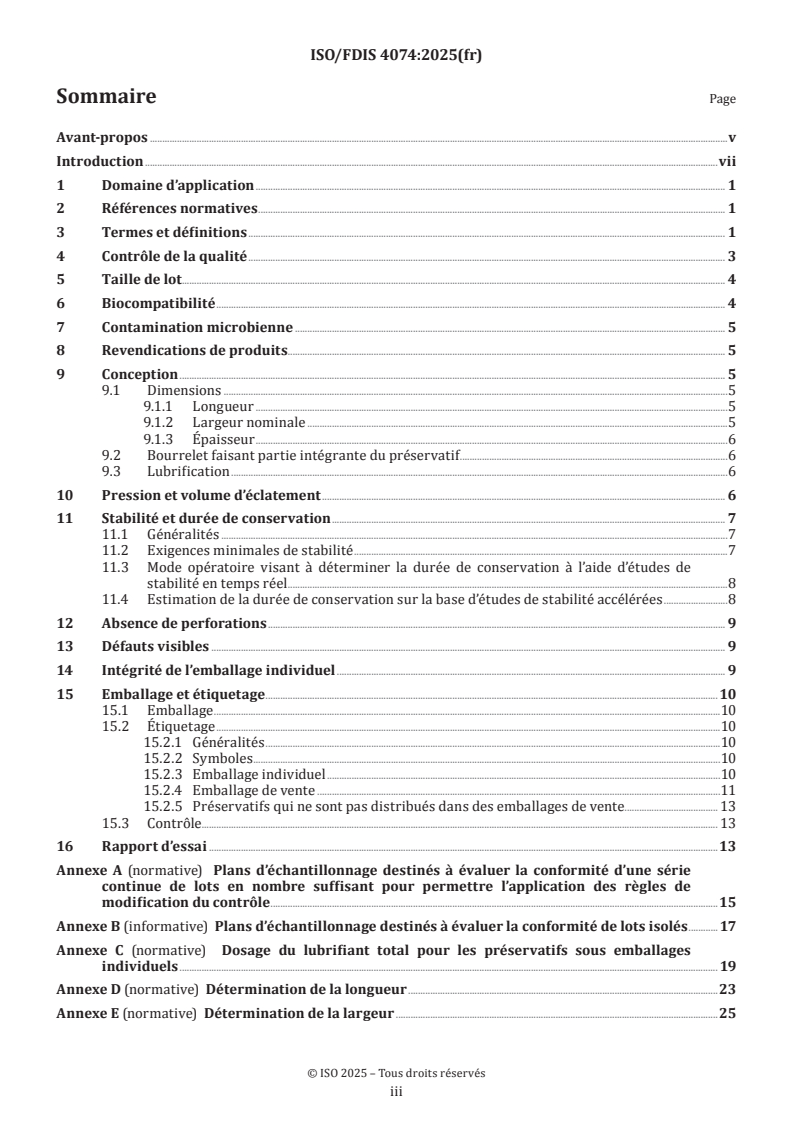
Sommaire Page
Avant-propos .v
Introduction .vii
1 Domaine d’application . 1
2 Références normatives . 1
3 Termes et définitions . 1
4 Contrôle de la qualité . 3
5 Taille de lot . 4
6 Biocompatibilité . 4
7 Contamination microbienne . 5
8 Revendications de produits. 5
9 Conception . 5
9.1 Dimensions .5
9.1.1 Longueur .5
9.1.2 Largeur nominale .5
9.1.3 Épaisseur .6
9.2 Bourrelet faisant partie intégrante du préservatif .6
9.3 Lubrification .6
10 Pression et volume d’éclatement . 6
11 Stabilité et durée de conservation . 7
11.1 Généralités .7
11.2 Exigences minimales de stabilité .7
11.3 Mode opératoire visant à déterminer la durée de conservation à l’aide d’études de
stabilité en temps réel .8
11.4 Estimation de la durée de conservation sur la base d’études de stabilité accélérées .8
12 Absence de perforations . 9
13 Défauts visibles . 9
14 Intégrité de l’emballage individuel . 9
15 Emballage et étiquetage . 10
15.1 Emballage .10
15.2 Étiquetage .10
15.2.1 Généralités .10
15.2.2 Symboles .10
15.2.3 Emballage individuel .10
15.2.4 Emballage de vente .11
15.2.5 Préservatifs qui ne sont pas distribués dans des emballages de vente . 13
15.3 Contrôle . . 13
16 Rapport d’essai .13
Annexe A (normative) Plans d’échantillonnage destinés à évaluer la conformité d’une série
continue de lots en nombre suffisant pour permettre l’application des règles de
modification du contrôle .15
Annexe B (informative) Plans d’échantillonnage destinés à évaluer la conformité de lots isolés . 17
Annexe C (normative) Dosage du lubrifiant total pour les préservatifs sous emballages
individuels . 19
Annexe D (normative) Détermination de la longueur .23
Annexe E (normative) Détermination de la largeur .25
iii
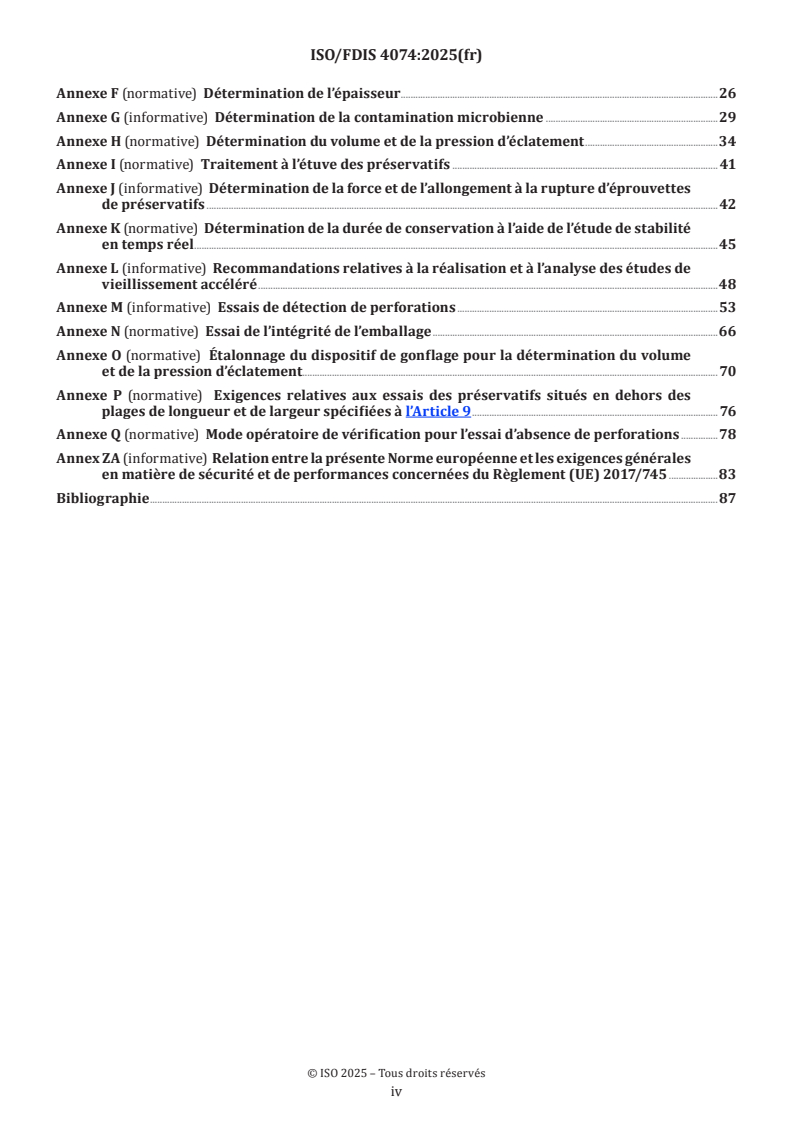
Annexe F (normative) Détermination de l’épaisseur .26
Annexe G (informative) Détermination de la contamination microbienne .29
Annexe H (normative) Détermination du volume et de la pression d’éclatement .34
Annexe I (normative) Traitement à l’étuve des préservatifs . 41
Annexe J (informative) Détermination de la force et de l’allongement à la rupture d’éprouvettes
de préservatifs .42
Annexe K (normative) Détermination de la durée de conservation à l’aide de l’étude de stabilité
en temps réel .45
Annexe L (informative) Recommandations relatives à la réalisation et à l’analyse des études de
vieillissement accéléré .48
Annexe M (informative) Essais de détection de perforations .53
Annexe N (normative) Essai de l’intégrité de l’emballage .66
Annexe O (normative) Étalonnage du dispositif de gonflage pour la détermination du volume
et de la pression d’éclatement .70
Annexe P (normative) Exigences relatives aux essais des préservatifs situés en dehors des
plages de longueur et de largeur spécifiées à l’Article 9 . 76
Annexe Q (normative) Mode opératoire de vérification pour l’essai d’absence de perforations .78
Annex ZA (informative) Relation entre la présente Norme européenne et les exigences générales
en matière de sécurité et de performances concernées du Règlement (UE) 2017/745 .83
Bibliographie .87
iv
Avant-propos
L’ISO (Organisation internationale de normalisation) est une fédération mondiale d’organismes nationaux
de normalisation (comités membres de l’ISO). L’élaboration des Normes internationales est en général
confiée aux comités techniques de l’ISO. Chaque comité membre intéressé par une étude a le droit de faire
partie du comité technique créé à cet effet. Les organisations internationales, gouvernementales et non
gouvernementales, en liaison avec l’ISO participent également aux travaux. L’ISO collabore étroitement avec
la Commission électrotechnique internationale (IEC) en ce qui concerne la normalisation électrotechnique.
Les procédures utilisées pour élaborer le présent document et celles destinées à sa mise à jour sont
décrites dans les Directives ISO/IEC, Partie 1. Il convient, en particulier, de prendre note des différents
critères d’approbation requis pour les différents types de documents ISO. Le présent document
a été rédigé conformément aux règles de rédaction données dans les Directives ISO/IEC, Partie 2
(voir www.iso.org/directives).
L’ISO attire l’attention sur le fait que la mise en application du présent document peut entraîner l’utilisation
d’un ou de plusieurs brevets. L’ISO ne prend pas position quant à la preuve, à la validité et à l’applicabilité de
tout droit de brevet revendiqué à cet égard. À la date de publication du présent document, l’ISO n’avait pas
reçu notification qu’un ou plusieurs brevets pouvaient être nécessaires à sa mise en application. Toutefois,
il y a lieu d’avertir les responsables de la mise en application du présent document que des informations
plus récentes sont susceptibles de figurer dans la base de données de brevets, disponible à l’adresse
www.iso.org/brevets. L’ISO ne saurait être tenue pour responsable de ne pas avoir identifié de tels droits de
propriété.
Les appellations commerciales éventuellement mentionnées dans le présent document sont données pour
information, par souci de commodité, à l’intention des utilisateurs et ne sauraient constituer un engagement.
Pour une explication de la nature volontaire des normes, la signification des termes et expressions
spécifiques de l’ISO liés à l’évaluation de la conformité, ou pour toute information au sujet de l’adhésion de
l’ISO aux principes de l’Organisation mondiale du commerce (OMC) concernant les obstacles techniques au
commerce (OTC), voir www.iso.org/avant-propos.
Le présent document a été élaboré par le comité ISO/TC 157, Contraceptifs non systémiques et barrière
prophylactique contre les IST, en collaboration avec le comité technique CEN/TC 205, Dispositifs médicaux non
actifs, du Comité européen de normalisation (CEN), conformément à l’Accord de coopération technique entre
l’ISO et le CEN (Accord de Vienne).
Cette quatrième édition annule et remplace la troisième édition (ISO 4074:2015), qui a fait l’objet d’une
révision technique.
Les principales modifications sont les suivantes:
— le présent document couvre toutes les tailles de préservatifs, y compris ceux dont les dimensions sont
spécifiées à l’Annexe P, désormais normative;
— l’essai électrique d’absence de perforations à l’Annexe M a été modifié pour améliorer la probabilité de
découvrir de petites perforations dans le réservoir et l’extrémité fermée du préservatif;
— une nouvelle Annexe Q a été ajoutée pour spécifier que les exigences et modes opératoires pour la
validation des modes opératoires d’essai nouveaux ou modifiés et permettant de s’assurer que les
méthodes d’essai d’absence de perforations satisfont aux exigences de performances spécifiées. En
conséquence, l’Annexe M est devenue informative;
— des améliorations ont été apportées au mode opératoire d’essai de gonflage spécifié à l’Annexe H;
— les modes opératoires de manipulation des préservatifs décrits dans l’ISO/TR 19969:2018 ont été
intégrés à l’Annexe H, essai des propriétés d’éclatement, et à l’Annexe M, essai d’absence de perforations;
— une mention a été ajoutée à l’Annexe A concernant les tailles d’échantillons utilisées pour le contrôle
réduit;
v
— l’utilisation d’alcool isopropylique de qualité technique est permise pour éliminer le lubrifiant des
préservatifs lors de la détermination de la quantité de lubrifiant conformément à l’Annexe C;
— l’Annexe G indique clairement qu’un Stomacher® est un type spécifique d’homogénéiseur pouvant être
utilisé avec d’autres types d’homogénéiseurs lors de la préparation des échantillons en vue des essais
microbiologiques des préservatifs. Certains amendements ont été apportés aux modes opératoires
d’essai en fonction des meilleures pratiques actuelles;
— une méthode alternative de vide sec pour l’essai de l’intégrité des emballages individuels de préservatifs
a été ajoutée à l’Annexe N;
— l’Annexe K a été mise à jour pour fournir des informations plus claires et détaillées relatives à la réalisation
d’essais de stabilité en temps réel;
— l’Annexe L a été mise à jour pour inclure un essai de stabilité accéléré plus rapide afin d’évaluer l’effet
des changements de traitement et de formulation sur la stabilité d’un produit et de fournir un essai de
contrainte pour les préservatifs pouvant être stockés dans des environnements soumis à une température
élevée;
— l’Annexe O est désormais normative et a été amendée pour inclure une nouvelle section visant à vérifier
que les techniciens peuvent dérouler les préservatifs correctement lors de la réalisation de l’essai
d’éclatement.
Il convient que l’utilisateur adresse tout retour d’information ou toute question concernant le présent
document à l’organisme national de normalisation de son pays. Une liste exhaustive desdits organismes se
trouve à l’adresse www.iso.org/fr/members.html.
vi
Introduction
Il a été démontré que les préservatifs réalisés en film de latex intact offrent une barrière au virus de
l’immunodéficience humaine (VIH), à d’autres agents infectieux responsables de la transmission de maladies
sexuellement transmissibles (MST) et aux spermatozoïdes. Un grand nombre d’études cliniques a confirmé
que les préservatifs externes en latex sont efficaces pour aider la prévention de la grossesse et réduisent le
risque de transmission de la plupart des MST, y compris le VIH.
Pour que les préservatifs puissent être efficaces dans un dessein contraceptif et pour contribuer à la
prévention de la transmission des MST, il est essentiel qu’ils s’adaptent convenablement sur le pénis,
qu’ils soient exempts de perforations et qu’ils présentent une résistance physique adéquate afin de ne pas
se déchirer en cours d’utilisation, qu’ils soient correctement emballés de façon à être protégés pendant le
stockage et convenablement étiquetés pour faciliter leur utilisation. Tous ces aspects sont traités par le
présent document.
Les préservatifs sont des dispositifs médicaux. Afin de garantir un produit de haute qualité, il est essentiel
que les préservatifs soient fabriqués dans le cadre d’un système de management de la qualité approprié.
[7]
Voir l’ISO 13485 relative aux exigences de management de la qualité et l’ISO 14971 relative aux exigences
de gestion des risques.
Les préservatifs sont des dispositifs médicaux non stériles, mais il est conseillé aux fabricants de prendre
les précautions appropriées pour réduire le plus possible la contamination microbiologique du produit tout
au long des processus de fabrication et de conditionnement. Des recommandations invitant les fabricants
à surveiller périodiquement la contamination microbienne en cours de fabrication sont incluses dans le
présent document. Des méthodes pouvant être utilisées pour déterminer les niveaux de biocontamination
sont incluses à l’Annexe G.
Le présent document exige des fabricants d’effectuer des essais de stabilité afin d’estimer la durée de
conservation de tout nouveau préservatif avant que le produit soit commercialisé et de commencer des
études de stabilité en temps réel. Les fabricants sont également tenus de tenir compte de la stabilité de toute
conception modifiée de préservatif. Ces exigences sont décrites à l’Article 11. L’essai de stabilité en temps
réel peut être considéré comme faisant partie des exigences s’appliquant aux fabricants selon lesquelles
ceux-ci doivent assurer une surveillance de leurs produits après leur mise sur le marché. Ces exigences ont
pour objectif de garantir que les fabricants possèdent les données adéquates justifiant les revendications
de durée de conservation avant la mise sur le marché des produits et que ces données sont disponibles
pour consultation par les autorités réglementaires, les laboratoires d’essais tiers et les acheteurs. Elles ont
également pour but de limiter la nécessité pour un tiers d’effectuer des études de stabilité à long terme.
Les préservatifs peuvent être soumis à des exigences locales spécifiques imposées par des organismes
réglementaires nationaux, s’ajoutant à celles qui sont spécifiées dans le présent document.
[8]
L’ISO 16038 fournit des recommandations pour l’application du présent document. Elle contient des
informations supplémentaires relatives aux méthodes d’essai et aux exigences définies dans le présent
document.
Les images et les diagrammes contenus dans le présent document visent à améliorer la clarté et à indiquer
une préférence pour tout type d’équipement ou toute conception spécifique.
Aucune exigence relative à la détermination des propriétés de traction des préservatifs n’est spécifiée dans
le présent document. Toutefois, des essais de traction sont parfois utilisés à des fins de développement et de
contrôle qualité. L’Annexe J inclut des recommandations sur la façon de déterminer la force et l’allongement
à la rupture des préservatifs.
Il convient de tenir compte de la nécessité d’une période de transition pour la mise en œuvre des exigences
du présent document, afin de permettre aux fabricants d’effectuer les modifications nécessaires au maintien
de la conformité.
vii
PROJET FINAL Norme internationale ISO/FDIS 4074:2025(fr)
Préservatifs externes en latex de caoutchouc naturel —
Exigences et méthodes d'essai
1 Domaine d’application
Le présent document spécifie les exigences et les méthodes d’essai à utiliser pour les préservatifs externes
réalisés en latex de caoutchouc naturel.
Le présent document ne spécifie pas les exigences liées à toute substance médicinale appliquée sur le
préservatif ou délivrée avec ce dernier.
NOTE La sécurité et l’efficacité de toute substance médicinale sont évaluées conformément aux réglementations
régionales et nationales.
2 Références normatives
Les documents suivants sont cités dans le texte de sorte qu’ils constituent, pour tout ou partie de leur
contenu, des exigences du présent document. Pour les références datées, seule l’édition citée s’applique. Pour
les références non datées, la dernière édition du document de référence s’applique (y compris les éventuels
amendements).
ISO 2859-1, Règles d’échantillonnage pour les contrôles par attributs — Partie 1: Procédures d’échantillonnage
pour les contrôles lot par lot, indexés d’après le niveau de qualité acceptable (NQA)
ISO 10993-1, Évaluation biologique des dispositifs médicaux — Partie 1: Exigences et principes généraux pour
l’évaluation de la sécurité biologique au sein d’un processus de gestion des risques
ISO 14971, Dispositifs médicaux — Application de la gestion des risques aux dispositifs médicaux
ISO 15223-1, Dispositifs médicaux — Symboles à utiliser avec les informations à fournir par le fabricant —
Partie 1: Exigences générales
ISO/IEC 17025, Exigences générales concernant la compétence des laboratoires d'étalonnages et d'essais
3 Termes et définitions
Pour les besoins du présent document, les termes et les définitions de l’ISO 2859-1 ainsi que les suivants
s’appliquent.
L’ISO et l’IEC tiennent à jour des bases de données terminologiques destinées à être utilisées en normalisation,
consultables aux adresses suivantes:
— ISO Online browsing platform: disponible à l’adresse https:// www .iso .org/ obp
— IEC Electropedia: disponible à l’adresse https:// www .electropedia .org/
3.1
niveau de qualité acceptable
NQA
sur une série continue de lots (3.11), niveau de qualité qui, pour le contrôle par échantillonnage, constitue la
limite pour une moyenne de processus satisfaisante
[SOURCE: ISO 2859-1:1999, 3.1.26]
3.2
préservatif externe
dispositif médical utilisé par les consommateurs, destiné à recouvrir le pénis et à y rester pendant l’activité
sexuelle à des fins de contraception et de prévention des maladies sexuellement transmissibles
3.3
conception modifiée de préservatif
conception de préservatif établie dont la formulation, le processus de fabrication, le site de fabrication,
la lubrification ou l’emballage scellé individuel a fait l’objet de modifications
3.4
emballage de vente
boîte, sac ou emballage destiné à la distribution aux consommateurs, contenant un ou plusieurs emballages
individuels de préservatifs
3.5
date d’expiration
date après laquelle il convient de ne pas utiliser le préservatif
3.6
numéro d’identification
nombre ou combinaison de chiffres, de symboles ou de lettres utilisés par un fabricant sur les emballages de
vente (3.4), pour identifier sans équivoque les numéros de lots (3.12) des préservatifs individuels contenus
dans cet emballage, et à partir desquels il est possible d’assurer la traçabilité de ces lots (3.11) pendant toutes
les étapes de fabrication, de conditionnement et de distribution
Note 1 à l'article: Lorsque l’emballage de vente contient un seul type de préservatif, le numéro d’identification peut
alors être identique au numéro de lot, toutefois, si l’emballage de vente contient plusieurs types de préservatifs
différents, par exemple des préservatifs de formes ou de couleurs différentes, le numéro d’identification sera différent
des numéros de lot.
3.7
emballage individuel
emballage primaire contenant un préservatif individuel
3.8
niveau de contrôle
indice de la proportion de contrôle d’un programme d’échantillonnage pour acceptation, choisi par avance et
reliant l’effectif d’échantillon à celui du lot
[SOURCE: ISO 3534-2:2006, 4.3.5]
3.9
longueur de gonflage
longueur à atteindre par gonflage par le préservatif lors de l’essai d’éclatement
3.10
bourrelet faisant partie intégrante du préservatif
anneau formé à l’extrémité ouverte du préservatif, constitué en général d’une partie du film en latex
partiellement séché et vulcanisé, permettant de faciliter le déroulage et la manipulation du préservatif
3.11
lot
un certain nombre de préservatifs, de modèle, couleur, forme, taille et formulation identiques, fabriqués à
peu près au même moment, en utilisant le même procédé, des matières premières présentant les mêmes
caractéristiques, le même équipement, et emballés avec le même lubrifiant et tout autre additif ou poudre,
dans le même type d’emballage individuel
3.12
numéro de lot
nombre ou combinaison de chiffres, de symboles ou de lettres, utilisés par le fabricant pour identifier un lot
(3.11) de préservatifs emballés individuellement et à partir desquels il est possible de tracer ce lot pendant
toutes les étapes de fabrication jusqu’au conditionnement
3.13
perforation non visible
perforation ou déchirement du préservatif qui n’est pas visible à l’œil nu ou avec une vue corrigée, mais qui
est détecté par l’essai à l’eau ou l’essai électrique
3.14
plan d’échantillonnage
plan spécifique indiquant le nombre d’unités de produit de chaque lot (3.11) à contrôler (taille d’échantillon
ou série de taille d’échantillons) et les critères associés pour déterminer l’acceptabilité du lot (nombre de lots
acceptés et rejetés)
3.15
durée de conservation
période à compter de la date de fabrication, pendant laquelle il est exigé que les préservatifs satisfassent
aux exigences de pression d’éclatement, de volume d’éclatement, d’absence de perforations et d’intégrité de
l’emballage
3.16
perforation visible
perforation ou déchirement du préservatif qui est visible à l’œil nu ou avec une vue corrigée avant de remplir
le préservatif d’eau ou d’électrolyte pour effectuer l’essai d’absence de perforations
3.17
date de fabrication
date, spécifiée par le fabricant, à laquelle le produit a été fabriqué
Note 1 à l'article: Voir 11.1.
3.18
défaut visible
bourrelet cassé, manquant, ou présentant une déformation importante et des plis permanents avec
adhérence du film
Note 1 à l'article: Cela se rapporte à des défauts visibles autres que des perforations.
4 Contrôle de la qualité
Les préservatifs sont des dispositifs médicaux réglementés dans la plupart des pays et il convient qu’ils
soient fabriqués et soumis à essai en utilisant un système de management de la qualité (SMQ) approprié. Un
[7]
SMQ adapté à la fabrication de dispositifs médicaux est décrit dans l’ISO 13485 .
Les préservatifs sont des articles produits en série. Il existe inévitablement des variations d’un préservatif
à l’autre, et il est possible qu’un petit nombre de préservatifs dans chaque série de production ne satisfasse
pas aux exigences du présent document. De plus, la plupart des méthodes d’essai décrites dans le présent
document sont destructives. C’est pourquoi la seule méthode pratique permettant d’évaluer la conformité
avec le présent document est de soumettre à essai un échantillon représentatif d’un lot ou d’une série de
lots. Les plans d’échantillonnage de base sont indiqués dans l’ISO 2859-1. Il convient de se référer à la série
[2]
ISO/TR 8550 pour obtenir des recommandations relatives à l’utilisation d’un système, d’un programme ou
d’un plan d’échantillonnage afin de contrôler les articles distincts dans des lots. Pour les besoins de l’essai,
l’échantillonnage doit être effectué par numéro de lot et non pas par numéro d’identification.
Des plans d’échantillonnage doivent être sélectionnés de sorte à fournir un niveau acceptable de protection
du consommateur. Des plans d’échantillonnage appropriés sont donnés aux Annexes A et B.
a) L’Annexe A décrit des plans d’échantillonnage fondés sur l’ISO 2859-1 et s’applique principalement
aux fabricants ou aux acheteurs évaluant la conformité d’une série de lots continue. Le niveau total
de protection du consommateur disponible dépend de la mise en œuvre d’un contrôle renforcé en
cas de dégradation de la qualité détectée. Les règles de cette modification du contrôle, décrite dans
l’ISO 2859-1:1999, Article 9, ne peuvent garantir une protection complète aux deux premiers lots soumis
à l’essai, mais elles gagnent progressivement en efficacité à mesure que le nombre de lots d’une série
augmente. Les plans d’échantillonnage de l’Annexe A doivent être utilisés lorsqu’une série continue de
cinq lots ou plus sont soumis à essai.
b) Lorsque des essais portent sur des lots isolés ou sur moins de 5 lots, le niveau de protection du
consommateur est réduit, car les règles de modification du contrôle ne peuvent pas être appliquées.
Si, dans de tels cas, il est nécessaire de maintenir des niveaux élevés de protection du consommateur,
les plans d’échantillonnage de l’Annexe B sont recommandés. Les plans d’échantillonnage de l’Annexe B
fournissent à peu près le même niveau de protection du consommateur que ceux indiqués dans
l’Annexe A, dès lors qu’ils sont utilisés avec les règles de modification du contrôle. Les exemples de cas
où il convient d’utiliser les plans d’échantillonnage de l’Annexe B incluent les cas de litige, les cas à des
fins d’arbitrage, les essais de type, les cas à des fins de qualification ou les cas de petites séries de lots
continus.
Il est nécessaire de connaître la taille du lot afin de déterminer, à partir de l’ISO 2859-1, le nombre de
préservatifs à soumettre à essai. La taille du lot varie selon les fabricants et elle est considérée comme
faisant partie du processus et des contrôles qualité utilisés par le fabricant.
Si la taille du lot n’est pas connue ou qu’elle ne peut pas être confirmée par le fabricant, il faut alors présumer
une taille de lots de 500 000 préservatifs pour déterminer les tailles d’échantillons soumis à essai.
5 Taille de lot
La taille maximale d’un lot individuel pour la production doit être de 500 000 préservatifs.
Le présent document ne spécifie pas la taille du lot, mais il est possible pour un acheteur de le faire dans
le cadre d’un contrat d’achat. Les acheteurs sont encouragés à spécifier une taille de lot compatible avec le
système de management de la qualité du fabricant.
6 Biocompatibilité
Des évaluations de biocompatibilité doivent être réalisées sur tout nouveau produit conformément à
l’ISO 10993-1. Lorsque des essais sont nécessaires, il est préférable de réaliser des essais in vitro si possible.
Il convient que les essais in vivo (sur animaux) soient réduits au minimum. Dans le cas d’une conception de
préservatif modifiée, les fabricants doivent réaliser une évaluation des risques conformément à l’ISO 14971
afin de déterminer s’il est nécessaire de répéter l’évaluation de biocompatibilité.
NOTE 1 Les autorités réglementaires exigent généralement d’effectuer des évaluations de la cytotoxicité
conformément à l’ISO 10993-5, de l’irritation conformément à l’ISO 10993-23 et de la sensibilisation conformément à
l’ISO 10993-10. Certaines autorités peuvent exiger des évaluations supplémentaires.
Le préservatif doit faire l’objet d’une évaluation, ainsi que tout lubrifiant, additif, matériau ou poudre qui lui
est appliqué.
Le laboratoire effectuant l’un de ces essais de biocompatibilité doit respecter les exigences de l’ISO/IEC 17025.
Les résultats doivent être interprétés par un toxicologue qualifié ou autre expert qualifié de manière
appropriée. Le rapport d’évaluation biologique doit justifier que le produit est sûr pour l’utilisation prévue.
NOTE 2 Un grand nombre de produits en latex dont la sûreté a été établie, y compris les préservatifs et les gants
médicaux, peuvent présenter une réponse cytotoxique positive lorsqu’ils font l’objet d’un essai selon l’ISO 10993-5.
Bien que tout effet cytotoxique puisse être inquiétant, il constitue principalement une indication potentielle de toxicité
in vivo. Un préservatif ne peut pas obligatoirement être déclaré inutilisable en se fondant uniquement sur des données
de cytotoxicité.
7 Contamination microbienne
Il est recommandé aux fabricants de déterminer des modes opératoires de contrôle et de surveillance
périodique de la contamination microbienne (biocontamination) au sein de leur système de management de
la qualité. Staphylococcus aureus, Pseudomonas aeruginosa et Enterobacteriaceae, y compris Escherichia coli,
sont des organismes pathogènes pouvant être potentiellement trouvés sur des préservatifs et provoquer
des infections urinaires ou autres. Il est recommandé que ces organismes soient absents des préservatifs.
Il convient que les modes opératoires incluent des exigences relatives à l’absence d’agents pathogènes
spécifiques et des valeurs limites pour le dénombrement total des germes viables sur des préservatifs finis.
Des méthodes de détermination des niveaux de biocontamination sur les préservatifs sont mentionnées à
l’Annexe G.
NOTE Les méthodes générales de détermination de la contamination microbienne sur les dispositifs médicaux
[6]
stériles sont données dans l’ISO 11737-1 . Elle contient des méthodes d’essais de validation (ISO 11737-1).
Les méthodes décrites à l’Annexe G se sont révélées appropriées pour une utilisation avec des préservatifs en
tenant compte des problèmes spécifiques associés à l’essai de ces produits. Ces problèmes comprennent l’activité
antimicrobienne résiduelle de certains des composés utilisés dans les formulations de latex, pouvant interférer avec
les analyses.
Afin de contrôler la contamination microbienne du produit fini, il est recommandé que les fabricants
contrôlent l’environnement de fabrication pour diminuer le risque de contamination du produit, mettent
en place des modes opératoires généraux de nettoyage et de désinfection tout au long de l’opération et
surveillent les niveaux de biocontamination sur les matières premières et sur le matériel.
8 Revendications de produits
Les préservatifs satisfaisant aux exigences du présent document peuvent être utilisés dans un dessein
contraceptif et pour faciliter la protection contre les maladies sexuellement transmissibles. Les fabricants
doivent justifier toutes revendications supplémentaires au sujet de leurs produits. Si un fabricant
revendique une amélioration de l’efficacité ou de la sûreté, cette revendication doit alors être validée par
une étude clinique appropriée visant à démontrer cette supériorité. Les informations venant à l’appui de ces
revendications doivent être mises à disposition des parties intéressées sur demande.
9 Conception
9.1 Dimensions
9.1.1 Longueur
La longueur du préservatif doit être déterminée conformément à la méthode donnée à l’Annexe D en utilisant
un échantillon de 13 préservatifs de chaque lot. Aucune mesure individuelle ne doit être inférieure à 160 mm,
à l’exception des préservatifs dont les dimensions sont spécifiées à l’Annexe P. Dans le cas de préservatifs de
moins de 160 mm, la longueur doit respecter la longueur nominale spécifiée par le fabricant à ±5 mm.
9.1.2 Largeur nominale
La largeur du préservatif doit être déterminée conformément à la méthode donnée à l’Annexe E en utilisant
un échantillon de 13 préservatifs. Les mesurages doivent être effectués au niveau de la partie la plus
étroite du préservatif, dans une plage comprise entre 20 mm et 50 mm par rapport à l’extrémité ouverte.
Aucun mesurage de la largeur ne doit s’écarter de plus de ±2 mm de la largeur nominale indiquée par le
fabricant.
9.1.3 Épaisseur
Le présent document ne spécifie pas de limites pour l’épaisseur du préservatif. Si une vérification de
l’épaisseur d’une conception de préservatif est exigée, l’épaisseur moyenne des échantillons, mesurée selon
l’une des méthodes données à l’Annexe F, doit être égale à l’épaisseur nominale déclarée, avec une tolérance
de:
— ±0,008 mm pour les préservatifs revendiquant une épaisseur nominale inférieure à 0,05 mm;
— ±0,01 mm pour les préservatifs revendiquant une épaisseur nominale supérieure ou égale à 0,05 mm.
La méthode à utiliser pour la vérification doit être spécifiée par le fabricant.
9.2 Bourrelet faisant partie intégrante du préservatif
L’extrémité ouverte du préservatif doit se terminer par un bourrelet faisant partie intégrante du préservatif.
9.3 Lubrification
Le présent document ne spécifie pas d’exigences relatives à la quantité et au type de lubrifiant. Si une
vérification de la quantité de lubrifiant sur un préservatif (et dans l’emballage) est exigée, l’une ou l’autre des
méthodes indiquées à l’Annexe C doit être utilisée.
Les méthodes de l’Annexe C couvrent également une partie de la poudre présente sur le préservatif. Il
convient d’en tenir compte lorsque les fabricants ou les acheteurs spécifient des niveaux de lubrification.
10 Pression et volume d’éclatement
Les propriétés d’éclatement des préservatifs doivent être déterminées conformément à la méthode spécifiée
à l’Annexe H. Dans le cas de préservatifs dont la longueur est supérieure ou égale à 160 mm, une longueur
de gonflage de (150 ± 3) mm doit être utilisée. Le Tableau 1 spécifie les pressions et volumes minimaux
d’éclatement:
Tableau 1 — Pression et volume minimaux d’éclatement pour des préservatifs d’une
longueur ≥ 160 mm
Largeur du préservatif Pression minimale d’éclate- Volume minimal d’éclatement
ment
mm dm
kPa
45,0 à 49,5 1,0 16,0
50,0 à 55,5 1,0 18,0
56,0 à 64,5 1,0 22,0
65,0 à 75,0 0,8 28,0
Pour les besoins de cet essai, la largeur à mi-longueur doit être la largeur moyenne, arrondie à 0,5 mm
près, de 13 préservatifs, mesurée conformément à l’Annexe E en un point situé à la moitié de la longueur
de gonflage, ±5 mm, à partir de l’extrémité fermée, réservoir exclu. Par exemple, les préservatifs de plus
de 160 mm ont une longueur de gonflage de 150 mm et une largeur à mi-longueur mesurée à 75 ± 5 mm de
l’extrémité fermée, réservoir exclu.
Dans le cas de préservatifs de moins de 160 mm, les longueurs de gonflage et les propriétés minimales
d’éclatement sont spécifiées à l’Annexe P.
Le niveau de conformité de chaque lot doit correspondre à un NQA de 1,5 pour les préservatifs ne satisfaisant
pas à l’exigence de volume d’éclatement et/ou de pression d’éclatement.
11 Stabilité et durée de conservation
11.1 Généralités
Les fabricants doivent vérifier que les préservatifs satisfont aux exigences des Articles 10, 12 et 14 jusqu’à la
fin de la durée de conservation indiquée sur l’étiquetage. Les produits commercialisés avant la publication de
l’ISO 4074:2015 (2015-10-15) doivent être réputés conformes aux revendications de durée de conservation
du présent document, à moins que le produit ne soit une conception modifiée. Les déclarations de durée de
conservation ne doivent pas
...
Questions, Comments and Discussion
Ask us and Technical Secretary will try to provide an answer. You can facilitate discussion about the standard in here.
Loading comments...