


ISO 10303-1:2021
(Main)Industrial automation systems and integration — Product data representation and exchange — Part 1: Overview and fundamental principles
Industrial automation systems and integration — Product data representation and exchange — Part 1: Overview and fundamental principles
This document provides an overview of ISO 10303. ISO 10303 provides a representation of product information along with the necessary mechanisms and definitions to enable product data to be exchanged. The exchange is among different computer systems and environments associated with the complete product lifecycle, including product design, manufacture, use, maintenance, and final disposition of the product. This document defines the basic principles of product information representation and exchange used in ISO 10303. It specifies the characteristics of the various series of parts of ISO 10303 and the relationships among them. The following are within the scope of this document: — scope statement for ISO 10303 as a whole; — overview of ISO 10303; — architectures of ISO 10303; — structure of ISO 10303; — terms and definitions used throughout ISO 10303; — overview of data specification methods used in ISO 10303; NOTE This includes the EXPRESS data specification language and graphical presentation of product information models. — introduction to the series of parts of ISO 10303: — integrated resources; — application interpreted constructs; — application modules; — business object models; — application protocols; — implementation methods; — usage guides; — conformance testing methodology and framework; — abstract test suites; — scheme for identification of schemas and other information objects defined within parts of ISO 10303.
Systèmes d'automatisation industrielle et intégration — Représentation et échange de données de produits — Partie 1: Aperçu et principes fondamentaux
General Information
- Status
- Withdrawn
- Publication Date
- 15-Mar-2021
- Technical Committee
- ISO/TC 184/SC 4 - Industrial data
- Drafting Committee
- ISO/TC 184/SC 4/WG 12 - STEP product modelling and resources
- Current Stage
- 9599 - Withdrawal of International Standard
- Start Date
- 17-Jan-2024
- Completion Date
- 12-Feb-2026
Relations
- Effective Date
- 06-Jun-2022
- Effective Date
- 27-Aug-2016

Get Certified
Connect with accredited certification bodies for this standard

National Aerospace and Defense Contractors Accreditation Program (NADCAP)
Global cooperative program for special process quality in aerospace.
CARES (UK Certification Authority for Reinforcing Steels)
UK certification for reinforcing steels and construction.
DVS-ZERT GmbH
German welding certification society.
Sponsored listings
Frequently Asked Questions
ISO 10303-1:2021 is a standard published by the International Organization for Standardization (ISO). Its full title is "Industrial automation systems and integration — Product data representation and exchange — Part 1: Overview and fundamental principles". This standard covers: This document provides an overview of ISO 10303. ISO 10303 provides a representation of product information along with the necessary mechanisms and definitions to enable product data to be exchanged. The exchange is among different computer systems and environments associated with the complete product lifecycle, including product design, manufacture, use, maintenance, and final disposition of the product. This document defines the basic principles of product information representation and exchange used in ISO 10303. It specifies the characteristics of the various series of parts of ISO 10303 and the relationships among them. The following are within the scope of this document: — scope statement for ISO 10303 as a whole; — overview of ISO 10303; — architectures of ISO 10303; — structure of ISO 10303; — terms and definitions used throughout ISO 10303; — overview of data specification methods used in ISO 10303; NOTE This includes the EXPRESS data specification language and graphical presentation of product information models. — introduction to the series of parts of ISO 10303: — integrated resources; — application interpreted constructs; — application modules; — business object models; — application protocols; — implementation methods; — usage guides; — conformance testing methodology and framework; — abstract test suites; — scheme for identification of schemas and other information objects defined within parts of ISO 10303.
This document provides an overview of ISO 10303. ISO 10303 provides a representation of product information along with the necessary mechanisms and definitions to enable product data to be exchanged. The exchange is among different computer systems and environments associated with the complete product lifecycle, including product design, manufacture, use, maintenance, and final disposition of the product. This document defines the basic principles of product information representation and exchange used in ISO 10303. It specifies the characteristics of the various series of parts of ISO 10303 and the relationships among them. The following are within the scope of this document: — scope statement for ISO 10303 as a whole; — overview of ISO 10303; — architectures of ISO 10303; — structure of ISO 10303; — terms and definitions used throughout ISO 10303; — overview of data specification methods used in ISO 10303; NOTE This includes the EXPRESS data specification language and graphical presentation of product information models. — introduction to the series of parts of ISO 10303: — integrated resources; — application interpreted constructs; — application modules; — business object models; — application protocols; — implementation methods; — usage guides; — conformance testing methodology and framework; — abstract test suites; — scheme for identification of schemas and other information objects defined within parts of ISO 10303.
ISO 10303-1:2021 is classified under the following ICS (International Classification for Standards) categories: 25.040.40 - Industrial process measurement and control. The ICS classification helps identify the subject area and facilitates finding related standards.
ISO 10303-1:2021 has the following relationships with other standards: It is inter standard links to ISO 10303-1:2024, ISO 10303-1:1994. Understanding these relationships helps ensure you are using the most current and applicable version of the standard.
ISO 10303-1:2021 is available in PDF format for immediate download after purchase. The document can be added to your cart and obtained through the secure checkout process. Digital delivery ensures instant access to the complete standard document.
Standards Content (Sample)
INTERNATIONAL ISO
STANDARD 10303-1
Second edition
2021-03
Industrial automation systems
and integration — Product data
representation and exchange —
Part 1:
Overview and fundamental principles
Systèmes d'automatisation industrielle et intégration —
Représentation et échange de données de produits —
Partie 1: Aperçu et principes fondamentaux
Reference number
©
ISO 2021
© ISO 2021
All rights reserved. Unless otherwise specified, or required in the context of its implementation, no part of this publication may
be reproduced or utilized otherwise in any form or by any means, electronic or mechanical, including photocopying, or posting
on the internet or an intranet, without prior written permission. Permission can be requested from either ISO at the address
below or ISO’s member body in the country of the requester.
ISO copyright office
CP 401 • Ch. de Blandonnet 8
CH-1214 Vernier, Geneva
Phone: +41 22 749 01 11
Email: copyright@iso.org
Website: www.iso.org
Published in Switzerland
ii © ISO 2021 – All rights reserved
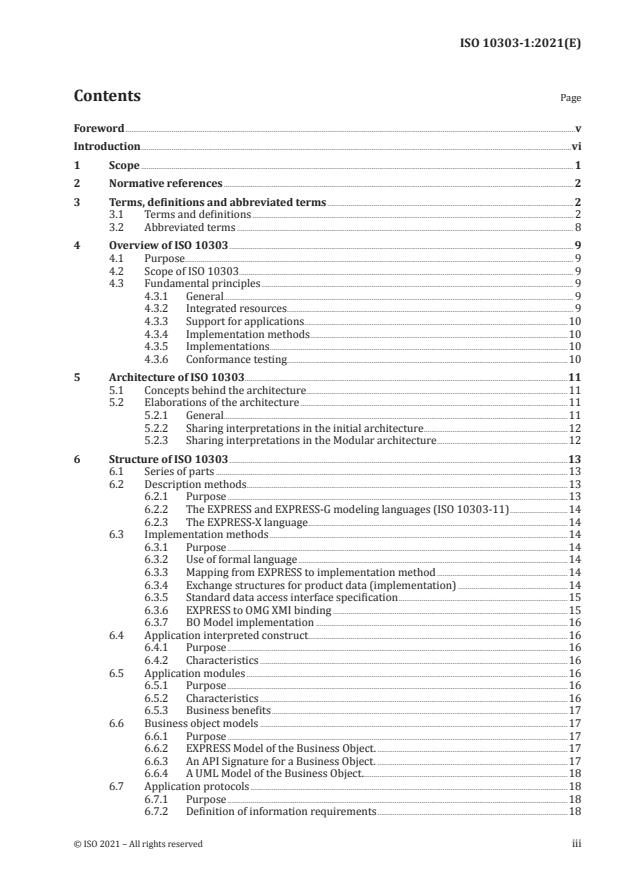
Contents Page
Foreword .v
Introduction .vi
1 Scope . 1
2 Normative references . 2
3 Terms, definitions and abbreviated terms . 2
3.1 Terms and definitions . 2
3.2 Abbreviated terms . 8
4 Overview of ISO 10303 . 9
4.1 Purpose . 9
4.2 Scope of ISO 10303. 9
4.3 Fundamental principles . 9
4.3.1 General. 9
4.3.2 Integrated resources . . 9
4.3.3 Support for applications .10
4.3.4 Implementation methods .10
4.3.5 Implementations .10
4.3.6 Conformance testing . .10
5 Architecture of ISO 10303.11
5.1 Concepts behind the architecture .11
5.2 Elaborations of the architecture .11
5.2.1 General.11
5.2.2 Sharing interpretations in the initial architecture.12
5.2.3 Sharing interpretations in the Modular architecture .12
6 Structure of ISO 10303 .13
6.1 Series of parts .13
6.2 Description methods.13
6.2.1 Purpose .13
6.2.2 The EXPRESS and EXPRESS-G modeling languages (ISO 10303-11) .14
6.2.3 The EXPRESS-X language .14
6.3 Implementation methods .14
6.3.1 Purpose .14
6.3.2 Use of formal language .14
6.3.3 Mapping from EXPRESS to implementation method .14
6.3.4 Exchange structures for product data (implementation) .14
6.3.5 Standard data access interface specification .15
6.3.6 EXPRESS to OMG XMI binding .15
6.3.7 BO Model implementation .16
6.4 Application interpreted construct .16
6.4.1 Purpose .16
6.4.2 Characteristics .16
6.5 Application modules .16
6.5.1 Purpose .16
6.5.2 Characteristics .16
6.5.3 Business benefits .17
6.6 Business object models .17
6.6.1 Purpose .17
6.6.2 EXPRESS Model of the Business Object. .17
6.6.3 An API Signature for a Business Object. .17
6.6.4 A UML Model of the Business Object.18
6.7 Application protocols .18
6.7.1 Purpose .18
6.7.2 Definition of information requirements .18
6.7.3 Information representation .18
6.7.4 Implementation methods .18
6.7.5 Conformance requirements .18
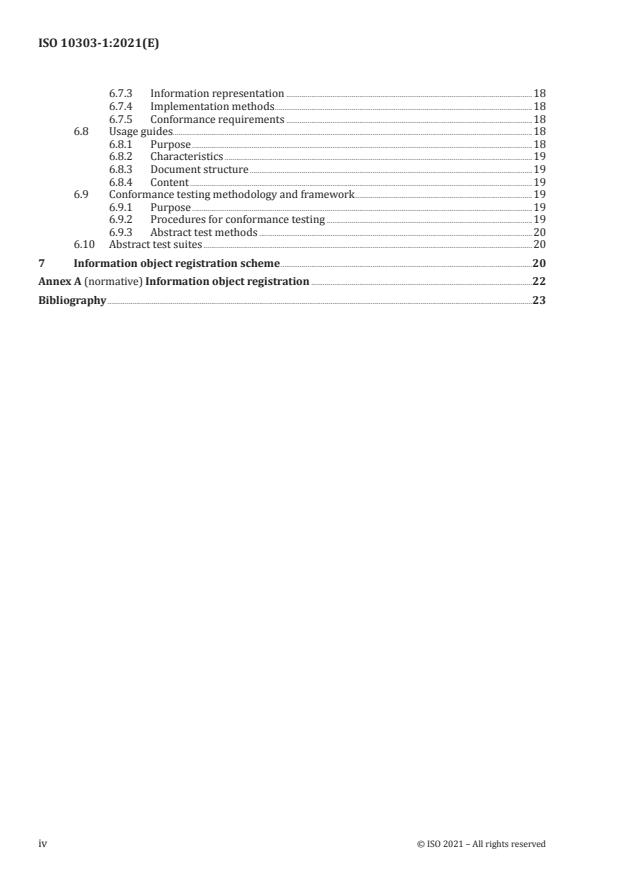
6.8 Usage guides.18
6.8.1 Purpose .18
6.8.2 Characteristics .19
6.8.3 Document structure .19
6.8.4 Content .19
6.9 Conformance testing methodology and framework .19
6.9.1 Purpose .19
6.9.2 Procedures for conformance testing .19
6.9.3 Abstract test methods .20
6.10 Abstract test suites .20
7 Information object registration scheme .20
Annex A (normative) Information object registration .22
Bibliography .23
iv © ISO 2021 – All rights reserved
Foreword
ISO (the International Organization for Standardization) is a worldwide federation of national standards
bodies (ISO member bodies). The work of preparing International Standards is normally carried out
through ISO technical committees. Each member body interested in a subject for which a technical
committee has been established has the right to be represented on that committee. International
organizations, governmental and non-governmental, in liaison with ISO, also take part in the work.
ISO collaborates closely with the International Electrotechnical Commission (IEC) on all matters of
electrotechnical standardization.
The procedures used to develop this document and those intended for its further maintenance are
described in the ISO/IEC Directives, Part 1. In particular, the different approval criteria needed for the
different types of ISO documents should be noted. This document was drafted in accordance with the
editorial rules of the ISO/IEC Directives, Part 2 (see www .iso .org/ directives).
Attention is drawn to the possibility that some of the elements of this document may be the subject of
patent rights. ISO shall not be held responsible for identifying any or all such patent rights. Details of
any patent rights identified during the development of the document will be in the Introduction and/or
on the ISO list of patent declarations received (see www .iso .org/ patents).
Any trade name used in this document is information given for the convenience of users and does not
constitute an endorsement.
For an explanation of the voluntary nature of standards, the meaning of ISO specific terms and
expressions related to conformity assessment, as well as information about ISO's adherence to the
World Trade Organization (WTO) principles in the Technical Barriers to Trade (TBT), see www .iso .org/
iso/ foreword .html.
This document was prepared by Technical Committee ISO/TC 184, Automation systems and integration,
Subcommittee SC 4, Industrial data.
This second edition cancels and replaces the first edition (ISO 10303-1:1994), which has been technically
revised.
The main changes compared to the previous edition are as follows:
— inclusion of application interpreted constructs;
— inclusion of application modules;
— inclusion of business object models;
— inclusion of additional implementation methods;
— inclusion of modular architecture as a preferred alternative to the initial architecture of
ISO 10303-1:1994;
— permission for integrated resources to reference constructs written using EXPRESS from other
International Standards;
— corrections to part numbering scheme;
— extension of information object registration to be usable on other standards;
— inclusion of usage guides;
— additional definitions.
Any feedback or questions on this document should be directed to the user’s national standards body. A
complete listing of these bodies can be found at www .iso .org/ members .html.
A list of all parts in the ISO 10303 series can be found on the ISO website.
Introduction
ISO 10303 is an International Standard for the computer-interpretable representation of product
information and for the exchange of product data. The objective is to provide a neutral mechanism
capable of describing products throughout their life cycle. This mechanism is suitable not only for neutral
file exchange, but also as a basis for implementing and sharing product databases, and as a basis for
archiving. The information generated about a product during its design, manufacture, use, maintenance,
and disposal is used for many purposes. The use can involve many computer systems, including some
that can be located in different organizations. In order to support such uses, organizations need to be
able to represent their product information in a common computer-interpretable form that is required
to remain complete and consistent when exchanged among different computer systems.
This document is an overview of ISO 10303. It specifies the overall scope of ISO 10303 and describes
the ISO 10303 architectures and structure. It describes the various series of parts of ISO 10303 and the
relationships among them.
ISO 10303 is organized as a series of parts, each published separately. The structure of ISO 10303 is
described in this document.
Each part of ISO 10303 is a member of one of the following series: description methods, implementation
methods, conformance testing methodology and framework, integrated generic resources, integrated
application resources, application protocols, abstract test suites, application interpreted constructs,
application modules and business object models.
A list of all parts in the ISO 10303 series is available from the following URL:
http:// standards .iso .org/ iso/ 10303/ tech/ step _titles .htm.
vi © ISO 2021 – All rights reserved
INTERNATIONAL STANDARD ISO 10303-1:2021(E)
Industrial automation systems and integration — Product
data representation and exchange —
Part 1:
Overview and fundamental principles
1 Scope
This document provides an overview of ISO 10303.
ISO 10303 provides a representation of product information along with the necessary mechanisms
and definitions to enable product data to be exchanged. The exchange is among different computer
systems and environments associated with the complete product lifecycle, including product design,
manufacture, use, maintenance, and final disposition of the product.
This document defines the basic principles of product information representation and exchange
used in ISO 10303. It specifies the characteristics of the various series of parts of ISO 10303 and the
relationships among them.
The following are within the scope of this document:
— scope statement for ISO 10303 as a whole;
— overview of ISO 10303;
— architectures of ISO 10303;
— structure of ISO 10303;
— terms and definitions used throughout ISO 10303;
— overview of data specification methods used in ISO 10303;
NOTE This includes the EXPRESS data specification language and graphical presentation of product
information models.
— introduction to the series of parts of ISO 10303:
— integrated resources;
— application interpreted constructs;
— application modules;
— business object models;
— application protocols;
— implementation methods;
— usage guides;
— conformance testing methodology and framework;
— abstract test suites;
— scheme for identification of schemas and other information objects defined within parts of
ISO 10303.
2 Normative references
The following documents are referred to in the text in such a way that some or all of their content
constitutes requirements of this document. For dated references, only the edition cited applies. For
undated references, the latest edition of the referenced document (including any amendments) applies.
ISO/IEC 8824-1, Information technology — Abstract Syntax Notation One (ASN.1) — Part 1: Specification
of basic notation
3 Terms, definitions and abbreviated terms
3.1 Terms and definitions
For the purposes of this document, the following terms and definitions apply.
3.1.1
abstract test case
ATC
specification, encapsulating at least one test purpose, that provides the formal basis from which
executable test cases are derived and that is independent of both the implementation and the values
3.1.2
abstract test method
ATM
description of how an implementation is tested, given at the appropriate level of abstraction to make
the description independent of any specific implementation of testing tools or procedures, but with
sufficient detail to enable these tools and procedures to be produced
3.1.3
abstract test suite
ATS
part of ISO 10303 that contains the set of abstract test cases necessary for conformance testing of an
implementation of an application protocol
3.1.4
agreement of common understanding
result of discussions between the partners of product data exchange or sharing, that ensures that all of
them have the same understanding of the transferred or shared information
3.1.5
application
one or more processes creating or using product data
3.1.6
application activity model
AAM
model that describes an application in terms of its processes and information flows
3.1.7
application construct
collection of EXPRESS language entities, types, functions, rules and references that are based on
resource constructs and that specialize those resource constructs as necessary to define a valid
description of an aspect of product data for specific application areas
2 © ISO 2021 – All rights reserved
3.1.8
application context
subset of an application activity model
3.1.9
application interpreted construct
AIC
logical grouping of interpreted constructs that supports a specific function for the usage of product
data across multiple application contexts
Note 1 to entry: See also interpretation (3.1.41).
3.1.10
application interpreted model
AIM
information model that includes the application constructs necessary to satisfy the requirements of an
application reference model
3.1.11
application module
AM
reusable collection of a scope statement, information requirements, mappings and module interpreted
model that supports a specific usage of product data across multiple application contexts
3.1.12
application object
AO
atomic element of an application reference model that defines a unique concept of the application and
contains attributes specifying the data elements of the object
3.1.13
application programming interface
API
set of standard software interrupts, calls, functions, and data formats that can be used by an application
program to access network services, devices, or operating systems
3.1.14
application programming interface implementation
API implementation
implementation of ISO 10303 that supplies the services of the application programming interface, in
contrast to an implementation of this standard that uses the API implementation
3.1.15
application programming interface instance
API instance
individual execution context and state of an application programming interface implementation
Note 1 to entry: The notion of “execution context” in ISO 10303 is the same as in ECMAScript.
3.1.16
application programming interface signature
APIS
description of the set of functions, protocols, and tools that programmers can use to enhance
applications to access network services, devices, or operating systems
3.1.17
application protocol
AP
part of ISO 10303 that specifies an application interpreted model satisfying the scope and information
requirements for a specific application
Note 1 to entry: This definition differs from the definition used in ISO 7498-2:1989 because the protocols address
different contexts of use.
3.1.18
application reference model
ARM
information model that describes the information requirements and constraints of an application
within an application protocol or module
3.1.19
application resource
integrated resource whose contents are related to a group of application contexts
3.1.20
assembly
product that is decomposable into a set of components or other assemblies from the perspective of a
specific application
3.1.21
business object model
BO Model
single integrated information model for the scope of an AP
3.1.22
common resources
collection of information models, specified in the EXPRESS language, that can be reused to specify
application-specific information models within the domain of industrial data
Note 1 to entry: The resource constructs defined by an application module are those defined in its module
interpreted model schema.
Note 2 to entry: The term does not specify a specific series of ISO 10303 parts.
3.1.23
component
product that is not subject to decomposition from the perspective of a specific application
3.1.24
conformance assessment
analysis of conformance testing results to determine conformance to a particular application protocol’s
conformance class or option
3.1.25
conformance class
subset of an application protocol for which conformance can be claimed
3.1.26
conformance option requirement
incremental subset of an application protocol for which conformance can be claimed in addition to the
conformance claimed for one or more conformance classes
3.1.27
conformance
precise, text definition of a characteristic required to be present in a conforming implementation
4 © ISO 2021 – All rights reserved
3.1.28
conformance testing
testing of a conforming implementation by evaluating its data for the specific characteristics required
by ISO 10303
3.1.29
data
representation of information in a formal manner suitable for communication, interpretation, or
processing by human beings or computers
3.1.30
data mapping language
computer interpretable language that specifies how one information set relates to another
3.1.31
data exchange
storing, accessing, transferring, and archiving of data
3.1.32
data specification language
set of rules for defining data and their relationships suitable for communication, interpretation, or
processing by computers
3.1.33
description method
systematic procedure for specifying elements of a domain
EXAMPLE ISO 10303-11 is a description method that specifies the elements of the EXPRESS language.
3.1.34
digital signature
result of a cryptographic transformation of data that, when properly implemented, provides a
mechanism for verifying origin authentication, data integrity and signatory non-repudiation
3.1.35
domain
area of knowledge, influence, or activity
3.1.36
exchange structure
computer-interpretable format used for storing, accessing, transferring, and archiving data
3.1.37
externally defined
explicit identification of the definition given within another source
Note 1 to entry: That source provides all the information necessary to unambiguously recreate the element; the
information can be referenced rather than recreated.
3.1.38
generic resource
integrated resource whose contents are independent of a specific application
EXAMPLE ISO 10303-42.
3.1.39
implementation method
part of ISO 10303 that specifies a technique used by computer systems to exchange product data that is
described using the EXPRESS data specification language
3.1.40
implementation under test
IUT
part of an application that is studied under testing
Note 1 to entry: This is normally an implementation of one or more characteristics of the standard(s) based on a
given implementation method.
3.1.41
information
facts, concepts, or instructions
3.1.42
information model
formal model of information
Note 1 to entry: In ISO 10303, an information model is based on the Object-relationship modeling technique that
organizes the product data as represented in different system aspects.
Note 2 to entry: In ISO 10303, information models are developed using EXPRESS modeling language.
EXAMPLE ISO 10303-242.
3.1.43
integrated resource
IR
part of ISO 10303 that defines a group of resource constructs used as the basis for product data. It
includes the two types of resource parts: generic resources and application resources
Note 1 to entry: The 4x to 6x numbering is reserved for integrated generic resources and the 1xx numbering is
reserved for integrated application resources.
EXAMPLE 1 ISO 10303-42.
EXAMPLE 2 ISO 10303-104.
3.1.44
interpretation
process of adapting a resource construct to satisfy an application-specific requirement of an application
protocol
Note 1 to entry: The interpretation process can involve the addition of restrictions on attributes, the addition of
constraints, and the addition of assignments.
3.1.45
module interpreted model
MIM
information model that uses the common resources necessary to satisfy the information requirements
and constraints of an application reference model, within an application module
Note 1 to entry: The term common resources is not meant to imply that all such information models are required
to be used in a module interpreted model regardless of domain or application.
EXAMPLE Three-dimensional geometry information models are common resources used in many MIMs.
However, an application module describing colour will not use three-dimensional geometry information models
as a resource.
3.1.46
neutral
independent of a specific computer system
6 © ISO 2021 – All rights reserved
3.1.47
predefined
explicit description of product data given within a clause of a part of IS0 10303
Note 1 to entry: The explicit description provides all the information necessary to unambiguously recreate the
element.
3.1.48
presentation
recognizable visual representation of product data intended for use by humans
3.1.49
product
thing or substance or information produced by a process
Note 1 to entry: Note to entry: In ISO 10303, it is common to include a product that is not a physical thing or
substance, but that is information (e.g., a computer-interpretable model).
3.1.50
product data
data that is a representation of product information
3.1.51
product information
information about a product
Note 1 to entry: Note to entry: In ISO 10303, it is common to describe product information with respect to a
specific industrial domain.
3.1.52
product information model
formal model of product information
3.1.53
protocol implementation conformance statement
PICS
statement of which capabilities and options are supported within an implementation of a given standard
Note 1 to entry: This statement is produced by completing a PICS proforma.
3.1.54
protocol implementation conformance statement proforma
PICS proforma
standardized document in the form of a questionnaire, which, when completed for a specific
implementation, becomes the protocol implementation conformance statement
3.1.55
resource construct
collection of EXPRESS language entities, types, functions, rules and references that together define a
valid description of an aspect of product data
3.1.56
standard data access interface
SDAI
abstract Application Programming Interface (API) to work on application data according to a given data
model defined in EXPRESS SDAI is specified in ISO 10303-22
Note 1 to entry: SDAI, which is specified in ISO 10303-22, is intended to be independent of programming
language used.
3.1.57
STEP modules and resource library
SMRL
collection of application modules, business object models, and integrated resources intended to support
one or more application protocols
3.1.58
Structural data mapping language
language elements that allow an unambiguous specification of a relationship between two schemas
Note 1 to entry: The two schemas both conform to the same schema definition language.
Note 2 to entry: The language elements of the structural data mapping language reference language elements of
the schema definition language.
3.1.59
structure
set of interrelated parts of any complex thing, and the relationships between them
3.1.60
test purpose
precise description of an objective which an abstract test case is designed to achieve
3.1.61
unit of functionality
UOF
collection of application objects and their relationships that defines one or more concepts within the
application context such that removal of any component would render the concepts incomplete or
ambiguous
3.1.62
usage of product data
subset of the information flows in an application activity model
3.1.63
usage guide
specification that is a recommendation on applying an application protocol for a specific application
domain within the scope of that application protocol
3.1.64
verdict
statement of "pass", "fail", or "inconclusive" concerning conformance of an implementation under test
with respect to an executable test case and the abstract test case from which it was derived
3.1.65
verdict criteria
information defined within an abstract test case which enables the testing laboratory to assign a verdict
3.2 Abbreviated terms
DTD document type definition
HDF Hierarchical data format
STEP Standard for the exchange of product model data
URL Uniform resource locator
UML Unified modeling language
8 © ISO 2021 – All rights reserved
XMI XML metadata interchange
XML Extensible mark-up language
XLSX Microsoft Excel open XML spreadsheet
4 Overview of ISO 10303
4.1 Purpose
The purpose of ISO 10303 is to specify a form for the unambiguous representation and exchange of
computer-interpretable product data throughout the life of a product. This form is independent
of any specific computer system. This form enables consistent implementations across multiple
applications and systems. ISO 10303 permits different implementation methods to be used for storing,
accessing, transferring, and archiving product data. ISO 10303 defines a rigorous process for testing
implementations for conformance.
4.2 Scope of ISO 10303
ISO 10303 provides a representation of product information along with the necessary mechanisms
and definitions to enable product data to be exchanged. The exchange is among different computer
systems and environments associated with the complete product lifecycle, including product design,
manufacture, use, maintenance, and final disposition.
The following are within the scope of ISO 10303:
— representation of product information, including components and assemblies;
— implementations methods for exchange of product data, including storing, transferring, accessing,
and archiving.
4.3 Fundamental principles
4.3.1 General
ISO 10303 separates the techniques of representation of product information from the implementation
methods used for data exchange.
The representation techniques provide a single representation of product information common to many
applications. This common representation may be adapted to meet the needs of specific applications.
An application protocol (AP) specifies the representation of product information for one or more
applications.
ISO 10303 specifies the implementation methods that support the exchange of product data defined in
APs.
ISO 10303 defines a formal data specification language, EXPRESS which is used to specify the
representation of product information. The use of a formal language provides unambiguous and
consistent representation and facilitates development of implementations. The representation of
product information may be annotated with a literal definition for each construct.
ISO 10303 provides a methodology and framework for conformance testing of implementations.
4.3.2 Integrated resources
A set of integrated resources (IRs) shall provide the specification of a representation of product
information. Each IR comprises a set of descriptions, written in a formal data specification language,
applicable to product data known as resource constructs. One set may be dependent on other sets for
its definition. A single resource construct may represent similar information for different applications.
The IRs in ISO 10303 are divided into two groups: generic resources and application resources. The
generic resources are independent of applications and may reference other resources. The application
resources may reference other resources and may add other resource constructs for use by a group
of similar applications. The IRs may reference product data descriptions written using EXPRESS from
other International Standards.
4.3.3 Support for applications
The IRs define a generic information model for product information. They are not sufficient to support
the information requirements of an application without the addition of application specific constraints,
relationships, and attributes.
ISO 10303 defines APs in which the IRs are interpreted to meet the product information requirements
of specific applications. The interpretation is achieved by selecting appropriate resource constructs
and refining their meaning, by specifying any appropriate constraints, relationships, and attributes.
This interpretation results in an application interpreted model (AIM). The AIM is documented as part
of an AP.
ISO 10303 has two mechanisms to ensure consistent interpretation when a resource construct
represents the same information requirement in different APs. One mechanism uses interpreted
resource constructs appearing in more than one AP as a documented application interpreted
construct (AIC). The other mechanism uses application modules (AMs) that document the harmonized
requirements along with the interpreted resource constructs.
NOTE Subclauses 6.4 and 6.5 discuss application interpreted constructs and application modules in
more detail.
The scope and information requirements of the application are specified using the terminology of the
application domain. The AP provides a mapping to show how the interpretation of the IRs is used to
meet the information requirements of the application domain.
ISO 10303 provides business object models that present complex models in a form that may be more
understandable to application experts.
4.3.4 Implementation methods
Each implementation method included in ISO 10303 is specified by a mapping from the EXPRESS
language onto the formal language used for the method. The mapping is independent of the AP. The
mapping is expressed in a formal notation. At least three implementation methods for ISO 10303 have
been identified (see 6.3.4).
4.3.5 Implementations
An AP may specify one or more applicable implementation methods from the set of implementation
methods in ISO 10303. An implementation shall apply one or more of the implementation methods
specified in the AP to the AIM.
4.3.6 Conformance testing
Conformance of an implementation to an AP is specified by the conformance requirements in the AP.
A set of tests, specified in an abstract test suite (ATS), may be defined for each AP. When associated with
an abstract test method (ATM), these tests can be used to assess the conformance of an implementation.
The overall framework for conformance assessment is specified in ISO 10303-31.
An ATM for each implementation method is specified in one of the conformance testing methodology
and framework series of parts of ISO 10303.
10 © ISO 2021 – All rights reserved
The scope of conformance testing of a specific implementation is the requirements specified for the
conformance classes claimed for the implementation in the protocol implementation conformance
statement (PICS). The tests are selected from the ATS, based on the conformance class claimed by the
implementation. Test results provide the basis for conformance assessment.
ISO 10303 contains ATSs and defines ATMs for performing conformance testing to provide a basis for
test results that are repeatable, comparable, and auditable. Inclusion of conformance testing procedures
in ISO 10303 is intended to promote widespread acceptance of test results.
5 Architecture of ISO 10303
5.1 Concepts behind the architecture
The ISO 10303 architecture is designed to support the development of standards for product data
exchange and product data sharing. The architecture is constrained by the following concepts:
— the scope of what is standardized and what is conformance tested is set at the level of an application;
— Information requirements are based on a model of a business activity;
— information requirements are standardized using natural language; and
— a mapping is specified that defines the data structures and population constraints using the IRs that
satisfy the information requirements.
ISO 10303 is implemented through APs. An AP consists of the following major elements:
— an AAM describing the business process that the information model supports;
— an ARM specifying the information requirements;
— an information model based on the IRs, called an application interpreted model (AIM), that is a basis
for implementations of ISO 10303;
— zero or more information models for data structures based on the ARM, called a business object
model (BO Model), that is a basis for implementations of ISO 10303.
The architecture is based on standardizing industry information requirements and mapping
those information requirements to an information model based on the IRs. The process of mapping
information requirements to the IRs is known as "interpretation".
The ISO 10303 architecture focuses on the information required by industrial processes rather than
on the processes themselves, as the processes can change over time, while the underlying information
requirements are longer lasting. This focus on information allows ISO 10303 to support data exchange,
some forms of data sharing, as well as long-term data retention.
Whenever a resource construct is used to represent the same information requirement in different APs,
the same interpretation of that resource construct shall be used.
5.2 Elaborations of the architecture
5.2.1 General
The general architectural principles described in 5.1 have been elaborated into two architectures: the
"initial architecture" and the "modular architecture". Both architectures adhere to the fundamental
principles described in 4.3. The primary change introduced by the modular architecture is the explicit
harmonization of common information requirements.
NOTE The term "ISO 10303 architecture", without qualification, refers to the general principles described in
5.1 and the common aspects of its elaborations.
An ISO 10303 project may use either the initial architecture or the modular architecture, although new
projects are encouraged to use the modular architecture. ISO TC 184/SC 4 shall determine, at the time a
project is approved, which architecture the project will use.
5.2.2 Sharing interpretations in the initial architecture
An AIC shall be used to specify a piece of an AIM that can be used to exchange product data common to
two or more application protocols.
NOTE An AIC does not document the common information requirements or the mapping of those information
requirements into the AIM.
An AP that complies with initial architecture is called a "monolithic AP".
5.2.3 Sharing interpretations in the Modular architecture
5.2.3.1 General
Rat
...
Questions, Comments and Discussion
Ask us and Technical Secretary will try to provide an answer. You can facilitate discussion about the standard in here.
Loading comments...