

ISO 23374-1:2023
(Main)Intelligent transport systems — Automated valet parking systems (AVPS) — Part 1: System framework, requirements for automated driving and for communications interface
General Information
- Abstract
Automated valet parking systems (AVPSs) perform level 4 automated driving of individual or multiple unoccupied vehicles within a prescribed area of a parking facility. This document specifies performance requirements for the operation functions, the environmental conditions within parking facilities where automated vehicle operation is performed, and the test procedures to verify the performance requirements. An AVPS is comprised of physically separated sub-systems distributed among vehicles, facility equipment and user domains. The functionalities of AVPSs are realized by cooperation of these sub-systems, which are, in many cases, provided by different organizations. This document defines the system architecture and the communication interfaces between the sub-systems at the logical level. An AVPS manages its system participants (i.e. AVPS-compliant vehicles and parking facilities) and provides interfaces to other facility users and involved persons (e.g. system operators, facility managers). This document contains requirements for the management functions such as checking compatibility between vehicles and parking facilities, performing remote assistance and recovery when automated driving cannot be performed, and executing operation stop commands in response to the actions of other facility users. AVPSs are intended for use by a service provider upon receiving authority over vehicles from individual service recipients. This document does not include parking automation technologies that are solely based on usage by an individual user. If the vehicle is put into driverless operation directly by the user, this is not considered to be part of the AVPS.
- Status
- Published
- Publication Date
- 12-Jul-2023
- Technical Committee
- ISO/TC 204 - Intelligent transport systems
- Drafting Committee
- ISO/TC 204/WG 14 - Vehicle/roadway warning and control systems
- Current Stage
- 6060 - International Standard published
- Start Date
- 13-Jul-2023
- Due Date
- 12-Apr-2023
- Completion Date
- 13-Jul-2023

Overview
ISO 23374-1:2023 - Intelligent transport systems - Automated valet parking systems (AVPS) - Part 1: System framework, requirements for automated driving and for communications interface provides a formal system-level specification for Level 4 automated valet parking of unoccupied vehicles inside prescribed parking facility areas. Published by ISO in 2023, the standard defines the system architecture, logical communication interfaces, performance requirements, environmental conditions inside facilities, management functions and test procedures for AVPS operation.
Key topics and technical requirements
- System framework and architecture
- Defines AVPS sub-systems (vehicle, facility, user domains), their functional allocation and logical interfaces.
- Clarifies basic flows, classifications (vehicle operation types, traffic environment categories) and system states.
- Automated driving requirements
- Performance requirements for automated driving functions including dynamic driving task (DDT), emergency stopping, route planning and destination assignment.
- Requirements for localization accuracy, end-position accuracy relative to digital maps, and human activity recognition within the facility.
- Management and operational functions
- Compatibility and occupancy checks, service provider and operator roles, remote assistance/recovery, remote engagement/disengagement and operation stop procedures.
- Identification and management of AVPS-compliant vehicles (SV identification) and responses to incapacitation of operation functions.
- Facility environment requirements
- Environmental conditions and facility elements: operation zones, drop-off/pick-up areas, SV identification areas, lighting, wireless communication coverage, localization markers and digital map requirements.
- Differentiates requirements for mixed traffic vs exclusive traffic environments.
- Communications and security
- Interface requirements, security goals and data reporting (object/event detection, data recording, user information).
- System state transition diagrams, suspend codes and transition conditions.
- Testing and verification
- Test scenarios, site and environmental condition guidance, and procedures to verify compliance with performance requirements.
Practical applications and users
- Who uses it: AVPS service providers, vehicle OEMs, facility owners/managers (airports, shopping centers, corporate campuses), systems integrators, parking operators, safety assessors and testing laboratories, and regulators.
- Use cases: Deploying commercial automated valet parking services; validating interoperability between vehicles and parking facilities; designing facility infrastructure (wireless, lighting, localization markers); defining operational policies and remote-assistance procedures.
- Benefits: Ensures interoperability, safety, and predictable performance of Level 4 AVPS deployments and provides a common basis for testing and certification.
Related keywords for SEO
ISO 23374-1, automated valet parking, AVPS, intelligent transport systems, Level 4 automated driving, system framework, communication interface, parking facility requirements, localization, digital maps, remote assistance, safety testing.
Get Certified
Connect with accredited certification bodies for this standard

BSI Group
BSI (British Standards Institution) is the business standards company that helps organizations make excellence a habit.

Great Wall Tianjin Quality Assurance Center
Established 1993, first batch to receive national accreditation with IAF recognition.
Hong Kong Quality Assurance Agency (HKQAA)
Hong Kong's leading certification body.
Sponsored listings
Frequently Asked Questions
ISO 23374-1:2023 is a standard published by the International Organization for Standardization (ISO). Its full title is "Intelligent transport systems — Automated valet parking systems (AVPS) — Part 1: System framework, requirements for automated driving and for communications interface". This standard covers: Automated valet parking systems (AVPSs) perform level 4 automated driving of individual or multiple unoccupied vehicles within a prescribed area of a parking facility. This document specifies performance requirements for the operation functions, the environmental conditions within parking facilities where automated vehicle operation is performed, and the test procedures to verify the performance requirements. An AVPS is comprised of physically separated sub-systems distributed among vehicles, facility equipment and user domains. The functionalities of AVPSs are realized by cooperation of these sub-systems, which are, in many cases, provided by different organizations. This document defines the system architecture and the communication interfaces between the sub-systems at the logical level. An AVPS manages its system participants (i.e. AVPS-compliant vehicles and parking facilities) and provides interfaces to other facility users and involved persons (e.g. system operators, facility managers). This document contains requirements for the management functions such as checking compatibility between vehicles and parking facilities, performing remote assistance and recovery when automated driving cannot be performed, and executing operation stop commands in response to the actions of other facility users. AVPSs are intended for use by a service provider upon receiving authority over vehicles from individual service recipients. This document does not include parking automation technologies that are solely based on usage by an individual user. If the vehicle is put into driverless operation directly by the user, this is not considered to be part of the AVPS.
Automated valet parking systems (AVPSs) perform level 4 automated driving of individual or multiple unoccupied vehicles within a prescribed area of a parking facility. This document specifies performance requirements for the operation functions, the environmental conditions within parking facilities where automated vehicle operation is performed, and the test procedures to verify the performance requirements. An AVPS is comprised of physically separated sub-systems distributed among vehicles, facility equipment and user domains. The functionalities of AVPSs are realized by cooperation of these sub-systems, which are, in many cases, provided by different organizations. This document defines the system architecture and the communication interfaces between the sub-systems at the logical level. An AVPS manages its system participants (i.e. AVPS-compliant vehicles and parking facilities) and provides interfaces to other facility users and involved persons (e.g. system operators, facility managers). This document contains requirements for the management functions such as checking compatibility between vehicles and parking facilities, performing remote assistance and recovery when automated driving cannot be performed, and executing operation stop commands in response to the actions of other facility users. AVPSs are intended for use by a service provider upon receiving authority over vehicles from individual service recipients. This document does not include parking automation technologies that are solely based on usage by an individual user. If the vehicle is put into driverless operation directly by the user, this is not considered to be part of the AVPS.
ISO 23374-1:2023 is classified under the following ICS (International Classification for Standards) categories: 03.220.20 - Road transport; 35.240.60 - IT applications in transport. The ICS classification helps identify the subject area and facilitates finding related standards.
ISO 23374-1:2023 is available in PDF format for immediate download after purchase. The document can be added to your cart and obtained through the secure checkout process. Digital delivery ensures instant access to the complete standard document.
Standards Content (Sample)
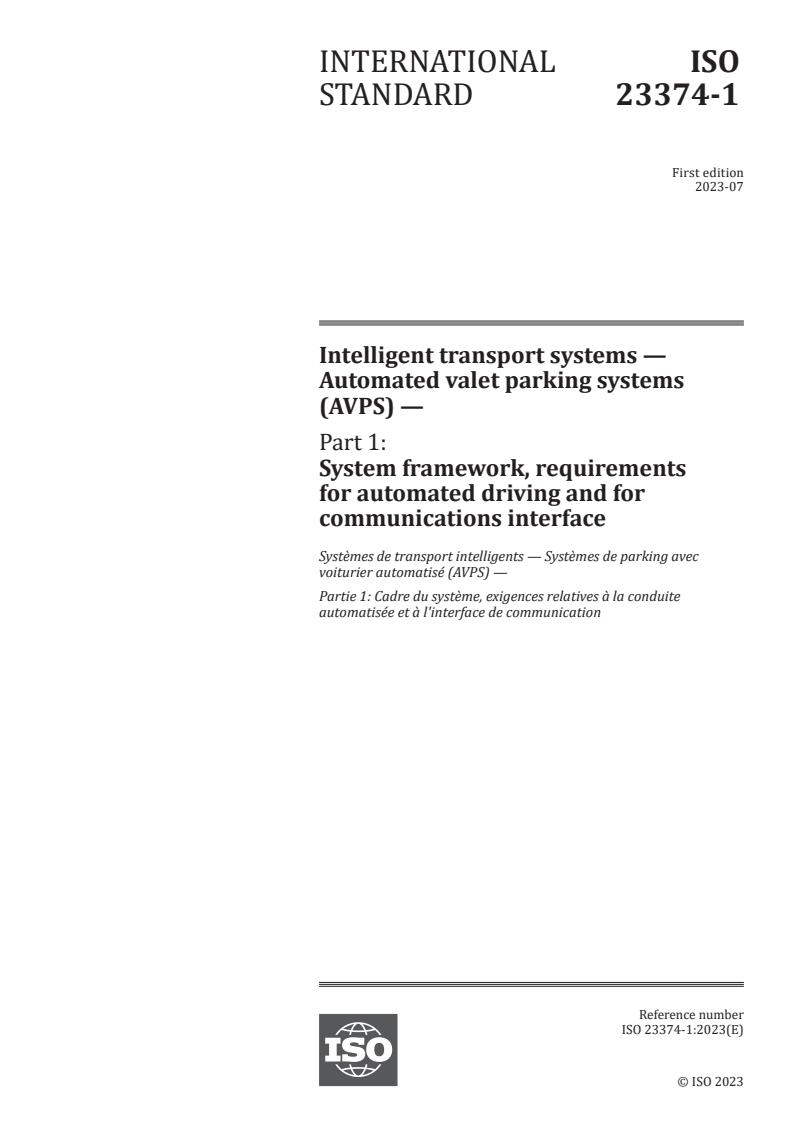
INTERNATIONAL ISO
STANDARD 23374-1
First edition
2023-07
Intelligent transport systems —
Automated valet parking systems
(AVPS) —
Part 1:
System framework, requirements
for automated driving and for
communications interface
Systèmes de transport intelligents — Systèmes de parking avec
voiturier automatisé (AVPS) —
Partie 1: Cadre du système, exigences relatives à la conduite
automatisée et à l'interface de communication
Reference number
© ISO 2023
All rights reserved. Unless otherwise specified, or required in the context of its implementation, no part of this publication may
be reproduced or utilized otherwise in any form or by any means, electronic or mechanical, including photocopying, or posting on
the internet or an intranet, without prior written permission. Permission can be requested from either ISO at the address below
or ISO’s member body in the country of the requester.
ISO copyright office
CP 401 • Ch. de Blandonnet 8
CH-1214 Vernier, Geneva
Phone: +41 22 749 01 11
Email: copyright@iso.org
Website: www.iso.org
Published in Switzerland
ii
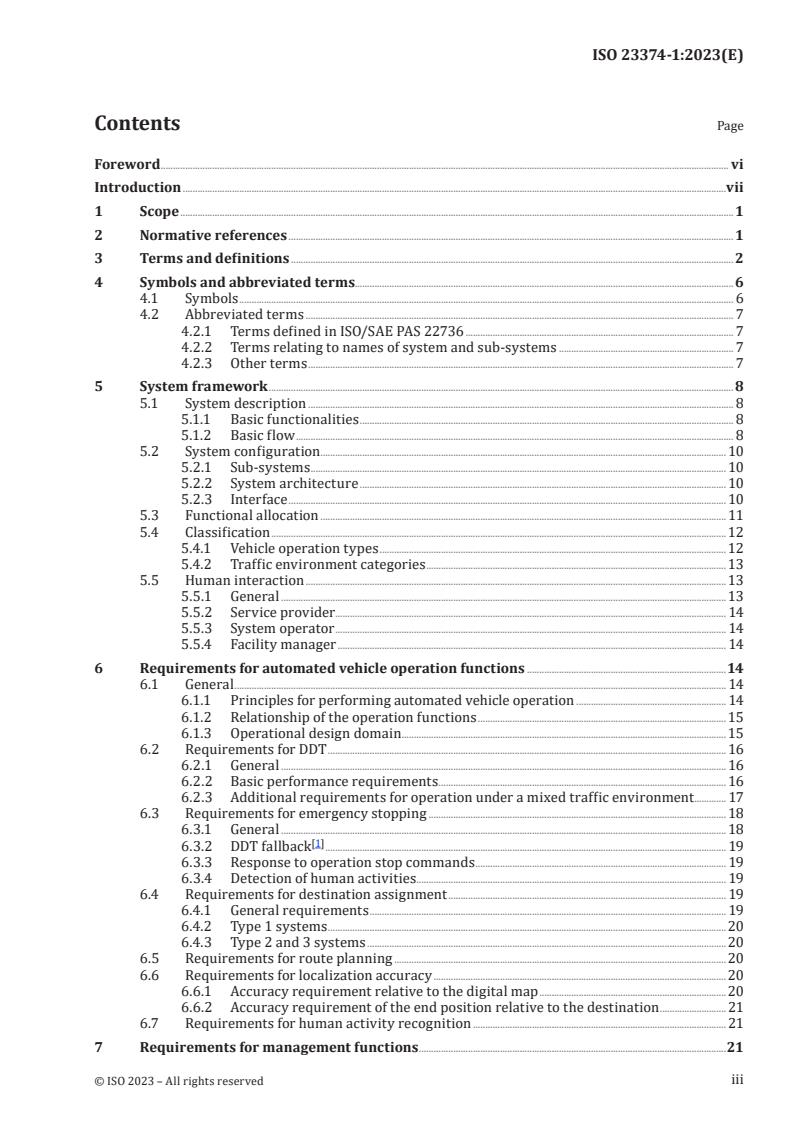
Contents Page
Foreword . vi
Introduction .vii
1 Scope . 1
2 Normative references . 1
3 Terms and definitions . 2
4 Symbols and abbreviated terms.6
4.1 Symbols . 6
4.2 Abbreviated terms . 7
4.2.1 Terms defined in ISO/SAE PAS 22736 . 7
4.2.2 Terms relating to names of system and sub-systems . 7
4.2.3 Other terms . 7
5 System framework . 8
5.1 System description . 8
5.1.1 Basic functionalities . 8
5.1.2 Basic flow . 8
5.2 System configuration . 10
5.2.1 Sub-systems . 10
5.2.2 System architecture . 10
5.2.3 Interface . 10
5.3 Functional allocation . 11
5.4 Classification .12
5.4.1 Vehicle operation types .12
5.4.2 Traffic environment categories . 13
5.5 Human interaction .13
5.5.1 General .13
5.5.2 Service provider . 14
5.5.3 System operator . 14
5.5.4 Facility manager . 14
6 Requirements for automated vehicle operation functions .14
6.1 General . 14
6.1.1 Principles for performing automated vehicle operation . 14
6.1.2 Relationship of the operation functions . 15
6.1.3 Operational design domain . 15
6.2 Requirements for DDT . 16
6.2.1 General . 16
6.2.2 Basic performance requirements . 16
6.2.3 Additional requirements for operation under a mixed traffic environment . 17
6.3 Requirements for emergency stopping . 18
6.3.1 General . 18
[1]
6.3.2 DDT fallback . 19
6.3.3 Response to operation stop commands . 19
6.3.4 Detection of human activities . 19
6.4 Requirements for destination assignment . 19
6.4.1 General requirements . 19
6.4.2 Type 1 systems .20
6.4.3 Type 2 and 3 systems .20
6.5 Requirements for route planning . 20
6.6 Requirements for localization accuracy . 20
6.6.1 Accuracy requirement relative to the digital map . 20
6.6.2 Accuracy requirement of the end position relative to the destination . 21
6.7 Requirements for human activity recognition . 21
7 Requirements for management functions .21
iii
7.1 Functions that influence the automated vehicle operation . 21
7.1.1 General . 21
7.1.2 Remote engagement . 21
7.1.3 Operation stop . 21
7.1.4 Remote assistance.22
7.1.5 Remote disengagement .22
7.1.6 Central control .22
7.2 Other management functions . 22
7.2.1 Compatibility and occupancy check . 22
7.2.2 SV identification .23
7.2.3 Response to incapacitation of the operation functions .23
7.2.4 Maintaining environmental conditions . 23
8 Requirements for the environment within parking facilities .24
8.1 General . 24
8.2 Common requirements . 24
8.2.1 Operation zone . 24
8.2.2 Drop-off and pick-up area . 24
8.2.3 SV identification area . 24
8.2.4 Wireless communication. 24
8.2.5 Operation stop device .25
8.2.6 Lighting . 25
8.3 Vehicle-operation-type-dependent requirements . 26
8.3.1 Detection capabilities of the R sub-system. 26
8.3.2 Localization markers . .26
8.3.3 Digital maps . 27
8.4 Traffic environment category dependent requirements .29
8.4.1 Mixed traffic .29
8.4.2 Exclusive traffic .29
9 Requirements for overall system operation .29
9.1 General .29
9.2 Requirements for the communication interface .30
9.2.1 General requirements .30
9.2.2 Security goals . 31
9.2.3 Security requirements . 31
9.3 System states and transition diagram . 31
9.3.1 State transition diagram . 31
9.3.2 Definition and requirements of system states . 33
9.3.3 Transition conditions . 36
9.4 Suspend condition codes .40
9.5 Object and event detection data reporting . 41
9.6 Data recording . 41
9.7 Information to the user . 42
9.8 Development process and management . 42
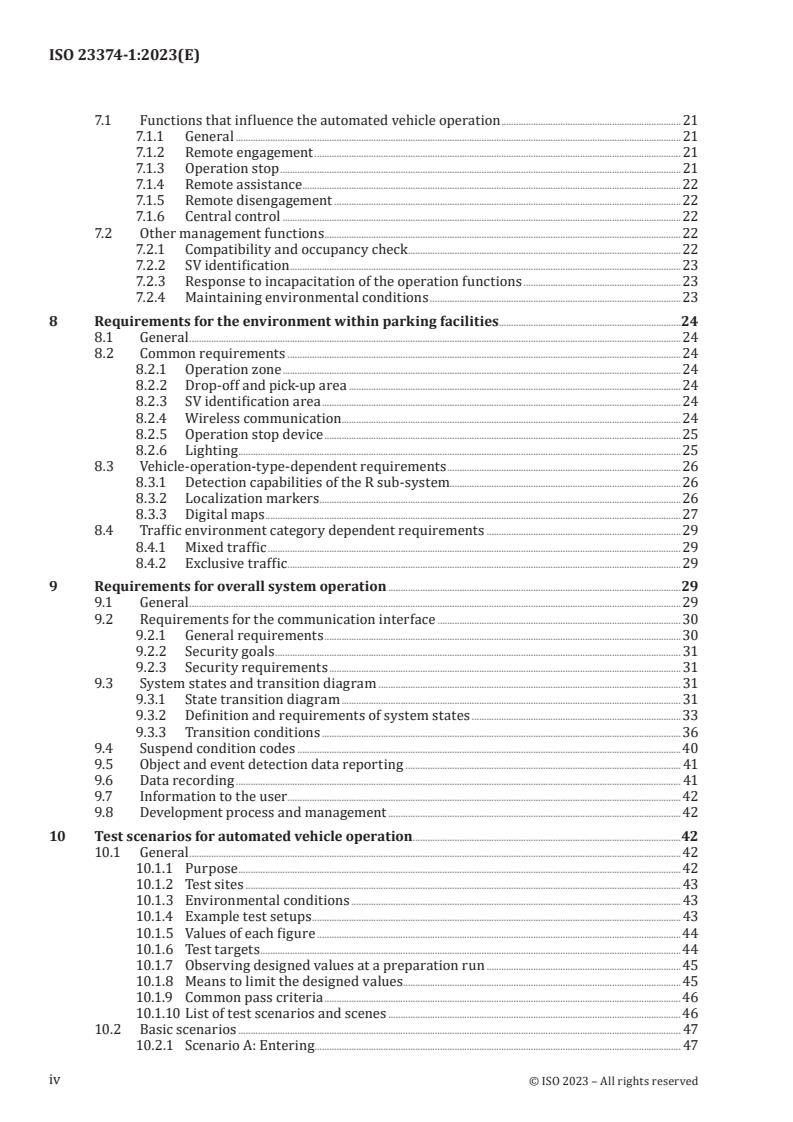
10 Test scenarios for automated vehicle operation .42
10.1 General . 42
10.1.1 Purpose . 42
10.1.2 Test sites . 43
10.1.3 Environmental conditions . 43
10.1.4 Example test setups . 43
10.1.5 Values of each figure .44
10.1.6 Test targets .44
10.1.7 Observing designed values at a preparation run . 45
10.1.8 Means to limit the designed values . . 45
10.1.9 Common pass criteria .46
10.1.10 List of test scenarios and scenes .46
10.2 Basic scenarios . 47
10.2.1 Scenario A: Entering. 47
iv
10.2.2 Scenario B: Re-parking .48
10.2.3 Scenario C: Exiting .50
10.3 Basic scenes . 51
10.3.1 Scene 01: Climbing a ramp at slow speed . 51
10.3.2 Scene 02: Ramp down . 52
10.3.3 Scene 03: Operation on spiral ramps (up/down) .53
10.3.4 Scene 04: Out of drop-off area . 55
10.3.5 Scene 05: SV identification . 55
10.3.6 Scene 06: Out of operation zone.56
10.4 Traffic rules and behaviours . 57
10.4.1 Scene 11: Stopping location . 57
10.4.2 Scene 12: Intersection passing.58
10.4.3 Scene 13: Blocked intersection . 59
10.4.4 Scene 14: Give way in two-way traffic .60
10.4.5 Scene 15: Vehicle in front is reversing towards SV . 61
10.5 Static object avoidance . 62
10.5.1 Scene 21: Smallest object in the direction of travel (forward/reverse) . 62
10.5.2 Scene 22: Overhanging object .64
10.5.3 Scene 23: Infant in parking spot (reverse/forward) .65
10.5.4 Scene 24: Infant lying near ramp (up/down) .66
10.5.5 Scene 25: Infant behind a curve .68
10.5.6 Scene 26: Infant in front of parked vehicle (forward/reverse) .69
10.5.7 Scene 27: Infant beside parked vehicle . 70
10.5.8 Scene 28: Infant lying partly underneath parked vehicle. 71
10.6 Dynamic object avoidance . .72
10.6.1 Scene 31: Forward vehicle braking hard .72
10.6.2 Scene 32: Parked vehicle rushing out .73
10.6.3 Scene 33: Cross-cutting child . 75
10.6.4 Scene 34: Irregular movement of an adult .77
10.6.5 Scene 35: Bicyclist approaching . 79
10.7 Emergency stopping .80
10.7.1 Scene 41: Operation stop command .80
10.7.2 Scene 42: Communication failure .80
Annex A (normative) Communication sequences .81
Annex B (normative) Test targets . 108
Annex C (informative) Description of localization markers .110
Annex D (informative) Guidance in placing coded markers in parking facilities .117
Annex E (informative) Example of line markings detectable by on-board sensors. 123
Annex F (informative) Parking facility dimension. 125
Annex G (informative) Examples for system implementation . 128
Annex H (informative) Type 3 implementation example . 129
Bibliography . 153
v
Foreword
ISO (the International Organization for Standardization) is a worldwide federation of national standards
bodies (ISO member bodies). The work of preparing International Standards is normally carried out
through ISO technical committees. Each member body interested in a subject for which a technical
committee has been established has the right to be represented on that committee. International
organizations, governmental and non-governmental, in liaison with ISO, also take part in the work.
ISO collaborates closely with the International Electrotechnical Commission (IEC) on all matters of
electrotechnical standardization.
The procedures used to develop this document and those intended for its further maintenance are
described in the ISO/IEC Directives, Part 1. In particular, the different approval criteria needed for the
different types of ISO document should be noted. This document was drafted in accordance with the
editorial rules of the ISO/IEC Directives, Part 2 (see www.iso.org/directives).
ISO draws attention to the possibility that the implementation of this document may involve the use
of (a) patent(s). ISO takes no position concerning the evidence, validity or applicability of any claimed
patent rights in respect thereof. As of the date of publication of this document, ISO had not received
notice of (a) patent(s) which may be required to implement this document. However, implementers are
cautioned that this may not represent the latest information, which may be obtained from the patent
database available at www.iso.org/patents. ISO shall not be held responsible for identifying any or all
such patent rights.
Any trade name used in this document is information given for the convenience of users and does not
constitute an endorsement.
For an explanation of the voluntary nature of standards, the meaning of ISO specific terms and
expressions related to conformity assessment, as well as information about ISO's adherence to
the World Trade Organization (WTO) principles in the Technical Barriers to Trade (TBT), see
www.iso.org/iso/foreword.html.
This document was prepared by Technical Committee ISO/TC 204, Intelligent transport systems.
Any feedback or questions on this document should be directed to the user’s national standards body. A
complete listing of these bodies can be found at www.iso.org/members.html.
vi
Introduction
The aim of this document is to contribute to the realization of safe and reliable level 4 driverless
operation of vehicles within parking facilities, and to support a fast and smooth market introduction
by achieving interoperability among vehicles provided by different manufactures and within different
parking facilities managed by different organizations.
An automated valet parking system (AVPS) will automatically operate unoccupied vehicles from the
drop off area (where the driver and passengers leave the vehicle) to a parking destination, and will also
send the vehicle to a pickup area upon the user’s request.
An AVPS will not only provide enhanced user experiences, but is also expected to contribute to accident
reduction, lowering energy consumption and CO emissions of vehicles searching for available parking
spaces, and effectively utilize land by densely parking vehicles in the available space.
An AVPS can be utilized in places such as the large-scale public parking facilities of shopping malls,
airports, large apartment buildings, time-based small public parking lots, or fleet management carpools.
By implementing the system in parking facilities, the service provider will gain the opportunity to add
other related services such as moving electric vehicles to and from charging stations or providing access
to the trunk for the delivery of goods. Rather than having fully-automated vehicles driving around and
searching for space, the system allows the service provider to govern the vehicles for improved traffic
management.
In order to contribute to the realization of safe and reliable level 4 driverless operation, the requirements
specified in this document are based on the performance of state-of-the-art technologies that are
available at the time of publication. Thus, this document will be revised in the future in accordance
with relevant technology enhancement.
Within this document, specific technological solutions for the communications interface (e.g.
communication method, message protocol) are intentionally left open due to differences in available and
commonly-used technology (e.g. spectrum allocation) around the world. Therefore, it is recommended
that the communications interface be further discussed at the national/regional level to ensure
interoperability.
vii
INTERNATIONAL STANDARD ISO 23374-1:2023(E)
Intelligent transport systems — Automated valet parking
systems (AVPS) —
Part 1:
System framework, requirements for automated driving
and for communications interface
1 Scope
Automated valet parking systems (AVPSs) perform level 4 automated driving of individual or multiple
unoccupied vehicles within a prescribed area of a parking facility. This document specifies performance
requirements for the operation functions, the environmental conditions within parking facilities
where automated vehicle operation is performed, and the test procedures to verify the performance
requirements.
An AVPS is comprised of physically separated sub-systems distributed among vehicles, facility
equipment and user domains. The functionalities of AVPSs are realized by cooperation of these sub-
systems, which are, in many cases, provided by different organizations. This document defines the
system architecture and the communication interfaces between the sub-systems at the logical level.
An AVPS manages its system participants (i.e. AVPS-compliant vehicles and parking facilities) and
provides interfaces to other facility users and involved persons (e.g. system operators, facility
managers). This document contains requirements for the management functions such as checking
compatibility between vehicles and parking facilities, performing remote assistance and recovery
when automated driving cannot be performed, and executing operation stop commands in response to
the actions of other facility users.
AVPSs are intended for use by a service provider upon receiving authority over vehicles from individual
service recipients. This document does not include parking automation technologies that are solely
based on usage by an individual user. If the vehicle is put into driverless operation directly by the user,
this is not considered to be part of the AVPS.
2 Normative references
The following documents are referred to in the text in such a way that some or all of their content
constitutes requirements of this document. For dated references, only the edition cited applies. For
undated references, the latest edition of the referenced document (including any amendments) applies.
ISO 20900, Intelligent transport systems — Partially-automated parking systems (PAPS) — Performance
requirements and test procedures
ISO 8608, Mechanical vibration — Road surface profiles — Reporting of measured data
ISO 19206-2, Road vehicles — Test devices for target vehicles, vulnerable road users and other objects, for
assessment of active safety functions — Part 2: Requirements for pedestrian targets
ISO 19206-3, Road vehicles — Test devices for target vehicles, vulnerable road users and other objects, for
assessment of active safety functions — Part 3: Requirements for passenger vehicle 3D targets
ISO 19206-4, Road vehicles — Test devices for target vehicles, vulnerable road users and other objects, for
assessment of active safety functions — Part 4: Requirements for bicyclist targets
ISO/SAE PAS 22736, Taxonomy and definitions for terms related to driving automation systems for on-
road motor vehicles
IEC 61508 (all parts),, Functional safety of electrical/electronic/programmable electronic safety-related
systems
ISO 21448, Road vehicles — Safety of the intended functionality
ISO/SAE 21434, Road vehicles — Cybersecurity engineering
3 Terms and definitions
For the purposes of this document, the terms and definitions given in ISO/SAE PAS 22736 and the
following apply.
ISO and IEC maintain terminology databases for use in standardization at the following addresses:
— ISO Online browsing platform: available at https:// www .iso .org/ obp
— IEC Electropedia: available at https:// www .electropedia .org/
3.1
service provider
organization that hands over or receives authority to or from users through an automated valet parking
system (AVPS)
Note 1 to entry: See 5.5.2 for further information.
3.2
user
individual service recipient that hands over or retrieves
authority to or from service providers through an automated valet parking system (AVPS)
Note 1 to entry: Both the owner of a personal vehicle and a user of a car share service can be a user of an AVPS.
Note 2 to entry: Within ISO/SAE PAS 22736, the term “user” is defined as the human role specifically in relation
to driving automation systems. An AVPS is a system that includes system participant management functions in
addition to level 4 automated driving functions. Within this document, the term “system operator” (see 3.28 and
5.5.3) is used as a role which performs dispatching and remote assistance in relation to the level 4 automated
driving functions of an AVPS. The term “user” is assigned to the individual service recipient, and not to the
dispatcher or remote assistant.
3.3
authority
rights and ability to perform certain tasks on the subject vehicle
Note 1 to entry: Within this document, authority is transferred between the user and the service provider, and
does not exist among the two at the same time. One always has priority regarding the management and operation
of the subject vehicle (SV).
Note 2 to entry: See 5.1.2.2 for further information.
3.4
subject vehicle
SV
[1]
light vehicle which is equipped with the vehicle operation sub-system of an automated valet parking
system (AVPS)
3.5
parking facility
public or private car park in which an automated valet parking system (AVPS) is available
Note 1 to entry: An AVPS does not necessarily have to be available in the entire facility in order to achieve
conformance to this document. For example, it is possible for only a certain floor within a multi-story parking
facility to be dedicated to an AVPS.
Note 2 to entry: Within ISO/TS 5206-1, a parking facility is defined by different elements of the place hierarchy
depending on the configuration of the place hierarchy. Typically, in ISO/TS 5206-1 conformant data, a parking
facility can be characterized as a "place" with associated characterizing attributes.
3.6
operation zone
single or multiple geographical area(s) within a parking facility where automated driving can be
performed by an automated valet parking system (AVPS)
Note 1 to entry: An operation zone can contain information other than the two-dimensional geographical area,
such as ceiling height or floor level information.
Note 2 to entry: Within ISO/TS 5206-1, an operation zone can be defined by different elements of the place
hierarchy depending on the configuration of the place hierarchy. Depending on the configuration of the parking
facility, in ISO/TS 5206-1 conformant data, an operation zone can either be characterized as a "place" or as an
"identified area" with associated characterizing attributes.
Note 3 to entry: Multiple areas may overlap.
3.7
drop-off area
location within the operation zone where the user leaves the subject vehicle (SV) and hands over
authority to the service provider
Note 1 to entry: The drop-off area may be for a single vehicle or a larger area (e.g. the entire operation zone).
Note 2 to entry: Within ISO/TS 5206-1, this term is defined as a “specific area” which is a sub-class of “identified
area”.
3.8
pick-up area
location within the operation zone where the service provider sends the subject vehicle (SV) to the user
for boarding, and hands over authority
Note 1 to entry: The pick-up area may be for a single vehicle or a larger area (e.g. the entire operation zone).
Note 2 to entry: Within ISO/TS 5206-1, this term is defined as a “specific area” which is a sub-class of “identified
area”.
3.9
parking spot
area within the parking facility where a single vehicle can be parked
Note 1 to entry: Parking spots are typically delineated by line markers, curbs or other identification markings on
the floor.
Note 2 to entry: Within ISO/TS 5206-1, this term is defined as a “space”.
3.10
parking area
area within the operation zone consisting of multiple parking spots
Note 1 to entry: Within ISO/TS 5206-1, this term is defined as a "specified area" with associated characterizing
attributes.
3.11
destination
location within the operation zone to which the subject vehicle is transferred
Note 1 to entry: The destination is determined by the automated valet parking system (AVPS). Parking spots,
service bays (e.g. location beside an electric vehicle charging station) and pick-up area are examples of a
destination.
3.12
route
planned traversal of a subject vehicle (SV) from the point of origin to a destination
Note 1 to entry: When way point(s) are given, a route will be created to pass these way point(s).
3.13
path
planned sequence of way points for a subject vehicle (SV) to follow
Note 1 to entry: A path is determined based on the physical size and moving capabilities (e.g. turning radius) of
the SV.
3.14
trajectory
planned path with dynamic information (e.g. time, speed, acceleration)
3.15
automated valet parking facility equipment
PFE
physical equipment installed in the parking facility for supporting automated valet parking system
(AVPS)
EXAMPLE Communication devices and detection sensors.
3.16
coded marker
physical indication with a unique ID installed in the parking facility, which is detectable by the SV for
the purpose of assisting localization
Note 1 to entry: The number of unique IDs may be limited depending on the area of application.
Note 2 to entry: “Marker” includes all kinds of localization indicators such as radio-based technologies and those
explained in Annex D.
3.17
anonymous marker
physical indication without a unique ID installed in the parking facility that is detectable by the subject
vehicle (SV) for the purpose of assisting localization
3.18
designed speed
situation-specific speed for travel under given circumstances (e.g. traffic conditions, environmental
conditions) which is determined by an automated valet parking system (AVPS) and which is designated
to the subject vehicle (SV) by that system
Note 1 to entry: Designed speed is a variable and not a fixed value. An AVPS will operate the SV based on the
designed speed, resulting in dynamic changes of the actual speed of the SV during its operation.
Note 2 to entry: Different manufacturers can provide different designed speeds under the same circumstances.
EXAMPLE An AVPS will adjust the SV’s operating speed when the SV is travelling towards a corner with
limited visibility due to occlusion by a wall. The exact operating speed depends on the system design in this
circumstance. Therefore, most of the test procedures in this document do not specify a specific value for the
speed but only refer to the designed speed.
3.19
designed distance
situation-specific physical distance to other facility users, objects or structures, which an automated
valet parking system (AVPS) intends to maintain under given circumstances while performing
automated driving, and which is designated to the subject vehicle (SV) by the system
Note 1 to entry: Different manufacturers can provide different designed distances towards the same object.
3.20
pause
braking activity performed by an automated valet parking system (AVPS) which either leads the subject
vehicle (SV) to a standstill or maintains a stationary condition that occurs during automated driving
and in which the SV remains ready to resume automated driving
Note 1 to entry: Situations such as coming to a standstill to give way to other traffic and coming to a standstill to
avoid a collision can be considered as a pause provided the AVPS is able to continue operating the SV towards the
destination after the situation that led to the pause has been cleared.
Note 2 to entry: When automated driving cannot be continue
...