


ISO 14723:2001
(Main)Petroleum and natural gas industries — Pipeline transportation systems — Subsea pipeline valves
Petroleum and natural gas industries — Pipeline transportation systems — Subsea pipeline valves
La présente Norme Internationale spécifie des exigences minimales et donne des recommandations pour la conception, la fabrication, les essais et la documentation des vannes à tournant sphérique, clapets de retenue et robinets-vannes prévus pour des applications immergées dans les systèmes de conduites sous-marines satisfaisant aux exigences de l'ISO 13623 applicable aux Industries du Pétrole et du Gaz Naturel. Les vannes pour des classes de pression excédant PN 420 (classe 2500) ne sont pas couvertes par la présente Norme Internationale. L'Annexe A de la présente Norme Internationale présente des lignes directrices pour aider les acheteurs à sélectionner le type de vanne et à spécifier les exigences particulières lors d'une commande de vannes. L'Annexe B de la présente Norme Internationale présente une liste résumée des informations que le fabricant et/ou l'acheteur doivent fournir lors d'une commande de vannes.
Industries du pétrole et du gaz naturel — Systèmes de transport par conduites — Vannes de conduites immergées
General Information
- Status
- Withdrawn
- Publication Date
- 12-Dec-2001
- Withdrawal Date
- 12-Dec-2001
- Technical Committee
- ISO/TC 67/SC 2 - Pipeline transportation systems
- Drafting Committee
- ISO/TC 67/SC 2 - Pipeline transportation systems
- Current Stage
- 9599 - Withdrawal of International Standard
- Start Date
- 08-Jun-2009
- Completion Date
- 12-Feb-2026
Relations
- Effective Date
- 12-Feb-2026
- Effective Date
- 15-Apr-2008
Get Certified
Connect with accredited certification bodies for this standard

ABS Quality Evaluations Inc.
American Bureau of Shipping quality certification.

Element Materials Technology
Materials testing and product certification.

ABS Group Brazil
ABS Group certification services in Brazil.
Sponsored listings
Frequently Asked Questions
ISO 14723:2001 is a standard published by the International Organization for Standardization (ISO). Its full title is "Petroleum and natural gas industries — Pipeline transportation systems — Subsea pipeline valves". This standard covers: La présente Norme Internationale spécifie des exigences minimales et donne des recommandations pour la conception, la fabrication, les essais et la documentation des vannes à tournant sphérique, clapets de retenue et robinets-vannes prévus pour des applications immergées dans les systèmes de conduites sous-marines satisfaisant aux exigences de l'ISO 13623 applicable aux Industries du Pétrole et du Gaz Naturel. Les vannes pour des classes de pression excédant PN 420 (classe 2500) ne sont pas couvertes par la présente Norme Internationale. L'Annexe A de la présente Norme Internationale présente des lignes directrices pour aider les acheteurs à sélectionner le type de vanne et à spécifier les exigences particulières lors d'une commande de vannes. L'Annexe B de la présente Norme Internationale présente une liste résumée des informations que le fabricant et/ou l'acheteur doivent fournir lors d'une commande de vannes.
La présente Norme Internationale spécifie des exigences minimales et donne des recommandations pour la conception, la fabrication, les essais et la documentation des vannes à tournant sphérique, clapets de retenue et robinets-vannes prévus pour des applications immergées dans les systèmes de conduites sous-marines satisfaisant aux exigences de l'ISO 13623 applicable aux Industries du Pétrole et du Gaz Naturel. Les vannes pour des classes de pression excédant PN 420 (classe 2500) ne sont pas couvertes par la présente Norme Internationale. L'Annexe A de la présente Norme Internationale présente des lignes directrices pour aider les acheteurs à sélectionner le type de vanne et à spécifier les exigences particulières lors d'une commande de vannes. L'Annexe B de la présente Norme Internationale présente une liste résumée des informations que le fabricant et/ou l'acheteur doivent fournir lors d'une commande de vannes.
ISO 14723:2001 is classified under the following ICS (International Classification for Standards) categories: 75.200 - Petroleum products and natural gas handling equipment. The ICS classification helps identify the subject area and facilitates finding related standards.
ISO 14723:2001 has the following relationships with other standards: It is inter standard links to EN ISO 14723:2001, ISO 14723:2009. Understanding these relationships helps ensure you are using the most current and applicable version of the standard.
ISO 14723:2001 is available in PDF format for immediate download after purchase. The document can be added to your cart and obtained through the secure checkout process. Digital delivery ensures instant access to the complete standard document.
Standards Content (Sample)
INTERNATIONAL ISO
STANDARD 14723
First edition
2001-12-01
Petroleum and natural gas industries —
Pipeline transportation systems — Subsea
pipeline valves
Industries du pétrole et du gaz naturel — Systèmes de transport par
conduites — Vannes de conduites immergées
Reference number
©
ISO 2001
PDF disclaimer
This PDF file may contain embedded typefaces. In accordance with Adobe's licensing policy, this file may be printed or viewed but shall not
be edited unless the typefaces which are embedded are licensed to and installed on the computer performing the editing. In downloading this
file, parties accept therein the responsibility of not infringing Adobe's licensing policy. The ISO Central Secretariat accepts no liability in this
area.
Adobe is a trademark of Adobe Systems Incorporated.
Details of the software products used to create this PDF file can be found in the General Info relative to the file; the PDF-creation parameters
were optimized for printing. Every care has been taken to ensure that the file is suitable for use by ISO member bodies. In the unlikely event
that a problem relating to it is found, please inform the Central Secretariat at the address given below.
© ISO 2001
All rights reserved. Unless otherwise specified, no part of this publication may be reproduced or utilized in any form or by any means, electronic
or mechanical, including photocopying and microfilm, without permission in writing from either ISO at the address below or ISO's member body
in the country of the requester.
ISO copyright office
Case postale 56 • CH-1211 Geneva 20
Tel. + 41 22 749 01 11
Fax + 41 22 749 09 47
E-mail copyright@iso.ch
Web www.iso.ch
Printed in Switzerland
ii © ISO 2001 – All rights reserved
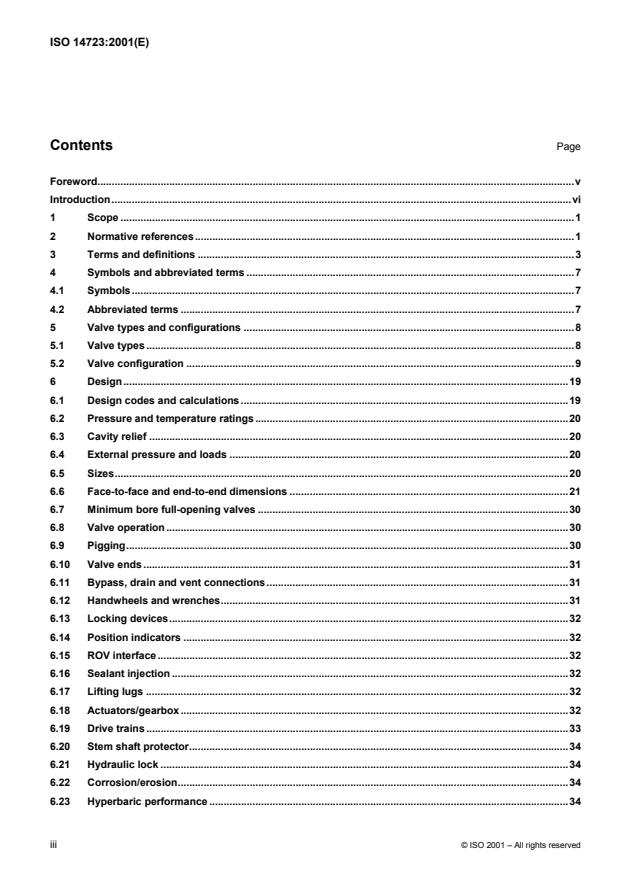
Contents Page
Foreword.v
Introduction.vi
1 Scope .1
2 Normative references.1
3 Terms and definitions .3
4 Symbols and abbreviated terms .7
4.1 Symbols.7
4.2 Abbreviated terms .7
5 Valve types and configurations .8
5.1 Valve types .8
5.2 Valve configuration .9
6 Design.19
6.1 Design codes and calculations .19
6.2 Pressure and temperature ratings .20
6.3 Cavity relief .20
6.4 External pressure and loads .20
6.5 Sizes.20
6.6 Face-to-face and end-to-end dimensions .21
6.7 Minimum bore full-opening valves .30
6.8 Valve operation .30
6.9 Pigging.30
6.10 Valve ends .31
6.11 Bypass, drain and vent connections.31
6.12 Handwheels and wrenches.31
6.13 Locking devices.32
6.14 Position indicators .32
6.15 ROV interface .32
6.16 Sealant injection .32
6.17 Lifting lugs .32
6.18 Actuators/gearbox .32
6.19 Drive trains .33
6.20 Stem shaft protector.34
6.21 Hydraulic lock .34
6.22 Corrosion/erosion.34
6.23 Hyperbaric performance .34
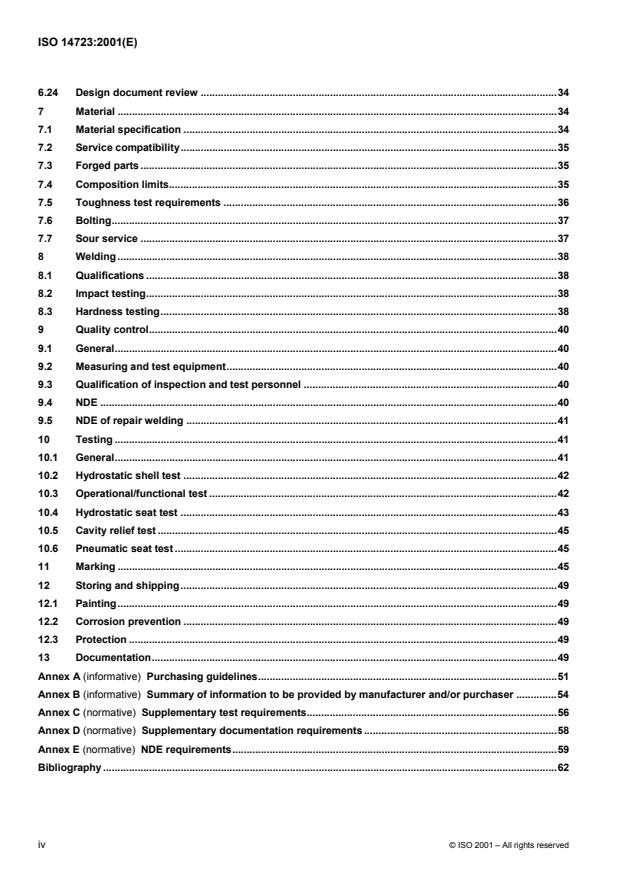
iii © ISO 2001 – All rights reserved
6.24 Design document review .34
7 Material .34
7.1 Material specification .34
7.2 Service compatibility.35
7.3 Forged parts .35
7.4 Composition limits.35
7.5 Toughness test requirements .36
7.6 Bolting.37
7.7 Sour service .37
8 Welding .38
8.1 Qualifications .38
8.2 Impact testing.38
8.3 Hardness testing.38
9 Quality control.40
9.1 General.40
9.2 Measuring and test equipment.40
9.3 Qualification of inspection and test personnel .40
9.4 NDE .40
9.5 NDE of repair welding .41
10 Testing .41
10.1 General.41
10.2 Hydrostatic shell test .42
10.3 Operational/functional test .42
10.4 Hydrostatic seat test .43
10.5 Cavity relief test .45
10.6 Pneumatic seat test .45
11 Marking .45
12 Storing and shipping.49
12.1 Painting.49
12.2 Corrosion prevention .49
12.3 Protection .49
13 Documentation.49
Annex A (informative) Purchasing guidelines.51
Annex B (informative) Summary of information to be provided by manufacturer and/or purchaser .54
Annex C (normative) Supplementary test requirements.56
Annex D (normative) Supplementary documentation requirements .58
Annex E (normative) NDE requirements.59
Bibliography .62
iv © ISO 2001 – All rights reserved
Foreword
ISO (the International Organization for Standardization) is a worldwide federation of national standards bodies (ISO
member bodies). The work of preparing International Standards is normally carried out through ISO technical
committees. Each member body interested in a subject for which a technical committee has been established has
the right to be represented on that committee. International organizations, governmental and non-governmental, in
liaison with ISO, also take part in the work. ISO collaborates closely with the International Electrotechnical
Commission (IEC) on all matters of electrotechnical standardization.
International Standards are drafted in accordance with the rules given in the ISO/IEC Directives, Part 3.
The main task of technical committees is to prepare International Standards. Draft International Standards adopted
by the technical committees are circulated to the member bodies for voting. Publication as an International
Standard requires approval by at least 75 % of the member bodies casting a vote.
Attention is drawn to the possibility that some of the elements of this International Standard may be the subject of
patent rights. ISO shall not be held responsible for identifying any or all such patent rights.
ISO 14723 was prepared by Technical Committee ISO/TC 67, Materials, equipment and offshore structures for
petroleum and natural gas industries, Subcommittee SC 2, Pipeline transportation systems.
Annexes C, D and E form a normative part of this International Standard. Annexes A and B are for information only.
Introduction
This International Standard is based on ISO 14313. It has been developed to address special requirements specific
to subsea pipeline valves.
Users of this International Standard should be aware that further or differing requirements may be needed for
individual applications. This International Standard is not intended to inhibit a contractor from offering, or the
company from accepting, alternative engineering solutions for the individual application. This may be particularly
applicable where there is innovative or developing technology. Where an alternative is offered, the manufacturer
should identify any variations from this International Standard and provide details.
vi © ISO 2001 – All rights reserved
INTERNATIONAL STANDARD ISO 14723:2001(E)
Petroleum and natural gas industries — Pipeline transportation
systems — Subsea pipeline valves
1 Scope
This International Standard specifies requirements and gives recommendations for the design, manufacturing,
testing and documentation of ball, check and gate valves for subsea application in offshore pipeline systems
meeting the requirements of ISO 13623 for the petroleum and natural gas industries.
This International Standard is not applicable to valves for pressure ratings exceeding PN 420 (Class 2500).
Annex A of this International Standard provides guidelines to assist the purchaser with valve type selection and
specification of requirements when ordering valves.
Annex B of this International Standard provides a checklist summary of information to be provided by the
manufacturer and/or purchaser when ordering valves.
2 Normative references
The following normative documents contain provisions which, through reference in this text, constitute provisions of
this International Standard. For dated references, subsequent amendments to, or revisions of, any of these
publications do not apply. However, parties to agreements based on this International Standard are encouraged to
investigate the possibility of applying the most recent editions of the normative documents indicated below. For
undated references, the latest edition of the normative document referred to applies. Members of ISO and IEC
maintain registers of currently valid International Standards.
ISO 7-1, Pipe threads where pressure-tight joints are made on the threads — Part 1: Dimensions, tolerances and
designation
ISO 148, Steel — Charpy impact test (V-notch)
ISO 228-1, Pipe threads where pressure-tight joints are not made on the threads — Part 1: Dimensions, tolerances
and designation
ISO 228-2, Pipe threads where pressure-tight joints are not made on the threads — Part 2: Verification by means
of limit gauges
ISO 5208, Industrial valves — Pressure testing of valves
ISO 7005-1, Metallic flanges — Part 1: Steel flanges
ISO 9712, Non-destructive testing — Qualification and certification of personnel
ISO 10474, Steel and steel products — Inspection documents
ISO 13623, Petroleum and natural gas industries — Pipeline transportation systems
1)
ASME B1.1, Unified inch screw threads (UN and UNR thread form)
1) American Society of Mechanical Engineers, 345 East 47th Street, NY 10017-2392, USA.
ASME B1.20.1, Pipe threads, general purpose (inch)
ASME B16.5, Pipe flanges and flanged fittings — NPS 1/2 through NPS 24
ASME B16.10, Face-to-face and end-to-end dimensions of valves
ASME B16.25, Buttwelding ends
ASME B16.34, Valves — Flanged, threaded, and welding end
ASME B16.47, Large diameter steel flanges — NPS 26 through NPS 60
ASME B31.4, Pipeline transportation systems for liquid hydrocarbons and other liquids
ASME B31.8, Gas transmission and distribution systems
ASME Boiler and Pressure Vessel Code:1998, Section V, Non destructive examination
ASME Boiler and Pressure Vessel Code:1998, Section VIII, Division 1, Rules for construction of pressure vessels
ASME Boiler and Pressure Vessel Code, Section IX, Qualification standard for welding and brazing procedures,
welders, brazers, and welding and brazing operators
2)
ASTM A 320/A 320M, Standard specification for alloy steel bolting materials for low-temperature service
ASTM A 370, Standard test methods and definitions for mechanical testing of steel products
ASTM A 388/A 388M, Standard practice for ultrasonic examination of heavy steel forgings
ASTM A 435/A 435M, Standard specification for straight-beam ultrasonic examination of steel plates
ASTM A 577/A 577M, Standard specification for ultrasonic angle-beam examination of steel plates
ASTM A 578/A 578M, Standard specification for straight-beam ultrasonic examination of plain and clad steel plates
for special applications
ASTM A 609/A 609M:1997, Standard practice for castings, carbon low-alloy, and martensitic stainless steel,
ultrasonic examination thereof
3)
AWS QC1, Standard for AWS certification of welding inspectors
EN 287-1, Approval testing of welders — Fusion welding — Part 1: Steels
EN 288-3, Specification and approval of welding procedures for metallic materials Part 3: Welding procedure
tests for the arc welding of steels
4)
MSS SP-44, Steel pipeline flanges
MSS SP-55, Quality standard for steel castings, flanges, fittings and other piping components — Visual method for
evaluation of surface irregularities
5)
NACE MR 0175, Sulfide stress cracking resistant metallic materials for oilfield equipment
NACE TM 0284, Evaluation of pipeline and pressure vessel steels for resistance to hydrogen-induced cracking
2) American Society for Testing and Materials, 100 Barr Harbor Drive, West Conshohocken, PA 19428-2959, USA.
3) The American Welding Society, 550 NW LeJeune Road, Miami, FL 33126, USA.
4) Manufacturers Standardization Society of the Valve & Fittings Industry Inc., 127 Park Street N.E., Vienna, VA 22180, USA.
5) National Association of Corrosion Engineers, P.O. Box 218340, Houston, TX 77218, USA.
2 © ISO 2001 – All rights reserved
3 Terms and definitions
For the purposes of this International Standard, the following terms and definitions apply.
3.1
ANSI rating class
numerical pressure design class defined in ASME B16.5 and used for reference purposes
NOTE The ANSI rating class is designated by the word “Class” followed by a number.
[ISO 14313:1999]
3.2
bi-directional valve
valve designed for blocking the fluid in both downstream and upstream directions
[ISO 14313:1999]
3.3
bleed
drain or vent
[ISO 14313:1999]
3.4
block valve
ball or gate valve that blocks flow into the downstream conduit when in the closed position
NOTE 1 Valves are either single- or double-seated, bi-directional or uni-directional.
NOTE 2 Adapted from ISO 14313:1999.
3.5
breakaway thrust [torque]
thrust [torque] required for opening a valve with maximum pressure differential
NOTE Adapted from ISO 14313:1999.
3.6
by agreement
agreed between manufacturer and purchaser
[ISO 14313:1999]
3.7
double-block-and-bleed valve
valve with two seating surfaces which, in the closed position, blocks flow from both valve ends when the cavity
between the seating surfaces is vented through a bleed connection provided on the body cavity
[ISO 14313:1999]
3.8
drive train
all parts of a valve drive between the operator and the obturator, including the obturator but excluding the operator
[ISO 14313:1999]
3.9
flow coefficient
q
v
volumetric flowrate of water at a temperature between 5 °C (40 °F) and 40 °C (104 °F) passing through a valve and
resulting in a pressure loss of 100 kPa (14,7 psi)
NOTE 1 It is expressed in cubic metres per hour.
NOTE 2 q relates to the flowrate coefficient C in US gallons per minute at 15,6 °C (60 °F) resulting in 1 psi pressure drop as
v v
follows:
C
v
q =
v
1,156
NOTE 3 Adapted from ISO 14313:1999.
3.10
full-opening valve
valve with an unobstructed opening capable of allowing a sphere or other internal device for the same nominal size
as the valve to pass
[ISO 14313:1999]
3.11
handwheel
wheel consisting of a rim connected to a hub, for example by spokes, and used to operate manually a valve
requiring multiple turns
[ISO 14313:1999]
3.12
locking device
part or an arrangement of parts for securing a valve in the open and/or closed position
[ISO 14313:1999]
3.13
manual operator
wrench (lever) or handwheel with or without a gearbox
[ISO 14313:1999]
3.14
maximum pressure differential
MPD
maximum difference between the upstream and downstream pressures across the obturator at which the obturator
may be operated
NOTE Adapted from ISO 14313:1999.
3.15
nominal pipe size
NPS
numerical inches designation of size which is common to components in piping systems of any one size
NOTE The nominal pipe size is designated by the letters NPS followed by a number
[ISO 14313:1999]
4 © ISO 2001 – All rights reserved
3.16
nominal pressure class
PN class
numerical pressure design class as defined in ISO 7005-1 and used for reference purposes
NOTE The nominal pressure class is designated by the letters PN followed by a number.
[ISO 14313:1999]
3.17
nominal size
DN
numerical metric designation of size which is common to components in piping systems of any one size
NOTE Nominal size is designated by the letters DN followed by a number.
[ISO 14313:1999]
3.18
obturator
closure member
part of a valve which is positioned in the flow stream to permit or block flow
EXAMPLE Ball, clapper, disc, gate or plug.
NOTE Adapted from ISO 14313:1999.
3.19
operator
device (or assembly) for opening or closing a valve
[ISO 14313:1999]
3.20
pipe pup
short piece of pipe with length typically equivalent to one or two times its diameter, welded directly to the valve to
prevent valve seal damage from girth welding, for transition of valve material to pipeline strength properties, or to
provide a valve end mating the pipeline dimensions
3.21
position indicator
device to show the position of the valve obturator
[ISO 14313:1999]
3.22
powered operator
powered actuator
electric, hydraulic or pneumatic device bolted or otherwise attached to the valve for powered opening and closing
of the valve
[ISO 14313:1999]
3.23
pressure cap
cap designed to contain internal pressure in the event of seal leakage or to prevent ingress due to hyperbaric
pressure
3.24
pressure class
numerical pressure design class expressed in accordance with either the nominal pressure class or the ANSI rating
class
NOTE 1 In this International Standard the pressure class is stated by the PN class, followed by the ANSI rating class between
parentheses.
NOTE 2 Adapted from ISO 14313:1999.
3.25
pressure-containing part
part designed to contain the pipeline fluid
EXAMPLES Bodies, bonnets, glands, stems, gaskets and bolting.
NOTE Adapted from ISO 14313:1999.
3.26
pressure-controlling part
part intended to block or permit the flow of fluids
EXAMPLE Seat and obturator.
NOTE Adapted from ISO 14313:1999.
3.27
process-wetted part
part exposed directly to the pipeline fluid
NOTE Adapted from ISO 14313:1999.
3.28
protection cap
cover to protect valve parts from mechanical damage
NOTE A pressure cap may also be used for protection.
3.29
reduced-opening valve
valve with the opening through the obturator smaller than at the end connection(s)
[ISO 14313:1999]
3.30
remote-operated vehicle
ROV
underwater vehicle operated remotely from a surface vessel or installation
3.31
seating surface
contact surface of the obturator and seat which ensure valve sealing
NOTE Adapted from ISO 14313:1999.
3.32
shaft
part of a check valve that connects the obturator to the operator and which may consist of one or more components
6 © ISO 2001 – All rights reserved
3.33
stem
part that connects the obturator to the operator and which may consist of one or more components
[ISO 14313:1999]
3.34
support ribs
legs
metal structure which provides a stable footing when the valve is set on a fixed base
NOTE Adapted from ISO 14313:1999.
3.35
through-conduit valve
valve with an unobstructed and continuous cylindrical opening
[ISO 14313:1999]
3.36
twin-seat valve
〈both seats bi-directional〉 valve with two seats, each sealing in either direction
NOTE Adapted from ISO 14313:1999.
3.37
twin-seat valve
〈one seat uni-directional and one seat bi-directional〉 valve with two seats, one sealing in one direction and the
other in either direction
NOTE Adapted from ISO 14313:1999.
3.38
uni-directional valve
valve designed for blocking the flow in one direction only
[ISO 14313:1999]
4 Symbols and abbreviated terms
4.1 Symbols
C Flow coefficient in United States Customary (USC) units
v
q Flow coefficient in SI units
v
4.2 Abbreviated terms
BM Base metal
CE Carbon equivalent
DN Nominal size
HAZ Heat-affected zone
HBW Brinell hardness
HIC Hydrogen-induced cracking
HRC Rockwell hardness
HV Vickers hardness
MPD Maximum pressure differential
MT Magnetic-particle testing
NDE Non-destructive examination
NPS Nominal pipe size
PN Nominal pressure
PQR Procedure qualification record
PT Penetrant testing
PWHT Post-weld heat treatment
ROV Remote-operated vehicle
RT Radiographic testing
SMYS Specified minimum yield strength
SSIV Subsea isolation valve
UT Ultrasonic testing
VT Visual testing
WM Weld metal
WPS Welding procedure specification
WQR Welder qualification record
5 Valve types and configurations
5.1 Valve types
5.1.1 Gate valves
Typical configurations for gate valves with flanged and welding ends are shown in Figures 1 and 2.
Gate valves shall have an obturator which moves in a plane perpendicular to the direction of flow. The direction of
travel of the gate should be down for closed, but may be reverse-acting in which case the gate is up for closed.
5.1.2 Ball valves
Typical configurations for ball valves with flanged or welding ends are shown in Figures 3, 4 and 5.
Ball valves shall have a spherical obturator which rotates on an axis perpendicular to the direction of flow, rotating
clockwise to close.
8 © ISO 2001 – All rights reserved
5.1.3 Check valves
Typical configurations for check valves are shown in Figures 6, 7, 8 and 9.
Check valves shall have an obturator which responds automatically to block fluid in one direction.
5.2 Valve configuration
5.2.1 Full-opening valves
Full-opening valves shall be unobstructed in the fully opened position and have an internal bore as specified in
Table 1. There is no restriction on the upper limit of valve bore sizes.
Full-opening through-conduit valves shall have a circular bore in the obturator that allows a sphere with a nominal
size not less than that specified in Table 1 to pass.
Welding-end valves may require a smaller bore at the welding end to mate with the pipe.
5.2.2 Reduced-opening valves
The internal bore of reduced-opening valves shall be less than the internal bore specified in Table 1.
Table 1 — Minimum bore for full-opening valves by pressure class
Minimum bore
Nominal size
mm
PN 20 to 100 PN 150 PN 250 PN 420
DN NPS
(Class 150 to 600) (Class 900) (Class 1500) (Class 2500)
50 2 49 49 49 42
65 2 / 62 62 62 52
80 3 74 74 74 62
100 4 100 100 100 87
150 6 150 150 144 131
200 8 201 201 192 179
250 10 252 252 239 223
300 12 303 303 287 265
350 14 334 322 315 —
400 16 385 373 360 —
450 18 436 423 — —
500 20 487 471 — —
550 22 538 522 — —
600 24 589 570 — —
650 26 633 617 — —
700 28 684 665 — —
750 30 735 712 — —
760 — —
800 32 779
850 34 830 808 — —
900 36 874 855 — —
950 38 925 — — —
1 000 40 976 — — —
1 050 42 1 020 — — —
1 200 48 1 166 — — —
1 350 54 1 312 — — —
1 400 56 1 360 — — —
1 500 60 1 458 — — —
10 © ISO 2001 – All rights reserved
Key
1 Stem indicator
2 Stem enclosure
3 Handwheel
4 Yoke nut
5 Yoke
6 Stem
7 Yoke bolting
8 Stem packing
9 Relief valve
10 Bonnet
11 Bonnet bolting
12 Gate guide
13 Gate assembly
14 Seat ring
15 Body
16 Support ribs or legs
17 Raised face
18 Welding end
19 Ring joint
A Raised-face face-to-face
dimension
B Welding-end end-to-end
dimension
C Ring-joint end-to-end
dimension
Figure 1 — Expanding-gate/rising-stem gate valve
Key
1 Stem indicator
2 Stem enclosure
3 Handwheel
4 Yoke nut
5 Yoke
6 Stem
7 Yoke bolting
8 Stem packing
9 Relief valve
10 Bonnet
11 Bonnet bolting
12 Gate
13 Seat ring
14 Body
15 Support ribs or legs
16 Raised face
17 Welding end
18 Ring joint
A Raised-face face-to-face
dimension
B Welding-end end-to-end
dimension
C Ring-joint end-to-end
dimension
Figure 2 — Slab-gate/through-conduit rising-stem gate valve
12 © ISO 2001 – All rights reserved
Key
1 Stem seal
2 Bonnet cover
3 Bonnet
4 Body bolting
5 Body
6 Seat ring
7 Stem
8 Ball
9 Raised face
10 Welding end
11 Ring joint
A Raised-face face-to-face
dimension
B Welding-end end-to-end
dimension
C Ring-joint end-to-end
dimension
Figure 3 — Top-entry ball valve
Key
1 Stem
2 Body cover
3 Stem seal
4 Body
5 Seat ring
6 Ball
7 Body bolting
8 Closure
9 Raised face
10 Welding end
11 Ring joint
A Raised-face face-to-face
dimension
B Welding-end end-to-end
dimension
C Ring-joint end-to-end
dimension
Figure 4 — Three-piece ball valve
14 © ISO 2001 – All rights reserved
Key
1 Stem
2 Body cover
3 Stem seal
4 Body
5 Seat ring
6 Ball
7 Closure
8 Raised face
9 Welding end
10 Ring joint
A Raised-face face-to-face
dimension
B Welding-end end-to-end
dimension
C Ring-joint end-to-end
dimension
Figure 5 — Welded-body ball valve
Key
1 Cover bolting
2 Cover
3 Body
4 Clapper disc arm
5 Shaft
6 Clapper disc
7 Seat ring
8 Support ribs or legs
9 Raised face
10 Welding end
11 Ring joint
12 Direction of flow
A Raised-face face-to-face
dimension
B Welding-end end-to-end
dimension
C Ring-joint end-to-end
dimension
Figure 6 — Reduced-opening swing check valve
16 © ISO 2001 – All rights reserved
Key
1 Cover bolting
2 Cover
3 Body
4 Clapper disc arm
5 Shaft
6 Seat ring
7 Clapper disc
8 Support ribs or legs
9 Raised face
10 Welding end
11 Ring joint
12 Direction of flow
A Raised-face face-to-face
dimension
B Welding-end end-to-end
dimension
C Ring-joint end-to-end
dimension
Figure 7 — Full-opening swing check valve
Key
1 Body
2 Hinge
3 Nut
4 Closure plate/stud assembly
5 Seat ring
6 Bearing spacers
7 Hinge pin
8 Hinge pin retainers
9 Direction of flow
Figure 8 — Single-plate wafer-type check valve, long pattern
18 © ISO 2001 – All rights reserved
Key
1 Body
2 Closure plate
3 Stop pin
4 Spring
5 Hinge pin
6 Plate lug bearings
7 Body lug bearings
8 Stop pin retainers
9 Hinge pin retainers
10 Spring bearings
11 Direction of flow
Figure 9 — Typical dual-plate wafer-type check valve, long pattern
6 Design
6.1 Design codes and calculations
Pressure-containing parts including bolting shall be designed with materials specified in clause 7. The pressure-
containment design and calculations shall be in accordance with an agreed pressure vessel design standard, for
example ASME Section VIII Division 1 or Division 2, or BS 5500. The allowable stress values shall be consistent
with the pressure vessel design standard.
If design standards have test pressures less than 1,5 times the design pressure, then the design pressure for the
body calculation shall be increased such that the hydrostatic test pressure in 10.2 can be applied.
6.2 Pressure and temperature ratings
The purchaser shall specify whether the PN class or the ANSI class shall be used for the specification of the
required pressure class.
Valves to which this International Standard is applicable should be furnished in one of the following classes:
PN 20 (Class 150) PN 150 (Class 900)
PN 50 (Class 300) PN 250 (Class 1500)
PN 64 (Class 400) PN 420 (Class 2500)
PN 100 (Class 600)
Pressure classes shall be specified by the purchaser in accordance with the applicable rating tables for material
groups in ASME B16.34 and the pipeline system design.
The purchaser may specify intermediate design pressures and temperatures for a specific application.
Allowable operating pressures and temperatures for valves made of materials not covered by ASME B16.34 shall
be determined by calculations in accordance with an agreed pressure vessel design standard, for example ASME
Section VIII Division 1 or Division 2, or BS 5500.
NOTE Non-metallic parts can limit minimum and maximum operating pressures and temperatures.
The minimum design temperature shall be 0 °C unless otherwise specified by the purchaser.
6.3 Cavity relief
The manufacturer shall determine whether fluid can become trapped in the body cavity in the open and/or closed
position. If fluid trapping is possible, then valves shall be provided with an automatic cavity pressure relief unless
otherwise specified by the purchaser. External cavity relief shall not be used.
6.4 External pressure and loads
Valves shall be designed for loads other than internal pressure and temperature (see 6.2), if specified by the
purchaser. The purchaser shall specify any other construction, test, functional or accidental load combinations or
external pressures which shall be accounted for in the design.
NOTE ISO 13623 specifies construction, functional and accidental loads and provides examples of such loads for
consideration by the purchaser.
6.5 Sizes
All valves, except for reduced-opening valves, shall be furnished in the DN sizes listed in Tables 2 to 5. Reduced-
opening valves shall be furnished in the nominal sizes in accordance with Table 1.
NOTE In this International Standard, DN sizes are stated first, followed by the equivalent NPS size between parentheses.
Except for reduced-opening valves, valve sizes shall be specified by DN or NPS.
Reduced-opening valves with a circular opening through the obturator shall be specified by the nominal size of the
end connections and the nominal size of the minimum bore of the obturator in accordance with Table 1, except that
for valve sizes DN 50 (NPS 2) or smaller, the actual bore of the obturator shall be specified.
EXAMPLE 1 A DN 400 (NPS 16) valve with a reduced 334-mm-diameter circular opening through the obturator is specified
as 400 × 350.
20 © ISO 2001 – All rights reserved
Reduced-opening valves with a non-circular opening through the obturator and reduced-opening check valves shall
be designated as reduced-bore valves and specified by the nominal size corresponding to the end connections
followed by the letter “R”.
EXAMPLE 2 A reduced-bore valve with DN 400 (NPS 16) end connections and a 381 × 305 mm rectangular opening
through the obturator is specified as 400R.
6.6 Face-to-face and end-to-end dimensions
Face-to-face and end-to-end dimensions of valves shall be in accordance with Tables 2 to 5 for the A, B and C
dimensions corresponding to Figures 1 to 7, unless otherwise agreed.
Face-to-face and end-to-end dimensions for valve sizes not specified in Tables 2 to 5 shall be in accordance with
ASME B16.10. Face-to-face and end-to-end dimensions not shown in Tables 2 to 5 or in ASME B16.10 shall be
established by agreement.
The length of valves having one welding end and one flanged end shall be determined by adding half the length of
a flanged-end valve to half the length of a welding-end valve.
Tolerances on the face-to-face and end-to-end dimensions shall be ± 2 mm for valve sizes DN 250 and smaller,
and ± 3 mm for valve sizes DN 300 and larger, unless otherwise agreed.
The nominal size and face-to-face or end-to-end dimensions shall be stated on the nameplate.
Table 2 — Gate valves Face-to-face and end-to-end dimensions
Dimensions in millimetres
DN NPS Raised Welding Ring Raised Welding Ring
face end joint face end joint
A B C A B C
PN 20 (Class 150) PN 50 (Class 300)
50 2 178 216 191 216 216 232
65 2 / 191 241 203 241 241 257
80 3 203 283 216 283 283 298
100 4 229 305 241 305 305 321
150 6 267 403 279 403 403 419
200 8 292 419 305 419 419 435
250 10 330 457 343 457 457 473
300 12 356 502 368 502 502 518
350 14 381 572 394 762 762 778
400 16 406 610 419 838 838 854
450 18 432 660 445 914 914 930
500 20 457 711 470 991 991 1 010
550 22 — — — 1 092 1 092 1 114
600 24 508 813 521 1 143 1 143 1 165
650 26 559 864 — 1 245 1 245 1 270
700 28 610 914 — 1 346 1 346 1 372
a
750 30 610 914 — 1 397 1 397 1 422
800 32 711 965 — 1 524 1 524 1 553
850 34 762 1 016 — 1 626 1 626 1 654
b
900 36 711 1 016 — 1 727 1 727 1 756
PN 64 (Class 400) PN 100 (Class 600)
50 2 292 292 295 292 292 295
65 2 / 330 330 333 330 330 333
80 3 356 356 359 356 356 359
100 4 406 406 410 432 432 435
150 6 495 495 498 559 559 562
200 8 597 597 600 660 660 664
250 10 673 673 676 787 787 791
300 12 762 762 765 838 838 841
350 14 826 826 829 889 889 892
400 16 902 902 905 991 991 994
450 18 978 978 981 1 092 1 092 1 095
500 20 1 054 1 054 1 060 1 194 1 194 1 200
550 22 1 143 1 143 1 153 1 295 1 295 1 305
600 24 1 232 1 232 1 241 1 397 1 397 1 407
650 26 1 308 1 308 1 321 1 448 1 448 1 461
700 28 1 397 1 397 1 410 1 549 1 549 1 562
750 30 1 524 1 524 1 537 1 651 1 651 1 664
800 32 1 651 1 651 1 667 1 778 1 778 1 794
850 34 1 778 1 778 1 794 1 930 1 930 1 946
900 36 1 880 1 880 1 895 2 083 2 083 2 099
22 © ISO 2001 – All rights reserved
Table 2 (continued)
DN NPS Raised Welding Ring Raised Welding Ring
face end joint face end joint
A B C A B C
PN 150 (Class 900) PN 250 (Class 1500)
50 2 368 368 371 368 368 371
65 2 / 419 419 422 419 419 422
80 3 381 381 384 470 470 473
100 4 457 457 460 546 546 549
150 6 610 610 613 705 705 711
200 8 737 737 740 832 832 841
250 10 838 838 841 991 991 1 000
300 12 965 965 968 1 130 1 130 1 146
350 14 1 029 1 029 1 038 1 257 1 257 1 276
400 16 1 130 1 130 1 140 1 384 1 384 1 407
450 18 1 219 1 219 1 232 1 537 1 537 1 559
500 20 1 321 1 321 1 334 1 664 1 664 1 686
550 22 — — — — — —
600 24 1 549 1 549 1 568 1 943 1 943 1 972
PN 420 (Class 2500)
50 2 451 451 454
65 2 / 508 508 514
80 3 578 578 584
100 4 673 673 683
150 6 914 914 927
200 8 1 022 1 022 1 038
250 10 1 270 1 270 1 292
300 12 1 422 1 422 1 445
a
Through-conduit valves shall be 650 mm.
b
Through-conduit valves shall be 800 mm.
NOTE For dimensions A, B and C see Figures 1 and 2.
Table 3 — Ball valves — Face-to-face and end-to-end dimensions
Dimensions in millimetres
Full-bore and reduced-bore Short-pattern, full-bore and
reduced-bore
DN NPS Raised Welding Ring Raised Welding Ring
face end joint face end joint
A B C A B C
PN 20 (Class 150)
50 2 178 216 191 — — —
65 2 / 191 241 203 — — —
80 3 203 283 216 — — —
100 4 229 305 241 — — —
150 6 394 457 406 267 403 279
200 8 457 521 470 292 419 305
250 10 533 559 546 330 457 343
300 12 610 635 622 356 502 368
350 14 686 762 699 — — —
400 16 762 838 775 — — —
450 18 864 914 876 — — —
...
Questions, Comments and Discussion
Ask us and Technical Secretary will try to provide an answer. You can facilitate discussion about the standard in here.
Loading comments...