

ISO 23296:2025
(Main)Metallic materials — Fatigue testing — Force controlled thermo-mechanical fatigue testing method
General Information
- Abstract
This document applies to force-controlled thermo-mechanical fatigue (TMF) testing. Both forms of control, force or stress, can be applied according to this document. This document describes the equipment, specimen preparation, and presentation of the test results to determine TMF properties.
- Status
- Published
- Publication Date
- 20-Nov-2025
- Technical Committee
- ISO/TC 164/SC 4 - Fatigue, fracture and toughness testing
- Drafting Committee
- ISO/TC 164/SC 4 - Fatigue, fracture and toughness testing
- Current Stage
- 6060 - International Standard published
- Start Date
- 21-Nov-2025
- Due Date
- 03-Oct-2025
- Completion Date
- 21-Nov-2025
Overview - ISO 23296:2025 (Force‑controlled TMF testing)
ISO 23296:2025 specifies a harmonized method for force‑controlled thermo‑mechanical fatigue (TMF) testing of metallic materials. The standard covers test objectives, equipment, specimen preparation and the presentation of results required to determine TMF properties under simultaneous thermal and mechanical cycling. It is intended to improve reproducibility and compatibility of force‑controlled TMF data across test laboratories and material studies.
Key topics and technical requirements
- Scope of control: Applies to force‑controlled TMF; both force or stress control modes are accommodated.
- Apparatus and calibration: Requirements for testing machines, calibration of the force‑measuring system, cycle counting, waveform generation/control, fixtures, alignment verification, heating and cooling devices. (See clauses on apparatus and ISO 7500‑1/ISO 23788 references.)
- Specimen requirements: Geometry, preparation, measurement, handling, insertion and thermocouple attachment (including spot welding) are specified to ensure consistent thermal and mechanical response.
- Temperature management: Guidance on temperature measurement, control, thermal profiling and maximum permissible temperature variation along the gauge section. Includes use of data recorders and furnace positioning.
- Waveform and force optimisation: Practical steps for force waveform design and temperature‑force interaction to meet test objectives.
- Instrumentation: Use of extensometers to monitor strain/ratcheting effects, and thermal imaging or thermocouple arrangements for profiling (informative annexes).
- Test execution & reporting: Start/monitoring/termination procedures, data recording, validation of analysis software and essential report contents (including fracture surface examination). Measurement uncertainty guidance is provided in an annex.
Applications and who uses it
ISO 23296:2025 is relevant to:
- Materials and mechanical test laboratories performing TMF characterization.
- Aerospace, power‑generation and turbomachinery manufacturers evaluating components (e.g., blades, vanes) exposed to coupled thermal and mechanical cycles.
- Materials engineers and researchers developing high‑temperature alloys and validating life‑prediction models.
- Quality assurance and certification bodies requiring reproducible TMF fatigue data.
Practical applications include generating force‑to‑life (S–N) TMF curves, assessing damage under service‑like thermal/mechanical phasing, and validating design margins for high‑temperature cyclic loading.
Related standards
- ISO 7500‑1:2018 (calibration/verification of force measurement)
- ISO 23788:2012 (alignment verification of fatigue machines)
- ASTM E2368 and ISO 12111 (strain‑controlled TMF - complementary but different control approach)
Keywords: ISO 23296:2025, thermo‑mechanical fatigue, TMF testing, force‑controlled TMF, metallic materials, fatigue testing, specimen preparation, thermal profiling, extensometer, thermocouple.
Relations
- Effective Date
- 08-Oct-2022
Get Certified
Connect with accredited certification bodies for this standard

Element Materials Technology
Materials testing and product certification.

Inštitut za kovinske materiale in tehnologije
Institute of Metals and Technology. Materials testing, metallurgical analysis, NDT.
Sponsored listings
Frequently Asked Questions
ISO 23296:2025 is a standard published by the International Organization for Standardization (ISO). Its full title is "Metallic materials — Fatigue testing — Force controlled thermo-mechanical fatigue testing method". This standard covers: This document applies to force-controlled thermo-mechanical fatigue (TMF) testing. Both forms of control, force or stress, can be applied according to this document. This document describes the equipment, specimen preparation, and presentation of the test results to determine TMF properties.
This document applies to force-controlled thermo-mechanical fatigue (TMF) testing. Both forms of control, force or stress, can be applied according to this document. This document describes the equipment, specimen preparation, and presentation of the test results to determine TMF properties.
ISO 23296:2025 is classified under the following ICS (International Classification for Standards) categories: 77.040.10 - Mechanical testing of metals. The ICS classification helps identify the subject area and facilitates finding related standards.
ISO 23296:2025 has the following relationships with other standards: It is inter standard links to ISO 23296:2022. Understanding these relationships helps ensure you are using the most current and applicable version of the standard.
ISO 23296:2025 is available in PDF format for immediate download after purchase. The document can be added to your cart and obtained through the secure checkout process. Digital delivery ensures instant access to the complete standard document.
Standards Content (Sample)
International
Standard
ISO 23296
Second edition
Metallic materials — Fatigue
2025-11
testing — Force controlled thermo-
mechanical fatigue testing method
Matériaux métalliques — Essai de fatigue — Méthode d'essai de
fatigue thermomécanique à force contrôlée
Reference number
© ISO 2025
All rights reserved. Unless otherwise specified, or required in the context of its implementation, no part of this publication may
be reproduced or utilized otherwise in any form or by any means, electronic or mechanical, including photocopying, or posting on
the internet or an intranet, without prior written permission. Permission can be requested from either ISO at the address below
or ISO’s member body in the country of the requester.
ISO copyright office
CP 401 • Ch. de Blandonnet 8
CH-1214 Vernier, Geneva
Phone: +41 22 749 01 11
Email: copyright@iso.org
Website: www.iso.org
Published in Switzerland
ii
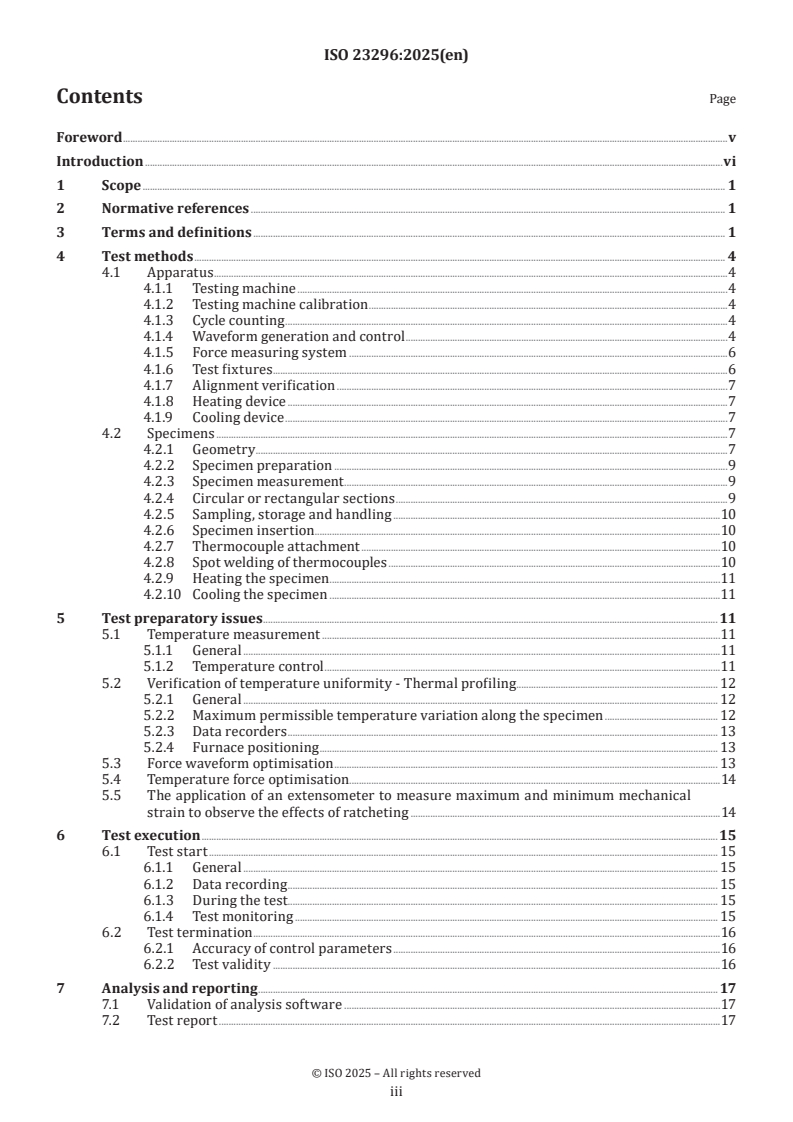
Contents Page
Foreword .v
Introduction .vi
1 Scope . 1
2 Normative references . 1
3 Terms and definitions . 1
4 Test methods . 4
4.1 Apparatus .4
4.1.1 Testing machine .4
4.1.2 Testing machine calibration .4
4.1.3 Cycle counting .4
4.1.4 Waveform generation and control .4
4.1.5 Force measuring system .6
4.1.6 Test fixtures .6
4.1.7 Alignment verification .7
4.1.8 Heating device .7
4.1.9 Cooling device .7
4.2 Specimens .7
4.2.1 Geometry .7
4.2.2 Specimen preparation .9
4.2.3 Specimen measurement .9
4.2.4 Circular or rectangular sections .9
4.2.5 Sampling, storage and handling .10
4.2.6 Specimen insertion .10
4.2.7 Thermocouple attachment .10
4.2.8 Spot welding of thermocouples .10
4.2.9 Heating the specimen . .11
4.2.10 Cooling the specimen .11
5 Test preparatory issues .11
5.1 Temperature measurement .11
5.1.1 General .11
5.1.2 Temperature control .11
5.2 Verification of temperature uniformity - Thermal profiling. 12
5.2.1 General . 12
5.2.2 Maximum permissible temperature variation along the specimen . 12
5.2.3 Data recorders . 13
5.2.4 Furnace positioning . 13
5.3 Force waveform optimisation . 13
5.4 Temperature force optimisation.14
5.5 The application of an extensometer to measure maximum and minimum mechanical
strain to observe the effects of ratcheting .14
6 Test execution .15
6.1 Test start . 15
6.1.1 General . 15
6.1.2 Data recording . 15
6.1.3 During the test. 15
6.1.4 Test monitoring . 15
6.2 Test termination .16
6.2.1 Accuracy of control parameters .16
6.2.2 Test validity .16
7 Analysis and reporting . 17
7.1 Validation of analysis software .17
7.2 Test report .17
iii
7.2.1 General .17
7.2.2 Essential information .17
7.2.3 Additional information .17
7.2.4 Examination of fracture surface .18
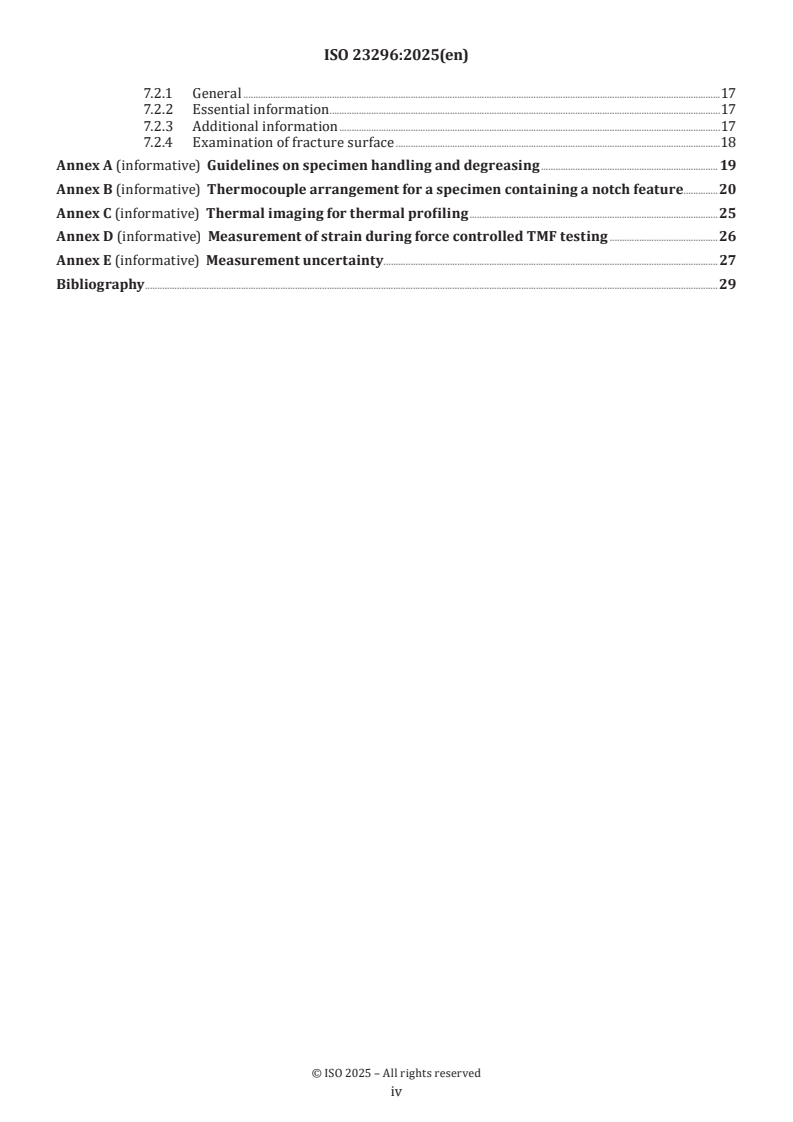
Annex A (informative) Guidelines on specimen handling and degreasing . 19
Annex B (informative) Thermocouple arrangement for a specimen containing a notch feature .20
Annex C (informative) Thermal imaging for thermal profiling .25
Annex D (informative) Measurement of strain during force controlled TMF testing .26
Annex E (informative) Measurement uncertainty.27
Bibliography .29
iv
Foreword
ISO (the International Organization for Standardization) is a worldwide federation of national standards
bodies (ISO member bodies). The work of preparing International Standards is normally carried out through
ISO technical committees. Each member body interested in a subject for which a technical committee
has been established has the right to be represented on that committee. International organizations,
governmental and non-governmental, in liaison with ISO, also take part in the work. ISO collaborates closely
with the International Electrotechnical Commission (IEC) on all matters of electrotechnical standardization.
The procedures used to develop this document and those intended for its further maintenance are described
in the ISO/IEC Directives, Part 1. In particular, the different approval criteria needed for the different types
of ISO document should be noted. This document was drafted in accordance with the editorial rules of the
ISO/IEC Directives, Part 2 (see www.iso.org/directives).
ISO draws attention to the possibility that the implementation of this document may involve the use of (a)
patent(s). ISO takes no position concerning the evidence, validity or applicability of any claimed patent
rights in respect thereof. As of the date of publication of this document, ISO had not received notice of (a)
patent(s) which may be required to implement this document. However, implementers are cautioned that
this may not represent the latest information, which may be obtained from the patent database available at
www.iso.org/patents. ISO shall not be held responsible for identifying any or all such patent rights.
Any trade name used in this document is information given for the convenience of users and does not
constitute an endorsement.
For an explanation of the voluntary nature of standards, the meaning of ISO specific terms and expressions
related to conformity assessment, as well as information about ISO's adherence to the World Trade
Organization (WTO) principles in the Technical Barriers to Trade (TBT), see www.iso.org/iso/foreword.html.
This document was prepared by Technical Committee ISO/TC 164, Mechanical testing of metals, Subcommittee
SC 4, Fatigue, fracture and toughness testing.
This second edition cancels and replaces the first edition (ISO 23296:2022), which has been technically
revised.
The main changes are as follows:
— terms and definitions expanded;
— keys to drawings and text clarification improved.
Any feedback or questions on this document should be directed to the user’s national standards body. A
complete listing of these bodies can be found at www.iso.org/members.html.
v
Introduction
Thermo-mechanical fatigue (TMF) test method was developed in the early 1970’s to simulate, in the
laboratory, loading behaviour of materials under conditions experienced in their service environment,
such as turbine blades and vanes. The TMF test belongs to one of the most complex mechanical testing
methods that can be performed in the laboratory. TMF is cyclic damage induced under varying thermal
and mechanical loadings. When a specimen is subjected to temperature and mechanical strain phasing it
is called strain controlled TMF. ASTM E2368 and ISO 12111 concern strain controlled TMF. However, these
do not allow for specimens where no compensation for free thermal expansion and contraction is required.
Therefore, this document addresses the need for a separate procedure for force controlled TMF testing.
This document covers the determination of TMF properties of materials under uniaxial loaded force-
controlled conditions. A thermo-mechanical fatigue cycle is defined as specimen tests where both
temperature and force amplitude waveform are simultaneously varied and independently controlled over
the specimen gauge or test section. A series of such tests allows the relationship between the applied force
and the number of cycles to failure to be established.
The specific aim of this document is to provide recommendations and guidance for harmonized procedures
for preparing and performing force controlled TMF tests using various specimen geometries. The purpose
of this document is to ensure the compatibility and reproducibility of test results. It does not cover the
evaluation or interpretation of results. Health safety issues, associated with the use of this document, are
solely the responsibility of the user.
The following clauses of this document are intended to provide the steps to be implemented in sequence,
during the process of carrying out force controlled TMF tests.
vi
International Standard ISO 23296:2025(en)
Metallic materials — Fatigue testing — Force controlled
thermo-mechanical fatigue testing method
1 Scope
This document applies to force-controlled thermo-mechanical fatigue (TMF) testing. Both forms of control,
force or stress, can be applied according to this document. This document describes the equipment, specimen
preparation, and presentation of the test results to determine TMF properties.
2 Normative references
The following documents are referred to in the text in such a way that some or all of their content constitutes
requirements of this document. For dated references, only the edition cited applies. For undated references,
the latest edition of the referenced document (including any amendments) applies.
ISO 7500-1:2018, Metallic materials — Calibration and verification of static uniaxial testing machines — Part 1:
Tension/compression testing machines — Calibration and verification of the force-measuring system
ISO 23788:2012, Metallic materials — Verification of the alignment of fatigue testing machines
3 Terms and definitions
For the purposes of this document, the following terms and definitions apply.
ISO and IEC maintain terminology databases for use in standardization at the following addresses:
— ISO Online browsing platform: available at https:// www .iso .org/ obp
— IEC Electropedia: available at https:// www .electropedia .org/
3.1
force
F
instantaneous load applied to the test section, in kN
Note 1 to entry: Tensile forces are positive and compressive forces negative.
3.2
maximum force
F
max
highest algebraic value of force (3.1) applied, in kN
3.3
minimum force
F
min
lowest algebraic value of force (3.1) applied, in kN
3.4
force range
ΔF
algebraic difference between the maximum and minimum forces (3.3), in kN
Note 1 to entry: ΔF = F – F
max min
3.5
force amplitude
F
a
half the algebraic difference between the maximum force (3.2) and minimum force (3.3), in kN
Note 1 to entry: F = (F – F )/2
a max min
3.6
mean force
F
m
half the algebraic sum of the maximum force (3.2) and minimum force (3.3), in kN
Note 1 to entry: F = (F + F )/2
m max min
3.7
force ratio
R
algebraic ratio of the minimum force (3.3) to the maximum force (3.2)
Note 1 to entry: R = F /F
min max
Note 2 to entry: See Figure 2 for examples of different force ratios.
3.8
stress
σ
force (3.1) divided by the nominal cross-sectional area, in MPa
Note 1 to entry: It is the independent variable in a stress-controlled fatigue test.
Note 2 to entry: The nominal cross-sectional area (engineering stress) is that calculated from measurements
taken at ambient temperature and no account is taken for the change in section as a result of expansion at elevated
temperatures.
3.9
stress ratio
R
s
ratio of minimum stress to maximum stress (3.11) during a fatigue cycle
Note 1 to entry: R = σ /σ
s min max
3.10
stress range
Δσ
arithmetic difference between maximum stress (3.11) and minimum stress (3.12), in MPa
Note 1 to entry: Δσ = σ - σ
max min
3.11
maximum stress
σ
max
highest algebraic value of stress (3.8) applied, in MPa
3.12
minimum stress
σ
min
lowest algebraic value of stress (3.8) applied, in MPa
3.13
theoretical stress concentration factor
K
t
ratio of the notch tip stress to net section stress, calculated in accordance with defined elastic theory, to the
nominal section stress
Note 1 to entry: Different methods used in determining K may lead to variations in reported values.
t
3.14
strain ratio
R
ε
ratio of minimum strain to maximum strain during a fatigue cycle
Note 1 to entry: R = ε /ε
ε min max
3.15
fatigue strength at N cycles
σ
N
value of the stress amplitude at a stated stress ratio under which the specimen would have a life of at least N
cycles (3.17) with a stated probability, in MPa
3.16
fatigue life
N
f
number of cycles to failure
3.17
number of force cycles
N
number of loading and unloading sequences applied
3.18
time per cycle
t
time applied per loading and unloading sequence
3.19
maximum temperature
T
max
highest algebraic value of temperature applied, in °C
3.20
minimum temperature
T
min
lowest algebraic value of temperature applied, in °C
3.21
phase angle
Φ
angle between temperature and mechanical force, defined with respect to the temperature as reference
variable
Note 1 to entry: The phase angle is expressed in degrees. A positive phase angle (0°< ɸ <180°) means that the maximum
of force follows behind the maximum temperature.
3.22
parallel length
L
p
length in the gauge test section of a specimen or test piece that has equal test diameter or test width and is
parallel
3.23
specimen length
L
z
overall length of test specimen
3.24
ratcheting
cyclic creep or incremental collapse, in which plastic deformation accumulates due to cyclic mechanical or
thermal stress
4 Test methods
4.1 Apparatus
4.1.1 Testing machine
The tests shall be carried out on a tension-compression machine designed for a smooth start-up. All test
machines shall be used in conjunction with a computer or controller to control the test and log the data
obtained. The test machine shall permit cycling to be carried out between predetermined limits of force
to a specified waveform. For R < 0 tests, there shall be no discernible backlash when passing through
zero. To minimise the risk of buckling of the specimen, the machine should have great lateral rigidity and
accurate alignment between the test space support references. The machine force indicator shall be capable
of displaying cyclic force maxima and minima for applied waveforms to a resolution consistent with the
calibration requirement.
During elevated temperature tests, the machine load cell shall be suitably shielded or cooled such that it
remains within its temperature compensation range.
Machines employing closed loop control systems for force and temperature shall be used.
4.1.2 Testing machine calibration
Machines shall be force calibrated to class 1 of ISO 7500-1:2018.
4.1.3 Cycle counting
The number of cycles applied to the specimen shall be recorded such that for tests lasting less than
10 000 cycles, individual cycles can be resolved, while for longer tests the resolution should be better than
0,01 % of indicated life.
4.1.4 Waveform generation and control
The force cycle waveform shall be maintained consistent and is to be applied at a fixed frequency throughout
the duration of a test programme. The waveform generator in use shall have repeatability such that the
variation in requested force levels between successive cycles is within the calibration tolerance of the test
machine as stated in ISO 7500-1, for the duration of the test.
Terms have been identified relative to the trapezoidal waveforms and can be found in the keys in Figure 1
and Figure 2. Other waveform shapes may require further parameter definition although nomenclature
should be retained where possible. Often, force-controlled TMF loading waveforms do not follow standard
trapezoidal patterns.
The phase angle between temperature and force is defined by the parameter Φ. Typical phase angles to
characterize a TMF test are Φ = 0° which is called “in phase” and Φ = 180° which is called “out of phase”. Any
other phase angle may be possible and permitted.
Key
X time
Y force
a
Mean force.
b
Minimum force.
c
Maximum force.
d
Force range.
e
Force amplitude.
f
One cycle.
Figure 1 — Trapezoidal fatigue force cycle
Key
X time
Y force
a
Cyclic tension.
b
Reversed.
c
Cyclic compression.
Figure 2 — Varying force ratio
4.1.5 Force measuring system
The force measuring system, consisting of a load cell, amplifier, and display, shall meet the requirements of
ISO 7500-1 over the complete range of dynamic forces expected to occur during the TMF test series. The load
cell should be rated for fully-reversed tension-compression fatigue testing. Its overload-capacity should be
at least twice as high as the forces expected during the test. The load cell shall be temperature compensated
and should not have a zero drift and temperature sensitivity variation greater than 0,002 % (full scale/°C).
During the test duration, the load cell should be maintained within the range of temperature compensation
and suitably protected from the heat applied during the test.
4.1.6 Test fixtures
An important consideration for specimen grips and fixtures is that they can be brought into good alignment
consistently from test to test. Good alignment is achieved from very careful attention to design details, i.e.,
specifying the concentricity and parallelism of critical machined parts.
To minimise bending strains, the gripping system should be capable of alignment such that the major axis of
the specimen coincides closely with the force axis throughout each stress cycle. In the case of through zero
tests, (Rε ≤ 0), shall also be free from force backlash.
A parallelism error of less than 0,2 mm/m, and an axial error of less than 0,03 mm for a specimen of less than
300 mm in length, and of less than 0,1 mm for a test space of more than 300 mm in length, should allow the
alignment requirements described in 4.1.7 to be achieved. A further benefit can be realised by minimising
the number of mechanical interfaces in the load train and the distance between the machine actuator and
crosshead.
4.1.7 Alignment verification
Alignment of the load train assembly shall be conducted and verified in accordance with ISO 23788:2012 to
a minimum of class 10.
4.1.8 Heating device
Testing will generally be conducted in air at elevated temperatures, although there may be a requirement to
test in vacuum or in a controlled atmosphere. Where additional apparatus is used such as vacuum chambers
etc., the full force indicated by the force indicator shall be applied to the specimen and is not being diverted
through the auxiliary apparatus (e.g., by friction). The heating device employed shall be such that the
specimen can be uniformly heated to the specified temperature and maintained for the duration of the test.
Radiant lamp furnaces are ideally suited to apply a dynamic temperature change. Induction furnaces are
also suitable for rapid temperature change. However, the specimen geometry (thickness or diameter) and
the temperature rate can be a limiting factor in their application.
4.1.9 Cooling device
To reduce the specimen temperature to the required cooling rate it is recommended to pass gaseous coolant
medium over the surface of the specimen. There are a few devices which can satisfactorily perform this task.
For induction systems, a range of nozzles that can be independently directed at the specimen are adequate
for this task. For radiant lamp furnaces the use of at least one air amplifier is recommended. Coupled to a
compressed air supply, the air amplifier accelerates a curtain of air over the specimen surface relatively
evenly enabling good cooling rates to be achieved.
4.2 Specimens
4.2.1 Geometry
Subject to the objectives of the test programme, the type of specimen geometry used will depend on the
equipment capacity, the type of equipment, and the form in which the material is available. Consideration
should be given to the interface to the test machine i.e., the gripping system and any possible test area
envelope caused by the furnacing.
The gauge portion of the specimen in a TMF test should, under ideal conditions, represent a volume element
of the investigated material contained within the thermally loaded component. Therefore, the geometry
of the specimen should not affect the resulting lifetime behaviour, e.g., due to stress inhomogeneities,
undesired stress deviations etc.
Generally, a specimen having a fully machined test section is of the type shown in Figure 3 for a smooth
cylindrical-type gauge section. The specimens may be of the following:
— circular cross-section with tangentially blending fillets between the test section and the ends, or with a
continuous radius between the ends (i.e., “hourglass” specimen);
— rectangular cross-section of uniform thickness over the test section with tangentially blending fillets
between the test section and the gripped ends (see Figure 4).
Specimens commonly known as “hourglass” specimens may be employed for testing with caution. In such
specimens, there is a continuous radius between grip ends with a minimum diameter or width of the
test section centrally located between these ends for cylindrical and flat specimens respectively. Unlike
a smooth, constant diameter or width, gauge section where a volume of material is equally under stress,
the hourglass specimen permits sampling only of a thin planar element of material at the minimum cross
section. Thus, the fatigue results produced may not represent the response of the bulk material, particularly
in the long-life fatigue regime. Inclusions govern behaviour in high hardness metals and there is a duality in
crack initiation from surface to subsurface. In fact, such results may be non-conservative particularly in the
longer life regime where the largest micro discontinuity may not lie in the planar section of greatest stress.
It is important to note that for specimens of rectangular cross-section, it may be necessary to reduce the test
section in both width and thickness. If this is necessary, then blending fillets will be required in both the
width and thickness directions. Also, for a rectangular-section specimen, where it is desired to take account
of the surface condition in which the metal will be used in actual application, at least one surface of the test
section of the test piece should remain unmachined. It is often the case, for fatigue tests conducted using a
rectangular-section piece, that the results are not always comparable to those determined on cylindrical
specimens because of the difficulty in obtaining an adequate surface finish or because fatigue cracks initiate
preferentially at the corner(s) of the rectangular test piece.
Dimensions in millimetres
Key
L total length
z
L length of parallel section
p
r transition radius
W width
D external diameter
d diameter of cylindrical gauge length
datum feature indicator
A datum feature identifier – capital letter
NOTE 1 For definitions of symbols for geometrical tolerances, see ISO 5459.
NOTE 2 The perpendicularity requirement applies to any gripping parts used for alignment.
Figure 3 — Recommended geometry of cylindrical specimen
Dimensions in millimetres
Key
L total length
z
L length of parallel section
p
r transition radius
W width
datum feature indicator
A datum feature identifier – capital letter
NOTE 1 For definitions of symbols for geometrical tolerances, see ISO 5459.
NOTE 2 The perpendicularity requirement applies to any gripping parts used for alignment.
Figure 4 — Possible geometry of flat-sheet specimen
The gauge portion of the specimen represents a volume element of the material under study, which implies
that the geometry of the specimen shall not affect the use of the results. The width of the specimen is reduced
in the gauge length to avoid failures in the grips. In some applications it may be necessary to add end-tabs to
increase the grip and thickness, as well as to avoid failure in the grips.
Geometric dimensions in Table 1 are recommended.
Table 1 — Geometric dimensions
Parameter Dimensions
Diameter of cylindrical gauge length d ≥ 3 mm
Transition radius (from parallel section to grip end) r ≥ 2d
External diameter D ≥ 2d
Length of reduced section L ≤ 8d
r
Length of parallel section L ≥ d
p
Other geometric cross-sections and gauge lengths may be used. It is important that general tolerances of the
specimens respect the three following properties:
— Parallelism // ≤0,005d
— Concentricity ⊚ ≤0,005d
— Perpendicularity ⊥ ≤0,005d
These values are expressed in relation to the axis or reference plane.
4.2.2 Specimen preparation
Utmost importance should be given to the condition of the specimen and method of preparation.
Inappropriate methods of preparation, which may be material specific, can greatly bias the test data
generated. The effect of contaminants such as cutting fluids and degreasing agents shall also be understood.
Whilst it may be the purpose of some commercial tests to establish the effect of a particular representative
surface finish, standard specimens shall have been prepared so that no alteration of the microstructure or
the introduction of residual stresses are applied to the material.
Final surface finishing processes should ensure that all machining marks or scratches on the specimen test
section or end transitions, and any burrs on notches, be eliminated as to the prescribed surface finish of the
drawing.
Throughout the test, observe any special handling requirements for the material in question.
4.2.3 Specimen measurement
The specimen dimensions for calculating the cross-sectional area shall be measured prior to the test to an
accuracy of 0,2 % or 0,005 mm, whichever is the greatest value. The surface finish shall not be jeopardised
by this activity.
4.2.4 Circular or rectangular sections
The width or diameter and thickness of the gauge section shall be measured at three positions on the gauge
length. The cross-sectional area is calculated from the average of these three values. For continuous radius
gauge sections, the minimum diameter shall be used.
4.2.5 Sampling, storage and handling
Specimens shall be stored in a manner that protects them from mechanical damage such as scratching, and
environmental effects such as extreme humidity, chemical contamination, etc.
Before attaching thermocouples, clean and degrease non-titanium specimens thoroughly. Titanium
specimens should be degreased after final finishing and from then on only be handled using Nitrile gloves.
Throughout the testing process, any special handling requirements for the material under investigation
should be adhered to. Annex A describes default handling and degreasing requirements.
4.2.6 Specimen insertion
Before loading, ensure the load cell has been calibrated, in accordance with ISO 7500-1 in compression and
tension, and aligned in accordance with ISO 23788.
The gripping device should transmit the imposed cyclic forces without backlash. Hydraulic gripping is
preferred and the number of mechanical interfaces within the load train should be minimized.
The grips should be water cooled to allow quick cyclic stabilisation of the longitudinal temperature
distribution within the gauge length and to provide stable thermal conditions during the experiment.
Therefore, the water-cooled gripping device should be designed in a way that allows the heat of the specimen
shaft to be carried away by the cooling water as directly as possible. Heat flow from the specimen to the load
cell shall be avoided.
The method employed to insert the specimen into the test fixture shall not jeopardise the alignment
mechanisms, surface finish integrity, or material properties. Excessive twisting should be avoided, and
compressive forces limited to a maximum of 500 N or 10 % of the intended test maximum force, whichever
is smaller.
Insert the specimen in the upper grips, tighten the grips by applying hydraulic clamping, and zero the
machine’s load cell output. Move the lower grips up until the specimen is located in the lower grips, and then
tighten the grips by applying hydraulic clamping. If the testing machine does not have an ‘anti-rotate’ clamp,
then it is recommended to tighten off the lower grip before the upper grip.
4.2.7 Thermocouple attachment
The position of the thermocouples is dependent on the stage of the test programme, i.e., thermal profiling
versus actual testing. Examples of the thermocouple layouts for a test programme on a feature-based
specimen using a radiant lamp furnace can be found in Annex B.
NOTE The use of other forms of thermocouples such as ribbon, beaded, etc., is permitted only when temperature
control can be maintained over the period of the test within the designated limits set out in the section on temperature
control, 5.1.2. For more information regarding the appropriate choice of thermocouples it is advisable to consult ASTM
E220, BS 1041-4, EN 60584-1 and EN 60584-3.
4.2.8 Spot welding of thermocouples
Accurate temperature monitoring is crucial in TMF testing. The best method to control the temperature
may be realised by spot welding thermocouples within the gauge section. However, it shall be ensured that
no crack initiation can occur at the position of the spot-welded thermocouple. If this cannot be ensured,
an alternative control method can be applied by controlling the temperature in the specimen radius. This
method is described in Annex B. When using the method in Annex B, a second temperature measurement
should be applied in the gauge section, but risk of crack initiation should also be avoided. The number of
thermocouples needed to control the temperature depends on the heating device used i.e., the number of
heating zones of the furnace.
These thermocouples shall remain attached to the specimen surface for the entire duration of the test
which can be as much as three months. The thickness of the thermocouple wires should be kept as small
as possible, to reduce the effects of cold spots on the specimen (the thermocouple effectively absorbs heat
from the specimen surface causing localised cooling). Wrapping the thermocouple wires approximately one
quarter around the specimen also reduces the effects of cold spots.
Alternative methods need to be developed for either:
Pyrometry: This method is non-contacting and can be used for the primary means of temperature control
to ensure the correct temperature at the centre of the specimen during the test. Pyrometry does have
additional problems such as ensuring correct emissivity etc. and needs to be validated and proven over the
length of a typical TMF test.
Thermal imagery: Similarly to pyrometry, the emissivity is the deciding factor in the correct quantitative
temperature measurement. It is feasible with the use of accurate high-resolution infrared equipment with
the necessary frame rate to obtain a thermal profile over the entire gauge length of the specimen. The
camera should be calibrated against thermocouple readings focused on the same location. Readings should
be performed over a range of temperatures to establish the accuracy of the temperature measurement
obtained. Dynamic temperature measurement should be carefully controlled and verified against
thermocouple readings.
4.2.9 Heating the specimen
The specimen shall be heated to the specified temperature at the customer’s prescribed heating rate. During
heating, the temperature difference across the specimen should not exceed the limits recommended in 5.2.2.
If in doubt, advice should be sought from the customer, as to the temperature sensitivity of the particular
material. Monitoring of the specimen temperature should be carried out using a calibrated temperature
logger, which allows a temperature history to be saved and the parameters of the test to be recorded.
4.2.10 Cooling the specimen
The specimen should be cooled using dissipated gaseous coolant medium to ensure a uniform temperature
across the specimen. The cooling should be controlled to a rate which is in accordance with the test
conditions. As with heating, the specimen temperature should be monitored using a calibrated temperature
logger and not exceed the limits recommended in 5.2.2. Maintaining a constant cooling gas flow across the
specimen during both heating and cooling phases of the test cycle has been shown to stabilise the furnace by
forcing it to constantly provide power to the heating element.
5 Test preparatory issues
5.1 Temperature measurement
5.1.1 General
The temperature measuring system comprising sensors and readout equipment shall be capable of operating
continuously for the duration of the test and have a resolution of at least 0,5 °C and an accuracy of ±1 °C. It
shall be verified over the working temperature range. The sensors employed shall not affect the surface
properties of the material.
5.1.2 Temperature control
The temperature cycle shall remain constant throughout the duration of the test. The importance of
[16]
maintaining constant temperature profiles through the test are discussed in .
Throughout the duration of the test, the temperature(s) indicated by the control sensor, e.g., thermocouple,
should not vary by more than the greater of ±5 °C or 1 % of the test temperature range from the stabilized
value(s) (i.e., following the establishment of dynamic equilibrium) at any given instant in time within the
cycle. Throughout the duration of the test, the temperature(s) indicated by the non-control sensor(s) should
not vary.
Furthermore, the reproducibility of the position of the thermocouples and of the specimen with respect to
the heat source and the specimen fixtures and cooling devices should be kept within a tolerance of ±0,5 mm.
Generally, a second temperature measurement system independent of the temperature control equipment
should be used to cross-check the reproducibility of the readout of the control temperature measuring
device. This is applicable for the set-up phases and for the TMF test.
5.2 Verification of temperature uniformity - Thermal profiling
5.2.1 General
The uniformity of temperature along the gauge section and at the shoulders shall be verified before every
series of tests that introduces a ne
...