

ISO 11806-2:2022
(Main)Agricultural and forestry machinery — Safety requirements and testing for portable, hand-held, powered brush-cutters and grass-trimmers — Part 2: Machines for use with backpack power unit
General Information
- Abstract
This document specifies safety requirements, and measures for their verification, for the design and construction of portable, hand-held, powered brush-cutters and grass-trimmers with a backpack-mounted combustion engine power source and mechanical power transmission between the power source and the cutting attachment (hereafter referred to as “machine”). Methods for the elimination or reduction of hazards arising from the use of these machines and the type of information on safe working practices to be provided by the manufacturer are specified. This document, taken together with the relevant clauses of ISO 11806-1:2021 (see 4.1), deals with all significant hazards, hazardous situations and hazardous events, with the exception of whole-body vibration from the backpack power unit, relevant to these machines when they are used as intended and under conditions of misuse which are reasonably foreseeable by the manufacturer. NOTE 1 A standardized test procedure for measuring whole-body vibration from the backpack power unit is not available at the time of publication. NOTE 2 See Annex A, together with ISO 11806-1:2021, Annex A, for a list of significant hazards. This document is applicable to portable, hand-held, powered brush-cutters and grass-trimmers manufactured after its date of publication. This document is not applicable to machines equipped with metallic cutting attachments consisting of more than one piece, such as pivoting chains or flail blades.
- Status
- Published
- Publication Date
- 31-Jan-2022
- Technical Committee
- ISO/TC 23/SC 17 - Manually portable (hand-held) powered lawn and garden equipment and forest machinery
- Drafting Committee
- ISO/TC 23/SC 17/WG 4 - Safety
- Current Stage
- 6060 - International Standard published
- Start Date
- 01-Feb-2022
- Due Date
- 06-Apr-2021
- Completion Date
- 24-Jan-2022
Buy Documents

ISO 11806-2:2022 - Agricultural and forestry machinery — Safety requirements and testing for portable, hand-held, powered brush-cutters and grass-trimmers — Part 2: Machines for use with backpack power unit Released:4/21/2022
ISO 11806-2:2022 - Agricultural and forestry machinery — Safety requirements and testing for portable, hand-held, powered brush-cutters and grass-trimmers — Part 2: Machines for use with backpack power unit Released:4/21/2022
Overview
ISO 11806-2:2022 is an international safety standard for portable, hand‑held, powered brush‑cutters and grass‑trimmers that use a backpack‑mounted combustion engine power unit with mechanical power transmission to the cutting attachment. The document specifies safety requirements and verification measures for design, construction and information for use, and it applies to machines manufactured after the date of publication. It excludes whole‑body vibration measurement (no standardized test available at publication) and machines with multi‑piece metallic cutting attachments (e.g., pivoting chains or flail blades).
Key topics and technical requirements
Highlights of the standard’s technical content include:
- Machine scope and definition: Covers the complete assembly - backpack power unit, drive shaft/tube, cutting attachment, guard, handles and harness.
- Safety distances: Minimum straight‑line distance of 1 200 mm from the midpoint of the rear handle to the nearest unguarded point of the cutting attachment for machines with front and rear handles.
- Backpack handgrip: A handgrip must be provided for transport/handling; it must be fully grippable with gloves and at least 100 mm long, with specified shape and surface for sure grip.
- Harness requirements: Mandatory double shoulder harness that is adjustable, easy to remove or fitted with a quick‑release mechanism; additional requirements for waist belts and release points are specified.
- Throttle control: New requirements for throttle position, operation and latch for backpack power units (added/updated in this edition).
- Fuel tank integrity: Structural integrity requirements and verification tests for the fuel tank are included (new Annex B in this edition).
- Hydraulic/pneumatic lines: Routing, protection and verification requirements for hydraulic and pneumatic pipes/hoses where applicable.
- Verification and testing: Measurement, inspection and functional testing methods are specified for key safety features.
Applications and users
ISO 11806-2:2022 is used by:
- Manufacturers of backpack‑powered brush‑cutters and grass‑trimmers for product design, safety compliance and CE/market documentation.
- Regulators, market surveillance and safety bodies assessing conformity and consumer safety.
- Employers and professional users specifying safe equipment and work practices.
- Service and maintenance providers ensuring that repairs preserve required safety characteristics.
Practical benefits include reduced operator injury risk, clearer design targets for harnesses, controls and guards, and standard test methods for safety verification.
Related standards
This part is intended to be used with:
- ISO 11806-1:2022 (machines with integral combustion engine)
- ISO 12100:2010 (general machine safety and risk reduction)
- ISO 13857:2019 (safety distances)
- Normative references: ISO 4413, ISO 4414 for hydraulic/pneumatic safety
Keywords: ISO 11806-2:2022, backpack power unit, brush‑cutters, grass‑trimmers, safety requirements, testing, portable hand‑held machinery, harness, throttle control, fuel tank integrity.
Relations
- Effective Date
- 12-Feb-2026
- Effective Date
- 21-Apr-2018
Buy Documents
ISO 11806-2:2022 - Agricultural and forestry machinery — Safety requirements and testing for portable, hand-held, powered brush-cutters and grass-trimmers — Part 2: Machines for use with backpack power unit Released:4/21/2022
ISO 11806-2:2022 - Agricultural and forestry machinery — Safety requirements and testing for portable, hand-held, powered brush-cutters and grass-trimmers — Part 2: Machines for use with backpack power unit Released:4/21/2022
Get Certified
Connect with accredited certification bodies for this standard

Control Union Certifications
Global certification for agriculture and sustainability.

ECOCERT
Organic and sustainability certification.

FSC International
Forest Stewardship Council certification.
Sponsored listings
Frequently Asked Questions
ISO 11806-2:2022 is a standard published by the International Organization for Standardization (ISO). Its full title is "Agricultural and forestry machinery — Safety requirements and testing for portable, hand-held, powered brush-cutters and grass-trimmers — Part 2: Machines for use with backpack power unit". This standard covers: This document specifies safety requirements, and measures for their verification, for the design and construction of portable, hand-held, powered brush-cutters and grass-trimmers with a backpack-mounted combustion engine power source and mechanical power transmission between the power source and the cutting attachment (hereafter referred to as “machine”). Methods for the elimination or reduction of hazards arising from the use of these machines and the type of information on safe working practices to be provided by the manufacturer are specified. This document, taken together with the relevant clauses of ISO 11806-1:2021 (see 4.1), deals with all significant hazards, hazardous situations and hazardous events, with the exception of whole-body vibration from the backpack power unit, relevant to these machines when they are used as intended and under conditions of misuse which are reasonably foreseeable by the manufacturer. NOTE 1 A standardized test procedure for measuring whole-body vibration from the backpack power unit is not available at the time of publication. NOTE 2 See Annex A, together with ISO 11806-1:2021, Annex A, for a list of significant hazards. This document is applicable to portable, hand-held, powered brush-cutters and grass-trimmers manufactured after its date of publication. This document is not applicable to machines equipped with metallic cutting attachments consisting of more than one piece, such as pivoting chains or flail blades.
This document specifies safety requirements, and measures for their verification, for the design and construction of portable, hand-held, powered brush-cutters and grass-trimmers with a backpack-mounted combustion engine power source and mechanical power transmission between the power source and the cutting attachment (hereafter referred to as “machine”). Methods for the elimination or reduction of hazards arising from the use of these machines and the type of information on safe working practices to be provided by the manufacturer are specified. This document, taken together with the relevant clauses of ISO 11806-1:2021 (see 4.1), deals with all significant hazards, hazardous situations and hazardous events, with the exception of whole-body vibration from the backpack power unit, relevant to these machines when they are used as intended and under conditions of misuse which are reasonably foreseeable by the manufacturer. NOTE 1 A standardized test procedure for measuring whole-body vibration from the backpack power unit is not available at the time of publication. NOTE 2 See Annex A, together with ISO 11806-1:2021, Annex A, for a list of significant hazards. This document is applicable to portable, hand-held, powered brush-cutters and grass-trimmers manufactured after its date of publication. This document is not applicable to machines equipped with metallic cutting attachments consisting of more than one piece, such as pivoting chains or flail blades.
ISO 11806-2:2022 is classified under the following ICS (International Classification for Standards) categories: 65.060.80 - Forestry equipment. The ICS classification helps identify the subject area and facilitates finding related standards.
ISO 11806-2:2022 has the following relationships with other standards: It is inter standard links to EN ISO 11806-2:2022, ISO 11806-2:2011. Understanding these relationships helps ensure you are using the most current and applicable version of the standard.
ISO 11806-2:2022 is available in PDF format for immediate download after purchase. The document can be added to your cart and obtained through the secure checkout process. Digital delivery ensures instant access to the complete standard document.
Standards Content (Sample)
INTERNATIONAL ISO
STANDARD 11806-2
Second edition
2022-02
Corrected version
2022-04
Agricultural and forestry
machinery — Safety requirements
and testing for portable, hand-held,
powered brush-cutters and grass-
trimmers —
Part 2:
Machines for use with backpack
power unit
Matériel agricole et forestier — Exigences de sécurité et essais pour
débroussailleuses et coupe-herbe portatifs à moteur —
Partie 2: Machines pour utilisation avec source motrice portée à dos
Reference number
© ISO 2022
All rights reserved. Unless otherwise specified, or required in the context of its implementation, no part of this publication may
be reproduced or utilized otherwise in any form or by any means, electronic or mechanical, including photocopying, or posting on
the internet or an intranet, without prior written permission. Permission can be requested from either ISO at the address below
or ISO’s member body in the country of the requester.
ISO copyright office
CP 401 • Ch. de Blandonnet 8
CH-1214 Vernier, Geneva
Phone: +41 22 749 01 11
Email: copyright@iso.org
Website: www.iso.org
Published in Switzerland
ii
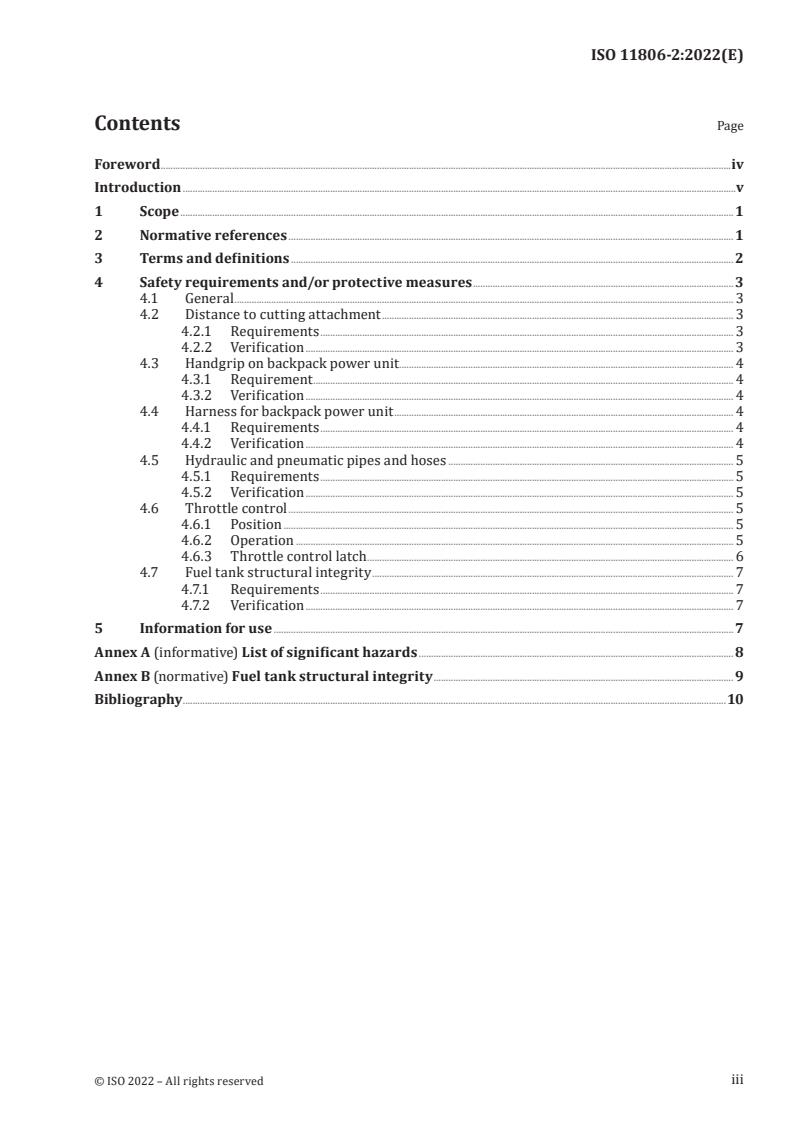
Contents Page
Foreword .iv
Introduction .v
1 Scope . 1
2 Normative references . 1
3 Terms and definitions . 2
4 Safety requirements and/or protective measures . 3
4.1 General . 3
4.2 Distance to cutting attachment . 3
4.2.1 Requirements . 3
4.2.2 Verification . 3
4.3 Handgrip on backpack power unit . 4
4.3.1 Requirement . 4
4.3.2 Verification . 4
4.4 Harness for backpack power unit . 4
4.4.1 Requirements . 4
4.4.2 Verification . 4
4.5 Hydraulic and pneumatic pipes and hoses . 5
4.5.1 Requirements . 5
4.5.2 Verification . 5
4.6 Throttle control . 5
4.6.1 Position . 5
4.6.2 Operation . 5
4.6.3 Throttle control latch . 6
4.7 Fuel tank structural integrity . 7
4.7.1 Requirements . 7
4.7.2 Verification . 7
5 Information for use .7
Annex A (informative) List of significant hazards . 8
Annex B (normative) Fuel tank structural integrity . 9
Bibliography .10
iii
Foreword
ISO (the International Organization for Standardization) is a worldwide federation of national standards
bodies (ISO member bodies). The work of preparing International Standards is normally carried out
through ISO technical committees. Each member body interested in a subject for which a technical
committee has been established has the right to be represented on that committee. International
organizations, governmental and non-governmental, in liaison with ISO, also take part in the work.
ISO collaborates closely with the International Electrotechnical Commission (IEC) on all matters of
electrotechnical standardization.
The procedures used to develop this document and those intended for its further maintenance are
described in the ISO/IEC Directives, Part 1. In particular, the different approval criteria needed for the
different types of ISO documents should be noted. This document was drafted in accordance with the
editorial rules of the ISO/IEC Directives, Part 2 (see www.iso.org/directives).
Attention is drawn to the possibility that some of the elements of this document may be the subject of
patent rights. ISO shall not be held responsible for identifying any or all such patent rights. Details of
any patent rights identified during the development of the document will be in the Introduction and/or
on the ISO list of patent declarations received (see www.iso.org/patents).
Any trade name used in this document is information given for the convenience of users and does not
constitute an endorsement.
For an explanation of the voluntary nature of standards, the meaning of ISO specific terms and
expressions related to conformity assessment, as well as information about ISO's adherence to
the World Trade Organization (WTO) principles in the Technical Barriers to Trade (TBT), see
www.iso.org/iso/foreword.html.
This document was prepared by Technical Committee ISO/TC 23, Tractors and machinery for agriculture
and forestry, Subcommittee SC 17, Manually portable (hand-held) powered lawn and garden equipment and
forest machinery, in collaboration with the European Committee for Standardization (CEN) Technical
Committee CEN/TC 144, Tractors and machinery for agriculture and forestry, in accordance with the
Agreement on technical cooperation between ISO and CEN (Vienna Agreement).
This second edition cancels and replaces the first edition (ISO 11806-2:2011), which has been technically
revised.
The main changes compared to the previous edition are as follows:
— the reference to ISO 11806-1 has been updated to the latest edition;
— the requirements for the harness for the backpack power unit have been reworded and amended;
— the throttle control requirements for the backpack power unit have been added;
— the requirements for the fuel tank structural integrity for the backpack power unit has been added
by including a new Annex B.
A list of all parts in the ISO 11806 series can be found on the ISO website.
Any feedback or questions on this document should be directed to the user’s national standards body. A
complete listing of these bodies can be found at www.iso.org/members.html.
This corrected version of ISO 11806-2:2022 incorporates the following corrections:
— the year of publication has been corrected for ISO 11806-1:2022.
iv
Introduction
This document is a type-C standard as stated in ISO 12100:2010.
This document is of relevance, in particular, for the following stakeholder groups representing the
market players with regard to machinery safety:
— machine manufacturers (small, medium and large enterprises);
— health and safety bodies (regulators, accident prevention organisations, market surveillance, etc.).
Others can be affected by the level of machinery safety achieved with the means of the document by the
above-mentioned stakeholder groups:
— machine users/employers (small, medium and large enterprises);
— machine users/employees (e.g. trade unions, organizations for people with special needs);
— service providers, e.g. for maintenance (small, medium and large enterprises);
— consumers (in case of machinery intended for use by consumers).
The above-mentioned stakeholder groups have been given the possibility to participate at the drafting
process of this document.
The machinery concerned and the extent to which hazards, hazardous situations or hazardous events
are covered are indicated in the scope of this document.
When requirements of this type-C standard are different from those which are stated in type-A or
type-B standards, the requirements of this type-C standard take precedence over the requirements of
the other standards for machines that have been designed and built according to the requirements of
this type-C standard.
v
INTERNATIONAL STANDARD ISO 11806-2:2022(E)
Agricultural and forestry machinery — Safety
requirements and testing for portable, hand-held, powered
brush-cutters and grass-trimmers —
Part 2:
Machines for use with backpack power unit
1 Scope
This document specifies safety requirements, and measures for their verification, for the design and
construction of portable, hand-held, powered brush-cutters and grass-trimmers with a backpack-
mounted combustion engine power source and mechanical power transmission between the power
source and the cutting attachment (hereafter referred to as “machine”). Methods for the elimination
or reduction of hazards arising from the use of these machines and the type of information on safe
working practices to be provided by the manufacturer are specified.
This document, taken together with the relevant clauses of ISO 11806-1:2022 (see 4.1), deals with all
significant hazards, hazardous situations and hazardous events, with the exception of whole-body
vibration from the backpack power unit, relevant to these machines when they are used as intended
and under conditions of misuse which are reasonably foreseeable by the manufacturer.
NOTE 1 A standardized test procedure for measuring whole-body vibration from the backpack power unit is
not available at the time of publication.
NOTE 2 See Annex A, together with ISO 11806-1:2022, Annex A, for a list of significant hazards.
This document is applicable to portable, hand-held, powered brush-cutters and grass-trimmers
manufactured after its date of publication.
This document is not applicable to machines equipped with metallic cutting attachments consisting of
more than one piece, such as pivoting chains or flail blades.
2 Normative references
The following documents are referred to in the text in such a way that some or all of their content
constitutes requirements of this document. For dated references, only the edition cited applies. For
undated references, the latest edition of the referenced document (including any amendments) applies.
ISO 4413:2010, Hydraulic fluid power — General rules and safety requirements for systems and their
components
ISO 4414:2010, Pneumatic fluid power — General rules and safety requirements for systems and their
components
ISO 11806-1:2022, Agricultural and forestry machinery — Safety requirements and testing for portable,
hand- held, powered brush-cutters and grass-trimmers — Part 1: Machines fitted with an integral
combustion engine
ISO 12100:2010, Safety of machinery — General principles for design — Risk assessment and risk reduction
ISO 13857:2019, Safety of machinery — Safety distances to prevent hazard zones being reached by upper
and lower limbs
3 Terms and definitions
For the purposes of this document, the terms and definitions given in ISO 11806-1:2022 and the
following apply.
ISO and IEC maintain terminological databases for use in standardization at the following addresses:
— ISO Online browsing platform: available at https:// www .iso .org/ obp
— IEC Electropedia: available at http:// www .electropedia .org/
3.1
machine
complete brush-cutter, brush saw or grass-trimmer, including backpack power unit and assembly of
drive shaft tube and mechanical power transmission including cutting attachment, guard, handles and
if applicable, barrier
Note 1 to entry: Figure 1 provides an example of a brush-cutter with a backpack power unit (machine) falling
within the scope of this document.
Key
1 harness
2 backpack power unit
3 barrier
4 blade
5 cutting attachment g
...
NORME ISO
INTERNATIONALE 11806-2
Deuxième édition
2022-02
Version corrigée
2022-04
Matériel agricole et forestier —
Exigences de sécurité et essais pour
débroussailleuses et coupe-herbe
portatifs à moteur —
Partie 2:
Machines pour utilisation avec source
motrice portée à dos
Agricultural and forestry machinery — Safety requirements and
testing for portable, hand-held, powered brush-cutters and grass-
trimmers —
Part 2: Machines for use with backpack power unit
Numéro de référence
DOCUMENT PROTÉGÉ PAR COPYRIGHT
© ISO 2022
Tous droits réservés. Sauf prescription différente ou nécessité dans le contexte de sa mise en œuvre, aucune partie de cette
publication ne peut être reproduite ni utilisée sous quelque forme que ce soit et par aucun procédé, électronique ou mécanique,
y compris la photocopie, ou la diffusion sur l’internet ou sur un intranet, sans autorisation écrite préalable. Une autorisation peut
être demandée à l’ISO à l’adresse ci-après ou au comité membre de l’ISO dans le pays du demandeur.
ISO copyright office
Case postale 401 • Ch. de Blandonnet 8
CH-1214 Vernier, Genève
Tél.: +41 22 749 01 11
E-mail: copyright@iso.org
Web: www.iso.org
Publié en Suisse
ii
Sommaire Page
Avant-propos .iv
Introduction .v
1 Domaine d’application . 1
2 Références normatives .1
3 Termes et définitions . 2
4 Exigences de sécurité et/ou mesures de protection . 3
4.1 Généralités . 3
4.2 Distance par rapport au dispositif de coupe . 4
4.2.1 Exigences . 4
4.2.2 Vérification . 4
4.3 Élément de préhension sur la source motrice portée à dos . 4
4.3.1 Exigences . 4
4.3.2 Vérification . 5
4.4 Harnais pour la source motrice portée à dos . 5
4.4.1 Exigences . 5
4.4.2 Vérification . 5
4.5 Tuyaux et flexibles hydrauliques et pneumatiques . 5
4.5.1 Exigences . 5
4.5.2 Vérification . 5
4.6 Commande d’accélérateur . 6
4.6.1 Position . 6
4.6.2 Utilisation . 6
4.6.3 Verrou de commande d’accélérateur . 7
4.7 Intégrité structurelle du réservoir de carburant . 8
4.7.1 Exigences . 8
4.7.2 Vérification . 8
5 Informations pour l’utilisation .8
Annexe A (informative) Liste des phénomènes dangereux significatifs . 9
Annexe B (normative) Intégrité structurelle du réservoir de carburant .10
Bibliographie .11
iii
Avant-propos
L'ISO (Organisation internationale de normalisation) est une fédération mondiale d'organismes
nationaux de normalisation (comités membres de l'ISO). L'élaboration des Normes internationales est
en général confiée aux comités techniques de l'ISO. Chaque comité membre intéressé par une étude
a le droit de faire partie du comité technique créé à cet effet. Les organisations internationales,
gouvernementales et non gouvernementales, en liaison avec l'ISO participent également aux travaux.
L'ISO collabore étroitement avec la Commission électrotechnique internationale (IEC) en ce qui
concerne la normalisation électrotechnique.
Les procédures utilisées pour élaborer le présent document et celles destinées à sa mise à jour sont
décrites dans les Directives ISO/IEC, Partie 1. Il convient, en particulier, de prendre note des différents
critères d'approbation requis pour les différents types de documents ISO. Le présent document a
été rédigé conformément aux règles de rédaction données dans les Directives ISO/IEC, Partie 2 (voir
www.iso.org/directives).
L'attention est attirée sur le fait que certains des éléments du présent document peuvent faire l'objet de
droits de propriété intellectuelle ou de droits analogues. L'ISO ne saurait être tenue pour responsable
de ne pas avoir identifié de tels droits de propriété et averti de leur existence. Les détails concernant
les références aux droits de propriété intellectuelle ou autres droits analogues identifiés lors de
l'élaboration du document sont indiqués dans l'Introduction et/ou dans la liste des déclarations de
brevets reçues par l'ISO (voir www.iso.org/brevets).
Les appellations commerciales éventuellement mentionnées dans le présent document sont données
pour information, par souci de commodité, à l’intention des utilisateurs et ne sauraient constituer un
engagement.
Pour une explication de la nature volontaire des normes, la signification des termes et expressions
spécifiques de l'ISO liés à l'évaluation de la conformité, ou pour toute information au sujet de l'adhésion
de l'ISO aux principes de l’Organisation mondiale du commerce (OMC) concernant les obstacles
techniques au commerce (OTC), voir www.iso.org/avant-propos.
Le présent document a été élaboré par le comité technique ISO/TC 23, Tracteurs et matériels agricoles
et forestiers, sous-comité SC 17, Matériel pour jardins et pelouses et matériel forestier portatifs à main
à moteur, en collaboration avec le comité technique CEN/TC 144, Tracteurs et matériels agricoles
et forestiers, du Comité européen de normalisation (CEN) conformément à l’Accord de coopération
technique entre l’ISO et le CEN (Accord de Vienne).
Cette deuxième édition annule et remplace la première édition (ISO 11806-2:2011), qui a fait l’objet
d’une révision technique.
Les principales modifications par rapport à l’édition précédente sont les suivantes:
— référence à la nouvelle version de l’ISO 11806-1;
— exigences pour les sources motrices portées à dos reformulées et modifiées;
— ajout des exigences relatives à la commande d’accélérateur pour la source motrice portée à dos;
— ajout des exigences relatives de l’intégrité structurelle du réservoir de carburant pour la source
motrice portée à dos, incluant une nouvelle Annexe B.
Une liste de toutes les parties de la série ISO 11806 se trouve sur le site web de l’ISO.
Il convient que l’utilisateur adresse tout retour d’information ou toute question concernant le présent
document à l’organisme national de normalisation de son pays. Une liste exhaustive desdits organismes
se trouve à l’adresse www.iso.org/fr/members.html.
La présente version corrigée de l'ISO 11806-2:2022 inclut les corrections suivantes :
— l'année de publication a été corrigée pour l'ISO 11806-1:2022.
iv
Introduction
Le présent document est une norme de type C telle que définie dans l’ISO 12100:2010.
Le présent document concerne, en particulier, les groupes de parties prenantes suivants, représentant
les acteurs du marché dans le domaine de la sécurité des machines:
— fabricants de machines (petites, moyennes et grandes entreprises);
— organismes de santé et de sécurité (autorités réglementaires, organismes de prévention des risques
professionnels, surveillance du marché, etc.).
D’autres groupes peuvent être concernés par le niveau de sécurité des machines atteint à l’aide du
document par les parties prenantes mentionnées ci-dessus:
— utilisateurs de machines/employeurs (petites, moyennes et grandes entreprises);
— utilisateurs de machines/salariés (par exemple syndicats de salariés, organisations représentant
des personnes ayant des besoins particuliers);
— prestataires de services, par exemple sociétés de maintenance (petites, moyennes et grandes
entreprises);
— consommateurs (dans le cas de machines destinées à être utilisées par des consommateurs).
Les groupes de parties prenantes mentionnés ci-dessus ont eu la possibilité de participer à l’élaboration
du présent document.
Les machines concernées et l’étendue des phénomènes dangereux, situations dangereuses ou
événements dangereux couverts sont indiquées dans le Domaine d’application du présent document.
Lorsque des exigences de la présente norme de type C sont différentes de celles énoncées dans les
normes de type A ou les normes de type B, les exigences de la présente norme de type C ont priorité
sur celles des autres normes pour les machines ayant été conçues et fabriquées conformément aux
exigences de la présente norme de type C.
v
NORME INTERNATIONALE ISO 11806-2:2022(F)
Matériel agricole et forestier — Exigences de sécurité et
essais pour débroussailleuses et coupe-herbe portatifs à
moteur —
Partie 2:
Machines pour utilisation avec source motrice portée à dos
1 Domaine d’application
Le présent document spécifie les exigences de sécurité et les mesures de protection pour leur
vérification, pour la conception et la construction des débroussailleuses et des coupe-herbe portatifs à
moteur, tenus à la main, équipés d’une source motrice à moteur à combustion interne, portée à dos, et
d’une transmission mécanique de puissance entre la source motrice et le dispositif de coupe (appelés
«machines» dans la suite du texte). Il spécifie des méthodes pour éliminer ou réduire les phénomènes
dangereux inhérents à l’utilisation de ces machines et le type d’informations devant être fournies par le
fabricant sur les pratiques d’utilisation sûre.
Le présent document, conjointement avec les articles pertinents de l’ISO 11806-1:2022 (voir 4.1), traite
de tous les phénomènes dangereux, situations dangereuses et événements dangereux significatifs,
à l’exception des vibrations transmises à l’ensemble du corps par la source motrice portée à dos,
pertinents pour ces machines lorsqu’elles sont utilisées normalement et dans des conditions de mauvais
usage raisonnablement prévisibles par le fabricant.
NOTE 1 Aucune méthode d’essai normalisée permettant de mesurer les vibrations transmises à l’ensemble du
corps par la source motrice portée à dos n’est actuellement disponible au moment de la publicaion.
NOTE 2 Pour la liste des phénomènes dangereux significatifs, voir l’Annexe A ainsi que l’ISO 11806-1:2022,
Annexe A.
Le présent document est applicable aux débroussailleuses et aux coupe-herbe portatifs à moteur tenus
à la main fabriqués après sa date de publication.
Le présent document n’est pas applicable aux machines équipées de dispositifs de coupe métalliques
constitués de plusieurs pièces, comme les chaînes articulées ou les lames à fléau.
2 Références normatives
Les documents suivants sont cités dans le texte de sorte qu’ils constituent, pour tout ou partie de leur
contenu, des exigences du présent document. Pour les références datées, seule l’édition citée s’applique.
Pour les références non datées, la dernière édition du document de référence s'applique (y compris les
éventuels amendements).
ISO 4413:2010, Transmissions hydrauliques — Règles générales et exigences de sécurité relatives aux
systèmes et leurs composants
ISO 4414:2010, Transmissions pneumatiques — Règles générales et exigences de sécurité pour les systèmes
et leurs composants
ISO 11806-1:2022, Matériel agricole et forestier — Exigences de sécurité et essais pour débroussailleuses
et coupe-herbe portatifs à moteur — Partie 1: Machines équipées d’un moteur à combustion interne intégré
ISO 12100:2010, Sécurité des machines — Principes généraux de conception — Appréciation du risque et
réduction du risque
ISO 13857:2019, Sécurité des machines — Distances de sécurité empêchant les membres supérieurs et
inférieurs d'atteindre les zones dangereuses
3 Termes et définitions
Pour les besoins du présent document, les termes et les définitions de l’ISO 11806-1:2022 ainsi que les
suivants s’appliquent.
L’ISO et l’IEC tiennent à jour des bases de données terminologiques destinées à être utilisées en
normalisation, consultables aux adresses suivantes:
— ISO Online browsing platform: disponible à l’adresse https:// www .iso .org/ obp
— IEC Electropedia: disponible à l’adresse http:// www .electropedia .org/
3.1
machine
débroussailleuse, débroussailleuse à scie ou coupe-herbe complet incluant la source motrice portée à
dos et l’assemblage du tube de protection de l’arbre de transmission et de la transmission mécanique
de puissance, avec un dispositif de coupe, un protecteur, des poignées et, le cas échéant, une barre
d’éloignement
Note 1 à l'article: La Figure 1 donne un exemple de débroussailleuse équipée d’une source motrice portée à dos
(machine) entrant dans le domaine d’application du présent document.
Légende
1 harnais
2 source motrice portée à dos
3 barre d’éloignement
4 lame
5 protecteur du dispositif de coupe
6 tube de protection de l’arbre de transmission
7 poignée avant
8 poignée arrière
Figure 1 — Machne (débroussailleuse) équipée d’une source motrice portée à dos
4 Exigences de sécurité et/ou mesures de protection
4.1 Généralités
La machine doit se conformer aux exigences de sécurité et/ou aux mesures de protection du présent
article. De plus, la machine doit être conçue selon les principes de l’ISO 12100:2010 pour les phénomènes
dangereux pertinents mais non significatifs qui ne sont pas traités dans le présent document.
Les machines doivent être conformes à l’ISO 11806-1:2022, Article 4, excepté pour 4.4, 4.5, 4.13 et 4.15.2.
...