

ISO/IEC TS 18661-4:2025
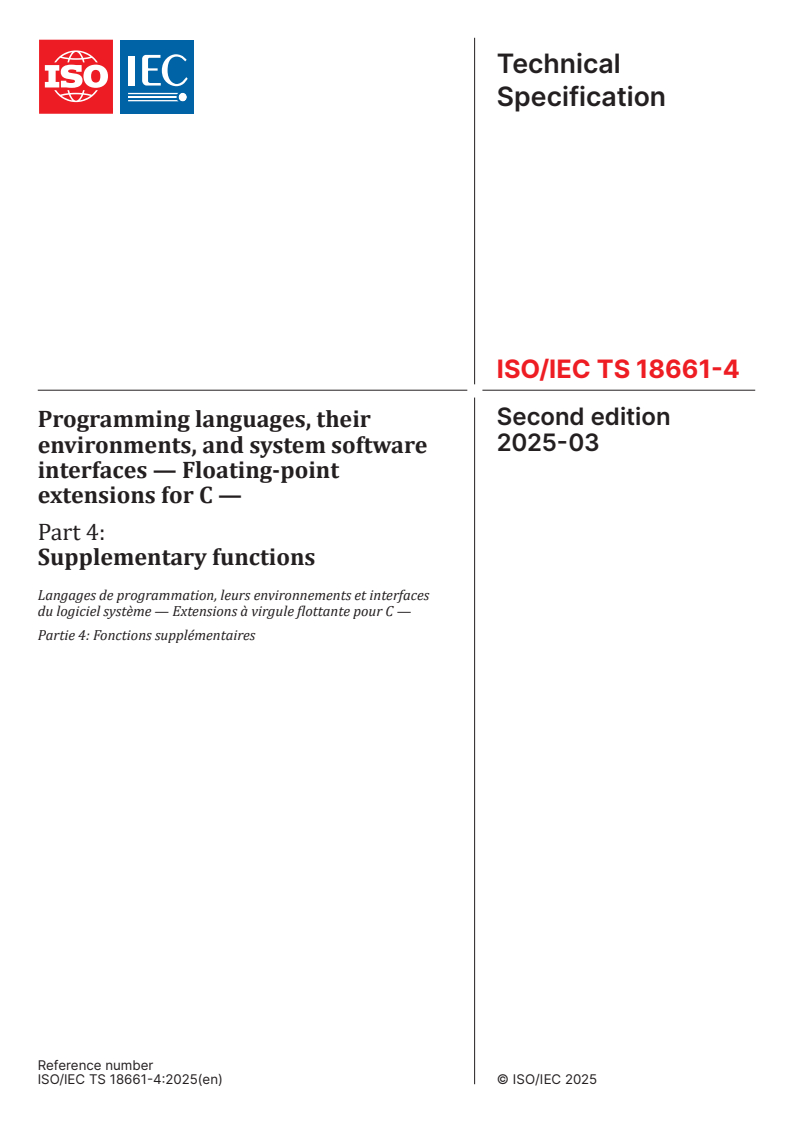
(Main)Programming languages, their environments, and system software interfaces — Floating-point extensions for C — Part 4: Supplementary functions
General Information
- Abstract
This document specifies extensions to programming language C to include functions corresponding to operations specified and recommended in ISO/IEC 60559, but not supported in ISO/IEC 9899:2024 (also referred to as C23).
- Status
- Published
- Publication Date
- 13-Mar-2025
- Current Stage
- 6060 - International Standard published
- Start Date
- 14-Mar-2025
- Due Date
- 25-May-2025
- Completion Date
- 14-Mar-2025
Overview
ISO/IEC TS 18661-4:2025 defines supplementary floating-point extensions for the C programming language. Published by ISO and IEC, this technical specification addresses the need for additional floating-point operations in C, corresponding to those defined in IEEE 754 (ISO/IEC 60559), which are not covered in the main C standard, ISO/IEC 9899:2024 (C23). The new extensions focus on advanced mathematical and numerical functions valuable for a wide range of technical, scientific, and engineering applications.
The primary goals of this standard are to enhance numerical reliability, provide precise computation tools, and support improved portability for C programs that require advanced floating-point functionality. By implementing these supplementary functions, both software developers and system architects can ensure consistent behavior and compliance with international floating-point arithmetic standards.
Key Topics
Reduction Functions (<reduc.h>)
- Provide sum, sum of absolute values, sum of squares, and dot product (sumprod) for arrays.
- Enable accurate and efficient vector computations, supporting both binary and decimal floating-point types.
- Offer scaled product and related operations (scaled_prod, scaled_prodsum, scaled_proddiff) to prevent overflow and underflow during intermediate computations.
Augmented Arithmetic Functions (<augarith.h>)
- Introduce augmented arithmetic as recommended by IEEE 754, including the well-known twoSum and twoProduct operations.
- Functions return both the computed value and the error term, assisting in double-double arithmetic for increased precision.
Conformance and Integration
- Implementations must use specific macros to indicate support:
__STDC_IEC_60559_FUNCS_REDUCTION__and__STDC_IEC_60559_FUNCS_AUGMENTED_ARITHMETIC__. - Designed as conditional standard library extensions, ensuring backward compatibility with C23 environments.
- Implementations must use specific macros to indicate support:
Precision and Exception Handling
- Functions are specified to minimize intermediate loss of precision.
- Floating-point exceptions are tightly defined for predictable behavior across platforms.
Applications
The supplementary floating-point functions in ISO/IEC TS 18661-4:2025 serve a variety of practical and advanced use cases:
Scientific Computing
- Reliable implementations for computing sums, dot products, and sum-of-squares, critical for data analysis, simulations, and scientific modeling.
- Example: Calculating large factorial products in quantum physics or statistical algorithms without intermediate overflow.
Numerical Libraries and High-Performance Computing
- Use of reduction and augmented arithmetic enables increased precision in iterative numerical methods and linear algebra routines.
- Double-double arithmetic is made easier and more robust, benefiting environments without native hardware support for high-precision types.
Embedded and Safety-critical Systems
- Ensures conforming implementations in resource-constrained or safety-sensitive contexts, with predictable exception and error signaling.
Financial Calculations
- Support for decimal floating-point arithmetic meets the needs of applications that demand exact decimal results.
Related Standards
- ISO/IEC 9899:2024 (C23): The core standard for the C programming language, with which these extensions are fully compatible.
- ISO/IEC 60559:2020: Specifies floating-point arithmetic following IEEE 754, forming the basis for the operations and numeric behaviors required by this extension.
- Other ISO/IEC TS 18661 parts: Additional documents in the 18661 series further extend floating-point support in C.
- IEEE 754-2019: The updated international standard for floating-point arithmetic, referenced in the design of the augmented arithmetic operations.
By adhering to ISO/IEC TS 18661-4:2025, developers and implementers of C can create portable, standards-compliant applications that harness advanced floating-point functions for greater accuracy, consistency, and performance in critical computations.
Relations
- Effective Date
- 06-Jun-2022
Get Certified
Connect with accredited certification bodies for this standard

BSI Group
BSI (British Standards Institution) is the business standards company that helps organizations make excellence a habit.

NYCE
Mexican standards and certification body.
Sponsored listings
Frequently Asked Questions
ISO/IEC TS 18661-4:2025 is a technical specification published by the International Organization for Standardization (ISO). Its full title is "Programming languages, their environments, and system software interfaces — Floating-point extensions for C — Part 4: Supplementary functions". This standard covers: This document specifies extensions to programming language C to include functions corresponding to operations specified and recommended in ISO/IEC 60559, but not supported in ISO/IEC 9899:2024 (also referred to as C23).
This document specifies extensions to programming language C to include functions corresponding to operations specified and recommended in ISO/IEC 60559, but not supported in ISO/IEC 9899:2024 (also referred to as C23).
ISO/IEC TS 18661-4:2025 is classified under the following ICS (International Classification for Standards) categories: 35.060 - Languages used in information technology. The ICS classification helps identify the subject area and facilitates finding related standards.
ISO/IEC TS 18661-4:2025 has the following relationships with other standards: It is inter standard links to ISO/IEC TS 18661-4:2015. Understanding these relationships helps ensure you are using the most current and applicable version of the standard.
ISO/IEC TS 18661-4:2025 is available in PDF format for immediate download after purchase. The document can be added to your cart and obtained through the secure checkout process. Digital delivery ensures instant access to the complete standard document.
Standards Content (Sample)
Technical
Specification
ISO/IEC TS 18661-4
Second edition
Programming languages, their
2025-03
environments, and system software
interfaces — Floating-point
extensions for C —
Part 4:
Supplementary functions
Langages de programmation, leurs environnements et interfaces
du logiciel système — Extensions à virgule flottante pour C —
Partie 4: Fonctions supplémentaires
Reference number
© ISO/IEC 2025
All rights reserved. Unless otherwise specified, or required in the context of its implementation, no part of this publication may
be reproduced or utilized otherwise in any form or by any means, electronic or mechanical, including photocopying, or posting on
the internet or an intranet, without prior written permission. Permission can be requested from either ISO at the address below
or ISO’s member body in the country of the requester.
ISO copyright office
CP 401 • Ch. de Blandonnet 8
CH-1214 Vernier, Geneva
Phone: +41 22 749 01 11
Email: copyright@iso.org
Website: www.iso.org
Published in Switzerland
© ISO/IEC 2025 – All rights reserved
ii
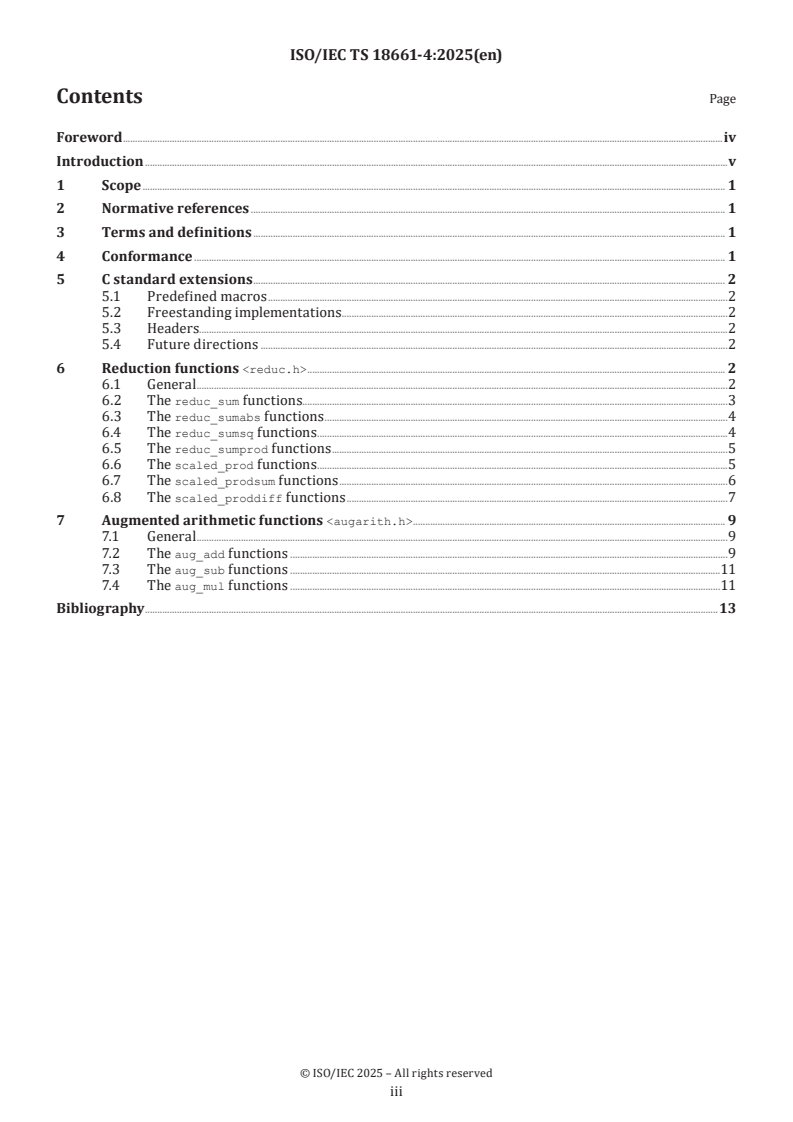
Contents Page
Foreword .iv
Introduction .v
1 Scope . 1
2 Normative references . 1
3 Terms and definitions . 1
4 Conformance . 1
5 C standard extensions . 2
5.1 Predefined macros .2
5.2 Freestanding implementations . .2
5.3 Headers.2
5.4 Future directions .2
6 Reduction functions . 2
6.1 General .2
6.2 The reduc_sum functions.3
6.3 The reduc_sumabs functions .4
6.4 The reduc_sumsq functions .4
6.5 The reduc_sumprod functions .5
6.6 The scaled_prod functions .5
6.7 The scaled_prodsum functions .6
6.8 The scaled_proddiff functions .7
7 Augmented arithmetic functions . 9
7.1 General .9
7.2 The aug_add functions .9
7.3 The aug_sub functions .11
7.4 The aug_mul functions .11
Bibliography .13
© ISO/IEC 2025 – All rights reserved
iii
Foreword
ISO (the International Organization for Standardization) and IEC (the International Electrotechnical
Commission) form the specialized system for worldwide standardization. National bodies that are
members of ISO or IEC participate in the development of International Standards through technical
committees established by the respective organization to deal with particular fields of technical activity.
ISO and IEC technical committees collaborate in fields of mutual interest. Other international organizations,
governmental and non-governmental, in liaison with ISO and IEC, also take part in the work.
The procedures used to develop this document and those intended for its further maintenance are described
in the ISO/IEC Directives, Part 1. In particular, the different approval criteria needed for the different types
of document should be noted. This document was drafted in accordance with the editorial rules of the ISO/
IEC Directives, Part 2 (see www.iso.org/directives or www.iec.ch/members_experts/refdocs).
ISO and IEC draw attention to the possibility that the implementation of this document may involve the
use of (a) patent(s). ISO and IEC take no position concerning the evidence, validity or applicability of any
claimed patent rights in respect thereof. As of the date of publication of this document, ISO and IEC had not
received notice of (a) patent(s) which may be required to implement this document. However, implementers
are cautioned that this may not represent the latest information, which may be obtained from the patent
database available at www.iso.org/patents and https://patents.iec.ch. ISO and IEC shall not be held
responsible for identifying any or all such patent rights.
Any trade name used in this document is information given for the convenience of users and does not
constitute an endorsement.
For an explanation of the voluntary nature of standards, the meaning of ISO specific terms and expressions
related to conformity assessment, as well as information about ISO's adherence to the World Trade
Organization (WTO) principles in the Technical Barriers to Trade (TBT) see www.iso.org/iso/foreword.html.
In the IEC, see www.iec.ch/understanding-standards.
This document was prepared by Joint Technical Committee ISO/IEC JTC 1, Information technology,
Subcommittee SC 22, Programming languages, their environments and system software interfaces.
This second edition cancels and replaces the first edition (ISO/IEC TS 18661-4:2015), which has been
technically revised.
The main changes are as follows:
— The specification has been updated to extend ISO/IEC 9899:2024.
— The mathematical functions and constant rounding modes have been removed. These features are now
incorporated into ISO/IEC 9899:2024.
— Functions to support the augmented arithmetic operations specified in IEEE 754-2019 have been added.
— New headers have been added, and all extensions to the header have been removed.
A list of all parts in the ISO 18661 series can be found on the ISO website.
Any feedback or questions on this document should be directed to the user’s national standards
body. A complete listing of these bodies can be found at www.iso.org/members.html and
www.iec.ch/national-committees.
© ISO/IEC 2025 – All rights reserved
iv
Introduction
The IEEE 754-1985 standard for binary floating-point arithmetic was motivated by an expanding diversity
in floating-point data representation and arithmetic, which made writing reliable programs, debugging
and moving programs between systems exceedingly difficult. Now the great majority of systems provide
data formats and arithmetic operations according to IEEE 754. Corresponding versions of IEEE 754 and
ISO/IEC 60559 have equivalent content.
Support for IEEE 754-1985 was added in ISO/IEC 9899:1999 (also referred to as C99), and ISO/IEC 9899:2018
is still based on IEEE 754-1985. However, IEEE 754 underwent a major revision in 2008 and a minor revision
in 2019, which added several new features.
The purpose of the ISO/IEC 18661 series (first published 2014 through 2016) has been to specify C language
support for the new features introduced into IEEE 754 since 1985. Most of the ISO/IEC 18661 series has
been incorporated into ISO/IEC 9899:2024 (also referred to as C23 because major work on this revision was
completed in 2023), which supports all required and most recommended features in IEEE 754-2019.
To supplement the IEEE 754 support in C23, this document specifies two C headers with functions
corresponding to the reduction and augmented arithmetic operations recommended by IEEE 754, but not
included in C23.
The reduction operations perform widely used vector computations involving sums and products, including
scaled products. These operations are allowed to associate in any order, and to evaluate in any wider format.
The augmented arithmetic operations, added in IEEE 754-2019, are versions of operations commonly called
twoSum and twoProduct. These operations can be used to implement arithmetic with extra precision, for
example, for double-double format. In theory, they can also be used to implement efficient reproducible dot
products.
© ISO/IEC 2025 – All rights reserved
v
Technical Specification ISO/IEC TS 18661-4:2025(en)
Programming languages, their environments, and system
software interfaces — Floating-point extensions for C —
Part 4:
Supplementary functions
1 Scope
This document specifies extensions to programming language C to include functions corresponding to
operations specified and recommended in ISO/IEC 60559, but not supported in ISO/IEC 9899:2024 (also
referred to as C23).
2 Normative references
The following documents, in whole or in part, are normatively referenced in this document and are
indispensable for its application. For dated references, only the edition cited applies. For undated references,
the latest edition of the referenced document (including any amendments) applies.
ISO/IEC 9899:2024, Information technology — Programming languages — C
ISO/IEC 60559:2020, Information technology — Microprocessor Systems — Floating-Point arithmetic
3 Terms and definitions
For the purposes of this document, the terms and definitions given in ISO/IEC 9899:2024 and
ISO/IEC 60559:2020 apply.
ISO and IEC maintain terminological databases for use in standardization at the following addresses:
— ISO Online browsing platform: available at https:// www .iso .org/ obp
— IEC Electropedia: available at https:// www .electropedia .org/
4 Conformance
An implementation that meets the requirements for a conforming implementation of C23 may conform to one
or both feature sets (reduction functions and augmented arithmetic) in this document. The implementation
conforms to the reduction functions feature if:
a) it defines __STDC_IEC_60559_BFP__ or __STDC_IEC_60559_DFP__ or both, indicating support for
ISO/IEC 60559 binary or decimal floating-point arithmetic, as specified in C23, Annex F;
b) it defines __STDC_IEC_60559_FUNCS_REDUCTION__ to 202401L and provides the header
specified in this document (Clause 6).
The implementation conforms to the augmented arithmetic feature if:
c) it defines __STDC_IEC_60559_BFP__, indicating support for ISO/IEC 60559 binary floating-point
arithmetic, as specified in C23, Annex F;
d) it defines __STDC_IEC_60559_FUNCS_AUGMENTED_ARITHMETIC__ to 202401L and provides the
header specified in this document (Clause 7).
© ISO/IEC 2025 – All rights reserved
5 C standard extensions
5.1 Predefined macros
The implementation defines one or both of the following macros to indicate conformance to the specification
in this document for support of the corresponding features specified and recommended in ISO/IEC 60559.
__STDC_IEC_60559_FUNCS_REDUCTION__ The integer constant 202401L.
__STDC_IEC_60559_FUNCS_AUGMENTED_ARITHMETIC__ The integer constant 202401L.
5.2 Freestanding implementations
The strictly conforming programs that shall be accepted by a conforming freestanding implementation that
defines one of the feature macros in 5.1 may also use features in the corresponding header specified in this
document. See C23, Clause 4.
5.3 Headers
If the implementation defines one of the feature macros in 5.1 then the implementation provides the
corresponding header specified in this document. The header and its use follow the general specification in
C23, 7.1 for the C Library as though the header were a subclause of C23, Clause 7 for a conditional feature.
5.4 Future directions
For implementations that define __STDC_IEC_60559_FUNCS_REDUCTION__, function names that begin
with reduc_ or scaled_ are potentially reserved identifiers and may be added to the declarations in the
header.
For implementations that define __STDC_IEC_60559_FUNCS_AUGMENTED_ARITHMETIC__, tag names that end
with aug_t and function names that begin with aug_ are potentially reserved identifiers and may be added
to the declarations in the header.
See C23, 7.33.
6 Reduction functions
6.1 General
The header declares the type and functions in this clause.
The type declared is size_t (described in C23, 7.21.1).
Each function in this clause is declared in if and only if the corresponding type is supported
according to C23, Annex F or Annex H.
The functions in this clause shall be implemented so that intermediate computations do not overflow or
underflow. For the reduc_sum, reduc_sumabs, reduc_sumsq, and reduc_sumprod functions, the “overflow”
or “underflow” floating-point exception is raised and a range error occurs, if and only if the final result
overflows or underflows. The scaled_prod, scaled_prodsum, and scaled_proddiff functions do not raise the
“overflow” or “underflow” floating-point exceptions and do not cause a range error.
The reduction functions do not raise the “divide-by-zero” floating-point exception.
With ISO/IEC 60559 default exception handling, these functions raise the “inexact” floating-point exception
in response to “overflow” and “underflow” exceptions; otherwise, whether they raise the “inexact” floating-
point exception is unspecified.
© ISO/IEC 2025 – All rights reserved
Numerical results and exceptional behavior, including the “invalid” floating-point exception, can differ due
to the precision of intermediates and the order of evaluation. However, only one floating-point exception is
raised (other than “inexact” in response to “overflow” or “underflow”) per reduction function invocation;
exceptions are not raised for each exceptional intermediate operand or result. Reduction functions may
raise the “invalid” floating-point exception if an element of an array argument is a signaling NaN (see C23,
F.2.2). Once an "invalid" floating-point exception is raised, due to signaling NaN, ∞−∞, or 0×∞, processing of
array elements may stop.
Whether and how rounding direction modes affect functions in this clause are implementation defined
and may be indeterminate. This applies to constant as well as dynamic rounding modes, C23, 7.6.3
notwithstanding.
The preferred quantum exponent for the reduction functions for decimal floating types is unspecified.
For each of the following synopses, an implementation shall declare the functions suffixed
with f N or f Nx only if it supports the corresponding binary f loating type and the macro
__STDC_WANT_IEC_60559_TYPES_EXT__ is defined at the point in the code where is first included. An
implementation shall declare the functions suffixed with dN for N ≠ 32, 64 or 128 or with dNx only if it supports
the corresponding decimal floating type and the macro __STDC_WANT_IEC_60559_TYPES_EXT__ is defined at
the point in the code where is first included (see C23, Annex H.)
NOTE For N = 32, 64 and 128, the functions suffixed with dN are declared if the implementation supports
decimal floating types (i.e. defines __STDC_IEC_60559_DFP__), without the requirement that the macro
__STDC_WANT_IEC_60559_TYPES_EXT__ be defined.
6.2 The reduc_sum functions
Synopsis
#include
#ifdef __STDC_IEC_60559_BFP__
double reduc_sum(size_t n, const double p[static n]);
float reduc_sumf(size_t n, const float p[static n]);
long double reduc_suml(size_t n, const long double p[static n]);
_FloatN reduc_sumfN(size_t n, const _FloatN p[static n]);
_FloatNx reduc_sumfNx(size_t n, const _FloatNx p[static n]);
#endif
#ifdef __STDC_IEC_60559_DFP__
_DecimalN reduc_sumdN(size_t n, const _DecimalN p[static n]);
_DecimalNx reduc_sumdNx(size_t n, const _DecimalNx p[static n]);
#endif
Description
n−1
The reduc_sum functions compute the sum of the n elements of array p: p i . If the length n = 0, the
[]
∑
i=0
functions return the value +0. If any element of array p is a NaN, the functions return a quiet NaN. If any two
elements of array p are infinities with different signs, the functions return a quiet NaN and raise the “invalid”
floating-point exception and a domain error occurs. Otherwise (if no element of p is a NaN and no two
elements of p are infinities with different signs), if any element of array p is an infinity, the functions return
that same infinity.
Returns
The reduc_sum functions return the computed sum.
© ISO/IEC 2025 – All rights reserved
6.3 The reduc_sumabs functions
Synopsis
#include
#ifdef __STDC_IEC_60559_BFP__
double reduc_sumabs(size_t n, const double p[static n]);
float reduc_sumabsf(size_t n, const float p[static n]);
long double reduc_sumabsl(size_t n, const long double p[static n]);
_FloatN reduc_sumabsfN(size_t n, const _FloatN p[static n]);
_FloatNx reduc_sumabsfNx(size_t n, const _FloatNx p[static n]);
#endif
#ifdef __STDC_IEC_60559_DFP__
_DecimalN reduc_sumabsdN(size_t n, const _DecimalN p[static n]);
_DecimalNx reduc_sumabsdNx(size_t n, const _DecimalNx p[static n]);
#endif
Description
The reduc_sumabs functions compute the sum of the absolute values of the n elements of array
n−1
p: p[]i . If the length n = 0, the functions return the value +0. If any element of array p is an infinity,
∑
i=0
the functions return +∞; otherwise, if any element of array p is a NaN, the functions return a quiet NaN.
Returns
The reduc_sumabs functions return the computed sum.
6.4 The reduc_sumsq functions
Synopsis
#include
#ifdef __STDC_IEC_60559_BFP__
double reduc_sumsq(size_t n, const double p[static n]);
float reduc_sumsqf(size_t n, const float p[static n]);
long double reduc_sumsql(size_t n, const long double p[static n]);
_FloatN reduc_sumsqfN(size_t n, const _FloatN p[static n]);
_FloatNx reduc_sumsqfNx(size_t n, const _FloatNx p[static n]);
#endif
#ifdef __STDC_IEC_60559_DFP__
_DecimalN reduc_sumsqdN(size_t n, const _DecimalN p[static n]);
_DecimalNx reduc_sumsqdN
...