

ISO 22762-2:2024
(Main)Elastomeric seismic-protection isolators — Part 2: Applications for bridges — Specifications
General Information
- Abstract
This document specifies minimum requirements and test methods for elastomeric seismic isolators used for bridges, as well as rubber material used in the manufacture of such isolators. It is applicable to elastomeric seismic isolators used to provide bridges with protection from earthquake damage. The isolators covered consist of alternate elastomeric layers and reinforcing steel plates, which are placed between a superstructure and its substructure to provide both flexibility for decoupling structural systems from ground motion and damping capability to reduce displacement at the isolation interface and the transmission of energy from the ground into the structure at the isolation frequency.
- Status
- Published
- Publication Date
- 11-Sep-2024
- Technical Committee
- ISO/TC 45/SC 4 - Products (other than hoses)
- Drafting Committee
- ISO/TC 45/SC 4/WG 9 - Elastomeric isolators
- Current Stage
- 6060 - International Standard published
- Start Date
- 12-Sep-2024
- Due Date
- 04-Sep-2025
- Completion Date
- 12-Sep-2024

Overview
ISO 22762-2:2024 - Elastomeric seismic-protection isolators: Part 2 - Applications for bridges - Specifications defines minimum requirements and test methods for elastomeric seismic isolators used to protect bridges from earthquake damage. The standard covers isolators made of alternating elastomeric layers and reinforcing steel plates installed between a bridge superstructure and substructure to provide flexibility (structural decoupling) and damping (energy dissipation) at the isolation interface.
Key topics and technical requirements
- Scope and classification
- Applicability to bridge isolation devices and classification by construction and shear-stiffness tolerances.
- Performance requirements
- Functional and performance criteria for compressive, shear, rotation and tensile behavior, including shear-displacement capacity and damping characteristics.
- Rubber material requirements
- Mandatory properties and test methods for rubber used in isolators: tensile properties, ageing, hardness, adhesion, compression set, ozone resistance and other durability metrics.
- Design rules
- Design guidance including shape factors, compressive and shear stiffness, shear strain evaluation, tensile stress limits, stability checks (buckling/rotation) and design of fixings to the structure.
- Testing and quality assurance
- Type and routine tests, specific test methods (normative and informative annexes), dimensional and manufacturing tolerances, marking and labelling, and factory quality assurance procedures.
- Annexes
- Normative annexes for tensile stresses and buckling; informative annexes for determination of shear properties, compressive stiffness and recommended material properties, supporting both design and verification.
Applications and practical value
- Ensures consistent safety, durability and performance of elastomeric seismic isolators for bridges.
- Used when specifying, designing, manufacturing, testing or procuring bridge isolation bearings to meet verifiable international criteria.
- Supports engineers in calculating isolator stiffness, expected displacements, damping, and in verifying stability and attachment details during seismic events.
Who should use this standard
- Bridge and structural engineers designing seismic isolation systems
- Manufacturers of elastomeric seismic isolators and rubber compounds
- Test laboratories performing type and routine tests
- Procurement professionals writing technical specifications for bridge projects
- Authorities and reviewers responsible for bridge seismic safety and compliance
Related standards
- ISO 22762-2:2024 is part of the broader seismic-isolation standards landscape; users should also consult other parts of the ISO 22762 series and applicable national bridge design codes and seismic regulations to ensure full compliance and integration.
Keywords: ISO 22762-2:2024, elastomeric seismic isolators, bridge seismic isolation, rubber material requirements, test methods, design rules, shear stiffness, damping.
Relations
- Effective Date
- 09-Mar-2024
Get Certified
Connect with accredited certification bodies for this standard

DIN CERTCO
DIN Group product certification.

Smithers Quality Assessments
US management systems and product certification.
Zavod za gradbeništvo Slovenije (ZAG) - Inšpekcija
ZAG inspection body for construction products, structures, and materials.
Sponsored listings
Frequently Asked Questions
ISO 22762-2:2024 is a standard published by the International Organization for Standardization (ISO). Its full title is "Elastomeric seismic-protection isolators — Part 2: Applications for bridges — Specifications". This standard covers: This document specifies minimum requirements and test methods for elastomeric seismic isolators used for bridges, as well as rubber material used in the manufacture of such isolators. It is applicable to elastomeric seismic isolators used to provide bridges with protection from earthquake damage. The isolators covered consist of alternate elastomeric layers and reinforcing steel plates, which are placed between a superstructure and its substructure to provide both flexibility for decoupling structural systems from ground motion and damping capability to reduce displacement at the isolation interface and the transmission of energy from the ground into the structure at the isolation frequency.
This document specifies minimum requirements and test methods for elastomeric seismic isolators used for bridges, as well as rubber material used in the manufacture of such isolators. It is applicable to elastomeric seismic isolators used to provide bridges with protection from earthquake damage. The isolators covered consist of alternate elastomeric layers and reinforcing steel plates, which are placed between a superstructure and its substructure to provide both flexibility for decoupling structural systems from ground motion and damping capability to reduce displacement at the isolation interface and the transmission of energy from the ground into the structure at the isolation frequency.
ISO 22762-2:2024 is classified under the following ICS (International Classification for Standards) categories: 83.140.99 - Other rubber and plastics products; 93.040 - Bridge construction. The ICS classification helps identify the subject area and facilitates finding related standards.
ISO 22762-2:2024 has the following relationships with other standards: It is inter standard links to ISO 22762-2:2018. Understanding these relationships helps ensure you are using the most current and applicable version of the standard.
ISO 22762-2:2024 is available in PDF format for immediate download after purchase. The document can be added to your cart and obtained through the secure checkout process. Digital delivery ensures instant access to the complete standard document.
Standards Content (Sample)
International
Standard
ISO 22762-2
Fourth edition
Elastomeric seismic-protection
2024-09
isolators —
Part 2:
Applications for bridges —
Specifications
Appareils d'appuis structuraux en élastomère pour protection
sismique —
Partie 2: Applications pour ponts — Spécifications
Reference number
© ISO 2024
All rights reserved. Unless otherwise specified, or required in the context of its implementation, no part of this publication may
be reproduced or utilized otherwise in any form or by any means, electronic or mechanical, including photocopying, or posting on
the internet or an intranet, without prior written permission. Permission can be requested from either ISO at the address below
or ISO’s member body in the country of the requester.
ISO copyright office
CP 401 • Ch. de Blandonnet 8
CH-1214 Vernier, Geneva
Phone: +41 22 749 01 11
Email: copyright@iso.org
Website: www.iso.org
Published in Switzerland
ii
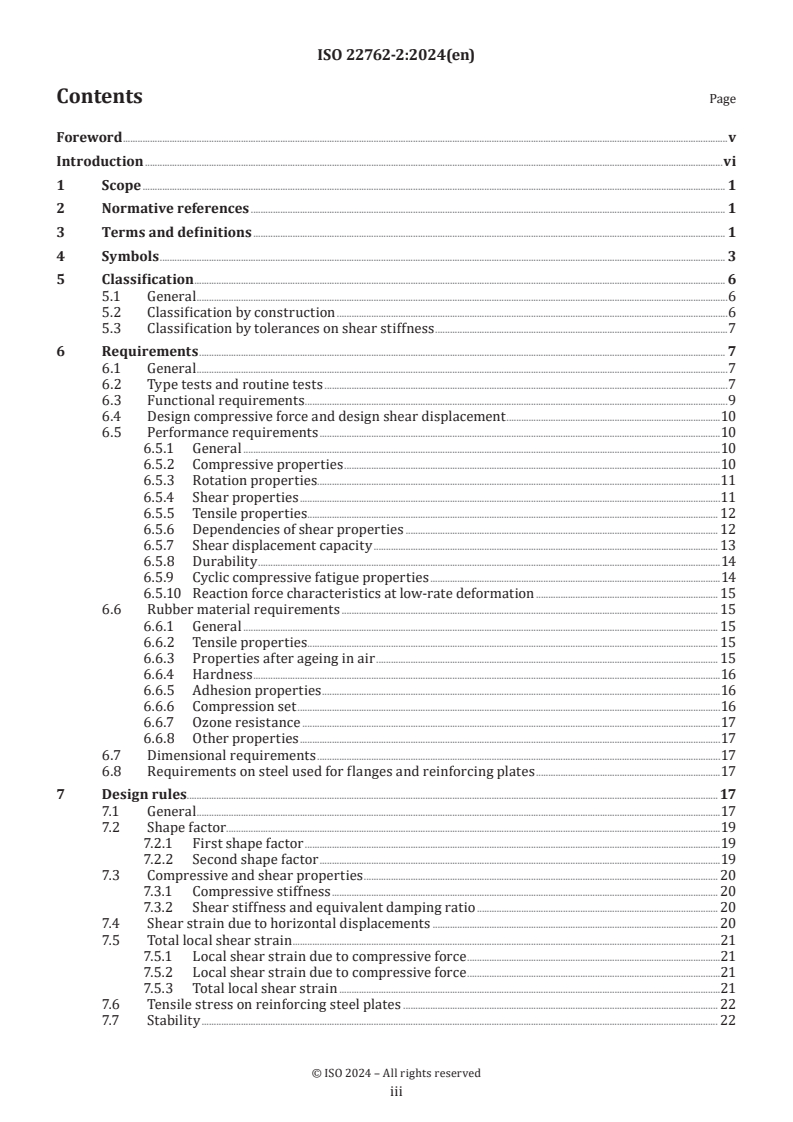
Contents Page
Foreword .v
Introduction .vi
1 Scope . 1
2 Normative references . 1
3 Terms and definitions . 1
4 Symbols . 3
5 Classification . 6
5.1 General .6
5.2 Classification by construction .6
5.3 Classification by tolerances on shear stiffness .7
6 Requirements . 7
6.1 General .7
6.2 Type tests and routine tests .7
6.3 Functional requirements . .9
6.4 Design compressive force and design shear displacement .10
6.5 Performance requirements .10
6.5.1 General .10
6.5.2 Compressive properties .10
6.5.3 Rotation properties.11
6.5.4 Shear properties .11
6.5.5 Tensile properties . . 12
6.5.6 Dependencies of shear properties . 12
6.5.7 Shear displacement capacity . 13
6.5.8 Durability .14
6.5.9 Cyclic compressive fatigue properties .14
6.5.10 Reaction force characteristics at low-rate deformation . 15
6.6 Rubber material requirements . 15
6.6.1 General . 15
6.6.2 Tensile properties . . 15
6.6.3 Properties after ageing in air . 15
6.6.4 Hardness .16
6.6.5 Adhesion properties .16
6.6.6 Compression set .16
6.6.7 Ozone resistance .17
6.6.8 Other properties .17
6.7 Dimensional requirements .17
6.8 Requirements on steel used for flanges and reinforcing plates .17
7 Design rules. 17
7.1 General .17
7.2 Shape factor . .19
7.2.1 First shape factor .19
7.2.2 Second shape factor .19
7.3 Compressive and shear properties . 20
7.3.1 Compressive stiffness . 20
7.3.2 Shear stiffness and equivalent damping ratio . 20
7.4 Shear strain due to horizontal displacements . 20
7.5 Total local shear strain .21
7.5.1 Local shear strain due to compressive force .21
7.5.2 Local shear strain due to compressive force .21
7.5.3 Total local shear strain .21
7.6 Tensile stress on reinforcing steel plates . 22
7.7 Stability . 22
iii
7.7.1 Maximum compressive stress in non-seismic condition . 22
7.7.2 Rotation performance check . 22
7.7.3 Buckling check . 23
7.7.4 Tensile stress on elastomeric isolator . 23
7.8 Force, moment and deformation affecting structures . 23
7.8.1 Shear force affecting structures due to movement . 23
7.8.2 Resistance to rotation . 23
7.8.3 Compressive displacement due to compressive force .24
7.9 Design of fixings .24
7.9.1 External forces affecting joint members .24
7.9.2 Fixings and stresses to be checked .24
7.9.3 Allowable stress . 25
8 Manufacturing tolerances . .25
8.1 General . 25
8.2 Measuring instruments . 25
8.3 Plan dimensions of elastomeric isolator body . 26
8.3.1 Measurement method (see Figure 1) . 26
8.3.2 Tolerances . 26
8.4 Product height .27
8.4.1 Measurement method .27
8.4.2 Tolerances . 28
8.5 Flatness of products. 28
8.5.1 Measurement method . 28
8.5.2 Tolerances . 29
8.6 Horizontal offset . 29
8.6.1 Measurement method . 29
8.6.2 Tolerances . 29
8.7 Plan dimensions of flanges . 29
8.8 Flange thickness . . 30
8.9 Tolerances on positions of flange bolt holes . 30
9 Marking and labelling .30
9.1 Information to be provided .31
9.2 Additional requirements .31
9.3 Marking and labelling examples .31
10 Test methods .31
11 Quality assurance .32
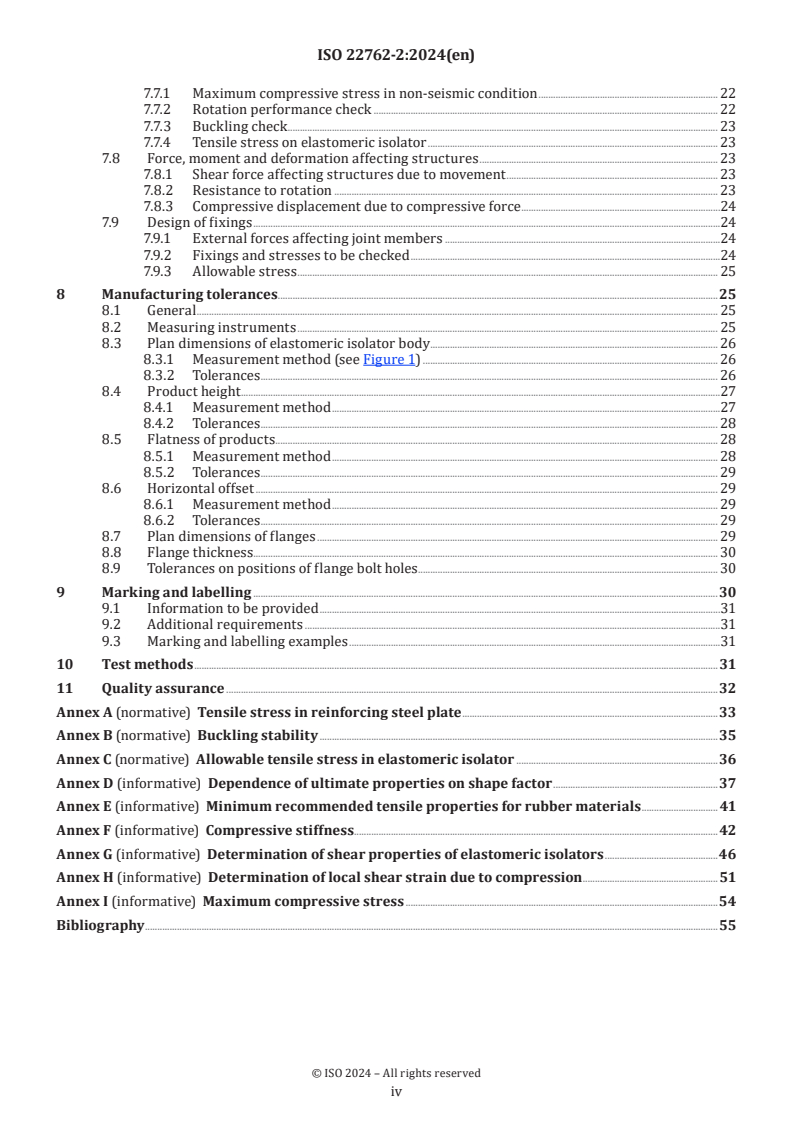
Annex A (normative) Tensile stress in reinforcing steel plate .33
Annex B (normative) Buckling stability .35
Annex C (normative) Allowable tensile stress in elastomeric isolator .36
Annex D (informative) Dependence of ultimate properties on shape factor .37
Annex E (informative) Minimum recommended tensile properties for rubber materials . 41
Annex F (informative) Compressive stiffness .42
Annex G (informative) Determination of shear properties of elastomeric isolators .46
Annex H (informative) Determination of local shear strain due to compression .51
Annex I (informative) Maximum compressive stress .54
Bibliography .55
iv
Foreword
ISO (the International Organization for Standardization) is a worldwide federation of national standards
bodies (ISO member bodies). The work of preparing International Standards is normally carried out through
ISO technical committees. Each member body interested in a subject for which a technical committee
has been established has the right to be represented on that committee. International organizations,
governmental and non-governmental, in liaison with ISO, also take part in the work. ISO collaborates closely
with the International Electrotechnical Commission (IEC) on all matters of electrotechnical standardization.
The procedures used to develop this document and those intended for its further maintenance are described
in the ISO/IEC Directives, Part 1. In particular, the different approval criteria needed for the different types
of ISO document should be noted. This document was drafted in accordance with the editorial rules of the
ISO/IEC Directives, Part 2 (see www.iso.org/directives).
ISO draws attention to the possibility that the implementation of this document may involve the use of (a)
patent(s). ISO takes no position concerning the evidence, validity or applicability of any claimed patent
rights in respect thereof. As of the date of publication of this document, ISO had not received notice of (a)
patent(s) which may be required to implement this document. However, implementers are cautioned that
this may not represent the latest information, which may be obtained from the patent database available at
www.iso.org/patents. ISO shall not be held responsible for identifying any or all such patent rights.
Any trade name used in this document is information given for the convenience of users and does not
constitute an endorsement.
For an explanation of the voluntary nature of standards, the meaning of ISO specific terms and expressions
related to conformity assessment, as well as information about ISO's adherence to the World Trade
Organization (WTO) principles in the Technical Barriers to Trade (TBT), see www.iso.org/iso/foreword.html.
This document was prepared by Technical Committee Technical Committee ISO/TC 45, Rubber and rubber
products, Subcommittee SC 4, Products (other than hoses).
This fourth edition cancels and replaces the third edition (ISO 22762-2:2018), of which it constitutes a minor
revision.
The changes are as follows:
— the relation of this document to ISO 22762-5 and ISO 22762-6 have been added in Introduction;
— the use of the terms "elastomeric isolators" and "seismic isolators have been made consistent throughout
the document;
— the term "fracture" has been replaced by "break" throughout the document;
— modification of Clause 3 to be kept consistent with ISO 22762-1 and ISO 22762-3.
A list of all parts in the ISO 22762 series can be found on the ISO website.
Any feedback or questions on this document should be directed to the user’s national standards body. A
complete listing of these bodies can be found at www.iso.org/members.html.
v
Introduction
The ISO 22762 series includes two parts related to specifications for elastomeric isolators, i.e. ISO 22762-2
for bridges and ISO 22762-3 for buildings. This is because the elastomeric isolator requirements for bridges
and buildings are quite different, although the basic concept of the two products is similar. Therefore,
ISO 22762-2 and the relevant clauses in ISO 22762-1 are used when ISO 22762 (all parts) is applied to the
design of bridge isolators whereas ISO 22762-3 and the relevant clauses of ISO 22762-1 are used when it is
applied to building isolators.
The main differences to be noted between elastomeric isolators for bridges and elastomeric isolators for
buildings are the following.
a) Elastomeric isolators for bridges are mainly rectangular in shape and those for buildings are circular
in shape.
b) Elastomeric isolators for bridges are designed to be used for both rotation and horizontal displacement,
while elastomeric isolators for buildings are designed for horizontal displacement only.
c) Elastomeric isolators for bridges are designed to perform on a daily basis to accommodate length
changes of bridges caused by temperature changes as well as during earthquakes, while elastomeric
isolators for buildings are designed to perform only during earthquakes.
d) Elastomeric isolators for bridges are designed to withstand dynamic loads caused by vehicles on a daily
basis as well as earthquakes, while elastomeric isolators for buildings are mainly designed to withstand
dynamic loads caused by earthquakes only.
For structures other than buildings and bridges (e.g. tanks), the structural engineer uses either ISO 22762-2
or ISO 22762-3, depending on the requirements of the structure.
ISO/TS 22762-4 is a guidance for the use of ISO 22762-3. ISO 22762-5 gives specifications and test methods
for sliding seismic-protection isolators which are not specified as elastomeric isolators. ISO 22762-6 gives
specifications and test methods for high-durability and high-performance elastomeric isolators. Three
grades of requirements for each test item are introduced in ISO 22762-6.
vi
International Standard ISO 22762-2:2024(en)
Elastomeric seismic-protection isolators —
Part 2:
Applications for bridges — Specifications
1 Scope
This document specifies minimum requirements and test methods for elastomeric seismic isolators used for
bridges, as well as rubber material used in the manufacture of such isolators.
It is applicable to elastomeric seismic isolators used to provide bridges with protection from earthquake
damage. The isolators covered consist of alternate elastomeric layers and reinforcing steel plates, which are
placed between a superstructure and its substructure to provide both flexibility for decoupling structural
systems from ground motion and damping capability to reduce displacement at the isolation interface and
the transmission of energy from the ground into the structure at the isolation frequency.
2 Normative references
The following documents are referred to in the text in such a way that some or all of their content constitutes
requirements of this document. For dated references, only the edition cited applies. For undated references,
the latest edition of the referenced document (including any amendments) applies.
ISO 630 (all parts), Structural steels
ISO 22762-1:2024, Elastomeric seismic-protection isolators — Part 1: Test methods
3 Terms and definitions
For the purposes of this document, the following terms and definitions apply.
ISO and IEC maintain terminological databases for use in standardization at the following addresses:
— ISO Online browsing platform: available at https:// www .iso .org/ obp
— IEC Electropedia: available at https:// www .electropedia .org/
3.1
breaking
rupture of elastomeric isolator (3.8) due to compression- (or tension-) shear loading
3.2
buckling
state when elastomeric isolator (3.8) lose their stability under compression-shear loading
3.3
compressive properties
K
v
compressive stiffness for all types of rubber bearings
3.4
cover rubber
rubber wrapped around the outside of inner rubber and reinforcing steel plates before or after curing of
elastomeric isolator (3.8) for the purposes of protecting the inner rubber from deterioration due to oxygen,
ozone and other natural elements and protecting the reinforcing plates from corrosion
3.5
design compressive stress
long-term compressive force on the elastomeric isolator (3.8) imposed by the structure
3.6
effective loaded area
area sustaining vertical load in elastomeric isolator (3.8), which corresponds to the area of reinforcing steel plates
3.7
effective width
the smaller of the two side lengths of inner rubber to which direction
shear displacement is not restricted
3.8
elastomeric isolator
rubber bearing, for seismic isolation of buildings, bridges and other structures, which consists of multi-
layered vulcanized rubber sheets and reinforcing steel plates
EXAMPLE High-damping rubber bearings, linear natural rubber bearings and lead rubber bearings.
3.9
first shape factor
ratio of effectively loaded area to free deformation area of one inner rubber layer between steel plates
3.10
high-damping rubber bearing
HDR
elastomeric isolator (3.8) with relatively high damping properties obtained by special compounding of the
rubber and the use of additives
3.11
inner rubber
rubber between multi-layered steel plates inside an elastomeric isolator (3.8)
3.12
lead rubber bearing
LRB
elastomeric isolator (3.8) whose inner rubber (3.11) with a lead plug or lead plugs press fitted into a hole or
holes of the elastomeric isolator body to achieve damping properties
3.13
linear natural rubber bearing
LNR
elastomeric isolator (3.8) with linear shear force-displacement characteristics and relatively low damping
properties, fabricated using natural rubber
Note 1 to entry: Any bearing with relatively low damping can be treated as an LNR bearing for the purposes of
elastomeric isolator testing.
3.14
maximum compressive stress
peak stress acting briefly on elastomeric isolator (3.8) in compressive direction during an earthquake
3.15
nominal compressive stress
long-term stress acting on elastomeric isolator (3.8) in compressive direction as recommended by the
manufacturer for the elastomeric isolator, including the safety margin
3.16
roll-out
instability of an elastomeric isolator with either dowelled or recessed connection under shear displacement
3.17
routine test
test for quality control of the production elastomeric isolators during and after manufacturing
3.18
second shape factor
ratio of the diameter of the inner rubber to the total thickness of the inner rubber
3.19
second shape factor
ratio of the effective width of the inner rubber to the total
thickness of the inner rubber
3.20
shear properties
comprehensive term that covers characteristics determined from elastomeric isolator tests:
— shear stiffness, K , for LNR;
h
— shear stiffness, K , and equivalent damping ratio, h , for HDR and LRB;
h eq
— post-yield stiffness, K , and characteristic strength, Q , for LRB
d d
3.21
structural engineer
engineer who is in charge of designing the structure for seismically isolated bridges or buildings and is
responsible for specifying the requirements for elastomeric isolators (3.8)
3.22
type test
test for verification either of material properties and elastomeric isolator performances during development
of the product or that project design parameters are achieved
3.23
ultimate properties
properties at either buckling, breaking, or roll-out of an elastomeric isolator under compression-shear
loading (see Annex D).
4 Symbols
For the purposes of this document, the symbols given in Table 1 apply.
Table 1 — Symbols and descriptions
Symbol Description
A effective plan area; plan area of elastomeric isolator, excluding cover rubber portion
A effective area of bolt
b
A overlap area between the top and bottom elastomer area of elastomeric isolator
e
A load-free area of elastomeric isolator
free
A Loaded area of elastomeric isolator
load
TTabablele 1 1 ((ccoonnttiinnueuedd))
Symbol Description
A area of the lead plug for a lead rubber bearing
p
a Side length of square elastomeric isolator, excluding cover rubber thickness, or length in longitudinal
direction of rectangular elastomeric isolator, excluding cover rubber thickness
a length of the shorter side of the rectangular elastomeric isolator, including cover rubber thickness
e
a′ length in longitudinal direction of the rectangular elastomeric isolator, including cover rubber thickness
B effective width for bending of flange
b length in transverse direction of the rectangular elastomeric isolator, excluding cover rubber thickness
b′ length in transverse direction of the rectangular elastomeric isolator, including cover rubber thickness
c distance from centre of bolt hole to effective flange section
D′ outer diameter of circular elastomeric isolator, including cover rubber
D diameter of flange
f
d inner diameter of reinforcing steel plate
i
d diameter of bolt hole
k
d outer diameter of reinforcing steel plate
E apparent Young's modulus of bonded rubber layer
ap
E apparent Young's modulus corrected, if necessary, by allowing for compressibility
c
s
E apparent Young's modulus corrected for bulk compressibility depending on its shape factor (S )
c 1
E bulk modulus of rubber
∞
E Young's modulus of rubber
F tensile force on elastomeric isolator by uplift
u
G shear modulus
G (γ) equivalent linear shear modulus as a function of shear strain
eq
H height of elastomeric isolator, including mounting flange
H height of elastomeric isolator, excluding mounting flange
n
h equivalent damping ratio
eq
h (γ) equivalent damping ratio as a function of shear strain
eq
K post-yield stiffness (tangential stiffness after yielding of lead plug) of lead rubber bearing
d
K shear stiffness
h
K initial shear stiffness
i
K shear stiffness of lead plug inserted in lead rubber bearing
p
K shear stiffness of lead rubber bearing before inserting lead plug
r
K tangential shear stiffness
t
K compressive stiffness
v
L length of one side of a rectangular flange
f
M resistance to rotation
M moment acting on bolt
f
M moment acting on elastomeric isolator
r
n number of rubber layers
n number of fixing bolts
b
P compressive force
P design compressive force in absence of seismic action effects
P maximum compressive force including seismic action effects
max
P minimum compressive force including seismic actions effects (the minimum may be negative; ie the min-
min
imum force may be tensile)
Q shear force
TTabablele 1 1 ((ccoonnttiinnueuedd))
Symbol Description
Q shear force at breaking
b
Q shear force at buckling
buk
Q characteristic strength
d
S first shape factor
S second shape factor
T temperature
T standard temperature, 23 °C or 27 °C;
where specified tolerance is ±2 °C, T is standard laboratory temperature
T total rubber thickness, given by T = n × t
r r r
t thickness of one rubber layer
r
t , t thickness of rubber layer laminated on each side of plate
r1 r2
t thickness of one reinforcing steel plate
s
t thickness of outside cover rubber
U(γ) function giving ratio of characteristic strength to maximum shear force of a loop
v loading velocity
W energy dissipated per cycle
d
X shear displacement
X design shear displacement
X shear displacement at breaking
b
X shear displacement at buckling
buk
X shear displacement due to quasi-static shear movement
s
X maximum shear displacement
max
X shear displacement due to dynamic shear movement
d
Y compressive displacement
Z section modulus of flange
α coefficient of linear thermal expansion
γ shear strain
γ design shear strain
γ upper limit of the total of design strains on elastomeric isolators
a
γ shear strain at breaking
b
γ local shear strain due to compressive force
c
γ shear strain due to dynamic shear movement
d
γ maximum design shear strain during earthquake
max
γ local shear strain due to rotation
r
γ shear strain due to quasi-static shear movement
s
γ ultimate shear strain
u
δ horizontal offset of elastomeric isolator
H
δ difference in elastomeric isolator height measured between two points at opposite extremes of the elas-
v
tomeric isolator
ε compressive strain of rubber
ε compressive creep strain
cr
ε tensile strain of elastomeric isolator
T
ε tensile-breaking strain of elastomeric isolator
Tb
ε tensile-yield strain of elastomeric isolator
Ty
ζ ratio of total height of rubber and steel layers to total rubber height
TTabablele 1 1 ((ccoonnttiinnueuedd))
Symbol Description
θ rotation angle of elastomeric isolator about the diameter of a circular bearing or about an axis through a
rectangular bearing
θ rotation angle of elastomeric isolator in the longitudinal direction (a)
a
θ rotation angle of elastomeric isolator in the transverse direction (b)
b
λ correction factor for calculation of stress in reinforcing steel plates
η correction factor for calculation of critical stress
κ correction factor for apparent Young's modulus according to hardness
Σγ total local shear strain
σ compressive stress in elastomeric isolator
σ design compressive stress
σ tensile stress in bolt
B
σ bending stress in flange
b
σ allowable bending stress in steel
bf
σ critical compressive stress in elastomeric isolator
cr
σ allowable tensile stress in steel
f
σ maximum design compressive stress
max
σ minimum design compressive stress
min
σ for building: nominal compressive stress recommended by manufacturer
nom
σ tensile stress in reinforcing steel plate
s
σ allowable tensile stress in steel plate
sa
σ yield stress of steel for flanges and reinforcing steel plates
sy
σ tensile strength of steel for flanges and reinforcing steel plates
su
σ tensile stress
t
σ allowable tensile stress in elastomeric isolator
te
τ shear stress in bolt
B
τ allowable shear stress in steel
f
ϕ factor for computation of buckling stability
ξ factor for computation of critical stress
5 Classification
5.1 General
Elastomeric isolators are classified by construction, their ultimate properties and tolerances on their
performance.
5.2 Classification by construction
Elastomeric isolators are classified by construction, as shown in Table 2. The structural engineer shall
specify which construction is to be used.
Table 2 — Classification by construction
Type Construction Illustration
Mounting flanges are bolted to connecting
Type I flange plates, which are bonded to the lami-
nated rubber.
Mounting flanges are directly bonded to the
Type II
laminated rubber.
Type III Elastomeric isolators without mounting flanges
5.3 Classification by tolerances on shear stiffness
Elastomeric isolators may be classified by their tolerance on shear stiffness, as shown in Table 3. The
structural engineer shall specify the tolerance required.
Table 3 — Classification by tolerance on shear stiffness
Tolerance
Class
%
S-A ±10
S-B ±20
6 Requirements
6.1 General
Elastomeric isolators for bridges and the materials used in their manufacture shall meet the requirements
specified in this clause. For test items (see Table 4) that have no specific required values, the manufacturer
shall define the values and inform the purchaser prior to production.
The standard temperature for determining the properties of elastomeric isolators is 23 °C or 27 °C in
accordance with prevailing International Standards. However, it is advisable to establish a range of working
temperatures, taking into consideration actual environmental temperatures and possible changes in
temperature at the work site where the elastomeric isolators are installed.
6.2 Type tests and routine tests
6.2.1 Testing to be carried out on elastomeric isolators is classified into type tests, and routine tests.
6.2.2 Type tests shall be conducted either to ensure that project design parameters have been achieved (in
which case the test results shall be submitted to the structural engineer for review prior to production) or
to verify elastomeric isolator performance and material properties during development of the product. The
test piece for each type test shall be full-scale or one of the options specified in Table 4. The test piece shall
not have been subjected to any previous test programme. The tests shall be performed on test pieces not
subjected to any scragging, unless the production elastomeric isolators are to be supplied after scragging. In
that case, the test pieces shall be subjected to the same scragging procedure as the production elastomeric
isolators
6.2.3 Previous type test results may be substituted, provided the following conditions are met.
a) Elastomeric isolators are fabricated in a similar manner and from the same compound and adhesive.
b) All corresponding external and internal dimensions are within 10 % of each other.
c) The second shape factors are within ±10 %.
d) The test conditions such as maximum and minimum vertical load applied in the ultimate property test,
as described in 6.5.7, are more severe.
Table 4 — Tests on products
Routine Type
a
Properties Test item Test method Test piece
test test
Compressive proper- Compressive stiffness ISO 22762-1:2024, 6.2.1,
ties Compressive displace- method 1 X X Full-scale only
Rotation performance ment
Shear properties Shear stiffness ISO 22762-1:2024, 6.2.2
Equivalent damping
ratio
Post-yield stiffness X X Full-scale only
(for LRB)
Characteristic
strength (for LRB)
Tensile properties Tensile breaking ISO 22762-1:2024, 6.5
strength N/A Opt. Scale B
Shear strain
Dependence of shear Shear strain depend- ISO 22762-1:2024, 6.3.1
N/A X Scale B
properties ence
Compressive stress ISO 22762-1:2024, 6.3.2
N/A Opt. Scale B
dependence
Frequency dependence ISO 22762-1:2024, 6.3.3
N/A X(m) Scale A, STD, SBS
ISO 22762-1:2024, 5.8
Repeated loading ISO 22762-1:2024, 6.3.4
N/A X Scale B
dependence
X: Test to be conducted with elastomeric isolators.
X(m): Test can be conducted either with elastomeric isolators or with shear-block test pieces.
N/A: Not applicable.
Opt.: Optional.
Scale A: Scaling such that, for a circular bearing, diameter ≥150 mm, for a rectangular bearing, side length ≥100 mm and, for both
types, rubber layer thickness ≥1,5 mm and thickness of reinforcing steel plates ≥0,5 mm.
Scale B: Scaling such that, for a circular bearing, diameter ≥450 mm, for a rectangular bearing, side length ≥400 mm and, for both
types, rubber layer thickness ≥1,5 mm and thickness of reinforcing steel plates ≥0,5 mm.
STD: Standard test piece (see ISO 22762-1:2024, Tables 12 and 13).
SBS: Shear-block test piece specified in ISO 22762-1:2024, 5.8.3. With LRB, SBS shall only be used for ageing tests.
a
Test piece may in all cases be a full-scale elastomeric isolator. This column indicates other options, where these exist.
TTabablele 4 4 ((ccoonnttiinnueuedd))
Routine Type
a
Properties Test item Test method Test piece
test test
Temperature depend- ISO 22762-1:2024, 6.3.5
N/A X(m) Scale A, STD, SBS
ence
ISO 22762-1:2024, 5.8
Shear displacement Breaking strain ISO 22762-1:2024, 6.4
capacity Buckling strain N/A X Scale B
Roll-out strain
Durability Ageing ISO 22762-1:2024, 6.6.1
N/A X(m) Scale A, STD, SBS
ISO 22762-1:2024, 5.8
Creep ISO 22762-1:2024, 6.6.2 N/A X Scale A
Cyclic compressive Shear stiffness ISO 22762-1:2024, 6.6.3
N/A X Scale B
fatigue
Reaction force Shear stiffness or ISO 22762-1:2024, 6.7
characteristics at low- shear force N/A Opt. Scale A
rate deformation
X: Test to be conducted with elastomeric isolators.
X(m): Test can be conducted either with elastomeric isolators or with shear-block test pieces.
N/A: Not applicable.
Opt.: Optional.
Scale A: Scaling such that, for a circular bearing, diameter ≥150 mm, for a rectangular bearing, side length ≥100 mm and, for both
types, rubber layer thickness ≥1,5 mm and thickness of reinforcing steel plates ≥0,5 mm.
Scale B: Scaling such that, for a circular bearing, diameter ≥450 mm, for a rectangular bearing, side length ≥400 mm and, for both
types, rubber layer thickness ≥1,5 mm and thickness of reinforcing steel plates ≥0,5 mm.
STD: Standard test piece (see ISO 22762-1:2024, Tables 12 and 13).
SBS: Shear-block test piece specified in ISO 22762-1:2024, 5.8.3. With LRB, SBS
...