

ISO 21318:2007
(Main)Plastics — Epoxy resins — Determination of electrical conductivity of aqueous resin extracts
General Information
- Abstract
ISO 21318:2007 specifies a method for the determination of the electrical conductivity of an aqueous extract obtained by extraction of an epoxy resin with water at 95 °C. The method is applicable only to epoxy resins that are in the molten state at the extraction temperature (95 °C). The method is important for epoxy resins which are used as insulation materials for electronic devices. The electrical conductivity of the extract is used as a measure of the concentration of the ionic species in the resin.
- Status
- Published
- Publication Date
- 23-Jan-2007
- Technical Committee
- ISO/TC 61/SC 12 - Thermosetting materials
- Current Stage
- 9093 - International Standard confirmed
- Start Date
- 05-Jun-2026
- Completion Date
- 29-Aug-2026
Overview
ISO 21318:2007 specifies a standardized test method for determining the electrical conductivity of aqueous extracts of epoxy resins. The method measures ionic species in an extract produced by water extraction at 95 °C and is intended for epoxy resins that are molten at that temperature. The measured conductivity serves as an aggregate indicator of ionic impurities (e.g., chloride, sodium, catalyst residues) that can impair epoxy insulation in electronic devices.
Key topics and technical requirements
- Scope: Applicable only to epoxy resins molten at 95 °C; used primarily for electronic insulation materials.
- Extraction conditions: Test portion 8.00 g ± 0.05 g with 80 ml ± 2 ml distilled/deionized water (conductivity < 2.0 µS/cm) in a sealed HDPE bottle; heated at 95 °C ± 3 °C.
- Timing and safety: Loosen cap after 30 min to relieve pressure; total extraction time 20 h ± 0.5 h; use protective equipment when releasing pressure.
- Measurement: Measure extract conductivity at 25 °C using a conductivity meter accurate to 0.1 µS/cm with temperature compensation.
- Result expression: Corrected conductivity = sample conductivity − blank conductivity (expressed in µS/cm). Perform a blank test using the same water without resin.
- Precision: Repeatability and reproducibility data were established in a multi-laboratory trial (see standard for tabulated values).
- Reporting: Test report must reference ISO 21318, identify the sample, record results and date, and note any relevant influences on the result.
Practical applications and users
ISO 21318:2007 is practical for:
- Epoxy resin producers performing routine quality control to monitor ionic impurity levels.
- Electronics manufacturers specifying resin acceptance criteria for insulating encapsulants, potting compounds and coatings.
- Independent testing laboratories conducting material qualification and failure analysis.
- R&D and materials engineers assessing formulation or curing changes that affect ionic contamination.
Benefits include a simple, reproducible proxy measurement for overall ionic content, helping to reduce field failures due to conductive contamination in electronic assemblies.
Related standards
- ISO 5725-2 - Accuracy (trueness and precision) of measurement methods and results: basic method for determination of repeatability and reproducibility (referenced for precision data in ISO 21318).
- ISO/TC 61 - Technical committee responsible for plastics standards (development context).
Keywords: ISO 21318:2007, epoxy resins, electrical conductivity, aqueous resin extracts, ionic impurities, electronic insulation, conductivity meter, quality control.
Relations
- Consolidated By
ISO 8536-11:2015 - Infusion equipment for medical use — Part 11: Infusion filters for single use with pressure infusion equipment - Effective Date
- 06-Jun-2022
Get Certified
Connect with accredited certification bodies for this standard

DIN CERTCO
DIN Group product certification.

Smithers Quality Assessments
US management systems and product certification.
Sponsored listings
Frequently Asked Questions
ISO 21318:2007 is a standard published by the International Organization for Standardization (ISO). Its full title is "Plastics — Epoxy resins — Determination of electrical conductivity of aqueous resin extracts". This standard covers: ISO 21318:2007 specifies a method for the determination of the electrical conductivity of an aqueous extract obtained by extraction of an epoxy resin with water at 95 °C. The method is applicable only to epoxy resins that are in the molten state at the extraction temperature (95 °C). The method is important for epoxy resins which are used as insulation materials for electronic devices. The electrical conductivity of the extract is used as a measure of the concentration of the ionic species in the resin.
ISO 21318:2007 specifies a method for the determination of the electrical conductivity of an aqueous extract obtained by extraction of an epoxy resin with water at 95 °C. The method is applicable only to epoxy resins that are in the molten state at the extraction temperature (95 °C). The method is important for epoxy resins which are used as insulation materials for electronic devices. The electrical conductivity of the extract is used as a measure of the concentration of the ionic species in the resin.
ISO 21318:2007 is classified under the following ICS (International Classification for Standards) categories: 83.080.10 - Thermosetting materials. The ICS classification helps identify the subject area and facilitates finding related standards.
ISO 21318:2007 has the following relationships with other standards: It is inter standard links to ISO 8536-11:2015. Understanding these relationships helps ensure you are using the most current and applicable version of the standard.
ISO 21318:2007 is available in PDF format for immediate download after purchase. The document can be added to your cart and obtained through the secure checkout process. Digital delivery ensures instant access to the complete standard document.
Standards Content (Sample)
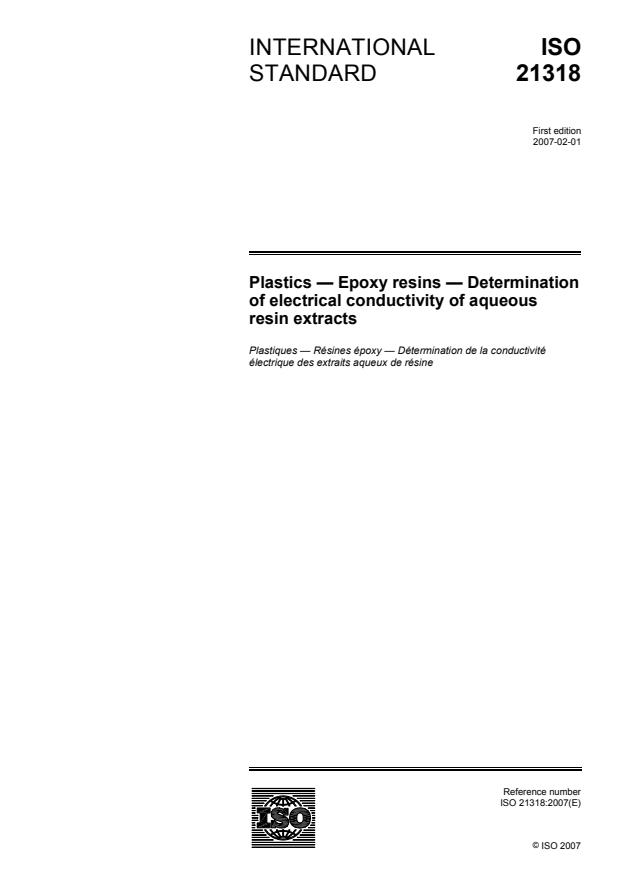
INTERNATIONAL ISO
STANDARD 21318
First edition
2007-02-01
Plastics — Epoxy resins — Determination
of electrical conductivity of aqueous
resin extracts
Plastiques — Résines époxy — Détermination de la conductivité
électrique des extraits aqueux de résine
Reference number
©
ISO 2007
PDF disclaimer
This PDF file may contain embedded typefaces. In accordance with Adobe's licensing policy, this file may be printed or viewed but
shall not be edited unless the typefaces which are embedded are licensed to and installed on the computer performing the editing. In
downloading this file, parties accept therein the responsibility of not infringing Adobe's licensing policy. The ISO Central Secretariat
accepts no liability in this area.
Adobe is a trademark of Adobe Systems Incorporated.
Details of the software products used to create this PDF file can be found in the General Info relative to the file; the PDF-creation
parameters were optimized for printing. Every care has been taken to ensure that the file is suitable for use by ISO member bodies. In
the unlikely event that a problem relating to it is found, please inform the Central Secretariat at the address given below.
© ISO 2007
All rights reserved. Unless otherwise specified, no part of this publication may be reproduced or utilized in any form or by any means,
electronic or mechanical, including photocopying and microfilm, without permission in writing from either ISO at the address below or
ISO's member body in the country of the requester.
ISO copyright office
Case postale 56 • CH-1211 Geneva 20
Tel. + 41 22 749 01 11
Fax + 41 22 749 09 47
E-mail copyright@iso.org
Web www.iso.org
Published in Switzerland
ii © ISO 2007 – All rights reserved
Foreword
ISO (the International Organization for Standardization) is a worldwide federation of national standards bodies
(ISO member bodies). The work of preparing International Standards is normally carried out through ISO
technical committees. Each member body interested in a subject for which a technical committee has been
established has the right to be represented on that committee. International organizations, governmental and
non-governmental, in liaison with ISO, also take part in the work. ISO collaborates closely with the
International Electrotechnical Commission (IEC) on all matters of electrotechnical standardization.
International Standards are drafted in accordance with the rules given in the ISO/IEC Directives, Part 2.
The main task of technical committees is to prepare International Standards. Draft International Standards
adopted by the technical committees are circulated to the member bodies for voting. Publication as an
International Standard requires approval by at least 75 % of the member bodies casting a vote.
Attention is drawn to the possibility that some of the elements of this document may be the subject of patent
rights. ISO shall not be held responsible for identifying any or all such patent rights.
ISO 21318 was prepared by Technical Committee ISO/TC 61, Plastics, Subcommittee SC 12, Thermosetting
materials.
Introduction
Where epoxy resins are used as insulation for electronic devices, ionic impurities such as chloride, sodium
and catalyst residues present in the epoxy resin can cause failure of the device. Instead of determining these
impurities separately, a test method may be used to evaluate their contents as a whole by measuring the
electrical conductivity of a resin extract obtained by extraction of the resin with water at an elevated
temperature. Because of its practical usage and simplicity, this method is becoming widely used in the quality
control of epoxy resins for electronic insulation applications.
iv © ISO 2007 – All rights reserved
INTERNATIONAL STANDARD ISO 21318:2007(E)
Plastics — Epoxy resins — Determination of electrical
conductivity of aqueous resin extracts
SAFETY STATEME
...