

ISO/IEC Guide 98-3:2008
(Main)Uncertainty of measurement — Part 3: Guide to the expression of uncertainty in measurement (GUM:1995)
General Information
- Abstract
ISO/IEC Guide 98-3:2008 is a reissue of the 1995 version of the Guide to the Expression of Uncertainty in Measurement (GUM), with minor corrections. This Guide establishes general rules for evaluating and expressing uncertainty in measurement that can be followed at various levels of accuracy and in many fields — from the shop floor to fundamental research. The principles of this Guide are intended to be applicable to a broad spectrum of measurements, including those required for: maintaining quality control and quality assurance in production; complying with and enforcing laws and regulations; conducting basic research, and applied research and development, in science and engineering; calibrating standards and instruments and performing tests throughout a national measurement system in order to achieve traceability to national standards; developing, maintaining, and comparing international and national physical reference standards, including reference materials.
- Status
- Published
- Publication Date
- 29-Sep-2008
- Technical Committee
- ISO/TMBG - Technical Management Board - groups
- Drafting Committee
- ISO/TMBG - Technical Management Board - groups
- Current Stage
- 9093 - International Standard confirmed
- Start Date
- 04-Aug-2023
- Completion Date
- 29-Aug-2026
Buy Documents

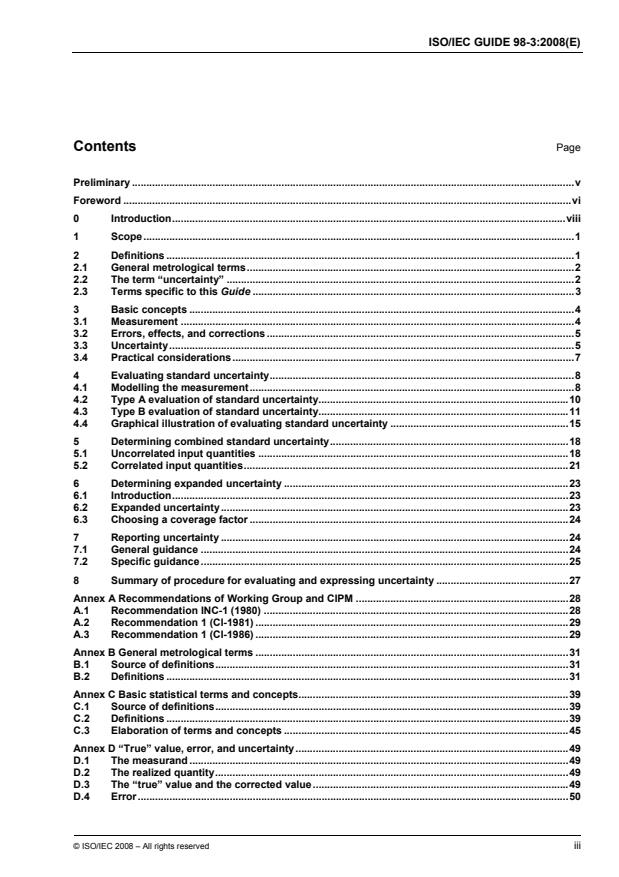
ISO/IEC Guide 98-3:2008 - Uncertainty of measurement — Part 3: Guide to the expression of uncertainty in measurement (GUM:1995) Released:11/12/2010
ISO/IEC Guide 98-3:2008 - Incertitude de mesure — Partie 3: Guide pour l'expression de l'incertitude de mesure (GUM:1995) Released:11/16/2010
Overview
ISO/IEC Guide 98-3:2008 is the reissued Guide to the Expression of Uncertainty in Measurement (GUM:1995) with minor corrections. It establishes internationally accepted principles and general rules for evaluating and expressing measurement uncertainty that apply across sectors and levels of accuracy - from shop-floor measurements to fundamental research. The Guide supports traceability, comparability of results, and transparent reporting of measurement quality.
Key topics
- Fundamental concepts: measurand, error, uncertainty, corrected value, and practical considerations for measurements.
- Modeling the measurement: identifying input quantities and relationships used to obtain a measurement result.
- Evaluating standard uncertainty: two complementary approaches
- Type A - statistical evaluation from repeated observations.
- Type B - evaluation from other information (calibration certificates, manufacturer specifications, expert judgment).
- Combining uncertainties: procedures for determining combined standard uncertainty, including treatment of correlated and uncorrelated input quantities.
- Expanded uncertainty: converting combined standard uncertainty into an interval (using a coverage factor) for reporting at a stated level of confidence.
- Reporting: guidance on documenting measurement results, uncertainty statements, and complete information for traceability and reproducibility.
- Supporting material: annexes with worked examples, glossary of symbols, statistical background, and practical guidance on evaluating components and degrees of freedom.
Applications
ISO/IEC Guide 98-3:2008 is used wherever reliable, comparable measurement results are required:
- Quality control and quality assurance in manufacturing and production.
- Calibration laboratories and national measurement institutes for establishing traceability.
- Regulatory compliance and enforcement where legally defensible measurement statements are needed.
- Scientific research and R&D to quantify measurement reliability.
- Development and comparison of reference standards and reference materials.
Who should use it
- Metrologists and calibration engineers
- Laboratory managers and quality assurance professionals
- Test and measurement engineers in industry and research
- Accreditation and conformity assessment bodies
- Regulators and standards developers
Related standards and organizations
The Guide is the internationally accepted foundation for expressing uncertainty and is closely associated with metrology organizations such as BIPM, JCGM, IEC, ISO and OIML. It is intended to be used in conjunction with national and international calibration, accreditation and measurement-system standards and best practices that require documented uncertainty evaluations.
Keywords: GUM, ISO/IEC Guide 98-3:2008, uncertainty of measurement, measurement uncertainty, standard uncertainty, combined standard uncertainty, expanded uncertainty, Type A, Type B, traceability, calibration, metrology.
Relations
- Effective Date
- 09-Sep-2026
- Effective Date
- 01-Sep-2026
- Effective Date
- 12-Aug-2026
- Effective Date
- 06-May-2026
- Effective Date
- 22-Apr-2026
- Effective Date
- 31-Mar-2026
- Effective Date
- 20-Feb-2026
- Effective Date
- 20-Feb-2026
- Effective Date
- 20-Feb-2026
- Effective Date
- 20-Feb-2026
- Effective Date
- 20-Feb-2026
- Effective Date
- 20-Feb-2026
- Effective Date
- 20-Feb-2026
- Effective Date
- 20-Feb-2026
- Effective Date
- 20-Feb-2026
Buy Documents
ISO/IEC Guide 98-3:2008 - Uncertainty of measurement — Part 3: Guide to the expression of uncertainty in measurement (GUM:1995) Released:11/12/2010
ISO/IEC Guide 98-3:2008 - Incertitude de mesure — Partie 3: Guide pour l'expression de l'incertitude de mesure (GUM:1995) Released:11/16/2010
Get Certified
Connect with accredited certification bodies for this standard

BSMI (Bureau of Standards, Metrology and Inspection)
Taiwan's standards and inspection authority.
Sponsored listings
Frequently Asked Questions
ISO/IEC Guide 98-3:2008 is a guide published by the International Organization for Standardization (ISO). Its full title is "Uncertainty of measurement — Part 3: Guide to the expression of uncertainty in measurement (GUM:1995)". This standard covers: ISO/IEC Guide 98-3:2008 is a reissue of the 1995 version of the Guide to the Expression of Uncertainty in Measurement (GUM), with minor corrections. This Guide establishes general rules for evaluating and expressing uncertainty in measurement that can be followed at various levels of accuracy and in many fields — from the shop floor to fundamental research. The principles of this Guide are intended to be applicable to a broad spectrum of measurements, including those required for: maintaining quality control and quality assurance in production; complying with and enforcing laws and regulations; conducting basic research, and applied research and development, in science and engineering; calibrating standards and instruments and performing tests throughout a national measurement system in order to achieve traceability to national standards; developing, maintaining, and comparing international and national physical reference standards, including reference materials.
ISO/IEC Guide 98-3:2008 is a reissue of the 1995 version of the Guide to the Expression of Uncertainty in Measurement (GUM), with minor corrections. This Guide establishes general rules for evaluating and expressing uncertainty in measurement that can be followed at various levels of accuracy and in many fields — from the shop floor to fundamental research. The principles of this Guide are intended to be applicable to a broad spectrum of measurements, including those required for: maintaining quality control and quality assurance in production; complying with and enforcing laws and regulations; conducting basic research, and applied research and development, in science and engineering; calibrating standards and instruments and performing tests throughout a national measurement system in order to achieve traceability to national standards; developing, maintaining, and comparing international and national physical reference standards, including reference materials.
ISO/IEC Guide 98-3:2008 is classified under the following ICS (International Classification for Standards) categories: 17.020 - Metrology and measurement in general. The ICS classification helps identify the subject area and facilitates finding related standards.
ISO/IEC Guide 98-3:2008 has the following relationships with other standards: It is inter standard links to EN ISO 14577-1:2026, EN IEC 62475:2026, EN ISO 15193:2026, EN ISO 13977-1:2026, EN ISO 14577-5:2026, EN IEC 62264-2:2026, EN IEC 62282-8-201:2024, EN 62387:2016, EN 61400-13:2016, EN IEC 62129-3:2019, EN IEC 60404-6:2018, EN 62751-2:2014, EN IEC/IEEE 62209-1528:2021, EN IEC 61400-12-2:2022, EN IEC 61757-2-1:2021. Understanding these relationships helps ensure you are using the most current and applicable version of the standard.
ISO/IEC Guide 98-3:2008 is available in PDF format for immediate download after purchase. The document can be added to your cart and obtained through the secure checkout process. Digital delivery ensures instant access to the complete standard document.
Standards Content (Sample)
GUIDE 98-3
Uncertainty of measurement —
Part 3:
Guide to the expression of
uncertainty in measurement
(GUM:1995)
Incertitude de mesure —
Partie 3: Guide pour l'expression de l'incertitude de
mesure (GUM:1995)
First edition 2008
Corrected version 2010
©
ISO/IEC 2008
PDF disclaimer
This PDF file may contain embedded typefaces. In accordance with Adobe's licensing policy, this file may be printed or viewed but
shall not be edited unless the typefaces which are embedded are licensed to and installed on the computer performing the editing. In
downloading this file, parties accept therein the responsibility of not infringing Adobe's licensing policy. The ISO Central Secretariat
accepts no liability in this area.
Adobe is a trademark of Adobe Systems Incorporated.
Details of the software products used to create this PDF file can be found in the General Info relative to the file; the PDF-creation
parameters were optimized for printing. Every care has been taken to ensure that the file is suitable for use by ISO member bodies. In
the unlikely event that a problem relating to it is found, please inform the Central Secretariat at the address given below.
© ISO/IEC 2008
All rights reserved. Unless otherwise specified, no part of this publication may be reproduced or utilized in any form or by any means,
electronic or mechanical, including photocopying and microfilm, without permission in writing from either ISO at the address below or
ISO's member body in the country of the requester.
ISO copyright office
Case postale 56 • CH-1211 Geneva 20
Tel. + 41 22 749 01 11
Fax + 41 22 749 09 47
E-mail copyright@iso.org
Web www.iso.org
Published in Switzerland
ii © ISO/IEC 2008 – All rights reserved
Contents Page
Preliminary .v
Foreword .vi
0 Introduction.viii
1 Scope.1
2 Definitions .1
2.1 General metrological terms.2
2.2 The term “uncertainty” .2
2.3 Terms specific to this Guide .3
3 Basic concepts .4
3.1 Measurement .4
3.2 Errors, effects, and corrections .5
3.3 Uncertainty.5
3.4 Practical considerations.7
4 Evaluating standard uncertainty.8
4.1 Modelling the measurement.8
4.2 Type A evaluation of standard uncertainty.10
4.3 Type B evaluation of standard uncertainty.11
4.4 Graphical illustration of evaluating standard uncertainty .15
5 Determining combined standard uncertainty.18
5.1 Uncorrelated input quantities .18
5.2 Correlated input quantities.21
6 Determining expanded uncertainty .23
6.1 Introduction.23
6.2 Expanded uncertainty.23
6.3 Choosing a coverage factor .24
7 Reporting uncertainty .24
7.1 General guidance .24
7.2 Specific guidance .25
8 Summary of procedure for evaluating and expressing uncertainty .27
Annex A Recommendations of Working Group and CIPM .28
A.1 Recommendation INC-1 (1980) .28
A.2 Recommendation 1 (CI-1981) .29
A.3 Recommendation 1 (CI-1986) .29
Annex B General metrological terms .31
B.1 Source of definitions.31
B.2 Definitions .31
Annex C Basic statistical terms and concepts.39
C.1 Source of definitions.39
C.2 Definitions .39
C.3 Elaboration of terms and concepts .45
Annex D “True” value, error, and uncertainty.49
D.1 The measurand .49
D.2 The realized quantity.49
D.3 The “true” value and the corrected value.49
D.4 Error.50
© ISO/IEC 2008 – All rights reserved iii
D.5 Uncertainty .51
D.6 Graphical representation .51
Annex E Motivation and basis for Recommendation INC-1 (1980).54
E.1 “Safe”, “random”, and “systematic” .54
E.2 Justification for realistic uncertainty evaluations.54
E.3 Justification for treating all uncertainty components identically.55
E.4 Standard deviations as measures of uncertainty.58
E.5 A comparison of two views of uncertainty .59
Annex F Practical guidance on evaluating uncertainty components .61
F.1 Components evaluated from repeated observations: Type A evaluation of standard
uncertainty.61
F.2 Components evaluated by other means: Type B evaluation of standard uncertainty.64
Annex G Degrees of freedom and levels of confidence .70
G.1 Introduction.70
G.2 Central Limit Theorem.71
G.3 The t-distribution and degrees of freedom .72
G.4 Effective degrees of freedom .73
G.5 Other considerations.75
G.6 Summary and conclusions .76
Annex H Examples.79
H.1 End-gauge calibration .79
H.2 Simultaneous resistance and reactance measurement.85
H.3 Calibration of a thermometer.89
H.4 Measurement of activity.93
H.5 Analysis of variance .98
H.6 Measurements on a reference scale: hardness.104
Annex J Glossary of principal symbols.109
Bibliography .114
Alphabetical index .116
iv © ISO/IEC 2008 – All rights reserved
This Guide establishes general rules for evaluating and expressing uncertainty in measurement that are
intended to be applicable to a broad spectrum of measurements. The basis of the Guide is
Recommendation 1 (CI-1981) of the Comité International des Poids et Mesures (CIPM) and Recommendation
INC-1 (1980) of the Working Group on the Statement of Uncertainties. The Working Group was convened by
the Bureau International des Poids et Mesures (BIPM) in response to a request of the CIPM. The ClPM
Recommendation is the only recommendation concerning the expression of uncertainty in measurement
adopted by an intergovernmental organization.
This Guide was prepared by a joint working group consisting of experts nominated by the BIPM, the
International Electrotechnical Commission (IEC), the International Organization for Standardization (ISO), and
the International Organization of Legal Metrology (OIML).
The following seven organizations* supported the development of this Guide, which is published in their name:
BIPM: Bureau International des Poids et Mesures
IEC: International Electrotechnical Commission
IFCC: International Federation of Clinical Chemistry**
ISO: International Organization for Standardization
IUPAC: International Union of Pure and Applied Chemistry
IUPAP: International Union of Pure and Applied Physics
OlML: International Organization of Legal Metrology
Users of this Guide are invited to send their comments and requests for clarification to any of the seven
supporting organizations, the mailing addresses of which are given on the inside front cover***.
____________________________
* Footnote to the 2008 version:
In 2005, the International Laboratory Accreditation Cooperation (ILAC) officially joined the seven founding international
organizations.
** Footnote to the 2008 version:
The name of this organization has changed since 1995. It is now:
IFCC: International Federation of Clinical Chemistry and Laboratory Medicine
*** Footnote to the 2008 version:
Links to the addresses of the eight organizations presently involved in the JCGM (Joint Committee for Guides in Metrology)
are given on http://www.bipm.org/en/committees/jc/jcgm.
© ISO/IEC 2008 – All rights reserved v
Foreword
In 1977, recognizing the lack of international consensus on the expression of uncertainty in measurement, the
world's highest authority in metrology, the Comité International des Poids et Mesures (CIPM), requested the
Bureau International des Poids et Mesures (BIPM) to address the problem in conjunction with the national
standards laboratories and to make a recommendation.
The BIPM prepared a detailed questionnaire covering the issues involved and distributed it to 32 national
metrology laboratories known to have an interest in the subject (and, for information, to five international
1)
organizations). By early 1979 responses were received from 21 laboratories [1]. Almost all believed that it
was important to arrive at an internationally accepted procedure for expressing measurement uncertainty and
for combining individual uncertainty components into a single total uncertainty. However, a consensus was not
apparent on the method to be used. The BIPM then convened a meeting for the purpose of arriving at a
uniform and generally acceptable procedure for the specification of uncertainty; it was attended by experts
from 11 national standards laboratories. This Working Group on the Statement of Uncertainties developed
Recommendation INC-1 (1980), Expression of Experimental Uncertainties [2]. The CIPM approved the
Recommendation in 1981 [3] and reaffirmed it in 1986 [4].
The task of developing a detailed guide based on the Working Group Recommendation (which is a brief
outline rather than a detailed prescription) was referred by the CIPM to the International Organization for
Standardization (ISO), since ISO could better reflect the needs arising from the broad interests of industry and
commerce.
Responsibility was assigned to the ISO Technical Advisory Group on Metrology (TAG 4) because one of its
tasks is to coordinate the development of guidelines on measurement topics that are of common interest to
ISO and the six organizations that participate with ISO in the work of TAG 4: the International Electrotechnical
Commission (IEC), the partner of ISO in worldwide standardization; the CIPM and the International
Organization of Legal Metrology (OIML), the two worldwide metrology organizations; the International Union of
Pure and Applied Chemistry (IUPAC) and the International Union of Pure and Applied Physics (IUPAP), the
two international unions that represent chemistry and physics; and the International Federation of Clinical
Chemistry (IFCC).
TAG 4 in turn established Working Group 3 (ISO/TAG 4/WG 3) composed of experts nominated by the BIPM,
IEC, ISO, and OIML and appointed by the Chairman of TAG 4. It was assigned the following terms of
reference:
To develop a guidance document based upon the recommendation of the BIPM Working Group on the
Statement of Uncertainties which provides rules on the expression of measurement uncertainty for use
within standardization, calibration, laboratory accreditation, and metrology services;
The purpose of such guidance is
⎯ to promote full information on how uncertainty statements are arrived at;
⎯ to provide a basis for the international comparison of measurement results.
This first edition of ISO/IEC Guide 98-3 cancels and replaces the Guide to the Expression of Uncertainty in
Measurement (GUM), BIPM, IEC, IFCC, ISO, IUPAC, IUPAP, OIML, 1993, corrected and reprinted in 1995.
1) See the Bibliography.
* Footnote to the 2008 version:
In producing this 2008 version of the GUM, necessary corrections only to the printed 1995 version have been introduced
by JCGM/WG 1. These corrections occur in Subclauses 4.2.2, 4.2.4, 5.1.2, B.2.17, C.3.2, C.3.4, E.4.3, H.4.3, H.5.2.5 and
H.6.2.
vi © ISO/IEC 2008 – All rights reserved
This corrected version of ISO/IEC Guide 98-3:2008 incorporates the following corrections:
⎯ on page v, Footnote ** has been corrected;
⎯ in 4.1.1, the note has been indented;
⎯ in the first line of the example in 5.1.5, ∆V has been replaced with ∆V ;
⎯ in the first lines of B.2 and C.2, Clause 0 has been corrected to Clause 2;
⎯ in G.3.2, (G,1c) has been changed to (G.1c);
⎯ in H.1.3.4, the formatting of the first equation has been improved.
© ISO/IEC 2008 – All rights reserved vii
0 Introduction
0.1 When reporting the result of a measurement of a physical quantity, it is obligatory that some quantitative
indication of the quality of the result be given so that those who use it can assess its reliability. Without such
an indication, measurement results cannot be compared, either among themselves or with reference values
given in a specification or standard. It is therefore necessary that there be a readily implemented, easily
understood, and generally accepted procedure for characterizing the quality of a result of a measurement, that
is, for evaluating and expressing its uncertainty.
0.2 The concept of uncertainty as a quantifiable attribute is relatively new in the history of measurement,
although error and error analysis have long been a part of the practice of measurement science or metrology.
It is now widely recognized that, when all of the known or suspected components of error have been
evaluated and the appropriate corrections have been applied, there still remains an uncertainty about the
correctness of the stated result, that is, a doubt about how well the result of the measurement represents the
value of the quantity being measured.
0.3 Just as the nearly universal use of the International System of Units (SI) has brought coherence to all
scientific and technological measurements, a worldwide consensus on the evaluation and expression of
uncertainty in measurement would permit the significance of a vast spectrum of measurement results in
science, engineering, commerce, industry, and regulation to be readily understood and properly interpreted. In
this era of the global marketplace, it is imperative that the method for evaluating and expressing uncertainty
be uniform throughout the world so that measurements performed in different countries can be easily
compared.
0.4 The ideal method for evaluating and expressing the uncertainty of the result of a measurement should
be:
⎯ universal: the method should be applicable to all kinds of measurements and to all types of input data
used in measurements.
The actual quantity used to express uncertainty should be:
⎯ internally consistent: it should be directly derivable from the components that contribute to it, as well as
independent of how these components are grouped and of the decomposition of the components into
subcomponents;
⎯ transferable: it should be possible to use directly the uncertainty evaluated for one result as a component
in evaluating the uncertainty of another measurement in which the first result is used.
Further, in many industrial and commercial applications, as well as in the areas of health and safety, it is often
necessary to provide an interval about the measurement result that may be expected to encompass a large
fraction of the distribution of values that could reasonably be attributed to the quantity subject to measurement.
Thus the ideal method for evaluating and expressing uncertainty in measurement should be capable of readily
providing such an interval, in particular, one with a coverage probability or level of confidence that
corresponds in a realistic way with that required.
0.5 The approach upon which this guidance document is based is that outlined in Recommendation
INC-1 (1980) [2] of the Working Group on the Statement of Uncertainties, which was convened by the BIPM in
response to a request of the CIPM (see Foreword). This approach, the justification of which is discussed
in Annex E, meets all of the requirements outlined above. This is not the case for most other methods
in current use. Recommendation INC-1 (1980) was approved and reaffirmed by the CIPM in its own
Recommendations 1 (CI-1981) [3] and 1 (CI-1986) [4]; the English translations of these CIPM Recommendations
are reproduced in Annex A (see A.2 and A.3, respectively). Because Recommendation INC-1 (1980) is the
foundation upon which this document rests, the English translation is reproduced in 0.7 and the French text,
which is authoritative, is reproduced in A.1.
viii © ISO/IEC 2008 – All rights reserved
0.6 A succinct summary of the procedure specified in this guidance document for evaluating and
expressing uncertainty in measurement is given in Clause 8 and a number of examples are presented in detail
in Annex H. Other annexes deal with general terms in metrology (Annex B); basic statistical terms and
concepts (Annex C); “true” value, error, and uncertainty (Annex D); practical suggestions for evaluating
uncertainty components (Annex F); degrees of freedom and levels of confidence (Annex G); the principal
mathematical symbols used throughout the document (Annex J); and bibliographical references (Bibliography).
An alphabetical index concludes the document.
0.7 Recommendation INC-1 (1980) Expression of experimental uncertainties
1) The uncertainty in the result of a measurement generally consists of several components which may
be grouped into two categories according to the way in which their numerical value is estimated:
A. those which are evaluated by statistical methods,
B. those which are evaluated by other means.
There is not always a simple correspondence between the classification into categories A or B and
the previously used classification into “random” and “systematic” uncertainties. The term “systematic
uncertainty” can be misleading and should be avoided.
Any detailed report of the uncertainty should consist of a complete list of the components, specifying
for each the method used to obtain its numerical value.
2) The components in category A are characterized by the estimated variances s , (or the estimated
i
“standard deviations” s) and the number of degrees of freedom v . Where appropriate, the
i i
covariances should be given.
3) The components in category B should be characterized by quantities u , which may be considered
j
as approximations to the corresponding variances, the existence of which is assumed. The quantities
u may be treated like variances and the quantities u like standard deviations. Where appropriate,
j j
the covariances should be treated in a similar way.
4) The combined uncertainty should be characterized by the numerical value obtained by applying the
usual method for the combination of variances. The combined uncertainty and its components should
be expressed in the form of “standard deviations”.
5) If, for particular applications, it is necessary to multiply the combined uncertainty by a factor to obtain
an overall uncertainty, the multiplying factor used must always be stated.
© ISO/IEC 2008 – All rights reserved ix
Uncertainty of measurement —
Part 3:
Guide to the expression of uncertainty in measurement
(GUM:1995)
1 Scope
1.1 This Guide establishes general rules for evaluating and expressing uncertainty in measurement that
can be followed at various levels of accuracy and in many fields — from the shop floor to fundamental
research. Therefore, the principles of this Guide are intended to be applicable to a broad spectrum of
measurements, including those required for:
⎯ maintaining quality control and quality assurance in production;
⎯ complying with and enforcing laws and regulations;
⎯ conducting basic research, and applied research and development, in science and engineering;
⎯ calibrating standards and instruments and performing tests throughout a national measurement system in
order to achieve traceability to national standards;
⎯ developing, maintaining, and comparing international and national physical reference standards, including
reference materials.
1.2 This Guide is primarily concerned with the expression of uncertainty in the measurement of a
well-defined physical quantity — the measurand — that can be characterized by an essentially unique value. If
the phenomenon of interest can be represented only as a distribution of values or is dependent on one or
more parameters, such as time, then the measurands required for its description are the set of quantities
describing that distribution or that dependence.
1.3 This Guide is also applicable to evaluating and expressing the uncertainty associated with the
conceptual design and theoretical analysis of experiments, methods of measurement, and complex
components and systems. Because a measurement result and its uncertainty may be conceptual and based
entirely on hypothetical data, the term “result of a measurement” as used in this Guide should be interpreted in
this broader context.
1.4 This Guide provides general rules for evaluating and expressing uncertainty in measurement rather
than detailed, technology-specific instructions. Further, it does not discuss how the uncertainty of a particular
measurement result, once evaluated, may be used for different purposes, for example, to draw conclusions
about the compatibility of that result with other similar results, to establish tolerance limits in a manufacturing
process, or to decide if a certain course of action may be safely undertaken. It may therefore be necessary to
develop particular standards based on this Guide that deal with the problems peculiar to specific fields of
measurement or with the various uses of quantitative expressions of uncertainty.* These standards may be
simplified versions of this Guide but should include the detail that is appropriate to the level of accuracy and
complexity of the measurements and uses addressed.
NOTE There may be situations in which the concept of uncertainty of measurement is believed not to be fully
applicable, such as when the precision of a test method is determined (see Reference [5], for example).
____________________________
* Footnote to the 2008 version:
Several derivative general and specific applications documents have been published. Non-exhaustive compilations listing
these documents can be found on http://www.bipm.org/en/committees/jc/jcgm/wg1_bibliography.html. In addition, up-to-
date listings of documents that cite the Guide to the expression of uncertainty in measurement can be found by using the
full-text search options on http://www.iso.org/ and http://www.iec.ch/.
© ISO/IEC 2008 – All rights reserved 1
2 Definitions
2.1 General metrological terms
The definition of a number of general metrological terms relevant to this Guide, such as “measurable quantity”,
“measurand”, and “error of measurement”, are given in Annex B. These definitions are taken from the
International vocabulary of basic and general terms in metrology (abbreviated VIM)* [6]. In addition, Annex C
gives the definitions of a number of basic statistical terms taken mainly from International Standard
ISO 3534-1 [7]. When one of these metrological or statistical terms (or a closely related term) is first used in
the text, starting with Clause 3, it is printed in boldface and the number of the subclause in which it is defined
is given in parentheses.
Because of its importance to this Guide, the definition of the general metrological term “uncertainty of
measurement” is given both in Annex B and 2.2.3. The definitions of the most important terms specific to this
Guide are given in 2.3.1 to 2.3.6. In all of these subclauses and in Annexes B and C, the use of parentheses
around certain words of some terms means that these words may be omitted if this is unlikely to cause
confusion.
2.2 The term “uncertainty”
The concept of uncertainty is discussed further in Clause 3 and Annex D.
2.2.1 The word “uncertainty” means doubt, and thus in its broadest sense “uncertainty of measurement”
means doubt about the validity of the result of a measurement. Because of the lack of different words for this
general concept of uncertainty and the specific quantities that provide quantitative measures of the concept,
for example, the standard deviation, it is necessary to use the word “uncertainty” in these two different senses.
2.2.2 In this Guide, the word “uncertainty” without adjectives refers both to the general concept of
uncertainty and to any or all quantitative measures of that concept. When a specific measure is intended,
appropriate adjectives are used.
2.2.3 The formal definition of the term “uncertainty of measurement” developed for use in this Guide and in
the VIM [6] (VIM:1993, definition 3.9) is as follows:
uncertainty (of measurement)
parameter, associated with the result of a measurement, that characterizes the dispersion of the values that
could reasonably be attributed to the measurand
NOTE 1 The parameter may be, for example, a standard deviation (or a given multiple of it), or the half-width of an
interval having a stated level of confidence.
NOTE 2 Uncertainty of measurement comprises, in general, many components. Some of these components may be
evaluated from the statistical distribution of the results of series of measurements and can be characterized by
experimental standard deviations. The other components, which also can be characterized by standard deviations, are
evaluated from assumed probability distributions based on experience or other information.
NOTE 3 It is understood that the result of the measurement is the best estimate of the value of the measurand, and
that all components of uncertainty, including those arising from systematic effects, such as components associated with
corrections and reference standards, contribute to the dispersion.
2.2.4 The definition of uncertainty of measurement given in 2.2.3 is an operational one that focuses on the
measurement result and its evaluated uncertainty. However, it is not inconsistent with other concepts of
uncertainty of measurement, such as
_____________________________
* Footnote to the 2008 version:
The third edition of the vocabulary was published in 2007, under the title ISO/IEC Guide 99, International vocabulary of
metrology — Basic and general concepts and associated terms (VIM).
2 © ISO/IEC 2008 – All rights reserved
⎯ a measure of the possible error in the estimated value of the measurand as provided by the result of a
measurement;
⎯ an estimate characterizing the range of values within which the true value of a measurand lies (VIM:1984,
definition 3.09).
Although these two traditional concepts are valid as ideals, they focus on unknowable quantities: the “error” of
the result of a measurement and the “true value” of the measurand (in contrast to its estimated value),
respectively. Nevertheless, whichever concept of uncertainty is adopted, an uncertainty component is always
evaluated using the same data and related information. (See also E.5.)
2.3 Terms specific to this Guide
In general, terms that are specific to this Guide are defined in the text when first introduced. However, the
definitions of the most important of these terms are given here for easy reference.
NOTE Further discussion related to these terms may be found as follows: for 2.3.2, see 3.3.3 and 4.2; for 2.3.3, see
3.3.3 and 4.3; for 2.3.4, see Clause 5 and Equations (10) and (13); and for 2.3.5 and 2.3.6, see Clause 6.
2.3.1
standard uncertainty
uncertainty of the result of a measurement expressed as a standard deviation
2.3.2
Type A evaluation (of uncertainty)
method of evaluation of uncertainty by the statistical analysis of series of observations
2.3.3
Type B evaluation (of uncertainty)
method of evaluation of uncertainty by means other than the statistical analysis of series of observations
2.3.4
combined standard uncertainty
standard uncertainty of the result of a measurement when that result is obtained from the values of a number
of other quantities, equal to the positive square root of a sum of terms, the terms being the variances or
covariances of these other quantities weighted according to how the measurement result varies with changes
in these quantities
2.3.5
expanded uncertainty
quantity defining an interval about the result of a measurement that may be expected to encompass a large
fraction of the distribution of values that could reasonably be attributed to the measurand
NOTE 1 The fraction may be viewed as the coverage probability or level of confidence of the interval.
NOTE 2 To associate a specific level of confidence with the interval defined by the expanded uncertainty requires
explicit or implicit assumptions regarding the probability distribution characterized by the measurement result and its
combined standard uncertainty. The level of confidence that may be attributed to this interval can be known only to the
extent to which such assumptions may be justified.
NOTE 3 Expanded uncertainty is termed overall uncertainty in paragraph 5 of Recommendation INC-1 (1980).
2.3.6
coverage factor
numerical factor used as a multiplier of the combined standard uncertainty in order to obtain an expanded
uncertainty
NOTE A coverage factor, k, is typically in the range 2 to 3.
© ISO/IEC 2008 – All rights reserved 3
3 Basic concepts
Additional discussion of basic concepts may be found in Annex D, which focuses on the ideas of “true” value,
error and uncertainty and includes graphical illustrations of these concepts; and in Annex E, which explores
the motivation and statistical basis for Recommendation INC-1 (1980) upon which this Guide rests. Annex J is
a glossary of the principal mathematical symbols used throughout the Guide.
3.1 Measurement
3.1.1 The objective of a measurement (B.2.5) is to determine the value (B.2.2) of the measurand (B.2.9),
that is, the value of the particular quantity (B.2.1, Note 1) to be measured. A measurement therefore begins
with an appropriate specification of the measurand, the method of measurement (B.2.7), and the
measurement procedure (B.2.8).
NOTE The term “true value” (see Annex D) is not used in this Guide for the reasons given in D.3.5; the terms “value
of a measurand” (or of a quantity) and “true value of a measurand” (or of a quantity) are viewed as equivalent.
3.1.2 In general, the result of a measurement (B.2.11) is only an approximation or estimate (C.2.26) of
the value of the measurand and thus is complete only when accompanied by a statement of the uncertainty
(B.2.18) of that estimate.
3.1.3 In practice, the required specification or definition of the measurand is dictated by the required
accuracy of measurement (B.2.14). The measurand should be defined with sufficient completeness with
respect to the required accuracy so that for all practical purposes associated with the measurement its value
is unique. It is in this sense that the expression “value of the measurand” is used in this Guide.
EXAMPLE If the length of a nominally one-metre long steel bar is to be determined to micrometre accuracy, its
specification should include the temperature and pressure at which the length is defined. Thus the measurand should be
specified as, for example, the length of the bar at 25,00 °C* and 101 325 Pa (plus any other defining parameters deemed
necessary, such as the way the bar is to be supported). However, if the length is to be determined to only millimetre
accuracy, its specification would not require a defining temperature or pressure or a value for any other defining parameter.
NOTE Incomplete definition of the measurand can give rise to a component of uncertainty sufficiently large that it
must be included in the evaluation of the uncertainty of the measurement result (see D.1.1, D.3.4, and D.6.2).
3.1.4 In many cases, the result of a measurement is determined on the basis of series of observations
obtained under repeatability conditions (B.2.15, Note 1).
3.1.5 Variations in repeated observations are assumed to arise because influence quantities (B.2.10) that
can affect the measurement result are not held completely constant.
3.1.6 The mathematical model of the measurement that transforms the set of repeated observations into
the measurement result is of critical importance because, in addition to the observations, it generally includes
various influence quantities that are inexactly known. This lack of knowledge contributes to the uncertainty of
the measurement result, as do the variations of the repeated observations and any uncertainty associated
with the mathematical model itself.
3.1.7 This Guide treats the measurand as a scalar (a single quantity). Extension to a set of related
measurands determined simultaneously in the same measurement requires replacing the scalar measurand
and its variance (C.2.11, C.2.20, C.3.2) by a vector measurand and covariance matrix (C.3.5). Such a
replacement is considered in this Guide only in the examples (see H.2, H.3, and H.4).
_____________________________
* Footnote to the 2008 version:
According to Resolution 10 of the 22nd CGPM (2003) “. the symbol for the decimal marker shall be either the point on the
line or the comma on the line.”. The JCGM has decided to adopt, in its documents in English, the point on the line.
However, in this document, the decimal comma has been retained for consistency with the 1995 printed version.
4 © ISO/IEC 2008 – All rights reserved
3.2 Errors, effects, and corrections
3.2.1 In general, a measurement has imperfections that give rise to an error (B.2.19) in the measurement
result. Traditionally, an error is viewed as having two components, namely, a random (B.2.21) component
and a systematic (B.2.22) component.
NOTE Error is an idealized concept and errors cannot be known exactly.
3.2.2 Random error presumably arises from unpredictable or stochastic temporal and spatial variations of
influence quantities. The effects of such variations, hereafter termed random effects, give rise to variations in
repeated observations of the measurand. Although it is not possible to compensate for the random error of a
measurement result, it can usually be reduced by increasing the number of observations; its expectation or
expected value (C.2.9, C.3.1) is zero.
NOTE 1 The experimental standard deviation of the arithmetic mean or average of a series of observations (see 4.2.3)
is not the random error of the mean, although it is so designated in some publications. It is instead a measure of the
uncertainty of the mean due to random effects. The exact value of the error in the mean arising from these effects cannot
be known.
NOTE 2 In this Guide, great care is taken to distinguish between the terms “error” and “uncertainty”. They are not
synonyms, but represent completely different concepts; they should not be confused with one another or misused.
3.2.3 Systematic error, like random error, cannot be eliminated but it too can often be reduced. If a
systematic error arises from a recognized effect of an influence quantity on a measurement result, hereafter
termed a systematic effect, the effect can be quantified and, if it is significant in size relative to the required
accuracy of the measurement, a correction (B.2.23) or correction factor (B.2.24) can be applied to
compensate for the effect. It is assumed that, after correction, the expectation or expected value of the error
arising from a systematic effect is zero.
NOTE The uncertainty of a correction applied to a measurement result to compensate for a systematic effect is not
the systematic error, often termed bias, in the measurement result due to the effect as it is sometimes called. It is instead
a measure of the uncertainty of the result due to incomplete knowledge of the required value of the correction. The error
arising from imperfect compensation of a systematic effect cannot be exactly known. The terms “error” and “uncertainty”
should be used properly and care taken to distinguish between them.
3.2.4 It is assumed that the result of a measurement has been corrected for all recognized significant
systematic effects and that every effort has been made to identify such effects.
EXAMPLE A correction due to the finite impedance of a voltmeter used to determine the potential difference (the
measurand) across a high-impedance resistor is applied to reduce the systematic effect on the result of the measurement
arising from the loading effect of the voltmeter. However, the values of the impedances of the voltmeter and resistor, which
are used to estimate the value of the correction and which are obtained from other measurements, are themselves
uncertain. These uncertainties are used to evaluate the component of the uncertainty of the potential difference
determination arising from the correction and thus from the systematic effect due to the finite impedance of the voltmeter.
NOTE 1 Often, measuring instruments and systems are adjusted or calibrated using meas
...
GUIDE 98-3
Incertitude de mesure —
Partie 3:
Guide pour l'expression de
l'incertitude de mesure
(GUM:1995)
Uncertainty of measurement —
Part 3: Guide to the expression of uncertainty in
measurement (GUM:1995)
Première édition 2008
©
ISO/CEI 2008
GUIDE ISO/CEI 98-3:2008(F)
PDF – Exonération de responsabilité
Le présent fichier PDF peut contenir des polices de caractères intégrées. Conformément aux conditions de licence d'Adobe, ce fichier
peut être imprimé ou visualisé, mais ne doit pas être modifié à moins que l'ordinateur employé à cet effet ne bénéficie d'une licence
autorisant l'utilisation de ces polices et que celles-ci y soient installées. Lors du téléchargement de ce fichier, les parties concernées
acceptent de fait la responsabilité de ne pas enfreindre les conditions de licence d'Adobe. Le Secrétariat central de l'ISO décline toute
responsabilité en la matière.
Adobe est une marque déposée d'Adobe Systems Incorporated.
Les détails relatifs aux produits logiciels utilisés pour la création du présent fichier PDF sont disponibles dans la rubrique General Info
du fichier; les paramètres de création PDF ont été optimisés pour l'impression. Toutes les mesures ont été prises pour garantir
l'exploitation de ce fichier par les comités membres de l'ISO. Dans le cas peu probable où surviendrait un problème d'utilisation,
veuillez en informer le Secrétariat central à l'adresse donnée ci-dessous.
DOCUMENT PROTÉGÉ PAR COPYRIGHT
© ISO/CEI 2008
Droits de reproduction réservés. Sauf prescription différente, aucune partie de cette publication ne peut être reproduite ni utilisée sous
quelque forme que ce soit et par aucun procédé, électronique ou mécanique, y compris la photocopie et les microfilms, sans l'accord écrit
de l'ISO à l'adresse ci-après ou du comité membre de l'ISO dans le pays du demandeur.
ISO copyright office
Case postale 56 • CH-1211 Geneva 20
Tel. + 41 22 749 01 11
Fax + 41 22 749 09 47
E-mail copyright@iso.org
Web www.iso.org
Version française parue en 2010
Publié en Suisse
ii © ISO/CEI 2008 – Tous droits réservés
GUIDE ISO/CEI 98-3:2008(F)
Sommaire Page
Préliminaires .v
Avant-propos .vi
Introduction.vii
1 Domaine d'application .1
2 Définitions .2
2.1 Termes métrologiques généraux.2
2.2 Le terme «incertitude» .2
2.3 Termes spécifiques à ce Guide.3
3 Concepts fondamentaux.4
3.1 Mesurage.4
3.2 Erreurs, effets et corrections .5
3.3 Incertitude .6
3.4 Considérations pratiques .7
4 Évaluation de l'incertitude-type .8
4.1 Modélisation du mesurage .8
4.2 Évaluation de Type A de l'incertitude-type.10
4.3 Évaluation de Type B de l'incertitude-type.12
4.4 Illustration graphique de l'évaluation de l'incertitude-type .15
5 Détermination de l'incertitude-type composée .19
5.1 Grandeurs d'entrée non corrélées.19
5.2 Grandeurs d'entrée corrélées .21
6 Détermination de l'incertitude élargie .24
6.1 Introduction.24
6.2 Incertitude élargie.24
6.3 Choix d'un facteur d'élargissement.25
7 Expression de l'incertitude.25
7.1 Conseils généraux.25
7.2 Conseils spécifiques.26
8 Récapitulation de la procédure d'évaluation et d'expression de l'incertitude.28
Annexe A Recommandations du Groupe de travail et du CIPM.29
A.1 Recommandation INC-1 (1980) .29
A.2 Recommandation 1 (CI-1981) .30
A.3 Recommandation 1 (CI-1986) .30
Annexe B Termes métrologiques généraux .32
B.1 Origine des définitions.32
B.2 Définitions .32
Annexe C Termes et concepts statistiques fondamentaux .40
C.1 Origine des définitions.40
C.2 Définitions .40
C.3 Élaboration de termes et de concepts .46
Annexe D Valeur «vraie», erreur et incertitude .50
D.1 Le mesurande .50
D.2 La grandeur réalisée .50
D.3 La valeur «vraie» et la valeur corrigée .50
D.4 Erreur.51
© ISO/CEI 2008 – Tous droits réservés iii
GUIDE ISO/CEI 98-3:2008(F)
D.5 Incertitude. 52
D.6 Représentation graphique . 52
Annexe E Motivation et fondements de la Recommandation INC-1 (1980) . 55
E.1 «Sûr», «aléatoire» et «systématique». 55
E.2 Justification pour des évaluations réalistes de l'incertitude . 55
E.3 Justification pour le traitement identique de toutes les composantes de l'incertitude. 56
E.4 Écart-type comme mesure de l'incertitude . 59
E.5 Une comparaison entre les deux points de vue sur l'incertitude. 61
Annexe F Conseils pratiques pour l'évaluation des composantes de l'incertitude . 62
F.1 Composantes évaluées à partir d'observations répétées: évaluation de Type A de
l'incertitude-type . 62
F.2 Composantes évaluées par d'autres moyens: évaluation de Type B de l'incertitude-type. 65
Annexe G Degrés de liberté et niveaux de confiance. 72
G.1 Introduction. 72
G.2 Théorème central limite . 73
G.3 La loi de t et les degrés de liberté . 74
G.4 Nombre effectif de degrés de liberté . 75
G.5 Autres considérations. 77
G.6 Résumé et conclusions. 78
Annexe H Exemples. 81
H.1 Étalonnage de calibres à bouts. 81
H.2 Mesurage simultané d'une résistance et d'une réactance . 87
H.3 Étalonnage d'un thermomètre. 91
H.4 Mesurage d'activité. 95
H.5 Analyse de variance . 100
H.6 Mesurages par rapport à une échelle de repérage: dureté . 106
Annexe J Liste des principaux symboles . 111
Bibliographie . 115
Index alphabétique . 117
iv © ISO/CEI 2008 – Tous droits réservés
GUIDE ISO/CEI 98-3:2008(F)
Le présent Guide établit les règles générales pour l'évaluation et l'expression de l'incertitude de mesure,
règles prévues pour s'appliquer à un large éventail de mesurages. Ce Guide est fondé sur la
Recommandation 1 (CI-1981) du Comité international des poids et mesures (CIPM) et sur la
Recommandation INC-1 (1980) du Groupe de travail sur l'expression des incertitudes. Ce groupe de travail
avait été constitué par le Bureau international des poids et mesures (BIPM) pour répondre à une demande du
CIPM. La Recommandation du CIPM est la seule recommandation concernant l'expression de l'incertitude de
mesure qui ait été avalisée par une organisation intergouvernementale.
Le présent Guide a été préparé par un groupe de travail mixte composé d'experts désignés par le BIPM, la
Commission électrotechnique internationale (CEI), l'Organisation internationale de normalisation (ISO) et
l'Organisation internationale de métrologie légale (OIML).
Les sept organisations* suivantes ont apporté leur soutien à l'élaboration du présent Guide et il est publié en
leur nom:
BIPM: Bureau international des poids et mesures
CEI: Commission électronique internationale
FICC: Fédération internationale de chimie clinique**
ISO: Organisation internationale de normalisation
OlML: Organisation internationale de métrologie légale
UICPA: Union internationale de chimie pure et appliquée
UIPPA: Union internationale de physique pure et appliquée
Les utilisateurs du présent Guide sont invités à adresser leurs commentaires et leurs demandes de
clarification à l'une des sept organisations de tutelle dont les adresses postales sont données sur la page 2 de
couverture***.
_____________________________
* Note de bas de page à la version 2008:
En 2005, la Coopération internationale sur l'agrément des laboratoires d'essais (ILAC) a rejoint officiellement les sept
organisations internationales fondatrices.
** Note de bas de page à la version 2008:
Le nom de cette organisation a changé depuis 1995. Il s'écrit maintenant:
IFCC: Fédération internationale de chimie clinique et de médecine de laboratoire
*** Note de bas de page à la version 2008:
Des liens vers les adresses des huit organisations membres du JCGM (Comité commun pour les guides en métrologie)
peuvent être trouvés à l'adresse http://www.bipm.org/en/committees/jc/jcgm.
© ISO/CEI 2008 – Tous droits réservés v
GUIDE ISO/CEI 98-3:2008(F)
Avant-propos
Le Comité international des poids et mesures (CIPM), la plus haute autorité mondiale en métrologie, a
reconnu en 1977 le manque de consensus international dans l'expression de l'incertitude de mesure. Il a
demandé au Bureau international des poids et mesures (BIPM) de traiter le problème de concert avec les
laboratoires de métrologie nationaux et d'émettre une recommandation.
Le BIPM a préparé un questionnaire détaillé couvrant les problèmes en cause et l'a diffusé à 32 laboratoires
de métrologie nationaux reconnus comme s'intéressant au sujet (et, pour information, à cinq organisations
1 )
internationales). Au début de 1979, 21 laboratoires avaient répondu [1] . Presque tous les laboratoires
reconnaissaient l'importance d'arriver à une procédure acceptée internationalement pour exprimer l'incertitude
de mesure et pour combiner les composantes individuelles de l'incertitude en une seule incertitude globale.
Toutefois, il n'y avait pas de consensus apparent sur la méthode à utiliser. En conséquence, le BIPM a
organisé une réunion qui avait pour objectif d'arriver à une procédure uniforme et généralement acceptable
pour la spécification de l'incertitude. Des experts de 11 laboratoires nationaux de métrologie ont participé à
cette réunion. Ce Groupe de travail sur l'expression des incertitudes a préparé la Recommandation INC-1
(1980), Expression des incertitudes expérimentales [2]. Le CIPM a approuvé la Recommandation en 1981 [3]
et l'a reconfirmée en 1986 [4].
Le CIPM s'en est remis à l'Organisation internationale de normalisation (ISO) pour développer un guide
détaillé fondé sur la Recommandation du Groupe de travail (qui est un bref canevas plutôt qu'une prescription
détaillée), l'ISO pouvant mieux, en effet, refléter les besoins provenant des larges intérêts de l'industrie et du
commerce.
C'est le groupe technique consultatif (TAG 4) sur la métrologie qui a été chargé de cette responsabilité, car
l'une de ses tâches consiste à coordonner l'élaboration de lignes directrices relatives aux problèmes de
mesurage qui sont d'intérêt commun à l'ISO et aux six organisations qui participent, avec l'ISO, au travail du
TAG 4, à savoir: la Commission électrotechnique internationale (CEI), partenaire de l'ISO pour la
normalisation au niveau mondial; le CIPM et l'Organisation internationale de métrologie légale (OIML), qui
sont les deux organisations mondiales de la métrologie; l'Union internationale de chimie pure et appliquée
(UICPA) et l'Union internationale de physique pure et appliquée (UIPPA), qui représentent la chimie et la
physique; et la Fédération internationale de chimie clinique (FICC).
Le TAG 4 a constitué à son tour le Groupe de travail 3 (ISO/TAG 4/GT 3) composé d'experts désignés par le
BIPM, la CEI, l'ISO et l'OIML et nommés par le Président du TAG 4. Son mandat est le suivant:
Développer un guide, fondé sur la recommandation du Groupe de travail BIPM sur l'expression des
incertitudes, qui fournisse des règles pour l'expression de l'incertitude de mesure, utilisables en
normalisation, dans l'étalonnage, dans l'accréditation des laboratoires et dans les services de métrologie.
L'objectif d'un tel guide est de
⎯ contribuer à une information complète sur la manière dont on aboutit à l'expression de l'incertitude;
⎯ fournir une base pour la comparaison internationale des résultats de mesure.
Cette première édition du Guide ISO/CEI 98-3 annule et remplace le Guide pour l’expression de l’incertitude
de mesure (GUM), BIPM, CEI, FICC, ISO, OIML, UICPA, UIPPA, 1993, corrigée et réimprimée 1995.
La présente édition française du Guide ISO/CEI 98-3 correspond à la version anglaise corrigée publiée en
2010.
1) Voir la Bibliographie.
* Note de bas de page à la version 2008:
Lors de l'élaboration de la présente version 2008 du GUM, seules les corrections jugées nécessaires par rapport à la
version papier de 1995 ont été introduites par le JCGM/WG 1. Elles concernent les paragraphes 4.2.2, 4.2.4, 5.1.2,
B.2.17, C.3.2, C.3.4, E.4.3, H.4.3, H.5.2.5 et H.6.2.
vi © ISO/CEI 2008 – Tous droits réservés
GUIDE ISO/CEI 98-3:2008(F)
Introduction
0.1 Lorsqu'on rend compte du résultat d'un mesurage d'une grandeur physique, il faut obligatoirement
donner une indication quantitative sur la qualité du résultat pour que ceux qui l'utiliseront puissent estimer sa
fiabilité. En l'absence d'une telle indication, les résultats de mesure ne peuvent pas être comparés, soit entre
eux, soit par rapport à ces valeurs de référence données dans une spécification ou une norme. Aussi est-il
nécessaire qu'il existe une procédure facilement applicable, aisément compréhensible et largement acceptée
pour caractériser la qualité du résultat d'un mesurage, c'est-à-dire pour évaluer et exprimer son incertitude.
0.2 Le concept d'incertitude comme attribut quantifiable est relativement nouveau dans l'histoire de la
mesure bien que l'erreur et l'analyse des erreurs soient des concepts depuis longtemps pratiqués dans la
science de la mesure, c'est-à-dire en métrologie. On reconnaît maintenant largement que, lorsqu'on a évalué
la totalité des composantes de l'erreur connues ou soupçonnées et que les corrections appropriées ont été
appliquées, il subsiste encore une incertitude sur la validité du résultat exprimé, c'est-à-dire un doute sur la
manière dont le résultat de mesure représente correctement la valeur de la grandeur mesurée.
0.3 De même que l'utilisation quasi universelle du Système international d'unités (SI) a apporté la
cohérence pour tous les mesurages scientifiques et technologiques, de même un consensus universel sur
l'évaluation et l'expression de l'incertitude de mesure permettrait la compréhension aisée et l'interprétation
correcte d'un vaste spectre de résultats de mesure en science, ingénierie, commerce, industrie et
réglementation. À notre époque de développement mondial du commerce, il est impératif que la méthode
d'évaluation et d'expression des incertitudes soit uniforme dans le monde entier pour pouvoir comparer
facilement des mesurages effectués dans des pays différents.
0.4 La méthode idéale d'évaluation et d'expression de l'incertitude du résultat d'un mesurage devrait être:
⎯ universelle: la méthode devrait pouvoir s'appliquer à tous les types de mesurages et à tous les types de
données d'entrée utilisées dans les mesurages.
La grandeur effectivement utilisée pour exprimer l'incertitude devrait être:
⎯ logique en elle-même: elle devrait pouvoir se déduire directement des composantes constitutives tout en
étant indépendante du groupement de ces composantes ou de leur décomposition en sous-
composantes;
⎯ transférable: l'incertitude évaluée pour un résultat devrait pouvoir être utilisée directement comme
composante dans l'évaluation de l'incertitude d'un autre mesurage où l'on utilise le premier résultat.
De plus, dans de nombreuses applications industrielles et commerciales de même que dans les domaines de
la santé et de la sécurité, il est souvent nécessaire de fournir, autour du résultat d'un mesurage, un intervalle
dont on puisse s'attendre à ce qu'il comprenne une fraction élevée de la distribution des valeurs qui pourraient
raisonnablement être attribuées au mesurande. Aussi, la méthode idéale d'évaluation et d'expression de
l'incertitude de mesure devrait pouvoir fournir aisément un tel intervalle, en particulier avec une probabilité ou
un niveau de confiance qui corresponde d'une manière réaliste à ce qui est exigé.
0.5 L'approche de base de ce Guide est celle qui est esquissée dans la Recommandation INC-1 (1980) [2]
du Groupe de travail sur l'expression des incertitudes, constitué par le BIPM en réponse à une demande du
CIPM (voir l'Avant-propos). Cette approche, dont la justification est développée en Annexe E, satisfait toutes
les exigences exposées ci-dessus. Cela n'est pas le cas pour la plupart des autres méthodes d'usage courant.
La Recommandation INC-1 (1980) a été approuvée et réaffirmée par le CIPM dans ses propres
Recommandations 1 (CI-1981) [3] et 1 (CI-1986) [4]. Le texte original en français des Recommandations du
CIPM est donné en Annexe A (voir respectivement A.2 et A.3). Comme la Recommandation INC-1 (1980) sert
de fondement au présent document, elle est donnée ci-après en 0.7. L'original français, qui fait autorité, est
donné en A.1 dans les deux versions, française et anglaise, du Guide.
© ISO/CEI 2008 – Tous droits réservés vii
GUIDE ISO/CEI 98-3:2008(F)
0.6 L’Article 8 du présent Guide donne un résumé succinct de la procédure spécifiée pour évaluer et
exprimer l'incertitude de mesure et l'Annexe H présente en détail un certain nombre d'exemples. Les autres
annexes traitent des termes généraux de métrologie (Annexe B), des termes et concepts statistiques
fondamentaux (Annexe C), de la valeur «vraie», de l'erreur et de l'incertitude (Annexe D), des suggestions
pratiques pour évaluer les composantes de l'incertitude (Annexe F), des degrés de liberté et niveaux de
confiance (Annexe G), des symboles mathématiques principaux utilisés dans le document (Annexe J), et des
références bibliographiques (Bibliographie). Un Index alphabétique complète le document.
0.7 Recommandation INC-1 (1980) Expression des incertitudes expérimentales
1) L'incertitude d'un résultat de mesure comprend généralement plusieurs composantes qui peuvent
être groupées en deux catégories d'après la méthode utilisée pour estimer leur valeur numérique:
A. celles qui sont évaluées à l'aide de méthodes statistiques,
B. celles qui sont évaluées par d'autres moyens.
Il n'y a pas toujours une correspondance simple entre le classement dans les catégories A ou B et le
caractère «aléatoire» ou «systématique» utilisé antérieurement pour classer les incertitudes.
L'expression «incertitude systématique» est susceptible de conduire à des erreurs d'interprétation:
elle doit être évitée.
Toute description détaillée de l'incertitude devrait comprendre une liste complète de ses
composantes et indiquer pour chacune la méthode utilisée pour lui attribuer une valeur numérique.
2) Les composantes de la catégorie A sont caractérisées par les variances estimées s (ou les «écarts-
i
types» estimés s ) et les nombres v de degrés de liberté. Le cas échéant, les covariances estimées
i i
doivent être données.
3) Les composantes de la catégorie B devraient être caractérisées par les variances estimées u , qui
j
peuvent être considérées comme des approximations des variances correspondantes dont on admet
l'existence. Les termes u peuvent être traités comme des variances et les termes u comme des
j j
écarts-types. Le cas échéant, les covariances doivent être traitées de façon analogue.
4) L'incertitude composée devrait être caractérisée par la valeur obtenue en appliquant la méthode
usuelle de combinaison des variances. L'incertitude composée ainsi que ses composantes devraient
être exprimées sous la forme d'«écarts-types».
5) Si, pour des utilisations particulières, on est amené à multiplier par un facteur l'incertitude composée
afin d'obtenir une incertitude globale, la valeur numérique de ce facteur doit toujours être donnée.
viii © ISO/CEI 2008 – Tous droits réservés
GUIDE ISO/CEI 98-3:2008(F)
Incertitude de mesure —
Partie 3:
Guide pour l'expression de l'incertitude de mesure (GUM:1995)
1 Domaine d'application
1.1 Ce Guide établit les règles générales pour l'évaluation et l'expression de l'incertitude pour les
mesurages qui peuvent être effectués à des niveaux variés d'exactitude et dans de nombreux domaines — de
la boutique du commerçant à la recherche fondamentale. C'est pourquoi les principes de ce Guide sont
prévus pour s'appliquer à un large spectre de mesurages y compris ceux qui sont exigés pour:
⎯ aider à la gestion et à l'assurance de la qualité en production,
⎯ satisfaire aux lois et réglementations et les appliquer,
⎯ mener des recherches fondamentales et des recherches et développement appliqués en science et
ingénierie,
⎯ étalonner des étalons et instruments et réaliser des essais dans le cadre d'un système de mesure
national pour obtenir la traçabilité aux étalons nationaux,
⎯ développer, maintenir et comparer des étalons physiques de référence internationaux et nationaux, en y
incluant les matériaux de référence.
1.2 Ce Guide concerne en premier lieu l'expression de l'incertitude de mesure d'une grandeur physique
bien définie — le mesurande — qui peut être caractérisée en première approximation par une valeur unique.
Si le phénomène auquel on s'intéresse peut seulement se représenter par une distribution de valeurs ou s'il
est fonction d'un ou de plusieurs paramètres, tel le temps, les mesurandes nécessaires à sa description sont
alors l'ensemble des grandeurs décrivant cette distribution ou cette fonctionnalité.
1.3 Ce Guide s'applique aussi à l'évaluation et à l'expression de l'incertitude associée aux études
conceptuelles et à l'analyse théorique d'essais, de méthodes de mesure et de composantes et systèmes
complexes. Comme un résultat de mesure et son incertitude peuvent être de nature conceptuelle et
entièrement fondés sur des données hypothétiques, c'est dans ce contexte plus large qu'on doit interpréter le
terme «résultat de mesure» tel qu'il est utilisé dans ce Guide.
1.4 Ce Guide fournit des règles générales pour l'évaluation et l'expression de l'incertitude de mesure plutôt
que des instructions détaillées, spécifiques à une technique. De plus, il ne traite pas de la manière d'utiliser,
pour différents objectifs, l'incertitude d'un résultat de mesure particulier, une fois qu'elle est évaluée, par
exemple, tirer des conclusions sur la compatibilité de ce résultat avec d'autres résultats analogues, établir des
limites de tolérance pour un procédé de fabrication, décider si l'on peut adopter de manière sûre une certaine
ligne de conduite. En conséquence, il peut s'avérer nécessaire de développer des normes spéciales fondées
sur ce Guide pour traiter les problèmes particuliers de domaines de mesure spécifiques ou les utilisations
diverses des expressions quantitatives de l'incertitude.* Ces normes peuvent être des versions simplifiées du
présent Guide, mais elles doivent comprendre le degré de détail approprié au niveau d'exactitude et de
complexité des mesurages et utilisations concernés.
NOTE Il peut se présenter des situations pour lesquelles on peut penser que le concept d'incertitude de mesure n'est
pas totalement applicable, par exemple pour la détermination de la fidélité d'une méthode d'essai (voir Référence [5], par
exemple).
_____________________________
* Note de bas de page à la version 2008:
Depuis la publication initiale de ce Guide, plusieurs documents d'application générale ou spécifique ont été publiés. À titre
d'information, des recueils non exhaustifs de ces documents peuvent être consultés à l'adresse
http://www.bipm.org/en/committees/jc/jcgm/wg1_bibliography.html. De plus, une liste actualisée de documents qui citent le
Guide pour l'expression de l'incertitude de mesure peut être obtenue en utilisant les fonctions de recherche plein texte sur
http://www.iso.org et http://www.iec.ch.
© ISO/CEI 2008 – Tous droits réservés 1
GUIDE ISO/CEI 98-3:2008(F)
2 Définitions
2.1 Termes métrologiques généraux
Les définitions d'un certain nombre de termes métrologiques généraux concernant ce Guide, tels que
«grandeur mesurable», «mesurande» et «erreur de mesure» sont donnés en Annexe B. Ces définitions sont
extraites du Vocabulaire international des termes généraux et fondamentaux de métrologie (VIM)* [6]. En
complément, l'Annexe C donne les définitions d'un certain nombre de termes statistiques fondamentaux
provenant principalement de la Norme internationale ISO 3534-1 [7]. À partir de l'Article 3, lorsqu'un de ces
termes métrologiques ou statistiques (ou un terme apparenté) est utilisé pour la première fois dans le texte, il
est imprimé en caractères gras et la référence du paragraphe dans lequel il est défini est donnée entre
parenthèses.
En raison de son importance pour ce Guide, la définition du terme métrologique général «incertitude de
mesure» est donnée à la fois en Annexe B et en 2.2.3. Les définitions des termes les plus importants,
spécifiques de ce Guide, sont données de 2.3.1 à 2.3.6. Dans tous ces paragraphes et dans les Annexes B
et C, l'utilisation de parenthèses pour les mots de certains termes signifie que ces mots peuvent être omis s'il
n'y a pas risque de confusion.
2.2 Le terme «incertitude»
Le concept d'incertitude est développé ultérieurement à l'Article 3 et en Annexe D.
2.2.1 Le mot «incertitude» signifie doute. Ainsi, dans son sens le plus large, «incertitude de mesure»
signifie doute sur la validité du résultat d'un mesurage. Comme on ne dispose pas de plusieurs mots pour ce
concept général d'incertitude et pour les grandeurs spécifiques qui fournissent des mesures quantitatives du
concept, par exemple l'écart-type, l'utilisation du mot «incertitude» s'impose pour ces deux sens différents.
2.2.2 Dans ce Guide, le mot «incertitude» sans adjectif se réfère à la fois au concept général d'incertitude
et à l'expression quantitative d'une mesure de ce concept. Un adjectif approprié est utilisé pour une mesure
spécifique déterminée.
2.2.3 La définition formelle du terme «incertitude de mesure» mise au point pour ce Guide et adoptée par le
VIM:1993, définition 3.9 [6] est la suivante:
incertitude (de mesure)
paramètre, associé au résultat d'un mesurage, qui caractérise la dispersion des valeurs qui pourraient
raisonnablement être attribuées au mesurande
NOTE 1 Le paramètre peut être, par exemple, un écart-type (ou un multiple de celui-ci) ou la demi-largeur d'un
intervalle de niveau de confiance déterminé.
NOTE 2 L'incertitude de mesure comprend, en général, plusieurs composantes. Certaines peuvent être évaluées à
partir de la distribution statistique des résultats de séries de mesurages et peuvent être caractérisées par des écarts-types
expérimentaux. Les autres composantes, qui peuvent aussi être caractérisées par des écarts-types, sont évaluées en
admettant des lois de probabilité, d'après l'expérience acquise ou d'après d'autres informations.
NOTE 3 Il est entendu que le résultat du mesurage est la meilleure estimation de la valeur du mesurande, et que
toutes les composantes de l'incertitude, y compris celles qui proviennent d'effets systématiques, telles que les
composantes associées aux corrections et aux étalons de référence, contribuent à la dispersion.
_____________________________
* Note de bas de page à la version 2008:
La troisième édition du vocabulaire a été publiée en 2007, sous le titre Guide ISO/CEI 99, Vocabulaire international de
métrologie — Concepts fondamentaux et généraux et termes associés (VIM).
2 © ISO/CEI 2008 – Tous droits réservés
GUIDE ISO/CEI 98-3:2008(F)
2.2.4 La définition de l'incertitude de mesure donnée en 2.2.3 est une définition opérationnelle qui se
focalise sur le résultat de mesure et son incertitude évaluée. Elle n'est cependant pas incompatible avec
d'autres concepts d'incertitude de mesure tels que
⎯ mesure de l'erreur possible sur la valeur estimée du mesurande telle que fournie par le résultat d'un
mesurage;
⎯ estimation caractérisant l'étendue des valeurs dans laquelle se situe la valeur vraie d'une grandeur
mesurée (VIM:1984, définition 3.09).
Bien que ces deux concepts traditionnels soient valables en tant qu'idéaux, ils se focalisent sur des grandeurs
inconnues: respectivement l'«erreur» du résultat d'un mesurage et la «valeur vraie» du mesurande (par
opposition avec sa valeur estimée). Quoi qu'il en soit, quel que soit le concept d'incertitude que l'on adopte,
une composante d'incertitude est toujours évaluée en utilisant les mêmes données et l'information associée.
(Voir aussi E.5.)
2.3 Termes spécifiques à ce Guide
En général, les termes qui sont spécifiques à ce Guide sont définis lorsqu'ils apparaissent dans le texte pour
la première fois. Cependant, les définitions des termes les plus importants sont données ci-après pour
permettre de s'y référer aisément.
NOTE Ces termes sont explicités ultérieurement selon les références suivantes: pour 2.3.2, voir 3.3.3 et 4.2; pour
2.3.3, voir 3.3.3 et 4.3; pour 2.3.4, voir Article 5 et Équations (10) et (13); et, pour 2.3.5 et 2.3.6, voir Article 6.
2.3.1
incertitude-type
incertitude du résultat d'un mesurage exprimée sous la forme d'un écart-type
2.3.2
évaluation de Type A (de l'incertitude)
méthode d'évaluation de l'incertitude par l'analyse statistique de séries d'observations
2.3.3
évaluation de Type B (de l'incertitude)
méthode d'évaluation de l'incertitude par des moyens autres que l'analyse statistique de séries d'observations
2.3.4
incertitude-type composée
incertitude-type du résultat d'un mesurage, lorsque ce résultat est obtenu à partir des valeurs d'autres
grandeurs, égale à la racine carrée d'une somme de termes, ces termes étant les variances ou covariances
de ces autres grandeurs, pondérées selon la variation du résultat de mesure en fonction de celle de ces
grandeurs
2.3.5
incertitude élargie
grandeur définissant un intervalle, autour du résultat d'un mesurage, dont on puisse s'attendre à ce qu'il
comprenne une fraction élevée de la distribution des valeurs qui pourraient être attribuées raisonnablement
au mesurande
NOTE 1 La fraction peut être considérée comme la probabilité ou le niveau de confiance de l'intervalle.
NOTE 2 L'association d'un niveau de confiance spécifique à l'intervalle défini par l'incertitude élargie nécessite des
hypothèses explicites ou implicites sur la loi de probabilité caractérisée par le résultat de mesure et son incertitude-type
composée. Le niveau de confiance qui peut être attribué à cet intervalle ne peut être connu qu'avec la même validité que
celle qui se rattache à ces hypothèses.
NOTE 3 L'incertitude élargie est appelée incertitude globale au paragraphe 5 de la Recommandation INC-1 (1980).
2.3.6
facteur d'élargissement
facteur numérique utilisé comme multiplicateur de l'incertitude-type composée pour obtenir l'incertitude élargie
NOTE Un facteur d'élargissement, k, a sa valeur typiquement comprise entre 2 et 3.
© ISO/CEI 2008 – Tous droits réservés 3
GUIDE ISO/CEI 98-3:2008(F)
3 Concepts fondamentaux
On peut trouver une présentation complémentaire des concepts fondamentaux dans l'Annexe D centrée sur
les idées de valeur «vraie», d'erreur et d'incertitude et qui comprend des illustrations graphiques de ces
concepts, ainsi que dans l'Annexe E qui approfondit les motifs et les fondements statistiques de la
Recommandation INC-1 (1980), base de ce Guide. L'Annexe J est une liste des principaux symboles
mathématiques utilisés tout au long du Guide.
3.1 Mesurage
3.1.1 L'objectif d'un mesurage (B.2.5) consiste à déterminer la valeur (B.2.2) du mesurande (B.2.9), c'est-
à-dire la valeur de la grandeur particulière (B.2.1, Note 1) à mesurer. En conséquence, un mesurage
commence par une définition appropriée du mesurande, de la méthode de mesure (B.2.7) et de la
procédure de mesure (B.2.8).
NOTE Le terme «valeur vraie» (voir Annexe D) n'est pas utilisé dans ce Guide pour la raison donnée en D.3.5; on
considère que les termes «valeur d'un mesurande» (ou d'une grandeur) et «valeur vraie d'un mesurande» (ou d'une
grandeur) sont deux termes équivalents.
3.1.2 En général, le résultat d'un mesurage (B.2.11) est seulement une approximation ou estimation
(C.2.26) de la valeur du mesurande et, de ce fait, est seulement complet lorsqu'il est accompagné par une
expression de l'incertitude (B.2.18) de cette estimation.
3.1.3 Dans la pratique, la spécification ou la définition exigée pour le mesurande est dictée par l'exactitude
de mesure (B.2.14) exigée pour le mesurage. Le mesurande doit être défini de façon suffisamment complète
en rapport avec l'exactitude exigée de sorte que sa valeur soit unique pour tous les objectifs pratiques
associés au mesurage. C'est dans ce sens qu'on utilise l'expression «valeur du mesurande» dans ce Guide.
EXEMPLE Si l'on doit déterminer la longueur nominale d'une barre d'acier de longueur un mètre au micromètre près,
sa spécification doit comprendre la température et la pression auxquelles la longueur est définie. Le mesurande peut alors
être spécifié comme, par exemple, la longueur de la barre à 25,00 °C* et 101 325 Pa (avec, en plus, tout autre paramètre
de définition jugé nécessaire, tel que la manière de supporter la barre). Cependant, si l'on ne doit déterminer la longueur
de la barre qu'au millimètre près, sa spécification ne nécessitera pas la définition d'une température, ou d'une pression, ou
de tout autre paramètre.
NOTE Une définition incomplète du mesurande peut entraîner une composante d'incertitude suffisamment grande
pour qu'il soit nécessaire de l'inclure dans l'évaluation de l'incertitude du résultat de mesure (voir D.1.1, D.3.4 et D.6.2).
3.1.4 Dans de nombreux cas, le résultat d'un mesurage est déterminé sur la base de séries d'observations
obtenues dans des conditions de répétabilité (B.2.15, Note 1).
3.1.5 Les variations entre les observations répétées sont supposées se produire parce que les grandeurs
d'influence (B.2.10) qui peuvent affecter le résultat de mesure ne sont pas maintenues parfaitement
constantes.
3.1.6 Le modèle mathématique du mesurage qui transforme l'ensemble des observations répétées en
résultat de mesure est d'importance critique parce que, en plus des observations, il comporte généralement
les différentes grandeurs d'influence qui ne sont pas connues exactement. La nature imparfaite de la
connaissance contribue à l'incertitude du résultat de mesure comme le font les variations des observations
répétées et toute incertitude associée au modèle mathématique lui-même.
_____________________________
* Note de bas de page à la version 2008:
Conformément à la Résolution 10 de la 22e CGPM (2003), «. le symbole du séparateur décimal pourra être le point sur
la ligne ou la virgule sur la ligne.». Le JCGM a décidé d'adopter, dans ses documents en anglais, le point sur la ligne.
Cependant, dans le présent document, la virgule sur la ligne a été retenue par souci de cohérence avec la version
imprimée.
4 © ISO/CEI 2008 – Tous droits réservés
GUIDE ISO/CEI 98-3:2008(F)
3.1.7 Ce Guide traite le mesurande comme un scalaire (une grandeur unique). L'extension à un ensemble
de mesurandes interdépendants, déterminés simultanément par le même mesurage, nécessite de remplacer
le mesurande scalaire et sa variance (C.2.11, C.2.20, C.3.2) par un mesurande vectoriel et une matrice de
covariance (C.3.5). Ce Guide n'envisage ce remplacement que dans les exemples (voir H.2, H.3 et H.4).
3.2 Erreurs, effets et corrections
3.2.1 Un mesurage présente, en général, des imperfections qui occasionnent une erreur (B.2.19) pour le
résultat de mesure. On envisage traditionnellement qu'une erreur possède deux composantes, à savoir une
composante aléatoire (B.2.21) et une composante systématique (B.2.22).
NOTE Le concept d'erreur est idéal et les erreurs ne peuvent pas être connues exactement.
3.2.2 L'erreur aléatoire provient probablement de variations temporelles et spatiales non prévisibles ou
stochastiques de grandeurs d'influence. Les effets de telles variations, appelés ci-après effets aléatoires,
entraînent des variations pour les observations répétées du mesurande. Bien qu'il ne soit pas possible de
compenser l'erreur aléatoire d'un résultat de mesure, elle peut généralement être réduite en augmentant le
nombre d'observations. Son espérance mathématique ou valeur espérée (C.2.9, C.3.1) est égale à zéro.
NOTE 1 L'écart-type expérimental de la moyenne arithmétique d'une série d'observations (voir 4.2.3) n'est pas l'erreur
aléatoire de la moyenne, bien qu'on le désigne ainsi dans certaines publications. Mais c'est, en fait, une mesure de
l'incertitude de la moyenne due aux effets aléatoires. La valeur exacte de l'erreur sur la moyenne provenant de ces effets
ne peut pas être connue.
NOTE 2 Ce Guide prend grand soin de distinguer les termes «erreur» et «incertitude». Ils ne sont pas synonymes mais
représentent des concepts complètement différents. Ils ne doivent pas être confondus ou utilisés à tort l'un pour l'autre.
3.2.3 L'erreur systématique, comme l'erreur aléatoire, ne peut pas être éliminée mais, elle aussi, peut
souvent être réduite. Si une erreur systématique se produit sur un résultat de mesure à partir d'un effet
reconnu d'une grandeur d'influence, effet appelé ci-après effet systématique, l'effet peut être quantifié et, s'il
est significatif par rapport à l'exactitude requise du mesurage, u
...