


ISO 10633-1:1995
(Main)Oilseed residues — Determination of glucosinolates content — Part 1: Method using high-performance liquid chromatography
Oilseed residues — Determination of glucosinolates content — Part 1: Method using high-performance liquid chromatography
Specifies a method for the determination of the content of the different glucosinolates in crucifer oilseeds. Does not allow to determine glucosinolates which are substituted on the glucose molekule.
Tourteaux de graines oléagineuses — Dosage des glucosinolates — Partie 1: Méthode par chromatographie en phase liquide à haute performance
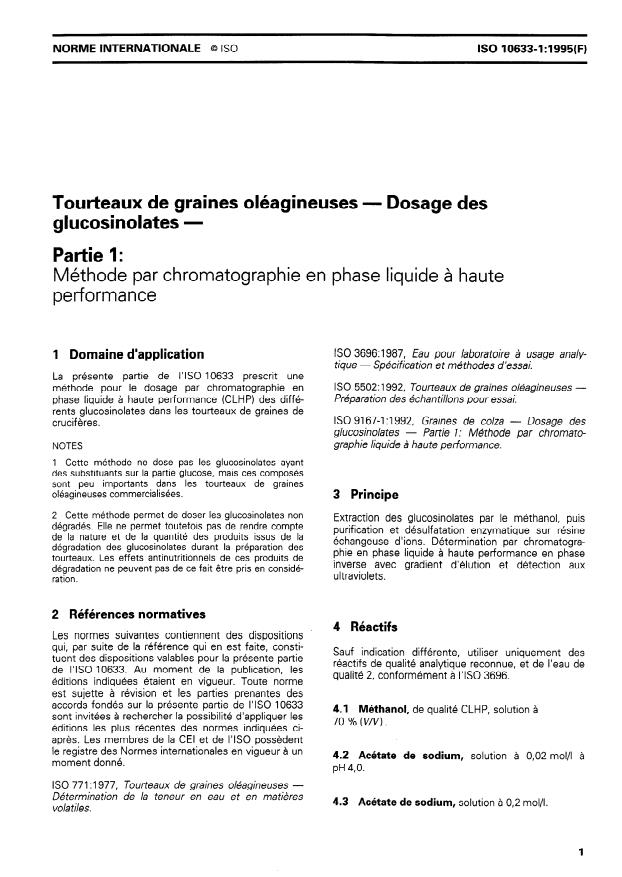
La présente partie de l'ISO 10633 prescrit une méthode pour le dosage par chromatographie en phase liquide à haute performance (CLHP) des différents glucosinolates dans les tourteaux de graines de crucifères. NOTES 1 Cette méthode ne dose pas les glucosinolates ayant des substituants sur la partie glucose, mais ces composés sont peu importants dans les tourteaux de graines oléagineuses commercialisées. 2 Cette méthode permet de doser les glucosinolates non dégradés. Elle ne permet toutefois pas de rendre compte de la nature et de la quantité des produits issus de la dégradation des glucosinolates durant la préparation des tourteaux. Les effets antinutritionnels de ces produits de dégradation ne peuvent pas de ce fait être pris en considération.
General Information
- Status
- Withdrawn
- Publication Date
- 08-Nov-1995
- Technical Committee
- ISO/TC 34/SC 2 - Oleaginous seeds and fruits and oilseed meals
- Drafting Committee
- ISO/TC 34/SC 2 - Oleaginous seeds and fruits and oilseed meals
- Current Stage
- 9599 - Withdrawal of International Standard
- Start Date
- 22-Mar-2024
- Completion Date
- 12-Feb-2026
ISO 10633-1:1995 - Oilseed residues -- Determination of glucosinolates content
ISO 10633-1:1995 - Tourteaux de graines oléagineuses -- Dosage des glucosinolates
ISO 10633-1:1995 - Tourteaux de graines oléagineuses -- Dosage des glucosinolates
Get Certified
Connect with accredited certification bodies for this standard

BSI Group
BSI (British Standards Institution) is the business standards company that helps organizations make excellence a habit.

Bureau Veritas
Bureau Veritas is a world leader in laboratory testing, inspection and certification services.

DNV
DNV is an independent assurance and risk management provider.
Sponsored listings
Frequently Asked Questions
ISO 10633-1:1995 is a standard published by the International Organization for Standardization (ISO). Its full title is "Oilseed residues — Determination of glucosinolates content — Part 1: Method using high-performance liquid chromatography". This standard covers: Specifies a method for the determination of the content of the different glucosinolates in crucifer oilseeds. Does not allow to determine glucosinolates which are substituted on the glucose molekule.
Specifies a method for the determination of the content of the different glucosinolates in crucifer oilseeds. Does not allow to determine glucosinolates which are substituted on the glucose molekule.
ISO 10633-1:1995 is classified under the following ICS (International Classification for Standards) categories: 67.200.20 - Oilseeds. The ICS classification helps identify the subject area and facilitates finding related standards.
ISO 10633-1:1995 is available in PDF format for immediate download after purchase. The document can be added to your cart and obtained through the secure checkout process. Digital delivery ensures instant access to the complete standard document.
Standards Content (Sample)
INTERNATIONAL
ISO
STANDARD
First edition
1995-11-15
Oilseed residues - Determination of
glucosinolates content -
Part 1:
Method using high-performance liquid
chromatography
Tourteaux de graines okagineuses - Dosage des glucosinolates -
Partie 1: Methode par chromatographie en Phase liquide a haute
Performance
Reference number
ISO 106334 :1995(E)
EO 10633=1:1995(E)
Foreword
ISO (the International Organization for Standardization) is a worldwide
federation of national Standards bodies (ISO member bodies). The work
of preparing International Standards is normally Garried out through ISO
technical committees. Esch member body interested in a subject for
which a technical committee has been established has the right to be
represented on that committee. International organizations, governmental
and non-governmental, in liaison with ISO, also take part in the work. ISO
collaborates closely with the International Electrotechnical Commission
(IEC) on all matters of electrotechnical standardization.
Draft International Standards adopted by the technical committees are
circulated to the member bodies for voting. Publication as an International
Standard requires approval by at least 75 % of the member bodies casting
a vote.
International Standard ISO 10633-1 was prepared by Technical Committee
lSO/TC 34, Agricultural food products, Subcommittee SC 2, Oleaginous
seeds and fruits.
ISO 10633 consists of the following Parts, under the general title Oilseed
residues - Determination o f glucosinola tes con ten t:
Part 1: Me thod using high-performance liquid chroma tograph y
Part 2: Method using X-ray fluorescence spectrometry
Annex A form an integral part of this part of ISO 10633. Annex B is for
information only.
0 ISO 1995
All rights reserved. Unless otherwise specified, no part of this publication may be reproduced
or utilized in any form or by any means, electronie or mechanical, including photocopying and
microfilm, without Permission in writing from the publisher.
International Organization for Standardization
Case postale 56 l CH-l 211 Geneve 20 l Switzerland
Printed in Switzerland
ii
@ ISO
ISO 10633=1:1995(E)
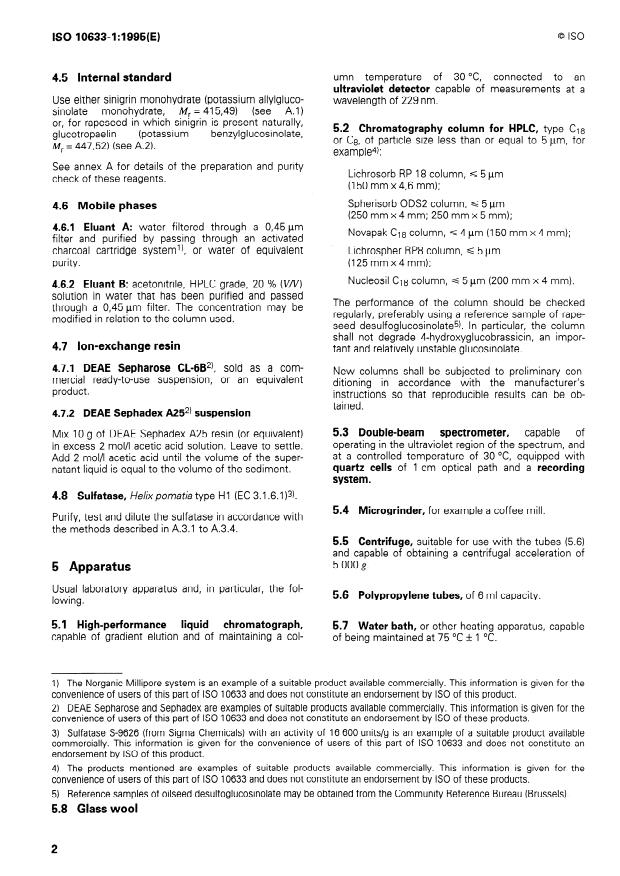
umn temperature of 30 OC, connected to an
4.5 Internal Standard
ultraviolet detector capable of measurements at a
Use either sinigrin monohydrate (potassium allylgluco-
wavelength of 229 nm.
monohydrate, Mr = 415,49) (see A.l)
sinolate
or, for rapeseed in which sinrgrin is present naturally,
5.2 Chromatography column for HPLC, type Cl8
(potassium benzylglucosinolate,
glucotropaelin
or CB, of particle size less than or equal to 5 Pm, for
M, = 447,52)(see A.2).
examplea):
See annex A for details of the preparation and purity
Lichrosorb RP 18 column, < 5 Pm
check of these reagents.
(150 mm x 4,6 mm).
I
Spherisorb ODS2 column, < 5 Pm
4.6 Mobile phases
(250 mm x 4 mm; 250 mm x 5 mm);
4.6.1 Eluant A: water filtered through a 0,45 Pm
Novapak Cl8 column, ~4~m(150mmx4mm);
filter and purified by passing through an activated
Lichrospher RP8 column, G 5 Pm
charcoal cartridge System? or water of equivalent
purity. (125 mm x 4 mm);
Nucleosil Cl8 column, 6 5 Pm (200 mm x 4 mm).
4.6.2 Eluant B: acetonitrile, HPLC grade, 20 % (WV)
Solution in water that has been purified and passed
The Performance of the column should be checked
through a 0,45 Pm filter. The concentration may be
regularly, preferably using a reference Sample of rape-
modified in relation to the column used.
seed desulfoglucosinolate? In particular, the column
shall not degrade 4-hydroxyglucobrassicin, an impor-
4.7 Ion-exchange resin
tant and relatively unstable glucosinolate.
4.7.1 DEAE Sepharose CL-6B2), sold as a com-
New columns shall be subjected to preliminary con-
mercial ready-to-use Suspension, or an equivalent
ditioning in accordance with the manufacturer ’s
product.
instructions so that reproducible results tan be ob-
tained.
4.7.2 DEAE Sephadex A252) Suspension
5.3 Double-beam spectrometer, capable of
Mix 10 g of DEAE Sephadex A25 resin (or equivalent)
operating in the ultraviolet region of the spectrum, and
in excess 2 mol/1 acetic acid Solution. Leave to settle.
at a controlled temperature of 30 OC, equipped with
Add 2 mol/1 acetic acid until the volume of the super-
quartz cells of 1 cm Optical path and a recording
natant liquid is equal to the volume of the Sediment.
System.
4.8 Sulfatase, Helix pomatia type Hl (EC 3.1.6.1)s).
5.4 Microgrinder, for example a coffee mill.
Purify, test and dilute the sulfatase in accordance with
the methods described in A.3.1 to A.3.4.
5.5 Centrifuge, suitable for use with the tubes (5.6)
and capable of obtaining a centrifugal acceleration of
5ooog.
5 Apparatus
Usual laboratory apparatus and, in particular, the fol-
56 . Polypropylene tubes, of 6 ml capacity.
lowing.
liquid
5.1 High- #Perform ante chromatograph,
5.7 Water bath, or other heating apparatus, capable
capable of gradient elution and of maintaining a col-
of being maintained at 75 “C & 1 “C.
1) The Norganic Millipore System is an example of a suitable product available commercially. This information is given for the
convenience of users of this part of ISO 10633 and does not constitute an endorsement by ISO of this product.
examples of suitable products available commercially. This information is given for the
2) DEAE Sepharose and Sephadex are
10633 and does not constitute an endorsement by ISO of these products.
convenience of users of this part of ISO
3) Sulfatase S-9626 (from Sigma Chemicals) with an activity of 16 600 units/g is an example of a suitable product available
commercially. This information is given for the convenience of users of this part of ISO 10633 and does not constitute an
endorsement by ISO of this product.
itable products ava ilable commercially. This information is given for the
The products mentioned are examples of su
4)
does not consti tute an endorsement by ISO of these products.
CO nvenience of users of this part of ISO 10633 and
Reference samples of oilseed desulfoglucosinolate may be obtained from the Community Reference Bureau (Brussels).
5)
5.8 Glass wool
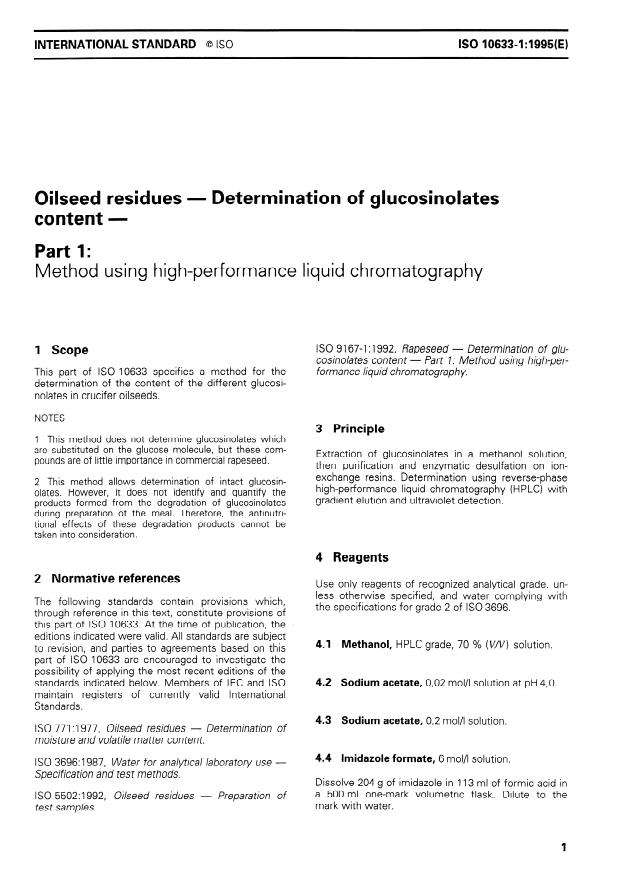
INTERNATIONAL STANDARD @ ISO ISO 10633=1:1995(E)
Oilseed residues - Determination of glucosinolates
content -
Part 1:
Method using high-performance liquid chromatography
ISO 9167-1:1992, Rapeseed - Determination of glu-
1 Scope
cosinola tes con ten t - Part 7: Method using high-per-
This part of ISO 10633 specifies a method for the formante liquid chromatography.
determination of the content of the different glucosi-
nolates in crucifer oilseeds.
NOTES
3 Principle
1 This method does not determine glucosinolates which
are substituted on the glucose molecule, but these com-
Extraction of glucosinolates in a methanol Solution,
pounds are of little importante in commercial rapeseed.
then purification and enzymatic desulfation on ion-
exchange resins. Determination using reverse-Phase
2 This method allows determination of intact glucosin-
high-performance liquid chromatography (HPLC) with
olates. However, it does not identify and quantify the
gradient elution and ultraviolet detection.
products formed from the degradation of glucosinolates
during preparation of the meal. Therefore, the antinutri-
tional effects of these degradation products cannot be
taken into consideration.
4 Reagents
2 Normative references
Use only reagents of recognized analytical grade, un-
less otherwise specified, and water complying with
The following Standards contain provisions which,
the specifications for grade 2 of ISO 3696.
through reference in this text, constitute provisions of
this part of ISO 10633. At the time of publication, the
editions indicated were valid. All Standards are subject
4.1 Methanol, HPLC grade, 70 % (WV) solution.
to revision, and Parties to agreements based on this
part of ISO 10633 are encouraged to investigate the
possibility of applying the most recent editions of the
4.2 Sodium acetate, 0,02 mol/1 solution at pH $0.
Standards indicated below. Members of IEC and ISO
maintain registers of currently valid International
Standards.
4.3 Sodium acetate, 0,2 mol/1 Solution.
ISO 771:1977, Oilseed residues - Determination of
moisture and volatile matter content.
4.4 Imidazole formate, 6 mol/1 solution.
ISO 3696:1987, Water for analytical laboratory use -
Specifica tion and tes t me thods.
Dissolve 204 g of imidazole in 113 ml of formic acid in
a 500 ml one-mark volumetric flask. Dilute to the
ISO 5502: 1992, Oilseed residues - Preparation of
mark with water.
tes t samples.
@ ISO
ISO 10633=1:1995(E)
b) For a Lichrospher RP8 column, G 5 Pm
8.4.4 Place a tube (5.6) under the column to collect
(125 mm x 4 mm):
the eluate.
- 100 % of eluant A over 2 min 30 s;
Elute the obtained desulfoglucosinolates with two
1 ml portions of water, allowing the water to drain
- a linear elution gradient over 18 min until 0 % of
after each addition.
eluant A and 100 % of eluant B are obtained;
8.4.5 Mix the eluate weil. If not used immediately
- 100 % of eluant B for 5 min;
for chromatography, store the eluate in the dark in a
freezer at - 18 “C for a week.
a linear elution gradient over 2 min until 100 % of
-
eluant A and 0 % of eluant B are obtained;
8.5 Blank test
- continue for 5 min to establish equilibrium.
If required (see 9.3), carry out a blank test using the
6 The gradient profiles may be modified to give Optimum
Same procedure on a test Portion taken from the
‘Separations according to the columns used.
Same test Sample, but omitting the sinigrin internal
Standard Solution in Order to detect and quantify any
8.6.3 Examination of chromatograms
sinigrin present in the test Portion.
Take into account only those peaks having an area
greater than 1% of the total sum of the peak areas.
8.6 Chromatography
The Order of elution of the peaks with a type Cl*
column and a suitable elution gradient (see the
8.6.1 Adjustment of apparatus
examples given in 8.6.2) is generally as shown in
figure 1.
Adjust the chromatograph (5.1) as follows:
- flowrate of the mobile Phase (4.6): depends on
the nature of the column (see 8.6.2) and generally 9 Exwession of results
is of the Order of 1 mI/min;
9.1 Calculation of the content of each
- temperature of the column (5.2): 30 “C;
glucosinolate
- detection wavelength: 229 nm.
The content of each glucosinolate, expressed in
micromoles per gram of dry matter of the product, is
equal to
8.6.2 Determination
A K
ALx100
SX -cX
Operating in accordance with the instructions for the
IOO-w
As m 4
apparatus, inject into the chromatograph not more
than 50 pl of the desulfoglucosinolate Solution ob-
where
tained in 8.4.4.
is the peak area, in integrator units, corre-
AS
Use an elution gradient appropriate to the column
sponding to the desulfoglucosinolate under
employed.
consideration;
NOTES As is the peak area, in integrator units, corre-
sponding to the internal Standard used (desul-
5 The following elution gradients are given as examples.
fosinigrin or desulfoglucotropaeolin);
Kg is the response factor of the desulfoglucosin-
a) For a Lichrosorb RP18 column, G 5 Pm
olate under consideration (9.2);
(150 mm x 4,6 mm):
& is the response factor of the internal Standard
- 100 % of eluant A (4.6.1) for 1 min;
used (desulfosinigrin or desulfoglucotropae-
olin);
- a linear elution gradient over 20 min until 0 % of
m
eluant A and 100 % of eluant B (4.6.2) are ob- is the mass, in grams, of the test Portion;
tained;
n is the quantity, in micromoles, of internal stan-
dard added to the tube in 8.2 (sinigrin or gluco-
- a linear elution gradient over 5 min until 100 % of
tropaeolin);
eluant A and 0 % of eluant B are obtained;
w is the moisture and volatile matter content,
- 100 % of eluant A for 5 min to establish
expressed as a percentage by mass, of the
equilibrium.
test Sample.
ISO 10633~1:1995(E)
@ ISO
- to tube A, 200 pl of 5 mmol/l internal Standard
5.8 Glass wo01
Solution (A.l .l); and
5.9 Pasteur pipettes, 150 mm long, and a suitable
- to tube B, 200 ~1 of 20 mmol/l internal Standard
stand or any other appropriate device.
Solution (A. 1.2).
6 Sampling NOTE 4 See 4.5 for the use of an alternative internal
Standard Solution.
lt is important that the laboratot-y receive a Sample
Continue heating at 75 “C for a further 10 min,
which is truly representative and has not been 8.2.2
damaged or changed during transport or storage. shaking the tubes at regular intervals. Mix the
contents of each tube and then centrifuge at 5 000 g
Sampling is not part of the method specified in this
for 3 min. Transfer the supernatant liquid from each
patt of ISO 10633. A recommended sampling method
tube to two other tubes (5.6) labelled A’ and B ’.
is given in ISO 55006).
8.2.3 Add, to each of the two tubes A and B
containing the solid residue, 2 ml of boiling methanol
7 Preparation of test samples
(4.1) and reheat in the water bath (5.7) set at 75 “C
for 10 min, shaking the tubes at regular intervals.
Reduce the laboratory Sample in accordance with
ISO 5502 to obtain the required size of test Sample.
Centrifuge for 3 min and then add the supernatant
Grind if necessary.
liquid from the tubes A and B, respectively, to the
tubes A’ and B ’, respectively, containing the super-
of this and determine the moisture and
Take a Sample
natant liquids retained in 8.2.2.
content in accordance with ISO 771.
volatile matter
8.2.4 Adjust the volume of the combined extracts in
If the result is less than 10 % (m/m), this value will be
the tubes A’ and B’ to approximately 5 ml with water
used for the calculation (9.1). Continue immediately
and mix.
with the determination of glucosinolate content
(clause 8) using the test Sample without further treat-
These extracts, if stored in the dark in a freezer at
ment.
-18 ”C, may be kept for 2 weeks.
If the moisture and volatile matter content is found to
be in excess of 10 % (m/m), dry the test Sample using
8.3 Preparation of ion-exchange columns
a current of air at approximately 45 OC, then
redetermine the content. Continue this process until a
Cut the required number of Pasteur pipettes (5.9), i.e.
moisture and volatile matter content of less
...
NORME
ISO
INTERNATIONALE
Première édition
1995-l l-1 5
Tourteaux de graines oléagineuses -
Dosage des glucosinolates
Partie 1:
Méthode par chromatograph
e en phase
liquide à haute performance
wseea reslaues - ue termIna tlon ot glucosmola tes content -
Part 1: Method using high-pen’ormance liquid chromatography
Numéro de référence
ISO 10633-I : 1995(F)
ISO 106334:1995(F)
Avant-propos
LIS0 (Organisation internationale de normalisation) est une fédération
mondiale d’organismes nationaux de normalisation (comités membres de
I’ISO). L’élaboration des Normes internationales est en général confiée
aux comités techniques de I’ISO. Chaque comité membre intéressé par
une étude a le droit de faire partie du comité technique créé à cet effet.
Les organisations internationales, gouvernementales et non gouverne-
mentales, en liaison avec I’ISO participent également aux travaux. L’ISO
collabore étroitement avec la Commission électrotechnique internationale
(CEI) en ce qui concerne la normalisation électrotechnique.
Les projets de Normes internationales adoptés par les comités techniques
sont soumis aux comités membres pour vote. Leur publication comme
Normes internationales requiert l’approbation de 75 % au moins des co-
mités membres votants.
La Norme internationale ISO 10633-I a été élaborée par le comité
technique ISOnC 34, Produits agricoles alimentaires, sous-comité SC 2,
Graines et fruits oléagineux.
L’ISO 10633 comprend les parties suivantes, présentées sous le titre
général Tourteaux de graines oléagineuses - Dosage des glucosinolates:
- Partie 1: Méthode par chromatographie en phase liquide à haute
performance
- Partie 2: Méthode par spectrométrie de fluorescence aux rayons X
L’annexe A fait partie intégrante de la présente partie de I’ISO 10633.
L’annexe B est donnée uniquement à titre d’information.
0 ISO 1995
Droits de reproduction réservés. Sauf prescription différente, aucune partie de cette publi-
cation ne peut être reproduite ni utilisée sous quelque forme que ce soit et par aucun procédé,
électronique ou mécanique, y compris la photocopie et les microfilms, sans l’accord écrit de
l’éditeur.
Organisation internationale de normalisation
Case postale 56. CH-121 1 Genève 20 l Suisse
Imprimé en Suisse
NORME INTERNATIONALE @ ISO ISO 10633-1:1995(F)
Tourteaux de graines oléagineuses - Dosage des
glucosinolates -
Partie 1:
Méthode par chromatographie en phase liquide à haute
performance
ISO 3696: 1987, Eau pour laboratoire à usage analy-
1 Domaine d’application
tique - Spécifica tion et méthodes d’essai.
La présente partie de I’ISO 10633 prescrit une
ISO 5502:1992, Tourteaux de graines oléagineuses -
méthode pour le dosage par chromatographie en
Préparation des échantillons pour essai.
phase liquide à haute performance (CLHP) des diffé-
rents glucosinolates dans les tourteaux de graines de
ISO 9167-I : 1992, Graines de colza - Dosage des
crucifères.
glucosinola tes - Partie 1: Méthode par chromato-
graphie liquide à haute performance.
NOTES
1 Cette méthode ne dose pas les glucosinolates ayant
des substituants sur la partie glucose, mais ces composés
sont peu importants dans les tourteaux de graines
oléagineuses commercialisées. 3 Principe
2 Cette méthode permet de doser les glucosinolates non
Extraction des glucosinolates par le méthanol, puis
dégradés. Elle ne permet toutefois pas de rendre compte
purification et désulfatation enzymatique sur résine
de la nature et de la quantité des produits issus de la
échangeuse d’ions. Détermination par chromatogra-
dégradation des glucosinolates durant la préparation des
phie en phase liquide à haute performance en phase
tourteaux. Les effets antinutritionnels de ces produits de
inverse avec gradient d’élution et détection aux
dégradation ne peuvent pas de ce fait être pris en considé-
ultraviolets.
ration.
2 Références normatives
4 Réactifs
Les normes suivantes contiennent des dispositions
qui, par suite de la référence qui en est faite, consti-
Sauf indication différente, utiliser uniquement des
tuent des dispositions valables pour la présente partie
réactifs de qualité analytique reconnue, et de l’eau de
de I’ISO 10633. Au moment de la publication, les
qualité 2, conformément à I’ISO 3696.
éditions indiquées étaient en vigueur. Toute norme
est sujette à révision et les parties prenantes des
accords fondés sur la présente partie de I’ISO 10633
4.1 Méthanol, de qualité CLHP, solution à
sont invitées à rechercher la possibilité d’appliquer les
70 % (WV).
éditions les plus récentes des normes indiquées ci-
après. Les membres de la CEI et de I’ISO possèdent
le registre des Normes internationales en vigueur à un
4.2 Acétate de sodium, solution à 0,02 mol/1 à
moment donné.
pH 4,0.
ISO 771 :1977, Tourteaux de graines oléagineuses -
Détermination de la teneur en eau et en matières
4.3 Acétate de sodium, solution à 0,2 mol/l.
volatiles.
@ ISO
ISO 10633=1:1995(F)
4.4 Formiate d’imidazole, solution à 6 mol/l.
5 Appareillage
Dissoudre 204 g d’imidazole dans 113 ml d’acide for-
Matériel courant de laboratoire et, en particulier, ce
mique dans une fiole jaugée de 500 ml. Ajuster au
qui suit.
trait repère avec de l’eau.
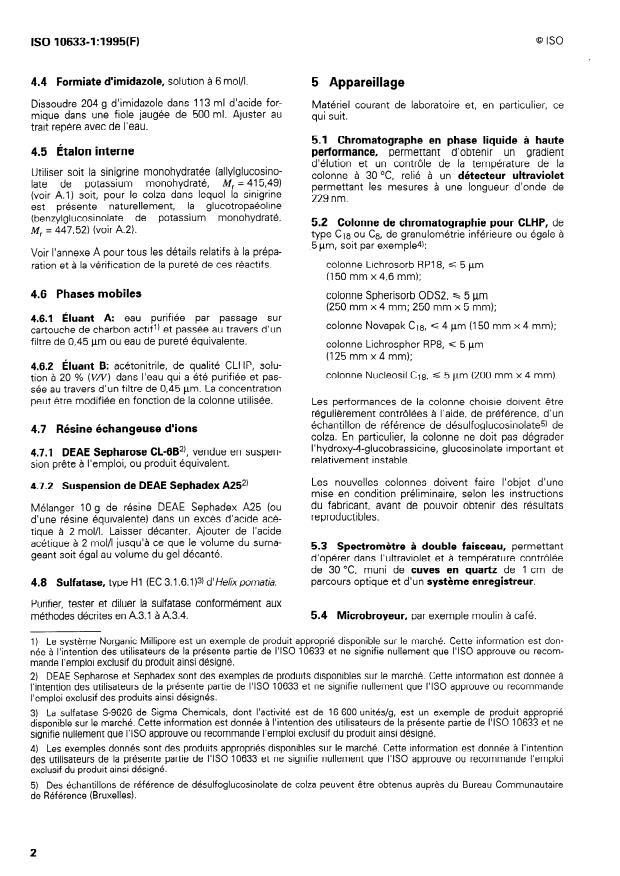
5.1 Chromatographe en phase liquide à haute
4.5 Étalon interne
performance, permettant d’obtenir un gradient
d’élution et un contrôle de la température de la
Utiliser soit la sinigrine monohydratée (allylglucosino-
colonne à 30 OC, relié à un détecteur ultraviolet
late de potassium monohydraté, Mr = 415,49)
permettant les mesures à une longueur d’onde de
(voir A.l) soit, pour le colza dans lequel la sinigrine
229 nm.
naturellement, la glucotropaéoline
est présente
(benzylglucosinolate de potassium monohydraté,
5.2 Colonne de chromatographie pour CLHP, de
M, = 447,52) (voir A.2).
type Cl8 ou C& de granulométrie inférieure ou égale à
5 prn, soit par exemplea):
Voir l’annexe A pour tous les détails relatifs à la prépa-
ration et à la vérification de la pureté de ces réactifs. colonne Lichrosorb RP18, < 5 prn
(150 mm x 4,6 mm)*
I
4.6 Phases mobiles
colonne Spherisorb ODS2, < 5 prn
(250 mm x 4 mm; 250 mm x 5 mm);
4.6.1 Éluant A: eau purifiée par passage sur
colonne Novapak Cl& ~4~m(150mmx4mm);
cartouche de charbon actif’) et passée au travers d’un
filtre de 0,45 prn ou eau de pureté équivalente.
colonne Lichrospher RP8, < 5 prn
(125 mm x 4 mm);
4.6.2 Éluant B: acétonitrile, de qualité CLHP, solu-
colonne Nucleosil Cl&
S 5 prn (200 mm x 4 mm).
tion à 20 % (WV) dans l’eau qui a été purifiée et pas-
sée au travers d’un filtre de 0,45 prn. La concentration
peut être modifiée en fonction de la colonne utilisée.
Les performances de la colonne choisie doivent être
régulièrement contrôlées à l’aide, de préférence, d’un
échantillon de référence de désulfoglucosinolate5) de
4.7 Résine échangeuse d’ions
colza. En particulier, la colonne ne doit pas dégrader
I’hydroxy-4-glucobrassicine, glucosinolate important et
4.7.1 DEAE Sepharose CL-6B*), vendue en suspen-
relativement instable.
sion prête à l’emploi, ou produit équivalent.
Les nouvelles colonnes doivent faire l’objet d’une
4.7.2 Suspension de DEAE Sephadex A25*)
mise en condition préliminaire, selon les instructions
du fabricant, avant de pouvoir obtenir des résultats
Mélanger 10 g de résine DEAE Sephadex A25 (ou
reproductibles.
d’une résine équivalente) dans un excès d’acide acé-
tique à 2 mol/l. Laisser décanter. Ajouter de l’acide
acétique à 2 mol/1 jusqu’à ce que le volume du surna-
5.3 Spectromètre à double faisceau, permettant
geant soit égal au volume du gel décanté.
d’opérer dans l’ultraviolet et à température contrôlée
de 30 OC, muni de cuves en quartz de 1 cm de
parcours optique et d’un système enregistreur.
4.8 Sulfatase, type HI (EC 3.1.6.1)3) d’He/;x pomatia.
Purifier, tester et diluer la sulfatase conformément aux
méthodes décrites en A.3.1 à A.3.4. 5.4 Microbroyeur, par exemple moulin à café.
1) Le système Norganic Millipore est un exemple de produit approprié disponible sur le marché. Cette information est don-
née à l’intention des utilisateurs de la présente partie de I’ISO 10633 et ne signifie nullement que NS0 approuve ou recom-
mande l’emploi exclusif du produit ainsi désigné.
2) DEAE Sepharose et Sephadex sont des exemples de produits disponibles sur le marché. Cette information est donnée à
l’intention des utilisateurs de la présente partie de NS0 10633 et ne signifie nullement que I’ISO approuve ou recommande
l’emploi exclusif des produits ainsi désignés.
3) La sulfatase S-9626 de Sigma Chemicals, dont l’activité est de 16 600 unités/g, est un exemple de produit approprié
disponible sur le marché. Cette information est donnée à l’intention des utilisateurs de la présente partie de I’ISO 10633 et ne
signifie nullement que I’ISO approuve ou recommande l’emploi exclusif du produit ainsi désigné.
4) Les exemples donnés sont des produits appropriés disponibles sur le marché. Cette information est donnée à l’intention
des utilisateurs de la présente partie de I’ISO 10633 et ne signifie nullement que NS0 approuve ou recommande l’emploi
exclusif du produit ainsi désigné.
5) Des échantillons de référence de désulfoglucosinolate de colza peuvent être obtenus auprès du Bureau Communautaire
de Référence (Bruxelles).
@ ISO ISO 10633=1:1995(F)
5.5 Centrifugeuse, convenant pour l’utilisation avec
8 Mode opératoire
les tubes (5.6) et permettant d’obtenir une accé-
lération centrifuge de 5 000 g. NOTE 3 S’il y a lieu de vérifier si l’exigence de répétabilité
est satisfaite, effectuer deux déterminations séparées
conformément aux paragraphes 8.1 à 8.4 et 8.6, dans les
Tubes de polypropylène, de 6 ml de capacité.
56 . conditions de répétabilité.
5.7 Bain d’eau ou bloc de chauffage, réglable à
8.1 Prise d’essai
75 “C A 1 “C.
Étiqueter deux tubes (5.6) A
et B, introduire dans
chaque tube 100 mg, pesés à
01 mg près, d’échan-
5.8 Laine de verre. I
tillon pour essai préparé (article
.
7)
5.9 Pipettes Pasteur, de 150 mm de longueur, et
support approprié ou tout autre dispositif adéquat.
8.2 Extraction des glucosinolates
8.2.1 Plonger les tubes dans le bain d’eau ou le bloc
de chauffage (5.7) réglé à 75 “C et les y laisser 1 min.
6 Échantillonnage
Ajouter ensuite 2 ml de solution bouillante de métha-
nol (4.1) et immédiatement après
II est important que le laboratoire reçoive un échan-
- dans le tube A, 200 ~1 de solution d’étalon interne
tillon réellement représentatif, non endommagé ou
à 5 mmol/l (A.1 .l ); et
modifié lors du transport et de l’entreposage.
- dans le tube B, 200 ~1 de solution d’étalon interne
L’échantillonnage ne fait pas partie de la méthode
à 20 mmol/l (A.l.2).
spécifiée dans la présente partie de I’ISO 10633. Une
méthode d’échantillonnage recommandée est donnée NOTE 4 Voir 4.5 pour l’utilisation de l’une ou l’autre des
solutions d’étalon interne.
dans I’ISO 55006).
8.2.2 Poursuivre le chauffage à 75 “C pendant
10 min, en agitant régulièrement. Mélanger le
contenu de chaque tube et centrifuger avec une accé-
7 Préparation de l’échantillon pour essai
lération de 5 000 g pendant 3 min. Transvaser le
liquide surnageant de chaque tube, dans deux autres
Réduire l’échantillon pour laboratoire conformément à
tubes (5.6) étiquetés A’ et B’.
I’ISO 5502 en vue d’obtenir la quantité requise
d’échantillon pour essai. Broyer si nécessaire.
8.2.3 Ajouter, dans chacun des deux tubes A et B
contenant le résidu, 2 ml d’une solution bouillante de
En prélever une partie pour déterminer la teneur en
méthanol (4.1) et chauffer à nouveau pendant 10 min,
eau et en matières volatiles conformément à
dans le bain d’eau ou le bloc de chauffage (5.7) réglé
I’ISO 771.
à 75 OC, en agitant les tubes régulièrement.
Si le résultat est inférieur à 10 % (m/m), cette valeur
Centrifuger pendant 3 min et ajouter le liquide sur-
sera utilisée pour le calcul (9.1). Poursuivre immédia-
nageant des tubes A et B respectivement aux liquides
tement avec le dosage des glocusinolates (article 8)
surnageants des tubes A’ et B’ retenus en 8.2.2.
en utilisant l’échantillon pour essai sans autre traite-
ment.
8.2.4 Ajuster le volume des extraits combinés dans
les tubes A’ et B’ à environ 5 ml avec de l’eau et
Si la teneur en eau et en matières volatiles trouvée
mélanger.
est supérieure à 10 % (m/m), sécher l’échantillon pour
essai avec un courant d’air à environ 45 OC, puis Ces extraits peuvent être conservés 2 semaines à
déterminer à nouveau cette teneur. Poursuivre ces l’abri de la lumière, au congélateur à - 18 OC.
opérations jusqu’à ce que la teneur en eau et en
volatiles obtenue soit inférieure à
matières
10 % (m/m). Cette valeur finale est utilisée pour le
8.3 Préparation des colonnes échangeuses
calcul. Poursuivre immédiatement avec le dosage des
d’ions
glucosinolates (article 8) en utilisant l’échantillon pour
essai séché. Couper le nombre de pipettes Pasteur (5.9) approprié,
6) ISO 5500: 1986, Tourteaux de graines oléagineuses - Échantillonnage.
@ ISO
soit deux pipettes par échantillon, de manière à laisser 8.6.2 Détermination
un volume de Il2 ml au-dessus de l’étranglement et
Selon les instructions relatives à l’appareillage, injec-
placer un tampon de laine de verre (5.8) au niveau de
ter dans le chomatographe un volume inférieur à 50 ~1
l’étranglement. Placer les pipettes en position verti-
de la solution de désulfoglucosinolates obtenue en
cale sur un support.
8.4.4.
Déposer OI5 ml de la suspension, préalablement bien
Utiliser un gradient d’élution approprié correspondant
mélangée, de résine échangeuse d’ions (4.7.2) dans
à la colonne utilisée.
chaque pipette, laisser décanter et écouler.
NOTES
Rincer les pipettes avec 2 ml de formiate d’imidazole
(4.4) puis avec deux fois 1 ml d’eau.
5 Les gradients d’élution suivants sont indiqués comme
exemples.
Pour une colonne Lichrosorb RP18, 6 5 prn
a)
8.4 Purification et désulfatation
(150 mm x 4,6 mm):
8.4.1 Effectuer les opérations suivantes pour chaque
- passer 100 % d’éluant A (4.6.1) pendant 1 min;
combiné.
extrait
- appliquer un gradient d’élution linéaire pendant
20 min jusqu’à obtention de 0 % d’éluant A et
8.4.2 Déposer 1 ml d’extrait (8.2.4) sur la colonne
100 % d’éluant B (4.6.2);
préparée (8.3) sans modifier la surface du gel et le
laisser s’écouler. Ajouter deux fois 1 ml de tampon
- appliquer un gradient d’élution linéaire pendant
d’acétate de sodium (4.2) en le laissar t s’écouler à
5 min jusqu’à obtention de 100 % d’éluant A et
chaque fois.
0 % d’éluant B;
- passer 100 % d’éluant A pendant 5 min pour
8.4.3 Ajouter dans la colonne 75 FI de a solution de
équilibrer.
sulfatase purifiée diluée (4.8). Laisser agir pendant
une nuit à température ambiante.
b) Pour une colonne Lichrospher RP8, 6 5 prn
(125 mm x4 mm):
8.4.4 Placer un tube (5.6) sous la colonne pour
- passer 100 % d’éluant A pendant 2 min 30 s;
recueillir I’éluat.
- appliquer un gradient d’élution linéaire pendant
18 min jusqu’à obtention de 0 % d’éluant A et
Éluer les désulfoglucosinolates obtenus avec deux
100 % d’éluant B;
fois 1 ml d’eau, en laissant l’eau s’écouler après
chaque addition.
- passer 100 % de I’éluant B pendant 5 min;
- appliquer un gradient d’élution linéaire pendant
8.4.5 Bien homogénéiser I’éluat. S’il n’est pas utilisé
2 min jusqu’à obtention de 100 % d’éluant A et
immédiatement pour la chromatographie, il peut être
0 % d’éluant B;
conservé à l’abri de la lumière au congélateur à
- - continuer pendant 5 min pour équilibrer.
18 OC, pendant une semaine.
6 Les profils des gradients peuvent être modifiés pour
donner des séparations optimales en f
...
NORME
ISO
INTERNATIONALE
Première édition
1995-l l-1 5
Tourteaux de graines oléagineuses -
Dosage des glucosinolates
Partie 1:
Méthode par chromatograph
e en phase
liquide à haute performance
wseea reslaues - ue termIna tlon ot glucosmola tes content -
Part 1: Method using high-pen’ormance liquid chromatography
Numéro de référence
ISO 10633-I : 1995(F)
ISO 106334:1995(F)
Avant-propos
LIS0 (Organisation internationale de normalisation) est une fédération
mondiale d’organismes nationaux de normalisation (comités membres de
I’ISO). L’élaboration des Normes internationales est en général confiée
aux comités techniques de I’ISO. Chaque comité membre intéressé par
une étude a le droit de faire partie du comité technique créé à cet effet.
Les organisations internationales, gouvernementales et non gouverne-
mentales, en liaison avec I’ISO participent également aux travaux. L’ISO
collabore étroitement avec la Commission électrotechnique internationale
(CEI) en ce qui concerne la normalisation électrotechnique.
Les projets de Normes internationales adoptés par les comités techniques
sont soumis aux comités membres pour vote. Leur publication comme
Normes internationales requiert l’approbation de 75 % au moins des co-
mités membres votants.
La Norme internationale ISO 10633-I a été élaborée par le comité
technique ISOnC 34, Produits agricoles alimentaires, sous-comité SC 2,
Graines et fruits oléagineux.
L’ISO 10633 comprend les parties suivantes, présentées sous le titre
général Tourteaux de graines oléagineuses - Dosage des glucosinolates:
- Partie 1: Méthode par chromatographie en phase liquide à haute
performance
- Partie 2: Méthode par spectrométrie de fluorescence aux rayons X
L’annexe A fait partie intégrante de la présente partie de I’ISO 10633.
L’annexe B est donnée uniquement à titre d’information.
0 ISO 1995
Droits de reproduction réservés. Sauf prescription différente, aucune partie de cette publi-
cation ne peut être reproduite ni utilisée sous quelque forme que ce soit et par aucun procédé,
électronique ou mécanique, y compris la photocopie et les microfilms, sans l’accord écrit de
l’éditeur.
Organisation internationale de normalisation
Case postale 56. CH-121 1 Genève 20 l Suisse
Imprimé en Suisse
NORME INTERNATIONALE @ ISO ISO 10633-1:1995(F)
Tourteaux de graines oléagineuses - Dosage des
glucosinolates -
Partie 1:
Méthode par chromatographie en phase liquide à haute
performance
ISO 3696: 1987, Eau pour laboratoire à usage analy-
1 Domaine d’application
tique - Spécifica tion et méthodes d’essai.
La présente partie de I’ISO 10633 prescrit une
ISO 5502:1992, Tourteaux de graines oléagineuses -
méthode pour le dosage par chromatographie en
Préparation des échantillons pour essai.
phase liquide à haute performance (CLHP) des diffé-
rents glucosinolates dans les tourteaux de graines de
ISO 9167-I : 1992, Graines de colza - Dosage des
crucifères.
glucosinola tes - Partie 1: Méthode par chromato-
graphie liquide à haute performance.
NOTES
1 Cette méthode ne dose pas les glucosinolates ayant
des substituants sur la partie glucose, mais ces composés
sont peu importants dans les tourteaux de graines
oléagineuses commercialisées. 3 Principe
2 Cette méthode permet de doser les glucosinolates non
Extraction des glucosinolates par le méthanol, puis
dégradés. Elle ne permet toutefois pas de rendre compte
purification et désulfatation enzymatique sur résine
de la nature et de la quantité des produits issus de la
échangeuse d’ions. Détermination par chromatogra-
dégradation des glucosinolates durant la préparation des
phie en phase liquide à haute performance en phase
tourteaux. Les effets antinutritionnels de ces produits de
inverse avec gradient d’élution et détection aux
dégradation ne peuvent pas de ce fait être pris en considé-
ultraviolets.
ration.
2 Références normatives
4 Réactifs
Les normes suivantes contiennent des dispositions
qui, par suite de la référence qui en est faite, consti-
Sauf indication différente, utiliser uniquement des
tuent des dispositions valables pour la présente partie
réactifs de qualité analytique reconnue, et de l’eau de
de I’ISO 10633. Au moment de la publication, les
qualité 2, conformément à I’ISO 3696.
éditions indiquées étaient en vigueur. Toute norme
est sujette à révision et les parties prenantes des
accords fondés sur la présente partie de I’ISO 10633
4.1 Méthanol, de qualité CLHP, solution à
sont invitées à rechercher la possibilité d’appliquer les
70 % (WV).
éditions les plus récentes des normes indiquées ci-
après. Les membres de la CEI et de I’ISO possèdent
le registre des Normes internationales en vigueur à un
4.2 Acétate de sodium, solution à 0,02 mol/1 à
moment donné.
pH 4,0.
ISO 771 :1977, Tourteaux de graines oléagineuses -
Détermination de la teneur en eau et en matières
4.3 Acétate de sodium, solution à 0,2 mol/l.
volatiles.
@ ISO
ISO 10633=1:1995(F)
4.4 Formiate d’imidazole, solution à 6 mol/l.
5 Appareillage
Dissoudre 204 g d’imidazole dans 113 ml d’acide for-
Matériel courant de laboratoire et, en particulier, ce
mique dans une fiole jaugée de 500 ml. Ajuster au
qui suit.
trait repère avec de l’eau.
5.1 Chromatographe en phase liquide à haute
4.5 Étalon interne
performance, permettant d’obtenir un gradient
d’élution et un contrôle de la température de la
Utiliser soit la sinigrine monohydratée (allylglucosino-
colonne à 30 OC, relié à un détecteur ultraviolet
late de potassium monohydraté, Mr = 415,49)
permettant les mesures à une longueur d’onde de
(voir A.l) soit, pour le colza dans lequel la sinigrine
229 nm.
naturellement, la glucotropaéoline
est présente
(benzylglucosinolate de potassium monohydraté,
5.2 Colonne de chromatographie pour CLHP, de
M, = 447,52) (voir A.2).
type Cl8 ou C& de granulométrie inférieure ou égale à
5 prn, soit par exemplea):
Voir l’annexe A pour tous les détails relatifs à la prépa-
ration et à la vérification de la pureté de ces réactifs. colonne Lichrosorb RP18, < 5 prn
(150 mm x 4,6 mm)*
I
4.6 Phases mobiles
colonne Spherisorb ODS2, < 5 prn
(250 mm x 4 mm; 250 mm x 5 mm);
4.6.1 Éluant A: eau purifiée par passage sur
colonne Novapak Cl& ~4~m(150mmx4mm);
cartouche de charbon actif’) et passée au travers d’un
filtre de 0,45 prn ou eau de pureté équivalente.
colonne Lichrospher RP8, < 5 prn
(125 mm x 4 mm);
4.6.2 Éluant B: acétonitrile, de qualité CLHP, solu-
colonne Nucleosil Cl&
S 5 prn (200 mm x 4 mm).
tion à 20 % (WV) dans l’eau qui a été purifiée et pas-
sée au travers d’un filtre de 0,45 prn. La concentration
peut être modifiée en fonction de la colonne utilisée.
Les performances de la colonne choisie doivent être
régulièrement contrôlées à l’aide, de préférence, d’un
échantillon de référence de désulfoglucosinolate5) de
4.7 Résine échangeuse d’ions
colza. En particulier, la colonne ne doit pas dégrader
I’hydroxy-4-glucobrassicine, glucosinolate important et
4.7.1 DEAE Sepharose CL-6B*), vendue en suspen-
relativement instable.
sion prête à l’emploi, ou produit équivalent.
Les nouvelles colonnes doivent faire l’objet d’une
4.7.2 Suspension de DEAE Sephadex A25*)
mise en condition préliminaire, selon les instructions
du fabricant, avant de pouvoir obtenir des résultats
Mélanger 10 g de résine DEAE Sephadex A25 (ou
reproductibles.
d’une résine équivalente) dans un excès d’acide acé-
tique à 2 mol/l. Laisser décanter. Ajouter de l’acide
acétique à 2 mol/1 jusqu’à ce que le volume du surna-
5.3 Spectromètre à double faisceau, permettant
geant soit égal au volume du gel décanté.
d’opérer dans l’ultraviolet et à température contrôlée
de 30 OC, muni de cuves en quartz de 1 cm de
parcours optique et d’un système enregistreur.
4.8 Sulfatase, type HI (EC 3.1.6.1)3) d’He/;x pomatia.
Purifier, tester et diluer la sulfatase conformément aux
méthodes décrites en A.3.1 à A.3.4. 5.4 Microbroyeur, par exemple moulin à café.
1) Le système Norganic Millipore est un exemple de produit approprié disponible sur le marché. Cette information est don-
née à l’intention des utilisateurs de la présente partie de I’ISO 10633 et ne signifie nullement que NS0 approuve ou recom-
mande l’emploi exclusif du produit ainsi désigné.
2) DEAE Sepharose et Sephadex sont des exemples de produits disponibles sur le marché. Cette information est donnée à
l’intention des utilisateurs de la présente partie de NS0 10633 et ne signifie nullement que I’ISO approuve ou recommande
l’emploi exclusif des produits ainsi désignés.
3) La sulfatase S-9626 de Sigma Chemicals, dont l’activité est de 16 600 unités/g, est un exemple de produit approprié
disponible sur le marché. Cette information est donnée à l’intention des utilisateurs de la présente partie de I’ISO 10633 et ne
signifie nullement que I’ISO approuve ou recommande l’emploi exclusif du produit ainsi désigné.
4) Les exemples donnés sont des produits appropriés disponibles sur le marché. Cette information est donnée à l’intention
des utilisateurs de la présente partie de I’ISO 10633 et ne signifie nullement que NS0 approuve ou recommande l’emploi
exclusif du produit ainsi désigné.
5) Des échantillons de référence de désulfoglucosinolate de colza peuvent être obtenus auprès du Bureau Communautaire
de Référence (Bruxelles).
@ ISO ISO 10633=1:1995(F)
5.5 Centrifugeuse, convenant pour l’utilisation avec
8 Mode opératoire
les tubes (5.6) et permettant d’obtenir une accé-
lération centrifuge de 5 000 g. NOTE 3 S’il y a lieu de vérifier si l’exigence de répétabilité
est satisfaite, effectuer deux déterminations séparées
conformément aux paragraphes 8.1 à 8.4 et 8.6, dans les
Tubes de polypropylène, de 6 ml de capacité.
56 . conditions de répétabilité.
5.7 Bain d’eau ou bloc de chauffage, réglable à
8.1 Prise d’essai
75 “C A 1 “C.
Étiqueter deux tubes (5.6) A
et B, introduire dans
chaque tube 100 mg, pesés à
01 mg près, d’échan-
5.8 Laine de verre. I
tillon pour essai préparé (article
.
7)
5.9 Pipettes Pasteur, de 150 mm de longueur, et
support approprié ou tout autre dispositif adéquat.
8.2 Extraction des glucosinolates
8.2.1 Plonger les tubes dans le bain d’eau ou le bloc
de chauffage (5.7) réglé à 75 “C et les y laisser 1 min.
6 Échantillonnage
Ajouter ensuite 2 ml de solution bouillante de métha-
nol (4.1) et immédiatement après
II est important que le laboratoire reçoive un échan-
- dans le tube A, 200 ~1 de solution d’étalon interne
tillon réellement représentatif, non endommagé ou
à 5 mmol/l (A.1 .l ); et
modifié lors du transport et de l’entreposage.
- dans le tube B, 200 ~1 de solution d’étalon interne
L’échantillonnage ne fait pas partie de la méthode
à 20 mmol/l (A.l.2).
spécifiée dans la présente partie de I’ISO 10633. Une
méthode d’échantillonnage recommandée est donnée NOTE 4 Voir 4.5 pour l’utilisation de l’une ou l’autre des
solutions d’étalon interne.
dans I’ISO 55006).
8.2.2 Poursuivre le chauffage à 75 “C pendant
10 min, en agitant régulièrement. Mélanger le
contenu de chaque tube et centrifuger avec une accé-
7 Préparation de l’échantillon pour essai
lération de 5 000 g pendant 3 min. Transvaser le
liquide surnageant de chaque tube, dans deux autres
Réduire l’échantillon pour laboratoire conformément à
tubes (5.6) étiquetés A’ et B’.
I’ISO 5502 en vue d’obtenir la quantité requise
d’échantillon pour essai. Broyer si nécessaire.
8.2.3 Ajouter, dans chacun des deux tubes A et B
contenant le résidu, 2 ml d’une solution bouillante de
En prélever une partie pour déterminer la teneur en
méthanol (4.1) et chauffer à nouveau pendant 10 min,
eau et en matières volatiles conformément à
dans le bain d’eau ou le bloc de chauffage (5.7) réglé
I’ISO 771.
à 75 OC, en agitant les tubes régulièrement.
Si le résultat est inférieur à 10 % (m/m), cette valeur
Centrifuger pendant 3 min et ajouter le liquide sur-
sera utilisée pour le calcul (9.1). Poursuivre immédia-
nageant des tubes A et B respectivement aux liquides
tement avec le dosage des glocusinolates (article 8)
surnageants des tubes A’ et B’ retenus en 8.2.2.
en utilisant l’échantillon pour essai sans autre traite-
ment.
8.2.4 Ajuster le volume des extraits combinés dans
les tubes A’ et B’ à environ 5 ml avec de l’eau et
Si la teneur en eau et en matières volatiles trouvée
mélanger.
est supérieure à 10 % (m/m), sécher l’échantillon pour
essai avec un courant d’air à environ 45 OC, puis Ces extraits peuvent être conservés 2 semaines à
déterminer à nouveau cette teneur. Poursuivre ces l’abri de la lumière, au congélateur à - 18 OC.
opérations jusqu’à ce que la teneur en eau et en
volatiles obtenue soit inférieure à
matières
10 % (m/m). Cette valeur finale est utilisée pour le
8.3 Préparation des colonnes échangeuses
calcul. Poursuivre immédiatement avec le dosage des
d’ions
glucosinolates (article 8) en utilisant l’échantillon pour
essai séché. Couper le nombre de pipettes Pasteur (5.9) approprié,
6) ISO 5500: 1986, Tourteaux de graines oléagineuses - Échantillonnage.
@ ISO
soit deux pipettes par échantillon, de manière à laisser 8.6.2 Détermination
un volume de Il2 ml au-dessus de l’étranglement et
Selon les instructions relatives à l’appareillage, injec-
placer un tampon de laine de verre (5.8) au niveau de
ter dans le chomatographe un volume inférieur à 50 ~1
l’étranglement. Placer les pipettes en position verti-
de la solution de désulfoglucosinolates obtenue en
cale sur un support.
8.4.4.
Déposer OI5 ml de la suspension, préalablement bien
Utiliser un gradient d’élution approprié correspondant
mélangée, de résine échangeuse d’ions (4.7.2) dans
à la colonne utilisée.
chaque pipette, laisser décanter et écouler.
NOTES
Rincer les pipettes avec 2 ml de formiate d’imidazole
(4.4) puis avec deux fois 1 ml d’eau.
5 Les gradients d’élution suivants sont indiqués comme
exemples.
Pour une colonne Lichrosorb RP18, 6 5 prn
a)
8.4 Purification et désulfatation
(150 mm x 4,6 mm):
8.4.1 Effectuer les opérations suivantes pour chaque
- passer 100 % d’éluant A (4.6.1) pendant 1 min;
combiné.
extrait
- appliquer un gradient d’élution linéaire pendant
20 min jusqu’à obtention de 0 % d’éluant A et
8.4.2 Déposer 1 ml d’extrait (8.2.4) sur la colonne
100 % d’éluant B (4.6.2);
préparée (8.3) sans modifier la surface du gel et le
laisser s’écouler. Ajouter deux fois 1 ml de tampon
- appliquer un gradient d’élution linéaire pendant
d’acétate de sodium (4.2) en le laissar t s’écouler à
5 min jusqu’à obtention de 100 % d’éluant A et
chaque fois.
0 % d’éluant B;
- passer 100 % d’éluant A pendant 5 min pour
8.4.3 Ajouter dans la colonne 75 FI de a solution de
équilibrer.
sulfatase purifiée diluée (4.8). Laisser agir pendant
une nuit à température ambiante.
b) Pour une colonne Lichrospher RP8, 6 5 prn
(125 mm x4 mm):
8.4.4 Placer un tube (5.6) sous la colonne pour
- passer 100 % d’éluant A pendant 2 min 30 s;
recueillir I’éluat.
- appliquer un gradient d’élution linéaire pendant
18 min jusqu’à obtention de 0 % d’éluant A et
Éluer les désulfoglucosinolates obtenus avec deux
100 % d’éluant B;
fois 1 ml d’eau, en laissant l’eau s’écouler après
chaque addition.
- passer 100 % de I’éluant B pendant 5 min;
- appliquer un gradient d’élution linéaire pendant
8.4.5 Bien homogénéiser I’éluat. S’il n’est pas utilisé
2 min jusqu’à obtention de 100 % d’éluant A et
immédiatement pour la chromatographie, il peut être
0 % d’éluant B;
conservé à l’abri de la lumière au congélateur à
- - continuer pendant 5 min pour équilibrer.
18 OC, pendant une semaine.
6 Les profils des gradients peuvent être modifiés pour
donner des séparations optimales en f
...
Questions, Comments and Discussion
Ask us and Technical Secretary will try to provide an answer. You can facilitate discussion about the standard in here.
Loading comments...