

ISO 4869-6:2019
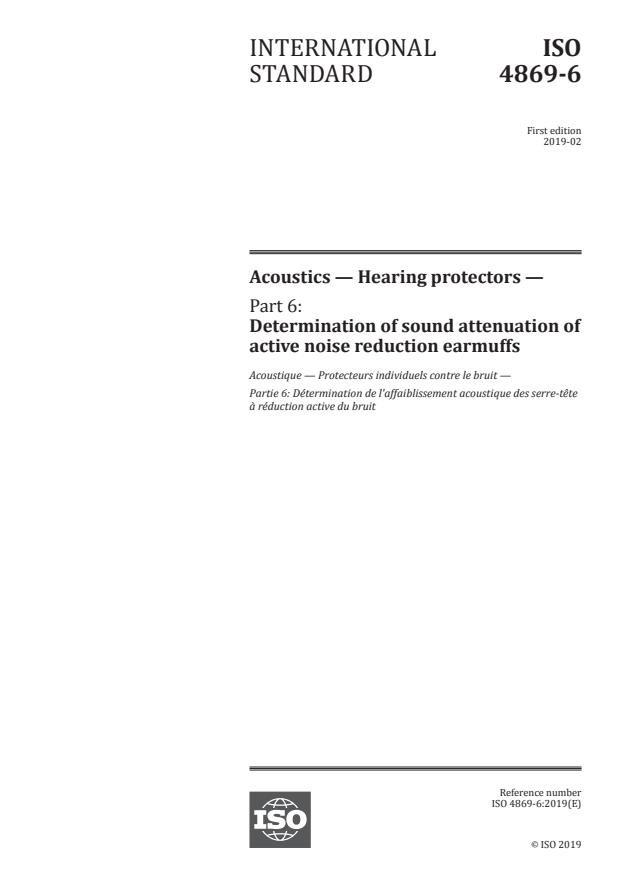
(Main)Acoustics — Hearing protectors — Part 6: Determination of sound attenuation of active noise reduction earmuffs
General Information
- Abstract
This document is concerned with active noise reduction (ANR) earmuffs. It specifies the test methods for the determination of the active insertion loss and calculation procedures for deriving the total attenuation. For this aim, the values of sound attenuation in the passive mode also have to be known and are determined according to ISO 4869‑1. These methods are intended for steady noise exposures and are not applicable to noises containing impulsive components. The test methods account for the acoustical interaction between the wearer and the device using measurements of passive (REAT) and active microphone-in-real-ear (MIRE) measurements as specified in ISO 4869‑1 and ISO 11904‑1, respectively.
- Status
- Published
- Publication Date
- 31-Jan-2019
- Technical Committee
- ISO/TC 43/SC 1 - Noise
- Current Stage
- 9093 - International Standard confirmed
- Start Date
- 19-Jul-2024
- Completion Date
- 29-Aug-2026
Buy Documents
ISO 4869-6:2019 - Acoustics — Hearing protectors — Part 6: Determination of sound attenuation of active noise reduction earmuffs Released:2/1/2019
ISO 4869-6:2019 - Acoustique — Protecteurs individuels contre le bruit — Partie 6: Détermination de l'affaiblissement acoustique des serre-tete a réduction active du bruit Released:2/1/2019
Overview
ISO 4869-6:2019 - "Acoustics - Hearing protectors - Part 6" specifies standardized test methods for determining the sound attenuation of active noise reduction (ANR) earmuffs. The standard defines how to measure the active insertion loss (AIL) provided by the ANR circuit and how to combine that with passive attenuation to derive the total attenuation in octave bands. It applies to steady (non-impulsive) noise exposures and accounts for the acoustical interaction between wearer and device using both REAT and MIRE measurement techniques.
Key topics and technical requirements
- Scope and limitations
- Focused on ANR (active noise reduction) earmuffs; not intended for impulsive noises.
- Test specimens and conditioning
- Four pairs of earmuffs required; power source fully operational. Conditioning at (22 ± 5) °C, relative humidity ≤ 85 %.
- Measurement techniques
- Passive attenuation measured by REAT (ISO 4869-1).
- Active attenuation measured by MIRE (microphone-in-real-ear) per ISO 11904-1 with closed earcanals.
- Test signals and levels
- Broadband noise (pink noise suitable) from 50 Hz (or 100 Hz) to 10 000 Hz for active insertion loss measurement.
- A-weighted levels for AIL measurement usually between 85 dB and 95 dB (up to 110 dB if device has a threshold).
- Red noise used to verify linear operation in low frequencies; level checks up to 110 dB.
- Protocol and statistical sampling
- Sixteen test subjects (both ears measured), each specimen tested by four subjects.
- Procedures for handling oscillation or malfunction and for reporting such events.
- Calculation
- Active insertion loss = difference between passive and active MIRE/REAT spectra per subject.
- Total attenuation computed per subject by combining passive REAT and measured AIL (detailed computation in the standard).
Practical applications
- Validating and certifying ANR earmuff performance for manufacturers and test laboratories.
- Supporting product development and R&D for hearing protectors targeting low-frequency noise control.
- Supplying objective data for safety officers, procurement teams, and hearing conservation programs when selecting ANR devices for industrial environments.
- Establishing evidence for marketing claims and regulatory compliance regarding attenuation values.
Who uses this standard
- Hearing protector manufacturers and design engineers
- Accredited acoustic test laboratories
- Occupational hygienists, safety managers, and procurement specialists
- Regulatory bodies and conformity assessment organizations
Related standards
- ISO 4869-1 - Subjective REAT method for passive attenuation
- ISO 4869-2 - Estimation of effective A-weighted sound levels with protectors
- ISO 11904-1 - MIRE technique (microphone in real ear)
- IEC 61094-4 - Working standard microphone specifications
Keywords: ISO 4869-6:2019, active noise reduction earmuffs, ANR earmuffs, active insertion loss, MIRE, REAT, sound attenuation, hearing protectors, acoustics standard.
Buy Documents
ISO 4869-6:2019 - Acoustics — Hearing protectors — Part 6: Determination of sound attenuation of active noise reduction earmuffs Released:2/1/2019
ISO 4869-6:2019 - Acoustique — Protecteurs individuels contre le bruit — Partie 6: Détermination de l'affaiblissement acoustique des serre-tete a réduction active du bruit Released:2/1/2019
Get Certified
Connect with accredited certification bodies for this standard

CIS Institut d.o.o.
Personal Protective Equipment (PPE) certification body. Notified Body NB-2890 for EU Regulation 2016/425 PPE.

Kiwa BDA Testing
Building and construction product certification.
Kmetijski inštitut Slovenije
Agricultural Institute of Slovenia. Soil testing, plant health, agricultural product analysis.
Sponsored listings
Frequently Asked Questions
ISO 4869-6:2019 is a standard published by the International Organization for Standardization (ISO). Its full title is "Acoustics — Hearing protectors — Part 6: Determination of sound attenuation of active noise reduction earmuffs". This standard covers: This document is concerned with active noise reduction (ANR) earmuffs. It specifies the test methods for the determination of the active insertion loss and calculation procedures for deriving the total attenuation. For this aim, the values of sound attenuation in the passive mode also have to be known and are determined according to ISO 4869‑1. These methods are intended for steady noise exposures and are not applicable to noises containing impulsive components. The test methods account for the acoustical interaction between the wearer and the device using measurements of passive (REAT) and active microphone-in-real-ear (MIRE) measurements as specified in ISO 4869‑1 and ISO 11904‑1, respectively.
This document is concerned with active noise reduction (ANR) earmuffs. It specifies the test methods for the determination of the active insertion loss and calculation procedures for deriving the total attenuation. For this aim, the values of sound attenuation in the passive mode also have to be known and are determined according to ISO 4869‑1. These methods are intended for steady noise exposures and are not applicable to noises containing impulsive components. The test methods account for the acoustical interaction between the wearer and the device using measurements of passive (REAT) and active microphone-in-real-ear (MIRE) measurements as specified in ISO 4869‑1 and ISO 11904‑1, respectively.
ISO 4869-6:2019 is classified under the following ICS (International Classification for Standards) categories: 13.340.20 - Head protective equipment. The ICS classification helps identify the subject area and facilitates finding related standards.
ISO 4869-6:2019 is available in PDF format for immediate download after purchase. The document can be added to your cart and obtained through the secure checkout process. Digital delivery ensures instant access to the complete standard document.
Standards Content (Sample)
INTERNATIONAL ISO
STANDARD 4869-6
First edition
2019-02
Acoustics — Hearing protectors —
Part 6:
Determination of sound attenuation of
active noise reduction earmuffs
Acoustique — Protecteurs individuels contre le bruit —
Partie 6: Détermination de l'affaiblissement acoustique des serre-tête
à réduction active du bruit
Reference number
©
ISO 2019
© ISO 2019
All rights reserved. Unless otherwise specified, or required in the context of its implementation, no part of this publication may
be reproduced or utilized otherwise in any form or by any means, electronic or mechanical, including photocopying, or posting
on the internet or an intranet, without prior written permission. Permission can be requested from either ISO at the address
below or ISO’s member body in the country of the requester.
ISO copyright office
CP 401 • Ch. de Blandonnet 8
CH-1214 Vernier, Geneva
Phone: +41 22 749 01 11
Fax: +41 22 749 09 47
Email: copyright@iso.org
Website: www.iso.org
Published in Switzerland
ii © ISO 2019 – All rights reserved
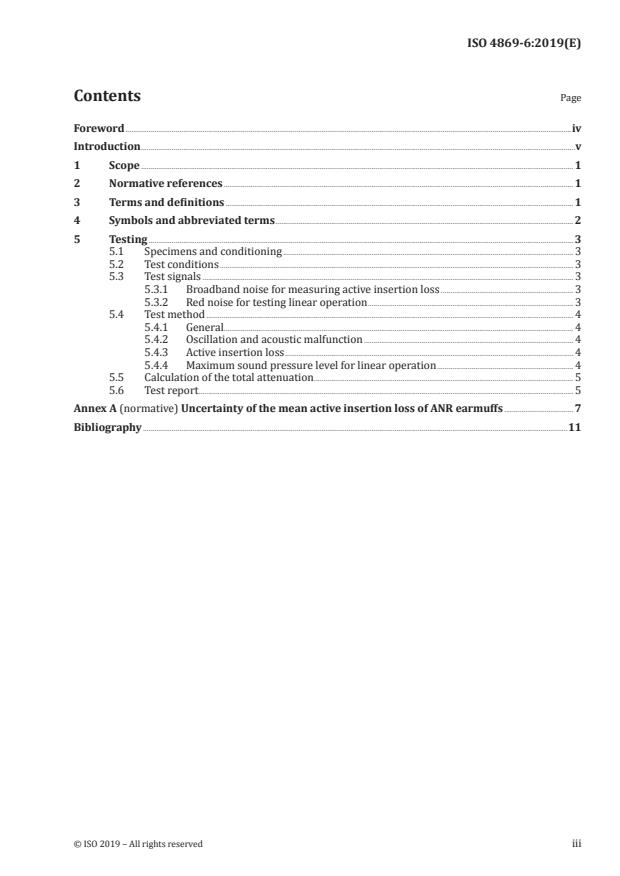
Contents Page
Foreword .iv
Introduction .v
1 Scope . 1
2 Normative references . 1
3 Terms and definitions . 1
4 Symbols and abbreviated terms . 2
5 Testing . 3
5.1 Specimens and conditioning . 3
5.2 Test conditions . 3
5.3 Test signals . 3
5.3.1 Broadband noise for measuring active insertion loss . 3
5.3.2 Red noise for testing linear operation . 3
5.4 Test method . 4
5.4.1 General. 4
5.4.2 Oscillation and acoustic malfunction . 4
5.4.3 Active insertion loss . 4
5.4.4 Maximum sound pressure level for linear operation . 4
5.5 Calculation of the total attenuation . 5
5.6 Test report . 5
Annex A (normative) Uncertainty of the mean active insertion loss of ANR earmuffs .7
Bibliography .11
Foreword
ISO (the International Organization for Standardization) is a worldwide federation of national standards
bodies (ISO member bodies). The work of preparing International Standards is normally carried out
through ISO technical committees. Each member body interested in a subject for which a technical
committee has been established has the right to be represented on that committee. International
organizations, governmental and non-governmental, in liaison with ISO, also take part in the work.
ISO collaborates closely with the International Electrotechnical Commission (IEC) on all matters of
electrotechnical standardization.
The procedures used to develop this document and those intended for its further maintenance are
described in the ISO/IEC Directives, Part 1. In particular, the different approval criteria needed for the
different types of ISO documents should be noted. This document was drafted in accordance with the
editorial rules of the ISO/IEC Directives, Part 2 (see www .iso .org/directives).
Attention is drawn to the possibility that some of the elements of this document may be the subject of
patent rights. ISO shall not be held responsible for identifying any or all such patent rights. Details of
any patent rights identified during the development of the document will be in the Introduction and/or
on the ISO list of patent declarations received (see www .iso .org/patents).
Any trade name used in this document is information given for the convenience of users and does not
constitute an endorsement.
For an explanation of the voluntary nature of standards, the meaning of ISO specific terms and
expressions related to conformity assessment, as well as information about ISO's adherence to the
World Trade Organization (WTO) principles in the Technical Barriers to Trade (TBT) see www .iso
.org/iso/foreword .html.
This document was prepared by Technical Committee ISO/TC 43, Acoustics, Subcommittee SC 1, Noise.
A list of all the parts in the ISO 4869 series can be found on the ISO website.
Any feedback or questions on this document should be directed to the user’s national standards body. A
complete listing of these bodies can be found at www .iso .org/members .html.
iv © ISO 2019 – All rights reserved
Introduction
Active noise reduction earmuffs are designed to provide additional attenuation of external sounds
by means of a noise cancellation circuit. This additional attenuation is generally more effective at low
frequencies. Such earmuffs can be selected for use in low-frequency dominated high noise environments.
INTERNATIONAL STANDARD ISO 4869-6:2019(E)
Acoustics — Hearing protectors —
Part 6:
Determination of sound attenuation of active noise
reduction earmuffs
1 Scope
This document is concerned with active noise reduction (ANR) earmuffs. It specifies the test methods
for the determination of the active insertion loss and calculation procedures for deriving the total
attenuation. For this aim, the values of sound attenuation in the passive mode also have to be known
and are determined according to ISO 4869-1. These methods are intended for steady noise exposures
and are not applicable to noises containing impulsive components.
The test methods account for the acoustical interaction between the wearer and the device using
measurements of passive (REAT) and active microphone-in-real-ear (MIRE) measurements as specified
in ISO 4869-1 and ISO 11904-1, respectively.
2 Normative references
The following documents are referred to in the text in such way that some or all of their content
constitutes requirements of this document. For dated references, only the edition cited applies. For
undated references, the latest edition of the referenced document (including any amendments) applies.
ISO 4869-1, Acoustics — Hearing protectors — Part 1: Subjective method for the measurement of sound
attenuation
ISO 4869-2, Acoustics — Hearing protectors — Part 2: Estimation of effective A-weighted sound pressure
levels when hearing protectors are worn
ISO 11904-1, Acoustics — Determination of sound immission from sound sources placed close to the ear —
Part 1: Technique using a microphone in a real ear (MIRE technique)
IEC 61094-4, Measurement microphones — Part 4: Specifications for working standard microphones
3 Terms and definitions
For the purposes of this document, the terms and definitions given in ISO 4869-1, ISO 4869-2,
ISO 11904-1 and the following apply.
ISO and IEC maintain terminological databases for use in standardization at the following addresses:
— ISO Online browsing platform: available at https: //www .iso .org/obp
— IEC Electropedia: available at http: //www .electropedia .org/
3.1
active noise reduction earmuff
ANR earmuff
earmuff that provides additional attenuation of external sounds by means of a noise cancellation circuit
3.2
active mode
operation of the ANR earmuff (3.1) with the ANR circuit active
3.3
passive mode
operation of the ANR earmuff (3.1) with the ANR circuit not active
3.4
active insertion loss
AIL
additional sound attenuation of the ANR earmuff (3.1) provided in the active mode (3.2) compared to the
passive mode (3.3)
Note 1 to entry: The active insertion loss is measured according to 5.4.3.
3.5
red noise
random noise signal with a spectral density that decreases by 6 dB per octave over a frequency range
which does not include DC
Note 1 to entry: The definition is often phrased as noise whose power spectral density is proportional to 1/f .
3.6
pink noise
random noise signal with a spectral density that decreases by 3 dB per octave, giving constant energy
per octave
Note 1 to entry: The definition is often phrased as noise whose power spectral density is inversely proportional
to frequency.
[SOURCE: ISO 7240-24:2016, 3.1.11; modified — Note 1 to entry added]
4 Symbols and abbreviated terms
α Active insertion loss
A Total attenuation
total
ANR Active noise reduction
REAT Real-ear attenuation at threshold
MIRE Microphone in a real ear
FFT Fast Fourier transform
APV Assumed protection value of the hearing protector
H High frequency attenuation value
M Medium frequency attenuation value
L Low frequency attenuation value
HML Method based on H, M, L
SNR Single number rating
2 © ISO 2019 – All rights reserved
5 Testing
5.1 Specimens and conditioning
Four pairs of earmuffs shall be submitted for testing. Each individual earmuff cup shall be uniquely
marked for identification. The power source shall be fully operational.
All specimens shall be conditioned and tested in an environment having a temperature of (22 ± 5) °C
and a relative humidity of not more than 85 %.
5.2 Test conditions
Random incidence sound field conditions at the reference point as described in ISO 4869-1 are required
for all one-third-octave bands of the test signals specified in 5.3.
5.3 Test signals
5.3.1 Broadband noise for measuring active insertion loss
A broadband noise signal shall be used to determine the diffuse-field related sound pressure levels.
The test signal at the reference point shall be a broadband random noise in each one-third-octave band
centred from 50 Hz (or 100 Hz) to 10 000 Hz, and shall be at least 3 dB down at the one-third-octave
bands below and above these limit bands, and roll off at least 12 dB/octave for the bands below and
above that. Adjacent one-third-octave-band levels shall not differ by more than 3 dB. The difference
between the maximum and minimum one-third-octave-band levels shall not exceed 10 dB from 50 Hz
(or 100 Hz) to 10 000 Hz.
NOTE 1 Pink noise is a suitable broadband noise signal.
If the total attenuation is to be determined for the frequency range from 63 Hz to 8 000 Hz, the test
signal shall extend from 50 Hz to 10 000 Hz. If the test signal is only available for 100 Hz and above, the
total attenuation can only be determined from 125 Hz upwards.
The measurements described above shall be conducted with a WS2P or WS2D microphone (working
standard, ½ inch, pressure field/random incidence) according to IEC 61094-4.
The use of digital pseudorandom white and pink noise sources is restricted to measurements of passive
hearing protectors. Some FFT analyzers with internally generated digital pseudorandom white and
pink noise sources with known statistical characteristics, i.e. wide sense stationary, can potentially
overestimate the active insertion loss with some ANR hearing protectors.
The sound pressure level measured under the hearing protector (occluded condition) in each one-
third-octave band with the test noise on shall be at least 10 dB higher than the sound pressure level
measured under the hearing protector with the test noise off. The test signal shall be presented up to
an A-weighted sound pressure level of 95 dB.
NOTE 2 Test signals up to an A-weighted sound pressure level of 110 dB can be necessary if the device
incorporates a threshold level only above which the active attenuation is working.
5.3.2 Red noise for testing linear operation
Red noise shall be used with the maximum of the spectrum in the 125 Hz one-third-octave band and
one-third-octave-band levels in the 100 Hz and 80 Hz band of 1 dB and 3 dB less than the maximum.
The signal shall be presented up to an A-weighted sound pressure level of 110 dB.
5.4 Test method
5.4.1 General
The measurements described in 5.4.3 determine the active contribution (active insertion loss) to the
total attenua
...
NORME ISO
INTERNATIONALE 4869-6
Première édition
2019-02
Acoustique — Protecteurs individuels
contre le bruit —
Partie 6:
Détermination de l'affaiblissement
acoustique des serre-tête à réduction
active du bruit
Acoustics — Hearing protectors —
Part 6: Determination of sound attenuation of active noise reduction
earmuffs
Numéro de référence
©
ISO 2019
DOCUMENT PROTÉGÉ PAR COPYRIGHT
© ISO 2019
Tous droits réservés. Sauf prescription différente ou nécessité dans le contexte de sa mise en œuvre, aucune partie de cette
publication ne peut être reproduite ni utilisée sous quelque forme que ce soit et par aucun procédé, électronique ou mécanique,
y compris la photocopie, ou la diffusion sur l’internet ou sur un intranet, sans autorisation écrite préalable. Une autorisation peut
être demandée à l’ISO à l’adresse ci-après ou au comité membre de l’ISO dans le pays du demandeur.
ISO copyright office
Case postale 401 • Ch. de Blandonnet 8
CH-1214 Vernier, Genève
Tél.: +41 22 749 01 11
Fax: +41 22 749 09 47
E-mail: copyright@iso.org
Web: www.iso.org
Publié en Suisse
ii © ISO 2019 – Tous droits réservés
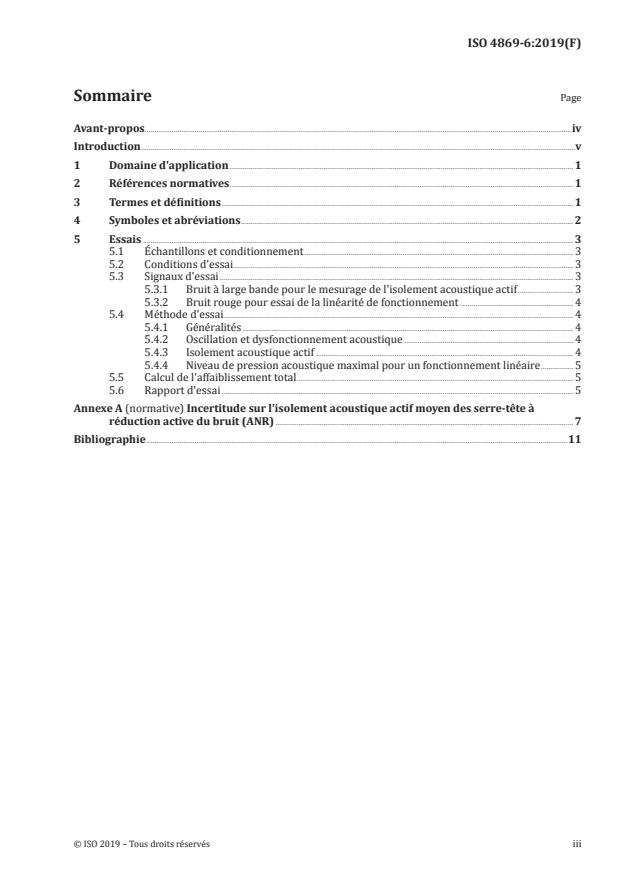
Sommaire Page
Avant-propos .iv
Introduction .v
1 Domaine d'application . 1
2 Références normatives . 1
3 Termes et définitions . 1
4 Symboles et abréviations . 2
5 Essais . 3
5.1 Échantillons et conditionnement . 3
5.2 Conditions d'essai. 3
5.3 Signaux d'essai . 3
5.3.1 Bruit à large bande pour le mesurage de l'isolement acoustique actif . 3
5.3.2 Bruit rouge pour essai de la linéarité de fonctionnement . 4
5.4 Méthode d'essai . 4
5.4.1 Généralités . 4
5.4.2 Oscillation et dysfonctionnement acoustique . 4
5.4.3 Isolement acoustique actif . 4
5.4.4 Niveau de pression acoustique maximal pour un fonctionnement linéaire . 5
5.5 Calcul de l'affaiblissement total . 5
5.6 Rapport d'essai . 5
Annexe A (normative) Incertitude sur l'isolement acoustique actif moyen des serre-tête à
réduction active du bruit (ANR) . 7
Bibliographie .11
Avant-propos
L'ISO (Organisation internationale de normalisation) est une fédération mondiale d'organismes
nationaux de normalisation (comités membres de l'ISO). L'élaboration des Normes internationales est
en général confiée aux comités techniques de l'ISO. Chaque comité membre intéressé par une étude
a le droit de faire partie du comité technique créé à cet effet. Les organisations internationales,
gouvernementales et non gouvernementales, en liaison avec l'ISO participent également aux travaux.
L'ISO collabore étroitement avec la Commission électrotechnique internationale (IEC) en ce qui
concerne la normalisation électrotechnique.
Les procédures utilisées pour élaborer le présent document et celles destinées à sa mise à jour sont
décrites dans les Directives ISO/IEC, Partie 1. Il convient en particulier de prendre note des différents
critères d'approbation requis pour les différents types de documents ISO. Le présent document a été
rédigé conformément aux règles de rédaction données dans les Directives ISO/IEC, Partie 2 (voir www
.iso .org/directives).
L'attention est attirée sur le fait que certains des éléments du présent document peuvent faire l'objet de
droits de propriété intellectuelle ou de droits analogues. L'ISO ne saurait être tenue pour responsable
de ne pas avoir identifié de tels droits de propriété et averti de leur existence. Les détails concernant
les références aux droits de propriété intellectuelle ou autres droits analogues identifiés lors de
l'élaboration du document sont indiqués dans l'Introduction et/ou dans la liste des déclarations de
brevets reçues par l'ISO (voir www .iso .org/brevets).
Les appellations commerciales éventuellement mentionnées dans le présent document sont données
pour information, par souci de commodité, à l'intention des utilisateurs et ne sauraient constituer un
engagement.
Pour une explication de la nature volontaire des normes, la signification des termes et expressions
spécifiques de l'ISO liés à l'évaluation de la conformité, ou pour toute information au sujet de l'adhésion
de l'ISO aux principes de l'Organisation mondiale du commerce (OMC) concernant les obstacles
techniques au commerce (OTC), voir: www .iso .org/iso/fr/avant -propos.
Le présent document a été élaboré par le comité technique ISO/TC 43, Acoustique, sous-comité SC 1, Bruit.
Une liste de toutes les parties de la série ISO 4869 se trouve sur le site Web de l'ISO.
Il convient que l'utilisateur adresse tout retour d'information ou toute question concernant le présent
document à l'organisme national de normalisation de son pays. Une liste exhaustive desdits organismes
se trouve à l'adresse www .iso .org/fr/members .html.
iv © ISO 2019 – Tous droits réservés
Introduction
Les serre-tête à réduction active du bruit sont conçus pour assurer un affaiblissement supplémentaire
des sons extérieurs au moyen d'un circuit (électronique) de suppression du bruit. Cet affaiblissement
supplémentaire est généralement plus efficace à basses fréquences. De tels serre-tête peuvent être
sélectionnés pour être utilisés dans des environnements de bruit élevé dominés par des basses
fréquences.
NORME INTERNATIONALE ISO 4869-6:2019(F)
Acoustique — Protecteurs individuels contre le bruit —
Partie 6:
Détermination de l'affaiblissement acoustique des serre-
tête à réduction active du bruit
1 Domaine d'application
Le présent document concerne les serre-tête à réduction active du bruit (ANR). Il précise les méthodes
d'essai pour la détermination de l'isolement acoustique actif et les procédures de calcul pour en dériver
l'affaiblissement total. À cette fin, les valeurs d'affaiblissement acoustique en mode passif doivent
également être connues et sont à déterminer conformément à l'ISO 4869-1. Ces méthodes sont prévues
pour des expositions à un bruit continu et ne s'appliquent pas à des bruits comportant des composantes
impulsives.
Les méthodes d'essai prennent en compte l'interaction acoustique entre l'utilisateur et le dispositif en
utilisant des mesures de l'affaiblissement passif (REAT) et de l'affaiblissement actif par la technique
du microphone placé dans l'oreille réelle (MIRE) comme spécifié dans l'ISO 4869-1 et l'ISO 11904-1,
respectivement.
2 Références normatives
Les documents suivants cités dans le texte constituent, pour tout ou partie de leur contenu, des
exigences du présent document. Pour les références datées, seule l'édition citée s'applique. Pour les
références non datées, la dernière édition du document de référence s'applique (y compris les éventuels
amendements).
ISO 4869-1, Acoustique — Protecteurs individuels contre le bruit — Partie 1: Méthode subjective de
mesurage de l'affaiblissement acoustique
ISO 4869-2, Acoustique — Protecteurs individuels contre le bruit — Partie 2: Estimation des niveaux de
pression acoustique pondérés A en cas d'utilisation de protecteurs individuels contre le bruit
ISO 11904-1, Acoustique — Détermination de l'exposition sonore due à des sources placées à proximité de
l'oreille — Partie 1: Technique du microphone placé dans une oreille réelle (technique MIRE)
IEC 61094-4, Microphones de mesure — Partie 4: Spécifications des microphones étalons de travail
3 Termes et définitions
Pour les besoins du présent document, les termes et définitions donnés dans l'ISO 4869-1, l'ISO 4869-2,
et dans l'ISO 11904-1 ainsi que les suivants s'appliquent.
L'ISO et l'IEC tiennent à jour des bases de données terminologiques destinées à être utilisées en
normalisation, consultables aux adresses suivantes:
— ISO Online browsing platform: disponible à l'adresse https: //www .iso .org/obp
— IEC Electropedia: disponible à l'adresse http: //www .electropedia .org/
3.1
serre-tête à réduction active du bruit
serre-tête ANR
serre-tête conçu pour assurer un affaiblissement supplémentaire des sons extérieurs au moyen d'un
circuit (électronique) de suppression du bruit
3.2
mode actif
fonctionnement du serre-tête de type ANR (à réduction active du bruit) (3.1) avec le circuit ANR activé
3.3
mode passif
fonctionnement du serre-tête de type ANR (à réduction active du bruit) (3.1) avec le circuit ANR désactivé
3.4
isolement acoustique actif
AIL
affaiblissement acoustique supplémentaire du serre-tête de type ANR (à réduction active du bruit) (3.1)
assuré en mode actif (3.2) par rapport au mode passif (3.3)
Note 1 à l'article: L'isolement acoustique actif est mesuré conformément à 5.4.3.
3.5
bruit rouge
signal de bruit aléatoire dont la densité spectrale diminue de 6 dB par octave sur une gamme de
fréquences qui ne comprend pas de DC
Note 1 à l'article: Cette définition est souvent énoncée comme «bruit dont la densité spectrale de puissance est
proportionnelle à 1/f ».
3.6
bruit rose
signal de bruit aléatoire dont la densité spectrale diminue de 3 dB par octave, donnant une énergie
constante par octave
Note 1 à l'article: Cette définition est souvent énoncée comme «bruit dont la densité spectrale de puissance est
inversement proportionnelle à la fréquence».
[SOURCE: ISO 7240-24:2016, 3.1.11, modifiée — Ajout d'une Note 1 à l'article]
4 Symboles et abréviations
α Isolement acoustique actif
A Affaiblissement total
total
ANR Réduction active du bruit [Active Noise Reduction]
REAT Affaiblissement sur une oreille réelle au seuil d'audition [Real-ear attenuation at threshold]
MIRE Microphone placé dans l'oreille réelle [Microphone In Real Ear]
FFT Transformée de Fourier rapide
APV Valeur de protection estimée [Assumed Protection Value] du protecteur individuel contre
le bruit
H Valeur d'affaiblissement à haute fréquence
M Valeur d'affaiblissement à moyenne fréquence
2 © ISO 2019 – Tous droits réservés
L Valeur d'affaiblissement à basse fréquence
HML Méthode basée sur H, M, L
SNR Indice global [Single Number Rating]
5 Essais
5.1 Échantillons et conditionnement
Quatre paires de serre-tête doivent être soumises aux essais. Chaque coquille des serre-tête individuels
doit avoir son marquage propre à des fins d'identification. La source d'alimentation doit être totalement
opérationnelle.
Tous les échantillons doivent être conditionnés et soumis à essai dans un environnement caractérisé
par une température de (22 ± 5) °C et une humidité relative inférieure ou égale à 85 %.
5.2 Conditions d'essai
Des conditions de champ acoustique à incidence aléatoire au point de référence, comme décrit dans
l'ISO 4869-1 sont requises pour toutes les bandes de tiers d'octave des signaux d'essai spécifiées en 5.3.
5.3 Signaux d'essai
5.3.1 Bruit à large bande pour le mesurage de l'isolement acoustique actif
Un signal de bruit à large bande doit être utilisé pour déterminer les niveaux de pression acoustique
rapportés à un champ diffus. Le signal d'essai au point de référence doit être un bruit aléatoire à large
bande dans chaque bande de tiers d'octave de fréquence centrale comprise entre 50 Hz (ou 100 Hz)
et 10 000 Hz, et doit décroître d'au moins 3 dB dans les bandes de tiers d'octave situées au-dessous et
au-dessus de ces bandes limites, et d'au moins 12 dB/octave dans les bandes situées au-dessous et au-
dessus de celles-ci. Les niveaux dans des bandes de tiers d'octave adjacentes ne doivent pas différer de
plus de 3 dB. La différence entre les niveaux maximal et minimal dans les bandes de tiers d'octave ne
doit pas dépasser 10 dB de 50 Hz (ou 100 Hz) à 10 000 Hz.
NOTE 1 Un bruit rose est un signal de bruit à large bande approprié.
Si l'affaiblissement total est à déterminer pour la gamme de fréquences de 63 Hz à 8 000 Hz, le signal
d'essai doit s'étendre de 50 Hz à 10,000 Hz. Si le signal d'essai est uniquement disponible pour 100 Hz et
plus, l'affaiblissement total ne peut être déterminé qu'à partir de 125 Hz.
Les mesurages décrits ci-dessus doivent être effectués avec un microphone WS2P ou WS2D (étalon de
travail, 1/2 pouce, champ de pression/incidence aléatoire) conformément à l'IEC 61094-4.
L'utilisation de générateurs numériques de bruit blanc et rose pseudo-aléatoires est limitée aux
mesurages des protecteurs individuels passifs contre le bruit. Certains analyseurs FFT munis de
générateurs numériques internes de bruit blanc et rose pseudo-aléatoires ayant des caractéristiques
statistiques connues, c'est-à-dire fixes au sens large, peuvent potentiellement surestimer l'isolement
acoustique actif pour certains protecteurs individuels contre le bruit de type ANR.
Le niveau de pression acoustique mesuré sous le protecteur individuel contre le bruit (condition occluse)
dans chaque bande de tiers d'octave avec le bruit d'essai doit être supérieur d'au moins 10 dB au niveau
de pression acoustique mesuré sous le protecteur individuel contre le bruit sans le bruit d'essai. Le
signal d'essai doit être présenté jusqu'à un niveau de pression acoustique pondéré A de 95 dB.
NOTE 2 Des signaux d'essai jusqu'à un niveau de pression acoustique pondéré A de 110 dB peuvent être
nécessaires si le dispositif intègre un niveau seuil au-dessus duquel uniquement l'affaiblissement actif fonctionne.
5.3.2 Bruit rouge pour essai de la linéarité de fonctionnement
Le bruit rouge doit être utilisé avec le maximum du spectre dans la bande de tiers d'octave de 125 Hz et
les niveaux de bande de tiers d'octave dans la bande de 100 Hz et de 80 Hz inférieurs au maximum de
1 dB et 3 dB. Le signal doit être présenté jusqu'à un niveau de pression acoustique pondéré A de 110 dB.
5.4 Méthode d'essai
5.4.1 Généralités
Les mesurages décrits au 5.4.3 déterminent la cont
...