


ISO 10364:2015
(Main)Structural adhesives — Determination of the pot life (working life) of multi-component adhesives
Structural adhesives — Determination of the pot life (working life) of multi-component adhesives
ISO 10364:2015 specifies methods for determining the pot life of multi-part adhesives in order to be able to determine whether the pot life conforms to the minimum specified working life required of an adhesive. For the purposes of simplification, the term "pot life" is deemed to have the same meaning as "working life" and will be used to represent both throughout this International Standard. Methods described to measure the property provide different answers. So the results shall be specified with respect to the method used. The test methods described are suitable for assessing all multi?part adhesives, and especially epoxy based and polyurethane based adhesives, but they are not suitable for some acrylic-based adhesives. NOTE 1 Some of the methods described in this International Standard can also be suitable for determination of working life of one-part adhesives that react to humidity (e.g. PUR prepolymers). NOTE 2 This International Standard can also be used for assessing non-structural adhesives.
Adhésifs structuraux — Détermination de la vie en pot (durée d'utilisation) des adhésifs multicomposants
ISO 10364:2015 spécifie des méthodes de détermination de la vie en pot des adhésifs multicomposants afin de pouvoir établir si la vie en pot correspond à la durée d'utilisation minimale spécifiée, requise pour un adhésif. À des fins de simplification, le terme «vie en pot» est considéré comme ayant la même signification que «durée d'utilisation» et sera utilisé pour les deux occurrences terminologiques tout au long de la présente Norme internationale. Les méthodes décrites pour mesurer cette propriété fournissent des résultats divers. Par conséquent, ces derniers doivent être spécifiés par rapport à la méthode utilisée. Les méthodes d'essai décrites permettent d'évaluer tous les adhésifs multicomposants, et notamment les adhésifs à base d'époxyde et à base de polyuréthanne mais elles ne sont pas appropriées à l'évaluation de certains adhésifs acryliques. NOTE 1 Parmi les méthodes décrites dans la présente Norme internationale, certaines peuvent également convenir pour déterminer la durée d'utilisation des adhésifs monocomposants qui réagissent à l'humidité (par exemple les prépolymères PUR). NOTE 2 La présente Norme internationale peut également être utilisée pour évaluer des adhésifs non structuraux.
General Information
- Status
- Withdrawn
- Publication Date
- 17-Sep-2015
- Technical Committee
- ISO/TC 61/SC 11 - Products
- Drafting Committee
- ISO/TC 61/SC 11/WG 5 - Polymeric adhesives
- Current Stage
- 9599 - Withdrawal of International Standard
- Start Date
- 31-Jan-2024
- Completion Date
- 12-Feb-2026
Relations
- Effective Date
- 06-Jun-2022
- Effective Date
- 10-Sep-2011
ISO 10364:2015 - Structural adhesives -- Determination of the pot life (working life) of multi-component adhesives
ISO 10364:2015 - Adhésifs structuraux -- Détermination de la vie en pot (durée d'utilisation) des adhésifs multicomposants
Get Certified
Connect with accredited certification bodies for this standard

Smithers Quality Assessments
US management systems and product certification.

DIN CERTCO
DIN Group product certification.
Sponsored listings
Frequently Asked Questions
ISO 10364:2015 is a standard published by the International Organization for Standardization (ISO). Its full title is "Structural adhesives — Determination of the pot life (working life) of multi-component adhesives". This standard covers: ISO 10364:2015 specifies methods for determining the pot life of multi-part adhesives in order to be able to determine whether the pot life conforms to the minimum specified working life required of an adhesive. For the purposes of simplification, the term "pot life" is deemed to have the same meaning as "working life" and will be used to represent both throughout this International Standard. Methods described to measure the property provide different answers. So the results shall be specified with respect to the method used. The test methods described are suitable for assessing all multi?part adhesives, and especially epoxy based and polyurethane based adhesives, but they are not suitable for some acrylic-based adhesives. NOTE 1 Some of the methods described in this International Standard can also be suitable for determination of working life of one-part adhesives that react to humidity (e.g. PUR prepolymers). NOTE 2 This International Standard can also be used for assessing non-structural adhesives.
ISO 10364:2015 specifies methods for determining the pot life of multi-part adhesives in order to be able to determine whether the pot life conforms to the minimum specified working life required of an adhesive. For the purposes of simplification, the term "pot life" is deemed to have the same meaning as "working life" and will be used to represent both throughout this International Standard. Methods described to measure the property provide different answers. So the results shall be specified with respect to the method used. The test methods described are suitable for assessing all multi?part adhesives, and especially epoxy based and polyurethane based adhesives, but they are not suitable for some acrylic-based adhesives. NOTE 1 Some of the methods described in this International Standard can also be suitable for determination of working life of one-part adhesives that react to humidity (e.g. PUR prepolymers). NOTE 2 This International Standard can also be used for assessing non-structural adhesives.
ISO 10364:2015 is classified under the following ICS (International Classification for Standards) categories: 83.180 - Adhesives. The ICS classification helps identify the subject area and facilitates finding related standards.
ISO 10364:2015 has the following relationships with other standards: It is inter standard links to ISO 10364:2024, ISO 10364:2007. Understanding these relationships helps ensure you are using the most current and applicable version of the standard.
ISO 10364:2015 is available in PDF format for immediate download after purchase. The document can be added to your cart and obtained through the secure checkout process. Digital delivery ensures instant access to the complete standard document.
Standards Content (Sample)
INTERNATIONAL ISO
STANDARD 10364
Third edition
2015-09-15
Structural adhesives — Determination
of the pot life (working life) of multi-
component adhesives
Adhésifs structuraux — Détermination de la durée de vie en pot (délai
d’utilisation) d’adhésifs multicomposants
Reference number
©
ISO 2015
© ISO 2015, Published in Switzerland
All rights reserved. Unless otherwise specified, no part of this publication may be reproduced or utilized otherwise in any form
or by any means, electronic or mechanical, including photocopying, or posting on the internet or an intranet, without prior
written permission. Permission can be requested from either ISO at the address below or ISO’s member body in the country of
the requester.
ISO copyright office
Ch. de Blandonnet 8 • CP 401
CH-1214 Vernier, Geneva, Switzerland
Tel. +41 22 749 01 11
Fax +41 22 749 09 47
copyright@iso.org
www.iso.org
ii © ISO 2015 – All rights reserved
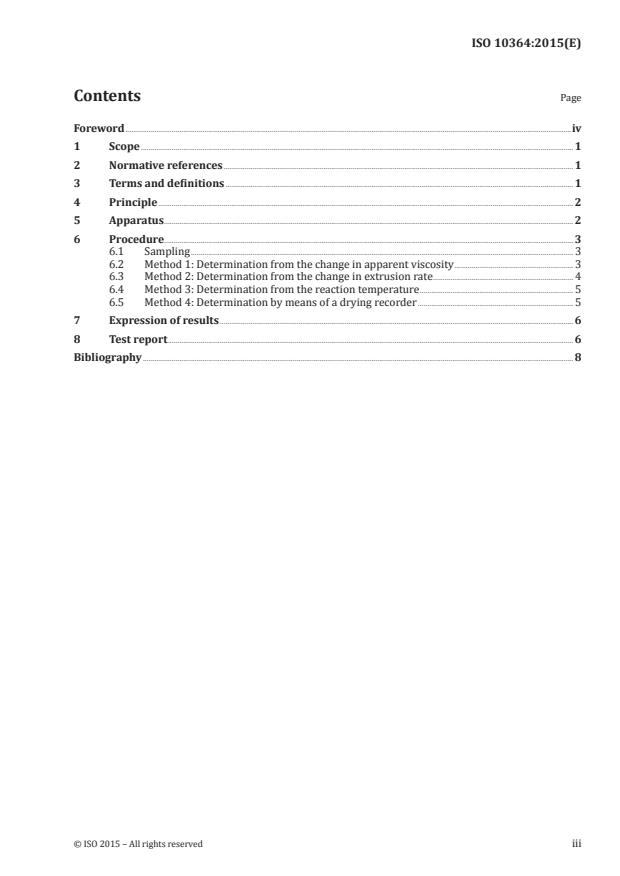
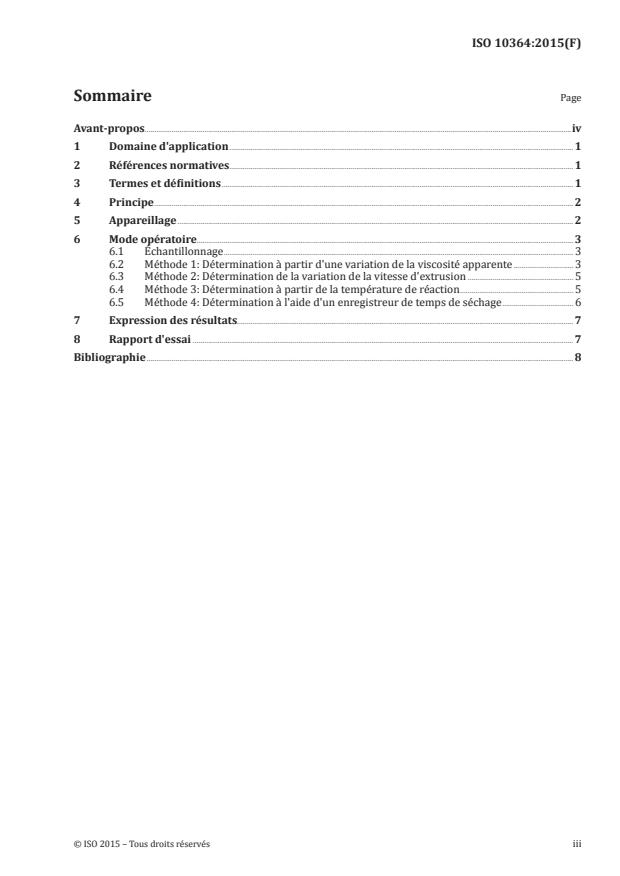
Contents Page
Foreword .iv
1 Scope . 1
2 Normative references . 1
3 Terms and definitions . 1
4 Principle . 2
5 Apparatus . 2
6 Procedure. 3
6.1 Sampling . 3
6.2 Method 1: Determination from the change in apparent viscosity . 3
6.3 Method 2: Determination from the change in extrusion rate . 4
6.4 Method 3: Determination from the reaction temperature . 5
6.5 Method 4: Determination by means of a drying recorder . 5
7 Expression of results . 6
8 Test report . 6
Bibliography . 8
Foreword
ISO (the International Organization for Standardization) is a worldwide federation of national standards
bodies (ISO member bodies). The work of preparing International Standards is normally carried out
through ISO technical committees. Each member body interested in a subject for which a technical
committee has been established has the right to be represented on that committee. International
organizations, governmental and non-governmental, in liaison with ISO, also take part in the work.
ISO collaborates closely with the International Electrotechnical Commission (IEC) on all matters of
electrotechnical standardization.
The procedures used to develop this document and those intended for its further maintenance are
described in the ISO/IEC Directives, Part 1. In particular the different approval criteria needed for the
different types of ISO documents should be noted. This document was drafted in accordance with the
editorial rules of the ISO/IEC Directives, Part 2 (see www.iso.org/directives).
Attention is drawn to the possibility that some of the elements of this document may be the subject of
patent rights. ISO shall not be held responsible for identifying any or all such patent rights. Details of
any patent rights identified during the development of the document will be in the Introduction and/or
on the ISO list of patent declarations received (see www.iso.org/patents).
Any trade name used in this document is information given for the convenience of users and does not
constitute an endorsement.
For an explanation on the meaning of ISO specific terms and expressions related to conformity
assessment, as well as information about ISO’s adherence to the WTO principles in the Technical
Barriers to Trade (TBT) see the following URL: Foreword - Supplementary information.
The committee responsible for this document is ISO/TC 61, Plastics, Subcommittee SC 11, Products.
This third edition cancels and replaces the second edition (ISO 10364:2007), which has been
technically revised.
iv © ISO 2015 – All rights reserved
INTERNATIONAL STANDARD ISO 10364:2015(E)
Structural adhesives — Determination of the pot life
(working life) of multi-component adhesives
SAFETY STATEMENT — Persons using this International Standard should be familiar with
normal laboratory practice, if applicable. This International Standard does not purport to
address all of the safety concerns, if any, associated with its use. It is the responsibility of the
user to establish appropriate safety and health practices and to ensure compliance with any
regulatory requirements.
1 Scope
This International Standard specifies methods for determining the pot life of multi-part adhesives in
order to be able to determine whether the pot life conforms to the minimum specified working life
required of an adhesive.
For the purposes of simplification, the term “pot life” is deemed to have the same meaning as “working life”
and will be used to represent both throughout this International Standard. Methods described to measure
the property provide different answers. So the results shall be specified with respect to the method used.
The test methods described are suitable for assessing all multi–part adhesives, and especially epoxy
based and polyurethane based adhesives, but they are not suitable for some acrylic-based adhesives.
NOTE 1 Some of the methods described in this International Standard can also be suitable for determination
of working life of one-part adhesives that react to humidity (e.g. PUR prepolymers).
NOTE 2 This International Standard can also be used for assessing non-structural adhesives.
2 Normative references
The following documents, in whole or in part, are normatively referenced in this document and are
indispensable for its application. For dated references, only the edition cited applies. For undated
references, the latest edition of the referenced document (including any amendments) applies.
ISO 472, Plastics — Vocabulary
ISO 2555, Plastics — Resins in the liquid state or as emulsions or dispersions — Determination of apparent
viscosity by the Brookfield Test method
ISO 3219, Plastics — Polymers/resins in the liquid state or as emulsions or dispersions — Determination of
viscosity using a rotational viscometer with defined shear rate
ISO 15605, Adhesives — Sampling
3 Terms and definitions
For the purposes of this document, the terms and definitions given in ISO 472 and the following apply.
3.1
pot life
working life
maximum period of time during which a multi-part adhesive can be used after mixing the components
4 Principle
This International Standard specifies four methods for the determination of the pot life of multi-
part adhesives.
In method 1, the pot life is determined from the increase in viscosity of the adhesive as it reacts. This
method is not suitable for the determination of pot lives that are shorter than 5 min.
In method 2, the pot life is determined from the decrease in the mass of mixed adhesive which is
extruded in unit time under standard conditions. This method is not suitable for the determination of
pot lives that are shorter than 5 min.
In method 3, the pot life is determined as the time taken by the mixed adhesive to reach a defined
temperature, the so-called critical temperature. This method is applicable to all multi-part systems.
In method 4, the working live of low viscose, self-levelling two part adhesives, or one-part moisture
curing adhesives is determined by means of the film formation point and the drying point. A thin weight-
loaded pin (“needle”) is drawn at a constant speed through a thin layer of the respective adhesive. The
time at which the trace, generated by the needle, is no longer levelled out by the still flowing adhesive is
defined as film formation time while the point at which the needle lifts out of the adhesive and continues
gliding on the film surface without leaving any marks is defined as film drying time.
5 Apparatus
5.1 Balance, capable of weighing up to (500 ± 0,1) g for methods 1 and 2 and up to (100 ± 0,1) g for
methods 3, and 4.
5.2 Beaker, squat shape, plain bottom of appropriate seize, made of a material which does not react
with the adhesive under test, with a wall thickness which does not exceed 1 mm.
5.3 Spatula, made of a material which does not react with the adhesive under test.
5.4 Rotational viscometer, as specified in ISO 2555 or ISO 3219.
5.5 Water bath, capable of being maintained at constant temperature to within ±0,1 °C for methods 2
and 3 and within ±0,2 °C for method 4 throughout the temperature range 15 °C to 30 °C.
5.6 Stopwatch, accurate to ±1 s.
5.7 Test enclosure, capable of being maintained at the test temperature and, if necessary, at a relative
humidity of (50 ± 5) %.
5.8 Disposable plastic cartridges, internal diameter 47 mm, length 210 mm, and fitted with a
threaded end fitting and a piston, both cartridge, and piston being made of a material which does not
react with the adhesive under test.
5.9 Stirrer, with a rigid, helical stirrer blade made of a material which does not react with the
adhesive under test.
5.10 Stirrer motor, electrically or pneumatically powered, whose speed can be regulated between
−1 −1
0 min and 1 000 min .
5.11 Extrusion nozzle, made of material which does not react with the adhesive under test, capable of
being screwed onto the end fitting of the cartridge (5.8). The diameter of the nozzle’s extrusion orifice
shall be suitable for dispensing the mixed adhesive. An orifice diameter of 3 mm shall be used.
2 © ISO 2015 – All rights reserved
5.12 Extrusion gun, powered by compressed air, suitable for use with the cartridge (5.8).
5.13 Pressure gauge, capable of measuring air pressures up to 500 kPa with an accuracy of ±10 kPa.
5.14 Tared aluminium-foil dishes, of suitable capacity.
5.15 Surgical blade, with 250 μm film thickness and a length of 20 mm.
5.16 Spreader, capable of spreading a layer of adhesive approximately 1 mm thick.
5.17 Thermocouple, accurate to ±1 °C, with a suitable recording device.
5.18 Gauge, with centimetre and millimetre grading and a minimum length of 30 mm.
5.19 Drying recorder, with several (e.g. six or 10) sample holders arranged in parallel and
accompanying motor driven linear moving needle holders.
5.20 Steel pins, 1 mm in diameter, which fit into the needle holders and are rounded at the front face.
5.21 Drilled weight stone, with a mass of 10 g that can be attached to the needle.
5.22 Flat glass ledge, 300 mm × 25 mm × 3 mm.
5.23 Conditioning chamber, of at least category 2 that is able to maintain a temperature of (23 ± 2) °C
and a relative humidity of (50 ± 5) %.
6 Procedure
6.1 Sampling
Each component of the adhesive shall be sampled, prepared and examined in accordance with
ISO 15605. For each of the four methods given in 6.2 to 6.5, take at least th
...
NORME ISO
INTERNATIONALE 10364
Troisième édition
2015-09-15
Adhésifs structuraux — Détermination
de la vie en pot (durée d'utilisation)
des adhésifs multicomposants
Structural adhesives — Determination of the pot life (working life) of
multi-component adhesives
Numéro de référence
©
ISO 2015
DOCUMENT PROTÉGÉ PAR COPYRIGHT
© ISO 2015, Publié en Suisse
Droits de reproduction réservés. Sauf indication contraire, aucune partie de cette publication ne peut être reproduite ni utilisée
sous quelque forme que ce soit et par aucun procédé, électronique ou mécanique, y compris la photocopie, l’affichage sur
l’internet ou sur un Intranet, sans autorisation écrite préalable. Les demandes d’autorisation peuvent être adressées à l’ISO à
l’adresse ci-après ou au comité membre de l’ISO dans le pays du demandeur.
ISO copyright office
Ch. de Blandonnet 8 • CP 401
CH-1214 Vernier, Geneva, Switzerland
Tel. +41 22 749 01 11
Fax +41 22 749 09 47
copyright@iso.org
www.iso.org
ii © ISO 2015 – Tous droits réservés
Sommaire Page
Avant-propos .iv
1 Domaine d'application . 1
2 Références normatives . 1
3 Termes et définitions . 1
4 Principe . 2
5 Appareillage . 2
6 Mode opératoire. 3
6.1 Échantillonnage . 3
6.2 Méthode 1: Détermination à partir d'une variation de la viscosité apparente . 3
6.3 Méthode 2: Détermination de la variation de la vitesse d'extrusion . 5
6.4 Méthode 3: Détermination à partir de la température de réaction . 5
6.5 Méthode 4: Détermination à l'aide d'un enregistreur de temps de séchage . 6
7 Expression des résultats. 7
8 Rapport d'essai . 7
Bibliographie . 8
Avant-propos
L'ISO (Organisation internationale de normalisation) est une fédération mondiale d'organismes
nationaux de normalisation (comités membres de l'ISO). L'élaboration des Normes internationales est
en général confiée aux comités techniques de l'ISO. Chaque comité membre intéressé par une étude
a le droit de faire partie du comité technique créé à cet effet. Les organisations internationales,
gouvernementales et non gouvernementales, en liaison avec l'ISO participent également aux travaux.
L'ISO collabore étroitement avec la Commission électrotechnique internationale (IEC) en ce qui
concerne la normalisation électrotechnique.
Les procédures utilisées pour élaborer le présent document et celles destinées à sa mise à jour sont
décrites dans les Directives ISO/IEC, Partie 1. Il convient, en particulier, de prendre note des différents
critères d'approbation requis pour les différents types de documents ISO. Le présent document a été
rédigé conformément aux règles de rédaction données dans les Directives ISO/IEC, Partie 2 (voir www
.iso .org/ directives).
L'attention est appelée sur le fait que certains des éléments du présent document peuvent faire l'objet de
droits de propriété intellectuelle ou de droits analogues. L'ISO ne saurait être tenue pour responsable
de ne pas avoir identifié de tels droits de propriété et averti de leur existence. Les détails concernant
les références aux droits de propriété intellectuelle ou autres droits analogues identifiés lors de
l'élaboration du document sont indiqués dans l'Introduction et/ou dans la liste des déclarations de
brevets reçues par l’ISO (voir www .iso .org/ brevets).
Les appellations commerciales éventuellement mentionnées dans le présent document sont données
pour information, par souci de commodité, à l'intention des utilisateurs et ne sauraient constituer un
engagement.
Pour une explication de la signification des termes et expressions spécifiques de l'ISO liés à l'évaluation
de la conformité, ou pour toute information au sujet de l'adhésion de l'ISO aux principes de l'Organisation
mondiale du commerce (OMC) concernant les obstacles techniques au commerce (OTC), voir le lien
suivant: Avant-propos — Informations supplémentaires.
Le comité chargé de l'élaboration du présent document est l'ISO/TC 61, Plastiques, sous-
comité SC 11, Produits.
Cette troisième édition annule et remplace la deuxième édition (ISO 10364:2007), qui a fait l’objet d’une
révision technique.
iv © ISO 2015 – Tous droits réservés
NORME INTERNATIONALE ISO 10364:2015(F)
Adhésifs structuraux — Détermination de la vie en pot
(durée d'utilisation) des adhésifs multicomposants
PRÉCAUTIONS DE SÉCURITÉ — Il convient que l’utilisateur de la présente Norme internationale
connaisse bien les pratiques courantes de laboratoire, si celles-ci sont applicables. La présente
Norme internationale n'a pas pour but de traiter toutes les questions de sécurité qui sont, le cas
échéant, liés à son utilisation. Il incombe à l’utilisateur d’établir des pratiques appropriées en
matière d’hygiène et de sécurité, et de s’assurer de la conformité à la réglementation en vigueur.
1 Domaine d'application
La présente Norme internationale spécifie des méthodes de détermination de la vie en pot des adhésifs
multicomposants afin de pouvoir établir si la vie en pot correspond à la durée d'utilisation minimale
spécifiée, requise pour un adhésif.
À des fins de simplification, le terme «vie en pot» est considéré comme ayant la même signification
que «durée d'utilisation» et sera utilisé pour les deux occurrences terminologiques tout au long de la
présente Norme internationale. Les méthodes décrites pour mesurer cette propriété fournissent des
résultats divers. Par conséquent, ces derniers doivent être spécifiés par rapport à la méthode utilisée.
Les méthodes d'essai décrites permettent d'évaluer tous les adhésifs multicomposants, et notamment
les adhésifs à base d'époxyde et à base de polyuréthanne mais elles ne sont pas appropriées à l'évaluation
de certains adhésifs acryliques.
NOTE 1 Parmi les méthodes décrites dans la présente Norme internationale, certaines peuvent également
convenir pour déterminer la durée d'utilisation des adhésifs monocomposants qui réagissent à l'humidité (par
exemple les prépolymères PUR).
NOTE 2 La présente Norme internationale peut également être utilisée pour évaluer des adhésifs non
structuraux.
2 Références normatives
Les documents ci-après, dans leur intégralité ou en partie, sont des références normatives indispensables
à l'application du présent document. Pour les références datées, seule l’édition citée s’applique. Pour les
références non datées, la dernière édition du document de référence s'applique (y compris les éventuels
amendements).
ISO 472, Plastiques — Vocabulaire
ISO 2555, Plastiques — Résines à l’état liquide ou en émulsions ou dispersions — Détermination de la
viscosité apparente selon le Procédé Brookfield
ISO 3219, Plastiques — Polymères/résines à l’état liquide, en émulsion ou en dispersion — Détermination de
la viscosité au moyen d’un viscosimètre rotatif à gradient de vitesse de cisaillement défini
ISO 15605, Adhésifs — Échantillonnage
3 Termes et définitions
Pour les besoins du présent document, les termes et définitions donnés dans l'ISO 472 ainsi que les
suivants s'appliquent.
3.1
vie en pot
durée d'utilisation
période maximale pendant laquelle un adhésif multicomposant peut être utilisé après mélange des
composants
4 Principe
La présente Norme internationale spécifie quatre méthodes visant à déterminer la vie en pot des
adhésifs multicomposants.
Pour la méthode 1, la vie en pot est déterminée lors de la réaction de l'adhésif en suivant l'augmentation
de sa viscosité. Cette méthode ne permet pas de déterminer les vies en pot d'une durée inférieure à 5 min.
Pour la méthode 2, la vie en pot est déterminée en suivant la diminution de la masse d'adhésif mélangé et
extrudé par unité de temps, dans les conditions normales. Cette méthode ne permet pas de déterminer
les vies en pot d'une durée inférieure à 5 min.
Dans le cas de la méthode 3, la vie en pot est déterminée en tant que durée mise par l'adhésif mélangé
à atteindre une température définie, dénommée température critique. Cette méthode est applicable à
tous les systèmes multicomposants.
Pour la méthode 4, la durée d'utilisation des adhésifs bicomposants coulables de faible viscosité ou des
adhésifs monocomposants durcissant à l'humidité est déterminée au moyen du temps de formation du
film et du temps de séchage. Une fine pointe lestée («aiguille») est déplacée à vitesse constante sur
une mince couche d'adhésif. Le temps de formation du film correspond au moment pour lequel la trace
produite par l'aiguille cesse de disparaître, l'adhésif n'étant plus coulable. Le temps de séchage du
film correspond à l'instant pour lequel l'aiguille sort de l'adhésif pour poursuivre son mouvement de
glissement à la surface du film sans laisser de marques.
5 Appareillage
5.1 Balance, permettant de peser jusqu'à (500 ± 0,1) g pour les méthodes 1 et 2, et jusqu'à (100 ± 0,1) g
pour les méthodes 3 et 4.
5.2 Bécher, de forme basse, à fond plat, de taille appropriée, fabriqué en un matériau qui ne réagit pas
avec l'adhésif soumis à essai, avec une épaisseur de paroi n'excédant pas 1 mm.
5.3 Spatule, fabriquée en un matériau qui ne réagit pas avec l'adhésif soumis à essai.
5.4 Viscosimètre rotatif, tel que spécifié dans l'ISO 2555 ou l'ISO 3219.
5.5 Bain d'eau, pouvant être maintenu à température constante à ± 0,1 °C près pour les méthodes 2
et 3, et à ± 0,2 °C près pour la méthode 4, sur la plage de température allant de 15 °C à 30 °C.
5.6 Chronomètre, ayant une exactitude de ± 1 s.
5.7 Enceinte d'essai, pouvant être maintenue à la température d'essai et, si nécessaire, à une humidité
relative de (50 ± 5) %.
5.8 Cartouches jetables en plastique, de diamètre intérieur 47 mm, de longueur 210 mm, et munies
d'un raccord terminal fileté et d'un piston; la cartouche et le piston étant constitués d'un matériau ne
réagissant pas avec l'adhésif soumis à essai.
2 © ISO 2015 – Tous droits réservés
5.9 Agitateur, à tige rigide à hélice fabriquée en un matériau ne réagissant pas avec l'adhésif soumis
à essai.
−1
5.10 Moteur d'agitateur, électrique ou pneumatique, dont la vitesse peut être régulée entre 0 min
−1
et 1 000 min .
5.11 Buse, fabriquée en un matériau ne réagissant pas avec l'adhésif soumis à essai, pouvant être
vissée au raccord terminal de la cartouche (5.8). Le diamètre de l'orifice d'extrusion de la buse doit être
approprié à la distribution de l'adhésif mélangé. Utiliser un diamètre d'orifice de 3 mm.
5.12 Pistolet d'extrusion, à air comprimé, pouvant être utilisé avec la cartouche (5.8).
5.13 Manomètre, permettant de mesurer des pressions d'air jusqu'à 500 kPa avec une exactitude
de ± 10 kPa.
5.14 Capsules tarées, en feuille d'aluminium, de contenance appropriée.
5.15 Lame de scalpel, avec une épaisseur de film de 250 μm et une longueur de 20 mm.
5.16 Système d'application, permettant d'étaler une couche d'adhésif d'environ 1 mm d'épaisseur.
5.17 Thermocouple, ayant une exactitude de ± 1 °C, avec dispositif d'enregistrement approprié.
5.18 Jauge, graduée en centimètres et en millimètres et d'une longueur minimale de 30 mm.
5.19 Dispositif d'enregistrement du séchage, comportant plusieurs (par exemple six ou 10) porte-
échantillons disposés en parallèle et des porte-aiguilles à moteur, à déplacement linéaire.
5.20 Pointes en acier, de 1 mm de diamètre, pouvant être montées dans les porte-aiguilles et à face
antérieure arrondie.
5.21 Masselote percée en pierre, ayant une masse de 10 g, pouvant être attachée à l'aiguille.
5.22 Lame de verre, de 300 mm × 25 mm × 3 mm.
5.23 Chambre de conditionnement, de catégorie 2 au minimum, pouvant maintenir une température
de (23 ± 2) °C et une humidité relative de (50 ± 5) %.
6 Mode opératoire
6.1 Échantillonnage
Chacun des composants de l'adhésif doit être échantillonné, préparé et examiné conformément
à l'ISO 15605. Pour chacune des quatre méthodes décrites de 6.2 à 6.5, prendre au moins trois
échantillons pour essai.
6.2 Méthode 1: Détermination à partir d'une variation de la viscosité apparente
En principe, il est possible d'utiliser tout type de viscosimètre rotatif capable de mesurer les viscosités
attendues, et équipé d'un système de me
...
Questions, Comments and Discussion
Ask us and Technical Secretary will try to provide an answer. You can facilitate discussion about the standard in here.
Loading comments...