

ISO 19432-1:2020
(Main)Building construction machinery and equipment — Portable, hand-held, internal combustion engine-driven abrasive cutting machines — Part 1: Safety requirements for cut-off machines for centre-mounted rotating abrasive wheels
General Information
- Abstract
This document specifies safety requirements and measures for their verification for the design and construction of portable, hand-held, internal combustion engine-driven cut-off machines intended to be used by a single operator in the cutting of construction materials, such as asphalt, concrete, stone and metal. It is applicable only to those machines designed purposely for use with a rotating, bonded-abrasive and/or super-abrasive (for example diamond) cut-off wheel having a maximum outer diameter of 430 mm, centre-mounted on and driven by a spindle shaft where the top of the wheel rotates away from the operator (see Figure 1). This document deals with all significant hazards, hazardous situations or hazardous events significant to these machines when they are used as intended and under conditions of misuse which are reasonably foreseeable by the manufacturer. See Annex F for a list of significant hazards. This document specifies methods for the elimination or reduction of hazards arising from their use, as well as the type of information on safe working practices to be provided with the machines. Cut-off wheel specifications are not considered in this document. Cut-off wheels are deemed to comply to existing cut-off wheel standards. NOTE For example see Bibliography. All through the document, portable, hand-held, internal combustion engine-driven cut-off machines are called "cut-off machines". This document is not applicable to machines manufactured before the date of its publication.
- Status
- Published
- Publication Date
- 12-Jan-2020
- Technical Committee
- ISO/TC 195 - Building construction machinery and equipment
- Drafting Committee
- ISO/TC 195/WG 6 - Hand-held machinery and equipment
- Current Stage
- 9093 - International Standard confirmed
- Start Date
- 13-Sep-2025
- Completion Date
- 29-Aug-2026
Buy Documents



ISO 19432-1:2020 - Building construction machinery and equipment -- Portable, hand-held, internal combustion engine-driven abrasive cutting machines

ISO 19432-1:2020 - Building construction machinery and equipment — Portable, hand-held, internal combustion engine-driven abrasive cutting machines — Part 1: Safety requirements for cut-off machines for centre-mounted rotating abrasive wheels/13/2020



ISO 19432-1:2020 - Machines et matériels pour la construction des bâtiments -- Machines de coupe par abrasion, portatives, a moteur a combustion interne

ISO 19432-1:2020 - Machines et matériels pour la construction des bâtiments — Machines de coupe par abrasion, portatives, à moteur à combustion interne — Partie 1: Exigences de sécurité des tronçonneuses à disque abrasif monté au centre/13/2020
Overview
ISO 19432-1:2020 specifies safety requirements and verification methods for portable, hand‑held, internal combustion engine‑driven cut‑off machines with centre‑mounted rotating bonded‑abrasive or super‑abrasive (for example, diamond) wheels up to 430 mm outer diameter. It covers machines intended for a single operator cutting construction materials such as asphalt, concrete, stone and metal, and addresses significant hazards when machines are used as intended or under reasonably foreseeable misuse. Cut‑off wheel specifications themselves are excluded and are covered by existing wheel standards.
Key topics and technical requirements
The standard organizes safety and verification across machine design, construction and information for use. Major technical areas include:
- Handles and ergonomics: design and verification to reduce loss of control and vibration transmission.
- Spindle, flange and guard: requirements for centre‑mounted spindle, flange assembly, flange locking device and robust cut‑off wheel guards (strength tests in Annex A).
- Drive and controls: engine start/stop devices, throttle control and locks, clutch requirements and transmission covers.
- Operational hazards: protection against hot parts, high voltage, exhaust gases, cutting‑debris discharge and fuel system safety (tank filler location/identification).
- Noise and vibration: requirements to reduce exposure and measurement procedures (Annex B for noise, Annex C for vibration).
- Electromagnetic immunity and use of special tools.
- Information and markings: required instruction handbook content, technical data, warnings and label durability tests.
- Hazard catalogue: Annex F lists significant hazards addressed by the standard.
Practical applications
ISO 19432-1:2020 is used to:
- Guide manufacturers and designers in building safer portable cut‑off machines and demonstrating compliance through verification tests.
- Support product safety testing and certification bodies performing strength, noise, vibration and labeling tests.
- Provide a basis for procurement specifications and on‑site risk assessments for construction contractors and facility managers.
- Inform safety officers and trainers about required safeguards and operator information to reduce injuries during cutting operations.
Who should use this standard
- Machine manufacturers, OEM design engineers, R&D teams
- Test laboratories and conformity assessors
- Construction safety managers, site supervisors and equipment procurement teams
- Regulatory authorities and standards committees
Related standards
- Cut‑off wheel standards (for bonded and super‑abrasive wheel specifications) - referenced in the ISO 19432‑1 bibliography.
- Relevant ISO/IEC directives for testing and technical documentation.
Keywords: ISO 19432-1:2020, cut-off machines, portable hand-held abrasive cutting machines, safety requirements, centre-mounted rotating abrasive wheels, noise, vibration, machine guards, construction equipment.
Relations
- Effective Date
- 12-Feb-2026
- Effective Date
- 05-Nov-2015
Buy Documents
ISO 19432-1:2020 - Building construction machinery and equipment -- Portable, hand-held, internal combustion engine-driven abrasive cutting machines
ISO 19432-1:2020 - Building construction machinery and equipment — Portable, hand-held, internal combustion engine-driven abrasive cutting machines — Part 1: Safety requirements for cut-off machines for centre-mounted rotating abrasive wheels/13/2020
ISO 19432-1:2020 - Machines et matériels pour la construction des bâtiments -- Machines de coupe par abrasion, portatives, a moteur a combustion interne
ISO 19432-1:2020 - Machines et matériels pour la construction des bâtiments — Machines de coupe par abrasion, portatives, à moteur à combustion interne — Partie 1: Exigences de sécurité des tronçonneuses à disque abrasif monté au centre/13/2020
Get Certified
Connect with accredited certification bodies for this standard

DIBt (Deutsches Institut für Bautechnik)
German Institute for Building Technology.
DIN CERTCO
DIN Group product certification.

Aboma Certification B.V.
Specialized in construction, metal, and transport sectors.
Sponsored listings
Frequently Asked Questions
ISO 19432-1:2020 is a standard published by the International Organization for Standardization (ISO). Its full title is "Building construction machinery and equipment — Portable, hand-held, internal combustion engine-driven abrasive cutting machines — Part 1: Safety requirements for cut-off machines for centre-mounted rotating abrasive wheels". This standard covers: This document specifies safety requirements and measures for their verification for the design and construction of portable, hand-held, internal combustion engine-driven cut-off machines intended to be used by a single operator in the cutting of construction materials, such as asphalt, concrete, stone and metal. It is applicable only to those machines designed purposely for use with a rotating, bonded-abrasive and/or super-abrasive (for example diamond) cut-off wheel having a maximum outer diameter of 430 mm, centre-mounted on and driven by a spindle shaft where the top of the wheel rotates away from the operator (see Figure 1). This document deals with all significant hazards, hazardous situations or hazardous events significant to these machines when they are used as intended and under conditions of misuse which are reasonably foreseeable by the manufacturer. See Annex F for a list of significant hazards. This document specifies methods for the elimination or reduction of hazards arising from their use, as well as the type of information on safe working practices to be provided with the machines. Cut-off wheel specifications are not considered in this document. Cut-off wheels are deemed to comply to existing cut-off wheel standards. NOTE For example see Bibliography. All through the document, portable, hand-held, internal combustion engine-driven cut-off machines are called "cut-off machines". This document is not applicable to machines manufactured before the date of its publication.
This document specifies safety requirements and measures for their verification for the design and construction of portable, hand-held, internal combustion engine-driven cut-off machines intended to be used by a single operator in the cutting of construction materials, such as asphalt, concrete, stone and metal. It is applicable only to those machines designed purposely for use with a rotating, bonded-abrasive and/or super-abrasive (for example diamond) cut-off wheel having a maximum outer diameter of 430 mm, centre-mounted on and driven by a spindle shaft where the top of the wheel rotates away from the operator (see Figure 1). This document deals with all significant hazards, hazardous situations or hazardous events significant to these machines when they are used as intended and under conditions of misuse which are reasonably foreseeable by the manufacturer. See Annex F for a list of significant hazards. This document specifies methods for the elimination or reduction of hazards arising from their use, as well as the type of information on safe working practices to be provided with the machines. Cut-off wheel specifications are not considered in this document. Cut-off wheels are deemed to comply to existing cut-off wheel standards. NOTE For example see Bibliography. All through the document, portable, hand-held, internal combustion engine-driven cut-off machines are called "cut-off machines". This document is not applicable to machines manufactured before the date of its publication.
ISO 19432-1:2020 is classified under the following ICS (International Classification for Standards) categories: 91.220 - Construction equipment. The ICS classification helps identify the subject area and facilitates finding related standards.
ISO 19432-1:2020 has the following relationships with other standards: It is inter standard links to EN ISO 19432-1:2020, ISO 19432:2012. Understanding these relationships helps ensure you are using the most current and applicable version of the standard.
ISO 19432-1:2020 is available in PDF format for immediate download after purchase. The document can be added to your cart and obtained through the secure checkout process. Digital delivery ensures instant access to the complete standard document.
Standards Content (Sample)
INTERNATIONAL ISO
STANDARD 19432-1
First edition
2020-01
Building construction machinery and
equipment — Portable, hand-held,
internal combustion engine-driven
abrasive cutting machines —
Part 1:
Safety requirements for cut-off
machines for centre-mounted rotating
abrasive wheels
Machines et matériels pour la construction des bâtiments — Machines
de coupe par abrasion, portatives, à moteur à combustion interne —
Partie 1: Exigences de sécurité des tronçonneuses à disque abrasif
monté au centre
Reference number
©
ISO 2020
© ISO 2020
All rights reserved. Unless otherwise specified, or required in the context of its implementation, no part of this publication may
be reproduced or utilized otherwise in any form or by any means, electronic or mechanical, including photocopying, or posting
on the internet or an intranet, without prior written permission. Permission can be requested from either ISO at the address
below or ISO’s member body in the country of the requester.
ISO copyright office
CP 401 • Ch. de Blandonnet 8
CH-1214 Vernier, Geneva
Phone: +41 22 749 01 11
Fax: +41 22 749 09 47
Email: copyright@iso.org
Website: www.iso.org
Published in Switzerland
ii © ISO 2020 – All rights reserved
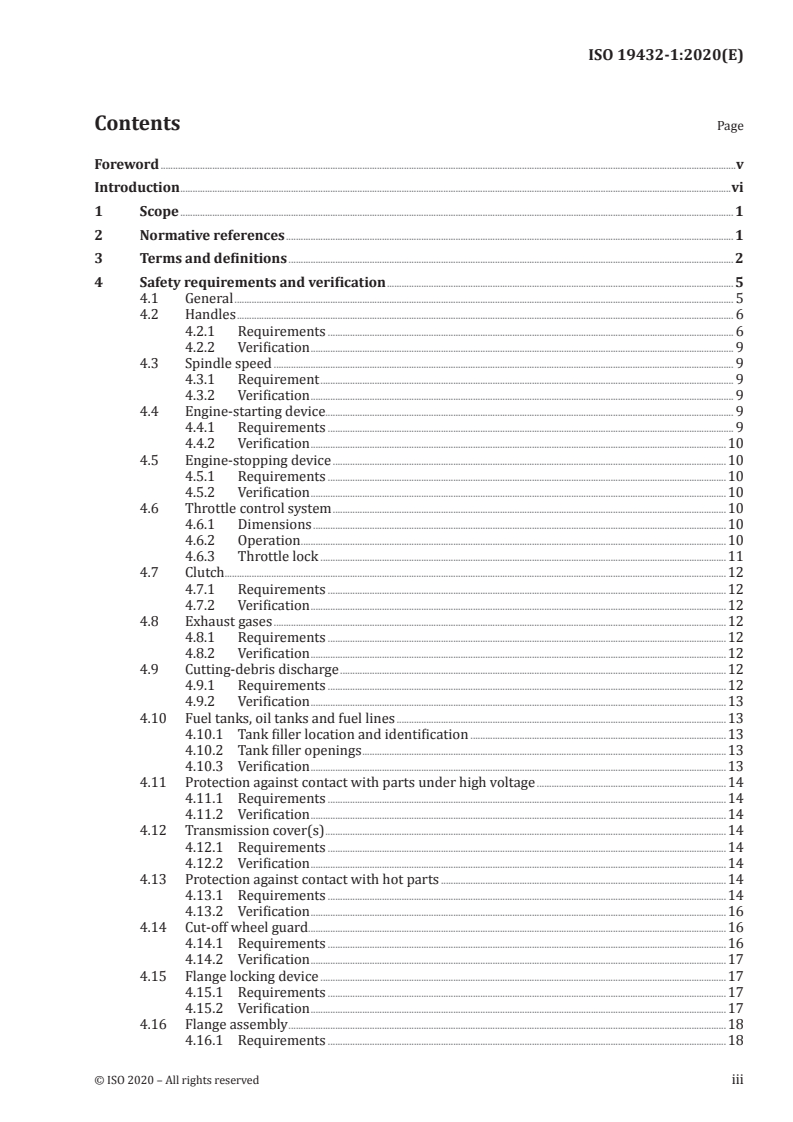
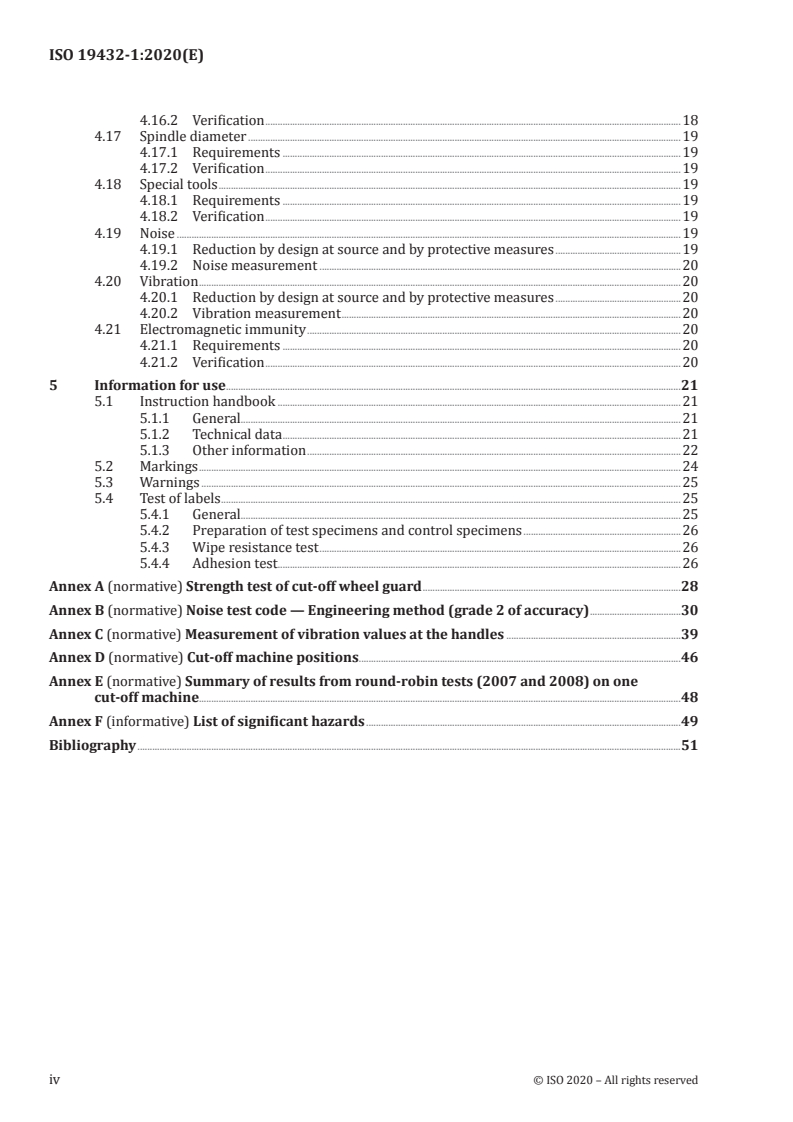
Contents Page
Foreword .v
Introduction .vi
1 Scope . 1
2 Normative references . 1
3 Terms and definitions . 2
4 Safety requirements and verification . 5
4.1 General . 5
4.2 Handles . 6
4.2.1 Requirements . 6
4.2.2 Verification . 9
4.3 Spindle speed . 9
4.3.1 Requirement . 9
4.3.2 Verification . 9
4.4 Engine-starting device . 9
4.4.1 Requirements . 9
4.4.2 Verification .10
4.5 Engine-stopping device .10
4.5.1 Requirements .10
4.5.2 Verification .10
4.6 Throttle control system .10
4.6.1 Dimensions .10
4.6.2 Operation .10
4.6.3 Throttle lock .11
4.7 Clutch.12
4.7.1 Requirements .12
4.7.2 Verification .12
4.8 Exhaust gases .12
4.8.1 Requirements .12
4.8.2 Verification .12
4.9 Cutting-debris discharge .12
4.9.1 Requirements .12
4.9.2 Verification .13
4.10 Fuel tanks, oil tanks and fuel lines .13
4.10.1 Tank filler location and identification .13
4.10.2 Tank filler openings .13
4.10.3 Verification .13
4.11 Protection against contact with parts under high voltage .14
4.11.1 Requirements .14
4.11.2 Verification .14
4.12 Transmission cover(s) .14
4.12.1 Requirements .14
4.12.2 Verification .14
4.13 Protection against contact with hot parts .14
4.13.1 Requirements .14
4.13.2 Verification .16
4.14 Cut-off wheel guard .16
4.14.1 Requirements .16
4.14.2 Verification .17
4.15 Flange locking device .17
4.15.1 Requirements .17
4.15.2 Verification .17
4.16 Flange assembly .18
4.16.1 Requirements .18
4.16.2 Verification .18
4.17 Spindle diameter .19
4.17.1 Requirements .19
4.17.2 Verification .19
4.18 Special tools .19
4.18.1 Requirements .19
4.18.2 Verification .19
4.19 Noise .19
4.19.1 Reduction by design at source and by protective measures .19
4.19.2 Noise measurement .20
4.20 Vibration .20
4.20.1 Reduction by design at source and by protective measures .20
4.20.2 Vibration measurement .20
4.21 Electromagnetic immunity .20
4.21.1 Requirements .20
4.21.2 Verification .20
5 Information for use .21
5.1 Instruction handbook .21
5.1.1 General.21
5.1.2 Technical data .21
5.1.3 Other information .22
5.2 Markings .24
5.3 Warnings .25
5.4 Test of labels .25
5.4.1 General.25
5.4.2 Preparation of test specimens and control specimens .26
5.4.3 Wipe resistance test .26
5.4.4 Adhesion test . . .26
Annex A (normative) Strength test of cut-off wheel guard .28
Annex B (normative) Noise test code — Engineering method (grade 2 of accuracy) .30
Annex C (normative) Measurement of vibration values at the handles .39
Annex D (normative) Cut-off machine positions .46
Annex E (normative) Summary of results from round-robin tests (2007 and 2008) on one
cut-off machine.48
Annex F (informative) List of significant hazards .49
Bibliography .51
iv © ISO 2020 – All rights reserved
Foreword
ISO (the International Organization for Standardization) is a worldwide federation of national standards
bodies (ISO member bodies). The work of preparing International Standards is normally carried out
through ISO technical committees. Each member body interested in a subject for which a technical
committee has been established has the right to be represented on that committee. International
organizations, governmental and non-governmental, in liaison with ISO, also take part in the work.
ISO collaborates closely with the International Electrotechnical Commission (IEC) on all matters of
electrotechnical standardization.
The procedures used to develop this document and those intended for its further maintenance are
described in the ISO/IEC Directives, Part 1. In particular, the different approval criteria needed for the
different types of ISO documents should be noted. This document was drafted in accordance with the
editorial rules of the ISO/IEC Directives, Part 2 (see www .iso .org/ directives).
Attention is drawn to the possibility that some of the elements of this document may be the subject of
patent rights. ISO shall not be held responsible for identifying any or all such patent rights. Details of
any patent rights identified during the development of the document will be in the Introduction and/or
on the ISO list of patent declarations received (see www .iso .org/ patents).
Any trade name used in this document is information given for the convenience of users and does not
constitute an endorsement.
For an explanation of the voluntary nature of standards, the meaning of ISO specific terms and
expressions related to conformity assessment, as well as information about ISO's adherence to the
World Trade Organization (WTO) principles in the Technical Barriers to Trade (TBT), see www .iso .org/
iso/ foreword .html.
This document was prepared by Technical Committee ISO/TC 195, Building construction machinery
and equipment, in collaboration with the European Committee for Standardization (CEN) Technical
Committee CEN/TC 151, Construction equipment and building material machines - Safety, in accordance
with the Agreement on technical cooperation between ISO and CEN (Vienna Agreement).
This first edition of ISO 19432-1 cancels and replaces ISO 19432:2012, which has been technically
revised.
The main changes compared to the previous edition are as follows:
— update of normative references;
— update/revision of terms and definitions;
— revision of handle requirements;
— update of figures;
— revision of requirements for fuel tanks, oil tanks and fuel lines;
— revision of Clause 5, information for use;
— revision of requirements for labels.
A list of all parts in the ISO 19432 series can be found on the ISO website.
Any feedback or questions on this document should be directed to the user’s national standards body. A
complete listing of these bodies can be found at www .iso .org/ members .html.
Introduction
This document is a type-C standard as stated in ISO 12100.
This document is of relevance, in particular, for the following stakeholder groups representing the
market players with regard to machinery safety:
— machine manufacturers (small, medium and large enterprises);
— health and safety bodies (regulators, accident prevention organisations, market surveillance etc.).
Others can be affected by the level of machinery safety achieved with the means of the document by the
above-mentioned stakeholder groups:
— machine users/employers (small, medium and large enterprises);
— machine users/employees (e.g. trade unions, organizations for people with special needs);
— service providers, e. g. for maintenance (small, medium and large enterprises);
— consumers (in case of machinery intended for use by consumers).
The above-mentioned stakeholder groups have been given the possibility to participate at the drafting
process of this document.
The machinery concerned and the extent to which hazards, hazardous situations or hazardous events
are covered are indicated in the Scope of this document.
When requirements of this type-C standard are different from those which are stated in type-A or
-B standards, the requirements of this type-C standard take precedence over the requirements of the
other standards for machines that have been designed and built according to the requirements of this
type-C standard.
vi © ISO 2020 – All rights reserved
INTERNATIONAL STANDARD ISO 19432-1:2020(E)
Building construction machinery and equipment —
Portable, hand-held, internal combustion engine-driven
abrasive cutting machines —
Part 1:
Safety requirements for cut-off machines for centre-
mounted rotating abrasive wheels
1 Scope
This document specifies safety requirements and measures for their verification for the design and
construction of portable, hand-held, internal combustion engine-driven cut-off machines intended to
be used by a single operator in the cutting of construction materials, such as asphalt, concrete, stone
and metal. It is applicable only to those machines designed purposely for use with a rotating, bonded-
abrasive and/or super-abrasive (for example diamond) cut-off wheel having a maximum outer diameter
of 430 mm, centre-mounted on and driven by a spindle shaft where the top of the wheel rotates away
from the operator (see Figure 1).
This document deals with all significant hazards, hazardous situations or hazardous events significant
to these machines when they are used as intended and under conditions of misuse which are reasonably
foreseeable by the manufacturer. See Annex F for a list of significant hazards.
This document specifies methods for the elimination or reduction of hazards arising from their use, as
well as the type of information on safe working practices to be provided with the machines.
Cut-off wheel specifications are not considered in this document. Cut-off wheels are deemed to comply
to existing cut-off wheel standards.
NOTE For example see Bibliography.
All through the document, portable, hand-held, internal combustion engine-driven cut-off machines are
called “cut-off machines”.
This document is not applicable to machines manufactured before the date of its publication.
2 Normative references
The following documents are referred to in the text in such a way that some or all of their content
constitutes requirements of this document. For dated references, only the edition cited applies. For
undated references, the latest edition of the referenced document (including any amendments) applies.
ISO 3744:2010, Acoustics — Determination of sound power levels and sound energy levels of noise sources
using sound pressure — Engineering methods for an essentially free field over a reflecting plane
ISO 4871:1996, Acoustics — Declaration and verification of noise emission values of machinery and
equipment
ISO 5349-2:2001, Mechanical vibration — Measurement and evaluation of human exposure to hand-
transmitted vibration — Part 2: Practical guidance for measurement at the workplace
ISO 7293:1997, Forestry machinery — Portable chain saws — Engine performance and fuel consumption
ISO 8041-1:2017, Human response to vibration — Measuring instrumentation — Part 1: General purpose
vibration meters
ISO 11201:2010, Acoustics — Noise emitted by machinery and equipment — Determination of emission
sound pressure levels at a work station and at other specified positions in an essentially free field over a
reflecting plane with negligible environmental corrections
ISO 12100:2010, Safety of machinery — General principles for design — Risk assessment and risk reduction
ISO 13857:2008, Safety of machinery — Safety distances to prevent hazard zones being reached by upper
and lower limbs
ISO 14982:1998, Agricultural and forestry machinery — Electromagnetic compatibility — Test methods
and acceptance criteria
ISO 16063-1:1998, Methods for the calibration of vibration and shock transducers — Part 1: Basic concepts
ISO 20643:2005, Mechanical vibration — Hand-held and hand-guided machinery — Principles for
evaluation of vibration emission
IEC 60745-1:2006, Hand-held motor-operated electric tools — Safety — Part 1: General requirements
IEC 61672-1:2013, Electroacoustics — Sound level meters — Part 1: Specifications
3 Terms and definitions
For the purposes of this document, the terms and definitions given in ISO 12100, ISO 20643 and the
following apply.
ISO and IEC maintain terminological databases for use in standardization at the following addresses:
— ISO Online browsing platform: available at http:// www .iso .org/ obp;
— IEC Electropedia: available at http:// www .electropedia .org/ .
3.1
cut-off wheel
wheel designed to be fitted to a hand-held portable cut-off machine and whose peripheral edge cuts
material such as asphalt, concrete, stone and metal
3.1.1
bonded-abrasive wheel
cut-off wheel (3.1) entirely made of abrasive particles bonded together with synthetic resin and
reinforced with glass fibre matting
3.1.2
superabrasive wheel
cut-off wheel (3.1) with diamond grains set into segments secured around the circumference of a steel
core disc (the wheel body)
3.2
arbor hole
centre hole of the cut-off wheel (3.1) used for mounting the cut-off wheel on the machine spindle (3.19)
3.3
blotter
washer made from compressible material (e.g. paper, card or similar), attached to each side of the cut-
off wheel (3.1)
Note 1 to entry: The function of the blotter is to smooth imperfections in the cut-off wheel and to allow a limited
degree of slip when the wheel stalls in use.
2 © ISO 2020 – All rights reserved
3.4
clutch
device for connecting and disconnecting the driven member to and from a rotating source of power
3.5
cut-off wheel guard
partial enclosure intended to deflect cutting debris as well as pieces of the cut-off wheel (3.1) in the
event that the wheel is broken in operation and to reduce the risk of unintentional contact with the cut-
off wheel
3.6
engine-stopping device
device by which the stopping of the engine is initiated
3.7
flange contact surface
area between the inner and outer circumference on the flange which forms the contact surface between
the flange and the cut-off wheel (3.1)
3.8
flange assembly
device provided to clamp and drive the cut-off wheel (3.1)
3.9
handle
device designed to facilitate safe and easy control of the machine
3.9.1
front handle
handle (3.9) located at or towards the front of the engine housing
3.9.2
rear handle
handle (3.9) located at or towards the rear of the engine housing
3.10
idle speed
speed at which the engine runs with no load and throttle trigger (3.21) released and the cut-off wheel
(3.1) does not rotate
3.11
reactive force
force generated in a direction opposite to that in which the wheel is moving at the point of contact
when the spinning cut-off wheel (3.1) is slowed or stopped by frictional contact with any solid object,
including the workpiece, or when it is pinched or bound in the cut
Note 1 to entry: 3.11.1, 3.11.2, and 3.11.3, which further describe these reactions, are based on an abrasive cut-off
wheel rotation with the top of the wheel rotating away from the operator.
3.11.1
rotational force
kickback
attempt of the wheel to move back and up towards the operator when the spinning cut-off wheel (3.1)
is slowed or stopped by frictional contact with any solid object in its upper quadrant, so that if it is
abruptly slowed or stopped by a pinch or binding in the upper quadrant, the wheel can be thrown back
and up towards the operator in a rotational kickback motion
3.11.2
climbing
attempt of the wheel to climb the object being cut when the spinning cut-off wheel (3.1) is slowed or
stopped by frictional contact with any solid object or by a pinch or binding at the front of the wheel
3.11.3
pulling
pull-away
attempt of the wheel to pull away from the operator when the spinning cut-off wheel (3.1) is slowed or
stopped by frictional contact with any solid object or by a pinch or binding at the bottom of the wheel
3.12
gyroscopic force
force caused by the rapid spinning of the cut-off wheel (3.1) that results in opposition to a directional
change of the cut-off machine
3.13
reducing bushing
insert or device used to reduce the hole size in a grinding wheel so that it can be mounted on a smaller
diameter spindle (3.19)
3.14
maximum depth of cut
t
distance to which the cut-off wheel (3.1) can enter the workpiece as measured from the outer diameter
of the wheel to the outside diameter of the flange
3.15
maximum cut-off wheel speed
maximum permitted speed of a new cut-off wheel (3.1) marked on the cut-off wheel
3.16
maximum spindle speed
maximum speed at which the spindle (3.19) rotates with a fully open throttle and no load
3.17
muffler
device for reducing engine exhaust noise and directing the exhaust gases
3.18
rated engine speed
rated speed
engine speed at which maximum power occurs as determined by the manufacturer
3.19
spindle
shaft of the cut-off machine which supports, retains and drives the cut-off wheel (3.1) in connection
with the flanges
3.20
spindle sleeve
device used to increase the spindle (3.19) shaft diameter at the contact area of the abrasive wheel for
mounting an abrasive wheel with a larger diameter arbor hole (3.2)
3.21
throttle trigger
device for controlling the engine speed
3.22
throttle lock
device for setting the throttle in a partially open position to aid starting
3.23
throttle trigger lock-out
device that prevents the unintentional operation of the throttle trigger (3.21) until manually released
4 © ISO 2020 – All rights reserved
3.24
throttle control linkage
mechanism which transmits motion from the throttle trigger (3.21) to the throttle control valve
3.25
transmission cover
device between the engine and the cutting equipment designed to prevent unintentional contact with
the transmission
Key
1 rear handle (3.9.2) 8 front handle (3.9.1)
2 throttle trigger (3.21) 9 cut-off wheel guard (3.5)
3 throttle trigger lock-out (3.23) 10 cut-off wheel (3.1)
4 engine stopping device 11 flange assembly (3.8)
5 fuel tank/fuel tank cap 12 spindle
6 starter 13 foot/standing base
7 muffler (3.17)
Figure 1 — Example of a cut-off machine
4 Safety requirements and verification
4.1 General
Machinery shall comply with the safety requirements and/or protective measures of this clause. In
addition, the machine shall be designed according to the principles of ISO 12100 for relevant but not
significant hazards which are not dealt with by this document.
The safe operation of cut-off machines depends on both complying with the safety requirements of this
clause and using safe working practices. The use of appropriate personal protection equipment (PPE),
such as gloves, leg protection, boots, eye, hearing, dust protection mask and head protection equipment,
are an integral part of safe working practices (see 5.1).
Cut-off machines shall be marked in accordance with 5.2. Cut-off machines shall carry warnings in
accordance with 5.3.
An instruction handbook shall be provided with the machine and shall comply with the
requirements of 5.1.
For protection from contact with moving parts, except the cut-off wheel, any opening shall have a safety
distance to the moving part that meets the requirements of ISO 13857:2008, 4.2.4.1 and 4.2.4.3.
When the machine is placed in its normal resting position (see Figure 2) on a flat horizontal surface, the
cut-off wheel or the guard shall not touch the horizontal surface and the machine shall remain stable.
The requirements for the normal resting position shall be verified by inspection.
Figure 2 — Example of cut-off machine placed in a normal position on a flat surface
A method of verification is established for each requirement in the following clauses.
WARNING — Some of the tests specified in this document involve processes that could lead to a
hazardous situation. Any person performing tests in accordance with this document should be
appropriately trained in the type of work to be carried out. All national regulatory conditions
and health and safety requirements shall be taken into consideration.
4.2 Handles
4.2.1 Requirements
Cut-off machines shall have a handle for each hand. These handles shall be designed so that they
— can be fully gripped by an operator when wearing protective gloves;
— provide the necessary sureness of grip by their shape and surface; and
— conform to the dimensions and clearances according to Table 1.
Cut-off machines with a system to isolate the machine vibration from the handles shall be designed so
that the operator is able to stop the engine in a controlled manner with the engine-stopping device,
even in the event of partial or full failure of the vibration isolators.
Table 1 — Handle requirements
Handles Description Dimension Figure Minimum size
Front Finger clearance in the grip area A 3 35 mm
Front and rear Perimeter of the cross-section of the handle H 4 65 mm
Distance from the rear side of the throttle trigger D 3 225 mm
to the centre of the front handle at the top
a
Rear Finger clearance at the released throttle trigger E 5 30 mm
Clearance below the released throttle trigger F 6 25 mm
b
Clearance behind the released throttle trigger G 7 25 mm × 3
a
The dimensions shall be gauged free of play, i.e. with a slight initial pressure on the throttle trigger.
b
3 represents the number of circles.
6 © ISO 2020 – All rights reserved
NOTE Refer to Table 1 for the A and D dimensions.
Figure 3 — Clearance and distance between front and rear handles for rear handle machines
NOTE Refer to Table 1 for the H dimension.
Figure 4 — Perimeter of handles cross section
Dimensions in millimetres
Key
1 pivot point 3 contact point
2 throttle trigger 4 intersection point
NOTE Refer to Table 1 for the E dimension.
Figure 5 — Finger clearance at released throttle trigger
The conformity of the E dimension shall be verified as follows:
— step 1: put gauge E to the uppermost position between housing and throttle trigger;
— step 2: define contact point with throttle trigger;
— step 3: connect a line between the centre of the gauge and the contact point and extend into the
direction of the throttle trigger;
— step 4: add a perpendicular line to this line which intersects the pivot point of the throttle trigger.
NOTE Refer to Table 1 for the F dimension.
Figure 6 — Finger clearance below the released throttle trigger
8 © ISO 2020 – All rights reserved
Key
1 throttle trigger
α = ±15°
NOTE 1 Angle α shows the maximum allowed deviation of the lower outline of the handle grip.
NOTE 2 Refer to Table 1 for the G dimension.
Figure 7 — Finger clearance at released throttle trigger
4.2.2 Verification
Dimensions shall be verified by measurements. The ability to control the machine if a failure occurs in
the vibration isolators shall be verified by inspection of the design and function test with a simulated
failure.
4.3 Spindle speed
4.3.1 Requirement
Engine speed shall be limited so that it is not possible to accelerate the engine beyond the specified
maximum spindle speed (see 5.1).
4.3.2 Verification
The spindle speed shall be measured at the spindle with fully open throttle and no load. The maximum
allowed inaccuracy is 5 r/min.
Simple calculations using the engine speed and the transmission ratio cannot be permitted due to the
potential for slippage in the energy transmission from the engine to the shaft.
4.4 Engine-starting device
4.4.1 Requirements
The engine-starting device shall be an electric starter or a manual starter. The actuator for the manual
starter shall be permanently attached to the machine.
The cut-off machine with a manual starter shall have a recoil device for the rope.
To activate the electrical starting device, two or more separate and dissimilar actions shall be required.
This also applies to manual starting devices with stored energy.
4.4.2 Verification
The means to start the cut-off machine shall be verified by inspection and a functional test.
4.5 Engine-stopping device
4.5.1 Requirements
The machine shall be fitted with an engine-stopping device by which the engine can be brought to
a final stop and which does not depend on sustained manual effort for its operation. The control for
this device shall be so positioned that it can be operated by the operator's hand while holding the rear
handle and wearing protective gloves.
The colour of the control shall contrast clearly with the background of the engine-stopping device.
4.5.2 Verification
Correct operation and location of the engine-stopping device shall be verified by inspection and
functional test while the machine is being operated. The colour of the engine-stopping device shall be
verified by inspection.
4.6 Throttle control system
4.6.1 Dimensions
4.6.1.1 Requirements
The throttle trigger shall be positioned so that it can be pressed and released with a gloved hand while
holding the rear handle by fulfilling the dimensional requirements for clearance around and behind the
throttle trigger, as shown in Table 1 and Figures 5, 6, 7.
4.6.1.2 Verification
The dimensions shall be verified by measurement.
4.6.2 Operation
4.6.2.1 Requirements
The cut-off machine shall be provided with a throttle trigger that, when released, automatically reverts
to the idling position unless a throttle lock to aid starting is engaged (see 4.6.3). The throttle trigger
shall be retained in the idling position by the automatic engagement of a throttle trigger lock-out.
After the starting procedure has finished, activation of the throttle trigger, to increase the engine speed
to a point where the cut-off wheel starts to move, shall only be possible after the throttle trigger lock-
out has been disengaged.
The starting procedure is finished when the operator disengages the throttle lock and the engine
returns to idling speed.
Unintentional movement of the cut-off wheel shall be minimized by a throttle control linkage, so
designed that a force applied to the rear handle with the throttle trigger lock-out engaged will not
increase the engine speed to a point where the clutch engages and cut-off wheel movement begins.
10 © ISO 2020 – All rights reserved
4.6.2.2 Verification
The function of the throttle trigger and throttle trigger lock-out shall be verified by inspection while
operating the machine. The throttle control linkage design shall be verified by applying a force in any
direction related to the plane of the cut-off wheel, on the centre of the rear handle grip and with the
machine body secured. The force shall be equal to three times the weight of the cut-off machine unit
with empty tanks, without accessories and without the cut-off wheel.
4.6.3 Throttle lock
4.6.3.1 Requirement
If a throttle lock is provided to aid starting and its engagement will result in a movement of the cut-off
wheel during starting, it shall be such that it has to be engaged manually and shall be automatically
released when the throttle trigger is operated. Releasing the throttle lock, both with and without
operation of the throttle trigger lock-out, is acceptable.
To prevent risk of unintentional operation, the throttle lock shall be located outside the gripping area of
the handle and require at least two independent motions to engage the throttle lock.
The gripping area of the handle is defined to extend from 25 mm in front of the rear part of the throttle
trigger to 75 mm behind the rear part of the throttle trigger (see Figure 8).
The operational force on the throttle trigger for releasing the throttle lock shall not exceed 25 N.
Dimensions in millimetres
Key
1 rear handle
2 throttle trigger
3 intersection between rear handle and throttle trigger
4 gripping area
Figure 8 — Handle gripping area
4.6.3.2 Verification
The function of the throttle lock shall be verified by inspection and measurement. The force to release
the throttle lock shall be applied within 1 s and measured (5 ± 1) mm in front of the rear part of the
throttle trigger and in the direction of the trigger movement (perpendicular to the rotation radius of
the trigger).
4.7 Clutch
4.7.1 Requirements
The cut-off machine shall have a clutch so designed that the cut-off wheel does not move when the
engine rotates at any speed less than 1,25 times the idling speed.
4.7.2 Verification
The function of the clutch shall be verified by running the engine with any speed up to 1,25 times the
idling speed. If a range is specified in the instruction handbook, the verification shall be done based on
the highest idling speed.
4.8 Exhaust gases
4.8.1 Requirements
The exhaust outlet shall be designed so that the exhaust gases are directed away from the operator
when the machine is held in a typical cutting position, as shown in Figure 9.
Key
1 wheel plane
Figure 9 — Example of cut-off machine held in typical cutting position
4.8.2 Verification
The location and direction of the exhaust outlet shall be verified by inspection and functional test
during operation of the cut-off machine.
4.9 Cutting-debris discharge
4.9.1 Requirements
The cut-off machine shall be designed so that the main stream of cutting debris from the cut-off wheel
is directed away from the operator’s face or upper body when holding the
...
INTERNATIONAL ISO
STANDARD 19432-1
First edition
2020-01
Building construction machinery and
equipment — Portable, hand-held,
internal combustion engine-driven
abrasive cutting machines —
Part 1:
Safety requirements for cut-off
machines for centre-mounted rotating
abrasive wheels
Machines et matériels pour la construction des bâtiments — Machines
de coupe par abrasion, portatives, à moteur à combustion interne —
Partie 1: Exigences de sécurité des tronçonneuses à disque abrasif
monté au centre
Reference number
©
ISO 2020
© ISO 2020
All rights reserved. Unless otherwise specified, or required in the context of its implementation, no part of this publication may
be reproduced or utilized otherwise in any form or by any means, electronic or mechanical, including photocopying, or posting
on the internet or an intranet, without prior written permission. Permission can be requested from either ISO at the address
below or ISO’s member body in the country of the requester.
ISO copyright office
CP 401 • Ch. de Blandonnet 8
CH-1214 Vernier, Geneva
Phone: +41 22 749 01 11
Fax: +41 22 749 09 47
Email: copyright@iso.org
Website: www.iso.org
Published in Switzerland
ii © ISO 2020 – All rights reserved
Contents Page
Foreword .v
Introduction .vi
1 Scope . 1
2 Normative references . 1
3 Terms and definitions . 2
4 Safety requirements and verification . 5
4.1 General . 5
4.2 Handles . 6
4.2.1 Requirements . 6
4.2.2 Verification . 9
4.3 Spindle speed . 9
4.3.1 Requirement . 9
4.3.2 Verification . 9
4.4 Engine-starting device . 9
4.4.1 Requirements . 9
4.4.2 Verification .10
4.5 Engine-stopping device .10
4.5.1 Requirements .10
4.5.2 Verification .10
4.6 Throttle control system .10
4.6.1 Dimensions .10
4.6.2 Operation .10
4.6.3 Throttle lock .11
4.7 Clutch.12
4.7.1 Requirements .12
4.7.2 Verification .12
4.8 Exhaust gases .12
4.8.1 Requirements .12
4.8.2 Verification .12
4.9 Cutting-debris discharge .12
4.9.1 Requirements .12
4.9.2 Verification .13
4.10 Fuel tanks, oil tanks and fuel lines .13
4.10.1 Tank filler location and identification .13
4.10.2 Tank filler openings .13
4.10.3 Verification .13
4.11 Protection against contact with parts under high voltage .14
4.11.1 Requirements .14
4.11.2 Verification .14
4.12 Transmission cover(s) .14
4.12.1 Requirements .14
4.12.2 Verification .14
4.13 Protection against contact with hot parts .14
4.13.1 Requirements .14
4.13.2 Verification .16
4.14 Cut-off wheel guard .16
4.14.1 Requirements .16
4.14.2 Verification .17
4.15 Flange locking device .17
4.15.1 Requirements .17
4.15.2 Verification .17
4.16 Flange assembly .18
4.16.1 Requirements .18
4.16.2 Verification .18
4.17 Spindle diameter .19
4.17.1 Requirements .19
4.17.2 Verification .19
4.18 Special tools .19
4.18.1 Requirements .19
4.18.2 Verification .19
4.19 Noise .19
4.19.1 Reduction by design at source and by protective measures .19
4.19.2 Noise measurement .20
4.20 Vibration .20
4.20.1 Reduction by design at source and by protective measures .20
4.20.2 Vibration measurement .20
4.21 Electromagnetic immunity .20
4.21.1 Requirements .20
4.21.2 Verification .20
5 Information for use .21
5.1 Instruction handbook .21
5.1.1 General.21
5.1.2 Technical data .21
5.1.3 Other information .22
5.2 Markings .24
5.3 Warnings .25
5.4 Test of labels .25
5.4.1 General.25
5.4.2 Preparation of test specimens and control specimens .26
5.4.3 Wipe resistance test .26
5.4.4 Adhesion test . . .26
Annex A (normative) Strength test of cut-off wheel guard .28
Annex B (normative) Noise test code — Engineering method (grade 2 of accuracy) .30
Annex C (normative) Measurement of vibration values at the handles .39
Annex D (normative) Cut-off machine positions .46
Annex E (normative) Summary of results from round-robin tests (2007 and 2008) on one
cut-off machine.48
Annex F (informative) List of significant hazards .49
Bibliography .51
iv © ISO 2020 – All rights reserved
Foreword
ISO (the International Organization for Standardization) is a worldwide federation of national standards
bodies (ISO member bodies). The work of preparing International Standards is normally carried out
through ISO technical committees. Each member body interested in a subject for which a technical
committee has been established has the right to be represented on that committee. International
organizations, governmental and non-governmental, in liaison with ISO, also take part in the work.
ISO collaborates closely with the International Electrotechnical Commission (IEC) on all matters of
electrotechnical standardization.
The procedures used to develop this document and those intended for its further maintenance are
described in the ISO/IEC Directives, Part 1. In particular, the different approval criteria needed for the
different types of ISO documents should be noted. This document was drafted in accordance with the
editorial rules of the ISO/IEC Directives, Part 2 (see www .iso .org/ directives).
Attention is drawn to the possibility that some of the elements of this document may be the subject of
patent rights. ISO shall not be held responsible for identifying any or all such patent rights. Details of
any patent rights identified during the development of the document will be in the Introduction and/or
on the ISO list of patent declarations received (see www .iso .org/ patents).
Any trade name used in this document is information given for the convenience of users and does not
constitute an endorsement.
For an explanation of the voluntary nature of standards, the meaning of ISO specific terms and
expressions related to conformity assessment, as well as information about ISO's adherence to the
World Trade Organization (WTO) principles in the Technical Barriers to Trade (TBT), see www .iso .org/
iso/ foreword .html.
This document was prepared by Technical Committee ISO/TC 195, Building construction machinery
and equipment, in collaboration with the European Committee for Standardization (CEN) Technical
Committee CEN/TC 151, Construction equipment and building material machines - Safety, in accordance
with the Agreement on technical cooperation between ISO and CEN (Vienna Agreement).
This first edition of ISO 19432-1 cancels and replaces ISO 19432:2012, which has been technically
revised.
The main changes compared to the previous edition are as follows:
— update of normative references;
— update/revision of terms and definitions;
— revision of handle requirements;
— update of figures;
— revision of requirements for fuel tanks, oil tanks and fuel lines;
— revision of Clause 5, information for use;
— revision of requirements for labels.
A list of all parts in the ISO 19432 series can be found on the ISO website.
Any feedback or questions on this document should be directed to the user’s national standards body. A
complete listing of these bodies can be found at www .iso .org/ members .html.
Introduction
This document is a type-C standard as stated in ISO 12100.
This document is of relevance, in particular, for the following stakeholder groups representing the
market players with regard to machinery safety:
— machine manufacturers (small, medium and large enterprises);
— health and safety bodies (regulators, accident prevention organisations, market surveillance etc.).
Others can be affected by the level of machinery safety achieved with the means of the document by the
above-mentioned stakeholder groups:
— machine users/employers (small, medium and large enterprises);
— machine users/employees (e.g. trade unions, organizations for people with special needs);
— service providers, e. g. for maintenance (small, medium and large enterprises);
— consumers (in case of machinery intended for use by consumers).
The above-mentioned stakeholder groups have been given the possibility to participate at the drafting
process of this document.
The machinery concerned and the extent to which hazards, hazardous situations or hazardous events
are covered are indicated in the Scope of this document.
When requirements of this type-C standard are different from those which are stated in type-A or
-B standards, the requirements of this type-C standard take precedence over the requirements of the
other standards for machines that have been designed and built according to the requirements of this
type-C standard.
vi © ISO 2020 – All rights reserved
INTERNATIONAL STANDARD ISO 19432-1:2020(E)
Building construction machinery and equipment —
Portable, hand-held, internal combustion engine-driven
abrasive cutting machines —
Part 1:
Safety requirements for cut-off machines for centre-
mounted rotating abrasive wheels
1 Scope
This document specifies safety requirements and measures for their verification for the design and
construction of portable, hand-held, internal combustion engine-driven cut-off machines intended to
be used by a single operator in the cutting of construction materials, such as asphalt, concrete, stone
and metal. It is applicable only to those machines designed purposely for use with a rotating, bonded-
abrasive and/or super-abrasive (for example diamond) cut-off wheel having a maximum outer diameter
of 430 mm, centre-mounted on and driven by a spindle shaft where the top of the wheel rotates away
from the operator (see Figure 1).
This document deals with all significant hazards, hazardous situations or hazardous events significant
to these machines when they are used as intended and under conditions of misuse which are reasonably
foreseeable by the manufacturer. See Annex F for a list of significant hazards.
This document specifies methods for the elimination or reduction of hazards arising from their use, as
well as the type of information on safe working practices to be provided with the machines.
Cut-off wheel specifications are not considered in this document. Cut-off wheels are deemed to comply
to existing cut-off wheel standards.
NOTE For example see Bibliography.
All through the document, portable, hand-held, internal combustion engine-driven cut-off machines are
called “cut-off machines”.
This document is not applicable to machines manufactured before the date of its publication.
2 Normative references
The following documents are referred to in the text in such a way that some or all of their content
constitutes requirements of this document. For dated references, only the edition cited applies. For
undated references, the latest edition of the referenced document (including any amendments) applies.
ISO 3744:2010, Acoustics — Determination of sound power levels and sound energy levels of noise sources
using sound pressure — Engineering methods for an essentially free field over a reflecting plane
ISO 4871:1996, Acoustics — Declaration and verification of noise emission values of machinery and
equipment
ISO 5349-2:2001, Mechanical vibration — Measurement and evaluation of human exposure to hand-
transmitted vibration — Part 2: Practical guidance for measurement at the workplace
ISO 7293:1997, Forestry machinery — Portable chain saws — Engine performance and fuel consumption
ISO 8041-1:2017, Human response to vibration — Measuring instrumentation — Part 1: General purpose
vibration meters
ISO 11201:2010, Acoustics — Noise emitted by machinery and equipment — Determination of emission
sound pressure levels at a work station and at other specified positions in an essentially free field over a
reflecting plane with negligible environmental corrections
ISO 12100:2010, Safety of machinery — General principles for design — Risk assessment and risk reduction
ISO 13857:2008, Safety of machinery — Safety distances to prevent hazard zones being reached by upper
and lower limbs
ISO 14982:1998, Agricultural and forestry machinery — Electromagnetic compatibility — Test methods
and acceptance criteria
ISO 16063-1:1998, Methods for the calibration of vibration and shock transducers — Part 1: Basic concepts
ISO 20643:2005, Mechanical vibration — Hand-held and hand-guided machinery — Principles for
evaluation of vibration emission
IEC 60745-1:2006, Hand-held motor-operated electric tools — Safety — Part 1: General requirements
IEC 61672-1:2013, Electroacoustics — Sound level meters — Part 1: Specifications
3 Terms and definitions
For the purposes of this document, the terms and definitions given in ISO 12100, ISO 20643 and the
following apply.
ISO and IEC maintain terminological databases for use in standardization at the following addresses:
— ISO Online browsing platform: available at http:// www .iso .org/ obp;
— IEC Electropedia: available at http:// www .electropedia .org/ .
3.1
cut-off wheel
wheel designed to be fitted to a hand-held portable cut-off machine and whose peripheral edge cuts
material such as asphalt, concrete, stone and metal
3.1.1
bonded-abrasive wheel
cut-off wheel (3.1) entirely made of abrasive particles bonded together with synthetic resin and
reinforced with glass fibre matting
3.1.2
superabrasive wheel
cut-off wheel (3.1) with diamond grains set into segments secured around the circumference of a steel
core disc (the wheel body)
3.2
arbor hole
centre hole of the cut-off wheel (3.1) used for mounting the cut-off wheel on the machine spindle (3.19)
3.3
blotter
washer made from compressible material (e.g. paper, card or similar), attached to each side of the cut-
off wheel (3.1)
Note 1 to entry: The function of the blotter is to smooth imperfections in the cut-off wheel and to allow a limited
degree of slip when the wheel stalls in use.
2 © ISO 2020 – All rights reserved
3.4
clutch
device for connecting and disconnecting the driven member to and from a rotating source of power
3.5
cut-off wheel guard
partial enclosure intended to deflect cutting debris as well as pieces of the cut-off wheel (3.1) in the
event that the wheel is broken in operation and to reduce the risk of unintentional contact with the cut-
off wheel
3.6
engine-stopping device
device by which the stopping of the engine is initiated
3.7
flange contact surface
area between the inner and outer circumference on the flange which forms the contact surface between
the flange and the cut-off wheel (3.1)
3.8
flange assembly
device provided to clamp and drive the cut-off wheel (3.1)
3.9
handle
device designed to facilitate safe and easy control of the machine
3.9.1
front handle
handle (3.9) located at or towards the front of the engine housing
3.9.2
rear handle
handle (3.9) located at or towards the rear of the engine housing
3.10
idle speed
speed at which the engine runs with no load and throttle trigger (3.21) released and the cut-off wheel
(3.1) does not rotate
3.11
reactive force
force generated in a direction opposite to that in which the wheel is moving at the point of contact
when the spinning cut-off wheel (3.1) is slowed or stopped by frictional contact with any solid object,
including the workpiece, or when it is pinched or bound in the cut
Note 1 to entry: 3.11.1, 3.11.2, and 3.11.3, which further describe these reactions, are based on an abrasive cut-off
wheel rotation with the top of the wheel rotating away from the operator.
3.11.1
rotational force
kickback
attempt of the wheel to move back and up towards the operator when the spinning cut-off wheel (3.1)
is slowed or stopped by frictional contact with any solid object in its upper quadrant, so that if it is
abruptly slowed or stopped by a pinch or binding in the upper quadrant, the wheel can be thrown back
and up towards the operator in a rotational kickback motion
3.11.2
climbing
attempt of the wheel to climb the object being cut when the spinning cut-off wheel (3.1) is slowed or
stopped by frictional contact with any solid object or by a pinch or binding at the front of the wheel
3.11.3
pulling
pull-away
attempt of the wheel to pull away from the operator when the spinning cut-off wheel (3.1) is slowed or
stopped by frictional contact with any solid object or by a pinch or binding at the bottom of the wheel
3.12
gyroscopic force
force caused by the rapid spinning of the cut-off wheel (3.1) that results in opposition to a directional
change of the cut-off machine
3.13
reducing bushing
insert or device used to reduce the hole size in a grinding wheel so that it can be mounted on a smaller
diameter spindle (3.19)
3.14
maximum depth of cut
t
distance to which the cut-off wheel (3.1) can enter the workpiece as measured from the outer diameter
of the wheel to the outside diameter of the flange
3.15
maximum cut-off wheel speed
maximum permitted speed of a new cut-off wheel (3.1) marked on the cut-off wheel
3.16
maximum spindle speed
maximum speed at which the spindle (3.19) rotates with a fully open throttle and no load
3.17
muffler
device for reducing engine exhaust noise and directing the exhaust gases
3.18
rated engine speed
rated speed
engine speed at which maximum power occurs as determined by the manufacturer
3.19
spindle
shaft of the cut-off machine which supports, retains and drives the cut-off wheel (3.1) in connection
with the flanges
3.20
spindle sleeve
device used to increase the spindle (3.19) shaft diameter at the contact area of the abrasive wheel for
mounting an abrasive wheel with a larger diameter arbor hole (3.2)
3.21
throttle trigger
device for controlling the engine speed
3.22
throttle lock
device for setting the throttle in a partially open position to aid starting
3.23
throttle trigger lock-out
device that prevents the unintentional operation of the throttle trigger (3.21) until manually released
4 © ISO 2020 – All rights reserved
3.24
throttle control linkage
mechanism which transmits motion from the throttle trigger (3.21) to the throttle control valve
3.25
transmission cover
device between the engine and the cutting equipment designed to prevent unintentional contact with
the transmission
Key
1 rear handle (3.9.2) 8 front handle (3.9.1)
2 throttle trigger (3.21) 9 cut-off wheel guard (3.5)
3 throttle trigger lock-out (3.23) 10 cut-off wheel (3.1)
4 engine stopping device 11 flange assembly (3.8)
5 fuel tank/fuel tank cap 12 spindle
6 starter 13 foot/standing base
7 muffler (3.17)
Figure 1 — Example of a cut-off machine
4 Safety requirements and verification
4.1 General
Machinery shall comply with the safety requirements and/or protective measures of this clause. In
addition, the machine shall be designed according to the principles of ISO 12100 for relevant but not
significant hazards which are not dealt with by this document.
The safe operation of cut-off machines depends on both complying with the safety requirements of this
clause and using safe working practices. The use of appropriate personal protection equipment (PPE),
such as gloves, leg protection, boots, eye, hearing, dust protection mask and head protection equipment,
are an integral part of safe working practices (see 5.1).
Cut-off machines shall be marked in accordance with 5.2. Cut-off machines shall carry warnings in
accordance with 5.3.
An instruction handbook shall be provided with the machine and shall comply with the
requirements of 5.1.
For protection from contact with moving parts, except the cut-off wheel, any opening shall have a safety
distance to the moving part that meets the requirements of ISO 13857:2008, 4.2.4.1 and 4.2.4.3.
When the machine is placed in its normal resting position (see Figure 2) on a flat horizontal surface, the
cut-off wheel or the guard shall not touch the horizontal surface and the machine shall remain stable.
The requirements for the normal resting position shall be verified by inspection.
Figure 2 — Example of cut-off machine placed in a normal position on a flat surface
A method of verification is established for each requirement in the following clauses.
WARNING — Some of the tests specified in this document involve processes that could lead to a
hazardous situation. Any person performing tests in accordance with this document should be
appropriately trained in the type of work to be carried out. All national regulatory conditions
and health and safety requirements shall be taken into consideration.
4.2 Handles
4.2.1 Requirements
Cut-off machines shall have a handle for each hand. These handles shall be designed so that they
— can be fully gripped by an operator when wearing protective gloves;
— provide the necessary sureness of grip by their shape and surface; and
— conform to the dimensions and clearances according to Table 1.
Cut-off machines with a system to isolate the machine vibration from the handles shall be designed so
that the operator is able to stop the engine in a controlled manner with the engine-stopping device,
even in the event of partial or full failure of the vibration isolators.
Table 1 — Handle requirements
Handles Description Dimension Figure Minimum size
Front Finger clearance in the grip area A 3 35 mm
Front and rear Perimeter of the cross-section of the handle H 4 65 mm
Distance from the rear side of the throttle trigger D 3 225 mm
to the centre of the front handle at the top
a
Rear Finger clearance at the released throttle trigger E 5 30 mm
Clearance below the released throttle trigger F 6 25 mm
b
Clearance behind the released throttle trigger G 7 25 mm × 3
a
The dimensions shall be gauged free of play, i.e. with a slight initial pressure on the throttle trigger.
b
3 represents the number of circles.
6 © ISO 2020 – All rights reserved
NOTE Refer to Table 1 for the A and D dimensions.
Figure 3 — Clearance and distance between front and rear handles for rear handle machines
NOTE Refer to Table 1 for the H dimension.
Figure 4 — Perimeter of handles cross section
Dimensions in millimetres
Key
1 pivot point 3 contact point
2 throttle trigger 4 intersection point
NOTE Refer to Table 1 for the E dimension.
Figure 5 — Finger clearance at released throttle trigger
The conformity of the E dimension shall be verified as follows:
— step 1: put gauge E to the uppermost position between housing and throttle trigger;
— step 2: define contact point with throttle trigger;
— step 3: connect a line between the centre of the gauge and the contact point and extend into the
direction of the throttle trigger;
— step 4: add a perpendicular line to this line which intersects the pivot point of the throttle trigger.
NOTE Refer to Table 1 for the F dimension.
Figure 6 — Finger clearance below the released throttle trigger
8 © ISO 2020 – All rights reserved
Key
1 throttle trigger
α = ±15°
NOTE 1 Angle α shows the maximum allowed deviation of the lower outline of the handle grip.
NOTE 2 Refer to Table 1 for the G dimension.
Figure 7 — Finger clearance at released throttle trigger
4.2.2 Verification
Dimensions shall be verified by measurements. The ability to control the machine if a failure occurs in
the vibration isolators shall be verified by inspection of the design and function test with a simulated
failure.
4.3 Spindle speed
4.3.1 Requirement
Engine speed shall be limited so that it is not possible to accelerate the engine beyond the specified
maximum spindle speed (see 5.1).
4.3.2 Verification
The spindle speed shall be measured at the spindle with fully open throttle and no load. The maximum
allowed inaccuracy is 5 r/min.
Simple calculations using the engine speed and the transmission ratio cannot be permitted due to the
potential for slippage in the energy transmission from the engine to the shaft.
4.4 Engine-starting device
4.4.1 Requirements
The engine-starting device shall be an electric starter or a manual starter. The actuator for the manual
starter shall be permanently attached to the machine.
The cut-off machine with a manual starter shall have a recoil device for the rope.
To activate the electrical starting device, two or more separate and dissimilar actions shall be required.
This also applies to manual starting devices with stored energy.
4.4.2 Verification
The means to start the cut-off machine shall be verified by inspection and a functional test.
4.5 Engine-stopping device
4.5.1 Requirements
The machine shall be fitted with an engine-stopping device by which the engine can be brought to
a final stop and which does not depend on sustained manual effort for its operation. The control for
this device shall be so positioned that it can be operated by the operator's hand while holding the rear
handle and wearing protective gloves.
The colour of the control shall contrast clearly with the background of the engine-stopping device.
4.5.2 Verification
Correct operation and location of the engine-stopping device shall be verified by inspection and
functional test while the machine is being operated. The colour of the engine-stopping device shall be
verified by inspection.
4.6 Throttle control system
4.6.1 Dimensions
4.6.1.1 Requirements
The throttle trigger shall be positioned so that it can be pressed and released with a gloved hand while
holding the rear handle by fulfilling the dimensional requirements for clearance around and behind the
throttle trigger, as shown in Table 1 and Figures 5, 6, 7.
4.6.1.2 Verification
The dimensions shall be verified by measurement.
4.6.2 Operation
4.6.2.1 Requirements
The cut-off machine shall be provided with a throttle trigger that, when released, automatically reverts
to the idling position unless a throttle lock to aid starting is engaged (see 4.6.3). The throttle trigger
shall be retained in the idling position by the automatic engagement of a throttle trigger lock-out.
After the starting procedure has finished, activation of the throttle trigger, to increase the engine speed
to a point where the cut-off wheel starts to move, shall only be possible after the throttle trigger lock-
out has been disengaged.
The starting procedure is finished when the operator disengages the throttle lock and the engine
returns to idling speed.
Unintentional movement of the cut-off wheel shall be minimized by a throttle control linkage, so
designed that a force applied to the rear handle with the throttle trigger lock-out engaged will not
increase the engine speed to a point where the clutch engages and cut-off wheel movement begins.
10 © ISO 2020 – All rights reserved
4.6.2.2 Verification
The function of the throttle trigger and throttle trigger lock-out shall be verified by inspection while
operating the machine. The throttle control linkage design shall be verified by applying a force in any
direction related to the plane of the cut-off wheel, on the centre of the rear handle grip and with the
machine body secured. The force shall be equal to three times the weight of the cut-off machine unit
with empty tanks, without accessories and without the cut-off wheel.
4.6.3 Throttle lock
4.6.3.1 Requirement
If a throttle lock is provided to aid starting and its engagement will result in a movement of the cut-off
wheel during starting, it shall be such that it has to be engaged manually and shall be automatically
released when the throttle trigger is operated. Releasing the throttle lock, both with and without
operation of the throttle trigger lock-out, is acceptable.
To prevent risk of unintentional operation, the throttle lock shall be located outside the gripping area of
the handle and require at least two independent motions to engage the throttle lock.
The gripping area of the handle is defined to extend from 25 mm in front of the rear part of the throttle
trigger to 75 mm behind the rear part of the throttle trigger (see Figure 8).
The operational force on the throttle trigger for releasing the throttle lock shall not exceed 25 N.
Dimensions in millimetres
Key
1 rear handle
2 throttle trigger
3 intersection between rear handle and throttle trigger
4 gripping area
Figure 8 — Handle gripping area
4.6.3.2 Verification
The function of the throttle lock shall be verified by inspection and measurement. The force to release
the throttle lock shall be applied within 1 s and measured (5 ± 1) mm in front of the rear part of the
throttle trigger and in the direction of the trigger movement (perpendicular to the rotation radius of
the trigger).
4.7 Clutch
4.7.1 Requirements
The cut-off machine shall have a clutch so designed that the cut-off wheel does not move when the
engine rotates at any speed less than 1,25 times the idling speed.
4.7.2 Verification
The function of the clutch shall be verified by running the engine with any speed up to 1,25 times the
idling speed. If a range is specified in the instruction handbook, the verification shall be done based on
the highest idling speed.
4.8 Exhaust gases
4.8.1 Requirements
The exhaust outlet shall be designed so that the exhaust gases are directed away from the operator
when the machine is held in a typical cutting position, as shown in Figure 9.
Key
1 wheel plane
Figure 9 — Example of cut-off machine held in typical cutting position
4.8.2 Verification
The location and direction of the exhaust outlet shall be verified by inspection and functional test
during operation of the cut-off machine.
4.9 Cutting-debris discharge
4.9.1 Requirements
The cut-off machine shall be designed so that the main stream of cutting debris from the cut-off wheel
is directed away from the operator’s face or upper body when holding the
...
NORME ISO
INTERNATIONALE 19432-1
Première édition
2020-01
Machines et matériels pour la
construction des bâtiments —
Machines de coupe par abrasion,
portatives, à moteur à combustion
interne —
Partie 1:
Exigences de sécurité des
tronçonneuses à disque abrasif monté
au centre
Building construction machinery and equipment — Portable, hand-
held, internal combustion engine-driven abrasive cutting machines —
Part 1: Safety requirements for cut-off machines for centre-mounted
rotating abrasive wheels
Numéro de référence
©
ISO 2020
DOCUMENT PROTÉGÉ PAR COPYRIGHT
© ISO 2020
Tous droits réservés. Sauf prescription différente ou nécessité dans le contexte de sa mise en œuvre, aucune partie de cette
publication ne peut être reproduite ni utilisée sous quelque forme que ce soit et par aucun procédé, électronique ou mécanique,
y compris la photocopie, ou la diffusion sur l’internet ou sur un intranet, sans autorisation écrite préalable. Une autorisation peut
être demandée à l’ISO à l’adresse ci-après ou au comité membre de l’ISO dans le pays du demandeur.
ISO copyright office
Case postale 401 • Ch. de Blandonnet 8
CH-1214 Vernier, Genève
Tél.: +41 22 749 01 11
Fax: +41 22 749 09 47
E-mail: copyright@iso.org
Web: www.iso.org
Publié en Suisse
ii © ISO 2020 – Tous droits réservés
Sommaire Page
Avant-propos .v
Introduction .vii
1 Domaine d'application . 1
2 Références normatives . 1
3 Termes et définitions . 2
4 Exigences de sécurité et vérification . 6
4.1 Généralités . 6
4.2 Poignées . 6
4.2.1 Exigences . 6
4.2.2 Vérification . 9
4.3 Vitesse de l’axe . 9
4.3.1 Exigences . 9
4.3.2 Vérification . 9
4.4 Dispositif de démarrage du moteur . 9
4.4.1 Exigences . 9
4.4.2 Vérification .10
4.5 Dispositif d’arrêt du moteur .10
4.5.1 Exigences .10
4.5.2 Vérification .10
4.6 Commande des gaz .10
4.6.1 Dimensions .10
4.6.2 Fonctionnement.10
4.6.3 Commande de réglage de l’ouverture des gaz .11
4.7 Embrayage .12
4.7.1 Exigences .12
4.7.2 Vérification .12
4.8 Gaz d’échappement .12
4.8.1 Exigences .12
4.8.2 Vérification .12
4.9 Projection de débris de coupe .13
4.9.1 Exigences .13
4.9.2 Vérification .13
4.10 Réservoir de carburant, réservoirs d’huile et conduites de carburant.13
4.10.1 Emplacement et identification de l’orifice de remplissage .13
4.10.2 Orifices de remplissage des réservoirs .13
4.10.3 Vérification .13
4.11 Protection contre le contact avec des parties actives (sous haute tension) .14
4.11.1 Exigences .14
4.11.2 Vérification .14
4.12 Protecteurs de la transmission .14
4.12.1 Exigences .14
4.12.2 Vérification .14
4.13 Protection contre le contact avec des parties chaudes .14
4.13.1 Exigences .14
4.13.2 Vérification .16
4.14 Protecteur de meule à tronçonner .17
4.14.1 Exigences .17
4.14.2 Vérification .18
4.15 Dispositif de blocage des flasques .18
4.15.1 Exigences .18
4.15.2 Vérification .18
4.16 Ensemble de flasques .18
4.16.1 Exigences .18
4.16.2 Vérification .19
4.17 Diamètre de l’axe .20
4.17.1 Exigences .20
4.17.2 Vérification .20
4.18 Outils spéciaux .20
4.18.1 Exigences .20
4.18.2 Vérification .20
4.19 Bruit .20
4.19.1 Réduction du bruit à la source dès la conception et par des mesures de
protection .20
4.19.2 Mesurage du bruit.20
4.20 Vibrations .21
4.20.1 Réduction des vibrations à la source dès la conception et par des mesures
de protection .21
4.20.2 Mesurage des vibrations .21
4.21 Immunité électromagnétique .21
4.21.1 Exigences .21
4.21.2 Vérification .21
5 Informations pour l’utilisation .21
5.1 Notice d’instructions .21
5.1.1 Généralités .21
5.1.2 Données techniques .22
5.1.3 Autres informations .23
5.2 Marquages .25
5.3 Avertissements .26
5.4 Test des étiquettes .27
5.4.1 Généralités .27
5.4.2 Préparation des éprouvettes et des échantillons témoins .27
5.4.3 Essai de résistance au frottement .28
5.4.4 Essai d'adhérence .28
Annexe A (normative) Essai de résistance du protecteur de meule .29
Annexe B (normative) Code d’essai acoustique — Méthode d’expertise (classe 2 de précision) .31
Annexe C (normative) Mesurage des valeurs de vibrations aux poignées .41
Annexe D (normative) Positions de tronçonneuse .48
Annexe E (normative) Récapitulatif des résultats des essais interlaboratoires réalisés sur
une tronçonneuse (2007-2008) .50
Annexe F (informative) Liste des phénomènes dangereux significatifs .51
Bibliographie .53
iv © ISO 2020 – Tous droits réservés
Avant-propos
L'ISO (Organisation internationale de normalisation) est une fédération mondiale d'organismes
nationaux de normalisation (comités membres de l'ISO). L'élaboration des Normes internationales est
en général confiée aux comités techniques de l'ISO. Chaque comité membre intéressé par une étude
a le droit de faire partie du comité technique créé à cet effet. Les organisations internationales,
gouvernementales et non gouvernementales, en liaison avec l'ISO participent également aux travaux.
L'ISO collabore étroitement avec la Commission électrotechnique internationale (IEC) en ce qui
concerne la normalisation électrotechnique.
Les procédures utilisées pour élaborer le présent document et celles destinées à sa mise à jour sont
décrites dans les Directives ISO/IEC, Partie 1. Il convient, en particulier, de prendre note des différents
critères d'approbation requis pour les différents types de documents ISO. Le présent document a été
rédigé conformément aux règles de rédaction données dans les Directives ISO/IEC, Partie 2 (voir www
.iso .org/ directives).
L'attention est attirée sur le fait que certains des éléments du présent document peuvent faire l'objet de
droits de propriété intellectuelle ou de droits analogues. L'ISO ne saurait être tenue pour responsable
de ne pas avoir identifié de tels droits de propriété et averti de leur existence. Les détails concernant
les références aux droits de propriété intellectuelle ou autres droits analogues identifiés lors de
l'élaboration du document sont indiqués dans l'Introduction et/ou dans la liste des déclarations de
brevets reçues par l'ISO (voir www .iso .org/ brevets).
Les appellations commerciales éventuellement mentionnées dans le présent document sont données
pour information, par souci de commodité, à l’intention des utilisateurs et ne sauraient constituer un
engagement.
Pour une explication de la nature volontaire des normes, la signification des termes et expressions
spécifiques de l'ISO liés à l'évaluation de la conformité, ou pour toute information au sujet de l'adhésion
de l'ISO aux principes de l’Organisation mondiale du commerce (OMC) concernant les obstacles
techniques au commerce (OTC), voir www .iso .org/ avant -propos.
Le présent document a été élaboré par le comité technique ISO/TC 195, Machines et matériels pour la
construction des bâtiments, en collaboration avec le comité technique CEN/TC 151, Machines de génie
civil et de production de matériaux de construction - Sécurité, du Comité européen de normalisation
(CEN) conformément à l’Accord de coopération technique entre l’ISO et le CEN (Accord de Vienne).
Cette première édition de l’ISO 19432-1 annule et remplace l’ISO 19432:2012, qui a fait l’objet d’une
révision technique.
Les principales modifications par rapport à l’édition précédente sont les suivantes:
— mise à jour des références normatives;
— mise à jour/révision des termes et définitions;
— révision des exigences pour la poignée;
— mise à jour des figures;
— révision des exigences pour les réservoirs à carburant, réservoirs d’huile et circuits d’huile et de
carburant;
— révision de l’Article 5, informations pour l’utilisation;
— révision des exigences pour les étiquettes.
Une liste de toutes les parties de la série ISO 19432 se trouve sur le site web de l’ISO.
Il convient que l’utilisateur adresse tout retour d’information ou toute question concernant le présent
document à l’organisme national de normalisation de son pays. Une liste exhaustive desdits organismes
se trouve à l’adresse www .iso .org/ fr/ members .html.
vi © ISO 2020 – Tous droits réservés
Introduction
Le présent document est une norme de type C comme définie dans l’ISO 12100.
Le présent document concerne, en particulier, les groupes de parties prenantes suivants, représentant
les acteurs du marché dans le domaine de la sécurité des machines:
— fabricants de machine (petites, moyennes et grandes entreprises);
— organismes de santé et de sécurité (autorités réglementaires, organismes de prévention des risques
professionnels, surveillance du marché, etc.).
D'autres partenaires peuvent être concernés par le niveau de sécurité des machines atteint à l'aide du
document par les groupes de parties prenantes mentionnés ci-dessus:
— utilisateurs de machines/employeurs (petites, moyennes et grandes entreprises);
— utilisateurs de machines/salariés (par exemple, syndicats de salariés, organisations représentant
des personnes ayant des besoins particuliers);
— prestataires de services, par exemple, sociétés de maintenance (petites, moyennes et grandes
entreprises);
— consommateurs (pour les machines devant être utilisées par les consommateurs).
Les groupes de parties prenantes mentionnés ci-dessus ont eu la possibilité de participer à l'élaboration
du présent document.
Les machines concernées et l'étendue des phénomènes dangereux, situations et événements dangereux
couverts sont indiqués dans le domaine d'application du présent document.
Si des dispositions de la présente norme de type C sont différentes de celles données dans les normes
de type A ou B, les dispositions du présent document de type C prennent le pas sur les dispositions des
autres normes, pour les machines qui ont été conçues et fabriquées suivant les dispositions du présent
document de type C.
NORME INTERNATIONALE ISO 19432-1:2020(F)
Machines et matériels pour la construction des
bâtiments — Machines de coupe par abrasion, portatives, à
moteur à combustion interne —
Partie 1:
Exigences de sécurité des tronçonneuses à disque abrasif
monté au centre
1 Domaine d'application
Le présent document spécifie les exigences de sécurité et les mesures de vérification, pour la conception
et la fabrication de tronçonneuses à disque, portatives, à moteur à combustion interne, conçues pour
être utilisées par un seul opérateur, pour couper des matériaux de construction, tels que l'asphalte,
le béton, les pierres et le métal. Le présent document s'applique uniquement aux tronçonneuses
spécifiquement conçues pour l'utilisation de meules à tronçonner, composées de particules abrasives
agglomérées et/ou de particules super-abrasives (par exemple diamant), d'un diamètre extérieur
maximal de 430 mm, qui présentent un montage central sur un arbre, sont entraînées par cet arbre et
dont la partie supérieure tourne loin de l'opérateur (voir Figure 1).
Le présent document traite de tous les phénomènes, situations et événements dangereux significatifs
spécifiques de ces machines lorsque celles-ci sont utilisées dans les conditions prévues et dans des
conditions d’utilisation abusive relativement prévisibles par le constructeur. Voir Annexe F pour la liste
des phénomènes dangereux significatifs.
Le présent document spécifie les méthodes d'élimination ou de réduction des phénomènes dangereux
résultant de leur utilisation ainsi que les informations relatives aux recommandations d'utilisation à
fournir avec la machine.
Les spécifications de la meule à tronçonner ne sont pas prises en considération dans le présent
document. Les meules à tronçonner sont considérées conformes aux normes de meule à tronçonner en
vigueur.
NOTE Par exemple, voir la Bibliographie.
Dans le document, les machines de coupure à moteur à combustion interne portatives, sont appelées
«machines de coupure» portatives.
Le présent document ne s'applique pas aux machines fabriquées avant la date de publication du présent
document.
2 Références normatives
Les documents suivants sont cités dans le texte de sorte qu’ils constituent, pour tout ou partie de leur
contenu, des exigences du présent document. Pour les références datées, seule l’édition citée s’applique.
Pour les références non datées, la dernière édition du document de référence s'applique (y compris les
éventuels amendements).
ISO 3744:2010, Acoustique — Détermination des niveaux de puissance acoustique et des niveaux d'énergie
acoustique émis par les sources de bruit à partir de la pression acoustique — Méthodes d'expertise pour des
conditions approchant celles du champ libre sur plan réfléchissant
ISO 4871:1996, Acoustique — Déclaration et vérification des valeurs d'émission sonore des machines et
équipements
ISO 5349-2:2001, Vibrations mécaniques — Mesurage et évaluation de l'exposition des individus aux
vibrations transmises par la main — Partie 2: Guide pratique pour le mesurage sur le lieu de travail
ISO 7293:1997, Machines forestières — Scies à chaîne portatives — Puissance et consommation de
carburant du moteur
ISO 8041-1:2017, Réponse des individus aux vibrations — Appareillage de mesure — Partie 1: Instrument
de mesure à usage général
ISO 11201:2010, Acoustique — Bruit émis par les machines et équipements — Détermination des niveaux
de pression acoustique d'émission au poste de travail et en d'autres positions spécifiées dans des conditions
approchant celles du champ libre sur plan réfléchissant avec des corrections d'environnement négligeables
ISO 12100:2010, Sécurité des machines — Principes généraux de conception — Appréciation du risque et
réduction du risque
ISO 13857:2008, Sécurité des machines — Distances de sécurité empêchant les membres supérieurs et
inférieurs d'atteindre les zones dangereuses
ISO 14982:1998, Machines agricoles et forestières — Compatibilité électromagnétique — Méthodes d'essai
et critères d'acceptation
ISO 16063-1:1998, Méthodes pour l'étalonnage des transducteurs de vibrations et de chocs — Partie 1:
Concepts de base
ISO 20643:2005, Vibration mécanique — Machines tenues et guidées à la main — Principes pour
l'évaluation d'émission de vibration
IEC 60745-1:2006, Outils électroportatifs à moteur — Sécurité — Partie 1: Règles générales
IEC 61672-1:2013, Electroacoustique — Sonomètres — Partie 1: Spécifications
3 Termes et définitions
Pour les besoins du présent document, les termes et les définitions de l’ISO 12100 et de l’ISO 20643
ainsi que les suivants, s’appliquent.
L’ISO et l’IEC tiennent à jour des bases de données terminologiques destinées à être utilisées en
normalisation, consultables aux adresses suivantes:
— ISO Online browsing platform: disponible à l’adresse https:// www .iso .org/ obp
— IEC Electropedia: disponible à l’adresse http:// www .electropedia .org/
3.1
meule à tronçonner
disque, conçu pour être monté sur une tronçonneuses à disque et dont le bord périphérique les
matériaux tels que l’asphalte, le béton, la pierre et le métal
3.1.1
meule abrasive agglomérée
meule à tronçonner (3.1) entièrement composé de particules liées ensemble par de la résine synthétique
et renforcée avec un tissu en fibre de verre
3.1.2
meule super-abrasive
meule à tronçonner (3.1) ayant des particules de diamant sur des segments fixés sur la circonférence
d’un disque central métallique (corps de la meule)
2 © ISO 2020 – Tous droits réservés
3.2
trou d’axe
trou central dans la meule à tronçonner (3.1) utilisé pour monter la meule à tronçonner sur l’axe (3.19)
de la machine
3.3
buvard
rondelle constituée d'un matériau compressible (par exemple, papier, carton ou matériau similaire),
fixée de chaque côté de la meule à tronçonner (3.1)
Note 1 à l'article: Le rôle du buvard est d'aplanir les imperfections de la meule et de permettre un degré limité de
glissement quand une meule se bloque en cours d’utilisation.
3.4
embrayage
dispositif destiné à connecter et à déconnecter l'élément entraîné de la source de puissance rotative
3.5
protecteur de meule à tronçonner
enceinte partielle destinée à dévier les débris de coupe ainsi que les fragments de la meule à tronçonner
(3.1) en cas d'éclatement pendant le fonctionnement et de réduire le risque de contact par inadvertance
avec la meule à tronçonner
3.6
dispositif d'arrêt du moteur
dispositif qui déclenche l'arrêt du moteur
3.7
surface de contact des flasques
zone entre les circonférences interne et externe du flasque, qui forme la surface de contact entre le
flasque et la meule à tronçonner (3.1)
3.8
ensemble de flasques
dispositif destiné à serrer et à entraîner la meule à tronçonner (3.1)
3.9
poignée
dispositif conçu pour permettre une manœuvre sûre et aisée de la machine
3.9.1
poignée avant
poignée (3.9) située à l'avant du carter moteur ou vers l'avant de celui-ci
3.9.2
poignée arrière
poignée (3.9) située à l'arrière du carter moteur ou vers l'arrière de celui-ci
3.10
vitesse de ralenti
vitesse à laquelle le moteur tourne à vide, avec la gâchette d’accélérateurgâchette d’accélérateur (3.21)
relâchée, et la meule à tronçonner (3.1) ne tourne pas
3.11
force de réaction
force réactive générée dans une direction opposée à celle dans laquelle la meule se déplace au point de
contact avec n'importe quel objet solide, y compris la pièce à usiner ou lorsqu’elle est pincée ou retenue
dans la coupe
Note 1 à l'article: Les paragraphes 3.11.1, 3.11.2 et 3.11.3, qui décrivent davantage ces réactions, sont basés sur
une rotation de meule à tronçonner (3.1) abrasive avec le haut de la meule tournant loin de l'opérateur
3.11.1
forces de rotation et rebond
tendance du disque à se déplacer en arrière ou en direction de l’opérateur lorsque la rotation de la
meule à tronçonner (3.1) est ralentie ou arrêtée par frottement avec n'importe quel objet solide dans son
quadrant supérieur, de sorte qu’elle soit abruptement ralentie ou arrêtée par un pincement ou retenue
dans le quadrant supérieur, le disque peut se reculer et se diriger vers l'opérateur dans un mouvement
de rebond
3.11.2
rebond de grimpée
tendance du disque à grimper sur l'objet coupé (escalade) lorsque la rotation de la meule à tronçonner
(3.1) est ralentie ou arrêtée par frottement avec n'importe quel objet solide ou si elle est pincée ou
retenue dans la coupe à l'avant de la meule
3.11.3
rebond de pincement
tendance du disque à s'écarter de l'opérateur (éloignement) lorsque la rotation de la meule à tronçonner
(3.1) est ralentie ou arrêtée par frottement avec n'importe quel objet solide ou si elle est pincée ou
retenue dans la coupe en bas de la meule
3.12
pincement
forces qui peuvent être causées par la rotation rapide de la meule à tronçonner (3.1) qui entraînent une
opposition au changement directionnel de la tronçonneuse à disque
3.13
bague de réduction
insert ou dispositif utilisé pour réduire la taille du trou de la meule afin de pouvoir la monter sur un axe
(3.19) de plus petit diamètre
3.14
profondeur de coupe maximale
t
distance à laquelle la meule à tronçonner (3.1) peut pénétrer dans la pièce, mesurée entre le diamètre
extérieur de la meule et le diamètre extérieur du flasque
3.15
vitesse maximale de la meule à tronçonner
vitesse maximale autorisée d'une meule à tronçonner (3.1) neuve, marquée sur la meule à tronçonner
3.16
vitesse maximale de l’axe
vitesse maximale de rotation de l’axe (3.19) pendant le fonctionnement à plein gaz et à vide
3.17
silencieux
dispositif destiné à réduire le bruit d'échappement du moteur et à diriger les gaz d'échappement
3.18
vitesse nominale
vitesse nominale du moteur
vitesse du moteur à laquelle la puissance maximale déterminée par le fabricant est atteinte
3.19
axe
arbre de la machine à tronçonner qui supporte, maintient en place et entraîne la meule à tronçonner
(3.1) reliée aux flasques
4 © ISO 2020 – Tous droits réservés
3.20
manchon de broche
dispositif utilisé pour augmenter le diamètre de l'axe (3.19) de la broche à la zone de contact de la meule
abrasive pour le montage d'une meule abrasive ayant un trou d’axe (3.2) de plus grand diamètre
3.21
gâchette d’accélérateur
dispositif destiné à commander la vitesse du moteur
3.22
commande de réglage de l’ouverture des gaz
dispositif destiné à régler la commande des gaz sur une position partiellement ouverte, afin de faciliter
le démarrage
3.23
organe de verrouillage de la gâchette d’accélérateur
dispositif destiné à empêcher le fonctionnement involontaire de la gâchette d’accélérateur (3.21) jusqu’à
ce qu’il soit déverrouillé manuellement
3.24
tringlerie des gaz
mécanisme qui transmet le mouvement de la gâchette d’accélérateur (3.21) à la vanne de commande des
gaz
3.25
protecteur de la transmission
dispositif situé entre le moteur et le dispositif de coupe qui empêche tout contact accidentel avec la
transmission
Légende
1 poignée arrière (3.9.2) 8 poignée avant (3.9.1)
2 gâchette d’accélérateur (3.21) 9 protecteur de meule à tronçonner (3.5)
3 verrouillage de la gâchette d’accélérateur (3.23) 10 meule à tronçonner (3.1)
4 dispositif d'arrêt du moteur 11 ensemble de flasques (3.8)
5 réservoir à carburant/bouchon du réservoir de
12 broche
carburant
6 démarreur 13 pied/base d’appui au sol
7 silencieux (3.17)
Figure 1 — Exemple de tronçonneuse à disque
4 Exigences de sécurité et vérification
4.1 Généralités
La machine doit être conforme aux exigences de sécurité et/ou aux mesures de protection du présent
article. En outre, la machine doit être conçue selon les principes de l’ISO 12100 pour les phénomènes
dangereux pertinents, mais non significatifs, qui ne sont pas traités par le présent document.
Le fonctionnement sûr des tronçonneuses dépend de la conformité à la fois aux exigences de sécurité du
présent article et aux pratiques de travail sûres. L'utilisation des équipements de protection individuelle
(EPI) appropriés, tels que les gants, les jambières, les bottes et les équipements de protection des yeux,
des oreilles, le masque de protection contre les poussières et de la tête font partie des méthodes de
travail sûres (Voir 5.1).
Les tronçonneuses doivent être marquées conformément à 5.2. Les tronçonneuses doivent porter les
avertissements conformément à 5.3.
La notice d’instructions doit accompagner la machine et doit être conforme aux exigences du 5.1.
Afin de prévenir tout contact avec les parties mobiles de la machine, à l’exception de la meule à
tronçonner, la distance de sécurité entre les ouvertures et les parties mobiles doit être conforme à
l'ISO 13857:2008, 4.2.4.1 et 4.2.4.3.
La machine étant placée dans sa position normale au repos (voir Figure 2) sur une surface plane
horizontale, la meule à tronçonner ou le protecteur ne doit pas toucher la surface horizontale et la
machine doit rester stable.
Les exigences pour la position normale de repos doivent être vérifiées par inspection.
Figure 2 — Exemple de tronçonneuse placée en position normale sur une surface plane
Une méthode de vérification est établie pour chaque exigence dans les paragraphes suivants.
AVERTISSEMENT — Certains essais spécifiés dans le présent document impliquent des
processus susceptibles de générer une situation dangereuse. Les personnes effectuant les essais
conformes au présent document doivent être formées de manière appropriée au type de tâche à
réaliser. Toutes les conditions réglementaires nationales et les exigences en matière de santé et
de sécurité doivent être prises en compte.
4.2 Poignées
4.2.1 Exigences
Les tronçonneuses doivent être équipées de deux poignées, une pour chaque main de l'opérateur. Ces
poignées doivent être conçues de façon à
— pouvoir être pleinement empoignées par un opérateur portant des gants de protection,
6 © ISO 2020 – Tous droits réservés
— fournir la garantie nécessaire de préhension de par leur forme et leur surface, et
— être conformes aux dimensions et aux espaces libres donnés dans le Tableau 1.
Les tronçonneuses équipées d'un système d'isolation des vibrations au niveau des poignées doivent
être conçues de sorte que l’opérateur soit capable d’arrêter le moteur de manière contrôlée à l’aide du
dispositif d’arrêt du moteur, même en cas de défaillance partielle ou totale des isolateurs de vibrations.
Tableau 1 — Dimensions des espaces libres
Valeur
Poignées Description Dimension Figure
minimale
Avant Espace libre pour les doigts dans la zone de préhension A 3 35 mm
Avant et Périmètre de la section transversale de la poignée H 4 65 mm
arrière
Distance entre la partie arrière de la gâchette d’accéléra- D 3 225 mm
teur et le centre du sommet de la poignée avant
a
Arrière Espace libre pour les doigts lorsque la gâchette d’accélé- E 5 30 mm
rateur est relâchée
Espace libre sous la gâchette d’accélérateur relâchée F 6 25 mm
b
Espace libre à l’arrière de la gâchette relâchée G 7 25 mm × 3
a
Les dimensions doivent être évaluées sans jeu, c’est-à-dire en appliquant un léger effort initial sur la gâchette
d’accélérateur
b
3 est le nombre de cercles.
NOTE Voir le Tableau 1 pour les dimensions A et D.
Figure 3 — Espace libre entre les poignées avant et arrière pour les machines à poignée arrière
NOTE Voir le Tableau 1 pour la dimension H.
Figure 4 — Périmètre de la coupe des poignées
Dimensions en millimètres
Légende
1 point de pivotement 3 point de contact
2 gâchette d’accélérateur 4 point d’intersection
NOTE Se référer au Tableau 1 pour la dimension E.
Figure 5 — Espace libre pour le doigt dans la zone de la gâchette d'accélérateur
La conformité avec la dimension E doit être vérifiée comme suit:
— étape 1: mettre la jauge E sur la position la plus haute entre le boîtier et la gâchette de l'accélérateur;
— étape 2: définir le point de contact avec la gâchette d'accélérateur;
— étape 3: tracer une ligne entre le centre de la jauge et le point de contact et l'étendre en direction de
la gâchette d'accélérateur;
— étape 4: ajouter une ligne perpendiculaire à cette ligne qui coupe le point de pivotement de la
gâchette d'accélérateur.
NOTE Voir le Tableau 1 pour la dimension F.
Figure 6 — Espace libre pour le doigt sous la gâchette d’accélérateur relâchée
8 © ISO 2020 – Tous droits réservés
Légende
1 gâchette d’accélérateur
α = ± 15°
NOTE 1 L’angle α montre l’écartement maximal du contour inférieur de la poignée.
NOTE 2 Voir le Tableau 1 pour la dimension G.
Figure 7 — Espace libre pour le doigt sur la gâchette d’accélérateur relâchée
4.2.2 Vérification
Les dimensions doivent être vérifiées par mesurage. L'aptitude à commander la machine, en cas de
défaillance des isolateurs de vibrations, doit être vérifiée par inspection de la conception et essai
fonctionnel avec une simulation de défaillance.
4.3 Vitesse de l’axe
4.3.1 Exigences
La vitesse du moteur doit être limitée de façon à empêcher l'accélération du moteur au-delà de la vitesse
maximale de rotation de l'axe (voir 5.1).
4.3.2 Vérification
La vitesse de rotation de l’axe doit être mesurée au niveau de l’axe pendant le fonctionnement à plein
gaz et à vide. La précision minimale autorisée est de 5 r/min.
Des calculs simples à partir de la vitesse du moteur et du rapport de transmission ne peuvent pas être
autorisés du fait de pertes potentielles d'énergie dans la transmission entre le moteur et l'arbre.
4.4 Dispositif de démarrage du moteur
4.4.1 Exigences
Le dispositif de démarrage du moteur doit être un démarreur électrique ou manuel. L’actionneur du
démarreur manuel doit être fixé en permanence à la machine.
La tronçonneuse avec un démarreur manuel doit avoir un dispositif de recul pour le câble.
L’actionnement d’un dispositif électrique de démarrage doit nécessiter au moins deux mouvements
distincts. Cela s’applique également aux dispositifs de démarrage manuels à accumulation d’énergie.
4.4.2 Vérification
Les dispositifs de démarrage de la tronçonneuse doivent être vérifiés par inspection et essai fonctionnel.
4.5 Dispositif d’arrêt du moteur
4.5.1 Exigences
La machine doit être équipée d'un dispositif d'arrêt du moteur permettant d'arrêter complètement
le moteur et qui ne dépend pas d'un effort manuel soutenu. La commande de ce dispositif doit être
positionnée de sorte à pouvoir être actionnée par la main de l'opérateur tout en tenant la poignée
arrière et en portant des gants de protection.
La couleur de la commande d'arrêt doit clairement contraster avec le fond du dispositif d’arrêt du moteur.
4.5.2 Vérification
Le fonctionnement et l’emplacement corrects du dispositif d'arrêt du moteur doivent être vérifiés par
inspection et essai fonctionnel lorsque la machine est en fonctionnement. La couleur du dispositif
d'arrêt du moteur doit être vérifiée par inspection.
4.6 Commande des gaz
4.6.1 Dimensions
4.6.1.1 Exigences
La gâchette d’accélérateur doit être placée de sorte à pouvoir être pressée et relâchée avec une main
gantée tout en tenant la poignée arrière conformément aux exigences de dimensions relatives aux
espaces libres autour et derrière la gâchette d’accélérateur, comme illustré dans le Tableau 1 et les
Figures 5, 6, 7.
4.6.1.2 Vérification
Les dimensions doivent être vérifiées par mesurage.
4.6.2 Fonctionnement
4.6.2.1 Exigences
La tronçonneuse doit être munie d’une gâchette d’accélérateur qui, lorsqu’elle est relâchée, revient
automatiquement en position de ralenti à moins qu’un verrouillage de la commande de réglage de
l’ouverture des gazne soit enclenché (voir 4.6.3). La gâchette d’accélérateur doit être maintenue en
position de ralenti par l’enclenchement automatique d’un organe de verrouillage de la commande
d’accélérateur.
Une fois l’opération de démarrage terminée, l’activation de la gâchette d’accélérateur pour l’augmentation
de la vitesse du moteur à un point où la meule à tronçonner se met en mouvement, ne doit être possible
après déblocage de l’organe de verrouillage de la commande d’accélérateur.
L'opération de démarrage est terminée lorsque l'opérateur dégage le verrouillage de la gâchette
d’accélérateur et le moteur revient en vitesse de ralenti.
10 © ISO 2020 – Tous droits réservés
-------------------
...
NORME ISO
INTERNATIONALE 19432-1
Première édition
2020-01
Machines et matériels pour la
construction des bâtiments —
Machines de coupe par abrasion,
portatives, à moteur à combustion
interne —
Partie 1:
Exigences de sécurité des
tronçonneuses à disque abrasif monté
au centre
Building construction machinery and equipment — Portable, hand-
held, internal combustion engine-driven abrasive cutting machines —
Part 1: Safety requirements for cut-off machines for centre-mounted
rotating abrasive wheels
Numéro de référence
©
ISO 2020
DOCUMENT PROTÉGÉ PAR COPYRIGHT
© ISO 2020
Tous droits réservés. Sauf prescription différente ou nécessité dans le contexte de sa mise en œuvre, aucune partie de cette
publication ne peut être reproduite ni utilisée sous quelque forme que ce soit et par aucun procédé, électronique ou mécanique,
y compris la photocopie, ou la diffusion sur l’internet ou sur un intranet, sans autorisation écrite préalable. Une autorisation peut
être demandée à l’ISO à l’adresse ci-après ou au comité membre de l’ISO dans le pays du demandeur.
ISO copyright office
Case postale 401 • Ch. de Blandonnet 8
CH-1214 Vernier, Genève
Tél.: +41 22 749 01 11
Fax: +41 22 749 09 47
E-mail: copyright@iso.org
Web: www.iso.org
Publié en Suisse
ii © ISO 2020 – Tous droits réservés
Sommaire Page
Avant-propos .v
Introduction .vii
1 Domaine d'application . 1
2 Références normatives . 1
3 Termes et définitions . 2
4 Exigences de sécurité et vérification . 6
4.1 Généralités . 6
4.2 Poignées . 6
4.2.1 Exigences . 6
4.2.2 Vérification . 9
4.3 Vitesse de l’axe . 9
4.3.1 Exigences . 9
4.3.2 Vérification . 9
4.4 Dispositif de démarrage du moteur . 9
4.4.1 Exigences . 9
4.4.2 Vérification .10
4.5 Dispositif d’arrêt du moteur .10
4.5.1 Exigences .10
4.5.2 Vérification .10
4.6 Commande des gaz .10
4.6.1 Dimensions .10
4.6.2 Fonctionnement.10
4.6.3 Commande de réglage de l’ouverture des gaz .11
4.7 Embrayage .12
4.7.1 Exigences .12
4.7.2 Vérification .12
4.8 Gaz d’échappement .12
4.8.1 Exigences .12
4.8.2 Vérification .12
4.9 Projection de débris de coupe .13
4.9.1 Exigences .13
4.9.2 Vérification .13
4.10 Réservoir de carburant, réservoirs d’huile et conduites de carburant.13
4.10.1 Emplacement et identification de l’orifice de remplissage .13
4.10.2 Orifices de remplissage des réservoirs .13
4.10.3 Vérification .13
4.11 Protection contre le contact avec des parties actives (sous haute tension) .14
4.11.1 Exigences .14
4.11.2 Vérification .14
4.12 Protecteurs de la transmission .14
4.12.1 Exigences .14
4.12.2 Vérification .14
4.13 Protection contre le contact avec des parties chaudes .14
4.13.1 Exigences .14
4.13.2 Vérification .16
4.14 Protecteur de meule à tronçonner .17
4.14.1 Exigences .17
4.14.2 Vérification .18
4.15 Dispositif de blocage des flasques .18
4.15.1 Exigences .18
4.15.2 Vérification .18
4.16 Ensemble de flasques .18
4.16.1 Exigences .18
4.16.2 Vérification .19
4.17 Diamètre de l’axe .20
4.17.1 Exigences .20
4.17.2 Vérification .20
4.18 Outils spéciaux .20
4.18.1 Exigences .20
4.18.2 Vérification .20
4.19 Bruit .20
4.19.1 Réduction du bruit à la source dès la conception et par des mesures de
protection .20
4.19.2 Mesurage du bruit.20
4.20 Vibrations .21
4.20.1 Réduction des vibrations à la source dès la conception et par des mesures
de protection .21
4.20.2 Mesurage des vibrations .21
4.21 Immunité électromagnétique .21
4.21.1 Exigences .21
4.21.2 Vérification .21
5 Informations pour l’utilisation .21
5.1 Notice d’instructions .21
5.1.1 Généralités .21
5.1.2 Données techniques .22
5.1.3 Autres informations .23
5.2 Marquages .25
5.3 Avertissements .26
5.4 Test des étiquettes .27
5.4.1 Généralités .27
5.4.2 Préparation des éprouvettes et des échantillons témoins .27
5.4.3 Essai de résistance au frottement .28
5.4.4 Essai d'adhérence .28
Annexe A (normative) Essai de résistance du protecteur de meule .29
Annexe B (normative) Code d’essai acoustique — Méthode d’expertise (classe 2 de précision) .31
Annexe C (normative) Mesurage des valeurs de vibrations aux poignées .41
Annexe D (normative) Positions de tronçonneuse .48
Annexe E (normative) Récapitulatif des résultats des essais interlaboratoires réalisés sur
une tronçonneuse (2007-2008) .50
Annexe F (informative) Liste des phénomènes dangereux significatifs .51
Bibliographie .53
iv © ISO 2020 – Tous droits réservés
Avant-propos
L'ISO (Organisation internationale de normalisation) est une fédération mondiale d'organismes
nationaux de normalisation (comités membres de l'ISO). L'élaboration des Normes internationales est
en général confiée aux comités techniques de l'ISO. Chaque comité membre intéressé par une étude
a le droit de faire partie du comité technique créé à cet effet. Les organisations internationales,
gouvernementales et non gouvernementales, en liaison avec l'ISO participent également aux travaux.
L'ISO collabore étroitement avec la Commission électrotechnique internationale (IEC) en ce qui
concerne la normalisation électrotechnique.
Les procédures utilisées pour élaborer le présent document et celles destinées à sa mise à jour sont
décrites dans les Directives ISO/IEC, Partie 1. Il convient, en particulier, de prendre note des différents
critères d'approbation requis pour les différents types de documents ISO. Le présent document a été
rédigé conformément aux règles de rédaction données dans les Directives ISO/IEC, Partie 2 (voir www
.iso .org/ directives).
L'attention est attirée sur le fait que certains des éléments du présent document peuvent faire l'objet de
droits de propriété intellectuelle ou de droits analogues. L'ISO ne saurait être tenue pour responsable
de ne pas avoir identifié de tels droits de propriété et averti de leur existence. Les détails concernant
les références aux droits de propriété intellectuelle ou autres droits analogues identifiés lors de
l'élaboration du document sont indiqués dans l'Introduction et/ou dans la liste des déclarations de
brevets reçues par l'ISO (voir www .iso .org/ brevets).
Les appellations commerciales éventuellement mentionnées dans le présent document sont données
pour information, par souci de commodité, à l’intention des utilisateurs et ne sauraient constituer un
engagement.
Pour une explication de la nature volontaire des normes, la signification des termes et expressions
spécifiques de l'ISO liés à l'évaluation de la conformité, ou pour toute information au sujet de l'adhésion
de l'ISO aux principes de l’Organisation mondiale du commerce (OMC) concernant les obstacles
techniques au commerce (OTC), voir www .iso .org/ avant -propos.
Le présent document a été élaboré par le comité technique ISO/TC 195, Machines et matériels pour la
construction des bâtiments, en collaboration avec le comité technique CEN/TC 151, Machines de génie
civil et de production de matériaux de construction - Sécurité, du Comité européen de normalisation
(CEN) conformément à l’Accord de coopération technique entre l’ISO et le CEN (Accord de Vienne).
Cette première édition de l’ISO 19432-1 annule et remplace l’ISO 19432:2012, qui a fait l’objet d’une
révision technique.
Les principales modifications par rapport à l’édition précédente sont les suivantes:
— mise à jour des références normatives;
— mise à jour/révision des termes et définitions;
— révision des exigences pour la poignée;
— mise à jour des figures;
— révision des exigences pour les réservoirs à carburant, réservoirs d’huile et circuits d’huile et de
carburant;
— révision de l’Article 5, informations pour l’utilisation;
— révision des exigences pour les étiquettes.
Une liste de toutes les parties de la série ISO 19432 se trouve sur le site web de l’ISO.
Il convient que l’utilisateur adresse tout retour d’information ou toute question concernant le présent
document à l’organisme national de normalisation de son pays. Une liste exhaustive desdits organismes
se trouve à l’adresse www .iso .org/ fr/ members .html.
vi © ISO 2020 – Tous droits réservés
Introduction
Le présent document est une norme de type C comme définie dans l’ISO 12100.
Le présent document concerne, en particulier, les groupes de parties prenantes suivants, représentant
les acteurs du marché dans le domaine de la sécurité des machines:
— fabricants de machine (petites, moyennes et grandes entreprises);
— organismes de santé et de sécurité (autorités réglementaires, organismes de prévention des risques
professionnels, surveillance du marché, etc.).
D'autres partenaires peuvent être concernés par le niveau de sécurité des machines atteint à l'aide du
document par les groupes de parties prenantes mentionnés ci-dessus:
— utilisateurs de machines/employeurs (petites, moyennes et grandes entreprises);
— utilisateurs de machines/salariés (par exemple, syndicats de salariés, organisations représentant
des personnes ayant des besoins particuliers);
— prestataires de services, par exemple, sociétés de maintenance (petites, moyennes et grandes
entreprises);
— consommateurs (pour les machines devant être utilisées par les consommateurs).
Les groupes de parties prenantes mentionnés ci-dessus ont eu la possibilité de participer à l'élaboration
du présent document.
Les machines concernées et l'étendue des phénomènes dangereux, situations et événements dangereux
couverts sont indiqués dans le domaine d'application du présent document.
Si des dispositions de la présente norme de type C sont différentes de celles données dans les normes
de type A ou B, les dispositions du présent document de type C prennent le pas sur les dispositions des
autres normes, pour les machines qui ont été conçues et fabriquées suivant les dispositions du présent
document de type C.
NORME INTERNATIONALE ISO 19432-1:2020(F)
Machines et matériels pour la construction des
bâtiments — Machines de coupe par abrasion, portatives, à
moteur à combustion interne —
Partie 1:
Exigences de sécurité des tronçonneuses à disque abrasif
monté au centre
1 Domaine d'application
Le présent document spécifie les exigences de sécurité et les mesures de vérification, pour la conception
et la fabrication de tronçonneuses à disque, portatives, à moteur à combustion interne, conçues pour
être utilisées par un seul opérateur, pour couper des matériaux de construction, tels que l'asphalte,
le béton, les pierres et le métal. Le présent document s'applique uniquement aux tronçonneuses
spécifiquement conçues pour l'utilisation de meules à tronçonner, composées de particules abrasives
agglomérées et/ou de particules super-abrasives (par exemple diamant), d'un diamètre extérieur
maximal de 430 mm, qui présentent un montage central sur un arbre, sont entraînées par cet arbre et
dont la partie supérieure tourne loin de l'opérateur (voir Figure 1).
Le présent document traite de tous les phénomènes, situations et événements dangereux significatifs
spécifiques de ces machines lorsque celles-ci sont utilisées dans les conditions prévues et dans des
conditions d’utilisation abusive relativement prévisibles par le constructeur. Voir Annexe F pour la liste
des phénomènes dangereux significatifs.
Le présent document spécifie les méthodes d'élimination ou de réduction des phénomènes dangereux
résultant de leur utilisation ainsi que les informations relatives aux recommandations d'utilisation à
fournir avec la machine.
Les spécifications de la meule à tronçonner ne sont pas prises en considération dans le présent
document. Les meules à tronçonner sont considérées conformes aux normes de meule à tronçonner en
vigueur.
NOTE Par exemple, voir la Bibliographie.
Dans le document, les machines de coupure à moteur à combustion interne portatives, sont appelées
«machines de coupure» portatives.
Le présent document ne s'applique pas aux machines fabriquées avant la date de publication du présent
document.
2 Références normatives
Les documents suivants sont cités dans le texte de sorte qu’ils constituent, pour tout ou partie de leur
contenu, des exigences du présent document. Pour les références datées, seule l’édition citée s’applique.
Pour les références non datées, la dernière édition du document de référence s'applique (y compris les
éventuels amendements).
ISO 3744:2010, Acoustique — Détermination des niveaux de puissance acoustique et des niveaux d'énergie
acoustique émis par les sources de bruit à partir de la pression acoustique — Méthodes d'expertise pour des
conditions approchant celles du champ libre sur plan réfléchissant
ISO 4871:1996, Acoustique — Déclaration et vérification des valeurs d'émission sonore des machines et
équipements
ISO 5349-2:2001, Vibrations mécaniques — Mesurage et évaluation de l'exposition des individus aux
vibrations transmises par la main — Partie 2: Guide pratique pour le mesurage sur le lieu de travail
ISO 7293:1997, Machines forestières — Scies à chaîne portatives — Puissance et consommation de
carburant du moteur
ISO 8041-1:2017, Réponse des individus aux vibrations — Appareillage de mesure — Partie 1: Instrument
de mesure à usage général
ISO 11201:2010, Acoustique — Bruit émis par les machines et équipements — Détermination des niveaux
de pression acoustique d'émission au poste de travail et en d'autres positions spécifiées dans des conditions
approchant celles du champ libre sur plan réfléchissant avec des corrections d'environnement négligeables
ISO 12100:2010, Sécurité des machines — Principes généraux de conception — Appréciation du risque et
réduction du risque
ISO 13857:2008, Sécurité des machines — Distances de sécurité empêchant les membres supérieurs et
inférieurs d'atteindre les zones dangereuses
ISO 14982:1998, Machines agricoles et forestières — Compatibilité électromagnétique — Méthodes d'essai
et critères d'acceptation
ISO 16063-1:1998, Méthodes pour l'étalonnage des transducteurs de vibrations et de chocs — Partie 1:
Concepts de base
ISO 20643:2005, Vibration mécanique — Machines tenues et guidées à la main — Principes pour
l'évaluation d'émission de vibration
IEC 60745-1:2006, Outils électroportatifs à moteur — Sécurité — Partie 1: Règles générales
IEC 61672-1:2013, Electroacoustique — Sonomètres — Partie 1: Spécifications
3 Termes et définitions
Pour les besoins du présent document, les termes et les définitions de l’ISO 12100 et de l’ISO 20643
ainsi que les suivants, s’appliquent.
L’ISO et l’IEC tiennent à jour des bases de données terminologiques destinées à être utilisées en
normalisation, consultables aux adresses suivantes:
— ISO Online browsing platform: disponible à l’adresse https:// www .iso .org/ obp
— IEC Electropedia: disponible à l’adresse http:// www .electropedia .org/
3.1
meule à tronçonner
disque, conçu pour être monté sur une tronçonneuses à disque et dont le bord périphérique les
matériaux tels que l’asphalte, le béton, la pierre et le métal
3.1.1
meule abrasive agglomérée
meule à tronçonner (3.1) entièrement composé de particules liées ensemble par de la résine synthétique
et renforcée avec un tissu en fibre de verre
3.1.2
meule super-abrasive
meule à tronçonner (3.1) ayant des particules de diamant sur des segments fixés sur la circonférence
d’un disque central métallique (corps de la meule)
2 © ISO 2020 – Tous droits réservés
3.2
trou d’axe
trou central dans la meule à tronçonner (3.1) utilisé pour monter la meule à tronçonner sur l’axe (3.19)
de la machine
3.3
buvard
rondelle constituée d'un matériau compressible (par exemple, papier, carton ou matériau similaire),
fixée de chaque côté de la meule à tronçonner (3.1)
Note 1 à l'article: Le rôle du buvard est d'aplanir les imperfections de la meule et de permettre un degré limité de
glissement quand une meule se bloque en cours d’utilisation.
3.4
embrayage
dispositif destiné à connecter et à déconnecter l'élément entraîné de la source de puissance rotative
3.5
protecteur de meule à tronçonner
enceinte partielle destinée à dévier les débris de coupe ainsi que les fragments de la meule à tronçonner
(3.1) en cas d'éclatement pendant le fonctionnement et de réduire le risque de contact par inadvertance
avec la meule à tronçonner
3.6
dispositif d'arrêt du moteur
dispositif qui déclenche l'arrêt du moteur
3.7
surface de contact des flasques
zone entre les circonférences interne et externe du flasque, qui forme la surface de contact entre le
flasque et la meule à tronçonner (3.1)
3.8
ensemble de flasques
dispositif destiné à serrer et à entraîner la meule à tronçonner (3.1)
3.9
poignée
dispositif conçu pour permettre une manœuvre sûre et aisée de la machine
3.9.1
poignée avant
poignée (3.9) située à l'avant du carter moteur ou vers l'avant de celui-ci
3.9.2
poignée arrière
poignée (3.9) située à l'arrière du carter moteur ou vers l'arrière de celui-ci
3.10
vitesse de ralenti
vitesse à laquelle le moteur tourne à vide, avec la gâchette d’accélérateurgâchette d’accélérateur (3.21)
relâchée, et la meule à tronçonner (3.1) ne tourne pas
3.11
force de réaction
force réactive générée dans une direction opposée à celle dans laquelle la meule se déplace au point de
contact avec n'importe quel objet solide, y compris la pièce à usiner ou lorsqu’elle est pincée ou retenue
dans la coupe
Note 1 à l'article: Les paragraphes 3.11.1, 3.11.2 et 3.11.3, qui décrivent davantage ces réactions, sont basés sur
une rotation de meule à tronçonner (3.1) abrasive avec le haut de la meule tournant loin de l'opérateur
3.11.1
forces de rotation et rebond
tendance du disque à se déplacer en arrière ou en direction de l’opérateur lorsque la rotation de la
meule à tronçonner (3.1) est ralentie ou arrêtée par frottement avec n'importe quel objet solide dans son
quadrant supérieur, de sorte qu’elle soit abruptement ralentie ou arrêtée par un pincement ou retenue
dans le quadrant supérieur, le disque peut se reculer et se diriger vers l'opérateur dans un mouvement
de rebond
3.11.2
rebond de grimpée
tendance du disque à grimper sur l'objet coupé (escalade) lorsque la rotation de la meule à tronçonner
(3.1) est ralentie ou arrêtée par frottement avec n'importe quel objet solide ou si elle est pincée ou
retenue dans la coupe à l'avant de la meule
3.11.3
rebond de pincement
tendance du disque à s'écarter de l'opérateur (éloignement) lorsque la rotation de la meule à tronçonner
(3.1) est ralentie ou arrêtée par frottement avec n'importe quel objet solide ou si elle est pincée ou
retenue dans la coupe en bas de la meule
3.12
pincement
forces qui peuvent être causées par la rotation rapide de la meule à tronçonner (3.1) qui entraînent une
opposition au changement directionnel de la tronçonneuse à disque
3.13
bague de réduction
insert ou dispositif utilisé pour réduire la taille du trou de la meule afin de pouvoir la monter sur un axe
(3.19) de plus petit diamètre
3.14
profondeur de coupe maximale
t
distance à laquelle la meule à tronçonner (3.1) peut pénétrer dans la pièce, mesurée entre le diamètre
extérieur de la meule et le diamètre extérieur du flasque
3.15
vitesse maximale de la meule à tronçonner
vitesse maximale autorisée d'une meule à tronçonner (3.1) neuve, marquée sur la meule à tronçonner
3.16
vitesse maximale de l’axe
vitesse maximale de rotation de l’axe (3.19) pendant le fonctionnement à plein gaz et à vide
3.17
silencieux
dispositif destiné à réduire le bruit d'échappement du moteur et à diriger les gaz d'échappement
3.18
vitesse nominale
vitesse nominale du moteur
vitesse du moteur à laquelle la puissance maximale déterminée par le fabricant est atteinte
3.19
axe
arbre de la machine à tronçonner qui supporte, maintient en place et entraîne la meule à tronçonner
(3.1) reliée aux flasques
4 © ISO 2020 – Tous droits réservés
3.20
manchon de broche
dispositif utilisé pour augmenter le diamètre de l'axe (3.19) de la broche à la zone de contact de la meule
abrasive pour le montage d'une meule abrasive ayant un trou d’axe (3.2) de plus grand diamètre
3.21
gâchette d’accélérateur
dispositif destiné à commander la vitesse du moteur
3.22
commande de réglage de l’ouverture des gaz
dispositif destiné à régler la commande des gaz sur une position partiellement ouverte, afin de faciliter
le démarrage
3.23
organe de verrouillage de la gâchette d’accélérateur
dispositif destiné à empêcher le fonctionnement involontaire de la gâchette d’accélérateur (3.21) jusqu’à
ce qu’il soit déverrouillé manuellement
3.24
tringlerie des gaz
mécanisme qui transmet le mouvement de la gâchette d’accélérateur (3.21) à la vanne de commande des
gaz
3.25
protecteur de la transmission
dispositif situé entre le moteur et le dispositif de coupe qui empêche tout contact accidentel avec la
transmission
Légende
1 poignée arrière (3.9.2) 8 poignée avant (3.9.1)
2 gâchette d’accélérateur (3.21) 9 protecteur de meule à tronçonner (3.5)
3 verrouillage de la gâchette d’accélérateur (3.23) 10 meule à tronçonner (3.1)
4 dispositif d'arrêt du moteur 11 ensemble de flasques (3.8)
5 réservoir à carburant/bouchon du réservoir de
12 broche
carburant
6 démarreur 13 pied/base d’appui au sol
7 silencieux (3.17)
Figure 1 — Exemple de tronçonneuse à disque
4 Exigences de sécurité et vérification
4.1 Généralités
La machine doit être conforme aux exigences de sécurité et/ou aux mesures de protection du présent
article. En outre, la machine doit être conçue selon les principes de l’ISO 12100 pour les phénomènes
dangereux pertinents, mais non significatifs, qui ne sont pas traités par le présent document.
Le fonctionnement sûr des tronçonneuses dépend de la conformité à la fois aux exigences de sécurité du
présent article et aux pratiques de travail sûres. L'utilisation des équipements de protection individuelle
(EPI) appropriés, tels que les gants, les jambières, les bottes et les équipements de protection des yeux,
des oreilles, le masque de protection contre les poussières et de la tête font partie des méthodes de
travail sûres (Voir 5.1).
Les tronçonneuses doivent être marquées conformément à 5.2. Les tronçonneuses doivent porter les
avertissements conformément à 5.3.
La notice d’instructions doit accompagner la machine et doit être conforme aux exigences du 5.1.
Afin de prévenir tout contact avec les parties mobiles de la machine, à l’exception de la meule à
tronçonner, la distance de sécurité entre les ouvertures et les parties mobiles doit être conforme à
l'ISO 13857:2008, 4.2.4.1 et 4.2.4.3.
La machine étant placée dans sa position normale au repos (voir Figure 2) sur une surface plane
horizontale, la meule à tronçonner ou le protecteur ne doit pas toucher la surface horizontale et la
machine doit rester stable.
Les exigences pour la position normale de repos doivent être vérifiées par inspection.
Figure 2 — Exemple de tronçonneuse placée en position normale sur une surface plane
Une méthode de vérification est établie pour chaque exigence dans les paragraphes suivants.
AVERTISSEMENT — Certains essais spécifiés dans le présent document impliquent des
processus susceptibles de générer une situation dangereuse. Les personnes effectuant les essais
conformes au présent document doivent être formées de manière appropriée au type de tâche à
réaliser. Toutes les conditions réglementaires nationales et les exigences en matière de santé et
de sécurité doivent être prises en compte.
4.2 Poignées
4.2.1 Exigences
Les tronçonneuses doivent être équipées de deux poignées, une pour chaque main de l'opérateur. Ces
poignées doivent être conçues de façon à
— pouvoir être pleinement empoignées par un opérateur portant des gants de protection,
6 © ISO 2020 – Tous droits réservés
— fournir la garantie nécessaire de préhension de par leur forme et leur surface, et
— être conformes aux dimensions et aux espaces libres donnés dans le Tableau 1.
Les tronçonneuses équipées d'un système d'isolation des vibrations au niveau des poignées doivent
être conçues de sorte que l’opérateur soit capable d’arrêter le moteur de manière contrôlée à l’aide du
dispositif d’arrêt du moteur, même en cas de défaillance partielle ou totale des isolateurs de vibrations.
Tableau 1 — Dimensions des espaces libres
Valeur
Poignées Description Dimension Figure
minimale
Avant Espace libre pour les doigts dans la zone de préhension A 3 35 mm
Avant et Périmètre de la section transversale de la poignée H 4 65 mm
arrière
Distance entre la partie arrière de la gâchette d’accéléra- D 3 225 mm
teur et le centre du sommet de la poignée avant
a
Arrière Espace libre pour les doigts lorsque la gâchette d’accélé- E 5 30 mm
rateur est relâchée
Espace libre sous la gâchette d’accélérateur relâchée F 6 25 mm
b
Espace libre à l’arrière de la gâchette relâchée G 7 25 mm × 3
a
Les dimensions doivent être évaluées sans jeu, c’est-à-dire en appliquant un léger effort initial sur la gâchette
d’accélérateur
b
3 est le nombre de cercles.
NOTE Voir le Tableau 1 pour les dimensions A et D.
Figure 3 — Espace libre entre les poignées avant et arrière pour les machines à poignée arrière
NOTE Voir le Tableau 1 pour la dimension H.
Figure 4 — Périmètre de la coupe des poignées
Dimensions en millimètres
Légende
1 point de pivotement 3 point de contact
2 gâchette d’accélérateur 4 point d’intersection
NOTE Se référer au Tableau 1 pour la dimension E.
Figure 5 — Espace libre pour le doigt dans la zone de la gâchette d'accélérateur
La conformité avec la dimension E doit être vérifiée comme suit:
— étape 1: mettre la jauge E sur la position la plus haute entre le boîtier et la gâchette de l'accélérateur;
— étape 2: définir le point de contact avec la gâchette d'accélérateur;
— étape 3: tracer une ligne entre le centre de la jauge et le point de contact et l'étendre en direction de
la gâchette d'accélérateur;
— étape 4: ajouter une ligne perpendiculaire à cette ligne qui coupe le point de pivotement de la
gâchette d'accélérateur.
NOTE Voir le Tableau 1 pour la dimension F.
Figure 6 — Espace libre pour le doigt sous la gâchette d’accélérateur relâchée
8 © ISO 2020 – Tous droits réservés
Légende
1 gâchette d’accélérateur
α = ± 15°
NOTE 1 L’angle α montre l’écartement maximal du contour inférieur de la poignée.
NOTE 2 Voir le Tableau 1 pour la dimension G.
Figure 7 — Espace libre pour le doigt sur la gâchette d’accélérateur relâchée
4.2.2 Vérification
Les dimensions doivent être vérifiées par mesurage. L'aptitude à commander la machine, en cas de
défaillance des isolateurs de vibrations, doit être vérifiée par inspection de la conception et essai
fonctionnel avec une simulation de défaillance.
4.3 Vitesse de l’axe
4.3.1 Exigences
La vitesse du moteur doit être limitée de façon à empêcher l'accélération du moteur au-delà de la vitesse
maximale de rotation de l'axe (voir 5.1).
4.3.2 Vérification
La vitesse de rotation de l’axe doit être mesurée au niveau de l’axe pendant le fonctionnement à plein
gaz et à vide. La précision minimale autorisée est de 5 r/min.
Des calculs simples à partir de la vitesse du moteur et du rapport de transmission ne peuvent pas être
autorisés du fait de pertes potentielles d'énergie dans la transmission entre le moteur et l'arbre.
4.4 Dispositif de démarrage du moteur
4.4.1 Exigences
Le dispositif de démarrage du moteur doit être un démarreur électrique ou manuel. L’actionneur du
démarreur manuel doit être fixé en permanence à la machine.
La tronçonneuse avec un démarreur manuel doit avoir un dispositif de recul pour le câble.
L’actionnement d’un dispositif électrique de démarrage doit nécessiter au moins deux mouvements
distincts. Cela s’applique également aux dispositifs de démarrage manuels à accumulation d’énergie.
4.4.2 Vérification
Les dispositifs de démarrage de la tronçonneuse doivent être vérifiés par inspection et essai fonctionnel.
4.5 Dispositif d’arrêt du moteur
4.5.1 Exigences
La machine doit être équipée d'un dispositif d'arrêt du moteur permettant d'arrêter complètement
le moteur et qui ne dépend pas d'un effort manuel soutenu. La commande de ce dispositif doit être
positionnée de sorte à pouvoir être actionnée par la main de l'opérateur tout en tenant la poignée
arrière et en portant des gants de protection.
La couleur de la commande d'arrêt doit clairement contraster avec le fond du dispositif d’arrêt du moteur.
4.5.2 Vérification
Le fonctionnement et l’emplacement corrects du dispositif d'arrêt du moteur doivent être vérifiés par
inspection et essai fonctionnel lorsque la machine est en fonctionnement. La couleur du dispositif
d'arrêt du moteur doit être vérifiée par inspection.
4.6 Commande des gaz
4.6.1 Dimensions
4.6.1.1 Exigences
La gâchette d’accélérateur doit être placée de sorte à pouvoir être pressée et relâchée avec une main
gantée tout en tenant la poignée arrière conformément aux exigences de dimensions relatives aux
espaces libres autour et derrière la gâchette d’accélérateur, comme illustré dans le Tableau 1 et les
Figures 5, 6, 7.
4.6.1.2 Vérification
Les dimensions doivent être vérifiées par mesurage.
4.6.2 Fonctionnement
4.6.2.1 Exigences
La tronçonneuse doit être munie d’une gâchette d’accélérateur qui, lorsqu’elle est relâchée, revient
automatiquement en position de ralenti à moins qu’un verrouillage de la commande de réglage de
l’ouverture des gazne soit enclenché (voir 4.6.3). La gâchette d’accélérateur doit être maintenue en
position de ralenti par l’enclenchement automatique d’un organe de verrouillage de la commande
d’accélérateur.
Une fois l’opération de démarrage terminée, l’activation de la gâchette d’accélérateur pour l’augmentation
de la vitesse du moteur à un point où la meule à tronçonner se met en mouvement, ne doit être possible
après déblocage de l’organe de verrouillage de la commande d’accélérateur.
L'opération de démarrage est terminée lorsque l'opérateur dégage le verrouillage de la gâchette
d’accélérateur et le moteur revient en vitesse de ralenti.
10 © ISO 2020 – Tous droits réservés
-------------------
...