

ISO/TR 23689:2024
(Main)Space environment (natural and artificial) — Space weather information for use in space systems operations
General Information
- Abstract
This document contains internationally accepted descriptions of the main phenomena of space weather, including its sources and effects upon space systems. This document is applicable for a variety of engineering and scientific domains. It is applicable to space system operations include ground-based, on-orbit, and deep space automated satellite operations. It can be applied by developers of software systems for space systems, designers of space systems, and launchers of space systems.
- Status
- Published
- Publication Date
- 20-Jun-2024
- Technical Committee
- ISO/TC 20/SC 14 - Space systems and operations
- Drafting Committee
- ISO/TC 20/SC 14/WG 4 - Space environment (natural and artificial)
- Current Stage
- 6060 - International Standard published
- Start Date
- 21-Jun-2024
- Due Date
- 14-Nov-2021
- Completion Date
- 21-Jun-2024
Overview
ISO/TR 23689:2024 provides internationally accepted descriptions of the main phenomena associated with space weather, outlining their sources and effects on space systems. The document serves as a critical reference for professionals operating in various engineering and scientific domains related to space systems. Covering both natural and artificial space environments, ISO/TR 23689 addresses operational needs for ground-based, on-orbit, and deep space automated satellite systems. It is particularly useful for developers of space system software, system designers, and launch operators requiring accurate, timely, and actionable space weather information to ensure reliable spacecraft performance and safety.
Key Topics
- Space Weather Phenomena: Describes the origins and domains of space weather, including solar activity (e.g., solar flares, coronal mass ejections), galactic cosmic rays, and artificial debris.
- Space Weather Sources and Effects: Details the mechanisms by which energy and particles from the sun and galaxy affect satellite operations, ground-based technology, and the near-Earth environment.
- Space Weather Domains: Explains the impact of space weather in different regions-including the magnetosphere, plasmasphere, Van Allen radiation belts, and the ionosphere.
- Impact on Space Systems: Highlights how space weather can disrupt satellite communications, navigation signals, orbit determination, and electronics via phenomena like geomagnetic storms or increased radiation levels.
- Operational Models and Information: Describes the development, usage, and benefits of space weather models, including historical data analysis, nowcasting (current condition assessment), and forecasting for space system decision-making.
- Time Frames for Space Weather: Defines the importance of historical, current, and forecast data for diverse operational and engineering requirements.
Applications
ISO/TR 23689:2024 is applicable to a wide range of practical scenarios in the space industry:
- Satellite Operations: Operators use the standard for pre-mission planning, in-orbit monitoring, and anomaly resolution by assessing real-time and forecasted space weather conditions.
- Spacecraft and Subsystem Design: Engineers leverage the document to understand the relevant environmental hazards, ensuring that satellites are built to withstand solar energetic particles, cosmic rays, and orbital debris.
- Software Development for Space Systems: Software specialists implement operational space weather models and integrate data feeds to enhance situational awareness, collision avoidance, and communication reliability.
- Mission Planning and Launch Operations: Launch providers apply the guidelines to reduce space weather-related launch risks and to maintain the safety of human and robotic missions.
- National Agencies and Academic Research: Government agencies and researchers utilize standardized space weather descriptors and indices to coordinate international space environment monitoring and data sharing, supporting global space situational awareness initiatives.
Related Standards
ISO/TR 23689:2024 references and complements several other space environment and space weather standards, including:
- ISO 15390: Galactic cosmic ray models used for radiation flux prediction
- ISO 16457: Ionospheric models and sunspot activity indices
- ISO 14200: Guidelines for micrometeoroid and space debris environment characterization
- ISO 21348: Solar irradiance reference spectra
- ISO/TR 18147, ISO 16698, ISO 17520: Additional guidance on solar wind, fields, and particles
- ISO 19923, ISO 22009: Magnetospheric and radiation belt characterization
By harmonizing space weather information and models, ISO/TR 23689:2024 supports the broader ecosystem of space operations, enabling cross-organizational cooperation and robust space system design against the dynamic challenges posed by the natural and artificial space environment.
Get Certified
Connect with accredited certification bodies for this standard

BUREAU VERITAS Certification Germany
Bureau Veritas certification in Germany.

Element Materials Technology
Materials testing and product certification.

AQMS Ltd.
AQMS provides ISO certification to SMEs across the UK.
Sponsored listings
Frequently Asked Questions
ISO/TR 23689:2024 is a technical report published by the International Organization for Standardization (ISO). Its full title is "Space environment (natural and artificial) — Space weather information for use in space systems operations". This standard covers: This document contains internationally accepted descriptions of the main phenomena of space weather, including its sources and effects upon space systems. This document is applicable for a variety of engineering and scientific domains. It is applicable to space system operations include ground-based, on-orbit, and deep space automated satellite operations. It can be applied by developers of software systems for space systems, designers of space systems, and launchers of space systems.
This document contains internationally accepted descriptions of the main phenomena of space weather, including its sources and effects upon space systems. This document is applicable for a variety of engineering and scientific domains. It is applicable to space system operations include ground-based, on-orbit, and deep space automated satellite operations. It can be applied by developers of software systems for space systems, designers of space systems, and launchers of space systems.
ISO/TR 23689:2024 is classified under the following ICS (International Classification for Standards) categories: 49.140 - Space systems and operations. The ICS classification helps identify the subject area and facilitates finding related standards.
ISO/TR 23689:2024 is available in PDF format for immediate download after purchase. The document can be added to your cart and obtained through the secure checkout process. Digital delivery ensures instant access to the complete standard document.
Standards Content (Sample)
Technical
Report
ISO/TR 23689
First edition
Space environment (natural
2024-06
and artificial) — Space weather
information for use in space
systems operations
Environnement spatial (naturel et artificiel) — Informations
météorologiques spatiales pour utilisation dans les opérations
des systèmes spatiaux
Reference number
© ISO 2024
All rights reserved. Unless otherwise specified, or required in the context of its implementation, no part of this publication may
be reproduced or utilized otherwise in any form or by any means, electronic or mechanical, including photocopying, or posting on
the internet or an intranet, without prior written permission. Permission can be requested from either ISO at the address below
or ISO’s member body in the country of the requester.
ISO copyright office
CP 401 • Ch. de Blandonnet 8
CH-1214 Vernier, Geneva
Phone: +41 22 749 01 11
Email: copyright@iso.org
Website: www.iso.org
Published in Switzerland
ii
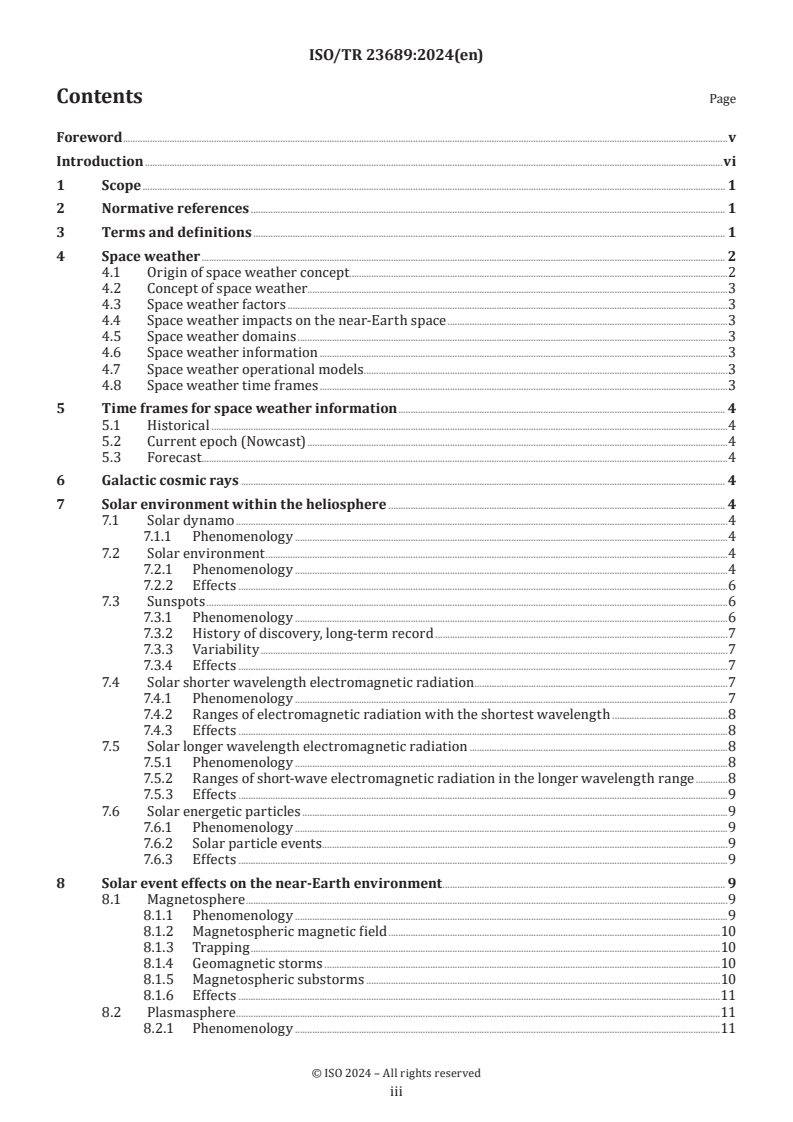
Contents Page
Foreword .v
Introduction .vi
1 Scope . 1
2 Normative references . 1
3 Terms and definitions . 1
4 Space weather . 2
4.1 Origin of space weather concept.2
4.2 Concept of space weather.3
4.3 Space weather factors .3
4.4 Space weather impacts on the near-Earth space .3
4.5 Space weather domains .3
4.6 Space weather information .3
4.7 Space weather operational models . .3
4.8 Space weather time frames .3
5 Time frames for space weather information . 4
5.1 Historical .4
5.2 Current epoch (Nowcast) .4
5.3 Forecast.4
6 Galactic cosmic rays . 4
7 Solar environment within the heliosphere . 4
7.1 Solar dynamo .4
7.1.1 Phenomenology .4
7.2 Solar environment .4
7.2.1 Phenomenology .4
7.2.2 Effects .6
7.3 Sunspots .6
7.3.1 Phenomenology .6
7.3.2 History of discovery, long-term record .7
7.3.3 Variability .7
7.3.4 Effects .7
7.4 Solar shorter wavelength electromagnetic radiation .7
7.4.1 Phenomenology .7
7.4.2 Ranges of electromagnetic radiation with the shortest wavelength .8
7.4.3 Effects .8
7.5 Solar longer wavelength electromagnetic radiation .8
7.5.1 Phenomenology .8
7.5.2 Ranges of short-wave electromagnetic radiation in the longer wavelength range .8
7.5.3 Effects .9
7.6 Solar energetic particles .9
7.6.1 Phenomenology .9
7.6.2 Solar particle events.9
7.6.3 Effects .9
8 Solar event effects on the near-Earth environment . 9
8.1 Magnetosphere .9
8.1.1 Phenomenology .9
8.1.2 Magnetospheric magnetic field .10
8.1.3 Trapping .10
8.1.4 Geomagnetic storms .10
8.1.5 Magnetospheric substorms .10
8.1.6 Effects .11
8.2 Plasmasphere .11
8.2.1 Phenomenology .11
iii
8.2.2 Geo corona .11
8.2.3 Dynamics .11
8.2.4 Effects .11
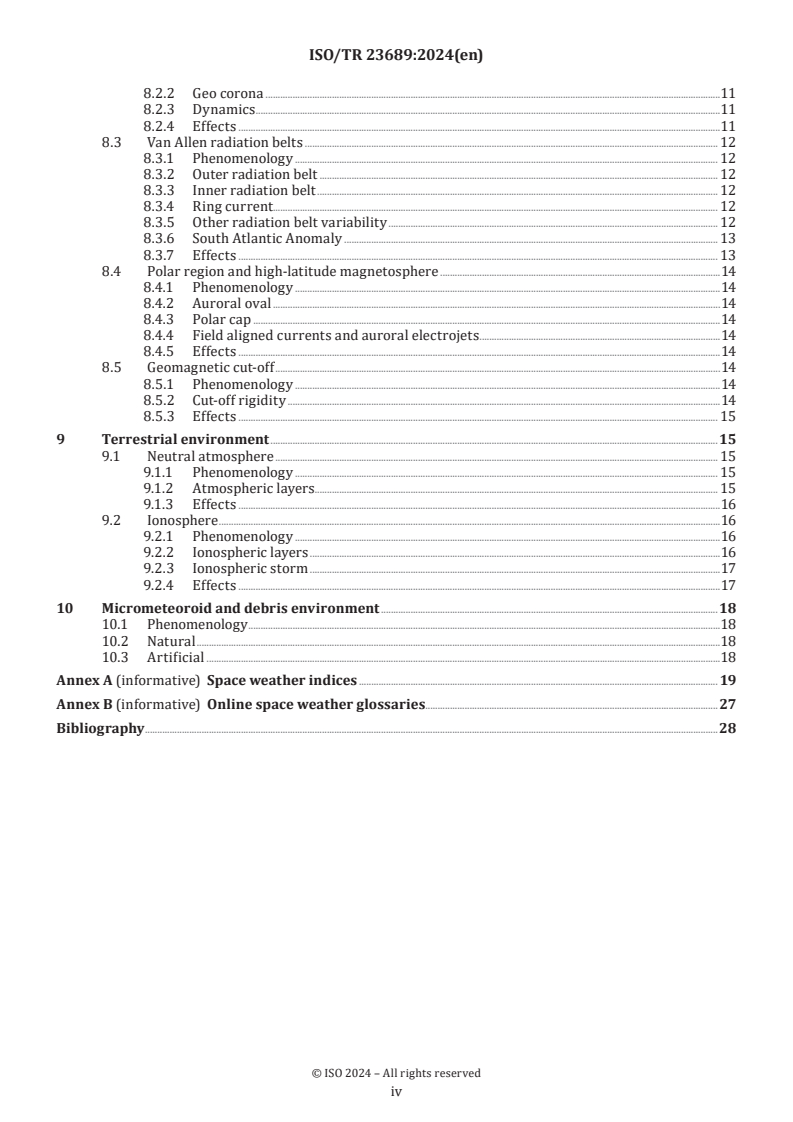
8.3 Van Allen radiation belts . 12
8.3.1 Phenomenology . 12
8.3.2 Outer radiation belt . 12
8.3.3 Inner radiation belt . 12
8.3.4 Ring current. 12
8.3.5 Other radiation belt variability . 12
8.3.6 South Atlantic Anomaly . 13
8.3.7 Effects . 13
8.4 Polar region and high-latitude magnetosphere .14
8.4.1 Phenomenology .14
8.4.2 Auroral oval .14
8.4.3 Polar cap .14
8.4.4 Field aligned currents and auroral electrojets .14
8.4.5 Effects .14
8.5 Geomagnetic cut-off .14
8.5.1 Phenomenology .14
8.5.2 Cut-off rigidity .14
8.5.3 Effects . 15
9 Terrestrial environment .15
9.1 Neutral atmosphere . 15
9.1.1 Phenomenology . 15
9.1.2 Atmospheric layers . . 15
9.1.3 Effects .16
9.2 Ionosphere .16
9.2.1 Phenomenology .16
9.2.2 Ionospheric layers .16
9.2.3 Ionospheric storm .17
9.2.4 Effects .17
10 Micrometeoroid and debris environment .18
10.1 Phenomenology .18
10.2 Natural .18
10.3 Artificial .18
Annex A (informative) Space weather indices . 19
Annex B (informative) Online space weather glossaries .27
Bibliography .28
iv
Foreword
ISO (the International Organization for Standardization) is a worldwide federation of national standards
bodies (ISO member bodies). The work of preparing International Standards is normally carried out through
ISO technical committees. Each member body interested in a subject for which a technical committee
has been established has the right to be represented on that committee. International organizations,
governmental and non-governmental, in liaison with ISO, also take part in the work. ISO collaborates closely
with the International Electrotechnical Commission (IEC) on all matters of electrotechnical standardization.
The procedures used to develop this document and those intended for its further maintenance are described
in the ISO/IEC Directives, Part 1. In particular, the different approval criteria needed for the different types
of ISO document should be noted. This document was drafted in accordance with the editorial rules of the
ISO/IEC Directives, Part 2 (see www.iso.org/directives).
ISO draws attention to the possibility that the implementation of this document may involve the use of (a)
patent(s). ISO takes no position concerning the evidence, validity or applicability of any claimed patent
rights in respect thereof. As of the date of publication of this document, ISO had not received notice of (a)
patent(s) which may be required to implement this document. However, implementers are cautioned that
this may not represent the latest information, which may be obtained from the patent database available at
www.iso.org/patents. ISO shall not be held responsible for identifying any or all such patent rights.
Any trade name used in this document is information given for the convenience of users and does not
constitute an endorsement.
For an explanation of the voluntary nature of standards, the meaning of ISO specific terms and expressions
related to conformity assessment, as well as information about ISO's adherence to the World Trade
Organization (WTO) principles in the Technical Barriers to Trade (TBT), see www.iso.org/iso/foreword.html.
This document was prepared by Technical Committee ISO/TC 20, Aircraft and space vehicles, Subcommittee
SC 14, Space systems and operations.
Any feedback or questions on this document should be directed to the user’s national standards body. A
complete listing of these bodies can be found at www.iso.org/members.html.
v
Introduction
This document describes the dynamic variability of the environment, i.e. space weather, and identifies
the tools and parameters needed for space systems operations. This document is important for satellite
operators who are not be familiar with space weather. For example, when Satellite operators arrive on shift,
they are often briefed about terrestrial weather, geomagnetic storms, and collision reports. This provides
insight into any possible collisions that their system can have with debris or other satellites. In addition,
others who participate in space systems operations can benefit from this document. For example, designers,
manufacturers, and launchers of space systems require real-time, operational space weather parameters
that can be measured, monitored, or built into automated systems. Users of these systems include developers
of software systems that provide LEO satellite orbit determination, radio communication availability for
scintillation events (GEO-to-ground L- and UHF-bands), GPS uncertainties, and the radiation environment
from ground-to-space for commercial space tourism. These groups require recent historical data, current
epoch specification, and forecast of space weather phenomena for their automated or manual systems.
National government agencies often rely on space weather data provided by their national organizations,
such as those represented in the International Space Environment Service (ISES) group of 14 national
agencies, and this document identifies key descriptors provided by those agencies.
This document identifies the phenomena of space weather as a dynamic component of the space environment
that affects the technology of space systems. Annexes A and B describe expanded material including
guidelines on how to use the document, how to obtain specific space weather parameters, and short but
detailed descriptions of parameters. Annexes A and B enable easy updates for this document because new
advances in scientific and engineering understanding provide new tools for characterizing the domain of
space weather. Table 1 gives an overview of existing ISO documents related to the space environment.
Table 1 — Terrestrial and lunar environment documents
LEO PEO MEO GEO >GEO
ISO 15856, ISO 15856,
ISO 15856, ISO 15856,
ISO 17851, ISO 17851, ISO 15856,
Testing/analysis/ ISO 17851, ISO 17851,
ISO 21980, ISO 21980, ISO 17851,
framework ISO/TS 22295, ISO/TS 22295,
ISO/TS 22295, ISO/TS 22295, (AUL)
(AUL) (AUL)
(AUL) (AUL)
ISO 15390, ISO 15390, ISO 15390, ISO 15390, ISO 15390,
Cosmic rays ISO 17520, ISO 17520, ISO 17520, ISO 17520, ISO 17520,
ISO/TR 23689 ISO/TR 23689 ISO/TR 23689 ISO/TR 23689 ISO/TR 23689
ISO 21348, ISO 21348, ISO 21348, ISO 21348, ISO 21348,
Solar photons
ISO/TR 23689 ISO/TR 23689 ISO/TR 23689 ISO/TR 23689 ISO/TR 23689
ISO 12208,
ISO 16698, ISO 16698, ISO 16698, ISO 16698,
ISO 16698,
ISO 17520, ISO 17520, ISO 17520, ISO 17520,
ISO 17520,
Solar particles ISO/TR 18147, ISO/TR 18147, ISO/TR 18147, ISO/TR 18147,
ISO/TR 18147,
(solar wind), (solar wind), (solar wind), (solar wind),
(solar wind),
ISO/TR 23689 ISO/TR 23689 ISO/TR 23689 ISO/TR 23689
ISO/TR 23689
ISO 16689, ISO 16689, ISO 16689, ISO 16689, ISO 16689,
Solar fields (solar wind), (solar wind), (solar wind), (solar wind), (solar wind),
ISO/TR 23689 ISO/TR 23689 ISO/TR 23689 ISO/TR 23689 ISO/TR 23689
ISO 16695, ISO 16695, ISO 16695, ISO 16695, ISO 16695,
Main magnetic
ISO 16698, ISO 16698, ISO 16698, ISO 16698, ISO 16698,
field
ISO/TR 23689 ISO/TR 23689 ISO/TR 23689 ISO/TR 23689 ISO/TR 23689
Key
AUL application utility level
IRENE International Radiation Environment Near Earth
AO atomic oxygen
vi
TTabablele 1 1 ((ccoonnttiinnueuedd))
LEO PEO MEO GEO >GEO
ISO 12208,
ISO 16695, ISO 16695, ISO 16695,
ISO 16695, ISO 16695,
ISO 16698, ISO 16698, ISO 16698,
ISO 16698, ISO 16698,
Magnetosphere ISO 19923, ISO 22009, ISO 22009,
ISO 19923, ISO 22009,
ISO/TR 23689, ISO 19923, ISO 19923,
ISO/TR 23689 ISO 19923,
(PC-index) ISO/TR 23689 ISO/TR 23689
ISO/TR 23689
ISO 17761, ISO 17761,
ISO 17520, ISO 17520, ISO 17520,
ISO 17520, ISO 17520,
ISO/TS 21979, ISO/TS 21979, ISO/TS 21979,
ISO/TS 21979, ISO/TS 21979,
Radiation belts (IRENE, internal (IRENE, internal (IRENE, internal
(IRENE, internal (IRENE, internal
charge), charge), charge),
charge), charge),
ISO/TR 23689 ISO/TR 23689 ISO/TR 23689
ISO/TR 23689 ISO/TR 23689
ISO 16457, ISO 16457, ISO 16457, ISO 16457,
ISO 16457,
Plasmasphere ISO 19923, ISO 19923, ISO 19923, ISO 19923,
ISO/TR 23689
ISO/TR 23689 ISO/TR 23689 ISO/TR 23689 ISO/TR 23689
ISO 16457, ISO 16457,
Ionosphere ISO 16698, ISO 16698, (topside)
ISO/TR 23689 ISO/TR 23689
ISO 14222, ISO 14222,
ISO/TR 11225, ISO/TR 11225,
Neutral atmos- ISO 16698, ISO 16698,
(He, H) (He, H) (He, H)
phere (AO, satellite (AO, satellite
drag), drag),
ISO/TR 23689 ISO/TR 23689
Micrometeoroids ISO 14200 ISO 14200 ISO 14200 ISO 14200 ISO 14200
ISO 14200, ISO 14200,
Debris ISO 14200 ISO 14200 ISO 14200
(radiation debris) (radiation debris)
Lunar ISO 10788
Key
AUL application utility level
IRENE International Radiation Environment Near Earth
AO atomic oxygen
vii
Technical Report ISO/TR 23689:2024(en)
Space environment (natural and artificial) — Space weather
information for use in space systems operations
1 Scope
This document contains internationally accepted descriptions of the main phenomena of space weather,
including its sources and effects upon space systems.
This document is applicable for a variety of engineering and scientific domains. It is applicable to space
system operations include ground-based, on-orbit, and deep space automated satellite operations. It can be
applied by developers of software systems for space systems, designers of space systems, and launchers of
space systems.
2 Normative references
There are no normative references in this document.
3 Terms and definitions
For the purposes of this document, the following terms and definitions apply.
ISO and IEC maintain terminology databases for use in standardization at the following addresses:
— ISO Online browsing platform: available at https:// www .iso .org/ obp
— IEC Electropedia: available at https:// www .electropedia .org/
3.1
aerodynamic drag
force derived from the kinetic energy of an orbiting object encountering an atmosphere (3.2) as a result of
the work done against the object by the atmosphere
3.2
atmosphere
layer of gases surrounding a planet, moon, asteroid, or comet with species composition and temperature
often described by altitude
3.3
deep space
region of space beyond the Earth’s atmosphere (3.2) and magnetosphere and especially beyond the Moon’s orbit
3.4
geomagnetically induced current
GIC
induced magnetic field variation caused by geomagnetic disturbances such as CMEs upon the Earth’s
magnetic field
3.5
geostationary Earth orbit
Earth orbit having zero inclination, zero eccentricity, and an orbital period equal to the Earth's sidereal
rotation period
Note 1 to entry: This orbit allows a satellite to remain continuously over approximately the same point on the Earth’s
surface.
[SOURCE: ISO 24113:2023, 3.11, modified — The abbreviated term “GEO” has been removed; note 1 to entry
has been added.]
3.6
geosynchronous Earth orbit
orbit with an orbital period equal to the Earth’s sidereal rotation period
3.7
heliosphere
region surrounding the Sun where the emanating solar wind dominates the interstellar medium
Note 1 to entry: It is the magnetosphere and outermost atmospheric layer of the Sun, taking the shape of a vast, bubble-
like region of space, i.e. a plasma cavity formed by the Sun in the surrounding interstellar medium where the strength
of the solar, interplanetary magnetic field is greater than that of the local galactic magnetic field.
[SOURCE: ISO 15856:2010, 3.1.8, modified — The word "emanating" has been added; the original note 1 to
entry has been replaced by a new one.]
3.8
low Earth orbit
Earth orbit with an apogee altitude that does not exceed 2 000 km
3.9
MEO
medium Earth orbit
mid-Earth’s orbit
Earth orbit with apogee an altitude that is greater than 2 000 km but does not exceed 36 000 km
3.10
space environment
surrounding, aggregated conditions and influences of photons, particles, and fields outside of planetary
atmospheres (3.2)
3.11
space weather
dynamic variability in the transfer of energy via photons, particles, and fields from the Galaxy and Sun to
the heliosphere (3.7), including planetary bodies, other objects, and their environs
3.12
suborbital flight
flight at an altitude and velocity that would result in a trajectory incapable of circling the Earth at least once
3.13
sunspot number
R
daily index of sunspot activity defined as k (10 g + s) where s is the number of individual spots, g is the
number of sunspot groups, and k is an observatory factor
[SOURCE: ISO 16457:2022, 3.6, modified — Notes to entry have been removed.]
4 Space weather
4.1 Origin of space weather concept
The space weather concept originated in the mid-1990’s within the space physics community and their
attempt to understand the temporal, non-climatological variations in the space environment along with the
effects at Earth.
4.2 Concept of space weather
Space weather primarily includes energetic processes that originate on the Sun but can include energy
transfer from galactic sources outside the heliosphere. Space weather can affect natural environments and
human technology starting at and below the surface of the Earth through the outer reaches of the Earth’s
magnetosphere. It can also affect the environments around other bodies in the solar system.
4.3 Space weather factors
Solar wind plasma, cosmic rays, solar energetic particles and solar electromagnetic and particle ionizing
radiation are the main space weather factors. All space factors either originate from the Sun or are
modulated by solar activity. Variations of space weather factors influence interplanetary space and
planetary (terrestrial) environments.
4.4 Space weather impacts on the near-Earth space
Space weather factors influence space and terrestrial environments. The main space weather manifestations
occur following solar flares and coronal mass ejections that produce magnetic storms and magnetospheric
substorms, solar proton events, ionospheric disturbances, changes in thermosphere densities, variability
in the radiation environment at aircraft altitudes, as well as variations of ground currents at and below the
Earth’s surface.
4.5 Space weather domains
Solar-terrestrial coupling plays the key role in the development of space weather events. Physical conditions
in the Sun, in the heliosphere and in the Earth’s magnetosphere are susceptible to space weather factors and
impact the terrestrial environment. In various space domains different processes are coupled with solar
irradiation, both electromagnetic and particulate, and can influence space weather factors. Solar-terrestrial
coupling is produced by the chain of the interconnections between processes in the Sun’s environment, in
the heliosphere and in near-Earth space. Measurements of the physical conditions in different regions of
space can be used to estimate the intensity of space weather factors and their possible impact on planetary
environments, including the Earth.
4.6 Space weather information
Space weather information is obtained from satellite, air, and ground-based measurements as well as
from space weather models, the combination of which can be used to determine the state of the space
environment. Information is collected by governmental, academic, and industrial space weather data centres
and processed by operational IT-services that can give a reliable release of space weather conditions.
4.7 Space weather operational models
The models of physical parameters for the space environment depend on measurements and often work
automatically in real-time mode. Operational models typically originate from scientific models that are
modified to run automatically using observational data input. The process of conversion of scientific
models to operational ones is called R2O (research to operations). Operational models testing is called V&M
(validation and metrics). The process of using the results of operational models to understand shortcomings
for further scientific research is called O2R (operations to research).
4.8 Space weather time frames
Space weather information in different time frames can be used to validate space weather models (e.g.
historical data), for verification diagnostics of current space environment conditions (current data), and for
space weather predictions (forecast data).
5 Time frames for space weather information
5.1 Historical
A historical time frame for space weather information starts at the current epoch and continues backwards
in time.
5.2 Current epoch (Nowcast)
The current epoch for space weather information is the present moment in time and whose interval is user-
defined; for example, the current epoch can be the present second, minute, hour, or day.
5.3 Forecast
A forecast time frame for space weather information starts at the current epoch and continues forwards in
time. The forecast horizon is the time period when forecast can be adequately used as a decision-aid.
6 Galactic cosmic rays
Galactic cosmic rays (GCRs) are high-energy charged particles penetrating the heliosphere from local
interstellar space (ISO 15390). They are comprised of high-energy charged particles consisting of
[34]
approximately H, He, and small contribution of heavier ions contributing to background radiation and
event radiation levels. The ISO 15390 model is used for GCR flux calculations. Originating from outside of
the solar system, the GCR flux within the heliosphere is modulated inversely with the solar cycle, i.e. there
are higher particle fluxes during solar minimum. Galactic cosmic rays give radiation impact on hardware
and on biological objects in space. They are also responsible for single-event effects on electronic devices.
Considering GCR effects are especially important for long-term space missions.
7 Solar environment within the heliosphere
7.1 Solar dynamo
7.1.1 Phenomenology
The solar dynamo is the source of the Sun’s magnetic field. The solar dynamo refers to the physical process
whereby the Sun’s magnetic field is created. It contains the elements of rotation of the Sun and the existence
of highly ionized plasma in a region below the surface of the Sun above the core and radiative zone, and
below the convective zone, called the tachocline. Here, solar temperatures in the range of 2 million K are
cool enough for ions to form and, as they move as a result of the Sun’s rotation, act in a way such that their
kinetic energy is converted into electromagnetic energy.
7.2 Solar environment
7.2.1 Phenomenology
7.2.1.1 Structure of Sun
The internal structure of the Sun is comprised of the core where thermonuclear reactions occur, the radiative
zone, the tachocline interface layer, and the convective zone. The photosphere is the visible surface of the
Sun where sunspots, faculae, and granules can be observed. The surface of the Sun is also considered the
photosphere at a mean altitude of 0 km or 1,0 solar radii.
7.2.1.2 Rotation
The Sun’s average rotation period is 27,75 days from Earth’s perspective. The rotation period varies with
the latitude ranging from 30 days at the poles (90°) to 24,47 days at the equator (0°) also known as the
sidereal period.
7.2.1.3 Magnetic fields
The Sun’s magnetic dipole reverses and returns to the same polarity approximately every 22 years and
is known as the solar magnetic cycle. At the beginning of each 11-year half cycle of the magnetic dipole
reversal, new sunspots begin forming in a band between 25 and 30 degrees north and south latitude; they
then progress towards the equator and this process is known as the solar sunspot cycle.
7.2.1.4 Heliosphere
The furthest extent of the Sun’s magnetic field out into the local galactic medium, whose border is defined
as that region where the Sun’s magnetic field strength equals the local galactic magnetic field strength, also
called the heliopause. Inside that bounded region the Sun’s particles, photons, magnetic fields (gravitational
and electromagnetic), dominate all energy transfer processes while outside that region the Galaxy
dominates. All solar-system planets reside within the heliosphere.
7.2.1.5 The photosphere
This is the lower layer of the Sun's atmosphere, that is about 100 km to 300 km thick. Temperature in this
layer varies from 8 000 K to 4 000 K outside. The Sun’s visible radiation is formed here. The photosphere
provides the most part of the star's radiation.
7.2.1.6 The chromosphere
This is the region of the Sun’s atmosphere above the photosphere and below the transition region, which
exhibits temperatures between 4 000 K to 8 000 K.
7.2.1.7 The transition region
This is the region of the Sun’s atmosphere above the chromosphere and below the corona, which exhibits
temperatures between 8 000 K to 500 000 K.
7.2.1.8 The corona
This is the region of the Sun’s atmosphere above the transition region and has temperatures starting at
500 000 K.
7.2.1.9 Solar flares
An explosive release of magnetic energy manifested as a solar atmosphere phenomenon and observed
as a sudden brightening in the electromagnetic radiation from the hard X-rays through far ultra-violet
wavelengths.
Solar flares are classified into two types of events using soft X-ray duration and other characteristics. One
type is an impulsive flare whose characteristics are short duration (minutes to an hour), an impulsive time
variation in the hard X-rays, and formed from a simple compact loop structure as observed in soft X-rays.
The other type is a long duration event (LDE), which shows a large-size or complex structure in the soft
X-rays and a gradual time variation in hard X-rays (hours).
Solar flares can be sources of the solar energetic particles that can reach the Earth environment and produce
so-called solar particle events, i.e. abrupt enhancements of energetic particle fluxes, mostly protons, in the
energy range about 1 MeV to 10 GeV (7.5.1).
7.2.1.10 Coronal mass ejections
A coronal mass ejection (CME) is an explosive release of charged particles into the ambient solar wind; the
particles were formerly captured in coronal loops in the solar atmosphere and that are released a result of
magnetic shearing process in flaring regions. Solar flares usually occur on solar magnetic field loops while
CMEs are the release of charged particles from ruptured magnetic field loops. The transient ejecta from the
Sun expands as it travels out from the Sun, initially radially, on the curved interplanetary magnetic field
lines. Coronal mass ejection material is also known as magnetic cloud or flux rope ejecta.
7.2.1.11 Coronal holes
Regions that are observed in XUV and EUV solar images as dark areas are manifestations of open magnetic
field lines extending outwards from the Sun into the interplanetary medium. These open field lines enable
the escape of highly energetic particles, especially electrons, and that are associated with high-speed
streams (HSS).
7.2.1.12 Solar wind
A non-uniform supersonic stream of charged particles, mostly electrons and protons, ejected from several
source regions on the Sun, including coronal holes, boundaries with regions of magnetic activity, and ejecta
during solar flare events. The solar wind velocity ranges from 300 km/s to over 2 000 km/s, depending upon
the solar source of the material in the solar wind. The solar wind plasma consists of electrons and protons
that are constrained to follow the interplanetary magnetic field (IMF) emanating from the Sun. The plasma
is usually inhomogeneous and can contain magnetic field properties different from interplanetary space.
7.2.2 Effects
The Sun’s magnetic field created by the solar dynamo is the source of small-scale phenomena such as
sunspots, flares, and coronal mass ejections as well as large-scale phenomena such as the interplanetary
magnetic field that extends throughout the heliosphere and acts as a guide for charged particles moving
out through and into the heliosphere. At Earth, sunspots have the effect of diminishing the TSI. Flare short
wavelength photons arriving at Earth can cause ionization in the ionosphere and heating of the neutral
thermosphere. Solar energetic particles give rise to significant intensification of ionizing radiation during
solar proton events.
Coronal mass ejection material upon arrival at Earth can cause geomagnetic storms as the charged particles
in the magnetic cloud or flux rope get injected onto Earth's magnetospheric field lines, which can direct
particles inwards towards geosynchronous Earth orbit and then all the way down to the auroral zones at
the top of the atmosphere Geomagnetic storms can be also caused by the fast solar wind streams originating
from the coronal holes, which are dark large regions on the Sun. Strong magnetic field variations are
responsible for particle acceleration. The addition of charged particles can severely disrupt the Earth’s
electrical field, even in subsurface conducting layers, to cause power surges in terrestrial power transmission
lines. These highly energetic events can cause effects on Earth such as radio communication loss, power grid
failure, satellite surface charging, increased satellite drag, and even particle precipitation that enhances the
radiation environment at commercial aviation altitudes. Wave-particle resonant interaction can accelerate
electrons up to relativistic energies and produce satellite deep dielectric charging.
7.3 Sunspots
7.3.1 Phenomenology
Sunspots are regions of cold and tenuous plasma on the solar surface that appear dark. These regions are
clearly visible on the surface, or photosphere, of the Sun that evolve through time with expansion and
breakup stages. Sunspo
...