


ISO 6966-2:2014
(Main)Aircraft ground equipment — Basic requirements — Part 2: Safety requirements
Aircraft ground equipment — Basic requirements — Part 2: Safety requirements
ISO 6966-2:2014 specifies the minimum design requirements applicable to all aircraft ground support equipment (GSE) in order to ensure safety of staff operating or maintaining the equipment or in its vicinity, and protection of aircraft against interference or damage. ISO 6966-2:2014 does not apply to automotive vehicles or parts thereof approved for public vehicles, when used on aircraft ground support equipment for the purpose for which they are designed.
Matériel au sol pour aéronefs — Exigences de base — Partie 2: Exigences de sécurité
General Information
- Status
- Published
- Publication Date
- 30-Jul-2014
- Technical Committee
- ISO/TC 20/SC 9 - Air cargo and ground equipment
- Drafting Committee
- ISO/TC 20/SC 9 - Air cargo and ground equipment
- Current Stage
- 9093 - International Standard confirmed
- Start Date
- 05-Jun-2023
- Completion Date
- 12-Feb-2026
Relations
- Effective Date
- 09-Feb-2026
- Revises
ISO 6966-2:2005 - Aircraft ground equipment — Basic requirements — Part 2: Safety requirements - Effective Date
- 10-Dec-2011
Overview - ISO 6966-2:2014 (Aircraft ground equipment - Safety requirements)
ISO 6966-2:2014 defines the minimum safety design requirements for aircraft ground support equipment (GSE). It is Part 2 of the ISO 6966 series and focuses on protecting personnel who operate or maintain GSE and preventing interference or damage to aircraft on the ramp. The standard applies to any purpose-designed mobile GSE used in airport ramp areas (not to general public automotive vehicles used in their original public-vehicle role).
Key facts:
- Part of a two-part series (Part 1 covers general design requirements).
- Emphasizes “design to safety” and risk-based design.
- Includes informative and normative annexes (e.g., typical GSE list, safety symbols).
Key technical topics and requirements
ISO 6966-2 organizes safety requirements across the lifecycle and systems of GSE. Major topics include:
- Risk assessment and design-to-safety: Manufacturers shall conduct comprehensive risk assessments (per ISO 14121-1) and implement inherently safe design features rather than rely solely on add-on protections.
- Personnel accommodation and protection: Requirements on operator space, access, guarding and emergency exit considerations to reduce operator risk.
- Stability and strength: Criteria to ensure equipment structural integrity and stability under operational loads.
- Components and systems safety: Fail‑safe or duplicated design for components whose failure could be hazardous; references to safety-related control system standards (e.g., ISO 13849-1).
- Aircraft protection: Measures to avoid aircraft contact and damage (e.g., defined concept of “aircraft contact” at <120 mm).
- Mobility, braking and maneuvering: Operational speed limits in equipment restraint areas (ERA defined as within 7.5 m of parked aircraft) and braking performance considerations.
- Back-up, emergency systems and markings: Emergency stop principles, backup systems, required markings and manufacturer instructions.
- Quality assurance and operator responsibilities: Documentation, maintenance and user obligations.
Practical applications - who uses this standard
ISO 6966-2 is essential for:
- GSE manufacturers and designers - to embed safety requirements in product design and documentation.
- Airport operators and ground-handling companies - to select compliant equipment and establish safe operating practices on the ramp.
- Procurement and safety engineers - to specify minimum safety criteria in tenders and inspections.
- Regulators and certification bodies - to harmonize safety oversight with international practice.
Benefits include reduced risk of injury, fewer aircraft incidents caused by ground equipment, clearer manufacturer guidance, and better harmonization with related standards (e.g., ISO 6966-1, EN 1915 series).
Related standards and references
ISO 6966-2 cross-references several ISO and regional standards (notably ISO 6966-1 and ISO 14121-1) and aligns with EN 1915. Users should consult those documents for general design, performance and ergonomics details.
Keywords: ISO 6966-2:2014, aircraft ground support equipment, GSE safety requirements, ramp safety, design to safety, risk assessment, airport ground equipment.
Get Certified
Connect with accredited certification bodies for this standard

DEKRA North America
DEKRA certification services in North America.

Eagle Registrations Inc.
American certification body for aerospace and defense.

Element Materials Technology
Materials testing and product certification.
Sponsored listings
Frequently Asked Questions
ISO 6966-2:2014 is a standard published by the International Organization for Standardization (ISO). Its full title is "Aircraft ground equipment — Basic requirements — Part 2: Safety requirements". This standard covers: ISO 6966-2:2014 specifies the minimum design requirements applicable to all aircraft ground support equipment (GSE) in order to ensure safety of staff operating or maintaining the equipment or in its vicinity, and protection of aircraft against interference or damage. ISO 6966-2:2014 does not apply to automotive vehicles or parts thereof approved for public vehicles, when used on aircraft ground support equipment for the purpose for which they are designed.
ISO 6966-2:2014 specifies the minimum design requirements applicable to all aircraft ground support equipment (GSE) in order to ensure safety of staff operating or maintaining the equipment or in its vicinity, and protection of aircraft against interference or damage. ISO 6966-2:2014 does not apply to automotive vehicles or parts thereof approved for public vehicles, when used on aircraft ground support equipment for the purpose for which they are designed.
ISO 6966-2:2014 is classified under the following ICS (International Classification for Standards) categories: 49.100 - Ground service and maintenance equipment; 49.120 - Cargo equipment. The ICS classification helps identify the subject area and facilitates finding related standards.
ISO 6966-2:2014 has the following relationships with other standards: It is inter standard links to EN ISO 11532:2020, ISO 6966-2:2005. Understanding these relationships helps ensure you are using the most current and applicable version of the standard.
ISO 6966-2:2014 is available in PDF format for immediate download after purchase. The document can be added to your cart and obtained through the secure checkout process. Digital delivery ensures instant access to the complete standard document.
Standards Content (Sample)
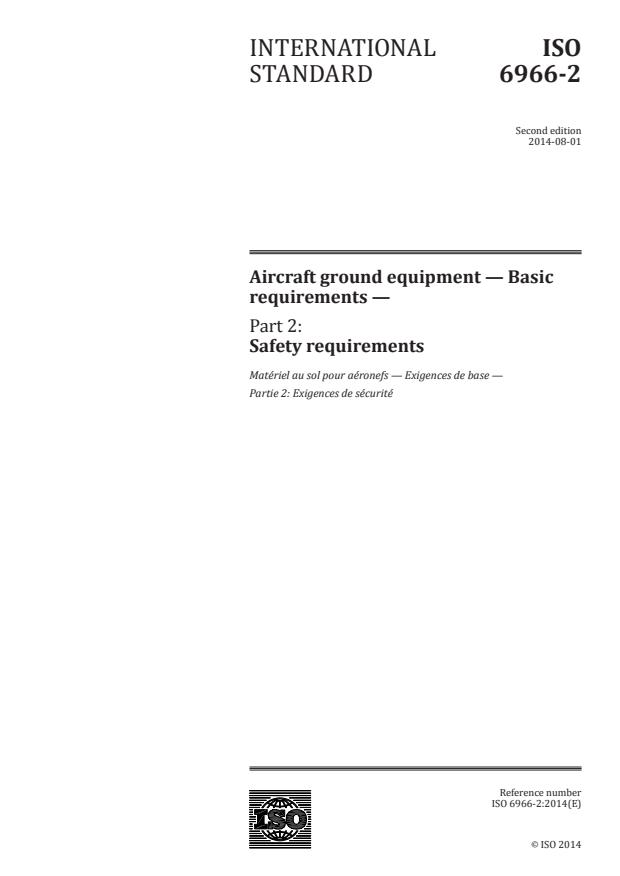
INTERNATIONAL ISO
STANDARD 6966-2
Second edition
2014-08-01
Aircraft ground equipment — Basic
requirements —
Part 2:
Safety requirements
Matériel au sol pour aéronefs — Exigences de base —
Partie 2: Exigences de sécurité
Reference number
©
ISO 2014
© ISO 2014
All rights reserved. Unless otherwise specified, no part of this publication may be reproduced or utilized otherwise in any form
or by any means, electronic or mechanical, including photocopying, or posting on the internet or an intranet, without prior
written permission. Permission can be requested from either ISO at the address below or ISO’s member body in the country of
the requester.
ISO copyright office
Case postale 56 • CH-1211 Geneva 20
Tel. + 41 22 749 01 11
Fax + 41 22 749 09 47
E-mail copyright@iso.org
Web www.iso.org
Published in Switzerland
ii © ISO 2014 – All rights reserved
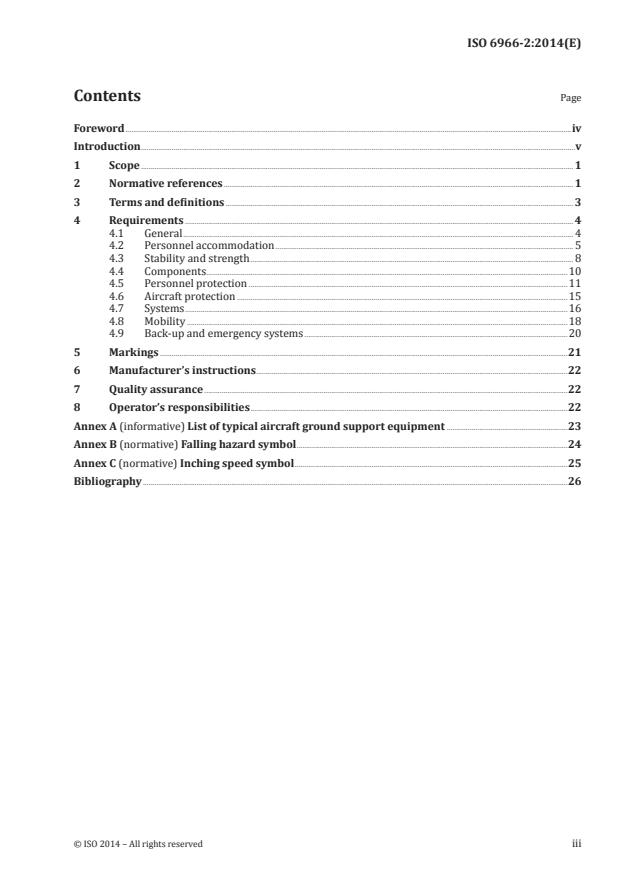
Contents Page
Foreword .iv
Introduction .v
1 Scope . 1
2 Normative references . 1
3 Terms and definitions . 3
4 Requirements . 4
4.1 General . 4
4.2 Personnel accommodation . 5
4.3 Stability and strength . 8
4.4 Components .10
4.5 Personnel protection .11
4.6 Aircraft protection .15
4.7 Systems .16
4.8 Mobility .18
4.9 Back-up and emergency systems .20
5 Markings .21
6 Manufacturer’s instructions .22
7 Quality assurance .22
8 Operator’s responsibilities .22
Annex A (informative) List of typical aircraft ground support equipment .23
Annex B (normative) Falling hazard symbol .24
Annex C (normative) Inching speed symbol .25
Bibliography .26
Foreword
ISO (the International Organization for Standardization) is a worldwide federation of national standards
bodies (ISO member bodies). The work of preparing International Standards is normally carried out
through ISO technical committees. Each member body interested in a subject for which a technical
committee has been established has the right to be represented on that committee. International
organizations, governmental and non-governmental, in liaison with ISO, also take part in the work.
ISO collaborates closely with the International Electrotechnical Commission (IEC) on all matters of
electrotechnical standardization.
The procedures used to develop this document and those intended for its further maintenance are
described in the ISO/IEC Directives, Part 1. In particular the different approval criteria needed for the
different types of ISO documents should be noted. This document was drafted in accordance with the
editorial rules of the ISO/IEC Directives, Part 2 (see www.iso.org/directives).
Attention is drawn to the possibility that some of the elements of this document may be the subject of
patent rights. ISO shall not be held responsible for identifying any or all such patent rights. Details of
any patent rights identified during the development of the document will be in the Introduction and/or
on the ISO list of patent declarations received (see www.iso.org/patents).
Any trade name used in this document is information given for the convenience of users and does not
constitute an endorsement.
For an explanation on the meaning of ISO specific terms and expressions related to conformity
assessment, as well as information about ISO’s adherence to the WTO principles in the Technical Barriers
to Trade (TBT) see the following URL: Foreword - Supplementary information
The committee responsible for this document is Technical Committee ISO/TC 20, Aircraft and space
vehicles, Subcommittee SC 9, Air cargo and ground equipment.
This second edition cancels and replaces the first edition (ISO 6966-2:2005), which has been technically
revised for increased harmonization with EN 1915-1:2013.
ISO 6966 consists of the following parts, under the general title Aircraft ground equipment — Basic
requirements:
— Part 1: General design requirements
— Part 2: Safety requirements
Annex A of this part of ISO 6966 is for information only.
iv © ISO 2014 – All rights reserved
Introduction
This part of ISO 6966 specifies the safety requirements to be taken into account by manufacturers for
the design of aircraft ground support equipment. It identifies the various concerns to be taken into
consideration to ensure ground equipment safety for operators and aircraft.
Throughout this International Standard, the minimum essential criteria are identified by use of the
keyword “shall”. Recommended criteria are identified by use of the key word “should” and, while not
mandatory, are considered to be of primary importance in providing safe, economical, and usable
aircraft ground support equipment. Deviation from recommended criteria should only occur after
careful consideration and thorough service evaluation have shown alternate methods to provide an
equivalent level of safety.
The requirements of this International Standard are expressed in the applicable SI units, with
approximate inch-pound units conversion between brackets for convenience in those countries using
that system. Where it is deemed necessary to use exact values, the SI unit ones are to be used.
INTERNATIONAL STANDARD ISO 6966-2:2014(E)
Aircraft ground equipment — Basic requirements —
Part 2:
Safety requirements
1 Scope
This part of ISO 6966 specifies the minimum design requirements applicable to all aircraft ground
support equipment (GSE), as defined in 3.1 hereafter, in order to ensure
a) safety of staff operating or maintaining the equipment or in its vicinity, and
b) protection of aircraft against interference or damage.
An informative list of the most commonly used pieces of ground equipment is provided in Annex A
hereafter. Nevertheless, the requirements of this part of ISO 6966 apply to any piece of aircraft ground
support equipment, as defined, used on airports.
This part of ISO 6966 does not intend to provide all the design requirements applicable for aircraft
ground support equipment. Other requirements apply, and can be found in separate International
Standards:
— ISO 6966-1 specifies the general, other than safety-related, requirements applicable to all aircraft
ground support equipment;
— ISO 4116 specifies the additional requirements applicable for conveying surfaces of those pieces of
aircraft ground support equipment intended for handling and loading of baggage and cargo unit
load devices;
— specific International Standards, listed in the Bibliography, define the functional and performance
requirements for certain types of aircraft ground support equipment.
In most countries, standing Government Health and Safety laws and regulations apply to machinery,
implicitly or explicitly, including aircraft ground support equipment. Nothing in this part of ISO 6966,
however, shall be deemed or otherwise used to supersede any locally applicable law or regulation, unless
a specific exemption has been obtained for this purpose from the appropriate Authority.
This part of ISO 6966 does not apply to automotive vehicles or parts thereof approved for public vehicles,
when used on aircraft ground support equipment for the purpose for which they are designed.
2 Normative references
The following documents, in whole or in part, are normatively referenced in this document and are
indispensable for its application. For dated references, only the edition cited applies. For undated
references, the latest edition of the referenced document (including any amendments) applies.
ISO 3411, Earth-moving machinery — Physical dimensions of operators and minimum operator space
envelope
ISO 3457, Earth-moving machinery — Guards — Definitions and requirements
ISO 3746, Acoustics — Determination of sound power levels and sound energy levels of noise sources using
sound pressure — Survey method using an enveloping measurement surface over a reflecting plane
ISO 3795, Road vehicles, and tractors and machinery for agriculture and forestry — Determination of
burning behaviour of interior materials
ISO 6682, Earth-moving machinery — Zones of comfort and reach for controls
ISO 6966-1:2005, Aircraft ground equipment — Basic requirements — Part 1: General design requirements
ISO 7010, Graphical symbols — Safety colours and safety signs — Registered safety signs
ISO 7731:2003, Ergonomics — Danger signals for public and work areas — Auditory danger signals
ISO 10254, Air cargo and ground equipment — Vocabulary
ISO 11228-2, Ergonomics — Manual handling — Part 2: Pushing and pulling
ISO 11532, Aircraft ground equipment — Graphical symbols
ISO 11995:1996, Aircraft — Stability requirements for loading and servicing equipment
ISO 13849-1, Safety of machinery — Safety-related parts of control systems — Part 1: General principles
for design
ISO 13850, Safety of machinery — Emergency stop function — Principles for design
ISO 14121-1, Safety of machinery — Risk assessment — Part 1: Principles
ISO 14122-1:2001, Safety of machinery — Permanent means of access to machinery — Part 1: Choice of
fixed means of access between two levels
ISO 14122-3, Safety of machinery — Permanent means of access to machinery — Part 3: Stairs, stepladders
and guard-rails
IEC 60825-1, Safety of laser products — Part 1: Equipment classification and requirements
1)
ECE 43 , Uniform provisions concerning the approval of safety glazing and glazing material
1)
ECE 79 , Uniform provisions concerning the approval of vehicles with regard to steering equipment
1)
ECE 104 , Uniform provisions concerning the approval of retro-reflective markings for heavy and long
vehicles and their trailers
2)
EN 1915-1:2013 , Aircraft ground support equipment - General requirements — Part 1: Basic safety
requirements
2)
EN 1915-2 , Aircraft ground support equipment — General requirements — Part 2: Stability and strength
requirements, calculations and test methods
2)
EN 1915-3 , Aircraft ground support equipment — General requirements — Part 3: Vibration measurement
methods and reduction
3)
DIN 51130:2014 , Testing of floor coverings — Determination of the anti-slip property — Workrooms and
fields of activities with slip danger, walking method — Ramp test
1) ECE 43, 79, and 104 are part of the United Nations Economic Commission for Europe agreement concerning
the adoption of uniform conditions of approval and reciprocal recognition of approval for motor vehicles equipment
and parts, and can be obtained from any United Nations office.
2) CEN European standards can be obtained from: Comité Européen de Normalization, Avenue Marnix 17, B-1000
Brussels, Belgium, or any of the European national standardization institutes, members of C.E.N.: Austria, Belgium,
Bulgaria, Croatia, Cyprus, Czech Republic, Denmark, Estonia, Finland, France, Germany, Greece, Hungary, Iceland,
Ireland, Italy, Latvia, Lithuania, Luxembourg, Malta, Netherlands, Norway, Poland, Portugal, Romania, Slovakia,
Slovenia, Spain, Sweden, Switzerland, and United Kingdom.
3) DIN 51130 can be obtained from: Deutsches Institut für Normen, Burggrafenstrasse 6, D-10787 Berlin, Germany.
2 © ISO 2014 – All rights reserved
3 Terms and definitions
For the purposes of this document, the terms and definitions given in ISO 6966-1 and ISO 10254 and the
following apply.
3.1
aircraft ground support equipment
GSE
ground equipment
ramp equipment, en US
any piece of mobile equipment, whether or not powered or self-propelled, purpose designed, built, and
used for ground handling, servicing, or field maintenance of civil transport aircraft on the ramp area of
an airport
Note 1 to entry: A non-comprehensive informative list of the most commonly used pieces of ground equipment is
provided in Annex A hereafter.
3.2
ramp area
traffic area
apron, en GB
zone of an airport where aircraft manoeuvre and park for ground handling purposes
3.3
ramp
apron, en GB
tarmac, en US
surface of the ground in the ramp area
3.4
equipment restraint area
ERA
part of the ramp area located less than 7,5 m (25 ft) away from a parked aircraft, as defined by Airports
Council International (ACI) Apron Markings and Signs Handbook (see Reference [20]), where vehicles
and equipment are not to exceed a walking speed
3.5
service road
restricted access roadway used by airport equipment and vehicles to reach parts of the ramp area, as
opposed to public roads
3.6
back-up
alternate system, which can include additional means exterior to the GSE, to ensure a GSE function in
the event of failure of the system concerned
3.7
emergency
hazardous situation where time is of the essence to protect safety of persons and/or the aircraft
Note 1 to entry: Emergencies can include a need for immediate evacuation of persons.
3.8
braking ratio
ratio of the sum of the braking forces on the wheels circumference, divided by GSE weight (including
maximum payload if designed for being driven with it), multiplied by 100
Note 1 to entry: It is expressed in per cent (%).
3.9
rated load
maximum mass (including persons) a vehicle is intended to carry
Note 1 to entry: It is the lowest of applicable constraints, general structural strength (including lifting), capability
of usable floor surfaces, vehicle’s driving gross mass, maximum allowable occupancy (e.g. emergency exits), etc.
3.10
aircraft contact
position where a part of the equipment is less than 120 mm (5 in) away from the aircraft fuselage skin
Note 1 to entry: It includes positions where actual physical contact is achieved.
4 Requirements
4.1 General
4.1.1 Considerable importance is attached to having aircraft ground support equipment into which
the essential safety aspects have been incorporated as part of the basic design (design to safety). It is
particularly necessary when designing aircraft GSE to take into account the adverse conditions which
frequently prevail in airport ramp areas, e.g. congested vehicle movement, exposure to weather, night
operation, noise from aircraft and other vehicles, and difficult communications.
4.1.2 Design to safety should be based on a specific comprehensive risk assessment for each type of
aircraft GSE, to be conducted by the manufacturer in accordance with ISO 14121-1. The retained design
should be commensurate with the results of the risk assessment, as well as take into account, if applicable,
each area of potential concern listed hereafter.
4.1.3 Design should aim at providing intrinsically safe equipment, i.e. one where potentially unsafe
occurrences are prevented by basic design features such as equipment and components geometry, layout,
or mode of operation, minimizing inasmuch as feasible the necessity to use additive safety devices or
circuits. Where such additional devices or circuits dedicated to safety purposes cannot be avoided, risk
assessment shall include an evaluation of any potential drawbacks or unforeseen additional hazards
resulting from this addition.
4.1.4 All equipment or any component thereof, the failure of which could be hazardous, shall be
designed to be fail-safe, or, where impractical, duplicated. In the event of duplication, each of the duplicated
components shall separately be capable of safely performing its function in the event of its alternate’s
failure.
4.1.5 The contents of this part of ISO 6966 were determined taking into account generally recognized
assumptions as to the following:
a) the normally intended use of aircraft ground support equipment, when used on the ramp of
international civil airports in order to handle, service, or maintain civil transport aircraft;
b) the foreseeable risks of equipment misuse evidenced by operating experience;
c) the environmental (surface, slope, weather, lighting, operating rules, staff qualification, etc.)
conditions prevailing on the ramp area of the majority of international civil airports.
Manufacturers of aircraft ground support equipment should define in the relevant documentation (see
Clause 6) the specifically intended conditions of use and environment for each equipment, and purchasers
systematically review their own specific conditions of use and environment in order to determine
4 © ISO 2014 – All rights reserved
whether those stated are adequate, or negotiate with the manufacturer appropriate modifications to
ensure they are.
NOTE For intended operation in Europe, additional EU Machinery Directive (see Reference [31]) requirements
also legally apply. They can be met by complying with the requirements of European standards EN 1915-1,
EN 1915-2, EN 1915-3, and EN 1915-4.
4.2 Personnel accommodation
4.2.1 Work areas
4.2.1.1 All personnel working surfaces, including work platforms, walkways, steps, landings, and
crossings as well as stairs, ramps, ladder rungs, cleats, or treads shall be self-draining and have a high
traction (non-slip) surface.
The operator’s workplace as well as all work platform areas, including standing areas and walkways
where staff is allowed at least in certain circumstances, shall have a durably slip-resistant floor surface,
with a minimum R11 slip-resistance classification in accordance with DIN 51130:2014, Table 3.
Surfaces not allowed to staff shall as far as possible be made inaccessible, or if not possible be clearly
marked.
4.2.1.2 Walkways shall have a minimum width of 0,4 m (16 in), except on unit load devices conveying
surfaces where they shall have a minimum width of 0,3 m (12 in), and elbow/shoulder minimum passage
width of 0,6 m (24 in) in a height range of 0,8 m (32 in) to 1,6 m (64 in) over the floor. Standing areas and
landings shall have minimum floor dimensions of 0,4 m × 0,5 m (16 in × 20 in), and the elbow/shoulder
space minimum criteria shall be met.
4.2.1.3 Ladder and stair treads shall be designed to support a minimum load of 890 N (200 lb). Landings
and all personnel working surfaces shall be designed to support a minimum load of 1 100 N (250 lb) for
each person occupying said landing and/or working surface at the same time, and withstand a minimum
−2 2
distributed load of 3 000 N·m (63 lb/ft ) over their whole surface, without incurring permanent
deflection.
4.2.1.4 All operational personnel work platforms and walkways where there is a possibility of falling
from a height exceeding 1,0 m (40 in) shall be protected against this risk in accordance with 4.5.2.
4.2.1.5 On vehicles with an open cabin, a hip guard shall be provided on the outside edge of the outer
seat(s), with a minimum height of 80 mm (3 in) above the seat surface.
4.2.1.6 The access means to be used while operating the equipment shall meet the requirements of
4.5.3. Additional exterior access means may be used where access is needed for maintenance purposes
only.
4.2.2 Driver/operator cabin
4.2.2.1 Where a cabin is provided, the minimum size of the driver’s or operator’s space envelope shall
conform to the requirements of ISO 3411. For seated accommodation, individual restraint systems (safety
belts) should be provided in accordance with locally applicable regulations.
4.2.2.2 Where transport of persons other than the driver/operator is specified, the GSE shall be
equipped with
— seats, with a restraint system when located in the outer position directly behind the windshield, or
— standing accommodation with appropriate handholds.
4.2.2.3 All glass in doors and windows shall be safety glass meeting the requirements of ECE 43,
or alternative material (e.g. polycarbonate) with at least the same performance characteristics. The
windshield and all windows considered to be important for the driver’s field of view when travelling shall
be transparent and as distortion-free as possible.
4.2.2.4 When selecting driver or operator seats, consideration should be given to
— providing adjustment to the person’s size and weight, and maintaining ergonomic access to controls
regardless of the person’s size, and
— protection against the vibrations encountered during vehicle travelling or operation (see 4.5.6).
4.2.2.5 The floor, upholstery, and insulation of enclosed cabins shall consist of flame retardant material
that has a horizontal burning rate not greater than 250 mm (10 in) per min in accordance with ISO 3795.
4.2.2.6 The inside of the cabin shall not include any sharp edges or protrusions. All corners or edges
shall be chamfered or rounded with a minimum radius of 6 mm (1/4 in), unless smooth corners are
provided by the intrinsic design of the standard material profiles used in the construction.
4.2.2.7 Fully enclosed driver/operator cabins with doors shall meet the following additional
requirements.
a) Devices, e.g. wiper, washing units, demister, window de-icing systems, etc., shall be provided to
keep clear the windshield (see 4.2.3.2) and all windows necessary for operating the GSE, taking into
account the operational and climatic conditions of the intended place of use.
b) Outward opening doors shall not open backward. All doors shall be provided with securing devices
to retain them in the closed and, where required, in the open position (see 4.4.1.1).
c) Door mechanisms shall be designed and fitted in such a way that opening is only possible on
intentional action and risk of injury is avoided.
d) An adequately sized system for cabin ventilation shall be provided. Provisions shall be made for
heating and/or air conditioning where appropriate for the intended place of use. If fuel heaters are
used, combustion air shall not be taken from the interior of the cabin, and it shall not be possible for
exhaust fumes to escape into the heating air. In the event of burner flame-out, fuel supply shall be
automatically cut off. Open flame heaters are prohibited in the vicinity of aircraft.
4.2.3 Visibility
4.2.3.1 Vehicle drivers and operators shall have clear and unimpaired visibility when travelling or
operating the unit. The shape and arrangement of any driver’s or operator’s cabin shall not restrict the
field of view for travel or operation. Where this cannot be achieved directly or through mirrors, other
means such as closed-circuit TV shall be considered. There shall at least be mirrors designed and fitted in
such a way that the driver is able to observe the rear sideward areas.
4.2.3.2 Any vehicle equipped with a windshield shall be provided with a powered windshield wiper
giving a wipe area of no less than 60 % of the glazed area. A sun visor of suitable size shall be provided.
Overhead view panels should also be fitted with wiping and, where climatic conditions require, defroster
mechanisms.
4.2.3.3 All windows affecting the driver’s or operator’s field of view shall be transparent and distortion
free. On vehicles equipped with an enclosed cabin, the windshield shall be provided with a defogger
and/or defroster.
4.2.3.4 Lighting shall be arranged in such a way that no disturbing dazzling effect is caused in conjunction
with the windshield and other windows that are in the driver’s field of view.
6 © ISO 2014 – All rights reserved
4.2.3.5 Passive visibility of the vehicle at night or by poor visibility shall be enhanced by fluorescent
paint, using safety colours in accordance with ISO 7010, or preferably retro-reflective material in
accordance with ECE 104, being applied on all its outer corners.
4.2.4 Controls
4.2.4.1 Controls and warning lights shall be grouped and located so as to be convenient to the operator
from his normal operating station or stations, within his reach in accordance with ISO 6682. All control
device actuators shall be constructed and mounted so as to minimize the risk of inadvertent operation.
4.2.4.2 Where there is more than one control station, interlocks shall be provided at each station to
render inoperative the controls of all other stations. The interlock systems shall ensure the performance
level (PLr) required for the function(s) concerned, determined according to ISO 13849-1 (see 4.4.3).
4.2.4.3 Controls and warning lights shall be properly and permanently identified, preferably by graphic
symbols in accordance with ISO 11532.
NOTE IATA Airport handling Manual (AHM) 915 (see Reference [22]) provides recommendations for the
respective layout of controls and displays on control panels.
4.2.4.4 Controls and controlling circuits shall be designed in such a manner that failure within a control
or its circuitry will not introduce an unsafe operating condition.
4.2.4.5 All operational controls shall move in the direction of travel for the function which they control.
As an exception, the transmission shift lever sequence on automatic transmissions of vehicles may
conform to local highway vehicles practice with a shift positions sequence P, R, N, D, L starting from the
front of the vehicle.
4.2.4.6 All controls for movements except travelling functions shall be designed so that when they have
been released, the energy initiating the controlled movement is cut off (“hold-to-run” or “deadman” type).
Controls with a lock-on facility shall be used only if functionally required and if other measures were
taken to reduce the risk. In this case, such set controls shall be detented or similarly locked into the
operating position to prevent inadvertent deactivation or reversing, and remain readily available to the
operator(s). Operating controls used only in emergencies need not meet this requirement.
4.2.4.7 On-off switches shall be “on” in the up position, or away from the operator if mounted on a
horizontal plane.
4.2.4.8 Hand and foot controls, including those for driving purposes, shall be sized and spaced to
provide easy operation with a gloved hand and/or booted foot dependent on the control. Consideration
shall be given to the environmental weather conditions in which the unit will operate. Furthermore,
— hand controls actuation shall not require a force of more than 60 N (15 lbf) except for vehicle steering
(see 4.8.3.4), and
— foot controls shall be a minimum of 50 mm × 80 mm (2 in × 3 in) and provided with a non-slip
surface material, and their actuation shall not require a force of more than 200 N (45 lbf) except for
vehicle braking (see 4.8.2.1).
4.2.4.9 Conventional automotive driving controls shall be used whenever possible.
4.2.5 Displays
4.2.5.1 The driver’s station and any operator’s station(s) control panels shall have the monitoring
devices and displays necessary to ensure safe operation and monitoring of the functions they control.
4.2.5.2 Monitoring devices or displays should be located as close as possible from the control(s) they
relate to, and arranged in a functional layout as representative as possible of the GSE’s geometry in order
[22]
to facilitate intuitive identification (see IATA AHM 915 for example).
4.2.5.3 Monitoring devices or displays shall be weatherproof and protected against accumulation of
snow, as well as any possible interference from inadvertent personnel movements or elements of load
being handled.
4.2.5.4 Control panels, monitoring devices, and displays shall remain legible at all times regardless of
ambient conditions and, unless located in a permanently shaded area, be duly protected against sunlight
or reflections thereof. Illumination shall be provided to ensure a minimum of 50 lx (5 fc), and be of anti-
glare and non-reflecting quality.
4.3 Stability and strength
4.3.1 Stability
4.3.1.1 Unless intrinsically stable to the same extent, lifting type units exposed to jet blast, wind, and/or
irregular surfaces shall be equipped with stabilizing devices which preclude the unit overturning when
exposed to
−1 −1
a) wind or blast up to 20,8 m·s (75 km·h , 40 kn) with all the static parameters in the worst case
conditions (most unfavourable load distribution, ramp slope, etc. conditions in fully erected position)
defined by ISO 11995:1996, 4.3 a), and
−1 −1 −1 −1
b) wind or blast between 20,8 m·s (75 km·h , 40 kn) and 33,3 m·s (120 km·h , 65 kn), subject
to appropriate operating constraints and precautions to be determined and implemented by the
operator, as per ISO 11995:1996, 4.3 b).
Stability shall be calculated in accordance with ISO 11995. Stability calculation in accordance with
EN 1915-2 constitutes an acceptable alternative method.
4.3.1.2 Where stability is achieved through power operated stabilizing devices, self-propelled type
units shall have an operator warning light to indicate when the stabilizers are not in the stowed position.
4.3.1.3 The stability outlined in 4.3.1.1 shall determine at which point during elevation the stabilizing
devices will be necessary. A safety circuit shall be provided to ensure this elevation is not exceeded unless
stabilizing devices are extended and/or engaged. Retraction of the stabilizing devices shall not be possible
under normal or back-up/emergency conditions until the unit has been lowered to within the stability
requirement outlined in 4.3.1.1. The relevant interlock system shall ensure the performance level (PLr)
required for this function, determined according to ISO 13849-1 (see 4.4.3).
4.3.1.4 Stabilizers design shall meet the following requirements:
a) stabilizer activating devices shall be located so as not to expose the operator to personal injury;
b) an interlock system shall be provided to prevent driving the vehicle when stabilizers are not fully
retracted. The interlock system shall ensure the performance level (PLr) required for this function,
determined according to ISO 13849-1 (see 4.4.3);
c) the stabilizers shall not collapse in the event of a system failure;
d) they shall be secured against unintentional shifts in both the extended and retracted positions by
means of a mechanical restraint device;
8 © ISO 2014 – All rights reserved
e) they shall be able to compensate gradients up to at least 1,5° (2,5 %) and unevenness in the ground.
Base plates shall be capable of being pivoted in all directions at least 5° (8,7 %) from the horizontal
plane when in the working position;
f) the stabilizers shall be marked with black and yellow reflective stripes, and stabilizer pads shall be
painted red, using safety colours in accordance with ISO 7010.
4.3.1.5 The stabilizers in the retracted position shall not protrude out of the overall width of the vehicle.
Whenever possible, they should not either protrude out of this overall width when in the extended
position.
4.3.2 Strength
4.3.2.1 GSE shall be designed and built so that its mechanical strength is ensured during intended use.
Strength calculations shall be based on the most unfavourable combination of equipment position, rated
load, local and snow loads, dynamic forces and wind conditions, in accordance with either
— recognized engineering design methods and codes of practice,
— finite elements analysis,
— actual testing and stress measurement, or
— combinations of these, commensurate with the type of GSE concerned.
Strength calculation in accordance with EN 1915-2 constitutes an acceptable method.
4.3.2.2 The rated load capacity shall be defined by the manufacturer, and consistent with maximum
allowed occupancy. See 5.2 for rated load marking requirements.
4.3.2.3 The general stress analysis shall be carried out to ensure safe levels of stress in relation to the
yield stress of the materials used. In addition to the most unfavourable combination defined in 4.3.2.1,
dynamic forces, including consideration of the high dynamic forces which can be caused by the operation of
a safety device for the prevention of unintentional movements, and significant effects of elastic deflection
shall be taken into account.
4.3.2.4 The stress factors used to determine acceptable yield stress ratios shall be stated, consistent with
the materials, assembly techniques (e.g. welding) and calculation methods used, and all the requirements
of locally applicable regulations or national standards.
4.3.2.5 A fatigue calculation shall be carried out, taking into account the intended load spectrum
(average load and number of cycles) throughout the expected life of the GSE, to be stated in manufacturer’s
documentation.
4.3.2.6 The rated load taken into account in stress calculations for each area capable of supporting a
load shall be stated and, unless otherwise specified in the relevant specific standard, shall not be less than
−2 2
3 000 N·m (63 lb/ft ) distributed over the whole accessible surface.
4.3.2.7 Where a standard automotive chassis is used, appropriate gross weight rating shall be
determined based on chassis manufacturer’s allowances, vehicle intended use, and any maximum speed
limitation per construction.
4.3.3 Lifting
4.3.3.1 All lifting systems shall be so designed and equipped that failure in any element of the lifting
mechanism does not result in uncontrolled descent or hazardous movement of the lifting platform.
Where self-lowering is acceptable in the event of a failure, the lowering speed shall not exceed 1,5 times
the maximum rated lifting speed. Where protection is achieved by limiting the possible fall range of the
platform, this shall not exceed 100 mm (4 in), and any platform tilting shall not exceed 3°.
4.3.3.2 Elements used as safety devices against unintentional lowering shall be independent from the
regular lifting elements and shall remain unloaded during usual operation. They shall be functional in
all positions of the lifting platform. If they can be overridden after they have tripped, this shall be only
in order to move the platform into the lowered position, and they shall automatically become operative
again.
4.3.3.3 Where a lifting system has two or more load bearing elements in parallel, they shall be designed
so that the loads resulting from failure of one element shall not have effects jeopardizing safety; the
remaining element shall be capable of carrying the total load, and the GSE shall remain stable.
Note For calculation purposes, this situation can be considered as exceptional loading.
4.3.3.4 Where chains or ropes are used as a lifting element for lifting persons, at least two independent
chains or ropes shall be used, each with its own anchorage. They shall meet the requirements of 4.3.3.3.
Wire rope grips shall not be used to secure ropes used as lifting elements.
4.3.3.5 The safety factors used to determine acceptable stress and pressure levels in lifting elements,
including chains, wire ropes, mechanical and hydraulic elements, shall be stated, consistent with the
techniques used and all the requirements of locally applicable regulations or national standards.
4.3.3.6 Maintenance supports painted in a safety colour in accordance with ISO 7010 shall be provided
to secure the raised platform(s) or other lifting element(s) in order to protect maintenance staff working
underneath against the risk of lowering.
4.4 Components
4.4.1 General
4.4.1.1 All GSE cabin or access doors and panels shall be provided with securing devices to retain them
in the closed and, where required, in the open positions. They shall be capable of withstanding jet blast or
ambient winds as specified in 4.3.1.1, and shall be installed so that the doors, when open, do not create a
personnel injury hazard.
4.4.1.2 It shall be possible to positively secure all movable elements or attachments, e.g. doors, covers,
flaps, access panels, tilting or lifting bodies, adjustable guard rail parts, etc. in selected positions by means
of mechanical restraint or friction type devices. Fixed mechanical stop devices shall prevent movement
farther than the designed end positions. Where safeguards using friction type devices are used, they shall
be in duplicate and designed so that one safeguard on its own is capable of securing the moveable parts
in the intended position.
4.4.1.3 All components that exceed a mass of 36 kg (80 lb), or that exceed a mass of 23 kg (50 lb) where
only one person has access to the unit for handling, shall have provisions for attaching lifting or handling
devices.
4.4.1.4 Internal combustion engines shall be fitted with a baffle type muffler. The exhaust system,
beyond the manifold, shall be supported at least 75 mm (3 in) clear of any combustible material, excluding
flexible mountings, and at least 50 mm (2 in) clear of any fuel, hydraulic and electrical system parts, and
shall not be subject to dripping of fuel, oil, or grease. The exhaust outlet flow shall be out of reach of
persons at work positions or on platforms or walkways (see 4.5.1.4).
10 © ISO 2014 – All rights reserved
4.4.2 Towing devices
4.4.2.1 Towing devices shall meet the requirements of ISO 6966-1:2005, 6.4.1. They shall be of rigid
construction and secured against unintentional disconnection by means of a mechanical restraint device.
It shall be possible to determine easily and without risk the efficiency of the mechanical restraint device
by means of a visual examination.
4.4.2.2 The location of towing hitches and tow bars shall be selected to ensure inasmuch as possible a
horizontal tow-bar position.
NOTE IATA AHM 916 (see Reference [23]) provides the recommended towing vehicle interface (hitch)
standard.
4.4.2.3 It shall be possible to operate coupling and de-coupling easily and without hazard. Towable GSE
and GSE intended to be moved by hand shall be equipped for pushing and pulling with ergonomic handles
or handle depressions compatible with gloved hands. The positions of handles and maximum forces to
manually push/pull the GSE shall be determined in accordance with ISO 11228-2.
4.4.2.4 Tongues, tow bars, draw bars, hitches, and their restraint devices shall be designed to minimize
exposure of fingers to pinch points during coupling and de-coupling.
4.4.2.5 A stop shall be provided to prevent the tow bar from coming into contact with the ground when
dropped. The ground clearance of the eye shall be at least 120 mm (5 in). Tow bars in the vertical position
shall be secured by an automatically engaged mechanical restraint device requiring deliberate action for
release.
4.4.2.6 Tow bars and any protruding towing hitches shall be made clearly visible in poor lighting
conditions in order to avoid accidents, using safety colours; preferably light reflecting, in accordance with
ISO 7010.
4.4.3 Safety components
4.4.3.1 All safety related components or parts, e.g. trip devices, ultimate position switches, over-speed
governors, interlocking switches, emergency stops, etc., shall be designed, selected, located, and protected
in order to reliably meet the most extreme intended environment conditions, and at least those specified
in ISO 6966-1:2005, 6.8.
4.4.3.2 All safety related components, parts, or circuitry shall be designed or selected in accordance
with the requirements of ISO 13849-1. Safety related components or parts, together with the associated
circuitry, shall meet the appropriate performance level (PLr) for the safety function(s) they ensure, to be
determined by risk assessment according to ISO 13849-1.
NOTE In certain instances where a programmable electronic system or software is used to control safety
functions, it can be necessary to also refer to the Safety Integration Level (SIL) classification and requirements of
IEC 62061 (see Reference [19]).
4.5 Personnel protection
4.5.1 General
4.5.1.1 All potential nip or pinch hazard points such as sprockets, gears, chains, belts, fans, pulleys, etc.
which are not protected by vehicle structures or covers shall be guarded in accordance with ISO 3457.
4.5.1.2 All potential crushing and shearing hazard points should be prevented from access by design.
If this is not possible, they shall be protected as specified in
...
Questions, Comments and Discussion
Ask us and Technical Secretary will try to provide an answer. You can facilitate discussion about the standard in here.
Loading comments...