


ISO 20258:2018
(Main)Magnesium lithium alloys — Determination of lithium — Inductively coupled plasma optical emission spectrometric method
Magnesium lithium alloys — Determination of lithium — Inductively coupled plasma optical emission spectrometric method
This document specifies a method for the determination of lithium contents in magnesium lithium alloys by inductively coupled plasma (ICP) optical emission spectrometry. The method is applicable to the determination of lithium content between 3,0 % and 16,0 % (mass fraction) in magnesium lithium alloys.
Alliages de magnésium — Détermination de lithium
General Information
- Status
- Withdrawn
- Publication Date
- 09-Aug-2018
- Technical Committee
- ISO/TC 79/SC 5 - Magnesium and alloys of cast or wrought magnesium
- Drafting Committee
- ISO/TC 79/SC 5/WG 4 - Analysis of magnesium and magnesium alloys
- Current Stage
- 9599 - Withdrawal of International Standard
- Start Date
- 08-Feb-2024
- Completion Date
- 12-Feb-2026
Relations
- Consolidated By
ISO 1524:2020 - Paints, varnishes and printing inks — Determination of fineness of grind - Effective Date
- 06-Jun-2022

Get Certified
Connect with accredited certification bodies for this standard

Element Materials Technology
Materials testing and product certification.

Inštitut za kovinske materiale in tehnologije
Institute of Metals and Technology. Materials testing, metallurgical analysis, NDT.
Sponsored listings
Frequently Asked Questions
ISO 20258:2018 is a standard published by the International Organization for Standardization (ISO). Its full title is "Magnesium lithium alloys — Determination of lithium — Inductively coupled plasma optical emission spectrometric method". This standard covers: This document specifies a method for the determination of lithium contents in magnesium lithium alloys by inductively coupled plasma (ICP) optical emission spectrometry. The method is applicable to the determination of lithium content between 3,0 % and 16,0 % (mass fraction) in magnesium lithium alloys.
This document specifies a method for the determination of lithium contents in magnesium lithium alloys by inductively coupled plasma (ICP) optical emission spectrometry. The method is applicable to the determination of lithium content between 3,0 % and 16,0 % (mass fraction) in magnesium lithium alloys.
ISO 20258:2018 is classified under the following ICS (International Classification for Standards) categories: 77.120.20 - Magnesium and magnesium alloys. The ICS classification helps identify the subject area and facilitates finding related standards.
ISO 20258:2018 has the following relationships with other standards: It is inter standard links to ISO 1524:2020. Understanding these relationships helps ensure you are using the most current and applicable version of the standard.
ISO 20258:2018 is available in PDF format for immediate download after purchase. The document can be added to your cart and obtained through the secure checkout process. Digital delivery ensures instant access to the complete standard document.
Standards Content (Sample)
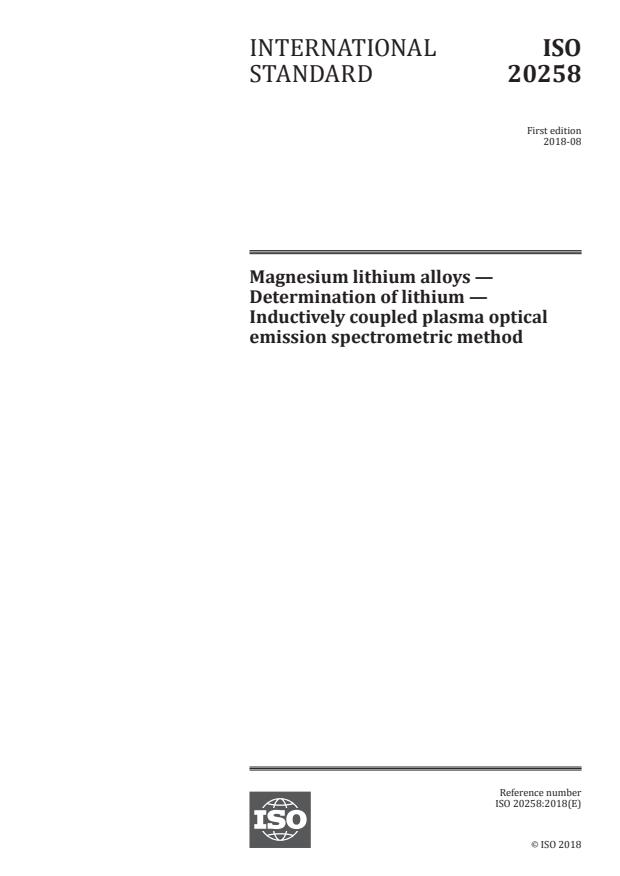
INTERNATIONAL ISO
STANDARD 20258
First edition
2018-08
Magnesium lithium alloys —
Determination of lithium —
Inductively coupled plasma optical
emission spectrometric method
Reference number
©
ISO 2018
© ISO 2018
All rights reserved. Unless otherwise specified, or required in the context of its implementation, no part of this publication may
be reproduced or utilized otherwise in any form or by any means, electronic or mechanical, including photocopying, or posting
on the internet or an intranet, without prior written permission. Permission can be requested from either ISO at the address
below or ISO’s member body in the country of the requester.
ISO copyright office
CP 401 • Ch. de Blandonnet 8
CH-1214 Vernier, Geneva
Phone: +41 22 749 01 11
Fax: +41 22 749 09 47
Email: copyright@iso.org
Website: www.iso.org
Published in Switzerland
ii © ISO 2018 – All rights reserved
Contents Page
Foreword .iv
Introduction .v
1 Scope . 1
2 Normative references . 1
3 Terms and definitions . 1
4 Principle . 1
5 Reagents . 2
6 Apparatus . 2
7 Sampling and sample preparation . 3
8 Procedure. 3
8.1 General . 3
8.2 Test portion . 4
8.3 Determination . 4
8.3.1 Preparation of the test solution . 4
8.3.2 Preparation of the calibration solutions . 4
8.4 Adjustment of the apparatus . 4
8.5 Measurement of the calibration solutions . 4
8.6 Calibration curve . 5
8.7 Measurements of the test solution . 5
9 Expression of results . 5
9.1 Method of calculation . 5
9.2 Precision . 5
10 Test report . 6
Annex A (normative) Inductively coupled plasma optical emission spectrometer —
Performance criteria to be checked . 7
Annex B (informative) Information on the precision test . 9
Annex C (informative) Graphical representation of precision data .10
Bibliography .11
Foreword
ISO (the International Organization for Standardization) is a worldwide federation of national standards
bodies (ISO member bodies). The work of preparing International Standards is normally carried out
through ISO technical committees. Each member body interested in a subject for which a technical
committee has been established has the right to be represented on that committee. International
organizations, governmental and non-governmental, in liaison with ISO, also take part in the work.
ISO collaborates closely with the International Electrotechnical Commission (IEC) on all matters of
electrotechnical standardization.
The procedures used to develop this document and those intended for its further maintenance are
described in the ISO/IEC Directives, Part 1. In particular, the different approval criteria needed for the
different types of ISO documents should be noted. This document was drafted in accordance with the
editorial rules of the ISO/IEC Directives, Part 2 (see www .iso .org/directives).
Attention is drawn to the possibility that some of the elements of this document may be the subject of
patent rights. ISO shall not be held responsible for identifying any or all such patent rights. Details of
any patent rights identified during the development of the document will be in the Introduction and/or
on the ISO list of patent declarations received (see www .iso .org/patents).
Any trade name used in this document is information given for the convenience of users and does not
constitute an endorsement.
For an explanation of the voluntary nature of standards, the meaning of ISO specific terms and
expressions related to conformity assessment, as well as information about ISO’s adherence to the
World Trade Organization (WTO) principles in the Technical Barriers to Trade (TBT) see www .iso
.org/iso/foreword .html.
This document was prepared by Technical Committee ISO/TC 79, Light metals and their alloys,
Subcommittee SC 5, Magnesium and alloys of cast or wrought magnesium.
Any feedback or questions on this document should be directed to the user’s national standards body. A
complete listing of these bodies can be found at www .iso .org/members .html.
iv © ISO 2018 – All rights reserved
Introduction
Magnesium lithium alloys are the lightest metallic materials in the world and show several
advantageous properties such as: excellent rigidity, high electric and thermal conductivity, good
damping, electromagnetic, shielding, welding, matching and cold forming performances. Lithium is the
most important element in magnesium lithium alloys, and can improve the deformation capability of
alloys with further a decrease in weight. With the increasing demands of the world today for lightweight
materials, energy saving, environmental protection and sustainable development, magnesium lithium
alloys show broad application prospects in the fields of materials, transportation, electronics, medical
products and so on.
Chemical compositions of magnesium and its alloys are widely standardized from major to trace
contents in international and other national standards. However, there is no standard dealing with the
determination of lithium content in magnesium lithium alloys.
INTERNATIONAL STANDARD ISO 20258:2018(E)
Magnesium lithium alloys — Determination of lithium
— Inductively coupled plasma optical emission
spectrometric method
1 Scope
This document specifies a method for the determination of lithium contents in magnesium lithium
alloys by inductively coupled plasma (ICP) optical emission spectrometry.
The method is applicable to the determination of lithium content between 3,0 % and 16,0 % (mass
fraction) in magnesium lithium alloys.
2 Normative references
The following documents are referred to in the text in such a way that some or all of their content
constitutes requirements of this document. For dated references, only the edition cited applies. For
undated references, the latest edition of the referenced document (including any amendments) applies.
ISO 648, Laboratory glassware — Single-volume pipettes
ISO 1042, Laboratory glassware — One-mark volumetric flasks
ISO 3696, Water for analytical laboratory use — Specification and test methods
3 Terms and definitions
No terms and definitions are listed in this document.
ISO and IEC maintain terminological databases for use in standardization at the following addresses:
— ISO Online browsing platform: available at https: //www .iso .org/obp
— IEC Electropedia: available at http: //www .electropedia .org/
4 Principle
Dissolution of a test portion in hydrochloric acid. Nebulization of the solution into an ICP optical
emission spectrometer and measurement of the intensity of the emitted light from lithium.
Calibration based on a very close matrix matching of the calibration solutions to the sample shall be
carried out. The advantage with this procedure is that all possible interferences from the matrix will be
compensated, which will result in high accuracy. This is important to spectral interferences, which can
be severe in highly alloyed matrixes.
All spectral interferences shall be kept at a minimum level. Therefore, it is essential to select the
appropriate wavelengths. The wavelengths generally used for lithium are shown in Table 1 together
with the possible interferences. Depending on the performance of each spectrometer, other wavelengths
may be used, provided that interferences, sensitivity, resolution and linearity criteria have been
carefully investigated.
5 Reagents
During the analysis, use only reagents of recognized analytical grade and only grade 2 water as
specified in ISO 3696, or water of equivalent purity.
5.1 Pure magnesium, purity ≥ 99,99 % (mass fraction), free from lithium.
5.2 Lithium carbonate, purity ≥ 99,99 % (mass fraction).
5.3 Hydrochloric acid, ρ about 1,19 g/ml.
5.4 Hydrochloric acid solution 1 + 1, add 500 ml of hydrochloric acid (5.3) to 500 ml of water.
5.5 Hydrogen peroxide, ρ about 1,13 g/ml.
5.6 Magnesium base solution, corresponding to 2,5 g of magnesium per litre.
Weigh, to the nearest of 1 mg, 0,5 g of pure magnesium (5.1) and transfer into a 300 ml glass beaker.
Add about 50 ml of water and, in small portions, 25 ml of hydrochloric acid (5.4). Cover with a watch-
glass and, if necessary, heat gently to complete the dissolution. Add a few drops of hydrogen peroxide
(5.5) and boil for 5 min. Cool and transfer quantitatively into a 200 ml one-mark volumetric flask. Dilute
to the mark with water and mix.
1 ml of this solution contains 2,5 mg of magnesium.
5.7 Magnesium base solution, corresponding to 0,25 g of magnesium per litre.
Transfer 10 ml of the solution (5.6) to a 100 m
...
Questions, Comments and Discussion
Ask us and Technical Secretary will try to provide an answer. You can facilitate discussion about the standard in here.
Loading comments...