

ISO 5832-5:2022
(Main)Implants for surgery — Metallic materials — Part 5: Wrought cobalt-chromium-tungsten-nickel
General Information
- Abstract
This document specifies the characteristics of, and corresponding test methods for, wrought cobalt-chromium-tungsten-nickel alloy for use in the manufacture of surgical implants. NOTE The tensile properties of a sample obtained from a finished product made of this alloy do not necessarily comply with those specified in this document.
- Status
- Published
- Publication Date
- 17-Mar-2022
- Technical Committee
- ISO/TC 150/SC 1 - Materials
- Drafting Committee
- ISO/TC 150/SC 1 - Materials
- Current Stage
- 6060 - International Standard published
- Start Date
- 18-Mar-2022
- Due Date
- 14-Nov-2021
- Completion Date
- 18-Mar-2022
Overview
ISO 5832-5:2022 - "Implants for surgery - Metallic materials - Part 5: Wrought cobalt-chromium-tungsten-nickel" specifies the required characteristics and corresponding test methods for wrought Co–Cr–W–Ni alloy intended for the manufacture of surgical implants. The standard covers chemical composition, microstructure, inclusion limits and tensile properties, and references specific test methods for verification. Note: tensile results taken from finished devices may not necessarily match the raw‑material limits in this document.
Key topics and requirements
- Scope: Defines requirements for wrought cobalt‑chromium‑tungsten‑nickel alloy used in surgical implants.
- Chemical composition (heat analysis): chromium 19.00–21.00%, tungsten 14.00–16.00%, nickel 9.00–11.00%, iron ≤3.00%, carbon 0.05–0.15%, manganese 1.00–2.00%, plus limits for Si, S, P and cobalt as balance.
- Microstructure:
- Grain size (annealed condition) measured per ISO 643: index 5 or finer.
- Inclusion content assessed per ISO 4967:2013 (Method A) with thin inclusion limits of 1.5 for sulfides, aluminates, silicates and globular oxides; thick inclusions allowed up to 1.0.
- Tensile properties (annealed condition): tensile strength Rm ≥ 860 MPa, yield/proof strength Rp0.2 ≥ 310 MPa, minimum elongation A ≥ 30%. Testing per ISO 6892‑1; retest rules are specified for failed specimens.
- Test methods and conformity: Tables in the standard map each requirement to recognized analytical or ISO test methods and describe sampling and retest procedures.
Applications and who uses this standard
ISO 5832-5 is used by:
- Medical device and implant manufacturers specifying raw materials for surgical implants.
- Material suppliers and foundries certifying wrought Co–Cr–W–Ni alloy heat analysis and microstructure.
- Quality assurance, regulatory and testing laboratories performing acceptance testing and certification.
- Design and R&D teams that need baseline material properties when selecting alloys for biocompatible implants.
Practical applications include specification and acceptance of metallic materials for load-bearing surgical components, where controlled composition, microstructure and mechanical properties are critical for performance and regulatory compliance.
Related standards
- ISO 643 - Micrographic determination of apparent grain size
- ISO 4967:2013 - Determination of non‑metallic inclusions (micrographic)
- ISO 6892-1 - Metallic materials - Tensile testing at room temperature
- Other parts of the ISO 5832 series for metallic implant materials
Keywords: ISO 5832-5, wrought cobalt-chromium-tungsten-nickel, implants for surgery, surgical implants, metallic materials, tensile properties, chemical composition, ISO 643, ISO 4967, ISO 6892-1.
Relations
- Consolidated By
ISO/TR 41030:2024 - Facility management — Existing performance management in facility management organizations — State of the industry - Effective Date
- 18-May-2024
- Effective Date
- 23-Apr-2020
Get Certified
Connect with accredited certification bodies for this standard

BSI Group
BSI (British Standards Institution) is the business standards company that helps organizations make excellence a habit.

TÜV Rheinland
TÜV Rheinland is a leading international provider of technical services.

TÜV SÜD
TÜV SÜD is a trusted partner of choice for safety, security and sustainability solutions.
Sponsored listings
Frequently Asked Questions
ISO 5832-5:2022 is a standard published by the International Organization for Standardization (ISO). Its full title is "Implants for surgery — Metallic materials — Part 5: Wrought cobalt-chromium-tungsten-nickel". This standard covers: This document specifies the characteristics of, and corresponding test methods for, wrought cobalt-chromium-tungsten-nickel alloy for use in the manufacture of surgical implants. NOTE The tensile properties of a sample obtained from a finished product made of this alloy do not necessarily comply with those specified in this document.
This document specifies the characteristics of, and corresponding test methods for, wrought cobalt-chromium-tungsten-nickel alloy for use in the manufacture of surgical implants. NOTE The tensile properties of a sample obtained from a finished product made of this alloy do not necessarily comply with those specified in this document.
ISO 5832-5:2022 is classified under the following ICS (International Classification for Standards) categories: 11.040.40 - Implants for surgery, prosthetics and orthotics. The ICS classification helps identify the subject area and facilitates finding related standards.
ISO 5832-5:2022 has the following relationships with other standards: It is inter standard links to ISO/TR 41030:2024, ISO 5832-5:2005. Understanding these relationships helps ensure you are using the most current and applicable version of the standard.
ISO 5832-5:2022 is available in PDF format for immediate download after purchase. The document can be added to your cart and obtained through the secure checkout process. Digital delivery ensures instant access to the complete standard document.
Standards Content (Sample)
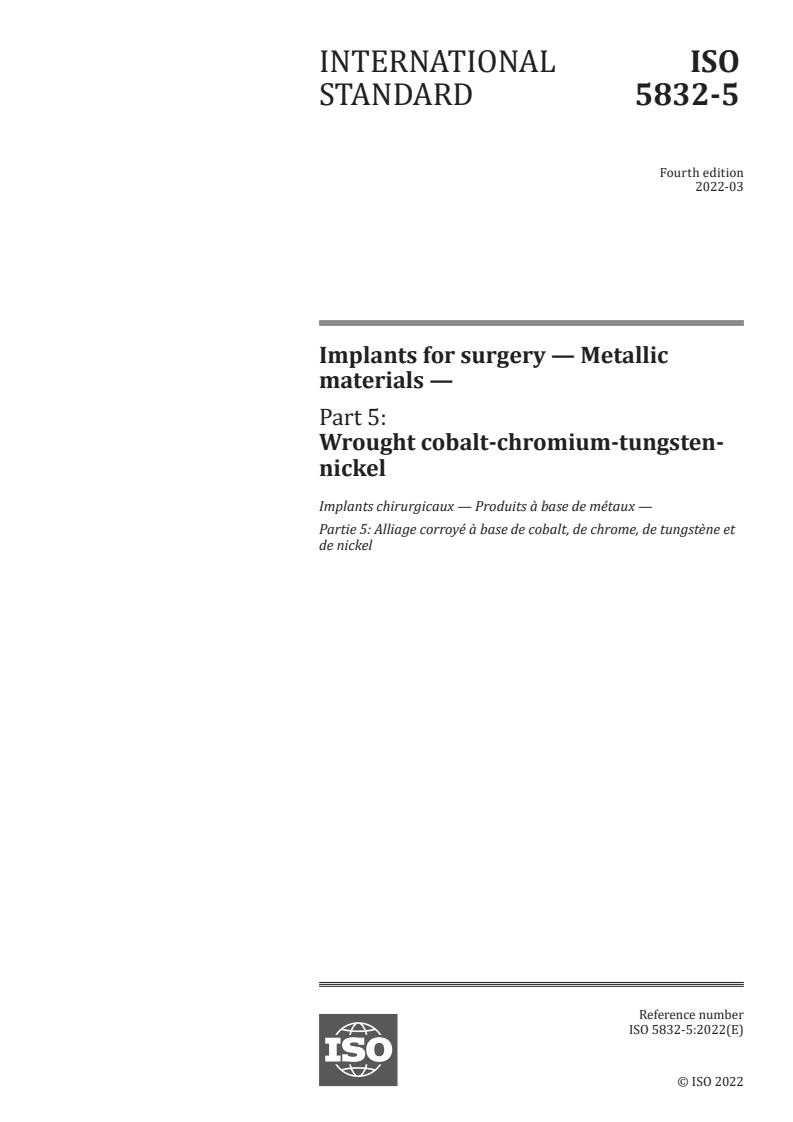
INTERNATIONAL ISO
STANDARD 5832-5
Fourth edition
2022-03
Implants for surgery — Metallic
materials —
Part 5:
Wrought cobalt-chromium-tungsten-
nickel
Implants chirurgicaux — Produits à base de métaux —
Partie 5: Alliage corroyé à base de cobalt, de chrome, de tungstène et
de nickel
Reference number
© ISO 2022
All rights reserved. Unless otherwise specified, or required in the context of its implementation, no part of this publication may
be reproduced or utilized otherwise in any form or by any means, electronic or mechanical, including photocopying, or posting on
the internet or an intranet, without prior written permission. Permission can be requested from either ISO at the address below
or ISO’s member body in the country of the requester.
ISO copyright office
CP 401 • Ch. de Blandonnet 8
CH-1214 Vernier, Geneva
Phone: +41 22 749 01 11
Email: copyright@iso.org
Website: www.iso.org
Published in Switzerland
ii
Contents Page
Foreword .iv
Introduction .v
1 Scope . 1
2 Normative references . 1
3 Terms and definitions . 1
4 Chemical composition .1
5 Microstructure. 2
5.1 Grain size index . 2
5.2 Inclusion content . 2
6 Tensile properties . 2
7 Test methods . 3
iii
Foreword
ISO (the International Organization for Standardization) is a worldwide federation of national standards
bodies (ISO member bodies). The work of preparing International Standards is normally carried out
through ISO technical committees. Each member body interested in a subject for which a technical
committee has been established has the right to be represented on that committee. International
organizations, governmental and non-governmental, in liaison with ISO, also take part in the work.
ISO collaborates closely with the International Electrotechnical Commission (IEC) on all matters of
electrotechnical standardization.
The procedures used to develop this document and those intended for its further maintenance are
described in the ISO/IEC Directives, Part 1. In particular, the different approval criteria needed for the
different types of ISO documents should be noted. This document was drafted in accordance with the
editorial rules of the ISO/IEC Directives, Part 2 (see www.iso.org/directives).
Attention is drawn to the possibility that some of the elements of this document may be the subject of
patent rights. ISO shall not be held responsible for identifying any or all such patent rights. Details of
any patent rights identified during the development of the document will be in the Introduction and/or
on the ISO list of patent declarations received (see www.iso.org/patents).
Any trade name used in this document is information given for the convenience of users and does not
constitute an endorsement.
For an explanation of the voluntary nature of standards, the meaning of ISO specific terms and
expressions related to conformity assessment, as well as information about ISO's adherence to
the World Trade Organization (WTO) principles in the Technical Barriers to Trade (TBT), see
www.iso.org/iso/foreword.html.
This document was prepared by Technical Committee ISO/TC 150, Implants for surgery, Subcommittee
SC 1, Materials.
This fourth edition cancels and replaces the third edition (ISO 5832-5:2005) which has been technically
revised. The main changes are as follows:
— the introduction has been updated;
— limits for carbon, silicon, and manganese in Table 1 have been updated;
— requirements of inclusion content in Table 2 have been updated;
— tensile properties Clause 6 and Table 3 have b
...