

ISO 23103:2020
(Main)Space link extension — Cross support transfer service — Specification framework
General Information
- Abstract
1.1.1 This Recommended Standard defines, in an abstract manner, a CSTS in terms of: a) the procedures necessary to provide the service; b) the states of the service; c) the behavior of each procedure; d) the states of the procedures; e) the operations necessary to constitute the procedures; and f) the parameters associated with each operation. 1.1.2 It does not specify: a) individual application services, implementations, or products; b) the implementation of entities or interfaces within real systems; c) the methods or technologies required to acquire data; d) the methods or technologies required to provide a suitable environment for communications; or e) the management activities required to schedule and configure services.
- Status
- Published
- Publication Date
- 30-Jan-2020
- Technical Committee
- ISO/TC 20/SC 13 - Space data and information transfer systems
- Drafting Committee
- ISO/TC 20/SC 13 - Space data and information transfer systems
- Current Stage
- 9093 - International Standard confirmed
- Start Date
- 17-Sep-2025
- Completion Date
- 29-Aug-2026
Buy Documents

ISO 23103:2020 - Space link extension -- Cross support transfer service -- Specification framework

ISO 23103:2020 - Space link extension — Cross support transfer service — Specification framework/31/2020
Overview - ISO 23103:2020 (Space link extension - Cross support transfer service - Specification framework)
ISO 23103:2020 (derived from CCSDS 921.1) defines a specification framework for the Cross Support Transfer Service (CSTS) used in space communications. The standard describes, in an abstract and implementation‑independent way, the service procedures, service and procedure states, procedure behaviors, constituent operations, and the parameters associated with each operation. It explicitly does not define concrete application services, product implementations, data‑acquisition technologies, communications environments, or service scheduling/management techniques.
Keywords: ISO 23103:2020, Cross Support Transfer Service, CSTS, space link extension, space communications, CCSDS.
Key topics and technical requirements
- Abstract service model: Defines CSTS in terms of procedures, states and behaviors rather than mandating wire formats or specific technologies.
- Common operations: Framework-level operations such as BIND/UNBIND, START/STOP, TRANSFER-DATA, PROCESS-DATA, NOTIFY, GET, and EXECUTE-DIRECTIVE are described conceptually and tied to parameters and headers.
- Procedures and state machines: Includes association control, unbuffered and buffered data delivery, data processing (buffered and sequence‑controlled), information query, cyclic reporting, notifications and event throwing - each with state tables and required operations.
- Protocol description and configuration: Guidance for constructing protocol descriptions, operation headers, extension parameters and configuration parameters.
- Supporting artifacts: Normative annexes provide an Implementation Conformance Statement (ICS) proforma, production status, qualified parameters, object identifier (OID) definitions, parameter and event composition rules, and data type definitions.
- Security and governance notes: Informative annex covering security, SANA (security architecture), and patent considerations.
Practical applications
- Provides a reference framework for designing cross‑agency or cross‑domain transfer services in ground and space segments.
- Useful for producing interoperable service specifications, API blueprints, and interface control documents (ICDs) without prescribing technologies.
- Supports development of middleware, ground‑station software, mission operations support tools, and inter‑agency cross‑support arrangements where protocol behavior and operational states must be standardized.
Who should use ISO 23103:2020
- Space agencies and mission operations teams
- Ground segment and communications system architects
- Satellite operators and systems integrators
- Software architects implementing cross‑support services and middleware
- Standards developers and test/conformance planners
Related standards
- CCSDS family of space data and information transfer standards (ISO 23103 is adopted from CCSDS 921.1)
- ISO/TC 20/SC 13 work on space data systems and interfaces
ISO 23103:2020 is a practical, implementation‑agnostic tool for achieving interoperable cross‑support services in space communications and for aligning system behavior, operations, and conformance evidence across organizations.
Buy Documents
ISO 23103:2020 - Space link extension -- Cross support transfer service -- Specification framework
ISO 23103:2020 - Space link extension — Cross support transfer service — Specification framework/31/2020
Get Certified
Connect with accredited certification bodies for this standard

BUREAU VERITAS Certification Germany
Bureau Veritas certification in Germany.

Element Materials Technology
Materials testing and product certification.

AQMS Ltd.
AQMS provides ISO certification to SMEs across the UK.
Sponsored listings
Frequently Asked Questions
ISO 23103:2020 is a standard published by the International Organization for Standardization (ISO). Its full title is "Space link extension — Cross support transfer service — Specification framework". This standard covers: 1.1.1 This Recommended Standard defines, in an abstract manner, a CSTS in terms of: a) the procedures necessary to provide the service; b) the states of the service; c) the behavior of each procedure; d) the states of the procedures; e) the operations necessary to constitute the procedures; and f) the parameters associated with each operation. 1.1.2 It does not specify: a) individual application services, implementations, or products; b) the implementation of entities or interfaces within real systems; c) the methods or technologies required to acquire data; d) the methods or technologies required to provide a suitable environment for communications; or e) the management activities required to schedule and configure services.
1.1.1 This Recommended Standard defines, in an abstract manner, a CSTS in terms of: a) the procedures necessary to provide the service; b) the states of the service; c) the behavior of each procedure; d) the states of the procedures; e) the operations necessary to constitute the procedures; and f) the parameters associated with each operation. 1.1.2 It does not specify: a) individual application services, implementations, or products; b) the implementation of entities or interfaces within real systems; c) the methods or technologies required to acquire data; d) the methods or technologies required to provide a suitable environment for communications; or e) the management activities required to schedule and configure services.
ISO 23103:2020 is classified under the following ICS (International Classification for Standards) categories: 49.140 - Space systems and operations. The ICS classification helps identify the subject area and facilitates finding related standards.
ISO 23103:2020 is available in PDF format for immediate download after purchase. The document can be added to your cart and obtained through the secure checkout process. Digital delivery ensures instant access to the complete standard document.
Standards Content (Sample)
INTERNATIONAL ISO
STANDARD 23103
First edition
2020-01
Space link extension — Cross support
transfer service — Specification
framework
Reference number
©
ISO 2020
© ISO 2020
All rights reserved. Unless otherwise specified, or required in the context of its implementation, no part of this publication may
be reproduced or utilized otherwise in any form or by any means, electronic or mechanical, including photocopying, or posting
on the internet or an intranet, without prior written permission. Permission can be requested from either ISO at the address
below or ISO’s member body in the country of the requester.
ISO copyright office
CP 401 • Ch. de Blandonnet 8
CH-1214 Vernier, Geneva
Phone: +41 22 749 01 11
Fax: +41 22 749 09 47
Email: copyright@iso.org
Website: www.iso.org
Published in Switzerland
ii © ISO 2020 – All rights reserved
Foreword
ISO (the International Organization for Standardization) is a worldwide federation of national standards
bodies (ISO member bodies). The work of preparing International Standards is normally carried out
through ISO technical committees. Each member body interested in a subject for which a technical
committee has been established has the right to be represented on that committee. International
organizations, governmental and non-governmental, in liaison with ISO, also take part in the work.
ISO collaborates closely with the International Electrotechnical Commission (IEC) on all matters of
electrotechnical standardization.
The procedures used to develop this document and those intended for its further maintenance are
described in the ISO/IEC Directives, Part 1. In particular, the different approval criteria needed for the
different types of ISO documents should be noted (see www.iso.org/directives).
Attention is drawn to the possibility that some of the elements of this document may be the subject of
patent rights. ISO shall not be held responsible for identifying any or all such patent rights. Details of any
patent rights identified during the development of the document will be in the Introduction and/or on
the ISO list of patent declarations received (see www.iso.org/patents).
Any trade name used in this document is information given for the convenience of users and does not
constitute an endorsement.
For an explanation of the voluntary nature of standards, the meaning of ISO specific terms and
expressions related to conformity assessment, as well as information about ISO's adherence to the
World Trade Organization (WTO) principles in the Technical Barriers to Trade (TBT) see
www.iso.org/iso/foreword.html.
This document was prepared by Consultative Committee for Space Data Systems (CCSDS) (as CCSDS
921.1-B-1, April 2017) and drafted in accordance with its editorial rules. It was assigned to Technical
Committee ISO/TC 20, Space vehicles, Subcommittee SC 13, Space data and information transfer systems
and adopted under the “fast-track procedure”.
Any feedback or questions on this document should be directed to the user’s national standards body.
A complete listing of these bodies can be found at www.iso.org/members.html.
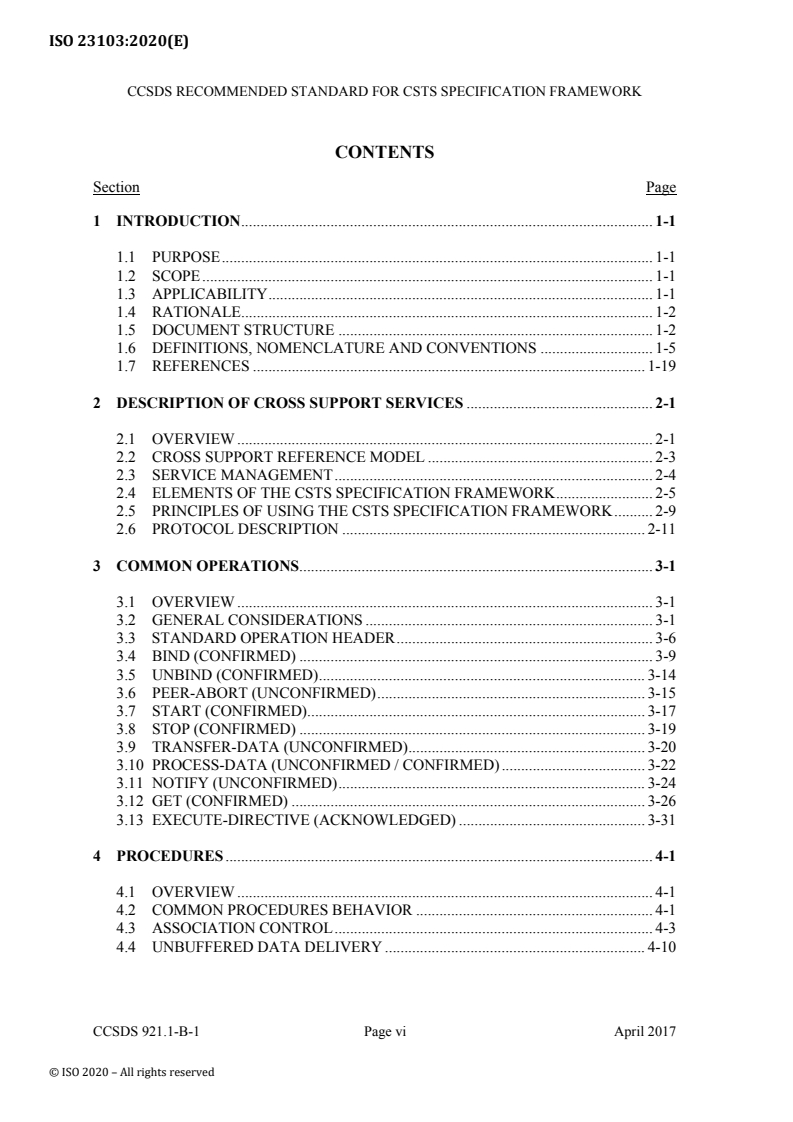
CCSDS RECOMMENDED STANDARD FOR CSTS SPECIFICATION FRAMEWORK
CONTENTS
Section Page
1 INTRODUCTION . 1-1
1.1 PURPOSE . 1-1
1.2 SCOPE . 1-1
1.3 APPLICABILITY . 1-1
1.4 RATIONALE . 1-2
1.5 DOCUMENT STRUCTURE . 1-2
1.6 DEFINITIONS, NOMENCLATURE AND CONVENTIONS . 1-5
1.7 REFERENCES . 1-19
2 DESCRIPTION OF CROSS SUPPORT SERVICES . 2-1
2.1 OVERVIEW . 2-1
2.2 CROSS SUPPORT REFERENCE MODEL . 2-3
2.3 SERVICE MANAGEMENT . 2-4
2.4 ELEMENTS OF THE CSTS SPECIFICATION FRAMEWORK . 2-5
2.5 PRINCIPLES OF USING THE CSTS SPECIFICATION FRAMEWORK . 2-9
2.6 PROTOCOL DESCRIPTION . 2-11
3 COMMON OPERATIONS . 3-1
3.1 OVERVIEW . 3-1
3.2 GENERAL CONSIDERATIONS . 3-1
3.3 STANDARD OPERATION HEADER . 3-6
3.4 BIND (CONFIRMED) . 3-9
3.5 UNBIND (CONFIRMED) . 3-14
3.6 PEER-ABORT (UNCONFIRMED) . 3-15
3.7 START (CONFIRMED) . 3-17
3.8 STOP (CONFIRMED) . 3-19
3.9 TRANSFER-DATA (UNCONFIRMED) . 3-20
3.10 PROCESS-DATA (UNCONFIRMED / CONFIRMED) . 3-22
3.11 NOTIFY (UNCONFIRMED) . 3-24
3.12 GET (CONFIRMED) . 3-26
3.13 EXECUTE-DIRECTIVE (ACKNOWLEDGED) . 3-31
4 PROCEDURES . 4-1
4.1 OVERVIEW . 4-1
4.2 COMMON PROCEDURES BEHAVIOR . 4-1
4.3 ASSOCIATION CONTROL . 4-3
4.4 UNBUFFERED DATA DELIVERY . 4-10
CCSDS 921.1-B-1 Page vi April 2017
CCSDS RECOMMENDED STANDARD FOR CSTS SPECIFICATION FRAMEWORK
CONTENTS (continued)
Section Page
4.5 BUFFERED DATA DELIVERY . 4-15
4.6 DATA PROCESSING . 4-39
4.7 BUFFERED DATA PROCESSING. 4-54
4.8 SEQUENCE-CONTROLLED DATA PROCESSING . 4-66
4.9 INFORMATION QUERY . 4-83
4.10 CYCLIC REPORT . 4-87
4.11 NOTIFICATION . 4-98
4.12 THROW EVENT . 4-109
ANNEX A IMPLEMENTATION CONFORMANCE STATEMENT
PROFORMA (NORMATIVE) . A-1
ANNEX B PRODUCTION STATUS (NORMATIVE) .B-1
ANNEX C QUALIFIED PARAMETERS (NORMATIVE) . C-1
ANNEX D OBJECT IDENTIFIERS DEFINITION (NORMATIVE) . D-1
ANNEX E COMPOSITION OF PARAMETER, EVENT, AND DIRECTIVE
NAMES AND PARAMETER AND EVENT LISTS (NORMATIVE) .E-1
ANNEX F DATA TYPES DEFINITION (NORMATIVE) . F-1
ANNEX G SERVICE STATE TABLES (NORMATIVE) . G-1
ANNEX H SECURITY, SANA, AND PATENT CONSIDERATIONS
(INFORMATIVE) . H-1
ANNEX I INFORMATIVE REFERENCES (INFORMATIVE) . I-1
ANNEX J INDEX TO DEFINITIONS (INFORMATIVE) . J-1
ANNEX K ACRONYMS (INFORMATIVE) . K-1
ANNEX L OBJECT IDENTIFIERS (INFORMATIVE) .L-1
ANNEX M PUBLISHED IDENTIFIERS FOR FUNCTIONAL
RESOURCES REGISTERED UNDER THE
CROSSSUPPORTFUNCTIONALITIES NODE (INFORMATIVE) . M-1
Figure
1-1 Cross Support Service Documentation . 1-4
2-1 CSTS Specification Framework Concept . 2-2
2-2 Service and Procedure States (Stateful Prime Procedure) . 2-13
2-3 Service and Procedure States (Stateless Prime Procedure) . 2-14
2-4 Communications Realization of a Cross Support Transfer Service . 2-17
4-1 Services Using a Buffered Data Delivery Procedure . 4-18
4-2 Real-Time and Complete Buffered Data Delivery Service Instances
and Supporting Buffering Mechanisms . 4-19
A-1 Production Status Diagram .B-1
C-1 CSTS and Cross Support Resources Root Object Identifier Tree . D-2
C-2 ‘procedures’ Subtree . D-6
CCSDS 921.1-B-1 Page vii April 2017
CCSDS RECOMMENDED STANDARD FOR CSTS SPECIFICATION FRAMEWORK
CONTENTS (continued)
Figure Page
C-3 ‘fwProceduresFunctionalities’ Subtree . D-8
C-4 ‘services’ Subtree . D-9
C-5 ‘service procedures’ Subtree . D-10
C-6 ‘crossSupportFunctionalities’ Subtree . D-12
C-7 ‘agenciesFunctionalities’ Subtree . D-14
L-1 Cross Support Services Part of the CCSDS Object Identifiers Tree . L-1
L-2 CSS Object Identifiers Tree . L-1
L-3 CSTS Object Identifiers Tree . L-2
L-4 CSTS Specification Framework Object Identifiers Tree . L-3
L-5 CSTS Services Object Identifiers Tree . L-4
L-6 CSTS Published Identifiers—Object Identifiers Tree . L-6
M-1 Example Cross Support Functional Resources . M-2
M-2 Subcarrier Related Parameters of the Rtn401SpaceLinkCarrierRecpt
Functional Resource . M-3
Table
2-1 Common Operations Defined by the CSTS Specification Framework . 2-6
2-2 Common Procedures Defined by the CSTS Specification Framework . 2-8
2-3 Use of Operations by Common Procedures . 2-9
3-1 Standard Confirmed Operation Header Parameters . 3-6
3-2 Standard Unconfirmed Operation Header Parameters . 3-6
3-3 BIND Operation Parameters . 3-10
3-4 UNBIND Operation Parameters . 3-14
3-5 PEER-ABORT Operation Parameters . 3-15
3-6 START Operation Parameters . 3-18
3-7 STOP Operation Parameters . 3-19
3-8 TRANSFER-DATA Operation Parameters . 3-20
3-9 PROCESS-DATA Operation Parameters . 3-22
3-10 NOTIFY Operation Parameters . 3-24
3-11 GET Operation Parameters . 3-29
3-12 EXECUTE-DIRECTIVE Operation Parameters . 3-32
4-1 Association Control Procedure Required Operations . 4-7
4-2 Association Control Procedure Configuration Parameters . 4-7
4-3 Association Control Procedure State Table . 4-8
4-4 Procedure State Table Incoming Event Description References . 4-9
4-5 Procedure State Table Predicate Descriptions . 4-9
4-6 Procedure State Table Simple Action References . 4-9
4-7 Procedure State Table Compound Action Definitions . 4-9
4-8 Unbuffered Data Delivery Procedure Required Operations . 4-12
CCSDS 921.1-B-1 Page viii April 2017
CCSDS RECOMMENDED STANDARD FOR CSTS SPECIFICATION FRAMEWORK
CONTENTS (continued)
Table Page
4-9 Unbuffered Data Delivery Procedure State Table . 4-13
4-10 Procedure State Table Incoming Event Description References . 4-13
4-11 Procedure State Table Predicate Descriptions . 4-13
4-12 Procedure State Table Boolean Flags . 4-14
4-13 Procedure State Table Simple Action References . 4-14
4-14 Buffered Data Delivery Procedure Required Operations . 4-25
4-15 START Extension Parameters . 4-25
4-16 Buffered Data Delivery Procedure Configuration Parameters . 4-31
4-17 Buffered Data Delivery Procedure State Table . 4-32
4-18 Procedure State Table Incoming Event Description References . 4-34
4-19 Procedure State Table Predicate Descriptions . 4-34
4-20 Procedure State Table Boolean Flags . 4-34
4-21 Procedure State Table Simple Action References . 4-35
4-22 Procedure State Table Compound Action Definitions . 4-35
4-23 Data Processing Procedure Required Operations . 4-45
4-24 PROCESS-DATA Extension Parameter . 4-45
4-25 NOTIFY Extension Parameters . 4-46
4-26 Data Processing Procedure Configuration Parameters . 4-50
4-27 Data Processing Procedure State Table . 4-51
4-28 Procedure State Table Incoming Event Description References . 4-52
4-29 Procedure State Table Predicate Descriptions . 4-52
4-30 Procedure State Table Boolean Flags . 4-53
4-31 Procedure State Table Simple Action References . 4-53
4-32 Procedure State Table Compound Action Definitions . 4-53
4-33 Buffered Data Processing Procedure Required Operations . 4-60
4-34 Buffered Data Processing Procedure Configuration Parameters . 4-61
4-35 Buffered Data Processing Procedure State Table . 4-62
4-36 Procedure State Table Incoming Event Description References . 4-64
4-37 Procedure State Table Predicate Descriptions . 4-64
4-38 Procedure State Table Boolean Flags . 4-65
4-39 Procedure State Table Simple Action References . 4-65
4-40 Procedure State Table Compound Action Definitions . 4-65
4-41 Sequence-Controlled Data Processing Procedure Required Operations . 4-72
4-42 START Extension Parameters . 4-72
4-43 PROCESS-DATA Invocation Extension Parameters . 4-73
4-44 PROCESS-DATA Return Extension Parameters . 4-73
4-45 Sequence-Controlled Data Processing Procedure Configuration Parameters . 4-79
4-46 Sequence-Controlled Data Processing Procedure State Table . 4-80
4-47 Procedure State Table Incoming Event Description References . 4-81
4-48 Procedure State Table Predicate Descriptions . 4-82
4-49 Procedure State Table Simple Action References . 4-82
CCSDS 921.1-B-1 Page ix April 2017
CCSDS RECOMMENDED STANDARD FOR CSTS SPECIFICATION FRAMEWORK
CONTENTS (continued)
Table Page
4-50 Procedure State Table Compound Action Definitions . 4-82
4-51 Information Query Procedure Required Operations . 4-85
4-52 Information Query Procedure Configuration Parameters . 4-85
4-53 Information Query Procedure State Table . 4-86
4-54 Procedure State Table Incoming Event Description References . 4-86
4-55 Procedure State Table Predicate Descriptions . 4-86
4-56 Procedure State Table Simple Action References . 4-86
4-57 Cyclic Report Procedure Required Operations . 4-92
4-58 START Extension Parameters . 4-93
4-59 Cyclic Report Procedure Configuration Parameters . 4-96
4-60 Cyclic Report Procedure State Table . 4-96
4-61 Procedure State Table Incoming Event Description References . 4-97
4-62 Procedure State Table Predicate Descriptions . 4-97
4-63 Procedure State Table Simple Action References . 4-97
4-64 Procedure State Table Compound Action Definitions . 4-97
4-65 Notification Procedure Required Operations . 4-103
4-66 START Extension Parameters . 4-103
4-67 Notification Procedure Configuration Parameters . 4-107
4-68 Notification Procedure State Table . 4-107
4-69 Procedure State Table Event Description References . 4-108
4-70 Procedure State Table Predicate Descriptions . 4-108
4-71 Procedure State Table Simple Action References . 4-108
4-72 Procedure State Table Compound Action Definitions . 4-108
4-73 Throw Event Procedure Required Operations . 4-111
4-74 Throw Event Procedure Configuration Parameters . 4-113
4-75 Throw Event Procedure State Table . 4-113
4-76 Procedure State Table Incoming Event Description References . 4-114
4-77 Procedure State Table Predicate Definitions . 4-114
4-78 Procedure State Table Simple Action References . 4-114
A-1 Production Status Semantic .B-2
A-2 Production Status Transitions .B-3
F-1 State Table for CSTSes with a Stateless Prime Procedure Instance . G-2
F-2 State Table for CSTSes with a Stateless Prime Procedure Instance:
Event Description References . G-2
F-3 State Table for CSTSes with a Stateless Prime Procedure Instance:
Predicate Descriptions . G-2
F-4 State Table for CSTSes with a Stateless Prime Procedure Instance:
Compound Action Definitions . G-3
F-5 State Table for CSTSes with a Stateful Prime Procedure Instance . G-4
CCSDS 921.1-B-1 Page x April 2017
CCSDS RECOMMENDED STANDARD FOR CSTS SPECIFICATION FRAMEWORK
CONTENTS (continued)
Table Page
F-6 State Table for CSTSes with a Stateful Prime Procedure Instance:
Event Description References . G-5
F-7 State Table for CSTSes with a Stateful Prime Procedure Instance:
Predicate Descriptions . G-5
F-8 State Table for CSTSes with a Stateful Prime Procedure Instance:
Compound Action Definitions . G-5
G-1 Identification of PICS . A-3
G-2 Identification of Implementation Under Test . A-4
G-3 Identification of Supplier . A-4
G-4 Identification of Specification . A-4
G-5 Required Procedures . A-5
G-6 Required PDUs . A-6
G-7 BIND Invocation Parameters . A-7
G-8 BIND Return Parameters . A-8
G-9 PEER-ABORT Invocation Parameters . A-9
G-10 UNBIND Invocation Parameters . A-9
G-11 UNBIND Return Parameters . A-10
G-12 EXECUTE-DIRECTIVE Invocation Parameters . A-11
G-13 EXECUTE-DIRECTIVE Acknowledgement Parameters . A-13
G-14 EXECUTE-DIRECTIVE Return Parameters . A-14
G-15 GET Invocation Parameters . A-16
G-16 GET Return Parameters . A-17
G-17 PROCESS-DATA Invocation Parameters . A-19
G-18 PROCESS-DATA Return Parameters . A-21
G-19 START Invocation Parameters . A-23
G-20 START Return Parameters . A-25
G-21 STOP Invocation Parameters . A-27
G-22 STOP Return Parameters . A-28
G-23 NOTIFY Invocation Parameters . A-29
G-24 TRANSFER-DATA Invocation Parameters . A-31
M-1 Specification of the Subcarrier Level Estimate Parameter . M-4
M-2 Specification of the Subcarrier Lock Status Parameter . M-5
CCSDS 921.1-B-1 Page xi April 2017
CCSDS RECOMMENDED STANDARD FOR CSTS SPECIFICATION FRAMEWORK
1 INTRODUCTION
1.1 PURPOSE
The purpose of this Recommended Standard is to define the various logical components, also
known within this Recommended Standard as procedures that are required for specifying
Cross Support Transfer Services (CSTSes).
1.2 SCOPE
1.2.1 This Recommended Standard defines, in an abstract manner, a CSTS in terms of:
a) the procedures necessary to provide the service;
b) the states of the service;
c) the behavior of each procedure;
d) the states of the procedures;
e) the operations necessary to constitute the procedures; and
f) the parameters associated with each operation.
1.2.2 It does not specify:
a) individual application services, implementations, or products;
b) the implementation of entities or interfaces within real systems;
c) the methods or technologies required to acquire data;
d) the methods or technologies required to provide a suitable environment for
communications; or
e) the management activities required to schedule and configure services.
1.3 APPLICABILITY
1.3.1 APPLICABILITY OF THIS RECOMMENDED STANDARD
This Recommended Standard provides a basis for the specification and development of Cross
Support Services that are intended to be used for developing real systems that implement
such services.
Implementation of a service based on the CSTS procedures defined in this Recommended
Standard in a real system additionally requires the availability of a communications service
to convey invocations and responses of the CSTS operations between the service user and the
service provider.
CCSDS 921.1-B-1 Page 1-1 April 2017
CCSDS RECOMMENDED STANDARD FOR CSTS SPECIFICATION FRAMEWORK
This Recommended Standard requires that such a communications service provides a reliable
protocol, i.e., that it ensures that invocations and responses of operations are transferred:
a) in sequence;
b) completely and with integrity;
c) without duplication;
d) with flow control that notifies the application layer in the event of congestion or
backpressure; and
e) with notification to the application layer in the event that communications between the
service user and the service provider are disrupted, possibly resulting in a loss of data.
It is the specific intent of this Recommended Standard to define the CSTS independently of any
particular communications services, protocols, technologies, or formatting of the data content.
1.3.2 LIMITS OF APPLICABILITY
This Recommended Standard specifies the CSTS procedures that may be used for the
definition of Cross Support Transfer Services. It does not intend to specify a Cross Support
Transfer Service.
1.4 RATIONALE
The goal of this Recommended Standard is to create a standard for interoperability between
various Agencies’ tracking stations or ground data handling systems and the consumers or
producers of spacecraft data and related monitor and/or control information.
1.5 DOCUMENT STRUCTURE
1.5.1 ORGANIZATION OF THIS DOCUMENT
This document is organized as follows:
a) section 1 presents the purpose, scope, applicability, and rationale of this
Recommended Standard and lists the definitions, conventions, and references;
b) section 2 provides an overview of the CSTS Specification Framework;
c) section 3 specifies the common operations to be used by Cross Support Transfer
Services;
d) section 4 specifies the procedures to be used by the Cross Support Transfer Services;
e) annex A contains the proforma of the Protocol Implementation Conformance
Statement;
CCSDS 921.1-B-1 Page 1-2 April 2017
CCSDS RECOMMENDED STANDARD FOR CSTS SPECIFICATION FRAMEWORK
f) annex B provides a formal specification of the production status;
g) annex C provides a formal specification of what a qualified parameter is;
h) annex D provides a formal specification of the Object Identifiers and the management
of their allocation;
i) annex E defines the composition of Functional Resource Names, Parameter Names,
Event Names, Parameter Lists, and Event Lists using Published Identifiers of the
appropriate types;
j) annex F provides a formal specification of data types for Protocol Data Units (PDUs)
for common operations using Abstract Syntax Notation One (ASN.1);
k) annex G provides a description of the service provider states;
l) annex H contains considerations related to security, SANA, and patents;
m) annex I provides a list of informative references;
n) annex J lists selected terms used in this Recommended Standard and identifies where
they are defined;
o) annex K lists acronyms used in this document;
p) annex L provides an informative list of Object Identifiers used by this Recommended
Standard;
q) annex M illustrates by means of examples the concept of Published Identifiers.
1.5.2 CROSS SUPPORT TRANSFER SERVICES DOCUMENTATION
The basic organization of the Cross Support Services documentation and the relationship to
CSTS documentation is shown in figure 1-1.
CCSDS 921.1-B-1 Page 1-3 April 2017
CCSDS RECOMMENDED STANDARD FOR CSTS SPECIFICATION FRAMEWORK
CrossSupportServices
Space
Cross Support
Cross Support Concept Communication Cross
Reference Model
Part 1: SLE Services Support Service
Part 1: SLE Services
Management
CrossSupportTransferServices
Cross Support Transfer
Service Specification
Cross Support Transfer
Framework Concept
Service Specification Suite
Cross Support Transfer
Service Specification
SLETransferServices
Framework
SLE Transfer Service
Guidelines for Specification
Specification Suite
of Cross Support Transfer
Services
SLE Internet Protocol for
Transfer Services
Key: Recommended Practice (Magenta)
Recommended Standard (Blue)
Informational Report (Green)
Figure 1-1: Cross Support Service Documentation
The Cross Support Services documents that are related to Cross Support Transfer Services are:
a) Cross Support Concept—Part 1: Space Link Extension Services (reference [I2]): A
report introducing the concepts of cross support and the SLE services. Many of the
concepts for the SLE transfer services have been adopted for the CSTSes (see h)
below).
b) Cross Support Reference Model—Part 1: Space Link Extension Services
(reference [1]): A Recommended Standard that defines the framework and
terminology for the specification of SLE services. Much of the framework and
terminology of this reference model has been adopted or adapted for CSTSes (see
1.6.1.3 and 2.2).
CCSDS 921.1-B-1 Page 1-4 April 2017
CCSDS RECOMMENDED STANDARD FOR CSTS SPECIFICATION FRAMEWORK
c) Space Communication Cross Support Service Management suite (references [I4], [I6]
and [I7]. Future data format Recommended Standards will specify the Service
Management Information Entities that are used to configure and schedule CSTSes.
d) The SLE Transfer Services suite: The SLE Transfer Services are a suite of Cross
Support Services that are used to transfer specific telecommand and telemetry
protocol data units. The SLE Transfer Services are closely related to the CSTS suite
in that they collectively define the set of operations that are the basis for the CSTS
Specification Framework. However, because of history (the SLE Transfer Services
were already specified and implemented prior to development of the CSTS
Specification Framework) the SLE Transfer Services are separated from CSTSes.
e) Space Link Extension—Internet Protocol for Transfer Services (reference [2]): A
Recommended Standard that defines a protocol for transfer of PDUs defined in the
Cross Support Transfer Services. This Recommended Standard was originally
developed to support SLE transfer services (hence the title), but it is also applicable
to use by Cross Support Transfer Services.
The documents specific to Cross Support Transfer Services are:
f) Cross Support Transfer Services Specification Framework (this Recommended
Standard): A Recommended Standard that defines the specification of the Cross
Support Transfer Service procedures;
g) Guideline for Specification of Cross Support Transfer Services (reference [I3]): A
Recommended Practice that defines the guidelines for construction of a Cross
Support Transfer Service based on the CSTS Specification Framework;
h) Cross Support Transfer Services Specification Framework Concept (reference [I5]):
A Report that provides tutorial material on the objectives and concepts of the CSTS
Specification Framework;
i) Cross Support Transfer Services Suite: The set of specifications for actual CSTSes
built from the procedures in the CSTS Specification Framework and in accordance
with the CSTS Guidelines.
1.6 DEFINITIONS, NOMENCLATURE AND CONVENTIONS
1.6.1 DEFINITIONS
1.6.1.1 Definitions from Open Systems Interconnection (OSI) Basic Reference Model
This Recommended Standard makes use of a number of terms defined in reference [3]. The
use of those terms in this Recommended Standard shall be understood in a generic sense, i.e.,
in the sense that those terms are generally applicable to technologies that provide for the
exchange of information between real systems. Those terms are:
a) abstract syntax;
CCSDS 921.1-B-1 Page 1-5 April 2017
CCSDS RECOMMENDED STANDARD FOR CSTS SPECIFICATION FRAMEWORK
b) application entity;
c) application layer;
d) flow control;
e) real system.
1.6.1.2 Definitions from Abstract Syntax Notation One
This Recommended Standard makes use of the following terms defined in reference [4]:
a) Abstract Syntax Notation One (ASN.1);
b) Object Identifier;
c) (data) type;
d) (data) value.
NOTE – In annex F of this Recommended Standard, ASN.1 is used for specifying the
abstract syntax of service operation invocations and responses.
1.6.1.3 Definitions from Cross Support Reference Model
This Recommended Standard makes use of the following terms defined in reference [1]:
a) binding;
b) initiator;
c) invoker;
d) operation;
e) performer;
f) physical channel;
g) responder;
h) service agreement;
i) service provider;
j) service user;
k) space link.
CCSDS 921.1-B-1 Page 1-6 April 2017
CCSDS RECOMMENDED STANDARD FOR CSTS SPECIFICATION FRAMEWORK
1.6.1.4 Definitions from CCSDS SANA Registry Management Policy
This Recommended Standard makes use of the following terms defined in reference [6]:
a) OID Registry;
b) owned by Agencies;
c) owned by xxx Area;
d) Review Authority;
e) Service Site and Aperture Registry;
f) Spacecraft Registry.
1.6.1.5 Definitions from SANA Role, Responsibilities, Policies, and Procedures
This Recommended Standard makes use of the following terms defined in reference [7]:
a) delegation;
b) registration rules;
c) registry;
d) SANA Steering Group.
1.6.1.6 Additional Definitions
1.6.1.6.1 acknowledgement: A confirmation that the invocation sent by the invoker was
accepted by the performer and will now be acted upon.
a) An acknowledgement with a negative result is also called a negative
acknowledgement.
b) An acknowledgement with a positive result is also called a positive
acknowledgement.
1.6.1.6.2 association: A cooperative relationship between a service-providing application
entity and a service-using application entity. An association is formed by exchanging service
protocol data units using an underlying communications service.
1.6.1.6.3 communications service: A capability that enables a CSTS-providing application
entity and a CSTS-using application entity to exchange information.
1.6.1.6.4 confirmed operation: An operation that requires the performer to return a report
of the operation outcome to the invoker. Confirmed operations are further classified as two-
phase operations and three-phase operations.
1.6.1.6.5 Cross Support Complex: A set of resources that are operated by a single
management authority to provide Cross Support Services to a space flight mission.
CCSDS 921.1-B-1 Page 1-7 April 2017
CCSDS RECOMMENDED STANDARD FOR CSTS SPECIFICATION FRAMEWORK
1.6.1.6.6 Cross Support Complex Management: The authority that negotiates the
provision of service packages with Cross Support Utilization Management and controls and
monitors the production and provision of the Cross Support Transfer Service instances by the
Functional Resources belonging to the Cross Support Complex.
1.6.1.6.7 Cross Support Service: A set of capabilities that an object that belongs to one
Space Agency provides to objects that belong to other Space Agencies by means of one or
more ports, in support of spacecraft operations. A Cross Support Service can also be used
within a given Space Agency.
1.6.1.6.8 Cross Support Transfer Service (CSTS): A subclass of Cross Support Service
that provides reliable, access-controlled transfer of spaceflight mission-related data between
ground element entities, realized through the invocation and performance of defined
operations in accordance with defined procedures. A CSTS is qualified by the kind of data it
transfers (e.g., telemetry frames, tracking data). A CSTS may optionally have capabilities to
coordinate and observe the behavior of the production with which this service is associated.
1.6.1.6.9 Cross Support Transfer Service instance: An instance of a specific Cross Support
Transfer Service type by means of which a Cross Support Complex provides the capability to
the service user to transfer the service-type specific spaceflight mission-related data.
1.6.1.6.10 Cross Support Service production: Performing of the data acquisition process
and/or the data transformation as necessary for the given type of Cross Support Transfer
Service.
1.6.1.6.11 Cross Support Utilization Management: The abstraction of the entities within a
real ground system that on behalf of the cross supported mission interacts with the Cross
Support Complex Management to arrange for the required Cross Support Services.
1.6.1.6.12 Cross Support Service provision: Exposing the operations necessary so that the
service user can obtain the service. Provision involves the interface between the service user
and the service provider.
1.6.1.6.13 data acquisition process: The means by which a Cross Support Complex provides
the capability to a service provider to access data required for service provisioning or to access
information coming from service production (e.g., physical channel of the space link).
1.6.1.6.14 derivation: A mechanism that allows extending (see 1.6.1.6.20) or refining (see
1.6.1.6.44) an operation or the behavior of a procedure.
NOTE – Derivation can also be applied to a Cross Support Transfer Service.
1.6.1.6.15 Directive Identifier: In the context of a CSTS, the unique identifier of a directive
defined for service provision or service production. A Directive Identifier is defined as a
Published Identifier (see D6).
CCSDS 921.1-B-1 Page 1-8 April 2017
CCSDS RECOMMENDED STANDARD FOR CSTS SPECIFICATION FRAMEWORK
1.6.1.6.16 Directive Name: A data structure consisting of a Directive Identifier that
represents an individual directive type, and a Functional Resource Name that represents the
Functional Resource with which the specific instance of that directive type is associated.
1.6.1.6.17 E
...
INTERNATIONAL ISO
STANDARD 23103
First edition
2020-01
Space link extension — Cross support
transfer service — Specification
framework
Reference number
©
ISO 2020
© ISO 2020
All rights reserved. Unless otherwise specified, or required in the context of its implementation, no part of this publication may
be reproduced or utilized otherwise in any form or by any means, electronic or mechanical, including photocopying, or posting
on the internet or an intranet, without prior written permission. Permission can be requested from either ISO at the address
below or ISO’s member body in the country of the requester.
ISO copyright office
CP 401 • Ch. de Blandonnet 8
CH-1214 Vernier, Geneva
Phone: +41 22 749 01 11
Fax: +41 22 749 09 47
Email: copyright@iso.org
Website: www.iso.org
Published in Switzerland
ii © ISO 2020 – All rights reserved
Foreword
ISO (the International Organization for Standardization) is a worldwide federation of national standards
bodies (ISO member bodies). The work of preparing International Standards is normally carried out
through ISO technical committees. Each member body interested in a subject for which a technical
committee has been established has the right to be represented on that committee. International
organizations, governmental and non-governmental, in liaison with ISO, also take part in the work.
ISO collaborates closely with the International Electrotechnical Commission (IEC) on all matters of
electrotechnical standardization.
The procedures used to develop this document and those intended for its further maintenance are
described in the ISO/IEC Directives, Part 1. In particular, the different approval criteria needed for the
different types of ISO documents should be noted (see www.iso.org/directives).
Attention is drawn to the possibility that some of the elements of this document may be the subject of
patent rights. ISO shall not be held responsible for identifying any or all such patent rights. Details of any
patent rights identified during the development of the document will be in the Introduction and/or on
the ISO list of patent declarations received (see www.iso.org/patents).
Any trade name used in this document is information given for the convenience of users and does not
constitute an endorsement.
For an explanation of the voluntary nature of standards, the meaning of ISO specific terms and
expressions related to conformity assessment, as well as information about ISO's adherence to the
World Trade Organization (WTO) principles in the Technical Barriers to Trade (TBT) see
www.iso.org/iso/foreword.html.
This document was prepared by Consultative Committee for Space Data Systems (CCSDS) (as CCSDS
921.1-B-1, April 2017) and drafted in accordance with its editorial rules. It was assigned to Technical
Committee ISO/TC 20, Space vehicles, Subcommittee SC 13, Space data and information transfer systems
and adopted under the “fast-track procedure”.
Any feedback or questions on this document should be directed to the user’s national standards body.
A complete listing of these bodies can be found at www.iso.org/members.html.
CCSDS RECOMMENDED STANDARD FOR CSTS SPECIFICATION FRAMEWORK
CONTENTS
Section Page
1 INTRODUCTION . 1-1
1.1 PURPOSE . 1-1
1.2 SCOPE . 1-1
1.3 APPLICABILITY . 1-1
1.4 RATIONALE . 1-2
1.5 DOCUMENT STRUCTURE . 1-2
1.6 DEFINITIONS, NOMENCLATURE AND CONVENTIONS . 1-5
1.7 REFERENCES . 1-19
2 DESCRIPTION OF CROSS SUPPORT SERVICES . 2-1
2.1 OVERVIEW . 2-1
2.2 CROSS SUPPORT REFERENCE MODEL . 2-3
2.3 SERVICE MANAGEMENT . 2-4
2.4 ELEMENTS OF THE CSTS SPECIFICATION FRAMEWORK . 2-5
2.5 PRINCIPLES OF USING THE CSTS SPECIFICATION FRAMEWORK . 2-9
2.6 PROTOCOL DESCRIPTION . 2-11
3 COMMON OPERATIONS . 3-1
3.1 OVERVIEW . 3-1
3.2 GENERAL CONSIDERATIONS . 3-1
3.3 STANDARD OPERATION HEADER . 3-6
3.4 BIND (CONFIRMED) . 3-9
3.5 UNBIND (CONFIRMED) . 3-14
3.6 PEER-ABORT (UNCONFIRMED) . 3-15
3.7 START (CONFIRMED) . 3-17
3.8 STOP (CONFIRMED) . 3-19
3.9 TRANSFER-DATA (UNCONFIRMED) . 3-20
3.10 PROCESS-DATA (UNCONFIRMED / CONFIRMED) . 3-22
3.11 NOTIFY (UNCONFIRMED) . 3-24
3.12 GET (CONFIRMED) . 3-26
3.13 EXECUTE-DIRECTIVE (ACKNOWLEDGED) . 3-31
4 PROCEDURES . 4-1
4.1 OVERVIEW . 4-1
4.2 COMMON PROCEDURES BEHAVIOR . 4-1
4.3 ASSOCIATION CONTROL . 4-3
4.4 UNBUFFERED DATA DELIVERY . 4-10
CCSDS 921.1-B-1 Page vi April 2017
CCSDS RECOMMENDED STANDARD FOR CSTS SPECIFICATION FRAMEWORK
CONTENTS (continued)
Section Page
4.5 BUFFERED DATA DELIVERY . 4-15
4.6 DATA PROCESSING . 4-39
4.7 BUFFERED DATA PROCESSING. 4-54
4.8 SEQUENCE-CONTROLLED DATA PROCESSING . 4-66
4.9 INFORMATION QUERY . 4-83
4.10 CYCLIC REPORT . 4-87
4.11 NOTIFICATION . 4-98
4.12 THROW EVENT . 4-109
ANNEX A IMPLEMENTATION CONFORMANCE STATEMENT
PROFORMA (NORMATIVE) . A-1
ANNEX B PRODUCTION STATUS (NORMATIVE) .B-1
ANNEX C QUALIFIED PARAMETERS (NORMATIVE) . C-1
ANNEX D OBJECT IDENTIFIERS DEFINITION (NORMATIVE) . D-1
ANNEX E COMPOSITION OF PARAMETER, EVENT, AND DIRECTIVE
NAMES AND PARAMETER AND EVENT LISTS (NORMATIVE) .E-1
ANNEX F DATA TYPES DEFINITION (NORMATIVE) . F-1
ANNEX G SERVICE STATE TABLES (NORMATIVE) . G-1
ANNEX H SECURITY, SANA, AND PATENT CONSIDERATIONS
(INFORMATIVE) . H-1
ANNEX I INFORMATIVE REFERENCES (INFORMATIVE) . I-1
ANNEX J INDEX TO DEFINITIONS (INFORMATIVE) . J-1
ANNEX K ACRONYMS (INFORMATIVE) . K-1
ANNEX L OBJECT IDENTIFIERS (INFORMATIVE) .L-1
ANNEX M PUBLISHED IDENTIFIERS FOR FUNCTIONAL
RESOURCES REGISTERED UNDER THE
CROSSSUPPORTFUNCTIONALITIES NODE (INFORMATIVE) . M-1
Figure
1-1 Cross Support Service Documentation . 1-4
2-1 CSTS Specification Framework Concept . 2-2
2-2 Service and Procedure States (Stateful Prime Procedure) . 2-13
2-3 Service and Procedure States (Stateless Prime Procedure) . 2-14
2-4 Communications Realization of a Cross Support Transfer Service . 2-17
4-1 Services Using a Buffered Data Delivery Procedure . 4-18
4-2 Real-Time and Complete Buffered Data Delivery Service Instances
and Supporting Buffering Mechanisms . 4-19
A-1 Production Status Diagram .B-1
C-1 CSTS and Cross Support Resources Root Object Identifier Tree . D-2
C-2 ‘procedures’ Subtree . D-6
CCSDS 921.1-B-1 Page vii April 2017
CCSDS RECOMMENDED STANDARD FOR CSTS SPECIFICATION FRAMEWORK
CONTENTS (continued)
Figure Page
C-3 ‘fwProceduresFunctionalities’ Subtree . D-8
C-4 ‘services’ Subtree . D-9
C-5 ‘service procedures’ Subtree . D-10
C-6 ‘crossSupportFunctionalities’ Subtree . D-12
C-7 ‘agenciesFunctionalities’ Subtree . D-14
L-1 Cross Support Services Part of the CCSDS Object Identifiers Tree . L-1
L-2 CSS Object Identifiers Tree . L-1
L-3 CSTS Object Identifiers Tree . L-2
L-4 CSTS Specification Framework Object Identifiers Tree . L-3
L-5 CSTS Services Object Identifiers Tree . L-4
L-6 CSTS Published Identifiers—Object Identifiers Tree . L-6
M-1 Example Cross Support Functional Resources . M-2
M-2 Subcarrier Related Parameters of the Rtn401SpaceLinkCarrierRecpt
Functional Resource . M-3
Table
2-1 Common Operations Defined by the CSTS Specification Framework . 2-6
2-2 Common Procedures Defined by the CSTS Specification Framework . 2-8
2-3 Use of Operations by Common Procedures . 2-9
3-1 Standard Confirmed Operation Header Parameters . 3-6
3-2 Standard Unconfirmed Operation Header Parameters . 3-6
3-3 BIND Operation Parameters . 3-10
3-4 UNBIND Operation Parameters . 3-14
3-5 PEER-ABORT Operation Parameters . 3-15
3-6 START Operation Parameters . 3-18
3-7 STOP Operation Parameters . 3-19
3-8 TRANSFER-DATA Operation Parameters . 3-20
3-9 PROCESS-DATA Operation Parameters . 3-22
3-10 NOTIFY Operation Parameters . 3-24
3-11 GET Operation Parameters . 3-29
3-12 EXECUTE-DIRECTIVE Operation Parameters . 3-32
4-1 Association Control Procedure Required Operations . 4-7
4-2 Association Control Procedure Configuration Parameters . 4-7
4-3 Association Control Procedure State Table . 4-8
4-4 Procedure State Table Incoming Event Description References . 4-9
4-5 Procedure State Table Predicate Descriptions . 4-9
4-6 Procedure State Table Simple Action References . 4-9
4-7 Procedure State Table Compound Action Definitions . 4-9
4-8 Unbuffered Data Delivery Procedure Required Operations . 4-12
CCSDS 921.1-B-1 Page viii April 2017
CCSDS RECOMMENDED STANDARD FOR CSTS SPECIFICATION FRAMEWORK
CONTENTS (continued)
Table Page
4-9 Unbuffered Data Delivery Procedure State Table . 4-13
4-10 Procedure State Table Incoming Event Description References . 4-13
4-11 Procedure State Table Predicate Descriptions . 4-13
4-12 Procedure State Table Boolean Flags . 4-14
4-13 Procedure State Table Simple Action References . 4-14
4-14 Buffered Data Delivery Procedure Required Operations . 4-25
4-15 START Extension Parameters . 4-25
4-16 Buffered Data Delivery Procedure Configuration Parameters . 4-31
4-17 Buffered Data Delivery Procedure State Table . 4-32
4-18 Procedure State Table Incoming Event Description References . 4-34
4-19 Procedure State Table Predicate Descriptions . 4-34
4-20 Procedure State Table Boolean Flags . 4-34
4-21 Procedure State Table Simple Action References . 4-35
4-22 Procedure State Table Compound Action Definitions . 4-35
4-23 Data Processing Procedure Required Operations . 4-45
4-24 PROCESS-DATA Extension Parameter . 4-45
4-25 NOTIFY Extension Parameters . 4-46
4-26 Data Processing Procedure Configuration Parameters . 4-50
4-27 Data Processing Procedure State Table . 4-51
4-28 Procedure State Table Incoming Event Description References . 4-52
4-29 Procedure State Table Predicate Descriptions . 4-52
4-30 Procedure State Table Boolean Flags . 4-53
4-31 Procedure State Table Simple Action References . 4-53
4-32 Procedure State Table Compound Action Definitions . 4-53
4-33 Buffered Data Processing Procedure Required Operations . 4-60
4-34 Buffered Data Processing Procedure Configuration Parameters . 4-61
4-35 Buffered Data Processing Procedure State Table . 4-62
4-36 Procedure State Table Incoming Event Description References . 4-64
4-37 Procedure State Table Predicate Descriptions . 4-64
4-38 Procedure State Table Boolean Flags . 4-65
4-39 Procedure State Table Simple Action References . 4-65
4-40 Procedure State Table Compound Action Definitions . 4-65
4-41 Sequence-Controlled Data Processing Procedure Required Operations . 4-72
4-42 START Extension Parameters . 4-72
4-43 PROCESS-DATA Invocation Extension Parameters . 4-73
4-44 PROCESS-DATA Return Extension Parameters . 4-73
4-45 Sequence-Controlled Data Processing Procedure Configuration Parameters . 4-79
4-46 Sequence-Controlled Data Processing Procedure State Table . 4-80
4-47 Procedure State Table Incoming Event Description References . 4-81
4-48 Procedure State Table Predicate Descriptions . 4-82
4-49 Procedure State Table Simple Action References . 4-82
CCSDS 921.1-B-1 Page ix April 2017
CCSDS RECOMMENDED STANDARD FOR CSTS SPECIFICATION FRAMEWORK
CONTENTS (continued)
Table Page
4-50 Procedure State Table Compound Action Definitions . 4-82
4-51 Information Query Procedure Required Operations . 4-85
4-52 Information Query Procedure Configuration Parameters . 4-85
4-53 Information Query Procedure State Table . 4-86
4-54 Procedure State Table Incoming Event Description References . 4-86
4-55 Procedure State Table Predicate Descriptions . 4-86
4-56 Procedure State Table Simple Action References . 4-86
4-57 Cyclic Report Procedure Required Operations . 4-92
4-58 START Extension Parameters . 4-93
4-59 Cyclic Report Procedure Configuration Parameters . 4-96
4-60 Cyclic Report Procedure State Table . 4-96
4-61 Procedure State Table Incoming Event Description References . 4-97
4-62 Procedure State Table Predicate Descriptions . 4-97
4-63 Procedure State Table Simple Action References . 4-97
4-64 Procedure State Table Compound Action Definitions . 4-97
4-65 Notification Procedure Required Operations . 4-103
4-66 START Extension Parameters . 4-103
4-67 Notification Procedure Configuration Parameters . 4-107
4-68 Notification Procedure State Table . 4-107
4-69 Procedure State Table Event Description References . 4-108
4-70 Procedure State Table Predicate Descriptions . 4-108
4-71 Procedure State Table Simple Action References . 4-108
4-72 Procedure State Table Compound Action Definitions . 4-108
4-73 Throw Event Procedure Required Operations . 4-111
4-74 Throw Event Procedure Configuration Parameters . 4-113
4-75 Throw Event Procedure State Table . 4-113
4-76 Procedure State Table Incoming Event Description References . 4-114
4-77 Procedure State Table Predicate Definitions . 4-114
4-78 Procedure State Table Simple Action References . 4-114
A-1 Production Status Semantic .B-2
A-2 Production Status Transitions .B-3
F-1 State Table for CSTSes with a Stateless Prime Procedure Instance . G-2
F-2 State Table for CSTSes with a Stateless Prime Procedure Instance:
Event Description References . G-2
F-3 State Table for CSTSes with a Stateless Prime Procedure Instance:
Predicate Descriptions . G-2
F-4 State Table for CSTSes with a Stateless Prime Procedure Instance:
Compound Action Definitions . G-3
F-5 State Table for CSTSes with a Stateful Prime Procedure Instance . G-4
CCSDS 921.1-B-1 Page x April 2017
CCSDS RECOMMENDED STANDARD FOR CSTS SPECIFICATION FRAMEWORK
CONTENTS (continued)
Table Page
F-6 State Table for CSTSes with a Stateful Prime Procedure Instance:
Event Description References . G-5
F-7 State Table for CSTSes with a Stateful Prime Procedure Instance:
Predicate Descriptions . G-5
F-8 State Table for CSTSes with a Stateful Prime Procedure Instance:
Compound Action Definitions . G-5
G-1 Identification of PICS . A-3
G-2 Identification of Implementation Under Test . A-4
G-3 Identification of Supplier . A-4
G-4 Identification of Specification . A-4
G-5 Required Procedures . A-5
G-6 Required PDUs . A-6
G-7 BIND Invocation Parameters . A-7
G-8 BIND Return Parameters . A-8
G-9 PEER-ABORT Invocation Parameters . A-9
G-10 UNBIND Invocation Parameters . A-9
G-11 UNBIND Return Parameters . A-10
G-12 EXECUTE-DIRECTIVE Invocation Parameters . A-11
G-13 EXECUTE-DIRECTIVE Acknowledgement Parameters . A-13
G-14 EXECUTE-DIRECTIVE Return Parameters . A-14
G-15 GET Invocation Parameters . A-16
G-16 GET Return Parameters . A-17
G-17 PROCESS-DATA Invocation Parameters . A-19
G-18 PROCESS-DATA Return Parameters . A-21
G-19 START Invocation Parameters . A-23
G-20 START Return Parameters . A-25
G-21 STOP Invocation Parameters . A-27
G-22 STOP Return Parameters . A-28
G-23 NOTIFY Invocation Parameters . A-29
G-24 TRANSFER-DATA Invocation Parameters . A-31
M-1 Specification of the Subcarrier Level Estimate Parameter . M-4
M-2 Specification of the Subcarrier Lock Status Parameter . M-5
CCSDS 921.1-B-1 Page xi April 2017
CCSDS RECOMMENDED STANDARD FOR CSTS SPECIFICATION FRAMEWORK
1 INTRODUCTION
1.1 PURPOSE
The purpose of this Recommended Standard is to define the various logical components, also
known within this Recommended Standard as procedures that are required for specifying
Cross Support Transfer Services (CSTSes).
1.2 SCOPE
1.2.1 This Recommended Standard defines, in an abstract manner, a CSTS in terms of:
a) the procedures necessary to provide the service;
b) the states of the service;
c) the behavior of each procedure;
d) the states of the procedures;
e) the operations necessary to constitute the procedures; and
f) the parameters associated with each operation.
1.2.2 It does not specify:
a) individual application services, implementations, or products;
b) the implementation of entities or interfaces within real systems;
c) the methods or technologies required to acquire data;
d) the methods or technologies required to provide a suitable environment for
communications; or
e) the management activities required to schedule and configure services.
1.3 APPLICABILITY
1.3.1 APPLICABILITY OF THIS RECOMMENDED STANDARD
This Recommended Standard provides a basis for the specification and development of Cross
Support Services that are intended to be used for developing real systems that implement
such services.
Implementation of a service based on the CSTS procedures defined in this Recommended
Standard in a real system additionally requires the availability of a communications service
to convey invocations and responses of the CSTS operations between the service user and the
service provider.
CCSDS 921.1-B-1 Page 1-1 April 2017
CCSDS RECOMMENDED STANDARD FOR CSTS SPECIFICATION FRAMEWORK
This Recommended Standard requires that such a communications service provides a reliable
protocol, i.e., that it ensures that invocations and responses of operations are transferred:
a) in sequence;
b) completely and with integrity;
c) without duplication;
d) with flow control that notifies the application layer in the event of congestion or
backpressure; and
e) with notification to the application layer in the event that communications between the
service user and the service provider are disrupted, possibly resulting in a loss of data.
It is the specific intent of this Recommended Standard to define the CSTS independently of any
particular communications services, protocols, technologies, or formatting of the data content.
1.3.2 LIMITS OF APPLICABILITY
This Recommended Standard specifies the CSTS procedures that may be used for the
definition of Cross Support Transfer Services. It does not intend to specify a Cross Support
Transfer Service.
1.4 RATIONALE
The goal of this Recommended Standard is to create a standard for interoperability between
various Agencies’ tracking stations or ground data handling systems and the consumers or
producers of spacecraft data and related monitor and/or control information.
1.5 DOCUMENT STRUCTURE
1.5.1 ORGANIZATION OF THIS DOCUMENT
This document is organized as follows:
a) section 1 presents the purpose, scope, applicability, and rationale of this
Recommended Standard and lists the definitions, conventions, and references;
b) section 2 provides an overview of the CSTS Specification Framework;
c) section 3 specifies the common operations to be used by Cross Support Transfer
Services;
d) section 4 specifies the procedures to be used by the Cross Support Transfer Services;
e) annex A contains the proforma of the Protocol Implementation Conformance
Statement;
CCSDS 921.1-B-1 Page 1-2 April 2017
CCSDS RECOMMENDED STANDARD FOR CSTS SPECIFICATION FRAMEWORK
f) annex B provides a formal specification of the production status;
g) annex C provides a formal specification of what a qualified parameter is;
h) annex D provides a formal specification of the Object Identifiers and the management
of their allocation;
i) annex E defines the composition of Functional Resource Names, Parameter Names,
Event Names, Parameter Lists, and Event Lists using Published Identifiers of the
appropriate types;
j) annex F provides a formal specification of data types for Protocol Data Units (PDUs)
for common operations using Abstract Syntax Notation One (ASN.1);
k) annex G provides a description of the service provider states;
l) annex H contains considerations related to security, SANA, and patents;
m) annex I provides a list of informative references;
n) annex J lists selected terms used in this Recommended Standard and identifies where
they are defined;
o) annex K lists acronyms used in this document;
p) annex L provides an informative list of Object Identifiers used by this Recommended
Standard;
q) annex M illustrates by means of examples the concept of Published Identifiers.
1.5.2 CROSS SUPPORT TRANSFER SERVICES DOCUMENTATION
The basic organization of the Cross Support Services documentation and the relationship to
CSTS documentation is shown in figure 1-1.
CCSDS 921.1-B-1 Page 1-3 April 2017
CCSDS RECOMMENDED STANDARD FOR CSTS SPECIFICATION FRAMEWORK
CrossSupportServices
Space
Cross Support
Cross Support Concept Communication Cross
Reference Model
Part 1: SLE Services Support Service
Part 1: SLE Services
Management
CrossSupportTransferServices
Cross Support Transfer
Service Specification
Cross Support Transfer
Framework Concept
Service Specification Suite
Cross Support Transfer
Service Specification
SLETransferServices
Framework
SLE Transfer Service
Guidelines for Specification
Specification Suite
of Cross Support Transfer
Services
SLE Internet Protocol for
Transfer Services
Key: Recommended Practice (Magenta)
Recommended Standard (Blue)
Informational Report (Green)
Figure 1-1: Cross Support Service Documentation
The Cross Support Services documents that are related to Cross Support Transfer Services are:
a) Cross Support Concept—Part 1: Space Link Extension Services (reference [I2]): A
report introducing the concepts of cross support and the SLE services. Many of the
concepts for the SLE transfer services have been adopted for the CSTSes (see h)
below).
b) Cross Support Reference Model—Part 1: Space Link Extension Services
(reference [1]): A Recommended Standard that defines the framework and
terminology for the specification of SLE services. Much of the framework and
terminology of this reference model has been adopted or adapted for CSTSes (see
1.6.1.3 and 2.2).
CCSDS 921.1-B-1 Page 1-4 April 2017
CCSDS RECOMMENDED STANDARD FOR CSTS SPECIFICATION FRAMEWORK
c) Space Communication Cross Support Service Management suite (references [I4], [I6]
and [I7]. Future data format Recommended Standards will specify the Service
Management Information Entities that are used to configure and schedule CSTSes.
d) The SLE Transfer Services suite: The SLE Transfer Services are a suite of Cross
Support Services that are used to transfer specific telecommand and telemetry
protocol data units. The SLE Transfer Services are closely related to the CSTS suite
in that they collectively define the set of operations that are the basis for the CSTS
Specification Framework. However, because of history (the SLE Transfer Services
were already specified and implemented prior to development of the CSTS
Specification Framework) the SLE Transfer Services are separated from CSTSes.
e) Space Link Extension—Internet Protocol for Transfer Services (reference [2]): A
Recommended Standard that defines a protocol for transfer of PDUs defined in the
Cross Support Transfer Services. This Recommended Standard was originally
developed to support SLE transfer services (hence the title), but it is also applicable
to use by Cross Support Transfer Services.
The documents specific to Cross Support Transfer Services are:
f) Cross Support Transfer Services Specification Framework (this Recommended
Standard): A Recommended Standard that defines the specification of the Cross
Support Transfer Service procedures;
g) Guideline for Specification of Cross Support Transfer Services (reference [I3]): A
Recommended Practice that defines the guidelines for construction of a Cross
Support Transfer Service based on the CSTS Specification Framework;
h) Cross Support Transfer Services Specification Framework Concept (reference [I5]):
A Report that provides tutorial material on the objectives and concepts of the CSTS
Specification Framework;
i) Cross Support Transfer Services Suite: The set of specifications for actual CSTSes
built from the procedures in the CSTS Specification Framework and in accordance
with the CSTS Guidelines.
1.6 DEFINITIONS, NOMENCLATURE AND CONVENTIONS
1.6.1 DEFINITIONS
1.6.1.1 Definitions from Open Systems Interconnection (OSI) Basic Reference Model
This Recommended Standard makes use of a number of terms defined in reference [3]. The
use of those terms in this Recommended Standard shall be understood in a generic sense, i.e.,
in the sense that those terms are generally applicable to technologies that provide for the
exchange of information between real systems. Those terms are:
a) abstract syntax;
CCSDS 921.1-B-1 Page 1-5 April 2017
CCSDS RECOMMENDED STANDARD FOR CSTS SPECIFICATION FRAMEWORK
b) application entity;
c) application layer;
d) flow control;
e) real system.
1.6.1.2 Definitions from Abstract Syntax Notation One
This Recommended Standard makes use of the following terms defined in reference [4]:
a) Abstract Syntax Notation One (ASN.1);
b) Object Identifier;
c) (data) type;
d) (data) value.
NOTE – In annex F of this Recommended Standard, ASN.1 is used for specifying the
abstract syntax of service operation invocations and responses.
1.6.1.3 Definitions from Cross Support Reference Model
This Recommended Standard makes use of the following terms defined in reference [1]:
a) binding;
b) initiator;
c) invoker;
d) operation;
e) performer;
f) physical channel;
g) responder;
h) service agreement;
i) service provider;
j) service user;
k) space link.
CCSDS 921.1-B-1 Page 1-6 April 2017
CCSDS RECOMMENDED STANDARD FOR CSTS SPECIFICATION FRAMEWORK
1.6.1.4 Definitions from CCSDS SANA Registry Management Policy
This Recommended Standard makes use of the following terms defined in reference [6]:
a) OID Registry;
b) owned by Agencies;
c) owned by xxx Area;
d) Review Authority;
e) Service Site and Aperture Registry;
f) Spacecraft Registry.
1.6.1.5 Definitions from SANA Role, Responsibilities, Policies, and Procedures
This Recommended Standard makes use of the following terms defined in reference [7]:
a) delegation;
b) registration rules;
c) registry;
d) SANA Steering Group.
1.6.1.6 Additional Definitions
1.6.1.6.1 acknowledgement: A confirmation that the invocation sent by the invoker was
accepted by the performer and will now be acted upon.
a) An acknowledgement with a negative result is also called a negative
acknowledgement.
b) An acknowledgement with a positive result is also called a positive
acknowledgement.
1.6.1.6.2 association: A cooperative relationship between a service-providing application
entity and a service-using application entity. An association is formed by exchanging service
protocol data units using an underlying communications service.
1.6.1.6.3 communications service: A capability that enables a CSTS-providing application
entity and a CSTS-using application entity to exchange information.
1.6.1.6.4 confirmed operation: An operation that requires the performer to return a report
of the operation outcome to the invoker. Confirmed operations are further classified as two-
phase operations and three-phase operations.
1.6.1.6.5 Cross Support Complex: A set of resources that are operated by a single
management authority to provide Cross Support Services to a space flight mission.
CCSDS 921.1-B-1 Page 1-7 April 2017
CCSDS RECOMMENDED STANDARD FOR CSTS SPECIFICATION FRAMEWORK
1.6.1.6.6 Cross Support Complex Management: The authority that negotiates the
provision of service packages with Cross Support Utilization Management and controls and
monitors the production and provision of the Cross Support Transfer Service instances by the
Functional Resources belonging to the Cross Support Complex.
1.6.1.6.7 Cross Support Service: A set of capabilities that an object that belongs to one
Space Agency provides to objects that belong to other Space Agencies by means of one or
more ports, in support of spacecraft operations. A Cross Support Service can also be used
within a given Space Agency.
1.6.1.6.8 Cross Support Transfer Service (CSTS): A subclass of Cross Support Service
that provides reliable, access-controlled transfer of spaceflight mission-related data between
ground element entities, realized through the invocation and performance of defined
operations in accordance with defined procedures. A CSTS is qualified by the kind of data it
transfers (e.g., telemetry frames, tracking data). A CSTS may optionally have capabilities to
coordinate and observe the behavior of the production with which this service is associated.
1.6.1.6.9 Cross Support Transfer Service instance: An instance of a specific Cross Support
Transfer Service type by means of which a Cross Support Complex provides the capability to
the service user to transfer the service-type specific spaceflight mission-related data.
1.6.1.6.10 Cross Support Service production: Performing of the data acquisition process
and/or the data transformation as necessary for the given type of Cross Support Transfer
Service.
1.6.1.6.11 Cross Support Utilization Management: The abstraction of the entities within a
real ground system that on behalf of the cross supported mission interacts with the Cross
Support Complex Management to arrange for the required Cross Support Services.
1.6.1.6.12 Cross Support Service provision: Exposing the operations necessary so that the
service user can obtain the service. Provision involves the interface between the service user
and the service provider.
1.6.1.6.13 data acquisition process: The means by which a Cross Support Complex provides
the capability to a service provider to access data required for service provisioning or to access
information coming from service production (e.g., physical channel of the space link).
1.6.1.6.14 derivation: A mechanism that allows extending (see 1.6.1.6.20) or refining (see
1.6.1.6.44) an operation or the behavior of a procedure.
NOTE – Derivation can also be applied to a Cross Support Transfer Service.
1.6.1.6.15 Directive Identifier: In the context of a CSTS, the unique identifier of a directive
defined for service provision or service production. A Directive Identifier is defined as a
Published Identifier (see D6).
CCSDS 921.1-B-1 Page 1-8 April 2017
CCSDS RECOMMENDED STANDARD FOR CSTS SPECIFICATION FRAMEWORK
1.6.1.6.16 Directive Name: A data structure consisting of a Directive Identifier that
represents an individual directive type, and a Functional Resource Name that represents the
Functional Resource with which the specific instance of that directive type is associated.
1.6.1.6.17 E
...