


ISO/TR 9143:2023
(Main)Health informatics — Sex and gender in electronic health records
Health informatics — Sex and gender in electronic health records
The purpose of this document is to: — describe the current challenges with documenting and sharing sex and gender information in electronic health records. — identify the current state of international standards and specifications that include sex and gender. — summarize the findings and identify opportunities to improve clarity and consistency in the use of sex and gender in electronic health records.
Titre manque
General Information
- Status
- Published
- Publication Date
- 10-Dec-2023
- Technical Committee
- ISO/TC 215 - Health informatics
- Drafting Committee
- ISO/TC 215 - Health informatics
- Current Stage
- 6060 - International Standard published
- Start Date
- 11-Dec-2023
- Completion Date
- 11-Dec-2023
Overview
ISO/TR 9143:2023 - Health informatics - Sex and gender in electronic health records is a technical report that surveys how sex and gender information is documented, exchanged and used across electronic health records (EHRs). Rather than prescribing mandatory rules, the report:
- Describes current challenges in collecting, storing and sharing sex/gender data in diverse clinical, cultural and jurisdictional contexts.
- Identifies the current state of international standards and specifications that include sex and gender constructs.
- Summarizes findings and opportunities to improve clarity, consistency and interoperability while safeguarding individual identities and clinical use cases.
This guidance is intended for health informatics stakeholders seeking consistent, non-pathologizing approaches to sex and gender data in EHR systems.
Key topics and technical guidance
ISO/TR 9143:2023 covers technical and conceptual topics essential to designing inclusive EHRs:
- Terms and definitions: clear definitions for sex, gender, cisgender, transgender (including nonbinary), gender-diverse and intersex to support consistent implementation.
- Background and current state: historical practices, systemic inconsistencies and how existing ontologies and terminologies (e.g., ICD‑11, SNOMED CT) interact with EHR logic.
- Challenges:
- EHR-related (single-field limitations, clinical decision support, reference intervals, identity matching, diagnostics, alerts).
- Person-level (privacy, identity documentation, fragmentation of data).
- Cultural and linguistic (local legal and social contexts, translation and semantics).
- Opportunities and benefits: actionable directions to reduce information loss, enable interoperability, and better represent marginalized groups.
- Informative annexes: examples of nonbinary and gender-diverse identities, intersex conditions, and a compilation of published data elements for gender and sex in international standards.
Note: The document contains no normative references; it is an informative technical report intended to guide standards development and implementation.
Applications and who should use it
ISO/TR 9143:2023 is practical for:
- EHR vendors and system architects designing demographic and clinical data models.
- Standards bodies and terminology maintainers updating data element definitions and value sets.
- Health informaticians and clinical informatics teams assessing clinical decision support, lab reference ranges and workflows that depend on sex/gender data.
- Policymakers, public health agencies and researchers needing consistent population-level data for equity, surveillance and research.
- Patient advocacy groups advising on respectful, non-pathologizing data practices.
Related standards and initiatives
Relevant references and initiatives discussed include HL7’s Gender Harmony Project, ICD‑11, SNOMED CT, and several national approaches (e.g., Australia, Canada, New Zealand). ISO/TR 9143:2023 provides context to harmonize these efforts and improve interoperability for sex and gender data in global health informatics.

Get Certified
Connect with accredited certification bodies for this standard

BSI Group
BSI (British Standards Institution) is the business standards company that helps organizations make excellence a habit.

NYCE
Mexican standards and certification body.
Sponsored listings
Frequently Asked Questions
ISO/TR 9143:2023 is a technical report published by the International Organization for Standardization (ISO). Its full title is "Health informatics — Sex and gender in electronic health records". This standard covers: The purpose of this document is to: — describe the current challenges with documenting and sharing sex and gender information in electronic health records. — identify the current state of international standards and specifications that include sex and gender. — summarize the findings and identify opportunities to improve clarity and consistency in the use of sex and gender in electronic health records.
The purpose of this document is to: — describe the current challenges with documenting and sharing sex and gender information in electronic health records. — identify the current state of international standards and specifications that include sex and gender. — summarize the findings and identify opportunities to improve clarity and consistency in the use of sex and gender in electronic health records.
ISO/TR 9143:2023 is classified under the following ICS (International Classification for Standards) categories: 35.240.80 - IT applications in health care technology. The ICS classification helps identify the subject area and facilitates finding related standards.
ISO/TR 9143:2023 is available in PDF format for immediate download after purchase. The document can be added to your cart and obtained through the secure checkout process. Digital delivery ensures instant access to the complete standard document.
Standards Content (Sample)
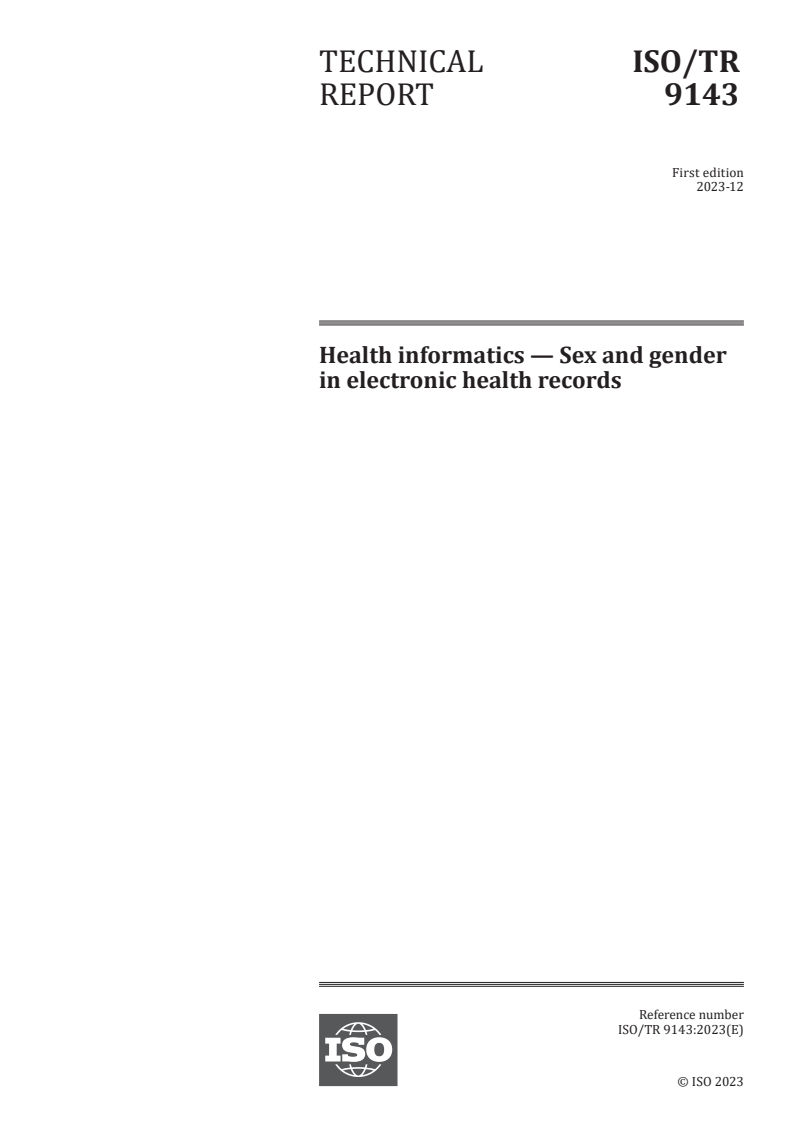
TECHNICAL ISO/TR
REPORT 9143
First edition
2023-12
Health informatics — Sex and gender
in electronic health records
Reference number
© ISO 2023
All rights reserved. Unless otherwise specified, or required in the context of its implementation, no part of this publication may
be reproduced or utilized otherwise in any form or by any means, electronic or mechanical, including photocopying, or posting on
the internet or an intranet, without prior written permission. Permission can be requested from either ISO at the address below
or ISO’s member body in the country of the requester.
ISO copyright office
CP 401 • Ch. de Blandonnet 8
CH-1214 Vernier, Geneva
Phone: +41 22 749 01 11
Email: copyright@iso.org
Website: www.iso.org
Published in Switzerland
ii
Contents Page
Foreword .iv
Introduction .v
1 Scope . 1
2 Normative references . 1
3 Terms, definitions and abbreviated terms . 1
3.1 Terms and definitions . 1
3.2 Abbreviated terms . 2
4 Background . 3
5 Current state . 3
6 Challenges . 4
6.1 Overview . 4
6.2 Electronic health record-related challenges . 4
6.3 Person-level challenges in EHR . 6
6.4 Cultural and linguistic challenges in EHR . 7
7 Opportunities . 8
7.1 Overview . 8
7.2 Benefits . 8
Annex A (informative) Identities which can be considered as falling under the nonbinary
umbrella .10
Annex B (informative) Identities which can be considered to be gender-diverse .12
Annex C (informative) Conditions which can be considered to be intersex .15
Annex D (informative) Published data elements for gender and sex international standards .18
Bibliography .21
iii
Foreword
ISO (the International Organization for Standardization) is a worldwide federation of national standards
bodies (ISO member bodies). The work of preparing International Standards is normally carried out
through ISO technical committees. Each member body interested in a subject for which a technical
committee has been established has the right to be represented on that committee. International
organizations, governmental and non-governmental, in liaison with ISO, also take part in the work.
ISO collaborates closely with the International Electrotechnical Commission (IEC) on all matters of
electrotechnical standardization.
The procedures used to develop this document and those intended for its further maintenance are
described in the ISO/IEC Directives, Part 1. In particular, the different approval criteria needed for the
different types of ISO document should be noted. This document was drafted in accordance with the
editorial rules of the ISO/IEC Directives, Part 2 (see www.iso.org/directives).
ISO draws attention to the possibility that the implementation of this document may involve the use
of (a) patent(s). ISO takes no position concerning the evidence, validity or applicability of any claimed
patent rights in respect thereof. As of the date of publication of this document, ISO had not received
notice of (a) patent(s) which may be required to implement this document. However, implementers are
cautioned that this may not represent the latest information, which may be obtained from the patent
database available at www.iso.org/patents. ISO shall not be held responsible for identifying any or all
such patent rights.
Any trade name used in this document is information given for the convenience of users and does not
constitute an endorsement.
For an explanation of the voluntary nature of standards, the meaning of ISO specific terms and
expressions related to conformity assessment, as well as information about ISO's adherence to
the World Trade Organization (WTO) principles in the Technical Barriers to Trade (TBT), see
www.iso.org/iso/foreword.html.
This document was prepared by Technical Committee ISO/TC 215, Health informatics.
Any feedback or questions on this document should be directed to the user’s national standards body. A
complete listing of these bodies can be found at www.iso.org/members.html.
iv
Introduction
Often, considerations related to sex- and/or gender-related data in electronic health record (EHR)
systems are thought of as purely a “how does an individual identify?” issue, greatly misrepresenting
the extent of the systems involved. Currently, many systems rely on a single value which dictates
most (if not all) of the internal logic of the EHR. It is used for everything from how to address patients,
gendered expectations of patient appearance, patient bed placement, checking demographic fields for
matches before surgery, patient matching algorithms, laboratory work, reference intervals and values,
diagnostic algorithms, imaging algorithms, matching with health insurance documentation, matching
with various identity documents, quality assurance with diagnostics and procedures, limitations of
diagnostics, limitations of procedures, alerts for particular medications and screenings, growth charts,
pharmaceutical dosages and contraindications, cohort analysis in research, clinical trials recruitment,
and much more.
Any successful approach moving forward needs to carefully consider all of these use cases and whether
they require distinct data elements and value sets, alongside the specific cultural and jurisdictional
contexts in which they occur. In addition to that, the approach needs to centre some form of
interoperability between those specific contexts while simultaneously preventing loss of information.
The current inability of EHRs, and the standards and ontologies which underpin them, to distinguish
between these use cases has led to issues for persons marginalized due to gender and/or sex
characteristics (MGSC). Over the past decade, there has been a significant rise in interest regarding and
visibility of diversification and sex- and gender-related data in EHR systems, beginning with the 2011
United States’ Institute of Medicine Report on the Health of Lesbian, Gay, Bisexual, and Transgender
[1]
(LGBT) Individuals.
Since the publication of that report, a number of jurisdictions have separately begun constructing their
own recommendations for standards regarding sex- and gender-related data collection, such as:
— Australia Standard for Sex, Gender, Variations of Sex Characteristics and Sexual Orientation
[2]
Variables 2021 ;
— Canada is the first country to provide census data on transgender and non-binary people in 2022
and Proposed Action Plan to Modernize Gender, Sex and Sexual Orientation Information Practices
[56]
in Canadian Electronic Health Record Systems ;
[57]
— Nepal introduced “others” gender category in latest census 2021 ;
[3]
— New Zealand, Sex and gender identity statistical standards: Consultation 2020 , Pakistan; and
— the United States Committee on Measuring Sex, Gender Identity, and Sexual Orientation, Committee
on National Statistics, Division of Behavioral and Social Sciences and Education, National Academies
[4]
of Sciences, Engineering, and Medicine 2022 .
A patchwork of differing recommendations, if they exist at all, has led to a confusing and contradictory
EHR standards landscape, even within single jurisdictions. While there have been calls for changes in
many international standards and systems, change has been slow, although one substantial effort has
1) [55]
been put together by the Health Level 7® (HL7) Gender Harmony Project (GHP). It is within this
context that this document provides an overview of the current state and international approaches to
sex- and/or gender-related data as well as challenges and opportunities in the space. This document
provides expected benefits for standardization regarding such data.
While sexual orientation is also an important, and often interrelated, entity to sex and gender, through
common acronyms such as SOGI (sexual orientation and gender identity), it is substantially different
from sex and gender constructs and presents unique challenges and opportunities of its own. Therefore,
this document will not consider sexual orientation specifically. See information related to sexual
orientation in the Challenges and Opportunities sections.
1) HL7 is the registered trademark of Health Level Seven International. This information is given for the convenience
of users of this document and does not constitute an endorsement by ISO of the product named.
v
Background
Collection of gender- and/or sex-related data has been routine in health care for much of the 20th
century Therefore, it is no surprise that it is collected as demographic information across almost
all electronic health record (EHR) systems. However, despite the longevity of this data collection,
the underlying constructs are many times poorly understood and not well characterized, leading to
systemic inconsistencies. These inconsistencies are most apparent in relationship to populations
marginalized due to gender and/or sex characteristics.
Marginalization due to one’s gender and/or sex characteristics (MGSC) permeates most, if not all,
countries worldwide.
Considering the following MGSC populations, which are the most likely to be affected by systemic
changes, can help the purposes of EHR standards development and help appreciate the impact of the
current gaps. The table below provides an approximation of the impacted population.
Name Estimated population size worldwide
[58]
Cisgender women and girls (CWG) Approximately 3,8 billion people
[59]
Transgender people, including nonbinary people (TGNB) Approximately 31 million people
[60]
Gender-diverse and gender-nonconforming people (GDGN) Unknown, highly dependent upon one’s analytical lens
[61]
Intersex people (I) Approximately 130 million people
Importantly, these groups are not mutually exclusive—some transgender people are also intersex, for
instance. Some cisgender women are intersex; many gender-diverse people are transgender.
Experiences in the health care system, even when present and available, are often worse among MGSC
than among cisgender, heterosexual men. Looking at medical standards and ontology systems, which
electronic health records were built around, these systems often treat normal differences between
MGSC persons and cisgender, heterosexual men as pathologies.
There are cases where transgender persons are forced into a pathological, binary system of male/
female, whether that system is called “transsexualism”, “gender dysphoria syndrome”, “gender
identity disorder”, “transgenderism”, etc. While newer terminology systems, such as the International
Classification of Diseases, 11th Edition (ICD-11), have indicated a path for depathologization, the
pathologization of trans persons is still deeply embedded in EHR systems. Likewise, Systematized
2)
Nomenclature of Medicine (SNOMED CT® ) includes content that is inaccurate or out-of-date. For
example, “472981000 |Fetishistic transvestism (disorder)|” is based on a label, not a true disorder.
Better, more accurate EHR standards are necessary to better characterize individual- and population-
level cisgender women’s health, which can be used to direct efforts where most needed.
In the case of GDGN people, it is very difficult to describe their health outcomes, and how they are
represented, because they simply are not represented at all. Very rarely, when represented, such gender
nonconformity is immediately pathologized, just as it is for transgender people and cisgender women.
Better, more comprehensive, and culturally focused EHR standards would help to grasp at the extent of
the problems that GDGN people face.
Generally, the systems and EHR standards discussed are often slow to change, and do not often take in
diverse inputs and lived experiences across stakeholder groups most affected by changes.
Considering those groups in relation to the political realities in which they reside is also important. A
transgender person in one country will have a very different relationship to health care, and therefore
to EHR systems, than one in another country. Language and cultural differences also lead to potential
for miscommunication and exploitation within EHR systems.
Since many efforts have been undertaken to address the gaps in the past and before any effort is
undertaken in the future to enhance sex- and gender-related standards, an in-depth understanding of
lived experiences is necessary.
2) SNOMED CT is a trademark of SNOMED International. This information is given for the convenience of users of
this document and does not constitute an endorsement by ISO if the product named.
vi
TECHNICAL REPORT ISO/TR 9143:2023(E)
Health informatics — Sex and gender in electronic health
records
1 Scope
The purpose of this document is to:
— describe the current challenges with documenting and sharing sex and gender information in
electronic health records.
— identify the current state of international standards and specifications that include sex and gender.
— summarize the findings and identify opportunities to improve clarity and consistency in the use of
sex and gender in electronic health records.
2 Normative references
There are no normative references in this document.
3 Terms, definitions and abbreviated terms
3.1 Terms and definitions
For the purposes of this document, the following terms and definitions apply.
ISO and IEC maintain terminology databases for use in standardization at the following addresses:
— ISO Online browsing platform: available at https:// www .iso .org/ obp
— IEC Electropedia: available at https:// www .electropedia .org/
3.1.1
sex
biological category based on reproductive, anatomical and genetic characteristics
Note 1 to entry: Includes the broad categories of male, female and intersex
Note 2 to entry: Typically, within health care settings the only officially recognized and assigned at birth
categories are female and male categories, which becomes part of someone’s official government record and
societally assumed gender.
3.1.2
gender
composite of socially constructed roles, behaviours, activities and/or attributes that a given society
considers appropriate for members of a given sex
3.1.3
cisgender women and girls
CWG
women who were assigned female at birth and/or were reared or raised as female, in relationship to
their culture
[SOURCE: Reference 58]
3.1.4
transgender people, including nonbinary people
TGNB
persons whose gender identity is incongruent (either partially or fully) with their assigned gender at
birth and/or the gender they were reared or raised as
Note 1 to entry: Annex A contains a noncomprehensive list of identities often considered as falling under the
nonbinary umbrella.
Note 2 to entry: Other definitions for transgender and nonbinary exist.
3.1.5
gender-diverse and gender-nonconforming people
GDGN
persons who are considered to not conform to any of various aspects of gender roles in a given culture
and/or people who are considered to be beyond a Eurocentric binarist gender framework
Note 1 to entry: ‘Eurocentric’ means focused on European culture and history and its emigration via routes of
colonialism and imperialism, to the exclusion of viewpoints outside of the Eurosphere, being those cultures and
regions directly affected by such emigration.
Note 2 to entry: A binarist gender framework is an artificially constructed gender system supposedly consisting
of two distinct and non-overlapping cultural categories, usually labeled as “female” and “male”. Such a framework
is a relatively recent invention.
Note 3 to entry: Annex B contains a non-comprehensive list of identities which can be considered to be gender-
diverse.
3.1.6
intersex people
I
persons who, from birth, express biological characteristics, or have the propensity to develop biological
characteristics, which are not strictly sexually dimorphic
Note 1 to entry: A list of conditions often considered to be intersex is included in Annex C.
3.1.7
grammatical gender
gender category ascribed to a class of nouns
Note 1 to entry: For instance, many Romance languages have a masculine and a feminine grammatical gender,
while many Germanic languages have masculine, feminine, and “neuter” grammatical genders. For example, in
German, "Buch" (book) is neutral, while in French "livre" (book) is masculine.
3.2 Abbreviated terms
AFAB Assigned female (gender) at birth
AMAB Assigned male (gender) at birth
EHR Electronic health record
GHP Gender Harmony Project
LGBT Lesbian, Gay, Bisexual, and Transgender
LGBTQIA+ Lesbian, Gay, Bisexual, Transgender, Queer/Questioning, Intersex, Asexual/Aromantic/
Agender, and other sexually- and gender-marginalized groups not explicitly named (“+”)
MGSC Marginalization due to one’s gender and/or sex characteristics
PMDS Persistent Müllerian duct syndrome
SOGI Sexual orientation and gender identity
4 Background
In 2011, the U.S. Institute of Medicine report The Health of Lesbian, Gay, Bisexual and Transgender
[1]
People provided, as its third recommendation, that data related to sexual orientation and gender
identity (SOGI) are “included in the required set of demographic data” and that “the collection of such
data will need to be performed with adequate privacy and security protections”.
In the United States in October 2015, the Centers for Medicare and Medicaid Services and Office of
the National Coordinator for health information technology require EHR vendors to include sex and
gender data fields as part of the EHR software certification, Inclusion of Sexual Orientation and Gender
[5]
Identity in Stage 3 Meaningful Use Guidelines: A Huge Step Forward for LGBT Health, but healthcare
providers are currently not required to collect this information.
In August of 2021, the Health Level 7 (HL7) Gender Harmony Project (GHP) released a product brief
entitled “Gender Harmony – Modeling Sex and Gender Representation, Release 1” as the result of two
years of deliberation and a successful ballot within the organization. The GHP’s approach was unique
in evaluating use cases in clinical settings, and recommending several distinct entities, namely: Gender
Identity, Recorded Sex or Gender [RSG], Sex for Clinical Use [SFCU], Name to Use, and Third-Person
Pronoun. This work is ongoing within HL7.
5 Current state
Standards development organizations (SDOs) play a role in providing standards and specifications
that provide the capability for systems to distinguish, capture, and share gender and sex information.
ISO/TC 215 Health informatics standards define how to represent the data elements needed for
identifying the subject of care, HL7 standards such as Fast Healthcare Interoperability Resources
3)
(FHIR® ) define how information can be shared in a consistent manner. Standard clinical terminologies
such as SNOMED CT® are often used to encode data via coded concepts.
Currently, most international standards provide a single data element to document gender and/or sex.
These international standards include inadequate data element names and descriptions, lack of use
case guidance or intent of use results in the need for organizations to refine the content or leave it up
to implementers to figure out, which in turn leads to inaccurate and inconsistent use of the standards.
And in some cases, leads to causing harm to MGSC persons.
Organizations often further refine international standards by adding or modifying data elements from
international standards such as the case with the datum “assigned gender at birth”.
The complex multi-level challenge to document and share sex and gender continues to contribute
to implementation barriers. The multi-level challenges with international standards and local
specifications consists of a lack of adequate specification of the following:
— data element names and unambiguous definitions
— Gender and Sex are often represented in a single data element and that inconsistency in data
capture and implementation leads to downstream issues for quality measurement instruments
and outcomes.
3) FHIR is a trademark of HL7®. This information is given for the convenience of users of this document and does
not constitute an endorsement by ISO of the product named.
— The terms gender and sex are often used interchangeably within a standard.
— context for how the data element is expected to be used such as:
— Person identity and/or patient matching.
— Clinical use that can include the use in algorithms to suggest tests or workflows based on sex or
the presence of specific organs.
— code systems that provide the concepts to be used in value sets.
— Concepts are sometimes created without adequate understanding of the requirements.
— general guidance within the standard that can include how a data element is not intended to be
used.
— data element relationships between other attributes that provide information related to the gender
of an individual, due to modern thinking of gender as well as new knowledge of psychological,
biological and social manifestations of gender.
— use of observations to specify sex and gender is another way that standards have been developed
for some specific use cases or as a work around when there were limitations in the intent of the use
of the data element.
The following SDOs published material related to sex and gender summarized in Annex D.
— ISO/TC 215
— HL7V2, V3, and FHIR
— DICOM
— OpenEHR including the Gender Archetype
6 Challenges
6.1 Overview
Several types of challenges are covered in this document. Challenges are defined as issues related to
the current state or barriers which could impact any future state and could therefore be considered as
well. They include challenges impacting electronic health records, challenges impacting persons on an
individual or group level, and challenges related to cultural and linguistic differences.
— Electronic Health Record (EHR)-Related Challenges
— Person-Level Challenges
— Cultural and Linguistic Challenges
6.2 Electronic health record-related challenges
1. There is inconsistency in the data element names, descriptions, code systems, concepts and value
sets used to represent sex and gender concepts across EHRs. The appropriateness and adequacy
of some value set options are questioned as the societal understanding of sexual health continues
to evolve. Outdated value set options raise concerns about current EHRs supporting the provision
of culturally competent, safe, and affirmative health care. The limited options available also
perpetuate the inequities faced by the TGNB populations.
— It is also fundamentally impossible to list all possible values for instances of certain data, such
as gender identity (see Annexes A and B); a system would need to expect unexpected values,
which can be in the form of free text. New standards would need to be clear with guidance
about how to handle situations with new variables from a technical standpoint.
2. One data element is not enough to serve the business requirements and meet non-binary person
health care needs.
— Existing data element descriptions lack clarity, are inaccurate and lack guidance on how to
use them within different use cases and contexts, thus making them difficult to implement
consistently, non inclusive and harmful to non-binary persons.
— Healthcare organizations struggle with how to incorporate gender identity and assigned gender
at birth information into EHRs when only one demographic data field is available in the EHR to
indicate assigned gender at birth, with no field for gender identity. A healthcare provider could
enter gender identity information into a progress note, but this addition might not be noticed by
other healthcare providers.
3. Limited value options available for selection perpetuate inequities faced by MGSC populations
by making them invisible in health data sets. At the same time, expanded definitions from
leading organizations and international standards communities such as transgender, gender
nonconforming, and nonbinary gender have raised implementation challenges in how one could
migrate these definitions into existing EHR systems.
4. Current system cannot provide effective, comprehensive disaggregated information.
— This leads to issues in cohort construction for retrospective EHR research, as well as issues
with effectively assessing healthcare quality indicators.
— Patient matching algorithms, where implemented, depend on accurate, contiguous data.
— Clinical trials recruitment and research also require such disaggregated data.
— It is unclear how translational research regarding non-human species and application to
humans can be treated in terms of sex-related development; comprehensive guidelines in this
area would contribute to producing the most effective treatments.
5. Medical providers continue to add being transgender or being intersex to problem lists and as
diagnoses in multiple jurisdictions, under labels such as “gender identity disorder”. As well, the lack
of inclusion of data provenance and fidelity in demographics generally means that providers can
change patient answers without their consent.
6. Some EHR systems have already begun to suggest tests or workflows based on sex or gender data
which is often inaccurate in describing the needs of transgender, gender-diverse, and intersex
persons. For instance, a patient can need to switch their insurance “sex” for a procedure to avoid
denial of coverage or to even be offered a procedure or test in the first place. Pharmacies can also
have to administratively change “sex” for approvals for particular medications and then switch the
“sex” back to avoid denial of coverage.
7. Clinicians can miss proper risk assessments based on whether the “correct” sex field is provided. For
instance, a transgender woman who is marked as “male” can miss crucial breast cancer screenings,
but a transgender woman who is marked as “female” can miss prostate cancer screenings.
8. Pronoun sets create difficulties when considering standardization of rule-based grammatical
systems, meaning that each language which includes pronouns in their systems will need to have
specific rules related to their various forms and how they are parsed.
9. In languages that do not utilize pronouns, other signifiers will likely need to be coded in some form,
specifically in relationship to honorifics.
10. Any effort or standard to improve the data elements to address sex and gender in EHRs might not
be supported and might not be implemented based on the political realities in some regions where
non-binary and transgender people are not accepted and harshly treated.
11. While sex/gender data are more firmly entrenched in EHRs as they currently stand, sexual
orientation (and related data elements) have similar issues in relationship to how collection is done,
and misunderstandings in relationship to the data element, its usage when inappropriate, and its
opportunities for discriminatory usage.
6.3 Person-level challenges in EHR
1. MGSC individuals face significant barriers to adequate and culturally responsive healthcare, leading
to numerous health disparities; these barriers are further exacerbated by inadequate digital health
documentation.
2. Relying on assigned gender at birth or gender identity alone within an EHR for all medical decisions
creates potential hazards to quality and safety when used as a marker even with other variables—
such as current anatomy, height, and weight—for health screenings, medication dosing, and other
medical decisions.
— Likewise, assigned gender at birth is currently usually said to be equivalent to the gender
marker present on a birth certificate or other birth record.
— Oftentimes, assumptions based on assigned gender at birth can cause issues in unexpected
cases. For instance, a transgender woman assigned male at birth (AMAB) became pregnant,
[6]
learning that she had PMDS in the late 2010s. The assumption that she could not get pregnant
because she was AMAB was inaccurate.
3. Medical mistreatment and/or malpractice, as well as violence against MGSC persons is well
documented to varying extremes, meaning that EHR standards can exacerbate such inequities.
Security is therefore of the utmost importance.
— For instance, some countries have created “LGBT” registries and others have suggested and put
in place mandatory testing for migrant workers to determine if they are gay or transgender, by
[7]
requiring submission of medical records. It is also not uncommon in many jurisdictions for
medical providers to call for the arrest of LGBTQIA+ patients. Given that many countries do not
have patient privacy protections codified, it is possible that providing values can open the door
for further mistreatment.
— Some situations, while less deadly, can have disastrous effects for individuals’ lives and
relationships, such as TGNB youth being outed to their parents via billing codes or open access
to all of the child or adolescent’s EHR, depending on jurisdiction. While many parents are
supportive, many are not, and this could cause significant psychiatric issues, or even lead to
suicide. In other situations, a TGNB adult cannot be out to all providers, or to some individuals
but not others. This accidental outing can result in anxiety, depression, strained relationships,
or increased suicidality.
— While some countries have limited protections available for intersex persons, most do not.
Whether intersex individuals can be discriminated against in these jurisdictions in relationship
to health insurance, life insurance, etc. is often open to legal debate, rather than strictly codified.
— Similarly, many cisgender women and TGNB people risk losing access to health insurance, life
[8]
insurance, or other forms of relief based upon BRCA mutations, dependent on jurisdiction .
4. Oftentimes, gender diversity is inaccurately mapped to being transgender; for instance,
healthcare providers in literature have often inaccurately referred to hijra or kathoey as having
“transsexualism”.
5. It is unclear how clinicians will react and agree to capture more specific sex, gender related data
on their patients. Also unclear how comfortable patients in various jurisdictions will be with being
asked routinely about aspects such as sexual orientation, gender identity, etc.
6. If provided with gender identity questions in order to populate “Gender Identity” data elements,
patients can be uncertain of the definition of some of the terms. For example, “trans” could refer to
individuals who had socially or medically transitioned, or neither, or who had a gender identity that
differed from the gender they were assigned at birth.
6.4 Cultural and linguistic challenges in EHR
1. Culturally-specific gender diversity presents a number of categories which (1) have not been
fully characterized or researched in clinical populations, (2) do not fit well into Eurocentric
categorizations such as gender identity, sexual orientation, etc., and/or (3) face additional
marginalization within a culturally-specific context. While such terms might not be understood by
a provider outside of that context, the terms themselves cannot be inappropriately translated.
2. Grammatical gender exists in many languages to varying degrees; approximately 40 % of the
world’s languages include explicit categorization of word classes by grammatical gender, and
approximately 75 % of those define their grammatical gender using terms such as “feminine”,
[9],[10]
“masculine” or “neuter” .
— However, the number of grammatical genders observed in a language is by no means set at two:
[9]
some languages observe three, four, five, or more grammatical gender classes .
— Further, classification of an individual’s gender grammatically often does not align with their
perceived or actual gender identity, even for cisgender people, and systems which include
“masculine”, “feminine”, etc. are often biased toward the masculine. For instance, the Lak
language classifies girls as non-male and non-female animate grammatically; German does the
same, with "Mädchen" (girl) being neuter gender grammatically. Additionally, in French, the
feminine third person pronoun "elles" is used to refer to a group of women. If only one man
were to join said group, the masculine third person pronoun "ils" would be used. Therefore,
assumption of one’s actual and/or perceived gender cannot necessarily be determined from
grammatical gender alone.
— Even languages without explicit grammatical gender often include terms which have associated
gendered connotations. For example, English includes terms such as “king”, “actress”, “man”,
“executrix”, etc. While many of these terms have fallen out of favour in the English language
over the past century, in favour of gender-neutral or gender-inclusive language, many of them
still exist and are used frequently, such as in the cases of pronouns and honorifics. Thus, just
because a language is grammatically genderless does not mean it is necessarily a gender-neutral
or gender-expansive language.
3. Pronouns, broadly, are a class of terms used to replace nouns or noun phrases in particular
contexts. It is estimated that around 43 % of the world’s languages include gendered pronouns in
[11]
some form. Languages which do not include pronouns can be known as pro-drop (or pronoun-
dropping) languages. However, even many of these languages include some gendered languages in
other forms, such as pro-drop Japanese include gendered honorific suffixes such as -chan and -kun.
— Because gender-neutral and/or gender-expansive pronouns can have language-specific
connotations, translation from one to another is a challenge.
4. Similarly to pronouns, honorifics are common across many of the world’s languages and often
reflect some aspect of gender. This can be seen in English with the conceptualization of "Miss",
"Ms.", and "Mrs." and the more recent development of the gender neutral "Mx". Additionally, they
can display roles within academic, military, religious, or royal settings which can or cannot be
gendered. Some can be formal, informal, or lie somewhere between the two. Depending on the
relationship that medical providers have to the society within which they practice, the types of
honorifics they use can be entirely different, even for the same patient.
— Similarly to pronouns, honorifics can thus not be assumed to translate from one system to
another outside of a given cultural context. In regions with many spoken languages, such as in
India, even intra-jurisdictional communication of honorifics can be complex.
5. Simply defining “sex” and “gender” without qualifiers is likely to be unhelpful, as many languages
do not have a sex/gender distinction. This means that translations including “gender” would be
prepared to be translated as “sex”, and then, if translated back, would reappear in the original
language as “sex”. Additional language-specific information would determine how prevalent such
an issue can be, and what the best way to solve it can be as well.
7 Opportunities
7.1 Overview
Opportunities in this context refers to those modifications needed for the benefits to be realized.
Robust data elements related to sex and gender that are based on sound recommendations and guidance
for use will help understand health disparities, assess health care quality, and build more inclusive
and diverse clinical research studies. Specifically identifying base-level relationships to health will
provide a better and more accurate foundation for all patients, regarding entities which have classically
been boiled down to a single sex or gender variable. This will lead to better understanding of health
pathways, better research, and better care.
The effort to create sex- and gender-related data elements can include a diverse stakeholder input using
an inclusive approach so that the standard will have the best chance of addressing the complexity.
Creating precise terminologies and standards that go beyond data elements for sex and gender and
utilizing data elements such as sexual orientation is essential for electronic health records and for
streamlining education and training, as well as opening pathways for cross-cultural care practices.
Inclusion of MGSC populations worldwide in their own health research and practice is a huge
opportunity for advancement, and funding of survey and clinical studies will help better position
evolving terminologies and standards.
Since this topic touches all SDOs, there is an opportunity for collaboration and a deeper sharing of
knowledge and of the impact to existing EHR standards to facilitate consistent adoption.
However, standardized terminology in the form of data elements and value sets for sex and gender
alone will not affect the paradigm of health worldwide as it applies to MGSC persons. Indeed, it is just
one step in that process and needs to be flexible regarding the human rights situations experienced by
MGSC persons.
7.2 Benefits
Benefits in this context refers to those positive effects brought about by addressing current challenges
and present opportunities.
The more accurate and complete collection and use of sex- and gender-related information can
contribute to the creation of a trusting care environment resulting in which patients feel comfortable
and safe. Additionally, this collection provides care providers information to guide clinical care
pathways. Important benefits of standardized data collection regarding sex and gender include:
1. Provision of a more complete and long-term picture of the health of MGSC populations, through
more consistent data collection and aggregation procedures.
2. Helping to create more inclusive environment with culturally-competent staff and enabling EHR
systems to work more effectively for MGSC persons.
3. Integration of sex- and gender-related data with national and international data can help reduce
disparities, address determinants of health inequities, and improve care experiences for MGSC
individuals.
4. Usage of EHR data-driven analytics and quality improvement approaches that draw on GSSO
(gender, sex, and sexual orientation) data will enable organizations to profile who is being served,
stratify health service utilization and outcome data and inform clinical care to ensure that all
populations receive timely and high-quality care.
5. Provision of comparable and actionable information (on MGSC populations) across different
geographic, organizational and/or administrative boundaries can track progress over time.
Satisfies increasing interest in inclusive EHR systems, particularly in relationship to personalized
health care.
6. Empowerment of MGSC persons in managing their own healthcare.
7. Usage of multiple fields related to sex and gender, such as in relationship to the two-step question,
has been shown to contribute to a higher response rate than asking a single question that is “sex”
or “gender” in certain jurisdictional contexts.
8. Reduction of provider burden in relationship to changing the single administrative sex value to
match particular diagnostics, procedures, etc., or having to deal with automated denials based on a
singular “sex” value.
Annex A
(informative)
Identities which can be considered as falling under the nonbinary
umbrella
This is a non-comprehensive list of gender identities which are typically thought of as falling under
the nonbinary umbrella. The identities shown are based on the results of the Gender Census (run from
[12]
2013-2021, including 44,583 usable responses in 2021) , the Gender Wiki (which lists over 300 gender
...
Questions, Comments and Discussion
Ask us and Technical Secretary will try to provide an answer. You can facilitate discussion about the standard in here.
Loading comments...