

ISO 16122-3:2024
(Main)Agricultural and forestry machinery — Inspection of sprayers in use — Part 3: Sprayers for bush and tree crops
General Information
- Abstract
This document, when used together with ISO 16122-1:2024, specifies the requirements and test methods for the inspection of sprayers for bush and tree crops, when in use. The requirements relate mainly to the condition of the sprayer with respect to its potential risk for the environment and its performance to achieve good application. NOTE Requirements for the protection of inspectors during an inspection are given in ISO 16122-1:2024.
- Status
- Published
- Publication Date
- 18-Dec-2024
- Technical Committee
- ISO/TC 23/SC 6 - Equipment for crop protection
- Drafting Committee
- ISO/TC 23/SC 6 - Equipment for crop protection
- Current Stage
- 6060 - International Standard published
- Start Date
- 19-Dec-2024
- Due Date
- 06-Jul-2024
- Completion Date
- 19-Dec-2024
Buy Documents
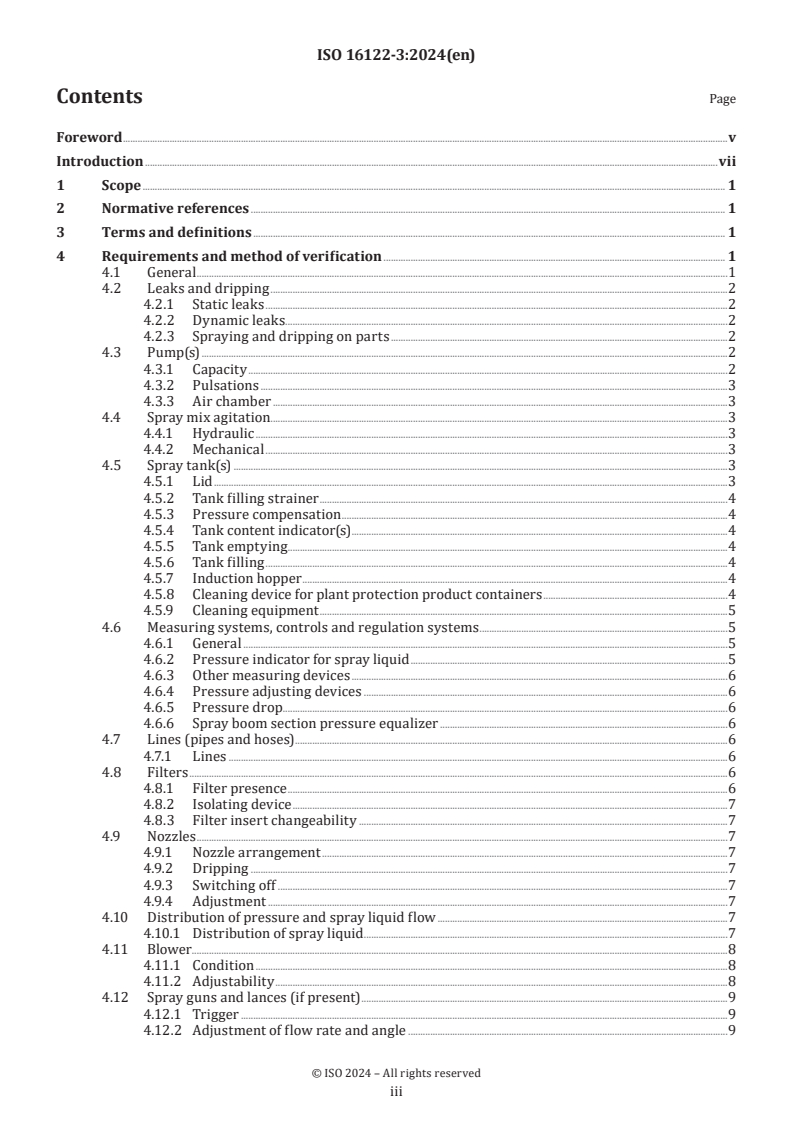
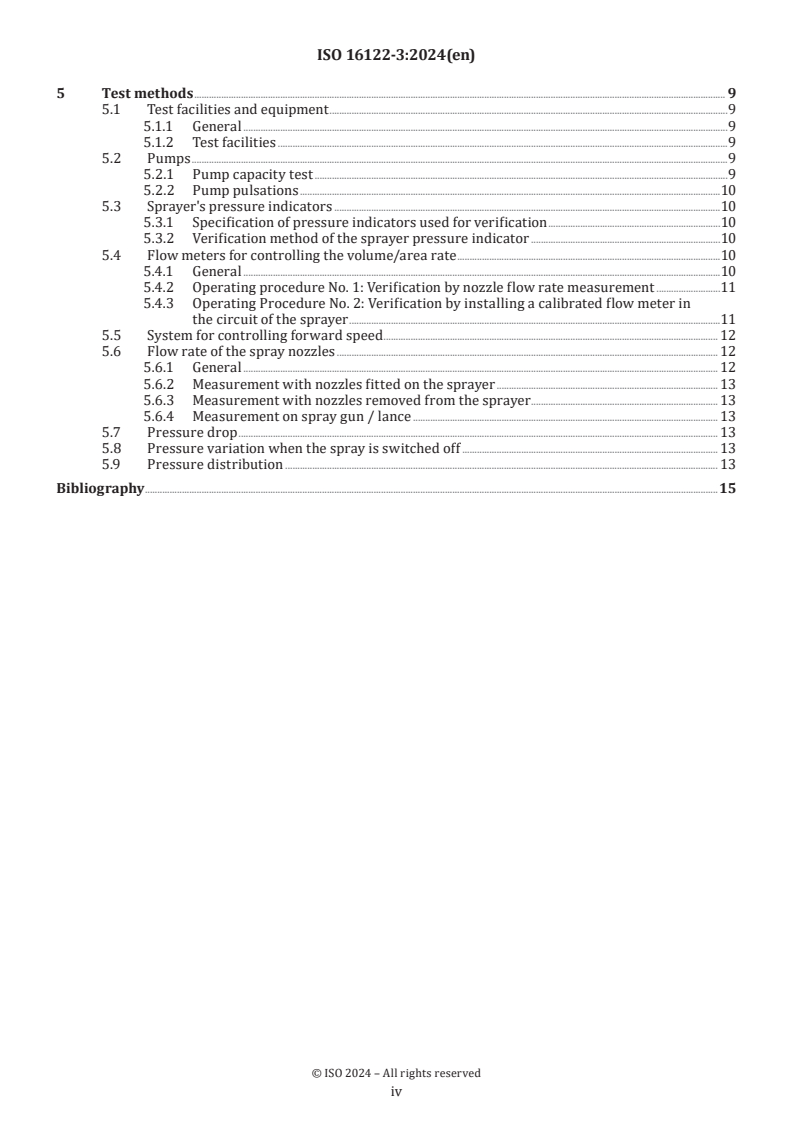
ISO 16122-3:2024 - Agricultural and forestry machinery — Inspection of sprayers in use — Part 3: Sprayers for bush and tree crops Released:12/19/2024
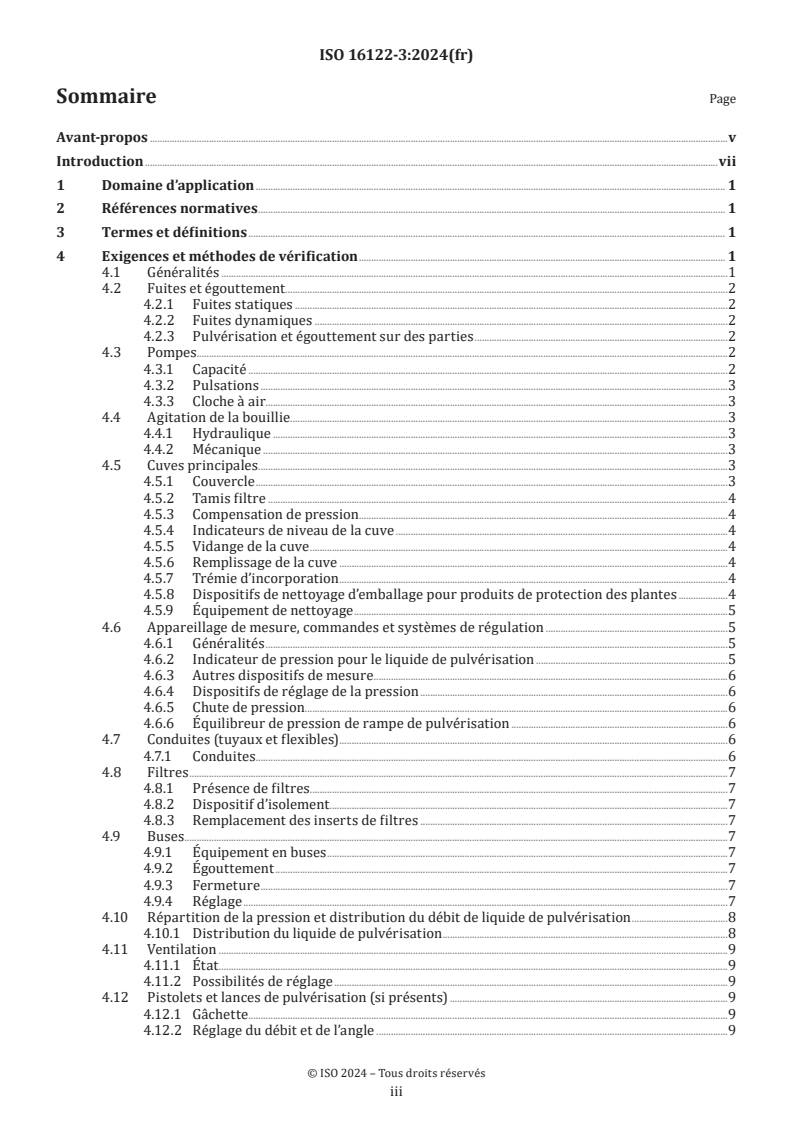
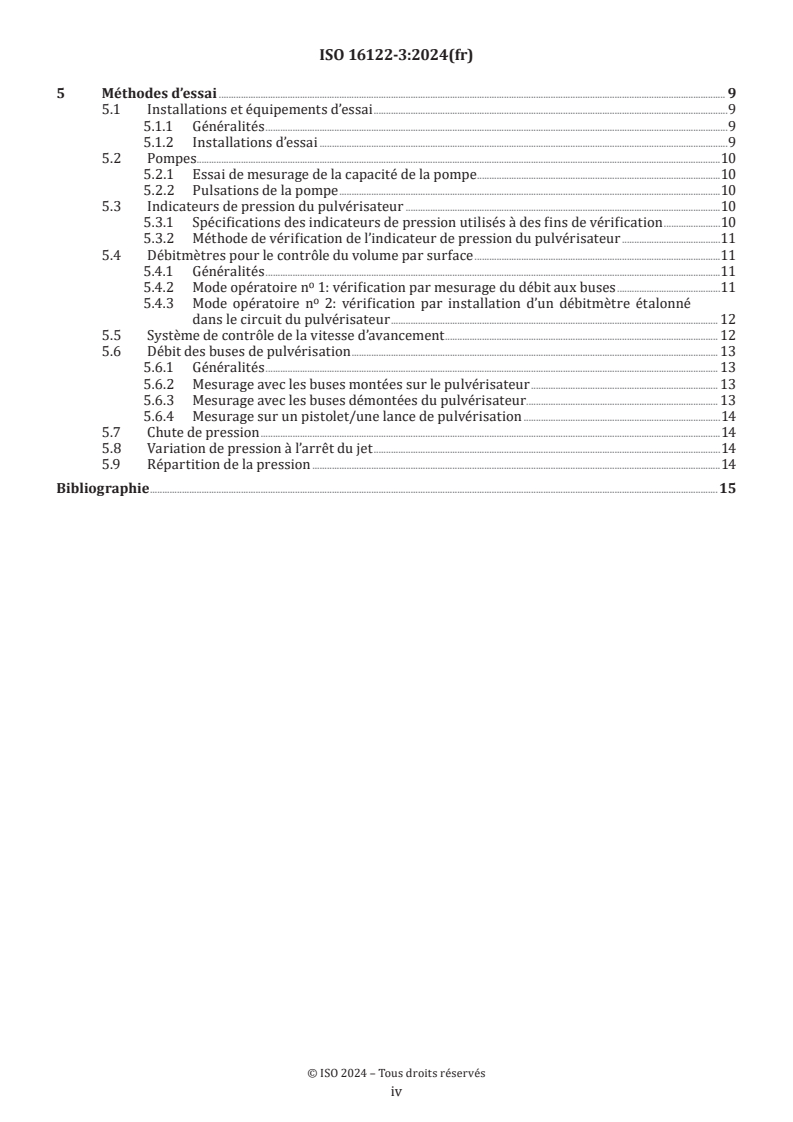
ISO 16122-3:2024 - Matériel agricole et forestier — Contrôle des pulvérisateurs en service — Partie 3: Pulvérisateurs pour cultures arbustives et arboricoles Released:12/19/2024
Overview
ISO 16122-3:2024 - "Agricultural and forestry machinery - Inspection of sprayers in use - Part 3: Sprayers for bush and tree crops" defines requirements and test methods for on‑site inspection of sprayers used in bush and tree crops. Used together with ISO 16122-1:2024, this second edition focuses on the condition of sprayers in service with respect to their environmental risk and their ability to achieve effective application. The document updates and replaces ISO 16122-3:2015 and aligns inspection practice with the ISO 16119 series for new sprayers.
Key topics and technical requirements
ISO 16122-3:2024 covers a comprehensive set of inspection items and verification methods. Major technical topics include:
- Leaks and dripping - static and dynamic leak checks and spray/drip detection on machine parts.
- Pumps - verification of pump capacity, pulsation behavior and presence/function of air chambers.
- Spray tank(s) - lids, filling strainers, pressure compensation, content indicators, emptying and filling arrangements, induction hoppers, and container cleaning devices.
- Agitation systems - hydraulic and mechanical agitation checks for uniform spray mix.
- Measuring, control and regulation systems - pressure indicators, flow meters, pressure adjustments, and pressure distribution across boom sections.
- Lines, filters and nozzles - integrity and isolation of hoses/pipes, filter presence and serviceability, nozzle arrangement, dripping, shut‑off and adjustment.
- Blower systems and air assistance - condition and adjustability of blowers used for drift control in tree and bush applications.
- Spray guns and lances - trigger function and flow/angle adjustment checks.
- Test methods - prescribed procedures for pumps, pressure indicators, nozzle flow rate measurement, calibrated flow meter installation, pressure distribution and pressure variation on shut‑off.
The standard emphasizes practical verification methods rather than prescribing threshold values; inspectors follow defined test procedures to assess performance and environmental risk.
Practical applications
ISO 16122-3:2024 is intended for:
- On‑farm and service‑center inspection of sprayers in use for bush and tree crops (e.g., orchards, vineyards where tree fruit or woody bushes are treated).
- Routine maintenance diagnostics and pre‑season checks to reduce drift, leaks and environmental contamination.
- Regulatory or certification checks where proof of safe, effective spray equipment operation is required.
- Manufacturer and dealer support for after‑sale service, retrofit evaluation and product improvement.
Adopting the standard improves sprayer performance, reduces environmental risk, and helps ensure accurate agrochemical application.
Who should use this standard
- Agricultural and forestry machinery inspectors
- Farm managers and operators of orchard/vineyard sprayers
- Equipment manufacturers, dealers and service technicians
- Certification bodies and regulators concerned with pesticide application safety
Related standards
- ISO 16122-1:2024 - General requirements and inspector protection (to be used together with Part 3).
- ISO 16119 series - Environmental and performance requirements for new sprayers (related guidance for design and manufacture).
Keywords: ISO 16122-3:2024, sprayer inspection, bush and tree crops, inspection of sprayers, agricultural and forestry machinery, test methods, pump capacity, nozzle flow, pressure distribution, environmental risk.
Relations
- Effective Date
- 09-Feb-2026
- Effective Date
- 12-Feb-2026
- Effective Date
- 06-Jun-2022
- Effective Date
- 06-Jun-2022
Buy Documents
ISO 16122-3:2024 - Agricultural and forestry machinery — Inspection of sprayers in use — Part 3: Sprayers for bush and tree crops Released:12/19/2024
ISO 16122-3:2024 - Matériel agricole et forestier — Contrôle des pulvérisateurs en service — Partie 3: Pulvérisateurs pour cultures arbustives et arboricoles Released:12/19/2024
Get Certified
Connect with accredited certification bodies for this standard

Control Union Certifications
Global certification for agriculture and sustainability.

ECOCERT
Organic and sustainability certification.

FSC International
Forest Stewardship Council certification.
Sponsored listings
Frequently Asked Questions
ISO 16122-3:2024 is a standard published by the International Organization for Standardization (ISO). Its full title is "Agricultural and forestry machinery — Inspection of sprayers in use — Part 3: Sprayers for bush and tree crops". This standard covers: This document, when used together with ISO 16122-1:2024, specifies the requirements and test methods for the inspection of sprayers for bush and tree crops, when in use. The requirements relate mainly to the condition of the sprayer with respect to its potential risk for the environment and its performance to achieve good application. NOTE Requirements for the protection of inspectors during an inspection are given in ISO 16122-1:2024.
This document, when used together with ISO 16122-1:2024, specifies the requirements and test methods for the inspection of sprayers for bush and tree crops, when in use. The requirements relate mainly to the condition of the sprayer with respect to its potential risk for the environment and its performance to achieve good application. NOTE Requirements for the protection of inspectors during an inspection are given in ISO 16122-1:2024.
ISO 16122-3:2024 is classified under the following ICS (International Classification for Standards) categories: 65.060.40 - Plant care equipment. The ICS classification helps identify the subject area and facilitates finding related standards.
ISO 16122-3:2024 has the following relationships with other standards: It is inter standard links to EN ISO 16122-1:2025, EN ISO 16122-3:2025, ISO 25619-1:2021, ISO 16122-3:2015. Understanding these relationships helps ensure you are using the most current and applicable version of the standard.
ISO 16122-3:2024 is available in PDF format for immediate download after purchase. The document can be added to your cart and obtained through the secure checkout process. Digital delivery ensures instant access to the complete standard document.
Standards Content (Sample)
International
Standard
ISO 16122-3
Second edition
Agricultural and forestry
2024-12
machinery — Inspection of sprayers
in use —
Part 3:
Sprayers for bush and tree crops
Matériel agricole et forestier — Contrôle des pulvérisateurs en
service —
Partie 3: Pulvérisateurs pour cultures arbustives et arboricoles
Reference number
© ISO 2024
All rights reserved. Unless otherwise specified, or required in the context of its implementation, no part of this publication may
be reproduced or utilized otherwise in any form or by any means, electronic or mechanical, including photocopying, or posting on
the internet or an intranet, without prior written permission. Permission can be requested from either ISO at the address below
or ISO’s member body in the country of the requester.
ISO copyright office
CP 401 • Ch. de Blandonnet 8
CH-1214 Vernier, Geneva
Phone: +41 22 749 01 11
Email: copyright@iso.org
Website: www.iso.org
Published in Switzerland
ii
Contents Page
Foreword .v
Introduction .vii
1 Scope . 1
2 Normative references . 1
3 Terms and definitions . 1
4 Requirements and method of verification . 1
4.1 General .1
4.2 Leaks and dripping .2
4.2.1 Static leaks .2
4.2.2 Dynamic leaks.2
4.2.3 Spraying and dripping on parts .2
4.3 Pump(s) .2
4.3.1 Capacity .2
4.3.2 Pulsations .3
4.3.3 Air chamber .3
4.4 Spray mix agitation . .3
4.4.1 Hydraulic .3
4.4.2 Mechanical .3
4.5 Spray tank(s) .3
4.5.1 Lid .3
4.5.2 Tank filling strainer .4
4.5.3 Pressure compensation .4
4.5.4 Tank content indicator(s) .4
4.5.5 Tank emptying . .4
4.5.6 Tank filling .4
4.5.7 Induction hopper .4
4.5.8 Cleaning device for plant protection product containers .4
4.5.9 Cleaning equipment .5
4.6 Measuring systems, controls and regulation systems .5
4.6.1 General .5
4.6.2 Pressure indicator for spray liquid .5
4.6.3 Other measuring devices .6
4.6.4 Pressure adjusting devices .6
4.6.5 Pressure drop.6
4.6.6 Spray boom section pressure equalizer .6
4.7 Lines (pipes and hoses) .6
4.7.1 Lines .6
4.8 Filters .6
4.8.1 Filter presence .6
4.8.2 Isolating device .7
4.8.3 Filter insert changeability .7
4.9 Nozzles .7
4.9.1 Nozzle arrangement .7
4.9.2 Dripping .7
4.9.3 Switching off .7
4.9.4 Adjustment .7
4.10 Distribution of pressure and spray liquid flow .7
4.10.1 Distribution of spray liquid .7
4.11 Blower.8
4.11.1 Condition .8
4.11.2 Adjustability .8
4.12 Spray guns and lances (if present) .9
4.12.1 Trigger .9
4.12.2 Adjustment of flow rate and angle .9
iii
5 Test methods . 9
5.1 Test facilities and equipment .9
5.1.1 General .9
5.1.2 Test facilities .9
5.2 Pumps .9
5.2.1 Pump capacity test .9
5.2.2 Pump pulsations .10
5.3 Sprayer's pressure indicators .10
5.3.1 Specification of pressure indicators used for verification .10
5.3.2 Verification method of the sprayer pressure indicator .10
5.4 Flow meters for controlling the volume/area rate .10
5.4.1 General .10
5.4.2 Operating procedure No. 1: Verification by nozzle flow rate measurement .11
5.4.3 Operating Procedure No. 2: Verification by installing a calibrated flow meter in
the circuit of the sprayer .11
5.5 System for controlling forward speed . 12
5.6 Flow rate of the spray nozzles . 12
5.6.1 General . 12
5.6.2 Measurement with nozzles fitted on the sprayer . 13
5.6.3 Measurement with nozzles removed from the sprayer . 13
5.6.4 Measurement on spray gun / lance . 13
5.7 Pressure drop . 13
5.8 Pressure variation when the spray is switched off . 13
5.9 Pressure distribution . 13
Bibliography .15
iv
Foreword
ISO (the International Organization for Standardization) is a worldwide federation of national standards
bodies (ISO member bodies). The work of preparing International Standards is normally carried out through
ISO technical committees. Each member body interested in a subject for which a technical committee
has been established has the right to be represented on that committee. International organizations,
governmental and non-governmental, in liaison with ISO, also take part in the work. ISO collaborates closely
with the International Electrotechnical Commission (IEC) on all matters of electrotechnical standardization.
The procedures used to develop this document and those intended for its further maintenance are described
in the ISO/IEC Directives, Part 1. In particular, the different approval criteria needed for the different types
of ISO document should be noted. This document was drafted in accordance with the editorial rules of the
ISO/IEC Directives, Part 2 (see www.iso.org/directives).
ISO draws attention to the possibility that the implementation of this document may involve the use of (a)
patent(s). ISO takes no position concerning the evidence, validity or applicability of any claimed patent
rights in respect thereof. As of the date of publication of this document, ISO had not received notice of (a)
patent(s) which may be required to implement this document. However, implementers are cautioned that
this may not represent the latest information, which may be obtained from the patent database available at
www.iso.org/patents. ISO shall not be held responsible for identifying any or all such patent rights.
Any trade name used in this document is information given for the convenience of users and does not
constitute an endorsement.
For an explanation of the voluntary nature of standards, the meaning of ISO specific terms and expressions
related to conformity assessment, as well as information about ISO's adherence to the World Trade
Organization (WTO) principles in the Technical Barriers to Trade (TBT), see www.iso.org/iso/foreword.html.
This document was prepared by Technical Committee ISO/TC 23, Tractors and machinery for agriculture and
forestry, Subcommittee SC 6, Equipment for crop protection, in collaboration with the European Committee for
Standardization (CEN) Technical Committee CEN/TC 144, Tractors and machinery for agriculture and forestry,
in accordance with the Agreement on technical cooperation between ISO and CEN (Vienna Agreement).
This second edition cancels and replaces the first edition (ISO 16122-3:2015), which has been technically
revised.
The main changes are as follows:
— removed errors and resolve contradictions to the ISO 16119 series which specifies environmental
requirements for new sprayers;
— updated the normative references;
— modified the terms and definitions;
— modified the testing capacity of the spraying pump;
— modified the tank filling strainer/Filling hole;
— modified the tank emptying (modified);
— modified the controls;
— modified the diameter analogue pressure indicators;
— modified the maximum error flow-meters for controlling the volume/hectare rate;
— modified dripping;
— modified spray guns and lances;
— modified the pump capacity test.
v
A list of all parts in the ISO 16122 series can be found on the ISO website.
Any feedback or questions on this document should be directed to the user’s national standards body. A
complete listing of these bodies can be found at www.iso.org/members.html.
vi
Introduction
There are two main reasons for the inspection of sprayers:
— reducing the potential risk of environmental contamination by plant protection products;
— good control of the pest with the minimum possible input of plant protection product.
In order to use plant protection products in agricultural production safely, it is necessary to define the
requirements and test methods for sprayers in use. This is a relevant step after having standardized
minimum requirements for new sprayers, in respect of safety hazards (see ISO 4254-6) and potential risks
of environmental contamination (see ISO 16119 series).
Standardising the requirements and methods for inspection of sprayers in use takes into consideration not
only the original performance of the sprayer but also its use, care and maintenance. This is a logical link to
ensure the continued benefit arising from the supply of new sprayers of good quality.
The inspection of sprayers in use can be a mandatory requirement or adopted on a voluntary basis. In
both cases further requirements, outside the scope of this document, are necessary for the management
of inspections. These include, for example, requirements for the competence of persons carrying out
inspections and the frequency of inspections.
The terms and definitions for specific sprayers in the relevant specific parts.
NOTE National or local regulations concerning the qualifications and competence of inspectors can apply.
vii
International Standard ISO 16122-3:2024(en)
Agricultural and forestry machinery — Inspection of sprayers
in use —
Part 3:
Sprayers for bush and tree crops
1 Scope
This document, when used together with ISO 16122-1:2024, specifies the requirements and test methods for
the inspection of sprayers for bush and tree crops, when in use.
The requirements relate mainly to the condition of the sprayer with respect to its potential risk for the
environment and its performance to achieve good application.
NOTE Requirements for the protection of inspectors during an inspection are given in ISO 16122-1:2024.
2 Normative references
The following documents are referred to in the text in such a way that some or all of their content constitutes
requirements of this document. For dated references, only the edition cited applies. For undated references,
the latest edition of the referenced document (including any amendments) applies.
ISO 5681:2020, Equipment for crop protection — Vocabulary
ISO 5682-2:2017, Equipment for crop protection — Spraying equipment — Part 2: Test methods to assess the
horizontal transverse distribution for hydraulic sprayers
ISO 12809:2020, Crop protection equipment — Reciprocating positive displacement pumps and centrifugal
pumps — Test method
ISO 16122-1:2024, Agricultural and forestry machinery — Inspection of sprayers in use — Part 1: General
3 Terms and definitions
For the purposes of this document, the terms and definitions given in ISO 5681:2020 apply.
ISO and IEC maintain terminological databases for use in standardization at the following addresses:
— ISO Online browsing platform: available at https:// www .iso .org/ obp
— IEC Electropedia: available at https:// www .electropedia .org/
4 Requirements and method of verification
4.1 General
Before starting the inspection, the pre-inspection requirements of ISO 16122-1:2024, Clause 5 shall be met.
4.2 Leaks and dripping
4.2.1 Static leaks
The sprayer shall be filled with water to its nominal tank volume.
With the pump not running and the sprayer parked on a level horizontal surface, a visual inspection for any
leakage from the tank, pump and associated pipes shall be carried out and there shall be no visible leakage
from any part of the sprayer.
For tanks with a volume > 2 000 l, water filling may be reduced to half the nominal volume or to 2 000 l,
whichever is the greater. For these cases, an additional visual inspection of the tank shall be carried out in
order to identify any cracks, holes or other damage that can cause leakage.
Compliance shall be checked by inspection.
4.2.2 Dynamic leaks
4.2.2.1 Leak test when not spraying
With the sprayer running at a pressure which is equal to the maximum working pressure specified in the
sprayer instruction manual, or if this is not known, max. 20 bar (10 bar far sprayers with pneumatic nozzles),
with the section valves closed, there shall be no visible leakage from any part of the sprayer.
Compliance shall be checked by inspection.
4.2.2.2 Leak test while spraying
While spraying at a pressure that is equal to the maximum working pressure recommended in the sprayer
instruction manual, or in the nozzle recommendations for the nozzles mounted on the sprayer if lower, there
shall be no visible leakage from any part of the sprayer or spray boom.
Compliance shall be checked by inspection.
4.2.3 Spraying and dripping on parts
Regardless of the distance between the spray nozzles to the target to be sprayed, in the range between the
nozzles and the target surface, no liquid shall be sprayed directly on to the sprayer itself (for example parts
of the sprayer, hoses). This does not apply if needed by function (for example sensors) and if dripping is
minimised.
Compliance shall be checked by inspection and function test.
4.3 Pump(s)
4.3.1 Capacity
The pump capacity shall be suited to the needs of the sprayer.
a) The pump capacity shall be at least 90 % of its original nominal flow as specified by the sprayer
instruction manual, or another minimum pump capacity as specified in the sprayer instruction manual,
measured at free outlet of the pump (with the lowest possible pressure) and with a pressure of the
pump of 8 bar to10 bar.
Compliance shall be checked by measurement according to 5.2.1.1.3.
b) Or, alternatively, in case method a) is not possible on sprayers not fitted with a test adapter, when the
pump capacity is not specified in the instruction manual for the pump mounted on the sprayer, or for
pumps for which the maximum working pressure is not known, for example for sprayers built before
ISO 16119-1:2013 is published, the pump(s) shall have sufficient flow rate capacity
...
Norme
internationale
ISO 16122-3
Deuxième édition
Matériel agricole et forestier —
2024-12
Contrôle des pulvérisateurs en
service —
Partie 3:
Pulvérisateurs pour cultures
arbustives et arboricoles
Agricultural and forestry machinery — Inspection of sprayers
in use —
Part 3: Sprayers for bush and tree crops
Numéro de référence
DOCUMENT PROTÉGÉ PAR COPYRIGHT
© ISO 2024
Tous droits réservés. Sauf prescription différente ou nécessité dans le contexte de sa mise en œuvre, aucune partie de cette
publication ne peut être reproduite ni utilisée sous quelque forme que ce soit et par aucun procédé, électronique ou mécanique,
y compris la photocopie, ou la diffusion sur l’internet ou sur un intranet, sans autorisation écrite préalable. Une autorisation peut
être demandée à l’ISO à l’adresse ci-après ou au comité membre de l’ISO dans le pays du demandeur.
ISO copyright office
Case postale 401 • Ch. de Blandonnet 8
CH-1214 Vernier, Genève
Tél.: +41 22 749 01 11
E-mail: copyright@iso.org
Web: www.iso.org
Publié en Suisse
ii
Sommaire Page
Avant-propos .v
Introduction .vii
1 Domaine d’application . 1
2 Références normatives . 1
3 Termes et définitions . 1
4 Exigences et méthodes de vérification . 1
4.1 Généralités .1
4.2 Fuites et égouttement . .2
4.2.1 Fuites statiques .2
4.2.2 Fuites dynamiques .2
4.2.3 Pulvérisation et égouttement sur des parties .2
4.3 Pompes.2
4.3.1 Capacité .2
4.3.2 Pulsations .3
4.3.3 Cloche à air.3
4.4 Agitation de la bouillie.3
4.4.1 Hydraulique .3
4.4.2 Mécanique .3
4.5 Cuves principales . .3
4.5.1 Couvercle .3
4.5.2 Tamis filtre .4
4.5.3 Compensation de pression .4
4.5.4 Indicateurs de niveau de la cuve .4
4.5.5 Vidange de la cuve .4
4.5.6 Remplissage de la cuve .4
4.5.7 Trémie d’incorporation .4
4.5.8 Dispositifs de nettoyage d’emballage pour produits de protection des plantes .4
4.5.9 Équipement de nettoyage .5
4.6 Appareillage de mesure, commandes et systèmes de régulation .5
4.6.1 Généralités .5
4.6.2 Indicateur de pression pour le liquide de pulvérisation .5
4.6.3 Autres dispositifs de mesure .6
4.6.4 Dispositifs de réglage de la pression .6
4.6.5 Chute de pression.6
4.6.6 Équilibreur de pression de rampe de pulvérisation .6
4.7 Conduites (tuyaux et flexibles) .6
4.7.1 Conduites . . .6
4.8 Filtres .7
4.8.1 Présence de filtres.7
4.8.2 Dispositif d’isolement .7
4.8.3 Remplacement des inserts de filtres .7
4.9 Buses.7
4.9.1 Équipement en buses .7
4.9.2 Égouttement .7
4.9.3 Fermeture .7
4.9.4 Réglage .7
4.10 Répartition de la pression et distribution du débit de liquide de pulvérisation .8
4.10.1 Distribution du liquide de pulvérisation .8
4.11 Ventilation .9
4.11.1 État .9
4.11.2 Possibilités de réglage .9
4.12 Pistolets et lances de pulvérisation (si présents) .9
4.12.1 Gâchette .9
4.12.2 Réglage du débit et de l’angle .9
iii
5 Méthodes d’essai . 9
5.1 Installations et équipements d’essai .9
5.1.1 Généralités .9
5.1.2 Installations d’essai .9
5.2 Pompes.10
5.2.1 Essai de mesurage de la capacité de la pompe .10
5.2.2 Pulsations de la pompe .10
5.3 Indicateurs de pression du pulvérisateur .10
5.3.1 Spécifications des indicateurs de pression utilisés à des fins de vérification .10
5.3.2 Méthode de vérification de l’indicateur de pression du pulvérisateur .11
5.4 Débitmètres pour le contrôle du volume par surface .11
5.4.1 Généralités .11
o
5.4.2 Mode opératoire n 1: vérification par mesurage du débit aux buses .11
o
5.4.3 Mode opératoire n 2: vérification par installation d’un débitmètre étalonné
dans le circuit du pulvérisateur . 12
5.5 Système de contrôle de la vitesse d’avancement . 12
5.6 Débit des buses de pulvérisation . 13
5.6.1 Généralités . 13
5.6.2 Mesurage avec les buses montées sur le pulvérisateur . 13
5.6.3 Mesurage avec les buses démontées du pulvérisateur . 13
5.6.4 Mesurage sur un pistolet/une lance de pulvérisation .14
5.7 Chute de pression .14
5.8 Variation de pression à l’arrêt du jet .14
5.9 Répartition de la pression .14
Bibliographie .15
iv
Avant-propos
L’ISO (Organisation internationale de normalisation) est une fédération mondiale d’organismes nationaux
de normalisation (comités membres de l’ISO). L’élaboration des Normes internationales est en général
confiée aux comités techniques de l’ISO. Chaque comité membre intéressé par une étude a le droit de faire
partie du comité technique créé à cet effet. Les organisations internationales, gouvernementales et non
gouvernementales, en liaison avec l’ISO participent également aux travaux. L’ISO collabore étroitement avec
la Commission électrotechnique internationale (IEC) en ce qui concerne la normalisation électrotechnique.
Les procédures utilisées pour élaborer le présent document et celles destinées à sa mise à jour sont
décrites dans les Directives ISO/IEC, Partie 1. Il convient, en particulier, de prendre note des différents
critères d’approbation requis pour les différents types de documents ISO. Le présent document
a été rédigé conformément aux règles de rédaction données dans les Directives ISO/IEC, Partie 2
(voir www.iso.org/directives).
L’ISO attire l’attention sur le fait que la mise en application du présent document peut entraîner l’utilisation
d’un ou de plusieurs brevets. L’ISO ne prend pas position quant à la preuve, à la validité et à l’applicabilité
de tout droit de propriété revendiqué à cet égard. À la date de publication du présent document, l’ISO
n’avait pas reçu notification qu’un ou plusieurs brevets pouvaient être nécessaires à sa mise en application.
Toutefois, il y a lieu d’avertir les responsables de la mise en application du présent document que des
informations plus récentes sont susceptibles de figurer dans la base de données de brevets, disponible à
l’adresse www.iso.org/brevets. L’ISO ne saurait être tenue pour responsable de ne pas avoir identifié de tels
droits de brevet.
Les appellations commerciales éventuellement mentionnées dans le présent document sont données pour
information, par souci de commodité, à l’intention des utilisateurs et ne sauraient constituer un engagement.
Pour une explication de la nature volontaire des normes, la signification des termes et expressions
spécifiques de l’ISO liés à l’évaluation de la conformité, ou pour toute information au sujet de l’adhésion de
l’ISO aux principes de l’Organisation mondiale du commerce (OMC) concernant les obstacles techniques au
commerce (OTC), voir www.iso.org/iso/fr/avant-propos.html.
Le présent document a été élaboré par le comité ISO/TC 23, Tracteurs et matériels agricoles et forestiers,
sous-comité SC 6, Matériel de protection des cultures, en collaboration avec le comité technique CEN/TC 144,
Tracteurs et matériels agricoles et forestiers, du Comité européen de normalisation (CEN), conformément à
l’Accord de coopération technique entre l’ISO et le CEN (Accord de Vienne).
Cette deuxième édition annule et remplace la première édition (ISO 16122-3:2015), qui a fait l’objet d’une
révision technique.
Les principales modifications sont les suivantes:
— suppression des erreurs et résolution des contradictions avec la série ISO 16119 qui spécifie les exigences
environnementales pour les nouveaux pulvérisateurs;
— mise à jour des références normatives;
— modification des termes et définitions;
— modification de l’essai de la capacité de la pompe de pulvérisation;
— modification du tamis filtre/orifice de remplissage;
— modification de la vidange de la cuve;
— modification des commandes;
— modification du diamètre des indicateurs de pression analogiques;
— modification de l’erreur maximale des débitmètres pour le contrôle du volume/hectare;
— modification de l’égouttement;
v
— modification des pistolets et lances de pulvérisation;
— modification de l’essai de mesurage de la capacité de la pompe.
Une liste de toutes les parties de la série ISO 16122 se trouve sur le site web de l’ISO.
Il convient que l’utilisateur adresse tout retour d’information ou toute question concernant le présent
document à l’organisme national de normalisation de son pays. Une liste exhaustive desdits organismes se
trouve à l’adresse www.iso.org/fr/members.html.
vi
Introduction
Deux raisons essentielles motivent le contrôle des pulvérisateurs:
— la diminution du risque potentiel de contamination de l’environnement par les produits de protection
des plantes;
— une bonne maîtrise de la pression parasitaire avec le plus petit apport possible de produit de protection
des plantes.
Afin de sécuriser l’utilisation de produits de protection des plantes dans la production agricole, il est
nécessaire de définir des exigences et des méthodes d’essai pour les pulvérisateurs en service. Il s’agit
d’une étape importante après avoir normalisé les exigences minimales pour les pulvérisateurs neufs en ce
qui concerne les risques pour la sécurité (voir l’ISO 4254-6) et les risques potentiels de contamination de
l’environnement (voir la série ISO 16119).
La normalisation des exigences et des méthodes de contrôle des pulvérisateurs en service prend en
compte non seulement la performance initiale du pulvérisateur, mais aussi son utilisation, son entretien
et sa maintenance. Il s’agit d’une suite logique si l’on veut asseoir durablement les bénéfices liés à la
commercialisation de nouveaux pulvérisateurs de bonne qualité.
Le contrôle des pulvérisateurs en service peut être le fait d’une exigence obligatoire ou relever du volontariat.
Dans les deux cas, des exigences supplémentaires, n’entrant pas dans le domaine d’application du présent
document, sont nécessaires pour la gestion des contrôles. Il peut s’agir par exemple des exigences relatives
aux compétences du personnel procédant aux contrôles et à la fréquence de ces derniers.
Les termes et définitions pour les pulvérisateurs spécifiques sont donnés dans les parties spécifiques
appropriées.
NOTE Des réglementations nationales ou locales concernant les qualifications et compétences des inspecteurs
peuvent s’appliquer.
vii
Norme internationale ISO 16122-3:2024(fr)
Matériel agricole et forestier — Contrôle des pulvérisateurs
en service —
Partie 3:
Pulvérisateurs pour cultures arbustives et arboricoles
1 Domaine d’application
Le présent document, lorsqu’il est utilisé conjointement avec l’ISO 16122-1:2024, spécifie les exigences et les
méthodes d’essai relatives au contrôle des pulvérisateurs pour cultures arbustives et arboricoles en service.
Les exigences concernent principalement l’état du pulvérisateur eu égard à son risque potentiel pour
l’environnement et sa performance pour obtenir une bonne application.
NOTE Les exigences relatives à la protection des inspecteurs pendant le contrôle sont données
dans l’ISO 16122-1:2024.
2 Références normatives
Les documents suivants sont cités dans le texte de sorte qu’ils constituent, pour tout ou partie de leur
contenu, des exigences du présent document. Pour les références datées, seule l’édition citée s’applique. Pour
les références non datées, la dernière édition du document de référence s’applique (y compris les éventuels
amendements).
ISO 5681:2020, Matériel de protection des cultures — Vocabulaire
ISO 5682-2:2017, Matériel de protection des cultures — Équipement de pulvérisation — Partie 2: Méthodes
d’essai pour évaluer la distribution transversale horizontale des pulvérisateurs à jet projeté
ISO 12809:2020, Matériel de protection des cultures — Pompes volumétriques alternatives et pompes
centrifuges — Méthodes d'essai
ISO 16122-1:2024, Matériel agricole et forestier — Contrôle des pulvérisateurs en service — Partie 1: Généralités
3 Termes et définitions
Pour les besoins du présent document, les termes et les définitions de l’ISO 5681:2020 s’appliquent.
L’ISO et l’IEC tiennent à jour des bases de données terminologiques destinées à être utilisées en normalisation,
consultables aux adresses suivantes:
— ISO Online browsing platform: disponible à l’adresse https:// www .iso .org/ obp
— IEC Electropedia: disponible à l’adresse https:// www .electropedia .org/
4 Exigences et méthodes de vérification
4.1 Généralités
Avant de commencer le contrôle, les exigences de pré-contrôle de l’ISO 16122-1:2024, Article 5, doivent être
satisfaites.
4.2 Fuites et égouttement
4.2.1 Fuites statiques
Le pulvérisateur doit être rempli d’eau au volume nominal de la cuve.
Le pulvérisateur étant stationné sur une surface horizontale, pompe à l’arrêt, une inspection visuelle
doit être effectuée pour détecter toute fuite de la cuve, de la pompe et des tuyauteries associées et aucun
composant du pulvérisateur ne doit présenter de fuites visibles.
Pour les cuves d’un volume > 2 000 l, le volume d’eau de remplissage peut être réduit à la moitié de la
capacité nominale de la cuve ou 2 000 l, la plus grande valeur étant retenue. Dans ce cas, une inspection
visuelle supplémentaire de la cuve doit être réalisée pour identifier d’éventuelles fissures, brèches ou autres
dommages pouvant entraîner des fuites.
La conformité doit être vérifiée par un contrôle.
4.2.2 Fuites dynamiques
4.2.2.1 Essai d’étanchéité hors pulvérisation
Le pulvérisateur fonctionnant à une pression égale à la pression maximale de travail spécifiée dans le manuel
d’instructions du pulvérisateur ou, si celle-ci n’est pas connue, a 20 bar maximum (10 bar maximum pour les
pulvérisateurs avec buses pneumatiques), vannes de section fermées, aucun composant du pulvérisateur ne
doit présenter de fuites.
La conformité doit être vérifiée par un contrôle.
4.2.2.2 Essai d’étanchéité en pulvérisation
En pulvérisant à une pression égale à la pression maximale de travail recommandée dans le manuel
d’instructions du pulvérisateur, ou dans les recommandations concernant les buses équipant le pulvérisateur
si elle est plus faible, aucun composant du pulvérisateur ou de la rampe ne doit présenter de fuites visibles.
La conformité doit être vérifiée par un contrôle.
4.2.3 Pulvérisation et égouttement sur des parties
Quelle que soit la distance entre les buses de pulvérisation et la cible à pulvériser, dans l’intervalle séparant
les buses de la surface de la cible, le liquide ne doit pas être pulvérisé directement sur le pulvérisateur à
proprement parler (par exemple composants du pulvérisateur, flexibles). Cela ne s’applique pas si la fonction
le nécessite (par exemple capteurs) et si l’égouttement est réduit le plus possible.
La conformité doit être vérifiée par un contrôle et un essai de fonctionnement.
4.3 Pompes
4.3.1 Capacité
La capacité de la ou des pompes doit être adaptée aux besoins du pulvérisateur.
a) La capacité de la ou des pompes doit correspondre à au moins 90 % de son débit nominal d’origine,
spécifié dans le manuel d’instructions du pulvérisateur, ou à une autre capacité minimale de la pompe
spécifiée dans le manuel d’instructions du pulvérisateur, mesurée à la sortie libre de la pompe (avec la
pression la plus basse possible) et avec une pression de pompe comprise entre 8 bar et 10 bar.
La conformité doit être vérifiée par un mesurage conformément à 5.2.1.1.3.
b) Sinon, dans le cas où la méthode a) n’est pas possible sur les pulvérisateurs non équipés d’un adaptateur
d’essai, lorsque la capacité de la pompe n’est pas spécifiée dans le manuel d’instructions de la pompe
montée sur le pulvérisateur ou pour les pompes dont la pression maximale de travail n’est pas connue,
par exemple pour les pulvérisateurs construits avant la publication de l’ISO 16119-1:2013, la ou les
pompes doivent avoir une capacité de débit suffisante afin de pouvoir pulvériser tout en maintenant une
agitation visible telle que spécifiée en 4.4.1 ou 4.4.2.
La conformité doit être vérifiée conformément à 5.2.1.1.2.
4.3.2 Pulsations
Les pulsations ne doivent pas dépasser ±10 % de la pression de travail (à l’exclusion des pompes doseuses
péristaltiques).
La conformité doit être vérifiée par un mesurage et un essai de fonctionnement conformément à 5.2.2.
4.3.3 Cloche à air
Si une cloche à air est présente, la membrane ne doit pas être endommagée. Aucun liquide ne doit être observé
lorsque la pompe fonctionne à la pression maximale spécifiée dans les recommandations concernant les
buses. La pression de l’air doit être la pression spécifiée dans les recommandations ou comprise entre 30 %
et 70 % de la pression de travail des buses en service.
La conformité doit être vérifiée par un essai de fonctionnement et un mesurage.
4.4 Agitation de la bouillie
4.4.1 Hydraulique
Une agitation clairement visible doit être maintenue:
— lors de la pulvérisation à la pression maximale de travail spécifiée dans le manuel d’instructions du
pulvérisateur ou dans les recommandations concernant les buses (la plus petite valeur étant retenue);
— avec les buses de plus grand calibre montées sur l’unité;
— avec la pompe tournant à la vitesse de rotation spécifiée dans le manuel d’instructions du pulvérisateur;
— avec la cuve remplie à la moitié du volume nominal de la cuve.
La conformité doit être vérifiée
...