

ISO 21371:2018
(Main)Traditional Chinese medicine — Labelling requirements of products intended for oral or topical use
General Information
- Abstract
ISO 21371:2018 specifies general requirements for the labelling of products intended for oral or topical use in and as traditional Chinese medicine (TCM). ISO 21371:2018 is applicable to all finished manufactured products including packaged herbs used in and as TCM. This document includes the essential and informative elements for labelling of products to assist in the choice and safe use of these products by consumers and practitioners. NOTE A list of TCM labelling requirements of the WHO and various regions and countries is given in Annex A.
- Status
- Published
- Publication Date
- 29-Jan-2018
- Technical Committee
- ISO/TC 249 - Traditional Chinese medicine
- Drafting Committee
- ISO/TC 249/WG 2 - Quality and safety of manufactured TCM products
- Current Stage
- 9093 - International Standard confirmed
- Start Date
- 09-Apr-2026
- Completion Date
- 29-Aug-2026
Buy Documents

ISO 21371:2018 - Traditional Chinese medicine -- Labelling requirements of products intended for oral or topical use
ISO 21371:2018 - Traditional Chinese medicine — Labelling requirements of products intended for oral or topical use/30/2018
Overview
ISO 21371:2018 - Traditional Chinese medicine (TCM) - Labelling requirements of products intended for oral or topical use - defines general labelling requirements for finished manufactured TCM products and packaged herbs. The standard specifies essential and informative label elements to help consumers and practitioners choose and use TCM products safely. It applies to products intended for oral or topical use and covers labelling visibility, legibility and format.
Key topics and requirements
ISO 21371:2018 outlines mandatory and optional labelling content and format. Key topics include:
- Essential labelling elements (both packaged herbs and finished products):
- Product name (brand)
- Category of the product as defined in the marketed country/region (e.g., pharmaceutical, supplement, food)
- Net weight/quantity (mass or volume units: kg, g, L, mL as appropriate)
- Contact information (name, full address - not PO box - and telephone of distributor/importer; previous distributor info if changed in last 12 months)
- Name of raw materials with Latin (scientific) name plus part used (e.g., liquorice (Glycyrrhiza uralensis) root)
- Warning statements where applicable (e.g., for children, pregnant women)
- Expiry date based on stability data or scientific rationale, legible without opening packaging
- Storage method (special conditions before opening)
- Batch/lot number (with allowed prefixes)
- Additional elements for finished manufactured products:
- Excipients listed separately from active ingredients
- Administration method
- For extracts: formula name, amounts, constituent raw materials and extraction method (including solvent)
- For single-herb extracts: extract name, amount, raw material weight, extraction method
- For non-extract products: herbal name and amount
- Informative elements (optional but recommended):
- TCM product/raw material codes, daily dosage or range, manufacturer name/address, permitted indications/functionality (subject to market rules), certification claims (e.g., GMP, HACCP), notices, country of origin.
- Format requirements: labelling must be in the official language of the sale country, legible font size and colour, and located on the outside packaging so it’s readable without opening.
Applications and who uses it
ISO 21371:2018 is used by:
- TCM manufacturers and contract packagers to design compliant labels
- Quality managers and regulatory affairs teams to ensure market entry compliance
- Distributors and importers for traceability and adverse-event reporting
- Packaging designers and print vendors for format and legibility specifications
- Regulators and testing bodies for conformity checks Benefits include improved consumer safety, traceability (batch/lot), clearer ingredient disclosure (Latin names), and smoother international trade compliance.
Related standards and references
Annex A of ISO 21371:2018 lists related labelling requirements and guidance, including:
- WHO Guidelines for the Appropriate Use of Herbal Medicines
- EU/EC regulations (e.g., EC Reg. No.1223/2009, No.655/2013, EU Directive 2001/83/EC)
- National regulatory frameworks (examples in Annex A: Germany, UK) These references help align TCM labelling with regional regulatory requirements and claims rules.
Buy Documents
ISO 21371:2018 - Traditional Chinese medicine -- Labelling requirements of products intended for oral or topical use
ISO 21371:2018 - Traditional Chinese medicine — Labelling requirements of products intended for oral or topical use/30/2018
Get Certified
Connect with accredited certification bodies for this standard

BSI Group
BSI (British Standards Institution) is the business standards company that helps organizations make excellence a habit.

TÜV Rheinland
TÜV Rheinland is a leading international provider of technical services.

TÜV SÜD
TÜV SÜD is a trusted partner of choice for safety, security and sustainability solutions.
Sponsored listings
Frequently Asked Questions
ISO 21371:2018 is a standard published by the International Organization for Standardization (ISO). Its full title is "Traditional Chinese medicine — Labelling requirements of products intended for oral or topical use". This standard covers: ISO 21371:2018 specifies general requirements for the labelling of products intended for oral or topical use in and as traditional Chinese medicine (TCM). ISO 21371:2018 is applicable to all finished manufactured products including packaged herbs used in and as TCM. This document includes the essential and informative elements for labelling of products to assist in the choice and safe use of these products by consumers and practitioners. NOTE A list of TCM labelling requirements of the WHO and various regions and countries is given in Annex A.
ISO 21371:2018 specifies general requirements for the labelling of products intended for oral or topical use in and as traditional Chinese medicine (TCM). ISO 21371:2018 is applicable to all finished manufactured products including packaged herbs used in and as TCM. This document includes the essential and informative elements for labelling of products to assist in the choice and safe use of these products by consumers and practitioners. NOTE A list of TCM labelling requirements of the WHO and various regions and countries is given in Annex A.
ISO 21371:2018 is classified under the following ICS (International Classification for Standards) categories: 11.120.10 - Medicaments. The ICS classification helps identify the subject area and facilitates finding related standards.
ISO 21371:2018 is available in PDF format for immediate download after purchase. The document can be added to your cart and obtained through the secure checkout process. Digital delivery ensures instant access to the complete standard document.
Standards Content (Sample)
INTERNATIONAL ISO
STANDARD 21371
First edition
2018-01
Traditional Chinese medicine —
Labelling requirements of products
intended for oral or topical use
Médecine traditionnelle chinoise — Exigences d’étiquetage des
produits destinés à un usage oral ou topique
Reference number
©
ISO 2018
© ISO 2018, Published in Switzerland
All rights reserved. Unless otherwise specified, no part of this publication may be reproduced or utilized otherwise in any form
or by any means, electronic or mechanical, including photocopying, or posting on the internet or an intranet, without prior
written permission. Permission can be requested from either ISO at the address below or ISO’s member body in the country of
the requester.
ISO copyright office
Ch. de Blandonnet 8 • CP 401
CH-1214 Vernier, Geneva, Switzerland
Tel. +41 22 749 01 11
Fax +41 22 749 09 47
copyright@iso.org
www.iso.org
ii © ISO 2018 – All rights reserved
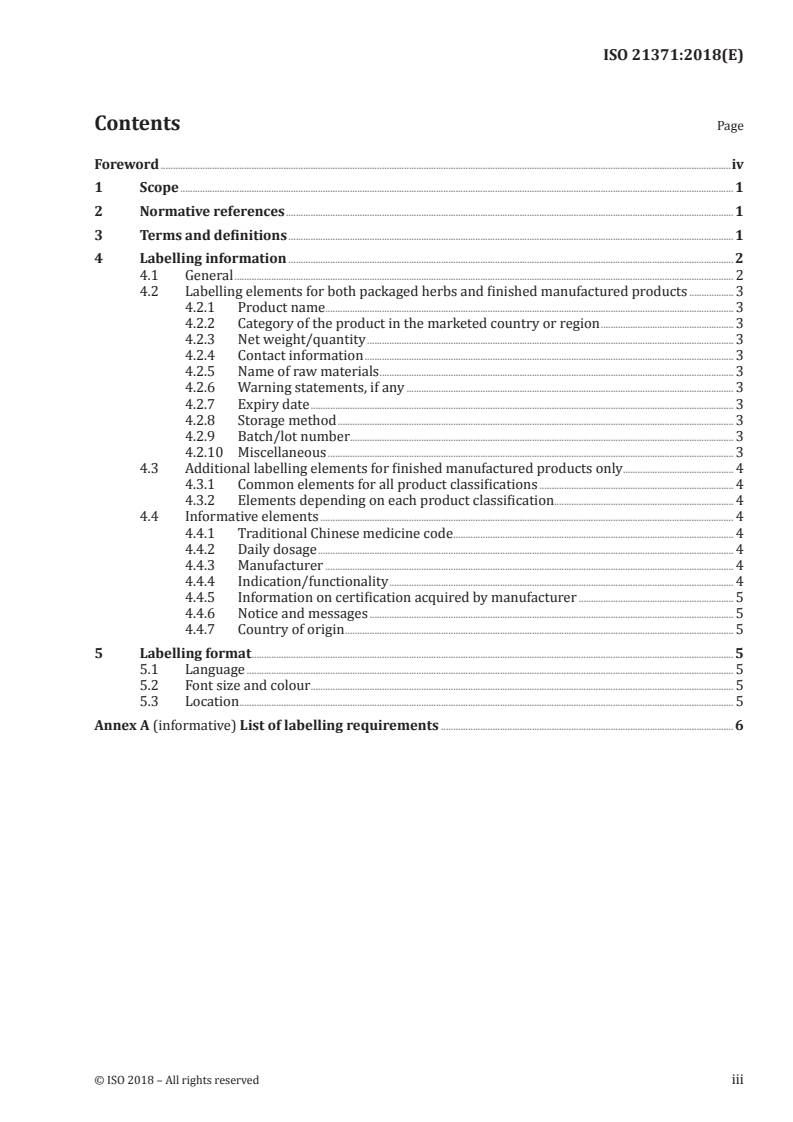
Contents Page
Foreword .iv
1 Scope . 1
2 Normative references . 1
3 Terms and definitions . 1
4 Labelling information . 2
4.1 General . 2
4.2 Labelling elements for both packaged herbs and finished manufactured products . 3
4.2.1 Product name . 3
4.2.2 Category of the product in the marketed country or region . 3
4.2.3 Net weight/quantity . 3
4.2.4 Contact information . 3
4.2.5 Name of raw materials . 3
4.2.6 Warning statements, if any . 3
4.2.7 Expiry date . 3
4.2.8 Storage method . 3
4.2.9 Batch/lot number. 3
4.2.10 Miscellaneous . 3
4.3 Additional labelling elements for finished manufactured products only . 4
4.3.1 Common elements for all product classifications . 4
4.3.2 Elements depending on each product classification. 4
4.4 Informative elements . 4
4.4.1 Traditional Chinese medicine code . 4
4.4.2 Daily dosage . 4
4.4.3 Manufacturer . 4
4.4.4 Indication/functionality . 4
4.4.5 Information on certification acquired by manufacturer . 5
4.4.6 Notice and messages . 5
4.4.7 Country of origin . 5
5 Labelling format . 5
5.1 Language . 5
5.2 Font size and colour . 5
5.3 Location . 5
Annex A (informative) List of labelling requirements . 6
Foreword
ISO (the International Organization for Standardization) is a worldwide federation of national standards
bodies (ISO member bodies). The work of preparing International Standards is normally carried out
through ISO technical committees. Each member body interested in a subject for which a technical
committee has been established has the right to be represented on that committee. International
organizations, governmental and non-governmental, in liaison with ISO, also take part in the work.
ISO collaborates closely with the International Electrotechnical Commission (IEC) on all matters of
electrotechnical standardization.
The procedures used to develop this document and those intended for its further maintenance are
described in the ISO/IEC Directives, Part 1. In particular the different approval criteria needed for the
different types of ISO documents should be noted. This document was drafted in accordance with the
editorial rules of the ISO/IEC Directives, Part 2 (see www.iso.org/directives).
Attention is drawn to the possibility that some of the elements of this document may be the subject of
patent rights. ISO shall not be held responsible for identifying any or all such patent rights. Details of
any patent rights identified during the development of the document will be in the Introduction and/or
on the ISO list of patent declarations received (see www.iso.org/patents).
Any trade name used in this document is information given for the convenience of users and does not
constitute an endorsement.
For an explanation on the voluntary nature of standards, the meaning of ISO specific terms and
expressions related to conformity assessment, as well as information about ISO's adherence to the
World Trade Organization (WTO) principles in the Technical Barriers to Trade (TBT) see the following
URL: www.iso.org/iso/foreword.html.
This document was prepared by Technical Committee ISO/TC 249, Traditional Chinese medicine.
iv © ISO 2018 – All rights reserved
INTERNATIONAL STANDARD ISO 21371:2018(E)
Traditional Chinese medicine — Labelling requirements of
products intended for oral or topical use
1 Scope
This document specifies general requirements for the labelling of products intended for oral or topical
use in and as traditional Chinese medicine (TCM).
It is applicable to all finished manufactured products including packaged herbs used in and as TCM.
This document includes the essential and informative elements for labelling of products to assist in the
choice and safe use of these products by consumers and practitioners.
NOTE A list of TCM labelling requirements of the WHO and various regions and countries is given in Annex A.
2 Normative references
There are no normative references in this document.
3 Terms and definitions
For the purposes of this document, the following terms and definitions apply.
ISO and IEC maintain terminological databases for use in standardization at the following addresses:
— ISO Online browsing platform: available at https://www.iso.org/obp
— IEC Electropedia: available at http://www.electropedia.org/
3.1
label
tag, brand, mark, pictorial or other descriptive matter, written, printed, stencilled, marked, embossed
or impressed on, or attached to the packaging or container of a finished manufactured product (3.4)
3.2
labelling
words, particulars, trademarks, brand name, pictorial m
...
INTERNATIONAL ISO
STANDARD 21371
First edition
2018-01
Traditional Chinese medicine —
Labelling requirements of products
intended for oral or topical use
Médecine traditionnelle chinoise — Exigences d’étiquetage des
produits destinés à un usage oral ou topique
Reference number
©
ISO 2018
© ISO 2018, Published in Switzerland
All rights reserved. Unless otherwise specified, no part of this publication may be reproduced or utilized otherwise in any form
or by any means, electronic or mechanical, including photocopying, or posting on the internet or an intranet, without prior
written permission. Permission can be requested from either ISO at the address below or ISO’s member body in the country of
the requester.
ISO copyright office
Ch. de Blandonnet 8 • CP 401
CH-1214 Vernier, Geneva, Switzerland
Tel. +41 22 749 01 11
Fax +41 22 749 09 47
copyright@iso.org
www.iso.org
ii © ISO 2018 – All rights reserved
Contents Page
Foreword .iv
1 Scope . 1
2 Normative references . 1
3 Terms and definitions . 1
4 Labelling information . 2
4.1 General . 2
4.2 Labelling elements for both packaged herbs and finished manufactured products . 3
4.2.1 Product name . 3
4.2.2 Category of the product in the marketed country or region . 3
4.2.3 Net weight/quantity . 3
4.2.4 Contact information . 3
4.2.5 Name of raw materials . 3
4.2.6 Warning statements, if any . 3
4.2.7 Expiry date . 3
4.2.8 Storage method . 3
4.2.9 Batch/lot number. 3
4.2.10 Miscellaneous . 3
4.3 Additional labelling elements for finished manufactured products only . 4
4.3.1 Common elements for all product classifications . 4
4.3.2 Elements depending on each product classification. 4
4.4 Informative elements . 4
4.4.1 Traditional Chinese medicine code . 4
4.4.2 Daily dosage . 4
4.4.3 Manufacturer . 4
4.4.4 Indication/functionality . 4
4.4.5 Information on certification acquired by manufacturer . 5
4.4.6 Notice and messages . 5
4.4.7 Country of origin . 5
5 Labelling format . 5
5.1 Language . 5
5.2 Font size and colour . 5
5.3 Location . 5
Annex A (informative) List of labelling requirements . 6
Foreword
ISO (the International Organization for Standardization) is a worldwide federation of national standards
bodies (ISO member bodies). The work of preparing International Standards is normally carried out
through ISO technical committees. Each member body interested in a subject for which a technical
committee has been established has the right to be represented on that committee. International
organizations, governmental and non-governmental, in liaison with ISO, also take part in the work.
ISO collaborates closely with the International Electrotechnical Commission (IEC) on all matters of
electrotechnical standardization.
The procedures used to develop this document and those intended for its further maintenance are
described in the ISO/IEC Directives, Part 1. In particular the different approval criteria needed for the
different types of ISO documents should be noted. This document was drafted in accordance with the
editorial rules of the ISO/IEC Directives, Part 2 (see www.iso.org/directives).
Attention is drawn to the possibility that some of the elements of this document may be the subject of
patent rights. ISO shall not be held responsible for identifying any or all such patent rights. Details of
any patent rights identified during the development of the document will be in the Introduction and/or
on the ISO list of patent declarations received (see www.iso.org/patents).
Any trade name used in this document is information given for the convenience of users and does not
constitute an endorsement.
For an explanation on the voluntary nature of standards, the meaning of ISO specific terms and
expressions related to conformity assessment, as well as information about ISO's adherence to the
World Trade Organization (WTO) principles in the Technical Barriers to Trade (TBT) see the following
URL: www.iso.org/iso/foreword.html.
This document was prepared by Technical Committee ISO/TC 249, Traditional Chinese medicine.
iv © ISO 2018 – All rights reserved
INTERNATIONAL STANDARD ISO 21371:2018(E)
Traditional Chinese medicine — Labelling requirements of
products intended for oral or topical use
1 Scope
This document specifies general requirements for the labelling of products intended for oral or topical
use in and as traditional Chinese medicine (TCM).
It is applicable to all finished manufactured products including packaged herbs used in and as TCM.
This document includes the essential and informative elements for labelling of products to assist in the
choice and safe use of these products by consumers and practitioners.
NOTE A list of TCM labelling requirements of the WHO and various regions and countries is given in Annex A.
2 Normative references
There are no normative references in this document.
3 Terms and definitions
For the purposes of this document, the following terms and definitions apply.
ISO and IEC maintain terminological databases for use in standardization at the following addresses:
— ISO Online browsing platform: available at https://www.iso.org/obp
— IEC Electropedia: available at http://www.electropedia.org/
3.1
label
tag, brand, mark, pictorial or other descriptive matter, written, printed, stencilled, marked, embossed
or impressed on, or attached to the packaging or container of a finished manufactured product (3.4)
3.2
labelling
words, particulars, trademarks, brand name, pictorial m
...