

ISO 14577-4:2016
(Main)Metallic materials — Instrumented indentation test for hardness and materials parameters — Part 4: Test method for metallic and non-metallic coatings
General Information
- Abstract
ISO 14577-4:2016 specifies a method for testing coatings which is particularly suitable for testing in the nano/micro range applicable to thin coatings. However, the application of this method of this part of ISO 14577 is not needed if the indentation depth is such a small fraction of the coating thickness that in any possible case a substrate influence can be neglected and the coating can be considered as a bulk material. Limits for such cases are given. This test method is limited to the examination of single layers when the indentation is carried out normal to the test piece surface, but graded and multilayer coatings can also be measured in cross-section if the thickness of the individual layers or gradations is greater than the spatial resolution of the indentation process. The test method is not limited to any particular type of material. Metallic and non-metallic coatings are included in the scope of this part of ISO 14577. In this part of ISO 14577, the term coating is used to refer to any solid layer with homogeneous properties different to that of a substrate it is connected to. The method assumes that coating properties are constant with indentation depth. Composite coatings are considered to be homogenous if the structure size is less than the indentation size. The application of this part of ISO 14577 regarding measurement of indentation hardness is only possible if the indenter is a pyramid or a cone with a radius of tip curvature small enough for plastic deformation to occur within the coating. The hardness of visco-elastic materials or materials exhibiting significant creep will be strongly affected by the time taken to perform the test.
- Status
- Published
- Publication Date
- 25-Oct-2016
- Technical Committee
- ISO/TC 164/SC 3 - Hardness testing
- Current Stage
- 9093 - International Standard confirmed
- Start Date
- 14-Aug-2026
- Completion Date
- 29-Aug-2026
Buy Documents


ISO 14577-4:2016 - Metallic materials -- Instrumented indentation test for hardness and materials parameters


ISO 14577-4:2016 - Metallic materials — Instrumented indentation test for hardness and materials parameters — Part 4: Test method for metallic and non-metallic coatings/26/2016

ISO 14577-4:2016 - Matériaux métalliques -- Essai de pénétration instrumenté pour la détermination de la dureté et de parametres des matériaux

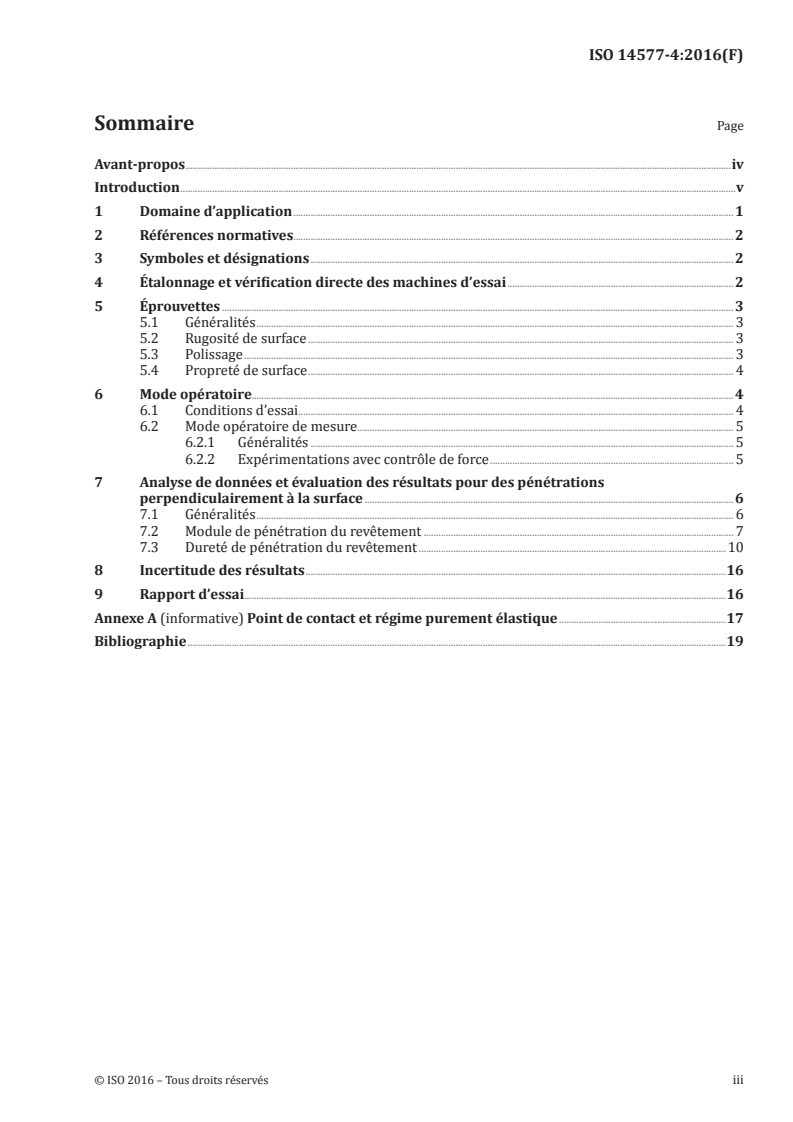
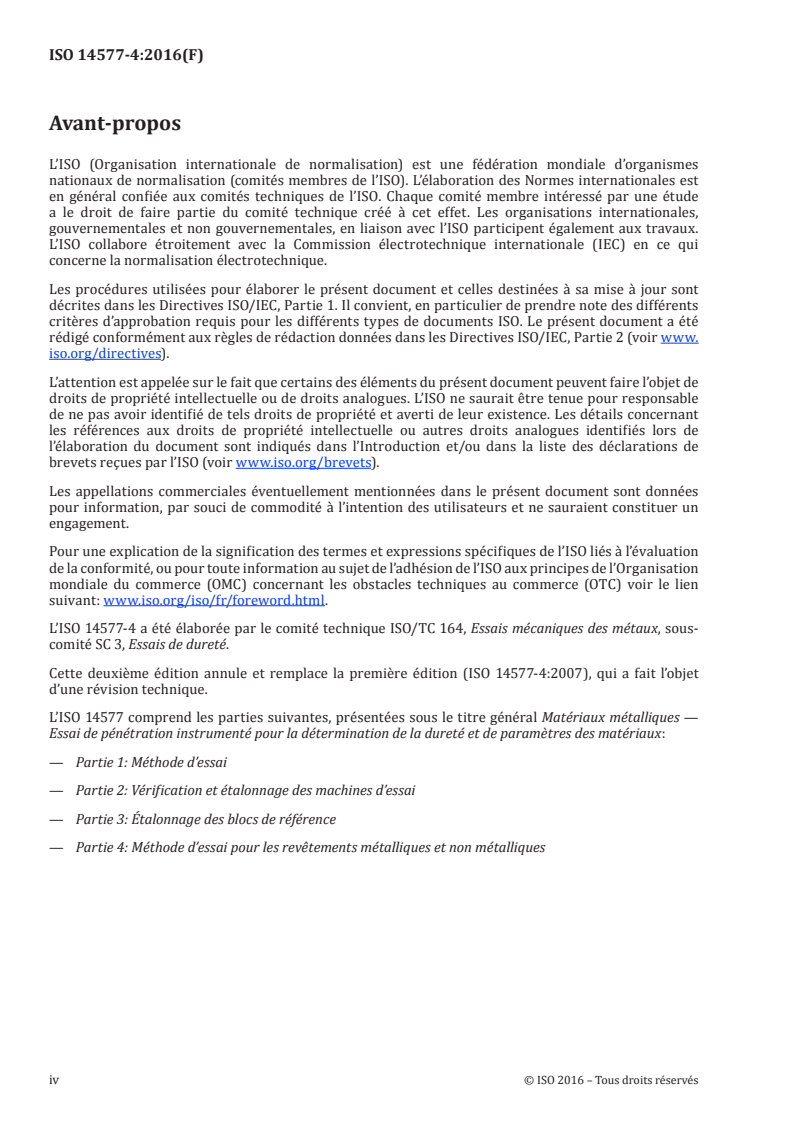
ISO 14577-4:2016 - Matériaux métalliques — Essai de pénétration instrumenté pour la détermination de la dureté et de paramètres des matériaux — Partie 4: Méthode d'essai pour les revêtements métalliques et non métalliques/26/2016
Overview
ISO 14577-4:2016 defines an instrumented indentation test method for determining hardness and material parameters of metallic and non‑metallic coatings, optimized for the nano/micro range and thin coatings. The standard focuses on testing when the coating and substrate form a composite system and provides guidelines and analytical approaches to extract coating properties when the substrate influence is significant. It applies to single layers tested normal to the surface and to graded or multilayer coatings measured in cross‑section when individual layer thicknesses exceed the indentation spatial resolution.
Key technical topics and requirements
- Scope and limitations
- Intended for thin/coating testing in the nano/micro range; not needed when indentation depth is so small relative to coating thickness that substrate effects are negligible (limits are given in the standard).
- Assumes coating properties are constant with indentation depth; composite coatings are considered homogeneous if structure size < indentation size.
- Indenter geometry
- For indentation hardness measurement, the indenter must be a pyramid or cone with tip curvature small enough to cause plastic deformation within the coating (examples: Berkovich, Vickers). Indenter choice impacts elastic vs. plastic response.
- Calibration and verification
- Testing machines must be calibrated and directly verified per ISO 14577-2 procedures; indirect verification using reference materials is also covered.
- Surface preparation and measurement control
- Surface roughness (Ra) should be minimized; Ra ideally < 5% of maximum penetration depth to reduce scatter.
- AFM is recommended to assess indent shape and to detect pile‑up or sink‑in, which affect contact area and measured hardness.
- Recommended AFM scan area for Ra when used: 10 µm × 10 µm.
- Data analysis
- Clauses cover measurement procedures, force control experiments, evaluation of indentation modulus and indentation hardness for coatings, and uncertainty estimation using GUM guidance.
- Material behavior warnings
- Results for visco‑elastic materials or materials with significant creep are strongly time‑dependent and require careful test timing and interpretation.
Practical applications and users
ISO 14577-4 is widely used for:
- Quality control of thin hard coatings (wear‑resistant, decorative, barrier coatings)
- R&D and materials development for thin films and surface engineering
- Failure analysis and coating performance assessment (hardness, modulus)
- Microelectronics, MEMS, and surface engineering labs requiring nanoindentation data
Typical users: materials scientists, coating manufacturers, test laboratories, tribologists, reliability engineers, and anyone performing instrumented indentation on thin coatings.
Related standards
- ISO 14577-1:2015 - Test method for instrumented indentation of bulk materials
- ISO 14577-2:2015 - Verification and calibration of indentation testing machines
- ISO 14577-3:2015 - Calibration of reference blocks
Keywords: ISO 14577-4, instrumented indentation test, coating hardness, indentation modulus, nanoindentation, thin coatings, Berkovich, AFM, surface roughness, calibration.
Relations
- Effective Date
- 22-Apr-2026
- Effective Date
- 12-Feb-2026
- Effective Date
- 07-Apr-2012
Buy Documents
ISO 14577-4:2016 - Metallic materials -- Instrumented indentation test for hardness and materials parameters
ISO 14577-4:2016 - Metallic materials — Instrumented indentation test for hardness and materials parameters — Part 4: Test method for metallic and non-metallic coatings/26/2016
ISO 14577-4:2016 - Matériaux métalliques -- Essai de pénétration instrumenté pour la détermination de la dureté et de parametres des matériaux
ISO 14577-4:2016 - Matériaux métalliques — Essai de pénétration instrumenté pour la détermination de la dureté et de paramètres des matériaux — Partie 4: Méthode d'essai pour les revêtements métalliques et non métalliques/26/2016
Get Certified
Connect with accredited certification bodies for this standard

Element Materials Technology
Materials testing and product certification.

Inštitut za kovinske materiale in tehnologije
Institute of Metals and Technology. Materials testing, metallurgical analysis, NDT.
Sponsored listings
Frequently Asked Questions
ISO 14577-4:2016 is a standard published by the International Organization for Standardization (ISO). Its full title is "Metallic materials — Instrumented indentation test for hardness and materials parameters — Part 4: Test method for metallic and non-metallic coatings". This standard covers: ISO 14577-4:2016 specifies a method for testing coatings which is particularly suitable for testing in the nano/micro range applicable to thin coatings. However, the application of this method of this part of ISO 14577 is not needed if the indentation depth is such a small fraction of the coating thickness that in any possible case a substrate influence can be neglected and the coating can be considered as a bulk material. Limits for such cases are given. This test method is limited to the examination of single layers when the indentation is carried out normal to the test piece surface, but graded and multilayer coatings can also be measured in cross-section if the thickness of the individual layers or gradations is greater than the spatial resolution of the indentation process. The test method is not limited to any particular type of material. Metallic and non-metallic coatings are included in the scope of this part of ISO 14577. In this part of ISO 14577, the term coating is used to refer to any solid layer with homogeneous properties different to that of a substrate it is connected to. The method assumes that coating properties are constant with indentation depth. Composite coatings are considered to be homogenous if the structure size is less than the indentation size. The application of this part of ISO 14577 regarding measurement of indentation hardness is only possible if the indenter is a pyramid or a cone with a radius of tip curvature small enough for plastic deformation to occur within the coating. The hardness of visco-elastic materials or materials exhibiting significant creep will be strongly affected by the time taken to perform the test.
ISO 14577-4:2016 specifies a method for testing coatings which is particularly suitable for testing in the nano/micro range applicable to thin coatings. However, the application of this method of this part of ISO 14577 is not needed if the indentation depth is such a small fraction of the coating thickness that in any possible case a substrate influence can be neglected and the coating can be considered as a bulk material. Limits for such cases are given. This test method is limited to the examination of single layers when the indentation is carried out normal to the test piece surface, but graded and multilayer coatings can also be measured in cross-section if the thickness of the individual layers or gradations is greater than the spatial resolution of the indentation process. The test method is not limited to any particular type of material. Metallic and non-metallic coatings are included in the scope of this part of ISO 14577. In this part of ISO 14577, the term coating is used to refer to any solid layer with homogeneous properties different to that of a substrate it is connected to. The method assumes that coating properties are constant with indentation depth. Composite coatings are considered to be homogenous if the structure size is less than the indentation size. The application of this part of ISO 14577 regarding measurement of indentation hardness is only possible if the indenter is a pyramid or a cone with a radius of tip curvature small enough for plastic deformation to occur within the coating. The hardness of visco-elastic materials or materials exhibiting significant creep will be strongly affected by the time taken to perform the test.
ISO 14577-4:2016 is classified under the following ICS (International Classification for Standards) categories: 77.040.10 - Mechanical testing of metals. The ICS classification helps identify the subject area and facilitates finding related standards.
ISO 14577-4:2016 has the following relationships with other standards: It is inter standard links to EN ISO 14577-5:2026, EN ISO 14577-4:2016, ISO 14577-4:2007. Understanding these relationships helps ensure you are using the most current and applicable version of the standard.
ISO 14577-4:2016 is available in PDF format for immediate download after purchase. The document can be added to your cart and obtained through the secure checkout process. Digital delivery ensures instant access to the complete standard document.
Standards Content (Sample)
INTERNATIONAL ISO
STANDARD 14577-4
Second edition
2016-11-01
Metallic materials — Instrumented
indentation test for hardness and
materials parameters —
Part 4:
Test method for metallic and non-
metallic coatings
Matériaux métalliques — Essai de pénétration instrumenté pour la
détermination de la dureté et de paramètres des matériaux —
Partie 4: Méthode d’essai pour les revêtements métalliques et non
métalliques
Reference number
©
ISO 2016
© ISO 2016, Published in Switzerland
All rights reserved. Unless otherwise specified, no part of this publication may be reproduced or utilized otherwise in any form
or by any means, electronic or mechanical, including photocopying, or posting on the internet or an intranet, without prior
written permission. Permission can be requested from either ISO at the address below or ISO’s member body in the country of
the requester.
ISO copyright office
Ch. de Blandonnet 8 • CP 401
CH-1214 Vernier, Geneva, Switzerland
Tel. +41 22 749 01 11
Fax +41 22 749 09 47
copyright@iso.org
www.iso.org
ii © ISO 2016 – All rights reserved
Contents Page
Foreword .iv
Introduction .v
1 Scope . 1
2 Normative references . 1
3 Symbols and designations . 2
4 Calibration and direct verification of testing machines . 2
5 Test pieces . 2
5.1 General . 2
5.2 Surface roughness . 2
5.3 Polishing . 3
5.4 Surface cleanliness . 3
6 Procedure. 4
6.1 Test conditions . 4
6.2 Measurement procedure . 5
6.2.1 General. 5
6.2.2 Force control experiments . 5
7 Data analysis and evaluation of results for indentation normal to the surface .5
7.1 General . 5
7.2 Coating indentation modulus . 6
7.3 Coating indentation hardness . 9
8 Uncertainty of the results .15
9 Test report .15
Annex A (informative) Contact point and fully elastic regime .16
Bibliography .18
Foreword
ISO (the International Organization for Standardization) is a worldwide federation of national standards
bodies (ISO member bodies). The work of preparing International Standards is normally carried out
through ISO technical committees. Each member body interested in a subject for which a technical
committee has been established has the right to be represented on that committee. International
organizations, governmental and non-governmental, in liaison with ISO, also take part in the work.
ISO collaborates closely with the International Electrotechnical Commission (IEC) on all matters of
electrotechnical standardization.
The procedures used to develop this document and those intended for its further maintenance are
described in the ISO/IEC Directives, Part 1. In particular the different approval criteria needed for the
different types of ISO documents should be noted. This document was drafted in accordance with the
editorial rules of the ISO/IEC Directives, Part 2 (see www.iso.org/directives).
Attention is drawn to the possibility that some of the elements of this document may be the subject of
patent rights. ISO shall not be held responsible for identifying any or all such patent rights. Details of
any patent rights identified during the development of the document will be in the Introduction and/or
on the ISO list of patent declarations received (see www.iso.org/patents).
Any trade name used in this document is information given for the convenience of users and does not
constitute an endorsement.
For an explanation on the meaning of ISO specific terms and expressions related to conformity assessment,
as well as information about ISO’s adherence to the World Trade Organization (WTO) principles in the
Technical Barriers to Trade (TBT) see the following URL: www.iso.org/iso/foreword.html.
The committee responsible for this document is ISO/TC 164, Mechanical testing of metals, Subcommittee
SC 3, Hardness testing.
This second edition cancels and replaces the first edition (ISO 14577-4:2007), which has been
technically revised.
ISO 14577 consists of the following parts, under the general title Metallic materials — Instrumented
indentation test for hardness and materials parameters:
— Part 1: Test method
— Part 2: Verification and calibration of testing machines
— Part 3: Calibration of reference blocks
— Part 4: Test method for metallic and non-metallic coatings
iv © ISO 2016 – All rights reserved
Introduction
The elastic and plastic properties of a coating are critical factors determining the performance of the
coated product. Indeed, many coatings are specifically developed to provide wear resistance that is
usually conferred by their high hardness. Measurement of coating hardness is often used as a quality
control check. Young’s modulus becomes important when calculation of the stress in a coating is
required in the design of coated components. For example, the extent to which coated components can
withstand external applied forces is an important property in the capability of any coated system.
It is relatively straightforward to determine the hardness and indentation modulus of bulk materials
using instrumented indentation. However, when measurements are made normal to a coated surface,
depending on the force applied and the thickness of the coating, the substrate properties influence
the result.
The purpose of this part of ISO 14577 is to provide guidelines for conditions where a significant
influence of the substrate is detected and to provide possible analytical methods to enable the coating
properties to be extracted from the composite measurement. In some cases, the coating property can
be determined directly from measurements on a cross-section.
INTERNATIONAL STANDARD ISO 14577-4:2016(E)
Metallic materials — Instrumented indentation test for
hardness and materials parameters —
Part 4:
Test method for metallic and non-metallic coatings
1 Scope
This part of ISO 14577 specifies a method for testing coatings which is particularly suitable for testing
in the nano/micro range applicable to thin coatings. However, the application of this method of this part
of ISO 14577 is not needed if the indentation depth is such a small fraction of the coating thickness that
in any possible case a substrate influence can be neglected and the coating can be considered as a bulk
material. Limits for such cases are given.
This test method is limited to the examination of single layers when the indentation is carried out
normal to the test piece surface, but graded and multilayer coatings can also be measured in cross-
section if the thickness of the individual layers or gradations is greater than the spatial resolution of the
indentation process.
The test method is not limited to any particular type of material. Metallic and non-metallic coatings are
included in the scope of this part of ISO 14577. In this part of ISO 14577, the term coating is used to refer
to any solid layer with homogeneous properties different to that of a substrate it is connected to. The
method assumes that coating properties are constant with indentation depth. Composite coatings are
considered to be homogenous if the structure size is less than the indentation size.
The application of this part of ISO 14577 regarding measurement of indentation hardness is only
possible if the indenter is a pyramid or a cone with a radius of tip curvature small enough for plastic
deformation to occur within the coating. The hardness of visco-elastic materials or materials exhibiting
significant creep will be strongly affected by the time taken to perform the test.
NOTE 1 ISO 14577-1, ISO 14577-2 and ISO 14577-3 define usage of instrumented indentation testing of bulk
materials over all force and displacement ranges.
NOTE 2 The analysis used here does not make any allowances for pile-up or sink-in of indents. Use of Atomic
Force Microscopy (AFM) to assess the indent shape allows the determination of possible pile-up or sink-in of the
surface around the indent. These surface effects result in an under-estimate (pile-up) or over-estimate (sink-in) of
the contact area in the analysis and hence may influence the measured results. Pile-up generally occurs for fully
work-hardened materials. Pile-up of soft, ductile materials is more likely for thinner coatings due to the constraint
of the stresses in the zone of plastic deformation in the coating. It has been reported that the piled up material
results in an effective increase of the contact area for the determination of hardness, while the effect is less
[1][2]
pronounced for the determination of indentation modulus, since the piled up material behaves less rigidly.
2 Normative references
The following documents, in whole or in part, are normatively referenced in this document and are
indispensable for its application. For dated references, only the edition cited applies. For undated
references, the latest edition of the referenced document (including any amendments) applies.
ISO 14577-1:2015, Metallic materials — Instrumented indentation test for hardness and materials
parameters — Part 1: Test method
ISO 14577-2:2015, Metallic materials — Instrumented indentation test for hardness and materials
parameters — Part 2: Verification and calibration of testing machines
ISO/IEC Guide 98-3, Uncertainty of measurement — Part 3: Guide to the expression of uncertainty in
measurement (GUM)
3 Symbols and designations
ISO 14577-1:2015, Table 1 provides a listing of symbols and their related designations. Additional
symbols and designations used in this international standard are included in Table 1.
Table 1 — Symbols and designations
Symbol Designation Unit
a Radius of contact mm
t Thickness of the coating mm
c
E Indentation modulus of the coating GPa
ITc
E * Indentation plane-strain modulus of the coating GPa
ITc
H Indentation hardness of the coating GPa
ITc
4 Calibration and direct verification of testing machines
The instrument shall be calibrated and directly verified according to the procedures set out in
ISO 14577-2:2015, Clause 4.
Indirect verification according to the procedure specified in ISO 14577-2:2015, Clause 5, using a
reference material, shall be made to ensure that a new direct verification is not needed and that no
damage or contamination has occurred to the indenter tip.
Indentation experiments may be performed with a variety of differently shaped indenters which should
be chosen to optimize the plastic and elastic deformation required for a given coating substrate system.
Typical indenter shapes are Vickers, Berkovich, conical, spherical and corner cube.
For the determination of coating plastic properties, pointed indenters are recommended. The thinner
the coating, the sharper the indenter should be. For the determination of coating elastic properties, any
geometry indenter may be used provided that its area function is known. If only the elastic properties
of the coating are required, indentations in the fully elastic regime are recommended (if possible) as
this avoids problems due to fracture, pile-up and high creep rates. A larger radius indenter tip or sphere
will allow fully elastic indentations over a larger force range than a smaller radius indenter. However,
too large a radius and surface effects will dominate the measurement uncertainties (roughness, surface
layers, etc.). Too small a radius and the maximum force or displacement before plastic deformation
begins will be very low. The optimum can be identified by preliminary experiments or modelling (see
Clause 7).
5 Test pieces
5.1 General
Generally, surface preparation of the test piece should be kept to a minimum and, if possible, the test
piece should be used in the as-received state if the surface condition conforms to the criteria given in
5.2, 5.3 and 5.4.
5.2 Surface roughness
Indentation into rough surfaces will lead to increased scatter in the results with decreasing indentation
depth (see ISO 14577-1:2015, Annex E). Clearly, when the roughness value, Ra, approaches the same
value as the indentation depth, the contact area will vary greatly from indent to indent depending on
its position relative to peaks and valleys at the surface. The final surface finish should be as smooth
2 © ISO 2016 – All rights reserved
as available experience and facilities permit. The Ra value should be less than 5 % of the maximum
penetration depth whenever possible.
NOTE It has been shown that for a Berkovich indenter, the angle that the surface normal presents to the axis
[3]
of indentation has to be greater than 7° for significant errors to result. The important angle is that between
the indentation axis and the local surface normal at the point of contact. This angle may be significantly different
from the average surface plane for rough surfaces.
While Ra has been recommended as a practical and easily understood roughness parameter, this is an
average. Thus, single peaks and valleys may be greater than this as defined by the Rz value, although
the likelihood of encountering the maximum peak, for example, on the surface is small. Modelling to
[4][5]
investigate the roughness of the coating surface has concluded that there are two limiting situations
for any Ra value. When the “wavelength” of the roughness (in the plane of the coating surface) is much
greater than the indenter tip radius, the force-penetration response is determined by the local coating
surface curvature, but when the wavelength is much less than the tip radius, asperity contact occurs
and the effect is similar to having an additional lower modulus coating on the surface.
In cases where coatings are used in the as-received condition, random defects (such as nodular growths
or scratches) might be present. Where an indentation site imaging system is included in the testing
machine, it is recommended that “flat” areas away from these defects be selected for measurement.
The radius of the roughness profilometer probe should be less than the indenter radius. If the roughness
parameter Ra is determined with an AFM on a scan area, a scan area of 10 µm × 10 µm is recommended.
Some instruments are capable of scanning the indentation site before indentation. In this case, areas
with the required local slope and roughness may be selected for indentation in surfaces that might
otherwise, on average, be too rough.
5.3 Polishing
It should be appreciated that mechanical polishing of surfaces can result in a change in the work
hardening and/or the residual stress state of the surface and, consequently, the measured hardness.
For ceramics, this is less of a concern than for metals, although surface damage can occur. Grinding
and polishing shall be carried out such that any stress induced by the previous stage is removed by
the subsequent stage, and the final stage shall be with a grade of polishing medium appropriate to the
displacement scale being used in the test. If possible, electrochemical polishing should be used.
NOTE 1 Many coatings replicate the surface finish of the substrate. If it is acceptable to do so, surface
preparation problems can be reduced by ensuring that the substrate has an appropriate surface finish, thus
eliminating the need to prepare the surface of the coating. In some cases, however, changing the substrate surface
roughness may affect other coating properties; therefore, care should be taken when using this approach.
NOTE 2 In coatings, it is common to get relatively large residual stresses (e.g. arising from thermal expansion
coefficient mismatch between the coating and the substrate and/or stress induced by the coating deposition
process). Thus, a stress-free surface would not normally be expected. Furthermore, stress gradients in coatings
are not uncommon, so that removal of excessive material during a remedial surface preparation stage may result
in a significant departure from the original surface state.
NOTE 3 Polishing reduces the coating thickness and so the effects of the substrate will be enhanced when
indenting normal to the surface. Where the data analysis requires an accurate knowledge of the coating thickness
indented, polishing will require re-measurement of coating thickness. This again emphasizes the need to carry
out minimum preparation.
5.4 Surface cleanliness
Generally, provided the surface is free from obvious surface contamination, cleaning procedures should
be avoided. If cleaning is required, it shall be limited to methods that minimize damage, for example
— application of dry, oil-free, filtered gas stream,
— application of subliming particle stream of CO (taking care not to depress the surface temperature
below the dew point), and
— rinsing with a solvent (which is chemically inert to the test piece) and then drying.
Ultrasonic methods are known to create or increase damage to coatings and should be used with
caution.
6 Procedure
6.1 Test conditions
6.1.1 The indenter geometry, maximum force and/or displacement and force displacement cycle (with
suitable hold periods) shall be selected by the operator to be appropriate to the coating to be measured
and the operating parameters of the instrument used (see Figure 1).
Indentation hardness values are only valid if plastic deformation has occurred so that there is a residual
indentation after force removal. Therefore, if both hardness and modulus are required from a single set
of indentations, then a small radius tip is required and a self-similar geometry.
NOTE 1 A typical “small” radius for hardness measurement is that of a Berkovich indenter (<250 nm). A typical
“large” radius for modulus measurement is <25 µm. In certain cases, a change of indenter can be avoided by force
selection. The range of elastic deformation can be estimated by the formulae in Annex A.
NOTE 2 An example of a simplified stress analysis is given in 7.3, Note 4.
6.1.2 Where multiple indentations normal to the surface or indentations in cross-section are planned,
each indent shall be positioned and separated according to ISO 14577-1:2015, 7.7.
NOTE Coatings can display a high degree of anisotropy, and thus the orientation of the indenter within the
plane and the direction of indentation (normal or cross-section) can significantly alter the measured value of the
hardness and sometimes the modulus.
6.1.3 The parameters of the instrumented indentation test are defined according to ISO 14577-
1:2015, 7.4.
The following parameters of coating/substrate influencing the measurement result should be
considered:
a) substrate hardness, Young’s modulus and Poisson’s ratio;
b) coating thickness;
c) surface roughness;
d) adhesion of the coating to the substrate (delamination of the coating should be avoided).
All these parameters should be kept constant if a direct comparison of force displacement curves is to
be made in order to detect a relative change in properties between two or more test pieces.
The time dependence of the material parameter being measured should be taken into account.
[6][7][8][9][10]
NOTE 1 Hardness and Young’s modulus values can be affected by adhesion.
NOTE 2 Variations in test piece parameters other than hardness or modulus can affect measurement of these
quantities. If the indentation depth is a sufficiently small fraction of the coating thickness, or the coating thickness
may be reasonably well estimated and is constant for all indentation sites on a particular sample, it is possible to
measure E * and H without an accurate thickness measurement. If, however, the properties as a function of
ITc ITc
relative indentation depth are to be compared, an accurate thickness determination may be necessary. The exact
limits depend on the ratio of properties of coating and substrate.
4 © ISO 2016 – All rights reserved
6.2 Measurement procedure
6.2.1 General
Introduce the prepared test piece and position it so that testing can be undertaken at the desired
location.
Carry out the predetermined number of indentation cycles using the selected test conditions.
6.2.2 Force control experiments
A single force application and removal cycle shall be used. A decision tree to assist in estimating the
drift during the experiment is shown in ISO 14577-1:2015, Annex G.
NOTE In case of displacement control measurements, the creep effects prevent an accurate determination
of the slope of the unloading curve at maximum force and this will result in an incorrect hardness and modulus
calculation. Furthermore, displacement control measurements do not allow thermal displacement drift
correction.
7 Data analysis and evaluation of results for indentation normal to the surface
7.1 General
Before the data obtained during the indentation experiments can be analysed, it is necessary to have
corrected the displacement data for significant thermal drift, determined the values of A (h ) and
p c
obtained C (the contact compliance) by correcting the data for the instrument frame compliance,
s
C . The hardness and indentation modulus of the test piece can then be calculated using formulae in
f
ISO 14577-1:2015, Annex A. ISO 14577-2:2015, Annex D describes the determination of C and C . The
s f
properties thus calculated according to ISO 14577-1 are composite properties for the coating/substrate
combination. 7.2 and 7.3 provide methods for extracting the hardness and indentation modulus of the
coating from the composite properties measured assuming that the coating properties are constant
with depth.
NOTE 1 For indentation into a cross-section, th
...
INTERNATIONAL ISO
STANDARD 14577-4
Second edition
2016-11-01
Metallic materials — Instrumented
indentation test for hardness and
materials parameters —
Part 4:
Test method for metallic and non-
metallic coatings
Matériaux métalliques — Essai de pénétration instrumenté pour la
détermination de la dureté et de paramètres des matériaux —
Partie 4: Méthode d’essai pour les revêtements métalliques et non
métalliques
Reference number
©
ISO 2016
© ISO 2016, Published in Switzerland
All rights reserved. Unless otherwise specified, no part of this publication may be reproduced or utilized otherwise in any form
or by any means, electronic or mechanical, including photocopying, or posting on the internet or an intranet, without prior
written permission. Permission can be requested from either ISO at the address below or ISO’s member body in the country of
the requester.
ISO copyright office
Ch. de Blandonnet 8 • CP 401
CH-1214 Vernier, Geneva, Switzerland
Tel. +41 22 749 01 11
Fax +41 22 749 09 47
copyright@iso.org
www.iso.org
ii © ISO 2016 – All rights reserved
Contents Page
Foreword .iv
Introduction .v
1 Scope . 1
2 Normative references . 1
3 Symbols and designations . 2
4 Calibration and direct verification of testing machines . 2
5 Test pieces . 2
5.1 General . 2
5.2 Surface roughness . 2
5.3 Polishing . 3
5.4 Surface cleanliness . 3
6 Procedure. 4
6.1 Test conditions . 4
6.2 Measurement procedure . 5
6.2.1 General. 5
6.2.2 Force control experiments . 5
7 Data analysis and evaluation of results for indentation normal to the surface .5
7.1 General . 5
7.2 Coating indentation modulus . 6
7.3 Coating indentation hardness . 9
8 Uncertainty of the results .15
9 Test report .15
Annex A (informative) Contact point and fully elastic regime .16
Bibliography .18
Foreword
ISO (the International Organization for Standardization) is a worldwide federation of national standards
bodies (ISO member bodies). The work of preparing International Standards is normally carried out
through ISO technical committees. Each member body interested in a subject for which a technical
committee has been established has the right to be represented on that committee. International
organizations, governmental and non-governmental, in liaison with ISO, also take part in the work.
ISO collaborates closely with the International Electrotechnical Commission (IEC) on all matters of
electrotechnical standardization.
The procedures used to develop this document and those intended for its further maintenance are
described in the ISO/IEC Directives, Part 1. In particular the different approval criteria needed for the
different types of ISO documents should be noted. This document was drafted in accordance with the
editorial rules of the ISO/IEC Directives, Part 2 (see www.iso.org/directives).
Attention is drawn to the possibility that some of the elements of this document may be the subject of
patent rights. ISO shall not be held responsible for identifying any or all such patent rights. Details of
any patent rights identified during the development of the document will be in the Introduction and/or
on the ISO list of patent declarations received (see www.iso.org/patents).
Any trade name used in this document is information given for the convenience of users and does not
constitute an endorsement.
For an explanation on the meaning of ISO specific terms and expressions related to conformity assessment,
as well as information about ISO’s adherence to the World Trade Organization (WTO) principles in the
Technical Barriers to Trade (TBT) see the following URL: www.iso.org/iso/foreword.html.
The committee responsible for this document is ISO/TC 164, Mechanical testing of metals, Subcommittee
SC 3, Hardness testing.
This second edition cancels and replaces the first edition (ISO 14577-4:2007), which has been
technically revised.
ISO 14577 consists of the following parts, under the general title Metallic materials — Instrumented
indentation test for hardness and materials parameters:
— Part 1: Test method
— Part 2: Verification and calibration of testing machines
— Part 3: Calibration of reference blocks
— Part 4: Test method for metallic and non-metallic coatings
iv © ISO 2016 – All rights reserved
Introduction
The elastic and plastic properties of a coating are critical factors determining the performance of the
coated product. Indeed, many coatings are specifically developed to provide wear resistance that is
usually conferred by their high hardness. Measurement of coating hardness is often used as a quality
control check. Young’s modulus becomes important when calculation of the stress in a coating is
required in the design of coated components. For example, the extent to which coated components can
withstand external applied forces is an important property in the capability of any coated system.
It is relatively straightforward to determine the hardness and indentation modulus of bulk materials
using instrumented indentation. However, when measurements are made normal to a coated surface,
depending on the force applied and the thickness of the coating, the substrate properties influence
the result.
The purpose of this part of ISO 14577 is to provide guidelines for conditions where a significant
influence of the substrate is detected and to provide possible analytical methods to enable the coating
properties to be extracted from the composite measurement. In some cases, the coating property can
be determined directly from measurements on a cross-section.
INTERNATIONAL STANDARD ISO 14577-4:2016(E)
Metallic materials — Instrumented indentation test for
hardness and materials parameters —
Part 4:
Test method for metallic and non-metallic coatings
1 Scope
This part of ISO 14577 specifies a method for testing coatings which is particularly suitable for testing
in the nano/micro range applicable to thin coatings. However, the application of this method of this part
of ISO 14577 is not needed if the indentation depth is such a small fraction of the coating thickness that
in any possible case a substrate influence can be neglected and the coating can be considered as a bulk
material. Limits for such cases are given.
This test method is limited to the examination of single layers when the indentation is carried out
normal to the test piece surface, but graded and multilayer coatings can also be measured in cross-
section if the thickness of the individual layers or gradations is greater than the spatial resolution of the
indentation process.
The test method is not limited to any particular type of material. Metallic and non-metallic coatings are
included in the scope of this part of ISO 14577. In this part of ISO 14577, the term coating is used to refer
to any solid layer with homogeneous properties different to that of a substrate it is connected to. The
method assumes that coating properties are constant with indentation depth. Composite coatings are
considered to be homogenous if the structure size is less than the indentation size.
The application of this part of ISO 14577 regarding measurement of indentation hardness is only
possible if the indenter is a pyramid or a cone with a radius of tip curvature small enough for plastic
deformation to occur within the coating. The hardness of visco-elastic materials or materials exhibiting
significant creep will be strongly affected by the time taken to perform the test.
NOTE 1 ISO 14577-1, ISO 14577-2 and ISO 14577-3 define usage of instrumented indentation testing of bulk
materials over all force and displacement ranges.
NOTE 2 The analysis used here does not make any allowances for pile-up or sink-in of indents. Use of Atomic
Force Microscopy (AFM) to assess the indent shape allows the determination of possible pile-up or sink-in of the
surface around the indent. These surface effects result in an under-estimate (pile-up) or over-estimate (sink-in) of
the contact area in the analysis and hence may influence the measured results. Pile-up generally occurs for fully
work-hardened materials. Pile-up of soft, ductile materials is more likely for thinner coatings due to the constraint
of the stresses in the zone of plastic deformation in the coating. It has been reported that the piled up material
results in an effective increase of the contact area for the determination of hardness, while the effect is less
[1][2]
pronounced for the determination of indentation modulus, since the piled up material behaves less rigidly.
2 Normative references
The following documents, in whole or in part, are normatively referenced in this document and are
indispensable for its application. For dated references, only the edition cited applies. For undated
references, the latest edition of the referenced document (including any amendments) applies.
ISO 14577-1:2015, Metallic materials — Instrumented indentation test for hardness and materials
parameters — Part 1: Test method
ISO 14577-2:2015, Metallic materials — Instrumented indentation test for hardness and materials
parameters — Part 2: Verification and calibration of testing machines
ISO/IEC Guide 98-3, Uncertainty of measurement — Part 3: Guide to the expression of uncertainty in
measurement (GUM)
3 Symbols and designations
ISO 14577-1:2015, Table 1 provides a listing of symbols and their related designations. Additional
symbols and designations used in this international standard are included in Table 1.
Table 1 — Symbols and designations
Symbol Designation Unit
a Radius of contact mm
t Thickness of the coating mm
c
E Indentation modulus of the coating GPa
ITc
E * Indentation plane-strain modulus of the coating GPa
ITc
H Indentation hardness of the coating GPa
ITc
4 Calibration and direct verification of testing machines
The instrument shall be calibrated and directly verified according to the procedures set out in
ISO 14577-2:2015, Clause 4.
Indirect verification according to the procedure specified in ISO 14577-2:2015, Clause 5, using a
reference material, shall be made to ensure that a new direct verification is not needed and that no
damage or contamination has occurred to the indenter tip.
Indentation experiments may be performed with a variety of differently shaped indenters which should
be chosen to optimize the plastic and elastic deformation required for a given coating substrate system.
Typical indenter shapes are Vickers, Berkovich, conical, spherical and corner cube.
For the determination of coating plastic properties, pointed indenters are recommended. The thinner
the coating, the sharper the indenter should be. For the determination of coating elastic properties, any
geometry indenter may be used provided that its area function is known. If only the elastic properties
of the coating are required, indentations in the fully elastic regime are recommended (if possible) as
this avoids problems due to fracture, pile-up and high creep rates. A larger radius indenter tip or sphere
will allow fully elastic indentations over a larger force range than a smaller radius indenter. However,
too large a radius and surface effects will dominate the measurement uncertainties (roughness, surface
layers, etc.). Too small a radius and the maximum force or displacement before plastic deformation
begins will be very low. The optimum can be identified by preliminary experiments or modelling (see
Clause 7).
5 Test pieces
5.1 General
Generally, surface preparation of the test piece should be kept to a minimum and, if possible, the test
piece should be used in the as-received state if the surface condition conforms to the criteria given in
5.2, 5.3 and 5.4.
5.2 Surface roughness
Indentation into rough surfaces will lead to increased scatter in the results with decreasing indentation
depth (see ISO 14577-1:2015, Annex E). Clearly, when the roughness value, Ra, approaches the same
value as the indentation depth, the contact area will vary greatly from indent to indent depending on
its position relative to peaks and valleys at the surface. The final surface finish should be as smooth
2 © ISO 2016 – All rights reserved
as available experience and facilities permit. The Ra value should be less than 5 % of the maximum
penetration depth whenever possible.
NOTE It has been shown that for a Berkovich indenter, the angle that the surface normal presents to the axis
[3]
of indentation has to be greater than 7° for significant errors to result. The important angle is that between
the indentation axis and the local surface normal at the point of contact. This angle may be significantly different
from the average surface plane for rough surfaces.
While Ra has been recommended as a practical and easily understood roughness parameter, this is an
average. Thus, single peaks and valleys may be greater than this as defined by the Rz value, although
the likelihood of encountering the maximum peak, for example, on the surface is small. Modelling to
[4][5]
investigate the roughness of the coating surface has concluded that there are two limiting situations
for any Ra value. When the “wavelength” of the roughness (in the plane of the coating surface) is much
greater than the indenter tip radius, the force-penetration response is determined by the local coating
surface curvature, but when the wavelength is much less than the tip radius, asperity contact occurs
and the effect is similar to having an additional lower modulus coating on the surface.
In cases where coatings are used in the as-received condition, random defects (such as nodular growths
or scratches) might be present. Where an indentation site imaging system is included in the testing
machine, it is recommended that “flat” areas away from these defects be selected for measurement.
The radius of the roughness profilometer probe should be less than the indenter radius. If the roughness
parameter Ra is determined with an AFM on a scan area, a scan area of 10 µm × 10 µm is recommended.
Some instruments are capable of scanning the indentation site before indentation. In this case, areas
with the required local slope and roughness may be selected for indentation in surfaces that might
otherwise, on average, be too rough.
5.3 Polishing
It should be appreciated that mechanical polishing of surfaces can result in a change in the work
hardening and/or the residual stress state of the surface and, consequently, the measured hardness.
For ceramics, this is less of a concern than for metals, although surface damage can occur. Grinding
and polishing shall be carried out such that any stress induced by the previous stage is removed by
the subsequent stage, and the final stage shall be with a grade of polishing medium appropriate to the
displacement scale being used in the test. If possible, electrochemical polishing should be used.
NOTE 1 Many coatings replicate the surface finish of the substrate. If it is acceptable to do so, surface
preparation problems can be reduced by ensuring that the substrate has an appropriate surface finish, thus
eliminating the need to prepare the surface of the coating. In some cases, however, changing the substrate surface
roughness may affect other coating properties; therefore, care should be taken when using this approach.
NOTE 2 In coatings, it is common to get relatively large residual stresses (e.g. arising from thermal expansion
coefficient mismatch between the coating and the substrate and/or stress induced by the coating deposition
process). Thus, a stress-free surface would not normally be expected. Furthermore, stress gradients in coatings
are not uncommon, so that removal of excessive material during a remedial surface preparation stage may result
in a significant departure from the original surface state.
NOTE 3 Polishing reduces the coating thickness and so the effects of the substrate will be enhanced when
indenting normal to the surface. Where the data analysis requires an accurate knowledge of the coating thickness
indented, polishing will require re-measurement of coating thickness. This again emphasizes the need to carry
out minimum preparation.
5.4 Surface cleanliness
Generally, provided the surface is free from obvious surface contamination, cleaning procedures should
be avoided. If cleaning is required, it shall be limited to methods that minimize damage, for example
— application of dry, oil-free, filtered gas stream,
— application of subliming particle stream of CO (taking care not to depress the surface temperature
below the dew point), and
— rinsing with a solvent (which is chemically inert to the test piece) and then drying.
Ultrasonic methods are known to create or increase damage to coatings and should be used with
caution.
6 Procedure
6.1 Test conditions
6.1.1 The indenter geometry, maximum force and/or displacement and force displacement cycle (with
suitable hold periods) shall be selected by the operator to be appropriate to the coating to be measured
and the operating parameters of the instrument used (see Figure 1).
Indentation hardness values are only valid if plastic deformation has occurred so that there is a residual
indentation after force removal. Therefore, if both hardness and modulus are required from a single set
of indentations, then a small radius tip is required and a self-similar geometry.
NOTE 1 A typical “small” radius for hardness measurement is that of a Berkovich indenter (<250 nm). A typical
“large” radius for modulus measurement is <25 µm. In certain cases, a change of indenter can be avoided by force
selection. The range of elastic deformation can be estimated by the formulae in Annex A.
NOTE 2 An example of a simplified stress analysis is given in 7.3, Note 4.
6.1.2 Where multiple indentations normal to the surface or indentations in cross-section are planned,
each indent shall be positioned and separated according to ISO 14577-1:2015, 7.7.
NOTE Coatings can display a high degree of anisotropy, and thus the orientation of the indenter within the
plane and the direction of indentation (normal or cross-section) can significantly alter the measured value of the
hardness and sometimes the modulus.
6.1.3 The parameters of the instrumented indentation test are defined according to ISO 14577-
1:2015, 7.4.
The following parameters of coating/substrate influencing the measurement result should be
considered:
a) substrate hardness, Young’s modulus and Poisson’s ratio;
b) coating thickness;
c) surface roughness;
d) adhesion of the coating to the substrate (delamination of the coating should be avoided).
All these parameters should be kept constant if a direct comparison of force displacement curves is to
be made in order to detect a relative change in properties between two or more test pieces.
The time dependence of the material parameter being measured should be taken into account.
[6][7][8][9][10]
NOTE 1 Hardness and Young’s modulus values can be affected by adhesion.
NOTE 2 Variations in test piece parameters other than hardness or modulus can affect measurement of these
quantities. If the indentation depth is a sufficiently small fraction of the coating thickness, or the coating thickness
may be reasonably well estimated and is constant for all indentation sites on a particular sample, it is possible to
measure E * and H without an accurate thickness measurement. If, however, the properties as a function of
ITc ITc
relative indentation depth are to be compared, an accurate thickness determination may be necessary. The exact
limits depend on the ratio of properties of coating and substrate.
4 © ISO 2016 – All rights reserved
6.2 Measurement procedure
6.2.1 General
Introduce the prepared test piece and position it so that testing can be undertaken at the desired
location.
Carry out the predetermined number of indentation cycles using the selected test conditions.
6.2.2 Force control experiments
A single force application and removal cycle shall be used. A decision tree to assist in estimating the
drift during the experiment is shown in ISO 14577-1:2015, Annex G.
NOTE In case of displacement control measurements, the creep effects prevent an accurate determination
of the slope of the unloading curve at maximum force and this will result in an incorrect hardness and modulus
calculation. Furthermore, displacement control measurements do not allow thermal displacement drift
correction.
7 Data analysis and evaluation of results for indentation normal to the surface
7.1 General
Before the data obtained during the indentation experiments can be analysed, it is necessary to have
corrected the displacement data for significant thermal drift, determined the values of A (h ) and
p c
obtained C (the contact compliance) by correcting the data for the instrument frame compliance,
s
C . The hardness and indentation modulus of the test piece can then be calculated using formulae in
f
ISO 14577-1:2015, Annex A. ISO 14577-2:2015, Annex D describes the determination of C and C . The
s f
properties thus calculated according to ISO 14577-1 are composite properties for the coating/substrate
combination. 7.2 and 7.3 provide methods for extracting the hardness and indentation modulus of the
coating from the composite properties measured assuming that the coating properties are constant
with depth.
NOTE 1 For indentation into a cross-section, th
...
NORME ISO
INTERNATIONALE 14577-4
Deuxième édition
2016-11-01
Matériaux métalliques — Essai de
pénétration instrumenté pour la
détermination de la dureté et de
paramètres des matériaux —
Partie 4:
Méthode d’essai pour les revêtements
métalliques et non métalliques
Metallic materials — Instrumented indentation test for hardness and
materials parameters —
Part 4: Test method for metallic and non-metallic coatings
Numéro de référence
©
ISO 2016
DOCUMENT PROTÉGÉ PAR COPYRIGHT
© ISO 2016, Publié en Suisse
Droits de reproduction réservés. Sauf indication contraire, aucune partie de cette publication ne peut être reproduite ni utilisée
sous quelque forme que ce soit et par aucun procédé, électronique ou mécanique, y compris la photocopie, l’affichage sur
l’internet ou sur un Intranet, sans autorisation écrite préalable. Les demandes d’autorisation peuvent être adressées à l’ISO à
l’adresse ci-après ou au comité membre de l’ISO dans le pays du demandeur.
ISO copyright office
Ch. de Blandonnet 8 • CP 401
CH-1214 Vernier, Geneva, Switzerland
Tel. +41 22 749 01 11
Fax +41 22 749 09 47
copyright@iso.org
www.iso.org
ii © ISO 2016 – Tous droits réservés
Sommaire Page
Avant-propos .iv
Introduction .v
1 Domaine d’application . 1
2 Références normatives . 2
3 Symboles et désignations . 2
4 Étalonnage et vérification directe des machines d’essai . 2
5 Éprouvettes . 3
5.1 Généralités . 3
5.2 Rugosité de surface . 3
5.3 Polissage . 3
5.4 Propreté de surface . 4
6 Mode opératoire. 4
6.1 Conditions d’essai . 4
6.2 Mode opératoire de mesure . 5
6.2.1 Généralités . 5
6.2.2 Expérimentations avec contrôle de force . 5
7 Analyse de données et évaluation des résultats pour des pénétrations
perpendiculairement à la surface . 6
7.1 Généralités . 6
7.2 Module de pénétration du revêtement . 7
7.3 Dureté de pénétration du revêtement .10
8 Incertitude des résultats .16
9 Rapport d’essai .16
Annexe A (informative) Point de contact et régime purement élastique .17
Bibliographie .19
Avant-propos
L’ISO (Organisation internationale de normalisation) est une fédération mondiale d’organismes
nationaux de normalisation (comités membres de l’ISO). L’élaboration des Normes internationales est
en général confiée aux comités techniques de l’ISO. Chaque comité membre intéressé par une étude
a le droit de faire partie du comité technique créé à cet effet. Les organisations internationales,
gouvernementales et non gouvernementales, en liaison avec l’ISO participent également aux travaux.
L’ISO collabore étroitement avec la Commission électrotechnique internationale (IEC) en ce qui
concerne la normalisation électrotechnique.
Les procédures utilisées pour élaborer le présent document et celles destinées à sa mise à jour sont
décrites dans les Directives ISO/IEC, Partie 1. Il convient, en particulier de prendre note des différents
critères d’approbation requis pour les différents types de documents ISO. Le présent document a été
rédigé conformément aux règles de rédaction données dans les Directives ISO/IEC, Partie 2 (voir www.
iso.org/directives).
L’attention est appelée sur le fait que certains des éléments du présent document peuvent faire l’objet de
droits de propriété intellectuelle ou de droits analogues. L’ISO ne saurait être tenue pour responsable
de ne pas avoir identifié de tels droits de propriété et averti de leur existence. Les détails concernant
les références aux droits de propriété intellectuelle ou autres droits analogues identifiés lors de
l’élaboration du document sont indiqués dans l’Introduction et/ou dans la liste des déclarations de
brevets reçues par l’ISO (voir www.iso.org/brevets).
Les appellations commerciales éventuellement mentionnées dans le présent document sont données
pour information, par souci de commodité à l’intention des utilisateurs et ne sauraient constituer un
engagement.
Pour une explication de la signification des termes et expressions spécifiques de l’ISO liés à l’évaluation
de la conformité, ou pour toute information au sujet de l’adhésion de l’ISO aux principes de l’Organisation
mondiale du commerce (OMC) concernant les obstacles techniques au commerce (OTC) voir le lien
suivant: www.iso.org/iso/fr/foreword.html.
L’ISO 14577-4 a été élaborée par le comité technique ISO/TC 164, Essais mécaniques des métaux, sous-
comité SC 3, Essais de dureté.
Cette deuxième édition annule et remplace la première édition (ISO 14577-4:2007), qui a fait l’objet
d’une révision technique.
L’ISO 14577 comprend les parties suivantes, présentées sous le titre général Matériaux métalliques —
Essai de pénétration instrumenté pour la détermination de la dureté et de paramètres des matériaux:
— Partie 1: Méthode d’essai
— Partie 2: Vérification et étalonnage des machines d’essai
— Partie 3: Étalonnage des blocs de référence
— Partie 4: Méthode d’essai pour les revêtements métalliques et non métalliques
iv © ISO 2016 – Tous droits réservés
Introduction
Les caractéristiques d’élasticité et de plasticité d’un revêtement sont des facteurs critiques déterminant
la performance du produit revêtu. En effet, de nombreux revêtements sont développés de manière
spécifique pour fournir une résistance à l’usure qui est généralement conférée par leur dureté élevée.
La mesure de la dureté du revêtement est souvent utilisée comme une vérification au titre du contrôle
de qualité. Le module de Young devient important lorsque le calcul de la contrainte dans un revêtement
est requis pour la conception des éléments revêtus. Par exemple, la capacité des éléments revêtus à
supporter des forces externes appliquées est une caractéristique importante pour la capacité de tout
système revêtu.
Il est relativement simple de déterminer la dureté et le module de pénétration des matériaux
massifs au moyen de la pénétration instrumentée. Cependant, lorsque les mesurages sont effectués
perpendiculairement à une surface revêtue, les caractéristiques du substrat influencent le résultat, en
fonction de la force appliquée et de l’épaisseur du revêtement.
L’objectif de la présente partie de l’ISO 14577 est de fournir des lignes directrices relatives aux conditions
pour lesquelles une influence significative du substrat est détectée et, de fournir des méthodes
analytiques possibles pour permettre d’extraire les caractéristiques du revêtement du mesurage
composite. Dans certains cas, la caractéristique du revêtement peut être déterminée directement à
partir des mesurages sur une section transversale.
NORME INTERNATIONALE ISO 14577-4:2016(F)
Matériaux métalliques — Essai de pénétration instrumenté
pour la détermination de la dureté et de paramètres des
matériaux —
Partie 4:
Méthode d’essai pour les revêtements métalliques et non
métalliques
1 Domaine d’application
La présente partie de l’ISO 14577 spécifie une méthode d’essai pour les revêtements qui convient
particulièrement pour soumettre à essai dans la plage nano-micro, applicable aux revêtements minces.
Cependant l’application de la méthode de la présente partie de l’ISO 14577 n’est pas nécessaire si la
profondeur de pénétration correspond à une fraction si petite de l’épaisseur du revêtement que, dans
tous les cas possibles, une influence du substrat peut être négligée et le revêtement peut être considéré
comme un matériau massif. Les limites de tels cas sont données.
La présente méthode d’essai est limitée à l’examen des couches simples lorsque l’empreinte est
réalisée perpendiculairement à la surface de l’éprouvette, mais les revêtements avec une gradation ou
comportant plusieurs couches peuvent également faire l’objet de mesures dans la section si l’épaisseur
des couches individuelles ou des zones où la dureté évolue est supérieure à la résolution spatiale du
processus de pénétration.
La méthode d’essai n’est pas limitée à un quelconque type particulier de matériau. Les revêtements
métalliques et non métalliques sont inclus dans le domaine d’application de la présente partie de
l’ISO 14577, le terme revêtement est utilisé pour désigner toute couche solide de caractéristiques
homogènes différentes de celles du substrat à laquelle elle est reliée. La méthode suppose que les
propriétés du revêtement sont constantes avec la profondeur de pénétration. Les revêtements
composites sont considérés homogènes si la taille de la structure est inférieure à la taille de l’empreinte.
L’application de la présente partie de l’ISO 14577 en ce qui concerne la mesure de la dureté est possible
seulement si le pénétrateur est une pyramide ou un cône avec un rayon de courbure de la pointe
suffisamment petit pour que la déformation plastique se produise à l’intérieur du revêtement. La dureté
des matériaux visco-élastiques ou des matériaux présentant un fluage significatif sera largement
influencée par le temps utilisé pour réaliser l’essai.
NOTE 1 L’ISO 14577-1, l’ISO 14577-2 et l’ISO 14577-3 définissent l’utilisation des essais de pénétration
instrumentés des matériaux massifs pour toutes les gammes de force et de déplacement.
NOTE 2 L’analyse utilisée ici ne donne aucune tolérance pour des empreintes se tassant ou s’enfonçant.
L’utilisation d’un microscope à force atomique (MFA) pour évaluer la forme de l’empreinte permet la détermination
d’éventuels tassements ou enfoncements de la surface autour de l’empreinte. Ces effets de surface entraînent une
sous-estimation (tassement) ou une surestimation (enfoncement) de l’aire de contact dans l’analyse et de ce fait
peuvent influencer les résultats mesurés. Le tassement survient en général pour des matériaux complètement
écrouis. Le tassement de matériaux mous et ductiles est plus probable pour des revêtements minces du fait du
confinement des contraintes dans la zone de déformation plastique dans le revêtement. Il a été indiqué qu’un
matériau avec tassement conduit à une augmentation effective de la zone de contact pour la détermination de la
dureté alors que l’effet est moins prononcé pour la détermination du module de pénétration puisque le matériau
[1][2]
avec tassement se comporte de manière moins rigide .
2 Références normatives
Les documents de référence suivants, en tout ou partie, sont indispensables pour l’application du
présent document. Pour les références datées, seule l’édition citée s’applique. Pour les références non
datées, la dernière édition du document de référence s’applique (y compris les éventuels amendements).
ISO 14577-1, Matériaux métalliques — Essai de pénétration instrumenté pour la détermination de la dureté
et de paramètres des matériaux — Partie 1: Méthode d’essai
ISO 14577-2, Matériaux métalliques — Essai de pénétration instrumenté pour la détermination de la dureté
et de paramètres des matériaux — Partie 2: Vérification et étalonnage des machines d’essai
Guide ISO/CEI 98-3, Incertitude de mesure — Partie 3: Guide pour l’expression de l’incertitude de mesure
(GUM:1995)
3 Symboles et désignations
L’ISO 14577-1:2015, Tableau 1, donne une liste de symboles et leurs désignations. Les symboles
additionnels et les désignations utilisées dans cette présente Norme internationale, sont inclus dans le
Tableau 1.
Tableau 1 — Symboles et désignations
Symbole Désignation Unité
a Rayon de la zone de contact mm
t Épaisseur du revêtement mm
c
E Module de pénétration du revêtement GPa
ITc
E * Module de pénétration en déformation plane du revêtement GPa
ITc
H Dureté de pénétration du revêtement GPa
ITc
4 Étalonnage et vérification directe des machines d’essai
L’instrument doit être étalonné et subir une vérification directe conformément aux modes opératoires
définis dans l’ISO 14577-2:2015, Article 4.
La vérification indirecte conformément à la procédure spécifiée dans l’ISO 14577-2:2015, Article 5, au
moyen d’un matériau de référence doit être réalisée pour assurer qu’une nouvelle vérification directe
n’est pas nécessaire et qu’aucun endommagement ou aucune contamination de la pointe du pénétrateur
n’est survenu.
Les expérimentations de pénétration peuvent être réalisées avec une variété de pénétrateurs de
différentes formes qu’il convient de choisir pour optimiser les déformations plastiques et élastiques
requises pour un système substrat/revêtement donné. Des formes typiques de pénétrateurs sont les
pénétrateurs Vickers, Berkovich, conique, sphérique et cube angulaire.
Pour la détermination des caractéristiques de plasticité du revêtement, des pénétrateurs en forme de
pointe sont recommandés. Plus le revêtement est mince, plus il convient que le pénétrateur soit pointu.
Pour la détermination des caractéristiques d’élasticité du revêtement, des pénétrateurs de géométrie
quelconque peuvent être utilisés pour autant que leur fonction d’aire soit connue. Si seulement les
caractéristiques d’élasticité du revêtement sont requises, des pénétrations dans le domaine purement
élastique sont recommandées (si possible) étant donné que cela évite des problèmes dus à la rupture,
aux tassements et à des vitesses élevées de fluage. Une sphère ou pointe de pénétrateur de rayon
plus grand permettra des pénétrations purement élastiques sur un intervalle de force plus grand
qu’un pénétrateur de rayon plus petit. Toutefois, un rayon trop grand et les effets de surface seront
prépondérants pour les incertitudes de mesure (rugosité, couches de surface, etc.). Plus le rayon est
petit, plus la force maximale ou le déplacement maximal avant que la déformation plastique commence
2 © ISO 2016 – Tous droits réservés
sera petit. L’optimum peut être identifié par des expérimentations préliminaires ou une modélisation
(voir Article 7).
5 Éprouvettes
5.1 Généralités
En général, il convient de limiter au minimum la préparation de surface de l’éprouvette et, si possible, il
convient d’utiliser l’éprouvette à l’état de réception si l’état de surface est conforme aux critères donnés
en 5.2, 5.3 et 5.4.
5.2 Rugosité de surface
La réalisation de pénétration dans des surfaces rugueuses conduira à une dispersion accrue des résultats
pour une profondeur de pénétration décroissante. (Voir l’Annexe E de l’ISO 14577-1:2015). Clairement
lorsque la valeur de la rugosité, Ra, avoisine la même valeur que la profondeur de pénétration, l’aire de
contact va varier de manière importante d’une pénétration à une autre, en fonction de sa position par
rapport aux pics et aux vallées à la surface. Il convient que la finition finale de surface soit aussi lisse
que l’expérience et les moyens disponibles le permettent. Il convient que la valeur de Ra soit inférieure à
5 % de la profondeur maximale de pénétration lorsque cela est possible.
NOTE Il a été montré que pour un pénétrateur Berkovich, l’angle que la normale à la surface présente
par rapport à l’axe de la pénétration doit être supérieur à 7° pour entraîner des erreurs significatives pour le
[3]
résultat . L’angle important est celui entre l’axe de la pénétration et la normale à la surface locale au point de
contact. Cet angle peut être significativement différent par rapport au plan moyen de la surface pour des surfaces
rugueuses.
Alors que Ra a été recommandé comme paramètre de rugosité pratique et aisément compréhensible, il
convient de garder à l’esprit qu’il s’agit d’une moyenne. De ce fait des pics et vallées individuels peuvent
être plus grands que cette valeur, comme définie par la valeur Rz, bien que la probabilité de rencontrer
le pic maximal, par exemple, sur la surface est faible. La modélisation pour étudier la rugosité de la
[4][5]
surface d’un revêtement a conclu qu’il y a deux situations limites pour toute valeur de Ra. Lorsque
«la longueur d’onde» de la rugosité (dans le plan de la surface du revêtement) est bien plus grande que
le rayon de la pointe du pénétrateur, la réponse force-pénétration est déterminée par la courbure locale
de la surface du revêtement mais lorsque la longueur d’onde est bien inférieure au rayon de la pointe, un
contact d’aspérité se produit et l’effet est semblable à la présence d’un revêtement complémentaire de
module plus faible sur la surface.
Dans les cas où des revêtements sont utilisés à l’état de réception, des défauts aléatoires (tels que des
excroissances nodulaires ou des rayures) peuvent être présents. Lorsque la machine d’essai comporte
un système de visualisation de la zone de pénétration, il est recommandé que des zones «planes»
éloignées de ces défauts soient choisies pour la mesure.
Il convient que le rayon du capteur du profilomètre de rugosité soit inférieur au rayon du pénétrateur.
Si le paramètre de rugosité Ra est déterminé avec un MFA sur une zone d’exploration, une zone
d’exploration de 10 μm × 10 μm est recommandée.
Certains instruments peuvent explorer la zone de pénétration avant pénétration. Dans ce cas, les zones
avec la pente locale et la rugosité requises peuvent être choisies pour la pénétration sur des surfaces
qui pourraient autrement en moyenne être trop rugueuses.
5.3 Polissage
Il convient de savoir que le polissage mécanique des surfaces peut conduire à une modification de
l’écrouissage et/ou l’état de contrainte résiduelle et par suite de la dureté mesurée. Pour les céramiques,
cela est moins important que pour les métaux bien qu’une altération de la surface puisse intervenir. Le
dégrossissage et le polissage doivent être réalisés de façon telle que toute contrainte induite par l’étape
précédente soit supprimée par l’étape suivante et l’état final doit être un degré de polissage moyen
approprié à l’échelle de déplacement utilisée pour l’essai. Si possible, il convient d’utiliser un polissage
électrochimique.
NOTE 1 De nombreux revêtements reproduisent le fini de surface du substrat. S’il est acceptable de procéder
ainsi, les problèmes de préparation de surface peuvent être réduits en assurant que le substrat a un fini de surface
approprié, supprimant ainsi la nécessité de préparer la surface du revêtement. Dans certains cas, cependant, la
modification de la rugosité de la surface du substrat peut influencer d’autres caractéristiques du revêtement,
donc il convient de prendre des précautions lorsque cette approche est utilisée.
NOTE 2 Pour les revêtements, il est courant d’avoir des contraintes résiduelles relativement importantes,
(par exemple provenant de la différence de coefficient de dilatation thermique entre le revêtement et le substrat
et/ou la contrainte induite par le procédé de dépôt du revêtement). Ainsi une surface exempte de contraintes
ne sera normalement pas escomptée. De plus, des gradients de contrainte dans les revêtements ne sont pas
exceptionnels; par suite l’enlèvement de matériau excédentaire pendant une étape de préparation de surface à
titre de réparation peut conduire à s’éloigner significativement de l’état de surface initial.
NOTE 3 Le polissage réduit l’épaisseur du revêtement et ainsi les effets du substrat seront accrus en réalisant
la pénétration perpendiculairement à la surface. Lorsque l’analyse des données exige une connaissance exacte de
l’épaisseur du revêtement soumis à essai de pénétration, le polissage exigera un nouveau mesurage de l’épaisseur
de revêtement. Cela souligne encore la nécessité de réaliser une préparation minimale.
5.4 Propreté de surface
En général, pour autant que la surface soit exempte d’une contamination évidente de la surface, il
convient d’éviter les procédures de nettoyage. Si un nettoyage est nécessaire, il doit être limité à des
méthodes qui minimisent l’endommagement, par exemple:
— application d’un flux de gaz filtré, sec et exempt d’huile;
— application d’un flux de CO , sublimant les particules (en prenant soin de ne pas faire descendre la
température de la surface en dessous du point de rosée) et
— rinçage avec un solvant (qui est chimiquement inerte pour l’éprouvette) suivi d’un séchage.
Des méthodes ultrasonores sont connues pour créer ou augmenter l’endommagement des revêtements
et il convient de les utiliser avec précaution.
6 Mode opératoire
6.1 Conditions d’essai
6.1.1 La géométrie du pénétrateur, la force maximale et/ou le déplacement maximal et le cycle force
déplacement (avec des périodes de maintien adaptées) doivent être choisis par l’opérateur de façon à
être appropriés pour le revêtement soumis au mesurage et les paramètres opératoires de l’instrument
utilisé. (Voir Figure 1).
Les valeurs de dureté sont valables seulement si la déformation plastique s’est produite et s’il y a une
pénétration résiduelle après suppression de la force. Par conséquence, si la dureté et le module sont
tous les deux requis pour un jeu unique de pénétration, alors un petit rayon de pénétrateur est requis
ainsi qu’une géométrie similaire
NOTE 1 Un «petit» rayon typique pour le mesurage de la dureté est celui du pénétrateur Berkovich (<250 nm).
Un «grand» rayon typique pour le mesurage du module est < 25 μm. Dans certains cas, un changement de
pénétrateur peut être évité par le choix de la force. La gamme de déformation élastique peut être estimée par les
formules de l’Annexe A.
NOTE 2 Un exemple d’analyse simplifiée des contraintes est donné en 7.3, Note 4.
4 © ISO 2016 – Tous droits réservés
6.1.2 Lorsqu’il est prévu de réaliser plusieurs empreintes perpendiculairement à la surface ou des
empreintes dans la section transversale, chaque empreinte doit être positionnée et séparée des autres
conformément à l’ISO 14577-1:2015, 7.7.
NOTE Il convient de garder à l’esprit que les revêtements peuvent présenter un haut degré d’anisotropie et
de ce fait l’orientation du pénétrateur dans le plan et la direction de la pénétration (perpendiculaire à la surface
ou section transversale) peuvent significativement modifier la valeur mesurée de la dureté et parfois du module.
6.1.3 Les paramètres de l’essai de pénétration instrumenté sont définis conformément à
l’ISO 14577-1, 7.4.
Il convient de considérer les paramètres suivants du revêtement/substrat influençant le résultat du
mesurage:
a) dureté, module de Young et coefficient de Poisson du substrat;
b) épaisseur du revêtement;
c) rugosité de surface;
d) adhérence du revêtement au substrat (il convient d’éviter un décollement du revêtement).
Il convient de maintenir constants tous ces paramètres si une comparaison directe est à réaliser entre
deux éprouvettes ou plus.
Il convient de tenir compte du paramètre d’évolution des matériaux dans le temps qui est mesuré.
NOTE 1 Les valeurs de la dureté et du module de Young peuvent être affectées par l’adhérence. Références [6],
[7], [8], [9], [10].
NOTE 2 Les modifications des paramètres de l’éprouvette autres que la dureté ou le module peuvent affecter le
mesurage de ces quantités. Si la profondeur de pénétration est une fraction suffisamment petite de l’épaisseur du
revêtement, ou si l’épaisseur du revêtement peut être raisonnablement bien estimée et est constante pour toutes
les zones de pénétration sur un échantillon particulier, il est possible de mesurer E * et H , sans un mesurage
ITc ITc
précis de l’épaisseur. Si, toutefois, les caractéristiques en fonction de la profondeur relative de pénétration sont
à comparer, une détermination précise de l’épaisseur peut être nécessaire. Les limites exactes dépendent de la
relation entre les caractéristiques du revêtement et celles du substrat.
6.2 Mode opératoire de mesure
6.2.1 Généralités
Introduire l’éprouvette préparée et la positionner de façon que les essais puissent être entrepris à
l’endroit voulu.
Réaliser le nombre prédéterminé de cycles de pénétration en utilisant les conditions d’essai choisies.
6.2.2 Expérimentations avec contrôle de force
Un seul cycle d’application et de suppression de la force doit être utilisé. Un arbre de décision pour aider
à l’estimation de la dérive pendant l’expérimentation est présenté dans l’Annexe G de l’ISO 14577-1:2015.
NOTE Dans le cas de mesures de contrôle de déplacement, les effets du fluage empêchent une détermination
précise de la pente de la courbe de décharge à la force maximale, ce qui se traduira par un calcul de la dureté et
du module incorrect. De plus, les mesures de contrôle de déplacement ne permettent pas de correction de dérive
de déplacement thermique.
7 Analyse de données et évaluation des résultats pour des pénétrations
perpendiculairement à la surface
7.1 Généralités
Avant de pouvoir analyser les données obtenues pendant les expérimentations de pénétration, il
est nécessaire de corriger les données de déplacement pour la dérive thermique significative, de
déterminer les valeurs de A (h ) et d’obtenir C (la compliance de contact) en corrigeant les données
p c s
pour la compliance du bâti de l’instrument, C . La dureté et le module de pénétration de l’éprouvette
f
peuvent alors être calculés au moyen des équations de l’Annexe A de l’ISO 14577-1:2015, L’Annexe D de
l’ISO 14577-2:2015 décrit la détermination de C et C . Les caractéristiques ainsi calculées conformément
s f
à l’ISO 14577-1 sont des caractéristiques composites de la combinaison revêtement/substrat. Les
paragraphes 7.2 et 7.3 donnent des méthodes pour extraire la dureté et le module de pénétration de
revêtement des caractéristiques composites me
...
NORME ISO
INTERNATIONALE 14577-4
Deuxième édition
2016-11-01
Matériaux métalliques — Essai de
pénétration instrumenté pour la
détermination de la dureté et de
paramètres des matériaux —
Partie 4:
Méthode d’essai pour les revêtements
métalliques et non métalliques
Metallic materials — Instrumented indentation test for hardness and
materials parameters —
Part 4: Test method for metallic and non-metallic coatings
Numéro de référence
©
ISO 2016
DOCUMENT PROTÉGÉ PAR COPYRIGHT
© ISO 2016, Publié en Suisse
Droits de reproduction réservés. Sauf indication contraire, aucune partie de cette publication ne peut être reproduite ni utilisée
sous quelque forme que ce soit et par aucun procédé, électronique ou mécanique, y compris la photocopie, l’affichage sur
l’internet ou sur un Intranet, sans autorisation écrite préalable. Les demandes d’autorisation peuvent être adressées à l’ISO à
l’adresse ci-après ou au comité membre de l’ISO dans le pays du demandeur.
ISO copyright office
Ch. de Blandonnet 8 • CP 401
CH-1214 Vernier, Geneva, Switzerland
Tel. +41 22 749 01 11
Fax +41 22 749 09 47
copyright@iso.org
www.iso.org
ii © ISO 2016 – Tous droits réservés
Sommaire Page
Avant-propos .iv
Introduction .v
1 Domaine d’application . 1
2 Références normatives . 2
3 Symboles et désignations . 2
4 Étalonnage et vérification directe des machines d’essai . 2
5 Éprouvettes . 3
5.1 Généralités . 3
5.2 Rugosité de surface . 3
5.3 Polissage . 3
5.4 Propreté de surface . 4
6 Mode opératoire. 4
6.1 Conditions d’essai . 4
6.2 Mode opératoire de mesure . 5
6.2.1 Généralités . 5
6.2.2 Expérimentations avec contrôle de force . 5
7 Analyse de données et évaluation des résultats pour des pénétrations
perpendiculairement à la surface . 6
7.1 Généralités . 6
7.2 Module de pénétration du revêtement . 7
7.3 Dureté de pénétration du revêtement .10
8 Incertitude des résultats .16
9 Rapport d’essai .16
Annexe A (informative) Point de contact et régime purement élastique .17
Bibliographie .19
Avant-propos
L’ISO (Organisation internationale de normalisation) est une fédération mondiale d’organismes
nationaux de normalisation (comités membres de l’ISO). L’élaboration des Normes internationales est
en général confiée aux comités techniques de l’ISO. Chaque comité membre intéressé par une étude
a le droit de faire partie du comité technique créé à cet effet. Les organisations internationales,
gouvernementales et non gouvernementales, en liaison avec l’ISO participent également aux travaux.
L’ISO collabore étroitement avec la Commission électrotechnique internationale (IEC) en ce qui
concerne la normalisation électrotechnique.
Les procédures utilisées pour élaborer le présent document et celles destinées à sa mise à jour sont
décrites dans les Directives ISO/IEC, Partie 1. Il convient, en particulier de prendre note des différents
critères d’approbation requis pour les différents types de documents ISO. Le présent document a été
rédigé conformément aux règles de rédaction données dans les Directives ISO/IEC, Partie 2 (voir www.
iso.org/directives).
L’attention est appelée sur le fait que certains des éléments du présent document peuvent faire l’objet de
droits de propriété intellectuelle ou de droits analogues. L’ISO ne saurait être tenue pour responsable
de ne pas avoir identifié de tels droits de propriété et averti de leur existence. Les détails concernant
les références aux droits de propriété intellectuelle ou autres droits analogues identifiés lors de
l’élaboration du document sont indiqués dans l’Introduction et/ou dans la liste des déclarations de
brevets reçues par l’ISO (voir www.iso.org/brevets).
Les appellations commerciales éventuellement mentionnées dans le présent document sont données
pour information, par souci de commodité à l’intention des utilisateurs et ne sauraient constituer un
engagement.
Pour une explication de la signification des termes et expressions spécifiques de l’ISO liés à l’évaluation
de la conformité, ou pour toute information au sujet de l’adhésion de l’ISO aux principes de l’Organisation
mondiale du commerce (OMC) concernant les obstacles techniques au commerce (OTC) voir le lien
suivant: www.iso.org/iso/fr/foreword.html.
L’ISO 14577-4 a été élaborée par le comité technique ISO/TC 164, Essais mécaniques des métaux, sous-
comité SC 3, Essais de dureté.
Cette deuxième édition annule et remplace la première édition (ISO 14577-4:2007), qui a fait l’objet
d’une révision technique.
L’ISO 14577 comprend les parties suivantes, présentées sous le titre général Matériaux métalliques —
Essai de pénétration instrumenté pour la détermination de la dureté et de paramètres des matériaux:
— Partie 1: Méthode d’essai
— Partie 2: Vérification et étalonnage des machines d’essai
— Partie 3: Étalonnage des blocs de référence
— Partie 4: Méthode d’essai pour les revêtements métalliques et non métalliques
iv © ISO 2016 – Tous droits réservés
Introduction
Les caractéristiques d’élasticité et de plasticité d’un revêtement sont des facteurs critiques déterminant
la performance du produit revêtu. En effet, de nombreux revêtements sont développés de manière
spécifique pour fournir une résistance à l’usure qui est généralement conférée par leur dureté élevée.
La mesure de la dureté du revêtement est souvent utilisée comme une vérification au titre du contrôle
de qualité. Le module de Young devient important lorsque le calcul de la contrainte dans un revêtement
est requis pour la conception des éléments revêtus. Par exemple, la capacité des éléments revêtus à
supporter des forces externes appliquées est une caractéristique importante pour la capacité de tout
système revêtu.
Il est relativement simple de déterminer la dureté et le module de pénétration des matériaux
massifs au moyen de la pénétration instrumentée. Cependant, lorsque les mesurages sont effectués
perpendiculairement à une surface revêtue, les caractéristiques du substrat influencent le résultat, en
fonction de la force appliquée et de l’épaisseur du revêtement.
L’objectif de la présente partie de l’ISO 14577 est de fournir des lignes directrices relatives aux conditions
pour lesquelles une influence significative du substrat est détectée et, de fournir des méthodes
analytiques possibles pour permettre d’extraire les caractéristiques du revêtement du mesurage
composite. Dans certains cas, la caractéristique du revêtement peut être déterminée directement à
partir des mesurages sur une section transversale.
NORME INTERNATIONALE ISO 14577-4:2016(F)
Matériaux métalliques — Essai de pénétration instrumenté
pour la détermination de la dureté et de paramètres des
matériaux —
Partie 4:
Méthode d’essai pour les revêtements métalliques et non
métalliques
1 Domaine d’application
La présente partie de l’ISO 14577 spécifie une méthode d’essai pour les revêtements qui convient
particulièrement pour soumettre à essai dans la plage nano-micro, applicable aux revêtements minces.
Cependant l’application de la méthode de la présente partie de l’ISO 14577 n’est pas nécessaire si la
profondeur de pénétration correspond à une fraction si petite de l’épaisseur du revêtement que, dans
tous les cas possibles, une influence du substrat peut être négligée et le revêtement peut être considéré
comme un matériau massif. Les limites de tels cas sont données.
La présente méthode d’essai est limitée à l’examen des couches simples lorsque l’empreinte est
réalisée perpendiculairement à la surface de l’éprouvette, mais les revêtements avec une gradation ou
comportant plusieurs couches peuvent également faire l’objet de mesures dans la section si l’épaisseur
des couches individuelles ou des zones où la dureté évolue est supérieure à la résolution spatiale du
processus de pénétration.
La méthode d’essai n’est pas limitée à un quelconque type particulier de matériau. Les revêtements
métalliques et non métalliques sont inclus dans le domaine d’application de la présente partie de
l’ISO 14577, le terme revêtement est utilisé pour désigner toute couche solide de caractéristiques
homogènes différentes de celles du substrat à laquelle elle est reliée. La méthode suppose que les
propriétés du revêtement sont constantes avec la profondeur de pénétration. Les revêtements
composites sont considérés homogènes si la taille de la structure est inférieure à la taille de l’empreinte.
L’application de la présente partie de l’ISO 14577 en ce qui concerne la mesure de la dureté est possible
seulement si le pénétrateur est une pyramide ou un cône avec un rayon de courbure de la pointe
suffisamment petit pour que la déformation plastique se produise à l’intérieur du revêtement. La dureté
des matériaux visco-élastiques ou des matériaux présentant un fluage significatif sera largement
influencée par le temps utilisé pour réaliser l’essai.
NOTE 1 L’ISO 14577-1, l’ISO 14577-2 et l’ISO 14577-3 définissent l’utilisation des essais de pénétration
instrumentés des matériaux massifs pour toutes les gammes de force et de déplacement.
NOTE 2 L’analyse utilisée ici ne donne aucune tolérance pour des empreintes se tassant ou s’enfonçant.
L’utilisation d’un microscope à force atomique (MFA) pour évaluer la forme de l’empreinte permet la détermination
d’éventuels tassements ou enfoncements de la surface autour de l’empreinte. Ces effets de surface entraînent une
sous-estimation (tassement) ou une surestimation (enfoncement) de l’aire de contact dans l’analyse et de ce fait
peuvent influencer les résultats mesurés. Le tassement survient en général pour des matériaux complètement
écrouis. Le tassement de matériaux mous et ductiles est plus probable pour des revêtements minces du fait du
confinement des contraintes dans la zone de déformation plastique dans le revêtement. Il a été indiqué qu’un
matériau avec tassement conduit à une augmentation effective de la zone de contact pour la détermination de la
dureté alors que l’effet est moins prononcé pour la détermination du module de pénétration puisque le matériau
[1][2]
avec tassement se comporte de manière moins rigide .
2 Références normatives
Les documents de référence suivants, en tout ou partie, sont indispensables pour l’application du
présent document. Pour les références datées, seule l’édition citée s’applique. Pour les références non
datées, la dernière édition du document de référence s’applique (y compris les éventuels amendements).
ISO 14577-1, Matériaux métalliques — Essai de pénétration instrumenté pour la détermination de la dureté
et de paramètres des matériaux — Partie 1: Méthode d’essai
ISO 14577-2, Matériaux métalliques — Essai de pénétration instrumenté pour la détermination de la dureté
et de paramètres des matériaux — Partie 2: Vérification et étalonnage des machines d’essai
Guide ISO/CEI 98-3, Incertitude de mesure — Partie 3: Guide pour l’expression de l’incertitude de mesure
(GUM:1995)
3 Symboles et désignations
L’ISO 14577-1:2015, Tableau 1, donne une liste de symboles et leurs désignations. Les symboles
additionnels et les désignations utilisées dans cette présente Norme internationale, sont inclus dans le
Tableau 1.
Tableau 1 — Symboles et désignations
Symbole Désignation Unité
a Rayon de la zone de contact mm
t Épaisseur du revêtement mm
c
E Module de pénétration du revêtement GPa
ITc
E * Module de pénétration en déformation plane du revêtement GPa
ITc
H Dureté de pénétration du revêtement GPa
ITc
4 Étalonnage et vérification directe des machines d’essai
L’instrument doit être étalonné et subir une vérification directe conformément aux modes opératoires
définis dans l’ISO 14577-2:2015, Article 4.
La vérification indirecte conformément à la procédure spécifiée dans l’ISO 14577-2:2015, Article 5, au
moyen d’un matériau de référence doit être réalisée pour assurer qu’une nouvelle vérification directe
n’est pas nécessaire et qu’aucun endommagement ou aucune contamination de la pointe du pénétrateur
n’est survenu.
Les expérimentations de pénétration peuvent être réalisées avec une variété de pénétrateurs de
différentes formes qu’il convient de choisir pour optimiser les déformations plastiques et élastiques
requises pour un système substrat/revêtement donné. Des formes typiques de pénétrateurs sont les
pénétrateurs Vickers, Berkovich, conique, sphérique et cube angulaire.
Pour la détermination des caractéristiques de plasticité du revêtement, des pénétrateurs en forme de
pointe sont recommandés. Plus le revêtement est mince, plus il convient que le pénétrateur soit pointu.
Pour la détermination des caractéristiques d’élasticité du revêtement, des pénétrateurs de géométrie
quelconque peuvent être utilisés pour autant que leur fonction d’aire soit connue. Si seulement les
caractéristiques d’élasticité du revêtement sont requises, des pénétrations dans le domaine purement
élastique sont recommandées (si possible) étant donné que cela évite des problèmes dus à la rupture,
aux tassements et à des vitesses élevées de fluage. Une sphère ou pointe de pénétrateur de rayon
plus grand permettra des pénétrations purement élastiques sur un intervalle de force plus grand
qu’un pénétrateur de rayon plus petit. Toutefois, un rayon trop grand et les effets de surface seront
prépondérants pour les incertitudes de mesure (rugosité, couches de surface, etc.). Plus le rayon est
petit, plus la force maximale ou le déplacement maximal avant que la déformation plastique commence
2 © ISO 2016 – Tous droits réservés
sera petit. L’optimum peut être identifié par des expérimentations préliminaires ou une modélisation
(voir Article 7).
5 Éprouvettes
5.1 Généralités
En général, il convient de limiter au minimum la préparation de surface de l’éprouvette et, si possible, il
convient d’utiliser l’éprouvette à l’état de réception si l’état de surface est conforme aux critères donnés
en 5.2, 5.3 et 5.4.
5.2 Rugosité de surface
La réalisation de pénétration dans des surfaces rugueuses conduira à une dispersion accrue des résultats
pour une profondeur de pénétration décroissante. (Voir l’Annexe E de l’ISO 14577-1:2015). Clairement
lorsque la valeur de la rugosité, Ra, avoisine la même valeur que la profondeur de pénétration, l’aire de
contact va varier de manière importante d’une pénétration à une autre, en fonction de sa position par
rapport aux pics et aux vallées à la surface. Il convient que la finition finale de surface soit aussi lisse
que l’expérience et les moyens disponibles le permettent. Il convient que la valeur de Ra soit inférieure à
5 % de la profondeur maximale de pénétration lorsque cela est possible.
NOTE Il a été montré que pour un pénétrateur Berkovich, l’angle que la normale à la surface présente
par rapport à l’axe de la pénétration doit être supérieur à 7° pour entraîner des erreurs significatives pour le
[3]
résultat . L’angle important est celui entre l’axe de la pénétration et la normale à la surface locale au point de
contact. Cet angle peut être significativement différent par rapport au plan moyen de la surface pour des surfaces
rugueuses.
Alors que Ra a été recommandé comme paramètre de rugosité pratique et aisément compréhensible, il
convient de garder à l’esprit qu’il s’agit d’une moyenne. De ce fait des pics et vallées individuels peuvent
être plus grands que cette valeur, comme définie par la valeur Rz, bien que la probabilité de rencontrer
le pic maximal, par exemple, sur la surface est faible. La modélisation pour étudier la rugosité de la
[4][5]
surface d’un revêtement a conclu qu’il y a deux situations limites pour toute valeur de Ra. Lorsque
«la longueur d’onde» de la rugosité (dans le plan de la surface du revêtement) est bien plus grande que
le rayon de la pointe du pénétrateur, la réponse force-pénétration est déterminée par la courbure locale
de la surface du revêtement mais lorsque la longueur d’onde est bien inférieure au rayon de la pointe, un
contact d’aspérité se produit et l’effet est semblable à la présence d’un revêtement complémentaire de
module plus faible sur la surface.
Dans les cas où des revêtements sont utilisés à l’état de réception, des défauts aléatoires (tels que des
excroissances nodulaires ou des rayures) peuvent être présents. Lorsque la machine d’essai comporte
un système de visualisation de la zone de pénétration, il est recommandé que des zones «planes»
éloignées de ces défauts soient choisies pour la mesure.
Il convient que le rayon du capteur du profilomètre de rugosité soit inférieur au rayon du pénétrateur.
Si le paramètre de rugosité Ra est déterminé avec un MFA sur une zone d’exploration, une zone
d’exploration de 10 μm × 10 μm est recommandée.
Certains instruments peuvent explorer la zone de pénétration avant pénétration. Dans ce cas, les zones
avec la pente locale et la rugosité requises peuvent être choisies pour la pénétration sur des surfaces
qui pourraient autrement en moyenne être trop rugueuses.
5.3 Polissage
Il convient de savoir que le polissage mécanique des surfaces peut conduire à une modification de
l’écrouissage et/ou l’état de contrainte résiduelle et par suite de la dureté mesurée. Pour les céramiques,
cela est moins important que pour les métaux bien qu’une altération de la surface puisse intervenir. Le
dégrossissage et le polissage doivent être réalisés de façon telle que toute contrainte induite par l’étape
précédente soit supprimée par l’étape suivante et l’état final doit être un degré de polissage moyen
approprié à l’échelle de déplacement utilisée pour l’essai. Si possible, il convient d’utiliser un polissage
électrochimique.
NOTE 1 De nombreux revêtements reproduisent le fini de surface du substrat. S’il est acceptable de procéder
ainsi, les problèmes de préparation de surface peuvent être réduits en assurant que le substrat a un fini de surface
approprié, supprimant ainsi la nécessité de préparer la surface du revêtement. Dans certains cas, cependant, la
modification de la rugosité de la surface du substrat peut influencer d’autres caractéristiques du revêtement,
donc il convient de prendre des précautions lorsque cette approche est utilisée.
NOTE 2 Pour les revêtements, il est courant d’avoir des contraintes résiduelles relativement importantes,
(par exemple provenant de la différence de coefficient de dilatation thermique entre le revêtement et le substrat
et/ou la contrainte induite par le procédé de dépôt du revêtement). Ainsi une surface exempte de contraintes
ne sera normalement pas escomptée. De plus, des gradients de contrainte dans les revêtements ne sont pas
exceptionnels; par suite l’enlèvement de matériau excédentaire pendant une étape de préparation de surface à
titre de réparation peut conduire à s’éloigner significativement de l’état de surface initial.
NOTE 3 Le polissage réduit l’épaisseur du revêtement et ainsi les effets du substrat seront accrus en réalisant
la pénétration perpendiculairement à la surface. Lorsque l’analyse des données exige une connaissance exacte de
l’épaisseur du revêtement soumis à essai de pénétration, le polissage exigera un nouveau mesurage de l’épaisseur
de revêtement. Cela souligne encore la nécessité de réaliser une préparation minimale.
5.4 Propreté de surface
En général, pour autant que la surface soit exempte d’une contamination évidente de la surface, il
convient d’éviter les procédures de nettoyage. Si un nettoyage est nécessaire, il doit être limité à des
méthodes qui minimisent l’endommagement, par exemple:
— application d’un flux de gaz filtré, sec et exempt d’huile;
— application d’un flux de CO , sublimant les particules (en prenant soin de ne pas faire descendre la
température de la surface en dessous du point de rosée) et
— rinçage avec un solvant (qui est chimiquement inerte pour l’éprouvette) suivi d’un séchage.
Des méthodes ultrasonores sont connues pour créer ou augmenter l’endommagement des revêtements
et il convient de les utiliser avec précaution.
6 Mode opératoire
6.1 Conditions d’essai
6.1.1 La géométrie du pénétrateur, la force maximale et/ou le déplacement maximal et le cycle force
déplacement (avec des périodes de maintien adaptées) doivent être choisis par l’opérateur de façon à
être appropriés pour le revêtement soumis au mesurage et les paramètres opératoires de l’instrument
utilisé. (Voir Figure 1).
Les valeurs de dureté sont valables seulement si la déformation plastique s’est produite et s’il y a une
pénétration résiduelle après suppression de la force. Par conséquence, si la dureté et le module sont
tous les deux requis pour un jeu unique de pénétration, alors un petit rayon de pénétrateur est requis
ainsi qu’une géométrie similaire
NOTE 1 Un «petit» rayon typique pour le mesurage de la dureté est celui du pénétrateur Berkovich (<250 nm).
Un «grand» rayon typique pour le mesurage du module est < 25 μm. Dans certains cas, un changement de
pénétrateur peut être évité par le choix de la force. La gamme de déformation élastique peut être estimée par les
formules de l’Annexe A.
NOTE 2 Un exemple d’analyse simplifiée des contraintes est donné en 7.3, Note 4.
4 © ISO 2016 – Tous droits réservés
6.1.2 Lorsqu’il est prévu de réaliser plusieurs empreintes perpendiculairement à la surface ou des
empreintes dans la section transversale, chaque empreinte doit être positionnée et séparée des autres
conformément à l’ISO 14577-1:2015, 7.7.
NOTE Il convient de garder à l’esprit que les revêtements peuvent présenter un haut degré d’anisotropie et
de ce fait l’orientation du pénétrateur dans le plan et la direction de la pénétration (perpendiculaire à la surface
ou section transversale) peuvent significativement modifier la valeur mesurée de la dureté et parfois du module.
6.1.3 Les paramètres de l’essai de pénétration instrumenté sont définis conformément à
l’ISO 14577-1, 7.4.
Il convient de considérer les paramètres suivants du revêtement/substrat influençant le résultat du
mesurage:
a) dureté, module de Young et coefficient de Poisson du substrat;
b) épaisseur du revêtement;
c) rugosité de surface;
d) adhérence du revêtement au substrat (il convient d’éviter un décollement du revêtement).
Il convient de maintenir constants tous ces paramètres si une comparaison directe est à réaliser entre
deux éprouvettes ou plus.
Il convient de tenir compte du paramètre d’évolution des matériaux dans le temps qui est mesuré.
NOTE 1 Les valeurs de la dureté et du module de Young peuvent être affectées par l’adhérence. Références [6],
[7], [8], [9], [10].
NOTE 2 Les modifications des paramètres de l’éprouvette autres que la dureté ou le module peuvent affecter le
mesurage de ces quantités. Si la profondeur de pénétration est une fraction suffisamment petite de l’épaisseur du
revêtement, ou si l’épaisseur du revêtement peut être raisonnablement bien estimée et est constante pour toutes
les zones de pénétration sur un échantillon particulier, il est possible de mesurer E * et H , sans un mesurage
ITc ITc
précis de l’épaisseur. Si, toutefois, les caractéristiques en fonction de la profondeur relative de pénétration sont
à comparer, une détermination précise de l’épaisseur peut être nécessaire. Les limites exactes dépendent de la
relation entre les caractéristiques du revêtement et celles du substrat.
6.2 Mode opératoire de mesure
6.2.1 Généralités
Introduire l’éprouvette préparée et la positionner de façon que les essais puissent être entrepris à
l’endroit voulu.
Réaliser le nombre prédéterminé de cycles de pénétration en utilisant les conditions d’essai choisies.
6.2.2 Expérimentations avec contrôle de force
Un seul cycle d’application et de suppression de la force doit être utilisé. Un arbre de décision pour aider
à l’estimation de la dérive pendant l’expérimentation est présenté dans l’Annexe G de l’ISO 14577-1:2015.
NOTE Dans le cas de mesures de contrôle de déplacement, les effets du fluage empêchent une détermination
précise de la pente de la courbe de décharge à la force maximale, ce qui se traduira par un calcul de la dureté et
du module incorrect. De plus, les mesures de contrôle de déplacement ne permettent pas de correction de dérive
de déplacement thermique.
7 Analyse de données et évaluation des résultats pour des pénétrations
perpendiculairement à la surface
7.1 Généralités
Avant de pouvoir analyser les données obtenues pendant les expérimentations de pénétration, il
est nécessaire de corriger les données de déplacement pour la dérive thermique significative, de
déterminer les valeurs de A (h ) et d’obtenir C (la compliance de contact) en corrigeant les données
p c s
pour la compliance du bâti de l’instrument, C . La dureté et le module de pénétration de l’éprouvette
f
peuvent alors être calculés au moyen des équations de l’Annexe A de l’ISO 14577-1:2015, L’Annexe D de
l’ISO 14577-2:2015 décrit la détermination de C et C . Les caractéristiques ainsi calculées conformément
s f
à l’ISO 14577-1 sont des caractéristiques composites de la combinaison revêtement/substrat. Les
paragraphes 7.2 et 7.3 donnent des méthodes pour extraire la dureté et le module de pénétration de
revêtement des caractéristiques composites me
...