


ISO 7066-1:1989
(Main)Assessment of uncertainty in the calibration and use of flow measurement devices — Part 1: Linear calibration relationships
Assessment of uncertainty in the calibration and use of flow measurement devices — Part 1: Linear calibration relationships
Évaluation de l'incertitude dans l'étalonnage et l'utilisation des appareils de mesure du débit — Partie 1: Relations d'étalonnage linéaires
General Information
- Status
- Withdrawn
- Publication Date
- 27-Sep-1989
- Withdrawal Date
- 27-Sep-1989
- Technical Committee
- ISO/TC 30 - Measurement of fluid flow in closed conduits
- Drafting Committee
- ISO/TC 30 - Measurement of fluid flow in closed conduits
- Current Stage
- 9599 - Withdrawal of International Standard
- Start Date
- 06-Feb-1997
- Completion Date
- 12-Feb-2026
Relations
- Effective Date
- 15-Apr-2008
ISO 7066-1:1989 - Assessment of uncertainty in the calibration and use of flow measurement devices
ISO 7066-1:1989 - Assessment of uncertainty in the calibration and use of flow measurement devices — Part 1: Linear calibration relationships Released:9/28/1989
Get Certified
Connect with accredited certification bodies for this standard

BSMI (Bureau of Standards, Metrology and Inspection)
Taiwan's standards and inspection authority.
Sponsored listings
Frequently Asked Questions
ISO 7066-1:1989 is a standard published by the International Organization for Standardization (ISO). Its full title is "Assessment of uncertainty in the calibration and use of flow measurement devices — Part 1: Linear calibration relationships". This standard covers: Assessment of uncertainty in the calibration and use of flow measurement devices — Part 1: Linear calibration relationships
Assessment of uncertainty in the calibration and use of flow measurement devices — Part 1: Linear calibration relationships
ISO 7066-1:1989 is classified under the following ICS (International Classification for Standards) categories: 17.120.10 - Flow in closed conduits. The ICS classification helps identify the subject area and facilitates finding related standards.
ISO 7066-1:1989 has the following relationships with other standards: It is inter standard links to ISO/TR 7066-1:1997. Understanding these relationships helps ensure you are using the most current and applicable version of the standard.
ISO 7066-1:1989 is available in PDF format for immediate download after purchase. The document can be added to your cart and obtained through the secure checkout process. Digital delivery ensures instant access to the complete standard document.
Standards Content (Sample)
I NTER NATIONAL IS0
STANDARD 7066-1
First edition
1989-10-01
Assessment of uncertainty in the calibration and
use of flow measurement devices -
Part 1 :
Linear calibration relationships
Évaluation de l'incertitude dans l'é talonnage et l'utilisation des appareils de mesure
du débit -
Partie 1 : Relations d'étalonnage linéaires
Reference number
IS0 7066-1 : 1989 (E)
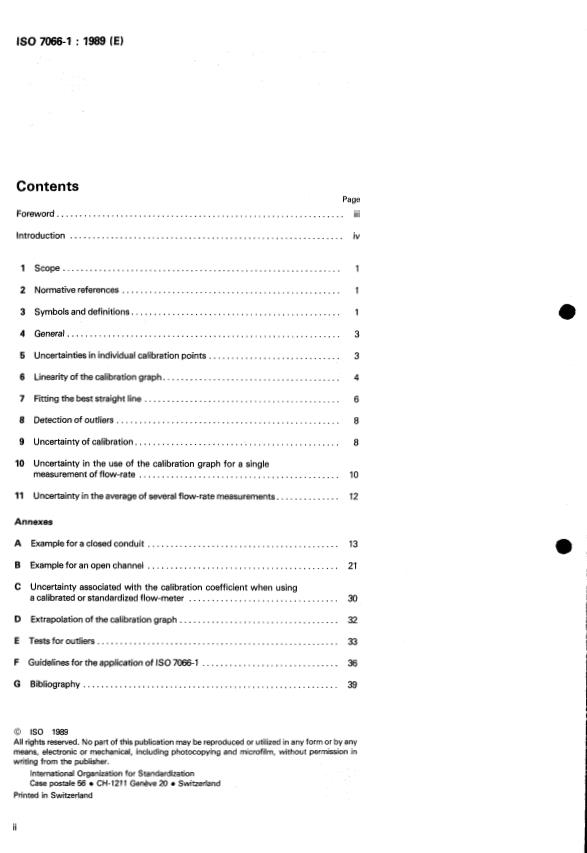
Contents
Page
...
............................................................... III
Foreword
Introduction . iv
1 Scope . 1
2 Normative references . 1
3 Symbols and definitions . 1
4 General . 3
5 Uncertainties in individual calibration points . 3
6 Linearity of the calibration graph . 4
7 Fitting the best straight line . 6
8 Detection of outliers . 8
9 Uncertainty of calibration . 8
10 Uncertainty in the use of the calibration graph for a single
measurement of flow-rate . 10
11 Uncertainty in the average of several flow-rate measurements . 12
Annexes
A Example for a closed conduit . 13
B Example for an open channel . 21
C Uncertainty associated with the calibration coefficient when using
a calibrated or standardized flow-meter . 30
D Extrapolation of the calibration graph . 32
E Tests for outliers . 33
F Guidelines for the application of IS0 7066-1 . 36
G Bibliography . 39
O IS0 1989
All rights reserved . No part of this publication may be reproduced or utilized in any form or by any
means. electronic or mechanical. including photocopying and microfilm. without permision in
writing from the publisher .
International Organization for Standardization
Case postale 56 O CH-I211 Genève 20 O Switzerland
Printed in Switzerland
II
IS0 7066-1 : 1989 (E)
Foreword
IS0 (the International Organization for Standardization) is a worldwide federation of
national standards bodies (IS0 member bodies). The work of preparing International
Standards is normally carried out through IS0 technical committees. Each member
body interested in a subject for which a technical committee has been established has
the right to be represented on that committee. International organizations, govern-
mental and non-governmental, in liaison with ISO, also take part in the work. IS0
collaborates closely with the International Electrotechnical Commission (IEC) on all
matters of electrotechnical standardization.
Draft International Standards adopted by the technical committees are circulated to
the member bodies for approval before their acceptance as International Standards by
the IS0 Council. They are approved in accordance with IS0 procedures requiring at
least 75 % approval by the member bodies voting.
International Standard IS0 7066-1 was prepared by Technical Committee ISO/TC 30,
Measurement of fluid flow in closed conduits.
IS0 7066 consists of the following parts, under the general title Assessment of
uncertainty in the calibration and use of flow measurement devices :
-
Part I: Linear calibration relationships
-
Part 2: Non-linear calibration relationships
Annexes A, B and C form an integral part of this part of IS0 7066. Annexes D, E, F and
G are for information only.
iii
IS0 7066-1 : 1989 (E)
Introduction
This International Standard has been drawn up according to the principles outlined in
IS0 5168 and gives guidance on how the uncertainty in a calibration curve or in the
mean of a number of measurements of the same flow-rate may be calculated. To
achieve this it is assumed that the uncertainty in each individual measurement of flow-
rate is calculated in accordance with IS0 5168.
I
This part of IS0 7066 deals only with calibration graphs which are linear or which can
be linearized. IS0 7066-2 deals with non-linear calibration graphs.
I
INTERNATIONAL STANDARD IS0 7066-1 : 1989 (E)
Assessment of uncertainty in the calibration and use
of flow measurement devices
Part 1 :
Linear calibration relationships
1 Scope 2 Normative references
e
The following standards contain provisions which, through
This International Standard deals with methods of assessing
reference in this text, constitute provisions of this part of
the uncertainty in the calibration of any method of measuring
IS0 7066. At the time of publication, the editions indicated
flow-rate, either in closed conduits or in open channels. It also
were valid. All standards are subject to revision, and parties to
deals with the estimation of the uncertainty in one or more
agreements based on this part of IS0 7066 are encouraged to
measurements which use the resulting calibration graph.
investigate the possibility of applying the most recent editions
of the standards listed below. Members of IEC and IS0 main-
Only linear relations are considered in this part of IS0 7066; the
tain registers of currently valid International Standards.
uncertainty in non-linear relations is the subject of IS0 7066-2.
Where a calibration curve is not linear, this part of IS0 7066 is
IS0 1100-2 : 1982, Liquid flow measurement in open channels
therefore applicable only if
- Part 2 : Determination of the stage-discharge relation.
a) the variables may be transformed (for example by tak-
IS0 5168 : 1978, Measurement of fluid flow - Estimation of
ing logarithms) to create a linear relationship between them;
uncertainty of a flow-rate measurement.
b) the range over which the relationship is established may
be subdivided in such a way that one variable varies linearly
with the other within each subdivision: or
3 Symbols and definitions
c) systematic deviations from linearity of the calibration
The symbols and definitions used in this part of IS0 7066 have
graph are negligible in comparison with the uncertainty
been taken from IS0 772 and IS0 4006.
associated with the individual points forming the graph').
The definitions given in 3.3 are only for terms used in some
Although it is assumed that the uncertainty in the independent
of which it seems useful
special sense or for terms the meaning
and dependent variables for which the calibration graph is
to emphasize.
constructed is normally established prior to determining the
calibration graph, consideration is given in 5.3 to how these
uncertainties may sometimes be determined during the calibra-
3.1 Symbols
tion procedure itself, when the uncertainty in an individual
calibration point is not known.
a intercept of the calibration graph on the ordinate
For most of the calculations given in this part of IS0 7066,
b gradient of the calibration graph
computer programs exist which are generally referred to in pro-
gram libraries as "linear regression methods" or "linear curve
C discharge coefficient
fitting".
d diameter of the orifice in an orifice plate flow-meter
I
Examples are given in annexes A and B of how the principles in
this part of IS0 7066 may be applied. D diameter of the pipe
1) For example, a turbine meter calibration graph may have a minimum value after the "hump" before rising asymptotically to become horizontal,
but the linear Calibration range is often assumed to extend down to the flow-rate at which the extrapolation of the horizontal art of the graph
intercepts the graph as it rises towards the maximum peak.
'7
IS0 7066-1 : 1989 (E)
3.3.2 random error: Component of the error of measure-
uncertainty of variable contained in parentheses1)
ment which, in the course of a number of measurements of the
random uncertainty of variable contained in paren-
same measurand, varies in an unpredictable way.
theses )
systematic uncertainty of variable contained in paren- NOTE - It is not possible to correct for random error.
theses”
3.3.3 systematic error: Component of the error of measure-
calibration coefficient
ment which, in the course of a number of measurements of the
number of repetitions of a measurement of flow-rate
same measurand, remains constant or varies in a predictable
number of measurement points used to establish
way.
calibration graph
NOTE - Systematic errors and their causes may be known or
number of pulses generated by a turbine meter per
unknown.
second
flow-rate
3.3.4 spurious errors: Errors which invalidate a measure-
Reynolds number based on bore diameter
ment. They generally have a single cause such as the incorrect
recording of one or more significant digits or malfunction of in-
experimental standard deviation of variable contained
struments.
in parentheses
standard deviation of points about the best straight line
3.3.5 uncertainty: An estimate characterizing the range of
[see equation (1711
values within which the true value of a measurand lies.
covariance of x and y [see equation (1011
Student’s t
3.3.6 random uncertainty: Component of uncertainty
associated with a random error. Its effect on mean values can
X independent variable
be reduced by taking many measurements.
Y dependent variable
the value of the dependent variable predicted by the
y
3.3.7 systematic uncertainty: Component of uncertainty
calibration graph
associated with a systematic error. Its effect cannot be reduced
V number of degrees of freedom
by taking many measurements.
3.3.8 experimental standard deviation: For a series of n
3.2 Subscripts and superscripts
measurements of the same measurand, the parameter s
ith value of a variable characterizing the dispersion of the results and given by the for-
i
mula
a specific value of a variable
k
-
arithmetic mean value of a variable
,.
the value of the variable predicted by an equation of a
fitted curve
S=
n-I
where
3.3 Definitions
xi is the result of the ith measurement;
3.3.1 (absolute) error of measurement: The result of a
measurement minus the (conventional) true value of the
F is the arithmetic mean of the n results considered.
measurand.
NOTES
NOTES
1 The experimental standard deviation should not be confused with
1 The term relates equally to the population standard deviation O of a population of size Nand of
mean m, given by the formula
- the indication,
- the uncorrected result, rN 1112
- the corrected result.
i= 1
2 The known parts of the error of measurement may be compensated
by applying appropriate corrections. The error of the corrected result
N
can only be characterized by an uncertainty.
3 The “absolute error”, which has a sign, should not be confused 2 If the series of n measurements is considered to be a sample of a
with the absolute value of an error which is the modulus of an error. population, s is an estimate of the population standard deviation.
1) In some International Standards the symbols U and E have been used instead of e.
IS0 7066-1 ; 1989 (E)
3.3.9 variance: The square of the standard deviation. In addition to determining the uncertainty in the coefficient or
curve obtained during the calibration of a flow-meter or gaug-
ing station, it is necessary to determine the uncertainty in the
3.3.10 confidence limits: The lower and upper limits within
particular value which is used as a coefficient or is read from
which the true value is expected to lie, with a specified prob-
the calibration curve when the flow-meter is used after having
ability assuming negligible systematic error.
been calibrated. Where the value of the calibration coefficient
to be used is determined completely independently of the
3.3.11 calibration graph: Locus of points obtained by plot-
measurement from which a flow-rate is to be obtained, then
ting some index of the response of a flow-meter against some
these two quantities are the same, provided that the conditions
function of the flow-rate.
of use are identical with those of the calibration; if, however,
some information from the test to measure the flow-rate is re-
quired before the calibration coefficient or curve can be used,
4 General
then an additional uncertainty will be introduced. Annex C
describes how this additional uncertainty is introduced.
For a calibration to be meaningful, the systematic uncertainty
in the calibrator shall be very much less than the systematic
The approaches to be used in these different circumstances are
uncertainty in the device or system being calibrated. This is
described in clause 9, and in clause 11 methods for assessing
especially true when the procedures specified in 7.3 are used.
the uncertainty in the average of a number of measurements
are described.
The calibration of a flow-metering device or system will result in
a graph of the calibration coefficient which will subsequently be
e
used to predict the flow-rate. As this subsequent flow-rate
5 Uncertainties in individual calibration
prediction has to have an uncertainty attached to it, then not
only the functional relationship between calibration coefficient points
and flow-rate but also the uncertainty in the calibration coeffi-
cient shall be established during calibration.
5.1 General
There will exist a number of pairs of values (x, y) where the
When a flow-meter is being calibrated, some function of its
uncertainties in x and y [e(x) and e(y) respectively1)] are known
output may be plotted against either a reference measurement
5. The choice of the
from one of the methods given in clause
of the flow-rate or some function of this flow-rate, such as the
procedure by which the coefficients and the uncertainty of the
Reynolds number.
calibration equation are calculated is determined by the relative
magnitudes of the random components of the uncertainties
e,(x) and e,ly), as described in clause 7. In either case, it is necessary to establish the uncertainty in the
coordinates of a single point in order to be able to compute the
When e,(x) can be ignored (as, for example, is normally the uncertainty in the calibration graph, and there are two ways in
case in the calibration of an orifice plate), the calibration which this may be done:
equation and the uncertainty in the calibration coefficient are
-
computed by the methods specified in 7.2 and 9.3 respectively. IS0 5168 may be used; or
When, however, the random uncertainties in x and y are of
-
similar magnitude, the methods specified in 7.3 and 9.4 should the information can sometimes be obtained from the
x and y are both significant calibration data directly.
be used. When the uncertainties in
but cannot be regarded as approximately equal, then the
calculation of the uncertainty in the calibration graph is outside It should be noted, however, that the uncertainty in a co-
the scope of this part of IS0 7066. ordinate may vary with the value of the coordinate itself; thus,
for example, where the reference flow-rate is measured by a
A special case is that where y is effectively independent of x; diversion system involving the static weighing of a quantity of
this is a common situation with flow-meters used in closed liquid collected over a measured period of time, the uncertainty
pipes, since there is an obvious advantage in having a calibra- due to the timing is usually less for long diversion periods (and
tion coefficient which is independent of flow-rate. In such consequently for low flow-rates if approximately the same
cases, the method specified in 9.2 may be used for calculating weight of water is collected at each test point) than for short
the uncertainty. diversion periods.
1) The customary categories of independent and dependent variables, and of abscissae (horizontal) and ordinate (vertical) coordinates in a graph,
are irrelevant for linear regressions in that the important distinction here is between variables that have significant uncertainties and variables that have
negligible (or zero) uncertainties. When the uncertainty in one variable is significantly greater, in the manner described in clause 7, than the other, the
former will be denoted byy and the latter byx. Thus the regressions studied are all fory on x irrespective of whether a variable is considered to be in-
dependent, and irrespective of which variable is plotted "horizontally".
IS0 7066-1 : 1989 (E)
Justification shall always be provided where it is assumed that 6 Linearity of the calibration graph
the uncertainty is constant throughout the range of a co-
ordinate. Where the uncertainty cannot be regarded as
6.1 General
constant, it shall be estimated for sufficient values of the
coordinate to give a clear idea of how it varies with the value of
In considering the shape of any calibration graph, previous
the coordinate.
knowledge or supporting information appropriate to the flow-
metering method being used (for example if there is a relevant
published standard) should always be taken into account to
justify any assumption made about the shape of the graph.
Where the shape of the calibration graph is unusual, a suffi-
5.2 Use of IS0 5168
cient number of calibration points shall be repeated to verify the
shape for that particular flow-meter.
IS0 5168 describes in detail how an estimation of the uncertain-
ty in a single measurement of flow-rate may be arrived at, and In the absence of such information, or where there is no reason
the procedures described in IS0 5168 may be used to calculate to believe in advance that the form of the curve should be
linear, simple techniques are available to establish whether or
the uncertainties of both the independent and the dependent
variables in the calibration graph. not the graph can be treated as linear, but these are applicable
only when the experimental points are not grouped into sets.
When the experimental points are grouped into sets, only visual
Is it important, however, that the random and systematic con-
observations may be used, since the extensive statistical tests
tributions to the uncertainty are calculated separately and not
which are otherwise required are outside the scope of this part
combined; the various formulae for calculating the uncertainty
IS0 7066.
of
in a calibration graph are first used to calculate only the random
component of the uncertainty, and so only the random compo-
When the data can be grouped into sets, the following test may
nent of the uncertainty in the individual points is used at that
be used, but the sets shall be such that each one consists of a
stage. Subsequently, the systematic uncertainty in the indi-
number of measurements made at one of a number of fixed
vidual points is added by the root-sum-square method to the
values for one of the coordinates. Figure 1 illustrates a case
value obtained to give the final combined value. The random
where there are five sets, the number of measurements within
component of the uncertainty is required separately in any
the sets varying from four to six.
case, since it is the relative magnitudes of random uncertainties
in x and y which determine the calculation procedures to be
The test consists of comparing the variance of the means of the
used.
groups about the fitted straight line with the variance within the
groups.
This method of calculating the uncertainty in the coordinates of
The variance within the groups, s;, is given by
a single experimental point may be used only when previous in-
vestigations have been carried out to establish the uncertainties
O n:
in the various subsidiary measurements which have to be
made, or when this information is available from some other
source.
where
5.3 Use of calibration data
n is the total number of measurements;
Where the measurement conditions can be kept constant, it is
n, is the number of measurements in the ith group;
possible to determine the random components of the uncer-
tainties of the coordinates of the calibration graph during the
q is the number of groups;
calibration by repeating measurements. Thus, for example in
the calibration of an orifice plate, it might be possible to keep
yi~ is the jth measurement in the ith group;
the Reynolds number constant and to take a series of readings
of the data necessary to compute the calibration coefficient,
n;
and it might conversely be possible to keep the differential
Yi,j
pressure across the orifice plate constant, while making a
- j=l
number of determinations of the reference flow-rate (and con-
sequently the Reynolds number).
Yi=ni
The variance of the means of the group about the fitted straight
The uncertainty (due to random effects) in the calibration coef-
line, s$,, is given by
ficient or Reynolds number may then be calculated from the
standard deviations of the resulting measurements.
a
There is no alternative to using the methods of IS0 5168 in
i= 1
assessing systematic uncertainties if the assessment of the
s2, = . . (2)
uncertainty is to be in accordance with this part of IS0 7066.
9-2
IS0 7066-1 : 1989 (E)
where
If the relationship between the calibration coefficient and the in-
dependent variable is not linear, there are two possible ways in
n, and q have the same meaning as in equation (1);
which the data may be made suitable for analysis in accordance
with this part of IS0 7066. The first, to linearize the curve, may,
however, only be done on the basis of some physical model,
$i is the value of y obtained from the fitted straight line for
a given value of x.
6.2 Linearization of curve
The test quotient iss’$sg, and if this number equals or exceeds
The coordinates may be transformed to give two new variables
1 for v, = q - 2 and v2 = n - q
the value given in table
degrees of freedom, then the best-fit equation through the data which, when plotted one against the other, produce a straight
line, 01 a function of one of the coordinates may be used in-
points cannot be assumed to be linear. If, however, the
stead of the coordinate itself SO as to produce this result,
quotient is less than the corresponding value given in table 1,
although it is of course essential that the transformation be
the best-fit equation may be assumed to be linear at the 95 %
capable of being used easily when the resulting graph is subse-
confidence level.
quently applied to the use of the flow-meter or the flow
measurement method.
Table 1 - Values of the F distribution for selected degrees of freedom -
Probability level 0.05
- - - -
__.
1 2 3 4 5 6 7 8 9
10 20 30 40 80 100
- -
1 161,44 200 216 225 230 234 237 239 241
242 248 250 251 252 253
18,51 19 19,2 19,2 19,3 19,3 19,4 19,4 19,4 19,4 19,4 19,5 19,5 19,5 19,5
3 10,13 9,55 9,28 9,12 9,Ol 8,85
8,94 8,89 8,81 8,79 8,62 8,55
8,66 8,59 8,s
7,71 6,94 6.39 6,26 6,16 6 5,96 5,75 5,67
659 6,09 604 5,s 5,72 5,66
5 6,61 5,79 5,41 5,19 5,05 4,95
4,m 4m 4,74 4,41 4,41
4,77 4,s 4,5 49
5,99 5,14 4,76 4,28 4,21 4,15 3,87 3,81 3,72 3,71
4,53 439 4,1 4,06 3,77
7 4,74 4,35 4,12 3,97 3,87 3,79
5,59 3,73 3,68 3,27
3,64 3,44 33 334 329
5,32 4,07 3’35 3,15 2,97
4,46 334 3,69 3,5a 3,5 3,44 33 3,m 3.04 239
9 5,12 4,26 3,86 3,37 3,29 3,18
3,63 3,48 3,23 3,14 2,76
234 2,s 2,83 2,77
10 4,96 3,71
3,33 3,14 3,07 3.02
4,l 39 3,22 2,98 2,77 2,7 2,s 2,6 2159
20 4,35 2,87 2,71 2,51 2,39 2,35 2,12 1,92 1,91
3,49 3,1 2,6 2,45 2,04
1,m
30 4,17 3,32 2,92 2,42 2,33 2,27
2869 233 2,21 2,16 1,93 1,79 1,71
1 1,7
4.08 3,23 2,61 2,45 2,34 2,25 2,18 2,12 2,08 1,74 1,61
2,84 1,84 I,@ 1 r59
80 3,11 2,72 2,21 2,13 2
3,96 2r49 23 2,06 1,7 1,6 1,45
I,% 1 ,a 1,43
334 2,31 2,19 2.03 1,97 1,93 1,57 1,52 1,41 1,39
3,09 2,7 2,46 2,1 1
- - -
X
X
X X
X
X
x
Figure 1 - Example of grouping data to establish linearity of best-fit straight line
IS0 7066-1 : 1989 (E)
linear; in this case, a separate calibration equation and con-
An example of the first possibility would be to plot "log y"
fidence limits shall be calculated for each portion of the graph.
against "log x" where the basic relation is of the form
Where possible, the number of points in each sub-section of
"y = ux2" ("a" being a constant).
the graph should be such that they give approximately the
same uncertainties for the line through each sub-section. Since
The second method of linearizing a curve is commonly used
calibration graphs should never be extrapolated beyond the ex-
when calibrating an orifice plate. In this case, it is known from
treme data points unless there is extremely good reason for
experience that it is better to plot the discharge coefficient C
doing so, there shall be at least three points common to adjac-
against the Reynolds number than to plot the differential
ent portions of the calibration graph.
pressure against the Reynolds number, since this gives a graph
which is linear over a fairly wide range. The graph is, however,
non-linear at low Reynolds numbers, and it has been found
7 Fitting the best straight line
from experience that plotting the discharge coefficient against
some function of the Reynolds number (for example Redo.5
or Re;0,75) extends the linear range.
7.1 General
Before a best straight line and its associated uncertainty are
6.3 Subdivision of the curve
calculated, the data available shall first be examined, since they
Although a calibration graph may not be linear over the full can fall into one of several classes, and different formulae apply
for different types of data. Some basic principles are illustrated
range of the calibration, it may well be that by subdividing the
2.
curve into a number of parts, each part can be regarded as in figure
Y
Yi
-
Figure 2 - Basic principles for best-fit straight lines
IS0 7066-1 : 1989 (E)
The best straight line fit to a sample of n points, (xi, ri), when
Obtain an approximate value for the gradient b from a graph or
1 i a n, is given by the regression of y on x: from equation (8) or from equation (1 1). If the absolute value of
be,(x) is less than approximately one-fifth of e,(y), the formulae
y, - y= b(xi - X) . . (3) given in 7.2 shall be used to fit a straight line; if not, the for-
mulae given in 7.3 shall be used.
where
7.2 Random uncertainty negligible or small in
one variable in comparison with the other
The gradient of the line is, in this case, given by
s(x, y)
pi is the value of y on the line for a measured value xi; b=- .
(8)
&XI
where
r. Yi
- i= 1
n
y=- .
(5)
n . (9)
n-I
i=l
Equation (3) may also be written as
= a + bxi . . : (6)
.. (101
where i= 1
The intercept, a, is given by equation (7) :
a =y- bT
The method to be used for computing the values of the coeffi-
cients a and b depends on the magnitude of the random uncer-
tainties in x and y.
7.3 Random uncertainty in both variables of
The most common case occurs when the random uncertainties
similar magnitude
in x and y are both significantly different from zero. Fortu-
nately, if both variables have random uncertainties significantly
The gradient is calculated from
different from zero, it is normally possible to assume that
a) one random uncertainty is negligible in comparison with
(11)
the other, or
where
b) these random uncertainties are of approximately equal
magnitude.
. . . (12)
The former assumption leads to the same formulae as for the
cases where only one variable has a random uncertainty i= 1
significantly different from zero; this is the situation which nor-
mally applies. s2(x) is given by equation (9);
To assess the relative magnitude of the random uncertainties in the intercept, a, is again given by equation (7)
x and y, first calculate e,(x) and e,(y) according to the principles
of IS0 5168. The sign of b is the same as that of s(x, y).
IS0 7066-1 : 1989 (E)
using the same range and values of x, and with the same
NOTE - The following alternative formulae for s2(x), s2(y) and dx, y)
are easier to use, if the computation is carried out manually, but great
number of measurements of y, and is given by
care should be taken since they are prone to rounding errors:
s2(X) is defined similarly.
Note that $(Y) and $(y) are quite different from $(XI and
$(y) defined in equations (9) and (12). s;!(y), for example, is the
variance of all the values of y over the range of the calibration
graph relative to their mean value, and s::(x) has a similar mean-
ing, whereas s*(?) is associated only with the scatter of dif-
8 Detection of outliers
ferent determinations of iand is essentially an indication of the
random uncertainty in y,
Spurious errors (see IS0 5168) are errors, such as human errors
or instrument malfunction, which invalidate a measurement;
From equation (7), it can be seen that the variance of a is given
they may be due to, for example, the transposing of numbers in
by
recording data or the presence of pockets of air in leads from a
water line to a manometer. Such errors cannot be incorporated
into any statistical analysis and the measurement shall be
discarded. Where the error is not large enough to make the
and the contribution of the variance in 6 to the variance in Fis
result obviously invalid, some rejection criterion should be ap-
plied to decide whether the data point should be rejected or re-
(Xk - X)2s2(b)
tained.
Thus the random component of the uncertainty in F, e,($), is
Whenever it is suspected that one or more results have been af-
given at the 95 % confidence level by
fected by errors of this nature, a statistical “outlier” test should
be applied. For the purposes of this part of IS0 7066, either the
Dixon test or the Grubbs extreme deviation outlier test may be e,($) = -I t [s2(y) + b2s2(X) + (xk -- X)2s2(b)]”2 . . .
(15)
used. The Dixon test is easy to use by hand, but when a set of
values are being processed by computer, the Grubbs test is
where t is obtained from table 2 for n -- 2 degrees of freedom.
more suitable, since it is more reliable, easier to program and
takes up less storage.
Table 2 - Value of Student’s t at 95 ?40
Details of these tests are given in annex E. confidence level
Number of degrees of
I
I freedom, v
9 Uncertainty of calibration
9.1 General
In general, the uncertainty in the best straight line arises from
uncertainties in the values for the intercept, a, and for the gra-
b. 10
dient,
From equation (3)
pi = y+ b(xi - X) . (13)
a3
Thus, combining the variances of j7 Xand b by the root-sum-
square method (see IS0 5168),
Equation (15) is the basic equation for uncertainty which is
s2(y) = ~~(j-4 + b2s2(X) + (xk - XI2$(b) . (14)
used either directly or in a modified form in the various
paragraphs below.
where xk is the value of x at which the uncertainty in y is re-
quired.
As noted in clause 4, the method to be used for calculating the
Thus s2(y) is the variance of Ywhich would be obtained from uncertainty in a calibration depends on the magnitude of the
the scatter of several different determinations of U obtained random uncertainty in the variable x, aind on whether or not the
IS0 7066-1 : 1989 (E)
value of y is independent of the value of x, that is on whether or NOTE - Equation (16) is strictly valid only when the random uncertain-
ty in x contributes significantly less to the calibration graph uncertainty
not b is zero. The first step is therefore to establish whether or
than the random uncertainty in y does, since it is a simplification of a
not the gradient, b, of the line is significantly different from
more general formula. The expansion of equation (17), used to develop
zero, and this is carried out as follows.
equation (18), also makes this assumption. The use of equations (18)
and (19) will, however, give a smaller uncertainty for b than the full for-
b, s(b), shall be calculated from
The standard deviation of
mulae would, and so if they include zero, the more general formula
would lead to the same conclusion. If they do not include zero, it is
possible that the gradient will be treated as having a non-zero value,
(16)
when it might have been acceptable to take its value as zero, but this
would be a rare situation, and the only penalty incurred would be that
the more complicated formulae given in 9.4 would be used instead of
where SR is the standard deviation of the points about the best the simpler method given in 9.2. The results obtained for the uncertain-
ty of the best-fit line would in such a case be virtually identical no mat-
straight line, i.e.
ter whether the formulae given in 9.2 or 9.4 were used.
9.2 Calibration curve with zero gradient
In this case, the calibration coefficient has a single value, and all
of the estimates of this value can be analysed together, ir-
respective of the value of the independent variable to which
they correspond. An example of where this often occurs is in
the calibration of a turbine meter for use in water.
The best estimate of the value of the calibration coefficient is
given by equation (5) :
This is more convenient, but the calculation of the numerator is
n
prone to rounding errors, so it is important to ensure that
-
enough significant figures are used in the computation.
% confidence limits for b are then given by
The 95
b - rsib)
... (19) In this case, b = s(b) = O, and so, from equation (151, the ran-
b + tdb)
dom component of the uncertainty in 9 is given at the 95 %
confidence level by
where r is the value obtained from table 2 for n - 2 degrees of
freedom.
(20)
If these limits include zero and there is independent evidence
that the particular flow-meter or type of flow-meter is expected
to have a constant coefficient (for example from the informa-
where
tion in a relevant standard or a previous calibration), it can be
assumed that the calibration coefficient has a constant value. If
there is no independent evidence that a constant calibration
coefficient is expected, then, whether or not the limits include
zero, the formulae given in 9.3 (if the uncertainty in x can be ig-
nored) or in 9.4 shall be used.
In order to calculate the uncertainty in the calibration coeffi-
and t is obtained from table 2 for n - 1 degrees of freedom.
cient the random and systematic components shall first be
evaluated separately. Random components are calculated from
The systematic component of the uncertainty in y, e,(?), is
the formulae given in 9.2 to 9.4 and shall include the contribu-
calculated as described in clause 5 and the uncertainty in the
tions from the random uncertainties in the instruments used
e(?,), is then given by
calibration coefficient,
during the calibration, so that these do not have to be allowed
for separately. In particular, hysteresis effects in instruments
will contribute to the random uncertainty component obtained
in this way. Systematic components are calculated in accord-
ance with IS0 5168.
IS0 7066-1 : 1989 (E)
In this case, si is given by
9.3 Random uncertainty negligible in one
variable in comparison with the other
. (27)
In general, the random component of the uncertainty in y is
given by equation (15). However, when the gradient of the best
straight line through the data is not zero, but the uncertainty in
Similarly, s2(h) shall be calculated from a more complicated for-
x may be ignored, it can be shown that the variance in 7 is
mula than in the simpler case given in 9.3 and is given, in this
given by
instance, by
Also, for ease of computation, SR may, for this case, be
In this case, therefore, the random cornponent of the uncer-
calculated from
tainty in 9 is given by
(24)
(29)
For this particular case, $(b) is also given by equation (16) :
where
is calculated from equations (17) or (27);
s:
s2(b) is calculated from equation 128);
Since the uncertainty in x is, in this case, being treated as
s(x), s(x, y), s(y) and b are obtained for use in equation (28)
negligible, s2(X) = O, and so, from equations (151, (23) and
from equations (91, (IO), (11) and (12);
(16), the random component of the uncertainty in Fis given by
t is obtained from table 2 for n - 2 degrees of freedom.
As before, the uncertainty in the calibration coefficient,
is
then given by equation (22) :
where
SR may be calculated from either equation (17) or equation
(24);
9.5 Extrapolation
t is obtained from table 2 for n - 2 degrees of freedom;
Values of calibration coefficients and uncertainties obtained by
is
extrapolating a calibration graph cannot be said to be obtained
xk is the value of x for which the uncertainty in
required. in accordance with this part of IS0 7066, since unpredictable
effects might render these values meaningless. Nevertheless,
limitations in the calibration facilities available occasionally
The uncertainty in ?is obviously a minimum at .>ck = and so
result in the calibration graph having to be extrapolated to
any set of calibration points should be such that the value of x,
higher flow-rates than were achieved during the calibration;
for which the flow-meter is most commonly used, is close to
D gives guidance on how extrapolation might be used.
annex
the middle of the range of values of x over which
measurements are made.
In the same way as in 9.2, the uncertainty in the calibration
10 Uncertainty in the use of the calibration
coefficient, e(?,), is then given by equation (22) :
graph for a single measurement of flow-rate
e(.?,) = [ef(j) + ei(j)]”2
10.1 General
9.4 Random uncertainty in both variables of
similar magnitude
The uncertainty in a calibration graph will have a systematic ef-
fect on any estimate of flow-rate for vvhich the graph is used.
When the uncertainties in x and y affect equally the uncertainty
The value of the calibration coefficient which is used is the best
in the calibration graph, it can be shown that
estimate of that coefficient, but any error in its determination
during a calibration will have the same effect on every value of
flow-rate which the coefficient is subsequently used to com-
pute.
IS0 7066-1 : 1989 (E)
Moreover, when a flow-meter is being used to measure a flow- EXAMPLE
rate under identical conditions to those experienced during the
calibration, and the value of its calibration coefficient or the When a turbine meter is used over the flat part of its
position to be used on its calibration graph is determined by a
characteristic, the flow-rate Q is given by
measurement made during the test in which the flow-rate is be-
ing measured (i.e. independently from the measurements
N
Q=P
which established the calibration graph), as is the case in 10.3,
K
then the uncertainty in the value used for the calibration coeffi-
cient is greater than simply the uncertainty in the calibration
where
graph. This increase is due to the uncertainty in the experimen-
tal observations which are required to locate the position to be
K is the calibration coefficient;
used on the calibration graph (see annex Ci.
N,, is the number of pulses generated per second by the
NOTE - A further additional uncertainty will be introduced if a flow-
turbine meter.
meter is used in conditions (for example the installation layout, the fluid
used or the data processing methods) which are different from those
under which it was calibrated and, generally, it is impossible to predict The systematic uncertainty in Q is given by
the magnitude of this so this source of uncertainty will have to be
assessed separately in each particular case.
... (32)
This additional uncertainty, denoted by e(yo), will have both a
random and a systematic component, and if the procedures
In order to obtain an estimate of the uncertainty in Q it is then
laid down in IS0 5168 were to be followed rigidly, only the lat-
of course necessary to assess the random uncertainty in Q
ter should be combined with the systematic uncertainty in the
arising from Np and to combine it with eJQ) in accordance with
calibration graph described above. In practice, however, the
IS0 5168.
systematic component will be at least as large as the random
component, and will very often be much larger; in addition, the
complicated calculations which are required if the uncertainties
10.3 Calibration coefficient determined by the
in the value used for the calibration coefficient are to be split up
iterative method
into their random and systematic components are not justified
by any appreciable improvement in the validity of the result,
This subclause generally applies only to closed conduit flow-
and so the uncertainties associated with the use of the calibra-
meters, since the case it describes does not arise in any open
tion graph or coefficient are treated as entirely systematic.
channel flow-metering method.
A more detailed explanation of how, in these situations, the
If the flow-rate is obtained by multiplying an output of the flow-
uncertainty in the value of the calibration coefficient is in-
meter by a coefficient, where the coefficient is, in some way,
creased beyond the value it had during the initial calibration is
itself a function of flow-rate, then it is necessary to use an
given in annex C.
iterative method to determine the value of the calibration coeffi-
cient to be used. An estimate is made of the value of the
In general, the uncertainty, e(?), in the value used for the coef-
calibration coefficient, which is used to give an approximate
ficient is, therefore, obtained by combining, by the root-sum-
value for the flow-rate, and this, in turn, is used to give a more
square method, the uncertainty in the calibration graph, e(Yc),
precise value for the calibration coefficient.
with the additional uncertainty, and so is given by
In this case, any error in the measurement of the flow-meter
e(?) = [e2(Yci + e2(Y0i]’/* . (30)
output will introduce an uncertainty, in the value used for
The manner in which the use of the calibration contributes to the coefficient, as described in annex C. The uncertainty, e(?),
in the value used for the coefficient is, therefore, given by
the uncertainty in the flow-rate depends on the nature of the
calibration graph. There are two broad groups. equation (301 :
10.2 Calibration coefficient with a constant value
The method of evaluating e2(Yc) depends on whether the flow-
If the calibration graph has a zero gradient, as described in 9.2,
meter coefficient is obtained by calibration or taken from a rel-
the flow-rate is obtained by multiplying some function of an
evant standard. If it is taken from a calibration graph, it also
output of the flow-meter (for example the output could be the
depends on whether the uncertainties in x and y are of approxi-
differential pressure across an orifice plate or the height of
mately equal magnitude or the effect of the uncertainty in x is
water over a weir) by a coefficient which is independent of
negligible in the calibration graph.
flow-rate. There is, therefore, no additional component e(Yo)
and so the contribution of the calibration coefficient to the
Thus when a calibrated flow-meter is used to measure flow-
systematic uncertainty in the flow-rate estimation is, in this
rate, the uncertainty in the calibration coefficient used is given
case, equal to the uncertainty in the calibration coefficient
itself, i.e. it is given by bY
... (31)
IS0 7066-1 : 1989 (E)
in the mean flow-rate may or may not be reduced by repeating
when the uncertainty in x is negligible [from equations (25) and
the measurem
...
NORME IS0
I N TE R NAT I O N ALE 7066-1
Première édition
1989- 10-01
Évaluation de l'incertitude dans l'étalonnage et
l'utilisation des appareils de mesure du débit -
Partie 1 :
Relations d'étalonnage linéaires
Assessment of uncertainty in the calibration and use of flow measurement devices -
Part I : Linear calibration relationships
Numéro de référence
IS0 7066-1 : 1989 (FI
Sommai re
Page
ii
Avant-propos .
Introduction . iii
1 Domaine d’application . . . . . . . . . . . . . . . . . . . . . . . . . . . . . . . . . , . . . . . . . . . . . . . 1
2 Références normatives. . , . . . . , , . . . . . . . . . . . . . . . . . . . . . . . . . . . . I . . . . . . . . . 1
3 Symboles et définitions . . . . . . . . . . . . . . . . . . , , . . . . . . . . . . . . . . . . . . . . . . . . . . 1
4 Généralités . . . . . . . . . . . . . . . . . . . . . . . . . . . . . . . . . . . . . . . . . . . . . . , . . . , . . , . . . 3
5 Incertitudes sur des points d’étalonnage isolés . . . . , . . . . . . . . . . . . . . . . . . . . . . 3
6 Linéarité de la courbe d‘étalonnage . . . . . . . . . . . . . . . . . . . 4
7 Droite d’ajustement . . . . . . . . . . . . , . . . . . . . . . . . . . . . . . . . . . . . . . . . . . . . . . . . . 6
8 Détection des points aberrants . . . . . . . . . . . . . . . . . . . . . . . . . . . . . . . . . . . . . . . . 8
9 Incertitude d’étalonnage . . . . . . . . . . . . . . . . . . . . . . . . . . . . . . . . . . . . . . . . . . . . .
10 Incertitude lors de l’utilisation d’une courbe d‘étalonnage pour
unmesurageuniquededébit .
11 Incertitude sur la moyenne de plusieurs mesurages de débit. . . . . . . . . . . . . . . .
Annexes
A Exemple de mesurage en conduite fermée . . . . . . . . . . . . . . . . . . . . . . . . . . . . . . . 13
B Exemple de mesurage en canal découvert . . . . . . . . . . . . . . . . . . . . . . . . . . . . . . .
C Incertitude associée au coefficient d’étalonnage lors de l’utilisation
d’un débitmètre étalonné ou normalisé . . , . . , . . , , . . . . . . . . . . . . . . . . . . . . . . . .
D Extrapolation de la courbe d’étalonnage. . . . . . . . . . . . . . . . . . . . . . . . . . . . . . . . . 32
E
Test des valeurs aberrantes. . . . . . . . . . . . . . . . . . . . . . . . . . . . . . . . . . . . . . . . . . . , 33
F Directives pour l‘utilisation de I‘ISO 7066-1 . . . . . . . . . . . . . . . . . . . . . . . . . . . . . . .
G Bibliographie .
O IS0 1989
Droits de reproduction réservés. Aucune partie de cette publication ne peut être reproduite ni
utilisée sous quelque forme que ce soit et par aucun procédé, électronique ou mécanique,
y compris la photocopie et les microfilms, sans l’accord écrit de l’éditeur.
Organisation internationale de normalisation
Case postale 56 CH-121 1 Genève 20 O Suisse
Imprimé en Suisse
ii
IS0 7066-1 : 1989 (F)
Ava n t- p ro pos
L'ISO (Organisation internationale de normalisation) est une fédération mondiale
d'organismes nationaux de normalisation (comités membres de I'ISO). L'élaboration
des Normes internationales est en général confiée aux comités techniques de I'ISO.
Chaque comité membre intéressé par une étude a le droit de faire partie du comité
technique créé à cet effet. Les organisations internationales, gouvernementales et non
gouvernementales, en liaison avec I'ISO participent également aux travaux. L'ISO col-
labore étroitement avec la Commission électrotechnique internationale (CEII en ce qui
concerne la normalisation électrotechnique.
Les projets de Normes internationales adoptés par les comités techniques sont soumis
aux comités membres pour approbation, avant leur acceptation comme Normes inter-
nationales par le Conseil de I'ISO. Les Normes internationales sont approuvées confor-
mément aux procédures de I'ISO qui requièrent l'approbation de 75 % au moins des
comités membres votants.
La Norme internationale IS0 7066-1 a été élaborée par le comité technique ISO/TC 30,
Mesure de débit des fluides dans les conduites fermées.
L'ISO 7066 comprend les parties suivantes, présentées sous le titre général Évaluation
de l'incertitude dans l'étalonnage et l'utilisation des appareils de mesure du débit:
-
Partie I : Relations dëtalonnage linéaires
-
Partie 2 : Relations dëtalonnage non linéaires
Les annexes A, B et C font partie intégrante de la présente partie de I'ISO 7066. Les
annexes D, E, F et G sont données uniquement à titre d'information.
iii
IS0 7066-1 : 1989 (F)
Introduction
La présente Norme internationale a été élaborée selon les principes décrits dans
I'ISO 5168 et donne la manière de calculer l'incertitude associée à une courbe d'étalon-
nage ou à la moyenne de plusieurs mesurages d'un même débit. Pour ce faire, il est
supposé que l'incertitude de chaque mesurage individuel de débit est calculée selon
I'ISO 5168.
Cette partie de I'ISO 7066 ne prend en compte que les courbes d'étalonnage linéaires
ou pouvant être linéarisées. L'ISO 7066-2 traite du cas de courbes d'étalonnage non
linéaires.
iv
NORM E I NTE R NAT1 O NALE
IS0 7066-1 : 1989 (F)
Évaluation de l‘incertitude dans l‘étalonnage et l’utilisation
des appareils de mesure du débit -
Partie I:
Relations d’étalonnage linéaires
Des exemples d‘application de la présente partie de I‘ISO 7066
0 1 Domaine d‘application
sont donnés en annexes A et B.
La présente Norme internationale traite des méthodes de calcul
de l’incertitude associée à l’étalonnage de n’importe quelle
2 Références normatives
méthode de mesure de débit, que ce soit en conduites fermées,
ou en canaux découverts. Elle traite aussi de l’estimation de
Les normes suivantes contiennent des dispositions qui, par
l’incertitude sur une ou plusieurs mesures à partir de la courbe
suite de la référence qui en est faite, constituent des disposi-
d‘étalonnage résultante.
tions valables pour la présente partie de I‘ISO 7066. Au moment
de la publication de cette partie de I‘ISO 7066, les éditions indi-
Seules les relations linéaires sont prises en considération dans
quées étaient en vigueur. Toute norme est sujette à révision et
la présente partie de I’ISO 7066; l‘incertitude associée à des
les parties prenantes des accords fondés sur cette partie de
relations non linéaires fait l‘objet de 1’60 7066-2.
I’ISO 7066 sont invitées à rechercher la possibilité d’appliquer
les éditions les plus récentes des normes indiquées ci-après.
La présente partie de I’ISO 7066 ne s’applique donc que si
Les membres de la CE1 et de I’ISO possèdent le registre des nor-
mes internationales en vigueur à un moment donné.
a) les variables peuvent être transformées (par exemple
par les logarithmes) de façon à créer entre elles une relation
IS0 1 100-2 : 1982, Mesure de débit des liquides dans les canaux
linéaire;
découverts - Détermination de la relation hauteur-débit.
b) le domaine dans lequel la relation a été établie peut être IS0 5168 : 1978, Mesure de débit des fluides - Calcul de
subdivisé de telle manière qu’une relation linéaire soit obte- l’erreur limite sur une mesure de débit.
nue dans chaque subdivision; ou
3 Symboles et définitions
c) les écarts systématiques de linéarité de la courbe d’éta-
lonnage sont négligeables par rapport à l’incertitude asso-
Les symboles et définitions utilisés dans la présente partie de
ciée à la détermination des points isolés constituant la
I’ISO 7066 sont donnés dans I’ISO 772 et I‘ISO 4006.
courbel).
Les définitions données en 3.3 concernent les termes utilisés
Bien que, par hypothèse, l’incertitude sur les variables indépen-
dans un sens précis ou les termes dont il paraît utile de donner
dantes et les variables liées, pour lesquelles la courbe d‘étalon-
une explication plus approfondie.
nage est établie, soit normalement fixée avant que ne soit défi-
nie la courbe d‘étalonnage, des indications sont données en 5.3
3.1 Symboles
sur la manière dont ces incertitudes peuvent parfois être déter-
minées en cours de procédure d’étalonnage lorsqu’on ne con-
a ordonnée de l’origine de la courbe d‘étalonnage
nait pas l’incertitude sur un point d‘étalonnage isolé.
b pente de la courbe d‘étalonnage
Pour la plupart des calculs indiqués dans la présente partie de
C coefficient de décharge
I’ISO 7066, il existe des programmes d’ordinateurs générale-
d diamètre de l’orifice pour les diaphragmes
ment dénommés (( méthodes de régression linéaire )) ou (( ajuste-
ment par une droite)) dans les bibliothèques de programmes. D diamètre de la conduite
1 i Par exemple, la courbe d’étalonnage d‘un compteur à turbine peut présenter une valeur minimale après la ((bossen avant de se mettre à croître
asymptotiquement vers l’horizontale. Le domaine d‘étalonnage linéaire est toutefois souvent considéré par hypothèse, comme s‘étendant jusqu’au
débit où l‘extrapolation de la partie horizontale de la courbe coupe la partie montante, croissant vers le maximum.
IS0 7066-1 : 1989 (FI
incertitude sur la variable entre parenthèses1) 3.3.2 erreur aléatoire: Composante de l'erreur de mesurage
e(
qui varie de façon imprévisible lors de plusieurs mesurages du
incertitude aléatoire sur la variable entre
e,( 1
même mesurande.
parenthèses'
incertitude systématique sur la variable entre NOTE - II n'est pas possible de corriger une erreur aléatoire.
e,( i
parenthèses1'
coefficient d'étalonnage
K 3.3.3 erreur systématique : Composante de l'erreur de
mesurage qui reste constante ou varie de façon prévisible lors
M nombre de mesures d'un même débit
de plusieurs mesurages du même mesurande.
n nombre de points de mesure utilisés pour établir la
courbe d'étalonnage
NOTE - Les erreurs systématiques et leurs causes peuvent être con-
nues ou inconnues.
nombre d'impulsions par seconde d'un compteur à
NP
turbine
3.3.4 erreurs aberrantes: Erreurs qui dénaturent totalement
débit
Q
un mesurage. Ces erreurs ont généralement une cause unique
nombre de Reynolds rapporté au diamètre de l'orifice
telle que transcription incorrecte d'un ou de plusieurs chiffres
Red
significatifs ou mauvais fonctionnement des instruments.
écart-type expérimental de la variable entre parenthè-
s( 1
ses
3.3.5 incertitude: Estimation caractérisant l'étendue des
écart-type des points par rapport à la droite d'ajuste-
SR
valeurs, dans laquelle se situe la valeur vraie d'un mesurande.
ment [voir équation (1711
covariance de x et y [voir équation (1011
slx, Y)
3.3.6 incertitude aléatoire: Composante de l'incertitude
coefficient de Student
t
associée à une erreur aléatoire. Son effet sur la moyenne peut
être réduit par la réalisation d'un grand nombre de mesurages.
X variable indépendante
variable liée
Y
3.3.7 incertitude systématique : Composante de I'incerti-
h
valeur de la variable liée, donnée par la courbe d'éta-
Y
tude associée à une erreur systématique. Son effet n'est pas
lonnage
réductible par la réalisation d'un grand nombre de mesurages.
V nombre de degrés de liberté
3.3.8 écart-type expérimental: Pour une série de n mesura-
ges du même mesurande, paramètre s caractérisant la disper-
3.2 Indices et exposants
sion des résultats, donné par la formule:
i ième valeur d'une variable
k une valeur spécifiée d'une variable
- valeur moyenne d'une variable
valeur de la variable donnée par l'équation de la
courbe d'ajustement
xi est le résultat du ième mesurage;
3.3 Définitions
X est la moyenne arithmétique des n résultats considérés.
3.3.1 erreur (absolue) de mesurage: Résultat d'un mesu-
rage moins la valeur vraie (conventionnelle) du mesurande.
NOTES
NOTES
1 L'écart-type expérimental ne devrait pas être confondu avec I'écart-
d'une population d'effectif Net de moyenne m, donné par la
1 Le terme peut également qualifier : type
formule :
- une indication,
- un résultat brut,
- un résultat corrigé.
2 Les parties connues de l'erreur de mesurage peuvent être compen-
sées par des corrections appropriées. L'erreur sur le résultat corrigé ne
peut être caractérisée que par une incertitude.
3 Ne pas confondre ((erreur absolue », qui est une grandeur algébri- 2 Si l'on considère la série de n mesurages comme échantillon d'une
population, s est une estimation de l'écart-type de la population.
que avec la valeur absolue d'une erreur qui est le module d'une erreur.
1 i Dans certaines normes internationales, les symboles U et E ont été utilisés à la place de e.
IS0 7066-1 : 1989 (F)
En plus de l‘incertitude sur le coefficient ou la courbe d’étalon-
3.3.9 variance: Carré de l’écart-type.
nage obtenue lors de l’étalonnage d‘un débitmètre ou d‘une
station de jaugeage, il est nécessaire de déterminer l’incertitude
3.3.10 limites de confiance: Limites supérieure et inférieure
sur la valeur particulière utilisée comme coefficient ou lue sur la
dans lesquelles est censée se trouver la valeur vraie avec une
courbe d‘étalonnage quand le débitmètre est utilisé après éta-
probabilité spécifiée supposant une erreur systématique négli-
lonnage. Lorsque la valeur du coefficient d‘étalonnage à utiliser
geable.
est déterminée de manière totalement indépendante des mesu-
res de débit effectuées, et si les conditions d‘utilisation sont
3.3.11 courbe d‘étalonnage: Lieu géométrique des points
strictement identiques aux conditions d’étalonnage, ces deux
obtenus par report de l’indication donnée par un débitmètre en
valeurs sont alors les mêmes; si toutefois, avant de pouvoir uti-
fonction du débit.
liser le coefficient ou la courbe d’étalonnage, il est nécessaire
de disposer de certaines informations sur la valeur du débit à
mesurer, une incertitude supplémentaire est introduite.
4 Généralités
L‘annexe C indique comment cette incertitude supplémentaire
est introduite.
Pour qu’un étalonnage présente de l‘intérêt, il faut que I’incerti-
tude systématique de l’étalon soit très inférieure à l’incertitude
à suivre dans ces différents cas sont décrites à
Les méthodes
systématique du dispositif ou du système que l’on étalonne.
l’article 9; en outre, à l‘article 11 sont décrites les méthodes
Ceci est particulièrement vrai lorsqu’on utilise les procédures
permettant de calculer l‘incertitude sur la moyenne de plusieurs
a spécifiées en 7.3.
mesures.
L’étalonnage d’un dispositif ou d‘un système de mesure de
débit fournit une courbe du coefficient d’étalonnage qui sera
ensuite utilisée pour prévoir le débit. La prévision du débit que
5 Incertitudes sur des points d‘étalonnage
l’on pourra en déduire étant nécessairement affectée d‘une
isolés
incertitude, il faut établir au moment de l’étalonnage non seule-
ment la relation fonctionnelle entre le coefficient d’étalonnage
et le débit, mais également l’incertitude sur le coefficient d‘éta-
5.1 Généralités
lonnage.
Lorsqu‘on étalonne un débitmètre, on peut tracer la courbe
II existe un certain nombre de couples de valeurs (x, y) dont
d‘une fonction quelconque du signal de sortie par rapport à une
l’une des méthodes décrites à l’article 5 permet de connaître
mesure de référence du débit ou par rapport à une fonction
l’incertitude [respectivement e(x) et e($’)]. Le choix de la pro-
quelconque de ce débit, telle que le nombre de Reynolds.
cédure à appliquer pour calculer ies coefficients et l‘incertitude
de l‘équation d’étalonnage est fixé par l‘importance relative des
Dans les deux cas, il est nécessaire de déterminer l’incertitude
composantes aléatoires des incertitudes e,(x) et er(y), tel
sur les coordonnées d‘un point unique de manière à pouvoir
qu‘indiqué à l‘article 7.
calculer l’incertitude sur la courbe d’étalonnage; pour ce faire,
deux méthodes peuvent être employées :
Lorsque er(x) peut être négligé (comme c’est généralement le
cas, par exemple, lors de l’étalonnage d‘un diaphragme),
-
utilisation de I’ISO 5168, ou
l’équation d‘étalonnage et l’incertitude sur le coefficient d’éta-
lonnage sont calculées par les méthodes décrites respective-
-
parfois obtention directe d‘éléments à partir des don-
@ ment en 7.2 et 9.3. Par contre, dans le cas où les incertitudes
nées de l’étalonnage.
aléatoires sur x et y sont d’égale importance, il faut appliquer
les méthodes spécifiées en 7.3 et 9.4. Lorsque les incertitudes
sur x et y sont toutes les deux significatives, mais ne peuvent II faut toutefois faire remarquer que l’incertitude sur une coor-
pas être considérées comme égales, le calcul de l’incertitude donnée peut varier avec la valeur de la coordonnée elle-même;
sur la courbe d’étalonnage sort du cadre de la présente partie ainsi, par exemple, lorsque le débit de référence est mesuré par
de I‘ISO 7066. un système de dérivation mettant en œuvre la pesée d‘une cer-
taine quantité de liquide recueillie pendant un temps mesuré,
Dans le cas particulier où y est effectivement indépendant de x l’incertitude due au chronométrage est généralement plus faible
(ce qui est un cas courant avec les débitmètres utilisés dans les pour des périodes de dérivation longues (et donc pour les fai-
bles débits si l‘on recueille approximativement la même masse
conduites fermées car il est intéressant d’avoir un coefficient
d’étalonnage indépendant du débit), la méthode décrite en 9.2 d’eau à chaque point d‘essai) que pour des périodes de dériva-
peut être utilisée pour calculer l’incertitude. tion courtes.
1) Les catégories habituelles des variables indépendantes et liées, et leur représentation en abscisses (horizontales) ou ordonnées (verticales) sur une
courbe ne sont pas applicables dans le cas des régressions linéaires, car ce qui importe ici, c‘est la distinction entre variables entachées d‘incertitudes
significatives et variables entachées d’incertitudes négligeables (ou nulles). Lorsqu’une variable présente une incertitude notablement plus grande que
l‘autre (voir article 7) la première sera appelée y et la seconde x. De ce fait, les régressions étudiées seront toujours des régressions dey en x sans qu’il
soit tenu compte de l’indépendance ou non de la variable et sans qu‘il soit tenu compte de quelle variable est portée en abscisse
(horizontalement).
IS0 7066-1 : 1989 (FI
Une justification doit toujours être fournie lorsqu’on suppose 6 Linéarité de la courbe d‘étalonnage
que l‘incertitude reste constante sur toute la gamme d‘une
coordonnée. Lorsque l’incertitude ne peut être considérée
6.1 Généralités
comme constante, celle-ci doit être qstimée pour un nombre
suffisant de valeurs de la coordonnée de façon à se faire une
Toute hypothèse sur la forme d’une courbe d‘étalonnage quel-
idée de la manière dont elle varie avec la valeur de la coordon-
conque doit prendre en compte l’expérience acquise ou la
née.
documentation relative à la méthode de mesure de débit utilisée
(éventuellement les normes publiées). Si cette forme est inhabi-
tuelle, il faut répéter un nombre suffisant de points d’étalon-
nage pour vérifier la forme de la courbe correspondant au débit-
5.2 Utilisation de I’ISO 5168
mètre particulier utilisé.
L‘ISO 5168 décrit de manière détaillée comment on peut arriver
En l’absence de telles informations, ou lorsqu‘il n’existe pas à
à l’estimation de l‘incertitude sur une mesure unique de débit.
priori de raison de croire que la forme de la courbe puisse être
Les procédures qui y sont décrites peuvent être utilisées pour
linéaire, on dispose de techniques simples permettant de déter-
calculer les incertitudes des variables indépendantes aussi bien
miner si l‘on peut ou non supposer la courbe linéaire mais ces
que des variables liées de la courbe d’étalonnage.
techniques ne sont utilisables que lorsque les points expérimen-
taux ne sont pas rassemblés en groupe. Lorsque les points
II est important, toutefois, de calculer séparément les compo-
expérimentaux sont rassemblés en groupe, on ne peut se servir
santes aléatoires et systématiques de l’incertitude, sans les
que d‘observations visuelles, car les nombreux tests statisti-
combiner. Les diverses formules de calcul de l’incertitude d’une
ques qui seraient alors nécessaires sortent du cadre de la pré-
courbe d’étalonnage servent en premier lieu à calculer la com-
sente partie de I’ISO 7066.
posante aléatoire de l’incertitude et c’est seulement cette com-
posante de l’incertitude sur les points isolés qui est utilisée à ce
Lorsque les données peuvent être rassemblées en groupes, on
stade. À la valeur ainsi obtenue on ajoute par combinaison qua-
peut se servir du test décrit ci-après, à condition toutefois que
dratique l‘incertitude systématique en chaque point, ce qui
chaque groupe se compose de mesurages effectués pour une
donne la valeur finale combinée. II est cependant nécessaire
valeur fixée de l’une des coordonnées. La figure 1 montre un
dans tous les cas de calculer séparément la composante aléa-
cas où l’on dispose de cinq groupes, le nombre de mesurages à
toire de l’incertitude car c’est l’importance relative des incertitu-
l’intérieur de chaque groupe variant de quatre à six.
des aléatoires sur x et y qui détermine la procédure de calcul à
suivre.
Le test consiste à comparer la variance des moyennes des grou-
pes autour de la droite d’ajustement à la variance intrinsèque
Cette méthode de calcul de l‘incertitude sur les coordonnées
des groupes.
d’un point expérimental unique ne peut être utilisée que lorsque
des recherches antérieures ont permis de déterminer les incerti-
La variance intrinsèque des groupes, s;, est donnée par I’équa-
tudes associées aux divers mesurages élémentaires qui doivent
tion
être effectués ou bien lorsqu’il est possible d’y accéder par une
autre source d’information.
U PI:
5.3 Utilisation des données d’étalonnage
(1
Lorsqu’il est possible de maintenir constantes les conditions de
où
mesurage, on peut déterminer les composantes aléatoires des
incertitudes sur les coordonnées de la courbe d’étalonnage n est le nombre total de mesurages;
pendant l‘étalonnage, en procédant à des mesurages répétés.
ni est le nombre de mesurages du ième groupe;
Ainsi, par exemple, dans l’étalonnage d‘un diaphragme, il serait
possible de maintenir constant le nombre de Reynolds et
q est le nombre de groupes;
d’effectuer une série de lectures des données nécessaires pour
les calculs du coefficient d‘étalonnage, et inversement de
y,,] est lejème mesurage dans le ième groupe.
maintenir constante la pression différentielle au travers du
diaphragme pendant que l‘on effectue une série de détermi-
n.
nations du débit de référence (et par conséquent du nombre
de Reynolds).
L‘incertitude (due aux erreurs aléatoires) sur le coefficient
La variance des moyennes des groupes par rapport à la droite
d‘étalonnage ou le nombre de Reynolds peut alors être calculée
d’ajustement, s&, est donnée par l’équation :
d’après les écarts-types des mesurages résultants.
a
II n‘existe pas d’autre solution que les méthodes de I’ISO 5168
pour déterminer les incertitudes systématiques, si l‘incertitude
doit être évaluée conformément à la présente partie de I’ISO
7066.
IS0 7066-1 : 1989 (FI
Si la relation entre le coefficient d’étalonnage et la variable indé-
1 où
pendante n’est pas linéaire, il existe deux manières de présenter
les données pour pouvoir les analyser conformément à la pré-
q et ni ont la même signification que dans l‘équation (1);
sente partie de I’ISO 7066. La première manière qui consiste à
linéariser la courbe ne peut toutefois être mise en œuvre qu’en
y, est la valeur dey calculée pour une valeur donnée dexà s’appuyant sur un modèle physique.
l’aide de l‘équation de la droite d’ajustement.
6.2 Linéarisation de la courbe
Le rapport soumis au test est donc $,,Is$ Si ce rapport est égal II est possible soit de transformer les coordonnées en deux nou-
ou supérieur à la valeur indiquée dans le tableau 1 pour velles variables qui, lorsqu’elles sont portées sur un graphique
v1 = q - 2 et v2 = n - q degrés de liberté, la meilleure l‘une par rapport à l‘autre, donnent une droite, soit, pour obte-
courbe d‘ajustement passant par les points expérimentaux ne nir le même résultat, d’utiliser, au lieu de la coordonnée elle-
peut être assimilée à une droite. Par contre, si ce rapport est même, une fonction de celle-ci. II est toutefois indispensable
inférieur à la valeur correspondante indiquée dans le tableau 1, que la transformation soit facile à utiliser pour appliquer la
la courbe d’ajustement peut être assimilée à une droite avec un courbe résultante au débitmètre ou à la méthode particulière de
niveau de confiance de 95 %. mesure de débit.
Tableau 1 - Valeurs de la fonction de distribution F pour différents degrés de liberté -
Niveau de probabilité 0,05
1 2 3 6 7 10 20 30 40 80 1 O0
1 161,44 200 216 234 237 239 241 242 248 250 251 252 253
2 19 19,2 19.3 19,4 19,4 19,4 19,4 19,4 19,5 19.5 19,5 19,5
18,51
3 10,13 9,55 9.28 8,94 8,89 8,85 8.81 8,79 8,66 8,62 8,59 8,56 8.55
4 7,71 6,94 6,59 6,16 6,09 6,04 6 5,96 5,75 5,72 5,67 5,66
5.8
5,79 5,41 4,95 4.82 4,77 4,74 4,56
5 6,61 4.88 4,5 4,46 4,41 4,41
6 5,99 5,14 4,76 4.28 4,21 4.15 4,l 4,06 3,87 3,81 3,77 3,72 3.71
4,74 4.35 3.87 3,73 3,68 3,38 3.34 3,27
7 5,59 3,79 334 3t44 3,29
8 5‘32 4,46 4,07 3,58 3,35 3,15 3,08 2,99 2,97
3,5 3,44 33 3.04
4,26 3.86 3,37 3,29 3,23 3,18 3,14 2,94 2,86 2,83 2,77 2,76
9 5,12
10 4,96 4.1 3,71 3,22 3.14 3,07 3,02 2,98 2,77 2,7 2,66 2.59
2,6
20 4’35 2.51 2.45 2.39 2,35 2,12 2.04 1,99 1,92 1,91
3.49 3,l 2,6
30 4.17 3,32 2.92 2,42 2,33 2.16 1,93 1,84 1,79 1.71
1.7
40 4,08 3.23 2,84 2.34 2,25 2.08 1,74 1,69 1,61 1,59
1 ,a
3.11 2,72 2.21 1,95 1.54
80 3.96 2,13 1.7 18 1,45 1 ,m
1 O0 3,94 3,09 2,7 2,19 ;;97 1.93 1,68 1,57 1,52 1,41 1.39
2,l
- - - - - - - - - -
x
I)
X
X
X
X Y
X
X
X
X
Figure 1 - Exemple de groupement des données permettant d’établir la linéarité de la droite d’ajustement
IS0 7066-1 : 1989 (FI
cas, il faut calculer séparément une équation d‘étalonnage et
Comme exemple de la première possibilité on peut citer le tracé
des limites de confiance pour chaque partie de la courbe. Le
de (( log y» en fonction de ((log x)) lorsque la relation de base est
nombre de points dans chaque subdivision de la courbe doit, si
de la forme «y = ax2)) (a étant une constante).
possible, donner approximativement la même incertitude dans
Quant à la deuxième méthode de linéarisation d’une courbe,
chaque subdivision.
elle est couramment utilisée lorsqu’on étalonne un diaphragme.
Étant donné que les courbes d’étalonnage ne doivent jamais
Dans ce cas, l’expérience montre qu‘il vaut mieux tracer la
être extrapolées au-delà des points expérimentaux extrêmes, à
courbe du coefficient de décharge, C, en fonction du nombre
moins que cette extrapolation ne soit parfaitement justifiée, les
de Reynolds que tracer la courbe de la pression différentielle en
parties adjacentes de la courbe d‘étalonnage doivent avoir au
fonction du nombre de Reynolds, car la relation obtenue est
Elle n’est cependant pas moins trois points communs.
linéaire sur une assez grande étendue.
linéaire pour les faibles nombres de Reynolds mais l’expérience
montre que si l’on porte le coefficient de décharge en fonction
7 Droite d’ajustement
de certaines puissances du nombre de Reynolds (Reg0.5 OU
Redot75 par exemple), le domaine de linéarité augmente.
7.1 Généralités
6.3 Subdivision de la courbe
Avant de calculer la droite d‘ajustement et l’incertitude qui lui
est associée, on doit d’abord étudier les données disponibles
Bien qu‘une courbe d‘étalonnage puisse ne pas être linéaire sur
toute l’étendue de l’étalonnage, elle peut très bien être rendue car on peut se trouver dans l’un des différents cas possibles et
des formules différentes sont applicables selon le type de don-
linéaire en la subdivisant en un certain nombre de parties, cha-
1)
que partie pouvant être considérée comme linéaire; dans ce nées. La figure 2 illustre quelques principes de base.
Y
I
-
-X
Pour chaque couple xi, yi
Xi
xi = y+ b(Xi - Y)
xi = x + b. (JJi - 7)
Figure 2 - Principes de base pour l’établissement des droites d’ajustement
IS0 7066-1 : 1989 (FI
La droite d'ajustement d'un échantillon de n points, (xi, y$, On obtient une valeur approchée de la pente b, soit d'après le
lorsque 1 < i a n, est donnée par la régression de y en x: graphique, soit en utilisant l'équation (8) ou bien l'équation
(11). Si la valeur absolue de be,(x) est inférieure à 1/5ème de
e,(y), les formules données en 7.2 doivent être utilisées pour
calculer la droite d'ajustement. Dans le cas contraire, il faut uti-
où liser les formules données en 7.3.
Yi est la valeur de y sur la droite pour une valeur mesurée
7.2 Cas où l'incertitude aléatoire d'une variable
Xi;
est négligeable ou peu importante par rapport à
l'autre
La pente de la droite est donnée dans ce cas par
où
- i=1
y=- . (5)
n
n 1
$(XI = - .
(9)
n-I
L'équation (3) peut également être écrite ainsi: i= 1
9, = a + bx, . . (6)
. (IO)
où
i=l
a = 7- b3 . (7)
L'ordonnée à l'origine, a, est donnée par l'équation (7) :
La méthode à utiliser pour le calcul des coefficients a et b
a=Y-bY
dépend de la valeur des incertitudes aléatoires sur x et y.
7.3 Cas où les incertitudes aléatoires des deux
Le cas le plus général se présente lorsque les incertitudes aléa-
variables sont d'égale importance
toires sur x et y sont toutes les deux nettement différentes de
zéro. Heureusement, si les deux variables présentent des incer-
La pente est calculée par
il est normale-
titudes aléatoires nettement différentes de zéro,
ment possible d'émettre l'une des deux hypothèses suivantes :
(11)
a) l'une des incertitudes aléatoires est négligeable par rap-
port à l'autre, ou
où
les deux incertitudes aléatoires sont à peu près d'égale
b)
importance.
(12)
La première hypothèse conduit aux mêmes formules que pour
i= 1
le cas où une seule des variables a une incertitude aléatoire net-
tement différente de zéro; c'est la situation normale.
s2(x) est donné par l'équation (9);
Pour calculer l'importance relative des incertitudes aléatoires
a est toujours donnée par l'équation (7).
sur x et y, il faut d'abord calculer e,(x) et e,(y) selon les principes
de I'ISO 5168.
Le signe de b est le même que celui de s(x, y)
IS0 7066-1 : 1989 (FI
NOTE - Les formules suivantes peuvent aussi être utilisées pour cal- Ainsi, s2(i) est la variance deyqui serait obtenue en analysant
culer s2 (x), s2 (y) et s(~, y) car elles sont plus aisées à employer dans un
la dispersion de plusieurs déterminations de y sur une même
calcul manuel, mais il faut alors faire attention car elles sont suscepti-
gamme de valeur de x, et pour le même nombre de mesurages
bles d‘introduire des erreurs «d’arrondis» :
de y. Elle est donnée par:
s2(X) est défini de la même manière.
II faut noter ques2(Z) et s2(Y) sont tout à fait différents de s2(x)
et s2(y), définis par les équations (9) et (12). s2(y), par exemple,
est la variance de toutes les valeurs de y sur l’ensemble de la
courbe d’étalonnage rapportée à leur valeur moyenne et s2(x) a
8 Détection des points aberrants
la même signification, tandis que s2(U) est associée seulement
à la dispersion de différentes déterminations de et est essen-
Les mesures aberrantes (voir IS0 5168) sont les erreurs dues à tiellement une indication de l’incertitude aléatoire sur y.
l’homme ou à un mauvais fonctionnement des instruments, qui
O
dénaturent un mesurage; elles peuvent être dues, par exemple,
D’après l‘équation (71, on peut voir que la variance de a est don-
à la mauvaise transcription d’un résultat ou à la présence de
née par
poches d‘air dans la conduite reliant une tuyauterie d’eau à un
manomètre. De telles erreurs ne peuvent être prises en compte
dans une analyse statistique et le mesurage correspondant doit
être annulé. Lorsque l’erreur n’est pas suffisamment grande
et la contribution de la variance de b à la variance de ;est
pour dénaturer visiblement le résultat, on peut, suivant certains
critères à considérer, décider d‘admettre ou de rejeter les don-
(Xk - 32s2(b)
nées correspondantes.
Ainsi la composante aléatoire de l‘incertitude sur 9, er(?), est-
Si l’on soupçonne qu‘un ou plusieurs résultats ont été entachés
elle donnée avec un intervalle de confiance de 95 % par
d‘erreurs de cette nature, il faut appliquer un test statistique
des ((valeurs aberrantes)). Dans le cadre de la présente partie de
I’ISO 7066, on peut utiliser soit le test de Dixon, soit le test des
écarts extrêmes de Grubbs. Le test de Dixon est commode
où t est donné par le tableau 2 pour n - 2 degrés de liberté.
d’emploi pour le calcul manuel, mais lorsqu’on traite un ensem-
ble de valeurs sur ordinateur, le test de Grubbs est plus appro-
prié car il est plus fiable, plus facile à programmer et il occupe Tableau 2 - Valeurs du coefficient t de Student
moins de place en mémoire. au niveau de confiance de 95 YO
Nombre de degrés de liberté, VI
t
Des détails sur ces tests sont donnés dans l’annexe E.
9 Incertitude d’étalonnage
9.1 Généralités
En général, l’incertitude sur la droite d’ajustement provient des
incertitudes sur l‘ordonnée à l‘origine, a, et sur la pente b.
L’équation (3) donne: a,
yi = y+ b(Xj - X) . (13)
L‘équation (15) est l‘équation de base pour le calcul de I’incerti-
Ainsi, en combinant quadratiquement les variances de
Fet b
tude qui est utilisée soit directement, soit sous une forme modi-
(voir IS0 51681, on obtient
fiée dans les paragraphes qui suivent.
$(y^) = sqy) + b2$(X) + (xk- X)2s2(b) . (14)
Comme indiqué à l’article 4, la méthode à utiliser pour le calcul
de l‘incertitude d‘un étalonnage dépend de l’ampleur de I’incer-
où xk est la valeur de x pour laquelle on recherche l’incertitude
titude aléatoire sur x et de l’indépendance ou non de y vis-à-vis
sur 9. de x, c’est-à-dire du fait que b soit ou non égal à zéro.
IS0 7066-1 : 1989 (FI
NOTE - L‘équation (16) n‘est valable au sens strict que si l’incertitude
La première étape à suivre est par conséquent d’établir si la
aléatoire sur x contribue notablement moins à l‘incertitude sur la
pente b est nettement différente de zéro; pour ce faire, on pro-
courbe d’étalonnage que l’incertitude aléatoire sur y, étant donné qu’il
cédera de la façon suivante.
s’agit d‘une simplification d’une formule plus générale.
La transformation de l’équation (17) utilisée pour établir l’équation (18)
L‘écart-type sur b, s(b), doit être calculé d’après l‘équation:
requiert la même hypothèse. L‘utilisation des équations (18) et (19)
conduira cependant à une incertitude sur b plus faible que celle
qu‘auraient donnée les formules complètes et, par conséquent, si elles
(16)
comprennent la valeur zéro, les formules plus générales devraient con-
duire à la même conclusion. Si elles ne comprennent pas la valeur zéro,
il est possible que la pente soit traitée comme ayant une valeur diffé-
où sR est l’écart-type des points expérimentaux par rapport à la
rente de zéro alors qu‘il aurait été admissible de la considérer comme
droite d’ajustement, c’est-à-dire :
nulle; mais ce cas est très rare et le seul ennui encouru serait d’utiliser,
au lieu de la méthode plus simple donnée en 9.2, les formules plus
compliquées données en 9.4. Dans un tel cas, les résultats obtenus
pour l’incertitude sur la droite d‘ajustement devraient virtuellement être
identiques, que l‘on utilise la formule donnée en 9.2 ou celle donnée en
9.4.
... (17)
9.2 Courbe d’étalonnage à pente nulle
sib) peut aussi être calculé par la formule suivante:
Dans le cas de courbe d’étalonnage à pente nulle, le coefficient
s2(y)s2(x) - s2(x, y) l’2 d’étalonnage a une valeur unique et toutes les estimations de
. * (18)
s(b) =
cette valeur peuvent être analysées en même temps, queiie que
(n - 2)s4(x)
soit la valeur de la variable indépendante à laauelle elles corres-
pondent. C’est généralement le cas pour iétalonnage d’un
Cette formule est plus pratique d’emploi mais le calcul du
débitmètre turbine pour ,,eau.
numérateur peut être entaché d’erreurs ((d‘arrondis)) et il est
donc important d‘utiliser un nombre suffisant de chiffres signifi-
La meilleure estimation de la du coefficient
catifs dans le calcul.
est donnée par l‘équation 15) :
Les limites de confiance à 95 % de b sont données par:
b - tdb)
...
(19)
b + tdb)
où t est la valeur donnée par le tableau 2 pour n - 2 degrés de
Dans ce cas, b = s(b) = O, de sorte que d’après l‘équation (15),
liberté.
la composante aléatoire de l‘incertitude sur 5 est donnée avec
un niveau de confiance de 95 % par l’équation:
Si ces limites comprennent la valeur zéro et à condition que le
le type de débitmètre utilisé soit censé (d’après
débitmètre ou
les indications d‘une norme ou d’un étalonnage antérieur, par
exemple) avoir un coefficient d‘étalonnage constant, on peut
supposer le coefficient d’étalonnage constant. Si rien par ail-
leurs ne permet de supposer un coefficient constant, que
où
l‘intervalle comprenne ou non la valeur zéro, on doit utiliser les
n
formules données en 9.3 (si l’on peut négliger l‘incertitude sur
1 /2
x) ou en 9.4.
Pour calculer l’incertitude sur le coefficient d‘étalonnage, on
s(y> = . (21)
doit d‘abord évaluer séparément les composantes aléatoires et n-I
systématiques. Les composantes aléatoires sont calculées
d’après les formules données en 9.2 à 9.4 compte tenu de la et t est donné par le tableau 2 pour n - 1 degrés de liberté.
contribution des incertitudes aléatoires des instruments de
mesure utilisés lors de l’étalonnage, de manière qu’il ne soit pas
La composante systématique de l’incertitude sur 9, e,(?), est
nécessaire de traiter celles-ci séparément. L‘hystérésis des ins- calculée comme indiqué à l‘article 5 et l’incertitude sur le coeffi-
truments contribue notamment à l’incertitude aléatoire ainsi
cient d’étalonnage e(S,) est alors donnée par l’équation :
obtenue. Les composantes systématiques sont calculées selon
I’ISO 5168. e(?,) = [et(?) + e$Y)]1/2 . (22)
IS0 7066-1 : 1989 (FI
Dans ce cas, si est donné par l'équation:
9.3 Cas où l'incertitude aléatoire sur une variable
est négligeable par rapport à l'autre
(27)
En général, la composante aléatoire de l'incertitude sur y est
donnée par l'équation (15). Cependant, dans le cas où la pente
de la droite d'ajustement n'est pas nulle mais où l'incertitude
De la même manière, s2(b) doit être calculé selon une formule
sur x est négligeable, il peut être démontré que la variance dey
plus compliquée que celle donnée en 9.3 et qui est alors la sui-
est donnée par
vante:
Pour faciliter le calcul, on peut également calculer dans ce cas
Dans ce cas, la composante aléatoire de l'incertitude sur 9 est
sk par:
donnée par l'équation :
(24)
(29)
Dans ce cas particulier, s2(b) est aussi donné par l'équation
où
(16):
si est calculé d'après les équations (17) ou (27);
si
s2(b) =
(n - l)s2(x)
s2(b) est calculé d'après l'équation (28);
x étant considérée dans ce cas comme négli-
L'incertitude sur
4x1, s(x, y), s(y> et b à utiliser dans l'équation (28) sont obte-
geable, c'est-à-dire s2(X) = O, selon les équations (15), (23) et
nus respectivement d'après les équations (9), (IO), (11) et
(161, la composante aléatoire de l'incertitude sur y est alors
(12);
donnée par l'équation :
t est obtenu d'après le tableau 2 pour n - 2 degrés de
liberté.
(25)
le coefficient d'étalon-
Comme précédemment, l'incertitude sur
où
nage, e(?,), est donnée par l'équation (22) :
sR peut être calculé indifféremment par l'équation (17) ou
e($,) = [e:(?) + eÇ(Y)]'/2
l'équation (24);
xk est la valeur de x pour laquelle on recherche i'incerti-
9.5 Extrapolation
tude sur ?;
Les valeurs des coefficients d'étalonnage et des incertitudes
t est obtenu d'après le tableau 2 pour n - 2 degrés de
obtenues par extrapolation d'une courbe d'étalonnage ne peu-
liberté.
vent pas être considérées comme obtenues conformément à la
présente partie de I'ISO 7066, des effets imprévisibles pouvant
II est évident que l'incertitude sur 9 est minimale lorsque
II est néanmoins possible que les moyens
dénaturer ces valeurs.
xk = X, et les ensembles de points d'étalonnage doivent donc
de mesurage disponibles soient limités et exigent parfois
être choisis de telle manière que la valeur de x pour laquelle le
l'extrapolation de la courbe à des débits supérieurs à ceux de
débitmètre est le plus couramment utilisé se situe le plus près
l'étalonnage. Dans ce cas, on pourra utiliser les indications
possible du milieu de l'étendue des valeurs de x sur laquelle
données dans l'annexe D sur la facon d'effectuer I'extrapola-
sont effectués les mesurages.
tion.
Comme indiqué en 9.2, l'incertitude e$,) sur le coefficient
d'étalonnage est alors donnée par l'équation (22):
10 Incertitude lors de l'utilisation d'une
e&) = [e$?) +
courbe d'étalonnage pour un mesurage
unique de débit
9.4 Cas où les incertitudes aléatoires de deux
variables sont d'égale importance
10.1 Généralités
Lorsque les incertitudes aléatoires sur x et y affectent sen6 de-
L'incertitude sur une courbe d'étalonnage aura un effet systé-
ment de la même manière l'incertitude sur la courbe d'étalon-
matique sur toute évaluation du débit à partir de cette courbe.
nage, on peut montrer que:
La valeur du coefficient d'étalonnage utilisée est la meilleure
estimation de ce coefficient, mais toute erreur sur sa détermina-
tion lors de l'étalonnage se répercutera sur les valeurs des
s2(U) + b2S*(T) = - sk . . . (26)
n débits qui en seront déduites.
IS0 7066-1 : 1989 (F)
Lorsqu’en outre le débitmètre est utilisé pour des mesurages de Exemple
débits dans des conditions identiques à celles de l‘étalonnage et
Lorsqu’un débitmètre à turbine est utilisé dans la partie plate de
que la valeur du coefficient d’étalonnage ou le point utilisé sur
sa courbe caractéristique, le débit Q est donné par:
la courbe d’étalonnage est déterminé par un mesurage effectué
pendant le mesurage du débit (c’est-à-dire indépendamment
à l’établissement de la courbe d’étalon-
des mesurages servant
Q=- NP
nage) comme c’est le cas en 10.3, l‘incertitude sur la valeur utili-
K
sée pour le coefficient d’étalonnage sera plus importante que la
seule incertitude de la courbe d‘étalonnage. Cette augmenta-
où
tion est due à l‘incertitude des observations expérimentales qui
sont nécessaires pour localiser le point à utiliser sur la courbe
K est le coefficient d’étalonnage;
(voir annexe Ci.
Np est le nombre d‘impulsions par seconde délivrées par le
NOTE - Une autre incertitude supplémentaire sera introduite si le
débitmètre à turbine.
débitmètre n‘est pas utilisé dans les mêmes conditions que celles de
son étalonnage (par exemple conditions d’installation différentes,
L’incertitude systématique sur Q est donnée par:
il est
fluide différent, méthodes de traitement des données différentes) et
généralement impossible de prévoir l’amplitude de cette incertitude,
d‘où la nécessité de l‘analyser séparément pour chaque cas particulier.
(32)
Cette incertitude supplémentaire, e(po), aura à la fois une com-
Pour obtenir une estimation de l’incertitude sur Q, il est bien sûr
posante systématique et une composante aléatoire. Si l’on
nécessaire de calculer l‘incertitude aléatoire sur Q provenant du
applique strictement la procédure spécifiée dans VISO 5168,
mesurage de Np et de la combiner avec e,(Q) conformément à
seule la composante systématique devrait être combinée avec
I’ISO 5168.
l‘incertitude systématique de la courbe d’étalonnage définie
antérieurement. Dans la pratique, toutefois, la composante
systématique est au moins aussi importante que la composante
10.3 Coefficient d‘étalonnage déterminé par une
aléatoire, et dans bien des cas, elle
...
Questions, Comments and Discussion
Ask us and Technical Secretary will try to provide an answer. You can facilitate discussion about the standard in here.
Loading comments...