

ISO 13116:2014
(Main)Dentistry — Test method for determining radio-opacity of materials
General Information
- Abstract
ISO 13116:2014 specifies test methods for determination of radio-opacity of a test material by reference to a specimen of an aluminium standard. The method is designed to discriminate radio-opacity at a clinically meaningful level and is not designed to take account of factors which may affect precise, inherent values of radio-opacity such as background noise, X-ray beam power, grey scale correction and image enhancement. It is recognized that such factors can change the value of radio-opacity but not the relative ranking compared to standard thicknesses of an internal standard such as aluminium. This test may be performed with conventional or digital sensoring techniques of dental X-ray apparatus.
- Status
- Published
- Publication Date
- 28-Oct-2014
- Technical Committee
- ISO/TC 106/SC 1 - Filling and restorative materials
- Drafting Committee
- ISO/TC 106/SC 1 - Filling and restorative materials
- Current Stage
- 9093 - International Standard confirmed
- Start Date
- 29-Sep-2025
- Completion Date
- 29-Aug-2026
Buy Documents


ISO 13116:2014 - Dentistry -- Test method for determining radio-opacity of materials
ISO 13116:2014 - Dentistry — Test method for determining radio-opacity of materials/29/2014

ISO 13116:2014 - Médecine bucco-dentaire -- Méthodes de détermination de la radio opacité des matériaux
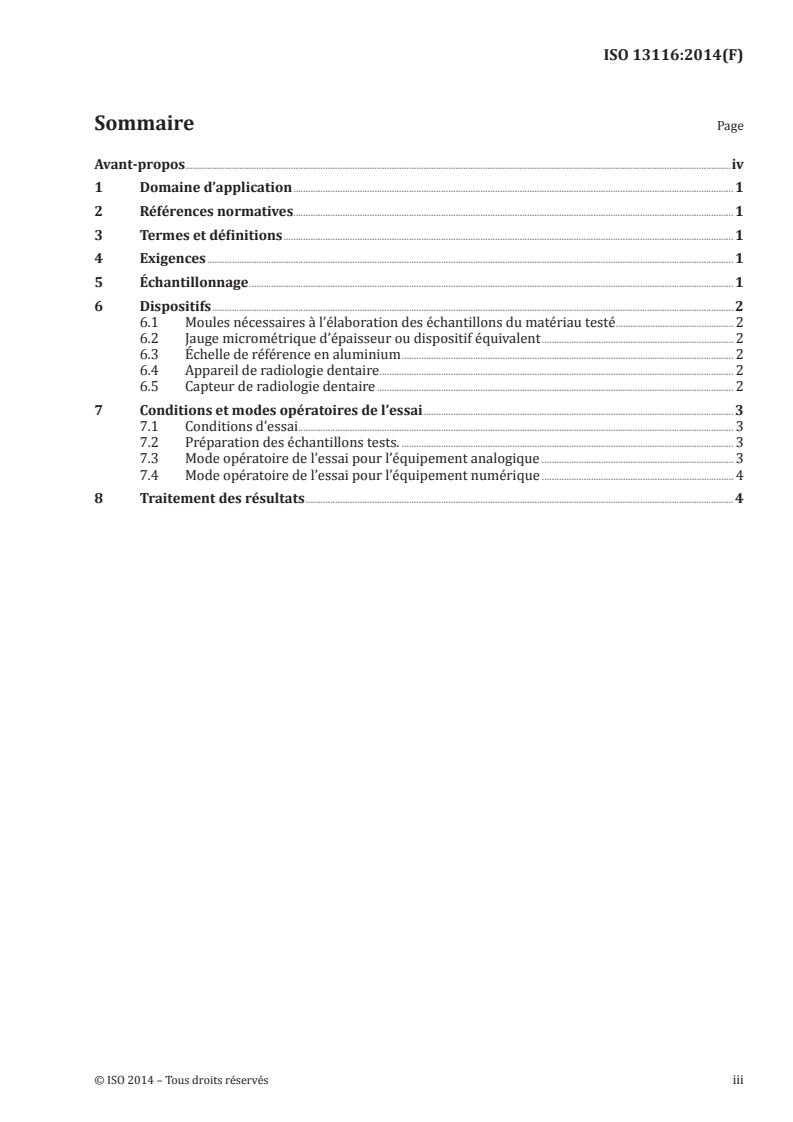
ISO 13116:2014 - Médecine bucco-dentaire — Méthodes de détermination de la radio opacité des matériaux/29/2014
Overview
ISO 13116:2014 specifies a standardized test method for determining the radio‑opacity of dental materials by reference to an aluminium internal standard. The method defines how to compare a material’s radio‑opacity to known aluminium step thicknesses (aluminium equivalent), using either conventional radiographic film or digital sensoring (intra‑oral sensors or phosphor imaging plates). It is intended to discriminate radio‑opacity at a clinically meaningful level rather than to establish absolute inherent values affected by imaging variables.
Key topics and technical requirements
- Aluminium step wedge: purity ≥98% Al, thickness range 0.5–5.0 mm in equally spaced steps (recommended ~0.5 mm step differences); thickness of each step measured to 0.01 mm accuracy.
- Specimens: homogeneous samples with uniform thickness (typical 1.0 ± 0.1 mm; range 0.5–2.5 mm depending on product standard); thickness variation ≤0.05 mm in measurement area.
- X‑ray conditions: dental X‑ray unit with total filtration 1.5–2 mm Al, operating at (60 ± 10) kV, target‑film distance 300–400 mm; exposure adjusted to produce appropriate film/sensor response.
- Sensoring options:
- Analogue: intra‑oral film (speed D/E/F per ISO 3665), controlled processing, densitometer (optical density 0–3.0, resolution 0.01).
- Digital: calibrated intra‑oral sensors or phosphor imaging plates with grey‑scale analysis software (accuracy ±1 grey value).
- Procedure: place specimen in contact with aluminium step wedge at the image center, expose, measure optical density or grey value for each wedge step and specimen, plot response vs aluminium thickness, interpolate aluminium equivalent (Ta/Ts) and report radio‑opacity.
- Limitations: ISO 13116 does not set pass/fail thresholds; it excludes detailed corrections for background noise, beam power variations, grey‑scale correction or image enhancement - these factors can shift absolute values but not relative ranking versus the aluminium standard.
Applications and who uses it
- Dental materials manufacturers: verify and document radio‑opacity claims for restorative, adhesive, cement and core materials.
- Testing laboratories and quality control: routine batch testing and product verification to produce aluminium‑equivalent radio‑opacity data.
- Regulatory bodies and certification: assess manufacturers’ compliance where product standards reference radio‑opacity requirements.
- R&D and product development: compare formulations and additives (e.g., radiopacifiers) to achieve clinically visible contrast on radiographs.
Related standards
- ISO 3665 - Intra‑oral dental radiographic film specifications
- ISO 1942 - Dentistry vocabulary
- ISO 8601 - Date/time representation (normative reference for documentation)
Keywords: ISO 13116, radio‑opacity, dental materials, aluminium step wedge, radiopacity testing, dental X‑ray, digital intra‑oral sensor, densitometer, aluminium equivalent.
Relations
- Effective Date
- 25-Aug-2026
- Effective Date
- 25-Aug-2026
- Effective Date
- 25-Aug-2026
- Effective Date
- 25-Aug-2026
- Effective Date
- 01-Apr-2026
- Effective Date
- 01-Apr-2026
- Consolidates
EN ISO 13116:2014 - Dentistry - Test Method for Determining Radio-Opacity of Materials (ISO 13116:2014) - Effective Date
- 12-Feb-2026
- Effective Date
- 06-Jun-2022
Buy Documents
ISO 13116:2014 - Dentistry -- Test method for determining radio-opacity of materials
ISO 13116:2014 - Dentistry — Test method for determining radio-opacity of materials/29/2014
ISO 13116:2014 - Médecine bucco-dentaire -- Méthodes de détermination de la radio opacité des matériaux
ISO 13116:2014 - Médecine bucco-dentaire — Méthodes de détermination de la radio opacité des matériaux/29/2014
Get Certified
Connect with accredited certification bodies for this standard

BSI Group
BSI (British Standards Institution) is the business standards company that helps organizations make excellence a habit.

TÜV Rheinland
TÜV Rheinland is a leading international provider of technical services.

TÜV SÜD
TÜV SÜD is a trusted partner of choice for safety, security and sustainability solutions.
Sponsored listings
Frequently Asked Questions
ISO 13116:2014 is a standard published by the International Organization for Standardization (ISO). Its full title is "Dentistry — Test method for determining radio-opacity of materials". This standard covers: ISO 13116:2014 specifies test methods for determination of radio-opacity of a test material by reference to a specimen of an aluminium standard. The method is designed to discriminate radio-opacity at a clinically meaningful level and is not designed to take account of factors which may affect precise, inherent values of radio-opacity such as background noise, X-ray beam power, grey scale correction and image enhancement. It is recognized that such factors can change the value of radio-opacity but not the relative ranking compared to standard thicknesses of an internal standard such as aluminium. This test may be performed with conventional or digital sensoring techniques of dental X-ray apparatus.
ISO 13116:2014 specifies test methods for determination of radio-opacity of a test material by reference to a specimen of an aluminium standard. The method is designed to discriminate radio-opacity at a clinically meaningful level and is not designed to take account of factors which may affect precise, inherent values of radio-opacity such as background noise, X-ray beam power, grey scale correction and image enhancement. It is recognized that such factors can change the value of radio-opacity but not the relative ranking compared to standard thicknesses of an internal standard such as aluminium. This test may be performed with conventional or digital sensoring techniques of dental X-ray apparatus.
ISO 13116:2014 is classified under the following ICS (International Classification for Standards) categories: 11.060.10 - Dental materials. The ICS classification helps identify the subject area and facilitates finding related standards.
ISO 13116:2014 has the following relationships with other standards: It is inter standard links to EN ISO 9917-2:2017, EN ISO 9917-1:2025, EN ISO 6877:2021, EN ISO 3696:1995, EN ISO 6877:2025, EN ISO 6876:2025, EN ISO 13116:2014, ISO/IEC 18028-1:2006. Understanding these relationships helps ensure you are using the most current and applicable version of the standard.
ISO 13116:2014 is available in PDF format for immediate download after purchase. The document can be added to your cart and obtained through the secure checkout process. Digital delivery ensures instant access to the complete standard document.
Standards Content (Sample)
INTERNATIONAL ISO
STANDARD 13116
First edition
2014-11-01
Dentistry — Test Method for
Determining Radio-Opacity of Materials
Médecine bucco-dentaire — Méthodes de détermination de la radio
opacité des matériaux
Reference number
©
ISO 2014
© ISO 2014
All rights reserved. Unless otherwise specified, no part of this publication may be reproduced or utilized otherwise in any form
or by any means, electronic or mechanical, including photocopying, or posting on the internet or an intranet, without prior
written permission. Permission can be requested from either ISO at the address below or ISO’s member body in the country of
the requester.
ISO copyright office
Case postale 56 • CH-1211 Geneva 20
Tel. + 41 22 749 01 11
Fax + 41 22 749 09 47
E-mail copyright@iso.org
Web www.iso.org
Published in Switzerland
ii © ISO 2014 – All rights reserved
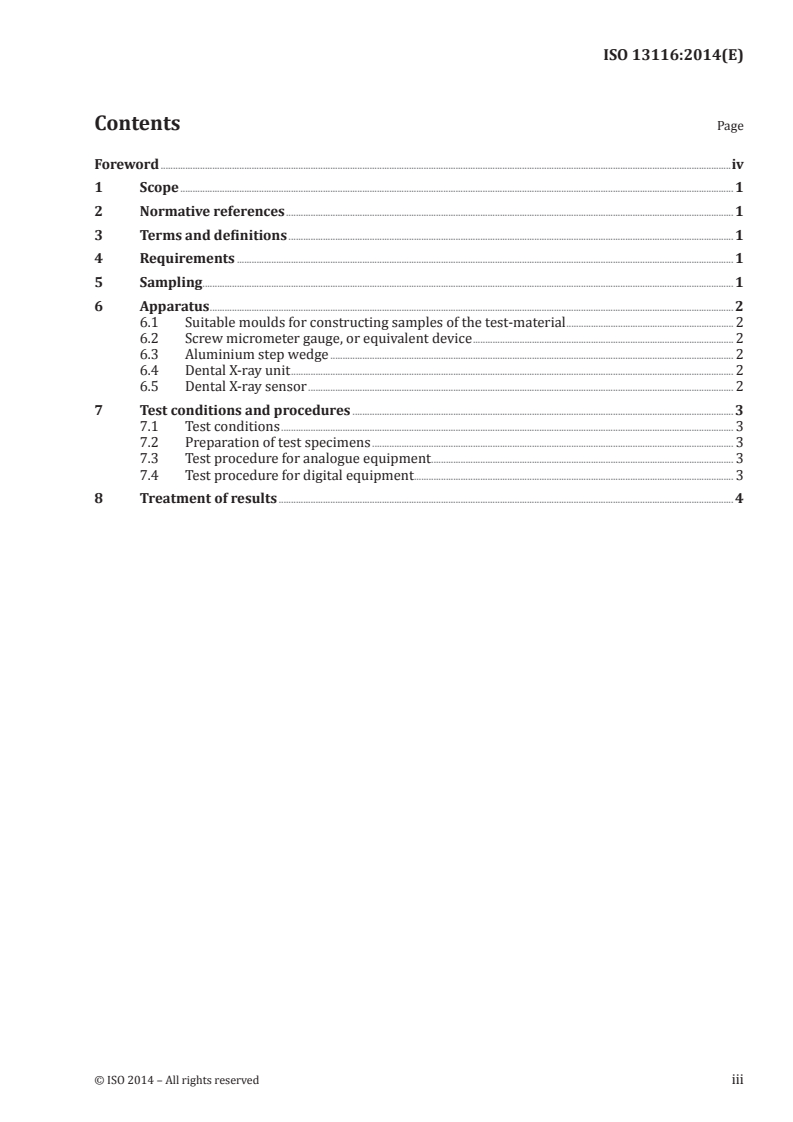
Contents Page
Foreword .iv
1 Scope . 1
2 Normative references . 1
3 Terms and definitions . 1
4 Requirements . 1
5 Sampling . 1
6 Apparatus . 2
6.1 Suitable moulds for constructing samples of the test-material . 2
6.2 Screw micrometer gauge, or equivalent device . 2
6.3 Aluminium step wedge . 2
6.4 Dental X-ray unit . 2
6.5 Dental X-ray sensor . 2
7 Test conditions and procedures . 3
7.1 Test conditions . 3
7.2 Preparation of test specimens . 3
7.3 Test procedure for analogue equipment . 3
7.4 Test procedure for digital equipment. 3
8 Treatment of results . 4
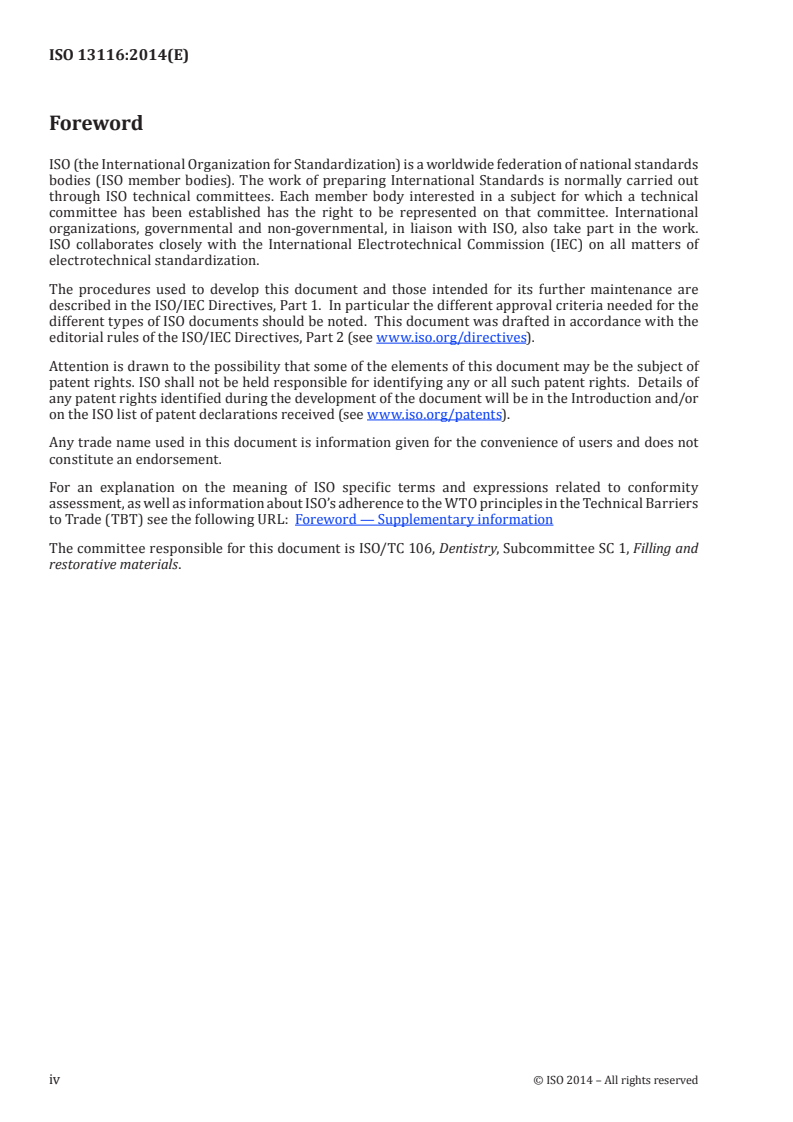
Foreword
ISO (the International Organization for Standardization) is a worldwide federation of national standards
bodies (ISO member bodies). The work of preparing International Standards is normally carried out
through ISO technical committees. Each member body interested in a subject for which a technical
committee has been established has the right to be represented on that committee. International
organizations, governmental and non-governmental, in liaison with ISO, also take part in the work.
ISO collaborates closely with the International Electrotechnical Commission (IEC) on all matters of
electrotechnical standardization.
The procedures used to develop this document and those intended for its further maintenance are
described in the ISO/IEC Directives, Part 1. In particular the different approval criteria needed for the
different types of ISO documents should be noted. This document was drafted in accordance with the
editorial rules of the ISO/IEC Directives, Part 2 (see www.iso.org/directives).
Attention is drawn to the possibility that some of the elements of this document may be the subject of
patent rights. ISO shall not be held responsible for identifying any or all such patent rights. Details of
any patent rights identified during the development of the document will be in the Introduction and/or
on the ISO list of patent declarations received (see www.iso.org/patents).
Any trade name used in this document is information given for the convenience of users and does not
constitute an endorsement.
For an explanation on the meaning of ISO specific terms and expressions related to conformity
assessment, as well as information about ISO’s adherence to the WTO principles in the Technical Barriers
to Trade (TBT) see the following URL: Foreword — Supplementary information
The committee responsible for this document is ISO/TC 106, Dentistry, Subcommittee SC 1, Filling and
restorative materials.
iv © ISO 2014 – All rights reserved
INTERNATIONAL STANDARD ISO 13116:2014(E)
Dentistry — Test Method for Determining Radio-Opacity of
Materials
1 Scope
This International Standard specifies test methods for determination of radio-opacity of a test material
by reference to a specimen of an aluminium standard. The method is designed to discriminate radio-
opacity at a clinically meaningful level and is not designed to take account of factors which may affect
precise, inherent values of radio-opacity such as background noise, X-ray beam power, grey scale
correction and image enhancement. It is recognized that such factors can change the value of radio-
opacity but not the relative ranking compared to standard thicknesses of an internal standard such
as aluminium. This test may be performed with conventional or digital sensoring techniques of dental
X-ray apparatus.
2 Normative references
The following documents, in whole or in part, are normatively referenced in this document and are
indispensable for its application. For dated references, only the edition cited applies. For undated
references, the latest edition of the referenced document (including any amendments) applies.
ISO 3665, Photography — Intra-oral dental radiographic film and film packets — Manufacturer specifications
ISO 1942, Dentistry — Vocabulary
ISO 8601, Data elements and interchange formats — Information interchange — Representation of
dates and times
3 Terms and definitions
For the purposes of this document, the terms and definitions given in ISO 1942 apply.
4 Requirements
This International Standard does not set pass/fail limits for radio-opacity. If a manufacturer claims that
a material is radio-opaque, the radio-opacity, determined in accordance with Clause 7, shall have a value
at least equivalent to the minimum level specified in the appropriate product standard requirements.
NOTE Aluminium has a radio-opacity equivalent to that
...
INTERNATIONAL ISO
STANDARD 13116
First edition
2014-11-01
Dentistry — Test Method for
Determining Radio-Opacity of Materials
Médecine bucco-dentaire — Méthodes de détermination de la radio
opacité des matériaux
Reference number
©
ISO 2014
© ISO 2014
All rights reserved. Unless otherwise specified, no part of this publication may be reproduced or utilized otherwise in any form
or by any means, electronic or mechanical, including photocopying, or posting on the internet or an intranet, without prior
written permission. Permission can be requested from either ISO at the address below or ISO’s member body in the country of
the requester.
ISO copyright office
Case postale 56 • CH-1211 Geneva 20
Tel. + 41 22 749 01 11
Fax + 41 22 749 09 47
E-mail copyright@iso.org
Web www.iso.org
Published in Switzerland
ii © ISO 2014 – All rights reserved
Contents Page
Foreword .iv
1 Scope . 1
2 Normative references . 1
3 Terms and definitions . 1
4 Requirements . 1
5 Sampling . 1
6 Apparatus . 2
6.1 Suitable moulds for constructing samples of the test-material . 2
6.2 Screw micrometer gauge, or equivalent device . 2
6.3 Aluminium step wedge . 2
6.4 Dental X-ray unit . 2
6.5 Dental X-ray sensor . 2
7 Test conditions and procedures . 3
7.1 Test conditions . 3
7.2 Preparation of test specimens . 3
7.3 Test procedure for analogue equipment . 3
7.4 Test procedure for digital equipment. 3
8 Treatment of results . 4
Foreword
ISO (the International Organization for Standardization) is a worldwide federation of national standards
bodies (ISO member bodies). The work of preparing International Standards is normally carried out
through ISO technical committees. Each member body interested in a subject for which a technical
committee has been established has the right to be represented on that committee. International
organizations, governmental and non-governmental, in liaison with ISO, also take part in the work.
ISO collaborates closely with the International Electrotechnical Commission (IEC) on all matters of
electrotechnical standardization.
The procedures used to develop this document and those intended for its further maintenance are
described in the ISO/IEC Directives, Part 1. In particular the different approval criteria needed for the
different types of ISO documents should be noted. This document was drafted in accordance with the
editorial rules of the ISO/IEC Directives, Part 2 (see www.iso.org/directives).
Attention is drawn to the possibility that some of the elements of this document may be the subject of
patent rights. ISO shall not be held responsible for identifying any or all such patent rights. Details of
any patent rights identified during the development of the document will be in the Introduction and/or
on the ISO list of patent declarations received (see www.iso.org/patents).
Any trade name used in this document is information given for the convenience of users and does not
constitute an endorsement.
For an explanation on the meaning of ISO specific terms and expressions related to conformity
assessment, as well as information about ISO’s adherence to the WTO principles in the Technical Barriers
to Trade (TBT) see the following URL: Foreword — Supplementary information
The committee responsible for this document is ISO/TC 106, Dentistry, Subcommittee SC 1, Filling and
restorative materials.
iv © ISO 2014 – All rights reserved
INTERNATIONAL STANDARD ISO 13116:2014(E)
Dentistry — Test Method for Determining Radio-Opacity of
Materials
1 Scope
This International Standard specifies test methods for determination of radio-opacity of a test material
by reference to a specimen of an aluminium standard. The method is designed to discriminate radio-
opacity at a clinically meaningful level and is not designed to take account of factors which may affect
precise, inherent values of radio-opacity such as background noise, X-ray beam power, grey scale
correction and image enhancement. It is recognized that such factors can change the value of radio-
opacity but not the relative ranking compared to standard thicknesses of an internal standard such
as aluminium. This test may be performed with conventional or digital sensoring techniques of dental
X-ray apparatus.
2 Normative references
The following documents, in whole or in part, are normatively referenced in this document and are
indispensable for its application. For dated references, only the edition cited applies. For undated
references, the latest edition of the referenced document (including any amendments) applies.
ISO 3665, Photography — Intra-oral dental radiographic film and film packets — Manufacturer specifications
ISO 1942, Dentistry — Vocabulary
ISO 8601, Data elements and interchange formats — Information interchange — Representation of
dates and times
3 Terms and definitions
For the purposes of this document, the terms and definitions given in ISO 1942 apply.
4 Requirements
This International Standard does not set pass/fail limits for radio-opacity. If a manufacturer claims that
a material is radio-opaque, the radio-opacity, determined in accordance with Clause 7, shall have a value
at least equivalent to the minimum level specified in the appropriate product standard requirements.
NOTE Aluminium has a radio-opacity equivalent to that
...
NORME ISO
INTERNATIONALE 13116
Première édition
2014-11-01
Médecine bucco-dentaire — Méthodes
de détermination de la radio opacité
des matériaux
Dentistry — Test Method for Determining Radio-Opacity of Materials
Numéro de référence
©
ISO 2014
DOCUMENT PROTÉGÉ PAR COPYRIGHT
© ISO 2014
Droits de reproduction réservés. Sauf indication contraire, aucune partie de cette publication ne peut être reproduite ni utilisée
sous quelque forme que ce soit et par aucun procédé, électronique ou mécanique, y compris la photocopie, l’affichage sur
l’internet ou sur un Intranet, sans autorisation écrite préalable. Les demandes d’autorisation peuvent être adressées à l’ISO à
l’adresse ci-après ou au comité membre de l’ISO dans le pays du demandeur.
ISO copyright office
Case postale 56 • CH-1211 Geneva 20
Tel. + 41 22 749 01 11
Fax + 41 22 749 09 47
E-mail copyright@iso.org
Web www.iso.org
Publié en Suisse
ii © ISO 2014 – Tous droits réservés
Sommaire Page
Avant-propos .iv
1 Domaine d’application . 1
2 Références normatives . 1
3 Termes et définitions . 1
4 Exigences . 1
5 Échantillonnage . 1
6 Dispositifs . 2
6.1 Moules nécessaires à l’élaboration des échantillons du matériau testé . 2
6.2 Jauge micrométrique d’épaisseur ou dispositif équivalent . 2
6.3 Échelle de référence en aluminium . 2
6.4 Appareil de radiologie dentaire . 2
6.5 Capteur de radiologie dentaire . 2
7 Conditions et modes opératoires de l’essai . 3
7.1 Conditions d’essai . 3
7.2 Préparation des échantillons tests. . 3
7.3 Mode opératoire de l’essai pour l’équipement analogique . 3
7.4 Mode opératoire de l’essai pour l’équipement numérique . 4
8 Traitement des résultats . 4
Avant-propos
L’ISO (Organisation internationale de normalisation) est une fédération mondiale d’organismes
nationaux de normalisation (comités membres de l’ISO). L’élaboration des Normes internationales est
en général confiée aux comités techniques de l’ISO. Chaque comité membre intéressé par une étude
a le droit de faire partie du comité technique créé à cet effet. Les organisations internationales,
gouvernementales et non gouvernementales, en liaison avec l’ISO participent également aux travaux.
L’ISO collabore étroitement avec la Commission électrotechnique internationale (IEC) en ce qui concerne
la normalisation électrotechnique.
Les procédures utilisées pour élaborer le présent document et celles destinées à sa mise à jour sont
décrites dans les Directives ISO/IEC, Partie 1. Il convient, en particulier de prendre note des différents
critères d’approbation requis pour les différents types de documents ISO. Le présent document a été
rédigé conformément aux règles de rédaction données dans les Directives ISO/IEC, Partie 2 (voir www.
iso.org/directives).
L’attention est appelée sur le fait que certains des éléments du présent document peuvent faire l’objet de
droits de propriété intellectuelle ou de droits analogues. L’ISO ne saurait être tenue pour responsable
de ne pas avoir identifié de tels droits de propriété et averti de leur existence. Les détails concernant les
références aux droits de propriété intellectuelle ou autres droits analogues identifiés lors de l’élaboration
du document sont indiqués dans l’Introduction et/ou dans la liste des déclarations de brevets reçues par
l’ISO (voir www.iso.org/brevets).
Les appellations commerciales éventuellement mentionnées dans le présent document sont données
pour information, par souci de commodité, à l’intention des utilisateurs et ne sauraient constituer un
engagement.
Pour une explication de la signification des termes et expressions spécifiques de l’ISO liés à l’évaluation de
la conformité, ou pour toute information au sujet de l’adhésion de l’ISO aux principes de l’OMC concernant
les obstacles techniques au commerce (OTC), voir le lien suivant: Avant-propos — Informations
supplémentaires.
Le comité chargé de l’élaboration du présent document est l’ISO/TC 106, Médecine bucco-dentaire,
sous-comité SC 1, Produits pour obturation et restauration.
iv © ISO 2014 – Tous droits réservés
NORME INTERNATIONALE ISO 13116:2014(F)
Médecine bucco-dentaire — Méthodes de détermination
de la radio opacité des matériaux
1 Domaine d’application
La présente Norme internationale spécifie des méthodes d’essai permettant de déterminer la radio-
opacité d’un matériau testé par référence à une échelle de référence en aluminium. La méthode est
conçue pour déterminer la radio-opacité à un niveau cliniquement significatif sans tenir compte des
facteurs susceptibles d’influer sur la précision des valeurs de radio-opacité (bruit de fond, énergie
du faisceau de rayons X, correction de l’échelle de gris, contraste de l’image). On sait que ces facteurs
peuvent modifier la valeur de la radio-opacité, mais pas son niveau relatif lors d’une comparaison avec
les épaisseurs standardisées d’un objet-test étalon réalisé en aluminium. Cet essai peut être réalisé avec
des capteurs analogiques ou numériques de dispositif de radiologie dentaire.
2 Références normatives
Les documents suivants, en totalité ou en partie, sont référencés de manière normative dans le présent
document et sont indispensables pour son application. Pour les références datées, seule l’édition citée
s’applique. Pour les références non datées, la dernière édition du document de référence s’applique (y
compris les éventuels amendements).
ISO 3665, Photographie — Film et paquets de films pour la radiographie dentaire intrabuccale —
Spécifications
ISO 1942, Médecine bucco-dentaire — Vocabulaire
ISO 8601, Éléments de données et formats d’échange — Échange d’information — Représentation de la date
et de l’heure
3 Termes et définitions
Pour les besoins du présent document, les termes et définitions donnés dans l’ISO 1942 s’appliquent.
4 Exigences
La présente Norme internationale ne fixe pas de critères de conformité pour la radio-opacité. Si un
fabricant déclare qu’un matériau est radio-opaque, la radio-opacité, déterminée conformément à
l’Article 7, doit avoir une valeur au moins équivalente au niveau minimal spécifié dans les exigences de
la norme propre à ce produit.
NOTE L’aluminium a une radio-opacité équivalente à celle de la dentine. Par conséquent, 1 mm de matériau
ayant une radio-opacité équivalente à 1 mm d’aluminium a une radio-opacité équivalente à celle de la dentine.
5 Échantillonnage
La norme de produit correspondante donne des précisions sur le mode opératoire d’échantillonnage.
NOTE Le mode opératoire normal s’applique à un échantillon issu d’un seul lot et comportant une quantité
suffisante du matériau à tester pour permettre la réalisation de l’essai prescrit. L’échantillon du produit testé est
normalement composé à partir de condit
...
NORME ISO
INTERNATIONALE 13116
Première édition
2014-11-01
Médecine bucco-dentaire — Méthodes
de détermination de la radio opacité
des matériaux
Dentistry — Test Method for Determining Radio-Opacity of Materials
Numéro de référence
©
ISO 2014
DOCUMENT PROTÉGÉ PAR COPYRIGHT
© ISO 2014
Droits de reproduction réservés. Sauf indication contraire, aucune partie de cette publication ne peut être reproduite ni utilisée
sous quelque forme que ce soit et par aucun procédé, électronique ou mécanique, y compris la photocopie, l’affichage sur
l’internet ou sur un Intranet, sans autorisation écrite préalable. Les demandes d’autorisation peuvent être adressées à l’ISO à
l’adresse ci-après ou au comité membre de l’ISO dans le pays du demandeur.
ISO copyright office
Case postale 56 • CH-1211 Geneva 20
Tel. + 41 22 749 01 11
Fax + 41 22 749 09 47
E-mail copyright@iso.org
Web www.iso.org
Publié en Suisse
ii © ISO 2014 – Tous droits réservés
Sommaire Page
Avant-propos .iv
1 Domaine d’application . 1
2 Références normatives . 1
3 Termes et définitions . 1
4 Exigences . 1
5 Échantillonnage . 1
6 Dispositifs . 2
6.1 Moules nécessaires à l’élaboration des échantillons du matériau testé . 2
6.2 Jauge micrométrique d’épaisseur ou dispositif équivalent . 2
6.3 Échelle de référence en aluminium . 2
6.4 Appareil de radiologie dentaire . 2
6.5 Capteur de radiologie dentaire . 2
7 Conditions et modes opératoires de l’essai . 3
7.1 Conditions d’essai . 3
7.2 Préparation des échantillons tests. . 3
7.3 Mode opératoire de l’essai pour l’équipement analogique . 3
7.4 Mode opératoire de l’essai pour l’équipement numérique . 4
8 Traitement des résultats . 4
Avant-propos
L’ISO (Organisation internationale de normalisation) est une fédération mondiale d’organismes
nationaux de normalisation (comités membres de l’ISO). L’élaboration des Normes internationales est
en général confiée aux comités techniques de l’ISO. Chaque comité membre intéressé par une étude
a le droit de faire partie du comité technique créé à cet effet. Les organisations internationales,
gouvernementales et non gouvernementales, en liaison avec l’ISO participent également aux travaux.
L’ISO collabore étroitement avec la Commission électrotechnique internationale (IEC) en ce qui concerne
la normalisation électrotechnique.
Les procédures utilisées pour élaborer le présent document et celles destinées à sa mise à jour sont
décrites dans les Directives ISO/IEC, Partie 1. Il convient, en particulier de prendre note des différents
critères d’approbation requis pour les différents types de documents ISO. Le présent document a été
rédigé conformément aux règles de rédaction données dans les Directives ISO/IEC, Partie 2 (voir www.
iso.org/directives).
L’attention est appelée sur le fait que certains des éléments du présent document peuvent faire l’objet de
droits de propriété intellectuelle ou de droits analogues. L’ISO ne saurait être tenue pour responsable
de ne pas avoir identifié de tels droits de propriété et averti de leur existence. Les détails concernant les
références aux droits de propriété intellectuelle ou autres droits analogues identifiés lors de l’élaboration
du document sont indiqués dans l’Introduction et/ou dans la liste des déclarations de brevets reçues par
l’ISO (voir www.iso.org/brevets).
Les appellations commerciales éventuellement mentionnées dans le présent document sont données
pour information, par souci de commodité, à l’intention des utilisateurs et ne sauraient constituer un
engagement.
Pour une explication de la signification des termes et expressions spécifiques de l’ISO liés à l’évaluation de
la conformité, ou pour toute information au sujet de l’adhésion de l’ISO aux principes de l’OMC concernant
les obstacles techniques au commerce (OTC), voir le lien suivant: Avant-propos — Informations
supplémentaires.
Le comité chargé de l’élaboration du présent document est l’ISO/TC 106, Médecine bucco-dentaire,
sous-comité SC 1, Produits pour obturation et restauration.
iv © ISO 2014 – Tous droits réservés
NORME INTERNATIONALE ISO 13116:2014(F)
Médecine bucco-dentaire — Méthodes de détermination
de la radio opacité des matériaux
1 Domaine d’application
La présente Norme internationale spécifie des méthodes d’essai permettant de déterminer la radio-
opacité d’un matériau testé par référence à une échelle de référence en aluminium. La méthode est
conçue pour déterminer la radio-opacité à un niveau cliniquement significatif sans tenir compte des
facteurs susceptibles d’influer sur la précision des valeurs de radio-opacité (bruit de fond, énergie
du faisceau de rayons X, correction de l’échelle de gris, contraste de l’image). On sait que ces facteurs
peuvent modifier la valeur de la radio-opacité, mais pas son niveau relatif lors d’une comparaison avec
les épaisseurs standardisées d’un objet-test étalon réalisé en aluminium. Cet essai peut être réalisé avec
des capteurs analogiques ou numériques de dispositif de radiologie dentaire.
2 Références normatives
Les documents suivants, en totalité ou en partie, sont référencés de manière normative dans le présent
document et sont indispensables pour son application. Pour les références datées, seule l’édition citée
s’applique. Pour les références non datées, la dernière édition du document de référence s’applique (y
compris les éventuels amendements).
ISO 3665, Photographie — Film et paquets de films pour la radiographie dentaire intrabuccale —
Spécifications
ISO 1942, Médecine bucco-dentaire — Vocabulaire
ISO 8601, Éléments de données et formats d’échange — Échange d’information — Représentation de la date
et de l’heure
3 Termes et définitions
Pour les besoins du présent document, les termes et définitions donnés dans l’ISO 1942 s’appliquent.
4 Exigences
La présente Norme internationale ne fixe pas de critères de conformité pour la radio-opacité. Si un
fabricant déclare qu’un matériau est radio-opaque, la radio-opacité, déterminée conformément à
l’Article 7, doit avoir une valeur au moins équivalente au niveau minimal spécifié dans les exigences de
la norme propre à ce produit.
NOTE L’aluminium a une radio-opacité équivalente à celle de la dentine. Par conséquent, 1 mm de matériau
ayant une radio-opacité équivalente à 1 mm d’aluminium a une radio-opacité équivalente à celle de la dentine.
5 Échantillonnage
La norme de produit correspondante donne des précisions sur le mode opératoire d’échantillonnage.
NOTE Le mode opératoire normal s’applique à un échantillon issu d’un seul lot et comportant une quantité
suffisante du matériau à tester pour permettre la réalisation de l’essai prescrit. L’échantillon du produit testé est
normalement composé à partir de condit
...