

ISO 15374:1998
(Main)Implants for surgery — Requirements for production of forgings
General Information
- Abstract
- Status
- Withdrawn
- Publication Date
- 12-Aug-1998
- Technical Committee
- ISO/TC 150/SC 1 - Materials
- Drafting Committee
- ISO/TC 150/SC 1 - Materials
- Current Stage
- 9599 - Withdrawal of International Standard
- Start Date
- 11-Dec-2024
- Completion Date
- 29-Aug-2026

Overview
ISO 15374:1998, "Implants for surgery - Requirements for production of forgings," specifies production requirements for forgings used as semifinished products in surgical implant manufacture. It covers forgings made from stainless steel, unalloyed titanium, titanium alloys and cobalt‑based alloys, and sets expectations for material composition, process control, mechanical testing, microstructure, traceability, identification and delivery.
Key topics and technical requirements
- Material compliance: Forging stock must conform to the relevant parts of ISO 5832 (metallic materials for implants).
- Process control:
- Heating temperature before forging shall be controlled. For titanium and titanium alloys, heating must minimize hydrogen pick‑up.
- Presence of shear bands is acceptable only if they do not impair application.
- Hot‑forged surfaces must be descaled and pickled if necessary; titanium forgings require removal of oxide scale and any oxygen‑enriched case.
- Post‑forging heat treatment conditions are to be agreed between supplier and customer.
- Hydrogen limit (titanium): For unalloyed titanium and titanium alloy forgings, hydrogen content measured on the smallest cross‑section shall not exceed 0.015% (mass fraction).
- Mechanical testing:
- Tensile test specimens to be prepared and tested in accordance with ISO 6892.
- Annealed forgings must meet tensile property requirements of the corresponding part of ISO 5832.
- Microstructure and grain size:
- Forgings must be free from signs of underheating/overheating and harmful segregation; surface defects detrimental to the finished implant are not acceptable.
- Unalloyed titanium grain size shall be uniform and not larger than ASTM E112 grain size 5.
- Titanium alloy microstructure acceptance referenced to ETTC Publication 2 and corresponding ISO 5832 parts.
- Traceability and documentation:
- Maintain batch (lot) traceability through manufacture and delivery.
- Batches must be packaged and labeled with manufacturer ID, quantity, design reference and batch number.
- Deliveries require a release certificate (or EN 10204 declaration) including supplier, purchase number, applicable standards, heat number, batch number, test report and delivery date.
Applications and users
ISO 15374 is intended for organizations involved in the production and supply of semifinished forgings for surgical implants, including:
- Implant manufacturers and OEMs specifying forgings for orthopedic, dental or other surgical devices
- Forging mills and subcontractors producing implant-grade stainless steel, titanium and cobalt alloy forgings
- Quality, regulatory and procurement professionals ensuring traceability, test reporting and compliance for implant materials
- Metallurgists and process engineers controlling heating, surface treatment and microstructure for implant applications
Related standards
- ISO 5832 series (parts 1–12) - metallic materials for implants
- ISO 6892 - tensile testing of metallic materials
- EN 10204 - types of inspection documents / release certificates
- ETTC Publication 2 - microstructural standards for alpha+beta titanium alloy bars
Keywords: ISO 15374, forgings for implants, titanium forgings, stainless steel forgings, implant traceability, microstructure, hydrogen content, mechanical testing.
Relations
- Consolidated By
ISO 24157:2008 - Ophthalmic optics and instruments — Reporting aberrations of the human eye - Effective Date
- 06-Jun-2022
Get Certified
Connect with accredited certification bodies for this standard

BSI Group
BSI (British Standards Institution) is the business standards company that helps organizations make excellence a habit.

TÜV Rheinland
TÜV Rheinland is a leading international provider of technical services.

TÜV SÜD
TÜV SÜD is a trusted partner of choice for safety, security and sustainability solutions.
Sponsored listings
Frequently Asked Questions
ISO 15374:1998 is a standard published by the International Organization for Standardization (ISO). Its full title is "Implants for surgery — Requirements for production of forgings". This standard covers: Implants for surgery — Requirements for production of forgings
Implants for surgery — Requirements for production of forgings
ISO 15374:1998 is classified under the following ICS (International Classification for Standards) categories: 11.040.40 - Implants for surgery, prosthetics and orthotics. The ICS classification helps identify the subject area and facilitates finding related standards.
ISO 15374:1998 has the following relationships with other standards: It is inter standard links to ISO 24157:2008. Understanding these relationships helps ensure you are using the most current and applicable version of the standard.
ISO 15374:1998 is available in PDF format for immediate download after purchase. The document can be added to your cart and obtained through the secure checkout process. Digital delivery ensures instant access to the complete standard document.
Standards Content (Sample)
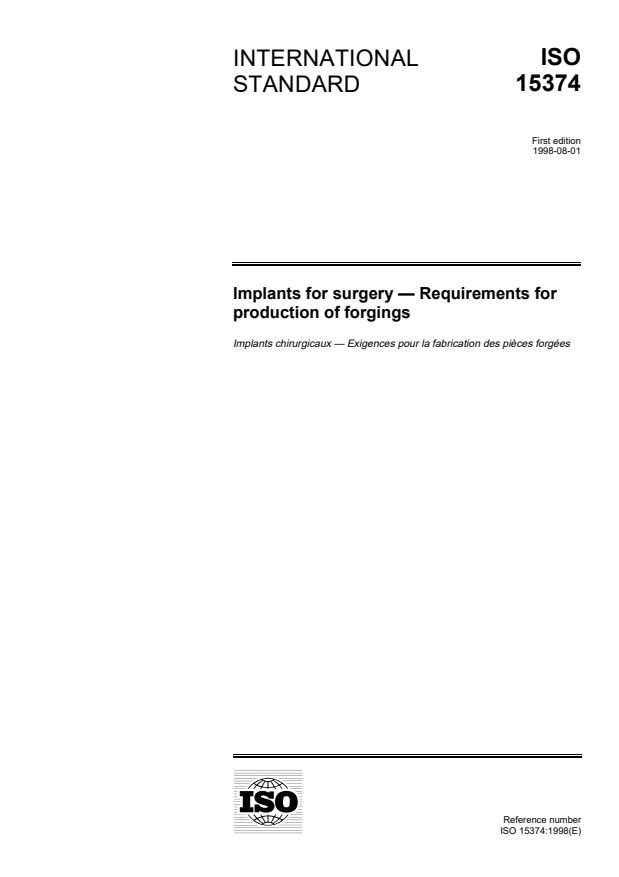
INTERNATIONAL ISO
STANDARD 15374
First edition
1998-08-01
Implants for surgery — Requirements for
production of forgings
Implants chirurgicaux — Exigences pour la fabrication des pièces forgées
A
Reference number
© ISO
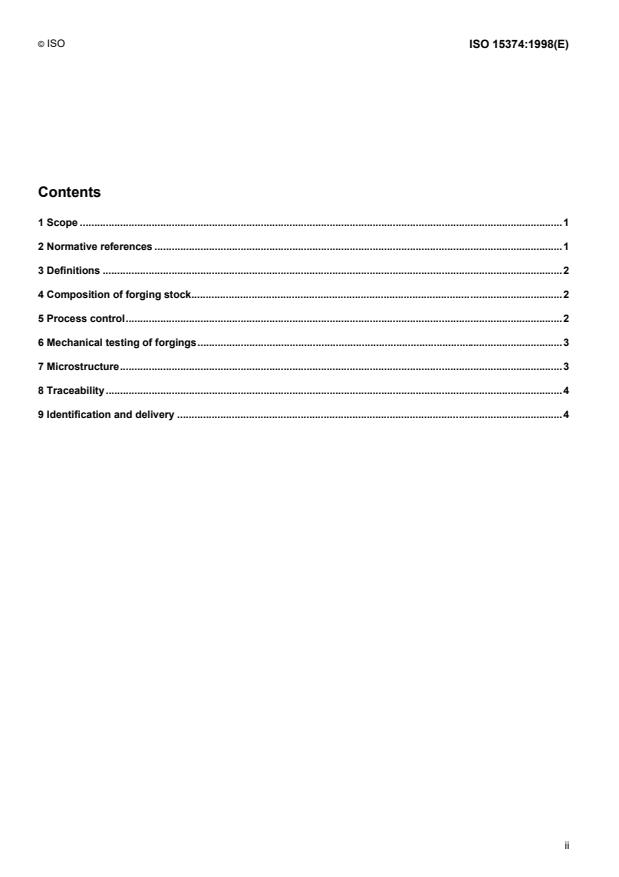
Contents
1 Scope .1
2 Normative references .1
3 Definitions .2
4 Composition of forging stock.2
5 Process control.2
6 Mechanical testing of forgings.3
7 Microstructure.3
8 Traceability.4
9 Identification and delivery .4
ii
© ISO
Foreword
ISO (the International Organization for Standardization) is a worldwide federation of national standards bodies (ISO
member bodies). The work of preparing International Standards is normally carried out through ISO technical
committees. Each member body interested in a subject for which a technical committee has been established has
the right to be represented on that committee. International organizations, governmental and non-governmental, in
liaison with ISO, also take part in the work. ISO collaborates closely with the International Electrotechnical
Commission (IEC) on all matters of electrotechnical standardization.
Draft International Standards adopted by the technical committees are circulated to the member bodies for voting.
Publication as an International Standard requires approval by at least 75 % of the member bodies casting a vote.
International Standard ISO 15374 was prepared by Technical Committee ISO/TC 150, Implants for surgery,
Subcommitee SC 1, Materials.
iii
INTERNATIONAL STANDARD © ISO ISO 15374:1998(E)
Implants for surgery — Requirements for production of
forgings
1 Scope
This International Standard specifies requirements for the production of forgings of stainless steel, unalloyed
titanium, titanium alloy or cobalt-based alloys intended to be used as semifinished products in the manufacturing of
surgical implants.
NOTE An International Standard giving requirements for forgings is under preparation.
2 Normative references
The following standards contain provisions which, through reference in this text, constitute provisions of this
International Standard. At the time of publication, the editions indicated were valid. All standards are subject to
revision, and parties to agreements based on this International Standard are encouraged to investigate the
possibility of applying the most recent edition of the standards indicated below. Members of IEC and ISO maintain
registers of currently valid International Standards.
ISO 5832-1:1997, Implants for surgery — Metallic materials — Part 1: Wrought stainless steel.
ISO 5832-2:1996, Implants for surgery — Metallic materials — Part 2: Unalloyed titanium.
ISO 5832-3:1996, Implants for surgery — Metallic materials — Part 3: Wrought titanium 6-aluminium 4-vanadium
alloy.
ISO 5832-5:1993, Implants for surgery — Metallic materials — Part 5: Wrought cobalt-chromium-tungsten-nickel
alloy.
ISO 5832-6:1997, Implants for surgery — Metallic materials — Part 6: Wrought cobalt-nickel-chromium-
molybdenum alloy.
ISO 5832-7:1994, Implants for surgery — Metallic materials — Part 7: Forgeable and cold-formed cobalt-chromium-
nickel-molybdenum iron alloy.
ISO 5832-8:1997, Implants for surgery — Metallic materials — Part 8: Wrought cobalt-nickel-chromium-
molybdenum-tungsten-iron alloy.
ISO 5832-9:1992, Implants for surgery — Metallic materials — Part 9: Wrought high nitrogen stainless steel.
ISO 5832-10:1993, Implants for surgery — Metallic materials — Part 10: Wrought titanium 5-aluminum 2,5-iron
alloy.
© ISO
ISO 5832-11:1994, Implants for surgery — Metallic materials — Part 11: Wrought titanium 6-aluminium 7-niobium
alloy.
ISO 5832-12:1996, Implants for surgery — Metallic materials — Part 12: Wrought cobalt-chromium-molybdenum
alloy.
ISO 6892:1984, Metallic materials
...