

ISO/TR 10465-3:2007
(Main)Underground installation of flexible glass-reinforced pipes based on unsaturated polyester resin (GRP-UP) — Part 3: Installation parameters and application limits
General Information
- Abstract
ISO 10465-3:2007 gives supplementary information on parameters and application limits for the underground installation of flexible glass-reinforced pipes based on unsaturated polyester resin (GRP-UP). It is particularly relevant when using an ATV-A 127 type design system. Explanations for the long-term safety factors incorporated into the GRP system standards based on simplified probabilistic methods are provided in an annex.
- Status
- Published
- Publication Date
- 28-Aug-2007
- Current Stage
- 9092 - International Standard to be revised
- Start Date
- 04-Apr-2025
- Completion Date
- 29-Aug-2026
Overview
ISO/TR 10465-3:2007 provides supplementary guidance for the underground installation of flexible glass‑reinforced pipes based on unsaturated polyester resin (GRP‑UP). Published as Part 3 of the ISO 10465 series, this technical report focuses on installation parameters and application limits, especially when using an ATV‑A 127 type design system. Annexes include explanations of long‑term safety factors and informative data for practical pipe‑soil interaction calculations.
Key topics
The report addresses technical topics essential for reliable GRP‑UP design and installation:
- Parameters for deflection calculations - initial and long‑term deflection methods when using ATV‑A 127 type systems.
- Soil parameters and strain coefficients - guidance on soil deformation moduli, shape factors and coefficients used in flexural‑strain calculations.
- Buckling and stability - influence of soil modulus and pipe stiffness on elastic and long‑term buckling under external loads and negative internal pressure.
- Rerounding and combined loading - parameters for pipe rerounding and combined effects of internal pressure with external bending loads.
- Traffic and construction loads - assessment of traffic loads, their effect on allowable deflection and soil pressure contributions.
- Influence of temporary sheeting - how construction sheeting affects pipe loading and design assumptions.
- Safety factors - discussion of gravity and pressure pipe safety factors, including probabilistic rationale found in Annex G.
- Informative annexes covering soil parameters, concentration/loading coefficients, bedding correction factors, and application limits for GRP pressure pipes installed underground.
Practical applications
ISO/TR 10465-3:2007 is used to support safe, durable underground installations of GRP‑UP systems. Typical applications include:
- Design verification and static calculations for buried GRP pressure and gravity pipes.
- Selection of installation parameters (backfill quality, compaction, bedding) to control deflection and buckling risk.
- Evaluating traffic loading effects for urban and roadway trench installations.
- Preparing technical specifications and installation procedures that reference ATV‑A 127 calculation methods.
Who should use this standard
- Civil and pipeline design engineers specifying GRP‑UP systems
- Geotechnical and structural engineers performing pipe‑soil interaction analyses
- Contractors and site supervisors responsible for pipe installation and compaction control
- Standards writers, procurement teams and asset owners specifying underground GRP pipe performance limits
Related standards
- ISO 10465‑1 - Installation procedures for GRP‑UP (Technical Specification)
- ISO 10465‑2 - Comparison of static calculation methods (Technical Report)
- ATV‑A 127 and AWWA M‑45 - primary calculation systems referenced for static design of buried GRP pipes
Keywords: ISO/TR 10465‑3:2007, GRP‑UP, glass‑reinforced pipes, underground installation, ATV‑A 127, deflection, buckling, soil parameters, installation parameters, safety factors.
Relations
- Effective Date
- 25-Aug-2026
- Effective Date
- 25-Aug-2026
- Effective Date
- 15-Apr-2008
Get Certified
Connect with accredited certification bodies for this standard

Institut za varilstvo d.o.o. (Welding Institute)
Slovenia's leading welding institute since 1952. ISO 3834, EN 1090, pressure equipment certification, NDT personnel, welder qualification. Only IIW Au
Sponsored listings
Frequently Asked Questions
ISO/TR 10465-3:2007 is a technical report published by the International Organization for Standardization (ISO). Its full title is "Underground installation of flexible glass-reinforced pipes based on unsaturated polyester resin (GRP-UP) — Part 3: Installation parameters and application limits". This standard covers: ISO 10465-3:2007 gives supplementary information on parameters and application limits for the underground installation of flexible glass-reinforced pipes based on unsaturated polyester resin (GRP-UP). It is particularly relevant when using an ATV-A 127 type design system. Explanations for the long-term safety factors incorporated into the GRP system standards based on simplified probabilistic methods are provided in an annex.
ISO 10465-3:2007 gives supplementary information on parameters and application limits for the underground installation of flexible glass-reinforced pipes based on unsaturated polyester resin (GRP-UP). It is particularly relevant when using an ATV-A 127 type design system. Explanations for the long-term safety factors incorporated into the GRP system standards based on simplified probabilistic methods are provided in an annex.
ISO/TR 10465-3:2007 is classified under the following ICS (International Classification for Standards) categories: 23.040.01 - Pipeline components and pipelines in general. The ICS classification helps identify the subject area and facilitates finding related standards.
ISO/TR 10465-3:2007 has the following relationships with other standards: It is inter standard links to EN 14364:2013, EN 1796:2013, ISO/TR 10465-3:1999. Understanding these relationships helps ensure you are using the most current and applicable version of the standard.
ISO/TR 10465-3:2007 is available in PDF format for immediate download after purchase. The document can be added to your cart and obtained through the secure checkout process. Digital delivery ensures instant access to the complete standard document.
Standards Content (Sample)
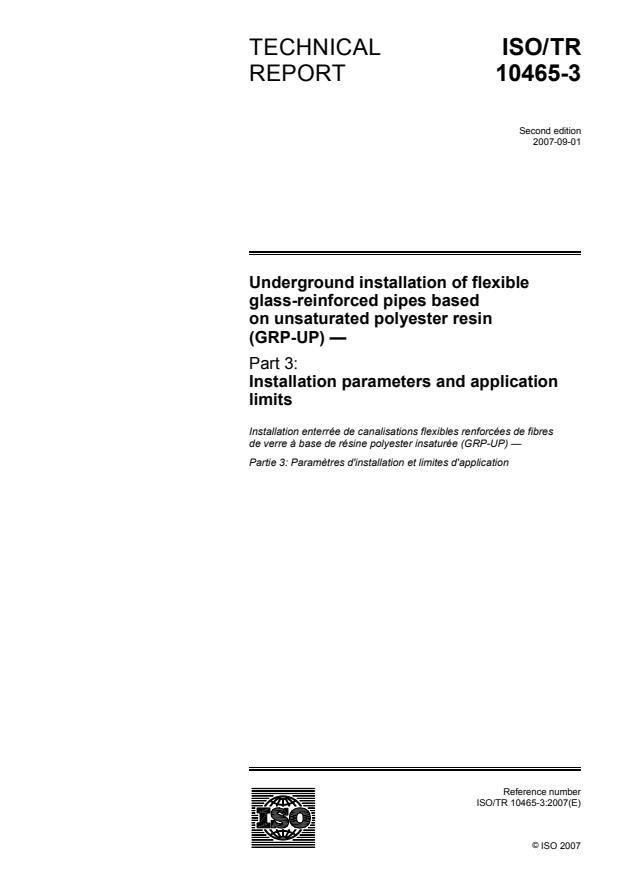
TECHNICAL ISO/TR
REPORT 10465-3
Second edition
2007-09-01
Underground installation of flexible
glass-reinforced pipes based
on unsaturated polyester resin
(GRP-UP) —
Part 3:
Installation parameters and application
limits
Installation enterrée de canalisations flexibles renforcées de fibres
de verre à base de résine polyester insaturée (GRP-UP) —
Partie 3: Paramètres d'installation et limites d'application
Reference number
©
ISO 2007
PDF disclaimer
This PDF file may contain embedded typefaces. In accordance with Adobe's licensing policy, this file may be printed or viewed but
shall not be edited unless the typefaces which are embedded are licensed to and installed on the computer performing the editing. In
downloading this file, parties accept therein the responsibility of not infringing Adobe's licensing policy. The ISO Central Secretariat
accepts no liability in this area.
Adobe is a trademark of Adobe Systems Incorporated.
Details of the software products used to create this PDF file can be found in the General Info relative to the file; the PDF-creation
parameters were optimized for printing. Every care has been taken to ensure that the file is suitable for use by ISO member bodies. In
the unlikely event that a problem relating to it is found, please inform the Central Secretariat at the address given below.
© ISO 2007
All rights reserved. Unless otherwise specified, no part of this publication may be reproduced or utilized in any form or by any means,
electronic or mechanical, including photocopying and microfilm, without permission in writing from either ISO at the address below or
ISO's member body in the country of the requester.
ISO copyright office
Case postale 56 • CH-1211 Geneva 20
Tel. + 41 22 749 01 11
Fax + 41 22 749 09 47
E-mail copyright@iso.org
Web www.iso.org
Published in Switzerland
ii © ISO 2007 – All rights reserved
Contents Page
Foreword. iv
Introduction . v
1 Scope .1
2 Normative references .1
3 Symbols and abbreviated terms .1
4 Parameters for deflection calculations when using an ATV-A 127 type design system.10
4.1 Initial deflection.10
4.2 Long-term deflection calculated using an ATV-A 127 type design system.16
5 Soil parameters, strain coefficients and shape factors for flexural strain calculations .17
5.1 For equations used in ATV-A 127 type design systems.17
5.2 Shape factor, D .19
f
6 Influence of soil moduli and pipe stiffness on pipe buckling calculations using ATV-A 127
type design systems .22
6.1 Elastic buckling under internal negative pressure for depths of cover over 1 m.22
6.2 Long-term buckling under sustained external load.23
6.3 Value for S .23
O
7 Parameters for rerounding and combined loading calculations .23
7.1 Rerounding.23
7.2 Combined effects of internal pressure and external bending loads.23
8 Traffic loads.24
8.1 General.24
8.2 Influence on allowable initial deflection.24
8.3 Soil pressure from traffic loads.24
9 Influence of sheeting.24
10 Safety factors for gravity pipes and pressure pipes.25
10.1 Gravity pipes .25
10.2 Pressure pipes .27
10.3 Safety factors in buckling calculations .29
Annex A (informative) Soil parameters .30
Annex B (informative) Determination of concentration factors used in ATV-A 127.42
Annex C (informative) Loading coefficients used in ATV-A 127 .43
Annex D (informative) Horizontal bedding correction factors.44
Annex E (informative) Selection of long-term stiffness .46
Annex F (informative) Partly residual soil friction used in ATV-A 127 type calculation systems.48
Annex G (informative) Application limits for GRP pressure pipes installed underground .50
Bibliography .63
Foreword
ISO (the International Organization for Standardization) is a worldwide federation of national standards bodies
(ISO member bodies). The work of preparing International Standards is normally carried out through ISO
technical committees. Each member body interested in a subject for which a technical committee has been
established has the right to be represented on that committee. International organizations, governmental and
non-governmental, in liaison with ISO, also take part in the work. ISO collaborates closely with the
International Electrotechnical Commission (IEC) on all matters of electrotechnical standardization.
International Standards are drafted in accordance with the rules given in the ISO/IEC Directives, Part 2.
The main task of technical committees is to prepare International Standards. Draft International Standards
adopted by the technical committees are circulated to the member bodies for voting. Publication as an
International Standard requires approval by at least 75 % of the member bodies casting a vote.
In exceptional circumstances, when a technical committee has collected data of a different kind from that
which is normally published as an International Standard (“state of the art”, for example), it may decide by a
simple majority vote of its participating members to publish a Technical Report. A Technical Report is entirely
informative in nature and does not have to be reviewed until the data it provides are considered to be no
longer valid or useful.
Attention is drawn to the possibility that some of the elements of this document may be the subject of patent
rights. ISO shall not be held responsible for identifying any or all such patent rights.
ISO 10465-3 was prepared by Technical Committee ISO/TC 138, Plastics pipes, fittings and valves for the
transport of fluids, Subcommittee SC 6, Reinforced plastics pipes and fittings for all applications.
This second edition cancels and replaces the first edition (ISO 10465-3:1999), which has been technically
revised to take into account changes made to methods in base documents ATV-A 127 and AWWA M-45 (see
Introduction).
ISO 10465 consists of the following parts, under the general title Underground installation of flexible glass-
reinforced pipes based on unsaturated polyester resin (GRP-UP):
⎯ Part 1: Installation procedures [Technical Specification]
⎯ Part 2: Comparison of static calculation methods [Technical Report]
⎯ Part 3: Installation parameters and application limits [Technical Report]
iv © ISO 2007 – All rights reserved
Introduction
Work in ISO/TC 5/SC 6 (now ISO/TC 138) on writing International Standards for the use of glass-reinforced
plastics (GRP) pipes and fittings was approved at the subcommittee meeting in Oslo in 1979. An ad hoc group
was established and the responsibility for drafting various International Standards was later given to a Task
Group (now ISO/TC 138/SC 6).
At the SC 6 meeting in London in 1980, Sweden proposed that a working group be formed to develop
documents regarding a code of practice for GRP pipes. This was approved by SC 6, and Working Group 4
(WG 4) was formed for this purpose. Since 1982, many WG 4 meetings have been held which have
considered the following matters:
⎯ procedures for the underground installation of GRP pipes;
⎯ pipe/soil interaction with pipes having different stiffness values;
⎯ minimum design parameters;
⎯ overview of various static calculation methods.
During the work of WG 4, it became evident that unanimous agreement could not be reached within the
working group on the specific methods to be employed to address these issues. It was therefore agreed that
all parts of the code of practice should be made into a type 3 Technical Report, and this was the form in which
this part of ISO 10465 was first published in 1999. Since then the ISO rules dealing with the classification of
document types have been revised and this has resulted in the three parts of ISO 10465 now being published
as either a Technical Specification or a Technical Report.
ISO 10465-1, published as Technical Report in 1993 and revised as a Technical Specification in 2007,
describes procedures for the underground installation of GRP pipes. It concerns particular stiffness classes for
which performance requirements have been specified in at least one product standard, but it can also be used
as a guide for the installation of pipes of other stiffness classes.
ISO 10465-2, published as a Technical Report in 1999 and revised in 2007, presents a comparison of the two
primary methods used internationally for static calculations on underground GRP pipe installations.
These methods are
a) the ATV method given in ATV-A 127, Guidelines for static calculations on drainage conduits and
pipelines, and
b) the AWWA method given in AWWA manual M-45, Fiberglass pipe design.
This part of ISO 10465, published as a Technical Report in 2007, gives additional information, which is useful
for static calculations primarily when using an ATV-A 127 type design system in accordance with
ISO 10465-2, on items such as:
parameters for deflection calculations;
soil parameters, strain coefficients and shape factors for flexural-strain calculations;
soil moduli and pipe stiffness for buckling calculations with regard to elastic behaviour;
parameters for rerounding and combined-loading calculations;
the influence of traffic loads;
the influence of sheeting;
safety factors.
This Technical Report is not to be regarded as an International Standard. It is proposed for provisional
application so that experience may be gained on its use in practice. Comments should be sent to the
secretariat of TC 138/SC 6.
vi © ISO 2007 – All rights reserved
TECHNICAL REPORT ISO/TR 10465-3:2007(E)
Underground installation of flexible glass-reinforced pipes
based on unsaturated polyester resin (GRP-UP) —
Part 3:
Installation parameters and application limits
1 Scope
This part of ISO 10465 gives supplementary information on parameters and application limits for the
underground installation of flexible glass-reinforced pipes based on unsaturated polyester resin (GRP-UP). It
is particularly relevant when using an ATV-A 127 type design system.
Explanations for the long-term safety factors incorporated into the GRP system standards based on simplified
probabilistic methods are provided in Annex G.
2 Normative references
The following referenced documents are indispensable for the application of this document. For dated
references, only the edition cited applies. For undated references, the latest edition of the referenced
document (including any amendments) applies.
ATV-A 127, Guidelines for static calculations on drainage conduits and pipelines, 3rd edition, August 2000,
(German Association for Water Pollution Control)
AWWA M-45, Fiberglass pipe design manual M-45, 2005 (American Water Works Association)
3 Symbols and abbreviated terms
For the purposes of this document, the following symbols apply.
NOTE 1 This clause also contains symbols and abbreviations from ISO 10465-1 and ISO 10465-3 for completeness.
NOTE 2 Several identical symbols are used in ATV-A 127 and AWWA M-45 to represent different quantities, and
where this occurs, the origin of the symbol is given in the rightmost column.
NOTE 3 The format of the symbols listed here has been aligned as far as practicable with the ISO/IEC Directives, part
2, namely they appear in Times New Roman italic font. This format may differ slightly from the format used in ATV-A 127
and AWWA M-45.
Symbol Unit Meaning
AQL — acceptable quality level
a′ — effective relative projection
a — ageing factor (ATV)
f
a — distribution factor (AWWA)
f
B1, B2, B3, B4 — embedment conditions
b m trench width at spring-line
b′ m distance from trench wall to pipe (see Figure 1)
C — buckling scalar calibration factor
n
c , c , c , c — coefficients used to determine ζ
1 2 3 4
c — reduction factor
c — creep factor
f
cc,,c ,,c c ,,c — deformation coefficients
h,qv v,qh v,qh* h,qh h,qh* v,qv
c,,,ccc
v* v,qh* h,qh* v*
D mm mean pipe diameter
D — shape factor
f
D — shape adjustment factor
g
D — deflection lag factor
L
D % compaction (based on simple proctor)
pr
d m external pipe diameter
e
d m internal pipe diameter
i
d m mean pipe diameter ⎡de×1000 − ⎤
( )
m e
⎣ ⎦
d mm vertical deflection
v
d mm maximum permissible long-term deflection
vA
d mm vertical deflection at rupture
vR
dd % maximum permissible relative vertical deflection
()
vm
permissible
(dd ) % initial vertical deflection
vm
initial
dd % long-term (50 year) vertical deflection
( )
vm
(dd ) % ultimate long-term vertical deflection
vm
ult
EE,,E,E N/m apparent flexural moduli of pipe wall
o p t,wet
E′′,,EE,E,E,E,E,E ,E N/m soil deformation moduli
12 3 4 s s s,σ 20
E N/m tensile hoop modulus
TH
e mm pipe wall thickness
e — base of natural logarithms (2,718 281 8)
F — compaction factor
F , F kN wheel loads
A E
2 © ISO 2007 – All rights reserved
FS — calculated safety factor (ATV)
FS — design factor = 2,5 (AWWA)
FS — bending safety factor
b
FS — pressure safety factor
pr
f — reduction factor for creep
f — reduction factor for ground water in pipe zone
G1, G2, G3, G4 — soil groups
HDB — extrapolated pressure strain at 50 years
H m environmental depth of cover
EVD
h m depth of cover to top of pipe
h m depth at which load from wheels interact
int
h m height of water surface above top of pipe
w
I m /m second moment of area in longitudinal direction per unit
length (of a pipe)
I — impact factor (AWWA)
f
i N/mm installation factor
f
*
K — coefficient for bedding reaction pressure
K′ — modulus of deformation
K , K — ratio of horizontal to vertical soil pressure in soil zones
1 2
1 and 2
K — ratio of horizontal to vertical soil pressures in pipe-zone
backfill, when backfill is at top of pipe (see
ISO 10465-3:2007, Annex A)
k — reduction factor to take into account the elastic-plastic
v2
soil mass law and preliminary deflections
k — bedding coefficient
x
L m load width parallel to direction of travel
L m load width perpendicular to direction of travel
LLDF — live load as a function of depth factor
M — sum of bending moments
M — multiple presence factor
p
M N/m composite constrained-soil modulus
s
M N/m value of composite constrained-soil modulus from
s1
ISO 10465-3:2007, Table A.3
M N/m composite constrained-soil modulus at 100 % SPD
s100
M N/m backfill soil constrained modulus
sb
M N/mm native soil constrained modulus
sn
mm,,m
— moment factors
qv qh qh*
N — sum of normal forces
n — number of blows
P N magnitude of wheel load
PN — nominal pressure (pipe characteristic)
P bar internal pressure
P — probability of failure
f
P MPa (N/mm) internal under-pressure
v
P N/m working pressure
w
P(X) — probability function
P bar long-term (50 year) failure pressure
p N/m soil stress resulting from traffic loads
p N/mm pressure due to prismatic soil load
E
p N/mm external water pressure
e
p N/m soil stress due to traffic load according to Boussinesq
F
p N/m soil pressure due to uniformly distributed surface load
o
p N/mm soil pressure resulting from traffic load
v
q MPa (N/mm) permissible buckling pressure
a
q MPa (N/mm) critical buckling pressure
c
q MPa (N/mm ) critical buckling pressure under sustained load
cl
q N/mm horizontal bedding reaction for pipe and contents
c*w
q , q N/mm horizontal or vertical soil pressure on pipe
h v
q N/mm horizontal bedding reaction pressure
h*
q N/mm reduced long-term horizontal soil pressure
hLT
q N/mm long-term (50 year) horizontal soil pressure
h,50
q N/mm reduced long-term vertical soil pressure
vLT
q N/mm long-term (50 year) vertical soil pressure
v,50
q N/mm vertical load due to pipe and contents
vwa
4 © ISO 2007 – All rights reserved
R — depth-of-fill correction factor
h
R — water buoyancy reduction factor
w
r — rerounding factor (AWWA)
r m mean pipe radius (AWWA)
r , r m wheel radii (ATV)
A E
r — rerounding coefficient
c
r m pipe internal radius
i
r m mean pipe radius
m
S N/mm horizontal bedding stiffness
Bh
S N/mm vertical bedding stiffness
Bv
S — long-term ring-bending strain capability of the pipe
b
S — soil support combining factor
c
S N/mm characteristic stress
k
S N/m long-term pipe stiffness
O
S N/m long-term pipe stiffness
O,50
S N/m weighted long-term pipe stiffness
o
S N/m long-term (50 year) pipe stiffness
OK
S N/m long-term (2 year) pipe stiffness
OL
SPD % standard proctor density
S N/m initial pipe stiffness
p
S N/m long-term pipe stiffness
p,50
−6
S ××810
S N/mm
p
R
−6
S N/mm S ××810
R,50 p,50
S N/mm standard deviation of strength of pipe
Res
S N/mm standard deviation of strength of pipe below ground
Res,B
S N/mm standard deviation of stress in pipe
S
S N/mm standard deviation of stress in pipe below ground
S, B
t m length of tyre footprint
l
t m width of tyre footprint
w
V — system stiffness
RB
V — stiffness ratio
S
W N/m vertical soil load on pipe
c
W N/m traffic load
L
X — safety index
y % coefficient of variation for initial tensile strength
y % coefficient of variation for tensile strength
R
z % coefficient of variation for initial ultimate deflection
α ° half the bedding angle (see Figure 2)
α — reduction factor depending upon trench proportions and
B
embedding conditions
α — value from ISO 10465-2:2007, Figure 5
Bi
α — snap-through coefficient
D
ακ, ακ , ακ — correction factor for extreme curvature of inner or outer
i e
edge
β ° half the horizontal support angle (see Figure 2)
β ° (ATV) trench wall slope angle (see Figure 1)
γ N/m bulk density of backfill material
b
γ N/m density of pipe contents
w
δ ° trench wall friction angle
δ % relative horizontal deflection
h
δ % relative vertical deflection
v
δ % negative relative vertical deflection due to traffic and
va
vacuum load
δ , δ % negative relative vertical deflection due to soil load
vc vs
δ % long-term relative vertical deflection
v50
δ % positive relative vertical deflection due to backfilling in
vio
pipe zone
δ % negative relative vertical deflection due to installation
viv
irregularities
δ % long-term negative relative vertical deflection due to soil
vs50
load
δ % negative relative vertical deflection due to weight of
vw
pipe
δ % relative vertical deflection due to traffic load
w
ε — bending strain caused by maximum permitted deflection
b
6 © ISO 2007 – All rights reserved
ε — compressive strain due to vertical load
comp
ε, ε , ε — calculated flexural strains in pipe wall
t f
ε — flexural strain due to installation irregularities
if
ε , ε — maximum permissible strain due to pressure
max R
ε — initial bending tensile strain
PK
ε — long-term bending tensile strain
PL
ε — calculated strain in pipe wall due to internal pressure
pr
ε — weighted calculated value of outer fibre strain
R
ε — total flexural strain
tot
ε — flexural strain due to total vertical load
v
ε — flexural strain due to backfilling in pipe zone
vio
ε — flexural strain due to weight of pipe
vw
ε — flexural strain due to pipe contents
w
ε — long-term maximum bending strain caused by
maximum permitted deflection
ζ — correction factor for horizontal bedding
η,,ηη,η — safety factors
tf ff
η — combined flexural safety factor
haf
η — combined tensile safety factor
hat
η — redefined safety factor for pipe to operate at PN
t,PN
ϕ ° soil internal friction angle
ϕ′ — impact factor (ATV)
ϕ — variability factor for compacted soil
s
χ — coefficient of safety
χ MN/m unit weight (density) of pipe material
P
χ N/m unit weight (density) of soil
s
χ N/m unit weight (density) of water
w
κκ,
— reduction factor for distributed load according to silo
β
theory when trench angle, β, is 90°
κκ, — reduction factor for distributed load according to silo
ooβ
theory when trench angle, β, is not 90°
λ , λ , λ , λ , λ , λ — concentration factors in soil next to pipe
B B50 P PG PG50 S
λ — maximum concentration factor
max
λ — long-term value for λ
PLT P
λ — reduction factor for soil friction with time
R
µ N/mm mean value of pipe strength (resistance)
Res
µ N/mm mean value of strength (resistance) of pipe above
Res, A
ground
µ N/mm mean value of strength (resistance) of pipe below
Res, B
ground
µ N/mm mean value of stress in pipe below ground
S,B
v — Poisson ratio of soil
s
ρ MN/m density of pipe wall material
σ N/mm calculated compressive stress in pipe wall
c
σ — initial bending tensile stress
PK
σ — long-term bending tensile stress
PL
σ — weighted bending tensile stress
R
σ N/mm calculated tensile stress in pipe wall
t
8 © ISO 2007 – All rights reserved
Key
1 ground level 7 trench wall angle, β
2 water table 8 thickness of primary embedment
3 height of water surface above top of pipe, h 9 thickness of bedding
w
4 vertical deflection, d 10 thickness of foundation (if required)
v
5 distance from trench wall to pipe, b′ 11 pipe embedment
6 depth of cover to top of pipe, h 12 thickness of backfill
Soil moduli zones
E1 trench backfill above pipe embedment
E2 pipe embedment
E3 undisturbed native soil or in situ material to side of trench
E4 undisturbed native soil or in situ material below bottom of trench (foundation material)
NOTE 1 The AWWA M-45 design manual uses M in zone E .
sb 2
NOTE 2 The AWWA M-45 design manual uses M in zones E and E .
sn 3 4
Figure 1 — Symbols and terminology
4 Parameters for deflection calculations when using an ATV-A 127 type design
system
This clause covers the recommended soil parameters and deflection coefficients to use when calculating the
initial or long-term deflections in accordance with ATV-A 127.
NOTE In the following calculations deflections having a negative value indicate a reduction in vertical diameter.
4.1 Initial deflection
The measurement of the initial deflection shortly after installation, when the effects of traffic loads are not
present, is a very easy way to assess and control the quality of the installation. A calculation of initial
deflection should be done for this loading condition.
ATV-A 127 and the AWWA M-45 design manual do not address effects of installation variability, deflection
resulting from the pipe's own weight, and the reduction in deflection from the upwards ovalization of the pipe
when the pipe zone backfill is compacted. It is recommended that, for deflection calculations, these effects be
considered in addition to the effects of soil and superimposed loads. This recommendation is made because
these matters have been found significant in practice, especially for pipes having a DN greater than 2000.
10 © ISO 2007 – All rights reserved
a) Spangler
b) ATV
Figure 2 — Soil stress distribution according to Spangler and ATV-A 127
4.1.1 Deflection from vertical soil load and superimposed loads but excluding traffic loads
The change in vertical diameter, δ , as a result of external loads is determined using Equation (1).
v
NOTE 1 This deflection has a negative value which indicates a reduction in vertical diameter.
2 × r
m
⎡⎤
δ=×Cq+Cq×+C×q (1)
()( )( )
v v,qv v v,qh h v,qh* h*
⎣⎦
This can be converted into relative vertical deflection, in %, δ , using
vs
∆d
v
δ=×100
vs
2 × r
m
The horizontal change in diameter is determined, if necessary, using Equation (2):
2 × r
m
⎡⎤
δ=×Cq+Cq×+C×q (2)
()( )( )
h h,qv v h,qh h h,qh* h*
⎣⎦
where
δ is the negative relative vertical deflection from soil load;
vs
r is the mean radius of the pipe wall;
m
C is the deformation coefficient for δ as a result of q ;
v,qv v v
C is the deformation coefficient for δ as a result of q ;
v,qh* h h
cc,,cc, are deformation coefficients (see Tables 1 and 2 and Annex C);
v,qv v,qh* h,qv h,qh*
⎡⎤
qh=×λκχ×+κ×p (3)
()( )
vPG S o o
⎣⎦
⎡⎤⎛⎞d
e
qK=×λκ×χ×h+κ×p + χ× (4)
()
⎢⎥⎜⎟
h2 S S o o S
⎝⎠
⎣⎦
Cq×+C ×q
( ) ( )
h,qv v h,qh h
q = (5)
h*
VC−
RB h,qh
where
q is the vertical soil pressure on pipe, in N/mm ;
v
q is the horizontal soil pressure on pipe, in N/mm ;
h
q is the horizontal bedding reaction pressure, in N/mm ;
h*
λ is the concentration factor for trench widths less than 4 d ;
PG e
⎛⎞
λ−−14b λ
PP
λ = ⎜⎟×+ (6)
PG
⎜⎟
33d
⎝⎠e
NOTE Based on experience, the limits given for λ for GRP pipes in ATV-A 127 are not normally reached.
PG
12 © ISO 2007 – All rights reserved
b is the trench width, in metres;
d is the external diameter of pipe, in metres;
e
λ is the concentration factor for the soil above the pipe (see Annex B);
P
κ is the silo theory reduction factor for friction (see ISO/TR 10465-2 and Annex F);
χ is the bulk density of the soil (i.e. its weight per unit volume), in N/m ;
S
h is the depth of cover to top of pipe, in m;
κ is the silo theory reduction factor for a uniformly distributed load (UDL), (see ISO 10465-2 and
o
Annex F);
p is the soil pressure applied by a UDL, in N/mm ;
o
K is the ratio of the horizontal to the vertical pressure at the pipe spring-line in zone E , (see
2 2
Annex A);
is the concentration factor in soil adjacent to pipe;
λ
S
V is the system stiffness calculated using Equation (7):
RB
8 × S
O
V = (7)
RB
S
Bh
where
S is the horizontal bedding stiffness that is calculated using Equation (8), in N/mm :
Bh
SE=×0,6 ζ× (8)
Bh 2
S is the initial pipe stiffness calculated using Equation (9), in N/m :
O
E × I
p
S = (9)
O
d
m
E is the pipe zone modulus, N/mm (see Figure 1);
E is the native soil modulus in zone E , in N/mm (see Figure 1);
3 3
E is the apparent flexural modulus of the pipe wall, in N/mm ;
p
I is the second moment of area in the longitudinal direction per unit length (of a pipe), in m /m;
d is mean pipe diameter [de×−1000 ];
()
m e
ζ is the correction factor for horizontal bedding stiffness, given by Equation (10):
1, 667
ζ = (10)
∆+f 1,667−∆fE× /E
()
where
⎛⎞
b
−1
⎜⎟
d
e
⎝⎠
∆=f u 1,667
⎛⎞
b
0,980+−0,303 1
⎜⎟
d
e
⎝⎠
(11)
NOTE The correction factor, ζ, takes into account the difference in soil modulus of the pipe embedment material, the
native soil and the width of the trench. The above equations are those included in ATV-A 127 for a support angle of 120°
but the variable values given in Annex D can be used for other angles. Annex D covers a wider range of support
conditions than only the 120° covered by Equation (10).
The relationship between the bedding angle, 2α (see Figure 2) and the coefficients c and c is shown
v,qv h,qv
in Table 1.
The values of c , c , c and c for a bedding reaction angle of 120° are given in Table 2.
v,qh* v,qh h,qh* h,qh
Table 1 — Values of c and c in relation to the bedding angle 2α
v,qv h,qv
Bedding angle
c c
v,qv h,qv
2α
60° −0,105 3 0,102 6
90° 0,095 6
−0,096 6
120° −0,089 3 0,089 1
180° −0,083 3 0,083 3
Table 2 — Values of c , c , c and c for a bedding reaction angle of 120°
v,qh v,qh* h,qh h,qh*
Bedding reaction
C C C C
v,qh v,qh* h,qh h,qh*
angle
120° 0,083 3 0,064 0 −0,083 3 −0,065 8
4.1.2 Deflection from pipe's own weight
ATV-A 127 does not address this matter; however, when the pipe diameter is DN 2000 or greater and the
nominal stiffness of the pipe is less than SN 2000, then it is recommended that account should be taken of the
relative deflection resulting from the pipe's own weight, calculated using Equation (12).
−4
δρ=−2,3× e× × 10 × (12)
vw
S
O
NOTE This deflection has a negative value, which indicates a reduction in vertical diameter.
where
e is the pipe wall thickness, in millimetres (mm);
ρ is the specific weight of the pipe wall, in meganewtons per cubic metre (MN/m ).
4.1.3 Deflection from compaction of pipe zone backfill (initial ovalization):
ATV-A 127 does not address this matter, even though it is known that, when the pipe zone backfill material is
being compacted, the horizontal soil pressure generated causes the pipe to ovalize in the vertical direction.
The magnitude of this relative vertical deflection can be calculated using Equation (13).
d
e
δ = K××χ (13)
3S
vio
24 × S
O
NOTE This deflection has a positive value, which indicates an increase in vertical diameter.
14 © ISO 2007 – All rights reserved
where
K is the ratio of the horizontal to vertical soil pressure in the pipe zone backfill, when the backfill is at
the top of the pipe (see Annex A).
4.1.4 Deflection from installation variability
To account for the inevitable variability in installation, there are many different approaches to allow for
irregularities with regard to initial deflections. Most of these are based on “adding a few percent”. Several
publications (see references [3], [6] and [7]) state that it is not possible to account for the actual measured
initial deflections by traditional static calculation methods without incorporating an allowance for the influence
of installation irregularities. Such a system, however, shall consider pipe stiffness, pipe diameter and soil
conditions. The calculated deflection is then used to estimate the corresponding flexural strain.
Equation (14) allows an estimate of the relative deflection from installation variability to be made.
i
* f
⎡⎤
δ=+cc ×K× (14)
viv v,qv()v,qh*
⎢⎥
⎣⎦
S
O
NOTE This relative deflection has a negative value, which indicates a reduction in vertical diameter.
Values for i are obtained from Table 3.
f
Values for c and c are obtained from Annex C.
v,qv v,qh*
*
The coefficient for bedding reaction pressure, K , is calculated using Equation (15):
C
h,qv
*
K = (15)
VC−
RB h,qh*
Table 3 — Values for installation factor, i
f
i
f
DN
N/mm
u 200
0,012
300 0,011
400 0,010
500 0,009
600 0,008
700 0,007
800 0,006
W 900
0,005
4.1.5 Total initial relative deflection
In accordance with this part of ISO 10465, the estimated initial deflection is determined using Equation (16):
⎛⎞
d
v
= (δ + δ + δ + δ) (16)
⎜⎟
vs vw vio viv
d
⎝⎠m
initial
where
δ is the positive relative vertical deflection from backfilling in the pipe zone;
vio
δ is the negative relative vertical deflection from installation variability;
viv
δ is the negative relative vertical deflection from soil load;
vs
δ is the negative relative vertical deflection from pipe's own weight;
vw
NOTE Relative deflection can be converted to percent deflection by multiplying by 100.
4.2 Long-term deflection calculated using an ATV-A 127 type design system
The calculated long-term deflection will vary according to whether the silo theory or prismatic load is used for
the calculation of vertical load.
4.2.1 Residual soil friction
In ATV-A 127, the silo theory is used.
The soil pressure from the traffic load, p , which is transient and not sustained, shall be added to q but not
v v
multiplied by λ to obtain the long-term vertical soil pressure, q , calculated using Equation (17).
PG50 v,50
qh=×⎡⎤κχ×+κ×p ×λ +p (17)
()
v,50 S o o PG50 v
⎣⎦
where
p is the soil pressure, in N/mm , from a uniformly distributed load (UDL);
o
p is the soil pressure, in N/mm , from the traffic load.
v
Equations (18) and (19) are used for the calculation of the long-term horizontal soil pressure, q , and long-
h,50
term relative vertical deflection, δ , from soil pressure.
vs50
⎡⎤
qK=×κχ×h×λ +κ×p×λ+χ×d 2 (18)
() ( ) ( )
h,50 2 50 s PG50 0,50 o B50 s e
⎣⎦
*
⎡⎤
δ =+cc ×K×q −q ×1S (19)
()
()
vs50 v,qv v,qh* v,50 h,50 OL
⎢⎥
⎣⎦
λ Is the long-term concentration factor for trench widths less than 4 × d .
PG50 e
λ Is calculated using Equation (6) and λ using Equation (B.6) in Annex B except that the long-term
PG50 B50
soil moduli from Annex A and long-term pipe stiffness, S , for S are used.
OL O
To obtain the total long-term relative deflection, (d /d ) , the initial deflections from the pipe's own weight,
v m 50
initial ovalization and installation irregularities should be added to the long-term deflection, δ , as shown in
v50
Equation (20):
(d /d ) = δ + δ + δ + δ (20)
v m 50 v50 vw vio viv
NOTE For sign convention, see 4.1.5.
16 © ISO 2007 – All rights reserved
4.2.2 Long-term prismatic soil load (i.e. no soil friction)
In the ATV system, silo theory is used and it is assumed that the reduction of soil load exists for the installed
lifetime of the pipe. If, however, the use of prismatic loading is required, which ignores any soil friction, then
the long-term deflection is obtained by setting λ = λ = κ = κ = 1 in Equations (17) to (20).
PG50 B50 o
4.2.3 Partly residual soil friction
There is a large difference in result depending upon whether silo theory or prismatic soil load is used for long-
term deflection calculations. This effect becomes more pronounced as the depth of cover increases. In order
to handle this, the so-called “environmental depth of cover”, H , has been introduced in this part of
EDV
ISO 10465. This depth is defined as the depth down to which the soil friction has been lost due to frost, rain,
traffic loads, and can be up to 3 m. Full prismatic load is used for this part of the depth of cover, and silo
theory for the rest.
Annex F describes how values for q and q can be calculated using this system. The new values, called
v,50 h,50
q and q , are then used in Equation (19) instead of q and q , respectively.
vLT hLT v,50 h,50
5 Soil parameters, strain coefficients and shape factors for flexural strain
calculations
5.1 For equations used in ATV-A 127 type design systems
In ATV-A 127, the absolute value of relative deflection is taken. In this part of ISO 10465, unlike ATV-A 127,
the strains are calculated at one position, namely the invert. A positive value indicates tensile strain and a
negative value compressive strain.
5.1.1 Flexural strain from the vertical soil load
The flexural strain from the vertical soil load, ε , can be calculated using Equation (21):
v
e
ε = {(m × q ) + (m × q ) + [m × K* × (q − q )]} (21)
v qv v qh h qh* v h
dS×
mO
NOTE 1 This flexural strain has a positive value, which indicates a tensile strain resulting from a reduction in vertical
diameter.
where
values from ATV-A 127 for the bending moment coefficients, m ; m ; m , are given in Annex C;
qv qh qh*
c
h,qv
*
K = (22)
Vc−
RB h,qh*
c and c are horizontal deflection coefficients (see Annex C);
h,qv h,qh*
NOTE 2 The values of these coefficients depend upon the choice made for the appropriate vertical soil reaction angle,
2α, or horizontal soil reaction angle, 2β (see Figure 1). The angle selected for 2α and 2β has much more effect on the
calculated flexural strain than on the calculated deflection (see 5.2).
q and q are calculated as described in Clause 4, for initial or long-term deflection.
v h
When calculating the long-term deflections, see Annex E regarding S .
O,50
5.1.2 Flexural strain from pipe's own weight:
When the pipe diameter is DN 2000 or greater and the nominal stiffness of the pipe is less than SN 2000, then
account should be taken of the deflection resulting from the pipe's own weight.
The flexural strain due to the pipe's weight is calculated using Equation (23):
e 1
εχ=×0,000 441×× (23)
vw P
dS
mO
where
χ is the specific weight of the pipe wall material, in meganewtons per cubic metre (MN/m ).
P
NOTE This flexural strain has a positive value, which indicates a tensile strain resulting from a reduction in vertical
diameter.
5.1.3 Flexural strain from initial ovalization
The flexural strain due to the initial ovalization of the pipe during compaction of the backfill in the pipe zone is
calculated using Equation (24), which is based upon Equation (13).
−3
d ×10
e
e
εχ=−0,025× K × × × (24)
vio 3 s
2 dS×
mO
NOTE This flexural strain has a negative value, which indicates a compressive strain resulting from an increase in
vertical diameter.
5.1.4 Compressive strain from vertical load
The compressive strain, e , from vertical loads is calculated using Equation (25) which is a simplification of
comp
the equations used in ATV-A 127 for estimating the strain at the bottom of the pipe.
33××YY
ε =−qq× − 0,577× × (25)
comp h h*
SS
OO
NOTE This compressive strain has a negative value.
where
e
Y = (26)
d
m
*
q = K × (q − q ) (27)
h* v h
*
for K see Equation (22).
5.1.5 Flexural strain from pipe contents
In the ATV-A 127 system, it is assumed that the pipe is filled with water before backfilling. This produces a
very high calculated flexural strain for GRP pipes, especially for pipes having a low nominal stiffness and large
nominal diameter. As it is obvious that the pipe, when full, receives support from the backfill, it is felt that this
design approach is unnecessarily pessimistic and unrealistic.
18 © ISO 2007 – All rights reserved
Leonhardt in a private communication has recommended that Equation (28) be used instead of the ATV
equation.
e
*
⎡ ⎤
δ = qm×× +m×K (28)
()
W hw* qv qh
⎢ ⎥
⎣ ⎦
dS×
mO
NOTE This flexural strain has a positive value, which indicates a tensile strain resulting from a reduction in vertical
diameter.
where
*
q = q × K ; (29)
hw* vwa
q = 0,5 × χ × π × r (30)
vwa w i
*
for K see Equation (22);
χ is the specific weight of the pipe's contents, in meganewtons per cubic metre (MN/m ).
w
5.1.6 Flexural strain from installation irregularities
The flexural strain due to installation irregularities is calculated using Equation (31):
e
*
ε = i × (0,25 + m ¥ K ) (31)
if f qh*
dS×
mO
NOTE This flexural strain has a positive value, which indicates a tensile strain resulting from a reduction in vertical
diameter.
For i see 4.1.4;
f
for m see Annex C;
qh*
*
for K see Equation (22).
5.1.7 Total flexural strain
The total flexural strain, in percent, is the sum of the strains calculated in 5.1 using Equation (32):
ε = (ε + ε + ε + ε + ε + ε ) × 100 (32)
tot v vw vio comp w if
NOTE Take care to ensure the correct signs are used for the different strains.
5.2 Shape factor, D
f
When buried flexible pipes deflect, they deform into non-elliptical shapes. To allow for this in calculations
performed to determine the strain, a shape factor, D , is used.
f
[10]
Some design systems, such as AWWA M-45 and the WRC , method, specify values for D . The ATV-A 127
f
system does not use D values but derives pipe strains based upon values of 2a and 2b. In order to allow the
f
design engineer to compare different systems, it is possible to derive values of D using equations from
f
ATV-A 127. This permits examination of the effects of parameters such as pipe stiffness, pipe deflection and
bedding angle upon the value of D .
f
5.2.1 Derivation of D using ATV-A 127 equations
f
Although D is not used in ATV-A 127, values for D can be calculated using Equation (33):
f f
d
m
Strain×× = D (33)
f
deflection
e
Using this procedure, D has been calculated across a range of bedding angles, 2α, and support angles, 2β,
f
for a series of deflections up to 12 % and covering pipe stiffnesses from SN 1000 to SN 8000.
Analysis of the data from these calculations showed that, for any given pipe stiffness and bedding angle, 2a,
and support angle, 2β, the value of D could be calculated from an equation of the form:
f
D = (A + B) /% deflection
f
where
A is a constant between 2,84 and 2,9;
B is a constant related to the pipe stiffness and the bedding and support angles, 2a and 2b.
This equation was used to prepare
...