

ISO 7927-1:2023
(Main)Spices and condiments — Fennel seed, whole or ground — Part 1: Bitter fennel seed specification (Foeniculum vulgare P. Miller var. vulgare)
General Information
- Abstract
This document specifies requirements for bitter fennel seed (Foeniculum vulgare P. Miller var. vulgare), whole or ground. Recommendations relating to storage and transport conditions are given in Annex A. ISO 7927-2 specifies requirements for sweet fennel seed. NOTE Although, botanically speaking, the product is a “fruit”, the term “seed” is in common commercial use.
- Status
- Published
- Publication Date
- 06-Jun-2023
- Technical Committee
- ISO/TC 34/SC 7 - Spices, culinary herbs and condiments
- Drafting Committee
- ISO/TC 34/SC 7 - Spices, culinary herbs and condiments
- Current Stage
- 6060 - International Standard published
- Start Date
- 07-Jun-2023
- Due Date
- 08-Mar-2024
- Completion Date
- 07-Jun-2023
Buy Documents

ISO 7927-1:2023 - Spices and condiments — Fennel seed, whole or ground — Part 1: Bitter fennel seed specification (Foeniculum vulgare P. Miller var. vulgare) Released:7. 06. 2023
ISO 7927-1:2023 - Épices et condiments — Graines de fenouil entieres ou moulues — Partie 1: Spécifications pour les graines de fenouil amer (Foeniculum vulgare P. Miller var. vulgare) Released:7. 06. 2023
Overview
ISO 7927-1:2023 - Spices and condiments - Fennel seed, whole or ground - Part 1: Bitter fennel seed specification (Foeniculum vulgare P. Miller var. vulgare) defines quality, safety and labelling requirements for commercially traded bitter fennel seed (commonly called “fennel seed”), available whole or ground. The standard covers sensory attributes, contamination limits, chemical criteria, sampling, test methods, packaging/marking and storage/transport guidance (Annex A). It complements ISO 7927-2, which addresses sweet fennel.
Key topics and technical requirements
- Identity and sensory: Product must have characteristic odour and an aniseed flavour, free from mustiness or foreign flavours.
- Fenchone (marker compound): The volatile oil fraction must contain not less than 15% fenchone (area %) as determined by ISO 6571 and ISO 11024‑1/2 to distinguish bitter from sweet fennel.
- Contaminants and freedom from pests:
- Free from living insects and moulds; practically free from dead insects, fragments and rodent contamination (visible with up to ×10 magnification).
- Specific test methods referenced (e.g., ISO 1208 for filth in disputes).
- Extraneous and foreign matter:
- Extraneous matter (plant parts of same species) in whole seed: ≤ 0.5% (mass fraction) (ISO 927).
- Non-animal foreign matter: ≤ 0.5% (mass fraction); for direct consumer sale, product should be free of foreign matter.
- Grading (defective seeds): Maximum defective seeds by grade - Grade 1: ≤ 3.0%, Grade 2: ≤ 5.0%, Grade 3: ≤ 9.0%.
- Chemical requirements:
- Whole bitter fennel: moisture ≤ 12.0%, volatile oil ≥ 1.0 ml/100 g (dry basis), total ash ≤ 10.0% (dry basis), acid‑insoluble ash ≤ 2.0% (methods: ISO 939, ISO 6571, ISO 928, ISO 930).
- Ground bitter fennel: moisture ≤ 10.0%, volatile oil ≥ 0.8 ml/100 g, same ash limits; must pass 500 µm sieve.
- Sampling and test methods: Sampling per ISO 948; ground-sample preparation ISO 2825; chromatographic profiling guidance ISO 11024‑1/2.
Practical applications and users
- Who uses it: spice growers, processors, quality control laboratories, food manufacturers, importers/exporters, regulatory authorities and retailers.
- Why it matters:
- Ensures consistent product quality, authenticity (fenchone content), and safety (pest/foreign‑matter limits).
- Supports specification-based purchasing, contract compliance, lab testing protocols and traceability (harvest year, batch coding, best-before date).
- Helps maintain shelf-life and sensory quality through recommended packaging and storage practices.
Related standards
- ISO 7927-2 (sweet fennel specification)
- ISO 6571, ISO 939, ISO 928, ISO 930, ISO 927, ISO 948, ISO 2825, ISO 1208, ISO 11024-1/2
Keywords: ISO 7927-1:2023, bitter fennel, fennel seed specification, Foeniculum vulgare, fenchone, volatile oil, spices and condiments, moisture content, sampling, packaging.
Relations
- Effective Date
- 14-Aug-2021
Buy Documents
ISO 7927-1:2023 - Spices and condiments — Fennel seed, whole or ground — Part 1: Bitter fennel seed specification (Foeniculum vulgare P. Miller var. vulgare) Released:7. 06. 2023
ISO 7927-1:2023 - Épices et condiments — Graines de fenouil entieres ou moulues — Partie 1: Spécifications pour les graines de fenouil amer (Foeniculum vulgare P. Miller var. vulgare) Released:7. 06. 2023
Get Certified
Connect with accredited certification bodies for this standard

BSI Group
BSI (British Standards Institution) is the business standards company that helps organizations make excellence a habit.

Bureau Veritas
Bureau Veritas is a world leader in laboratory testing, inspection and certification services.

DNV
DNV is an independent assurance and risk management provider.
Sponsored listings
Frequently Asked Questions
ISO 7927-1:2023 is a standard published by the International Organization for Standardization (ISO). Its full title is "Spices and condiments — Fennel seed, whole or ground — Part 1: Bitter fennel seed specification (Foeniculum vulgare P. Miller var. vulgare)". This standard covers: This document specifies requirements for bitter fennel seed (Foeniculum vulgare P. Miller var. vulgare), whole or ground. Recommendations relating to storage and transport conditions are given in Annex A. ISO 7927-2 specifies requirements for sweet fennel seed. NOTE Although, botanically speaking, the product is a “fruit”, the term “seed” is in common commercial use.
This document specifies requirements for bitter fennel seed (Foeniculum vulgare P. Miller var. vulgare), whole or ground. Recommendations relating to storage and transport conditions are given in Annex A. ISO 7927-2 specifies requirements for sweet fennel seed. NOTE Although, botanically speaking, the product is a “fruit”, the term “seed” is in common commercial use.
ISO 7927-1:2023 is classified under the following ICS (International Classification for Standards) categories: 67.220.10 - Spices and condiments. The ICS classification helps identify the subject area and facilitates finding related standards.
ISO 7927-1:2023 has the following relationships with other standards: It is inter standard links to ISO 7927-1:1987. Understanding these relationships helps ensure you are using the most current and applicable version of the standard.
ISO 7927-1:2023 is available in PDF format for immediate download after purchase. The document can be added to your cart and obtained through the secure checkout process. Digital delivery ensures instant access to the complete standard document.
Standards Content (Sample)
SLOVENSKI STANDARD
01-julij-2024
Nadomešča:
SIST ISO 7927-1:1997
Začimbe in pripravki - Seme koromača, celo ali mleto (v prahu) - 1. del: Seme
grenkega koromača (Foeniculum vulgare P. Miller var. vulgare) - Specifikacija (ISO
7927-1:2023)
Spices and condiments — Fennel seed, whole or ground — Part 1: Bitter fennel seed
specification (Foeniculum vulgare P. Miller var. vulgare) (ISO 7927-1:2023)
Épices et condiments — Graines de fenouil entières ou moulues — Partie 1:
Spécifications pour les graines de fenouil amer (Foeniculum vulgare P. Miller var.
vulgare) (ISO 7927-1:2023)
Ta slovenski standard je istoveten z: ISO 7927-1:2023
ICS:
67.220.10 Začimbe Spices and condiments
2003-01.Slovenski inštitut za standardizacijo. Razmnoževanje celote ali delov tega standarda ni dovoljeno.
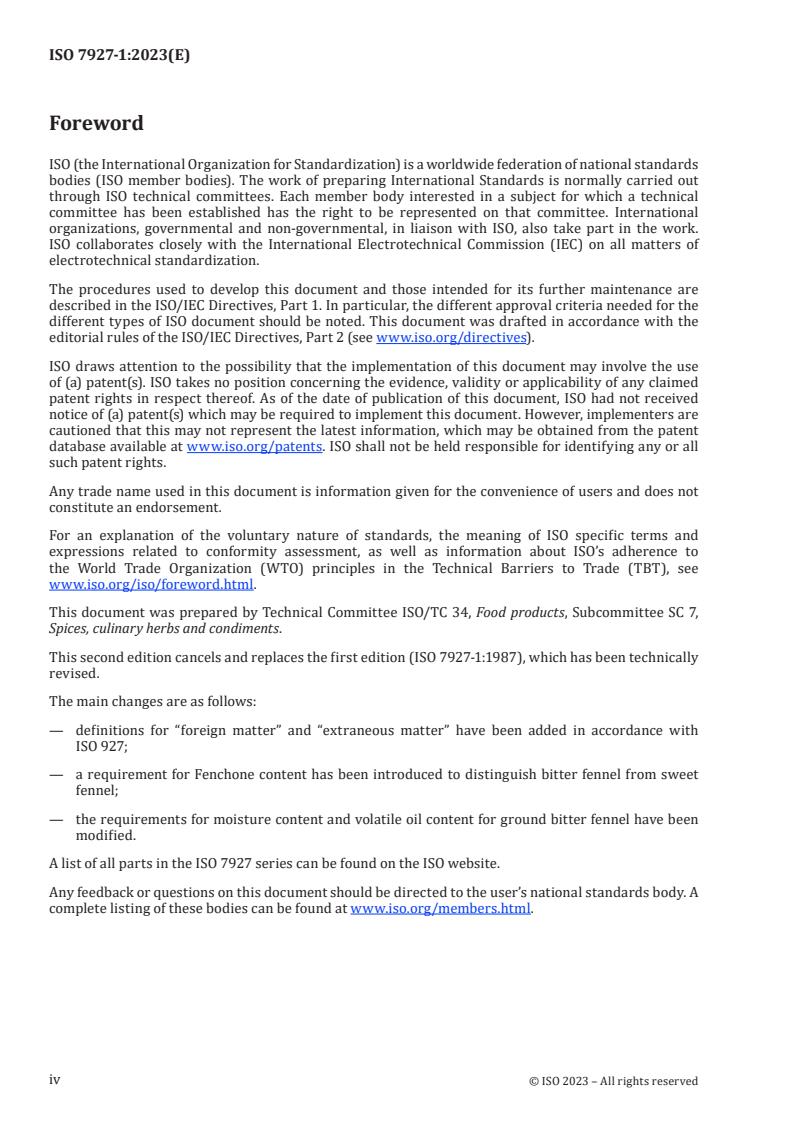
INTERNATIONAL ISO
STANDARD 7927-1
Second edition
2023-06
Spices and condiments — Fennel seed,
whole or ground —
Part 1:
Bitter fennel seed specification
(Foeniculum vulgare P. Miller var.
vulgare)
Épices et condiments — Graines de fenouil entières ou moulues —
Partie 1: Spécifications pour les graines de fenouil amer (Foeniculum
vulgare P. Miller var. vulgare)
Reference number
© ISO 2023
All rights reserved. Unless otherwise specified, or required in the context of its implementation, no part of this publication may
be reproduced or utilized otherwise in any form or by any means, electronic or mechanical, including photocopying, or posting on
the internet or an intranet, without prior written permission. Permission can be requested from either ISO at the address below
or ISO’s member body in the country of the requester.
ISO copyright office
CP 401 • Ch. de Blandonnet 8
CH-1214 Vernier, Geneva
Phone: +41 22 749 01 11
Email: copyright@iso.org
Website: www.iso.org
Published in Switzerland
ii
Contents Page
Foreword .iv
Introduction .v
1 Scope . 1
2 Normative references . 1
3 Terms and definitions . 1
4 Requirements . 2
4.1 Odour and flavour . 2
4.2 Freedom from insects, moulds, etc. . 2
4.3 Extraneous matter in whole fennel . 2
4.4 Foreign matter . 2
4.4.1 Foreign matter from animals . 2
4.4.2 Foreign matter from non-animals . 3
4.5 Defective seeds in whole fennel . 3
4.6 Chemical requirements . . 3
4.6.1 Whole bitter fennel . 3
4.6.2 Ground bitter fennel . 3
5 Sampling . 4
6 Methods of test .4
7 Packaging and marking . 4
7.1 Packaging . 4
7.2 Marking . 4
7.2.1 Whole bitter fennel . 4
7.2.2 Ground bitter fennel . 4
Annex A (informative) Recommendations relating to storage and transport conditions .6
iii
Foreword
ISO (the International Organization for Standardization) is a worldwide federation of national standards
bodies (ISO member bodies). The work of preparing International Standards is normally carried out
through ISO technical committees. Each member body interested in a subject for which a technical
committee has been established has the right to be represented on that committee. International
organizations, governmental and non-governmental, in liaison with ISO, also take part in the work.
ISO collaborates closely with the International Electrotechnical Commission (IEC) on all matters of
electrotechnical standardization.
The procedures used to develop this document and those intended for its further maintenance are
described in the ISO/IEC Directives, Part 1. In particular, the different approval criteria needed for the
different types of ISO document should be noted. This document was drafted in accordance with the
editorial rules of the ISO/IEC Directives, Part 2 (see www.iso.org/directives).
ISO draws attention to the possibility that the implementation of this document may involve the use
of (a) patent(s). ISO takes no position concerning the evidence, validity or applicability of any claimed
patent rights in respect thereof. As of the date of publication of this document, ISO had not received
notice of (a) patent(s) which may be required to implement this document. However, implementers are
cautioned that this may not represent the latest information, which may be obtained from the patent
database available at www.iso.org/patents. ISO shall not be held responsible for identifying any or all
such patent rights.
Any trade name used in this document is information given for the convenience of users and does not
constitute an endorsement.
For an explanation of the voluntary nature of standards, the meaning of ISO specific terms and
expressions related to conformity assessment, as well as information about ISO’s adherence to
the World Trade Organization (WTO) principles in the Technical Barriers to Trade (TBT), see
www.iso.org/iso/foreword.html.
This document was prepared by Technical Committee ISO/TC 34, Food products, Subcommittee SC 7,
Spices, culinary herbs and condiments.
This second edition cancels and replaces the first edition (ISO 7927-1:1987), which has been technically
revised.
The main changes are as follows:
— definitions for “foreign matter” and “extraneous matter” have been added in accordance with
ISO 927;
— a requirement for Fenchone content has been introduced to distinguish bitter fennel from sweet
fennel;
— the requirements for moisture content and volatile oil content for ground bitter fennel have been
modified.
A list of all parts in the ISO 7927 series can be found on the ISO website.
Any feedback or questions on this document should be directed to the user’s national standards body. A
complete listing of these bodies can be found at www.iso.org/members.html.
iv
Introduction
Whole b
...
INTERNATIONAL ISO
STANDARD 7927-1
Second edition
2023-06
Spices and condiments — Fennel seed,
whole or ground —
Part 1:
Bitter fennel seed specification
(Foeniculum vulgare P. Miller var.
vulgare)
Épices et condiments — Graines de fenouil entières ou moulues —
Partie 1: Spécifications pour les graines de fenouil amer (Foeniculum
vulgare P. Miller var. vulgare)
Reference number
© ISO 2023
All rights reserved. Unless otherwise specified, or required in the context of its implementation, no part of this publication may
be reproduced or utilized otherwise in any form or by any means, electronic or mechanical, including photocopying, or posting on
the internet or an intranet, without prior written permission. Permission can be requested from either ISO at the address below
or ISO’s member body in the country of the requester.
ISO copyright office
CP 401 • Ch. de Blandonnet 8
CH-1214 Vernier, Geneva
Phone: +41 22 749 01 11
Email: copyright@iso.org
Website: www.iso.org
Published in Switzerland
ii
Contents Page
Foreword .iv
Introduction .v
1 Scope . 1
2 Normative references . 1
3 Terms and definitions . 1
4 Requirements . 2
4.1 Odour and flavour . 2
4.2 Freedom from insects, moulds, etc. . 2
4.3 Extraneous matter in whole fennel . 2
4.4 Foreign matter . 2
4.4.1 Foreign matter from animals . 2
4.4.2 Foreign matter from non-animals . 3
4.5 Defective seeds in whole fennel . 3
4.6 Chemical requirements . . 3
4.6.1 Whole bitter fennel . 3
4.6.2 Ground bitter fennel . 3
5 Sampling . 4
6 Methods of test .4
7 Packaging and marking . 4
7.1 Packaging . 4
7.2 Marking . 4
7.2.1 Whole bitter fennel . 4
7.2.2 Ground bitter fennel . 4
Annex A (informative) Recommendations relating to storage and transport conditions .6
iii
Foreword
ISO (the International Organization for Standardization) is a worldwide federation of national standards
bodies (ISO member bodies). The work of preparing International Standards is normally carried out
through ISO technical committees. Each member body interested in a subject for which a technical
committee has been established has the right to be represented on that committee. International
organizations, governmental and non-governmental, in liaison with ISO, also take part in the work.
ISO collaborates closely with the International Electrotechnical Commission (IEC) on all matters of
electrotechnical standardization.
The procedures used to develop this document and those intended for its further maintenance are
described in the ISO/IEC Directives, Part 1. In particular, the different approval criteria needed for the
different types of ISO document should be noted. This document was drafted in accordance with the
editorial rules of the ISO/IEC Directives, Part 2 (see www.iso.org/directives).
ISO draws attention to the possibility that the implementation of this document may involve the use
of (a) patent(s). ISO takes no position concerning the evidence, validity or applicability of any claimed
patent rights in respect thereof. As of the date of publication of this document, ISO had not received
notice of (a) patent(s) which may be required to implement this document. However, implementers are
cautioned that this may not represent the latest information, which may be obtained from the patent
database available at www.iso.org/patents. ISO shall not be held responsible for identifying any or all
such patent rights.
Any trade name used in this document is information given for the convenience of users and does not
constitute an endorsement.
For an explanation of the voluntary nature of standards, the meaning of ISO specific terms and
expressions related to conformity assessment, as well as information about ISO’s adherence to
the World Trade Organization (WTO) principles in the Technical Barriers to Trade (TBT), see
www.iso.org/iso/foreword.html.
This document was prepared by Technical Committee ISO/TC 34, Food products, Subcommittee SC 7,
Spices, culinary herbs and condiments.
This second edition cancels and replaces the first edition (ISO 7927-1:1987), which has been technically
revised.
The main changes are as follows:
— definitions for “foreign matter” and “extraneous matter” have been added in accordance with
ISO 927;
— a requirement for Fenchone content has been introduced to distinguish bitter fennel from sweet
fennel;
— the requirements for moisture content and volatile oil content for ground bitter fennel have been
modified.
A list of all parts in the ISO 7927 series can be found on the ISO website.
Any feedback or questions on this document should be directed to the user’s national standards body. A
complete listing of these bodies can be found at www.iso.org/members.html.
iv
Introduction
Whole bitter fennel is the dried fruit of Foeniculum vulgare P. Miller var. vulgare, commonly called “bitter
fennel seed”, and occurs as small seeds about 3 mm to 10 mm in length, 2 mm to 2,5 mm in breadth,
oblong in shape and yellowish to greenish-brown in colour (see Figure 1).
Key
1 plant
2 flower
3 fruit
4 separated achenes
5 transverse section of achene
6 ribs
Figure 1 — Foeniculum vulgare P. Miller var. vulgare
v
INTE
...
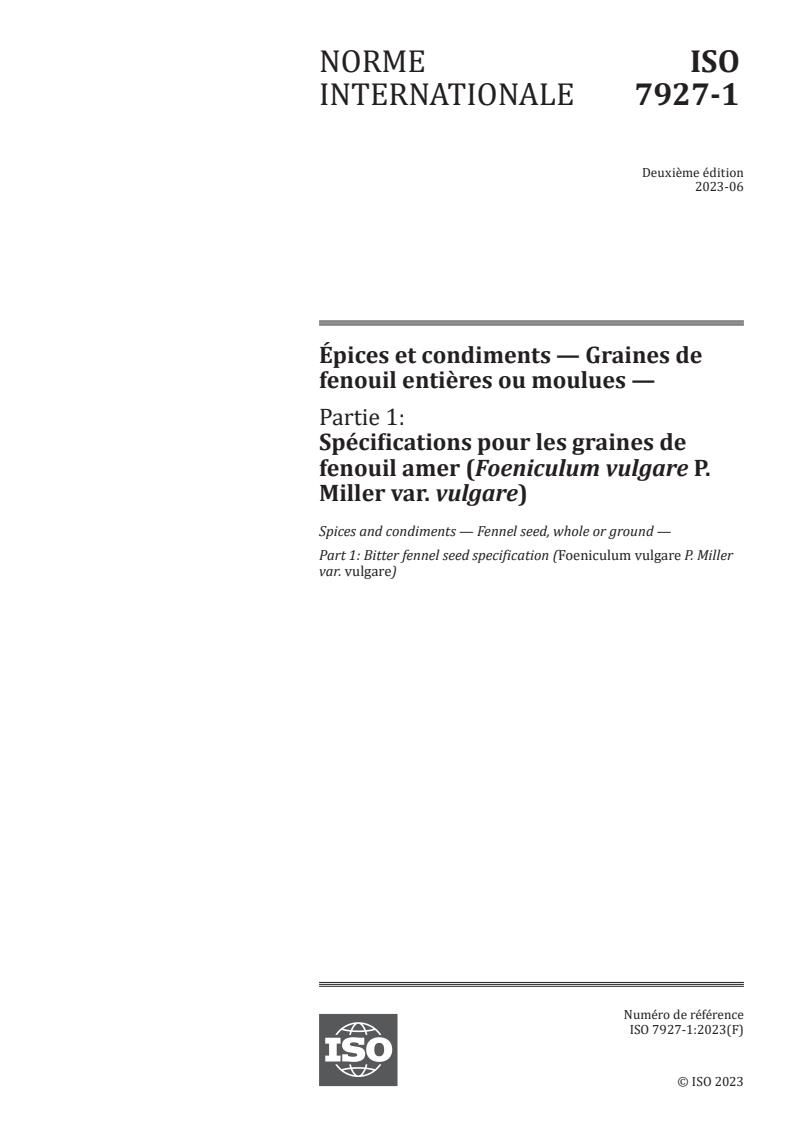
NORME ISO
INTERNATIONALE 7927-1
Deuxième édition
2023-06
Épices et condiments — Graines de
fenouil entières ou moulues —
Partie 1:
Spécifications pour les graines de
fenouil amer (Foeniculum vulgare P.
Miller var. vulgare)
Spices and condiments — Fennel seed, whole or ground —
Part 1: Bitter fennel seed specification (Foeniculum vulgare P. Miller
var. vulgare)
Numéro de référence
DOCUMENT PROTÉGÉ PAR COPYRIGHT
© ISO 2023
Tous droits réservés. Sauf prescription différente ou nécessité dans le contexte de sa mise en œuvre, aucune partie de cette
publication ne peut être reproduite ni utilisée sous quelque forme que ce soit et par aucun procédé, électronique ou mécanique,
y compris la photocopie, ou la diffusion sur l’internet ou sur un intranet, sans autorisation écrite préalable. Une autorisation peut
être demandée à l’ISO à l’adresse ci-après ou au comité membre de l’ISO dans le pays du demandeur.
ISO copyright office
Case postale 401 • Ch. de Blandonnet 8
CH-1214 Vernier, Genève
Tél.: +41 22 749 01 11
E-mail: copyright@iso.org
Web: www.iso.org
Publié en Suisse
ii
Sommaire Page
Avant-propos .iv
Introduction .v
1 Domaine d’application . 1
2 Références normatives .1
3 Termes et définitions . 1
4 Exigences . 2
4.1 Odeur et flaveur . 2
4.2 Absence d’insectes, de moisissures, etc. . 2
4.3 Matières étrangères endogènes dans le fenouil entier . 2
4.4 Matières étrangères exogènes . 3
4.4.1 Matières étrangères exogènes d’origine animale . 3
4.4.2 Matières étrangères exogènes d’origine non animale . 3
4.5 Graines défectueuses dans le fenouil entier . 3
4.6 Exigences chimiques . 3
4.6.1 Fenouil amer entier . 3
4.6.2 Fenouil amer moulu . 3
5 Échantillonnage .4
6 Méthodes d’essai . 4
7 Emballage et marquage . 4
7.1 Emballage . 4
7.2 Marquage . 4
7.2.1 Fenouil amer entier . 4
7.2.2 Fenouil amer moulu . 5
Annexe A (informative) Recommandations relatives aux conditions de stockage et
de transport . 6
iii
Avant-propos
L’ISO (Organisation internationale de normalisation) est une fédération mondiale d’organismes
nationaux de normalisation (comités membres de l’ISO). L’élaboration des Normes internationales est
en général confiée aux comités techniques de l’ISO. Chaque comité membre intéressé par une étude
a le droit de faire partie du comité technique créé à cet effet. Les organisations internationales,
gouvernementales et non gouvernementales, en liaison avec l’ISO participent également aux travaux.
L’ISO collabore étroitement avec la Commission électrotechnique internationale (IEC) en ce qui
concerne la normalisation électrotechnique.
Les procédures utilisées pour élaborer le présent document et celles destinées à sa mise à jour sont
décrites dans les Directives ISO/IEC, Partie 1. Il convient, en particulier, de prendre note des différents
critères d’approbation requis pour les différents types de documents ISO. Le présent document a été
rédigé conformément aux règles de rédaction données dans les Directives ISO/IEC, Partie 2 (voir
www.iso.org/directives).
L’ISO attire l’attention sur le fait que la mise en application du présent document peut entraîner
l’utilisation d’un ou de plusieurs brevets. L’ISO ne prend pas position quant à la preuve, à la validité
et à l’applicabilité de tout droit de brevet revendiqué à cet égard. À la date de publication du présent
document, l’ISO n’avait pas reçu notification qu’un ou plusieurs brevets pouvaient être nécessaires à sa
mise en application. Toutefois, il y a lieu d’avertir les responsables de la mise en application du présent
document que des informations plus récentes sont susceptibles de figurer dans la base de données de
brevets, disponible à l’adresse www.iso.org/brevets. L’ISO ne saurait être tenue pour responsable de ne
pas avoir identifié tout ou partie de tels droits de propriété.
Les appellations commerciales éventuellement mentionnées dans le présent document sont données
pour information, par souci de commodité, à l’intention des utilisateurs et ne sauraient constituer un
engagement.
Pour une explication de la nature volontaire des normes, la signification des termes et expressions
spécifiques de l’ISO liés à l’évaluation de la conformité, ou pour toute information au sujet de l’adhésion
de l’ISO aux principes de l’Organisation mondiale du commerce (OMC) concernant les obstacles
techniques au commerce (OTC), voir www.iso.org/avant-propos.
Le présent document a été élaboré par le comité technique ISO/TC 34, Produits alimentaires, sous-
comité SC 7, Épices, herbes aromatiques et condiments.
Cette deuxième édition annule et remplace la première édition (ISO 7927-1:1987), qui a fait l’objet d’une
révision technique.
Les principales modifications sont les suivantes:
— les définitions de «matière étrangère exogène» et de «matière étrangère endogène» ont été ajoutées
conformément à l’ISO 927;
— une exigence relative à la teneur en fenchone a été insérée pour faire la distinction entre le fenouil
amer et le fenouil doux;
— les exigences relatives à la teneur en eau et à la teneur en huile essentielle ont été modifiées pour le
fenouil amer moulu.
Une liste de toutes les parties de la série ISO 7927 se trouve sur le site web de l’ISO.
Il convient que l’utilisateur adresse tout retour d’information ou toute question concernant le présent
document à l’organisme national de normalisation de son pays. Une liste exhaustive desdits organismes
se trouve à l’adresse www.iso.org/fr/members.html.
iv
Introduction
La graine de fenouil amer entière est le fruit séché du Foeniculum vulgare P. Miller var. vulgare, appelé
communément «graine de fenouil amer» et se présente sous forme de méricarpes oblongs ayant environ
3 mm à 10 mm de longueur, 2 mm à 2,5 mm de largeur et dont la couleur varie du brun jaunâtre au brun
verdâtre (voir la Figure 1).
Légende
1 plante
2 fleur
3 méricarpe
4 akènes séparés
5 coupe transversale d’un akène
6 côtes
Figure 1 — Foeniculum vulgare P. Miller var. vulgare
v
NORME INTERNATIONALE ISO 7927-1:2023(F)
Épices et condiments — Graines de fenouil entières ou
moulues —
Partie 1:
Spécifications pour les graines de fenouil amer
(Foeniculum vulgare P. Miller var. vulgare)
1 Domaine d’application
Le présent document spécifie les exigences relatives aux graines de fenouil amer (Foeniculum vulgare P.
Miller var. vulgare) entières ou moulues.
Des recommandations relatives aux conditions de stockage et de transport figurent à
...