

ISO 11118:2025
(Main)Gas cylinders — Non-refillable metallic gas cylinders — Specification and test methods
General Information
- Abstract
This document specifies requirements for the material, design, inspections, construction and workmanship, manufacturing processes, and tests at manufacture of non-refillable metallic gas cylinders of welded, brazed, or seamless construction. This document also specifies the requirements for the non-refillable sealing devices and their methods of testing. It is applicable to non-refillable metallic gas cylinders for compressed and liquefied gases. NOTE The specific gases permitted in cylinders constructed to this document can be limited by national or international requirements. This document is applicable to cylinders where: a) the test pressure does not exceed 250 bar1) (i.e. ph ≤ 250 bar) for liquefied gases and 450 bar for compressed gases; or b) the product of the test pressure and the water capacity does not exceed 1 000 bar·litres (i.e. ph V ≤ 1 000 bar l); or c) the test pressure exceeds 45 bar and the water capacity does not exceed 5 l (i.e. for ph > 45 bar, then V ≤ 5 l). 1) 1 bar = 0,1 MPa = 105 Pa; 1 MPa = 1 N/mm2
- Status
- Published
- Publication Date
- 09-Jan-2025
- Technical Committee
- ISO/TC 58/SC 3 - Cylinder design
- Drafting Committee
- ISO/TC 58/SC 3 - Cylinder design
- Current Stage
- 6060 - International Standard published
- Start Date
- 10-Jan-2025
- Due Date
- 01-Nov-2025
- Completion Date
- 10-Jan-2025
Buy Documents

ISO 11118:2025 - Gas cylinders — Non-refillable metallic gas cylinders — Specification and test methods Released:10. 01. 2025


ISO 11118:2025 - Bouteilles a gaz — Bouteilles a gaz métalliques non rechargeables — Spécifications et méthodes d’essai Released:10. 01. 2025
Overview - ISO 11118:2025 at a glance
ISO 11118:2025, "Gas cylinders - Non-refillable metallic gas cylinders - Specification and test methods," defines requirements for the design, materials, manufacture and testing of non-refillable metallic gas cylinders (welded, brazed or seamless) used for compressed and liquefied gases. The third edition updates and consolidates requirements for materials, sealing devices, manufacturing controls, prototype and batch testing, marking and certification. It is written to be suitable for reference in the UN Model Regulations and to support safe, compliant production and use of disposable gas cylinders.
Keywords: ISO 11118:2025, non-refillable metallic gas cylinders, specification and test methods, gas cylinder safety, sealing devices, compressed gases, liquefied gases
Key topics and technical requirements
- Scope and applicability
- Applies to non-refillable metallic cylinders where:
- test pressure ≤ 250 bar (liquefied gases) and ≤ 450 bar (compressed gases); or
- p · V ≤ 1 000 bar·litres; or
- if p > 45 bar, then water capacity V ≤ 5 l.
- Applies to non-refillable metallic cylinders where:
- Materials
- Standards for carbon and low-alloy steels, aluminium and aluminium alloys, and austenitic stainless steels; includes chemical composition and resistance requirements.
- Design and construction
- Rules for pressure-containing parts, minimum shell wall thickness verification, drawings and workmanship for welded, brazed or seamless construction.
- Sealing devices
- Requirements and prototype tests for non-refillable sealing devices (Annex A normative).
- Inspection and testing
- Prototype tests: material, tensile, burst, drop, valve-to-cylinder interface, dimensional checks.
- Batch tests and tests on every cylinder: inspection, proof pressure test, leak testing, rejection and repair criteria.
- Conformity and marking
- Type approval procedures, certificates of conformance, required manufacturing and operational markings.
- Notable updates (third edition)
- Updated normative references; minimum shell thickness verification added; simplified wall thickness calculation (fixed F factor); revised welding qualification and valve sampling/testing; clarified UN-based marking requirements.
Practical applications - who uses ISO 11118:2025
- Cylinder manufacturers (design, production, QA)
- Testing and certification laboratories (type approval, batch testing)
- Regulators and transport authorities (safety compliance, enforcement)
- Gas producers and suppliers (selection and procurement of non-refillable cylinders)
- Conformity assessors and auditors ensuring compliance with UN Model Regulations
Related standards
- ISO 7866 (refillable aluminium cylinders)
- ISO 9809 (refillable seamless steel cylinders)
- ISO 4706 (refillable welded steel cylinders)
- UN Model Regulations (transport and marking alignment)
ISO 11118:2025 helps ensure consistent safety, manufacturability and regulatory compliance for non-refillable metallic gas cylinders used across industrial, medical and consumer applications.
Relations
- Effective Date
- 12-Feb-2026
- Effective Date
- 19-Nov-2022
- Effective Date
- 05-Nov-2022
- Effective Date
- 05-Nov-2022
Buy Documents
ISO 11118:2025 - Gas cylinders — Non-refillable metallic gas cylinders — Specification and test methods Released:10. 01. 2025
ISO 11118:2025 - Bouteilles a gaz — Bouteilles a gaz métalliques non rechargeables — Spécifications et méthodes d’essai Released:10. 01. 2025
Get Certified
Connect with accredited certification bodies for this standard

Institut za varilstvo d.o.o. (Welding Institute)
Slovenia's leading welding institute since 1952. ISO 3834, EN 1090, pressure equipment certification, NDT personnel, welder qualification. Only IIW Au
Sponsored listings
Frequently Asked Questions
ISO 11118:2025 is a standard published by the International Organization for Standardization (ISO). Its full title is "Gas cylinders — Non-refillable metallic gas cylinders — Specification and test methods". This standard covers: This document specifies requirements for the material, design, inspections, construction and workmanship, manufacturing processes, and tests at manufacture of non-refillable metallic gas cylinders of welded, brazed, or seamless construction. This document also specifies the requirements for the non-refillable sealing devices and their methods of testing. It is applicable to non-refillable metallic gas cylinders for compressed and liquefied gases. NOTE The specific gases permitted in cylinders constructed to this document can be limited by national or international requirements. This document is applicable to cylinders where: a) the test pressure does not exceed 250 bar1) (i.e. ph ≤ 250 bar) for liquefied gases and 450 bar for compressed gases; or b) the product of the test pressure and the water capacity does not exceed 1 000 bar·litres (i.e. ph V ≤ 1 000 bar l); or c) the test pressure exceeds 45 bar and the water capacity does not exceed 5 l (i.e. for ph > 45 bar, then V ≤ 5 l). 1) 1 bar = 0,1 MPa = 105 Pa; 1 MPa = 1 N/mm2
This document specifies requirements for the material, design, inspections, construction and workmanship, manufacturing processes, and tests at manufacture of non-refillable metallic gas cylinders of welded, brazed, or seamless construction. This document also specifies the requirements for the non-refillable sealing devices and their methods of testing. It is applicable to non-refillable metallic gas cylinders for compressed and liquefied gases. NOTE The specific gases permitted in cylinders constructed to this document can be limited by national or international requirements. This document is applicable to cylinders where: a) the test pressure does not exceed 250 bar1) (i.e. ph ≤ 250 bar) for liquefied gases and 450 bar for compressed gases; or b) the product of the test pressure and the water capacity does not exceed 1 000 bar·litres (i.e. ph V ≤ 1 000 bar l); or c) the test pressure exceeds 45 bar and the water capacity does not exceed 5 l (i.e. for ph > 45 bar, then V ≤ 5 l). 1) 1 bar = 0,1 MPa = 105 Pa; 1 MPa = 1 N/mm2
ISO 11118:2025 is classified under the following ICS (International Classification for Standards) categories: 23.020.35 - Gas cylinders. The ICS classification helps identify the subject area and facilitates finding related standards.
ISO 11118:2025 has the following relationships with other standards: It is inter standard links to EN ISO 11118:2025, ISO 23629-7:2021, ISO 11118:2015/Amd 1:2019, ISO 11118:2015. Understanding these relationships helps ensure you are using the most current and applicable version of the standard.
ISO 11118:2025 is available in PDF format for immediate download after purchase. The document can be added to your cart and obtained through the secure checkout process. Digital delivery ensures instant access to the complete standard document.
Standards Content (Sample)
International
Standard
ISO 11118
Third edition
Gas cylinders — Non-refillable
2025-01
metallic gas cylinders —
Specification and test methods
Bouteilles à gaz — Bouteilles à gaz métalliques non
rechargeables — Spécifications et méthodes d’essai
Reference number
© ISO 2025
All rights reserved. Unless otherwise specified, or required in the context of its implementation, no part of this publication may
be reproduced or utilized otherwise in any form or by any means, electronic or mechanical, including photocopying, or posting on
the internet or an intranet, without prior written permission. Permission can be requested from either ISO at the address below
or ISO’s member body in the country of the requester.
ISO copyright office
CP 401 • Ch. de Blandonnet 8
CH-1214 Vernier, Geneva
Phone: +41 22 749 01 11
Email: copyright@iso.org
Website: www.iso.org
Published in Switzerland
ii
Contents Page
Foreword .v
Introduction .vi
1 Scope . 1
2 Normative references . 1
3 Terms and definitions . 2
4 Symbols . 3
5 Materials . 3
5.1 General requirements .3
5.2 Material types .4
5.2.1 Carbon and low-alloy steels . .4
5.2.2 Aluminium and aluminium alloy .4
5.2.3 Austenitic stainless steels .4
5.3 Chemical compositions .5
5.3.1 Carbon and low-alloy steels . .5
5.3.2 Aluminium and aluminium alloys.6
6 Inspection and testing . 6
7 Design . 6
7.1 General requirements .6
7.2 Calculation of pressure containing parts .6
7.3 Design drawings .7
8 Construction and workmanship . 7
8.1 Construction .7
8.1.1 Types of construction of cylinder shell .7
8.1.2 Cylinder non-refillability.11
8.1.3 Pressure relief devices .11
8.2 Workmanship .11
9 Type approval procedure .12
9.1 General requirements . 12
9.2 Prototype tests . . 12
9.2.1 General . 12
9.2.2 Material tests . 12
9.2.3 Tensile tests . 13
9.2.4 Burst tests .14
9.2.5 Drop tests .16
9.2.6 Dimension checks .17
9.2.7 Valve to cylinder interface test .18
9.3 Design type approval .18
10 Batch tests . .18
10.1 General requirements .18
10.2 Failure to meet test requirements .18
11 Tests on every cylinder . 19
11.1 Inspection .19
11.2 Proof pressure test .19
11.3 Leak testing .19
11.4 Rejection criteria .19
11.5 Repairs .19
12 Markings . 19
12.1 General .19
12.2 Manufacturing and operational markings .19
12.3 Other markings . 20
iii
13 Test reports and certificate of conformance .20
Annex A (normative) Non-refillable sealing devices — Specifications and prototype testing .21
Annex B (informative) Type approval certificate .27
Annex C (informative) Certificate of conformance .29
Annex D (informative) Yield point elongation (YPE) .31
Bibliography .34
iv
Foreword
ISO (the International Organization for Standardization) is a worldwide federation of national standards
bodies (ISO member bodies). The work of preparing International Standards is normally carried out through
ISO technical committees. Each member body interested in a subject for which a technical committee
has been established has the right to be represented on that committee. International organizations,
governmental and non-governmental, in liaison with ISO, also take part in the work. ISO collaborates closely
with the International Electrotechnical Commission (IEC) on all matters of electrotechnical standardization.
The procedures used to develop this document and those intended for its further maintenance are described
in the ISO/IEC Directives, Part 1. In particular, the different approval criteria needed for the different types
of ISO document should be noted. This document was drafted in accordance with the editorial rules of the
ISO/IEC Directives, Part 2 (see www.iso.org/directives).
ISO draws attention to the possibility that the implementation of this document may involve the use of (a)
patent(s). ISO takes no position concerning the evidence, validity or applicability of any claimed patent
rights in respect thereof. As of the date of publication of this document, ISO had not received notice of (a)
patent(s) which may be required to implement this document. However, implementers are cautioned that
this may not represent the latest information, which may be obtained from the patent database available at
www.iso.org/patents. ISO shall not be held responsible for identifying any or all such patent rights.
Any trade name used in this document is information given for the convenience of users and does not
constitute an endorsement.
For an explanation of the voluntary nature of standards, the meaning of ISO specific terms and expressions
related to conformity assessment, as well as information about ISO's adherence to the World Trade
Organization (WTO) principles in the Technical Barriers to Trade (TBT), see www.iso.org/iso/foreword.html.
This document was prepared by Technical Committee ISO/TC 58, Gas cylinders, Subcommittee SC 3, Cylinder
design, in collaboration with the European Committee for Standardization (CEN) Technical Committee CEN/
TC 23, Transportable gas cylinders, in accordance with the Agreement on technical cooperation between ISO
and CEN (Vienna Agreement).
This third edition cancels and replaces the second edition (ISO 11118:2015), which has been technically
revised. It also incorporates the Amendment ISO 11118:2015/Amd 1:2019.
The main changes are as follows:
— the normative references have been updated;
— verification of minimum cylinder shell wall thickness has been added;
— the calculation of determination of minimum wall thickness has been simplified by fixing the “F” factor;
— welding qualification, including defining process and operator, has been modified;
— testing of nonrefillable valve sampling has been clarified;
— marking requirements based on UN Model Regulation requirements have been clarified.
Any feedback or questions on this document should be directed to the user’s national standards body. A
complete listing of these bodies can be found at www.iso.org/members.html.
v
Introduction
The purpose of this document is to facilitate agreement on the design and manufacture of non-refillable
metallic gas cylinders and their sealing devices in all countries. The requirements are based on knowledge
of, and experience with, materials, design requirements, manufacturing processes and controls in common
use for the manufacture of gas cylinders.
[10]
This document has been written so that it is suitable to be referenced in the UN Model Regulations .
In this document, the unit bar is used, due to its universal use in the field of technical gases. It should,
however, be noted that bar is not an SI unit, and that the corresponding SI unit for pressure is Pa (1 bar =
5 5 2
10 Pa = 10 N/m ).
Pressure values given in this document are given as gauge pressure (pressure exceeding atmospheric
pressure) unless noted otherwise.
Any tolerances given in this document include measurement uncertainties.
vi
International Standard ISO 11118:2025(en)
Gas cylinders — Non-refillable metallic gas cylinders —
Specification and test methods
1 Scope
This document specifies requirements for the material, design, inspections, construction and workmanship,
manufacturing processes, and tests at manufacture of non-refillable metallic gas cylinders of welded, brazed,
or seamless construction. This document also specifies the requirements for the non-refillable sealing
devices and their methods of testing. It is applicable to non-refillable metallic gas cylinders for compressed
and liquefied gases.
NOTE The specific gases permitted in cylinders constructed to this document can be limited by national or
international requirements.
This document is applicable to cylinders where:
1)
a) the test pressure does not exceed 250 bar (i.e. p ≤ 250 bar) for liquefied gases and 450 bar for
h
compressed gases; or
b) the product of the test pressure and the water capacity does not exceed 1 000 bar·litres (i.e.
p V ≤ 1 000 bar l); or
h
c) the test pressure exceeds 45 bar and the water capacity does not exceed 5 l (i.e. for p > 45 bar, then
h
V ≤ 5 l).
2 Normative references
The following documents are referred to in the text in such a way that some or all of their content constitutes
requirements of this document. For dated references, only the edition cited applies. For undated references,
the latest edition of the referenced document (including any amendments) applies.
ISO 3651-2, Determination of resistance to intergranular corrosion of stainless steels — Part 2: Ferritic,austenitic
and ferritic-austenitic (duplex) stainless steels — Corrosion test in media containing sulfuric acid
ISO 4706:2023, Gas cylinders — Refillable welded steel cylinders — Test pressure 60 bar and below
ISO 6892-1, Metallic materials — Tensile testing — Part 1: Method of test at room temperature
ISO 7866:2012, Gas cylinders — Refillable seamless aluminium alloy gas cylinders — Design, construction and testing
ISO 9329-1, Seamless steel tubes for pressure purposes — Technical delivery conditions — Part 1: Unalloyed
steels with specified room temperature properties
ISO 9809-1:2019, Gas cylinders — Design, construction and testing of refillable seamless steel gas cylinders and
tubes — Part 1: Quenched and tempered steel cylinders and tubes with tensile strength less than 1 100 MPa
ISO 9809-4:2021, Gas cylinders — Design, construction and testing of refillable seamless steel gas cylinders and
tubes — Part 4: Stainless steel cylinders with an R value of less than 1 100 MPa
m
ISO 10156, Gas cylinders — Gases and gas mixtures — Determination of fire potential and oxidizing ability for
the selection of cylinder valve outlets
ISO 10286, Gas cylinders — Vocabulary
5 2
1) 1 bar = 0,1 MPa = 10 Pa; 1 MPa = 1 N/mm
ISO 10297, Gas cylinders — Cylinder valves — Specification and type testing
ISO 11114-1, Gas cylinders — Compatibility of cylinder and valve materials with gas contents — Part 1: Metallic
materials
ISO 11114-2, Gas cylinders — Compatibility of cylinder and valve materials with gas contents — Part 2: Non-
metallic materials
ISO 13769, Gas cylinders — Stamp marking
ISO 15614-1, Specification and qualification of welding procedures for metallic materials — Welding procedure
test — Part 1: Arc and gas welding of steels and arc welding of nickel and nickel alloys
ISO 15614-12, Specification and qualification of welding procedures for metallic materials — Welding procedure
test — Part 12: Spot, seam and projection welding
ISO 20703:2006, Gas cylinders — Refillable welded aluminium-alloy cylinders — Design, construction and testing
3 Terms and definitions
For the purposes of this document, the terms and definitions given in ISO 10286 and the following apply.
ISO and IEC maintain terminological databases for use in standardization at the following addresses:
— ISO Online browsing platform: available at https:// www .iso .org/ obp
— IEC Electropedia: available at https:// www .electropedia .org/
3.1
batch
quantity of completed and pressure tested cylinders made
consecutively by the same manufacturer using the same manufacturing techniques to the same design, size,
and material specifications using the same type of welding machines (when applicable), welding procedures
(when applicable), and to the same heat treatment conditions (when applicable)
Note 1 to entry: See Clause 10 for details.
3.2
cylindrical shell
portion of the cylinder shell excluding the cylinder ends which is parallel to the centreline axis of the cylinder
3.3
cylinder shell
empty cylinder before affixing the non-refillable sealing device (3.12), but including all other permanent
attachments
3.4
material certificate
document issued by the material manufacturer which certifies the chemical analysis, mechanical properties,
heat treatment, processing techniques, or other properties/features if required
3.5
burst pressure
highest pressure reached in a cylinder during the burst test
3.6
test pressure
required pressure applied during the pressure test
3.7
working pressure
settled pressure of compressed gas at a uniform reference temperature of 15 °C (288 K) in a full gas cylinder
3.8
minimum operating temperature
minimum temperature to which the cylinder contents can be exposed
Note 1 to entry: See 5.1.6.
3.9
non-refillable cylinder
cylinder including a non-refillable sealing device (3.12) that permits the cylinder to be filled only once
Note 1 to entry: Where there is no risk of ambiguity, the short abbreviated form “cylinder” is used in this document.
3.10
water capacity
volume of water required to completely fill an empty cylinder
3.11
processor
facility that anneals, rolls, slits, or otherwise, changes the material from the form received from the location
where the steel was melted
3.12
non-refillable sealing device
device permanently attached to the cylinder which, once activated, prevents the cylinder from being refilled
4 Symbols
a calculated minimum thickness, in millimetres, of the cylindrical shell
D nominal outside diameter of the cylinder, in millimetres
F design stress factor
P burst pressure of the cylinder, in bar
b
p test pressure, in bar above atmospheric pressure
h
p working pressure, in bar above atmospheric pressure
w
p non-refillable sealing device test pressure, in bar above atmospheric pressure
vt
R actual value of the yield strength, in megapascals, of the cylinder when tested
ea
R minimum guaranteed value of the yield strength, in megapascals, for the finished cylinder
eg
R actual value of the tensile strength, in megapascals, of the cylinder when tested
ma
R minimum guaranteed value of the tensile strength, in megapascals, for the finished cylinder
mg
V water capacity of the cylinder, in litres
5 Materials
5.1 General requirements
5.1.1 Cylinder shells shall be made of carbon or low alloy steels, austenitic stainless steel, aluminium, or
aluminium alloys. The materials used shall be specified by type (see 5.2) and chemical composition (see 5.3).
Materials shall not contain seams, cracks, laminations, or other injurious defects. For material requirements
of non-refillable sealing devices, see Annex A.
5.1.2 The cylinder manufacturer shall specify the chemical and mechanical requirements to the material
supplier.
5.1.3 The cylinder manufacturer shall obtain a material certificate from the manufacturer/processor of
the material certifying the chemical analysis of the cast. The certificate shall be issued by the manufacturer
of the material and shall confirm compliance to the material specification.
5.1.4 The cylinder manufacturer shall verify that the materials are in accordance with the cylinder
manufacturer specifications.
5.1.5 All materials used in the construction of the pressure containing parts of the cylinder shall be
traceable.
5.1.6 All materials shall be suitable for use at the minimum operating temperature or at –20 °C, whichever
is the lower.
5.1.7 The materials used for manufacture of the cylinder shell shall be compatible with the intended gas
service as specified in ISO 11114-1 or ISO 11114-2.
5.1.8 Contact between dissimilar metals resulting in damage by galvanic corrosion shall be avoided.
5.2 Material types
5.2.1 Carbon and low-alloy steels
5.2.1.1 The steel used for the fabrication of gas cylinder shells shall be made in an electric furnace or,
by the basic oxygen process, shall have non-ageing properties and shall be fully killed (de-oxidized) by
aluminium and/or silicon.
5.2.1.2 Carbon steel for cold deep drawn seamless, welded, or brazed cylinder shells shall have non-ageing
properties, processed free of stretcher strain, and shall be fully killed with aluminium and/or silicon. The
chemical composition shall meet the requirements of 5.3.1.1.
5.2.1.3 Carbon steel for other welded cylinder shells shall have a chemical composition which meets the
requirements of 5.3.1.2. The maximum tensile strength shall not exceed 700 MPa.
5.2.1.4 Carbon steel for cylinder shells made from seamless steel tubing with integrally formed ends, hot
drawn, and finished shall have a chemical composition which meets the requirements of 5.3.1.3.
5.2.1.5 Low alloy steels shall conform to ISO 4706:2023, 5.2.1 or ISO 9809-1:2019, 6.1, 6.2, and 6.3.
5.2.2 Aluminium and aluminium alloy
5.2.2.1 Aluminium alloys with a tensile strength greater than 500 MPa shall not be used.
5.2.2.2 Aluminium alloys used for cylinders shall conform to the material requirements of ISO 7866:2012,
6.1 and 6.2 or ISO 20703:2006, 4.1 and 4.2, as appropriate.
5.2.2.3 Pure aluminium is permitted and shall have a minimum aluminium content of 99,0 %.
5.2.3 Austenitic stainless steels
5.2.3.1 For austenitic stainless steels, the maximum tensile strength shall not exceed 800 MPa.
5.2.3.2 The cylinder manufacturer shall take into consideration the loss of material strength within the
heat affected zone of any weld.
5.2.3.3 Austenitic stainless steels for all types of cylinder shells shall conform to ISO 9809-4:2021, 6.1 and 6.2.
5.2.3.4 Due to the risk of sensitization to inter-granular corrosion resulting from hot working/welding for
each material specification and heat-treatment method, a corrosion test shall be carried out in accordance
with ISO 3651-2 on a specimen taken from a finished cylinder.
Some grades of stainless steels can be susceptible to environmental stress corrosion cracking. Special
precautions should be taken in such cases.
5.3 Chemical compositions
5.3.1 Carbon and low-alloy steels
5.3.1.1 Carbon steels having non-aging properties for cold deep drawn welded or brazed cylinder shells
shall have the following chemical composition limits in % mass fraction given in Table 1.
Table 1 — Cylinder shell and ends non-aging properties for cold deep drawn chemistry allowable limits
Element Maximum content
% (mass fraction)
Carbon ≤ 0,12
Manganese ≤ 0,50
Phosphorus ≤ 0,025
Sulfur ≤ 0,025
5.3.1.2 Carbon steels for welded cylinder shells other than cold deep drawn shall have the following
chemical composition limits in % mass fraction given in Table 2.
Table 2 — Cylinder shell and ends other than cold deep drawn chemistry allowable limits
Element Maximum content
% (mass fraction)
Carbon ≤ 0,25
Manganese ≤ 0,50
Phosphorus ≤ 0,025
Sulfur ≤ 0,025
5.3.1.3 Carbon steels for cylinder shells made of seamless steel with integrally formed ends, hot drawn,
and finished shall have the following chemical composition limits in % mass fraction given in Table 3.
Table 3 — Seamless steel with integrally formed ends, hot drawn cylinder shell chemistry
allowable limits
Element Maximum content
% (mass fraction)
Carbon ≤ 0,55
Manganese ≤ 1,70
Phosphorus ≤ 0,025
Sulfur ≤ 0,025
5.3.2 Aluminium and aluminium alloys
Aluminium and aluminium alloys shall have a maximum lead and bismuth contents not exceeding 0,003 % each.
6 Inspection and testing
To ensure that the cylinders conform to this document, they shall be subject to inspection and testing
in accordance with Clauses 9 to 11 and Annex A by an inspection body (hereinafter referred to as “the
inspector”).
Tests and examinations performed to demonstrate compliance with this document shall be conducted using
instruments calibrated before being put into service and thereafter according to an established program.
7 Design
7.1 General requirements
7.1.1 The calculation of the cylindrical wall thickness of the pressure containing parts shall be related to
the guaranteed minimum yield strength of the finished cylinder (R ).
eg
7.1.2 The design of the cylinder shell shall be such that the pressure containing parts, when subjected to
the test pressure (p ), shall not show any permanent visible deformation.
h
7.1.3 Welded aluminium and welded aluminium alloy cylinders are limited to a maximum of 60 bar test
pressure.
7.2 Calculation of pressure containing parts
The minimum thickness of the cylindrical shell of the pressure containing parts shall not be less than any of
the three values determined in 7.2 a), b), and c).
a) The minimum thickness of the cylindrical shell shall be not less than that necessary for the minimum
burst pressure to be greater than 1,6 times the test pressure (p ) and such that the requirements of
h
9.2.4.5 and Clause 11 are met.
b) The minimum thickness of the cylindrical shell shall not be less than that calculated by the Lamé - von
Mises formula as given in Formula (1).
10FR − 3 p
D
eg h
a=−1 (1)
2 10FR
eg
with F = 0,85
c) The minimum thickness of the cylindrical shell shall not be less than that calculated by using Formula (2)
or Formula (3) as appropriate.
Formula (2) (for steel):
a=+D/650 04, (2)
Formula (3) (for aluminium alloys):
a=+D/300 05, (3)
NOTE It is generally assumed that p is equal to 1,5 times working pressure for compressed gases.
h
7.3 Design drawings
Fully dimensioned drawing(s) of the non-refillable cylinder shall be supplied which includes the following as
a minimum:
a) material specifications for cylinder shells including, but not limited to R and R (MPa). In addition,
eg mg
the material specifications for the non-refillable sealing device shall be noted;
b) test pressure (bar);
c) minimum burst pressure (bar);
d) minimum thickness of the cylindrical shell (mm);
e) minimum water capacity (litre) (for cylinders ≤ 2 l, the water capacity may be reported in ml);
f) nominal cylinder outside diameter (mm);
g) dimensions of the cylinder ends (mm);
h) overall length of the cylinder (mm);
i) heat treatment (if any);
j) method of construction;
k) welding/brazing procedure designation (if any);
l) specifications for valve outlet connection or cylinder threaded connection for use (if applicable);
m) cylinder design identification;
n) design standard (i.e. ISO 11118:2025);
o) date and revision identity of drawing;
p) manufacturer’s identity;
q) content and position of markings;
r) description of non-refillable sealing device that guarantees non-refillability and, if applicable, piercing
force and energy required to pierce membranes.
8 Construction and workmanship
8.1 Construction
8.1.1 Types of construction of cylinder shell
The cylinder shells shall be of seamless, welded, or brazed construction. The minimum wall thickness of
the cylindrical shell shall be verified during the production process. The frequency and method used to
determine the minimum cylindrical shell wall thickness shall be agreed with the inspector.
8.1.1.1 Seamless construction
8.1.1.1.1 Seamless cylinder shells shall be produced by
a) forging or drop forging from a solid ingot or billet,
b) manufacturing from seamless tube, or
c) pressing from a flat plate (cold deep drawn).
8.1.1.1.2 Welding and brazing are only permitted to attach the non-refillable sealing device.
a) Welding shall be carried out only on cylinders made of weldable materials.
b) Brazing shall be carried out only on cylinders made of materials not degraded by this procedure.
8.1.1.2 Welded construction
8.1.1.2.1 General requirements
The welding of longitudinal and circumferential seams shall be by a semi-automatic or automatic process.
The longitudinal seam weld, if any, shall be of the butt type weld joint as illustrated in Figure 1 a).
The circumferential seam(s), if any, shall be as illustrated in Figure 1 a), b), c) or d).
Welded joints shall have strength greater than the tensile strength of the finished cylindrical wall.
The welding procedure and operator qualifications shall include, as a minimum, welds representative of
those made in production representing the variables in the materials and the process. Requalifying of the
procedures and operators shall be required if there is a change in any of the essential variables as specified
in 8.1.1.2.2.7.
a) Butt weld joint c) Butt weld joint with backing ring
b) Offset weld d) Joggle weld
Figure 1 — Weld joints
8.1.1.2.2 Welding qualifications
8.1.1.2.2.1 General
a) All welding equipment, welding operators and welding procedures may be approved by meeting the
requirements of 8.1.1.2.2 to 8.1.1.2.2.9 or those given in ISO 5817 (level B), ISO 9606-1, ISO 10042 (level
C), ISO 14732, ISO 15613, ISO 15614-1 and ISO 15614-12, as appropriate.
b) Records of welders and welding operator qualifications and welding procedure qualifications shall be
kept on file by the manufacturer.
c) Welding procedure specification approval tests shall be carried out such that the welds shall be
representative of those made in production.
d) Welders, welding operators and welding procedures shall pass the approval tests for the specific type of
work and procedure specification concerned.
8.1.1.2.2.2 Materials for pressure and non-pressure containing parts
The materials used for qualification shall be the same as those specified in the procedure specification and
those used for the production.
8.1.1.2.2.3 Positions of welds
For welder qualification, the position of the part for welding shall be the same as that in the actual
manufacturing.
8.1.1.2.2.4 Welding consumables
The weld consumables shall be the same as those specified in the procedure specification, those tested from
the welders, and those used for the production.
8.1.1.2.2.5 Retesting
Where a welder or welding operator fails to meet the requirements of this document
a) an immediate retest shall be carried out of two test welds of the type failed, both of which shall meet all
the requirements of the standard, or
b) a retest shall be carried out provided there is evidence that the operator has had further training and
practice to the design and procedure specification.
8.1.1.2.2.6 Period of validity
A welder and welding operator shall be requalified on the design if the design has not been produced by the
welder for a period of six months or more. Records of effectiveness shall be retained by the manufacturer.
8.1.1.2.2.7 Essential variables of the welding process
The welding procedure specification and welder qualification shall be tested and approved when any of the
following changes are made, if not already covered:
a) a change to the base materials;
b) a change to the welding material;
c) a change to the weld process;
d) a change to the weld position;
e) a decrease of 30 °C or more in the minimum specified preheating temperature;
f) the omission or addition of a backing ring in single pass welds;
g) a change from multiple pass to single pass per side;
h) a change to the shielding gas or to the composition (if greater than a 15 % change in the mixture);
i) a change from a single arc to multi arc or vice versa.
8.1.1.2.2.8 Welder and weld operator qualification tests
a) For longitudinal welds:
1) bend test, root of weld;
2) weld tensile test.
b) For circumferential welds:
1) macro test;
2) weld tensile test.
c) For threaded connections to cylinder ends: macro tests, 180° apart.
d) For welded attachments, foot rings, collars, rupture disc, or lugs: macro test.
e) For fillet welds: macro tests, 180° apart.
8.1.1.2.2.9 Acceptance
a) For bend tests:
Upon completion of the test, the test piece (weld metal and base material) shall remain uncracked.
b) For tensile tests:
The tensile strength value obtained, R , shall not be less than that guaranteed by the cylinder
ma
manufacturer regardless of the fracture location.
c) For macro tests:
The etched specimen shall be prepared to a resolution where visually, examination can occur to
determine adequate root penetration into both members as to the established design (e.g. ISO 17639).
8.1.1.3 Brazed construction
Butt weld brazed joints shall not be used.
Three-piece cylinder designs with brazed seams shall not be permitted.
Brazing shall not be used for aluminium or aluminium alloy cylinders.
Brazing materials shall be compatible with the intended gas being placed in the cylinder.
The brazing material shall have a melting point greater than 540 °C.
Brazed seams shall be assembled such as to ensure complete penetration of the brazing material throughout
the joint.
Brazed joints shall have strength greater than the tensile strength of the finished cylindrical wall.
Brazing procedures and operators shall be qualified to a written procedure according to, for example,
ISO 13585 or EN 13134.
8.1.1.4 Attachments and openings
Attachments to the cylinder including sealing of the neck opening by welding or crimping a pierceable metal
membrane shall be by means which are not detrimental to the integrity of the cylinder. Welding or brazing
of attachments to the cylinder other than non-refillable sealing device shall be completed prior to the final
testing of the cylinder shell (see Clause 11).
There shall be no openings or attachments in the cylindrical shell.
All openings and their reinforcements shall be within an imaginary circle concentric with the centreline
axis of the cylinder. The diameter of the circle shall not exceed 80 % of the outside diameter of the cylinder.
The plane of the circle shall be perpendicular to the centreline axis of the cylinder (see Figure 2).
If necessary, each opening can be reinforced by a securely attached fitting, boss, pad, collar, or other
suitable means.
Material used for welded attachments and fittings shall be of weldable quality and compatible with the
cylinder material.
Material used for brazed attachments and fittings shall be of brazable quality and compatible with the
cylinder material. The minimum width of the brazed joints shall be at least four times the minimum design
shell wall thickness.
Figure 2 — Openings
8.1.2 Cylinder non-refillability
The cylinder shall be equipped with a device rendering the cylinder non-refillable. This can be accomplished
by a valve or a pierceable metal membrane in accordance with Annex A that is permanently attached to the
neck opening which, when in place, renders the cylinder non-refillable. Replaceable sealing devices shall not
be used.
8.1.3 Pressure relief devices
Where a pressure relief device is an integral part of the cylinder, the manufacturer shall ensure that the
pressure relief device has sufficient capacity to prevent rupture of the cylinder. For membranes, see A.4.3.
8.2 Workmanship
The quality of workmanship and construction shall be such as to ensure that cylinders are free from defects,
including at least the following:
a) the pressure containing parts shall be of uniform quality and free from surface imperfections which can
adversely affect the safe working of the cylinder;
b) before sealing the cylinder or after welding the longitudinal joint, if any, each cylinder shall be clean,
dry, and free of any loose particles;
c) after completion of all welded/brazed joints, the weld shall not have concavity, weld under-cutting, or
abrupt weld irregularity nor have any cracks or other defects;
d) if filling is part of the cylinder manufacturing process, appropriate regulations can apply to the gas
properties and filling conditions.
9 Type approval procedure
9.1 General requirements
A technical specification of each new design of cylinder [or cylinder family as defined in 9.1 f)], including
design drawing, design calculations, material details, and heat treatment, shall be submitted by the
manufacturer to the inspector. The results of the tests shall be summarized in a report to be kept available
by the approval holder and are available for review/inspection when required.
Prototype tests detailed in 9.2 and Annex A shall be carried out on each new design under the supervision of
the inspector.
A cylinder shall be considered to be of a new design when at least one of the following applies:
a) it is manufactured in a different manufacturing facility;
b) it is manufactured by a different process (this includes any major process change);
c) it is manufactured from a material of different specification;
d) it is given a different heat treatment, if applicable;
e) either the cylinder profile or the thickness of the starting material have changed relative to the cylinder
diameter or calculated minimum thickness of the cylindrical shell, respectively;
f) the overall length of the cylinder has increased by more than 50 % (cylinders with a length/outside
diameter ratio less than three shall not be used as reference for any new design with this ratio greater
than three);
g) the nominal outside diameter of the cylinder has been increased or decreased by more than 1 % or
5 mm, whichever is greater of the original design diameter;
h) an increase in the test pressure that requires a change in design cylindrical wall thickness;
i) the non-refillable sealing device design has changed.
9.2 Prototype tests
9.2.1 General
A minimum of 50-cylinder shells guaranteed by the manufacturer to be representative of the new design
will be tested as described in 9.2.2, 9.2.3, 9.2.4 and 9.2.6. Prior to subjecting the cylinder shells to prototype
testing, the cylinder shells are to be subjected to a pressure equal to the test pressure (p ) and exhibit no
h
leakage or visible distortion. The complete non-refillable cylinders shall be tested as described in 9.2.5 and
9.2.7 (if applicable).
The non-refillable sealing device shall be tested as defined in A.3 or A.4 as applicable.
If the results of the tests conducted in accordance with 9.2.2 to 9.2.7 and Annex A are sati
...
Norme
internationale
ISO 11118
Troisième édition
Bouteilles à gaz — Bouteilles à gaz
2025-01
métalliques non rechargeables —
Spécifications et méthodes d’essai
Gas cylinders — Non-refillable metallic gas cylinders —
Specification and test methods
Numéro de référence
DOCUMENT PROTÉGÉ PAR COPYRIGHT
© ISO 2025
Tous droits réservés. Sauf prescription différente ou nécessité dans le contexte de sa mise en œuvre, aucune partie de cette
publication ne peut être reproduite ni utilisée sous quelque forme que ce soit et par aucun procédé, électronique ou mécanique,
y compris la photocopie, ou la diffusion sur l’internet ou sur un intranet, sans autorisation écrite préalable. Une autorisation peut
être demandée à l’ISO à l’adresse ci-après ou au comité membre de l’ISO dans le pays du demandeur.
ISO copyright office
Case postale 401 • Ch. de Blandonnet 8
CH-1214 Vernier, Genève
Tél.: +41 22 749 01 11
E-mail: copyright@iso.org
Web: www.iso.org
Publié en Suisse
ii
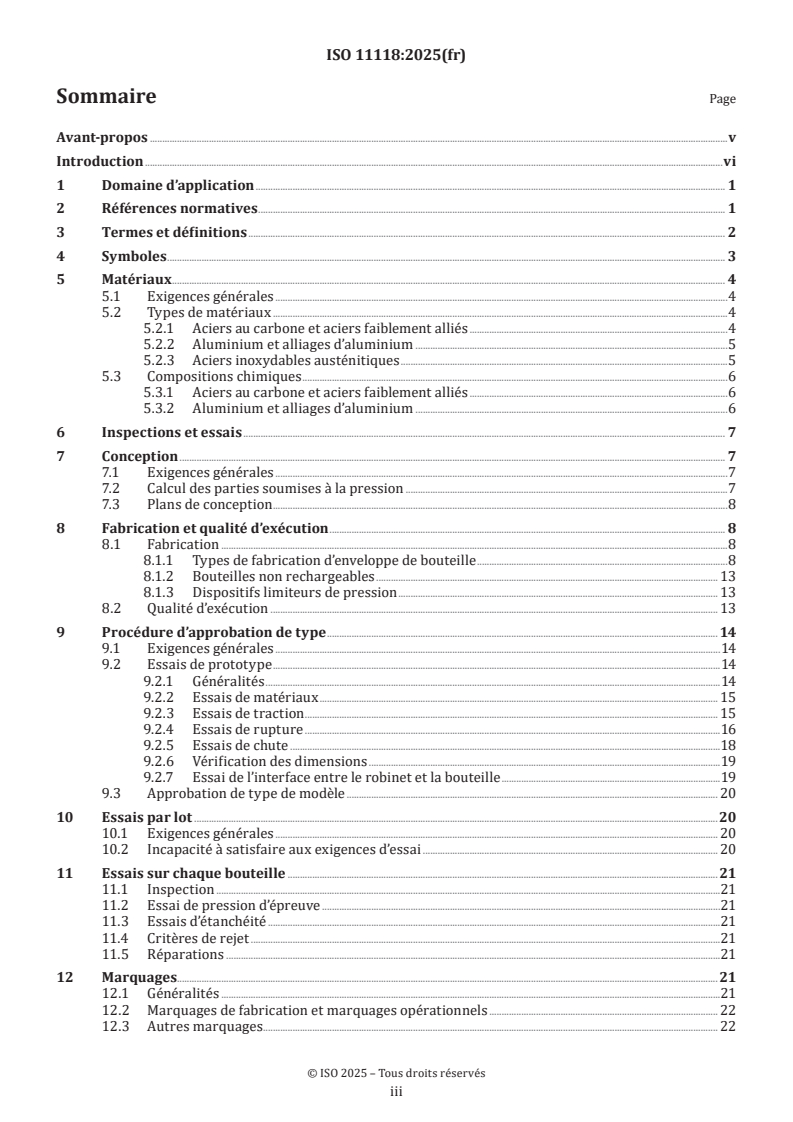
Sommaire Page
Avant-propos .v
Introduction .vi
1 Domaine d’application . 1
2 Références normatives . 1
3 Termes et définitions . 2
4 Symboles . 3
5 Matériaux . 4
5.1 Exigences générales .4
5.2 Types de matériaux .4
5.2.1 Aciers au carbone et aciers faiblement alliés .4
5.2.2 Aluminium et alliages d’aluminium .5
5.2.3 Aciers inoxydables austénitiques .5
5.3 Compositions chimiques .6
5.3.1 Aciers au carbone et aciers faiblement alliés .6
5.3.2 Aluminium et alliages d’aluminium .6
6 Inspections et essais . 7
7 Conception . 7
7.1 Exigences générales .7
7.2 Calcul des parties soumises à la pression .7
7.3 Plans de conception .8
8 Fabrication et qualité d’exécution . 8
8.1 Fabrication .8
8.1.1 Types de fabrication d’enveloppe de bouteille .8
8.1.2 Bouteilles non rechargeables . 13
8.1.3 Dispositifs limiteurs de pression . 13
8.2 Qualité d’exécution . 13
9 Procédure d’approbation de type . 14
9.1 Exigences générales .14
9.2 Essais de prototype .14
9.2.1 Généralités .14
9.2.2 Essais de matériaux . 15
9.2.3 Essais de traction . 15
9.2.4 Essais de rupture .16
9.2.5 Essais de chute .18
9.2.6 Vérification des dimensions .19
9.2.7 Essai de l’interface entre le robinet et la bouteille .19
9.3 Approbation de type de modèle . 20
10 Essais par lot .20
10.1 Exigences générales . 20
10.2 Incapacité à satisfaire aux exigences d’essai . 20
11 Essais sur chaque bouteille .21
11.1 Inspection .21
11.2 Essai de pression d’épreuve .21
11.3 Essais d’étanchéité .21
11.4 Critères de rejet .21
11.5 Réparations .21
12 Marquages.21
12.1 Généralités .21
12.2 Marquages de fabrication et marquages opérationnels . 22
12.3 Autres marquages . . 22
iii
13 Rapports d’essai et certificat de conformité .22
Annexe A (normative) Dispositifs d’étanchéité non réutilisables — Spécifications et essais
de prototype .23
Annexe B (informative) Certificat d’approbation de type .29
Annexe C (informative) Certificat de conformité.31
Annexe D (informative) Allongement à la limite d’élasticité (YPE) .33
Bibliographie .36
iv
Avant-propos
L'ISO (Organisation internationale de normalisation) est une fédération mondiale d'organismes nationaux
de normalisation (comités membres de l'ISO). L'élaboration des Normes internationales est en général
confiée aux comités techniques de l'ISO. Chaque comité membre intéressé par une étude a le droit de faire
partie du comité technique créé à cet effet. Les organisations internationales, gouvernementales et non
gouvernementales, en liaison avec l'ISO participent également aux travaux. L'ISO collabore étroitement avec
la Commission électrotechnique internationale (IEC) en ce qui concerne la normalisation électrotechnique.
Les procédures utilisées pour élaborer le présent document et celles destinées à sa mise à jour sont
décrites dans les Directives ISO/IEC, Partie 1. Il convient, en particulier, de prendre note des différents
critères d'approbation requis pour les différents types de documents ISO. Le présent document a
été rédigé conformément aux règles de rédaction données dans les Directives ISO/IEC, Partie 2 (voir
www.iso.org/directives).
L’ISO attire l’attention sur le fait que la mise en application du présent document peut entraîner l’utilisation
d’un ou de plusieurs brevets. L’ISO ne prend pas position quant à la preuve, à la validité et à l’applicabilité de
tout droit de brevet revendiqué à cet égard. À la date de publication du présent document, l’ISO n'avait pas
reçu notification qu’un ou plusieurs brevets pouvaient être nécessaires à sa mise en application. Toutefois,
il y a lieu d’avertir les responsables de la mise en application du présent document que des informations
plus récentes sont susceptibles de figurer dans la base de données de brevets, disponible à l'adresse
www.iso.org/brevets. L’ISO ne saurait être tenue pour responsable de ne pas avoir identifié tout ou partie de
tels droits de propriété.
Les appellations commerciales éventuellement mentionnées dans le présent document sont données pour
information, par souci de commodité, à l’intention des utilisateurs et ne sauraient constituer un engagement.
Pour une explication de la nature volontaire des normes, la signification des termes et expressions
spécifiques de l'ISO liés à l'évaluation de la conformité, ou pour toute information au sujet de l'adhésion de
l'ISO aux principes de l’Organisation mondiale du commerce (OMC) concernant les obstacles techniques au
commerce (OTC), voir www.iso.org/avant-propos.
Le présent document a été élaboré par le comité technique ISO/TC 58, Bouteilles à gaz, sous-comité SC 3,
Construction des bouteilles, en collaboration avec le comité technique CEN/TC 23, Bouteilles à gaz
transportables, du Comité européen de normalisation (CEN) conformément à l’Accord de coopération
technique entre l’ISO et le CEN (Accord de Vienne).
Cette troisième édition annule et remplace la deuxième édition (ISO 11118:2015), qui a fait l’objet d’une
révision technique. Elle intègre également l’Amendement ISO 11118:2015/Amd 1:2019.
Les principales modifications sont les suivantes:
— mise à jour des références normatives;
— ajout de la vérification de l’épaisseur de paroi minimale de l’enveloppe de la bouteille;
— simplification du calcul pour déterminer l’épaisseur de paroi minimale en définissant le facteur «F»;
— modification de la qualification du soudage, y compris la définition du procédé et de l’opérateur;
— clarification des essais d’échantillonnage des robinets de bouteilles non rechargeables;
— clarification des exigences en matière de marquage sur la base des exigences du Règlement type de l’ONU.
Il convient que l’utilisateur adresse tout retour d’information ou toute question concernant le présent
document à l’organisme national de normalisation de son pays. Une liste exhaustive desdits organismes se
trouve à l’adresse www.iso.org/fr/members.html.
v
Introduction
L’objectif du présent document est de favoriser les accords sur la conception et la fabrication des bouteilles
à gaz métalliques non rechargeables et de leurs dispositifs d’étanchéité dans tous les pays. Les exigences
se fondent sur les connaissances et l’expérience acquises sur les matériaux, les exigences de conception, les
procédés de fabrication et les inspections couramment utilisés pour la fabrication de bouteilles à gaz.
[10]
Le présent document a été rédigé de sorte à pouvoir être référencé dans le Règlement type de l’ONU .
Dans le présent document, le bar est utilisé comme unité en raison de son utilisation universelle dans le
domaine des gaz techniques. Toutefois, il convient de noter que le bar n’est pas une unité SI et que l’unité SI
5 5 2
correspondante pour la pression est le Pa (1 bar = 10 Pa = 10 N/m ).
Sauf indication contraire, les valeurs de pression indiquées dans le présent document correspondent à la
pression manométrique (pression supérieure à la pression atmosphérique).
Toutes les tolérances indiquées dans le présent document incluent les incertitudes de mesure.
vi
Norme internationale ISO 11118:2025(fr)
Bouteilles à gaz — Bouteilles à gaz métalliques non
rechargeables — Spécifications et méthodes d’essai
1 Domaine d’application
Le présent document spécifie les exigences applicables aux matériaux, à la conception, aux inspections, à
la fabrication et à la qualité d’exécution ainsi qu’aux procédés de fabrication et aux essais chez le fabricant
de bouteilles à gaz métalliques non rechargeables, soudées, brasées ou sans soudure. Le présent document
spécifie également les exigences applicables aux dispositifs d’étanchéité non réutilisables et à leurs méthodes
d’essai. Il est applicable aux bouteilles à gaz métalliques non rechargeables utilisées pour les gaz comprimés
et liquéfiés.
NOTE Les gaz spécifiques autorisés pour les bouteilles construites en conformité avec le présent document
peuvent être limités par des exigences nationales ou internationales.
Le présent document est applicable aux bouteilles dont:
1)
a) la pression d’épreuve ne dépasse pas 250 bar (c’est-à-dire p ≤ 250 bar) pour les gaz liquéfiés et 450 bar
h
pour les gaz comprimés; ou
b) le produit de la pression d’épreuve par la contenance en eau ne dépasse pas 1 000 bar·l (c’est-à-dire
p V ≤ 1 000 bar·l); ou
h
c) la pression d’épreuve dépasse 45 bar et la contenance en eau ne dépasse pas 5 l (c’est-à-dire que pour
p > 45 bar, alors V ≤ 5 l).
h
2 Références normatives
Les documents suivants sont cités dans le texte de sorte qu’ils constituent, pour tout ou partie de leur
contenu, des exigences du présent document. Pour les références datées, seule l’édition citée s’applique. Pour
les références non datées, la dernière édition du document de référence s’applique (y compris les éventuels
amendements).
ISO 3651-2, Détermination de la résistance à la corrosion intergranulaire des aciers inoxydables — Partie 2:
Aciers ferritiques, austénitiques et austéno-ferritiques (duplex) — Essais de corrosion en milieux contenant de
l'acide sulfurique
ISO 4706:2023, Bouteilles à gaz — Bouteilles en acier soudées rechargeables — Pression d'essai de 60 bar et moins
ISO 6892-1, Matériaux métalliques — Essai de traction — Partie 1: Méthode d'essai à température ambiante
ISO 7866:2012, Bouteilles à gaz — Bouteilles à gaz sans soudure en alliage d'aluminium destinées à être
rechargées — Conception, construction et essais
ISO 9329-1, Tubes en acier sans soudure pour service sous pression — Conditions techniques de livraison —
Partie 1: Aciers non alliés avec caractéristiques spécifiées à température ambiante
ISO 9809-1:2019, Bouteilles à gaz — Conception, construction et essais des bouteilles à gaz et des tubes
rechargeables en acier sans soudure — Partie 1: Bouteilles et tubes en acier trempé et revenu ayant une
résistance à la traction inférieure à 1 100 MPa
5 2
1) 1 bar = 0,1 MPa = 10 Pa; 1 MPa = 1 N/mm .
ISO 9809-4:2021, Bouteilles à gaz — Conception, construction et essais des bouteilles à gaz et des tubes
rechargeables en acier sans soudure — Partie 4: Bouteilles en acier inoxydable ayant une valeur de Rm inférieure
à 1 100 MPa
ISO 10156, Bouteilles à gaz — Gaz et mélanges de gaz — Détermination du potentiel d'inflammabilité et
d'oxydation pour le choix des raccords de sortie de robinets
ISO 10286, Bouteilles à gaz — Vocabulaire.
ISO 10297, Bouteilles à gaz — Robinets de bouteilles — Spécifications et essais de type
ISO 11114-1, Bouteilles à gaz — Compatibilité des matériaux des bouteilles et des robinets avec les contenus
gazeux — Partie 1: Matériaux métalliques
ISO 11114-2, Bouteilles à gaz — Compatibilité des matériaux des bouteilles et des robinets avec les contenus
gazeux — Partie 2: Matériaux non métalliques
ISO 13769, Bouteilles à gaz — Marquage
ISO 15614-1, Descriptif et qualification d'un mode opératoire de soudage pour les matériaux métalliques —
Épreuve de qualification d'un mode opératoire de soudage — Partie 1: Soudage à l'arc et aux gaz des aciers et
soudage à l'arc du nickel et des alliages de nickel
ISO 15614-12, Descriptif et qualification d'un mode opératoire de soudage pour les matériaux métalliques —
Épreuve de qualification d'un mode opératoire de soudage — Partie 12: Soudage par points, à la molette et par
bossages
ISO 20703:2006, Bouteilles à gaz — Bouteilles rechargeables soudées en alliage d'aluminium — Conception,
construction et essais
3 Termes et définitions
Pour les besoins du présent document, les termes et les définitions de l’ISO 10286 ainsi que les suivants
s’appliquent.
L’ISO et l’IEC tiennent à jour des bases de données terminologiques destinées à être utilisées en normalisation,
consultables aux adresses suivantes:
— ISO Online browsing platform: disponible à l’adresse https:// www .iso .org/ obp
— IEC Electropedia: disponible à l’adresse https:// www .electropedia .org/
3.1
lot
nombre de bouteilles non rechargeables finies ayant subi
les essais en pression, fabriquées de façon consécutive par le même fabricant à l’aide du même procédé de
fabrication, des mêmes spécifications de conception, de taille ou de matériau en utilisant le même type de
machine à souder (le cas échéant), les mêmes modes opératoires de soudage (le cas échéant) dans les mêmes
conditions de traitement thermique (le cas échéant)
Note 1 à l'article: Voir l’Article 10 pour des informations détaillées.
3.2
partie cylindrique
partie de l’enveloppe de la bouteille, à l’exclusion des extrémités, dont les parois sont parallèles à l’axe de
symétrie de la bouteille
3.3
enveloppe de bouteille
bouteille vide avant la fixation du dispositif d’étanchéité non réutilisable (3.12), mais qui comprend tous les
autres accessoires permanents
3.4
certificat de conformité de matière première
document, délivré par le fabricant du matériau, certifiant l’analyse chimique, ses propriétés mécaniques, le
traitement thermique appliqué, la technique retenue et, si nécessaire, d’autres propriétés ou caractéristiques
3.5
pression de rupture
pression la plus élevée atteinte par la bouteille lors de l’essai de rupture
3.6
pression d’épreuve
pression requise appliquée au cours de l’essai de pression
3.7
pression de service
pression stabilisée d’un gaz comprimé à une température uniforme de référence de 15 °C (288 K) dans une
bouteille à gaz pleine
3.8
température de service minimale
température minimale à laquelle peut être exposé le contenu de la bouteille
Note 1 à l'article: Voir 5.1.6.
3.9
bouteille non rechargeable
bouteille comprenant un dispositif d’étanchéité non réutilisable (3.12) qui permet de remplir la bouteille une
seule fois
Note 1 à l'article: Lorsqu’il n’y a aucun risque d’ambiguïté, la forme abrégée «bouteille» est utilisée dans le présent
document.
3.10
contenance en eau
volume d’eau requis pour remplir complètement une bouteille vide
3.11
unité de fabrication
installation qui recuit, lamine, refend ou modifie de toute autre façon le matériau par rapport à la forme
reçue depuis le lieu où l’acier a été fondu
3.12
dispositif d’étanchéité non réutilisable
dispositif fixé de façon permanente à la bouteille qui, une fois activé, empêche le rechargement de la bouteille
4 Symboles
a épaisseur minimale calculée de la partie cylindrique, exprimée en millimètres
D diamètre extérieur nominal de la bouteille non rechargeable, exprimé en millimètres
F facteur de contrainte théorique
P pression de rupture de la bouteille, exprimée en bar
b
p pression d’épreuve, exprimée en bar au-dessus de la pression atmosphérique
h
p pression de service, exprimée en bar au-dessus de la pression atmosphérique
w
p pression d’épreuve du dispositif d’étanchéité non réutilisable, exprimée en bar au-dessus de la pres-
vt
sion atmosphérique
R valeur réelle de la limite apparente d’élasticité de la bouteille lorsqu’elle est soumise à essai, exprimée
ea
en mégapascals
R valeur minimale garantie de la limite apparente d’élasticité de la bouteille finie, exprimée en méga-
eg
pascals
R valeur réelle de la résistance à la traction de la bouteille lorsqu’elle est soumise à essai, exprimée en
ma
mégapascals
R valeur minimale garantie de la résistance à la traction de la bouteille finie, exprimée en mégapascals
mg
V contenance en eau de la bouteille, exprimée en litres
5 Matériaux
5.1 Exigences générales
5.1.1 Les enveloppes de bouteille doivent être réalisées en acier au carbone ou faiblement allié, en acier
inoxydable austénitique, en aluminium ou en alliage d’aluminium. Les matériaux utilisés doivent être définis
par type (voir 5.2) et par composition chimique (voir 5.3). Les matériaux ne doivent pas présenter de défauts
de soudures, fissures, défauts de lamination ou autres défauts préjudiciables. Pour connaître les exigences
relatives aux matériaux des dispositifs d’étanchéité non réutilisables, voir l’Annexe A.
5.1.2 Le fabricant de bouteilles doit indiquer au fournisseur du matériau les spécifications chimiques et
mécaniques de ce dernier.
5.1.3 Le fabricant de bouteilles doit obtenir un certificat de conformité de matière première du fabricant/
de l’unité de fabrication du matériau certifiant l’analyse chimique de la coulée. Ce certificat doit être délivré
par le fabricant du matériau et doit confirmer la conformité du matériau aux spécifications.
5.1.4 Le fabricant de bouteilles doit vérifier que les matériaux utilisés sont conformes à ses spécifications.
5.1.5 Tous les matériaux utilisés pour la fabrication des parties d’une bouteille soumises à la pression
doivent être traçables.
5.1.6 Tous les matériaux doivent pouvoir être utilisés à la température de service minimale ou à −20 °C, la
valeur retenue étant la plus basse des deux.
5.1.7 Les matériaux utilisés pour la fabrication de l’enveloppe de la bouteille doivent être compatibles avec
le service de gaz prévu comme spécifié dans l’ISO 11114-1 ou l’ISO 11114-2.
5.1.8 Tout contact entre des métaux différents qui provoque des dommages par corrosion galvanique doit
être évité.
5.2 Types de matériaux
5.2.1 Aciers au carbone et aciers faiblement alliés
5.2.1.1 L’acier utilisé pour la fabrication des enveloppes de bouteilles à gaz doit être réalisé dans un four
électrique ou par le procédé d’affinage à l’oxygène basique, doit être entièrement calmé (désoxydé) par
aluminium et/ou par silicium et ne doit pas être sujet au vieillissement.
5.2.1.2 L’acier au carbone utilisé pour les enveloppes de bouteilles embouties à froid, sans soudure,
soudées ou brasées ne doit pas être sujet au vieillissement, doit être traité sans contrainte d’étirage et doit
être entièrement calmé par aluminium et/ou par silicium. Leur composition chimique doit être conforme
aux exigences de 5.3.1.1.
5.2.1.3 La composition chimique des aciers au carbone utilisés pour la fabrication des autres enveloppes
de bouteilles soudées doit être conforme aux exigences de 5.3.1.2. Leur résistance maximale à la traction ne
doit pas dépasser 700 MPa.
5.2.1.4 La composition chimique des aciers au carbone utilisés pour la fabrication d’enveloppes de
bouteilles d’une seule pièce à partir de tubes sans soudure étirés à chaud doit être conforme aux exigences
de 5.3.1.3.
5.2.1.5 Les aciers faiblement alliés doivent être conformes à l’ISO 4706:2023, 5.2.1, ou à l’ISO 9809-1:2019,
6.1, 6.2 et 6.3.
5.2.2 Aluminium et alliages d’aluminium
5.2.2.1 Les alliages d’aluminium présentant une résistance à la traction supérieure à 500 MPa ne doivent
pas être utilisés.
5.2.2.2 Les alliages d’aluminium utilisés pour les bouteilles doivent être conformes aux exigences relatives
aux matériaux de l’ISO 7866:2012, 6.1 et 6.2 ou de l’ISO 20703:2006, 4.1 et 4.2, suivant le cas.
5.2.2.3 L’aluminium pur est autorisé et doit avoir une teneur minimale en aluminium de 99,0 %.
5.2.3 Aciers inoxydables austénitiques
5.2.3.1 La résistance maximale à la traction des aciers austénitiques inoxydables ne doit pas être
supérieure à 800 MPa.
5.2.3.2 Le fabricant de bouteilles doit tenir compte de la diminution de résistance du matériau dans les
zones affectées thermiquement des soudures ou brasures.
5.2.3.3 Les aciers austénitiques inoxydables pour tous les types d’enveloppes de bouteilles doivent être
conformes à l’ISO 9809-4:2021, 6.1 et 6.2.
5.2.3.4 En raison du risque de sensibilité à la corrosion intergranulaire résultant du formage à chaud ou
du soudage, un essai de corrosion doit être effectué, pour chaque spécification de matériau ou procédé de
traitement thermique, sur un échantillon prélevé sur une bouteille finie, conformément à l’ISO 3651-2.
Certaines nuances d’aciers inoxydables peuvent être sensibles à la fissuration par corrosion sous contrainte
liée à l’environnement. Il convient dans ce cas de prendre les précautions particulières qui s’imposent.
5.3 Compositions chimiques
5.3.1 Aciers au carbone et aciers faiblement alliés
5.3.1.1 Les aciers au carbone non sujets au vieillissement utilisés pour les enveloppes de bouteilles
embouties à froid, soudées ou brasées, doivent présenter les limites de composition chimique, exprimées en
% de fraction massique, indiquées dans le Tableau 1.
Tableau 1 — Limites admissibles de composition chimique des éléments non sujets au vieillissement
pour les enveloppes et extrémités des bouteilles embouties à froid
Élément Teneur maximale
en % (fraction massique)
Carbone ≤ 0,12
Manganèse ≤ 0,50
Phosphore ≤ 0,025
Soufre ≤ 0,025
5.3.1.2 Les aciers au carbone utilisés pour les enveloppes de bouteilles soudées autres que les enveloppes
embouties à froid doivent présenter les limites de composition chimique, exprimées en % de fraction
massique, indiquées dans le Tableau 2.
Tableau 2 — Limites admissibles de composition chimique des enveloppes et extrémités des
bouteilles autres que celles embouties à froid
Élément Teneur maximale
en % (fraction massique)
Carbone ≤ 0,25
Manganèse ≤ 0,50
Phosphore ≤ 0,025
Soufre ≤ 0,025
5.3.1.3 Les aciers au carbone utilisés pour des enveloppes de bouteille en acier sans soudure d’une seule
pièce, étirées à chaud et finies, doivent présenter les limites de composition chimique, exprimées en % de
fraction massique, indiquées dans le Tableau 3.
Tableau 3 — Limites admissibles de composition chimique des enveloppes de bouteilles en acier
sans soudure d’une seule pièce étirées à chaud
Élément Teneur maximale
en % (fraction massique)
Carbone ≤ 0,55
Manganèse ≤ 1,70
Phosphore ≤ 0,025
Soufre ≤ 0,025
5.3.2 Aluminium et alliages d’aluminium
L’aluminium et les alliages d’aluminium doivent présenter une teneur maximale en plomb et bismuth
n’excédant pas 0,003 %.
6 Inspections et essais
Pour garantir que les bouteilles non rechargeables sont conformes au présent document, elles doivent
être soumises à des inspections et essais conformément aux Articles 9 à 11 et à l’Annexe A réalisés par un
organisme de contrôle (ci-après appelé «l’inspecteur»).
Les essais et examens effectués pour démontrer la conformité au présent document doivent être réalisés à
l’aide d’instruments étalonnés avant d’être mis en service, puis conformément à un programme établi.
7 Conception
7.1 Exigences générales
7.1.1 Le calcul de l’épaisseur de paroi des parties cylindriques soumises à la pression doit prendre en
compte la limite d’élasticité minimale garantie (R ) de la bouteille finie.
eg
7.1.2 L’enveloppe de la bouteille doit être conçue de telle sorte que les parties soumises à la pression ne
présentent pas de déformations visibles permanentes après avoir été soumises à la pression d’épreuve (p ).
h
7.1.3 Les bouteilles en aluminium soudé ou en alliage d’aluminium soudé sont limitées à une pression
d’épreuve maximale de 60 bar.
7.2 Calcul des parties soumises à la pression
L’épaisseur minimale de la partie cylindrique des parties soumises à la pression ne doit pas être inférieure à
l’une des trois valeurs obtenues en 7.2 a), b) et c).
a) L’épaisseur minimale de la partie cylindrique ne doit pas être inférieure à la valeur nécessaire pour que
la valeur de la pression minimale de rupture soit supérieure à 1,6 fois la valeur de la pression d’épreuve
(p ) tout en respectant les exigences de 9.2.4.5 et de l’Article 11.
h
b) L’épaisseur minimale de la partie cylindrique ne doit pas être inférieure à la valeur calculée à l’aide de la
Formule (1) de Lamé-von Mises:
10FR − 3 p
D
eg h
a =−1 (1)
2 10FR
eg
avec F = 0,85.
c) L’épaisseur minimale de la partie cylindrique ne doit pas être inférieure à la valeur calculée à l’aide de la
Formule (2) ou de la Formule (3), suivant le cas.
Formule (2) (pour l’acier):
a=+D/,650 04 (2)
Formule (3) (pour les alliages d’aluminium):
a=+D/,300 05 (3)
NOTE Il est généralement présumé que p est égale à 1,5 fois la pression de service pour les gaz comprimés.
h
7.3 Plans de conception
Des plans entièrement cotés de la bouteille non rechargeable doivent être fournis et inclure au minimum les
éléments suivants:
a) les spécifications du matériau pour les enveloppes de bouteilles incluant, sans toutefois s’y limiter, la R
eg
et la R (en MPa). De plus, les spécifications du matériau pour le dispositif d’étanchéité non réutilisable
mg
doivent être indiquées;
b) la pression d’épreuve (en bar);
c) la pression de rupture minimale (en bar);
d) l’épaisseur minimale de la partie cylindrique (en mm);
e) la contenance minimale en eau (en litre) (pour les bouteilles ≤ 2 l, la contenance en eau peut être
indiquée en ml);
f) le diamètre extérieur nominal de la bouteille (en mm);
g) les dimensions des extrémités de la bouteille (en mm);
h) la longueur hors tout de la bouteille (en mm);
i) le traitement thermique (le cas échéant);
j) le procédé de fabrication;
k) l’identification du mode opératoire de soudage/brasage fort (le cas échéant);
l) les spécifications du raccord de sortie du robinet ou du raccord fileté de la bouteille pour son utilisation
(le cas échéant);
m) l’identification de la conception de la bouteille;
n) la norme de conception (c’est-à-dire l’ISO 11118:2025);
o) la date et le numéro de la révision du plan;
p) l’identité du fabricant;
q) la teneur et la position des marquages;
r) la description du dispositif d’étanchéité non réutilisable qui garantit que la bouteille ne peut pas être
rechargée et, le cas échéant, la force de rupture et l’énergie requises pour rompre les disques.
8 Fabrication et qualité d’exécution
8.1 Fabrication
8.1.1 Types de fabrication d’enveloppe de bouteille
Les enveloppes de bouteilles doivent être réalisées sans soudure, avec soudure ou par brasage fort.
L’épaisseur minimale de paroi de la partie cylindrique doit être vérifiée au cours du processus de production.
La fréquence et la méthode utilisées pour déterminer l’épaisseur minimale de paroi de la partie cylindrique
doivent être convenues avec l’inspecteur.
8.1.1.1 Fabrication sans soudure
8.1.1.1.1 Les enveloppes de bouteilles sans soudure doivent être fabriquées:
a) par forgeage ou par estampage à partir d’une billette ou d’un lingot massif;
b) à partir d’un tube sans soudure; ou
c) par emboutissage d’une tôle plate (bouteilles embouties à froid).
8.1.1.1.2 Le soudage et le brasage fort ne sont autorisés que pour fixer le dispositif d’étanchéité non
réutilisable.
a) Le soudage ne doit être effectué que sur des bouteilles en matériaux aptes au soudage.
b) Le brasage fort ne doit être effectué que sur des bouteilles dont le matériau n’est pas dégradé par ce
procédé.
8.1.1.2 Fabrication avec soudure
8.1.1.2.1 Exigences générales
Les cordons de soudure longitudinaux et circonférentiels doivent être réalisés par un procédé semi-
automatique ou automatique.
Le cordon de soudure longitudinal, lorsqu’il existe, doit être du type soudé bout à bout, tel que décrit à la
Figure 1 a).
Le ou les cordons de soudure circonférentiels, lorsqu’ils existent, doivent être tels que représentés à la
Figure 1 a), b), c) ou d).
La résistance des soudures doit être supérieure à la résistance à la traction de la paroi cylindrique finie.
Le mode opératoire de soudage et les qualifications de l’opérateur doivent inclure au minimum des soudures
représentatives de celles réalisées en production et tenir compte des différents matériaux et procédés
utilisés. Si l’un des critères principaux tels que spécifiés en 8.1.1.2.2.7 est modifié, le mode opératoire et les
opérateurs doivent subir une nouvelle qualification.
a) Soudure bout à bout c) Soudure bout à bout avec bague d’appui
b) Soudure à déport d) Soudure sur soyage
Figure 1 — Soudures
8.1.1.2.2 Qualifications de soudage
8.1.1.2.2.1 Généralités
a) L’ensemble du matériel de soudage, des opérateurs de soudage et des modes opératoires de soudage
peuvent être approuvés en satisfaisant aux exigences énoncées de 8.1.1.2.2 à 8.1.1.2.2.9 ou à celles
données dans l’ISO 5817 (niveau B), l’ISO 9606-1, l’ISO 10042 (niveau C), l’ISO 14732, l’ISO 15613,
l’ISO 15614-1 et l’ISO 15614-12, selon le cas.
b) Les enregistrements des qualifications des soudeurs, des opérateurs et des modes opératoires de
soudage doivent être archivés par le fabricant.
c) Des essais d’approbation des spécifications du mode opératoire de soudage doivent être réalisés de
sorte que les soudures soient représentatives de celles réalisées en production.
d) Les soudeurs, les opérateurs de soudage et les modes opératoires de soudage doivent avoir réussi les
essais d’approbation pour les types particuliers de travail et les spécifications du mode opératoire
concernées.
8.1.1.2.2.2 Matériaux pour les parties soumises et non soumises à la pression
Les matériaux utilisés pour la qualification doivent être identiques à ceux mentionnés dans les spécifications
du mode opératoire et à ceux utilisés pour la production.
8.1.1.2.2.3 Positions des soudures
Pour la qualification du soudeur, la position de la partie à souder doit être la même que celle dans la
fabrication réelle.
8.1.1.2.2.4 Produits consommables pour le soudage
Les produits consommables pour le soudage doivent être les mêmes que ceux spécifiés dans les spécifications
du mode opératoire, ceux soumis à essai par les soudeurs et ceux utilisés pour la production.
8.1.1.2.2.5 Renouvellement de l’essai
Lorsqu’un soudeur ou un opérateur de soudage ne parvient pas à satisfaire aux exigences du présent
document:
a) un nouvel essai immédiat doit être réalisé sur deux soudures d’essai de type ayant échoué, les deux
devant satisfaire à toutes les exigences de la norme; ou
b) un nouvel essai doit être réalisé à condition qu’il existe des preuves que l’opérateur a effectué une
formation et une pratique supplémentaires dans le domaine des spécifications de conception et du mode
opératoire.
8.1.1.2.2.6 Période de validité
Un soudeur et un opérateur de soudage doivent être requalifiés sur la conception si la conception n’a pas
été produite par le soudeur pendant une période de six mois ou plus. Des procès-verbaux de qualification
doivent être conservés par le fabricant.
8.1.1.2.2.7 Critères principaux du procédé de soudage
La spécification du mode opératoire de soudage et la qualification du soudeur doivent être soumises à
essai et approuvées lorsque l’une des modifications suivantes est apportée, si ces points n’ont pas déjà été
couverts:
a) modification des matériaux de base;
b) modification du matériau de soudage;
c) modification du procédé de soudage;
d) modification de la position de soudage;
e) baisse de 30 °C ou plus de la température de préchauffage minimale spécifiée;
f) omission ou ajout d’une bague d’appui dans des soudures à une seule passe;
g) passage de plusieurs passes à une seule passe par côté;
h) modification du gaz protecteur ou de la composition (en cas de modification du mélange supérieure à 15 %);
i) passage d’un procédé à l’arc simple à un procédé à multi-arc, ou inversement.
8.1.1.2.2.8 Essais de qualification des soudeurs et des opérateurs de soudage
a) Pour les soudures longitudinales:
1) essai de pliage, base de la soudure;
2) essai de traction des soudures.
b) Pour les soudures circonférentielles:
1) essai macrographique;
2) essai de traction des soudures.
c) Pour les raccords filetés aux extrémités de la bouteille: essais macrographiques, à intervalle de 180°.
d) Pour les accessoires soudés, les frettes de pied, les collerettes, le disque de rupture ou les bouchons:
essai macrographique.
e) Pour les soudures d’angle: essais macrographiques, à intervalle de 180°.
8.1.1.2.2.9 Acceptation
a) Pour les essais de pliage:
une fois l’essai achevé, l’éprouvette (métal soudé et métal de base) ne doit présenter aucune fissure.
b) Pour les essais de traction:
la valeur obtenue pour la résistance à la traction, R , ne doit pas être inférieure à la valeur garantie par
ma
le fabricant de la bouteille, quel que soit l’endroit où se produit la rupture.
c) Pour les essais macrographiques:
l’éprouvette attaquée doit être préparée jusqu’à une résolution permettant son examen visuel afin de
vérifier qu’il y a une bonne pénétration du cordon de soudure entre les deux éléments en accord avec la
conception validée (par exemple, ISO 17639).
8.1.1.3 Fabrication par brasage fort
Les brasures assemblées bout à bout ne doivent pas être utilisées.
Les conceptions de bouteilles à gaz soudées «trois pièces» avec des soudures brasées ne doivent pas être
permises.
Le brasage fort ne doit pas être utilisé pour les bouteilles en aluminium ou en alliage d’aluminium.
Les produits d’apport de brasage fort doivent être compatibles avec le gaz prévu en service dans la bouteille.
Le point de fusion du produit d’apport doit être supérieur à 540 °C.
Les cordons brasés doivent être ajustés convenablement pour permettre une pénétration complète du
produit d’apport dans la brasure.
La résistance calculée des brasures doit être supérieure
...