

ISO 3455:2021
(Main)Hydrometry — Calibration of current-meters in straight open tanks
General Information
- Abstract
This document specifies a calibration method for mechanical type, electromagnetic type and acoustic type hydrometric current-meters used for point velocity measurement of flowing water. The method requires towing the instrument through still water in a straight open tank. It includes measuring apparatus, the calibration procedure, the method of presenting the results and the uncertainties associated with the method.
- Status
- Published
- Publication Date
- 07-Jan-2021
- Technical Committee
- ISO/TC 113/SC 5 - Instruments, equipment and data management
- Drafting Committee
- ISO/TC 113/SC 5/WG 6 - Revision of ISO 3455
- Current Stage
- 9093 - International Standard confirmed
- Start Date
- 30-Jun-2026
- Completion Date
- 29-Aug-2026
Buy Documents





ISO 3455:2021 - Hydrometry -- Calibration of current-meters in straight open tanks
ISO 3455:2021 - Hydrometry — Calibration of current-meters in straight open tanks/8/2021
Overview
ISO 3455:2021 - Hydrometry - Calibration of current-meters in straight open tanks - specifies a standardized towing-tank method to calibrate mechanical (rotating-element), electromagnetic and acoustic current-meters used for point velocity measurement of flowing water. The method requires towing the instrument through still water in a straight open tank and covers the required measuring apparatus, the calibration procedure, presentation of results and the calculation of measurement uncertainties.
Key topics and technical requirements
- Scope of calibration: Applicable to rotating-element, electromagnetic and acoustic current-meters for point velocity measurement.
- Calibration principle: Relate towing-cart speed to instrument output (revolutions or indicated velocity) by towing the meter at steady speeds in a straight tank.
- Infrastructure: Requirements for tank dimensions (length divided into accelerating, stabilizing, measuring and braking sections), depth and width considerations to avoid systematic errors caused by surface-wave effects.
- Towing cart and suspension: Design, track alignment and safe stopping distances; methods to suspend instruments at specified immersion depths.
- Measuring equipment: Accurate distance and time measurement, instrumentation for recording current-meter response, and mitigation of errors from residual currents or tank disturbances.
- Data acquisition & processing: Collection and analysis procedures to derive calibration curves or correction factors, plus recommended formats for presenting results.
- Uncertainty evaluation: Calculation of overall uncertainty for velocity measurement, following accepted measurement-uncertainty principles and considering position, timing and residual flow errors.
- Procedure details by meter type: Specific steps for rotating-element meters (suspension, performance, data analysis), electromagnetic meters (mounting, calibration points), and acoustic meters (mounting and analysis).
Practical applications
- Establishing traceable calibration for current-meters used in hydrology, river discharge measurement, irrigation studies and environmental monitoring.
- Ensuring interoperable, comparable velocity readings across instruments and organizations.
- Supporting instrument manufacturers, calibration laboratories and research facilities in producing reliable meter transfer functions and stated uncertainties.
Who uses ISO 3455:2021
- Hydrometry and water-resources laboratories
- Calibration and testing facilities with towing tanks
- Instrument manufacturers and QA teams
- River gauging networks and environmental monitoring agencies
- Researchers in open-channel flow measurement
Related standards
- ISO 772 - Hydrometry: vocabulary and symbols
- ISO 2537 - Rotating-element current-meters
- ISO/IEC Guide 98‑3 (GUM) - Uncertainty of measurement
Keywords: ISO 3455:2021, hydrometry, calibration of current-meters, towing tank, current-meter calibration, point velocity measurement, uncertainty.
Relations
- Effective Date
- 06-Jun-2022
- Effective Date
- 17-Sep-2016
Buy Documents
ISO 3455:2021 - Hydrometry -- Calibration of current-meters in straight open tanks
ISO 3455:2021 - Hydrometry — Calibration of current-meters in straight open tanks/8/2021
Get Certified
Connect with accredited certification bodies for this standard

BSMI (Bureau of Standards, Metrology and Inspection)
Taiwan's standards and inspection authority.
Sponsored listings
Frequently Asked Questions
ISO 3455:2021 is a standard published by the International Organization for Standardization (ISO). Its full title is "Hydrometry — Calibration of current-meters in straight open tanks". This standard covers: This document specifies a calibration method for mechanical type, electromagnetic type and acoustic type hydrometric current-meters used for point velocity measurement of flowing water. The method requires towing the instrument through still water in a straight open tank. It includes measuring apparatus, the calibration procedure, the method of presenting the results and the uncertainties associated with the method.
This document specifies a calibration method for mechanical type, electromagnetic type and acoustic type hydrometric current-meters used for point velocity measurement of flowing water. The method requires towing the instrument through still water in a straight open tank. It includes measuring apparatus, the calibration procedure, the method of presenting the results and the uncertainties associated with the method.
ISO 3455:2021 is classified under the following ICS (International Classification for Standards) categories: 17.120.20 - Flow in open channels. The ICS classification helps identify the subject area and facilitates finding related standards.
ISO 3455:2021 has the following relationships with other standards: It is inter standard links to ISO 5370:2023, ISO 3455:2007. Understanding these relationships helps ensure you are using the most current and applicable version of the standard.
ISO 3455:2021 is available in PDF format for immediate download after purchase. The document can be added to your cart and obtained through the secure checkout process. Digital delivery ensures instant access to the complete standard document.
Standards Content (Sample)
SLOVENSKI STANDARD
01-oktober-2021
Nadomešča:
SIST ISO 3455:2013
Hidrometrija - Kalibracija merilnikov tokov v ravnih odprtih cisternah
Hydrometry - Calibration of current-meters in straight open tanks
Hydrométrie - Étalonnage des moulinets en bassins découverts rectilignes
Ta slovenski standard je istoveten z: ISO 3455:2021
ICS:
17.120.20 Pretok v odprtih kanalih Flow in open channels
2003-01.Slovenski inštitut za standardizacijo. Razmnoževanje celote ali delov tega standarda ni dovoljeno.
INTERNATIONAL ISO
STANDARD 3455
Third edition
2021-01
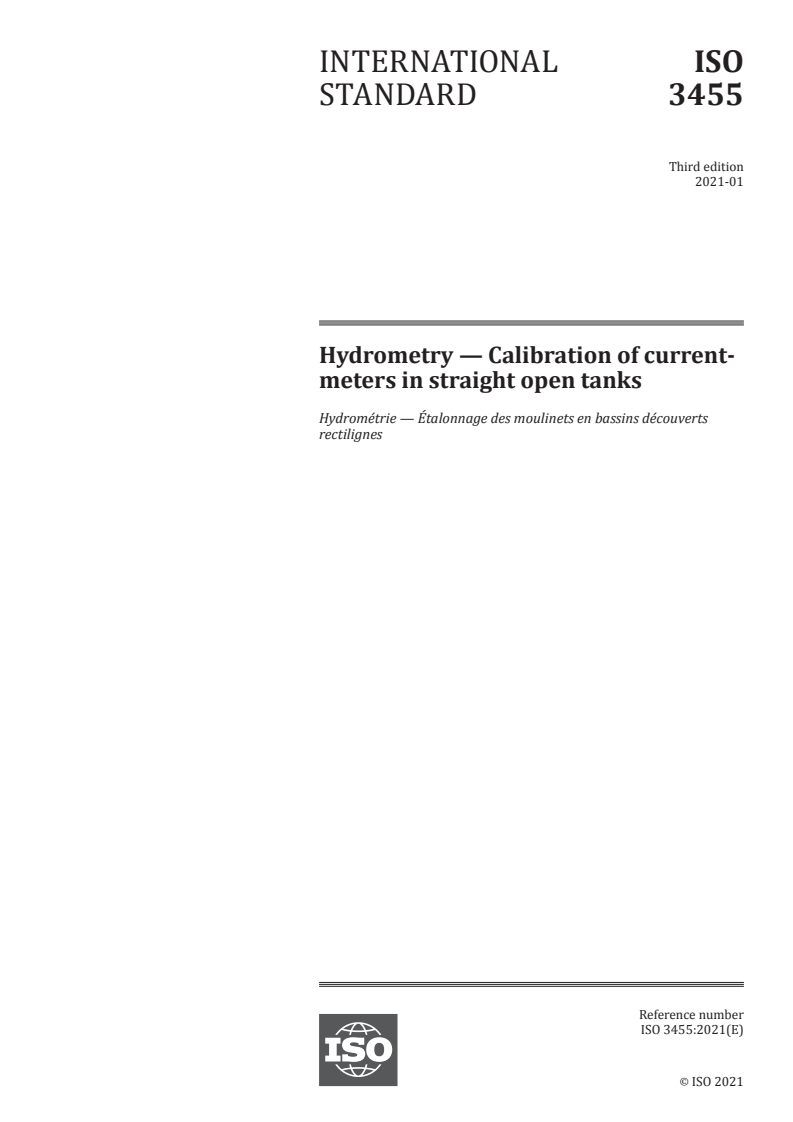
Hydrometry — Calibration of current-
meters in straight open tanks
Hydrométrie — Étalonnage des moulinets en bassins découverts
rectilignes
Reference number
©
ISO 2021
© ISO 2021
All rights reserved. Unless otherwise specified, or required in the context of its implementation, no part of this publication may
be reproduced or utilized otherwise in any form or by any means, electronic or mechanical, including photocopying, or posting
on the internet or an intranet, without prior written permission. Permission can be requested from either ISO at the address
below or ISO’s member body in the country of the requester.
ISO copyright office
CP 401 • Ch. de Blandonnet 8
CH-1214 Vernier, Geneva
Phone: +41 22 749 01 11
Email: copyright@iso.org
Website: www.iso.org
Published in Switzerland
ii © ISO 2021 – All rights reserved
Contents Page
Foreword .iv
1 Scope . 1
2 Normative references . 1
3 Terms and definitions . 1
4 Principle of calibration . 1
4.1 Statement of the principle . 1
4.2 Accuracy of the method . 2
4.2.1 Overall uncertainty on the velocity measurement . 2
4.2.2 Requirements for accurate measurements . 2
5 Infrastructure . 2
5.1 Dimensions of the towing tank . 2
5.1.1 General. 2
5.1.2 Length. 2
5.1.3 Depth and width . 2
5.2 Towing cart . 3
5.2.1 General. 3
5.2.2 Cart track system . 3
5.2.3 Types of towing carts . 3
5.2.4 Cart operation . 3
5.2.5 Cart control . 4
5.3 Measuring equipment . 4
5.3.1 General. 4
5.3.2 Distance measurement . 4
5.3.3 Time measurement . 4
5.3.4 Current-meter velocity measurement . 4
5.3.5 Sources of error related to infrastructure . 5
5.4 Data acquisition . 6
5.5 Data processing . 6
5.6 Other requirements . 6
6 Calculation of uncertainty . 6
7 Calibration procedure . 7
7.1 Calibration of rotating element current-meters . 7
7.1.1 Suspension of the current-meter . 7
7.1.2 Performance of calibration . 7
7.1.3 Data analysis . 8
7.1.4 Presentation of results . 9
7.2 Calibration of electromagnetic current-meters .10
7.2.1 Instructions for calibration .10
7.2.2 Mounting the electromagnetic current-meter .10
7.2.3 Number of calibration points .10
7.2.4 Performance of calibration .11
7.2.5 Data analysis .11
7.2.6 Presentation of results .11
7.3 Calibration of acoustic current-meters for point velocity measurement .11
7.3.1 Instructions for calibration .11
7.3.2 Mounting the acoustic current-meter .12
7.3.3 Performance of calibration .12
7.3.4 Data analysis .12
7.3.5 Presentation of results .12
Bibliography .13
Foreword
ISO (the International Organization for Standardization) is a worldwide federation of national standards
bodies (ISO member bodies). The work of preparing International Standards is normally carried out
through ISO technical committees. Each member body interested in a subject for which a technical
committee has been established has the right to be represented on that committee. International
organizations, governmental and non-governmental, in liaison with ISO, also take part in the work.
ISO collaborates closely with the International Electrotechnical Commission (IEC) on all matters of
electrotechnical standardization.
The procedures used to develop this document and those intended for its further maintenance are
described in the ISO/IEC Directives, Part 1. In particular, the different approval criteria needed for the
different types of ISO documents should be noted. This document was drafted in accordance with the
editorial rules of the ISO/IEC Directives, Part 2 (see www .iso .org/ directives).
Attention is drawn to the possibility that some of the elements of this document may be the subject of
patent rights. ISO shall not be held responsible for identifying any or all such patent rights. Details of
any patent rights identified during the development of the document will be in the Introduction and/or
on the ISO list of patent declarations received (see www .iso .org/ patents).
Any trade name used in this document is information given for the convenience of users and does not
constitute an endorsement.
For an explanation of the voluntary nature of standards, the meaning of ISO specific terms and
expressions related to conformity assessment, as well as information about ISO's adherence to the
World Trade Organization (WTO) principles in the Technical Barriers to Trade (TBT) see www .iso .org/
iso/ foreword .html.
This document was prepared by Technical Committee ISO/TC 113, Hydrometry, Subcommittee SC 5,
Instruments, equipment and data management.
This third edition cancels and replaces the second edition (ISO 3455:2007), which has been technically
revised.
The main changes compared to the previous editions are as follows:
— a subclause for calibration of acoustic current-meters for point velocity measurement has been added;
— clauses referring to outdated tracking systems like track systems using tooth belts have been
removed;
— clauses referring to outdated technique for data acquisition like strip chart recorder or magnetic
tapes have been removed;
— the clause for computerized data acquisition and processing system has been removed;
— the clause discussing the Epper effect has been removed.
Any feedback or questions on this document should be directed to the user’s national standards body. A
complete listing of these bodies can be found at www .iso .org/ members .html.
iv © ISO 2021 – All rights reserved
INTERNATIONAL STANDARD ISO 3455:2021(E)
Hydrometry — Calibration of current-meters in straight
open tanks
1 Scope
This document specifies a calibration method for mechanical type, electromagnetic type and acoustic
type hydrometric current-meters used for point velocity measurement of flowing water. The method
requires towing the instrument through still water in a straight open tank. It includes measuring
apparatus, the calibration procedure, the method of presenting the results and the uncertainties
associated with the method.
2 Normative references
The following documents are referred to in the text in such a way that some or all of their content
constitutes requirements of this document. For dated references, only the edition cited applies. For
undated references, the latest edition of the referenced document (including any amendments) applies.
ISO 772, Hydrometry — Vocabulary and symbols
ISO 2537, Hydrometry — Rotating-element current-meters
ISO/IEC Guide 98-3Uncertainty of measurement — Part 3: Guide to the expression of uncertainty in
me a s ur ement (GUM: 1995)
3 Terms and definitions
For the purposes of this document, the terms and definitions given in ISO 772 apply.
ISO and IEC maintain terminological databases for use in standardization at the following addresses:
— ISO Online browsing platform: available at https:// www .iso .org/ obp
— IEC Electropedia: available at http:// www .electropedia .org/
4 Principle of calibration
4.1 Statement of the principle
Calibration of a current-meter means experimental determination of the relationship between water
velocity and either the rate of revolution of the rotating element or the velocity directly indicated
by the current-meter. For this purpose, the current-meter is mounted on a towing cart and drawn
through still water contained in a straight tank with a uniform cross section at a number of steady
speeds of the towing cart. Simultaneous measurements of the speed of the towing cart and the rate
of revolution of the rotating element or the velocity indicated by the current-meter are made. In the
case of rotating-element current-meters, the two parameters are related by one or more formula(e), the
limits of validity of which are stated. In the case of stationary-sensor type current-meters, containing
no rotating elements, the velocity indicated by its display unit is compared with the corresponding cart
speed to know the error in measurement.
4.2 Accuracy of the method
4.2.1 Overall uncertainty on the velocity measurement
The towing method gives an absolute measurement of water speed, which in principle only requires
position and time measurements. This method can be considered as very accurate if the precautions
listed in 4.2.2 are taken.
4.2.2 Requirements for accurate measurements
The towing method gives an accurate measurement of water speed provided that:
a) the position, the timing and means for starting and stopping it achieve the necessary accuracy;
b) residual currents in the water are small.
5 Infrastructure
5.1 Dimensions of the towing tank
5.1.1 General
The dimensions of the tank and the number and relative position of current-meters in the tank cross
section shall be chosen so that their effects on the test result are minimized.
5.1.2 Length
The length of a rating tank comprises of accelerating, stabilizing, measuring and braking sections.
The length of the accelerating and braking sections depend on the design of the cart, the maximum
acceleration and deceleration achievable at maximum payload, and the maximum speed at which the
payload is to be towed along the tank. Safety requirements of the cart should be taken into account
while working out the length of the braking section. The length of the measuring section shall be such
that the calibration error, which is composed of inaccuracies in the measurement of time, distance
covered and rate of revolution, does not exceed the desired tolerance at any velocity. The required
length, therefore, depends on the type of current-meter being calibrated, type of cart and the way the
signals are produced and transmitted.
5.1.3 Depth and width
The depth of the tank can have an influence on the test results which cannot be regarded as negligible,
more particularly when the towing speed coincides with the velocity of propagation of the surface
wave. The dependence of this critical velocity, v , on tank depth is given by the Formula (1):
c
vg= d (1)
c
where
g is the acceleration due to gravity;
d is the depth of water.
Depending on the size of the current-meter(s) and the cross section of the suspension equipment
relative to the cross-sectional area of the tank, the wave crest produced by the current-meter and its
means of suspension may cause an error in calibration within a narrow band in the velocity range from
0,5 v to 1,5 v . It is a systematic and not a random error.
c c
2 © ISO 2021 – All rights reserved
The depth and width of the tank shall therefore be chosen to suit the size and the maximum velocity
limits of the current-meters to be calibrated. Care shall be taken to ensure that either high calibration
velocities are attained before the interference or that they exceed it sufficiently for the critical zone to
be bridged without extrapolation.
5.2 Towing cart
5.2.1 General
During calibration, the current-meter is suspended below the cart and immersed in the water at a
specified depth and the cart travels along the length of the tank at known and accurate speeds in the
measuring section.
5.2.2 Cart track system
The cart may run on two parallel rails which shall be accurately aligned with both the length of the
tank and the surface of the water in the tank. It is essential that the rails are straight and that both the
rails and the wheels of the cart are free of irregularities in order to avoid irregular motions of the cart.
The material and hardness of the rails and the driving wheels should be chosen so that there shall not
be undue wear and tear of the wheels. In the case of rubber tire wheels, provision shall be made to lift
the wheels above the rail surface when not in use for a long time.
5.2.3 Types of towing carts
The following types of towing carts are in common usage.
a) The towed cart which is moved along the track by a cable driven from a constant speed motor
standing apart from the moving cart. The towed cart may be lighter in construction with the
consequent advantage of high acceleration and quick braking, but the elasticity of the towing cable
can cause irregularities in the running of the cart thereby affecting the accuracy of current-meter
calibration.
b) The self-propelled cart which is moved along the track by internally mounted electric motor(s). The
power to the cart may be fed by a trailing wire track system, by an overhead conductor system or
other systems specially designed for the purpose. The self-propelled cart is heavier in construction
as it carries the driving motors. This results in greater inertia of the cart and assists in smoothing
out the running irregularities of the cart.
5.2.4 Cart operation
The cart shall travel smoothly and at constant speed in the measuring section of the towing tank
ensuring that oscillatory motion is not transmitted to the current-meters under calibration.
The cart shall have smooth operational capability. Vibration of the tow cart should be avoided.
The cart shall remain stable during acceleration, deceleration and braking. There shall not be any
forward/backward or sideways rocking, or slippage during peak acceleration/deceleration and during
normal operation at any speed in specified range.
During calibration, the measuring equipment, sensors and other instruments shall not be affected
by noise and spurious signals induced by the main power supply or cart drive and control system or
otherwise by electrical equipment installed in the rating tank building and vicinity.
In addition to normal braking, an alternate brake system shall also be provided on the cart which would
automatically activate during an emergency.
5.2.5 Cart control
The cart may be manned or unmanned. In the case of a manned cart, an operator on-board controls
various functions of the cart.
The unmanned cart is operated remotely without any operator on board.
5.3 Measuring equipment
5.3.1 General
The calibration of a current-meter calls for the simultaneous recording of the following three
parameters:
a) distance covered by the cart;
b) time; and
c) signal (pulses) delivered by the current-meter or velocity processed by the meter control unit.
The towing speed is calculated from the simultaneous measurement of distance and time. In case of
a rotating-element current-meter, the rate of current-meter revolutions (rotations) is obtained by the
simultaneous measurement of the number of signals (pulses) and the time.
5.3.2 Distance measurement
Different methods are available for measurement of distance to the specified measurement uncertainty
(see 5.3.5). Two of the most common methods are as follows:
a) the establishment of light barriers (markers) at regular intervals along the length of the tank which
actuate mechanical or optical pulse transmitters fitted to the cart;
b) the use of measuring wheels with mechanical or photoelectric pulse transmitters/optical encoders
which are drawn along the track by the cart.
In the case of using a measuring wheel, it shall be ensured that there is no slippage during travel
...
INTERNATIONAL ISO
STANDARD 3455
Third edition
2021-01
Hydrometry — Calibration of current-
meters in straight open tanks
Hydrométrie — Étalonnage des moulinets en bassins découverts
rectilignes
Reference number
©
ISO 2021
© ISO 2021
All rights reserved. Unless otherwise specified, or required in the context of its implementation, no part of this publication may
be reproduced or utilized otherwise in any form or by any means, electronic or mechanical, including photocopying, or posting
on the internet or an intranet, without prior written permission. Permission can be requested from either ISO at the address
below or ISO’s member body in the country of the requester.
ISO copyright office
CP 401 • Ch. de Blandonnet 8
CH-1214 Vernier, Geneva
Phone: +41 22 749 01 11
Email: copyright@iso.org
Website: www.iso.org
Published in Switzerland
ii © ISO 2021 – All rights reserved
Contents Page
Foreword .iv
1 Scope . 1
2 Normative references . 1
3 Terms and definitions . 1
4 Principle of calibration . 1
4.1 Statement of the principle . 1
4.2 Accuracy of the method . 2
4.2.1 Overall uncertainty on the velocity measurement . 2
4.2.2 Requirements for accurate measurements . 2
5 Infrastructure . 2
5.1 Dimensions of the towing tank . 2
5.1.1 General. 2
5.1.2 Length. 2
5.1.3 Depth and width . 2
5.2 Towing cart . 3
5.2.1 General. 3
5.2.2 Cart track system . 3
5.2.3 Types of towing carts . 3
5.2.4 Cart operation . 3
5.2.5 Cart control . 4
5.3 Measuring equipment . 4
5.3.1 General. 4
5.3.2 Distance measurement . 4
5.3.3 Time measurement . 4
5.3.4 Current-meter velocity measurement . 4
5.3.5 Sources of error related to infrastructure . 5
5.4 Data acquisition . 6
5.5 Data processing . 6
5.6 Other requirements . 6
6 Calculation of uncertainty . 6
7 Calibration procedure . 7
7.1 Calibration of rotating element current-meters . 7
7.1.1 Suspension of the current-meter . 7
7.1.2 Performance of calibration . 7
7.1.3 Data analysis . 8
7.1.4 Presentation of results . 9
7.2 Calibration of electromagnetic current-meters .10
7.2.1 Instructions for calibration .10
7.2.2 Mounting the electromagnetic current-meter .10
7.2.3 Number of calibration points .10
7.2.4 Performance of calibration .11
7.2.5 Data analysis .11
7.2.6 Presentation of results .11
7.3 Calibration of acoustic current-meters for point velocity measurement .11
7.3.1 Instructions for calibration .11
7.3.2 Mounting the acoustic current-meter .12
7.3.3 Performance of calibration .12
7.3.4 Data analysis .12
7.3.5 Presentation of results .12
Bibliography .13
Foreword
ISO (the International Organization for Standardization) is a worldwide federation of national standards
bodies (ISO member bodies). The work of preparing International Standards is normally carried out
through ISO technical committees. Each member body interested in a subject for which a technical
committee has been established has the right to be represented on that committee. International
organizations, governmental and non-governmental, in liaison with ISO, also take part in the work.
ISO collaborates closely with the International Electrotechnical Commission (IEC) on all matters of
electrotechnical standardization.
The procedures used to develop this document and those intended for its further maintenance are
described in the ISO/IEC Directives, Part 1. In particular, the different approval criteria needed for the
different types of ISO documents should be noted. This document was drafted in accordance with the
editorial rules of the ISO/IEC Directives, Part 2 (see www .iso .org/ directives).
Attention is drawn to the possibility that some of the elements of this document may be the subject of
patent rights. ISO shall not be held responsible for identifying any or all such patent rights. Details of
any patent rights identified during the development of the document will be in the Introduction and/or
on the ISO list of patent declarations received (see www .iso .org/ patents).
Any trade name used in this document is information given for the convenience of users and does not
constitute an endorsement.
For an explanation of the voluntary nature of standards, the meaning of ISO specific terms and
expressions related to conformity assessment, as well as information about ISO's adherence to the
World Trade Organization (WTO) principles in the Technical Barriers to Trade (TBT) see www .iso .org/
iso/ foreword .html.
This document was prepared by Technical Committee ISO/TC 113, Hydrometry, Subcommittee SC 5,
Instruments, equipment and data management.
This third edition cancels and replaces the second edition (ISO 3455:2007), which has been technically
revised.
The main changes compared to the previous editions are as follows:
— a subclause for calibration of acoustic current-meters for point velocity measurement has been added;
— clauses referring to outdated tracking systems like track systems using tooth belts have been
removed;
— clauses referring to outdated technique for data acquisition like strip chart recorder or magnetic
tapes have been removed;
— the clause for computerized data acquisition and processing system has been removed;
— the clause discussing the Epper effect has been removed.
Any feedback or questions on this document should be directed to the user’s national standards body. A
complete listing of these bodies can be found at www .iso .org/ members .html.
iv © ISO 2021 – All rights reserved
INTERNATIONAL STANDARD ISO 3455:2021(E)
Hydrometry — Calibration of current-meters in straight
open tanks
1 Scope
This document specifies a calibration method for mechanical type, electromagnetic type and acoustic
type hydrometric current-meters used for point velocity measurement of flowing water. The method
requires towing the instrument through still water in a straight open tank. It includes measuring
apparatus, the calibration procedure, the method of presenting the results and the uncertainties
associated with the method.
2 Normative references
The following documents are referred to in the text in such a way that some or all of their content
constitutes requirements of this document. For dated references, only the edition cited applies. For
undated references, the latest edition of the referenced document (including any amendments) applies.
ISO 772, Hydrometry — Vocabulary and symbols
ISO 2537, Hydrometry — Rotating-element current-meters
ISO/IEC Guide 98-3Uncertainty of measurement — Part 3: Guide to the expression of uncertainty in
me a s ur ement (GUM: 1995)
3 Terms and definitions
For the purposes of this document, the terms and definitions given in ISO 772 apply.
ISO and IEC maintain terminological databases for use in standardization at the following addresses:
— ISO Online browsing platform: available at https:// www .iso .org/ obp
— IEC Electropedia: available at http:// www .electropedia .org/
4 Principle of calibration
4.1 Statement of the principle
Calibration of a current-meter means experimental determination of the relationship between water
velocity and either the rate of revolution of the rotating element or the velocity directly indicated
by the current-meter. For this purpose, the current-meter is mounted on a towing cart and drawn
through still water contained in a straight tank with a uniform cross section at a number of steady
speeds of the towing cart. Simultaneous measurements of the speed of the towing cart and the rate
of revolution of the rotating element or the velocity indicated by the current-meter are made. In the
case of rotating-element current-meters, the two parameters are related by one or more formula(e), the
limits of validity of which are stated. In the case of stationary-sensor type current-meters, containing
no rotating elements, the velocity indicated by its display unit is compared with the corresponding cart
speed to know the error in measurement.
4.2 Accuracy of the method
4.2.1 Overall uncertainty on the velocity measurement
The towing method gives an absolute measurement of water speed, which in principle only requires
position and time measurements. This method can be considered as very accurate if the precautions
listed in 4.2.2 are taken.
4.2.2 Requirements for accurate measurements
The towing method gives an accurate measurement of water speed provided that:
a) the position, the timing and means for starting and stopping it achieve the necessary accuracy;
b) residual currents in the water are small.
5 Infrastructure
5.1 Dimensions of the towing tank
5.1.1 General
The dimensions of the tank and the number and relative position of current-meters in the tank cross
section shall be chosen so that their effects on the test result are minimized.
5.1.2 Length
The length of a rating tank comprises of accelerating, stabilizing, measuring and braking sections.
The length of the accelerating and braking sections depend on the design of the cart, the maximum
acceleration and deceleration achievable at maximum payload, and the maximum speed at which the
payload is to be towed along the tank. Safety requirements of the cart should be taken into account
while working out the length of the braking section. The length of the measuring section shall be such
that the calibration error, which is composed of inaccuracies in the measurement of time, distance
covered and rate of revolution, does not exceed the desired tolerance at any velocity. The required
length, therefore, depends on the type of current-meter being calibrated, type of cart and the way the
signals are produced and transmitted.
5.1.3 Depth and width
The depth of the tank can have an influence on the test results which cannot be regarded as negligible,
more particularly when the towing speed coincides with the velocity of propagation of the surface
wave. The dependence of this critical velocity, v , on tank depth is given by the Formula (1):
c
vg= d (1)
c
where
g is the acceleration due to gravity;
d is the depth of water.
Depending on the size of the current-meter(s) and the cross section of the suspension equipment
relative to the cross-sectional area of the tank, the wave crest produced by the current-meter and its
means of suspension may cause an error in calibration within a narrow band in the velocity range from
0,5 v to 1,5 v . It is a systematic and not a random error.
c c
2 © ISO 2021 – All rights reserved
The depth and width of the tank shall therefore be chosen to suit the size and the maximum velocity
limits of the current-meters to be calibrated. Care shall be taken to ensure that either high calibration
velocities are attained before the interference or that they exceed it sufficiently for the critical zone to
be bridged without extrapolation.
5.2 Towing cart
5.2.1 General
During calibration, the current-meter is suspended below the cart and immersed in the water at a
specified depth and the cart travels along the length of the tank at known and accurate speeds in the
measuring section.
5.2.2 Cart track system
The cart may run on two parallel rails which shall be accurately aligned with both the length of the
tank and the surface of the water in the tank. It is essential that the rails are straight and that both the
rails and the wheels of the cart are free of irregularities in order to avoid irregular motions of the cart.
The material and hardness of the rails and the driving wheels should be chosen so that there shall not
be undue wear and tear of the wheels. In the case of rubber tire wheels, provision shall be made to lift
the wheels above the rail surface when not in use for a long time.
5.2.3 Types of towing carts
The following types of towing carts are in common usage.
a) The towed cart which is moved along the track by a cable driven from a constant speed motor
standing apart from the moving cart. The towed cart may be lighter in construction with the
consequent advantage of high acceleration and quick braking, but the elasticity of the towing cable
can cause irregularities in the running of the cart thereby affecting the accuracy of current-meter
calibration.
b) The self-propelled cart which is moved along the track by internally mounted electric motor(s). The
power to the cart may be fed by a trailing wire track system, by an overhead conductor system or
other systems specially designed for the purpose. The self-propelled cart is heavier in construction
as it carries the driving motors. This results in greater inertia of the cart and assists in smoothing
out the running irregularities of the cart.
5.2.4 Cart operation
The cart shall travel smoothly and at constant speed in the measuring section of the towing tank
ensuring that oscillatory motion is not transmitted to the current-meters under calibration.
The cart shall have smooth operational capability. Vibration of the tow cart should be avoided.
The cart shall remain stable during acceleration, deceleration and braking. There shall not be any
forward/backward or sideways rocking, or slippage during peak acceleration/deceleration and during
normal operation at any speed in specified range.
During calibration, the measuring equipment, sensors and other instruments shall not be affected
by noise and spurious signals induced by the main power supply or cart drive and control system or
otherwise by electrical equipment installed in the rating tank building and vicinity.
In addition to normal braking, an alternate brake system shall also be provided on the cart which would
automatically activate during an emergency.
5.2.5 Cart control
The cart may be manned or unmanned. In the case of a manned cart, an operator on-board controls
various functions of the cart.
The unmanned cart is operated remotely without any operator on board.
5.3 Measuring equipment
5.3.1 General
The calibration of a current-meter calls for the simultaneous recording of the following three
parameters:
a) distance covered by the cart;
b) time; and
c) signal (pulses) delivered by the current-meter or velocity processed by the meter control unit.
The towing speed is calculated from the simultaneous measurement of distance and time. In case of
a rotating-element current-meter, the rate of current-meter revolutions (rotations) is obtained by the
simultaneous measurement of the number of signals (pulses) and the time.
5.3.2 Distance measurement
Different methods are available for measurement of distance to the specified measurement uncertainty
(see 5.3.5). Two of the most common methods are as follows:
a) the establishment of light barriers (markers) at regular intervals along the length of the tank which
actuate mechanical or optical pulse transmitters fitted to the cart;
b) the use of measuring wheels with mechanical or photoelectric pulse transmitters/optical encoders
which are drawn along the track by the cart.
In the case of using a measuring wheel, it shall be ensured that there is no slippage during travel. An
additional method of precise speed measurement shall also be provided to check the accuracy of the
measuring wheel on a regular basis.
5.3.3 Time measurement
The time of travel of the cart is normally measured by an electronic counter with an in-built accurate
time reference, for example a quartz crystal. A period can thus be read to 1 ms or better. This equipment
should be checked periodi
...
INTERNATIONAL ISO
STANDARD 3455
Third edition
2021-01
Hydrometry — Calibration of current-
meters in straight open tanks
Hydrométrie — Étalonnage des moulinets en bassins découverts
rectilignes
Reference number
©
ISO 2021
© ISO 2021
All rights reserved. Unless otherwise specified, or required in the context of its implementation, no part of this publication may
be reproduced or utilized otherwise in any form or by any means, electronic or mechanical, including photocopying, or posting
on the internet or an intranet, without prior written permission. Permission can be requested from either ISO at the address
below or ISO’s member body in the country of the requester.
ISO copyright office
CP 401 • Ch. de Blandonnet 8
CH-1214 Vernier, Geneva
Phone: +41 22 749 01 11
Email: copyright@iso.org
Website: www.iso.org
Published in Switzerland
ii © ISO 2021 – All rights reserved
Contents Page
Foreword .iv
1 Scope . 1
2 Normative references . 1
3 Terms and definitions . 1
4 Principle of calibration . 1
4.1 Statement of the principle . 1
4.2 Accuracy of the method . 2
4.2.1 Overall uncertainty on the velocity measurement . 2
4.2.2 Requirements for accurate measurements . 2
5 Infrastructure . 2
5.1 Dimensions of the towing tank . 2
5.1.1 General. 2
5.1.2 Length. 2
5.1.3 Depth and width . 2
5.2 Towing cart . 3
5.2.1 General. 3
5.2.2 Cart track system . 3
5.2.3 Types of towing carts . 3
5.2.4 Cart operation . 3
5.2.5 Cart control . 4
5.3 Measuring equipment . 4
5.3.1 General. 4
5.3.2 Distance measurement . 4
5.3.3 Time measurement . 4
5.3.4 Current-meter velocity measurement . 4
5.3.5 Sources of error related to infrastructure . 5
5.4 Data acquisition . 6
5.5 Data processing . 6
5.6 Other requirements . 6
6 Calculation of uncertainty . 6
7 Calibration procedure . 7
7.1 Calibration of rotating element current-meters . 7
7.1.1 Suspension of the current-meter . 7
7.1.2 Performance of calibration . 7
7.1.3 Data analysis . 8
7.1.4 Presentation of results . 9
7.2 Calibration of electromagnetic current-meters .10
7.2.1 Instructions for calibration .10
7.2.2 Mounting the electromagnetic current-meter .10
7.2.3 Number of calibration points .10
7.2.4 Performance of calibration .11
7.2.5 Data analysis .11
7.2.6 Presentation of results .11
7.3 Calibration of acoustic current-meters for point velocity measurement .11
7.3.1 Instructions for calibration .11
7.3.2 Mounting the acoustic current-meter .12
7.3.3 Performance of calibration .12
7.3.4 Data analysis .12
7.3.5 Presentation of results .12
Bibliography .13
Foreword
ISO (the International Organization for Standardization) is a worldwide federation of national standards
bodies (ISO member bodies). The work of preparing International Standards is normally carried out
through ISO technical committees. Each member body interested in a subject for which a technical
committee has been established has the right to be represented on that committee. International
organizations, governmental and non-governmental, in liaison with ISO, also take part in the work.
ISO collaborates closely with the International Electrotechnical Commission (IEC) on all matters of
electrotechnical standardization.
The procedures used to develop this document and those intended for its further maintenance are
described in the ISO/IEC Directives, Part 1. In particular, the different approval criteria needed for the
different types of ISO documents should be noted. This document was drafted in accordance with the
editorial rules of the ISO/IEC Directives, Part 2 (see www .iso .org/ directives).
Attention is drawn to the possibility that some of the elements of this document may be the subject of
patent rights. ISO shall not be held responsible for identifying any or all such patent rights. Details of
any patent rights identified during the development of the document will be in the Introduction and/or
on the ISO list of patent declarations received (see www .iso .org/ patents).
Any trade name used in this document is information given for the convenience of users and does not
constitute an endorsement.
For an explanation of the voluntary nature of standards, the meaning of ISO specific terms and
expressions related to conformity assessment, as well as information about ISO's adherence to the
World Trade Organization (WTO) principles in the Technical Barriers to Trade (TBT) see www .iso .org/
iso/ foreword .html.
This document was prepared by Technical Committee ISO/TC 113, Hydrometry, Subcommittee SC 5,
Instruments, equipment and data management.
This third edition cancels and replaces the second edition (ISO 3455:2007), which has been technically
revised.
The main changes compared to the previous editions are as follows:
— a subclause for calibration of acoustic current-meters for point velocity measurement has been added;
— clauses referring to outdated tracking systems like track systems using tooth belts have been
removed;
— clauses referring to outdated technique for data acquisition like strip chart recorder or magnetic
tapes have been removed;
— the clause for computerized data acquisition and processing system has been removed;
— the clause discussing the Epper effect has been removed.
Any feedback or questions on this document should be directed to the user’s national standards body. A
complete listing of these bodies can be found at www .iso .org/ members .html.
iv © ISO 2021 – All rights reserved
INTERNATIONAL STANDARD ISO 3455:2021(E)
Hydrometry — Calibration of current-meters in straight
open tanks
1 Scope
This document specifies a calibration method for mechanical type, electromagnetic type and acoustic
type hydrometric current-meters used for point velocity measurement of flowing water. The method
requires towing the instrument through still water in a straight open tank. It includes measuring
apparatus, the calibration procedure, the method of presenting the results and the uncertainties
associated with the method.
2 Normative references
The following documents are referred to in the text in such a way that some or all of their content
constitutes requirements of this document. For dated references, only the edition cited applies. For
undated references, the latest edition of the referenced document (including any amendments) applies.
ISO 772, Hydrometry — Vocabulary and symbols
ISO 2537, Hydrometry — Rotating-element current-meters
ISO/IEC Guide 98-3Uncertainty of measurement — Part 3: Guide to the expression of uncertainty in
me a s ur ement (GUM: 1995)
3 Terms and definitions
For the purposes of this document, the terms and definitions given in ISO 772 apply.
ISO and IEC maintain terminological databases for use in standardization at the following addresses:
— ISO Online browsing platform: available at https:// www .iso .org/ obp
— IEC Electropedia: available at http:// www .electropedia .org/
4 Principle of calibration
4.1 Statement of the principle
Calibration of a current-meter means experimental determination of the relationship between water
velocity and either the rate of revolution of the rotating element or the velocity directly indicated
by the current-meter. For this purpose, the current-meter is mounted on a towing cart and drawn
through still water contained in a straight tank with a uniform cross section at a number of steady
speeds of the towing cart. Simultaneous measurements of the speed of the towing cart and the rate
of revolution of the rotating element or the velocity indicated by the current-meter are made. In the
case of rotating-element current-meters, the two parameters are related by one or more formula(e), the
limits of validity of which are stated. In the case of stationary-sensor type current-meters, containing
no rotating elements, the velocity indicated by its display unit is compared with the corresponding cart
speed to know the error in measurement.
4.2 Accuracy of the method
4.2.1 Overall uncertainty on the velocity measurement
The towing method gives an absolute measurement of water speed, which in principle only requires
position and time measurements. This method can be considered as very accurate if the precautions
listed in 4.2.2 are taken.
4.2.2 Requirements for accurate measurements
The towing method gives an accurate measurement of water speed provided that:
a) the position, the timing and means for starting and stopping it achieve the necessary accuracy;
b) residual currents in the water are small.
5 Infrastructure
5.1 Dimensions of the towing tank
5.1.1 General
The dimensions of the tank and the number and relative position of current-meters in the tank cross
section shall be chosen so that their effects on the test result are minimized.
5.1.2 Length
The length of a rating tank comprises of accelerating, stabilizing, measuring and braking sections.
The length of the accelerating and braking sections depend on the design of the cart, the maximum
acceleration and deceleration achievable at maximum payload, and the maximum speed at which the
payload is to be towed along the tank. Safety requirements of the cart should be taken into account
while working out the length of the braking section. The length of the measuring section shall be such
that the calibration error, which is composed of inaccuracies in the measurement of time, distance
covered and rate of revolution, does not exceed the desired tolerance at any velocity. The required
length, therefore, depends on the type of current-meter being calibrated, type of cart and the way the
signals are produced and transmitted.
5.1.3 Depth and width
The depth of the tank can have an influence on the test results which cannot be regarded as negligible,
more particularly when the towing speed coincides with the velocity of propagation of the surface
wave. The dependence of this critical velocity, v , on tank depth is given by the Formula (1):
c
vg= d (1)
c
where
g is the acceleration due to gravity;
d is the depth of water.
Depending on the size of the current-meter(s) and the cross section of the suspension equipment
relative to the cross-sectional area of the tank, the wave crest produced by the current-meter and its
means of suspension may cause an error in calibration within a narrow band in the velocity range from
0,5 v to 1,5 v . It is a systematic and not a random error.
c c
2 © ISO 2021 – All rights reserved
The depth and width of the tank shall therefore be chosen to suit the size and the maximum velocity
limits of the current-meters to be calibrated. Care shall be taken to ensure that either high calibration
velocities are attained before the interference or that they exceed it sufficiently for the critical zone to
be bridged without extrapolation.
5.2 Towing cart
5.2.1 General
During calibration, the current-meter is suspended below the cart and immersed in the water at a
specified depth and the cart travels along the length of the tank at known and accurate speeds in the
measuring section.
5.2.2 Cart track system
The cart may run on two parallel rails which shall be accurately aligned with both the length of the
tank and the surface of the water in the tank. It is essential that the rails are straight and that both the
rails and the wheels of the cart are free of irregularities in order to avoid irregular motions of the cart.
The material and hardness of the rails and the driving wheels should be chosen so that there shall not
be undue wear and tear of the wheels. In the case of rubber tire wheels, provision shall be made to lift
the wheels above the rail surface when not in use for a long time.
5.2.3 Types of towing carts
The following types of towing carts are in common usage.
a) The towed cart which is moved along the track by a cable driven from a constant speed motor
standing apart from the moving cart. The towed cart may be lighter in construction with the
consequent advantage of high acceleration and quick braking, but the elasticity of the towing cable
can cause irregularities in the running of the cart thereby affecting the accuracy of current-meter
calibration.
b) The self-propelled cart which is moved along the track by internally mounted electric motor(s). The
power to the cart may be fed by a trailing wire track system, by an overhead conductor system or
other systems specially designed for the purpose. The self-propelled cart is heavier in construction
as it carries the driving motors. This results in greater inertia of the cart and assists in smoothing
out the running irregularities of the cart.
5.2.4 Cart operation
The cart shall travel smoothly and at constant speed in the measuring section of the towing tank
ensuring that oscillatory motion is not transmitted to the current-meters under calibration.
The cart shall have smooth operational capability. Vibration of the tow cart should be avoided.
The cart shall remain stable during acceleration, deceleration and braking. There shall not be any
forward/backward or sideways rocking, or slippage during peak acceleration/deceleration and during
normal operation at any speed in specified range.
During calibration, the measuring equipment, sensors and other instruments shall not be affected
by noise and spurious signals induced by the main power supply or cart drive and control system or
otherwise by electrical equipment installed in the rating tank building and vicinity.
In addition to normal braking, an alternate brake system shall also be provided on the cart which would
automatically activate during an emergency.
5.2.5 Cart control
The cart may be manned or unmanned. In the case of a manned cart, an operator on-board controls
various functions of the cart.
The unmanned cart is operated remotely without any operator on board.
5.3 Measuring equipment
5.3.1 General
The calibration of a current-meter calls for the simultaneous recording of the following three
parameters:
a) distance covered by the cart;
b) time; and
c) signal (pulses) delivered by the current-meter or velocity processed by the meter control unit.
The towing speed is calculated from the simultaneous measurement of distance and time. In case of
a rotating-element current-meter, the rate of current-meter revolutions (rotations) is obtained by the
simultaneous measurement of the number of signals (pulses) and the time.
5.3.2 Distance measurement
Different methods are available for measurement of distance to the specified measurement uncertainty
(see 5.3.5). Two of the most common methods are as follows:
a) the establishment of light barriers (markers) at regular intervals along the length of the tank which
actuate mechanical or optical pulse transmitters fitted to the cart;
b) the use of measuring wheels with mechanical or photoelectric pulse transmitters/optical encoders
which are drawn along the track by the cart.
In the case of using a measuring wheel, it shall be ensured that there is no slippage during travel. An
additional method of precise speed measurement shall also be provided to check the accuracy of the
measuring wheel on a regular basis.
5.3.3 Time measurement
The time of travel of the cart is normally measured by an electronic counter with an in-built accurate
time reference, for example a quartz crystal. A period can thus be read to 1 ms or better. This equipment
should be checked periodi
...