

ISO 21846:2025
(Main)Vegetable fats and oils — Determination of composition of triacylglycerols and composition and content of diacylglycerols by capillary gas chromatography
General Information
- Abstract
This document specifies the determination of composition of triacylglycerols and the determination of the composition and content of diacylglycerols by capillary gas chromatography in vegetable oils with a lauric acid content below 1 %. Applying certain technological processing 1,2-diacylglycerols (1,2-DAGs) are transformed to the more stable isomeric 1,3-diacylglycerols (1,3-DAGs) due to acidic catalysed reaction. During storage, the speed and amount of this rearrangement depends on the acidity of the oil. The transformation normally reaches an equilibrium between the two isomeric forms. The relative amount of 1,2-DAGs is related to oil freshness or to a possible technological treatment. Therefore, it is possible to use the ratio of 1,2-DAGs to 1,3-DAGs as a quality criterion for vegetable fats and oils. The triacylglycerols profile is of potential interest for the fingerprint of each vegetable oil and may help the detection of certain types of adulteration, such as the addition of high oleic sunflower oil or palm olein in olive oil. NOTE This document is based on Reference [ REF Reference_ref_3 \r \h 3 08D0C9EA79F9BACE118C8200AA004BA90B0200000008000000100000005200650066006500720065006E00630065005F007200650066005F0033000000 ].
- Status
- Published
- Publication Date
- 21-Oct-2025
- Technical Committee
- ISO/TC 34/SC 11 - Animal and vegetable fats and oils
- Drafting Committee
- ISO/TC 34/SC 11 - Animal and vegetable fats and oils
- Current Stage
- 6060 - International Standard published
- Start Date
- 22-Oct-2025
- Due Date
- 21-Jul-2026
- Completion Date
- 22-Oct-2025
Overview
ISO 21846:2025 specifies a laboratory method for the determination of triacylglycerol composition and the composition and total content of diacylglycerols (DAGs) in vegetable fats and oils (lauric acid < 1 %) using capillary gas chromatography (GC). The standard describes sample preparation, silylation, use of an internal standard, chromatographic conditions and data treatment. It also notes the analytical significance of 1,2‑DAG vs 1,3‑DAG isomers - the 1,2/1,3 ratio can indicate oil freshness or technological treatments.
Key topics and technical requirements
- Scope: Vegetable oils with lauric acid content below 1 %; method applies to both triacylglycerol profiling and DAG quantification.
- Principle: Silylate sample with BSTFA/TMCS in pyridine, add internal standard (dinonadecanoin in MTBE), and inject into a capillary GC. Triacylglycerols separate by carbon number; 1,2‑ and 1,3‑DAGs separate by retention time.
- Chromatography: Fused‑silica capillary column (6–8 m × 0.25–0.32 mm, film 0.10–0.15 µm) with SE‑52/SE‑54 stationary phase; flame‑ionization detector; specified oven temperature program and injection volumes (0.5–1 µL).
- Quantification: Triacylglycerol classes normalized to 100 % (expressed to two decimal places). DAG composition expressed as percentage of total DAGs (one decimal place). Total DAG content calculated by internal standard (g/100 g).
- Quality metrics: The standard includes method precision descriptors - repeatability (r) and reproducibility (R) - and requires reporting of chromatographic conditions and sample identification in the test report.
- Identification: Use reference mixtures for peak assignment (triacylglycerol carbon number series C46–C64; DAG 1,2 and 1,3 isomers such as C32, C34, C36).
Applications and users
- Food and edible‑oil laboratories performing quality control, shelf‑life studies and routine compositional analysis.
- Regulatory and official control laboratories assessing adulteration or compliance (e.g., detecting addition of high‑oleic sunflower oil or palm olein in olive oil).
- Oil processors and refiners monitoring technological processing effects that induce DAG isomerization.
- Research groups profiling vegetable oil fingerprints for authentication and traceability.
Practical benefits: robust DAG isomer quantification for freshness/processing assessment, triacylglycerol profiles that aid adulteration screening, and a harmonized GC procedure for interlaboratory comparability.
Related standards
- Prepared by ISO/TC 34/SC 11 (Animal and vegetable fats and oils). There are no normative references within ISO 21846:2025; laboratories should consult other ISO methods for complementary fat/oil analyses and national accreditation requirements.
Keywords: ISO 21846:2025, triacylglycerols, diacylglycerols, 1,2‑DAG, 1,3‑DAG, capillary gas chromatography, vegetable oils, oil adulteration, oil freshness, DAG content.
Relations
- Effective Date
- 25-Jan-2025
Get Certified
Connect with accredited certification bodies for this standard

BSI Group
BSI (British Standards Institution) is the business standards company that helps organizations make excellence a habit.

Bureau Veritas
Bureau Veritas is a world leader in laboratory testing, inspection and certification services.

DNV
DNV is an independent assurance and risk management provider.
Sponsored listings
Frequently Asked Questions
ISO 21846:2025 is a standard published by the International Organization for Standardization (ISO). Its full title is "Vegetable fats and oils — Determination of composition of triacylglycerols and composition and content of diacylglycerols by capillary gas chromatography". This standard covers: This document specifies the determination of composition of triacylglycerols and the determination of the composition and content of diacylglycerols by capillary gas chromatography in vegetable oils with a lauric acid content below 1 %. Applying certain technological processing 1,2-diacylglycerols (1,2-DAGs) are transformed to the more stable isomeric 1,3-diacylglycerols (1,3-DAGs) due to acidic catalysed reaction. During storage, the speed and amount of this rearrangement depends on the acidity of the oil. The transformation normally reaches an equilibrium between the two isomeric forms. The relative amount of 1,2-DAGs is related to oil freshness or to a possible technological treatment. Therefore, it is possible to use the ratio of 1,2-DAGs to 1,3-DAGs as a quality criterion for vegetable fats and oils. The triacylglycerols profile is of potential interest for the fingerprint of each vegetable oil and may help the detection of certain types of adulteration, such as the addition of high oleic sunflower oil or palm olein in olive oil. NOTE This document is based on Reference [ REF Reference_ref_3 \r \h 3 08D0C9EA79F9BACE118C8200AA004BA90B0200000008000000100000005200650066006500720065006E00630065005F007200650066005F0033000000 ].
This document specifies the determination of composition of triacylglycerols and the determination of the composition and content of diacylglycerols by capillary gas chromatography in vegetable oils with a lauric acid content below 1 %. Applying certain technological processing 1,2-diacylglycerols (1,2-DAGs) are transformed to the more stable isomeric 1,3-diacylglycerols (1,3-DAGs) due to acidic catalysed reaction. During storage, the speed and amount of this rearrangement depends on the acidity of the oil. The transformation normally reaches an equilibrium between the two isomeric forms. The relative amount of 1,2-DAGs is related to oil freshness or to a possible technological treatment. Therefore, it is possible to use the ratio of 1,2-DAGs to 1,3-DAGs as a quality criterion for vegetable fats and oils. The triacylglycerols profile is of potential interest for the fingerprint of each vegetable oil and may help the detection of certain types of adulteration, such as the addition of high oleic sunflower oil or palm olein in olive oil. NOTE This document is based on Reference [ REF Reference_ref_3 \r \h 3 08D0C9EA79F9BACE118C8200AA004BA90B0200000008000000100000005200650066006500720065006E00630065005F007200650066005F0033000000 ].
ISO 21846:2025 is classified under the following ICS (International Classification for Standards) categories: 67.200.10 - Animal and vegetable fats and oils. The ICS classification helps identify the subject area and facilitates finding related standards.
ISO 21846:2025 has the following relationships with other standards: It is inter standard links to ISO 21846:2018. Understanding these relationships helps ensure you are using the most current and applicable version of the standard.
ISO 21846:2025 is available in PDF format for immediate download after purchase. The document can be added to your cart and obtained through the secure checkout process. Digital delivery ensures instant access to the complete standard document.
Standards Content (Sample)
International
Standard
ISO 21846
Second edition
Vegetable fats and oils —
2025-10
Determination of composition of
triacylglycerols and composition
and content of diacylglycerols by
capillary gas chromatography
Corps gras d'origine végétale — Détermination de la composition
des triacylglycérols et de la teneur en diacylglycérols par
chromatographie en phase gazeuse sur colonne capillaire
Reference number
© ISO 2025
All rights reserved. Unless otherwise specified, or required in the context of its implementation, no part of this publication may
be reproduced or utilized otherwise in any form or by any means, electronic or mechanical, including photocopying, or posting on
the internet or an intranet, without prior written permission. Permission can be requested from either ISO at the address below
or ISO’s member body in the country of the requester.
ISO copyright office
CP 401 • Ch. de Blandonnet 8
CH-1214 Vernier, Geneva
Phone: +41 22 749 01 11
Email: copyright@iso.org
Website: www.iso.org
Published in Switzerland
ii
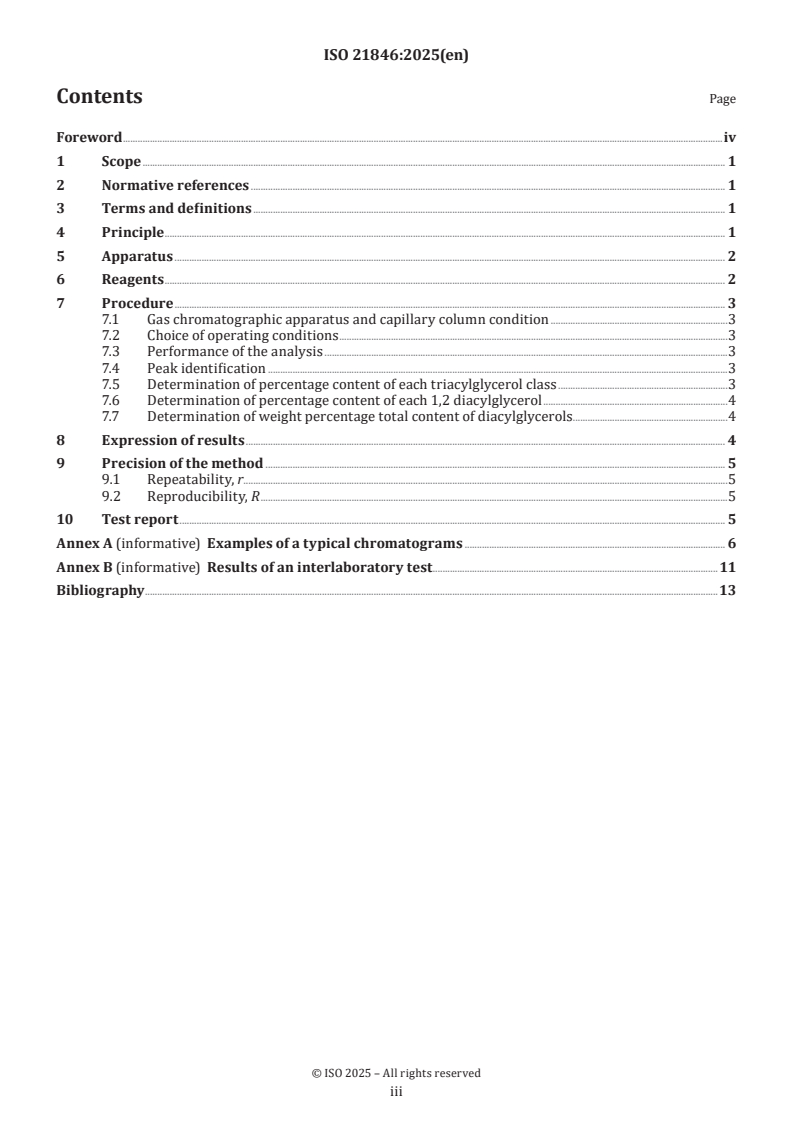
Contents Page
Foreword .iv
1 Scope . 1
2 Normative references . 1
3 Terms and definitions . 1
4 Principle . 1
5 Apparatus . 2
6 Reagents . 2
7 Procedure . 3
7.1 Gas chromatographic apparatus and capillary column condition .3
7.2 Choice of operating conditions .3
7.3 Performance of the analysis .3
7.4 Peak identification .3
7.5 Determination of percentage content of each triacylglycerol class .3
7.6 Determination of percentage content of each 1,2 diacylglycerol .4
7.7 Determination of weight percentage total content of diacylglycerols .4
8 Expression of results . 4
9 Precision of the method . 5
9.1 Repeatability, r.5
9.2 Reproducibility, R .5
10 Test report . 5
Annex A (informative) Examples of a typical chromatograms . 6
Annex B (informative) Results of an interlaboratory test .11
Bibliography .13
iii
Foreword
ISO (the International Organization for Standardization) is a worldwide federation of national standards
bodies (ISO member bodies). The work of preparing International Standards is normally carried out through
ISO technical committees. Each member body interested in a subject for which a technical committee
has been established has the right to be represented on that committee. International organizations,
governmental and non-governmental, in liaison with ISO, also take part in the work. ISO collaborates closely
with the International Electrotechnical Commission (IEC) on all matters of electrotechnical standardization.
The procedures used to develop this document and those intended for its further maintenance are described
in the ISO/IEC Directives, Part 1. In particular, the different approval criteria needed for the different types
of ISO document should be noted. This document was drafted in accordance with the editorial rules of the
ISO/IEC Directives, Part 2 (see www.iso.org/directives).
ISO draws attention to the possibility that the implementation of this document may involve the use of (a)
patent(s). ISO takes no position concerning the evidence, validity or applicability of any claimed patent
rights in respect thereof. As of the date of publication of this document, ISO had not received notice of (a)
patent(s) which may be required to implement this document. However, implementers are cautioned that
this may not represent the latest information, which may be obtained from the patent database available at
www.iso.org/patents. ISO shall not be held responsible for identifying any or all such patent rights.
Any trade name used in this document is information given for the convenience of users and does not
constitute an endorsement.
For an explanation of the voluntary nature of standards, the meaning of ISO specific terms and expressions
related to conformity assessment, as well as information about ISO’s adherence to the World Trade
Organization (WTO) principles in the Technical Barriers to Trade (TBT), see www.iso.org/iso/foreword.html.
This document was prepared by Technical Committee ISO/TC 34, Food products, Subcommittee SC 11, Animal
and vegetable fats and oils.
This second edition cancels and replaces the first edition (ISO 21846:2018), of which it constitutes a minor
revision.
The changes are as follows:
— entry errors have been corrected in Tables B.1, B.2, B.3, B.4 and B.5.
Any feedback or questions on this document should be directed to the user’s national standards body. A
complete listing of these bodies can be found at www.iso.org/members.html.
iv
International Standard ISO 21846:2025(en)
Vegetable fats and oils — Determination of composition
of triacylglycerols and composition and content of
diacylglycerols by capillary gas chromatography
1 Scope
This document specifies the determination of composition of triacylglycerols and the determination of the
composition and content of diacylglycerols by capillary gas chromatography in vegetable oils with a lauric
acid content below 1 %.
Applying certain technological processing 1,2-diacylglycerols (1,2-DAGs) are transformed to the more stable
isomeric 1,3-diacylglycerols (1,3-DAGs) due to acidic catalysed reaction. During storage, the speed and
amount of this rearrangement depends on the acidity of the oil. The transformation normally reaches an
equilibrium between the two isomeric forms. The relative amount of 1,2-DAGs is related to oil freshness or
to a possible technological treatment. Therefore, it is possible to use the ratio of 1,2-DAGs to 1,3-DAGs as a
quality criterion for vegetable fats and oils.
The triacylglycerols profile is of potential interest for the fingerprint of each vegetable oil and may help the
detection of certain types of adulteration, such as the addition of high oleic sunflower oil or palm olein in
olive oil.
NOTE This document is based on Reference [3].
2 Normative references
There are no normative references in this document.
3 Terms and definitions
No terms and definitions are listed in this document.
ISO and IEC maintain terminology databases for use in standardization at the following addresses:
— ISO Online browsing platform: available at https:// www .iso .org/ obp
— IEC Electropedia: available at https:// www .electropedia .org/
4 Principle
After the addition of an internal standard the oil sample is silylated, dissolved in a suitable reagent and
directly injected in the gas chromatographic apparatus. Triacyglycerols are separated into classes on the
basis of their carbon atom number, while diacylglycerols are separated in function of their carbon atom
number and structure, as 1,2 structures show a lower retention time than 1,3 ones.
Unsaturated diacylglycerol structures do not affect retention time. Therefore, saturated and unsaturated
diacylglycerols elute together, so 1,2 and 1,3-diacylglycerol structures are identified by their peak retention
time. The percentage content of 1,2 structure is determined through the ratio of 1,2-diacylglycerol areas to
the sum of areas of all the diacylglycerol peaks.
The diacylglycerol total content is calculated by means of an internal standard.
The percentage content for each triacylglycerol class is calculated after normalization to 100 % of all the
triacylglycerol peaks.
5 Apparatus
5.1 Analytical balance, suitable to perform weighing to an accuracy of within +/−0,1 mg.
5.2 Gas chromatograph, for use with a capillary column, equipped with a system for direct on-column
for cold injection or a programmed temperature vaporizer.
5.3 Thermostat-controlled oven, with temperature programming.
5.4 Cold injector, for on-column injection or programmed temperature vaporizer.
5.5 Flame-ionization detector, and converter-amplifier.
5.6 Recorder-integrator, for use with the converter-amplifier (5.5), with a rate of response below 1 s and
variable paper speed, or any suitable device for data capture and handling.
5.7 Capillary column, fused silica, 6 m to 8 m length, 0,25 mm to 0,32 mm internal diameter, internally
coated with SE 52, SE 54 liquid phase to a uniform thickness of 0,10 μm to 0,15 μm.
5.8 Microsyringe, 10 μl, with a hardened needle for on-column injector.
5.9 Microsyringe, 100 μl, with a hardened needle.
5.10 Usual laboratory glassware.
6 Reagents
WARNING — Attention is drawn to the regulations which specify the handling of hazardous
substances. Technical, organizational and personal safety measures shall be followed.
Unless otherwise stated analytically pure reagents shall be used.
6.1 Carrier gas, hyd
...