

ISO 15087-1:1999
(Main)Dental elevators — Part 1: General requirements
General Information
- Abstract
- Status
- Withdrawn
- Publication Date
- 03-Nov-1999
- Technical Committee
- ISO/TC 106/SC 4 - Dental instruments
- Drafting Committee
- ISO/TC 106/SC 4/WG 8 - Dental hand instruments
- Current Stage
- 9599 - Withdrawal of International Standard
- Start Date
- 17-Oct-2025
- Completion Date
- 29-Aug-2026
Buy Documents

ISO 15087-1:1999 - Dental elevators — Part 1: General requirements Released:11/4/1999

ISO 15087-1:1999 - Élévateurs dentaires — Partie 1: Exigences générales Released:11/4/1999
Overview
ISO 15087-1:1999 - "Dental elevators - Part 1: General requirements" defines the general material, dimensional, performance and marking requirements for dental elevators. It sets baseline criteria for working-end hardness, surface finish, corrosion and thermal resistance, mechanical strength at the union between working end and handle, and leak integrity of hollow handles. The part is the general framework that complements the subsequent parts of ISO 15087 that cover specific elevator types.
Key topics and requirements
- Classification by hardness: Working ends are classified by Vickers hardness into Class 1 (480–600 HV1) and Class 2 (600–720 HV1). The manufacturer must state the Vickers class in product documentation.
- Materials: Working ends shall be martensitic stainless steel (grades B, C, D or R per ISO 7153-1) or other materials that meet the performance clauses. Handle material is at the manufacturer’s discretion but must comply with performance requirements.
- Dimensional limit: Unless otherwise specified, the maximum overall length is 178 mm. Annex A describes a recommended optical-projector measurement method.
- Surface finish: All surfaces must be visibly free of pores, crevices, grinding marks, scale, acid or grease. Satin and mirror finishes have defined visual-quality expectations.
- Sterilization and thermal tests: Resistance to autoclaving, boiling water and thermal exposure is required; test methods reference ISO 13402. Instruments must show no visible alteration after test cycles.
- Corrosion resistance: No visible corrosion on working end or handle after boiling-water tests.
- Mechanical union tests: The working-end/handle union must resist:
- Tensile load: 1000 N applied for at least 5 s (Annex C procedure);
- Torque: 500 N·cm applied for at least 5 s (Annex D procedure).
- Hollow-handle leak tests: Two options - heated oil immersion (oil at ~180 °C) or ultrasonic water tests - to detect pinholes or leaks.
- Marking: Instruments must be indelibly marked with manufacturer name/trade name, pattern number/name, and lot number.
Applications and users
- Manufacturers and product designers of dental elevators use ISO 15087-1 to specify materials, hardness class and test criteria for design and production.
- Quality control and laboratory testing facilities apply the standard’s test methods and acceptance criteria during validation and batch testing.
- Regulatory compliance teams and purchasing/procurement in dental clinics and supply chains rely on the standard to verify product claims (hardness class, sterilization resistance, marking).
- Sterilization services and instrument refurbishment technicians use the resistance and leak-test guidance to assess reusability and safety.
Related standards
- ISO 6507-1 (Vickers hardness test)
- ISO 7153-1 (Surgical instruments - stainless steels)
- ISO 13402 (Determination of resistance to autoclaving, corrosion and thermal exposure)
- ISO 1942-3, ISO 2592, ISO 3104
- Other parts of ISO 15087 (Parts 2–6 cover specific elevator types)
Keywords: ISO 15087-1, dental elevators, Vickers hardness, stainless steel dental instruments, autoclave resistance, corrosion testing, tensile test, hollow-handle leak test.
Relations
- Effective Date
- 25-Aug-2026
- Effective Date
- 25-Aug-2026
- Effective Date
- 25-Aug-2026
- Effective Date
- 25-Aug-2026
- Referred By
EN ISO 15087-2:2000 - Dental elevators - Part 2: Warwick James elevators (ISO 15087-2:2000) - Effective Date
- 25-Aug-2026
- Effective Date
- 25-Aug-2026
- Effective Date
- 24-Sep-2022
Buy Documents
ISO 15087-1:1999 - Dental elevators — Part 1: General requirements Released:11/4/1999
ISO 15087-1:1999 - Élévateurs dentaires — Partie 1: Exigences générales Released:11/4/1999
Get Certified
Connect with accredited certification bodies for this standard

BSI Group
BSI (British Standards Institution) is the business standards company that helps organizations make excellence a habit.

TÜV Rheinland
TÜV Rheinland is a leading international provider of technical services.

TÜV SÜD
TÜV SÜD is a trusted partner of choice for safety, security and sustainability solutions.
Sponsored listings
Frequently Asked Questions
ISO 15087-1:1999 is a standard published by the International Organization for Standardization (ISO). Its full title is "Dental elevators — Part 1: General requirements". This standard covers: La présente partie de l'ISO 15087 spécifie les exigences générales en ce qui concerne les matériaux et les performances relatives aux élévateurs dentaires.
La présente partie de l'ISO 15087 spécifie les exigences générales en ce qui concerne les matériaux et les performances relatives aux élévateurs dentaires.
ISO 15087-1:1999 is classified under the following ICS (International Classification for Standards) categories: 11.060.20 - Dental equipment. The ICS classification helps identify the subject area and facilitates finding related standards.
ISO 15087-1:1999 has the following relationships with other standards: It is inter standard links to EN ISO 15087-5:2000, EN ISO 17937:2015, EN ISO 15087-4:2000, EN ISO 15087-3:2000, EN ISO 15087-2:2000, EN ISO 19490:2017, ISO 15087:2025. Understanding these relationships helps ensure you are using the most current and applicable version of the standard.
ISO 15087-1:1999 is available in PDF format for immediate download after purchase. The document can be added to your cart and obtained through the secure checkout process. Digital delivery ensures instant access to the complete standard document.
Standards Content (Sample)
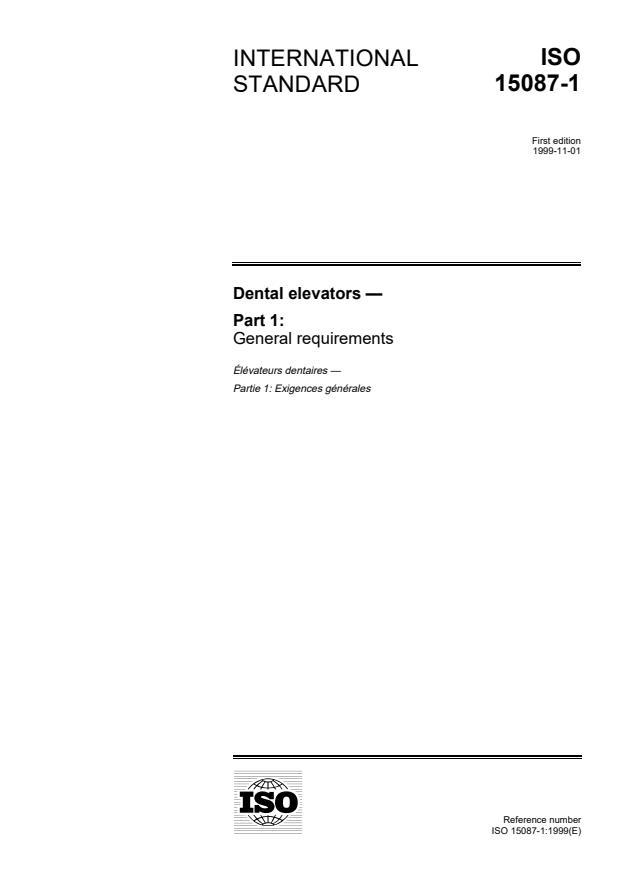
INTERNATIONAL ISO
STANDARD 15087-1
First edition
1999-11-01
Dental elevators —
Part 1:
General requirements
Élévateurs dentaires —
Partie 1: Exigences générales
A
Reference number
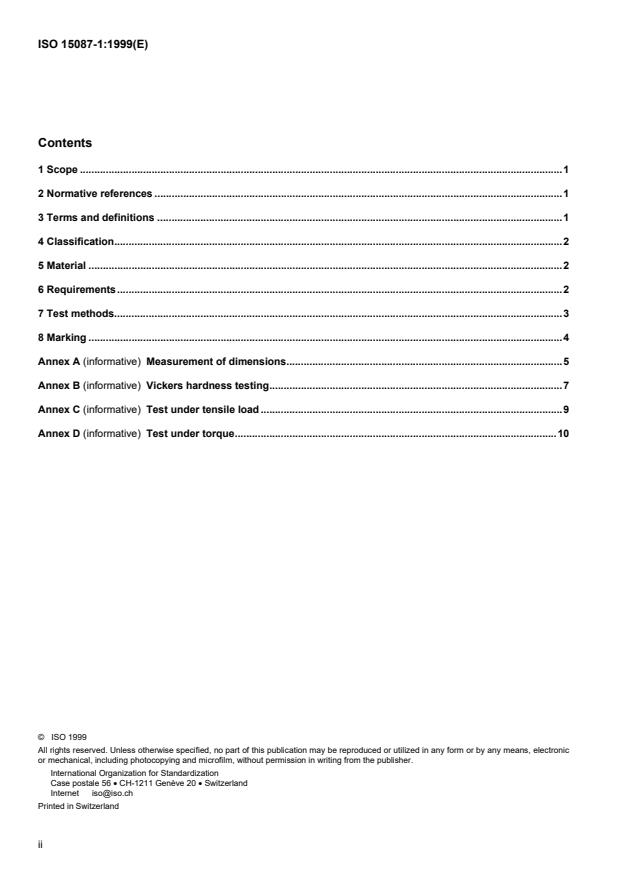
Contents
1 Scope .1
2 Normative references .1
3 Terms and definitions .1
4 Classification.2
5 Material .2
6 Requirements.2
7 Test methods.3
8 Marking .4
Annex A (informative) Measurement of dimensions.5
Annex B (informative) Vickers hardness testing.7
Annex C (informative) Test under tensile load.9
Annex D (informative) Test under torque.10
© ISO 1999
All rights reserved. Unless otherwise specified, no part of this publication may be reproduced or utilized in any form or by any means, electronic
or mechanical, including photocopying and microfilm, without permission in writing from the publisher.
International Organization for Standardization
Case postale 56 • CH-1211 Genève 20 • Switzerland
Internet iso@iso.ch
Printed in Switzerland
ii
© ISO
Foreword
ISO (the International Organization for Standardization) is a worldwide federation of national standards bodies (ISO
member bodies). The work of preparing International Standards is normally carried out through ISO technical
committees. Each member body interested in a subject for which a technical committee has been established has
the right to be represented on that committee. International organizations, governmental and non-governmental, in
liaison with ISO, also take part in the work. ISO collaborates closely with the International Electrotechnical
Commission (IEC) on all matters of electrotechnical standardization.
International Standards are drafted in accordance with the rules given in the ISO/IEC Directives, Part 3.
Draft International Standards adopted by the technical committees are circulated to the member bodies for voting.
Publication as an International Standard requires approval by at least 75 % of the member bodies casting a vote.
International Standard ISO 15087-1 was prepared by Technical Committee ISO/TC 106, Dentistry, Subcommittee
SC 4, Dental instruments.
ISO 15087 consists of the following parts, under the general title Dental elevators:
Part 1: General requirements
Part 2: Warwick James elevators
Part 3: Cryer elevators
Part 4: Coupland elevators
Part 5: Bein elevators
Part 6: Flohr elevators
Annexes A to D of this part of ISO 15087 are for information only.
iii
INTERNATIONAL STANDARD © ISO ISO 15087-1:1999(E)
Dental elevators —
Part 1:
General requirements
1 Scope
This part of ISO 15087 specifies the general material and performance requirements for dental elevators.
2 Normative references
The following normative documents contain provisions which, through reference in this text, constitute provisions of
this part of ISO 15087. For dated references, subsequent amendments to, or revisions of, any of these publications
do not apply. However, parties to agreements based on this part of ISO 15087 are encouraged to investigate the
possibility of applying the most recent editions of the normative documents indicated below. For undated
references, the latest edition of the normative document referred to applies. Members of ISO and IEC maintain
registers of currently valid International Standards.
ISO 1942-3:1989, Dental vocabulary — Part 3: Dental instruments.
ISO 2592, Petroleum products — Determination of flash and fire points — Cleveland open cup method.
ISO 3104, Petroleum products — Transparent and opaque liquids — Determination of kinematic viscosity and
calculation of dynamic viscosity.
ISO 6507-1:1997, Metallic materials — Vickers hardness test — Part 1: Test method.
ISO 7153-1:1991, .
Surgical instruments — Metallic materials — Part 1: Stainless steel
ISO 13402, Surgical and dental hand instruments — Determination of resistance against autoclaving, corrosion and
thermal exposure.
3 Terms and definitions
For the purposes of this part of ISO 15087, the terms and definitions given in ISO 1942-3 apply.
© ISO
4 Classification
Dental elevators specified in all parts of ISO 15087 are classified according to the Vickers hardness of the working
end into the following classes:
Class 1: 480 HV 1 to 600 HV 1
Class 2: 600 HV 1 to 720 HV 1
The manufacturer shall state the Vickers classification in the product documentation.
5 Material
5.1 Material of the working end
The working end shall be made of martensitic stainless steel of grade B, C, D or R complying with ISO 7153-1, or
other materials providing the instrument made therefrom meets the requirements of clause 6.
5.2 Material of the handle
The material of the handle, selected at the discretion of the manufacturer, shall meet the requirements of clause 6.
6 Requirements
6.1 Maximum overall length
Unless otherwise specified in other parts of ISO 15087, the maximum overall length of dental elevators shall be
178 mm.
Annex A provides details of one method of measurement applicable to most types of dental elevators.
6.2 Vickers hardness of the working end
The Vickers hardness of the working end of the finished instrument, when tested in accordance with ISO 6507-1,
shall be within the range of class 1 or class 2. The manufacturer shall state the appropriate hardness class for each
instrument pattern or range of instruments in the product documentation.
Annex B provides details of a method of measurement for Vickers hardness.
6.3 Surface finish
6.3.1 All surfaces
All surfaces shall be visibly free from pores, crevices, grinding marks, residual scales, acid, grease and residual
grinding and polishing materials, when inspected using normal vision.
6.3.2 Satin finish
Any satin finish shall be both uniform and smooth, and it shall reduce glare.
6.3.3 Mirror finish
Any mirror finish shall be ground to remove all surface imperfections and polished to remove grinding marks,
resulting in a highly reflective surface.
6.4 Resistance against autoclaving
When tested in accordance with 7.2, the instrument shall exhibit no visible signs of alteration.
© ISO
6.5 Resistance against corrosion
6.5.1 Working end
When tested for resistance to boiling water in accordance with 7.3, the working end shall exhibit no visible signs of
corrosion.
6.5.2 Handle
When tested for resistance to boiling water in accordance with 7.3, the handle shall exhibit no visible signs of
corrosion.
6.6 Resistance against thermal exposure
When tested for resistance against thermal exposure in accordance with 7.3, the instrument shall exhibit no visible
signs of alteration.
6.7 Union between the working end and handle
The union between the working end and the handle of the instrument, previously tested in accordance with 6.3 to
6.6, shall not become loosened under tensile load when tested in accordance with 7.4.1 and under torque when
tested in accordance with 7.4.2.
6.8 Hollow-handle leak test
When tested in accordance with 7.5.1 or 7.5.2, the instrument handle shall emit no bubbles which are a sign of
leakage.
7 Test methods
7.1 Test sequence and cycles
Carry out one of the following testing alternatives in one continuous operation for five cycles:
a) autoclave test or
b) boiling water test and thermal exposure test.
After completing the test (7.2 or 7.3), rub the instrument vigorously with a cloth to remove blemishes.
NOTE Instruments with hollow handles, when subject to the combination of boiling water and thermal exposure tests, may
rupture from the expansion of trapped moisture.
7.2 Autoclave test
Carry out the autoclave test as specified in ISO 13402.
7.3 Boiling water test and thermal exposure test
Carry out both the boiling water test and the thermal exposure test as specified in ISO 13402.
7.4 Test for union between working end and handle
7.4.1 Test under tensile load
Subject the union between the working end and the handle to a tensile force of 1000 N, applied in the direction
parallel to the centreline of the handle, for a duration of at least 5 s.
Annex C describes a suitable test procedure.
© ISO
7.4.2 Test under torque
Subject the union between the working end and the handle to a torque of 500 N { cm for a duration of at least 5 s.
Annex D describes a suitable test procedure.
7.5 Hollow-handle leak test
7.5.1 Heated oil test
7.5.1.1 Apparatus
7.5.1.1.1 Heat-resistant vessel.
7.5.1.1.2 Light oil, of minimum flash point 220 °C in accordance with ISO 2592 and nominal kinematic viscosity of
16,5 mm /s at 100 °C in accordance with ISO 3104.
7.5.1.2 Procedure
Put the light oil into the heat-resistant vessel.
Heat the oil to (180 – 5) °C and then completely immerse the elevator handle in the oil for 2 min.
No air bubbles shall be emitted during this test.
7.5.2 Ultrasonic test
7.5.2.1 Apparatus
7.5.2.1.1 Ultrasonic cleaning apparatus.
7.5.2.1.2 Basket made of wire net.
7.5.2.2 Procedure
Align the dental elevators in a basket (7.5.2.1.2). Put the basket in an ultrasonic cleaning apparatus (7.5.2.1.1) filled
with water at (40 – 2) °C. Shake the basket carefully by hand and observe the appearance of the handles. If air
bubbles immediately emerge from the handle surfaces, there are large-size pin
...
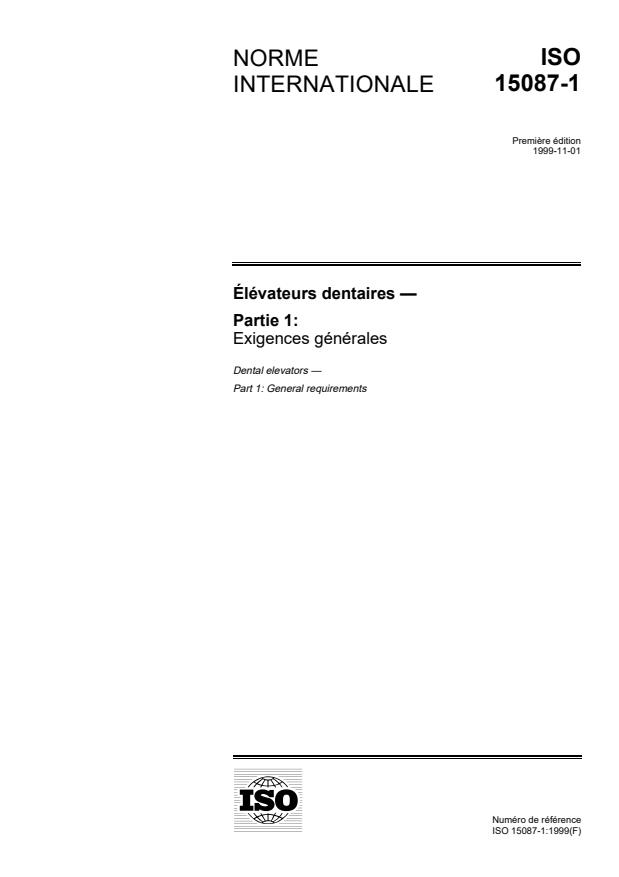
NORME ISO
INTERNATIONALE 15087-1
Première édition
1999-11-01
Élévateurs dentaires —
Partie 1:
Exigences générales
Dental elevators —
Part 1: General requirements
A
Numéro de référence
Sommaire
1 Domaine d’application .1
2 Références normatives .1
3 Termes et définitions.1
4 Classification.2
5 Matériaux .2
6 Exigences .2
7 Méthodes d'essai .3
8 Marquage.5
Annexe A (informative) Mesurage des dimensions .6
Annexe B (informative) Essai de dureté Vickers.8
Annexe C (informative) Essai de résistance à la traction.10
Annexe D (informative) Essai de torsion .11
© ISO 1999
Droits de reproduction réservés. Sauf prescription différente, aucune partie de cette publication ne peut être reproduite ni utilisée sous quelque
forme que ce soit et par aucun procédé, électronique ou mécanique, y compris la photocopie et les microfilms, sans l'accord écrit de l'éditeur.
Organisation internationale de normalisation
Case postale 56 • CH-1211 Genève 20 • Suisse
Internet iso@iso.ch
Imprimé en Suisse
ii
© ISO
Avant-propos
L'ISO (Organisation internationale de normalisation) est une fédération mondiale d'organismes nationaux de
normalisation (comités membres de l'ISO). L'élaboration des Normes internationales est en général confiée aux
comités techniques de l'ISO. Chaque comité membre intéressé par une étude a le droit de faire partie du comité
technique créé à cet effet. Les organisations internationales, gouvernementales et non gouvernementales, en
liaison avec l'ISO participent également aux travaux. L'ISO collabore étroitement avec la Commission
électrotechnique internationale (CEI) en ce qui concerne la normalisation électrotechnique.
Les Normes internationales sont rédigées conformément aux règles données dans les Directives ISO/CEI, Partie 3.
Les projets de Normes internationales adoptés par les comités techniques sont soumis aux comités membres pour
vote. Leur publication comme Normes internationales requiert l'approbation de 75 % au moins des comités
membres votants.
La Norme internationale ISO 15087-1 a été élaborée par le comité technique ISO/TC 106, Art dentaire, sous-comité
SC 4, Instruments dentaires.
L'ISO 15087 comprend les parties suivantes, présentées sous le titre général Élévateurs dentaires:
Partie 1: Exigences générales
Partie 2: Élévateurs Warwick James
Partie 3: Élévateurs Cryer
Partie 4: Élévateurs Coupland
Partie 5: Élévateurs Bein
Partie 6: Élévateurs Flohr
Les annexes A à D de la présente partie de l'ISO 15087 sont données uniquement à titre d'information.
iii
NORME INTERNATIONALE © ISO ISO 15087-1:1999(F)
Élévateurs dentaires —
Partie 1:
Exigences générales
1 Domaine d’application
La présente partie de l'ISO 15087 spécifie les exigences générales en ce qui concerne les matériaux et les
performances relatives aux élévateurs dentaires.
2 Références normatives
Les documents normatifs suivants contiennent des dispositions qui, par suite de la référence qui y est faite,
constituent des dispositions valables pour la présente partie de l'ISO 15087. Pour les références datées, les
amendements ultérieurs ou les révisions de ces publications ne s’appliquent pas. Toutefois, les parties prenantes
aux accords fondés sur la présente partie de l'ISO 15087 sont invitées à rechercher la possibilité d'appliquer les
éditions les plus récentes des documents normatifs indiqués ci-après. Pour les références non datées, la dernière
édition du document normatif en référence s’applique. Les membres de l'ISO et de la CEI possèdent le registre des
Normes internationales en vigueur.
ISO 1942-3:1989, Vocabulaire de l'art dentaire — Partie 3: Instruments dentaires.
ISO 2592, Produits pétroliers — Détermination des points d'éclair et de feu — Méthode Cleveland en vase ouvert.
ISO 3104, Produits pétroliers — Liquides opaques et transparents — Détermination de la viscosité cinématique et
calcul de la viscosité dynamique.
ISO 6507-1:1997, Matériaux métalliques — Essai de dureté Vickers — Partie 1: Méthode d'essai.
ISO 7153-1:1991, Instruments chirurgicaux — Matériaux métalliques — Partie 1: Acier inoxydable.
ISO 13402, Instruments chirurgicaux et dentaires à main — Détermination de la résistance au passage à
l'autoclave, à la corrosion et à l'exposition à la chaleur.
3 Termes et définitions
Pour les besoins de la présente partie de l'ISO 15087, les termes et définitions donnés dans l'ISO 1942-3
s'appliquent.
© ISO
4 Classification
Les élévateurs dentaires spécifiés dans toutes les parties de l'ISO 15087 sont classés selon la dureté Vickers de
l'extrémité active, dans les classes suivantes:
Classe 1: 480 HV 1 à 600 HV 1
Classe 2: 600 HV 1 à 720 HV 1
Le fabricant doit indiquer la classification Vickers dans la documentation relative au produit.
5 Matériaux
5.1 Matériau constituant l'extrémité active
L'extrémité active doit être en acier inoxydable martensitique de nuance B, C, D ou R, conformément à l'ISO 7153-1
ou en d'autres matériaux, sous réserve que l'instrument réalisé dans ces matériaux soit conforme aux exigences de
l'article 6.
5.2 Matériau constituant le manche
Le matériau constituant le manche, dont le choix est laissé à l'appréciation du fabricant, doit satisfaire aux
exigences de l'article 6.
6 Exigences
6.1 Longueur totale maximale
Sauf spécification contraire dans d'autres parties de l'ISO 15087, la longueur totale maximale des élévateurs
dentaires doit être de 178 mm.
L'annexe A détaille une méthode de mesurage applicable à la plupart des types d'élévateurs dentaires.
6.2 Dureté Vickers de l'extrémité active
La dureté Vickers de l'extrémité active de l'instrument fini, lorsqu'il est soumis à l'essai conformément à
l'ISO 6507-1, doit être comprise dans la gamme de la classe 1 ou de la classe 2. Le fabricant doit indiquer la classe
de dureté appropriée pour chaque modèle ou gamme d'instruments dans la documentation relative au produit.
L'annexe B détaille une méthode de mesurage de la dureté Vickers.
6.3 Finition de surface
6.3.1 Toutes surfaces
Contrôlées en vision normale, toutes les surfaces doivent être visiblement exemptes de pores, criques, marques de
meulage, écailles, restes d'acide, de graisse ou de matériaux de meulage et de polissage.
6.3.2 Finition satinée
La finition satinée doit être uniforme et lisse, et réduire l'éblouissement.
6.3.3 Poli miroir
Le poli miroir doit être obtenu par meulage, afin de supprimer toutes les imperfections de surface, et par polissage,
afin d'éliminer les marques de meulage; il en résulte une surface de haute réflectivité.
© ISO
6.4 Résistance au passage en autoclave
Lorsque les essais sont effectués conformément à 7.2, aucun signe d'altération ne doit être visible sur l'instrument.
6.5 Résistance à la corrosion
6.5.1 Extrémité active
Aucun signe visible de corrosion ne doit être constaté sur l'extrémité active lorsque les essais à l'eau bouillante sont
effectués conformément à 7.3.
6.5.2 Manche
Aucun signe visible de corrosion ne doit être constaté sur le manche lorsque les essais à l'eau bouillante sont
effectués conformément à 7.3.
6.6 Résistance à l'exposition thermique
Lorsque les essais thermiques sont effectués conformément à 7.3, il ne doit pas y avoir d'altération de l'apparence
physique de l'instrument.
6.7 Jonction entre l'extrémité active et le manche
La jonction entre l'extrémité active et le manche de l'instrument, préalablement soumise aux essais conformément à
6.3 à 6.6, ne doit pas avoir tendance à se dissocier sous traction lorsqu'elle est soumise à l'essai selon 7.4.1, ni
sous torsion lorsqu'elle est soumise à l'essai selon 7.4.2.
6.8 Essai d'étanchéité des manches creux
L'instrument ne doit pas émettre de bulles (signe de l'existence d'une fuite) lorsqu'il est soumis à l'essai selon 7.5.1
ou 7.5.2.
7 Méthodes d'essai
7.1 Séquence et cycles d'essai
Réaliser l'un des deux essais suivants en une seule opération sur cinq cycles:
a) essai à l'autoclave, ou
b) essai à l'eau bouillante et essai thermique.
Au terme des essais selon 7.2 ou 7.3, essuyer vigoureusement l'instrument à l'aide d'un chiffon afin d'éliminer les
défauts d'aspect.
NOTE Lorsqu'ils sont soumis à une combinaison de l'essai à l'eau bouillante et de l'essai thermique, les instruments à
manche creux peuvent se rompre par l'expansion de l'humidité emmagasinée.
7.2 Essai à l'autoclave
Réaliser l'essai à l'autoclave selon les spécifications de l'ISO 13402.
7.3 Essai à l'eau bouillante et essai thermique
Réaliser l'essai à l'eau bouillante et l'essai thermique selon les spécifications de l'ISO 13402.
© ISO
7.4 Essai de la jonction entre l'extrémité active et le manche
7.4.1 Essai sous traction
Soumettre la jonction entre l'extrémité active et le manche à une force de traction de 1 000 N, appliquée dans la
direction parallèle à l'axe du manche, pendant une durée d'au moins 5 s.
L'annexe C décrit une méthode d'essai appropriée.
7.4.2 Essai sous torsion
Soumettre la jonction entre l'extrémité active et le manche à un couple de 500 N·cm pendant une durée d'au moins
5 s.
L'annexe D décrit une méthode d'essai appropriée.
7.5 Essai d'étanchéité des manches creux
7.5.1 Essai à l'huile chaude
7.5.1.1 Appareillage
7.5.1.1.1 Récipient résistant à la chaleur.
7.5.1.1.2 Huile légère, dont le point d'éclair est au minimum de 220 °C conformément à l'ISO 2592 et dont la
viscosité cinématique nominale à 100 °C est de 16,5 mm /s conformément à l'ISO 3104.
7.5.1.2 Mode opératoire
Verser l'huile légère dans le récipient résistant à la chaleur.
Chauffer l'huile à (180 – 5) °C, puis immerger totalement le manche dans cette dernière pendant 2 min.
Aucune bulle d'air ne doit apparaître au cours de l'essai.
7.5.2 Essai à ultrasons
7.5.2.1 Appareillage
7.5.2.1.1 Équipement de nettoyage à ultrasons.
7.5.2.1.2 Panier en filet métallique.
7.5.2.2 Mode opératoire
Aligner les élévateurs dentaires dans un panier (7.5.2.1.2). Mettre le panier dans un équipement de nettoyage à
ultrasons (7.5.2.1.1) rempli d'eau à (40 – 2) °C. Agiter manuellement et avec précaution l'eau dans le panier et
surveiller l'aspect des manches. Si des bulles d'air se forment immédiatement sur les surfaces des manches, ces
dernières comportent alors des piqûres de grande dimension.
Faire descendre le panier lentem
...