

ISO 16355-3:2025
(Main)Applications of statistical and related methods to new technology and product development process — Part 3: Quantitative approaches for the acquisition of voice of customer and voice of stakeholder
General Information
- Abstract
This document describes quantitative approaches for acquisition of the voice of customer (VOC) and voice of stakeholder (VOS) and its purpose, and provides recommendations on the use of the applicable tools and methods. It is not a management system standard. NOTE It does not provide requirements or guidelines for organizations to develop and systematically manage their policies, processes, and procedures in order to achieve specific objectives. Users of this document include all organization functions necessary to assure customer satisfaction, including business planning, marketing, sales, research and development (R&D), engineering, information technology (IT), manufacturing, procurement, quality, production, service, packaging and logistics, support, testing, regulatory, and other phases in hardware, software, service, and system organizations.
- Status
- Published
- Publication Date
- 02-Oct-2025
- Technical Committee
- ISO/TC 69/SC 8 - Application of statistical and related methodology for new technology and product development
- Drafting Committee
- ISO/TC 69/SC 8/WG 3 - Optimization
- Current Stage
- 6060 - International Standard published
- Start Date
- 03-Oct-2025
- Due Date
- 12-Jan-2026
- Completion Date
- 03-Oct-2025
Buy Documents

ISO 16355-3:2025 - Applications of statistical and related methods to new technology and product development process — Part 3: Quantitative approaches for the acquisition of voice of customer and voice of stakeholder Released:10/3/2025
Overview
ISO 16355-3:2025 - Applications of statistical and related methods to new technology and product development process (Part 3) - defines quantitative approaches for acquiring the voice of customer (VOC) and voice of stakeholder (VOS). It provides guidance and recommendations on selecting and using quantitative tools and methods (not management system requirements). The standard supports cross-functional teams across business planning, marketing, R&D, engineering, IT, manufacturing, quality, service, procurement, packaging, logistics and regulatory functions involved in hardware, software, service and system development.
Key topics
The standard covers practical methods and analytical techniques used during QFD (Quality Function Deployment) and customer-research integration:
- Basic QFD concepts and team structures (core teams, subject matter experts, leadership)
- Types of information to collect: market strategy, trends, segmentation, competitive space, customer needs
- Quantitative tools & methods, including:
- Analytic Network Process (ANP) and Analytic Hierarchy Process (AHP)
- Conjoint analysis, regression, factor analysis and covariance structure analysis
- Cluster analysis, multidimensional scaling (MDS), market position analysis
- Text analytics/text mining, neural networks and other AI techniques
- Fuzzy set theory, multi-attribute utility approaches, L-matrices
- Kano model, Kansei engineering, repertory grid technique, benchmarking
- Customer satisfaction metrics (e.g., NPS) and preference benchmarking
- Applications in QFD: translating VOC/VOS into product requirements, prioritization, feature sets and concept options
- Guidance on study design: building surveys, case-study examples, and tool selection criteria
Practical applications
ISO 16355-3:2025 helps organizations apply robust quantitative methods to:
- Capture and quantify customer and stakeholder needs for new products and services
- Prioritize product features and design trade-offs using data-driven methods
- Segment markets and benchmark competitive positioning
- Improve requirements definition, concept selection and risk-informed design decisions
- Integrate AI, text analytics and statistical modeling into customer insights workflows
Who should use this standard
Relevant users include cross-functional teams and specialists responsible for assuring customer satisfaction and product success:
- Product managers, R&D and engineering teams
- Marketing, sales and business planners
- UX researchers, data scientists and IT teams applying AI/text analytics
- Quality, regulatory, manufacturing and procurement functions
Related standards
- Part of the ISO 16355 series (applications of statistical methods to product development). Note: ISO 16355-3:2025 is advisory and not a management-system standard.
Keywords: ISO 16355-3:2025, voice of customer (VOC), voice of stakeholder (VOS), quantitative approaches, QFD, conjoint analysis, ANP, text analytics, customer needs, market segmentation.
Relations
- Effective Date
- 13-Jul-2024
Buy Documents
ISO 16355-3:2025 - Applications of statistical and related methods to new technology and product development process — Part 3: Quantitative approaches for the acquisition of voice of customer and voice of stakeholder Released:10/3/2025
Get Certified
Connect with accredited certification bodies for this standard

BSI Group
BSI (British Standards Institution) is the business standards company that helps organizations make excellence a habit.

Bureau Veritas
Bureau Veritas is a world leader in laboratory testing, inspection and certification services.

DNV
DNV is an independent assurance and risk management provider.
Sponsored listings
Frequently Asked Questions
ISO 16355-3:2025 is a standard published by the International Organization for Standardization (ISO). Its full title is "Applications of statistical and related methods to new technology and product development process — Part 3: Quantitative approaches for the acquisition of voice of customer and voice of stakeholder". This standard covers: This document describes quantitative approaches for acquisition of the voice of customer (VOC) and voice of stakeholder (VOS) and its purpose, and provides recommendations on the use of the applicable tools and methods. It is not a management system standard. NOTE It does not provide requirements or guidelines for organizations to develop and systematically manage their policies, processes, and procedures in order to achieve specific objectives. Users of this document include all organization functions necessary to assure customer satisfaction, including business planning, marketing, sales, research and development (R&D), engineering, information technology (IT), manufacturing, procurement, quality, production, service, packaging and logistics, support, testing, regulatory, and other phases in hardware, software, service, and system organizations.
This document describes quantitative approaches for acquisition of the voice of customer (VOC) and voice of stakeholder (VOS) and its purpose, and provides recommendations on the use of the applicable tools and methods. It is not a management system standard. NOTE It does not provide requirements or guidelines for organizations to develop and systematically manage their policies, processes, and procedures in order to achieve specific objectives. Users of this document include all organization functions necessary to assure customer satisfaction, including business planning, marketing, sales, research and development (R&D), engineering, information technology (IT), manufacturing, procurement, quality, production, service, packaging and logistics, support, testing, regulatory, and other phases in hardware, software, service, and system organizations.
ISO 16355-3:2025 is classified under the following ICS (International Classification for Standards) categories: 03.120.30 - Application of statistical methods. The ICS classification helps identify the subject area and facilitates finding related standards.
ISO 16355-3:2025 has the following relationships with other standards: It is inter standard links to ISO 16355-3:2019. Understanding these relationships helps ensure you are using the most current and applicable version of the standard.
ISO 16355-3:2025 is available in PDF format for immediate download after purchase. The document can be added to your cart and obtained through the secure checkout process. Digital delivery ensures instant access to the complete standard document.
Standards Content (Sample)
International
Standard
ISO 16355-3
Second edition
Applications of statistical and
2025-10
related methods to new technology
and product development
process —
Part 3:
Quantitative approaches for the
acquisition of voice of customer and
voice of stakeholder
Application des méthodes statistiques et des méthodes liées aux
nouvelles technologies et de développement de produit —
Partie 3: Acquisition quantitative du retour client et du retour des
parties prenantes
Reference number
© ISO 2025
All rights reserved. Unless otherwise specified, or required in the context of its implementation, no part of this publication may
be reproduced or utilized otherwise in any form or by any means, electronic or mechanical, including photocopying, or posting on
the internet or an intranet, without prior written permission. Permission can be requested from either ISO at the address below
or ISO’s member body in the country of the requester.
ISO copyright office
CP 401 • Ch. de Blandonnet 8
CH-1214 Vernier, Geneva
Phone: +41 22 749 01 11
Email: copyright@iso.org
Website: www.iso.org
Published in Switzerland
ii
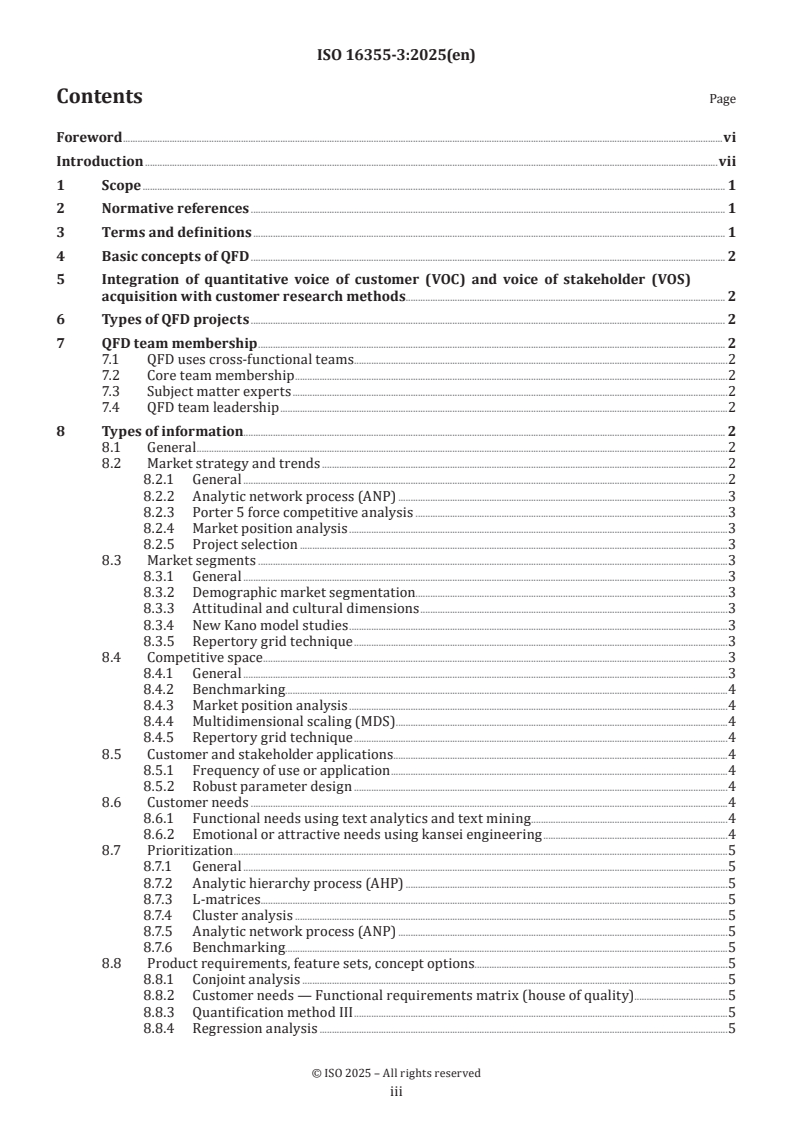
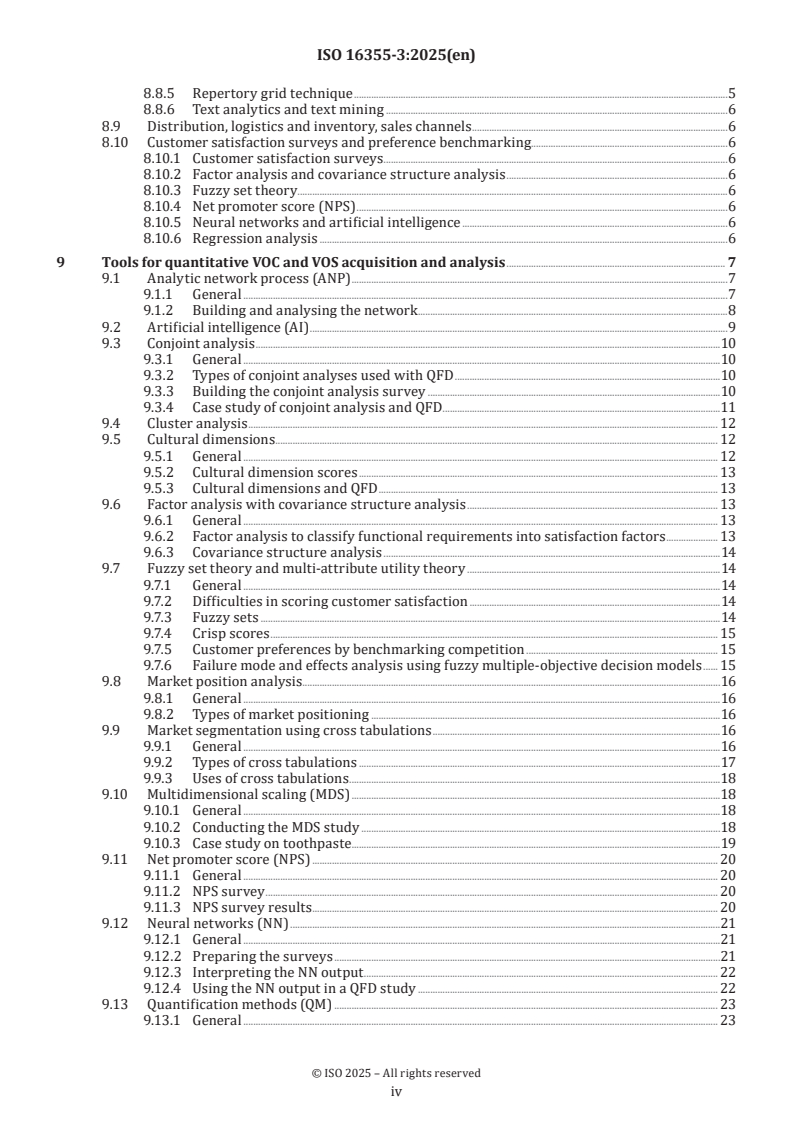
Contents Page
Foreword .vi
Introduction .vii
1 Scope . 1
2 Normative references . 1
3 Terms and definitions . 1
4 Basic concepts of QFD . 2
5 Integration of quantitative voice of customer (VOC) and voice of stakeholder (VOS)
acquisition with customer research methods . . 2
6 Types of QFD projects . 2
7 QFD team membership . 2
7.1 QFD uses cross-functional teams.2
7.2 Core team membership .2
7.3 Subject matter experts .2
7.4 QFD team leadership .2
8 Types of information. 2
8.1 General .2
8.2 Market strategy and trends .2
8.2.1 General .2
8.2.2 Analytic network process (ANP) .3
8.2.3 Porter 5 force competitive analysis .3
8.2.4 Market position analysis .3
8.2.5 Project selection .3
8.3 Market segments .3
8.3.1 General .3
8.3.2 Demographic market segmentation .3
8.3.3 Attitudinal and cultural dimensions .3
8.3.4 New Kano model studies .3
8.3.5 Repertory grid technique .3
8.4 Competitive space .3
8.4.1 General .3
8.4.2 Benchmarking . .4
8.4.3 Market position analysis .4
8.4.4 Multidimensional scaling (MDS) .4
8.4.5 Repertory grid technique .4
8.5 Customer and stakeholder applications.4
8.5.1 Frequency of use or application .4
8.5.2 Robust parameter design .4
8.6 Customer needs .4
8.6.1 Functional needs using text analytics and text mining .4
8.6.2 Emotional or attractive needs using kansei engineering .4
8.7 Prioritization .5
8.7.1 General .5
8.7.2 Analytic hierarchy process (AHP) .5
8.7.3 L-matrices.5
8.7.4 Cluster analysis .5
8.7.5 Analytic network process (ANP) .5
8.7.6 Benchmarking . .5
8.8 Product requirements, feature sets, concept options.5
8.8.1 Conjoint analysis .5
8.8.2 Customer needs — Functional requirements matrix (house of quality) .5
8.8.3 Quantification method III .5
8.8.4 Regression analysis .5
iii
8.8.5 Repertory grid technique .5
8.8.6 Text analytics and text mining .6
8.9 Distribution, logistics and inventory, sales channels .6
8.10 Customer satisfaction surveys and preference benchmarking.6
8.10.1 Customer satisfaction surveys . .6
8.10.2 Factor analysis and covariance structure analysis .6
8.10.3 Fuzzy set theory.6
8.10.4 Net promoter score (NPS) .6
8.10.5 Neural networks and artificial intelligence .6
8.10.6 Regression analysis .6
9 Tools for quantitative VOC and VOS acquisition and analysis . 7
9.1 Analytic network process (ANP) .7
9.1.1 General .7
9.1.2 Building and analysing the network .8
9.2 Artificial intelligence (AI) .9
9.3 Conjoint analysis .10
9.3.1 General .10
9.3.2 Types of conjoint analyses used with QFD .10
9.3.3 Building the conjoint analysis survey .10
9.3.4 Case study of conjoint analysis and QFD . .11
9.4 Cluster analysis . 12
9.5 Cultural dimensions . 12
9.5.1 General . 12
9.5.2 Cultural dimension scores . 13
9.5.3 Cultural dimensions and QFD . 13
9.6 Factor analysis with covariance structure analysis . 13
9.6.1 General . 13
9.6.2 Factor analysis to classify functional requirements into satisfaction factors . 13
9.6.3 Covariance structure analysis .14
9.7 Fuzzy set theory and multi-attribute utility theory .14
9.7.1 General .14
9.7.2 Difficulties in scoring customer satisfaction .14
9.7.3 Fuzzy sets .14
9.7.4 Crisp scores . 15
9.7.5 Customer preferences by benchmarking competition . 15
9.7.6 Failure mode and effects analysis using fuzzy multiple-objective decision models . 15
9.8 Market position analysis.16
9.8.1 General .16
9.8.2 Types of market positioning .16
9.9 Market segmentation using cross tabulations .16
9.9.1 General .16
9.9.2 Types of cross tabulations .17
9.9.3 Uses of cross tabulations .18
9.10 Multidimensional scaling (MDS) .18
9.10.1 General .18
9.10.2 Conducting the MDS study .18
9.10.3 Case study on toothpaste.19
9.11 Net promoter score (NPS) . 20
9.11.1 General . 20
9.11.2 NPS survey . 20
9.11.3 NPS survey results . . 20
9.12 Neural networks (NN) .21
9.12.1 General .21
9.12.2 Preparing the surveys .21
9.12.3 Interpreting the NN output . 22
9.12.4 Using the NN output in a QFD study . 22
9.13 Quantification methods (QM) . 23
9.13.1 General . 23
iv
9.13.2 Quantification method III (QM III) . 23
9.13.3 Applying QM III to a 2-dimensional QFD matrix . 23
9.14 Regression analysis .27
9.14.1 General .27
9.14.2 Regression analysis in QFD . .27
9.14.3 Regression data . 28
9.15 Repertory grid technique . 30
9.15.1 General . 30
9.15.2 The repertory grid technique process . 30
9.16 Text analytics and text mining .31
9.16.1 General .31
9.16.2 Text clustering .31
9.16.3 Topic modelling .32
10 Deployment to next stage .33
10.1 Customer needs related information. 33
10.2 Product related information . 33
Annex A (informative) Using sampling surveys .34
Bibliography .42
v
Foreword
ISO (the International Organization for Standardization) is a worldwide federation of national standards
bodies (ISO member bodies). The work of preparing International Standards is normally carried out through
ISO technical committees. Each member body interested in a subject for which a technical committee
has been established has the right to be represented on that committee. International organizations,
governmental and non-governmental, in liaison with ISO, also take part in the work. ISO collaborates closely
with the International Electrotechnical Commission (IEC) on all matters of electrotechnical standardization.
The procedures used to develop this document and those intended for its further maintenance are described
in the ISO/IEC Directives, Part 1. In particular, the different approval criteria needed for the different types
of ISO documents should be noted. This document was drafted in accordance with the editorial rules of the
ISO/IEC Directives, Part 2 (see www.iso.org/directives).
ISO draws attention to the possibility that the implementation of this document may involve the use of (a)
patent(s). ISO takes no position concerning the evidence, validity or applicability of any claimed patent
rights in respect thereof. As of the date of publication of this document, ISO had not received notice of (a)
patent(s) which may be required to implement this document. However, implementers are cautioned that
this may not represent the latest information, which may be obtained from the patent database available at
www.iso.org/patents. ISO shall not be held responsible for identifying any or all such patent rights.
Any trade name used in this document is information given for the convenience of users and does not
constitute an endorsement.
For an explanation of the voluntary nature of standards, the meaning of ISO specific terms and expressions
related to conformity assessment, as well as information about ISO's adherence to the World Trade
Organization (WTO) principles in the Technical Barriers to Trade (TBT), see www.iso.org/iso/foreword.html.
This document was prepared by Technical Committee ISO/TC 69, Applications of statistical methods,
Subcommittee SC 8, Application of statistical and related methodology for new technology and product
development.
This second edition cancels and replaces the first edition (ISO 16355-3:2019), which has been technically
revised.
The main changes are as follows:
— minor correction to cited text for cultural dimensions.
A list of all parts in the ISO 16355 series can be found on the ISO website.
Any feedback or questions on this document should be directed to the user’s national standards body. A
complete listing of these bodies can be found at www.iso.org/members.html.
vi
Introduction
Quality function deployment (QFD) is a method to assure customer or stakeholder satisfaction and value
with new and existing products by designing in, from different levels and different perspectives, the
requirements that are most important to the customer or stakeholder. These requirements can be well
understood through the use of quantitative and non-quantitative tools and methods to improve confidence
of the design and development phases that they are working on the right things. In addition to satisfaction
with the product, QFD improves the process by which new products are developed.
Reported results of using QFD include improved customer satisfaction with products at time of launch,
improved cross-functional communication, systematic and traceable design decisions, efficient use of
resources, reduced rework, reduced time-to-market, lower lifecycle cost, and improved reputation of the
organization among its customers or stakeholders.
This document demonstrates the dynamic nature of a customer-driven approach. Since its inception in 1966,
QFD has broadened and deepened its methods and tools to respond to the changing business conditions of
QFD users, their management, their customers, and their products. Those who have used older QFD models
find these improvements make QFD easier and faster to use. The methods and tools shown and referenced in
the standard represent decades of improvements to QFD; the list is neither exhaustive nor exclusive. Users
can consider the applicable methods and tools as suggestions, not requirements.
This document is descriptive and discusses current best practice, it is not prescriptive by requiring specific
tools and methods.
vii
International Standard ISO 16355-3:2025(en)
Applications of statistical and related methods to new
technology and product development process —
Part 3:
Quantitative approaches for the acquisition of voice of
customer and voice of stakeholder
1 Scope
This document describes quantitative approaches for acquisition of the voice of customer (VOC) and voice
of stakeholder (VOS) and its purpose, and provides recommendations on the use of the applicable tools and
methods. It is not a management system standard.
NOTE It does not provide requirements or guidelines for organizations to develop and systematically manage
their policies, processes, and procedures in order to achieve specific objectives.
Users of this document include all organization functions necessary to assure customer satisfaction,
including business planning, marketing, sales, research and development (R&D), engineering, information
technology (IT), manufacturing, procurement, quality, production, service, packaging and logistics, support,
testing, regulatory, and other phases in hardware, software, service, and system organizations.
2 Normative references
The following documents are referred to in the text in such a way that some or all of their content constitutes
requirements of this document. For dated references, only the edition cited applies. For undated references,
the latest edition of the referenced document (including any amendments) applies.
ISO 3534-1, Statistics — Vocabulary and symbols — Part 1: General statistical terms and terms used in
probability
ISO 3534-4, Statistics — Vocabulary and symbols — Part 4: Survey sampling
ISO 10004, Quality management — Customer satisfaction — Guidelines for monitoring and measuring
ISO 16355-1, Application of statistical and related methods to new technology and product development process
— Part 1: General principles and perspectives of quality function deployment (QFD)
ISO 20252, Market, opinion and social research — Vocabulary and service requirements
3 Terms and definitions
For the purposes of this document, the terms and definitions given in ISO 3534-1, ISO 3534-4, ISO 16355-1,
ISO 10004 and ISO 20252 apply.
ISO and IEC maintain terminology databases for use in standardization at the following addresses:
— ISO Online browsing platform: available at https:// www .iso .org/ obp
— IEC Electropedia: available at https:// www .electropedia .org/
4 Basic concepts of QFD
The basic concepts of QFD are described in ISO 16355-1:2021, Clause 4.
5 Integration of quantitative voice of customer (VOC) and voice of stakeholder (VOS)
acquisition with customer research methods
Integration of quantitative voice of customer (VOC) and voice of stakeholder (VOS) acquisition with customer
research methods is described in ISO 16355-1:2021, 8.2 and ISO 16355-2:2017, Clause 5.
6 Types of QFD projects
QFD projects encompass new developments, as well as generational improvements to existing products. The
types of QFD projects are described in ISO 16355-1:2021, Clause 6 and ISO 16355-2:2017, Clause 6 Notes.
7 QFD team membership
An example of a table is given in Table 1.
7.1 QFD uses cross-functional teams
Cross-functional teams are described in ISO 16355-1:2021, 7.1.
7.2 Core team membership
Core team membership is described in ISO 16355-1:2021, 7.2.
7.3 Subject matter experts
Subject matter experts' involvement is described in ISO 16355-1:2021, 7.3.
7.4 QFD team leadership
QFD team leadership is described in ISO 16355-1:2021, 7.4.
NOTE It is common for quantitative VOC and VOS acquisition to be led by market researchers. This can be an
internal department or outsourced to a third-party organization.
8 Types of information
8.1 General
Quantitative methods and tools are used in QFD to understand, structure, prioritize, and analyse voice of
customer and stakeholder. These are summarized in Table 1.
8.2 Market strategy and trends
8.2.1 General
Quantitative information is useful in setting strategies and projects for new product development. It is the
basis for both the objective and subjective decision making described in ISO 16355-2:2017, 9.1.2.
8.2.2 Analytic network process (ANP)
The ANP is used to prioritize alternative plans for achieving strategic objectives that require input from
[1]
multiple stakeholders . ANP is described in 9.1.
8.2.3 Porter 5 force competitive analysis
This is used in strategic planning to give a high level view of future market opportunities and threats. Its use
in QFD is described in ISO 16355-2:2017, 9.1.2.3.
8.2.4 Market position analysis
This is used to show current and trending changes in markets. Its use in QFD is described in 9.8.
8.2.5 Project selection
Quantification is used to identify both objective and subjective criteria that can be used to synthesize a
prioritized project portfolio. The analytic hierarchy process (AHP) is used throughout QFD for this purpose.
Its use in QFD is described in ISO 16355-2:2017, 9.1.2.8.
8.3 Market segments
8.3.1 General
Quantitative information is useful in identifying potential market segments and applications during new
product development which is described in ISO 16355-2:2017, 9.2.2.
8.3.2 Demographic market segmentation
Market segments can be analysed according to demographic attributes using cross tabulations. Its use in
QFD is described in 9.9.
8.3.3 Attitudinal and cultural dimensions
Demographics, attitudes, and culture can affect how customers respond to surveys and visits. Quantification
of these factors and its use in QFD is described in 9.5.
8.3.4 New Kano model studies
Using knowledgeable consumers to respond to Kano model satisfaction surveys, the new Kano model can be
used to reveal hidden market segments. Its use in QFD is described in ISO 16355-5:2017, 10.3.4.4.8.1.
8.3.5 Repertory grid technique
In addition to the obvious physical characteristics of a product, for example shape or colour, there can also
be unconsciously perceived customer-specific characteristics. The repertory grid technique helps customers
and stakeholders reveal their personal constructs by organizing and scoring product characteristics. Its use
in QFD is described in 9.15.
8.4 Competitive space
8.4.1 General
In new product development, it is important to understand the alternative choices that customers can
make. This can include both similar products as well as new technologies. The following tools are useful in
ISO 16355-2:2017 and ISO 16355-4.
8.4.2 Benchmarking
Benchmarking is used to capture customer perceptions about current and competitive products, as well as
to plan future product placement in QFD. Customer perception benchmarking is used in the quality planning
table described in ISO 16355-4:2017, 12.2.
8.4.3 Market position analysis
Market position analysis is used to understand how competing products are perceived by customers. Its use
in QFD is described in 9.8.
8.4.4 Multidimensional scaling (MDS)
MDS is used to graphically display visual maps of competitive market space and opportunities. Its use in
QFD is described in 9.10.
8.4.5 Repertory grid technique
Repertory grid technique is used to capture customer perceptions regarding competing products. Its use in
QFD is described in 9.15.
8.5 Customer and stakeholder applications
8.5.1 Frequency of use or application
How often a customer uses a product for a certain problem or opportunity can influence design choices.
Cross tabulations can be used to gather and analyse this information. Its use in QFD is described in 9.9.
8.5.2 Robust parameter design
Robust parameter design can incorporate the impact of customer usage and application as well as
environmental influences in order to make the product more robust to these factors. Its use in QFD is
described in ISO/TS 16355-6 and ISO 16336.
8.6 Customer needs
8.6.1 Functional needs using text analytics and text mining
Text analytics of big data is used to augment interview- and observation-derived customer needs, as
described in 9.16. Customer needs are defined in ISO 16355-1:2021, 3.3 and ISO 16355-4:2017, 9.1.3.3. The
use of AHP to prioritize them is described in ISO 16355-4:2017, 11.2. The house of quality is described in
ISO 16355-5:2017, 9.3.6.
8.6.2 Emotional or attractive needs using kansei engineering
In QFD, customer needs are described as the benefit to the customer of their problem solved, their opportunity
enabled, or their image (self or to others) enhanced. Problem solved and opportunity enabled are functional
needs as described in 8.6.1. Image enhanced to self or to others are addressed using kansei engineering.
Kansei engineering uses quantitative techniques such as the semantic differential, factor analysis, and
multivariate analysis to explain what components at what performance level drive design elements that lead
targeted customers to experience specific emotions. This is explained in ISO/TR 16355-8:2017, Clause 8. For
category-type variables, the quantification methods can be used, as described in 9.13.
8.7 Prioritization
8.7.1 General
Prioritization is used throughout QFD to focus the efforts of the design team. Modern QFD uses the
analytic hierarchy process (AHP) in voice of customer and stakeholder analysis to structure and prioritize
customer needs.
8.7.2 Analytic hierarchy process (AHP)
Prioritize business and project goals as well as prioritize market segments using AHP. (ISO 16355-2:2017,
9.1.2.8 and 9.1.3). Prioritize customer needs using AHP. (ISO 16355-4:2017, 11.2)
8.7.3 L-matrices
Structure and prioritize customer segments using L-matrices and AHP. (ISO 16355-2:2017, 9.2.3)
8.7.4 Cluster analysis
Structure customer needs using cluster analysis (9.4) instead of affinity diagram and hierarchy diagram.
(ISO 16355-4:2017, 10.2 and 10.3)
8.7.5 Analytic network process (ANP)
Prioritize customer needs using the analytic network process (ANP) (9.1).
8.7.6 Benchmarking
Benchmark customer perceptions of current and competitive products (ISO 16355-4:2017, 12.2).
8.8 Product requirements, feature sets, concept options
8.8.1 Conjoint analysis
Conjoint analysis is used to determine what combination of product attributes and performance levels are
most preferred by customers. Its use in QFD is described in 9.3.
8.8.2 Customer needs — Functional requirements matrix (house of quality)
The house of quality is used to transfer prioritized customer needs into prioritized functional requirements
in QFD. Its use in QFD is described in ISO 16355-5:2017, 9.3.6.
8.8.3 Quantification method III
This variation on correspondence analysis helps uncover hidden use cases and appropriate concepts to
address them. Its use in QFD is described in 9.13.2.
8.8.4 Regression analysis
Regression analysis is used to predict the effects of product performance on customer evaluations. Its use in
QFD is described in 9.14.
8.8.5 Repertory grid technique
Repertory grid technique is used to what product features are desired by customers. Its use in QFD is
described in 9.15.
8.8.6 Text analytics and text mining
Text analytics of big data helps extract product features that are referenced frequently in online reviews. Its
use in QFD is described in 9.16.
8.9 Distribution, logistics and inventory, sales channels
New Lanchester strategy can be used to take competitive advantage of distribution and sales channels. Its
use in QFD is described in ISO 16355-2:2017, 9.1.2.6.
8.10 Customer satisfaction surveys and preference benchmarking
8.10.1 Customer satisfaction surveys
Customer satisfaction surveys are described in ISO 10004. Sample survey development guidance is described
in Annex A. These can be used to produce customer satisfaction surveys based on sample survey methods.
8.10.2 Factor analysis and covariance structure analysis
Customer satisfaction and dissatisfaction surveys can be analysed to help developers prioritize which
product attributes and functional requirements are strongly associated with customer excitement or basic
expectations. Its use in QFD is described in 9.6.
8.10.3 Fuzzy set theory
Customer scoring on a linear satisfaction scale is difficult when the scores are not crisp. Fuzzy set theory
can be used to improve the process. Its use in QFD is described in 9.6.
8.10.4 Net promoter score (NPS)
Net promoter score is used to measure customer loyalty in terms of likelihood of recommending a product
to others. Its use in QFD is described in 9.11.
8.10.5 Neural networks and artificial intelligence
Neural networks are computer models that use surveys to create and test a hypothesis of customer
satisfaction and preferences. Its use in QFD is described in 9.12 and 9.2.
8.10.6 Regression analysis
Regression analysis is used to predict the effects of product performance on customer evaluations of current,
competitive, and proposed products. Its use in QFD is described in 9.14.
Table 1 — Quantitative voice of customer tools used in QFD
New product development
Method or tool Detailed information
phase
8.2 Market strategy and Analytic network process (ANP) 9.1
trends
Porter 5 force competitive analysis ISO 16355-2:2017, 9.1.2.3
Market position analysis 9.8
Project selection ISO 16355-2:2017, 9.1.2.8
8.3 Market segments Demographics using cross tabulation 9.9
Attitudinal and cultural dimensions 9.5
New Kano model ISO 16355-5:2017, 10.3.4.4.8.1
Repertory grid technique 9.15
TTabablele 1 1 ((ccoonnttiinnueuedd))
New product development
Method or tool Detailed information
phase
8.4 Competitive space Benchmarking ISO 16355-4:2017, 12.2
Market position a
...