

ISO 20474-12:2017
(Main)Earth-moving machinery — Safety — Part 12: Requirements for cable excavators
General Information
- Abstract
ISO 20474-12:2017 gives the safety requirements specific to cable excavators as defined in ISO 6165. It is intended to be used in conjunction with ISO 20474‑1, which specifies general safety requirements common to two or more earth-moving machine families. The specific requirements given in this document take precedence over the general requirements of ISO 20474‑1. ISO 20474-12:2017 deals with all significant hazards, hazardous situations and events relevant to the earth-moving machinery within its scope (see ISO 20474‑1:2017, Annex A) when used as intended or under conditions of misuse reasonably foreseeable by the manufacturer. It specifies the appropriate technical measures for eliminating or reducing risks arising from relevant hazards, hazardous situations or events during commissioning, operation and maintenance. It is applicable only to the machine itself if the cable excavator is intended for use in combination with other equipment or attachments such as drill rigs and those for pile driving or extracting and moving (e.g. rail-track, walking legs, pontoon, ship equipment or stationary undercarriages). It does not deal with the specific hazards relevant to such additional equipment or attachments. ISO 20474-12:2017 is not applicable to machines manufactured before the date of its publication.
- Status
- Published
- Publication Date
- 06-Jul-2017
- Technical Committee
- ISO/TC 127/SC 2 - Safety, ergonomics and general requirements
- Drafting Committee
- ISO/TC 127/SC 2 - Safety, ergonomics and general requirements
- Parallel Committee
- ISO/TC 23/SC 15 - Machinery for forestry
- Current Stage
- 9093 - International Standard confirmed
- Start Date
- 06-Dec-2022
- Completion Date
- 29-Aug-2026
Overview
ISO 20474-12:2017 - Earth-moving machinery - Safety - Part 12: Requirements for cable excavators specifies safety requirements specific to cable excavators (as defined in ISO 6165). It is a type‑C standard intended to be used together with ISO 20474‑1:2017 (General requirements); where the requirements differ, ISO 20474‑12 takes precedence for cable excavators. The standard addresses significant hazards during commissioning, operation and maintenance and defines technical measures to eliminate or reduce risk. It is applicable only to machines manufactured on or after the publication date and covers the machine itself (not the specific hazards of additional attachments or auxiliary equipment).
Key topics and technical requirements
ISO 20474‑12 lays out targeted safety requirements for cable excavators, including:
- Operator’s station
- Provision for a top and front operator’s protective guard (manufacturer must offer; selection by user per ISO 10262:1998).
- Specific requirements for controls, indicators and warning signals (e.g., indicators for free‑fall operation and deactivated load‑moment limiting devices).
- Controls and indicators
- Requirements for driving/steering controls and warning indicators tailored to cable excavator operation.
- Steering and travel
- Special steering considerations for rubber‑tyred machines; travel speed thresholds referenced (e.g., >30 km/h measured to ISO 6014).
- Swing system
- Definitions and requirements for swing service brakes and swing parking brakes (Annex A provides brake requirements).
- Lift and boom hoist systems
- Requirements addressing force‑controlled and free‑fall operations, ropes, rope drums/pulleys, and boom sections.
- Limiting devices and stability
- Load moment limiting devices, lift limiting switches and limit switches for boom hoist systems.
- Methods for calculation of lift capacity and stability requirements for multiple applications (dragline, grab, front shovel, object handling).
- Safety‑related parts of control systems, electrical power source considerations, verification procedures and information for use.
Practical applications - who uses this standard
ISO 20474‑12 is essential for:
- Manufacturers and designers of cable excavators to ensure machine safety and compliance
- Safety engineers, risk assessors and CE/ conformity assessors performing machine certification
- Maintenance teams and operators who follow information for use and safe‑operation rules
- Procurement and fleet managers specifying safe equipment for earth‑moving, demolition, compaction and material handling applications
Related standards
- ISO 20474‑1:2017 - General requirements for earth‑moving machinery safety
- ISO 6165 - Identification and terms for earth‑moving machinery (cable excavator definition)
- ISO 10262:1998 - Operator protective guards requirements
- ISO 15219 - Cable excavator terminology and commercial specifications
- IEC 60204‑32 - Safety of machinery - Electrical equipment for hoisting machines
- ISO 4310, ISO 6014, ISO 7546 - Referenced test and measurement standards
Keywords: ISO 20474‑12, cable excavators safety, earth‑moving machinery safety, operator protective guard, load moment limiting device, swing brakes, lift capacity, machine stability.
Relations
- Consolidated By
ISO 15798:2013/Amd 1:2017 - Ophthalmic implants — Ophthalmic viscosurgical devices — Amendment 1 - Effective Date
- 06-Jun-2022
- Revises
ISO 20474-12:2008 - Earth-moving machinery — Safety — Part 12: Requirements for cable excavators - Effective Date
- 03-Nov-2011
Frequently Asked Questions
ISO 20474-12:2017 is a standard published by the International Organization for Standardization (ISO). Its full title is "Earth-moving machinery — Safety — Part 12: Requirements for cable excavators". This standard covers: ISO 20474-12:2017 gives the safety requirements specific to cable excavators as defined in ISO 6165. It is intended to be used in conjunction with ISO 20474‑1, which specifies general safety requirements common to two or more earth-moving machine families. The specific requirements given in this document take precedence over the general requirements of ISO 20474‑1. ISO 20474-12:2017 deals with all significant hazards, hazardous situations and events relevant to the earth-moving machinery within its scope (see ISO 20474‑1:2017, Annex A) when used as intended or under conditions of misuse reasonably foreseeable by the manufacturer. It specifies the appropriate technical measures for eliminating or reducing risks arising from relevant hazards, hazardous situations or events during commissioning, operation and maintenance. It is applicable only to the machine itself if the cable excavator is intended for use in combination with other equipment or attachments such as drill rigs and those for pile driving or extracting and moving (e.g. rail-track, walking legs, pontoon, ship equipment or stationary undercarriages). It does not deal with the specific hazards relevant to such additional equipment or attachments. ISO 20474-12:2017 is not applicable to machines manufactured before the date of its publication.
ISO 20474-12:2017 gives the safety requirements specific to cable excavators as defined in ISO 6165. It is intended to be used in conjunction with ISO 20474‑1, which specifies general safety requirements common to two or more earth-moving machine families. The specific requirements given in this document take precedence over the general requirements of ISO 20474‑1. ISO 20474-12:2017 deals with all significant hazards, hazardous situations and events relevant to the earth-moving machinery within its scope (see ISO 20474‑1:2017, Annex A) when used as intended or under conditions of misuse reasonably foreseeable by the manufacturer. It specifies the appropriate technical measures for eliminating or reducing risks arising from relevant hazards, hazardous situations or events during commissioning, operation and maintenance. It is applicable only to the machine itself if the cable excavator is intended for use in combination with other equipment or attachments such as drill rigs and those for pile driving or extracting and moving (e.g. rail-track, walking legs, pontoon, ship equipment or stationary undercarriages). It does not deal with the specific hazards relevant to such additional equipment or attachments. ISO 20474-12:2017 is not applicable to machines manufactured before the date of its publication.
ISO 20474-12:2017 is classified under the following ICS (International Classification for Standards) categories: 53.100 - Earth-moving machinery. The ICS classification helps identify the subject area and facilitates finding related standards.
ISO 20474-12:2017 has the following relationships with other standards: It is inter standard links to ISO 15798:2013/Amd 1:2017, ISO 20474-12:2008. Understanding these relationships helps ensure you are using the most current and applicable version of the standard.
ISO 20474-12:2017 is available in PDF format for immediate download after purchase. The document can be added to your cart and obtained through the secure checkout process. Digital delivery ensures instant access to the complete standard document.
Standards Content (Sample)
INTERNATIONAL ISO
STANDARD 20474-12
Second edition
2017-07
Earth-moving machinery — Safety —
Part 12:
Requirements for cable excavators
Engins de terrassement — Sécurité —
Partie 12: Exigences applicables aux pelles à câble
Reference number
©
ISO 2017
© ISO 2017, Published in Switzerland
All rights reserved. Unless otherwise specified, no part of this publication may be reproduced or utilized otherwise in any form
or by any means, electronic or mechanical, including photocopying, or posting on the internet or an intranet, without prior
written permission. Permission can be requested from either ISO at the address below or ISO’s member body in the country of
the requester.
ISO copyright office
Ch. de Blandonnet 8 • CP 401
CH-1214 Vernier, Geneva, Switzerland
Tel. +41 22 749 01 11
Fax +41 22 749 09 47
copyright@iso.org
www.iso.org
ii © ISO 2017 – All rights reserved
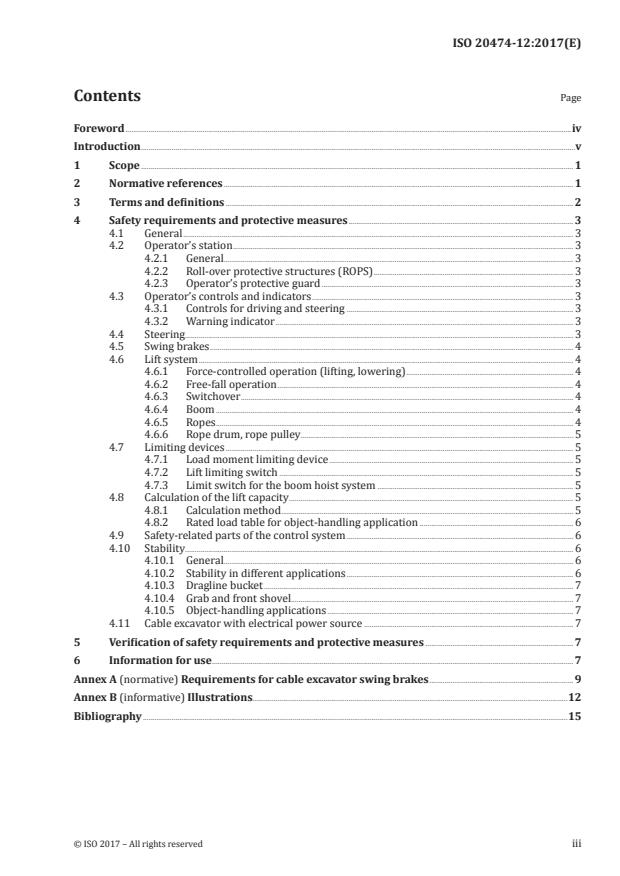
Contents Page
Foreword .iv
Introduction .v
1 Scope . 1
2 Normative references . 1
3 Terms and definitions . 2
4 Safety requirements and protective measures . 3
4.1 General . 3
4.2 Operator’s station . 3
4.2.1 General. 3
4.2.2 Roll-over protective structures (ROPS) . 3
4.2.3 Operator’s protective guard . 3
4.3 Operator’s controls and indicators . 3
4.3.1 Controls for driving and steering . 3
4.3.2 Warning indicator . 3
4.4 Steering . 3
4.5 Swing brakes . 4
4.6 Lift system . 4
4.6.1 Force-controlled operation (lifting, lowering) . 4
4.6.2 Free-fall operation . 4
4.6.3 Switchover . 4
4.6.4 Boom . 4
4.6.5 Ropes . 4
4.6.6 Rope drum, rope pulley . . 5
4.7 Limiting devices . 5
4.7.1 Load moment limiting device . 5
4.7.2 Lift limiting switch . 5
4.7.3 Limit switch for the boom hoist system . 5
4.8 Calculation of the lift capacity . 5
4.8.1 Calculation method . 5
4.8.2 Rated load table for object-handling application . 6
4.9 Safety-related parts of the control system . 6
4.10 Stability . 6
4.10.1 General. 6
4.10.2 Stability in different applications . 6
4.10.3 Dragline bucket . 7
4.10.4 Grab and front shovel. 7
4.10.5 Object-handling applications . 7
4.11 Cable excavator with electrical power source . 7
5 Verification of safety requirements and protective measures . 7
6 Information for use . 7
Annex A (normative) Requirements for cable excavator swing brakes . 9
Annex B (informative) Illustrations.12
Bibliography .15
Foreword
ISO (the International Organization for Standardization) is a worldwide federation of national standards
bodies (ISO member bodies). The work of preparing International Standards is normally carried out
through ISO technical committees. Each member body interested in a subject for which a technical
committee has been established has the right to be represented on that committee. International
organizations, governmental and non-governmental, in liaison with ISO, also take part in the work.
ISO collaborates closely with the International Electrotechnical Commission (IEC) on all matters of
electrotechnical standardization.
The procedures used to develop this document and those intended for its further maintenance are
described in the ISO/IEC Directives, Part 1. In particular the different approval criteria needed for the
different types of ISO documents should be noted. This document was drafted in accordance with the
editorial rules of the ISO/IEC Directives, Part 2 (see www .iso .org/ directives).
Attention is drawn to the possibility that some of the elements of this document may be the subject of
patent rights. ISO shall not be held responsible for identifying any or all such patent rights. Details of
any patent rights identified during the development of the document will be in the Introduction and/or
on the ISO list of patent declarations received (see www .iso .org/ patents).
Any trade name used in this document is information given for the convenience of users and does not
constitute an endorsement.
For an explanation on the voluntary nature of standards, the meaning of ISO specific terms and
expressions related to conformity assessment, as well as information about ISO’s adherence to the
World Trade Organization (WTO) principles in the Technical Barriers to Trade (TBT) see the following
URL: w w w . i s o .org/ iso/ foreword .html
This document was prepared by Technical Committee ISO/TC 127, Earth-moving machinery,
Subcommittee SC 2, Safety, ergonomics and general requirements.
This second edition cancels and replaces the first edition (ISO 20474-12:2008), which has been
technically revised with the following changes:
— normative references have been updated;
— references to national and regional provisions in the withdrawn ISO/TS 20474-14 have been deleted;
— new safety requirements and protective measures have been added, including requirements for the
operator’s protective guard.
It is intended to be used in conjunction with ISO 20474-1.
A list of all parts in the ISO 20474 series, published under the general title, Earth-moving machinery —
Safety, can be found on the ISO website.
iv © ISO 2017 – All rights reserved
Introduction
This document is a type-C standard as stated in ISO 12100.
The machinery concerned and the extent to which hazards, hazardous situations or hazardous events
are covered are indicated in the Scope of this document.
When requirements of this type-C standard are different from those which are stated in type-A or B
standards, the requirements of this type-C standard take precedence over the requirements of the
other standards for machines that have been designed and built according to the requirements of this
type-C standard.
ISO 20474 provides acceptable safety requirements for earth-moving machinery. This standard does
not necessarily provide requirements to meet all national and regional regulatory provisions, e.g. Japan
does not allow object handling with earth-moving machinery.
INTERNATIONAL STANDARD ISO 20474-12:2017(E)
Earth-moving machinery — Safety —
Part 12:
Requirements for cable excavators
1 Scope
This document gives the safety requirements specific to cable excavators as defined in ISO 6165. It
is intended to be used in conjunction with ISO 20474-1, which specifies general safety requirements
common to two or more earth-moving machine families. The specific requirements given in this
document take precedence over the general requirements of ISO 20474-1.
This document deals with all significant hazards, hazardous situations and events relevant to the earth-
moving machinery within its scope (see ISO 20474-1:2017, Annex A) when used as intended or under
conditions of misuse reasonably foreseeable by the manufacturer. It specifies the appropriate technical
measures for eliminating or reducing risks arising from relevant hazards, hazardous situations or
events during commissioning, operation and maintenance.
It is applicable only to the machine itself if the cable excavator is intended for use in combination with
other equipment or attachments such as drill rigs and those for pile driving or extracting and moving
(e.g. rail-track, walking legs, pontoon, ship equipment or stationary undercarriages). It does not deal
with the specific hazards relevant to such additional equipment or attachments.
This document is not applicable to machines manufactured before the date of its publication.
2 Normative references
The following documents are referred to in the text in such a way that some or all of their content
constitutes requirements of this document. For dated references, only the edition cited applies. For
undated references, the latest edition of the referenced document (including any amendments) applies.
ISO 4310, Cranes — Test code and procedures
ISO 5010, Earth-moving machinery — Rubber-tyred machines — Steering requirements
ISO 6165, Earth-moving machinery — Basic types — Identification and terms and definitions
ISO 6014, Earth-moving machinery — Determination of ground speed
ISO 7546, Earth-moving machinery — Loader and front loading excavator buckets — Volumetric ratings
ISO 10262:1998, Earth-moving machinery — Hydraulic excavators — Laboratory tests and performance
requirements for operator protective guards
ISO 15219, Earth-moving machinery — Cable excavators — Terminology and commercial specifications
IEC 60204-32, Safety of machinery — Electrical equipment of machines — Part 32: Requirements for
hoisting machines
ISO 20474-1:2017, Earth-moving machinery — Safety — Part 1: General requirements
EN 791:1995, Drill rigs — Safety
3 Terms and definitions
For the purposes of this document, the terms and definitions given in ISO 20474-1, ISO 15219, and the
following, apply.
ISO and IEC maintain terminological databases for use in standardization at the following addresses:
— ISO Online browsing platform: available at http:// www .iso .org/ obp
— IEC Electropedia: available at http:// www .electropedia .org/
3.1
cable excavator
excavator having a wire-rope-operated upper structure designed primarily for excavation with a dragline
bucket, front shovel or grab, used for compacting material with a compaction plate, for demolition work
by hook or ball, and for material handling with special equipment (3.3) and attachments (3.2)
Note 1 to entry: See Annex B for illustrations.
Note 2 to entry: For the definition of excavator, see ISO 6165 or ISO 20474-5.
[SOURCE: ISO 6165:2012, 4.4.3, modified — By adding Notes 1 and 2.]
3.2
boom hoist system
boom system comprising lower, intermediate and head sections, and A-frame and boom hoist winch
systems
3.3
lift system
main winch system used for earth-moving, demolition, compaction and object-handling (e.g. with hook
assembly) applications
3.4
sw
...