

ISO 16454:2024
(Main)Space systems — Structural design — Stress analysis requirements
General Information
- Abstract
This document provides requirements for the determination of maximum stress and corresponding margin of safety under loading and defines criteria for static strength failure modes, such as rupture, collapse and detrimental yielding. This document does not cover critical-conditions-induced fatigue, creep and crack growths. Notwithstanding these limitations in scope, the results of stress calculations based on the requirements of this document are applicable to other critical condition analysis. This document is applicable to the determination of the stress/strain distribution and margins of safety in launch vehicles and spacecraft load-bearing elements design. Liquid propellant engine structures, solid propellant engine nozzles and the solid propellant itself are not covered, but liquid propellant tanks, pressure vessels and solid propellant cases are within the scope of this document. In accordance with the requirements of this document, the models, methods and procedures for stress calculation can also be applicable to the displacements and deformation calculation, as well as the calculation of loads, applied to substructures and structural elements under consideration. When this document is applied, it is assumed that temperature distribution has been determined and is used as input data.
- Status
- Published
- Publication Date
- 29-Feb-2024
- Technical Committee
- ISO/TC 20/SC 14 - Space systems and operations
- Drafting Committee
- ISO/TC 20/SC 14 - Space systems and operations
- Current Stage
- 6060 - International Standard published
- Start Date
- 01-Mar-2024
- Due Date
- 24-Aug-2024
- Completion Date
- 01-Mar-2024
Overview
ISO 16454:2024 - Space systems - Structural design - Stress analysis requirements defines uniform requirements for static stress analysis of space structures. The standard specifies how to determine maximum stress, compute margins of safety, and apply acceptance criteria for static strength failure modes such as rupture, collapse and detrimental yielding. It applies to load‑bearing elements of launch vehicles and spacecraft (including liquid propellant tanks, pressure vessels and solid propellant cases) and assumes temperature distributions are provided as input. Fatigue, creep and crack‑growth induced failures are outside its scope, although the stress results are applicable to other critical‑condition analyses.
Key topics and requirements
- Basic data: required inputs for stress analysis - structural configuration, geometry and gauges, material properties and loading data (see Clause 4.2).
- Analysis methodology & software: expectations for methodological definition and software verification for numerical stress calculations (Clause 4.3).
- Structural mathematical model: modelling rules, boundary conditions and model checks to ensure fidelity between the physical structure and the analytical model (Clauses 4.4–4.5 and Annex A).
- Failure modes: formal criteria and definitions for detrimental yielding, rupture, collapse and local buckling; guidance on identifying critical locations (Clause 4.6–4.7).
- Margins of safety: procedures for calculating allowable loads, design safety factors, limit loads and the margin of safety expression used to assess compliance (Clause 4.8).
- Reporting: minimum content and documentation required for stress analysis deliverables (Clause 4.9).
Applications and users
ISO 16454:2024 is intended for professionals involved in spacecraft structural integrity and qualification:
- Structural and mechanical engineers performing stress analysis and finite element analysis (FEA) for spacecraft and launch vehicle structures.
- Systems and design engineers setting requirements for pressure vessels, liquid propellant tanks and structural components.
- Verification, validation and test teams defining static strength acceptance criteria and documenting margins of safety.
- Suppliers and manufacturers of spaceflight hardware who must comply with standard structural design practice and produce analysis reports for procurement or certification.
Related standards
- ISO 14622 - Space systems: Structural design - Loads and induced environment (normative reference).
- ISO 14623 - Space systems: Pressure vessels and pressurized structures - Design and operation (normative reference).
Keywords: ISO 16454:2024, stress analysis, space systems, structural design, margins of safety, static strength, launch vehicle, spacecraft, finite element analysis, pressure vessels.
Relations
- Effective Date
- 27-Aug-2022
Get Certified
Connect with accredited certification bodies for this standard

BUREAU VERITAS Certification Germany
Bureau Veritas certification in Germany.

Element Materials Technology
Materials testing and product certification.

AQMS Ltd.
AQMS provides ISO certification to SMEs across the UK.
Sponsored listings
Frequently Asked Questions
ISO 16454:2024 is a standard published by the International Organization for Standardization (ISO). Its full title is "Space systems — Structural design — Stress analysis requirements". This standard covers: This document provides requirements for the determination of maximum stress and corresponding margin of safety under loading and defines criteria for static strength failure modes, such as rupture, collapse and detrimental yielding. This document does not cover critical-conditions-induced fatigue, creep and crack growths. Notwithstanding these limitations in scope, the results of stress calculations based on the requirements of this document are applicable to other critical condition analysis. This document is applicable to the determination of the stress/strain distribution and margins of safety in launch vehicles and spacecraft load-bearing elements design. Liquid propellant engine structures, solid propellant engine nozzles and the solid propellant itself are not covered, but liquid propellant tanks, pressure vessels and solid propellant cases are within the scope of this document. In accordance with the requirements of this document, the models, methods and procedures for stress calculation can also be applicable to the displacements and deformation calculation, as well as the calculation of loads, applied to substructures and structural elements under consideration. When this document is applied, it is assumed that temperature distribution has been determined and is used as input data.
This document provides requirements for the determination of maximum stress and corresponding margin of safety under loading and defines criteria for static strength failure modes, such as rupture, collapse and detrimental yielding. This document does not cover critical-conditions-induced fatigue, creep and crack growths. Notwithstanding these limitations in scope, the results of stress calculations based on the requirements of this document are applicable to other critical condition analysis. This document is applicable to the determination of the stress/strain distribution and margins of safety in launch vehicles and spacecraft load-bearing elements design. Liquid propellant engine structures, solid propellant engine nozzles and the solid propellant itself are not covered, but liquid propellant tanks, pressure vessels and solid propellant cases are within the scope of this document. In accordance with the requirements of this document, the models, methods and procedures for stress calculation can also be applicable to the displacements and deformation calculation, as well as the calculation of loads, applied to substructures and structural elements under consideration. When this document is applied, it is assumed that temperature distribution has been determined and is used as input data.
ISO 16454:2024 is classified under the following ICS (International Classification for Standards) categories: 49.140 - Space systems and operations. The ICS classification helps identify the subject area and facilitates finding related standards.
ISO 16454:2024 has the following relationships with other standards: It is inter standard links to ISO 16454:2007. Understanding these relationships helps ensure you are using the most current and applicable version of the standard.
ISO 16454:2024 is available in PDF format for immediate download after purchase. The document can be added to your cart and obtained through the secure checkout process. Digital delivery ensures instant access to the complete standard document.
Standards Content (Sample)
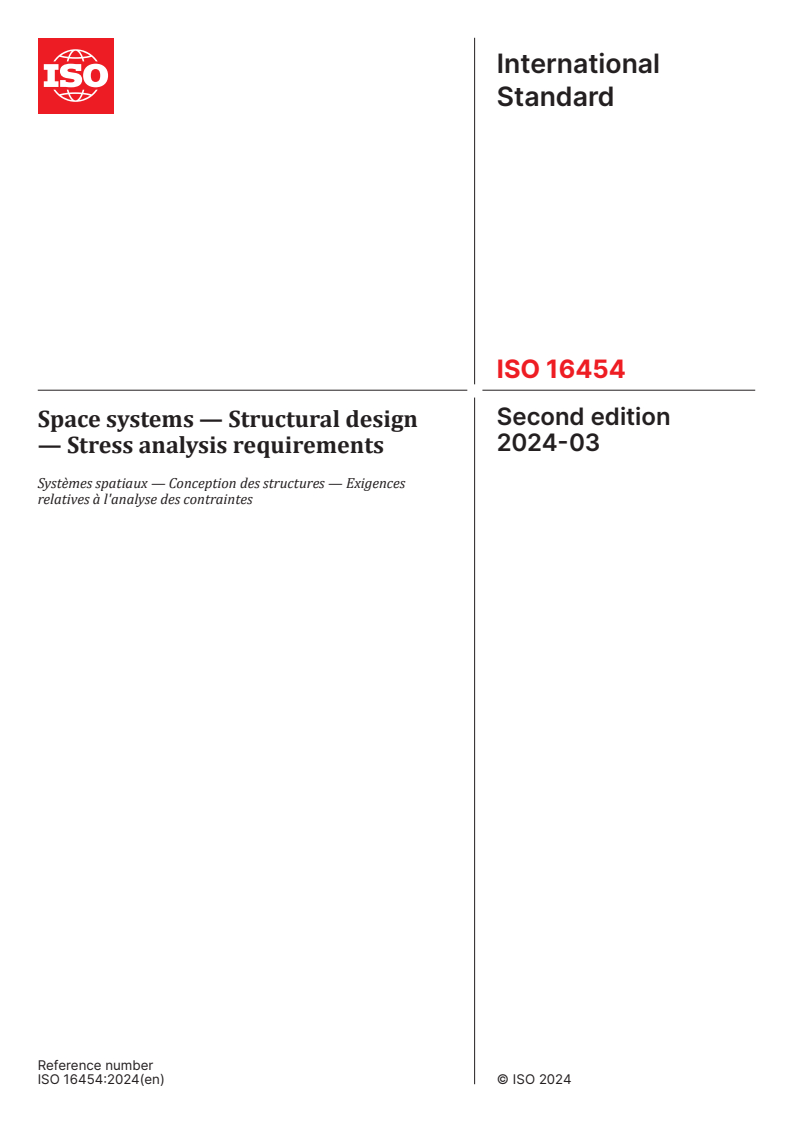
International
Standard
ISO 16454
Second edition
Space systems — Structural design
2024-03
— Stress analysis requirements
Systèmes spatiaux — Conception des structures — Exigences
relatives à l'analyse des contraintes
Reference number
© ISO 2024
All rights reserved. Unless otherwise specified, or required in the context of its implementation, no part of this publication may
be reproduced or utilized otherwise in any form or by any means, electronic or mechanical, including photocopying, or posting on
the internet or an intranet, without prior written permission. Permission can be requested from either ISO at the address below
or ISO’s member body in the country of the requester.
ISO copyright office
CP 401 • Ch. de Blandonnet 8
CH-1214 Vernier, Geneva
Phone: +41 22 749 01 11
Email: copyright@iso.org
Website: www.iso.org
Published in Switzerland
ii
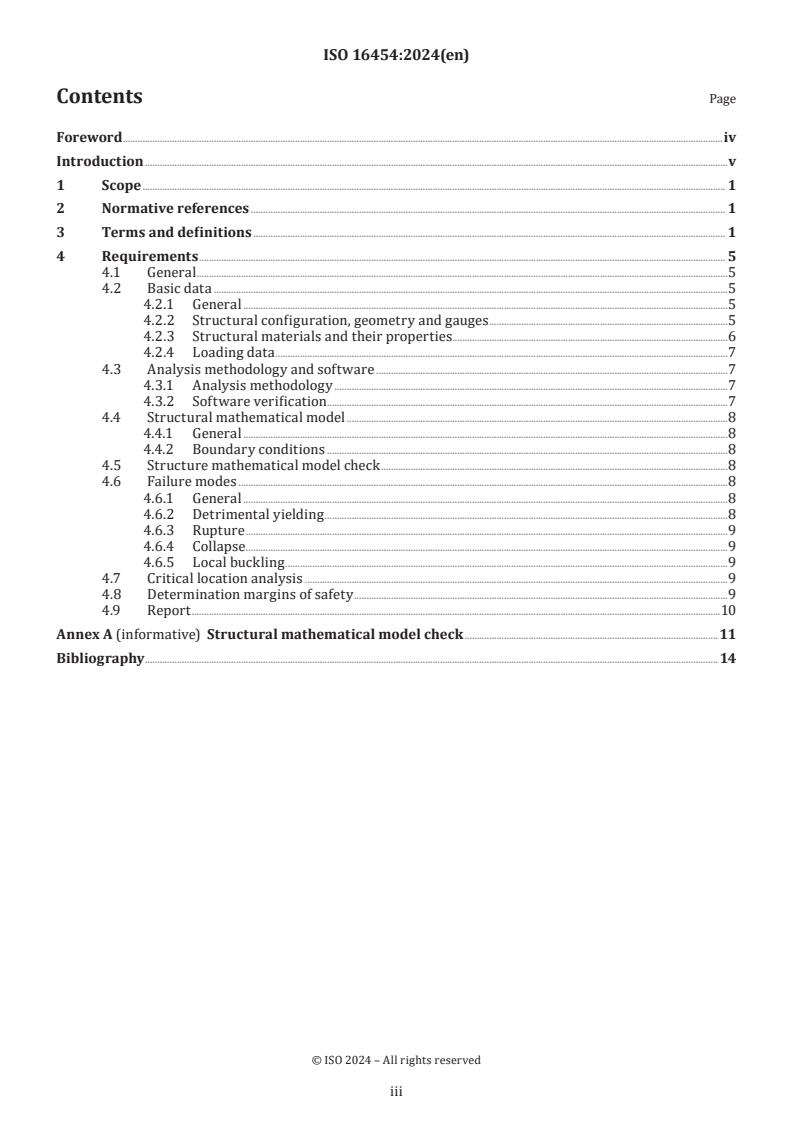
Contents Page
Foreword .iv
Introduction .v
1 Scope . 1
2 Normative references . 1
3 Terms and definitions . 1
4 Requirements . 5
4.1 General .5
4.2 Basic data .5
4.2.1 General .5
4.2.2 Structural configuration, geometry and gauges .5
4.2.3 Structural materials and their properties .6
4.2.4 Loading data .7
4.3 Analysis methodology and software .7
4.3.1 Analysis methodology .7
4.3.2 Software verification . .7
4.4 Structural mathematical model .8
4.4.1 General .8
4.4.2 Boundary conditions .8
4.5 Structure mathematical model check .8
4.6 Failure modes .8
4.6.1 General .8
4.6.2 Detrimental yielding .8
4.6.3 Rupture .9
4.6.4 Collapse .9
4.6.5 Local buckling .9
4.7 Critical location analysis .9
4.8 Determination margins of safety .9
4.9 Report .10
Annex A (informative) Structural mathematical model check .11
Bibliography . 14
iii
Foreword
ISO (the International Organization for Standardization) is a worldwide federation of national standards
bodies (ISO member bodies). The work of preparing International Standards is normally carried out through
ISO technical committees. Each member body interested in a subject for which a technical committee
has been established has the right to be represented on that committee. International organizations,
governmental and non-governmental, in liaison with ISO, also take part in the work. ISO collaborates closely
with the International Electrotechnical Commission (IEC) on all matters of electrotechnical standardization.
The procedures used to develop this document and those intended for its further maintenance are described
in the ISO/IEC Directives, Part 1. In particular, the different approval criteria needed for the different types
of ISO document should be noted. This document was drafted in accordance with the editorial rules of the
ISO/IEC Directives, Part 2 (see www.iso.org/directives).
ISO draws attention to the possibility that the implementation of this document may involve the use of (a)
patent(s). ISO takes no position concerning the evidence, validity or applicability of any claimed patent
rights in respect thereof. As of the date of publication of this document, ISO had not received notice of (a)
patent(s) which may be required to implement this document. However, implementers are cautioned that
this may not represent the latest information, which may be obtained from the patent database available at
www.iso.org/patents. ISO shall not be held responsible for identifying any or all such patent rights.
Any trade name used in this document is information given for the convenience of users and does not
constitute an endorsement.
For an explanation of the voluntary nature of standards, the meaning of ISO specific terms and expressions
related to conformity assessment, as well as information about ISO's adherence to the World Trade
Organization (WTO) principles in the Technical Barriers to Trade (TBT), see www.iso.org/iso/foreword.html.
This document was prepared by Technical Committee ISO/TC 20, Aircraft and space vehicles, Subcommittee
SC 14, Space systems and operations.
This second edition cancels and replaces the first edition (ISO 16454:2007), which has been technically
revised.
The main changes are as follows:
— updated the terms and definitions;
— updated requirements in Clause 4.
Any feedback or questions on this document should be directed to the user’s national standards body. A
complete listing of these bodies can be found at www.iso.org/members.html.
iv
Introduction
From the beginning of the space age, structural integrity verification has been one of the main fields of
activity of experts in the domain of mechanics. Mission failure and potential danger to human life, expensive
ground constructions and other public and private properties are the most probable consequences of
a space structural integrity failure. Static strength is one of the most important critical conditions for
structural integrity analysis. It is usually the main criterion for space structure weight evaluation. If the
space structure is too heavy, the mission can be extremely expensive or impossible to achieve. If the space
structure is under-designed, it can result in mission failure, structural failure, leading to high risk associated
with safety of life, and loss of expensive hardware and other properties. It is therefore necessary to specify
unique requirements for static strength analysis in order to provide cost-effective design and light-weight,
reliable and low-risk structures for space application.
v
International Standard ISO 16454:2024(en)
Space systems — Structural design — Stress analysis
requirements
1 Scope
This document provides requirements for the determination of maximum stress and corresponding margin
of safety under loading and defines criteria for static strength failure modes, such as rupture, collapse
and detrimental yielding. This document does not cover critical-conditions-induced fatigue, creep and
crack growths. Notwithstanding these limitations in scope, the results of stress calculations based on the
requirements of this document are applicable to other critical condition analysis.
This document is applicable to the determination of the stress/strain distribution and margins of safety
in launch vehicles and spacecraft load-bearing elements design. Liquid propellant engine structures,
solid propellant engine nozzles and the solid propellant itself are not covered, but liquid propellant tanks,
pressure vessels and solid propellant cases are within the scope of this document.
In accordance with the requirements of this document, the models, methods and procedures for stress
calculation can also be applicable to the displacements and deformation calculation, as well as the calculation
of loads, applied to substructures and structural elements under consideration. When this document is
applied, it is assumed that temperature distribution has been determined and is used as input data.
2 Normative references
The following documents are referred to in the text in such a way that some or all of their content constitutes
requirements of this document. For dated references, only the edition cited applies. For undated references,
the latest edition of the referenced document (including any amendments) applies.
ISO 14622, Space systems — Structural design — Loads and induced environment
ISO 14623, Space systems - Pressure vessels and pressurized structures — Design and operation
3 Terms and definitions
For the purposes of this document, the following terms and definitions apply.
ISO and IEC maintain terminology databases for use in standardization at the following addresses:
— ISO Online browsing platform: available at https:// www .iso .org/ obp
— IEC Electropedia: available at https:// www .electropedia .org/
3.1
A-basis allowable
mechanical strength value above which at least 99 % of the population of values is expected to fall, with a
confidence level of 95 %
3.2
allowable load
allowable stress
allowable strain
maximum load (3.18) that can be accommodated by a material or structure (3.31) without potential rupture
(3.25), collapse (3.5) or detrimental yielding (3.12) in a given environment
Note 1 to entry: The load can imply the corresponding stress or strain.
Note 2 to entry: Allowable loads commonly correspond to the statistically based minimum ultimate strength, buckling
strength and yield strength, respectively.
Note 3 to entry: The allowable load shall be determined in accordance with the criteria formulated in 4.6 and the
requirements of 4.2.
3.3
basic data
input data required to perform stress analysis (3.30) and to determine margins of safety
3.4
B-basis allowable
mechanical strength value above which at least 90 % of the population of values is expected to fall, with a
confidence level of 95 %
3.5
collapse
failure mode induced by quasi-static compression, shear or combined stress, accompanied by very rapid
irreversible loss of load (3.18) resistance capability
3.6
composite material
combination of materials different in composition or form on a macro scale
Note 1 to entry: The constituents retain their identities in the composite.
Note 2 to entry: The constituents can normally be physically identified; and there is an interface between them.
3.7
creep
process of a permanent material deformation resulting from long duration under constant or slowly altered
load (3.18)
Note 1 to entry: The ultimate creep deformation, corresponding to the loss of material integrity, is often much larger
than the ultimate deformation in the case of short time loading.
3.8
critical condition
most severe environmental condition in terms of load (3.18) and temperature, or combination thereof,
imposed on a structure (3.31), system, subsystem or component during its service life
3.9
critical location
structural point at which rupture (3.25), local buckling (3.20) or detrimental yielding (3.12) first leads to
structural failure
3.10
design safety factor
coefficient by which limit loads (3.17) are multiplied in order to account for the statistical variations of loads
(3.18) and structure (3.31) resistance, and inaccuracies in the knowledge of their statistical distributions
3.11
destabilizing load
load (3.18) that produces compressive stress at critical location (3.9)
3.12
detrimental yielding
〈metallic structures〉 permanent deformation specified at the system level to be detrimental
3.13
development test
test to provide design information that can be used to check the validity of analytic technique and assumed
design parameters, to uncover unexpected system response characteristics, to evaluate design changes,
to determine interface compatibility, to prove qualification and acceptance procedures and techniques, to
check manufacturing technology, or to establish accept/reject criteria
3.14
flight-type hardware test
test of a flight structure (3.31) article, a protoflight model, a representative special model or a structural
element fabricated with the same or close to flight hardware technology
3.15
gauge
thickness or other structure (3.31) dimension that affects stress levels and/or margin of safety (3.21)
significantly
3.16
knockdown coefficient
empirical coefficient, other than design safety factor (3.10), used to determine analytically actual or allowable
loads (3.2), as well as allowable stresses or strains, and defined on the basis of test results of flight-type
structures (3.31), model structures or structural elements as compared with corresponding stress analysis
(3.30) data
3.17
limit load
maximum load (3.18) that can be expected during life cycle of the structure (3.31)
3.18
load
volume force or moment, concentrated and/or distributed over the structure (3.31) surfaces or structure,
caused by its interaction with environment and adjacent parts of vehicle, and accelerations
Note 1 to entry: This includes pressure (3.23), external load and enforced displacement acted at considered structural
element, pretension, inertial load caused by accelerations and thermal gradient.
3.19
loading case
particular condition described in terms of loads (3.18), pressures and temperatures combinations, which
can occur for some parts of structure (3.31) at the same time during its service life
3.20
local buckling
failure mode that occurs when an alternative equilibrium mode of a structural element exists and can lead
to detrimental yielding (3.12) or rupture (3.25) of that element
Note 1 to entry: Local buckling is not considered as a critical condition (3.8) if the structure (3.31) can be operated
normally during and after loading.
3.21
margin of safety
M
S
L
A
M = −1
S
()fL×
L
where
L is the allowable load (3.2) under specified functional conditions [e.g. yield, rupture (3.25), collapse
A
(3.5), local buckling (3.20)];
L is the limit load (3.17);
L
f is the design safety factor (3.10)
Note 1 to entry: Load can imply corresponding stress or strain.
3.22
minimum allowable
minimum material mechanical properties warranted by the supplier
3.23
pressure
external load (3.18) caused by fluid action on a structural surface
Note 1 to entry: The terms “pressure” and “load” are sometimes referred to simultaneously in this document.
3.24
primary structure
part of a vehicle that carries the main loads (3.18) and/or defines the fundamental resonance frequencies
3.25
rupture
loss of integrity by structure (3.31) material differed from fatigue and ultimate creep (3.7) deformation
attainment, which can prevent the structure from withstanding load (3.18) combinations
3.26
semi-finished item
product that is used for structure (3.31) manufacturing or assembling
EXAMPLE Sheets, plates, profiles, strips.
3.27
stabilizing load
load (3.18) which decreases compressive stresses if applied in conjunction with destabilizing loads (3.11)
3.28
static strength
property of a structure (3.31), characterized by its capability to withstand loads (3.18) and temperature
combinations without rupture (3.25), collapse (3.5), detrimental local buckling (3.20) and detrimental yielding
(3.12)
3.29
strength failure mode
condition of a structure (3.31) or a structural element considered as a critical condition (3.8) in accordance
with stress analysis (3.30) results
3.30
stress analysis
analytical procedure to determine structure stress or strain distribution, deformations and margins of
safety
3.31
structure
primary structure (3.24), unit (3.34) attachments, pressure (3.23) or loads (3.18) carrying elements of
pressure vessels, loads carrying elements of appendages (solar panels and antennas)
3.32
structural mathematical model
analytical or digital representation of the structure (3.31), which, as it is considered, could provide an
adequate description of structure behavior when loads (3.18), pressure (3.23) and temperature are applied
Note 1 to entry: The model should provide adequate description of the structure's response under loads/pressures/
temperatures.
3.33
ultimate load
limit load (3.17) multiplied by ultimate design safety factor (3.10) used for strength verification
3.34
unit
part of a vehicle which is designed mainly to provide vehicle functioning and which differs from a structure
(3.31)
4 Requirements
4.1 General
For structures used
...