

ISO 11615:2017
(Main)Health informatics — Identification of medicinal products — Data elements and structures for the unique identification and exchange of regulated medicinal product information
General Information
- Abstract
ISO 11615:2017 establishes definitions and concepts and describes data elements and their structural relationships, which are required for the unique identification and the detailed description of Medicinal Products. Taken together, the standards listed in the Introduction define, characterise and uniquely identify regulated Medicinal Products for human use during their entire life cycle, i.e. from development to authorisation, post-marketing and renewal or withdrawal from the market, where applicable. Furthermore, to support successful information exchange in relation to the unique identification and characterisation of Medicinal Products, the use of other normative IDMP messaging standards is included, which are to be applied in the context of ISO 11615:2017.
- Status
- Published
- Publication Date
- 18-Oct-2017
- Technical Committee
- ISO/TC 215 - Health informatics
- Drafting Committee
- ISO/TC 215/WG 6 - Pharmacy and medicines business
- Current Stage
- 9092 - International Standard to be revised
- Start Date
- 29-Nov-2023
- Completion Date
- 29-Aug-2026
Buy Documents



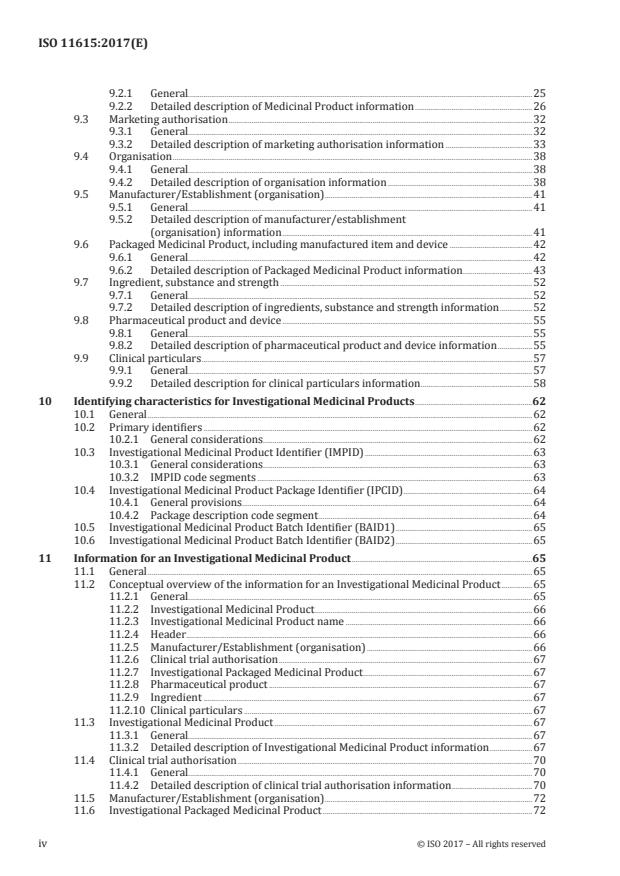
ISO 11615:2017 - Health informatics -- Identification of medicinal products -- Data elements and structures for the unique identification and exchange of regulated medicinal product information

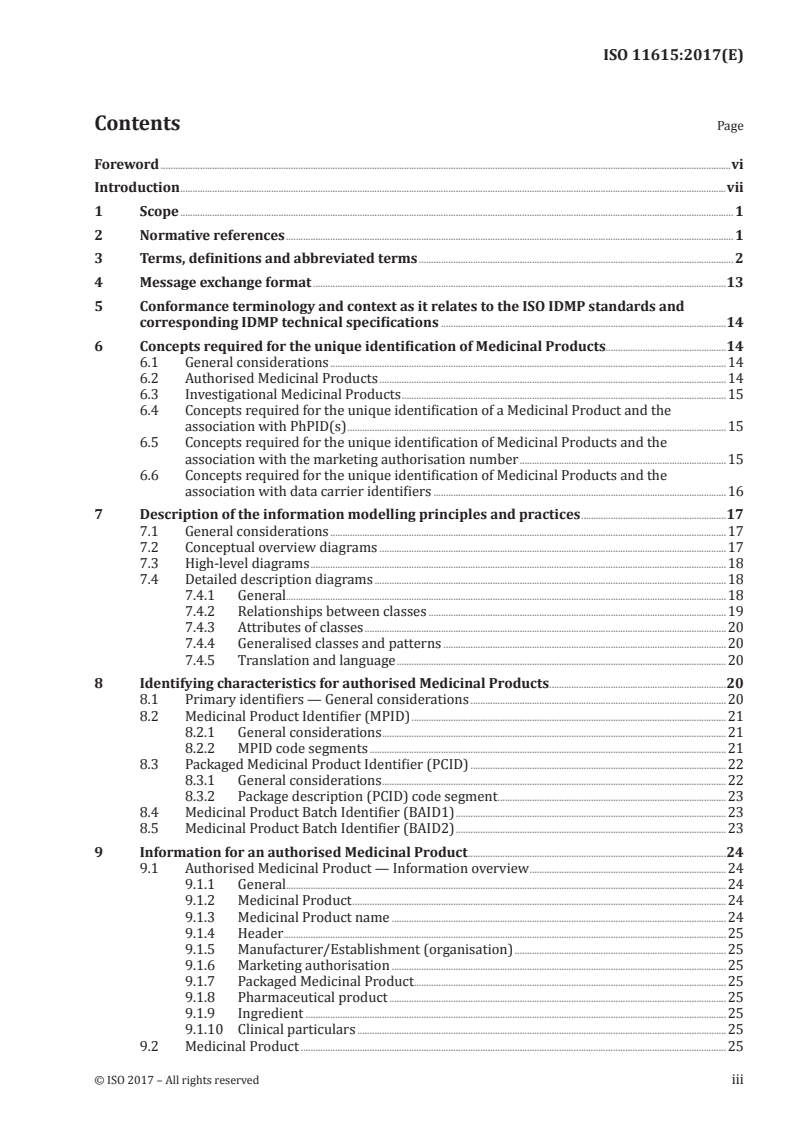
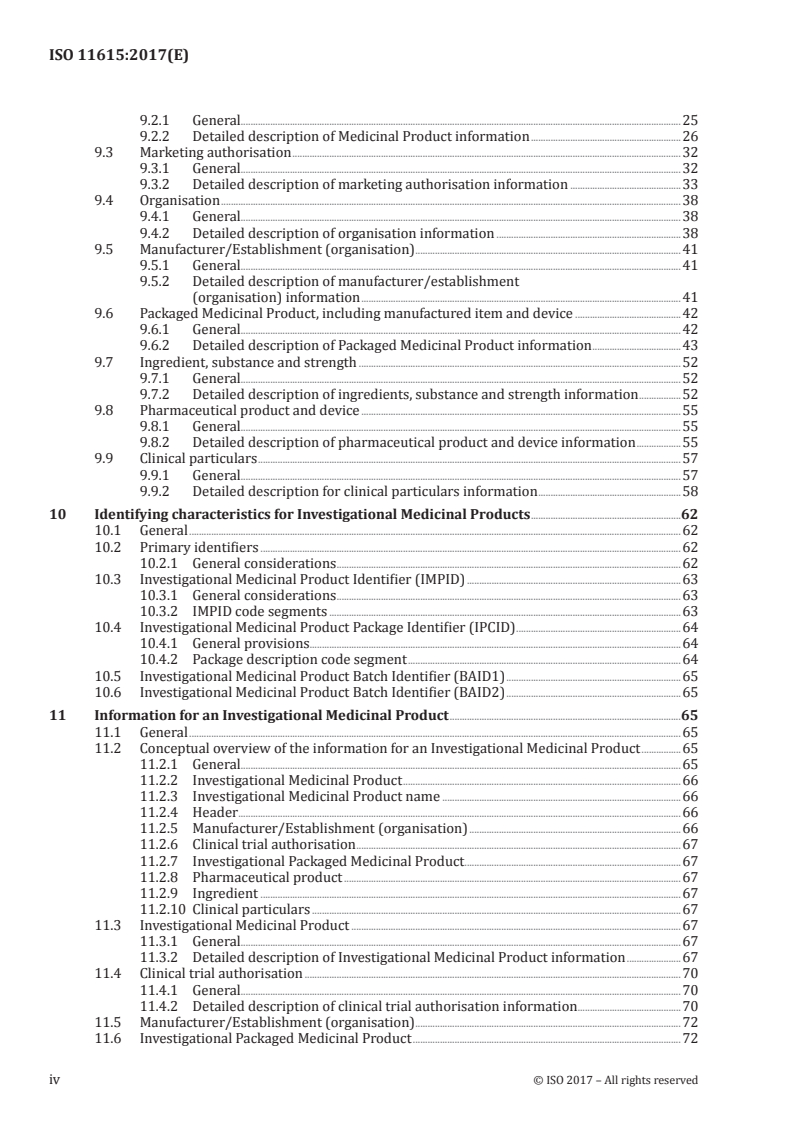
ISO 11615:2017 - Health informatics — Identification of medicinal products — Data elements and structures for the unique identification and exchange of regulated medicinal product information/19/2017


ISO 11615:2017 - Informatique de santé -- Identification des médicaments -- Éléments de données et structures pour l'identification unique et l'échange d'informations sur les médicaments contrôlés
ISO 11615:2017 - Informatique de santé — Identification des médicaments — Éléments de données et structures pour l'identification unique et l'échange d'informations sur les médicaments contrôlés/5/2018
Overview
ISO 11615:2017 - Health informatics - Identification of medicinal products - specifies the data elements and structures needed for the unique identification and exchange of regulated medicinal product information. It establishes definitions, information modelling principles, message exchange format guidance and the structural relationships of data elements that uniquely characterise regulated medicinal products for human use across their full life cycle - from development and authorisation to post‑marketing, renewal or withdrawal. ISO 11615 is part of the ISO IDMP (Identification of Medicinal Products) family and supports interoperable regulatory and clinical data exchange.
Key Topics and Technical Requirements
- Unique identifiers and code segments for authorised and investigational products, including identifiers referenced in the standard (e.g., MPID, PCID, BAID1/BAID2, IMPID, IPCID).
- Data elements and relationships describing medicinal products, packaged products, pharmaceutical products, ingredients, strengths and clinical particulars.
- Information modelling principles: conceptual overviews, high‑level and detailed diagrams, class relationships and attribute definitions to ensure consistent data structure.
- Message exchange format and conformance guidance to support interoperable data sharing between regulatory bodies, industry systems and health IT.
- Product lifecycle coverage: mapping identification and metadata needs for development, marketing authorisation, post‑marketing surveillance and withdrawal.
- Investigational medicinal product considerations and separate identifier schemes for clinical trial contexts.
- Emphasis on translation, language handling and organisation/manufacturer data required for regulatory exchange.
Applications and Who Uses ISO 11615
ISO 11615 is intended for organizations that need consistent, machine‑readable representation of regulated medicinal product information:
- Regulatory authorities for submissions, approval tracking, pharmacovigilance and product lifecycle management.
- Pharmaceutical companies and contract research organizations (CROs) for regulatory dossiers, product master data and clinical trial packaging.
- Health IT vendors, EHR/EMR integrators and interoperability architects implementing IDMP‑aligned data exchange and master data management (MDM).
- Supply chain and serialization systems that need to associate product identifiers with packaging and batch data.
- Data modelers and informaticians mapping product data to standardised schemas for analytics, safety reporting and compliance.
Related Standards
ISO 11615 is part of the broader ISO IDMP suite and is designed to be used together with other IDMP messaging standards and technical specifications to enable complete, standardised exchange of medicinal product information across regulatory and healthcare ecosystems.
Keywords: ISO 11615, IDMP, medicinal product identification, MPID, PCID, IMPID, health informatics, regulatory data exchange, unique identification, medicinal product data elements.
Relations
- Effective Date
- 25-Aug-2026
- Effective Date
- 25-Aug-2026
- Effective Date
- 08-Apr-2026
- Effective Date
- 12-Feb-2026
- Effective Date
- 11-Dec-2021
- Effective Date
- 14-Nov-2015
Buy Documents
ISO 11615:2017 - Health informatics -- Identification of medicinal products -- Data elements and structures for the unique identification and exchange of regulated medicinal product information
ISO 11615:2017 - Health informatics — Identification of medicinal products — Data elements and structures for the unique identification and exchange of regulated medicinal product information/19/2017
ISO 11615:2017 - Informatique de santé -- Identification des médicaments -- Éléments de données et structures pour l'identification unique et l'échange d'informations sur les médicaments contrôlés
ISO 11615:2017 - Informatique de santé — Identification des médicaments — Éléments de données et structures pour l'identification unique et l'échange d'informations sur les médicaments contrôlés/5/2018
Get Certified
Connect with accredited certification bodies for this standard

BSI Group
BSI (British Standards Institution) is the business standards company that helps organizations make excellence a habit.

NYCE
Mexican standards and certification body.
Sponsored listings
Frequently Asked Questions
ISO 11615:2017 is a standard published by the International Organization for Standardization (ISO). Its full title is "Health informatics — Identification of medicinal products — Data elements and structures for the unique identification and exchange of regulated medicinal product information". This standard covers: ISO 11615:2017 establishes definitions and concepts and describes data elements and their structural relationships, which are required for the unique identification and the detailed description of Medicinal Products. Taken together, the standards listed in the Introduction define, characterise and uniquely identify regulated Medicinal Products for human use during their entire life cycle, i.e. from development to authorisation, post-marketing and renewal or withdrawal from the market, where applicable. Furthermore, to support successful information exchange in relation to the unique identification and characterisation of Medicinal Products, the use of other normative IDMP messaging standards is included, which are to be applied in the context of ISO 11615:2017.
ISO 11615:2017 establishes definitions and concepts and describes data elements and their structural relationships, which are required for the unique identification and the detailed description of Medicinal Products. Taken together, the standards listed in the Introduction define, characterise and uniquely identify regulated Medicinal Products for human use during their entire life cycle, i.e. from development to authorisation, post-marketing and renewal or withdrawal from the market, where applicable. Furthermore, to support successful information exchange in relation to the unique identification and characterisation of Medicinal Products, the use of other normative IDMP messaging standards is included, which are to be applied in the context of ISO 11615:2017.
ISO 11615:2017 is classified under the following ICS (International Classification for Standards) categories: 35.240.80 - IT applications in health care technology. The ICS classification helps identify the subject area and facilitates finding related standards.
ISO 11615:2017 has the following relationships with other standards: It is inter standard links to EN ISO 11616:2017, CEN ISO/TS 22756:2020, CEN ISO/TS 16791:2020, EN ISO 11615:2017, ISO 11615:2017/Amd 1:2022, ISO 11615:2012. Understanding these relationships helps ensure you are using the most current and applicable version of the standard.
ISO 11615:2017 is available in PDF format for immediate download after purchase. The document can be added to your cart and obtained through the secure checkout process. Digital delivery ensures instant access to the complete standard document.
Standards Content (Sample)
INTERNATIONAL ISO
STANDARD 11615
Second edition
2017-10
Health informatics — Identification
of medicinal products — Data
elements and structures for the
unique identification and exchange
of regulated medicinal product
information
Informatique de santé — Identification des médicaments — Éléments
de données et structures pour l'identification unique et l'échange
d'informations sur les médicaments contrôlés
Reference number
©
ISO 2017
© ISO 2017, Published in Switzerland
All rights reserved. Unless otherwise specified, no part of this publication may be reproduced or utilized otherwise in any form
or by any means, electronic or mechanical, including photocopying, or posting on the internet or an intranet, without prior
written permission. Permission can be requested from either ISO at the address below or ISO’s member body in the country of
the requester.
ISO copyright office
Ch. de Blandonnet 8 • CP 401
CH-1214 Vernier, Geneva, Switzerland
Tel. +41 22 749 01 11
Fax +41 22 749 09 47
copyright@iso.org
www.iso.org
ii © ISO 2017 – All rights reserved
Contents Page
Foreword .vi
Introduction .vii
1 Scope . 1
2 Normative references . 1
3 Terms, definitions and abbreviated terms . 2
4 Message exchange format .13
5 Conformance terminology and context as it relates to the ISO IDMP standards and
corresponding IDMP technical specifications .14
6 Concepts required for the unique identification of Medicinal Products.14
6.1 General considerations .14
6.2 Authorised Medicinal Products .14
6.3 Investigational Medicinal Products .15
6.4 Concepts required for the unique identification of a Medicinal Product and the
association with PhPID(s) .15
6.5 Concepts required for the unique identification of Medicinal Products and the
association with the marketing authorisation number .15
6.6 Concepts required for the unique identification of Medicinal Products and the
association with data carrier identifiers .16
7 Description of the information modelling principles and practices .17
7.1 General considerations .17
7.2 Conceptual overview diagrams .17
7.3 High-level diagrams .18
7.4 Detailed description diagrams .18
7.4.1 General.18
7.4.2 Relationships between classes .19
7.4.3 Attributes of classes .20
7.4.4 Generalised classes and patterns .20
7.4.5 Translation and language .20
8 Identifying characteristics for authorised Medicinal Products.20
8.1 Primary identifiers — General considerations .20
8.2 Medicinal Product Identifier (MPID) .21
8.2.1 General considerations .21
8.2.2 MPID code segments .21
8.3 Packaged Medicinal Product Identifier (PCID) .22
8.3.1 General considerations .22
8.3.2 Package description (PCID) code segment.23
8.4 Medicinal Product Batch Identifier (BAID1) .23
8.5 Medicinal Product Batch Identifier (BAID2) .23
9 Information for an authorised Medicinal Product .24
9.1 Authorised Medicinal Product — Information overview .24
9.1.1 General.24
9.1.2 Medicinal Product .24
9.1.3 Medicinal Product name .24
9.1.4 Header .25
9.1.5 Manufacturer/Establishment (organisation) .25
9.1.6 Marketing authorisation .25
9.1.7 Packaged Medicinal Product .25
9.1.8 Pharmaceutical product .25
9.1.9 Ingredient .25
9.1.10 Clinical particulars .25
9.2 Medicinal Product .25
9.2.1 General.25
9.2.2 Detailed description of Medicinal Product information .26
9.3 Marketing authorisation .32
9.3.1 General.32
9.3.2 Detailed description of marketing authorisation information .33
9.4 Organisation .38
9.4.1 General.38
9.4.2 Detailed description of organisation information .38
9.5 Manufacturer/Establishment (organisation) .41
9.5.1 General.41
9.5.2 Detailed description of manufacturer/establishment
(organisation) information .41
9.6 Packaged Medicinal Product, including manufactured item and device .42
9.6.1 General.42
9.6.2 Detailed description of Packaged Medicinal Product information .43
9.7 Ingredient, substance and strength .52
9.7.1 General.52
9.7.2 Detailed description of ingredients, substance and strength information .52
9.8 Pharmaceutical product and device .55
9.8.1 General.55
9.8.2 Detailed description of pharmaceutical product and device information .55
9.9 Clinical particulars .57
9.9.1 General.57
9.9.2 Detailed description for clinical particulars information .58
10 Identifying characteristics for Investigational Medicinal Products .62
10.1 General .62
10.2 Primary identifiers .62
10.2.1 General considerations .62
10.3 Investigational Medicinal Product Identifier (IMPID) .63
10.3.1 General considerations .63
10.3.2 IMPID code segments .63
10.4 Investigational Medicinal Product Package Identifier (IPCID) .64
10.4.1 General provisions.64
10.4.2 Package description code segment .64
10.5 Investigational Medicinal Product Batch Identifier (BAID1) .65
10.6 Investigational Medicinal Product Batch Identifier (BAID2) .65
11 Information for an Investigational Medicinal Product .65
11.1 General .65
11.2 Conceptual overview of the information for an Investigational Medicinal Product .65
11.2.1 General.65
11.2.2 Investigational Medicinal Product .66
11.2.3 Investigational Medicinal Product name .66
11.2.4 Header .66
11.2.5 Manufacturer/Establishment (organisation) .66
11.2.6 Clinical trial authorisation .67
11.2.7 Investigational Packaged Medicinal Product .67
11.2.8 Pharmaceutical product .67
11.2.9 Ingredient .67
11.2.10 Clinical particulars .67
11.3 Investigational Medicinal Product .67
11.3.1 General.67
11.3.2 Detailed description of Investigational Medicinal Product information .67
11.4 Clinical trial authorisation .70
11.4.1 General.70
11.4.2 Detailed description of clinical trial authorisation information .70
11.5 Manufacturer/Establishment (organisation) .72
11.6 Investigational Packaged Medicinal Product .72
iv © ISO 2017 – All rights reserved
11.7 Pharmaceutical product .72
11.7.1 General.72
11.7.2 Pharmaceutical product .73
11.7.3 Dosing and route of administration .73
11.8 Ingredient .73
11.9 Clinical particulars .74
11.10 PhPID sets .74
11.11 Device nomenclature .74
11.12 Device batch identifier .74
11.13 Physical characteristics .74
11.14 Other characteristics .74
Annex A (normative) Full model — Authorised Medicinal Products detailed diagram.75
Annex B (normative) Full model — Investigational Medicinal Products detailed diagram .76
Bibliography .77
Foreword
ISO (the International Organization for Standardization) is a worldwide federation of national standards
bodies (ISO member bodies). The work of preparing International Standards is normally carried out
through ISO technical committees. Each member body interested in a subject for which a technical
committee has been established has the right to be represented on that committee. International
organizations, governmental and non-governmental, in liaison with ISO, also take part in the work.
ISO collaborates closely with the International Electrotechnical Commission (IEC) on all matters of
electrotechnical standardization.
The procedures used to develop this document and those intended for its further maintenance are
described in the ISO/IEC Directives, Part 1. In particular the different approval criteria needed for the
different types of ISO documents should be noted. This document was drafted in accordance with the
editorial rules of the ISO/IEC Directives, Part 2 (see www.iso.org/directives).
Attention is drawn to the possibility that some of the elements of this document may be the subject of
patent rights. ISO shall not be held responsible for identifying any or all such patent rights. Details of
any patent rights identified during the development of the document will be in the Introduction and/or
on the ISO list of patent declarations received (see www.iso.org/patents).
Any trade name used in this document is information given for the convenience of users and does not
constitute an endorsement.
For an explanation on the voluntary nature of standards, the meaning of ISO specific terms and
expressions related to conformity assessment, as well as information about ISO's adherence to the
World Trade Organization (WTO) principles in the Technical Barriers to Trade (TBT) see the following
URL: www.iso.org/iso/foreword.html.
This document was prepared by Technical Committee ISO/TC 215, Health informatics.
This second edition cancels and replaces the first edition (ISO 11615:2012), which has been technically
revised.
vi © ISO 2017 – All rights reserved
Introduction
This document was developed in response to a worldwide demand for internationally harmonised
specifications for Medicinal Products. It is part of a set of five ISO Standards and four ISO Technical
Specifications which together provide the basis for the unique Identification of Medicinal Products (IDMP).
These sets of standards and technical specifications comprise:
— ISO 11615
— ISO/TS 20443;
— ISO 11616;
— ISO/TS 20451;
— ISO 11238;
— ISO/TS 19844;
— ISO 11239;
— ISO/TS 20440;
— ISO 11240.
These standards and technical specifications for the identification of Medicinal Products (IDMP)
support the activities of medicines regulatory agencies worldwide by region. These include a variety
of regulatory activities related to development, registration and life cycle management of Medicinal
Products, as well as pharmacovigilance and risk management.
To meet the primary objectives of the regulation of medicines and pharmacovigilance, it is necessary
to reliably exchange Medicinal Product information in a robust and consistent manner. The IDMP
standards therefore support, at a minimum, the following interactions:
— regulatory medicines authority to regulatory medicines authority;
— pharmaceutical company to regulatory medicines authority;
— sponsor of a clinical trial to regulatory medicines authority;
— regulatory medicines authority to other stakeholders (as applicable);
— regulatory medicines authority to worldwide-maintained data sources.
The necessary messaging specifications are included as an integral part of the IDMP standards to
secure the interactions above.
Unique identifiers produced in conformance with the IDMP standards are aimed at supporting
applications where it is necessary to reliably identify and trace the use of Medicinal Products.
There are many terms in use to describe basic concepts in the regulatory, pharmaceutical and
healthcare standards development domain for different purposes and in different contexts. The terms
and definitions given in this document are to be applied for the concepts which are required to uniquely
identify, characterise and exchange regulated Medicinal Products and associated information.
The terms and definitions adopted in this document are intended to facilitate the interpretation and
application of legal and regulatory requirements.
This document has been developed in conjunction with the Common Product Model (CPM) and
Structured Product Labelling (SPL) in HL7.
In the context of exchange of regulatory information, the purpose of this document is twofold:
— to specify data elements, structures and relationships between the data elements which are required
to uniquely and with certainty identify Medicinal Products for human use;
— to specify definitions of terms for all data elements required to uniquely and with certainty identify
Medicinal Products for human use.
In addition, reference to the use of other normative IDMP and messaging standards for Medicinal
Product information is included in this document in order to support successful information exchange.
viii © ISO 2017 – All rights reserved
INTERNATIONAL STANDARD ISO 11615:2017(E)
Health informatics — Identification of medicinal
products — Data elements and structures for the unique
identification and exchange of regulated medicinal product
information
1 Scope
This document establishes definitions and concepts and describes data elements and their structural
relationships, which are required for the unique identification and the detailed description of Medicinal
Products.
Taken together, the standards listed in the Introduction define, characterise and uniquely identify
regulated Medicinal Products for human use during their entire life cycle, i.e. from development to
authorisation, post-marketing and renewal or withdrawal from the market, where applicable.
Furthermore, to support successful information exchange in relation to the unique identification
and characterisation of Medicinal Products, the use of other normative IDMP messaging standards is
included, which are to be applied in the context of this document.
2 Normative references
The following documents are referred to in the text in such a way that some or all of their content
constitutes requirements of this document. For dated references, only the edition cited applies. For
undated references, the latest edition of the referenced document (including any amendments) applies.
ISO 639-1, Codes for the representation of names of languages — Part 1: Alpha-2 code
ISO 3166-1:2013, Codes for the representation of names of countries and their subdivisions — Part 1:
Country codes
ISO 8601, Data elements and interchange formats — Information interchange — Representation of dates
and times
ISO 11238, Health informatics — Identification of Medicinal Products — Data elements and structures for
the unique identification and exchange of regulated information on substances
ISO 11239, Health informatics — Identification of Medicinal Products — Data elements and structures for
the unique identification and exchange of regulated information on pharmaceutical dose forms, units of
presentation, routes of administration and packaging
ISO 11240, Health informatics — Identification of Medicinal Products — Data elements and structures for
the unique identification and exchange of units of measurement
ISO 11616, Health informatics — Identification of Medicinal Products — Data elements and structures for
the unique identification and exchange of regulated pharmaceutical product information
ISO/TS 19844, Health informatics — Identification of Medicinal Products — Implementation guidelines
for data elements and structures for the unique identification and exchange of regulated information on
substances
ISO/TS 20440, Health informatics — Identification of Medicinal Products — Implementation guide for
ISO 11239 data elements and structures for the unique identification and exchange of regulated information
on pharmaceutical dose forms, units of presentation, routes of administration and packaging
ISO/TS 20443, Health informatics — Identification of Medicinal Products — Implementation guide for
ISO 11615 data elements and structures for the unique identification and exchange of regulated Medicinal
Product information
ISO/TS 20451, Health informatics — Identification of Medicinal Products — Implementation guide
for ISO 11616 data elements and structures for the unique identification and exchange of regulated
pharmaceutical product information
ISO/IEC 5218, Information technology — Codes for the representation of human sexes
HL7 Version 3 Standard, Structured Product Labelling
3 Terms, definitions and abbreviated terms
3.1 Terms and definitions
For the purposes of this document, the following terms and definitions apply.
ISO and IEC maintain terminological databases for use in standardization at the following addresses:
— ISO Online browsing platform: available at http://www.iso.org/obp
— IEC Electropedia: available at http://www.electropedia.org/
3.1.1
adjuvant
component that potentiates the immune response to an antigen and/or modulates it towards the
desired immune response
3.1.2
administrable dose form
pharmaceutical dose form for administration to the patient, after any necessary transformation of
the manufactured items (3.1.37) and their corresponding manufactured dose forms (3.1.36) has been
carried out
Note 1 to entry: The administrable dose form is identical to the manufactured dose form in cases where
no transformation of the manufactured item is necessary (i.e. where the manufactured item is equal to the
pharmaceutical product).
Note 2 to entry: Administered dose form and pharmaceutical administrable dose form are synonyms of
administrable dose form.
3.1.3
administration device
equipment intended for correct administration of the Medicinal Product (3.1.50)
Note 1 to entry: An administration device may be an integral part of an immediate container (3.1.27) or a closure.
[SOURCE: ENV 12610:1997]
3.1.4
allergen
material (3.1.47) of concern used as ingredient (3.1.28) or in a device capable of stimulating a type-I
hypersensitivity or allergic reaction in atopic individuals
3.1.5
authorisation date
date when the authorisation was granted by a Medicines Regulatory Agency (3.1.56) following a specific
regulatory activity
2 © ISO 2017 – All rights reserved
3.1.6
authorisation procedure
formal procedure applied by a Medicines Regulatory Agency (3.1.56) to grant a marketing authorisation
(3.1.40), to amend an existing one, to extend its duration or to revoke it
Note 1 to entry: The terms authorisation procedure and marketing authorisation procedure (3.1.43) are
synonymous.
3.1.7
authorisation status
phase of the marketing authorisation (3.1.40) during its life cycle
Note 1 to entry: The status indicates a particular moment in its life cycle.
3.1.8
batch
specific quantity of a drug or other material (3.1.47) that is intended to have uniform character and
quality, within specified limits, and is produced according to a single manufacturing order during the
same cycle of manufacture
3.1.9
batch number
identifier (3.1.26) assigned to a specific batch (3.1.8) of a Medicinal Product (3.1.50) or item resulting
from a manufacturing process at a specific point of time
3.1.10
characteristic
abstraction of a property of an object
3.1.11
clinical trial
investigation in human subjects intended to discover or verify the clinical, pharmacological and/or other
pharmacodynamic effects of an investigational product(s), and/or to identify any adverse reactions to
an Investigational Medicinal Product(s) (3.1.31), and/or to study absorption, distribution, metabolism
and excretion of Investigational Medicinal Product(s) with the object of ascertaining its safety and/or
efficacy
Note 1 to entry: The terms clinical trial and clinical study are synonymous.
3.1.12
clinical trial authorisation
approval given by a Medicines Regulatory Agency (3.1.56) to conduct a clinical trial (3.1.11) in a region
(3.1.73)
3.1.13
class
set of objects that share the same specifications of features, constraints, and semantics
3.1.14
combined pharmaceutical dose form
two or more manufactured items (3.1.37) that are intended to be combined in a specific way to produce
a single pharmaceutical product, and that includes information on the manufactured dose form (3.1.36)
of each manufactured item and the administrable dose form (3.1.2) of the pharmaceutical product
3.1.15
common name
official non-proprietary or generic name recommended by the World Health Organisation (WHO), or,
if one does not exist, a non-proprietary name recommended by the region (3.1.73) within which the
name is used
Note 1 to entry: Generic name and international non-proprietary name are synonymous of common name.
[SOURCE: WHO 46th Consultation on International Nonproprietary Names (INNs) for Pharmaceutical
Substances]
3.1.16
container
item of packaging that is part of a Medicinal Product (3.1.50) and is used for storage, identification
and/or transport of the components of the Medicinal Product
3.1.17
contraindication
situations where the Medicinal Product (3.1.50) shall not be given for safety reasons
3.1.18
controlled vocabulary
finite set of values that represent the only allowed values for a data item
Note 1 to entry: The allowed values can be codes, text or numeric.
[SOURCE: CDISC Clinical Research Glossary V10.0, 2016]
3.1.19
datatype
set of distinct values, characterised by properties of those values, and by operations on those values
[SOURCE: ISO 11404:2007, 3.12]
3.1.20
device listing number
number assigned by a Medicines Regulatory Agency (3.1.56) during registration and/or listing to all
devices in commercial distribution, regardless of pre-market authorisation requirements, per regional
registration and listing requirements
3.1.21
device model number
identifier (3.1.26) assigned by a medical device manufacturer (3.1.38) to a particular design or version
of a medical device (3.1.49)
3.1.22
distributor
organisation in possession of a license covering the procuring, holding, supplying or exporting of
Medicinal Products (3.1.50), apart from supplying Medicinal Products to the public
Note 1 to entry: This is applicable to “wholesale distribution of Medicinal Products”.
3.1.23
dose
specified quantity of a medicine, to be taken at one time or at stated intervals
3.1.24
dose form
physical manifestation of a Medicinal Product (3.1.50) that contains the active ingredient(s) (3.1.28)
and/or inactive ingredient(s) that are intended to be delivered to the patient
Note 1 to entry: Dose form, dosage form and pharmaceutical dose form are synonymous. “Pharmaceutical dose
form” can refer to the administrable dose form (3.1.2) or the manufactured dose form (3.1.36).
4 © ISO 2017 – All rights reserved
3.1.25
Global Trade Item Number
GTIN
GS1 unique identifier (3.1.26) of items that are traded [e.g. pharmaceuticals, medical devices (3.1.49)] in
the supply chain
Note 1 to entry: A GTIN is used to identify any item upon which there is a need to retrieve predefined information
and that may be priced, ordered or invoiced at any point in any supply chain. GTINs may be 8, 12, 13 or 14 digits
in length.
3.1.26
identifier
description that is sufficient to represent an object in a given environment
Note 1 to entry: In the context of this document, this is a list of identifying characteristics (3.1.10) that together
unambiguously identify a Medicinal Product (3.1.50), pharmaceutical product, substance (3.1.80), specified
substance (3.1.77), route of administration (3.1.76), pharmaceutical dose form or any other element which
requires to be uniquely identified.
[SOURCE: ENV 12610:1997]
3.1.27
immediate container
packaging in which a manufactured item (3.1.37) or pharmaceutical product is contained and with
which it is in direct contact
Note 1 to entry: An immediate container can be fitted with or have integrated into it an administration device
(3.1.3) and/or closure. A pharmaceutical dose form can fulfil the role of an immediate container, e.g. a capsule
containing a powder for inhalation; the capsule in this case is not a container (3.1.16). An alternative, compatible
definition of immediate container (“immediate packaging”) is given in Directive 92/27/EEC.
[SOURCE: ENV 12610:1997]
3.1.28
ingredient
material (3.1.47) used in the preparation of a medicinal/pharmaceutical product
Note 1 to entry: The ingredient is part of a Medicinal Product (3.1.50), either alone or in combination with other
ingredients. The ingredient is also a component of a pharmaceutical product. Ingredient is equal to a substance
(3.1.80) with the indication of the specific role it is playing in the product.
3.1.29
intermediate packaging
container (3.1.16) between the outer packaging (3.1.57) and the immediate container (3.1.27)
3.1.30
invented name
proprietary name for a Medicinal Product (3.1.50) as authorised by a Medicines Regulatory Agency
(3.1.56) in a region (3.1.73)
Note 1 to entry: The term invented name is synonymous with trade name and with brand name for a Medicinal
Product.
3.1.31
Investigational Medicinal Product
pharmaceutical product or combination of pharmaceutical products or placebo(s) being tested or used
as a reference in a clinical trial (3.1.11), including products already with a marketing authorisation
(3.1.40) but used or assembled (packaged) in a way different from the authorised form, used for an
unauthorised indication, or used to gain further information about the authorised form
3.1.32
Investigational Medicinal Product Identifier
unique identifier (3.1.26) allocated to an Investigational Medicinal Product (3.1.31) supplementary to any
existing identifier as ascribed by a Medicines Regulatory Agency (3.1.56) in a region (3.1.73)/jurisdiction
(3.1.34) or a sponsor of a clinical trial (3.1.11)
Note 1 to entry: This is an alphanumeric text field.
Note 2 to entry: This is for indexing purposes and to contribute to improving patient safety by allowing for the
unique identification of Medicinal Products (3.1.50) worldwide.
3.1.33
Investigational Medicinal Product Package Identifier
unique identifier (3.1.26) allocated to an Investigational Packaged Medicinal Product at package level
supplementary to any existing identifier as ascribed by a Medicines Regulatory Agency (3.1.56) in a
region (3.1.73)/jurisdiction (3.1.34) or a sponsor of a clinical trial (3.1.11)
Note 1 to entry: This is for indexing purposes and to contribute to improving patient safety by allowing for the
unique identification of Medicinal Products (3.1.50) worldwide.
3.1.34
jurisdiction
geographical area within a country/region (3.1.73) or subject matter to which the Medicines Regulatory
Agency (3.1.56) applies
3.1.35
legal status of supply
regional/jurisdictional rule as to whether a Medicinal Product (3.1.50) is subject to a medical
prescription before it may be supplied to a patient or consumer
3.1.36
manufactured dose form
pharmaceutical dose form of a manufactured item (3.1.37) as manufactured and, where applicable,
before transformation into the pharmaceutical product
Note 1 to entry: The manufactured dose form is identical to the administrable dose form (3.1.2) in cases where
no transformation of the manufactured item is necessary (i.e. where the manufactured item is equal to the
pharmaceutical product).
3.1.37
manufactured item
qualitative (3.1.70) and quantitative composition (3.1.71) of a product as contained in the packaging of
the Medicinal Product (3.1.50) as put on the market or Investigational Medicinal Product (3.1.31) as used
in a clinical trial (3.1.11)
Note 1 to entry: A Medicinal Product (3.1.50) may contain one or more manufactured items. In many instances,
the manufactured item is equal to the pharmaceutical product. However, there are instances where the
manufactured item(s) undergo a transformation before being administered to the patient (as the pharmaceutical
product) and the two are not equal.
3.1.38
manufacturer
organisation that holds the authorisation for the manufacturing process
Note 1 to entry: Establishment is a synonym of manufacturer.
6 © ISO 2017 – All rights reserved
3.1.39
manufacturing authorisation
authorisation provided by a Medicines Regulatory Agency (3.1.56) to manufacture Medicinal Products
(3.1.50) within a region (3.1.73)
Note 1 to entry: Such authorisation may be required for both total and partial manufacture and for the various
processes of dividing up, packaging or presentation. However, such authorisation may not be required for
preparation, dividing up, changes in packaging or presentation where these processes are carried out, solely for
retail supply, by pharmacists in dispensing pharmacies or by persons legally authorised in a region to carry out
such processes.
3.1.40
marketing authorisation
authorisation issued from a Medicines Regulatory Agency (3.1.56) that allows a Medicinal Product
(3.1.50) to be placed on the market
3.1.41
marketing authorisation holder
organisation that holds the authorisation for marketing a Medicinal Product (3.1.50) in a region (3.1.73)
3.1.42
marketing authorisation number
identifier (3.1.26) assigned by a Medicines Regulatory Agency (3.1.56) to a Medicinal Product (3.1.50)
3.1.43
marketing authorisation procedure
formal procedure applied by a Medicines Regulatory Agency (3.1.56) to grant a marketing authorisation
(3.1.40), amend an existing one, extend its duration or to withdraw it
Note 1 to entry: Marketing authorisation procedure and authorisation procedure (3.1.6) are synonymous.
3.1.44
marketing start date
date when the authorised Medicinal Product is marketed in a region (3.1.73)
Note 1 to entry: The date of actual marketing of a Medicinal Product (3.1.50) is always after a marketing
authorisation (3.1.40) has been granted by a Medicines Regulatory Agency (3.1.56).
3.1.45
marketing stop date
date when the marketing of the authorised Medicinal Product is stopped in a region (3.1.73)
3.1.46
marketing status
when a Me
...
INTERNATIONAL ISO
STANDARD 11615
Second edition
2017-10
Health informatics — Identification
of medicinal products — Data
elements and structures for the
unique identification and exchange
of regulated medicinal product
information
Informatique de santé — Identification des médicaments — Éléments
de données et structures pour l'identification unique et l'échange
d'informations sur les médicaments contrôlés
Reference number
©
ISO 2017
© ISO 2017, Published in Switzerland
All rights reserved. Unless otherwise specified, no part of this publication may be reproduced or utilized otherwise in any form
or by any means, electronic or mechanical, including photocopying, or posting on the internet or an intranet, without prior
written permission. Permission can be requested from either ISO at the address below or ISO’s member body in the country of
the requester.
ISO copyright office
Ch. de Blandonnet 8 • CP 401
CH-1214 Vernier, Geneva, Switzerland
Tel. +41 22 749 01 11
Fax +41 22 749 09 47
copyright@iso.org
www.iso.org
ii © ISO 2017 – All rights reserved
Contents Page
Foreword .vi
Introduction .vii
1 Scope . 1
2 Normative references . 1
3 Terms, definitions and abbreviated terms . 2
4 Message exchange format .13
5 Conformance terminology and context as it relates to the ISO IDMP standards and
corresponding IDMP technical specifications .14
6 Concepts required for the unique identification of Medicinal Products.14
6.1 General considerations .14
6.2 Authorised Medicinal Products .14
6.3 Investigational Medicinal Products .15
6.4 Concepts required for the unique identification of a Medicinal Product and the
association with PhPID(s) .15
6.5 Concepts required for the unique identification of Medicinal Products and the
association with the marketing authorisation number .15
6.6 Concepts required for the unique identification of Medicinal Products and the
association with data carrier identifiers .16
7 Description of the information modelling principles and practices .17
7.1 General considerations .17
7.2 Conceptual overview diagrams .17
7.3 High-level diagrams .18
7.4 Detailed description diagrams .18
7.4.1 General.18
7.4.2 Relationships between classes .19
7.4.3 Attributes of classes .20
7.4.4 Generalised classes and patterns .20
7.4.5 Translation and language .20
8 Identifying characteristics for authorised Medicinal Products.20
8.1 Primary identifiers — General considerations .20
8.2 Medicinal Product Identifier (MPID) .21
8.2.1 General considerations .21
8.2.2 MPID code segments .21
8.3 Packaged Medicinal Product Identifier (PCID) .22
8.3.1 General considerations .22
8.3.2 Package description (PCID) code segment.23
8.4 Medicinal Product Batch Identifier (BAID1) .23
8.5 Medicinal Product Batch Identifier (BAID2) .23
9 Information for an authorised Medicinal Product .24
9.1 Authorised Medicinal Product — Information overview .24
9.1.1 General.24
9.1.2 Medicinal Product .24
9.1.3 Medicinal Product name .24
9.1.4 Header .25
9.1.5 Manufacturer/Establishment (organisation) .25
9.1.6 Marketing authorisation .25
9.1.7 Packaged Medicinal Product .25
9.1.8 Pharmaceutical product .25
9.1.9 Ingredient .25
9.1.10 Clinical particulars .25
9.2 Medicinal Product .25
9.2.1 General.25
9.2.2 Detailed description of Medicinal Product information .26
9.3 Marketing authorisation .32
9.3.1 General.32
9.3.2 Detailed description of marketing authorisation information .33
9.4 Organisation .38
9.4.1 General.38
9.4.2 Detailed description of organisation information .38
9.5 Manufacturer/Establishment (organisation) .41
9.5.1 General.41
9.5.2 Detailed description of manufacturer/establishment
(organisation) information .41
9.6 Packaged Medicinal Product, including manufactured item and device .42
9.6.1 General.42
9.6.2 Detailed description of Packaged Medicinal Product information .43
9.7 Ingredient, substance and strength .52
9.7.1 General.52
9.7.2 Detailed description of ingredients, substance and strength information .52
9.8 Pharmaceutical product and device .55
9.8.1 General.55
9.8.2 Detailed description of pharmaceutical product and device information .55
9.9 Clinical particulars .57
9.9.1 General.57
9.9.2 Detailed description for clinical particulars information .58
10 Identifying characteristics for Investigational Medicinal Products .62
10.1 General .62
10.2 Primary identifiers .62
10.2.1 General considerations .62
10.3 Investigational Medicinal Product Identifier (IMPID) .63
10.3.1 General considerations .63
10.3.2 IMPID code segments .63
10.4 Investigational Medicinal Product Package Identifier (IPCID) .64
10.4.1 General provisions.64
10.4.2 Package description code segment .64
10.5 Investigational Medicinal Product Batch Identifier (BAID1) .65
10.6 Investigational Medicinal Product Batch Identifier (BAID2) .65
11 Information for an Investigational Medicinal Product .65
11.1 General .65
11.2 Conceptual overview of the information for an Investigational Medicinal Product .65
11.2.1 General.65
11.2.2 Investigational Medicinal Product .66
11.2.3 Investigational Medicinal Product name .66
11.2.4 Header .66
11.2.5 Manufacturer/Establishment (organisation) .66
11.2.6 Clinical trial authorisation .67
11.2.7 Investigational Packaged Medicinal Product .67
11.2.8 Pharmaceutical product .67
11.2.9 Ingredient .67
11.2.10 Clinical particulars .67
11.3 Investigational Medicinal Product .67
11.3.1 General.67
11.3.2 Detailed description of Investigational Medicinal Product information .67
11.4 Clinical trial authorisation .70
11.4.1 General.70
11.4.2 Detailed description of clinical trial authorisation information .70
11.5 Manufacturer/Establishment (organisation) .72
11.6 Investigational Packaged Medicinal Product .72
iv © ISO 2017 – All rights reserved
11.7 Pharmaceutical product .72
11.7.1 General.72
11.7.2 Pharmaceutical product .73
11.7.3 Dosing and route of administration .73
11.8 Ingredient .73
11.9 Clinical particulars .74
11.10 PhPID sets .74
11.11 Device nomenclature .74
11.12 Device batch identifier .74
11.13 Physical characteristics .74
11.14 Other characteristics .74
Annex A (normative) Full model — Authorised Medicinal Products detailed diagram.75
Annex B (normative) Full model — Investigational Medicinal Products detailed diagram .76
Bibliography .77
Foreword
ISO (the International Organization for Standardization) is a worldwide federation of national standards
bodies (ISO member bodies). The work of preparing International Standards is normally carried out
through ISO technical committees. Each member body interested in a subject for which a technical
committee has been established has the right to be represented on that committee. International
organizations, governmental and non-governmental, in liaison with ISO, also take part in the work.
ISO collaborates closely with the International Electrotechnical Commission (IEC) on all matters of
electrotechnical standardization.
The procedures used to develop this document and those intended for its further maintenance are
described in the ISO/IEC Directives, Part 1. In particular the different approval criteria needed for the
different types of ISO documents should be noted. This document was drafted in accordance with the
editorial rules of the ISO/IEC Directives, Part 2 (see www.iso.org/directives).
Attention is drawn to the possibility that some of the elements of this document may be the subject of
patent rights. ISO shall not be held responsible for identifying any or all such patent rights. Details of
any patent rights identified during the development of the document will be in the Introduction and/or
on the ISO list of patent declarations received (see www.iso.org/patents).
Any trade name used in this document is information given for the convenience of users and does not
constitute an endorsement.
For an explanation on the voluntary nature of standards, the meaning of ISO specific terms and
expressions related to conformity assessment, as well as information about ISO's adherence to the
World Trade Organization (WTO) principles in the Technical Barriers to Trade (TBT) see the following
URL: www.iso.org/iso/foreword.html.
This document was prepared by Technical Committee ISO/TC 215, Health informatics.
This second edition cancels and replaces the first edition (ISO 11615:2012), which has been technically
revised.
vi © ISO 2017 – All rights reserved
Introduction
This document was developed in response to a worldwide demand for internationally harmonised
specifications for Medicinal Products. It is part of a set of five ISO Standards and four ISO Technical
Specifications which together provide the basis for the unique Identification of Medicinal Products (IDMP).
These sets of standards and technical specifications comprise:
— ISO 11615
— ISO/TS 20443;
— ISO 11616;
— ISO/TS 20451;
— ISO 11238;
— ISO/TS 19844;
— ISO 11239;
— ISO/TS 20440;
— ISO 11240.
These standards and technical specifications for the identification of Medicinal Products (IDMP)
support the activities of medicines regulatory agencies worldwide by region. These include a variety
of regulatory activities related to development, registration and life cycle management of Medicinal
Products, as well as pharmacovigilance and risk management.
To meet the primary objectives of the regulation of medicines and pharmacovigilance, it is necessary
to reliably exchange Medicinal Product information in a robust and consistent manner. The IDMP
standards therefore support, at a minimum, the following interactions:
— regulatory medicines authority to regulatory medicines authority;
— pharmaceutical company to regulatory medicines authority;
— sponsor of a clinical trial to regulatory medicines authority;
— regulatory medicines authority to other stakeholders (as applicable);
— regulatory medicines authority to worldwide-maintained data sources.
The necessary messaging specifications are included as an integral part of the IDMP standards to
secure the interactions above.
Unique identifiers produced in conformance with the IDMP standards are aimed at supporting
applications where it is necessary to reliably identify and trace the use of Medicinal Products.
There are many terms in use to describe basic concepts in the regulatory, pharmaceutical and
healthcare standards development domain for different purposes and in different contexts. The terms
and definitions given in this document are to be applied for the concepts which are required to uniquely
identify, characterise and exchange regulated Medicinal Products and associated information.
The terms and definitions adopted in this document are intended to facilitate the interpretation and
application of legal and regulatory requirements.
This document has been developed in conjunction with the Common Product Model (CPM) and
Structured Product Labelling (SPL) in HL7.
In the context of exchange of regulatory information, the purpose of this document is twofold:
— to specify data elements, structures and relationships between the data elements which are required
to uniquely and with certainty identify Medicinal Products for human use;
— to specify definitions of terms for all data elements required to uniquely and with certainty identify
Medicinal Products for human use.
In addition, reference to the use of other normative IDMP and messaging standards for Medicinal
Product information is included in this document in order to support successful information exchange.
viii © ISO 2017 – All rights reserved
INTERNATIONAL STANDARD ISO 11615:2017(E)
Health informatics — Identification of medicinal
products — Data elements and structures for the unique
identification and exchange of regulated medicinal product
information
1 Scope
This document establishes definitions and concepts and describes data elements and their structural
relationships, which are required for the unique identification and the detailed description of Medicinal
Products.
Taken together, the standards listed in the Introduction define, characterise and uniquely identify
regulated Medicinal Products for human use during their entire life cycle, i.e. from development to
authorisation, post-marketing and renewal or withdrawal from the market, where applicable.
Furthermore, to support successful information exchange in relation to the unique identification
and characterisation of Medicinal Products, the use of other normative IDMP messaging standards is
included, which are to be applied in the context of this document.
2 Normative references
The following documents are referred to in the text in such a way that some or all of their content
constitutes requirements of this document. For dated references, only the edition cited applies. For
undated references, the latest edition of the referenced document (including any amendments) applies.
ISO 639-1, Codes for the representation of names of languages — Part 1: Alpha-2 code
ISO 3166-1:2013, Codes for the representation of names of countries and their subdivisions — Part 1:
Country codes
ISO 8601, Data elements and interchange formats — Information interchange — Representation of dates
and times
ISO 11238, Health informatics — Identification of Medicinal Products — Data elements and structures for
the unique identification and exchange of regulated information on substances
ISO 11239, Health informatics — Identification of Medicinal Products — Data elements and structures for
the unique identification and exchange of regulated information on pharmaceutical dose forms, units of
presentation, routes of administration and packaging
ISO 11240, Health informatics — Identification of Medicinal Products — Data elements and structures for
the unique identification and exchange of units of measurement
ISO 11616, Health informatics — Identification of Medicinal Products — Data elements and structures for
the unique identification and exchange of regulated pharmaceutical product information
ISO/TS 19844, Health informatics — Identification of Medicinal Products — Implementation guidelines
for data elements and structures for the unique identification and exchange of regulated information on
substances
ISO/TS 20440, Health informatics — Identification of Medicinal Products — Implementation guide for
ISO 11239 data elements and structures for the unique identification and exchange of regulated information
on pharmaceutical dose forms, units of presentation, routes of administration and packaging
ISO/TS 20443, Health informatics — Identification of Medicinal Products — Implementation guide for
ISO 11615 data elements and structures for the unique identification and exchange of regulated Medicinal
Product information
ISO/TS 20451, Health informatics — Identification of Medicinal Products — Implementation guide
for ISO 11616 data elements and structures for the unique identification and exchange of regulated
pharmaceutical product information
ISO/IEC 5218, Information technology — Codes for the representation of human sexes
HL7 Version 3 Standard, Structured Product Labelling
3 Terms, definitions and abbreviated terms
3.1 Terms and definitions
For the purposes of this document, the following terms and definitions apply.
ISO and IEC maintain terminological databases for use in standardization at the following addresses:
— ISO Online browsing platform: available at http://www.iso.org/obp
— IEC Electropedia: available at http://www.electropedia.org/
3.1.1
adjuvant
component that potentiates the immune response to an antigen and/or modulates it towards the
desired immune response
3.1.2
administrable dose form
pharmaceutical dose form for administration to the patient, after any necessary transformation of
the manufactured items (3.1.37) and their corresponding manufactured dose forms (3.1.36) has been
carried out
Note 1 to entry: The administrable dose form is identical to the manufactured dose form in cases where
no transformation of the manufactured item is necessary (i.e. where the manufactured item is equal to the
pharmaceutical product).
Note 2 to entry: Administered dose form and pharmaceutical administrable dose form are synonyms of
administrable dose form.
3.1.3
administration device
equipment intended for correct administration of the Medicinal Product (3.1.50)
Note 1 to entry: An administration device may be an integral part of an immediate container (3.1.27) or a closure.
[SOURCE: ENV 12610:1997]
3.1.4
allergen
material (3.1.47) of concern used as ingredient (3.1.28) or in a device capable of stimulating a type-I
hypersensitivity or allergic reaction in atopic individuals
3.1.5
authorisation date
date when the authorisation was granted by a Medicines Regulatory Agency (3.1.56) following a specific
regulatory activity
2 © ISO 2017 – All rights reserved
3.1.6
authorisation procedure
formal procedure applied by a Medicines Regulatory Agency (3.1.56) to grant a marketing authorisation
(3.1.40), to amend an existing one, to extend its duration or to revoke it
Note 1 to entry: The terms authorisation procedure and marketing authorisation procedure (3.1.43) are
synonymous.
3.1.7
authorisation status
phase of the marketing authorisation (3.1.40) during its life cycle
Note 1 to entry: The status indicates a particular moment in its life cycle.
3.1.8
batch
specific quantity of a drug or other material (3.1.47) that is intended to have uniform character and
quality, within specified limits, and is produced according to a single manufacturing order during the
same cycle of manufacture
3.1.9
batch number
identifier (3.1.26) assigned to a specific batch (3.1.8) of a Medicinal Product (3.1.50) or item resulting
from a manufacturing process at a specific point of time
3.1.10
characteristic
abstraction of a property of an object
3.1.11
clinical trial
investigation in human subjects intended to discover or verify the clinical, pharmacological and/or other
pharmacodynamic effects of an investigational product(s), and/or to identify any adverse reactions to
an Investigational Medicinal Product(s) (3.1.31), and/or to study absorption, distribution, metabolism
and excretion of Investigational Medicinal Product(s) with the object of ascertaining its safety and/or
efficacy
Note 1 to entry: The terms clinical trial and clinical study are synonymous.
3.1.12
clinical trial authorisation
approval given by a Medicines Regulatory Agency (3.1.56) to conduct a clinical trial (3.1.11) in a region
(3.1.73)
3.1.13
class
set of objects that share the same specifications of features, constraints, and semantics
3.1.14
combined pharmaceutical dose form
two or more manufactured items (3.1.37) that are intended to be combined in a specific way to produce
a single pharmaceutical product, and that includes information on the manufactured dose form (3.1.36)
of each manufactured item and the administrable dose form (3.1.2) of the pharmaceutical product
3.1.15
common name
official non-proprietary or generic name recommended by the World Health Organisation (WHO), or,
if one does not exist, a non-proprietary name recommended by the region (3.1.73) within which the
name is used
Note 1 to entry: Generic name and international non-proprietary name are synonymous of common name.
[SOURCE: WHO 46th Consultation on International Nonproprietary Names (INNs) for Pharmaceutical
Substances]
3.1.16
container
item of packaging that is part of a Medicinal Product (3.1.50) and is used for storage, identification
and/or transport of the components of the Medicinal Product
3.1.17
contraindication
situations where the Medicinal Product (3.1.50) shall not be given for safety reasons
3.1.18
controlled vocabulary
finite set of values that represent the only allowed values for a data item
Note 1 to entry: The allowed values can be codes, text or numeric.
[SOURCE: CDISC Clinical Research Glossary V10.0, 2016]
3.1.19
datatype
set of distinct values, characterised by properties of those values, and by operations on those values
[SOURCE: ISO 11404:2007, 3.12]
3.1.20
device listing number
number assigned by a Medicines Regulatory Agency (3.1.56) during registration and/or listing to all
devices in commercial distribution, regardless of pre-market authorisation requirements, per regional
registration and listing requirements
3.1.21
device model number
identifier (3.1.26) assigned by a medical device manufacturer (3.1.38) to a particular design or version
of a medical device (3.1.49)
3.1.22
distributor
organisation in possession of a license covering the procuring, holding, supplying or exporting of
Medicinal Products (3.1.50), apart from supplying Medicinal Products to the public
Note 1 to entry: This is applicable to “wholesale distribution of Medicinal Products”.
3.1.23
dose
specified quantity of a medicine, to be taken at one time or at stated intervals
3.1.24
dose form
physical manifestation of a Medicinal Product (3.1.50) that contains the active ingredient(s) (3.1.28)
and/or inactive ingredient(s) that are intended to be delivered to the patient
Note 1 to entry: Dose form, dosage form and pharmaceutical dose form are synonymous. “Pharmaceutical dose
form” can refer to the administrable dose form (3.1.2) or the manufactured dose form (3.1.36).
4 © ISO 2017 – All rights reserved
3.1.25
Global Trade Item Number
GTIN
GS1 unique identifier (3.1.26) of items that are traded [e.g. pharmaceuticals, medical devices (3.1.49)] in
the supply chain
Note 1 to entry: A GTIN is used to identify any item upon which there is a need to retrieve predefined information
and that may be priced, ordered or invoiced at any point in any supply chain. GTINs may be 8, 12, 13 or 14 digits
in length.
3.1.26
identifier
description that is sufficient to represent an object in a given environment
Note 1 to entry: In the context of this document, this is a list of identifying characteristics (3.1.10) that together
unambiguously identify a Medicinal Product (3.1.50), pharmaceutical product, substance (3.1.80), specified
substance (3.1.77), route of administration (3.1.76), pharmaceutical dose form or any other element which
requires to be uniquely identified.
[SOURCE: ENV 12610:1997]
3.1.27
immediate container
packaging in which a manufactured item (3.1.37) or pharmaceutical product is contained and with
which it is in direct contact
Note 1 to entry: An immediate container can be fitted with or have integrated into it an administration device
(3.1.3) and/or closure. A pharmaceutical dose form can fulfil the role of an immediate container, e.g. a capsule
containing a powder for inhalation; the capsule in this case is not a container (3.1.16). An alternative, compatible
definition of immediate container (“immediate packaging”) is given in Directive 92/27/EEC.
[SOURCE: ENV 12610:1997]
3.1.28
ingredient
material (3.1.47) used in the preparation of a medicinal/pharmaceutical product
Note 1 to entry: The ingredient is part of a Medicinal Product (3.1.50), either alone or in combination with other
ingredients. The ingredient is also a component of a pharmaceutical product. Ingredient is equal to a substance
(3.1.80) with the indication of the specific role it is playing in the product.
3.1.29
intermediate packaging
container (3.1.16) between the outer packaging (3.1.57) and the immediate container (3.1.27)
3.1.30
invented name
proprietary name for a Medicinal Product (3.1.50) as authorised by a Medicines Regulatory Agency
(3.1.56) in a region (3.1.73)
Note 1 to entry: The term invented name is synonymous with trade name and with brand name for a Medicinal
Product.
3.1.31
Investigational Medicinal Product
pharmaceutical product or combination of pharmaceutical products or placebo(s) being tested or used
as a reference in a clinical trial (3.1.11), including products already with a marketing authorisation
(3.1.40) but used or assembled (packaged) in a way different from the authorised form, used for an
unauthorised indication, or used to gain further information about the authorised form
3.1.32
Investigational Medicinal Product Identifier
unique identifier (3.1.26) allocated to an Investigational Medicinal Product (3.1.31) supplementary to any
existing identifier as ascribed by a Medicines Regulatory Agency (3.1.56) in a region (3.1.73)/jurisdiction
(3.1.34) or a sponsor of a clinical trial (3.1.11)
Note 1 to entry: This is an alphanumeric text field.
Note 2 to entry: This is for indexing purposes and to contribute to improving patient safety by allowing for the
unique identification of Medicinal Products (3.1.50) worldwide.
3.1.33
Investigational Medicinal Product Package Identifier
unique identifier (3.1.26) allocated to an Investigational Packaged Medicinal Product at package level
supplementary to any existing identifier as ascribed by a Medicines Regulatory Agency (3.1.56) in a
region (3.1.73)/jurisdiction (3.1.34) or a sponsor of a clinical trial (3.1.11)
Note 1 to entry: This is for indexing purposes and to contribute to improving patient safety by allowing for the
unique identification of Medicinal Products (3.1.50) worldwide.
3.1.34
jurisdiction
geographical area within a country/region (3.1.73) or subject matter to which the Medicines Regulatory
Agency (3.1.56) applies
3.1.35
legal status of supply
regional/jurisdictional rule as to whether a Medicinal Product (3.1.50) is subject to a medical
prescription before it may be supplied to a patient or consumer
3.1.36
manufactured dose form
pharmaceutical dose form of a manufactured item (3.1.37) as manufactured and, where applicable,
before transformation into the pharmaceutical product
Note 1 to entry: The manufactured dose form is identical to the administrable dose form (3.1.2) in cases where
no transformation of the manufactured item is necessary (i.e. where the manufactured item is equal to the
pharmaceutical product).
3.1.37
manufactured item
qualitative (3.1.70) and quantitative composition (3.1.71) of a product as contained in the packaging of
the Medicinal Product (3.1.50) as put on the market or Investigational Medicinal Product (3.1.31) as used
in a clinical trial (3.1.11)
Note 1 to entry: A Medicinal Product (3.1.50) may contain one or more manufactured items. In many instances,
the manufactured item is equal to the pharmaceutical product. However, there are instances where the
manufactured item(s) undergo a transformation before being administered to the patient (as the pharmaceutical
product) and the two are not equal.
3.1.38
manufacturer
organisation that holds the authorisation for the manufacturing process
Note 1 to entry: Establishment is a synonym of manufacturer.
6 © ISO 2017 – All rights reserved
3.1.39
manufacturing authorisation
authorisation provided by a Medicines Regulatory Agency (3.1.56) to manufacture Medicinal Products
(3.1.50) within a region (3.1.73)
Note 1 to entry: Such authorisation may be required for both total and partial manufacture and for the various
processes of dividing up, packaging or presentation. However, such authorisation may not be required for
preparation, dividing up, changes in packaging or presentation where these processes are carried out, solely for
retail supply, by pharmacists in dispensing pharmacies or by persons legally authorised in a region to carry out
such processes.
3.1.40
marketing authorisation
authorisation issued from a Medicines Regulatory Agency (3.1.56) that allows a Medicinal Product
(3.1.50) to be placed on the market
3.1.41
marketing authorisation holder
organisation that holds the authorisation for marketing a Medicinal Product (3.1.50) in a region (3.1.73)
3.1.42
marketing authorisation number
identifier (3.1.26) assigned by a Medicines Regulatory Agency (3.1.56) to a Medicinal Product (3.1.50)
3.1.43
marketing authorisation procedure
formal procedure applied by a Medicines Regulatory Agency (3.1.56) to grant a marketing authorisation
(3.1.40), amend an existing one, extend its duration or to withdraw it
Note 1 to entry: Marketing authorisation procedure and authorisation procedure (3.1.6) are synonymous.
3.1.44
marketing start date
date when the authorised Medicinal Product is marketed in a region (3.1.73)
Note 1 to entry: The date of actual marketing of a Medicinal Product (3.1.50) is always after a marketing
authorisation (3.1.40) has been granted by a Medicines Regulatory Agency (3.1.56).
3.1.45
marketing stop date
date when the marketing of the authorised Medicinal Product is stopped in a region (3.1.73)
3.1.46
marketing status
when a Me
...
NORME ISO
INTERNATIONALE 11615
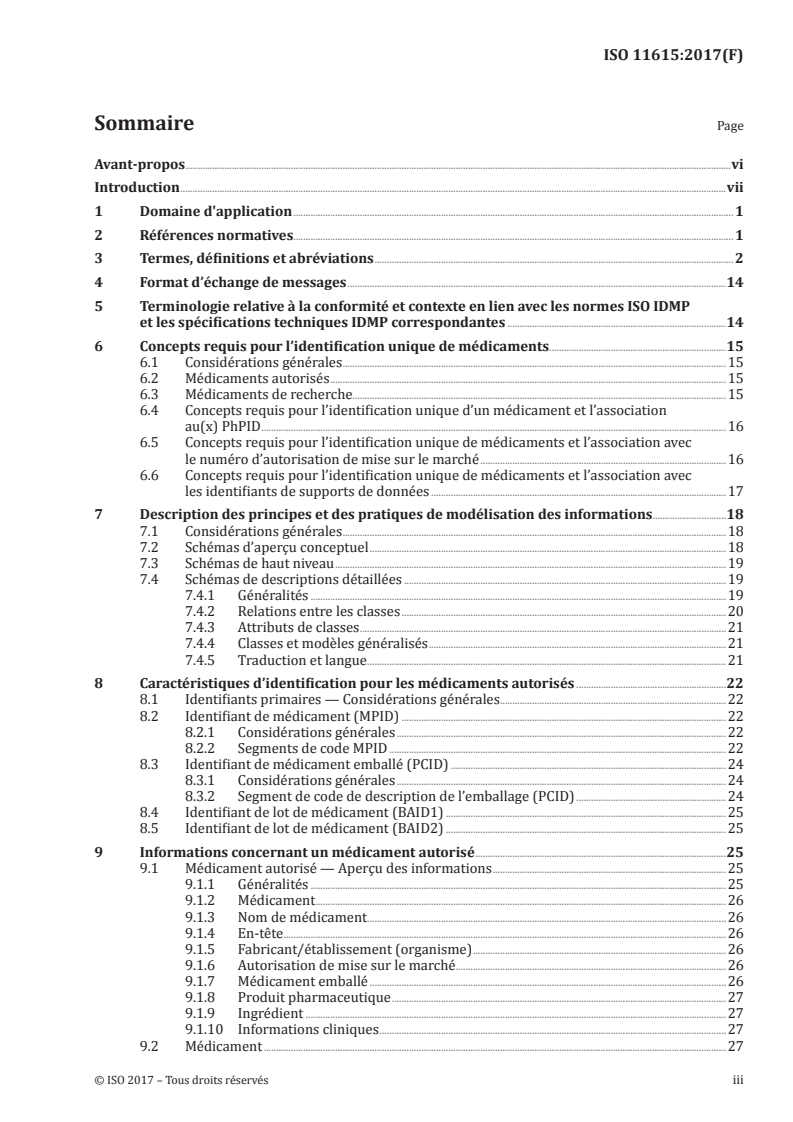
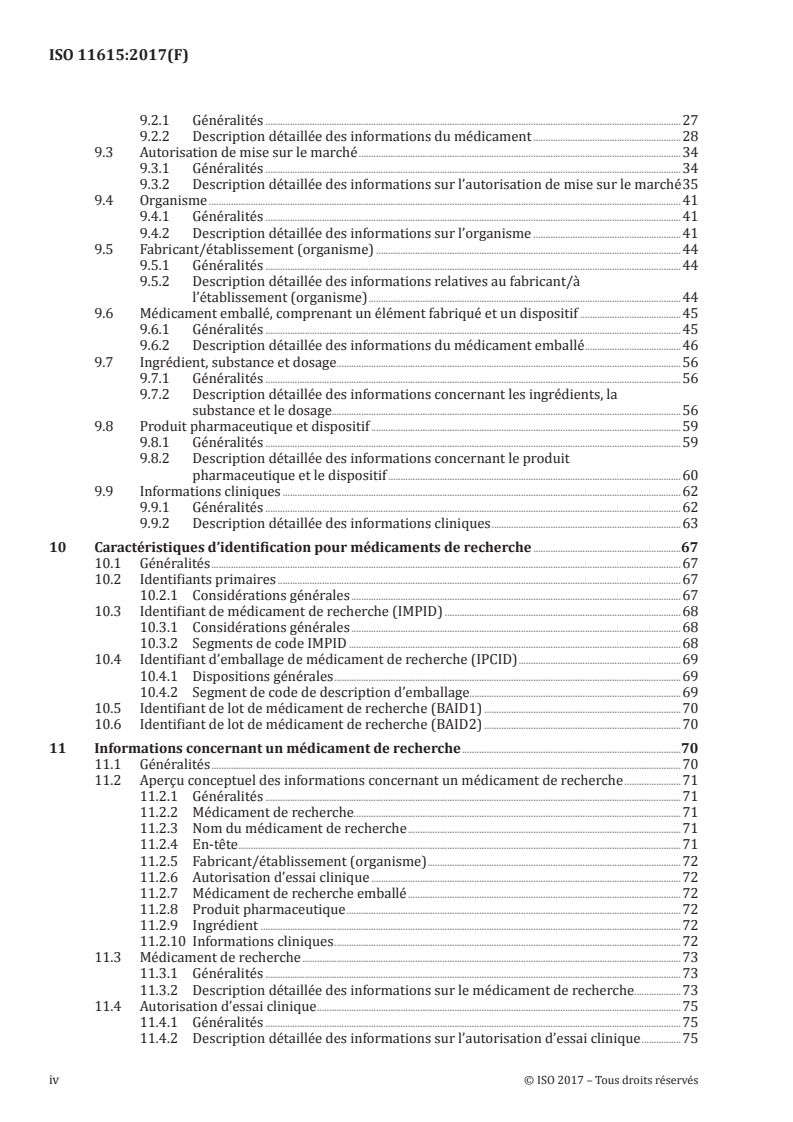
Deuxième édition
2017-10
Informatique de santé —
Identification des médicaments —
Éléments de données et structures
pour l'identification unique et
l'échange d'informations sur les
médicaments contrôlés
Health informatics — Identification of medicinal products — Data
elements and structures for the unique identification and exchange of
regulated medicinal product information
Numéro de référence
©
ISO 2017
DOCUMENT PROTÉGÉ PAR COPYRIGHT
© ISO 2017, Publié en Suisse
Droits de reproduction réservés. Sauf indication contraire, aucune partie de cette publication ne peut être reproduite ni utilisée
sous quelque forme que ce soit et par aucun procédé, électronique ou mécanique, y compris la photocopie, l’affichage sur
l’internet ou sur un Intranet, sans autorisation écrite préalable. Les demandes d’autorisation peuvent être adressées à l’ISO à
l’adresse ci-après ou au comité membre de l’ISO dans le pays du demandeur.
ISO copyright office
Ch. de Blandonnet 8 • CP 401
CH-1214 Vernier, Geneva, Switzerland
Tel. +41 22 749 01 11
Fax +41 22 749 09 47
copyright@iso.org
www.iso.org
ii © ISO 2017 – Tous droits réservés
Sommaire Page
Avant-propos .vi
Introduction .vii
1 Domaine d'application . 1
2 Références normatives . 1
3 Termes, définitions et abréviations . 2
4 Format d’échange de messages .14
5 Terminologie relative à la conformité et contexte en lien avec les normes ISO IDMP
et les spécifications techniques IDMP correspondantes .14
6 Concepts requis pour l’identification unique de médicaments.15
6.1 Considérations générales .15
6.2 Médicaments autorisés .15
6.3 Médicaments de recherche.15
6.4 Concepts requis pour l’identification unique d’un médicament et l’association
au(x) PhPID .16
6.5 Concepts requis pour l’identification unique de médicaments et l’association avec
le numéro d’autorisation de mise sur le marché .16
6.6 Concepts requis pour l’identification unique de médicaments et l’association avec
les identifiants de supports de données .17
7 Description des principes et des pratiques de modélisation des informations.18
7.1 Considérations générales .18
7.2 Schémas d’aperçu conceptuel .18
7.3 Schémas de haut niveau .19
7.4 Schémas de descriptions détaillées .19
7.4.1 Généralités .19
7.4.2 Relations entre les classes .20
7.4.3 Attributs de classes .21
7.4.4 Classes et modèles généralisés .21
7.4.5 Traduction et langue .21
8 Caractéristiques d’identification pour les médicaments autorisés .22
8.1 Identifiants primaires — Considérations générales.22
8.2 Identifiant de médicament (MPID) .22
8.2.1 Considérations générales .22
8.2.2 Segments de code MPID .22
8.3 Identifiant de médicament emballé (PCID) .24
8.3.1 Considérations générales .24
8.3.2 Segment de code de description de l’emballage (PCID) .24
8.4 Identifiant de lot de médicament (BAID1) .25
8.5 Identifiant de lot de médicament (BAID2) .25
9 Informations concernant un médicament autorisé .25
9.1 Médicament autorisé — Aperçu des informations .25
9.1.1 Généralités .25
9.1.2 Médicament .26
9.1.3 Nom de médicament . .26
9.1.4 En-tête .26
9.1.5 Fabricant/établissement (organisme) .26
9.1.6 Autorisation de mise sur le marché .26
9.1.7 Médicament emballé .26
9.1.8 Produit pharmaceutique .27
9.1.9 Ingrédient .27
9.1.10 Informations cliniques .27
9.2 Médicament .27
9.2.1 Généralités .27
9.2.2 Description détaillée des informations du médicament .28
9.3 Autorisation de mise sur le marché .34
9.3.1 Généralités .34
9.3.2 Description détaillée des informations sur l’autorisation de mise sur le marché 35
9.4 Organisme .41
9.4.1 Généralités .41
9.4.2 Description détaillée des informations sur l’organisme .41
9.5 Fabricant/établissement (organisme) .44
9.5.1 Généralités .44
9.5.2 Description détaillée des informations relatives au fabricant/à
l’établissement (organisme) .44
9.6 Médicament emballé, comprenant un élément fabriqué et un dispositif .45
9.6.1 Généralités .45
9.6.2 Description détaillée des informations du médicament emballé .46
9.7 Ingrédient, substance et dosage .56
9.7.1 Généralités .56
9.7.2 Description détaillée des informations concernant les ingrédients, la
substance et le dosage.56
9.8 Produit pharmaceutique et dispositif .59
9.8.1 Généralités .59
9.8.2 Description détaillée des informations concernant le produit
pharmaceutique et le dispositif .60
9.9 Informations cliniques .62
9.9.1 Généralités .62
9.9.2 Description détaillée des informations cliniques .63
10 Caractéristiques d’identification pour médicaments de recherche .67
10.1 Généralités .67
10.2 Identifiants primaires .67
10.2.1 Considérations générales .67
10.3 Identifiant de médicament de recherche (IMPID) .68
10.3.1 Considérations générales .68
10.3.2 Segments de code IMPID .68
10.4 Identifiant d’emballage de médicament de recherche (IPCID) .69
10.4.1 Dispositions générales .69
10.4.2 Segment de code de description d’emballage.69
10.5 Identifiant de lot de médicament de recherche (BAID1) .70
10.6 Identifiant de lot de médicament de recherche (BAID2) .70
11 Informations concernant un médicament de recherche .70
11.1 Généralités .70
11.2 Aperçu conceptuel des informations concernant un médicament de recherche .71
11.2.1 Généralités .71
11.2.2 Médicament de recherche .71
11.2.3 Nom du médicament de recherche .71
11.2.4 En-tête .71
11.2.5 Fabricant/établissement (organisme) .72
11.2.6 Autorisation d’essai clinique .72
11.2.7 Médicament de recherche emballé .72
11.2.8 Produit pharmaceutique .72
11.2.9 Ingrédient .72
11.2.10 Informations cliniques .72
11.3 Médicament de recherche .73
11.3.1 Généralités .73
11.3.2 Description détaillée des informations sur le médicament de recherche .73
11.4 Autorisation d’essai clinique .75
11.4.1 Généralités .75
11.4.2 Description détaillée des informations sur l’autorisation d’essai clinique .75
iv © ISO 2017 – Tous droits réservés
11.5 Fabricant/établissement (organisme) .78
11.6 Médicament de recherche emballé .78
11.7 Produit pharmaceutique .78
11.7.1 Généralités .78
11.7.2 Produit pharmaceutique .79
11.7.3 Dosage et voie d’administration .79
11.8 Ingrédient .79
11.9 Informations cliniques .80
11.10 Ensembles de PhPID .80
11.11 Nomenclature du dispositif .80
11.12 Identifiant de lot de dispositif .80
11.13 Caractéristiques physiques .80
11.14 Autres caractéristiques .80
Annexe A (normative) Modèle complet — Schéma détaillé des médicaments autorisés.81
Annexe B (normative) Modèle complet — Schéma détaillé des médicaments de recherche .82
Bibliographie .83
Avant-propos
L'ISO (Organisation internationale de normalisation) est une fédération mondiale d'organismes
nationaux de normalisation (comités membres de l'ISO). L'élaboration des Normes internationales est
en général confiée aux comités techniques de l'ISO. Chaque comité membre intéressé par une étude
a le droit de faire partie du comité technique créé à cet effet. Les organisations internationales,
gouvernementales et non gouvernementales, en liaison avec l'ISO participent également aux travaux.
L'ISO collabore étroitement avec la Commission électrotechnique internationale (IEC) en ce qui
concerne la normalisation électrotechnique.
Les procédures utilisées pour élaborer le présent document et celles destinées à sa mise à jour sont
décrites dans les Directives ISO/IEC, Partie 1. Il convient, en particulier de prendre note des différents
critères d'approbation requis pour les différents types de documents ISO. Le présent document a été
rédigé conformément aux règles de rédaction données dans les Directives ISO/IEC, Partie 2 (voir www.
iso.org/directives).
L'attention est attirée sur le fait que certains des éléments du présent document peuvent faire l'objet de
droits de propriété intellectuelle ou de droits analogues. L'ISO ne saurait être tenue pour responsable
de ne pas avoir identifié de tels droits de propriété et averti de leur existence. Les détails concernant
les références aux droits de propriété intellectuelle ou autres droits analogues identifiés lors de
l'élaboration du document sont indiqués dans l'Introduction et/ou dans la liste des déclarations de
brevets reçues par l'ISO (voir www.iso.org/brevets).
Les appellations commerciales éventuellement mentionnées dans le présent document sont données
pour information, par souci de commodité, à l’intention des utilisateurs et ne sauraient constituer un
engagement.
Pour une explication de la nature volontaire des normes, la signification des termes et expressions
spécifiques de l'ISO liés à l'évaluation de la conformité, ou pour toute information au sujet de l'adhésion
de l'ISO aux principes de l’Organisation mondiale du commerce (OMC) concernant les obstacles
techniques au commerce (OTC), voir le lien suivant: www.iso.org/avant-propos.
Le présent document a été élaboré par le comité technique ISO/TC 215, Informatique de santé.
Cette deuxième édition annule et remplace la première édition (ISO 11615:2012), qui a fait l’objet d’une
révision technique.
vi © ISO 2017 – Tous droits réservés
Introduction
Le présent document a été élaboré en réponse à une demande mondiale de spécifications des
médicaments qui soient harmonisées au niveau international. Il fait partie d’un groupe de cinq
normes ISO et de quatre Spécifications techniques ISO qui constituent, ensemble, la base de
l’identification unique des médicaments (IDMP).
Ce groupe de normes et de spécifications techniques comprend:
— l’ISO 11615;
— l’ISO/TS 20443;
— l’ISO 11616;
— l’ISO/TS 20451;
— l’ISO 11238;
— l’ISO/TS 19844;
— l’ISO 11239;
— l’ISO/TS 20440;
— l’ISO 11240.
Ces normes et spécifications techniques relatives à l’identification des médicaments (IDMP, pour
Identification of Medicinal Products) soutiennent les activités des agences de réglementation
des médicaments du monde entier par région. Celles-ci comprennent de nombreuses activités
réglementaires relatives au développement, à l’enregistrement et à la gestion du cycle de vie des
médicaments, ainsi qu’à la pharmacovigilance et à la gestion des risques.
Pour remplir les principaux objectifs de la réglementation des médicaments et de la pharmacovigilance,
il est nécessaire d’échanger des informations sur les médicaments d’une manière fiable, rigoureuse et
cohérente. Par conséquent, les normes IDMP soutiennent au moins les interactions suivantes:
— d’une autorité de réglementation des médicaments à une autre autorité de réglementation des
médicaments;
— d’un laboratoire pharmaceutique à une autorité de réglementation des médicaments;
— du commanditaire d’un essai clinique à une autorité de réglementation des médicaments;
— d’une autorité de réglementation des médicaments à d’autres parties prenantes (le cas échéant);
— d’une autorité de réglementation des médicaments à des sources de données gérées à l’échelle
mondiale.
Les spécifications de messagerie nécessaires sont incluses comme partie intégrante des normes IDMP
afin de sécuriser les interactions susmentionnées.
Les identifiants uniques générés conformément aux normes IDMP ont pour objectif d’appuyer des
demandes qui nécessitent d’identifier de manière fiable et d’assurer la traçabilité de l’utilisation des
médicaments.
De nombreux termes sont utilisés pour décrire des concepts de base dans le domaine de l’élaboration
de normes réglementaires, pharmaceutiques et de soins de santé, à différentes fins et dans différents
contextes. Les termes et définitions donnés dans le présent document doivent être appliqués aux
concepts requis pour identifier de façon unique, caractériser et échanger des informations réglementées
sur les médicaments et d’autres informations associées.
Les termes et définitions adoptés dans le présent document sont destinés à faciliter l’interprétation et
l’application des exigences légales et réglementaires.
Le présent document a été élaboré conjointement au modèle de produit commun (CPM, pour Common
Product Model) et à l’étiquetage structuré des produits (SPL, pour Structured Product Labeling) du HL7.
Dans le cadre d’échanges d’informations réglementaires, le présent document a deux objectifs:
— spécifier des éléments de données, des structures et des relations entre les éléments de données
nécessaires à l’identification unique et fiable des médicaments à usage humain;
— spécifier les définitions des termes pour tous les éléments de données nécessaires à l’identification
unique et fiable des médicaments à usage humain.
De plus, pour garantir l’échange satisfaisant des informations, le présent document contient une
référence à l’emploi d’autres normes IDMP et de messagerie relatives aux informations sur les
médicaments.
viii © ISO 2017 – Tous droits réservés
NORME INTERNATIONALE ISO 11615:2017(F)
Informatique de santé — Identification des médicaments
— Éléments de données et structures pour l'identification
unique et l'échange d'informations sur les médicaments
contrôlés
1 Domaine d'application
Le présent document établit des définitions et des concepts, et décrit des éléments de données et
leurs relations structurelles, nécessaires à l’identification unique et à la description détaillée des
médicaments.
Considérées ensemble, les normes listées dans l’introduction définissent, caractérisent et identifient de
façon unique des médicaments réglementés à usage humain pendant leur cycle de vie complet, c’est-à-
dire depuis leur développement jusqu’à leur autorisation, leur mise sur le marché consécutive et leur
renouvellement ou leur retrait du marché, le cas échéant.
En outre, pour garantir l’échange satisfaisant des informations relatives à l’identification unique et à la
caractérisation des médicaments, le recours à d’autres normes IDMP et de messagerie à appliquer dans
le contexte du présent document est inclus.
2 Références normatives
Les documents suivants cités dans le texte constituent, pour tout ou partie de leur contenu, des
exigences du présent document. Pour les références datées, seule l’édition citée s’applique. Pour les
références non datées, la dernière édition du document de référence s'applique (y compris les éventuels
amendements).
ISO 639-1, Codes pour la représentation des noms de langue — Partie 1: Code alpha-2
ISO 3166-1:2013, Codes pour la représentation des noms de pays et de leurs subdivisions — Partie 1:
Codes de pays
ISO 8601, Éléments de données et formats d'échange — Échange d'information — Représentation de la
date et de l'heure
ISO 11238, Informatique de santé — Identification des médicaments — Éléments de données et structures
pour l’identification unique et l’échange d’informations réglementées sur les substances
ISO 11239, Informatique de santé — Identification des médicaments — Éléments de données et
structures pour l'identification unique et l'échange d'informations réglementées sur les formes des doses
pharmaceutiques, les unités de présentation, les voies d'administration et les emballages
ISO 11240, Informatique de santé — Identification des médicaments — Éléments de données et structures
pour l'identification unique et l'échange d'informations sur les unités de mesure
ISO 11616, Informatique de santé — Identification des médicaments — Éléments de données et structures
pour l'identification unique et l'échange d'informations réglementées sur les produits pharmaceutiques
ISO/TS 19844, Informatique de santé — Identification des médicaments — Lignes directrices pour la mise
en oeuvre des éléments de données et structures pour l'identification unique et l'échange d'informations
réglementées sur les substances
ISO/TS 20440, Informatique de santé — Identification des produits médicaux — Guide de mise en oeuvre
des éléments de données et structures pour l'identification unique et l'échange d'informations réglementées
sur les formes des doses pharmaceutiques, les unités de présentation, les voies d'administration et les
emballages de l'ISO 11239
ISO/TS 20443, Informatique de santé — Identification des médicaments — Lignes directrices pour
l’implémentation des éléments de données et structures ISO 11615 pour l’identification unique et l’échange
d’informations réglementées sur les médicaments
ISO/TS 20451, Informatique de santé — Identification des médicaments — Lignes directrices pour
l’implémentation des éléments de données et structures ISO 11616 pour l’identification unique et l’échange
d’informations réglementées sur les produits pharmaceutiques
ISO/IEC 5218, Technologies de l'information — Codes de représentation des sexes humains
HL7. Version 3 Standard, Structured Product Labelling
3 Termes, définitions et abréviations
3.1 Termes et définitions
Pour les besoins du présent document, les termes et définitions suivants s’appliquent.
L’ISO et l’IEC tiennent à jour des bases de données terminologiques destinées à être utilisées en
normalisation, consultables aux adresses suivantes:
— ISO Online browsing platform: disponible à l’adresse https://www.iso.org/obp
— IEC Electropedia: disponible à l’adresse http://www.electropedia.org/
3.1.1
adjuvant
composant qui renforce la réponse immunitaire à un antigène et/ou la module vers la réponse
immunitaire souhaitée
3.1.2
forme galénique administrable
forme pharmaceutique pour administration au patient, après que toute transformation nécessaire
des éléments fabriqués (3.1.37) et de leurs formes galéniques fabriquées (3.1.36) correspondantes a été
réalisée
Note 1 à l'article: La forme galénique administrable est identique à la forme galénique fabriquée dans les cas
où aucune transformation de l’élément fabriqué n’est nécessaire (c’est-à-dire lorsque l’élément fabriqué est
équivalent au produit pharmaceutique).
Note 2 à l'article: Les termes «forme galénique administrée» et «forme galénique pharmaceutique administrable»
sont synonymes du terme «forme galénique administrable».
3.1.3
dispositif d’administration
équipement prévu pour une administration correcte du médicament (3.1.50)
Note 1 à l'article: Un dispositif d’administration peut faire partie intégrante d’un conteneur primaire (3.1.27) ou
d’un système de fermeture.
[SOURCE: ENV 12610:1997]
3.1.4
allergène
matériau (3.1.47) à surveiller utilisé comme ingrédient (3.1.28) ou dans un dispositif pouvant stimuler
une hypersensibilité de type I ou une réaction allergique chez des individus atopiques
2 © ISO 2017 – Tous droits réservés
3.1.5
date d’autorisation
date à laquelle a été accordée l’autorisation par une agence de réglementation des médicaments (3.1.56)
suite à une activité réglementaire particulière
3.1.6
procédure d’autorisation
procédure officielle appliquée par une agence de réglementation des médicaments (3.1.56) visant
à accorder une autorisation de mise sur le marché (3.1.40) ou à modifier, prolonger ou retirer une
autorisation de mise sur le marché déjà en vigueur
Note 1 à l'article: Les termes «procédure d’autorisation» et «procédure d’autorisation de mise sur le marché»
(3.1.43) sont synonymes.
3.1.7
statut d’autorisation
phase de l’autorisation de mise sur le marché (3.1.40) au cours de son cycle de vie
Note 1 à l'article: Le statut indique un moment particulier du cycle de vie.
3.1.8
lot
quantité spécifique d’un médicament ou d’un autre matériau (3.1.47) destinée à présenter un caractère
et une qualité uniformes dans des limites spécifiées et produite conformément à un ordre de fabrication
unique au cours du même cycle de fabrication
3.1.9
numéro de lot
identifiant (3.1.26) attribué à un lot (3.1.8) spécifique d’un médicament (3.1.50) ou d’un élément
résultant d’un processus de fabrication à un moment spécifique
3.1.10
caractéristique
abstraction d’une propriété d’un objet
3.1.11
essai clinique
investigation menée sur des sujets humains destinée à découvrir ou vérifier les effets cliniques,
pharmacologiques et/ou pharmacodynamiques d’un ou plusieurs produits de recherche, et/ou à
identifier tous les effets indésirables d’un ou de plusieurs médicaments de recherche (3.1.31), et/ou à
étudier l’absorption, la distribution, le métabolisme et l’élimination d’un ou de plusieurs médicaments
de recherche afin de garantir son/leur innocuité et/ou son/leur efficacité
Note 1 à l'article: Les termes «essai clinique» et «étude clinique» sont synonymes.
3.1.12
autorisation d’essai clinique
approbation donnée par une agence de réglementation des médicaments (3.1.56) pour mener un essai
clinique (3.1.11) dans une région (3.1.73)
3.1.13
classe
ensemble d’objets partageant les mêmes spécifications de caractéristiques, de contraintes et de
sémantique
3.1.14
forme pharmaceutique combinée
deux éléments fabriqués (3.1.37) ou plus, destinés à être combinés d’une manière particulière afin de
produire un seul produit pharmaceutique, et incluant des informations concernant la forme galénique
fabriquée (3.1.36) de chaque élément fabriqué, ainsi que la forme galénique administrable (3.1.2) du
produit pharmaceutique
3.1.15
nom commun
nom générique ou dénomination commune officielle recommandée par l’Organisation mondiale de la
santé (OMS), ou, si elle n’existe pas, une dénomination commune recommandée par la région (3.1.73)
dans laquelle la dénomination est utilisée
Note 1 à l'article: Les termes «nom générique» et «dénomination commune internationale» sont synonymes de
«nom commun».
e
[SOURCE: OMS, 46 consultation sur les dénominations communes internationales (DCI) pour les
substances pharmaceutiques]
3.1.16
conteneur
élément de conditionnement faisant partie du médicament (3.1.50) et utilisé pour le stockage,
l’identification et/ou le transport des composants du médicament
3.1.17
contre-indication
situation dans laquelle le médicament (3.1.50) ne doit pas être administré pour des raisons de sécurité
3.1.18
vocabulaire contrôlé
ensemble fini de valeurs représentant les seules valeurs autorisées pour un élément de données
Note 1 à l'article: Les valeurs autorisées peuvent être des codes, du texte ou des valeurs numériques.
[SOURCE: CDISC Clinical Research Glossary V10.0, 2016]
3.1.19
type de données
ensemble de valeurs distinctes, caractérisé par les propriétés de ces valeurs et par les opérations
effectuées sur ces valeurs
[SOURCE: ISO 11404:2007, 3.12]
3.1.20
numéro d’inventaire d’un dispositif
numéro attribué par une agence de réglementation des médicaments (3.1.56) au cours de l’enregistrement
et/ou de l’inventaire à tous les dispositifs distribués commercialement, indépendamment des exigences
d’autorisation préalable à la mise sur le marché, selon l’enregistrement régional et les exigences
d’inventaire
3.1.21
numéro de modèle d’un dispositif
identifiant (3.1.26) attribué par un fabricant (3.1.38) de dispositifs médicaux à une conception ou une
version particulière d’un dispositif médical (3.1.49)
3.1.22
distributeur
organisme détenteur d’une licence couvrant l’obtention, la possession, l’approvisionnement ou
l’exportation de médicaments (3.1.50), en dehors de l’approvisionnement du public en médicaments
Note 1 à l'article: Ce terme s’applique à «la distribution en gros de médicaments».
3.1.23
dose
quantité spécifiée d’un médicament, à prendre en une fois ou à intervalles fixes
4 © ISO 2017 – Tous droits réservés
3.1.24
forme galénique
manifestation physique d’un médicament (3.1.50) qui contient le ou les ingrédients (3.1.28) actifs et/ou
le ou les ingrédients inactifs destinés à être administrés au patient
Note 1 à l'article: Les termes «forme galénique» et «forme pharmaceutique» sont synonymes. Le terme «forme
pharmaceutique» peut faire référence à la forme galénique administrable (3.1.2) ou à la forme galénique fabriquée
(3.1.36).
3.1.25
code d’article international
GTIN
identifiant (3.1.26) unique GS1 d’éléments [par exemple, produits pharmaceutiques, dispositifs médicaux
(3.1.49)] mis sur le marché dans la chaîne logistique
Note 1 à l'article: Un GTIN est utilisé pour identifier tout élément au sujet duquel il est nécessaire d’obtenir des
informations prédéfinies et qui peut être tarifé, commandé ou facturé à tout moment dans une chaîne logistique.
Les GTIN peuvent être des nombres à 8, 12, 13 ou 14 chiffres.
3.1.26
identifiant
description suffisante pour représenter un objet dans un environnement donné
Note 1 à l'article: Dans le contexte du présent document, il s’agit d’une liste de caractéristiques (3.1.10)
d’identification qui, ensemble, identifient d’une manière non ambiguë un médicament (3.1.50), un produit
pharmaceutique, une substance (3.1.80), une substance spécifiée (3.1.77), une voie d’administration (3.1.76), une
forme pharmaceutique ou tout autre élément nécessitant d’être identifié de façon unique.
[SOURCE: ENV 12610:1997]
3.1.27
conteneur primaire
conditionnement renfermant un élément fabriqué (3.1.37) ou un produit pharmaceutique avec lequel il
est en contact direct
Note 1 à l'article: Un conteneur primaire peut intégrer ou être muni d’un dispositif d’administration (3.1.3)
et/ou d’un système de fermeture. Une forme pharmaceutique peut remplir le rôle de conteneur primaire, par
exemple une gélule contenant une poudre pour inhalation; dans ce cas, la gélule n’est pas un conteneur (3.1.16).
Une autre définition compatible de conteneur primaire («conditionnement primaire») est donnée dans la
Directive 92/27/CEE.
[SOURCE: ENV 12610:1997]
3.1.28
ingrédient
matériau (3.1.47) utilisé dans la préparation d’un médicament ou d’un produit pharmaceutique
Note 1 à l'article: L’ingrédient seul ou combiné à d’autres ingrédients fait partie d’un médicament (3.1.50).
L’ingrédient est aussi un composant d’un produit pharmaceutique. Un ingrédient correspond à une substance
(3.1.80) avec l’indication du rôle spécifique que celle-ci joue dans le produit.
3.1.29
conditionnement intermédiaire
conteneur (3.1.16) situé entre le conditionnement extérieur (3.1.57) et le conteneur primaire (3.1.27)
3.1.30
nom de fantaisie
nom déposé attribué à un médicament (3.1.50) tel qu’autorisé par une agence de réglementation des
médicaments (3.1.56) dans une région (3.1.73)
Note 1 à l'article: Le terme «nom de fantaisie» est synonyme de «nom commercial» et de «marque» pour un
médicament.
3.1.31
médicament de recherche
produit pharmaceutique, combinaison de produits pharmaceutiques ou placebo(s) soumis(e) à essai ou
utilisé(es) comme référence dans un essai clinique (3.1.11), comprenant des produits bénéficiant déjà
d’une autorisation de mise sur le marché (3.1.40), mais qui sont utilisés ou assemblés (emballés) d’une
manière différente de la forme autorisée, qui sont utilisés pour une indication non autorisée ou qui sont
utilisés pour obtenir davantage d’information sur la forme autorisée
3.1.32
identifiant de médicament de recherche
identifiant (3.1.26) unique attribué à un médicament de recherche (3.1.31), en plus de tout autre
identifiant existant attribué par une agence de réglementation des médicaments (3.1.56) au sein d’une
région (3.1.73)/juridiction (3.1.34) ou par le commanditaire d’un essai clinique (3.1.11)
Note 1 à l'article: Il s’agit d’un champ de texte alphanumérique.
Note 2 à l'article: Il est utilisé à des fins d’indexation et vise à renforcer la sécurité des patients en permettant
l’identification unique des médicaments (3.1.50) au niveau mondial.
3.1.33
identifiant d’emballage de médicament de recherche
identifiant (3.1.26) unique attribué à un médicament de recherche emballé au niveau de l’emballage,
en plus de tout autre identifiant existant attribué par une agence de réglementation des médicaments
(3.1.56) au sein d’une région (3.1.73)/juridiction (3.1.34) ou par le commanditaire d’un essai clinique
(3.1.11)
Note 1 à l'article: Il est utilisé à des fins d’indexation et vise à renforcer la sécurité des patients en permettant
l’identification unique des médicaments (3.1.50) au niveau mondial.
3.1.34
juridiction
zone géographique au sein d’un pays/d’une région (3.1.73) ou compétence matérielle à laquelle l’agence
de réglementation des médicaments (3.1.56) s’applique
3.1.35
statut juridique de distribution
règle d’une région/juridiction selon laquelle un médicament (3.1.50) fait l’objet ou non d’une prescription
médicale avant de pouvoir être délivré à un patient ou à un consommateur
3.1.36
forme galénique fabriquée
forme pharmaceutique d’un élément fabriqué (3.1.37) telle qu’elle est fabriquée et, le cas échéant, avant
sa transformation en produit pharmaceutique
Note 1 à l'article: La forme galénique fabriquée est identique à la forme galénique administrable (3.1.2) dans les
cas où aucune transformation de l’élément fabriqué n’est nécessaire (c’est-à-dire lorsque l’élément fabriqué est
équivalent au produit pharmaceutique).
3.1.37
élément fabriqué
composition qualitative (3.1.70) et quantitative (3.1.71) d’u
...
NORME ISO
INTERNATIONALE 11615
Deuxième édition
2017-10
Informatique de santé —
Identification des médicaments —
Éléments de données et structures
pour l'identification unique et
l'échange d'informations sur les
médicaments contrôlés
Health informatics — Identification of medicinal products — Data
elements and structures for the unique identification and exchange of
regulated medicinal product information
Numéro de référence
©
ISO 2017
DOCUMENT PROTÉGÉ PAR COPYRIGHT
© ISO 2017, Publié en Suisse
Droits de reproduction réservés. Sauf indication contraire, aucune partie de cette publication ne peut être reproduite ni utilisée
sous quelque forme que ce soit et par aucun procédé, électronique ou mécanique, y compris la photocopie, l’affichage sur
l’internet ou sur un Intranet, sans autorisation écrite préalable. Les demandes d’autorisation peuvent être adressées à l’ISO à
l’adresse ci-après ou au comité membre de l’ISO dans le pays du demandeur.
ISO copyright office
Ch. de Blandonnet 8 • CP 401
CH-1214 Vernier, Geneva, Switzerland
Tel. +41 22 749 01 11
Fax +41 22 749 09 47
copyright@iso.org
www.iso.org
ii © ISO 2017 – Tous droits réservés
Sommaire Page
Avant-propos .vi
Introduction .vii
1 Domaine d'application . 1
2 Références normatives . 1
3 Termes, définitions et abréviations . 2
4 Format d’échange de messages .14
5 Terminologie relative à la conformité et contexte en lien avec les normes ISO IDMP
et les spécifications techniques IDMP correspondantes .14
6 Concepts requis pour l’identification unique de médicaments.15
6.1 Considérations générales .15
6.2 Médicaments autorisés .15
6.3 Médicaments de recherche.15
6.4 Concepts requis pour l’identification unique d’un médicament et l’association
au(x) PhPID .16
6.5 Concepts requis pour l’identification unique de médicaments et l’association avec
le numéro d’autorisation de mise sur le marché .16
6.6 Concepts requis pour l’identification unique de médicaments et l’association avec
les identifiants de supports de données .17
7 Description des principes et des pratiques de modélisation des informations.18
7.1 Considérations générales .18
7.2 Schémas d’aperçu conceptuel .18
7.3 Schémas de haut niveau .19
7.4 Schémas de descriptions détaillées .19
7.4.1 Généralités .19
7.4.2 Relations entre les classes .20
7.4.3 Attributs de classes .21
7.4.4 Classes et modèles généralisés .21
7.4.5 Traduction et langue .21
8 Caractéristiques d’identification pour les médicaments autorisés .22
8.1 Identifiants primaires — Considérations générales.22
8.2 Identifiant de médicament (MPID) .22
8.2.1 Considérations générales .22
8.2.2 Segments de code MPID .22
8.3 Identifiant de médicament emballé (PCID) .24
8.3.1 Considérations générales .24
8.3.2 Segment de code de description de l’emballage (PCID) .24
8.4 Identifiant de lot de médicament (BAID1) .25
8.5 Identifiant de lot de médicament (BAID2) .25
9 Informations concernant un médicament autorisé .25
9.1 Médicament autorisé — Aperçu des informations .25
9.1.1 Généralités .25
9.1.2 Médicament .26
9.1.3 Nom de médicament . .26
9.1.4 En-tête .26
9.1.5 Fabricant/établissement (organisme) .26
9.1.6 Autorisation de mise sur le marché .26
9.1.7 Médicament emballé .26
9.1.8 Produit pharmaceutique .27
9.1.9 Ingrédient .27
9.1.10 Informations cliniques .27
9.2 Médicament .27
9.2.1 Généralités .27
9.2.2 Description détaillée des informations du médicament .28
9.3 Autorisation de mise sur le marché .34
9.3.1 Généralités .34
9.3.2 Description détaillée des informations sur l’autorisation de mise sur le marché 35
9.4 Organisme .41
9.4.1 Généralités .41
9.4.2 Description détaillée des informations sur l’organisme .41
9.5 Fabricant/établissement (organisme) .44
9.5.1 Généralités .44
9.5.2 Description détaillée des informations relatives au fabricant/à
l’établissement (organisme) .44
9.6 Médicament emballé, comprenant un élément fabriqué et un dispositif .45
9.6.1 Généralités .45
9.6.2 Description détaillée des informations du médicament emballé .46
9.7 Ingrédient, substance et dosage .56
9.7.1 Généralités .56
9.7.2 Description détaillée des informations concernant les ingrédients, la
substance et le dosage.56
9.8 Produit pharmaceutique et dispositif .59
9.8.1 Généralités .59
9.8.2 Description détaillée des informations concernant le produit
pharmaceutique et le dispositif .60
9.9 Informations cliniques .62
9.9.1 Généralités .62
9.9.2 Description détaillée des informations cliniques .63
10 Caractéristiques d’identification pour médicaments de recherche .67
10.1 Généralités .67
10.2 Identifiants primaires .67
10.2.1 Considérations générales .67
10.3 Identifiant de médicament de recherche (IMPID) .68
10.3.1 Considérations générales .68
10.3.2 Segments de code IMPID .68
10.4 Identifiant d’emballage de médicament de recherche (IPCID) .69
10.4.1 Dispositions générales .69
10.4.2 Segment de code de description d’emballage.69
10.5 Identifiant de lot de médicament de recherche (BAID1) .70
10.6 Identifiant de lot de médicament de recherche (BAID2) .70
11 Informations concernant un médicament de recherche .70
11.1 Généralités .70
11.2 Aperçu conceptuel des informations concernant un médicament de recherche .71
11.2.1 Généralités .71
11.2.2 Médicament de recherche .71
11.2.3 Nom du médicament de recherche .71
11.2.4 En-tête .71
11.2.5 Fabricant/établissement (organisme) .72
11.2.6 Autorisation d’essai clinique .72
11.2.7 Médicament de recherche emballé .72
11.2.8 Produit pharmaceutique .72
11.2.9 Ingrédient .72
11.2.10 Informations cliniques .72
11.3 Médicament de recherche .73
11.3.1 Généralités .73
11.3.2 Description détaillée des informations sur le médicament de recherche .73
11.4 Autorisation d’essai clinique .75
11.4.1 Généralités .75
11.4.2 Description détaillée des informations sur l’autorisation d’essai clinique .75
iv © ISO 2017 – Tous droits réservés
11.5 Fabricant/établissement (organisme) .78
11.6 Médicament de recherche emballé .78
11.7 Produit pharmaceutique .78
11.7.1 Généralités .78
11.7.2 Produit pharmaceutique .79
11.7.3 Dosage et voie d’administration .79
11.8 Ingrédient .79
11.9 Informations cliniques .80
11.10 Ensembles de PhPID .80
11.11 Nomenclature du dispositif .80
11.12 Identifiant de lot de dispositif .80
11.13 Caractéristiques physiques .80
11.14 Autres caractéristiques .80
Annexe A (normative) Modèle complet — Schéma détaillé des médicaments autorisés.81
Annexe B (normative) Modèle complet — Schéma détaillé des médicaments de recherche .82
Bibliographie .83
Avant-propos
L'ISO (Organisation internationale de normalisation) est une fédération mondiale d'organismes
nationaux de normalisation (comités membres de l'ISO). L'élaboration des Normes internationales est
en général confiée aux comités techniques de l'ISO. Chaque comité membre intéressé par une étude
a le droit de faire partie du comité technique créé à cet effet. Les organisations internationales,
gouvernementales et non gouvernementales, en liaison avec l'ISO participent également aux travaux.
L'ISO collabore étroitement avec la Commission électrotechnique internationale (IEC) en ce qui
concerne la normalisation électrotechnique.
Les procédures utilisées pour élaborer le présent document et celles destinées à sa mise à jour sont
décrites dans les Directives ISO/IEC, Partie 1. Il convient, en particulier de prendre note des différents
critères d'approbation requis pour les différents types de documents ISO. Le présent document a été
rédigé conformément aux règles de rédaction données dans les Directives ISO/IEC, Partie 2 (voir www.
iso.org/directives).
L'attention est attirée sur le fait que certains des éléments du présent document peuvent faire l'objet de
droits de propriété intellectuelle ou de droits analogues. L'ISO ne saurait être tenue pour responsable
de ne pas avoir identifié de tels droits de propriété et averti de leur existence. Les détails concernant
les références aux droits de propriété intellectuelle ou autres droits analogues identifiés lors de
l'élaboration du document sont indiqués dans l'Introduction et/ou dans la liste des déclarations de
brevets reçues par l'ISO (voir www.iso.org/brevets).
Les appellations commerciales éventuellement mentionnées dans le présent document sont données
pour information, par souci de commodité, à l’intention des utilisateurs et ne sauraient constituer un
engagement.
Pour une explication de la nature volontaire des normes, la signification des termes et expressions
spécifiques de l'ISO liés à l'évaluation de la conformité, ou pour toute information au sujet de l'adhésion
de l'ISO aux principes de l’Organisation mondiale du commerce (OMC) concernant les obstacles
techniques au commerce (OTC), voir le lien suivant: www.iso.org/avant-propos.
Le présent document a été élaboré par le comité technique ISO/TC 215, Informatique de santé.
Cette deuxième édition annule et remplace la première édition (ISO 11615:2012), qui a fait l’objet d’une
révision technique.
vi © ISO 2017 – Tous droits réservés
Introduction
Le présent document a été élaboré en réponse à une demande mondiale de spécifications des
médicaments qui soient harmonisées au niveau international. Il fait partie d’un groupe de cinq
normes ISO et de quatre Spécifications techniques ISO qui constituent, ensemble, la base de
l’identification unique des médicaments (IDMP).
Ce groupe de normes et de spécifications techniques comprend:
— l’ISO 11615;
— l’ISO/TS 20443;
— l’ISO 11616;
— l’ISO/TS 20451;
— l’ISO 11238;
— l’ISO/TS 19844;
— l’ISO 11239;
— l’ISO/TS 20440;
— l’ISO 11240.
Ces normes et spécifications techniques relatives à l’identification des médicaments (IDMP, pour
Identification of Medicinal Products) soutiennent les activités des agences de réglementation
des médicaments du monde entier par région. Celles-ci comprennent de nombreuses activités
réglementaires relatives au développement, à l’enregistrement et à la gestion du cycle de vie des
médicaments, ainsi qu’à la pharmacovigilance et à la gestion des risques.
Pour remplir les principaux objectifs de la réglementation des médicaments et de la pharmacovigilance,
il est nécessaire d’échanger des informations sur les médicaments d’une manière fiable, rigoureuse et
cohérente. Par conséquent, les normes IDMP soutiennent au moins les interactions suivantes:
— d’une autorité de réglementation des médicaments à une autre autorité de réglementation des
médicaments;
— d’un laboratoire pharmaceutique à une autorité de réglementation des médicaments;
— du commanditaire d’un essai clinique à une autorité de réglementation des médicaments;
— d’une autorité de réglementation des médicaments à d’autres parties prenantes (le cas échéant);
— d’une autorité de réglementation des médicaments à des sources de données gérées à l’échelle
mondiale.
Les spécifications de messagerie nécessaires sont incluses comme partie intégrante des normes IDMP
afin de sécuriser les interactions susmentionnées.
Les identifiants uniques générés conformément aux normes IDMP ont pour objectif d’appuyer des
demandes qui nécessitent d’identifier de manière fiable et d’assurer la traçabilité de l’utilisation des
médicaments.
De nombreux termes sont utilisés pour décrire des concepts de base dans le domaine de l’élaboration
de normes réglementaires, pharmaceutiques et de soins de santé, à différentes fins et dans différents
contextes. Les termes et définitions donnés dans le présent document doivent être appliqués aux
concepts requis pour identifier de façon unique, caractériser et échanger des informations réglementées
sur les médicaments et d’autres informations associées.
Les termes et définitions adoptés dans le présent document sont destinés à faciliter l’interprétation et
l’application des exigences légales et réglementaires.
Le présent document a été élaboré conjointement au modèle de produit commun (CPM, pour Common
Product Model) et à l’étiquetage structuré des produits (SPL, pour Structured Product Labeling) du HL7.
Dans le cadre d’échanges d’informations réglementaires, le présent document a deux objectifs:
— spécifier des éléments de données, des structures et des relations entre les éléments de données
nécessaires à l’identification unique et fiable des médicaments à usage humain;
— spécifier les définitions des termes pour tous les éléments de données nécessaires à l’identification
unique et fiable des médicaments à usage humain.
De plus, pour garantir l’échange satisfaisant des informations, le présent document contient une
référence à l’emploi d’autres normes IDMP et de messagerie relatives aux informations sur les
médicaments.
viii © ISO 2017 – Tous droits réservés
NORME INTERNATIONALE ISO 11615:2017(F)
Informatique de santé — Identification des médicaments
— Éléments de données et structures pour l'identification
unique et l'échange d'informations sur les médicaments
contrôlés
1 Domaine d'application
Le présent document établit des définitions et des concepts, et décrit des éléments de données et
leurs relations structurelles, nécessaires à l’identification unique et à la description détaillée des
médicaments.
Considérées ensemble, les normes listées dans l’introduction définissent, caractérisent et identifient de
façon unique des médicaments réglementés à usage humain pendant leur cycle de vie complet, c’est-à-
dire depuis leur développement jusqu’à leur autorisation, leur mise sur le marché consécutive et leur
renouvellement ou leur retrait du marché, le cas échéant.
En outre, pour garantir l’échange satisfaisant des informations relatives à l’identification unique et à la
caractérisation des médicaments, le recours à d’autres normes IDMP et de messagerie à appliquer dans
le contexte du présent document est inclus.
2 Références normatives
Les documents suivants cités dans le texte constituent, pour tout ou partie de leur contenu, des
exigences du présent document. Pour les références datées, seule l’édition citée s’applique. Pour les
références non datées, la dernière édition du document de référence s'applique (y compris les éventuels
amendements).
ISO 639-1, Codes pour la représentation des noms de langue — Partie 1: Code alpha-2
ISO 3166-1:2013, Codes pour la représentation des noms de pays et de leurs subdivisions — Partie 1:
Codes de pays
ISO 8601, Éléments de données et formats d'échange — Échange d'information — Représentation de la
date et de l'heure
ISO 11238, Informatique de santé — Identification des médicaments — Éléments de données et structures
pour l’identification unique et l’échange d’informations réglementées sur les substances
ISO 11239, Informatique de santé — Identification des médicaments — Éléments de données et
structures pour l'identification unique et l'échange d'informations réglementées sur les formes des doses
pharmaceutiques, les unités de présentation, les voies d'administration et les emballages
ISO 11240, Informatique de santé — Identification des médicaments — Éléments de données et structures
pour l'identification unique et l'échange d'informations sur les unités de mesure
ISO 11616, Informatique de santé — Identification des médicaments — Éléments de données et structures
pour l'identification unique et l'échange d'informations réglementées sur les produits pharmaceutiques
ISO/TS 19844, Informatique de santé — Identification des médicaments — Lignes directrices pour la mise
en oeuvre des éléments de données et structures pour l'identification unique et l'échange d'informations
réglementées sur les substances
ISO/TS 20440, Informatique de santé — Identification des produits médicaux — Guide de mise en oeuvre
des éléments de données et structures pour l'identification unique et l'échange d'informations réglementées
sur les formes des doses pharmaceutiques, les unités de présentation, les voies d'administration et les
emballages de l'ISO 11239
ISO/TS 20443, Informatique de santé — Identification des médicaments — Lignes directrices pour
l’implémentation des éléments de données et structures ISO 11615 pour l’identification unique et l’échange
d’informations réglementées sur les médicaments
ISO/TS 20451, Informatique de santé — Identification des médicaments — Lignes directrices pour
l’implémentation des éléments de données et structures ISO 11616 pour l’identification unique et l’échange
d’informations réglementées sur les produits pharmaceutiques
ISO/IEC 5218, Technologies de l'information — Codes de représentation des sexes humains
HL7. Version 3 Standard, Structured Product Labelling
3 Termes, définitions et abréviations
3.1 Termes et définitions
Pour les besoins du présent document, les termes et définitions suivants s’appliquent.
L’ISO et l’IEC tiennent à jour des bases de données terminologiques destinées à être utilisées en
normalisation, consultables aux adresses suivantes:
— ISO Online browsing platform: disponible à l’adresse https://www.iso.org/obp
— IEC Electropedia: disponible à l’adresse http://www.electropedia.org/
3.1.1
adjuvant
composant qui renforce la réponse immunitaire à un antigène et/ou la module vers la réponse
immunitaire souhaitée
3.1.2
forme galénique administrable
forme pharmaceutique pour administration au patient, après que toute transformation nécessaire
des éléments fabriqués (3.1.37) et de leurs formes galéniques fabriquées (3.1.36) correspondantes a été
réalisée
Note 1 à l'article: La forme galénique administrable est identique à la forme galénique fabriquée dans les cas
où aucune transformation de l’élément fabriqué n’est nécessaire (c’est-à-dire lorsque l’élément fabriqué est
équivalent au produit pharmaceutique).
Note 2 à l'article: Les termes «forme galénique administrée» et «forme galénique pharmaceutique administrable»
sont synonymes du terme «forme galénique administrable».
3.1.3
dispositif d’administration
équipement prévu pour une administration correcte du médicament (3.1.50)
Note 1 à l'article: Un dispositif d’administration peut faire partie intégrante d’un conteneur primaire (3.1.27) ou
d’un système de fermeture.
[SOURCE: ENV 12610:1997]
3.1.4
allergène
matériau (3.1.47) à surveiller utilisé comme ingrédient (3.1.28) ou dans un dispositif pouvant stimuler
une hypersensibilité de type I ou une réaction allergique chez des individus atopiques
2 © ISO 2017 – Tous droits réservés
3.1.5
date d’autorisation
date à laquelle a été accordée l’autorisation par une agence de réglementation des médicaments (3.1.56)
suite à une activité réglementaire particulière
3.1.6
procédure d’autorisation
procédure officielle appliquée par une agence de réglementation des médicaments (3.1.56) visant
à accorder une autorisation de mise sur le marché (3.1.40) ou à modifier, prolonger ou retirer une
autorisation de mise sur le marché déjà en vigueur
Note 1 à l'article: Les termes «procédure d’autorisation» et «procédure d’autorisation de mise sur le marché»
(3.1.43) sont synonymes.
3.1.7
statut d’autorisation
phase de l’autorisation de mise sur le marché (3.1.40) au cours de son cycle de vie
Note 1 à l'article: Le statut indique un moment particulier du cycle de vie.
3.1.8
lot
quantité spécifique d’un médicament ou d’un autre matériau (3.1.47) destinée à présenter un caractère
et une qualité uniformes dans des limites spécifiées et produite conformément à un ordre de fabrication
unique au cours du même cycle de fabrication
3.1.9
numéro de lot
identifiant (3.1.26) attribué à un lot (3.1.8) spécifique d’un médicament (3.1.50) ou d’un élément
résultant d’un processus de fabrication à un moment spécifique
3.1.10
caractéristique
abstraction d’une propriété d’un objet
3.1.11
essai clinique
investigation menée sur des sujets humains destinée à découvrir ou vérifier les effets cliniques,
pharmacologiques et/ou pharmacodynamiques d’un ou plusieurs produits de recherche, et/ou à
identifier tous les effets indésirables d’un ou de plusieurs médicaments de recherche (3.1.31), et/ou à
étudier l’absorption, la distribution, le métabolisme et l’élimination d’un ou de plusieurs médicaments
de recherche afin de garantir son/leur innocuité et/ou son/leur efficacité
Note 1 à l'article: Les termes «essai clinique» et «étude clinique» sont synonymes.
3.1.12
autorisation d’essai clinique
approbation donnée par une agence de réglementation des médicaments (3.1.56) pour mener un essai
clinique (3.1.11) dans une région (3.1.73)
3.1.13
classe
ensemble d’objets partageant les mêmes spécifications de caractéristiques, de contraintes et de
sémantique
3.1.14
forme pharmaceutique combinée
deux éléments fabriqués (3.1.37) ou plus, destinés à être combinés d’une manière particulière afin de
produire un seul produit pharmaceutique, et incluant des informations concernant la forme galénique
fabriquée (3.1.36) de chaque élément fabriqué, ainsi que la forme galénique administrable (3.1.2) du
produit pharmaceutique
3.1.15
nom commun
nom générique ou dénomination commune officielle recommandée par l’Organisation mondiale de la
santé (OMS), ou, si elle n’existe pas, une dénomination commune recommandée par la région (3.1.73)
dans laquelle la dénomination est utilisée
Note 1 à l'article: Les termes «nom générique» et «dénomination commune internationale» sont synonymes de
«nom commun».
e
[SOURCE: OMS, 46 consultation sur les dénominations communes internationales (DCI) pour les
substances pharmaceutiques]
3.1.16
conteneur
élément de conditionnement faisant partie du médicament (3.1.50) et utilisé pour le stockage,
l’identification et/ou le transport des composants du médicament
3.1.17
contre-indication
situation dans laquelle le médicament (3.1.50) ne doit pas être administré pour des raisons de sécurité
3.1.18
vocabulaire contrôlé
ensemble fini de valeurs représentant les seules valeurs autorisées pour un élément de données
Note 1 à l'article: Les valeurs autorisées peuvent être des codes, du texte ou des valeurs numériques.
[SOURCE: CDISC Clinical Research Glossary V10.0, 2016]
3.1.19
type de données
ensemble de valeurs distinctes, caractérisé par les propriétés de ces valeurs et par les opérations
effectuées sur ces valeurs
[SOURCE: ISO 11404:2007, 3.12]
3.1.20
numéro d’inventaire d’un dispositif
numéro attribué par une agence de réglementation des médicaments (3.1.56) au cours de l’enregistrement
et/ou de l’inventaire à tous les dispositifs distribués commercialement, indépendamment des exigences
d’autorisation préalable à la mise sur le marché, selon l’enregistrement régional et les exigences
d’inventaire
3.1.21
numéro de modèle d’un dispositif
identifiant (3.1.26) attribué par un fabricant (3.1.38) de dispositifs médicaux à une conception ou une
version particulière d’un dispositif médical (3.1.49)
3.1.22
distributeur
organisme détenteur d’une licence couvrant l’obtention, la possession, l’approvisionnement ou
l’exportation de médicaments (3.1.50), en dehors de l’approvisionnement du public en médicaments
Note 1 à l'article: Ce terme s’applique à «la distribution en gros de médicaments».
3.1.23
dose
quantité spécifiée d’un médicament, à prendre en une fois ou à intervalles fixes
4 © ISO 2017 – Tous droits réservés
3.1.24
forme galénique
manifestation physique d’un médicament (3.1.50) qui contient le ou les ingrédients (3.1.28) actifs et/ou
le ou les ingrédients inactifs destinés à être administrés au patient
Note 1 à l'article: Les termes «forme galénique» et «forme pharmaceutique» sont synonymes. Le terme «forme
pharmaceutique» peut faire référence à la forme galénique administrable (3.1.2) ou à la forme galénique fabriquée
(3.1.36).
3.1.25
code d’article international
GTIN
identifiant (3.1.26) unique GS1 d’éléments [par exemple, produits pharmaceutiques, dispositifs médicaux
(3.1.49)] mis sur le marché dans la chaîne logistique
Note 1 à l'article: Un GTIN est utilisé pour identifier tout élément au sujet duquel il est nécessaire d’obtenir des
informations prédéfinies et qui peut être tarifé, commandé ou facturé à tout moment dans une chaîne logistique.
Les GTIN peuvent être des nombres à 8, 12, 13 ou 14 chiffres.
3.1.26
identifiant
description suffisante pour représenter un objet dans un environnement donné
Note 1 à l'article: Dans le contexte du présent document, il s’agit d’une liste de caractéristiques (3.1.10)
d’identification qui, ensemble, identifient d’une manière non ambiguë un médicament (3.1.50), un produit
pharmaceutique, une substance (3.1.80), une substance spécifiée (3.1.77), une voie d’administration (3.1.76), une
forme pharmaceutique ou tout autre élément nécessitant d’être identifié de façon unique.
[SOURCE: ENV 12610:1997]
3.1.27
conteneur primaire
conditionnement renfermant un élément fabriqué (3.1.37) ou un produit pharmaceutique avec lequel il
est en contact direct
Note 1 à l'article: Un conteneur primaire peut intégrer ou être muni d’un dispositif d’administration (3.1.3)
et/ou d’un système de fermeture. Une forme pharmaceutique peut remplir le rôle de conteneur primaire, par
exemple une gélule contenant une poudre pour inhalation; dans ce cas, la gélule n’est pas un conteneur (3.1.16).
Une autre définition compatible de conteneur primaire («conditionnement primaire») est donnée dans la
Directive 92/27/CEE.
[SOURCE: ENV 12610:1997]
3.1.28
ingrédient
matériau (3.1.47) utilisé dans la préparation d’un médicament ou d’un produit pharmaceutique
Note 1 à l'article: L’ingrédient seul ou combiné à d’autres ingrédients fait partie d’un médicament (3.1.50).
L’ingrédient est aussi un composant d’un produit pharmaceutique. Un ingrédient correspond à une substance
(3.1.80) avec l’indication du rôle spécifique que celle-ci joue dans le produit.
3.1.29
conditionnement intermédiaire
conteneur (3.1.16) situé entre le conditionnement extérieur (3.1.57) et le conteneur primaire (3.1.27)
3.1.30
nom de fantaisie
nom déposé attribué à un médicament (3.1.50) tel qu’autorisé par une agence de réglementation des
médicaments (3.1.56) dans une région (3.1.73)
Note 1 à l'article: Le terme «nom de fantaisie» est synonyme de «nom commercial» et de «marque» pour un
médicament.
3.1.31
médicament de recherche
produit pharmaceutique, combinaison de produits pharmaceutiques ou placebo(s) soumis(e) à essai ou
utilisé(es) comme référence dans un essai clinique (3.1.11), comprenant des produits bénéficiant déjà
d’une autorisation de mise sur le marché (3.1.40), mais qui sont utilisés ou assemblés (emballés) d’une
manière différente de la forme autorisée, qui sont utilisés pour une indication non autorisée ou qui sont
utilisés pour obtenir davantage d’information sur la forme autorisée
3.1.32
identifiant de médicament de recherche
identifiant (3.1.26) unique attribué à un médicament de recherche (3.1.31), en plus de tout autre
identifiant existant attribué par une agence de réglementation des médicaments (3.1.56) au sein d’une
région (3.1.73)/juridiction (3.1.34) ou par le commanditaire d’un essai clinique (3.1.11)
Note 1 à l'article: Il s’agit d’un champ de texte alphanumérique.
Note 2 à l'article: Il est utilisé à des fins d’indexation et vise à renforcer la sécurité des patients en permettant
l’identification unique des médicaments (3.1.50) au niveau mondial.
3.1.33
identifiant d’emballage de médicament de recherche
identifiant (3.1.26) unique attribué à un médicament de recherche emballé au niveau de l’emballage,
en plus de tout autre identifiant existant attribué par une agence de réglementation des médicaments
(3.1.56) au sein d’une région (3.1.73)/juridiction (3.1.34) ou par le commanditaire d’un essai clinique
(3.1.11)
Note 1 à l'article: Il est utilisé à des fins d’indexation et vise à renforcer la sécurité des patients en permettant
l’identification unique des médicaments (3.1.50) au niveau mondial.
3.1.34
juridiction
zone géographique au sein d’un pays/d’une région (3.1.73) ou compétence matérielle à laquelle l’agence
de réglementation des médicaments (3.1.56) s’applique
3.1.35
statut juridique de distribution
règle d’une région/juridiction selon laquelle un médicament (3.1.50) fait l’objet ou non d’une prescription
médicale avant de pouvoir être délivré à un patient ou à un consommateur
3.1.36
forme galénique fabriquée
forme pharmaceutique d’un élément fabriqué (3.1.37) telle qu’elle est fabriquée et, le cas échéant, avant
sa transformation en produit pharmaceutique
Note 1 à l'article: La forme galénique fabriquée est identique à la forme galénique administrable (3.1.2) dans les
cas où aucune transformation de l’élément fabriqué n’est nécessaire (c’est-à-dire lorsque l’élément fabriqué est
équivalent au produit pharmaceutique).
3.1.37
élément fabriqué
composition qualitative (3.1.70) et quantitative (3.1.71) d’u
...