

ISO 981:1973
(Main)Sodium hydroxide for industrial use — Determination of chloride content — Mercurimetric method
General Information
- Abstract
The method is applicable to products of which the chloride content is greater than 0.005 % (m/m). The procedure based on titration of the chloride ions with mercury(II) nitrate in the presence of diphenylcarbazone as indicator. - Replaces ISO Recommendation R 981-1969.
- Status
- Published
- Publication Date
- 31-Jan-1973
- Technical Committee
- ISO/TC 47 - Chemistry
- Drafting Committee
- ISO/TC 47 - Chemistry
- Current Stage
- 9093 - International Standard confirmed
- Start Date
- 29-Nov-2023
- Completion Date
- 29-Aug-2026
Buy Documents

ISO 981:1973 - Sodium hydroxide for industrial use — Determination of chloride content — Mercurimetric method Released:2/1/1973

ISO 981:1973 - Hydroxyde de sodium a usage industriel — Dosage des chlorures — Méthode mercurimétrique Released:2/1/1973
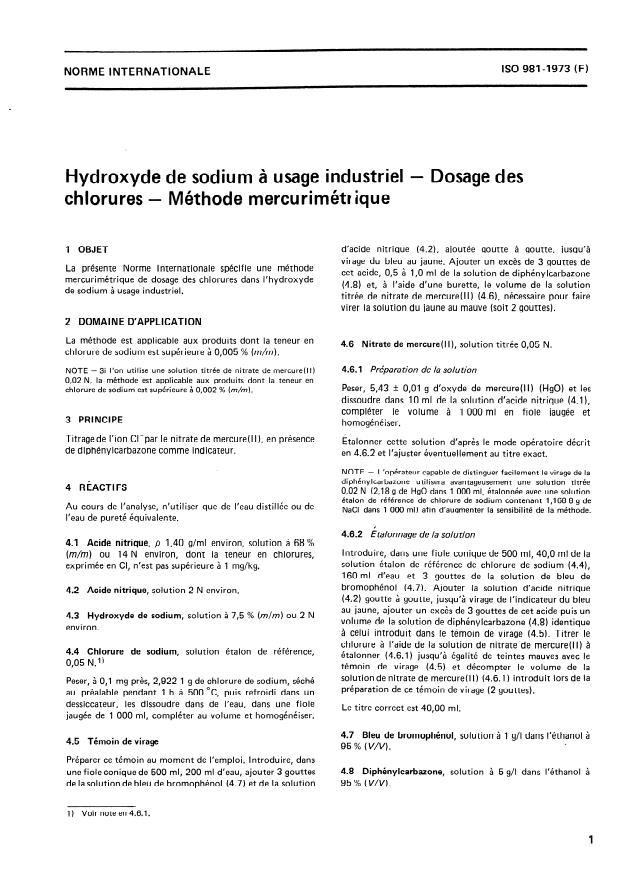

ISO 981:1973 - Hydroxyde de sodium a usage industriel — Dosage des chlorures — Méthode mercurimétrique Released:2/1/1973
Overview
ISO 981:1973 specifies a mercurimetric method for the determination of chloride content in sodium hydroxide for industrial use. The procedure titrates chloride ions with mercury(II) nitrate in the presence of diphenylcarbazone as the visual indicator. The method is intended for samples with chloride greater than 0.005 % (m/m); using a more sensitive 0.02 N mercury(II) nitrate increases sensitivity to about 0.002 % (m/m). ISO 981 replaces the earlier ISO Recommendation R 981‑1969 (Volhard volumetric method).
Key topics and technical requirements
- Analytical principle: Volumetric titration of Cl‑ with Hg(II) nitrate (mercurimetric titration) using diphenylcarbazone to reveal the end point (mauve color).
- Sensitivity / scope: Applicable for chloride content > 0.005% m/m; optional 0.02 N titrant extends lower limit to ~0.002% m/m.
- Reagents: Distilled water; nitric acid (concentrated and ~2 N); sodium hydroxide solution for pH adjustments; mercury(II) nitrate standard volumetric solution (prepared from HgO and standardized); diphenylcarbazone indicator; bromophenol blue for intermediate color control.
- Standardization: The mercury(II) nitrate solution is standardized against a sodium chloride reference solution and a standard end‑point matching solution to ensure accurate titrant concentration.
- Procedure essentials: Prepare a test solution with controlled acidity, match indicator volumes to the standard end‑point solution, and titrate until the mauve endpoint appears. Simple laboratory apparatus is sufficient.
- Results expression: Chloride is reported as sodium chloride (NaCl) percentage by mass, calculated from titrant volumes, the test portion mass and the known conversion factor (mass of NaCl per mL of titrant).
Applications and users
- Quality control in industrial sodium hydroxide (caustic soda) production and supply chains.
- Analytical and QC laboratories performing routine chloride determination in alkali chemicals.
- Chemical manufacturers, formulators, and purchasers who must verify chloride limits for downstream processes (electrochemical, specialty chemicals, pulp & paper).
- Regulatory and standards bodies assessing compliance with impurity specifications.
Related standards
- ISO 981 supersedes ISO Recommendation R 981‑1969 (Volhard method).
- Useful to consult other ISO standards on sodium hydroxide specifications and general chemical analysis / volumetric methods for context and complementary test methods.
Keywords: ISO 981, sodium hydroxide chloride determination, mercurimetric method, mercury(II) nitrate titration, diphenylcarbazone, industrial sodium hydroxide, chloride analysis, analytical chemistry.
Buy Documents
ISO 981:1973 - Sodium hydroxide for industrial use — Determination of chloride content — Mercurimetric method Released:2/1/1973
ISO 981:1973 - Hydroxyde de sodium a usage industriel — Dosage des chlorures — Méthode mercurimétrique Released:2/1/1973
ISO 981:1973 - Hydroxyde de sodium a usage industriel — Dosage des chlorures — Méthode mercurimétrique Released:2/1/1973
Get Certified
Connect with accredited certification bodies for this standard

ECOCERT
Organic and sustainability certification.

Eurofins Food Testing Global
Global leader in food, environment, and pharmaceutical product testing.

Intertek Bangladesh
Intertek certification and testing services in Bangladesh.
Sponsored listings
Frequently Asked Questions
ISO 981:1973 is a standard published by the International Organization for Standardization (ISO). Its full title is "Sodium hydroxide for industrial use — Determination of chloride content — Mercurimetric method". This standard covers: The method is applicable to products of which the chloride content is greater than 0.005 % (m/m). The procedure based on titration of the chloride ions with mercury(II) nitrate in the presence of diphenylcarbazone as indicator. - Replaces ISO Recommendation R 981-1969.
The method is applicable to products of which the chloride content is greater than 0.005 % (m/m). The procedure based on titration of the chloride ions with mercury(II) nitrate in the presence of diphenylcarbazone as indicator. - Replaces ISO Recommendation R 981-1969.
ISO 981:1973 is classified under the following ICS (International Classification for Standards) categories: 71.060.40 - Bases. The ICS classification helps identify the subject area and facilitates finding related standards.
ISO 981:1973 is available in PDF format for immediate download after purchase. The document can be added to your cart and obtained through the secure checkout process. Digital delivery ensures instant access to the complete standard document.
Standards Content (Sample)
INTERNATIONAL STANDARD
INTERNATIONAL ORGANIZATION FOR STANDARDIZATION .MEXAYHAPOAHAfi OPTAHM3AUWX II0 CTAHAAPTM3ALWiW~ORGANISATION INTERNATIONALE DE NORMALISATION
Sodium hydroxide for industrial use - Determination of
chloride content - Mercurimetric method
First edition - 1973-02-15
UDC 661.322.1 : 546.132 : 543.24 Ref. No. IS0 981-1973 (E)
Descriptors : sodium hydroxide, chemical analysis, determination of content, volumetric analysis, chlorides.
Price based on 2 pages
FOREWORD
IS0 (the International Organization for Standardization) is a worldwide federation
of national standards institutes (IS0 Member Bodies). The work of developing
International Standards is carried out through IS0 Technical Committees. Every
Member Body interested in a subject for which a Technical Committee has been set
up has the right to be represented on that Committee. International organizations,
governmental and non-governmental, in liaison with ISO, also take part in the work.
Draft International Standards adopted by the Technical Committees are circulated
to the Member Bodies for approval before their acceptance as International
Standards by the IS0 Council.
International Standard IS0 981 (originally Draft No. 2458) was drawn up by
Technical Committee lSO/TC 47, Chemistry.
It was approved in January 1972 by the Member Bodies of the following countries :
Austria India Portugal
Ireland South Africa, Rep. of
Belgium
Israel
Chile Spain
Italy Sweden
Czechoslovakia
Egypt, Arab Rep. of . Korea, Dem. p. rep. of Switzerland
France Netherlands Thailand
Germany New Zealand United Kingdom
Poland U.S.S.R.
Hungary
No Member Body expressed disapproval of the document.
This International Standard cancels and replaces IS0 Recommendation R 981-1969,
Sodium hydroxide for industrial use - Determination of chloride con tent - Volhard
volumetric method.
0 International Organization for Standardization, 1973 l
Printed in Switzerland
IS0 981-1973 (E)
INTERNATIONAL STANDARD
Sodium hydroxide for industrial use - Determination of
chloride content - Mercurimetric method
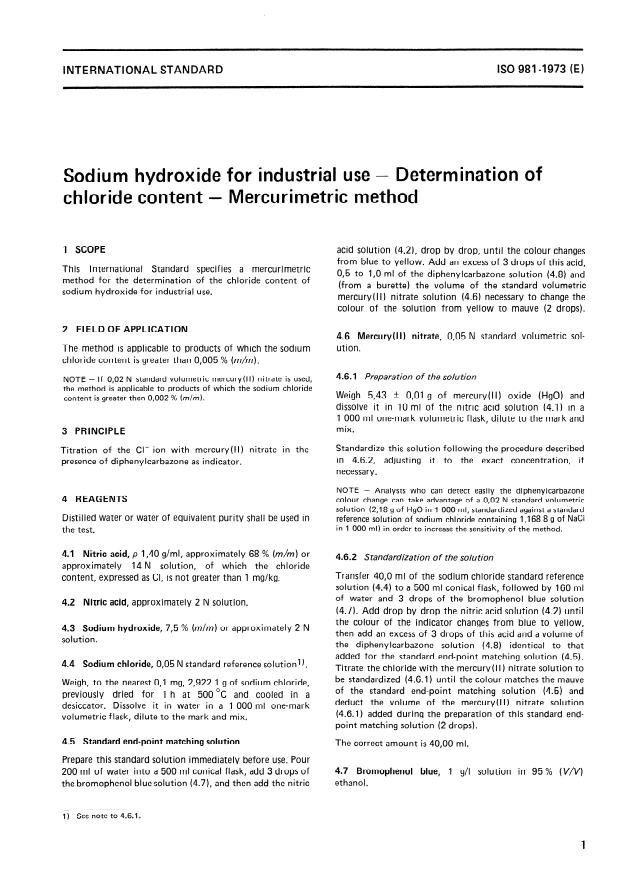
1 SCOPE
acid solution (4.2), drop by drop, until the colour changes
from blue to yellow. Add an excess of 3 drops of this acid,
This International Standard specifies a mercurimetric
0,5 to I,0 ml of the diphenylcarbazone solution (4.8) and
method for the determination of the chloride content of
(from a burette) the volume of the standard volumetric
sodium hydroxide for industrial use.
mercury(ll) nitrate solution (4.6) necessary to change the
colour of the solution from yellow to mauve (2 drops).
2 FIELD OF APPLICATION
4.6 Mercury(H) nitrate, 0,05 N standard volumetric sol-
ution.
The method is applicable to products of which the sodium
chloride content is greater than 0,005 % (m/m).
4.6. I Preparation of the so/u tion
NOTE - If 0,02 N standard volumetric mercury(II) nitrate is used,
the method is applicable to products of which the sodium chloride
Weigh 5,43 * 0,Ol g of mercury(l I) oxide (HgO) and
content is greater then 0,002 % (m/m).
dissolve it in 10 ml of the nitric acid solution (4.1) in a
1 000 ml one-mark volumetric flask, dilute to the mark and
mix.
3 PRINCIPLE
Standardize this solution following the procedure described
Titration of the Cl- ion with mercury(U) nitrate in the
in 4.6.2, adjusting it to the exact concentration, if
presence of diphenylcarbazone as indicator.
necessary.
NOTE - Analysts who can detect easily the diphenylcarbazone
4 REAGENTS
colour change can take advantage of a 0,02 N standard volumetric
solution (2,18 g of HgO in 1 000 ml, standardized against a standard
Distilled water or water of equivalent purity shall be used in
reference solution of sodium chloride containing 1,168 8 g of NaCf
in 1 000 ml) in order to increase the sensitivity of the method.
the test.
4.1 Nitric acid, p I,40 g/ml, approximately 68 % (m/m) or
4.6.2 Standardization of the solution
approximately 14 N solution, of which the chloride
Transfer 40,O ml of the sodium chloride standard reference
content, expressed as Cl, is not greater than 1 mg/kg.
solution (4.4) to a 500 ml conical flask, follo
...
NORME INTERNATIONALE
INTERNATIONAL ORGANIZATION FOR STANDARDIZATION l MEXAYHAPOAHAR OPTAHW3ALU-W l-I0 ~AHAAPTW3ALViM*ORGANISATION INTERNATIONALE DE NORMALISATION
Hydroxyde de sodium à usage industriel - Dosage des
chlorures
- Méthode mercurimétrique
Première édition - 1973-02-15
Réf. No : ISO 981-1973 (F)
CDU 661.322.1 : 546.132 : 543.24
Descripteurs : hydroxyde de sodium, analyse chimique, dosage, analyse volumétrique, chlorure.
Prix basé sur 2 pages
AVANT-PROPOS
ISO (Organisation Internationale de Normalisation) est une fédération mondiale
d’organismes nationaux de normalisation (Comités Membres ISO). L’élaboration de
Normes Internationales est confiée aux Comités Techniques ISO. Chaque Comité
Membre intéressé par une étude a le droit de faire partie du Comité Technique
correspondant. Les organisations internationales, gouvernementales et non
gouvernementales, en liaison avec I’ISO, participent également aux travaux.
Les Projets de Normes Internationales adoptés par les Comités Techniques sont
soumis aux Comités Membres pour approbation, avant leur acceptation comme
Normes Internationales par le Conseil de I’ISO.
La Norme Internationale ISO 981 (précédemment Projet No 2458) a été établie par
le Comité Technique ISO/TC 47, Chimie.
Elle fut approuvée en janvier 1972 par les Comités Membres des pays suivants :
Afrique du Sud, Rép. d’ France Pologne
Allemagne Hongrie Portugal
Autriche Inde Royaume-Uni
Belgique Irlande Suède
Chi Ii Israël Suisse
Corée, Rép. dém. p. de Italie Tchécoslovaquie
Egypte, Rép. arabe d’ Nouvelle-Zélande Thaïlande
Espagne Pays-Bas U.R.S.S.
Aucun Comité Membre n’a désapprouvé le document.
Cette Norme Internationale annule et remplace la Recommandation lSO/R 981-1969,
Hydroxyde de sodium à usage industriel - Dosage des chlorures - Méthode volu-
métrique de Volhard.
0 Organisation Internationale de Normalisation, 1973 l
Imprimé en Suisse
ISO 981-1973 (FI
NORME INTERNATIONALE
Hydroxyde de sodium à usage industriel - Dosage des
chlorures - Méthode mercurimétr ique
d’acide nitrique (4.2), ajoutée goutte à goutte, jusqu’à
1 OBJET
virage du bleu au jaune. Ajouter un excès de 3 gouttes de
La présente Norme Internationale spécifie une méthode
cet acide, 0,5 à 1,O ml de la solution de diphénylcarbazone
mercurimétrique de dosage des chlorures dans l’hydroxyde
(4.8) et, à l’aide d’une burette, le volume de la solution
de sodium à usage industriel.
titrée de nitrate de mercure(H) (4.6), nécessaire pour faire
virer la solution du jaune au mauve (soit 2 gouttes).
2 DOMAINE D’APPLICATION
La méthode est applicable aux produits dont la teneur en
4.6 Nitrate de mercure( solution titrée 0,05 N.
chlorure de sodium est supérieure à 0,005 % (m/m).
4.6.1 Préparation de la solution
NOTE - Si l’on utilise une solution titrée de nitrate de mercure( II)
0,02 N, la méthode est applicable aux produits dont la teneur en
Peser, 5,43 tr 0,Ol g d’oxyde de mercure(I 1) (HgO) et les
chlorure de sodium est supérieure à 0,002 % (m/m).
dissoudre dans 10 ml de la solution d’acide nitrique (4.1),
compléter le volume à
1 000 ml en fiole jaugée et
3 PRINCIPE
homogénéiser,
Titrage de l’ion Cl-par le nitrate de mercure( II), en présence
Étalonner cette solution d’après le mode opératoire décrit
de diphénylcarbazone comme indicateur.
en 4.6.2 et l’ajuster éventuellement au titre exact.
NOTE
- L’opérateur capable de distinguer facilement le virage de la
diphénylcarbazone utilisera avantageusement une solution titrée
4 RÉACTIFS
0,02 N (2,18 g de HgO dans 1 000 ml, étalonnée avec une solution
étalon de référence de chlorure de sodium contenant 1,168 8 g de
Au cours de l’analyse, n’utiliser que de l’eau distillée ou de
NaCI dans 1 000 ml) afin d’augmenter la sensibilité de la.méthode.
l’eau de pureté équivalente.
4.6.2 Étalonnage de la solution
4.1 Acide nitrique, p 1,40 g/ml environ, solution à 68 %
Introduire, dans une fiole conique de 500 ml, 40,O ml de la
(m/m) ou 14 N environ, dont la teneur en chlorures,
solution étalon de référence de chlorure de sodium (4.4),
exprimée en Cl, n’est pas supérieure à 1 mg/kg.
160 ml d’eau et 3 gouttes de la solution de bleu de
bromophénol (4.7). Ajouter la solution d’acide nitrique
4.2 Acide nitrique, solu
...
NORME INTERNATIONALE
INTERNATIONAL ORGANIZATION FOR STANDARDIZATION l MEXAYHAPOAHAR OPTAHW3ALU-W l-I0 ~AHAAPTW3ALViM*ORGANISATION INTERNATIONALE DE NORMALISATION
Hydroxyde de sodium à usage industriel - Dosage des
chlorures
- Méthode mercurimétrique
Première édition - 1973-02-15
Réf. No : ISO 981-1973 (F)
CDU 661.322.1 : 546.132 : 543.24
Descripteurs : hydroxyde de sodium, analyse chimique, dosage, analyse volumétrique, chlorure.
Prix basé sur 2 pages
AVANT-PROPOS
ISO (Organisation Internationale de Normalisation) est une fédération mondiale
d’organismes nationaux de normalisation (Comités Membres ISO). L’élaboration de
Normes Internationales est confiée aux Comités Techniques ISO. Chaque Comité
Membre intéressé par une étude a le droit de faire partie du Comité Technique
correspondant. Les organisations internationales, gouvernementales et non
gouvernementales, en liaison avec I’ISO, participent également aux travaux.
Les Projets de Normes Internationales adoptés par les Comités Techniques sont
soumis aux Comités Membres pour approbation, avant leur acceptation comme
Normes Internationales par le Conseil de I’ISO.
La Norme Internationale ISO 981 (précédemment Projet No 2458) a été établie par
le Comité Technique ISO/TC 47, Chimie.
Elle fut approuvée en janvier 1972 par les Comités Membres des pays suivants :
Afrique du Sud, Rép. d’ France Pologne
Allemagne Hongrie Portugal
Autriche Inde Royaume-Uni
Belgique Irlande Suède
Chi Ii Israël Suisse
Corée, Rép. dém. p. de Italie Tchécoslovaquie
Egypte, Rép. arabe d’ Nouvelle-Zélande Thaïlande
Espagne Pays-Bas U.R.S.S.
Aucun Comité Membre n’a désapprouvé le document.
Cette Norme Internationale annule et remplace la Recommandation lSO/R 981-1969,
Hydroxyde de sodium à usage industriel - Dosage des chlorures - Méthode volu-
métrique de Volhard.
0 Organisation Internationale de Normalisation, 1973 l
Imprimé en Suisse
ISO 981-1973 (FI
NORME INTERNATIONALE
Hydroxyde de sodium à usage industriel - Dosage des
chlorures - Méthode mercurimétr ique
d’acide nitrique (4.2), ajoutée goutte à goutte, jusqu’à
1 OBJET
virage du bleu au jaune. Ajouter un excès de 3 gouttes de
La présente Norme Internationale spécifie une méthode
cet acide, 0,5 à 1,O ml de la solution de diphénylcarbazone
mercurimétrique de dosage des chlorures dans l’hydroxyde
(4.8) et, à l’aide d’une burette, le volume de la solution
de sodium à usage industriel.
titrée de nitrate de mercure(H) (4.6), nécessaire pour faire
virer la solution du jaune au mauve (soit 2 gouttes).
2 DOMAINE D’APPLICATION
La méthode est applicable aux produits dont la teneur en
4.6 Nitrate de mercure( solution titrée 0,05 N.
chlorure de sodium est supérieure à 0,005 % (m/m).
4.6.1 Préparation de la solution
NOTE - Si l’on utilise une solution titrée de nitrate de mercure( II)
0,02 N, la méthode est applicable aux produits dont la teneur en
Peser, 5,43 tr 0,Ol g d’oxyde de mercure(I 1) (HgO) et les
chlorure de sodium est supérieure à 0,002 % (m/m).
dissoudre dans 10 ml de la solution d’acide nitrique (4.1),
compléter le volume à
1 000 ml en fiole jaugée et
3 PRINCIPE
homogénéiser,
Titrage de l’ion Cl-par le nitrate de mercure( II), en présence
Étalonner cette solution d’après le mode opératoire décrit
de diphénylcarbazone comme indicateur.
en 4.6.2 et l’ajuster éventuellement au titre exact.
NOTE
- L’opérateur capable de distinguer facilement le virage de la
diphénylcarbazone utilisera avantageusement une solution titrée
4 RÉACTIFS
0,02 N (2,18 g de HgO dans 1 000 ml, étalonnée avec une solution
étalon de référence de chlorure de sodium contenant 1,168 8 g de
Au cours de l’analyse, n’utiliser que de l’eau distillée ou de
NaCI dans 1 000 ml) afin d’augmenter la sensibilité de la.méthode.
l’eau de pureté équivalente.
4.6.2 Étalonnage de la solution
4.1 Acide nitrique, p 1,40 g/ml environ, solution à 68 %
Introduire, dans une fiole conique de 500 ml, 40,O ml de la
(m/m) ou 14 N environ, dont la teneur en chlorures,
solution étalon de référence de chlorure de sodium (4.4),
exprimée en Cl, n’est pas supérieure à 1 mg/kg.
160 ml d’eau et 3 gouttes de la solution de bleu de
bromophénol (4.7). Ajouter la solution d’acide nitrique
4.2 Acide nitrique, solu
...