

ISO 10406-2:2025
(Main)Fibre-reinforced polymer (FRP) reinforcement of concrete — Test methods — Part 2: FRP sheets
General Information
- Abstract
This document specifies test methods applicable to fibre-reinforced polymer (FRP) sheets for the upgrading of concrete members.
- Status
- Published
- Publication Date
- 12-Nov-2025
- Current Stage
- 6060 - International Standard published
- Start Date
- 13-Nov-2025
- Due Date
- 12-Dec-2025
- Completion Date
- 13-Nov-2025
Overview
ISO 10406-2:2025 - Fibre-reinforced polymer (FRP) reinforcement of concrete - Test methods - Part 2: FRP sheets provides standardized laboratory procedures for testing FRP sheets used to upgrade and strengthen concrete members. The third edition specifies how to prepare test pieces, carry out tensile, bond and splice tests, and report results. It supports consistent evaluation of material performance for design, quality control and research.
Key topics and technical requirements
The standard details test methods and the essential parameters to ensure reproducible, comparable results. Major topics include:
- Test piece preparation and conditioning
- Types, dimensions, curing and conditioning of specimens; anchorage and notching for specific tests.
- Tensile properties
- Procedures for tensile testing of FRP sheets, strain measurement (strain gauges/extensometers), loading rate, and expression of tensile strength, Young’s modulus and ultimate strain.
- Overlap splice strength
- Test layout, failure category definitions and calculation of splice capacity for overlapped sheet terminations.
- Bond properties to concrete
- Methods to determine bond strength and interfacial fracture energy between FRP sheets and concrete substrates.
- Direct pull-off strength
- Setup and procedures to measure pull-off resistance of sheet-to-concrete systems and classification of failure modes.
- Durability testing
- Environmental conditioning such as freeze/thaw resistance and other conditioning regimes referenced for long-term performance.
- Testing equipment and data reporting
- Requirements for testing machines, chucks, measuring devices, test temperature control, range of test and standardized test report content.
Keywords integrated: ISO 10406-2:2025, FRP sheets, fibre-reinforced polymer, test methods, bond strength, tensile properties, overlap splice, pull-off.
Applications and users
ISO 10406-2:2025 is directly applicable to professionals involved in the evaluation and use of FRP sheet systems for concrete strengthening:
- Structural and civil engineers assessing retrofit solutions for beams, slabs, columns and bridge decks
- Materials testing laboratories performing qualification and quality control of FRP sheets
- Manufacturers and suppliers of FRP composites developing product data and test certificates
- Contractors and inspectors verifying installation performance and long-term durability
- Researchers and standards committees comparing materials and informing design guidance
Practical uses include verifying material properties for design, comparing different FRP systems, establishing acceptance criteria, and supporting durable rehabilitation techniques.
Related standards
Related documents include other parts of the ISO 10406 series and national/international concrete reinforcement and testing standards that address FRP bars, design principles and complementary test procedures. For project compliance, use ISO 10406-2 alongside applicable design codes and material specifications.
Relations
- Effective Date
- 06-Jun-2022
Get Certified
Connect with accredited certification bodies for this standard

DIN CERTCO
DIN Group product certification.
DIBt (Deutsches Institut für Bautechnik)
German Institute for Building Technology.

Aboma Certification B.V.
Specialized in construction, metal, and transport sectors.
Sponsored listings
Frequently Asked Questions
ISO 10406-2:2025 is a standard published by the International Organization for Standardization (ISO). Its full title is "Fibre-reinforced polymer (FRP) reinforcement of concrete — Test methods — Part 2: FRP sheets". This standard covers: This document specifies test methods applicable to fibre-reinforced polymer (FRP) sheets for the upgrading of concrete members.
This document specifies test methods applicable to fibre-reinforced polymer (FRP) sheets for the upgrading of concrete members.
ISO 10406-2:2025 is classified under the following ICS (International Classification for Standards) categories: 83.120 - Reinforced plastics; 91.100.30 - Concrete and concrete products. The ICS classification helps identify the subject area and facilitates finding related standards.
ISO 10406-2:2025 has the following relationships with other standards: It is inter standard links to ISO 10406-2:2015. Understanding these relationships helps ensure you are using the most current and applicable version of the standard.
ISO 10406-2:2025 is available in PDF format for immediate download after purchase. The document can be added to your cart and obtained through the secure checkout process. Digital delivery ensures instant access to the complete standard document.
Standards Content (Sample)
International
Standard
ISO 10406-2
Third edition
Fibre-reinforced polymer (FRP)
2025-11
reinforcement of concrete — Test
methods —
Part 2:
FRP sheets
Polymère renforcé par des fibres (PRF) pour l'armature du
béton — Méthodes d'essai —
Partie 2: Feuilles en PRF
Reference number
© ISO 2025
All rights reserved. Unless otherwise specified, or required in the context of its implementation, no part of this publication may
be reproduced or utilized otherwise in any form or by any means, electronic or mechanical, including photocopying, or posting on
the internet or an intranet, without prior written permission. Permission can be requested from either ISO at the address below
or ISO’s member body in the country of the requester.
ISO copyright office
CP 401 • Ch. de Blandonnet 8
CH-1214 Vernier, Geneva
Phone: +41 22 749 01 11
Email: copyright@iso.org
Website: www.iso.org
Published in Switzerland
ii
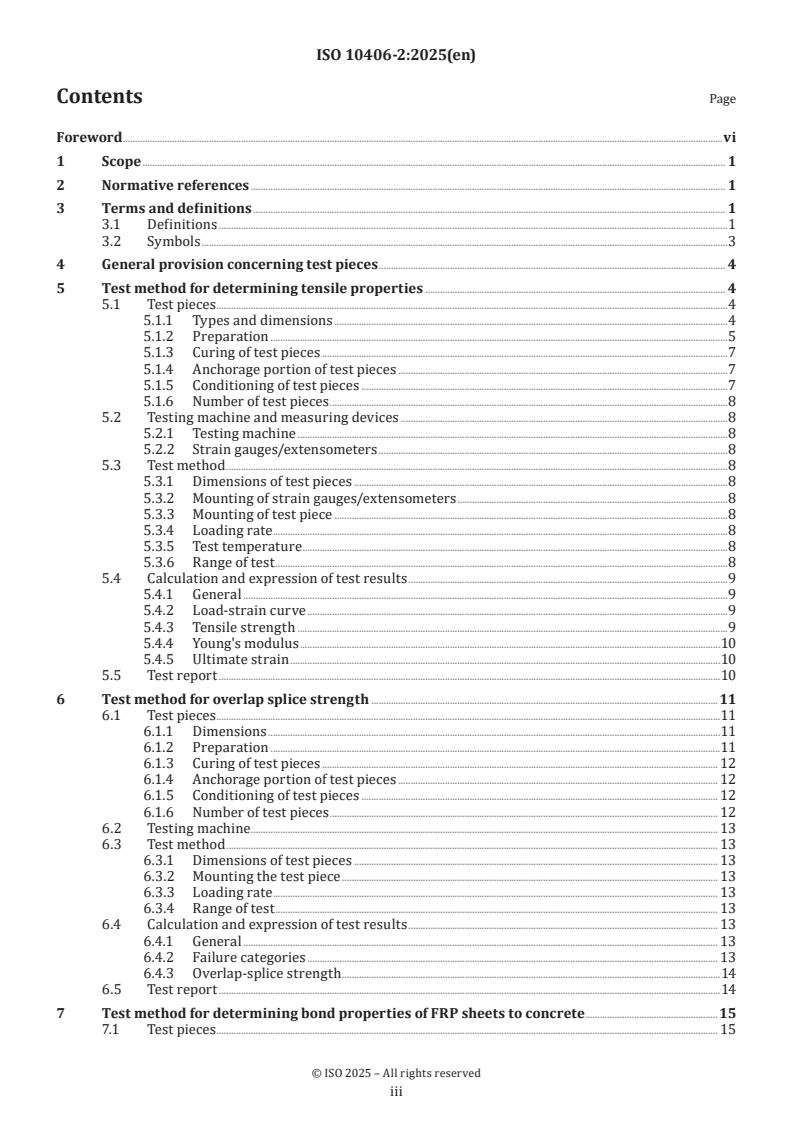
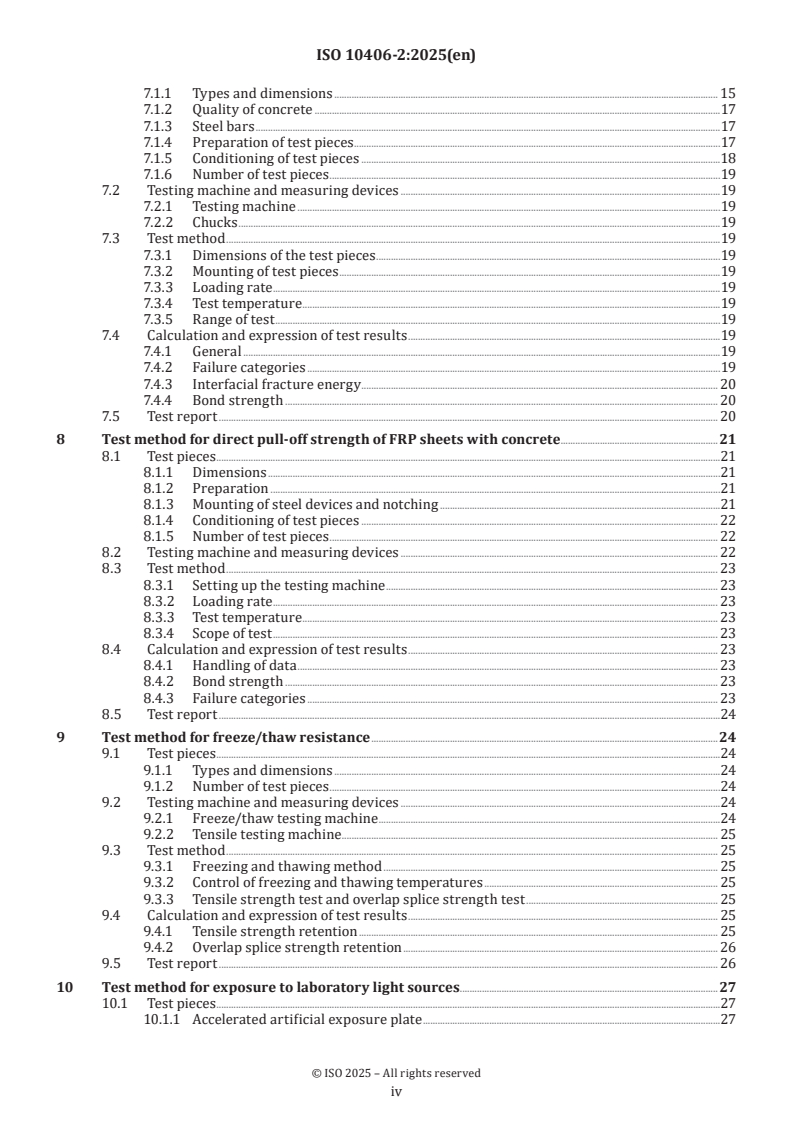
Contents Page
Foreword .vi
1 Scope . 1
2 Normative references . 1
3 Terms and definitions . 1
3.1 Definitions .1
3.2 Symbols .3
4 General provision concerning test pieces . 4
5 Test method for determining tensile properties . 4
5.1 Test pieces . .4
5.1.1 Types and dimensions .4
5.1.2 Preparation .5
5.1.3 Curing of test pieces .7
5.1.4 Anchorage portion of test pieces .7
5.1.5 Conditioning of test pieces .7
5.1.6 Number of test pieces .8
5.2 Testing machine and measuring devices .8
5.2.1 Testing machine .8
5.2.2 Strain gauges/extensometers .8
5.3 Test method .8
5.3.1 Dimensions of test pieces .8
5.3.2 Mounting of strain gauges/extensometers .8
5.3.3 Mounting of test piece .8
5.3.4 Loading rate .8
5.3.5 Test temperature .8
5.3.6 Range of test .8
5.4 Calculation and expression of test results .9
5.4.1 General .9
5.4.2 Load-strain curve .9
5.4.3 Tensile strength .9
5.4.4 Young's modulus .10
5.4.5 Ultimate strain .10
5.5 Test report .10
6 Test method for overlap splice strength .11
6.1 Test pieces . .11
6.1.1 Dimensions .11
6.1.2 Preparation .11
6.1.3 Curing of test pieces . 12
6.1.4 Anchorage portion of test pieces . 12
6.1.5 Conditioning of test pieces . 12
6.1.6 Number of test pieces . 12
6.2 Testing machine . . 13
6.3 Test method . 13
6.3.1 Dimensions of test pieces . 13
6.3.2 Mounting the test piece . 13
6.3.3 Loading rate . 13
6.3.4 Range of test . 13
6.4 Calculation and expression of test results . 13
6.4.1 General . 13
6.4.2 Failure categories . 13
6.4.3 Overlap-splice strength .14
6.5 Test report .14
7 Test method for determining bond properties of FRP sheets to concrete .15
7.1 Test pieces . 15
iii
7.1.1 Types and dimensions . 15
7.1.2 Quality of concrete .17
7.1.3 Steel bars .17
7.1.4 Preparation of test pieces .17
7.1.5 Conditioning of test pieces .18
7.1.6 Number of test pieces .19
7.2 Testing machine and measuring devices .19
7.2.1 Testing machine .19
7.2.2 Chucks .19
7.3 Test method .19
7.3.1 Dimensions of the test pieces .19
7.3.2 Mounting of test pieces .19
7.3.3 Loading rate .19
7.3.4 Test temperature .19
7.3.5 Range of test .19
7.4 Calculation and expression of test results .19
7.4.1 General .19
7.4.2 Failure categories .19
7.4.3 Interfacial fracture energy . 20
7.4.4 Bond strength . 20
7.5 Test report . 20
8 Test method for direct pull-off strength of FRP sheets with concrete .21
8.1 Test pieces .21
8.1.1 Dimensions .21
8.1.2 Preparation .21
8.1.3 Mounting of steel devices and notching .21
8.1.4 Conditioning of test pieces . 22
8.1.5 Number of test pieces . 22
8.2 Testing machine and measuring devices . 22
8.3 Test method . 23
8.3.1 Setting up the testing machine . 23
8.3.2 Loading rate . 23
8.3.3 Test temperature . 23
8.3.4 Scope of test . 23
8.4 Calculation and expression of test results . 23
8.4.1 Handling of data . 23
8.4.2 Bond strength . 23
8.4.3 Failure categories . 23
8.5 Test report .24
9 Test method for freeze/thaw resistance .24
9.1 Test pieces .24
9.1.1 Types and dimensions .24
9.1.2 Number of test pieces .24
9.2 Testing machine and measuring devices .24
9.2.1 Freeze/thaw testing machine .24
9.2.2 Tensile testing machine . 25
9.3 Test method . 25
9.3.1 Freezing and thawing method . 25
9.3.2 Control of freezing and thawing temperatures . 25
9.3.3 Tensile strength test and overlap splice strength test . 25
9.4 Calculation and expression of test results . 25
9.4.1 Tensile strength retention . 25
9.4.2 Overlap splice strength retention . 26
9.5 Test report . 26
10 Test method for exposure to laboratory light sources .27
10.1 Test pieces . .27
10.1.1 Accelerated artificial exposure plate .27
iv
10.1.2 Number of accelerated artificial exposure plates .27
10.1.3 Types and dimensions .27
10.1.4 Number of test pieces .27
10.2 Testing machine and measuring devices .27
10.3 Test method . 28
10.3.1 Test period . 28
10.3.2 Tensile strength test and overlap splice strength test . 28
10.4 Calculation and expression of test results . 28
10.4.1 Visual inspection . 28
10.4.2 Handling of data . 28
10.4.3 Tensile strength retention . 28
10.4.4 Overlap-splice strength retention . 29
10.5 Test report . 29
11 Test method for durability .30
11.1 Types of test methods for durability . 30
11.2 Test piece . 30
11.2.1 Durability test for pull-off strength — Test A . 30
11.2.2 Durability test for bond properties — Test B . 30
11.2.3 Durability test for overlap splice strength — Test C . 30
11.3 Test method .31
11.3.1 Durability test for pull-off strength — Test A .31
11.3.2 Durability test for bond properties — Test B: dry-and-wet-cycle test .32
11.3.3 Durability test for overlap splice strength — Test C: dry-and-wet-cycle test .32
11.4 Calculation and expression of test results .32
11.4.1 Durability test for pull-off strength — Test A .32
11.4.2 Durability test for bond properties — Test B .32
11.4.3 Durability test for overlap splice strength — Test C .32
11.5 Test report .32
11.5.1 Durability test for pull-off strength — Test A .32
11.5.2 Durability test for bond properties — Test B .32
11.5.3 Durability test for overlap splice strength — Test C . 33
v
Foreword
ISO (the International Organization for Standardization) is a worldwide federation of national standards
bodies (ISO member bodies). The work of preparing International Standards is normally carried out through
ISO technical committees. Each member body interested in a subject for which a technical committee
has been established has the right to be represented on that committee. International organizations,
governmental and non-governmental, in liaison with ISO, also take part in the work. ISO collaborates closely
with the International Electrotechnical Commission (IEC) on all matters of electrotechnical standardization.
The procedures used to develop this document and those intended for its further maintenance are described
in the ISO/IEC Directives, Part 1. In particular, the different approval criteria needed for the different types
of ISO document should be noted. This document was drafted in accordance with the editorial rules of the
ISO/IEC Directives, Part 2 (see www.iso.org/directives).
ISO draws attention to the possibility that the implementation of this document may involve the use of (a)
patent(s). ISO takes no position concerning the evidence, validity or applicability of any claimed patent
rights in respect thereof. As of the date of publication of this document, ISO had not received notice of (a)
patent(s) which may be required to implement this document. However, implementers are cautioned that
this may not represent the latest information, which may be obtained from the patent database available at
www.iso.org/patents. ISO shall not be held responsible for identifying any or all such patent rights.
Any trade name used in this document is information given for the convenience of users and does not
constitute an endorsement.
For an explanation of the voluntary nature of standards, the meaning of ISO specific terms and expressions
related to conformity assessment, as well as information about ISO's adherence to the World Trade
Organization (WTO) principles in the Technical Barriers to Trade (TBT), see www.iso.org/iso/foreword.html.
This document was prepared by Technical Committee ISO/TC 71, Concrete, reinforced concrete and pre-
stressed concrete, Subcommittee SC 6, Non-traditional reinforcing materials for concrete structures.
This third edition cancels and replaces the second edition (ISO 10406-2:2015), which has been technically
revised.
The main changes are as follows:
— “Terms and definitions" has been revised to appropriately reflect the content of the main text.
— Figure 3 has been revised to appropriately reflect the content of the main text.
— “Test report” has been revised.
A list of all parts in the ISO 10406 series can be found on the ISO website.
Any feedback or questions on this document should be directed to the user’s national standards body. A
complete listing of these bodies can be found at www.iso.org/members.html.
vi
International Standard ISO 10406-2:2025(en)
Fibre-reinforced polymer (FRP) reinforcement of concrete —
Test methods —
Part 2:
FRP sheets
1 Scope
This document specifies test methods applicable to fibre-reinforced polymer (FRP) sheets for the upgrading
of concrete members.
2 Normative references
The following documents are referred to in the text in such a way that some or all of their content constitutes
requirements of this document. For dated references, only the edition cited applies. For undated references,
the latest edition of the referenced document (including any amendments) applies.
ISO 31-0:1992, Quantities and units — Part 0: General principles
ISO 291, Plastics — Standard atmospheres for conditioning and testing
ISO 4892 (all parts), Plastics — Methods of exposure to laboratory light sources
ISO 5725 (all parts), Accuracy (trueness and precision) of measurement methods and results
ISO 7500-1, Metallic materials — Calibration and verification of static uniaxial testing machines — Part 1:
Tension/compression testing machines — Calibration and verification of the force-measuring system
3 Terms and definitions
For the purposes of this document, the following terms and definitions apply.
ISO and IEC maintain terminology databases for use in standardization at the following addresses:
— ISO Online browsing platform: available at https:// www .iso .org/ obp
— IEC Electropedia: available at https:// www .electropedia .org/
3.1 Definitions
3.1.1
accelerated artificial exposure testing machine
machine that creates reproducible standard test conditions to accelerate weathering artificially
3.1.2
ambient temperature
environmental conditions corresponding to the usual atmospheric conditions in laboratories with
uncontrolled temperature and humidity
Note 1 to entry: In hot and humid areas, temperature and humidity have no effect on the experimental results.
3.1.3
anchorage block
block corresponding to the test block to prevent bond failure of the FRP sheet
Note 1 to entry: Additional FRP sheet circumferentially jackets the block with sheets being tested to provide higher
bond strength (in this block).
3.1.4
anchoring portion
end parts of a test piece fitted with anchoring devices to transmit loads from the testing machine to the
test portion
3.1.5
bond strength
strength calculated by dividing the maximum load by the effective bond area
3.1.6
concrete block
rectangular block of concrete used to study the bond properties of FRP sheets to concrete
Note 1 to entry: Steel reinforcement or steel bars are embedded in the axial direction at the centre of the cross-
sectional area of the concrete block to transmit tensile strength. Concrete blocks are made up of a test block and an
anchorage block.
3.1.7
conditioning
storage of test pieces at a prescribed temperature and humidity to keep them under identical conditions
before testing
3.1.8
effective bond length
length of the portion in which the bond stress between the FRP sheet and the concrete acts effectively at
maximum load before the FRP sheet comes loose from the concrete
3.1.9
fibre bundle
several fibre filaments bound together to form a bundle
3.1.10
fibre mass per unit area
mass of fibre in the direction of reinforcement in dry sheet (fibre sheets before impregnation with resin)
Note 1 to entry: Expressed as mass per square metres.
3.1.11
interfacial fracture energy
amount of energy per unit bond area necessary to produce interfacial fracture
3.1.12
plate
FRP sheet impregnated with resin from which the test pieces are cut
3.1.13
steel device
mechanism made of steel connected to a loading machine to apply tensile force
Note 1 to entry: Adhesive is used to mount the device to the FRP sheet attached to the concrete surface. The shape of
the bond surface is either square or circular.
3.1.14
tab
plate made of fibre-reinforced polymer, aluminium, or any other suitable material bonded to the test piece to
transmit loads from the testing machine to the test portion
3.1.15
tensile capacity
maximum tensile load which the test piece bears during the tensile test
3.1.16
test block
block used to study the bond properties of FRP sheets
3.1.17
test portion
part of a test piece that is in between the anchoring portions and is subjected to testing
3.1.18
ultimate strain
strain corresponding to the tensile capacity
3.2 Symbols
For symbols used in this document, see Table 1.
Table 1 — Symbols
Symbol Unit Description Reference
A mm Nominal cross-sectional area (general) 5.4
A mm Nominal cross-sectional area of type A test piece 5.4, 6.4
A
A mm Nominal cross-sectional area of type B test piece 5.4, 6.4
B
A mm Area of steel device 8.4
s
b mm Average width of FRP sheet 7.4
av
b mm Minimum width of test piece 5.4, 6.4
t,min
E N/mm Young's modulus 5.4, 7.4
f
f N/mm Bond strength 8.4
au
f N/mm Tensile strength 5.4
fu
N/mm Average value for tensile strength before treating, e.g. freezing and 9.4, 10.4
f
fu0
thawing or accelerated artificial exposure
N/mm Average value for tensile strength after treating, e.g. freezing and 9.4, 10.4
f
fu1
thawing or accelerated artificial exposure
f N/mm Overlap splice strength 6.4
fus
N/mm Average value for overlap splice strength before treating, e.g. freez- 9.4, 10.4
f
fus0
ing and thawing or accelerated artificial exposure
N/mm Average value for overlap splice strength after treating, e.g. freez- 9.4, 10.4
f
fus1
ing and thawing or accelerated artificial exposure
F N Maximum load 8.4
au
F N The load included in the last simultaneously recorded pair of values 5.4.5
last
of the load and the strain when determining the ultimate strain
F N Tensile capacity 5.4, 6.4
u
G N/mm Interfacial fracture energy 7.4
f
L mm Anchoring portion length 5.1.1
A1
L mm Anchorage thickness 5.1.1
A2
L mm Anchorage length 5.1.1
A3
L mm Width at both ends 5.1.1
end
L mm Gauge length 5.1.1
ga
L mm Thickness 5.1.1
th
L mm Total length 5.1.1
tot
TTabablele 1 1 ((ccoonnttiinnueuedd))
Symbol Unit Description Reference
l mm Effective bond length in test portion of FRP sheet 7.4
N — Number of fibre bundles in test piece 5.4
t
n — Number of plies of the sheet 7.4
n strands/mm Number of fibre bundles per unit area of the sheet 5.4
u
P N Maximum load 7.4
max
R % Overlap splice strength retention 9.4
ets
R % Tensile strength retention 9.4
ett
−3
t mm 7.4
Thickness of sheet, equal to n·ρρ ×10
Ssh
ΔF N Difference between loads at two points at 20 % and 50 % of tensile 5.4
capacity
ρ g/m Fibre mass per unit area of dry sheet 5.4, 6.4, 7.4
S
ρ g/cm Fiber density of dry sheet 5.4, 6.4, 7.4
sh
ε — The strain included in the last simultaneously recorded pair of val- 5.4.5
last
ues of the load and the strain when determining the ultimate strain
— Difference in strain between the two points used to calculate ΔF 5.4.5
ε
fu
Δε
— Ultimate strain 5.4
N/mm Bond strength 7.4
τ
u
4 General provision concerning test pieces
Unless otherwise agreed upon, test pieces shall be taken from the sheet in the “as delivered” condition.
For the determination of the mechanical properties in the tensile, bond, and anchorage tests, the test piece
may be artificially aged (after straightening, if applicable) depending on the performance requirements of
the product.
When a test piece is “aged”, the conditions of the ageing treatment shall be stated in the test report.
5 Test method for determining tensile properties
5.1 Test pieces
5.1.1 Types and dimensions
Two types of test pieces may be used (see Figure 1 and Table 2):
a) Type A test pieces: Prepare type A test pieces in accordance with the method described in 6.1.2.1 and
use them for the general tension test. The shape and the dimensions of type A test pieces are given in
Figure 1 and Table 2, respectively.
b) Type B test pieces: Prepare type B test pieces in accordance with the method described in 6.1.2.2. These
test pieces are suitable for FRP sheets in which the fibre bundles consist of a number of filaments that
can be easily separated into individual bundles.
NOTE See Table 2 for definitions of symbols and dimensions.
Figure 1 — Shape of type A and type B test pieces
Table 2 — Dimensions of test pieces
Dimensions in millimetres
Dimension for the types of test piece
Symbol
Type A Type B
L total length ≥200
tot
L width at both ends 12,5 ± 0,5 10 to 15
end
L thickness Recommended not to exceed 2,5
th
L gauge length ≥100
ga
L anchoring portion length ≥35
A1
L anchorage thickness 1 to 2
A2
L anchorage length ≥50
A3
NOTE When the peeling off at tabs and the pull-out in the chuck do not occur, the thickness of the
test piece can exceed 2,5 mm. When the thickness of the test piece is less than 2,5 mm and fracture
at anchoring section occurs, the specification of the anchoring section should be reconsidered.
5.1.2 Preparation
5.1.2.1 Type A test pieces
Type A test pieces shall be prepared using the following method:
a) prepare a dry sheet cut to a sufficient length for the test piece;
b) apply the bottom coat of impregnation resin to the separation film and attach the sheet, fastening it so
that the fibre axis of the sheet is in a straight line;
c) apply the top coat of impregnation resin then smooth the surface so that the thickness of the impregnation
resin layer is even, to form a plate. Covering with separation film and smoothing would be best;
d) cure the plate for the prescribed duration considering manufacturer’s instructions, then cut in widths
of 12,5 mm as shown in Figure 2. The cut length should be at least 200 mm. Use a diamond cutter for
cutting;
e) attach the anchorages to the anchorage portions to form the test pieces;
f) prior to testing, the test pieces shall be conditioned as prescribed in 5.1.5 considering manufacturer’s
instructions.
Dimensions in millimetres
Key
1 direction of fibre axis
2 section used to prepare test piece: ≥200 (area impregnated with resin)
3 test piece portion
4 cut-away portion
5 marking
a, b
Location of the two straight-line marks perpendicular to the fibre axis that define a length of at least 200 mm.
Figure 2 — Dimensions of plate used to prepare type A test pieces
5.1.2.2 Type B test pieces
Type B test pieces shall be prepared using the following method:
a) prepare a dry sheet cut to a sufficient length for the test piece. Fasten the sheet so that the fibre axis is in
a straight line;
b) in the centre of the fastened sheet, mark two straight lines (footnotes a and b in Figure 3) perpendicular
to the fibre axis that define a length of at least 200 mm. Mark two other straight lines (footnotes c and d
in Figure 3) approximately 100 mm on either side of the area defined by lines a and b;
c) working along the fibre axis between lines c and d, remove one to three fibre bundles from each side of
the test piece sections. The width measures 10 mm to 15 mm. When preparing several test pieces from
the same FRP sheet, the portions to be used as test pieces should be separated by intervals of at least
50 mm in the direction perpendicular to the fibre axis;
d) apply the bottom coat of impregnation resin to the separation film and attach the sheet onto the film.
e) apply the topcoat of impregnation resin. Then smooth the surface, so that the thickness of the impregnation
resin layer is even, to form a plate. Covering with separation film and smoothing would be best;
f) cure the plate for the prescribed duration, then cut the fibre bundle portions that are to be the test
pieces at widths of 10 mm to 15 mm. The cut length shall be at least 200 mm;
g) attach the anchorages to the anchorage portions to form the test pieces.
Dimensions in millimetres
Key
1 direction of fibre axis
2 area impregnated with resin: ≥400
3 section used to prepare test piece: ≥200
4 marking
5 cut-away portion
6 test piece portion
a, b
Location of the two straight-line marks perpendicular to the fibre axis that define a length of at least 200 mm.
c, d
Location of the two straight-line marks at least 100 mm on either side of lines a and b.
Figure 3 — Dimensions of plate used to prepare type B test pieces
h) prior to testing, condition the test pieces as prescribed in 5.1.5 considering manufacturer’s instructions.
A tracer thread can be added to uncured, wet-laid material to help identify the fibre direction and to
somehow specify how accurately the specimens should be cut from the larger piece of material, specifically
with respect to the fibre direction.
5.1.3 Curing of test pieces
Establish the curing period needed to give the test piece the desired strength and cure the test piece
considering manufacturer’s instructions.
5.1.4 Anchorage portion of test pieces
The anchorage portion of the test piece shall not have a shape that causes the test piece to twist or bend. An
anchorage made of fibre-reinforced polymer or aluminium shall be attached to the a
...