

ISO/TS 20065:2022
(Main)Acoustics — Objective method for assessing the audibility of tones in noise — Engineering method
General Information
- Abstract
This document describes a method for the objective determination of the audibility of tones in environmental noise. This document is intended to augment the usual method for evaluation on the basis of aural impression, in particular, in cases in which there is no agreement on the degree of the audibility of tones. The method described can be used if the frequency of the tone being evaluated is equal to, or greater than, 50 Hz. In other cases, if the tone frequency is below 50 Hz, or if other types of noise (such as screeching) are captured, then this method cannot replace subjective evaluation. NOTE The procedure has not been validated below 50 Hz. The method presented herein can be used in continuous measurement stations that work automatically.
- Status
- Published
- Publication Date
- 18-Dec-2022
- Technical Committee
- ISO/TC 43/SC 1 - Noise
- Drafting Committee
- ISO/TC 43/SC 1 - Noise
- Current Stage
- 9093 - International Standard confirmed
- Start Date
- 20-Apr-2026
- Completion Date
- 29-Aug-2026
Buy Documents


ISO/TS 20065:2022 - Acoustics — Objective method for assessing the audibility of tones in noise — Engineering method Released:19. 12. 2022

ISO/TS 20065:2022 - Acoustique — Méthode objective d'évaluation de l'audibilité des tonalités dans le bruit — Méthode d'expertise/6/2023
Overview
ISO/TS 20065:2022 - Acoustics: Objective method for assessing the audibility of tones in noise (Engineering method) defines an objective, engineering procedure for determining when tonal components in environmental noise are audible. It is intended to augment aural impression-based evaluation, especially when subjective judgements disagree. The method applies for tones at frequencies >= 50 Hz (the procedure has not been validated below 50 Hz) and can be implemented in automated, continuous measurement stations.
Key topics and technical requirements
- Objective audibility metric (ΔL): Audibility is defined as the difference between the identified tone level and the masking threshold. The standard specifies how to determine the tone level, masking threshold and resulting audibility.
- Critical band analysis: Uses critical-band concepts to integrate narrow-band levels and derive the critical band level (LG) and mean narrow‑band level (LS) for masking assessment.
- Tone detection and prominence: Procedures to identify prominent tones, compute tone level (LT), and evaluate distinctness and audibility within a critical band.
- Masking index and masking threshold: Methods to calculate the masking threshold and the masking index (av′ ) that quantify tone detectability.
- Measurement procedure and instrumentation: Guidance on sampling, time-windowing, DFT/line spectrum analysis, antialiasing, block length and line spacing (document references recommended ranges for line spacing). References normative requirements to ISO 1996-1 and IEC 61672-1.
- Uncertainty and reporting: Procedures to calculate uncertainty of audibility (ΔL) and recommendations for presenting measurement results, acoustic environment, instruments and data.
- Annexes and implementation aids: Informative annexes cover window/picket-fence effects, ear resolving power, masking explanation, iterative determination methods and worked examples (including supporting example files referenced in the specification).
Applications
- Objective assessment of tonal components in environmental noise monitoring (urban, industrial, transport).
- Dispute resolution when different observers disagree on perceived tonal annoyance.
- Automated analysis in continuous noise monitoring stations and environmental compliance systems.
- Engineering evaluation for noise control design, mitigation planning and impact assessments.
- Specialist analyses such as wind turbine tonal assessment (examples and round‑robin material are referenced in the specification).
Who should use this standard
- Acoustic consultants and noise engineers
- Environmental regulators and compliance officers
- Monitoring station operators and instrumentation/software developers
- Urban planners and industrial facility designers concerned with tonal noise
Related standards
- ISO 1996-1 (environmental noise description, measurement and assessment basics)
- IEC 61672-1 (sound level meter specifications)
Keywords: ISO/TS 20065:2022, audibility of tones in noise, objective method, acoustics, critical band, masking threshold, environmental noise monitoring, continuous measurement stations.
Relations
- Effective Date
- 06-Jun-2022
Buy Documents
ISO/TS 20065:2022 - Acoustics — Objective method for assessing the audibility of tones in noise — Engineering method Released:19. 12. 2022
ISO/TS 20065:2022 - Acoustique — Méthode objective d'évaluation de l'audibilité des tonalités dans le bruit — Méthode d'expertise/6/2023
Get Certified
Connect with accredited certification bodies for this standard

BSMI (Bureau of Standards, Metrology and Inspection)
Taiwan's standards and inspection authority.
CIS Institut d.o.o.
Personal Protective Equipment (PPE) certification body. Notified Body NB-2890 for EU Regulation 2016/425 PPE.

Kiwa BDA Testing
Building and construction product certification.
Sponsored listings
Frequently Asked Questions
ISO/TS 20065:2022 is a technical specification published by the International Organization for Standardization (ISO). Its full title is "Acoustics — Objective method for assessing the audibility of tones in noise — Engineering method". This standard covers: This document describes a method for the objective determination of the audibility of tones in environmental noise. This document is intended to augment the usual method for evaluation on the basis of aural impression, in particular, in cases in which there is no agreement on the degree of the audibility of tones. The method described can be used if the frequency of the tone being evaluated is equal to, or greater than, 50 Hz. In other cases, if the tone frequency is below 50 Hz, or if other types of noise (such as screeching) are captured, then this method cannot replace subjective evaluation. NOTE The procedure has not been validated below 50 Hz. The method presented herein can be used in continuous measurement stations that work automatically.
This document describes a method for the objective determination of the audibility of tones in environmental noise. This document is intended to augment the usual method for evaluation on the basis of aural impression, in particular, in cases in which there is no agreement on the degree of the audibility of tones. The method described can be used if the frequency of the tone being evaluated is equal to, or greater than, 50 Hz. In other cases, if the tone frequency is below 50 Hz, or if other types of noise (such as screeching) are captured, then this method cannot replace subjective evaluation. NOTE The procedure has not been validated below 50 Hz. The method presented herein can be used in continuous measurement stations that work automatically.
ISO/TS 20065:2022 is classified under the following ICS (International Classification for Standards) categories: 13.140 - Noise with respect to human beings; 17.140.01 - Acoustic measurements and noise abatement in general. The ICS classification helps identify the subject area and facilitates finding related standards.
ISO/TS 20065:2022 has the following relationships with other standards: It is inter standard links to ISO/PAS 20065:2016. Understanding these relationships helps ensure you are using the most current and applicable version of the standard.
ISO/TS 20065:2022 is available in PDF format for immediate download after purchase. The document can be added to your cart and obtained through the secure checkout process. Digital delivery ensures instant access to the complete standard document.
Standards Content (Sample)
TECHNICAL ISO/TS
SPECIFICATION 20065
First edition
2022-12
Acoustics — Objective method for
assessing the audibility of tones in
noise — Engineering method
Acoustique — Méthode objective d'évaluation de l'audibilité des
tonalités dans le bruit — Méthode d'expertise
Reference number
© ISO 2022
All rights reserved. Unless otherwise specified, or required in the context of its implementation, no part of this publication may
be reproduced or utilized otherwise in any form or by any means, electronic or mechanical, including photocopying, or posting on
the internet or an intranet, without prior written permission. Permission can be requested from either ISO at the address below
or ISO’s member body in the country of the requester.
ISO copyright office
CP 401 • Ch. de Blandonnet 8
CH-1214 Vernier, Geneva
Phone: +41 22 749 01 11
Email: copyright@iso.org
Website: www.iso.org
Published in Switzerland
ii
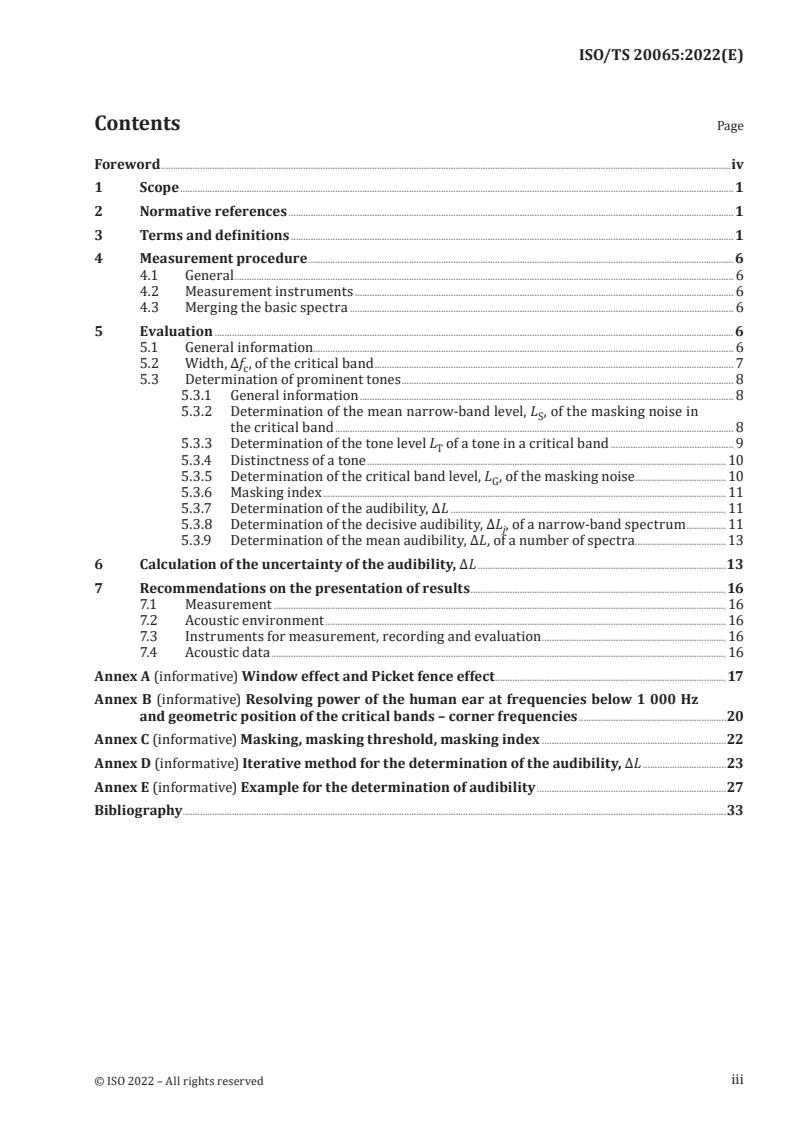
Contents Page
Foreword .iv
1 Scope . 1
2 Normative references . 1
3 Terms and definitions . 1
4 Measurement procedure . 6
4.1 General . 6
4.2 Measurement instruments . 6
4.3 Merging the basic spectra . 6
5 Evaluation . 6
5.1 General information. 6
5.2 Width, Δf , of the critical band . 7
c
5.3 Determination of prominent tones . 8
5.3.1 General information . 8
5.3.2 Determination of the mean narrow-band level, L , of the masking noise in
S
the critical band . 8
5.3.3 Determination of the tone level L of a tone in a critical band . 9
T
5.3.4 Distinctness of a tone . 10
5.3.5 Determination of the critical band level, L , of the masking noise . 10
G
5.3.6 Masking index . 11
5.3.7 Determination of the audibility, ΔL . 11
5.3.8 Determination of the decisive audibility, ΔL , of a narrow-band spectrum . 11
j
5.3.9 Determination of the mean audibility, ΔL, of a number of spectra .13
6 Calculation of the uncertainty of the audibility, ΔL .13
7 Recommendations on the presentation of results .16
7.1 Measurement . 16
7.2 Acoustic environment . 16
7.3 Instruments for measurement, recording and evaluation . 16
7.4 Acoustic data . 16
Annex A (informative) Window effect and Picket fence effect .17
Annex B (informative) Resolving power of the human ear at frequencies below 1 000 Hz
and geometric position of the critical bands – corner frequencies .20
Annex C (informative) Masking, masking threshold, masking index .22
Annex D (informative) Iterative method for the determination of the audibility, ∆L .23
Annex E (informative) Example for the determination of audibility .27
Bibliography .33
iii
Foreword
ISO (the International Organization for Standardization) is a worldwide federation of national standards
bodies (ISO member bodies). The work of preparing International Standards is normally carried out
through ISO technical committees. Each member body interested in a subject for which a technical
committee has been established has the right to be represented on that committee. International
organizations, governmental and non-governmental, in liaison with ISO, also take part in the work.
ISO collaborates closely with the International Electrotechnical Commission (IEC) on all matters of
electrotechnical standardization.
The procedures used to develop this document and those intended for its further maintenance are
described in the ISO/IEC Directives, Part 1. In particular, the different approval criteria needed for the
different types of ISO documents should be noted. This document was drafted in accordance with the
editorial rules of the ISO/IEC Directives, Part 2 (see www.iso.org/directives).
Attention is drawn to the possibility that some of the elements of this document may be the subject of
patent rights. ISO shall not be held responsible for identifying any or all such patent rights. Details of
any patent rights identified during the development of the document will be in the Introduction and/or
on the ISO list of patent declarations received (see www.iso.org/patents).
Any trade name used in this document is information given for the convenience of users and does not
constitute an endorsement.
For an explanation of the voluntary nature of standards, the meaning of ISO specific terms and
expressions related to conformity assessment, as well as information about ISO's adherence to
the World Trade Organization (WTO) principles in the Technical Barriers to Trade (TBT), see
www.iso.org/iso/foreword.html.
This document was prepared by Technical Committee ISO/TC 43, Acoustics, Subcommittee SC 1, Noise.
This first edition of ISO/TS 20065 cancels and replaces ISO/PAS 20065:2016, which has been technically
revised.
The main changes are as follows:
— guidance on residual sound (5.3.1);
— a file containing a number of other example audio files and a guidance document can be downloaded
from https://standards.iso.org/iso/ts/20065/ed-1/en (from “Prominent tones in wind turbine noise
Round robin test IEC 61400-11, ISO/PAS 20065”);
— editorial changes for clarity, for easier implementation in software, and to meet the latest ISO
standards, including definitions, measures, formulae, aligned and streamlined terminology, and
additional background information.
Any feedback or questions on this document should be directed to the user’s national standards body. A
complete listing of these bodies can be found at www.iso.org/members.html.
iv
TECHNICAL SPECIFICATION ISO/TS 20065:2022(E)
Acoustics — Objective method for assessing the audibility
of tones in noise — Engineering method
1 Scope
This document describes a method for the objective determination of the audibility of tones in
environmental noise.
This document is intended to augment the usual method for evaluation on the basis of aural impression,
in particular, in cases in which there is no agreement on the degree of the audibility of tones. The
method described can be used if the frequency of the tone being evaluated is equal to, or greater than,
50 Hz. In other cases, if the tone frequency is below 50 Hz, or if other types of noise (such as screeching)
are captured, then this method cannot replace subjective evaluation.
NOTE The procedure has not been validated below 50 Hz.
The method presented herein can be used in continuous measurement stations that work automatically.
2 Normative references
The following documents are referred to in the text in such a way that some or all of their content
constitutes requirements of this document. For dated references, only the edition cited applies. For
undated references, the latest edition of the referenced document (including any amendments) applies.
ISO 1996-1, Acoustics — Description, measurement and assessment of environmental noise — Part 1: Basic
quantities and assessment procedures
IEC 61672-1, Electroacoustics — Sound level meters — Part 1: Specifications
3 Terms and definitions
For the purposes of this document, the terms and definitions given in ISO 1996-1 and the following
apply.
ISO and IEC maintain terminology databases for use in standardization at the following addresses:
— ISO Online browsing platform: available at https:// www .iso .org/ obp
— IEC Electropedia: available at https:// www .electropedia .org/
NOTE Unless otherwise stated, the reference level for decibel (dB) values in these definitions is 20 µPa.
3.1
tone
sound characterized by a single-frequency component or narrow-band components
3.2
tone frequency
f
T
frequency of the spectral line (3.23) (or mid-band frequency of the narrow-band filter), to the level of
which the tone (3.1) contributes most strongly
Note 1 to entry: Tone frequency is expressed in hertz (Hz).
3.3
tone level
L
T
energy summation of the narrow-band level (3.22) with the tone frequency (3.2), f , and the lateral lines
T
about f , assignable to this tone
T
Note 1 to entry: Tone level is expressed in decibels (dB).
Note 2 to entry: If the critical band (3.5) for the frequency, f , under consideration contains a number of tones,
T
then the tone level, L , is the energy sum of these tones. This level, L , is then assigned to the frequency of the
T T
participating tone that has the maximal value of audibility (3.4), ΔL.
Note 3 to entry: The method for the determination of the tone level, L , of a tone in a critical band is described in
T
5.3.3.
3.4
audibility
ΔL
Audibility of tones is the arithmetic difference between the tone level (3.3), L , and the masking threshold
T
′
(3.15), L
T
Note 1 to entry: Audibility is expressed in decibels (dB).
Note 2 to entry: The method for the determination of the decisive audibility (3.24), ΔL , of a narrow-band spectrum
j
(3.12) is described in 5.3.8.
3.5
critical band
frequency band with a bandwidth (3.17), ∆f within which the auditory system integrates the sound
c
intensity in the formation of loudness and within which it integrates the sound intensity in the
formation of the masking threshold (3.15)
Note 1 to entry: Critical band is expressed in hertz (Hz).
Note 2 to entry: This characteristic of a critical band (see also References [3] and [4]) holds only for a restricted
sound level range. This dependence is neglected here.
3.6
mean narrow-band level of the critical band
L
S
energy mean value of all narrow-band levels (3.22) in a critical band (3.5), except for the spectral line for
the frequency, f , under consideration and all lines that exceed this mean value by more than 6 dB
T
Note 1 to entry: Mean narrow-band level of the critical band is expressed in decibels (dB).
Note 2 to entry: The iterative method for the determination of the mean narrow-band level, L , of the masking
S
noise is described in 5.3.2 and in Annex D.
3.7
critical band level
L
G
level of noise that is assigned to the critical band (3.5) that describes the masking characteristic of the
noise for one or more tones of the noise in this critical band
Note 1 to entry: Critical band level is expressed in decibels (dB).
Note 2 to entry: See narrow-band level (3.22) and Annex C for masking.
Note 3 to entry: For the definition formula for L , see Formula (12).
G
3.8
sampling frequency
f
S
number of samples taken per second
Note 1 to entry: Sampling frequency is expressed in hertz (Hz).
Note 2 to entry: The analogue data provided continuously are converted into samples through sampling at
discrete time intervals for digital processing.
Note 3 to entry: To ensure the reproducibility of a digitized signal, the Shannon theorem requires that the
sampling frequency, f , is at least 2 times the highest frequency of the signal components used for evaluation in
S
the time signal [ f ≥ 2 f , see also aliasing (3.9), antialiasing filter (3.10) and useable frequency (3.20)]. Discrete
S N
Fourier Transform (DFT) analysers thus need a sampling frequency that is at least 2,56 times the maximum
frequency to be analysed.
3.9
aliasing
reflection in the line spectrum (3.12) of frequency components from the range above the sampling
frequency (3.8) divided by two ( f /2) in the range below f /2
S S
Note 1 to entry: Antialiasing filters (3.10) are used to avoid errors through such reflections.
Note 2 to entry: Half the sampling frequency ( f /2) is also known as the Nyquist frequency.
S
3.10
antialiasing filter
low-pass filter
ideal filter that allows frequencies below half the sampling frequency (3.8) to pass through completely
(without influencing the signal), but completely block all higher frequencies
Note 1 to entry: To prevent aliasing (3.9), the noise under investigation shall be filtered using an antialiasing
filter before analogue-to-digital conversion.
Note 2 to entry: Real aliasing filters have a final damping (generally 120 dB/octave) within the blocking range, i.e.
signal components in this transition range are reflected (damped). For example, in the transformation of 2 048
(2 k) data points, 1 024 frequency lines are calculated and 800 lines shown. A component in the line number
1 248 is folded back into the line number 800. With a low-pass filter of 120 dB/octave the damping of these
components is approximately 75 dB.
Note 3 to entry: The usual commercial DFT analysers have an antialiasing filter, the limit frequency of which
can be switched automatically with the selectable sampling frequency. The reflection of simulated narrow-band
levels (3.22) is suppressed.
3.11
block length
N
block of sampling values that in discrete form represents a time-limited range of the time signal to be
analysed
Note 1 to entry: In contrast to frequency analysis with analogue and digital filters, the noise with the Fast Fourier
Transform is processed in data blocks. In general, these blocks embrace only a part of the noise recording. The
block length, N, expresses the number of data points processed at the same time. Regarding the Fast Fourier
Transform, the value of N generally has the integer of power of 2. It has a value, for example, of N = 2 = 1 024
data points.
3.12
line spectrum
narrow-band spectrum
frequency spectrum
plot of the sound pressure level (narrow-band level) (3.22) as a function of the frequency in frequency
bands of constant bandwidth (3.17) (line spacing, ∆f ) (3.13)
Note 1 to entry: A-weighting of the level is assumed in this document.
Note 2 to entry: DFT analysis delivers a line spectrum, in which each line represents the output of a filter, the
mid-frequency of which corresponds to the frequency of the spectral line (3.23).
3.13
line spacing
frequency resolution
distance, between adjacent spectral lines (3.23), where the line spacing in the DFT is given by
Δff= /N
S
where
f is the sampling frequency (3.8);
S
N is the block length (3.11).
Note 1 to entry: Line spacing is expressed in hertz (Hz).
Note 2 to entry: In this document, the line spacing is 1,9 Hz ≤ Δf ≤ 4,0 Hz.
3.14
time window
time data set of the signal segment (block length) (3.11) that is multiplied by a weighting function
(window function)
Note 1 to entry: In accordance with the definition of the Fourier integral, a prerequisite of the DFT analysis is
that the time data set is periodic. If this is not the case (as with stochastic signals), cut-off effects at the edges
of the time window will lead to distortion of the spectrum. These distortions are avoided through weighting
functions such as the Hanning function.
Note 2 to entry: For more information on window and weighting functions, see, for example, Reference [5] and
Annex A.
3.15
masking threshold
′
L
T
audibility (3.4) threshold for a specific sound in the presence of a masking sound (masker)
Note 1 to entry: Masking threshold is expressed in decibels (dB).
Note 2 to entry: See Annex C for more information on the audibility threshold and the masking noise.
3.16
masking index
a
v
′
arithmetic difference between the masking threshold (3.15), L , and the critical band level (3.7), L , of
T G
the masking noise
Note 1 to entry: Masking index is expressed in decibels (dB).
Note 2 to entry: For frequency-dependent masking index, a , masking and masking noise, see Annex C.
v
3.17
bandwidth
frequency bandwidth
frequency range of a number of adjacent spectral lines (3.23)
Note 1 to entry: Bandwidth is expressed in hertz (Hz).
Note 2 to entry: If the width of a frequency band is calculated for which its beginning or end does not correspond
to the boundary between two spectral lines, then only the spectral lines that lie in their full width within the
calculated frequency range are assigned to the frequency band.
3.18
distinctness
clarity ratio of the prominence of a tone based on a bandpass noise to the prominence of a sinusoidal
tone of the same tone frequency (3.2), f , and same tone level (3.3), L
T T
Note 1 to entry: Distinctness is expressed in percentage (%).
3.19
edge steepness
slope of the level difference between the maximum narrow-band level (3.22) of a tone, L , and the
Tmax
narrow-band levels of the first line below/above the tone to the corresponding frequency difference
Note 1 to entry: Edge steepness is expressed in decibels per hertz (dB/Hz).
3.20
useable frequency
f
N
upper limit frequency of the signal components used for evaluation
Note 1 to entry: Useable frequency is expressed in hertz (Hz).
3.21
investigation range
frequency range within which tones are investigated in the line spectrum (3.12)
Note 1 to entry: Investigation range is expressed in hertz (Hz).
3.22
narrow-band level
averaged level within a spectral line (3.23)
Note 1 to entry: Narrow-band level is expressed in decibels (dB).
3.23
spectral line
frequency band of bandwidth (3.17), ∆f (line spacing) (3.13), in a line spectrum (3.12)
Note 1 to entry: Spectral line is expressed in hertz (Hz).
3.24
decisive audibility
ΔL
j
maximum audibility (3.4), ∆L in the individual spectrum, j
Note 1 to entry: Decisive audibility is expressed in decibels (dB).
3.25
mean audibility
ΔL,
energy average of decisive audibility (3.24), ΔLj, calculated for each narrow-band averaged spectrum
Note 1 to entry: Mean audibility is expressed in decibels (dB).
4 Measurement procedure
4.1 General
The measurement procedure will depend on the aims. The requirements for the measurement and
assessment procedure in terms of the choice of measurement point, measurement time and duration of
measurement, extraneous noise, etc. shall be satisfied.
The variable for determination of audibility of prominent tones is the sound pressure, p(t). For frequency
analysis, the A-weighted equivalent continuous sound pressure level, L , as given in ISO 1996-1, shall
Aeq
be established for the respective spectral lines. If the spectrum is unweighted ("LIN" or "Z"), then it
shall be corrected to A-weighting in accordance with IEC 61672-1.
4.2 Measurement instruments
Sound level meters that meet, or exceed, the requirements of Class 1 in IEC 61672-1 shall be used. These
have a frequency weighting “A”/“LIN” or “A”/“Z” with a lower limit frequency equal to, or below, 20 Hz.
Additional instruments such as recording instruments (digital or magnetic tape) may also be used. The
measured values derived through recording instruments shall lie within the tolerance range given in
IEC 61672-1.
Analysis of frequency components in the measurement signals is performed using a frequency
analyser. The constant line spacing, Δf, shall lie in the range 1,9 Hz to 4 Hz (inclusive). The use of the
Hanning window is mandatory in this document. For further processing, it shall be ensured that the
digitalization of the sound pressure signal across the entire dynamic range used has a resolution of at
least 0,1 dB.
Before it is processed further, the analogue measurement signal shall be passed through a steep low-
pass filter (antialiasing filter) to avoid errors in frequency analysis. The sampling frequency (see 3.8)
shall be at least two times the maximum usable frequency present (see 3.20). The Hanning window is to
be used as time window to reduce lateral bands (see 3.14).
4.3 Merging the basic spectra
The spectra for the prominent tone assessment shall have an averaging time of approximately 3 s. Due
to the line spacing of 1,9 Hz to 4 Hz (see 4.2) and the typical frequency range, f, of a few kHz, the basic
spectra given by the frequency analyser will have an averaging time below 1 s. To get the averaging
time of approximately 3 s, a number of basic spectra shall be merged. This shall be done line by line
with Formula (1):
1 N
01,dL / B
ij,
L = 10 lgd10 B (1)
i ∑
j=1
N
where
th th
L is the level of the i spectral line for the j spectrum, in dB;
i,j
N is the number of merged spectra.
5 Evaluation
5.1 General information
The aim of evaluation is to establish the audibility, ΔL. The procedure is the same for stationary and
non-stationary noises. For tones that can only just be perceived, a quaver (eighth note) is to be adopted
as a base time that is adequate for hearing. However, comprehensive studies have shown that the lower
limit for use of the procedure is reached at averaging times of approximately 3 s. Lower averaging times
lead to unjustified values of audibility, ΔL (too high, but also too low). Signals that have very high level
and/or frequency dynamics that no longer correspond with a 3-second averaging can, therefore, not be
evaluated using this document. The following conditions shall be satisfied for the measurements.
— The extended uncertainty, U, of the audibility, ΔL, with a coverage probability of 90 % in a bilateral
confidence interval (see Clause 6) shall not exceed ±1,5 dB. This is generally the case with evaluation
of at least 12 time-staggered narrow-band averaged spectra. If there are less than 12 averaged
spectra then the uncertainty shall be taken into consideration as given in Clause 6.
— Where there are alternating operating states, all of the operating states shall be covered by the
averaging spectra used (see Annex E).
Tones in different critical bands are evaluated separately. To arrive at a decision on whether an
assessment has to be made, only the critical band with the most pronounced tone is considered (see
5.3.8).
If a number of tones are present within a critical band, then an energy summation of their tone levels,
L , is carried out to yield a tone level, L (see 5.3.8).
Ti T
An assessment is performed for a tone only if its distinctness (see 3.18) is at least 70 %. This means
a maximal bandwidth, Δf , dependent on the tone frequency [see Formula (9)] and necessitates edge
R
steepness (see 3.19) of at least 24 dB/octave.
The mean audibility, ΔL, which is the conclusive result of this method for the noise to be assessed, is
determined by averaging in energy terms the decisive audibility ΔL calculated for each narrow-band
j
averaged spectrum. In this averaging, the ΔL , the maximum audibility in each spectrum, is used
j
regardless of the frequency of the tone. Because the aim of this method is to estimate the annoyance
of a noise containing tones relative to a noise without tones, not the annoyance of a tone at a particular
frequency.
NOTE 1 For the distinctness of a tone, see 5.3.4.
NOTE 2 Harmonic multiples of a tone are evaluated, independently of that tone, similarly to all other
components of the line spectrum.
A sample program to determine audibility can be downloaded from https:// standards .iso .org/ iso/ ts/
20065/ ed -1/ en. This is based on ISO/PAS 20065. It is useful for validating proprietary analysis codes.
5.2 Width, Δf , of the critical band
c
The width, Δf , of the critical band about the tone frequency, f , is given by Formula (2):
c T
06, 9
f /Hz
T
Δ=f 25,H07z,++5010,,14 Hz (2)
c
Assuming a geometric position of the corner frequencies of the critical band (see Annex B), these corner
frequencies, f and f , are derived as follows:
1 2
ff=× f (3)
T 12
2 2
−Δf Δff+4
()
c cT
f = + (4)
2 2
ff=+Δf (5)
21 c
5.3 Determination of prominent tones
5.3.1 General information
The audibility of a tone is determined using the tone level, L , and the critical band level, L , of the
T G
masking noise in the critical band about the tone frequency, f . The frequency of all maxima of the line
T
spectrum is considered as the tone frequency.
The use of the Hanning window is recommended in Annex A. With window functions (except for
rectangular windows), the effective analysis bandwidth, Δf , is greater than the bandwidth, Δf, of an
e
ideal filter (see 3.13), i.e. the individual bands are thus superimposed. In the summation process, the
energy components are counted a number of times (see Annex A for more information).
In a frequency analyser, this influence of summation (number of lines >1) is taken into consideration
through a correction value; if the level addition is simulated by the analyser program, then this
correction value has to be considered in the computing program, both in the formation of the tone level
[see Formula (8)] and in the calculation of the masking noise [see Formula (12)].
The measurement is to be made where possible at such times that tones from sources of residual
sound are not present as these can impact the assessment of the source of specific sound under
investigation. Justification of the selection of the measurement time period is to be reported. Where
not possible, the influence of the sources of residual sound on the measurement is to be reported. When
unattended measurements are used, ancillary data such as audio recording or other methods of source
identification are recommended. It is recommended that tones that are suspected of being caused
by sources of residual sound are excluded from analysis. In addition, it is recommended to consider
limiting the frequency range over which tones are searched for.
5.3.2 Determination of the mean narrow-band level, L , of the masking noise in the critical
S
band
The mean narrow-band level of the critical band, L , [see Formula (6)] is derived in an iterative procedure
S
from the lines of the critical band about the line under investigation. The procedure commences with
the energy averaging of all lines of the critical band with the exception of the line under investigation
itself. In the subsequent steps, the levels of the lines of the critical band under consideration are no
longer taken into consideration in the averaging procedure if their level exceeds the energy mean value
determined beforehand by more than 6 dB. The iterative procedure is discontinued, if in an iteration
step, the new energy mean value is equal within a tolerance of ±0,005 dB to that of the previous iteration
step or if the number of lines contributing to the mean narrow-band level to the right or left of the line
under investigation falls below a value of 5. In this case, the energy mean value from the last iteration
step, at which the number of energy averaged levels on both sides of the line under investigation in each
case was still at least 5 is used to form the mean narrow-band level.
For determination of the mean narrow-band level, the entire critical band about the line under
investigation is used. Consequently, the range under investigation (see 3.21) is limited relative to the
useable frequency, f , such that the upper limit of the uppermost critical band being considered does not
N
exceed the useable frequency, f . A corresponding condition also applies in principle for the lower limit
N
of the lowest critical band considered. Since the use of this document is restricted to tone frequencies
greater than or equal to 50 Hz and the usual analysers generate line spectra starting at 0 Hz, it is not
generally necessary to take any special precautions.
The mean narrow-band level of the critical band, L , is given by Formula (6):
S
1 M Δf
01,dL / B
i
L = 10 lg 10 + 10 lg dB (6)
S ∑
i=1
M Δf
e
where
th
L is the narrow-band level of the i spectral line of the critical band under consideration, in
i
decibels (dB);
M is the number of spectral lines to be averaged in the critical band;
Δf is the line spacing, in hertz (Hz) (see 3.13);
Δf is the effective bandwidth in Hz; if a Hanning window is used then the effective bandwidth, Δf ,
e e
is 1,5 times the frequency resolution (line spacing), Δf (see Annex A).
If the line spectrum is unweighted ("LIN" or "Z"), then it shall be A-weighted in accordance within
IEC 61672-1.
NOTE 1 If the iteration is discontinued, because the remaining number of spectral lines to be averaged on one
or both sides falls below 5, then the audibility can be somewhat greater than the audibility calculated with this
mean narrow-band level.
NOTE 2 The iteration procedure is described in Annex D.
NOTE 3 Using a digital calculation program, the equal condition in the iteration procedure is typically given
by the resolution of the number format (high resolution should be used).
5.3.3 Determination of the tone level L of a tone in a critical band
T
The tone level, L , is determined from the individual levels of the spectral lines in the critical band about
T
f that contain energy to be assigned to the tone. In principle, a tone may only be present if the level of
T
the spectral line considered is at least 6 dB greater than the corresponding mean narrow-band level, L .
S
In general, a number of spectral lines have to be taken into consideration, since, for instance, because
of the Picket fence effect (see Annex A), or actual small frequency fluctuations during data capture, the
tone energy is represented through the levels of a number of spectral lines.
Adjacent spectral lines should be used for summation purposes if
— they differ from the narrow-band level at a frequency, f , by less than 10 dB, and
T
— they differ from the mean narrow-band level, L , of the masking noise within the critical band about
S
the tone by more than 6 dB.
In case K = 1:
LL= (7)
TT
In case K > 1:
K Δf
01,dL / B
i
L = 10lg 10 +10lg dB (8)
T (∑ )
i=1
Δf
e
where
th
L is the narrow-band level of the i spectral line of this critical band with tone energy, in
i
decibels (dB);
K is the number of spectral lines with tone energy;
Δf is the line spacing, in hertz (Hz) (see 3.13);
Δf is the effective bandwidth, in hertz (Hz) (see 5.3.2).
e
NOTE The individual levels of the spectral lines with tone energy [see Formula (8)] also contain energy
components of the masking noise. These can generally be neglected.
5.3.4 Distinctness of a tone
The distinctness of a tone depends on the bandwidth of the tone and its edge steepness; if the
corresponding criteria are not satisfied then the tone is not audible to individuals with normal hearing.
If a tone based on bandpass noise has a distinctness of 70 % relative to that of a sinusoidal tone then
the maximum permitted bandwidth, Δf , as a function of the tone frequency, f , is approximated (see
R T
Figure 1 in Reference [8]) by:
Δ=ff26,,01 00Hz+ ,001 (9)
()
RT
The bandwidth of a tone with a frequency, f , is derived from the number of spectral lines, K [see
T
Formula (8)], multiplied by the line spacing, Δf.
First criterion: The bandwidth of the tone shall not exceed the maximum permitted bandwidth given
by Formula (9).
Second criterion: The edge steepness shall be at least 24 dB/octave.
This yields the level differences between the maximum narrow-band level of the tone, L , and the
Tmax
narrow-band levels of the first spectral line below the tone L /above the tone L as follows:
u o
The lower level difference ΔL is given by Formula (10):
u
f LL−
T Tmax u
Δ=L ≥24dB (10)
u
2 ff−
Tu
where
f is the frequency of the first spectral line below the tone, in hertz (Hz);
u
f is the frequency of the maximum narrow-band level, in hertz (Hz).
T
The upper level difference, ΔL , is given by Formula (11):
o
LL−
Tmax o
Δ=Lf ≥24dB (11)
oT
ff−
oT
where
f is the frequency of the first spectral line above the tone, in hertz (Hz);
o
f is the frequency of the maximum narrow-band level, in hertz (Hz).
T
5.3.5 Determination of the critical band level, L , of the masking noise
G
The level L is given by Formula (12):
G
Δf
c
LL=+ 10lg dB (12)
GS
Δf
where
L is the mean narrow-band level of the critical band, see 5.3.2;
S
Δf is the width of the critical band about the tone frequency, f , in hertz (Hz) (see 5.2);
c T
Δf is the line spacing (frequency resolution), in hertz (Hz).
5.3.6 Masking index
The masking index, a , is given by Formula (13):
v
25,
f /Hz
a =−21−+lg dB (13)
v
where f is the frequency, in hertz (Hz).
NOTE For information on the masking index, a , see Annex C.
v
5.3.7 Determination of the audibility, ΔL
The audibility, ΔL, between the tone level, L , (see 5.3.3) and the level of the masking threshold (see
T
3.15) is given by Formula (14):
Δ=LL()−−La (14)
TG v
where
L is the tone level, in decibels (dB) (see 5.3.3);
T
L is the masking noise, in decibels (dB) (see 5.3.5);
G
a is the masking index, in decibels (dB) (see 5.3.6).
v
NOTE Formula (14) holds correspondingly if all the parameters of that formula are given.
5.3.8 Determination of the decisive audibility, ΔL , of a narrow-band spectrum
j
To determine the audibility, ΔL, of a noise a number of narrow-band spectra (see Annex D), staggered in
time, of the noise with the same line width and same number of lines are used. The measurement time
for such a spectrum should be approximately 3 s. The decisive audibility, ΔL , of an individual spectrum
j
is determined in the following four steps. For simplification purposes the run index j is not given.
Step 1
Each spectral line, i, is investigated in ascending sequence to establish whether it represents a potential
tone. A narrow-band level is a potential tone if the following conditions are satisfied:
LL>>andLL (15)
ii+−11ii
and
LL>+6dB (16)
iiS
NOTE 1 Mean narrow-band level, L , see 5.3.2.
Si
Step 2
The tone levels, L , (see 5.3.3) of all the potential tones (run index k across all potential tones) is
Tk
determined. The masking noises, L (see 5.3.5), and the masking index, a (see 5.3.6), are determined
Gk vk
for the tone levels at which the condition of distinctness of a tone (see 5.3.4) is satisfied. These
parameters are used to calculate the corresponding audibilities, ΔL [see 5.3.7, Formula (14)].
k
If ΔL > 0, then a tone is present.
k
Step 3
Critical bands with the width, Δf , are formed about each of these audible tones, L (run index m
cm Tm
across all audible tones) of frequency, f .
Tm
If a number of tones are present in a critical band, then their tone levels, L (run index n across all
Tm,n
tones in the critical band; H is the number) are summed in terms of energy.
H
01,dL / B
T,mn
L = 10lg 10 dB (17)
Tm )
(∑
n=1
where
H is the total number of all tones in the critical band;
L is the tone level with the run index m across all audible tones and the run index n across all
Tm,n
tones in the critical band, in decibels (dB).
It is possible for the energy of individual spectral lines to be assigned to a number of neighbouring tones
at the same time. Upon addition of the tone levels of neighbouring tones, the energy of these individual
spectral lines may not be summed more than once.
The tone frequency, f , is the frequency of the most pronounced tone, i.e. the tone with the greatest
Tm
audibility, ΔL .
m,n
The mean narrow-band level of the masking noise is that mean narrow-band level that was calculated in
the iterative procedure in 5.3.2 [see Formula (6)] from the lines about the tone with this tone frequency.
The level of the masking noise is the critical band level, L , calculated with this mean narrow-band
Gm,n
level in accordance with 5.3.5.
This tone level, L , is used to recalculate the decisive audibility, ΔL (see Step 2).
Tm k
If exactly 2 tones with tone frequencies, f and f , appear in one critical band, then they are evaluated
T1 T2
separately if both tone frequencies lie below 1 000 Hz and the frequency difference, f .
D
ff=− f (18)
DT12T
where f , f < 1 000 Hz.
T1 T2
Formula (18) exceeds the following value (see Annex B):
18,
f /Hz
T
12,lg
f =×21 10 Hz (19)
D
where
50 Hz < f < 1 000 Hz;
T
f is the frequency of the more pronounced tone (the tone with the greater audibility, ΔL ).
T k
NOTE 2 If precisely 2 tones are present in a critical band below 1 000 Hz, then the human ear can distinguish
differences less than half the critical bandwidth (see Reference [6] and Annex B).
Step 4
The audibility with the maximum value, ΔL , is the decisive audibility, ΔL , of the individual spectrum.
k j
5.3.9 Determination of the mean audibility, ΔL, of a number of spectra
As given in 5.3.8, the decisive audibility, ΔL , is calculated for each narrow-band averaged spectrum
j
(run index j, J is the number). These J audibilities, ΔL , are averaged in energy terms to yield a ΔL:
j
J
1 01,dΔL / B
j
Δ=L 10 lgd10 B (20)
∑
j=1
J
where
ΔL is the decisive audibility, in decibels (dB);
j
j is the run index;
J is the number of spectra.
The tone frequencies are the frequencies of the tones to which the audibilities are assigned. To ensure
a sufficient distance from the positive audibilities, ΔL , for all spectra in which no tone is found, the
j
following value is used for ΔL :
j
ΔL = −10 dB (21)
j
No tone frequencies are stated for this ΔL .
j
NOTE The audibilities, ΔL (and not the tone levels, L ), are averaged in energy terms since the tones in the
j Tj
individual spectra have different tone frequencies, and thus, different masking index, a [see Formula (13)] and
v
masking noises [see Formula (12)] have to be calculated.
6 Calculation of the uncertainty of the audibility, ΔL
The mean audibility, ΔL, between the tone level and the level of the masking threshold of a noise is
calculated using Formula (20) from the decisive audibilities, ΔL , of the individual narrow-band spectra
j
(see 5.3.8 and 5.3.9):
1 J 01,dΔL / B
j
Δ=L 10lg 10 dB (22)
∑
j=1
J
ΔL is calculated through the use of Formula (14) and Formula (12):
j
Δf
c
j
Δ=LL −−L 10lg dB−a (23)
jjTS,,jjv,
Δf
with the expressions of
K
01,/L dB Δf
ji;
L = 10 lg 10 + 10 lg dB (24)
Tj, (∑ )
i=1
Δf
e
1 M 01,/L dB Δf
ji;
L = 10 lg 10 + 10 lg dB (25)
Sj, ∑
i=1
M Δf
e
25,
f / Hz
j
a =−21−+lg dB (26)
vj,
502
NOTE All frequencies are expressed in hertz (Hz).
Δf
c
j
A normal distribution within the level zone is to be assumed for the term 10lg .
Δf
No uncertainty is assumed for the masking index, a
v.
The L values are derived through summation and the L values through averaging of intensities. It
T,j S,j
is therefore necessary to assume a normal distribution of these values within the intensity range. To
simplify the procedure, however, a normal distribution within the sound level range is assumed for
all summands. Since, for the consideration of uncertainty, it is of interest to know the probability of
determining audibility of a tone or tones that is too low, and for the upper limit of the confidence interval
the consideration in the level zone yields greater uncertainties than a corresponding consideration in
the intensity zone, the agreement can be regarded as a safe estimation.
A number of sound sources act on the emission point and may be regarded as incoherent. Their emitted
output levels are uncorrelated in their statistical behaviour. The uncertainty consideration of L and
T
L is based only on the uncertainty of the level of the spectral lines involved. The question as to which
S
spectral lines contribute to L /L is neglected in the consideration of uncertainty h
...
SPÉCIFICATION ISO/TS
TECHNIQUE 20065
Première édition
2022-12
Acoustique — Méthode objective
d'évaluation de l'audibilité des
tonalités dans le bruit — Méthode
d'expertise
Acoustics — Objective method for assessing the audibility of tones in
noise — Engineering method
Numéro de référence
DOCUMENT PROTÉGÉ PAR COPYRIGHT
© ISO 2022
Tous droits réservés. Sauf prescription différente ou nécessité dans le contexte de sa mise en œuvre, aucune partie de cette
publication ne peut être reproduite ni utilisée sous quelque forme que ce soit et par aucun procédé, électronique ou mécanique,
y compris la photocopie, ou la diffusion sur l’internet ou sur un intranet, sans autorisation écrite préalable. Une autorisation peut
être demandée à l’ISO à l’adresse ci-après ou au comité membre de l’ISO dans le pays du demandeur.
ISO copyright office
Case postale 401 • Ch. de Blandonnet 8
CH-1214 Vernier, Genève
Tél.: +41 22 749 01 11
E-mail: copyright@iso.org
Web: www.iso.org
Publié en Suisse
ii
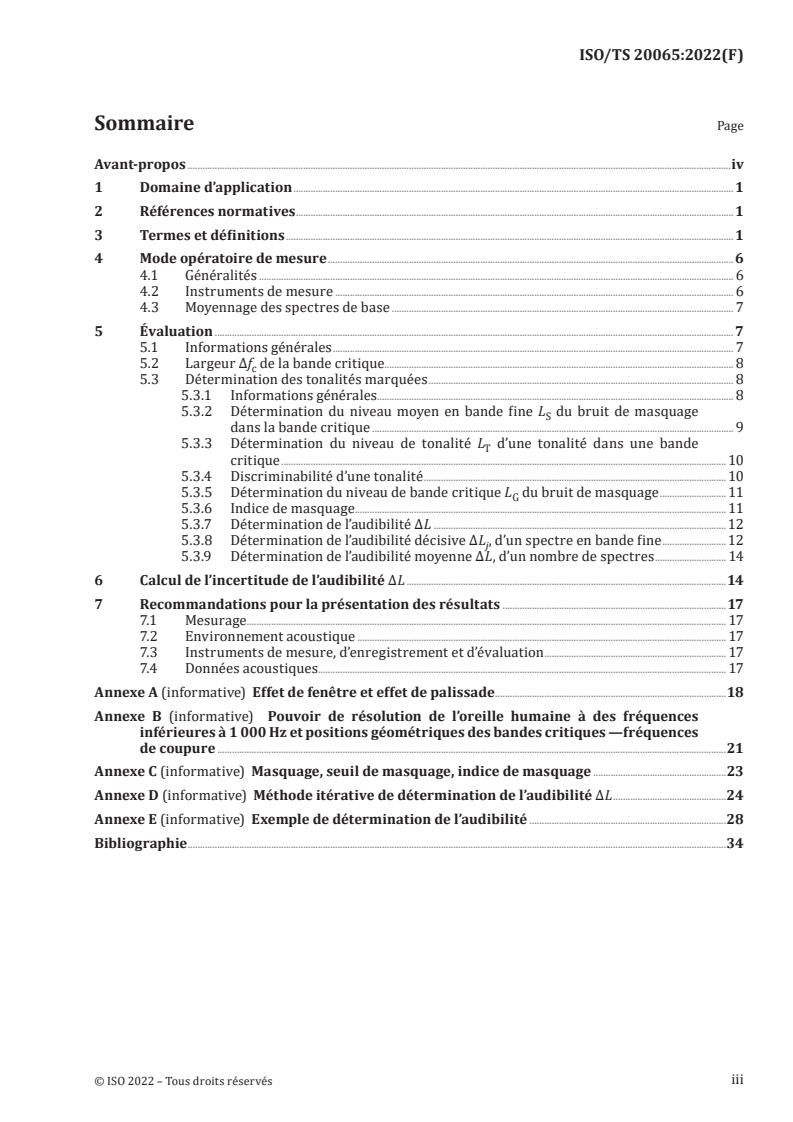
Sommaire Page
Avant-propos .iv
1 Domaine d’application . 1
2 Références normatives .1
3 Termes et définitions . 1
4 Mode opératoire de mesure .6
4.1 Généralités . 6
4.2 Instruments de mesure . 6
4.3 Moyennage des spectres de base . 7
5 Évaluation . 7
5.1 Informations générales . 7
5.2 Largeur Δf de la bande critique . . 8
c
5.3 Détermination des tonalités marquées . 8
5.3.1 Informations générales. 8
5.3.2 Détermination du niveau moyen en bande fine L du bruit de masquage
S
dans la bande critique . 9
5.3.3 Détermination du niveau de tonalité L d’une tonalité dans une bande
T
critique . 10
5.3.4 Discriminabilité d’une tonalité . 10
5.3.5 Détermination du niveau de bande critique L du bruit de masquage . 11
G
5.3.6 Indice de masquage . . 11
5.3.7 Détermination de l’audibilité ΔL .12
5.3.8 Détermination de l’audibilité décisive ΔL , d’un spectre en bande fine .12
j
5.3.9 Détermination de l’audibilité moyenne ΔL, d’un nombre de spectres . 14
6 Calcul de l’incertitude de l’audibilité ΔL .14
7 Recommandations pour la présentation des résultats .17
7.1 Mesurage . . 17
7.2 Environnement acoustique . 17
7.3 Instruments de mesure, d’enregistrement et d’évaluation . 17
7.4 Données acoustiques . 17
Annexe A (informative) Effet de fenêtre et effet de palissade .18
Annexe B (informative) Pouvoir de résolution de l’oreille humaine à des fréquences
inférieures à 1 000 Hz et positions géométriques des bandes critiques —fréquences
de coupure .21
Annexe C (informative) Masquage, seuil de masquage, indice de masquage .23
Annexe D (informative) Méthode itérative de détermination de l’audibilité ∆L .24
Annexe E (informative) Exemple de détermination de l’audibilité .28
Bibliographie .34
iii
Avant-propos
L’ISO (Organisation internationale de normalisation) est une fédération mondiale d’organismes
nationaux de normalisation (comités membres de l’ISO). L’élaboration des Normes internationales est
en général confiée aux comités techniques de l’ISO. Chaque comité membre intéressé par une étude
a le droit de faire partie du comité technique créé à cet effet. Les organisations internationales,
gouvernementales et non gouvernementales, en liaison avec l’ISO participent également aux travaux.
L’ISO collabore étroitement avec la Commission électrotechnique internationale (IEC) en ce qui
concerne la normalisation électrotechnique.
Les procédures utilisées pour élaborer le présent document et celles destinées à sa mise à jour sont
décrites dans les Directives ISO/IEC, Partie 1. Il convient, en particulier de prendre note des différents
critères d’approbation requis pour les différents types de documents ISO. Le présent document
a été rédigé conformément aux règles de rédaction données dans les Directives ISO/IEC, Partie 2
(voir www.iso.org/directives).
L’attention est attirée sur le fait que certains des éléments du présent document peuvent faire l’objet de
droits de propriété intellectuelle ou de droits analogues. L’ISO ne saurait être tenue pour responsable
de ne pas avoir identifié de tels droits de propriété et averti de leur existence. Les détails concernant
les références aux droits de propriété intellectuelle ou autres droits analogues identifiés lors de
l’élaboration du document sont indiqués dans l’Introduction et/ou dans la liste des déclarations de
brevets reçues par l’ISO (voir www.iso.org/brevets).
Les appellations commerciales éventuellement mentionnées dans le présent document sont données
pour information, par souci de commodité, à l’intention des utilisateurs et ne sauraient constituer un
engagement.
Pour une explication de la nature volontaire des normes, la signification des termes et expressions
spécifiques de l’ISO liés à l’évaluation de la conformité, ou pour toute information au sujet de l’adhésion
de l’ISO aux principes de l’Organisation mondiale du commerce (OMC) concernant les obstacles
techniques au commerce (OTC), voir le lien suivant: www.iso.org/iso/fr/avant-propos.
Le présent document a été élaboré par le comité technique ISO/TC 43, Acoustique, sous-comité SC 1,
Bruit.
Cette première édition de l’ISO/TS 20065 annule et remplace l’ISO/PAS 20065:2016, qui a fait l’objet
d’une révision technique.
Les principales modifications sont les suivantes:
— des recommandations relatives au bruit résiduel ont été ajoutées (5.3.1);
— un fichier contenant un certain nombre d’autres exemples de fichiers audio et un document
d’orientation peuvent être téléchargés à l’adresse https://standards.iso.org/iso/ts/20065/ed-1/en
(source: «Prominent tones in wind turbine noise Round robin test IEC 61400-11, ISO/PAS 20065»);
— des modifications rédactionnelles ont été apportées dans un souci de clarté afin de faciliter la mise
en œuvre dans les logiciels et de se conformer aux dernières normes ISO, notamment des définitions,
des mesures, des formules, l’harmonisation et la simplification de la terminologie ainsi que des
informations contextuelles supplémentaires.
Il convient que l’utilisateur adresse tout retour d’information ou toute question concernant le présent
document à l’organisme national de normalisation de son pays. Une liste exhaustive desdits organismes
se trouve à l’adresse www.iso.org/fr/members.html.
iv
SPÉCIFICATION TECHNIQUE ISO/TS 20065:2022(F)
Acoustique — Méthode objective d'évaluation de
l'audibilité des tonalités dans le bruit — Méthode
d'expertise
1 Domaine d’application
Le présent document décrit une méthode de détermination objective de l’audibilité des tonalités dans le
bruit environnemental.
Le présent document est destiné à améliorer la méthode habituelle d’évaluation sur la base de
l’impression auditive, en particulier en cas d’absence d’accord sur le degré d’audibilité des tonalités. La
méthode décrite peut être utilisée lorsque la fréquence de la tonalité évaluée est égale ou supérieure
à 50 Hz. Dans les autres cas, si la fréquence de la tonalité est inférieure à 50 Hz ou si d’autres types de
bruit (par exemple un crissement) sont captés, la présente méthode ne peut pas remplacer l’évaluation
subjective.
NOTE Le mode opératoire n’a pas été validé pour des fréquences inférieures à 50 Hz.
La méthode présentée ici peut être utilisée sur les postes de mesure continu qui fonctionnent
automatiquement.
2 Références normatives
Les documents suivants sont cités dans le texte de sorte qu’ils constituent, pour tout ou partie de leur
contenu, des exigences du présent document. Pour les références datées, seule l’édition citée s’applique.
Pour les références non datées, la dernière édition du document de référence s'applique (y compris les
éventuels amendements).
ISO 1996-1, Acoustique — Description, mesurage et évaluation du bruit de l'environnement — Partie 1:
Grandeurs fondamentales et méthodes d'évaluation
IEC 61672-1, Électroacoustique — Sonomètres — Partie 1: Spécifications
3 Termes et définitions
Pour les besoins du présent document, les termes et définitions de l’ISO 1996-1 ainsi que les suivants
s’appliquent.
L’ISO et l’IEC tiennent à jour des bases de données terminologiques destinées à être utilisées en
normalisation, consultables aux adresses suivantes:
— ISO Online browsing platform: disponible à l’adresse https:// www .iso .org/ obp
— IEC Electropedia: disponible à l’adresse https:// www .electropedia .org/
NOTE Sauf spécification contraire, le niveau de référence des valeurs en décibels (dB) dans ces définitions
est de 20 µPa.
3.1
tonalité
son caractérisé par une composante monofréquence ou par des composantes en bande fine
3.2
fréquence de la tonalité
f
T
fréquence de la raie spectrale (3.23) (ou de la fréquence à mi-bande du filtre en bande fine), au niveau de
laquelle la tonalité (3.1) contribue le plus fortement
Note 1 à l'article: La fréquence de la tonalité est exprimée en hertz (Hz).
3.3
niveau de tonalité
L
T
sommation énergétique du niveau en bande fine (3.22) contenant la fréquence de la tonalité (3.2), f , et de
T
ceux des raies latérales autour de f pouvant être assignées à cette tonalité
T
Note 1 à l'article: Le niveau de tonalité est exprimé en décibels (dB).
Note 2 à l'article: Si la bande critique (3.5) pour la fréquence f considérée contient un certain nombre de tonalités,
T,
alors le niveau de tonalité, L est la somme de l’énergie de ces tonalités. Ce niveau, L est ensuite assigné à la
T, T,
fréquence de la tonalité participante qui présente la valeur maximale d’audibilité (3.4) ΔL.
Note 3 à l'article: La méthode de détermination du niveau de tonalité L d’une tonalité dans une bande critique
T
est décrite en 5.3.3.
3.4
audibilité
ΔL
audibilité des tonalités, c’est-à-dire différence arithmétique entre le niveau de tonalité (3.3) L et le seuil
T
de masquage (3.15) L′
T
Note 1 à l'article: L’audibilité est exprimée en décibels (dB).
Note 2 à l'article: La méthode de détermination de l’audibilité décisive (3.24) ΔL d’un spectre en bande fine (3.12)
j
est décrit en 5.3.8.
3.5
bande critique
bande de fréquences d’une largeur de bande (3.17) ∆f dans laquelle le système auditif intègre l’intensité
c
acoustique dans la formation de la sonie et dans laquelle il intègre l’intensité acoustique dans la
formation du seuil de masquage (3.15)
Note 1 à l'article: La bande critique est exprimée en hertz (Hz).
Note 2 à l'article: Cette caractéristique d’une bande critique (voir également les Références [3] et [4]) ne vaut que
pour une gamme de niveau sonore limitée. Cette dépendance est ici négligée.
3.6
niveau moyen de la bande critique en bande fine
L
S
valeur énergétique moyenne de tous les niveaux en bande fine (3.22) dans une bande critique (3.5), à
l’exception de la raie spectrale pour la fréquence f étudiée et de toutes les raies qui dépassent cette
T
valeur moyenne de plus de 6 dB
Note 1 à l'article: Le niveau moyen de la bande critique en bande fine est exprimé en décibels (dB).
Note 2 à l'article: La méthode itérative de détermination du niveau moyen en bande fine L du bruit de masquage
S
est décrite en 5.3.2 et dans l’Annexe D.
3.7
niveau de bande critique
L
G
niveau de bruit qui est assigné à la bande critique (3.5) qui décrit la caractéristique de masquage du
bruit pour une ou plusieurs tonalités du bruit dans cette bande critique
Note 1 à l'article: Le niveau de bande critique est exprimé en décibels (dB).
Note 2 à l'article: Voir niveau en bande fine (3.22) et l'Annexe C pour le masquage.
Note 3 à l'article: Pour la formule de définition de L , voir la Formule (12).
G
3.8
fréquence d’échantillonnage
f
S
nombre d’échantillons pris par seconde
Note 1 à l'article: La fréquence d’échantillonnage est exprimée en hertz (Hz).
Note 2 à l'article: Les données analogiques fournies en continu sont converties en échantillons par échantillonnage
à des intervalles de temps discrets pour le traitement numérique.
Note 3 à l'article: Pour garantir la reproductibilité d’un signal numérisé, le théorème de Shannon exige que la
fréquence d’échantillonnage f soit au moins 2 fois supérieure à la fréquence la plus élevée des composantes
S
de signaux utilisés pour l’évaluation du signal temporel [ f ≥ 2 f ; voir également repliement (3.9), filtre anti-
S N
repliement (3.10) et fréquence utile (3.20)]. Les analyseurs à transformée de Fourier discrète (TFD) exigent donc
une fréquence d’échantillonnage qui est au moins égale à 2,56 fois la fréquence maximale à analyser.
3.9
repliement
réflexion dans le spectre de raies (3.12) des composantes de fréquence de la gamme supérieure à la
fréquence d’échantillonnage (3.8) divisée par deux ( f /2) vers la gamme inférieure à f /2
S S
Note 1 à l'article: Les filtres anti-repliement (3.10) sont utilisés pour éviter les erreurs dues à ces réflexions.
Note 2 à l'article: La moitié de la fréquence d’échantillonnage ( f /2) est également connue comme la fréquence de
S
Nyquist.
3.10
filtre anti-repliement
filtre passe-bas
filtre idéal qui permet aux fréquences inférieures à la moitié de la fréquence d’échantillonnage (3.8) de
traverser complètement (sans influencer le signal), mais bloque complètement toutes les fréquences
plus élevées
Note 1 à l'article: Pour éviter le repliement (3.9), le bruit étudié doit être filtré en utilisant un filtre anti-repliement
avant la conversion analogique-numérique.
Note 2 à l'article: Les filtres anti-repliement réels ont un amortissement final (généralement 120 dB/octave) dans
la plage de blocage, c’est-à-dire que les composantes du signal dans cette gamme de transition sont réfléchies
(amorties). Par exemple, dans la transformée de 2 048 (2 k) points de données, 1 024 lignes de fréquence sont
calculées et 800 lignes sont affichées. Une composante de la ligne numéro 1 248 est repliée dans le numéro de
ligne 800. Avec un filtre passe-bas de 120 dB/octave, l’amortissement de ces composantes est d’environ 75 dB.
Note 3 à l'article: Les analyseurs TFD commerciaux habituels possèdent un filtre anti-repliement dont la
fréquence limite peut être commutée automatiquement avec la fréquence d’échantillonnage sélectionnable. La
réflexion des niveaux en bande fine simulés (3.22) est supprimée.
3.11
longueur de bloc
N
bloc de valeurs d’échantillonnage qui sous une forme discrète, représente un intervalle de temps limité
du signal temporel à analyser
Note 1 à l'article: Contrairement à l’analyse de fréquence avec les filtres analogiques et numériques, le bruit avec
la transformée de Fourier rapide est traité dans des blocs de données. En général, ces blocs englobent seulement
une partie de l’enregistrement sonore. La longueur du bloc N indique le nombre de points de données traités
en même temps. En ce qui concerne la transformée de Fourier rapide, la valeur de N a généralement une valeur
entière de puissance de 2. La valeur est par exemple de N = 2 = 1 024 points de données.
3.12
spectre de raies
spectre en bande fine
spectre de fréquence
tracé du niveau de pression acoustique (niveau en bande fine) (3.22) en fonction de la fréquence dans
des bandes de fréquences de largeur de bande constante (3.17) (espacement des raies ∆f ) (3.13)
Note 1 à l'article: Une pondération A du niveau est prise pour hypothèse dans le présent document.
Note 2 à l'article: L’analyse TFD délivre un spectre de raies, dans lequel chaque raie représente la sortie d’un filtre
dont la fréquence moyenne correspond à la fréquence de la raie spectrale (3.23).
3.13
espacement des raies
résolution en fréquence
distance entre des raies spectrales (3.23) adjacentes, où l’espacement des raies dans la TFD est donné
par
Δff= /N
S
où
f est la fréquence d’échantillonnage (3.8);
S
N est la longueur de bloc (3.11).
Note 1 à l'article: L’espacement des raies est exprimé en hertz (Hz).
Note 2 à l'article: Dans le présent document, l’espacement des raies est dans l’intervalle 1,9 Hz ≤ Δf ≤ 4,0 Hz.
3.14
fenêtre temporelle
ensemble de données temporelles du segment de signal (longueur de bloc) (3.11) qui est multiplié par
une fonction de pondération (fenêtrage)
Note 1 à l'article: Conformément à la définition de l’intégrale de Fourier, un prérequis de l’analyse DFT est que
l’ensemble des données temporelles est périodique. Si ce n’est pas le cas (comme avec les signaux stochastiques),
alors les effets de coupure sur les bords de la fenêtre temporelle entraînent une distorsion du spectre. Ces
distorsions sont évitées grâce à des fonctions de pondération telles que la fonction de Hanning.
Note 2 à l'article: Pour plus d’informations sur la fonction de fenêtrage et la fonction de pondération, voir par
exemple la Référence [5] et l’Annexe A.
3.15
seuil de masquage
′
L
T
seuil d’audibilité (3.4) pour un son spécifique en présence d’un son de masquage (masqueur)
Note 1 à l'article: Le seuil de masquage est exprimé en décibels (dB).
Note 2 à l'article: Voir l’Annexe C pour plus d’informations sur le seuil d’audibilité et le bruit de masquage.
3.16
indice de masquage
a
v
′
différence arithmétique entre le seuil de masquage (3.15) L et le niveau de bande critique (3.7) L du
T G
bruit de masquage
Note 1 à l'article: L’indice de masquage est exprimé en décibels (dB).
Note 2 à l'article: Pour un indice de masquage dépendant de la fréquence a , le masquage et le bruit de masquage,
v
voir l’Annexe C.
3.17
largeur de bande
largeur de bande de fréquences
gamme de fréquences d’un certain nombre de raies spectrales (3.23) adjacentes
Note 1 à l'article: La largeur de bande est exprimée en hertz (Hz).
Note 2 à l'article: Si la largeur d’une bande de fréquence est calculée pour que son début ou sa fin ne corresponde
pas à la limite entre deux raies spectrales, alors seules les raies spectrales qui se trouvent dans toute leur largeur
dans la plage de fréquences calculée sont affectées à la bande de fréquences.
3.18
discriminabilité
rapport de la proéminence d’une tonalité d’un bruit passe-bande sur la proéminence d’une tonalité
sinusoïdale de même fréquence de tonalité (3.2) f et de même niveau de tonalité (3.3) L
T T
Note 1 à l'article: La discriminabilité est exprimée en pourcentage (%).
3.19
pente de crête
rapport de la différence de niveau entre le niveau en bande fine (3.22) maximal d’une tonalité L et
Tmax
les niveaux en bande fine de la première ligne au-dessous/au-dessus de la tonalité, sur la différence de
fréquence correspondante
Note 1 à l'article: La pente de crête est exprimée en décibels par hertz (dB/Hz).
3.20
fréquence utile
f
N
fréquence de limite supérieure des composantes de signal utilisées pour l’évaluation
Note 1 à l'article: La fréquence utile est exprimée en hertz (Hz).
3.21
gamme d’investigation
gamme de fréquences dans laquelle les tonalités sont étudiées dans le spectre de raies (3.12)
Note 1 à l'article: La gamme d’investigation est exprimée en hertz (Hz).
3.22
niveau en bande fine
niveau moyenné dans une raie spectrale (3.23)
Note 1 à l'article: Le niveau en bande fine est exprimé en décibels (dB).
3.23
raie spectrale
bande de fréquences de largeur de bande (3.17) ∆f (espacement des raies) (3.13) dans un spectre de raies
(3.12)
Note 1 à l'article: La raie spectrale est exprimée en hertz (Hz).
3.24
audibilité décisive
ΔL
j
audibilité maximale (3.4) ∆L dans le spectre individuel j
Note 1 à l'article: L’audibilité décisive est exprimée en décibels (dB).
3.25
audibilité moyenne
ΔL,
moyenne énergétique de l’audibilité décisive (3.24) ΔLj calculée pour chaque spectre en bande fine
moyenné
Note 1 à l'article: L’audibilité moyenne est exprimée en décibels (dB).
4 Mode opératoire de mesure
4.1 Généralités
Le mode opératoire de mesure dépend des objectifs. Les exigences relatives au mesurage et la méthode
d’évaluation en matière de choix du point de mesure, du moment et de la durée du mesurage, du bruit
perturbateur, etc., doivent être satisfaites.
La variable pour la détermination de l’audibilité des tonalités marquées est la pression acoustique p(t).
Pour l’analyse de la fréquence, le niveau de pression acoustique continu équivalent pondéré A L , tel
Aeq
que donné dans l’ISO 1996-1, doit être déterminé pour les raies spectrales respectives. Si le spectre est
non pondéré («LIN» ou «Z»), alors il doit être corrigé avec la pondération A conformément à l’IEC 61672-1.
4.2 Instruments de mesure
Des sonomètres qui satisfont aux exigences de la Classe 1 de l’IEC 61672-1 ou qui les surpassent
doivent être utilisés. Ceux-ci présentent une pondération en fréquence «A»/«LIN» ou «A»/«Z» avec une
fréquence limite inférieure égale à ou en dessous de 20 Hz.
D’autres instruments tels que des enregistreurs (bande magnétique ou numérique) peuvent également
être utilisés. Les valeurs mesurées obtenues par les instruments d’enregistrement doivent se trouver
dans la plage de tolérance donnée dans l’IEC 61672-1.
L’analyse des composantes de fréquence dans les signaux de mesure est effectuée au moyen d’un
analyseur de fréquence. L’espacement constant des raies Δf doit se trouver dans la plage comprise
entre 1,9 Hz et 4 Hz (compris). L’utilisation de la fenêtre de Hanning est obligatoire dans le présent
document. Pour le traitement ultérieur, il faut s’assurer que la numérisation du signal de pression
acoustique sur toute la gamme dynamique utilisée a une résolution d’au moins 0,1 dB.
Avant un traitement ultérieur, le signal de mesure analogique doit passer par un filtre passe-
bas à pente raide (filtre anti-repliement) afin d’éviter des erreurs dans l’analyse de fréquence. La
fréquence d’échantillonnage (voir 3.8) doit être égale à au moins deux fois la fréquence utile maximale
présente (voir 3.20). La fenêtre de Hanning doit être utilisée en tant que fenêtre temporelle pour réduire
les bandes latérales (voir 3.14).
4.3 Moyennage des spectres de base
Les spectres pour l’évaluation de la tonalité marquée doivent avoir une durée de moyennage
d’environ 3 s. En raison de l’espacement des raies compris entre 1,9 Hz et 4 Hz (voir 4.2) et de la plage de
fréquences caractéristiques f de quelques kHz, les spectres de base fournis par l’analyseur de fréquence
ont une durée de moyennage inférieure à 1 s. Pour obtenir une durée d’intégration d’environ 3 s, un
certain nombre de spectres de base doivent être combinés. Cela doit être effectué ligne par ligne selon
la Formule (1):
1 N 01,dL / B
ij,
L = 10 lgd10 B (1)
i ∑
j=1
N
où
e e
L est le niveau de la i raie spectrale du j spectre, en dB;
i,j
N est le nombre de spectres combinés.
5 Évaluation
5.1 Informations générales
Le but de l’évaluation est d’établir l’audibilité ΔL. Le mode opératoire est identique pour les bruits
stationnaires et non stationnaires. Pour les tonalités qui peuvent tout juste être perçues, une croche
doit être adoptée comme une unité de temps adaptée à l’audition. Toutefois, des études approfondies
ont montré que la limite inférieure pour l’utilisation du mode opératoire est atteinte avec des durées de
moyennage d’environ 3 s. Des durées de moyennage plus courtes conduisent à des valeurs non justifiées
d’audibilité ΔL (trop élevées, mais aussi trop faibles). Les signaux qui ont une très grande dynamique
en niveau et/ou en fréquence, qui ne correspondent plus à un moyennage de 3 s, ne peuvent donc pas
être évalués à l’aide du présent document. Les conditions qui suivent doivent être satisfaites pour les
mesurages.
— L’incertitude élargie U de l’audibilité ΔL, avec une probabilité de couverture de 90 % dans un intervalle
de confiance bilatéral (voir l’Article 6), ne doit pas dépasser ±1,5 dB. Cela est généralement le cas
avec l’évaluation d’au moins 12 spectres en bande fine moyennés décalés dans le temps. Lorsqu’il
y a moins de 12 spectres moyennés, alors l’incertitude doit être prise en compte, comme indiqué à
l’Article 6.
— Lorsqu’il existe d’autres états de fonctionnement, tous ces états doivent être couverts par les
spectres moyennés utilisés (voir l’Annexe E).
Les tonalités dans différentes bandes critiques sont évaluées séparément. Pour parvenir à une
conclusion sur la nécessité d’une évaluation, seule la bande critique présentant la tonalité la plus
marquée est considérée (voir 5.3.8).
Lorsqu’un certain nombre de tonalités sont présentes dans une bande critique, une sommation
énergétique de leurs niveaux de tonalité L est effectuée pour obtenir un niveau de tonalité L
Ti T
(voir 5.3.8).
Une évaluation est réalisée pour une tonalité uniquement si sa discriminabilité (voir 3.18) est au moins
égale à 70 %. Cela signifie une largeur de bande maximale Δf dépendant de la fréquence de la tonalité
R
[voir la Formule (9)] et nécessite une pente de crête (voir 3.19) d’au moins 24 dB/octave.
L’audibilité moyenne ΔL qui constitue le résultat final de la présente méthode concernant le bruit à
évaluer, est déterminée par moyennage énergétique de l’audibilité décisive ΔL calculée pour chaque
j
spectre en bande fine moyenné. Dans le cadre de ce moyennage, l’audibilité maximale dans chaque
spectre, ΔL est utilisée indépendamment de la fréquence de la tonalité, puisque la présente méthode
j
vise à estimer l’interférence d’un bruit contenant des tonalités par rapport à un bruit sans tonalité, et
non l’interférence d’une tonalité à une fréquence particulière.
NOTE 1 Pour la discriminabilité d’une tonalité, voir 5.3.4.
NOTE 2 Les multiples harmoniques d’une tonalité sont évaluées, indépendamment de cette tonalité, de façon
similaire à toutes les autres composantes du spectre de raies.
Un programme d’exemple de détermination de l’audibilité peut être téléchargé à l’adresse https://
standards .iso .org/ iso/ ts/ 20065/ ed -1/ en. Ce programme est fondé sur l’ISO/PAS 20065. Il permet de
valider des codes propriétaires d’analyse.
5.2 Largeur Δf de la bande critique
c
La largeur Δf de la bande critique sur la fréquence de la tonalité f est donnée par la Formule (2):
c T
06, 9
f /Hz
T
Δ=f 25,H07z,++50 10,,14 Hz (2)
c
En présumant une position géométrique des fréquences de coupure de la bande critique (voir l’Annexe B),
ces fréquences de coupure f et f sont obtenues comme suit:
1 2
ff=× f (3)
T 12
2 2
−Δf ()Δff+4
c cT
f = + (4)
2 2
ff=+Δf (5)
21 c
5.3 Détermination des tonalités marquées
5.3.1 Informations générales
L’audibilité d’une tonalité est déterminée en utilisant le niveau de tonalité L et le niveau de bande
T
critique L du bruit de masquage dans la bande critique sur la fréquence de la tonalité f . La fréquence
G T
de toutes les valeurs maximales du spectre de raies est considérée comme la fréquence de tonalité.
L’utilisation de la fenêtre de Hanning est recommandée à l’Annexe A. Avec des fonctions de fenêtrage
(à l’exception des fenêtres rectangulaires), la largeur effective de la bande passante d’analyse Δf est
e
supérieure à la largeur de bande Δf d’un filtre idéal (voir 3.13), c’est-à-dire que les bandes individuelles
sont ainsi superposées. Lors du processus de sommation, des composantes énergétiques sont comptées
plusieurs fois (voir l’Annexe A pour plus d’informations).
Dans un analyseur de fréquence, cette influence de la sommation (nombre de lignes >1) est prise en
compte par le biais d’une valeur de correction; si l’addition de niveau est simulée par le programme
d’analyse, cette valeur de correction doit être prise en compte dans le programme de calcul, à la fois
dans la formation du niveau de tonalité [voir la Formule (8)] et dans le calcul du bruit de masquage
[voir la Formule (12)].
Le mesurage doit être réalisé si possible aux instants où les tonalités de sources de bruit résiduel ne
sont pas présentes, car celles-ci peuvent exercer une influence sur l’évaluation de la source de bruit
spécifique étudiée. Une justification du choix de la période de mesure doit être consignée dans le
rapport. Lorsque cela n’est pas possible, l’influence des sources de bruit résiduel sur la mesure doit
être indiquée dans le rapport. Lorsque des mesurages automatisés sont utilisés, des données auxiliaires
telles qu’un enregistrement audio ou d’autres méthodes d’identification de source sont recommandées.
Il est recommandé d’exclure de l’analyse les tonalités soupçonnées d’être générées par des sources de
bruit résiduel. De plus, il est recommandé d’envisager de limiter la gamme de fréquences sur laquelle
les tonalités sont recherchées.
5.3.2 Détermination du niveau moyen en bande fine L du bruit de masquage dans la bande
S
critique
Le niveau moyen de la bande critique en bande fine L [voir la Formule (6)] est obtenu dans le cadre d’une
S
méthode itérative à partir des raies de la bande critique sur la raie objet de l’évaluation. La méthode
commence par le calcul de la moyenne de l’énergie de toutes les raies de la bande critique, à l’exception
de la raie objet de l’évaluation elle-même. Aux étapes suivantes, les niveaux des raies de la bande
critique considérée ne sont plus pris en compte dans la méthode de calcul de moyenne si leur niveau est
supérieur à la valeur moyenne de l’énergie déterminée à l’avance de plus de 6 dB. La méthode itérative
est interrompue si lors d’une étape d’itération, la nouvelle valeur de la moyenne énergétique est égale,
avec une tolérance de ±0,005 dB, à celle de l’étape d’itération précédente ou si le nombre de raies qui
contribuent au niveau moyen de la bande fine vers la droite ou la gauche de la raie objet de l’évaluation
tombe en dessous d’une valeur de 5. Dans ce cas, la valeur de la moyenne énergétique à partir de la
dernière étape d’itération, au cours de laquelle le nombre de niveaux énergétiques moyennés de chaque
côté de la raie objet de l’évaluation était encore d’au moins 5, est utilisée pour former le niveau moyen
en bande fine.
Pour la détermination du niveau moyen en bande fine, l’ensemble de la bande critique de la raie objet
de l’évaluation est utilisé. Par conséquent, la gamme d’investigation (voir 3.21) est limitée par rapport
à la fréquence utile f de sorte que la limite supérieure de la bande critique la plus haute considérée
N
ne dépasse pas la fréquence utile f . Une condition correspondante s’applique également en principe à
N
la limite inférieure de la plus basse bande critique considérée. L’utilisation du présent document étant
restreinte aux fréquences de tonalité supérieures ou égales à 50 Hz et les analyseurs habituels générant
des spectres de raies à partir de 0 Hz, il n’est généralement pas nécessaire de prendre des précautions
particulières.
Le niveau moyen de la bande critique en bande fine L est donné par la Formule (6):
S
1 M Δf
01,dL / B
i
L = 10 lg 10 + 10 lg dB (6)
S ∑
i=1
M Δf
e
où
e
L est le niveau moyen en bande fine de la i raie spectrale de la bande critique étudiée, en déci-
i
bels (dB);
M est le nombre de raies spectrales à moyenner dans la bande critique;
Δf est l’espacement des raies en hertz (Hz) (voir 3.13);
Δf est la largeur de bande effective en Hz; si une fenêtre de Hanning est utilisée, alors la largeur
e
de bande effective Δf est égale à 1,5 fois la résolution en fréquence (espacement des raies) Δf
e
(voir l’Annexe A).
Si le spectre de raies est non pondéré («LIN» ou «Z»), alors il doit être corrigé avec la pondération A
conformément à l’IEC 61672-1.
NOTE 1 Si l’itération est interrompue parce que le nombre restant de raies spectrales à moyenner sur un ou
deux côtés tombe en dessous de 5, alors l’audibilité peut être un peu plus grande que l’audibilité calculée avec ce
niveau moyen en bande fine.
NOTE 2 La méthode d’itération est décrite dans l’Annexe D.
NOTE 3 Avec un programme de calcul numérique, la condition d’égalité dans la méthode d’itération est
généralement donnée par la résolution du format de nombre (il convient d’utiliser une résolution élevée).
5.3.3 Détermination du niveau de tonalité L d’une tonalité dans une bande critique
T
Le niveau de tonalité L est déterminé à partir des niveaux individuels des raies spectrales dans la
T
bande critique autour de f qui contiennent l’énergie à assigner à la tonalité. En principe, une tonalité
T
ne peut être présente que si le niveau de la raie spectrale considérée est d’au moins 6 dB supérieur au
niveau moyen en bande fine L correspondant.
S
En général, un certain nombre de raies spectrales doivent être prises en compte, car, notamment en
raison de «l’effet palissade» (voir l’Annexe A), ou de légères fluctuations réelles de fréquence pendant la
saisie des données, l’énergie de la tonalité est représentée par les niveaux d’un certain nombre de raies
spectrales.
Il convient d’utiliser les raies spectrales adjacentes pour la sommation si:
— elles diffèrent du niveau en bande fine à une fréquence f de moins de 10 dB;
T
— elles diffèrent du niveau moyen en bande fine L du bruit de masquage dans la bande critique de la
S
tonalité de plus de 6 dB.
Si K = 1:
LL= (7)
TT
Si K > 1:
K
Δf
01,dL / B
i
L = 10lg 10 +10lg dB (8)
T (∑ )
i=1
Δf
e
où
e
L est le niveau moyen en bande fine de la i raie spectrale de cette bande critique avec l’énergie
i
de la tonalité, en décibels (dB);
K est le nombre de raies spectrales contribuant à l’énergie de la tonalité;
Δf est l’espacement des raies en hertz (Hz) (voir 3.13);
Δf est la largeur de bande effective, en hertz (Hz) (voir 5.3.2).
e
NOTE Les niveaux individuels des raies spectrales contribuant à l’énergie de la tonalité [voir la Formule (8)]
contiennent également des composantes énergétiques du bruit de masquage. Celles-ci peuvent généralement être
négligées.
5.3.4 Discriminabilité d’une tonalité
La discriminabilité d’une tonalité dépend de la largeur de bande de la tonalité et de sa pente de crête; si
les critères correspondants ne sont pas satisfaits, alors la tonalité n’est pas audible pour des personnes
ayant une audition normale.
Si une tonalité basée sur un bruit passe-bande a une discriminabilité de 70 % par rapport à celle d’une
tonalité sinusoïdale, alors la largeur de bande maximale autorisée Δf en fonction de la fréquence de
R
tonalité f est estimée (voir la Figure 1 de la Référence [8]) par:
T
Δ=ff26,,01()00Hz+ ,001 (9)
RT
La largeur de bande d’une tonalité avec une fréquence f est obtenue à partir du nombre de raies
T
spectrales K [voir la Formule (8)] multiplié par l’espacement des raies Δf.
Premier critère: La largeur de bande de la tonalité ne doit pas dépasser la largeur de bande maximale
autorisée donnée par la Formule (9).
Second critère: La pente de crête doit être au moins égale à 24 dB/octave.
Cela donne les différences de niveau entre le niveau en bande fine maximal de la tonalité L et les
Tmax
niveaux en bande fine de la première raie spectrale sous la tonalité L /au-dessus de la tonalité L
u o
comme suit:
La différence de niveau inférieur ΔL est donnée par la Formule (10):
u
f LL−
T Tmax u
Δ=L ≥24dB (10)
u
2 ff−
Tu
où
f est la fréquence de la première raie spectrale inférieure à la tonalité, en hertz (Hz);
u
f est la fréquence du niveau en bande fine maximal, en hertz (Hz).
T
La différence de niveau supérieur ΔL est donnée par la Formule (11):
o
LL−
Tmax o
Δ=Lf ≥24dB (11)
oT
ff−
oT
où
f est la fréquence de la première raie spectrale supérieure à la tonalité, en hertz (Hz);
o
f est la fréquence du niveau en bande fine maximal, en hertz (Hz).
T
5.3.5 Détermination du niveau de bande critique L du bruit de masquage
G
Le niveau L est donné par la Formule (12):
G
Δf
c
LL=+ 10lg dB (12)
GS
Δf
où
L est le niveau moyen de la bande critique en bande fine (voir 5.3.2);
S
Δf est la largeur de la bande critique contenant la fréquence de la tonalité f , en hertz (Hz) (voir 5.2);
c T
Δf est l’espacement des raies (résolution en fréquence), en hertz (Hz).
5.3.6 Indice de masquage
L’indice de masquage a est donné par la Formule (13):
v
25,
f /Hz
a =−21−+lg dB (13)
v
où f est la fréquence, en hertz (Hz).
NOTE Pour plus d’informations sur l’indice de masquage a , voir l’Annexe C.
v
5.3.7 Détermination de l’audibilité ΔL
L’audibilité ΔL entre le niveau de tonalité L (voir 5.3.3) et le niveau du seuil de masquage (voir 3.15) est
T
donnée par la Formule (14):
Δ=LL()−−La (14)
TG v
où
L est le niveau de tonalité, en décibels (dB) (voir 5.3.3);
T
L est le bruit de masquage, en décibels (dB) (voir 5.3.5);
G
a est l’indice de masquage, en décibels (dB) (voir 5.3.6).
v
NOTE La Formule (14) s’applique de façon correspondante si tous les paramètres de cette formule sont
donnés.
5.3.8 Détermination de l’audibilité décisive ΔL , d’un spectre en bande fine
j
Pour déterminer l’audibilité ΔL d’un bruit, un certain nombre de spectres en bande fine (voir l’Annexe D),
décalés dans le temps, du bruit avec la même largeur de raie et un même nombre de raies sont utilisés.
Il convient que la durée de mesure pour un tel spectre soit d’environ 3 s. L’audibilité décisive ΔL d’un
j
spectre individuel est déterminée au moyen des quatre étapes qui suivent. À des fins de simplification,
l’indice d’itération j n’est pas donné.
Étape 1
Chaque raie spectrale i est étudiée dans l’ordre croissant afin de déterminer si elle représente une
tonalité possible. Un niveau en bande fine est une tonalité possible si les conditions suivantes sont
remplies:
LL>>et LL (15)
ii+−11ii
et
LL>+6dB (16)
iiS
NOTE 1 Pour le niveau moyen en bande fine L , voir 5.3.2.
Si
Étape 2
Les niveaux de tonalité L (voir 5.3.3) de toutes les tonalités possibles (indice d’itération k dans
Tk
toutes les tonalités possibles) sont déterminés. Les bruits de masquage L (voir 5.3.5) et l’indice
Gk
de masquage a (voir 5.3.6) sont déterminés pour les niveaux de tonalité auxquels la condition de
vk
discriminabilité d’une tonalité (voir 5.3.4) est satisfaite. Ces paramètres sont utilisés pour calculer les
audibilités correspondantes ΔL [voir 5.3.7, Formule (14)].
k
Si ΔL > 0, alors une tonalité est présente.
k
Étape 3
Les bandes critiques de largeur Δf sont formées autour de chacune de ces tonalités audibles L
cm Tm
(indice d’itération m dans toutes les tonalités audibles) de fréquence f .
Tm
Si un certain nombre de tonalités sont présentes dans une bande critique, alors leurs niveaux de
tonalité L (indice d’itération n dans toutes les tonalités de la bande critique; H est leur nombre) sont
Tm,n
sommés énergétiquement.
H
01,dL / B
T,mn
L = 10lg 10 dB (17)
Tm (∑ )
n=1
où
H est le nombre total de toutes les tonalités dans la bande critique;
L est le niveau de tonalité avec l’indice d’itération m sur toutes les tonalités audibles et l’indice
Tm,n
d’itération n sur toutes les tonalités dans la bande critique, en décibels (dB).
Il est possible d’assigner l’énergie de chaque raie spectrale à un certain nombre de tonalités voisines
en même temps. À la suite de l’ajout des niveaux de tonalité des tonalités vo
...