


ISO 17546:2016
(Main)Space systems — Lithium ion battery for space vehicles — Design and verification requirements
Space systems — Lithium ion battery for space vehicles — Design and verification requirements
ISO 17546:2016 specifies design and minimum verification requirements for lithium ion rechargeable (including lithium ion polymer) batteries for space vehicles. Lithium ion secondary electrochemical systems use intercalation compounds (intercalated lithium exists in an ionic or quasi-atomic form within the lattice of the electrode material) in the positive and in the negative electrodes. The focus of this International Standard is on "battery assembly" and cell is described as "component cells" to be harmonized with other industrial standards and regulations. "Performance"," safety", and "logistics" are the main points of view to specify. ISO 17546:2016 does not address "disposal" or "recycle"; however, some recommendations regarding disposal are suggested.
Systèmes spatiaux — Batteries à ions lithium pour véhicules spatiaux — Exigences de vérification et de conception
General Information
- Status
- Withdrawn
- Publication Date
- 08-Mar-2016
- Technical Committee
- ISO/TC 20/SC 14 - Space systems and operations
- Drafting Committee
- ISO/TC 20/SC 14 - Space systems and operations
- Current Stage
- 9599 - Withdrawal of International Standard
- Start Date
- 19-Feb-2024
- Completion Date
- 12-Feb-2026
Relations
- Effective Date
- 06-Jun-2022

Get Certified
Connect with accredited certification bodies for this standard

DEKRA North America
DEKRA certification services in North America.

Eagle Registrations Inc.
American certification body for aerospace and defense.

Element Materials Technology
Materials testing and product certification.
Sponsored listings
Frequently Asked Questions
ISO 17546:2016 is a standard published by the International Organization for Standardization (ISO). Its full title is "Space systems — Lithium ion battery for space vehicles — Design and verification requirements". This standard covers: ISO 17546:2016 specifies design and minimum verification requirements for lithium ion rechargeable (including lithium ion polymer) batteries for space vehicles. Lithium ion secondary electrochemical systems use intercalation compounds (intercalated lithium exists in an ionic or quasi-atomic form within the lattice of the electrode material) in the positive and in the negative electrodes. The focus of this International Standard is on "battery assembly" and cell is described as "component cells" to be harmonized with other industrial standards and regulations. "Performance"," safety", and "logistics" are the main points of view to specify. ISO 17546:2016 does not address "disposal" or "recycle"; however, some recommendations regarding disposal are suggested.
ISO 17546:2016 specifies design and minimum verification requirements for lithium ion rechargeable (including lithium ion polymer) batteries for space vehicles. Lithium ion secondary electrochemical systems use intercalation compounds (intercalated lithium exists in an ionic or quasi-atomic form within the lattice of the electrode material) in the positive and in the negative electrodes. The focus of this International Standard is on "battery assembly" and cell is described as "component cells" to be harmonized with other industrial standards and regulations. "Performance"," safety", and "logistics" are the main points of view to specify. ISO 17546:2016 does not address "disposal" or "recycle"; however, some recommendations regarding disposal are suggested.
ISO 17546:2016 is classified under the following ICS (International Classification for Standards) categories: 49.140 - Space systems and operations. The ICS classification helps identify the subject area and facilitates finding related standards.
ISO 17546:2016 has the following relationships with other standards: It is inter standard links to ISO 17546:2024. Understanding these relationships helps ensure you are using the most current and applicable version of the standard.
ISO 17546:2016 is available in PDF format for immediate download after purchase. The document can be added to your cart and obtained through the secure checkout process. Digital delivery ensures instant access to the complete standard document.
Standards Content (Sample)
INTERNATIONAL ISO
STANDARD 17546
First edition
2016-03-01
Space systems — Lithium ion battery
for space vehicles — Design and
verification requirements
Systèmes spatiaux — Batteries à ions lithium pour véhicules spatiaux
— Exigences de vérification et de conception
Reference number
©
ISO 2016
© ISO 2016, Published in Switzerland
All rights reserved. Unless otherwise specified, no part of this publication may be reproduced or utilized otherwise in any form
or by any means, electronic or mechanical, including photocopying, or posting on the internet or an intranet, without prior
written permission. Permission can be requested from either ISO at the address below or ISO’s member body in the country of
the requester.
ISO copyright office
Ch. de Blandonnet 8 • CP 401
CH-1214 Vernier, Geneva, Switzerland
Tel. +41 22 749 01 11
Fax +41 22 749 09 47
copyright@iso.org
www.iso.org
ii © ISO 2016 – All rights reserved
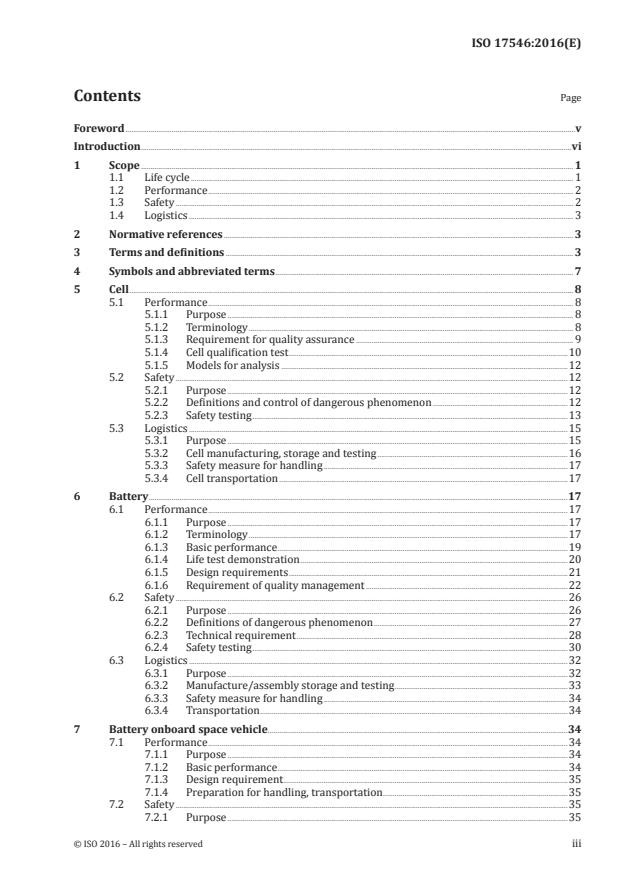
Contents Page
Foreword .v
Introduction .vi
1 Scope . 1
1.1 Life cycle . 1
1.2 Performance . 2
1.3 Safety . 2
1.4 Logistics . 3
2 Normative references . 3
3 Terms and definitions . 3
4 Symbols and abbreviated terms . 7
5 Cell . 8
5.1 Performance . 8
5.1.1 Purpose . 8
5.1.2 Terminology . 8
5.1.3 Requirement for quality assurance . 9
5.1.4 Cell qualification test .10
5.1.5 Models for analysis .12
5.2 Safety .12
5.2.1 Purpose .12
5.2.2 Definitions and control of dangerous phenomenon .12
5.2.3 Safety testing .13
5.3 Logistics .15
5.3.1 Purpose .15
5.3.2 Cell manufacturing, storage and testing .16
5.3.3 Safety measure for handling .17
5.3.4 Cell transportation .17
6 Battery .17
6.1 Performance .17
6.1.1 Purpose .17
6.1.2 Terminology .17
6.1.3 Basic performance .19
6.1.4 Life test demonstration .20
6.1.5 Design requirements .21
6.1.6 Requirement of quality management .22
6.2 Safety .26
6.2.1 Purpose .26
6.2.2 Definitions of dangerous phenomenon .27
6.2.3 Technical requirement .28
6.2.4 Safety testing .30
6.3 Logistics .32
6.3.1 Purpose .32
6.3.2 Manufacture/assembly storage and testing .33
6.3.3 Safety measure for handling .34
6.3.4 Transportation .34
7 Battery onboard space vehicle .34
7.1 Performance .34
7.1.1 Purpose .34
7.1.2 Basic performance .34
7.1.3 Design requirement . . .35
7.1.4 Preparation for handling, transportation .35
7.2 Safety .35
7.2.1 Purpose .35
7.2.2 Definitions of dangerous phenomenon .36
7.2.3 Technical requirement .36
7.3 Logistics .36
7.3.1 Purpose .36
7.3.2 Safety measure for handling .36
7.3.3 Integration to the space vehicle .36
7.3.4 Battery maintenance on the space vehicle .37
7.3.5 Battery transportation equipped in space vehicle .37
8 Launch site .37
8.1 Performance .38
8.1.1 Purpose .38
8.1.2 Degradation calculation in launch site .38
8.2 Safety .38
8.2.1 Purpose .38
8.2.2 Definitions of dangerous phenomenon .38
8.3 Logistics .39
8.3.1 Purpose .39
8.3.2 Safety measure for handling .39
8.3.3 Preparation for transportation .39
8.3.4 Battery testing (health checking after transportation) .39
8.3.5 Battery storage at launch site .40
8.3.6 Integration to the space vehicle .41
8.3.7 Battery monitoring preceding launch .41
9 Mission in orbit and end of life .41
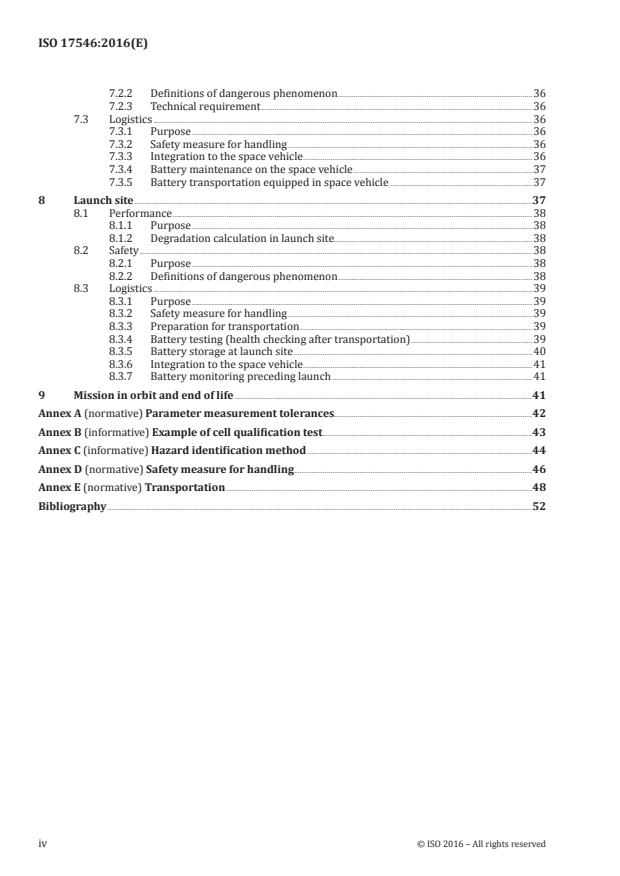
Annex A (normative) Parameter measurement tolerances.42
Annex B (informative) Example of cell qualification test .43
Annex C (informative) Hazard identification method .44
Annex D (normative) Safety measure for handling .46
Annex E (normative) Transportation .48
Bibliography .52
iv © ISO 2016 – All rights reserved
Foreword
ISO (the International Organization for Standardization) is a worldwide federation of national standards
bodies (ISO member bodies). The work of preparing International Standards is normally carried out
through ISO technical committees. Each member body interested in a subject for which a technical
committee has been established has the right to be represented on that committee. International
organizations, governmental and non-governmental, in liaison with ISO, also take part in the work.
ISO collaborates closely with the International Electrotechnical Commission (IEC) on all matters of
electrotechnical standardization.
The procedures used to develop this document and those intended for its further maintenance are
described in the ISO/IEC Directives, Part 1. In particular the different approval criteria needed for the
different types of ISO documents should be noted. This document was drafted in accordance with the
editorial rules of the ISO/IEC Directives, Part 2 (see www.iso.org/directives).
Attention is drawn to the possibility that some of the elements of this document may be the subject of
patent rights. ISO shall not be held responsible for identifying any or all such patent rights. Details of
any patent rights identified during the development of the document will be in the Introduction and/or
on the ISO list of patent declarations received (see www.iso.org/patents).
Any trade name used in this document is information given for the convenience of users and does not
constitute an endorsement.
For an explanation on the meaning of ISO specific terms and expressions related to conformity
assessment, as well as information about ISO’s adherence to the WTO principles in the Technical
Barriers to Trade (TBT) see the following URL: Foreword - Supplementary information
The committee responsible for this document is ISO/TC 20, Aircraft and space vehicles, Subcommittee
SC 14, Space systems and operations.
Introduction
This International Standard has been developed for the purpose of addressing the standard to obtain
sustainable development and to prevent incident of lithium ion battery for space vehicle.
For battery developer and spacecraft system architects, this International Standard leads the way to
assess the whole life cycle “from electrolyte filling to the end of the mission in space” and to clarify
what is considered in the battery design phase and the processes to reach the appropriate verification.
It is important for lithium ion battery (LIB) for space vehicle to prevent performance defect in orbit and
incident through the life cycle.
The three objectives in the life cycle, which are “performance”, “safety”, and comfortable “logistics”, aim
to realize more reliable, more safe, and high efficient means at the same time for development of space
vehicle batteries.
We address each objective as follows.
Performance
“How to estimate the life degradation at end of life”
Since LIB starts to degrade from activation, the consideration to meet the power requirement through
the mission life is needed, that is, unaffected from handling conditions (temperature) and usage
conditions in orbit (temperature, cycle, current or power and depth of discharge). Also, the risk in orbit
could be mitigated based on the life estimation and unexpected degradation could be carefully avoided
throughout the whole life cycle.
Safety
Here, we establish a complex risk assessment process that is easy to understand. The method was
agreed internationally at ISO/IEC and is a traditional method for space use.
LIB needs to keep some amount of the SOC to avoid significant capacity degradation, so that the specific
consideration and care for handling are required because of potential hazard source.
It is well known that LIB has specific risks with higher voltage when compared to other power sources
and no saturation characteristic for overcharge.
The important thing is that the process, which can result to a hazardous situation, does not always
immediately result to an incident. Because of these risks, LIB is considered hazardous at all times. The
risk assessment needs to become very important to cover a variety of environment during the handling
or use and history of stress.
Logistics
“How to bring the demand close to the general requirements to guarantee the safety and space quality”
From a wide-ranging point of view, the most important thing is to conduct life cycle assessment against
performance and safety. For example, temperature history (especially high temperature history when
cell is kept outdoors, where temperature is not controlled) and shocks/vibrations that cell receives
during transport and electrical short when handling. Also, to reflect the results of handling or usage,
measurement is needed.
All the personnel who owed responsibility of development, design, and handling are desired to survey
and estimate the influence of their assessment spontaneously to improve for sustainable development
of space component. As a result, a third party can evaluate the validity of the design and verification.
vi © ISO 2016 – All rights reserved
INTERNATIONAL STANDARD ISO 17546:2016(E)
Space systems — Lithium ion battery for space vehicles —
Design and verification requirements
1 Scope
This International Standard specifies design and minimum verification requirements for lithium ion
rechargeable (including lithium ion polymer) batteries for space vehicles.
Lithium ion secondary electrochemical systems use intercalation compounds (intercalated lithium
exists in an ionic or quasi-atomic form within the lattice of the electrode material) in the positive and in
the negative electrodes.
The focus of this International Standard is on “battery assembly” and cell is described as “component
cells” to be harmonized with other industrial standards and regulations.
“Performance”,” safety”, and “logistics” are the main points of view to specify.
This International Standard does not address “disposal” or “recycle”; however, some recommendations
regarding disposal are suggested.
1.1 Life cycle
The service life of a battery starts at cell activation and continues through all subsequent
fabrication, acceptance testing, handling, storage, transportation, testing preceding launch, launch
and mission operation.
The scope of this International Standard addresses the shelf life, from cell activation to launch, although
the life design and evaluations of the battery on the ground need to accommodate to the whole mission
life in space.
Each article in this International Standard addresses “performance”, “safety”, and “logistics”, according
to the each stage of lifecycle.
NOTE Stages 3 and 5 include storage period which induce some performances verifications.
Table 1 — Life cycle of lithium ion battery for space vehicle
Total lifecycle of lithium ion battery for space vehicle
Service life of lithium ion battery for space vehicle
Activation Shelf life of lithium ion battery for space vehicle
Stage 0 Stage 1 Stage 2 Stage 3 Stage 4 Stage 5 Stage 6 Stage 7 Stage 8 Stage 9
Material Cell Cell Battery Battery Space vehicle Space vehicle Launch site End of life
Mission
Manufacture/ Manufacture/ Trans- Manufacture/ Trans- Integration/ transportation ~Launch ~Deorbit
in
Inspection Testing porta- Testing porta- Testing equipped battery orbit
tion tion
1.2 Performance
Evaluation items and methods of application for battery used for space vehicle is explained. The focus
of the applicability is on the performance characteristics at the end of life (EOL).
The scope of the performance addresses terminology for the basic performance, typical usage (charge
and discharge profile), quality assurance, testing method.
1.3 Safety
This International Standard follows the principle of ISO/IEC Guide 51.
Classify the hazards while normal usage through the lifecycle and provide rationale for the dangerous
phenomenon, such as fire, burst/explosion, leakage of cell electrolyte, venting, burns from excessively
high external temperatures, rupture of battery case with exposure of internal components, and smokes.
Typical risk analysis, hazard analysis and fault tree analysis (FTA) through the battery life cycle is
suggested in this International Standard. Hazard control method is distributed and tailored into each
stage of life cycle, to harmonize with other industrial standards.
The safety test involves the items of “United Nations UN Manual of Tests and Criteria, Part III, sub-
section 38.3, (UN38.3)” or UL1642. Necessary minimum safety precaution is described as Lithium Ion
Battery for Space Vehicle.
Technical requirements are intended to reduce the risk of fire or explosion when lithium batteries are
used in space vehicle. The final acceptability of these batteries is dependent on their use in a space
vehicle that complies with the requirements applicable for range safety or payload safety.
These requirements are also intended to reduce the risk of injury to persons due to fire or explosion
[11]
when prior to the launch site, transportation, battery testing and manufacturing.
2 © ISO 2016 – All rights reserved
1.4 Logistics
In this International Standard, “logistics” means not only physical distribution or transportation but
also descriptions on how to handle and care for and configuration (status or conditions of hardware
and desirable environment) by each stage of lifecycle.
Descriptions of logistics contain the precautions for “manufacture”, “assembling”, “handling”, “testing”,
“storage”, “packing” and “transportation”.
The scope of the logistics addresses the miscellaneous important precaution and rationale to maintain
the performance and safety as a space vehicle battery, to harmonize with other industrial standards
and regulations. Although, each item of relevant compliances is referred to the original document
because each document or regulation is revised independently.
2 Normative references
The following documents, in whole or in part, are normatively referenced in this document and are
indispensable for its application. For dated references, only the edition cited applies. For undated
references, the latest edition of the referenced document (including any amendments) applies.
ISO 24113, Space systems — Space debris mitigation requirements
IEC 61960, Secondary cells and batteries containing alkaline or other non-acid electrolytes — Secondary
lithium cells and batteries for portable applications
3 Terms and definitions
For the purposes of this document, the following terms and definitions apply.
3.1
accelerated test
test designed to shorten the controlled environmental test time with respect to the service use
time by increasing the frequency of occurrence, amplitude, duration, or any combination of these of
[7]
environmental stresses during service use
3.2
activation
process of making an assembled cell functional, by introducing an electrolyte at the manufacturing
[1][2][3][8]
facility during cell production, which is used to define the start of battery shelf life
3.3
aging
[3]
permanent loss of capacity due to repeated cycling or passage of time from activation
3.4
battery
two or more cells which are electrically connected together, fitted with devices necessary for use, for
example, case, terminals, marking and protective devices
[6]
Note 1 to entry: A single cell battery is considered a “cell”.
Note 2 to entry: A battery may also include some or more attachments, such as electrical bypass devices, charge
[1][2]
control electronics, heaters, temperature sensors, thermal switches, and thermal control elements.
Note 3 to entry: Units that are commonly referred to as “battery packs”, “modules”, or “battery assemblies”
having the primary function of providing a source of power to another piece of equipment are, for the purposes of
[6]
this International Standard, treated as batteries.
3.5
calendar loss
degradation of electrical performances due to passage of time after activation
3.6
cell
single encased electrochemical unit (one positive and one negative electrode) which exhibits a voltage
[6]
differential across its two terminals
3.7
dangerous phenomenon
fire, burst/explosion, leakage of cell electrolyte, venting, burns from excessively high external
temperatures, rupture of battery case with exposure of internal components, and smokes
3.8
disassembly
vent or rupture where solid matter from any part of a cell or battery penetrates a wire mesh
screen (annealed aluminum wire with a diameter of 0,25 mm and grid density of 6 wires per cm to
[6]
7 wires per cm) placed 25 cm away from the cell or battery
3.9
effluent
[6]
liquid or gas released when a cell vents or leaks
3.10
explosion
condition that occurs when a cell container or battery case violently opens and major components are
[9][11]
forcibly expelled and the cell or battery casing is torn or split
3.11
external short circuit
direct connection between positive and negative terminals of a cell or battery that provides less than
[6]
0,1 ohm resistance path for current flow
Note 1 to entry: An external short circuit occurs when a direct connection between the positive and negative
terminals is made where the connection resistance is sufficiently low enough to higher than rated current flow
through the cell.
3.12
fading
degradation of electrical performances due to cycling
Note 1 to entry: It is evaluated through life test and wear out test.
3.13
fire
[6][9]
flames are emitted from the test cell or battery
3.14
gassing
[3]
evolution of gas from one or more of the electrodes in a cell
3.15
harm
physical injury or damage to the health of people or damage to property or the environment
3.16
hazard
potential source of harm
Note 1 to entry: The term hazard is qualified in order to define its origin or the nature of the expected harm (for
example, electric shock hazard, crushing hazard, cutting hazard, toxic hazard, fire hazard, drowning hazard).
4 © ISO 2016 – All rights reserved
3.17
hermetic seal
[7]
permanent air-tight seal
3.18
intercalation
process where lithium ions are reversibly removed or inserted into a host material without causing
[8]
significant structural change to that host
3.19
intended use
use of a product, process or service in accordance with specifications, instructions and information
[9]
provided by the supplier
3.20
internal resistance
opposition to the flow of current within a cell or a battery, that is, sum of electronic resistance and ionic
resistance with the contribution to total effective resistance including inductive/capacitive properties
3.21
leakage
visible escape of electrolyte or other material from a cell or battery or the loss of material (except
battery casing, handling devices or labels) from a cell or battery such that the loss of mass exceeds the
values in Table 2
Note 1 to entry: Mass loss means a loss of mass that exceeds the values in Table 2.
Table 2 — Table of mass loss limit
Mass M of cell Mass loss limit
M < 1 g 0,5 %
l g ≤ M ≤ 75 g 0,2 %
M > 75 g 0,1 %
Note 2 to entry: In order to quantify the mass loss, the following procedure is provided:
(M1 - M2)
Mass loss (%) = × 100
M1
where
M1 is the mass before the test and M2 is the mass after the test.
[6]
When mass loss does not exceed the values in Table 2, it shall be considered as “no mass loss”.
3.22
life
duration of maintaining a required performance (e.g. 50 % of BOL capacity), estimated in years
[3]
(calendar life) or in the number of charge/discharge cycle
3.23
lithium ion battery
rechargeable electrochemical cell or battery in which the positive and negative electrodes are both
intercalation compounds (intercalated lithium exists in an ionic or quasi-atomic form with the lattice of
[6]
the electrode material) constructed with no metallic lithium in either electrode
3.24
load profile
illustration of the power needed from a battery to support a given system, which is usually expressed
[8]
by graphing required current versus time
3.25
lot
[2]
continuous, uninterrupted production run with no change in processes or drawings
3.26
open circuit voltage
difference in electrical potential voltage between the terminals of a cell or battery measured when the
[3][6]
circuit is open (no-load condition) and no external current is flowing
3.27
overcharge
charge past the manufacturer’s recommended limit of voltage
3.28
over discharge
to discharge a cell or battery past the point determined by cell supplier where the full capacity has
been obtained
Note 1 to entry: Continuous discharging of a cell or battery below zero volts causing voltage reversal is defined
[3]
as forced discharge.
3.29
probability of occurrence
[7]
theoretical distribution that measures of how likely it is that some event shall occur
3.30
protective devices
devices such as fuses, by-pass, diodes and current limiters which interrupt the current flow, block the
[6]
current flow in one direction or limit the current flow in an electrical circuit
3.31
reasonable foreseeable misuse
use of a product, process or service in the way which is not intended by the supplier but which results
[9]
from readily predictable human behaviour
3.32
rupture
mechanical failure of a cell container or battery case induced by an internal or external cause, resulting
[6]
in exposure or spillage but not ejection of solid materials
3.33
self-discharge
phenomenon due to leakage current in open circuit at cell and/or battery level
3.34
shelf life limit
maximum allowed time from cell activation to launch, which includes any time in storage, whatever the
[1][2]
temperature storage conditions
3.35
space quality
high reliability required for vehicles and equipments built for space use
6 © ISO 2016 – All rights reserved
3.36
tailoring
process of choosing design characteristics/tolerances and test environments, methods, procedures,
sequences and conditions, and altering critical design and test values, conditions of failure, etc., to take
into account the effects of the particular environmental forcing functions to which material normally is
[7]
subjected during its life cycle
3.37
thermal runaway
uncontrollable condition whereby a cell or battery shall overheat and reach very high temperatures in
very short periods (seconds) through internal heat generation caused due to an internal short or due to
[3]
an abusive condition
3.38
vent
release of excessive internal pressure from a cell or battery in a manner intended by design to preclude
[6][8][9]
rupture or disassembly
4 Symbols and abbreviated terms
BOL beginning of life
C capacity, expressed in ampere hours (Ah)
CC/CV constant current/constant voltage
CID current interrupt device
[3]
DOD depth of discharge
[4]
EOCV end of charge voltage
[4]
EODV end of discharge voltage
[4]
EOL end of life
[4]
FMEA failure modes, effective analysis
FTA fault tree analysis
GEO geosynchronous earth orbit
[3]
GTO geosynchronous transfer orbit
GSE ground support equipment
IPA iso propylic alcohol
LAT lot acceptance test
LEO low earth orbit
LIB lithium ion battery
[8]
MSDS material safety data sheet
[3]
OCV open circuit voltage
PTC positive temperature coefficient
[4]
QA quality assurance
SOC state of charge
UN38.3 United Nations UN Manual of Tests and Criteria, Part III, 38.3
5 Cell
5.1 Performance
5.1.1 Purpose
This subclause describes the electro-chemical performance as a single cell in harmony with other
standards.
Each article specifies the items that shall be necessary to verify when specific cells are to be assembled
into the battery for space vehicle.
The cell contained in a battery shall be described as a component cell and a cell whose contents are
enclosed within a sealed flexible pouch rather than a rigid casing is expressed as “pouch cell”.
The definitions of the size of cell, such as a small or large format, shall be tailored from UN38.3 and
IEC 62281.
Recommended cell qualification test items are specified and the requirement for quality assurance of
flight cells shall be addressed.
5.1.2 Terminology
For the purposes of understanding requirement of cell performance, the following terms and
definitions apply.
Cell operating region
The conditions during charging and discharging in which the cell operates within its voltage and current
and temperature range as specified by the cell manufacturer. See Figure 1 for a graphic representation
[11]
of the cell operating region.
8 © ISO 2016 – All rights reserved
Figure 1 — Diagram representing an example of a cell operating region (e.g. from the Battery
Association of Japan)
Maximum charging current for safety aspect
The maximum charging current in the cell operating region, which is specified by the cell manufacturer
[11]
for the safety reason.
Charging current limits for performances
The charging current limits in the cell operating region, which is specified by the cell manufacturer for
the performances reason, shall not exceed the maximum charging current.
5.1.3 Requirement for quality assurance
Cells shall be manufactured under a quality management programme specified in United Nation
Recommendation (see Annex E).
Acceptance tests shall be performed on cell level before the cells are installed in the battery-powered
flight hardware.
Acceptance testing for Li-ion cells shall include as a minimum: a) visual inspection; b) leak check; c)
dimensions and weight measurement; d) open circuit voltage; e) self-discharge, capacity or energy
tests; e) internal resistance. Some environmental and safety device testing such as vibration, extreme
thermal cycling, CID/PTC testing, etc. include acceptance test. In each testing, criteria shall be specified
by the battery manufacturer.
[1]
Test data trending
Key cell performance parameters, such as charge retention, capacity or energy, voltage under maximum
load, and resistance, shall be monitored across successive manufacturing lots (trend analysis) to
identify possible performance degradation due to unanticipated material or manufacturing variation
during acceptance testing.
Additional tests are carried out as for example: a) closed circuit voltage checks; b) cycle testing,
vibration; c) thermal cycling, d) X-ray; e) impedance; f) LAT; g) electrical wear-out cycling.
Off-gassing/out-gassing tests shall be required for materials compatibility. Any cell displaying any
evidence of electrolyte leakage fails these tests.
Users shall verify that all cells intended for flight use are within the designated shelf life based on the
cell manufacture date as specified in the Limited Life Items data.
The overall accuracies of controlled or measured values are commonly specified in Annex A.
5.1.4 Cell qualification test
Standard cell qualification test includes functional checkout (operational, cycle), environmental
(i.e. vibration, thermal, thermal vacuum, radiation) and safety as stated in 5.2.1 or others as deemed
[2][12][13]
appropriate for the specific hardware and application.
Recommended test items of the component cell qualification for the space vehicle are specified.
Examples are attached in Annex B.
For the space use, critical items for evaluations are hermetic test, safety testing, mechanical environment
test, radiation, life cycling data and thermal/thermal vacuum test. The typical test method and criteria
are specified, but not limited to, as follows or described rational for evaluation.
Leakage (hermetic) test
Each cell shall be tested for leakage in cell/battery acceptance test
−6 3
Criteria: The maximum helium gas leakage equivalent rate shall not exceed 1,0 × 10 Pa·m /s.
Safety Tests
Each cell shall be subjected to over-charge, over-discharge, and over-current (short circuit testing) to
ensure the cell does not result in a scenario where flame or fire exists.
[2]
Thermal/thermal vacuum test
Cells shall be tested in an environment that encompasses the intended application as possible. Thermal
environment, in particular, is a factor that significantly affects how a battery shall perform. Qualification
temperature ranges shall encompass the mission temperature ranges and shall have a range sufficient
to stress the hermeticity of the cell. The cells shall also experience a vacuum environment to determine
the integrity of the cell hermetic seal.
Mechanical environmental test
Mechanical environment tests including sine and random vibrations and shock tests values shall
encompass all possible space mission profile.
Examples of mechanical environment level for cells are described as follows.
Table 3 — Sine vibration
Qualification
Amplitude/
Axis Frequency/Hz
Acceleration
5–22 20 mm (double)
All axis
22–100 20 (9,8 m/s )
10 © ISO 2016 – All rights reserved
Sweep rate: 2 octave/min.
Table 4 — Random vibration
Axis Frequency/Hz Level
20–50 +6 dB/oct
2 2
50–300 0,2 (9,8 m/s ) /Hz
Along the length of the cell 300–450 +12 dB/oct
2 2
Cell Z axis 450–700 1,0 (9,8 m/s ) /Hz
700–1 000 −19,43 dB/oct
1 000–2 000 −3 dB/oct
Overall 23,68 (9,8 m/s ) rms
20–50 +6 dB/oct
2 2
50–100 0,1 (9,8 m/s ) /Hz
100–150 +17,1 dB/oct
In the plane of the cell
2 2
150–250 1,0 (9,8 m/s ) /Hz
Cross section
250–284 −12 dB/oct
Cell X and Y axes for rectangular shape
2 2
284–500 0,6 (9,8 m/s ) /Hz
Cell R axis for cylindrical shape
500–783 −12 dB/oct
2 2
783–1 000 0,1 (9,8 m/s ) /Hz
1 000–2 000 −3 dB/oct
Overall 21,19 (9,8 m/s ) rms
Duration time: 180 s per each axis.
Table 5 — Shock
Axis Frequency/Hz Acceleration (x9,8 m/s )
200 24
All axis 1 400 4,200
4 000 4,200
Three times per axis.
Radiation test
Cells shall be exposed to the cumulative radiation dose, as a minimum, as specified for the mission
environment.
Life cycle test
Life tests shall be performed for lot performance verification and for mission lifetime demonstration.
The life test for lot performance evaluation purpose shall be also included in a lot trend analysis. The
supplier shall propose a representative wear out life test using accelerated conditions for current and
cycle duration. The total energy (or capacity) degradation shall be checked after a defined number of
cycles. An example of test procedure is given hereafter.
a) For lot acceptance: DOD 100 %:
1) Temperature T (°C) (T /T ): defined by battery supplier typically at ambient
bat amb bat
temperature);
2) CC/CV; Charge current 0,5 C (A)/EOCV: V (V): defined by battery supplier;
ch
3) CC; Discharge current 0,5 C (A) to EODV: V (V): defined by battery supplier.
disch
Standard capacity measurements shall be performed before life test and every 100 cycles.
5.1.5 Models for analysis
The following information shall be clearly defined by battery supplier based on cell suppliers’ information
for the battery design evaluation, if available, and their information shall be provided to battery assembler.
Models shall be correlated with on-ground and on-orbit experimental data, where available.
a) Heat generation and thermal model
To evaluate worthiness of thermal design of the battery.
b) Structural model
To evaluate worthiness of structural design of strength and stiffness of the battery.
c) Life (aging) model
To eval
...
Questions, Comments and Discussion
Ask us and Technical Secretary will try to provide an answer. You can facilitate discussion about the standard in here.
Loading comments...